The older I get, the harder I find it to stay asleep through the whole night. Squawking birds, rumbling trucks, flushing toilets, the dog pacing downstairs- something’s always waking me up. So I find it hard to imagine Jesus sleeping on a rocking boat in the midst of a violent storm. Perhaps he was really tired. Or maybe we’re to understand Jesus’ peacefulness in the midst of chaos as a contrast to the panic of his disciples. They had freaked out. But they wouldn’t have done so, according to Jesus, if only they’d had faith.
Are there things in our life that we’re anxious about, but shouldn’t be? Things that lead us to say to the Lord: “How come you aren’t paying attention? Don’t you see how important this is? Aren’t you concerned about my well-being and happiness? Are you asleep?”
At times we’re all tempted to think that God doesn’t care. But God does care. It’s just that he doesn’t always see things we way we do. That’s why we need faith. With faith, we can purify our perspectives, priorities, and expectations. With faith, we remember that while God always gives us what we need, he doesn’t always give us what we want. With faith, we can be grateful for what we have instead of frustrated over what we don’t. With faith, we can be happy in the present instead of thinking that we’ll only be happy in a future that may never come. With faith, we understand that everything happens for a reason. With faith, we’re assured that God is always with us, surrounding us with love, giving us the grace to do what he wants us to do. With faith, we’ll know the peace that only Jesus can give.
Life can indeed be hard. But as he was with his disciples, Jesus is in the same boat with us. He invites us to faith, so he can replace our “violent storms,” with “great calm.”
One of the strong traditions of Scripture is of the great reversal that will one day come for many. I have often been sobered by it when I consider how blessed I have been in this life. I have also been consoled by it when I struggle to understand why some people in this world seem to suffer so much more that I do, or others do. Life seems a very uneven proposition if we only look at this side of the equation. Only God sees the whole picture but to some extent he has revealed that those who have suffered much in this life will be more than rewarded in the life to come and that there will be a great reversal.
The theme of the great reversal is most fully developed in the New Testament where the understanding of the life to come is also most developed.
Consider the following texts:
[Jesus said], “But many who are first will be last, and the last will be first.” (Matt 19:30 & also Matt 20:16 & also Mark 10:31)
[Mary said], “He has cast down the mighty from their thrones but lifted up the lowly. The hungry he has filled with good things; but the rich he has sent away empty.” (Lk 1:52-53)
Abraham replied [to the rich man], ‘My child, remember that you received what was good during your lifetime while Lazarus likewise received what was bad; but now he is comforted here, whereas you are tormented. (Luke 16:25)
Blessed are you who are now hungry, for you will be satisfied. Blessed are you who are now weeping, for you will laugh. Blessed are you when people hate you, and when they exclude and insult you, and denounce your name as evil on account of the Son of Man. Rejoice and leap for joy on that day! Behold, your reward will be great in heaven. For their ancestors treated the prophets in the same way. But woe to you who are rich, for you have received your consolation. But woe to you who are filled now, for you will be hungry. Woe to you who laugh now, for you will grieve and weep. Woe to you when all speak well of you, for their ancestors treated the false prophets in this way. (Luke 6:21-26)
Much will be required of the person entrusted with much, and still more will be demanded of the person entrusted with more. (Luke 12:48)
I consider that the sufferings of this present time are as nothing compared with the glory to be revealed for us. (Rom 8:18)
For this momentary light affliction is producing for us an eternal weight of glory beyond all comparison, as we look not to what is seen but to what is unseen; for what is seen is transitory, but what is unseen is eternal. (2 Cor 4:17-18)
There are other texts, and I am grateful if you will add to this list. But, for now, let these suffice. As I have said, I am both challenged and consoled by these texts.
I am consoled for I, like others, have suffered in this life and experienced set backs. In regards to this, the Lord promises that sufferings and set backs, if endured with faith, produce ultimate profit, not loss. Much of this profit may wait till heaven, but surely sufferings endured with faith are like treasure stored up in heaven. First the cross, but then the crown. Hallelujah.
I am also consoled on account of others. I, like you, know people who have suffered far more than seems fair. Loss after loss mounts up, grief after grief. My humanity recoils and I often cry to God on behalf of others who seem to suffer so much more than others. Lost health, lost jobs, lost home and family members. Why, O Lord?!
I think of my poor sister who was mentally ill and horribly afflicted by demons and voices who spoke to her, haunted her and robbed her increasingly of any touch with reality. Ultimately her life ended tragically when she died in a fire. She was surely among the last. But she loved God and wanted desperately to get well. The day after she died I offered Mass for her and I heard her speak to me in the depth of my heart and she said “I’m OK now, Charlie.” And somehow I knew that God was taking care of her, purifying and clearing her mind. And I also knew that she who was among the last but believed, I would one day see as among the first in the glory of heaven (pray God I get there). I suspect that she will be closest to the throne and that I, who have been among the first here in this world will have a “mansion” far less spacious than hers.
I am consoled for my sister’s sake and also for those who, unlike me, live in great poverty in other parts of the world. The bounty of American living is but a dream to them. Perhaps there is war. Perhaps there is famine or natural disaster. Perhaps they are victims of despotic and corrupt governments. They are less free, less blessed, in greater stress and often in desperate need. They are among the “last” in this world. But, if they have faith, they will be blessed to be among the first in the great reversal that is coming when the Kingdom fully breaks in. Faith IS essential. Jesus did not say all the last shall be first but that many who are last shall be first. I am sure that it is living faith that makes the difference.
But I am also challenged. I am among those who are first. What does this say for me in the great reversal that is coming upon this world? I have good health, I enjoy bountiful blessings. I am more blessed that I deserve. I live in the greatest, richest, and most powerful country in the world. My needs are largely provided for. I am here in my air-conditioned room with time enough to write and ponder things far beyond mere subsistence. I am surely among the first, the rich. Even the poorest in this country are blessed compared to many others in the world. Where shall I be when the first trumpet sounds, when the great reversal sets in?
Not everything is as it appears. We crave wealth, power and access and call it a blessing. We want to be first. But God warns it may well be a curse: Those who want to be rich are falling into temptation and into a trap and into many foolish and harmful desires, which plunge them into ruin and destruction. For the love of money is the root of all evils, and some people in their desire for it have strayed from the faith and have pierced themselves with many pains. (1 Tim 6:9-10). Knowing this and other texts like it, we still want to be rich, on top, first. We are very obtuse.
And so, I must say I am challenged. I am not defeated however or fatalistic. God has not utterly forsaken the “first.” He has left us a way and given us instruction on how to avoid the “curse” of our wealth and good fortune. Simply put, that we should use our status as “first” to bless others. That our many gifts would be placed at the service of the human family. A few texts come to mind:
[Jesus said], “I tell you, make friends for yourselves with deceitful wealth, so that when it fails, they [likely the poor whom we befriended] will welcome you into eternal dwellings.” (Luke 16:9)
Tell the rich in the present age not to be proud and not to rely on so uncertain a thing as wealth but rather on God, who richly provides us with all things for our enjoyment. Tell them to do good, to be rich in good works, to be generous, ready to share, thus accumulating as treasure a good foundation for the future, so as to win the life that is true life. (1 Tim 6:17-19)
And so it is that the Lord tells us who are “cursed” to be first to store up our true treasure in heaven (Matt 6:19). Of course we do not store up our treasure in heaven by putting it in a balloon or rocket. Rather we store it up by generously dispensing it to the poor. Perhaps by simple gift, or by providing jobs and economic opportunity for others. Perhaps by sharing our gifts of knowledge, or time or other talents. In so doing perhaps our curse of being among the first will be overcome and the challenge will be met.
The great reversal is coming! Where will I be when the first trumpet sounds?
This Chant of the funeral Mass refers to the great reversal but prays that the deceased will be found with Lazarus who once was poor. The text says: In paradisum deducant te Angeli; in tuo adventu suscipiant te martyres, et perducant te in civitatem sanctam Ierusalem. Chorus angelorum te suscipiat, et cum Lazaro quondam paupere æternam habeas requiem.(May the angels lead you to paradise and at your coming may the martyrs receive you and may they lead you into the Holy City Jerusalem. May a choir of Angels receive you and with Lazarus who once was poor, may you have eternal rest).
“How not to be a follower of Jesus” would be an appropriate title, I think, for the gospel we just heard. If you’ll recall, we were introduced to two characters. The first promised that he would follow Jesus wherever he would go. Yet Jesus replies to this boast with a warning. Unlike the foxes and birds, Jesus said, he had nowhere to lay his head. In other words, our Lord was telling this person that following him might be a bit more challenging than he imagined, and that he might wish to think twice before signing on the bottom line. In a sense, Jesus was asking: “Are you sure you want to follow me? Do you really know what you’re getting into?”
The second character we meet agrees to follow Jesus, but only after he has buried his father. Now we have to understand that this person’s father was not dead. His father was living, and he wanted to stay nearby. In effect, this person was saying: “I’d like to follow you, Jesus, but only when it’s more convenient. It’s just not the right time; I have other things I want to do first.” Jesus’ response that the dead should bury their own dead was his way of saying that following him is more important than anything else we might do.
The witness of these two individuals serves to remind us that if we truly want to be disciples of Christ, we need to be prepared to make significant changes in our life, and make them right away. In other words, authentic discipleship is not an afterthought or just a part time activity, but should instead be our top priority that absolutely defines who we are and what we do. We’re called to serve, not according to our own plan and out own timetable, but God’s. In the words of St. Alphonsus Liguori, “We must love God, then, in the way that pleases him, and not just in a way that suits ourselves.”
One of the consistent observations that God makes of our human family, and we, the individual members of it is that we are stiff-necked (cf Ex 32:9; 33:3; Deut 9:3; 10:16; 2 Chron 30:8; 2 Kings 17:14; Jer 7:26, and many, many other texts). That is to say we tend to be stubborn, prideful, and difficult to correct. And when reproved we easily become resentful and tend to harden our hearts.
One of the more humorous and true things God ever said to us (in love) is:I know that you are obstinate, and your neck is an iron sinew and your forehead brass (Is 48:4). This is another way of saying: I know that you are stubborn. Like iron, you are hardheaded. Like bronze, nothing gets through your thick skull. 🙂 Yes, we are difficult to be sure! God calls us sheep, but in some way we are more like cats, and our Shepherd Jesus, has the unenviable task of herding cats!
For many of us, this tendency to be stiff-necked is gradually softened by the power of grace, the medicine of the sacraments, instruction by God’s Word, and the humility that can come from these.
But for some, the stubbornness never abates. In fact it grows even stronger as a descent into pride, and an increasing hard-heartedness sets up. The deeper this descent, the more obnoxious the truth seems to them, and the less likely their conversion, as a they are not just resistant to the truth, but hostile to it. They harden their hearts and stiffen their necks and at some point, it would seem they reach the point of no return.
This is a very great mystery, which St. Paul termed the mystery of iniquity (2 Thess 2:7). The Greek word here translated “iniquity” is ἀνομία (anomia) which literally means, “without law,” and by extension, speaks of an attitude of living in lawlessness; and of having utter disregard for God’s law. While it is clear that our rebelliousness has its roots in Original Sin, there remains a mysterious aspect of why we are so easily rebellious and stiff-necked. The mystery deepens as we ponder why some are this way more than others, why some harden their hearts, while others find the path of humility more open to them.
But let us be clear, being stiff-necked, stubborn, impenitent, and ultimately hard-hearted is deadly. It is a path straight to destruction, to Hell, if it is not repented for those who have hardened their hearts to God cannot submit to him in order to be saved.
Let’s consider a short text from Proverbs to illustrate the grave and mysterious problem of “anomia,” of being lawless, of being stubbornly impenitent and persisting in disregard and even contempt of God’s Law:
He who is often reproved, yet stiffens his neck, will suddenly be broken beyond healing. (Prov 29:1)
Consider this text in three stages (with acknowledgment to Rev. Adrian Rogers who preached a sermon on this I’ve never forgotten. The alliterated structure here is his, the content is mine):
1. Spiritual Direction– Note how the text describes us as being often reproved. God sends us endless messages always urging us to repentance, to, to turn toward Him, to call on Him, to learn obedience, and to rejoice in the salvation he offers. He whispers, he urges, and he calls. No one who ever went to Hell, went there without being “often reproved.” The Hebrew word is תּוֹכֵחָה (towkechah) means chastisement, correction, refutation, proof, argument, reasoning, rebuke, or reproof. Well, you get the idea, God is pleading with us to come to him, to accept his Kingdom and the Kingdom values that underlie it. He does this in many ways. He sends to us his:
Spirit – The Holy Spirit of God pleads with our spirit. The voice of God is echoing in our conscience. Scripture says, And your ears shall hear a word behind you, saying, “This is the way, walk in it,” when you turn to the right or when you turn to the left (Isaiah 30:21). Another text says, This is what the LORD says–your Redeemer, the Holy One of Israel: “I am the LORD your God, who teaches you what is best for you, who directs you in the way you should go (Isaiah 48:17). So the Holy Spirit of God directs us.
Servants – God sends his servants, the prophets, he sends his priests, deacons, bishops, indeed, he sends many holy men and women to each of us, to testify to the truth and summon us to holiness and truth. Even in a sinful world, there are many around us who live lives of exceptional holiness and by their testimony summon to God and offer us direction and reproof, where necessary. Scripture says, The Lord gave the Word, and great was the company of the preachers and those who announced it (Ps 68:11)
Situations – In many an varied ways God directs us through the situations of our life. Since we are stubborn, it often takes great difficulties and challenges to get to us. But where necessary God will allow these to draw us to humility and dependance. Scripture says, Before I was afflicted I went astray, but now I obey your word (Ps 119:67)
Scripture – God directs us through his Word and through the Teachings of the Church. Scripture says, All Scripture is breathed out by God and profitable for teaching, for reproof, for correction, and for training in righteousness (2 Tim 3:16). And again, I am writing you these instructions so that, if I am delayed, you will know how people ought to conduct themselves in God’s household, which is the church of the living God, the pillar and foundation of the truth (1 Tim 3:15)
Yes, it is clear that God gives us spiritual direction in many ways. We must be clear, God is pleading with sinners. There is no one on this planet according to this scripture (Prov 29:1) who is not often reproved.
2. Stubborn Disobedience – The text goes on to say that, despite this, some “stiffen their necks.” as we have noted this is caught up in the mystery of iniquity. Why some stiffen their necks all the more and others heed, is mysterious. The usual reasons and manifestations of these are:
Procrastination – some become hardened merely through endless delay. Scripture says, Do not boast about tomorrow, for you do not know what a day may bring forth (Prov 27:1). And yet many say, siempre manana (always, tomorrow). Yet the more we delay our conversion the less likely it becomes. The further down a road we travel, the more invested in it we become, and the way back seems too large an undertaking. We become invested in the familiar. As we adjust to the darkness, the light begins to seem harsh. God is light and those accustomed to the darkness cannot endure him easily. The longer we wait, the deeper we sink. Deathbed conversions are possible, but not as frequent as one might think. Jesus said, This is the verdict: Light has come into the world, but men loved darkness instead of light because their deeds were evil (Jn 3:19). Yes, the light is detestable to a world in darkness.
Pride – Pride is the sinful refusal to recognize anyone or anything greater than us, to whom, or to which we owe reverence and obedience. Modern man has not only abandoned God, but even natural law. In Original Sin Adam said, “I will do what I want to do and I will decide if it is right or wrong.” Thus he refused submission to God. Modern Man extends this concept beyond God’s law, even to reality itself. In this attitude, there is no reality outside himself to which he must conform himself or to which he woes any allegiance. In abandoning natural law, modern man increasing says that reality is what he says it is. Reality no longer matters, all that matters is what I think or feel. In severing his relationship with God, and even with reality itself, the human person can turn in almost entirely on himself and be unreachable. He becomes hardened in his self-enclosed thinking and will only admit data and people who conform to his stinking thinking. As time goes by, almost nothing can break through this wall of pride. Scripture says, For although they knew God, they did not honor him as God or give thanks to him, but they became futile in their thinking, and their senseless minds were darkened. Claiming to be wise, they became fools….(Rom 1:22-23). They become hardened in their hearts and stubborn in their thinking.
Pleasures – Scripture is replete with warnings about the pernicious effects of wealth and worldly pleasure and how these things draw us away from God and cause us to stiffen our neck against God and following him. The world and its pleasures are considered preferable to God and those who go down this path become lovers of pleasure rather than lovers of God (2 Tim 3:4). This makes God and any limits he might set, or demands he might make, seem obnoxious and too costly. The rich and the lovers of this word have too much too loose. Thus they harden themselves against God whom they come to see as unreasonable. Jesus said, How hard it is for the rich to enter the kingdom of God! (Lk 18:24). Knowing this, most people, including Church going Christians, still want to be rich. Jesus’ teaching is “for someone else” who earns a $1 more an hour than I do. St Paul says, But those who desire to be rich fall into temptation, into a snare, into many senseless and harmful desires that plunge people into ruin and destruction. For the love of money is a root of all kinds of evils. It is through this craving that some have wandered away from the faith and pierced themselves with many pangs (1 Tim 6:9-10). Thus the pernicious effect of wealth and pleasures of this world cause many to stiffen their necks against God who they increasingly come to see as a thief.
And so it is that some, even though often reproved stiffen their necks and harden their hearts against God.
3. Sudden Destruction – There comes a point when this hardening, this stiffening of the neck become permanent, beyond repair. Here too is a deep mystery. For in this life, conversion seems always possible. Yet God teaches, there comes a point when this is no longer the case, when our hardness of heart will be forever fixed and beyond remedy, our destruction complete. When exactly this happens may not always be clear. It could be death itself, or perhaps it happens for some, long before death. But the Lord is teaching us a very hard truth that, if we are not careful, our “No” will become permanent, our hardness of heart complete.
And the LORD said, My Spirit shall not always strive with a man (Gen 6:3), as if to say “There comes a day when I will accept that your “no” is final.” For now the Lord “often reproves us” but there comes a day when that will end for some, for they have stiffened their necks and hardened their hearts.
While we may think this time to be way down the road, the Lord warns us it may come suddenly, that is, more quickly than we think. For the descent into deep sin and toward a hard heart is steeper and faster than most imagine or admit. So God says, “suddenly.”
Please understand this post for what it intends to be. It is not a post of despair, or severity, but of sobriety. God is a Good God, and a divine Physician. But a good doctor does not lie to his patients, and make light of things that are deadly and harmful. He warns of heart disease not because he is cruel or judgmental, but because he loves his patients and wants them to be well and saved from sudden loss of health. It is more so with God who loves us and want to save us, but who also respects our freedom and warns us of the cumulative effects of our sin. If today you hear his voice, harden not your hearts! (Psalm 95; Heb 3:15)
I grew up in a Navy family, which meant that when I was a kid, my dad was often away from home while his ship was on a cruise. Fortunately, dad spent only one Christmas out at sea- the Christmas of ’73. I remember my mom and the other ship’s wives putting together a huge care package of cookies and other goodies they hoped could be delivered to the ship by Christmas. It wasn’t a guarantee that it could happen. But I remember how happy everyone was to learn that, in spite of rough seas, a helicopter delivered the crate on Christmas day itself.
Receiving that care package meant a lot to my dad and his shipmates. If you’ve ever been away from home- at summer camp, school, the military, Peace Corps, whatever- you know how wonderful it is to receive a care package. It’s a little bit of home we can enjoy while we’re away from home, sent by those who love us.
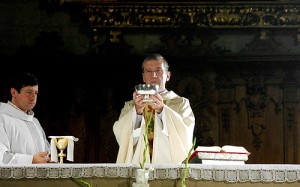
Today- Corpus Christi Sunday- or more properly, the Solemnity of the Body and Blood of Christ- is a day we celebrate God’s gift of the Eucharist: a gift we might think of as a care package from God. You and I are far from home, because Scripture tells us that our true home is in heaven. In the Eucharist, however, our loving God gives us a little taste of our heavenly homeland, so we can begin to experience what it will be like.
Consider what Jesus said in today’s gospel. He spoke of a “living bread come down from heaven.” This heavenly bread is the Eucharist; it’s bread from our true home. But this bread is more than just bread. Jesus explained that those who eat it will live forever. So not only does this bread come from heaven. It also allows us, even now, to begin to enjoy the eternal life promised us in heaven.
Of course, there’s a danger in equating the Eucharist with a care package. There’s a big difference between heavenly bread and homemade cookies. We don’t want to risk minimizing the importance of the Eucharist or misunderstanding what it is. So maybe we should consider another analogy.
Many of you know that I’m a runner. As a runner, I’ve learned that what I eat, and when I eat it, is critically important. To begin with, runners need carbs for fuel. You’ve probably heard of runners “carbo-loading” on pasta in the days leading up to a long race. In addition, it’s also important that runners eat during a long race- typically little energy gels or beans which pack carbs, electrolytes, and even caffeine. Also, it’s important to eat right after a race for muscle recovery- typically a bagel and a banana. In short, to run well, one needs to eat well- before, during, and after a race. Because if you don’t, you’ll slow down, conk out, or get hurt.
St. Paul tells us that our spiritual life is something like a race- an endurance run in which we need to persevere and keep our eyes on our heavenly goal. “Run in such a way as to get the prize,” Paul told the Corinthian church. In this race, just like in road running, we need to eat well in order to run well. And the food we need for this spiritual journey is the Eucharist.
But what sort of nourishment does the Eucharist give us for our journey? We already know that it gives us a taste of heaven. But it gives more than that. In today’s gospel, Jesus said: “I am the bread from heaven.” This bread is Jesus! Or more precisely, at Mass bread becomes Jesus. It doesn’t simply remind us of Jesus; nor is it merely symbolic of Jesus. It is Jesus: His “body, blood, soul, and divinity.”
During televised coverage of the Pope’s Mass at National Stadium a few years ago, one obviously non-Catholic commentator said: “This is when the bread is ‘transmorgified’ into Jesus.” Now, you can read the Catechism from cover to cover and not find anything about “transmorgification.” What you can read about, however, is “transubstantiation.” It’s a fancy Catholic word loaded with philosophy. At its heart, however, transubstantiation means that something becomes something else while continuing to look the same. In our case, bread becomes Jesus. It may still taste like bread. But what it nourishes us with is the very life of God. And it is life that we need, more than anything, as we continue our spiritual journey.
We ask for this whenever we pray the Our Father and say: “Give us this day our daily bread.” With these words, we aren’t just asking that God provide us with essential things like food, clothing, and shelter. The word we translate as “daily” is a rare Greek word found nowhere else in the Bible. It’s means “super-essential” or “more than essential.” And it refers to the bread-become-Jesus in the Eucharist.
It’s good that we think of the Eucharist as “daily bread” because we need the nourishment it gives us in our daily lives. We need Jesus. And there’s no better way to meet him, and receive him, than in the Eucharist. That’s why daily Mass has become an important part of Catholic spirituality. Every one of the 140 parish churches in the Archdiocese of Washington has a Mass celebrated every day. Some churches in business areas offer Mass at Noon, to accommodate the lunchtime crowd. And other churches have Masses in the late afternoon to catch folks coming home from work.
It’s not possible for most of us to attend Mass each day. But we can make it a Sunday priority, and try to come as often as we can, so we can enjoy God’s care package of love, and have the fuel we need to run our race until we finally arrive at our heavenly home.
This Sunday in many places features the (moved) Solemnity of the Most Holy Body and Blood of Christ, Our Lord.
While you may puzzle over my title, allow me to explain it later. On a Solemn feast like this many things occur that might be preached and taught. Allow three areas for reflection: The Reality of the Eucharist, The Requirement of the Eucharist, the Remembrance of the Eucharist. We will look at each in order.
I. The Reality of the Eucharist – On this solemn feast we are called above all to faith in the fact, as revealed by the Lord himself, that the Eucharist, the Holy Communion we partake of, is in fact, a reception of the very Body, Blood, Soul and Divinity of Jesus Christ, whole and entire, in his glorified state. We do not partake of a symbol, the Eucharist is not a metaphor, it is truly the Lord. Neither is it a “piece” of his flesh, but is Christ, whole and entire. Scripture attests to this in many places:
A. Luke 22:19-20And he took bread, and when he had given thanks he broke it and gave it to them, saying, “This is my body which is given for you. Do this in remembrance of me.” And likewise the cup after supper, saying, “This cup which is poured out for you is the new covenant in my blood.
B. 1 Cor 10:16 The cup of blessing which we bless, is it not a partaking in the blood of Christ? The bread which we break, is it not a partaking in the body of Christ?
C. Luke 24:35They recognized him in the breaking of the bread.
D. 1 Cor 11:29For anyone who eats and drinks without recognizing the body of the Lord eats and drinks judgment on himself.
E. John 6:51I am the living bread which came down from heaven; if any one eats of this bread, he will live for ever; and the bread which I shall give for the life of the world is my flesh.”
This last quote is from our Gospel for today’s feast. The passage is a profound theology of the Eucharist from Jesus himself and he makes it clear that we are not permitted to think of the Eucharist in symbolic or metaphor.
As he speaks the words, the bread is my flesh, the Jewish people hearing him grumbled in protest. Jesus did not seek to reassure them or insist that we was speaking only symbolically when he said they must eat his flesh. Rather he becomes even more adamant by shifting his vocabulary from the polite form of eating, φάγητε (phagete – meaning simply “to eat”) to the impolite form, τρώγων (trogon – meaning to “munch, gnaw or chew”).
So insistent was he that they grasp this that he permitted the fact that most left him that day and would no longer follow in his company due to this teaching (cf Jn 6:66). Yes the Lord paid quite a price for his graphic and “hard” teaching (Jn 6:60).
Today, he asks us, Do you also want to leave me? (Jn 6:67). We must supply our answer each time we approach the altar and hear the word, The Body of Christ. It is here that we answer the Lord, Amen as if to say, Lord, to whom shall we go, you have the word of eternal life! (Jn 6:68).
Would that people grasped that the Lord himself was truly present in our Churches! Were that so, one could never empty our parishes of those seeking to pray with the Lord. As it is, only 27% come to Mass regularly. This is more evidence of the narrow road and how few there are who find it. As Jesus experienced that most left him, so too many continue to leave him or stand far away, either through indifference or false notions.
What father would not be severely alarmed if one of his children stopped eating. Consider too God’s alarm that many of us have stopped eating. This leads us to the next point.
II. The Requirement of the Eucharist – When I was a kid I just thought of Church and Communion as something my mom made me do, it was just rituals and stuff. I never thought of it as essential for my survival. But Jesus teaches something very profound in John’s Gospel today when he was teaching about Holy Communion (the Eucharist). In effect he says that without Holy Communion we will starve and die spiritually.
Here is what Jesus says, Unless you eat the flesh of the Son of Man and drink his blood, you have no life in you. (John 6:53)
As a kid and even a young adult I never thought of Holy Communion as essential for my life, as something that, if I didn’t receive it regularly, I would die spiritually. But it makes sense doesn’t it? If we don’t eat food in our physical lives we grow weak and eventually die. It is the same with Holy Communion.
Remember in the Book of Exodus: the people were without food in the desert and they feared for their lives. So God gave them bread from heaven called “manna” that they collected each morning. Without eating that bread from heaven they would never have made it to the Promised Land, they would have died in the desert.
It is the same with us. Without receiving Jesus, our Living Manna from heaven in Holy Communion we will not make it to our Promised Land of Heaven! I guess it’s not just merely a ritual after all. It is essential for our survival.
Don’t miss Holy Communion! Jesus urges you to eat.
A mother and father in my parish recently noticed their daughter wasn’t eating. Within a very short time they took her to the doctor who discovered the problem and now the young girl is able to eat again. Those parents would have moved heaven and earth to make sure their daughter was able to eat.
It is the same with God. Jesus urges us to eat, to receive the Holy Communion every Sunday without fail. Jesus urges us with this word: “Unless!” Holy Communion is our required food.
III. The Remembrance of the Eucharist. The word remembrance comes up a lot in reference to Holy Communion and today’s readings. Consider the following
A. Remember how for forty years now the LORD, your God, has directed all your journeying in the desert…and then fed you with manna (Deut 8).
B. Do not forget the LORD, your God, who brought you out of the land of Egypt (Deut 8:24)
C. Do this in remembrance of me….(1 Cor 11:24 inter al).
What is remembrance and why is it important? In effect, to “remember” is to have present in your mind what God has done for you so that you’re grateful, to have it so present to you, so that you are different. God has saved us, made us his children, and opened heaven for us. Yet, our minds are very weak and we too easily let this slip from our conscious thoughts. Thus, the summons to an ἀνάμνησιν (anamnesin) or “remembrance” that is so common in the Eucharistic liturgy, is a summons to our minds to be open to, and powerfully aware of what the Lord has done for us, “Don’t just stand or kneel there, forgetting, let this be present to you as a living and conscious reality, that changes you!”
Are you a mouse or a man? So here comes the question. Back in seminary days we were all given the example of a mouse who runs across the altar and takes a consecrated host and runs off and eats it. And we were asked, “Does he eat the body of Christ?” Yes! For the Eucharist has a reality unto itself. “But does he receive a sacrament?” No! A mouse has no mind. It eats the very Body of Christ but to no avail for it has no conscious awareness or appreciation of of what (whom) it eats. And so here comes the question – Are you a mouse or a man?
How do you receive Holy Communion? Do you go up mindlessly, shuffling along in the Communion line in a mechanistic way? Or do you go up powerfully aware of He, whom you are bout to receive? Do you remember, do you have vividly present to your mind what the Lord has done for you? Are you grateful and amazed at what he has done and what he offers? Or are you just like a mouse having something mindlessly put into your mouth?
Some people put more faith in Tylenol than they do the Eucharist. Why? Because when they take Tylenol they actually expect something to happen, for the pain to go away, and for there to be relief and healing. But when it comes to Holy Communion, they expect next to nothing. To them, it’s just a ritual, time to go up and get the wafer, (pardon the expression).
Really?! Nothing? How can this be? Poor catechesis? Sure. Little faith? Sure. Boredom? Yes indeed. At some level it can be no better than a mouse eating a host. We are receiving the Lord of all creation, yet most expect little.
To this the Church says, “Remember!” “Have present to your mind all that the Lord has done for you and what he is about to do. Let this reality of the Lord’s presence be alive in your mind so that it changes you and makes you profoundly grateful and joyful. Become the One you receive!”
Jesus is more powerful than Tylenol and we are men (and women) not mice.
On this Solemnity of the Body of Christ we are summoned to deepen our faith in the Lord, present in the Eucharist, and acting through his Sacraments. Routine may have dulling effects, but it cannot be so that we receive the Lord of glory each Sunday in any way that would be called mindless.
Ask the Lord to anoint your mind so that you remember and never forget.
The video at the bottom of this page is a commentary on the Gospel of John by Fr. Francis Martin, an excellent and well known biblical scholar. He has given many priest retreats, and taught in many settings, most recently at the Dominican House of Studies here in Washington.
He has been a great teacher of mine though his retreats and tape ministry. He has also been instrumental in my spiritual life through his careful and clear articulation of a theology of transformation, and insistence that we, as Christians, come to know and live the normal Christian life, a life of on-going and total transformation by the grace of God. He is a humble and prayerful man of God, a holy priest.
Recently Fr. Martin has begun a YouTube ministry that I would like to recommend to your attention. The video at the bottom is but a sample of a growing series. I want to be brief here to encourage you to take the time and watch the video. Fr. Martin is here covering the cleansing of the Temple by Jesus, in John’s gospel. Among the points he makes are these
1. Going up to Jerusalem– You always go up to Jerusalem. It doesn’t matter where you live, south or north, even if you live in the highest mountains, you always go up to Jerusalem.
2. Temple Worship is over – The cleansing of the Temple marks a major turning point in the Lord’s life. One of the over arching themes of the Gospel of John is that Temple worship is over. Jesus is now the temple.
3. Time – we in the modern West like to control things by measuring them. Time for us (especially in America) is considered a precise measurement, and it’s a way we try to stay in control. But in ancient culture, (and in many cultures today), the idea of space and time were different, more poetic, less precise. “Tuesday morning at 10 AM” is precise for us, for the ancients, it was a more general framework. This helps explain why John places the cleansing of the Temple at the beginning of Jesus’ ministry, the Synoptics at the end. The time is less the point to them. We obsess over which is right, but they were less concerned with when and more with what.
4. What is the Theology of Geography?
5. Why were there money changers and the selling of animals?
6. What was the spiritual problem against which Jesus is reacting?
Please consider taking some time to view the video. It is very informative and spiritual. Fr. Martin’s style is relaxed and subtle. Listen carefully and let the Lord teach you through him.
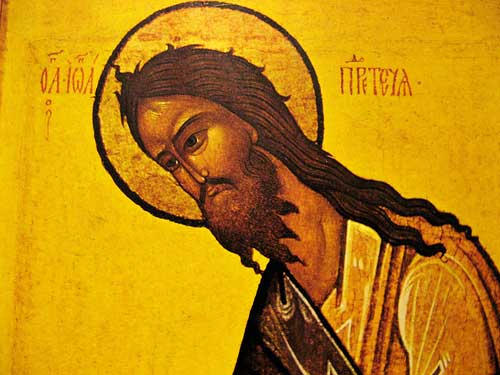
Today we celebrate the birthday of St. John the Baptist. We don’t decorate trees, send card, or exchange presents as we do on Christmas. But I don’t think that John the Baptist minds that his birthday is celebrated with less fanfare than that of our Lord. You’ll recall that he once said about Jesus: “He must increase, but I must decrease.”
In fact, it’s thanks to these words that we celebrate John the Baptist’s birthday today. Because from this point on, daily sunlight will decrease until we arrive at the birthday celebration of Jesus, when daily sunlight will begin to increase.
John the Baptist knew that his mission was to prepare the way for Jesus. He lived his life, not to promote himself, but to promote the Lord. In this, John the Baptist is an important witness for us and challenges our society’s preoccupation with self-promotion. He reminds us that Christians shouldn’t aspire to be a celebrity, but should strive to be a servant. We should live lives that shout not “Look at me!” but “Look to Jesus.”
This is not to say that John the Baptist was not important. He was incredibly important! That’s why each of the four gospels begins the story of Jesus’ public ministry, by first telling the story of John the Baptist.
You and I may be called to positions of importance: in the workplace, in society, in the church. But there’s a big difference between being important and self-important. John the Baptist bears witness to that.
So happy birthday, St. John. Like you, may we live our lives, not for ourselves, but for Jesus.

 The older I get, the harder I find it to stay asleep through the whole night. Squawking birds, rumbling trucks, flushing toilets, the dog pacing downstairs- something’s always waking me up. So I find it hard to imagine Jesus sleeping on a rocking boat in the midst of a violent storm. Perhaps he was really tired. Or maybe we’re to understand Jesus’ peacefulness in the midst of chaos as a contrast to the panic of his disciples. They had freaked out. But they wouldn’t have done so, according to Jesus, if only they’d had faith.