When I reflect on the witness of St. Mary Magdalene, one thing that always impresses me is the she “kept the faith”- even when “keeping the faith” was terribly hard; even when “keeping the faith” didn’t seem to make much sense.
While Jesus hung dying on the cross, and after most of Jesus’ friends had run away out of fear, she stayed and kept watch. We can only imagine the thoughts, feelings, and temptations that swirled around her that day: anger, confusion, terror, helplessness, loneliness, resentment.
It would have been very easy for her to have run away too. But she didn’t. She stayed; she “kept the faith.” Certainly out of courage; and maybe because she knew that at that moment, faith was the only thing she had left; faith was the one thing she really needed. Her reward? She saw the risen Jesus- something that those who had run away had to wait to experience.
The witness of St. Mary Magdalene can inspire us to “keep the faith”- when things seem their bleakest, when our friends aren’t there for us, when God himself seems to be distant or indifferent. Because as she learned, there is a light at the end of the tunnel, just like the first rays of the sun on Easter morning.
Years ago, in seminary, one of my brother-seminarians from North Dakota gave me an image of prayer. It occurs to me to tell this winter story in the midst of the heat wave that has most of the U.S. in its grip.
Imagine yourself in those years, some 25 years ago or before. Cell phones were not yet common.
Now imagine the deep winter months in rural North Dakota. The temperature can dip to 30 below and blizzards and snow-squalls can set in quickly. What if you are driving from one town to another and you car breaks down? Sometimes it is forty miles to the next town. If it’s 30 below with wind or blowing snow, walking even a short distance can kill you.
All you can do is wait for help to drive by. Remember there are no cell phones, this is rural North Dakota, and, especially in bad weather, help might not come for a long time. With a broken down car, no heat, and the temperature so cold, death could come soon.
How will you survive?
Candles.
My North Dakota friend told me that his mother often asked him in winter as he would leave in the car, “Do you have candles with you?!”
People in that region, in those years, and I suppose some today as well, used to carry a box of votive candles with them in the car, and some matches too. On frigid day, if the car broke down, or got stuck in the snow, lighting even one candle and cracking the window just slightly (for ventilation), could mean the difference between life and death.
Just one candle, maybe two, could warm the car enough to stave off death. And Catholic votive candles were the perfect choice.
What are votive candles if not a symbol of our prayer, our hope in God. They also are a burnt offering, and an memorare of our prayer burning before God.
And if one candle can save a life, how about one prayer?
In most cases the full power of prayer is hid from us here. But I suspect one of the joys of heaven will be that we will see what a remarkable difference our prayer really made, even our distracted and poorly executed prayers. Perhaps someone in heaven will come to us and say, “I am here because you prayed.” Perhaps we will see how our prayers helped avert war, turn back violence, save children from abortion, and convert hearts. We will know that our prayers helped open doors, brought blessings, and contained damage.
Just one prayer. Just one candle.
Do you have candles with you? Have you prayed? You never know, you might save a life in this cold world.
Here is a sermon I preached at the White House about five years ago on the power of prayer.
When little kids don’t want to hear something, they’ll stick their fingers in their ears and mutter “Blah, blah, blah” to drown out whatever is being said to them. We adults are more sophisticated in how we tune things out. But we do it, nevertheless.
We need to appreciate this in order to understand Jesus’ words in today’s gospel. On the surface, they sound like Jesus spoke in parables to confuse people on purpose, and that only an elite few would comprehend his teaching. And that’s partly right: Not everyone does comprehend Jesus’ teaching. But not because Jesus wants to confuse them. It’s because people just don’t want to hear.
If you recall, Jesus quoted the prophet Isaiah. And throughout history, the message of God’s prophets has been rejected time and time again. They spoke challenging words, calling on people to change their ways and turn their lives around. And folks generally don’t like to hear that sort of thing. So they tuned out.
People tune out Jesus’ message too, and we can be just as guilty as anyone else. Jesus calls us to believe in a God we cannot see, carry a cross and suffer with him, love our enemies, forgive those who hurt us, and be humble, selfless, servants. We hear these things and sometimes we want to stick our fingers in our ears and go “blah, blah, blah.”
But ignorance isn’t bliss, when it comes to the Word of God. As hard as they may be to hear, they’re the words of truth and life. “Blessed are your ears, because they hear,” said the Lord. Jesus invites us today to take our fingers from our ears, so we can “understand with our hearts,” “be converted” and be healed.
A few weeks ago when the Gospel from today’s Mass was proclaimed on Sunday, someone asked me a series of questions regarding the sower. We are told by Jesus that the sower is the Son of Man, Jesus himself. Hence, why would the Lord, who knows everything ahead of time, sow seed he knew would not bear fruit?
Let’s review the text:
“A sower went out to sow. And as he sowed, some seed fell on the path, and birds came and ate it up. Some fell on rocky ground, where it had little soil. It sprang up at once because the soil was not deep, and when the sun rose it was scorched, and it withered for lack of roots. Some seed fell among thorns, and the thorns grew up and choked it. But some seed fell on rich soil, and produced fruit, a hundred or sixty or thirtyfold. Whoever has ears ought to hear.” (Matt 13:1-9)
Now, a human sower can have little control over the destiny of the seeds he sows. But in this parable Jesus, who is God is the sower and he has the capacity to sow seeds only in perfect soil. Why then waste any seed on rocky or thin soil, or the path? This is the question I was asked.
Perhaps a series of possible “answers” is all we can venture. I place “answers” in quotes since we are in fact touching on some mysteries here of which we can only speculate. So, here are some “answers.”
1. God is extravagant – it is not just seed He scatters liberally, it is everything. There are hundreds of billions of stars in over 100 billion galaxies, most of these seemingly devoid of life as we understand it. Between these 100 billion galaxies are huge amounts of, what seems to be, empty space. On this planet where one species of bird would do, there are thousands of species, tens of thousands of different sorts of insects, a vast array of different sorts of trees, mammals, fish etc. Extravagant barely covers it. The word “extravagant” means “to go, or wander beyond.” And God has gone vastly beyond anything we can imagine. But God is love, and love is extravagant. The image of him sowing seeds, almost in a careless way is thus consistent with the usual way of God.
This of course is less an answer to the question before us than a deepening of the question. The answer, if there is one, is caught up in the mystery of love. Love does not say, what is the least I can do? It says “What more can I do.” If a man loves a woman, he does not look for the cheapest gift on her birthday, rather he looks for an extravagant gift. God is Love and God is extravagant.
2. Even if the failed seed represents those who ultimately reject him, God loves that seed anyway. Remember, as Jesus goes on to explain, the seeds that fail to bear fruit, are symbols of those who allow riches, worldly preoccupation, persecution and other things to draw them away from God. But, even knowing this, does not change God’s love for them. He still wills their existence. Scripture says elsewhere, But I tell you: Love your enemies and pray for those who persecute you, that you may be sons of your Father in heaven. He causes his sun to rise on the evil and the good, and sends rain on the righteous and the unrighteous (Matt 5:44-45).
Yes, God loves even those who will reject him and will not, knowing ahead of that rejection, say to them, “You cannot exist.” He thus scatters even that seed, knowing ahead of time that it will not bear fruit. Further, he continues to send the sun and rain, even on those who will reject him.
Hence this parable shows forth God’s unfailing love. He sows seeds, even knowing they will not bear the fruit he wants. He wills the existence of all, even those who he knows ahead of time will reject him.
3. That God sows seeds and allows them to fall on bad soil is indicative of our freedom. The various places the seed falls is indicative of human freedom, more than illustrative of the intent of God. For one may still question, “Why would God “allow” seed to fall on the path, or among thorns, or in rocky soil?” And the only answer here is that God has made us free. Were He to go back and place the seed in good soil, this would, by way of the analogy of the parable, veto our choice, and we could only bear good fruit. In other words, there could be no other outcome than to bear fruit. But this is not freedom, for there is no real choice. Thus, that God sows seeds and allows them to fall on bad soil is indicative of our freedom.
So, permit these “answers.” God sows seed he knows will bear no fruit because he is extravagant, because he loves and wills the existence even of those he knows will reject him, and because he respects our freedom.
As with all reckoning about the interaction of God’s sovereignty with our freedom, these “answers” limp a bit. There are mysteries here caught up in time, in providence, freedom and the sovereignty of God. These answers are thus submitted with humility and should be read with humility.
I interpret this video to mean that God will never withdraw his offer, not that he is trying to force a solution. For though he wants to save us, he respects our freedom to let go.
Let me say upfront that I am neutral on Duke Athletics. Generally, if you are a college sports fan, you either love Duke or hate Duke. This blog is not about Duke Athletics, it is about Duke’s very successful basketball coach, Mike Krzyzewski. Coach Krzyzewski wrote an interesting piece on motivation in the “Word Craft” Column in the Wall Street Journal.
The Power of Words
Coach K believes that his work is as much about “choosing words as it is about coaching strategies.” He sees his primary task as motivation and he writes that to motivate “you need to know your audience and tell vivid stories. It strikes me as I listen to the Sunday Gospels in the month of July that Coach K took a page write out of Jesus’ playbook. The Gospels are filled with vivid stories that Jesus tells in the form of parables for the purpose of motivating!
Treasures, pearls, leaven, salt, light, weeds, lost sheep, missing coins, nets bursting with fish—not all of these images may spark your imagination but I bet one or two of them get you thinking. Coach K writes “meaning is understood by seeing a word in action.” Jesus chooses parables to put a word of faith in action.
Two weeks ago it was the parable of the sower planting seeds in fertile soil and on rocky ground. We can easily imagine what happened next. Last week, it was the image of wheat and weeds growing together and two possible ways to attack this problem. This Sunday Jesus asks us to imagine that we have discovered a buried treasure—or a net thrown in the sea bursting with every kind of fish. We don’t necessarily need to be a farmer or a fisherman or Indiana Jones to understand Jesus’ point.
Imagine
Coach Krzyzewski has learned that for some players imagination is the key to becoming good and great. Players have to imagine themselves as something more than they are at this moment. The parables invite us to do the same. Saint Augustine imagined the weeds and wheat growing together as a metaphor for conversion. Weeds, with God’s help can be saved and bundled with wheat. Perhaps, what looked like a weed in the earliest stage of growth might actually be wheat!
Can you imagine how your relationship with our Lord might be different if you treated your relationship like a great treasure? Can you let go of everything that keeps you from that treasure? Is your mind or heart a bit like rocky ground? Can you imagine how life might look different if you allowed God’s word to take root in your mind and heart more fully? What might happen if you do not stop listening when you hear a parable or teaching that you know is a tough one or that you are not ready to face.
The beauty of the parables is that Jesus tells a vivid story he knows his audience needs to hear. Jesus is putting a word of faith in action. Which of these parables is motivating for you?
With a name like “Hurd,” it’s evident that my heritage lies more with livestock, than it does with agriculture. Thus, maybe I can blame my ancestors for my “black thumb.” Seriously, the only thing I seem to grow well are dandelions.
Nevertheless, I do know enough to appreciate that not all soil is the same. A Nigerian parishioner once described his come country to me as a “land flowing with milk and honey.” All one needs to do there, he insisted, is plant seeds, after which anything and everything grows beautifully! Most soil, however, is of a different quality. To be profitable, it requires weeding, plowing, watering, and fertilizing- over and over again! Great effort is necessary.
Isn’t this implied in Jesus’ parable of the seeds and the soil? Much of the scattered seed of God’s Word falls on soil that’s either thin, thorny, or hard as a rock. Don’t those conditions describe all of us at times? Aren’t we all, on occasion, resistant, dismissive, or deaf to God’s Word? But it doesn’t always have to be that way. Poor soil can become good soil. If we change our thinking and our priorities, God’s Word can change our lives.
Such change may require hard work. Jesus assures us, however, that the fruits of our labors, will bring forth great fruits of the Spirit.
The times in which we live are often described as “secular.” This word comes from the Latin “saecula” meaning “world.” Hence in saying our age is secular is another way of saying our times are worldly.
We may think it has always been so but such is not the case.
To be sure, it IS the human condition to be a little preoccupied with the world. But previous times have featured a much more religious focus than our own. The Middle Ages were especially known for way in which faith permeated the culture and daily experience. The Rose window to the right presents a typically Medieval Notion: Christ (the Lamb of God) at the center and everything surrounding Him.
In those days the holidays were the HOLYdays and one’s understanding of the calendar and the time of year centered around the Church’s calendar of saints and feasts. It wasn’t Winter it was advent, and then Christmastide. Even the word Christmas was ChristMASS. Halloween was the “Een (evening before) all Hallows (All Saints Day). Three times every day the Church bells rang the “Angelus” calling Catholics to a moment of prayer in honor of the incarnation. The Bells also rang summoning Catholics to Mass and vespers. In a previous article in this blog (By Their Buildings You Will Know Them) it was noted that even the architecture of the Middle Ages placed a large church at the center of every town.
Those days were not perfect days but they were more spiritual and the Christians everywhere were constantly reminded of the presence of God by the culture in which they lived. Seldom so today. Many people today almost never hear of God on a day-to-day basis.
But the truth is, God is everywhere. He indwells his creation and sustains every aspect of it. The Scriptures say that Jesus holds all creation together in himself (Col 1:17). Most people think of creation as a sort of machine or closed system in which we live. But that is not the case. Creation is a revelation of and experience of God’s love and providence. Not one leaf falls to the ground without God leading it there. Not one hair of our head is unknown and provided for by God. We are enveloped by God, caught up into his presence.
It is especially sad for young people today. Some of us who are a bit older remember a time when God was more recognized. I remember that we prayed every day in my PUBLIC school until I was in 6th grade.
I remember my 4th grade teacher often reminding me when I got out of line: “God is Watching!” SHe also kept a copy of the King James Bible on her desk and the worst thing a student could do was to put anything on top of the Bible. Within seconds Mrs Hicks would scold: “Don’t ever put on top of God’s Word….!” To this day I have a deep instinct never to place anything on top of a Bible. In that same public school we began each day as our Principal, Mr. Bulware read from the Bible, usually the New Testament, and then we prayed the Lord’s Prayer, then followed the Pledge of Allegiance….One nation, under God, indivisible, with liberty and justice for all.
I remember when Christmas (not “winter holidays”) in School was actually celebrated and that we sang religious songs even in public school well into my High School years. I remember our public high school choir singing “O Come All Ye Faithful” and many songs with religious subjects. Can you imagine a public school choir singing today “O come let us adore Him, Christ the Lord” ? Gone are the days.
But we need to teach and help our young people get in touch with God’s presence. Families out to pray grace at meals with their children and have numerous religious images. There ought to be family prayer and observances of the various feasts and seasons of our Church.
Question For Readers: What are some of the websites you might know that are helpful in families staying focused on God? Perhaps there are some devoted to helping Children and Teenagers experience the faith and the cycle of the Church’s year? Perhaps a few of you can also recommend sites that are helpful in this regard.
But the point is that we have to be intentional about placing reminders of God’s presence in our lives and those of our children.
Here too is a video for young people reminding them that God is near, not far. It’s a toe-tapper with a message:
Every now and then I hear the Old Latin Mass described as a somber affair. Many think only dirges are sung and that everything is quite subdued. Granted a low Mass can be rather quiet as the Priest whispers much of the Mass.
But a sung Mass in the Old Latin Rite (Extraordinary Form) can be quite elaborate, especially if the Choir sings in polyphony (harmony). Some of the greatest music in history was composed during the Renaissance in a form known as “Renaissance Polyphony.” It is a kind of harmonic singing that features four or more independent melodies sung simultaneously in rich harmony. Much of this Church music was written in a kind of Dance Time, such that you can almost dance to it! While I am celebrating a Traditional Mass and this sort of music is sung, I sometimes tap my toe even though the rubrics don’t call for it. And while the Gregorian Chant is sung there unfolds a kind of mystical contemplation. No, Traditional Latin Masses are not somber, they are, especially in their sung form, joyful and even exuberant.
Enjoy a few videos that demonstrate this joyful and rhythmic singing.
This first Video is of setting by William Byrd. The text is Haec Dies quam fecit Dominus Exultemus et laetemur in ea, Alleluia! (This is the Day which the Lord has made. Let us be glad and rejoice in it, Alleluia!). Enjoy, it’s rich harmony, jovial tone and dance-like rhythm
This second video of the Angus Dei (try not to tap your toe). The song was recorded at the Oratory of St. Francis De Sales in St. Louis – one of the most beautiful churches in the Country. The text is Agnus Dei, qui tollis peccata mundi, miserere nobis, dona nobis pacem (Lamb of God who takes away the sins of the world, have mercy on us…grant us peace). Enjoy another beautiful sample of Renaissance Polyphony in toe tap (dance) time.

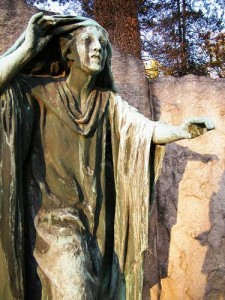 When I reflect on the witness of St. Mary Magdalene, one thing that always impresses me is the she “kept the faith”- even when “keeping the faith” was terribly hard; even when “keeping the faith” didn’t seem to make much sense.