Continuing in the theme of marriage that we had earlier this week, there is a very humorous video at the bottom of this page, one I often use for couples I prepare for marriage.
It centers on the fact that a woman is very different from a man. The physical differences are obvious but these physical differences arise from important differences in the soul. It is the soul that is the form of the body and the qualities of the male and female soul give rise to physical differences. I know that this is politically incorrect today, but it is true. It is a common modern error to be dismissive of the profound differences between the sexes. No one can deny the physical differences, but too often they are dismissed as surface only, of no real significance. But the truth is that our bodies are expressions of the faculties of our soul and male and female differences are far more than skin deep.
It remains true that these differences often give rise to tensions in the marriage and the overall relationships between men and women. That men and women perceive differently, think differently, and have different emotional experiences is just a fact and it is always healthy to recognize and accept reality. Too often in the modern age there has been a tendency to dismiss these deep differences as just archetypes of bygone “sexist” era. But what ends up happening is that an expectation is created that these differences will just go away when we decide to ignore them or pretend they don’t exist. But guess what , they don’t. And thus resentments and anger follow. Too many marriages end in power struggles because neither spouse can accept that it was not good for them to be alone and that God gave them a spouse who, by design, is very different so that they could be challenged and completed.
Original sin has intensified our pain at the experience of these given differences. The Catechism links the tension surrounding these difference to the Fall of Adam and Eve:
[The] union [of husband and wife] has always been threatened by discord, a spirit of domination, infidelity, jealousy, and conflicts that can escalate into hatred and separation. This disorder can manifest itself more or less acutely, and can be more or less overcome according to the circumstances of cultures, eras, and individuals, but it does seem to have a universal character. According to faith the disorder we notice so painfully does not stem from the nature of man and woman, nor from the nature of their relations, but from sin. As a break with God, the first sin had for its first consequence the rupture of the original communion between man and woman. Their relations were distorted by mutual recriminations; their mutual attraction, the Creator’s own gift, changed into a relationship of domination and lust; and the beautiful vocation of man and woman to be fruitful, multiply, and subdue the earth was burdened by the pain of childbirth and the toil of work. Nevertheless, the order of creation persists, though seriously disturbed. To heal the wounds of sin, man and woman need the help of the grace that God in his infinite mercy never refuses them. Without his help man and woman cannot achieve the union of their lives for which God created them “in the beginning.” (CCC #s 1606-1608)
One important cure for the disorders of marriage is to return to an appreciation of the necessity of our differences. Though our differences can be be intensified by sin, it is a fact that God made us different for a reason. These differences help spouses to complete each other. A husband should say, “My wife has some things important to teach me. I am incomplete without her.” Likewise the wife should be able to say that her husband has important things to teach her and that he somehow completes her. In this way we move beyond power struggles and what is right and wrong in every case and learn to experience that some tension is good. No tension, no change. God intends many of these differences to change and complete spouses. God calls the very difference humans he has made “suitable” partners.
And humor never hurts. Here is a wonderful and funny comedy routine about the differences between a man’s brain and a woman’s brain. Humor is often the best of medicines to defuse some of the tensions that arise from our differences. Vive la difference!
(By the way, as with any humor, stereotypes are used a bit here. But things are usually funny because they ring true. It is also a fact that not every individual man or woman has every trait described here (for example, I don’t have a very big “nothing box”) but enjoy this video for the humorous descriptions of the general situation).
What if you threw a party and nobody came? You’d be heartbroken, of course, as you’d be let down by those you love.
Jesus spoke of a party in today’s gospel- a wedding banquet thrown by a king for his son. Many were invited, but nobody came. The king, we’re meant to understand, is God the Father; Jesus himself is the king’s son.
This parable is about the “kingdom of heaven,” which is a kingdom of love, because God is love. And because God is love, he treasures relationships. That’s why so many are invited to the wedding party! But no one was compelled to come. With love, there’s no such thing as an offer we can’t refuse.
Sadly, in Jesus’ parable many did refuse to come to the party, because they were indifferent, rude, or downright hostile and angry. Will this be our choice as well? Or will we accept Love’s invitation to love like him? After all, this is a party we don’t want to miss! And we wouldn’t want to let down our host.
Today started with an 8:45am wake up after a much needed seven hours of sleep and a light Spanish breakfast, before heading to the Viva la Vida! Pro-Life Youth Festival. Organized by the Irish, the conference showcased many Pro-life Programs throughout the world (England, USA, Poland, Canada, Australia, Austria, New Zealand, and Ireland were all represented). The speakers’ main theme centered on the importance of using images to proclaim the evil of abortion, as they have proven to be extremely effective. The goal of each group was to end abortion, totally and completely: First by changing public opinion, and then the law. Currently, many speakers said, society uses people and loves things. We are acting completely backwards. Interspersed between the presentations, several bands performed and the crowd got more riled up each time.
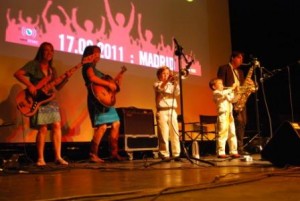
Highlights included a talk by Lila Rose, founder of Live Action, who dedicates her life to ending abortion and investigates Planned Parenthood’s facilitation of child abuse through undercover operations (check out her videos on YouTube!) The band L’Angelus was also a hit! A combination of Cajun fiddle tunes, saxophone pop, and New Orleans R&B, these four siblings put on quite a show that got the audience off their feet to say the least! It was not long before their younger 9 and 5 year old sisters, 7 year old twin brothers, and mother came on to perform as well—such a powerful expression of family and life.
After the conference, we made our way (extremely slowly due to increasingly massive crowds) to the Parque del Retiro. The metro was just insane…picture included…but it just goes to show how many youth there are out there living the Catholic Faith. Ole!
Exiting the metro we immediately come across a church and went inside to take a peak and say a prayer. The contrast from the crowded and noisy streets to the air conditioned and serene church was significant. It felt as if God was reminding us to take a hiatus from our busy lives and make that quiet time for Our Lord. Just so happens the priest needed an English version of the WYD pilgrimage book and we had one. Mass was starting in 10 minutes. I bet you can guess what happened. The mass was beautiful, and in English! The Lord is always leading us to where he wants us to be and He certainly had a plan for us today.
At the park we stopped for ice cream (a necessity of course), stood in the shade from the hot sun while watching a youth pep rally and band (the spirit never dies down, wherever you go), and made friends with some Italians who fervently tried to persuade us to trade our American flag for theirs along with every other patriotic item they had. After a solid 20 minutes of friendly argumentation, we decided to meet at the same spot at 3pm on Saturday to exchange flags, story to be continued…
After finally making it back through the crowded metro to our host’s home, we quickly changed into a clean and sweat free pair of clothes before heading back to town for dinner. Exiting the Puerta del Sol metro stop around 8:20pm, we stumbled upon a march of protestors against the pope. Now this is something I would rather not include but I believe it to be significant to the heart of the youth here today. Despite lines of police separating the youth from the protestors and blocking two major streets, every country seemed to have a group of youth praying and shouting, “Benedicto, we love you!” Through the difficult trials, we do not back down.
The night ended with a spectacular performance of Flamenco dancing. Every step, every facial expression is done with intention. The little things which these talented dancers do make the show so full of passion. It is in some way a metaphor for our own lives—we must do what we do with a true passion for the glory of God.
I would like to end with a brief prayer Lila Rose said in her early teens and shared with us. “Lord, use me. Use me to work for Your glory and to fulfill Your plans for me.”
Good (3am) night!
Eliz.
Written by: Elizabeth Lent, Junior at University of Notre Dame and parishioner at Little Flower in Bethesda
I am very happy about, and look forward to the new English translation of the Roman Missal that will begin use in November. However, I have had challenges in explaining to the faithful what the essential problem with the current translation is. When the distinction between “formal equivalence” and “dynamic equivalence” is mentioned, many eyes glaze over or puzzled looks appear. I have tried to take an example of a prayer and show the difference in three columns: Latin, new translation, and current translation (as I do below). But asking people to compare three different columns, one of them in a language unknown to most of them, presents problems too.
But, at the bottom of this post there is a great video that does a wonderful job explaining the difference between the method of “dynamic equivalence” (translating the gist of a prayer, and capturing its basic thoughts), versus “formal equivalence” (translating a prayer in a more literal, word for word way). The video shows the difference with a basic down to earth example and then explains why the difference is important. While it’s geared to teens, adults can benefit greatly from it as well. See what you think.
Example of difference – As Fr. Z. often does to great effect, the opening prayer (collect) for this coming Sunday shows the different approaches of the current translation and the new translation.
LATIN: Deus, qui fidelium mentes unius efficis voluntatis, da nobis id amare, quod praecipis, id desiderare, quod promittis, ut inter mundanas varietates, ibi nostra fixa sint corda, ubi vera sunt gaudia.
NEW TRANSLATION (formal (word for word) equivalence) O God, who cause the minds of the faith to unite in a single purpose, grant your people to love what you command and to desire what you promise., that amidst the uncertainties of this world, our hearts may be fixed, where true gladness is found.
CURRENT TRANSLATION (dynamic (gist) equivalence). Father, help us to seek the values that will bring us lasting joy in this changing world. In our desire for what you promise make us one in mind and heart.
As you can see the current translation (lame duck, as Fr. Z calls it), gets the gist of the Latin prayers. But there are important omissions.
First it proposes that lasting joys can be found in this world, rather than in heaven, which the Latin says.
The current translation rather weakly ask that we will be helped to “seek the values” whereas the Latin more vigorously asks that we may “love what you command.”
The Latin speaks of hearts as being “fixed,” whereas the current translation muddles this into our joys (not our hearts) being “lasting.”
Etc.
It will be seen that the current translation is in much need of help and that the new translation fixes the problems of the old by using a formal equivalence (word for word) translation as opposed to the “dynamic equivalence” (a general summation of the idea) translation currently in use (but not for long)!
Clearly we need more than the “gist of a prayer,” to pray with the universal Church. The new translation will be welcomed by this pastor.
Fr. Zuhlsdorf of course is the master of analyzing these collects and you can see his more expansive treat of this prayer here: 21st Sunday in Ordinary Time
What do John Wayne, Oscar Wilde, Buffalo Bill, and (possibly) George Washington have in common? They all became Catholic on their deathbeds.
Conversions such as these should cause rejoicing! But that’s not always the case. News that a notorious gangster became Catholic as he died was met with howls or protest by those who thought it unfair that such a person might receive God’s mercy. Much like those in today’s gospel who grumbled when the latecoming workers received the same pay as those who’d worked all day.
From the world’s perspective, the conclusion of Jesus’ parable isn’t fair. After all, longer work should lead to greater pay! But Jesus was speaking of the kingdom of heaven, where different rules apply.
On the job, we can earn a paycheck, and even a bonus. But there’s nothing we can do to earn our way into God’s kingdom. We’re welcomed in, not because of anything we’ve done, but because of what Jesus has done. Heaven isn’t a reward for good behavior, it’s a gift from God. There’s no admissions fee, as Jesus already paid the price for us.
Yes, we are accountable for our actions before God, who calls us to lead holy lives. But Jesus’ parable reminds us that those passing through the pearly gates won’t hear, “Congratulations! You’ve earned it!” Jesus will say instead: “Welcome! I love you.”
Wow, what a day. First thing I learned: do not abandon your group to go join some high school friends you see across the room at the Catedral de la Almudena. Turns out you will most likely not be able to find your group again and become lost in a completely foreign Palacio Real. Oh yeah, and you don’t realize this until after you’ve already left the high school friends… definitely panicked for a good twenty five minutes before being reunited at last, thank you St. Anthony!
Turned out to be a huge test of faith as well as humility. But the Cathedral was magnificent and filled to the brim with youth. First thing you would notice? The ceiling. Arches upon arches with gold trim; the simplicity made the Cathedral seem infinitely high. Eager crowds which had been rambunctiously waiting outside quickly became a prayerful wave of souls all pouring eyes over saint after saint and then spiraled up a staircase to venerate a pristine statue of the Virgin of Alumdena, displaying their country’s flag on the way for all to see to see.
Next stop, Calle Mayor—a main street which runs right through the center of town. Walking through many plazas, we were amidst a wave of colors. Every WYD group was dressed head to toe in patriotic wear and waving flags every which way. When we eventually reached Plaza Mayor, we were engulfed by singing, yelling, dancing, and chanting—all for the tremendous show of their country’s spirited participation. The peak of the excitement, or so we thought. At one point, we turned around to find a group of Italians racing towards us waving flags and yelling, “Italia! Italia!” The whole experience was really something.
Spending the rest of the afternoon exploring Madrid, we helped ourselves to some Tinto de Verano, or Sangria, and tried our first Spanish tapas. At 8pm began the opening mass, held at the Plaza de la Cibeles, a massive square…well, more of an odd shaped rectangle. Now, there were not just huge crowds here, there was a multitude of disciples. One ten minute stretch to get to the street was the equivalent of a mosh pit—every man for himself. It was actually insane. Followed by more singing, yelling, dancing, and chanting (this was the real peak of spirit), the mass began.
I knew to expect tons of countries at WYD, but I never fathomed the spirit and the reality of the faith that these young people literally all over the world are living in their daily lives. It was comforting and I felt very calm and relaxed for the rest of the evening, knowing that the fight against the secular society will be won. We are all together in this, we are all member of the One Church and no one can take that away.
Happy trails!
Eliz.
Written by: Elizabeth Lent, Junior at University of Notre Dame and parishioner at Little Flower in Bethesda
Yesterday on the blog we discussed some of the media back and forth on some statements by candidate Michele Bachmann. On of the issues is of a wife being submitted to her husband. Mrs. Bachmann at first indicated support for this biblical principle but has since, in the face of questioning backed off from it more than a little. You can read more of that in yesterday’s post here: Michele Bachmann Interview A portion of the video interview on marriage is also at the bottom of this post.
In yesterday’s post I indicated I wanted to spend some time today setting for this biblical principle of the headship of the husband. It is a headship rooted in love and service, not in power, but it is a headship.
There are cultural and worldly notions that underlie the rejection by many Catholics and Christians of the biblical teaching on the Headship of the husband. Indeed, such a concept is unpopular in our culture which usually gets pretty worked up over questions of authority in general. But that is because the worldly notion of authority usually equates authority only with power, dignity, rights and being somehow “better,” rather than equating authority with love, and service. Consider what Jesus says about authority:
Jesus called them together and said, “You know that those who are regarded as rulers of the Gentiles lord it over them, and their high officials exercise authority and make their importance felt. Not so with you. Instead, whoever wants to become great among you must be your servant, and whoever wants to be first must be slave of all. For even the Son of Man did not come to be served, but to serve, and to give his life as a ransom for many.” (Mk 10:41-45)
Jesus describes then sets aside the worldly notion of authority wherein those in authority wield their power by “lording it over” using fear, and the trappings of power. But in the Christian setting there is authority (there has to be) but it exists for service.
Consider a teacher in a classroom. She has authority. She has to in order to unify and keep order. But she has that authority in order to serve the children, not to berate them and revel in power over over them. The same is true for a police officer who has his authority not for his own sake, but for ours so he can protect us and preserve order.
Further, having authority in a Christian setting does not make one better, for authority is always exercised among equals. Our greatest dignity is to be a child of God, and none of us are more or less so because we hold any position of authority.
But, truth be told, worldly notions of authority affect Christians and many harbor resentments to authority because they think of it in worldly ways. Further, many who have authority (and most of us have some) can also fall prey to worldly notions of authority and abuse their leadership role.
The key to understanding the authority of a husband and father in the home is set aside worldly notions of authority and see the teaching in the light of the Christian understanding of authority as existing for love and service, to unite and preserve.
With that in mind let us turn to the “unpopular” and politically incorrect notion of wives being submissive to their husbands.The teaching is found in a number of places in the New Testament: Ephesians 5:22; Col 3:18; Titus 2:5; 1 Peter 3:1. In all places the wording is quite similar that wives are to be submissive, that is under the authority, of their husbands. In each case however, the teaching is balanced by an exhortation that the husband is to love and be considerate of his wife.
The most well known of the texts is from Ephesians 5, wherein the infamous line is: Wives should be subordinate to their Husbands as to the Lord. For the Husband is the husband is head of his wife just as Christ is the Head of the Church…so wives should be subordinate to their husbands in everything; (Eph 5:20-21, 23) Apparently the Holy Spirit didn’t get the memo that we don’t think and talk like that today! 🙂
Alright, so maybe it grates on modern ears today but don’t just dismiss what God teaches here. One of the great dangers of this passage is that it is so startling to modern ears that many people tune out after the first line into their own thoughts and reactions and thus miss the rest of what God has to say. It will be noticed that there is text that follows, and before a man gloats at the first line, or a women reacts with anger or sadness, we do well to pay attention to the rest of the text, which spells out the duties of a husband. You see if you’re going to be the head of a household there are certain requirements that have to be met. God’s not playing around here or choosing sides. He has a comprehensive plan for husbands that is demanding and requires him to curb any notions that authority is about power and to remember that, for a Christian, authority is always given so that the one who has it may serve. And before we look at submission we might do well to look at the duties of the husband.
So what are the requirements for a husband?
1. Husbands, love your wives– Pay attention men, don’t just tolerate your wife, don’t just bring home money, don’t just love in some intellectual sort of way. LOVE your wife with all your heart. Beg God for the grace to love your wife tenderly, powerfully and unconditionally. Did you hear what God says? LOVE your wife! Now he goes on to tell you to love her in three ways: passionately, purifyingly and providingly.
2. Passionate love – The text says a man is to love his wife: even as Christ loved the Church and handed himself over for her. The Greek word, παραδίδωμι (paradidomi), translated here as, “handed over,” always refers in the New Testament to Jesus’ crucifixion. Husbands, are you willing to give your life for your wife and children? Are you willing to die to yourself and give your life as a daily sacrifice for them? God instructs you to love your wife (and children) with the same kind of love he has for his Bride the Church. That kind of love is summed up in the cross. Love your wife passionately, be willing to suffer for her, be willing to make sacrifices for her and the children.
3. Purifying love – The text says of Christ, and the husband who is to imitate him, that Christ wills to sanctify her, cleansing her by the bath of water with the word, that he might present to himself the church in splendor, without spot or wrinkle or any such thing, that she might be holy and without blemish. Now a husband cannot sanctify his wife in the same way God can. But what a husband is called to do is to help his wife and children grow in their relationship to Jesus Christ. He is first to be under God’s authority himself, and thus make it easier for his wife and children to live out their baptismal commitments. He ought to a spiritual leader in his home, praying with his wife and children, reading scripture and seeing to it that his home is a place where God is loved and obeyed, first of all by him. His wife should not have to drag him to Church, he should willingly help her to grow in holiness, and pray with her every day. And he should become more holy as well and thus make it easier for his wife to live the Christian life. He should be the first teacher of his children, along with his wife in the ways of faith.
Too many American homes do not feature a man being the spiritual leader of his house. If any one is raising up the kids in the Lord it is usually the wife. But Scripture has in mind that the husband and father should be a spiritual leader to his wife and children. Scripture says, Fathers, do not exasperate your children; instead, bring them up in the training and instruction of the Lord (Eph 6:4). Fathers and husbands need to step up here and not leave all the burden to his wife.
4. Providing love – So also husbands should love their wives as their own bodies. He who loves his wife loves himself. For no one hates his own flesh but rather nourishes and cherishes it– Husbands, take care of your wife in her needs. She needs more than food money and shelter, these days she can get a lot of that for herself. What she needs even more is your love, understanding, and appreciation. She needs for you to be a good listener and wants an attentive husband who is present to her. Like any human being she needs reassurance and affirmation. Tell her of your love and appreciation, don’t just presume she knows. Show care for your wife, attend to her needs just like you instinctively do for your own self. Encourage her with the kids. Confirm her authority over the kids and teach them to respect their mother. Show her providing love also by taking up your role and duties as a father who is involved with his kids. That’s what God is teaching here.
OK, so scripture DOES teach that a wife should be submitted to her husband. But what kind of husband does scripture have in mind? A husband who really loves his wife, who is a servant leader, who is makes sacrifices for his wife, who is prayerful and spiritual, submitted to God’s authority and who cares deeply for his wife and her needs. The same God who teaches submission (and he does) also teaches these things clearly for the husband. The teaching must be taken as a whole. But all that said, there IS a teaching on wives being submitted to their husbands (properly understood).
And there is just no way around it, no matter how much the modern age wants to insist there doesn’t need to be headship, there does. Every organization needs a head. Consider your own body first. With two heads you’re a freak, with no head you are dead. The members of your body need a head to unify the parts, otherwise there is disunity, death and decay. Every organization needs headship, a final decider, to whom all look when consensus on significant issues cannot otherwise be reached. The Protestants have tried to have a “church” without a head, without a Pope, and behold the division. Even this Country, which we like to call a democracy, is not actually a pure democracy. There are legislators, judges, law enforcers and many other people and mechanisms who exercise local, federal and final headship and authority.
Thus in a family, where consensus and compromise may often win the day, nevertheless needs a head, a final decider, to whom all look and all submit, to resolve conflicts that cannot be resolved otherwise. Scripture assigns this task to the husband and father. Headship just has to be. But please remember to shed your worldly notions of headship when considering the teaching of Scripture and remember, headship, authority, is for love and service, it is for unity and preservation, not for power, prestige, trappings and superiority.
For more on this consider listening to my sermon Teaching on Marriage in mp3 format. But beware, It is 35 minutes! Consider downloading it if you can’t listen just now. You can download this and other sermons of mine by going here: http://frpope.com/audio/recordings.php and then right clicking on the title of any talk and selecting the “Save Target As” option. You can also get my sermons at iTunes. Just search on my name.
Here is the video clip where Michele Bachmann is attacked for saying a woman should be submitted and then backs down. Please note however, I am not sure a husband’s servant leadership means that he should force his wife to take a law course she does not want to take. Such an exercise of authority hardly seems necessary or proper.
–
–
This video clip is from the movie Fireproof and depicts a heartfelt apology from a husband who realizes he has not loved his wife as he should. A beautiful movie available at Amazon if you have never seen it.
The great English Catholic G. K. Chesterton once remarked that ever since Jesus insisted that it’s easier for a camel to squeeze through a needle’s eye than for the rich to enter the kingdom of God, we’ve been frantically trying to build bigger needles and breed smaller camels!
People of every generation have found this teaching of our Lord hard to swallow. It certainly shocked the disciples, as we just heard. And this saying can make us uncomfortable too, because so often we seek our comfort in the things of this world.
Jesus is not saying that we don’t have legitimate financial needs. We most certainly do! And he wants us to pray for them. What Jesus is saying, however, is that when our wants become needs, we cross the border into the land of idolatry, which is a dangerous and foolish thing to do. Because to love riches more than God is, as Bishop Robert Morneau has put it, to commit spiritual adultery.
And so today’s gospel challenges us to consider our priorities, to evaluate our goals, and assess how we spend our time and energy, to determine if we have de-throned almighty God as Lord of our life, and replaced him with the “almighty” dollar. Because if we wish to enter God’s kingdom, we must seek it, first of all.