During Mass, we hear Jesus speak to us in Scripture, and we receive Him in Holy Communion. After Mass, Jesus asks us to bring him home.
Simon Peter did this in today’s gospel. Like us, he encountered Jesus in word and worship, at the synagogue. And afterwards, Peter took Jesus to his home, where a family member was in need of a healing only Jesus could provide.
In our own families, we too may find a need for Jesus’ healing touch- healing of brokenness, jealousy, resentments, old wounds, rivalries, physical sickness, mental illness, addictions.
Like Peter, we need to bring Jesus home. Yes, sometimes Jesus does arrive unannounced! But more often than not, Jesus waits for an invitation- and an escort.
We can bring Jesus home in so many ways. Maybe we need to share our faith by sharing our story. Maybe we need to lend a helping hand. Maybe we need to confront one who is hurting others, or hurting themselves. Maybe we need to say “I’m sorry” and “I forgive you.” Maybe we need to say “I love you.” Maybe we just need to stop being a stranger, and pick up the phone.
There are any number of ways Jesus can bring healing into our homes. But we can’t just wait for him to appear. Because the truth is, it might be Jesus who is waiting for us!
Susan Gibbs, the former Executive Director of the Office of Communications for the Archdiocese of Washington posted this blog on the Diocese of Arlington website. With her permission, we are re-posting it because it is a perfect introduction to the importance of a conference the archdiocese is hosting on October 1 at Catholic University of America.
Christ…or a sandy beach?
Ok, I admit it. Nearly every Sunday, I read the wedding section of the New York Times.
After a double dose of bad news from the front pages of the Times and TheWashington Post, I usually need some entertainment and the “how-we-met” stories tend to be a lot of fun. Plus, it can be inspiring to seecouples ready to embark on a new life together.
But what started as a diversion turned into something else. I started noticing fewer church weddings. Priests and ministers were being replaced with “Universal Life” celebrants and other officiants who were friends of the couple “ordained” for the occasion. (Like everything else these days, it turns out you can go online and get instantly “ordained.”) No longer held in churches, weddings are migrating to beaches, restaurants and exotic destinations.
Is this just the result of editors choosing unusual venues, or a sign that church weddings are on the decline?
Given that the number of Catholics in the United Statesis growing, that’s not good news. What is going on?
According to the researchers,it’s not that Catholics areless likely than anyone else to marry,although that’s not saying a lot. The rate of marriage in the United States has dropped by nearly half since 1970, while the number of couples cohabitating has skyrocketed, according to The National Marriage Project. Instead, CARA researchers found:
Catholics are waiting slightly longer to marry
Catholics who divorce may be remarrying outside the Church
Catholics are marrying non-Catholics in increasing numbers
Catholics are not marrying at all.
That last one – not marrying at all– turns out to be the biggest factor in explaining the precipitous decline in weddings celebrated in Catholic churches. In 1970, nearly 80 percent of all adult Catholics in the U.S. were married. Today, barely 53 percent are. For younger Catholics (18- to 40-year-olds), the drop is even more significant: 69 percent were married in 1972, but only 38 percent are today.
In 2007, nearly a quarter of never-married U.S. Catholics said they were “not at all likely” to ever get married.
And, when they are marrying, they aren’t marrying other Catholics as often as in the past. From 1991 to 2008, the percent of young married Catholics (under age 41) married to other Catholics dropped from 78 percent to 57 percent. These couples may or may not marry in a Catholic Church.
Does it matter? Yes, quite a lot, because being married means something as a Catholic. There are only seven sacraments and marriage is one of them.
As the U.S. bishops’ website explains, “The sacraments make Christ present in our midst. Like the other sacraments, marriage is not just for the good of individuals, or the couple, but for the community as a whole. The Catholic Church teaches that marriage between two baptized persons is a sacrament. The Old Testament prophets saw the marriage of a man and woman as a symbol of the covenant relationship between God and his people. The permanent and exclusive union between husband and wife mirrors the mutual commitment between God and his people.”
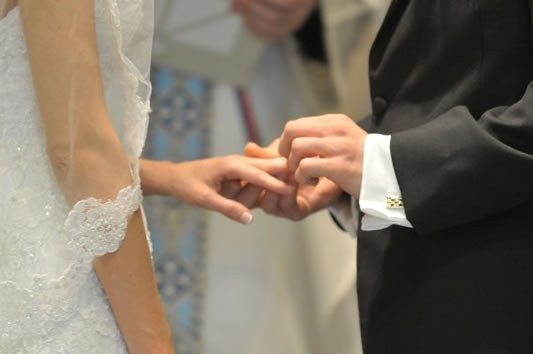
Getting married – making that commitment – and holding the wedding in the sacred place of a church keeps the focus on what a wedding truly is – a joining of two people before Christ who now will become one within a community. I’m all for friends at a wedding, but I’d rather have them in the pews. After all, having Christ in your wedding and marriage will get you a lot further than a buddy on a sandy beach.
Prior to entering the Seminary, I was a choir director, cantor and organist in Catholic Parishes. In those days, (early 1980s), it was widely held that working for a Catholic Parish meant your were going to be paid poorly. The “real money” was made working for Protestant congregations. Concerns were raised (many of them legitimate) among Catholic liturgists and musicians that Catholic parishes needed to rethink their priorities, and pay more just and competitive wages, if we were ever going to rescue Catholic music from the amateurish state it largely was in in the 1980s.
It would seem, according to a recent CARA report that a lot of progress has been made in this direction. And this is true not only in terms of musicians, but also other professional positions. The CARA report says,
A companion piece to the CARA research released in the Emerging Models project’s The Changing Face of U.S. Catholic Parishes is the National Association of Church Personnel Administrators report, Pay & Benefits Survey of Catholic Parishes….One of many interesting findings is how similar wages and salaries are for Catholic parish ministers and those working in similar capacities in Protestant churches in the United States. (See Chart above right). The Protestant data used by NACPA are from Protestant: 2010 Church Staff Compensation Survey.
It would seem that we have largely closed the gap in terms of wage comparisons with the Protestant denominations. As a pastor, I think this is good news. I have come to depend greatly on competent and well trained laity doing parish work. I have a very fine staff here at my parish. My administrative assistant and business manager is the best and daily brings great wisdom and experience to bear on parish issues. My music director is top drawer, and nationally known. My support staff are all excellent. What a blessing.
It is also a fact that the parish has come to bat in the offertory and are well formed in their understanding of what it takes to run a parish where we pay just wages, and strive for excellence in the service of the Lord. I remain humbly grateful to my congregation for their immense generosity and Love of God. Biblical tithing has been embraced by most of the parishioners here who though small in number, yearly generate an offertory income of almost one million dollars.
Money is sign of what we value. Catholics who regularly toss down $50-100 to take the family to the movies, or even more to go to sports events, and then toss $10 in the collection basket are saying something about what they value. Likewise, Catholics who direct 10% of their income to God’s house in obedience to his word (cf Malachi 3:10, inter al) are also saying something.
Further, parishes that pay significant wages for administrative leadership, music and catechetical ministry are also saying something about the value associated with these works in God’s house. Money does have something to say about what we value.
I realize that what I say here is not without controversy. Some prefer to emphasize volunteerism in parish settings. Well enough, and volunteerism must continue to have an important place in parishes. For just as with money, what people do with their time is also an important indicator of what they value.
But there must be a proper balance or proportion at work. Music and liturgy, parish administration and catechesis are essential and important post that ought to be staffed by well trained and well paid individuals. It will surely be the job of such individuals to engage volunteers, and train good leaders to assist them. But in the end, we have to be willing to have well trained people in essential posts and be willing to pay them wages commensurate with both “the market” and also with the value we attribute to their work. And that value is significant. Further, we ought to be willing to pay just wages, with benefits to those whose work approaches full time.
Pastors do well to form their congregations around such notions so that God’s house will not be an afterthought in their lives and financial priorities. In preaching biblical tithing, I often emphasize that God gets the FIRST tenth of our income, not the tenth that is (hopefully) leftover after we pay the cable bill and for the latest iPad.
I also realize that some will comment that they don’t like the money is spent or that they don’t prefer the music, the catechesis. But be careful, give and then offer concerns to the Parish Finance Council. Give and then insist on excellence. Every pastor and finance council is required to report to the congregation every year. But give critique as one who is invested (in obedience to God), rather than one who withholds until he gets what he likes. Our parishes are not products we buy, not services we contract for. They are the Body of Christ we join and become part of, financially and through service. And in the context of communion and generosity, we listen for God’s will and move forward, in conformity to Church teaching.
Alright. I was not born yesterday and realize that whenever money is in the discussion there will be strong opinions. Remember, I do not write a complete treatise here. I am starting a conversation.
It’s been said that we live in a very “wordy world.” Every day we’re bombarded with words from TV, radio, the internet, billboards, road signs, t-shirts, bumper stickers, and goodness knows what else. We can’t even go to the beach without seeing airplanes dragging banners advertising beer or seafood.
Because we’re so inundated by them, words can often lose their power for us. We say things like, “Talk is cheap” or “They’re only words” or “Words don’t mean anything.” What a contrast to the situation described in today’s gospel, in which Jesus spoke at a synagogue. We’re told that people were “astonished at his teaching” and that they said to one another, “What is there about his word?”
It’s interesting that we aren’t told much of what Jesus actually said except for the command: “Be quiet!” These words were initially directed to a demon! But perhaps we can understand them as the Holy Spirit’s little reminder to us today to “tune out” our “wordy world” and spend a moment in quiet reflection on Holy Scripture, that the amazing, astonishing, authoritative, life-giving words of Jesus- the Word made flesh- might resound in our hearts.
Most Catholics are unaware of how our traditional church buildings are based on designs given by God himself. Designs that stretch all the way back to Mount Sinai when God set forth the design for the sanctuary in the desert and the tent of meeting. Many of the fundamental aspects of our church layouts still follow that plan and the stone version of it that became the Jewish Temple in Jerusalem. Our traditional church buildings also have numerous references to the Book of Revelation and the Book of Hebrews, both of which describe the heavenly liturgy and heaven itself.
There is not time to develop these roots at length in this post today, though I hope to do so in a series of future posts.
Sadly in recent decades there was a casting off of these biblical roots in favor of a “meeting house” approach to church design. No longer was the thinking that our churches should reflect heavenly realities, teach the faith, and follow biblical plans. Rather the thinking was that the Church simply provided a space for the people to meet and conduct various liturgies.
In some cases the liturgical space came to be considered “fungible” in that it could be reconfigured to suit various needs: Mass today, concert tomorrow, spaghetti dinner on Wednesday. This thinking began to be set forth as early as the 1950s. Pews were often replaced by chairs which could be moved to suit various functions. And even in parishes which did not go so far as to allow spaghetti dinners in the nave, (mine did in the 1970s), the notion of a church as essentially a meeting space prevailed.
Thus churches looked less and less like churches and more like meeting halls. Bare essentials such as an altar, pews or chairs, a pulpit and very minimal statuary were used, but the main point was simply to provide a place for people to come together. There was very little sense that the structure was to reflect heaven or even remind us of it.
That is beginning to change as newer architects are returning more and more to sacred and biblical principles in church design. Further, many Catholics are becoming more educated on the meaning of church art as something beyond what is merely “pretty,” and coming to understand the rich symbolism or art and architecture as revealing the faith and expressing heavenly realities.
Take stained glass for instance. Stained glass is more than just pretty colors, pictures and symbols. Stained glass was used for centuries to teach the faith through picture and symbol. Until the past 200 years most people, even among the upper classes, could not read well, or at all. How does the Church teach the faith in such a setting? Preaching, art, passion plays, statues, and stained glass.
Stained glass depicted biblical stories, saints, sacraments, and glimpses into heaven. Over the centuries a rich shorthand of symbols also developed: crossed keys = St. Peter, a sword = St. Paul, a large boat = the Church, shell = baptism, and so forth. And so the church taught the faith through the exquisite art of stained glass.
But stained glass also served another purpose, that of imaging the foundational walls of heaven. For, recall that traditional church architecture saw the church as an image of heaven. Hence it’s design was based on the descriptions of heaven found in the Scriptures. Now among other things, heaven is described in the Book of Revelation as having high walls with rows of jewels embedded in the foundations of those walls:
One of the seven angels…showed me the Holy City, Jerusalem, coming down out of heaven from God. It shone with the glory of God, and its brilliance was like that of a very precious jewel, like a jasper, clear as crystal. It had a great, high wall with twelve gates….The foundations of the city walls were decorated with every kind of precious stone. The first foundation was jasper, the second sapphire, the third chalcedony, the fourth emerald, the fifth sardonyx, the sixth carnelian, the seventh chrysolite, the eighth beryl, the ninth topaz, the tenth chrysoprase, the eleventh jacinth, and the twelfth amethyst.... (Revelation 21:varia)
Thus, because heaven had great high walls, older churches almost always had a lot of verticality. The lower foundational walls gave way to the higher clerestory, and above the clerestory the vaults of the ceiling rise even higher. And in the lower sections of the walls, extending even as high as the clerestory, the jewel-like stained glass recalls the precious jeweled gemstones described in the lower walls of heaven, according to Revelation 21.
The compelling effect of a traditional church is to say to the believer, you are in heaven now. In my own parish church, the floors are a green jasper color, and the clerestory walls, red jasper. On the clerestory are painted the saints gathered before the throne-like altar in heaven (Heb 12:1; Rev. 7:9) . In the apse is the throne like altar, with Jesus at the center (Rev 5:6), the seven lamp stands are surrounding him in seven candles (Rev 4:5). In the stained glass of the transept are 12 apostles, joined with the 12 patriarchs symbolized by 12 wooden pillars. Together they form the 24 elders who surround the throne in heaven (Rev 4:4). Above the high altar in the clerestory windows are the four living creatures also said to surround the throne (Rev 4:6-7).
Yes, amazing. I stand in my church and realize its message: you are in heaven when you enter here and celebrate the sacred mysteries: sursum corda! (hearts aloft)!
Photo above: San Chapelle, Paris France
Here’s a video I put together on stained glass. Enjoy these jewels of light that recall the lower walls of heaven as the choir sings Christe Lux mundi (O Christ you are the Light of the world).
The Sources of many of the photos in this video are:
Have you ever feared to do the right thing, or bear witness to your faith, because you were concerned about what others might do or say? I would imagine that most of us have; it’s something of a universal struggle. Teens struggle with peer pressure about sex and drugs. Workers weigh the pros and cons about resisting a corrupt or unethical corporate culture. Public figures bow to opinion polls. Christians keep their faith under wraps, lest they be labeled a “holy roller.” It’s all a matter of our conscience, versus our reputation.
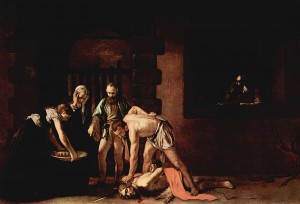
King Herod was a case in point. He knew that the right thing to do was to set John the Baptist free. But he was afraid of what his guests might think. So against his better judgment, he delivered John to death. For his part, John could not have been a greater contrast to King Herod. As a true prophet of God, he spoke the hard truth. And he paid a hard price. All because he made a hard choice to be faithful to his Lord and true to his conscience.
John’s witness is an inspiration to us to be courageous in always choosing to do the right thing. Sure, in some people’s eye’s we’ll look like a fool; but in God’s eyes, we’ll look like a saint.
I want to talk about the relationship of the word “martyr” and Evangelization in two ways. For the word martyr has two senses, and they both apply to Evangelization. On the one hand martyr is simply the Greek word (μάρτυς – martus) that means “witness.” On the other hand, in modern English, we think of the martyrs as those who suffered and died for their faith. Both concepts are essential for evangelizers (this means you).
Lets look first at the concept of “martyr” as one who suffers. – If you’re going to evangelize prepare to suffer. This explains a lot in terms of why most Christians don’t evangelize.
When I was training people in my parish to go door to door (we had fifty people), and also preparing others to go to their family members and summon them back, it was clear we had to get something out of the way at the very start. And that was that we were all going to suffer for doing this. We would be rejected, scorned, ridiculed, have anger vented on us and be asked questions we couldn’t answer. And yes, we would also have people who were delighted to see us and were very friendly, even open to the invitation to come to Mass, or to find out more. But in the end, I wanted to be clear, we have to expect to get it with both barrels: POW!
Ready to Suffer? For, if you’re going to be a witness, you have to know that the Greek word for witness is μάρτυς – (martus) – “martyr.” Are you ready to suffer for Jesus? There are many who have go so far as to be killed for announcing Jesus. And how about us? Are we even willing to risk a raised eyebrow? How about laughter, scorn, derision, anger, rejection, or even worse, simply being dismissed or ignored?
These things are just part of the picture. In no way does it indicate failure. In fact, it may indicate success for Christ promised such things to faithful disciples and witnesses. Further, anger and protests does not mean a seed has not been sown. In sowing the seed, the ground must first be broken, and that is not often an easy task. For the ground often makes “protest” and we will only get fruit from it by the sweat of our brow. Scripture says of such suffering:
Remember the words I spoke to you: ‘No servant is greater than his master.’ If they persecuted me, they will persecute you also. If they obeyed my teaching, they will obey yours also. They will treat you this way because of my name, for they do not know the One who sent me. (John 15:20-21)
The apostles left the Sanhedrin, rejoicing because they had been counted worthy of suffering disgrace for the Name. (Acts 5:41)
If you are insulted because of the name of Christ, you are blessed, for the Spirit of glory and of God rests on you. (1 Peter 4:14)
If you suffer for being a Christian, don’t feel ashamed, but praise God for being called that name. (1 Peter 4:16)
We are fools for Christ’s sake (1 Cor 4:10)
God was pleased through the foolishness of what was preached to save those who believe. (1 Cor 1:21)
As servants of God we commend ourselves in every way: in great endurance; in troubles, hardships and distresses; in beatings, imprisonments and riots; in hard work, sleepless nights and hunger; in purity, understanding, patience and kindness; in the Holy Spirit and in sincere love; in truthful speech and in the power of God; with weapons of righteousness in the right hand and in the left; through glory and dishonor, bad report and good report; genuine, yet regarded as impostors; known, yet regarded as unknown; dying, and yet we live on; beaten, and yet not killed; sorrowful, yet always rejoicing; poor, yet making many rich; having nothing, and yet possessing everything. (2 Cor 6:4-10)
How can we read texts like these and think that we will not suffer for speaking and living our faith? Some will accept us, many will reject us. But in rejection, derision, scorn, and being called a fool consider yourself in good company. Jesus, the apostles and martyrs, the saints and all the heroes suffered in this way. It is not failure to thought of this way, it is simply the lot of the faithful to be often considered as such. In this sense it is a sign of success. We do not go looking for a fight or to make people angry. But often they are, and this is to be expected. Suffering is an essential part of being and evangelizer, a witness (a martyr).
Here are few things to remember when being scorned or the object of anger:
Don’t take anger and rejection personally. In most cases, it is not about you. Most people’s anger is really directed at Christ, or at God in general, or at his Church, or at organized religion. Some have been hurt by the Church, or feel hurt by God. It’s not about you.
Just because someone is angry or takes offense, doesn’t mean you did anything wrong or gave offense. I have often thought that, in a primitive part of our brain, developed in childhood, we instinctively think that, if some one is angry or upset with us, we have done something wrong. Not necessarily so. In fact, anger is sometimes a sign we have done something right, for, if we are faithful, we are raising issues that, though uncomfortable, are necessary to consider.
Do not give in to the temptation to retaliate or be personally hurt. Rather, rejoice that you have been deemed worthy to suffer for Christ.
Do not be discouraged. Shake the dust and move on. (cf Matt 10:14).
Remember that you are sowing seeds. You may not experience the harvest, but others may well bring it in. The fruitfulness of what you do may take years to come to harvest. Just stay faithful and keep sowing seeds.
Remember too, an evangelizer is a witness and the Greek word for witness is martyr. Suffering is simply part of the picture.
When we understand and accept these things we are less resentful and anxious when it happens. Don’t lose heart. Accept the martyrdom of evangelization.
And this leads us to the second notion of the word “martyr,” that of being a witness.
Now the word “witness” indicates someone who has seen or experienced the thing they are talking about. They are a witness because they themselves have personally seen or experienced and know what they are talking about. In English the word “witness” contains the sense of “knowing” for its etymological roots come from Old English and Germanic words such as “wit” and “wissen” meaning to know something, and also likely influenced by the the German verb “kennen” meaning to be personally familiar with someone or something. Hence, to combine these roots, a “witness” is someone who knows the facts and truth of something personally, by first hand knowledge. I cannot really serve as a witness in a court by saying what others saw. Hearsay is not admissible. I have to say what I saw and and personally know. This is what it means to be a witness.
In evangelization work too, we are called to be witnesses. That is, we are called to speak not only what we intellectually know, or have heard others say, but also what we have personally experienced. As witnesses we are called to have firsthand knowledge, and not only say what others have said. It is not enough to know about the Lord, we have to personally KNOW the Lord. A child knows if his parents are just going through the motions of teaching them a prayer, and whether they really know the Lord personally, and are actually praying. Congregants know if their priest is just giving an informational sermon or if he has really met the Lord and “knows” personally what and Whom he speaks of.
People know the difference. And frankly what people are most hungry for is first hand witnesses, not people who just quote slogans and “safe, ” “tested” sayings of others. What people need to hear is: God is real, and I know this because I just talked with him this morning, and I experience his presence even now. And, in the laboratory of my own life I have tested God’s teachings from the Scriptures and the Church, and I have found them to be true and reliable. I am talking to you from experience, God is real, and his teachings are true, and I know this personally for I have experienced it in my life.
Too often, what could be evangelical moments devolve into religious debates about whether Pope “so-and-so” said this or that in the 8th Century, or about why women can’t be ordained, or why the “evil” Catholic Church conducted the inquisition. These sorts of topics come up quickly because we talk only of issues, and not from personal experience. It is harder for a person to deny what you have experienced when you or I say, “I have come to experience that God is real, that what he says through his Church is true, and I have staked my whole life on what he has revealed.”
What we need are witnesses more than apologetical experts who know every rebuttal. Intellectual knowledge is important, but personal witness is even more important. It’s OK to say “I don’t know” to some technical question, but it’s not OK to be incapable of witness. Even as a priest I sometimes have to say I don’t know the answer to that, I’ll try to find out and let you know…But Let me tell you what I do know, and that is that God is at the center of my life and I have come to experience his love for me and every human being. I have come to experience his power to set me free from sin and every bondage and root me in the truth of his Word. And whatever the answer to your question is, I know it will be rooted in that.
Yes, we need martyrs for the work of evangelization. Those who are willing to suffer, and also those who are willing to be first hand witnesses, who have a personal testimony to give of the Lord they have come to know by experience.You should be an evangelizer, a witness, a martyr.
Photo Credit above: Paul in Jail by Rembrandt
Here is a video clip from Fr. Francis Martin wherein he beautifully described the second notion of the word martyr as “witness.” This clip is part of a longer series on the Gospel of John Series which you can see here: Gospel of John Series 3A
In today’s Gospel the Lord firmly sets before us the need for the Cross, not as an end in itself, but as the way to glory. Lets consider the Gospel in three stages.
I. The Pattern that is Announced – The text says, Jesus began to show his disciples that he must go to Jerusalem and suffer greatly from the elders, the chief priests, and the scribes, and be killed and on the third day be raised.
Note here that the Lord does not only announce the cross, he also announces the resurrection. In effect he announces the pattern of the Christian life which we have come to call the “Paschal Mystery.”
The expression, “Paschal Mystery” refers to the suffering, death, resurrection and glorification of Jesus as a whole. The word “Paschal” is related to the Hebrew for Passover. Just as the shed blood of a lamb saved the people from the angel of death and signaled their deliverance, so does Jesus’ death, his Blood, save us from death and deliver us from slavery to sin.
So he is announcing a pattern: the Cross leads somewhere, accomplishes something. It is not an end in itself, it is for a purpose, it is part of a pattern.
St. Paul articulates the pattern of the Paschal Mystery this way: We always carry around in our body the death of Jesus, so that the life of Jesus may also be revealed in our body (2 Cor 4:10). It is like an upward spiral where the cross brings blessings we enjoy. But we often circle back to the crosses God permits, and there come even greater blessings and higher capacities. Cross, growth, cross, growth, and so the pattern continues, till we reach the end, dying with Christ so as to live with him.
This is the pattern of our life. We are dying to our old self, dying to this world, dying to our sins, but rising to new life, rising to the Kingdom of God, becoming victorious over sin. The cross brings life, it is prelude to growth. We die in order to live more richly. And old spiritual says of this repeated pattern that “every round goes higher, higher.”
Do you see the pattern Jesus announces? The Lord does not announce the cross to burden us, neither does the Church. No, the cross is part of a pattern that, if accepted with faith, brings blessing, new life, and greater strength.
II. The Prevention that is Attempted – The text says, Then Peter took Jesus aside and began to rebuke him, “God forbid, Lord! No such thing shall ever happen to you.” He turned and said to Peter, “Get behind me, Satan! You are an obstacle to me. You are thinking not as God does, but as human beings do.”
Notice the exact wording of Peter’s words: “No such thing shall ever happen to you.” And we ought to ask, “What such thing?” For in precluding that Jesus suffer and die, he also implicitly blocks the rising and glorification of Jesus. For Christ cannot rise, unless he dies.
Peter of course is not thinking all this through, he is not connecting the dots. But neither do we as we seek to avoid crosses for ourselves or to improperly hinder others from accepting the cross. For the cross brings glory and growth and we run the danger of depriving others of these if we rush to eliminate all the crosses, demands and difficulties of life. Perhaps we do this by enabling behaviors, perhaps we do it by spoiling children.
We also hinder our own growth by refusing to accept the crosses of self-discipline, hard work, obedience, resisting temptation, accepting suffering, consequences and limits. In rejecting the cross we also reject its fruits.
All this explains Jesus severe reaction to Peter. He goes so far as to call Peter “Satan” for it pertains to Satan to pretend to befriend us in protesting our crosses, but it is really our blessings he wants to thwart. Peter may not know what he is doing, but Satan does, and seeks to become an obstacle to Jesus’ work.
Jesus’ severe reaction is rooted in protecting our blessings.
III. The Prescription that is Awarding – Jesus goes on to teach further on the need for and wisdom of the Cross. The text says, Then Jesus said to his disciples, “Whoever wishes to come after me must deny himself, take up his cross, and follow me. For whoever wishes to save his life will lose it, but whoever loses his life for my sake will find it. What profit would there be for one to gain the whole world and forfeit his life? Or what can one give in exchange for his life? For the Son of Man will come with his angels in his Father’s glory, and then he will repay all according to his conduct.”
The heart of Jesus’ teaching here is the deep paradox that in order to find our life, we must lose it. More specifically, in order to gain heaven we must die to this world. And that dying is a process more than just an event at the end of our physical life here. Though we cling to life in this world, it is really not life at all. It is a mere spark compared to the fire of love that God offers. It is a mere note compared to the great symphony God directs.
Jesus instructs us to be willing to exchange this tiny and dying life for that which is true life. Whatever tiny blessing comes from clinging to this life and world the Lord says it is no profit at all. If you choose life in this world rather than the true life God offers, you’re nothing but a big loser.
Of course what the world’s cheap trinkets offer is immediate gratification and evasion of the Cross. We may feel relief for a moment, but our growth is stunted and the cheap little trinkets slip through our fingers. We gain the world (cheap little trinket that it is) but lose our souls. Total loss. To quote a modern expression: “FAIL!”
Jesus final world reminds us that the choice is ours, however. For the day will come when he will ratify our choice. Either we accept true life and win, or we choose the passing, dying life this world has and we lose. The choice is ours.
This songs speaks of life as a kind of spiral climb between cross and glory. The text says, “Every round goes higher, higher, soldiers of the cross.”

 During Mass, we hear Jesus speak to us in Scripture, and we receive Him in Holy Communion. After Mass, Jesus asks us to bring him home.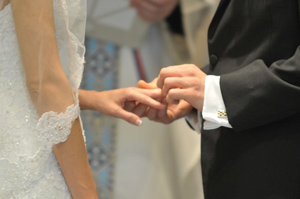
 Prior to entering the Seminary, I was a choir director, cantor and organist in Catholic Parishes. In those days, (early 1980s), it was widely held that working for a Catholic Parish meant your were going to be paid poorly. The “real money” was made working for Protestant congregations. Concerns were raised (many of them legitimate) among Catholic liturgists and musicians that Catholic parishes needed to rethink their priorities, and pay more just and competitive wages, if we were ever going to rescue Catholic music from the amateurish state it largely was in in the 1980s.