I first posted the video at the bottom two years ago on this blog. I thought it was quite funny and a humorous look at the culture of Catholicism. In no way did I think the “deacon” in the video was ridiculing the faith. In fact it was really more a spoof on used car salesmen who will often do anything to sell a car.
But, when I published the video there were a number of strong reactions in the combox from readers who did not think the commercial funny at all, and offensive to boot. Here are a couple of examples:
I’m sorry. I know the attempt at humor was well meant and may appeal to some. But I found it in bad taste and almost offensive. It was the use of sacred words and realities in such a flippant manner that I could not appreciate.
Not funny and what is being promoted? Open on Sundays? What about keeping the Sabbath Day holy?
Others thought differently –
I thought this was a brilliant way to connect…Sometimes we get just too uptight and try to keep our religion in a pretty box. Well done brother, I hope to see more.
My favorite line is: “We’re on South Water Street, just before it turns into Wine” That’s funny and clever! Anyway, some here don’t agree. I see it as lighthearted humor and some of you clearly do not.
As I have said, I think the spoof is more on car salesman, and not that far from the truth either. I remember that, some years ago, in the Catholic Standard, our Archdiocesan Newspaper, a certain Deacon, who was also a car dealer, used to advertise each week. He loved to point out that he was a permanent Deacon at such-and-so a parish. There was more than a hint in his add that he had a special deal for practicing Catholics: “An outrageously low price for a new or used car! Just bring a Church Bulletin and get the discount!” Hey, why not. I think if I’d been in the market for a car I might of just paid him a visit!
But humor is clearly risky sort of a thing, for what often makes it funny is that goes out to the edges, sometimes engages in stereotyping, and usually has a element of truth wrapped up in hyperbole and histrionics. We human beings are often funny even when we’re doing serious stuff and a good laugh doesn’t always mean ridicule, sometimes it means appreciation of the traits we notice in others.
Finally, the word humor and humility are likely related. The Latin word “humus” means soil, earth or ground. Another root of the word is the Latin and Greek word “humor” referring to the water and other bodily fluids that make up our bodies. Either way, we are dust and water and unto dust we shall return. Recalling this is a way to remember, among other things, that we not take ourselves too seriously. Proper humor and laughter that is not ridiculing in intent, can help us to be more humble.
I am interested in what you think of the video below. Is the humor of it appropriate, as I think it is? Does some or all of it go too far? What’s the balance between being able to laugh at ourselves and being too uptight? Clearly some people, two years ago were offended. I was not. What do you think?
Anyway, enjoy this rather humorous and well done video.
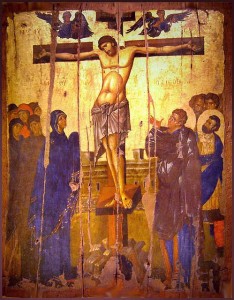
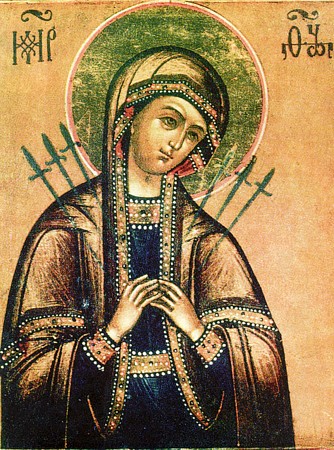
How did Mary show her feelings as she witnessed her Son’s Passion? Was she numb with shock? Did she try to be stoic and stifle her tears? Did she crumple in a heap and sob uncontrollably? Or did she express her anguish in all of these ways?
Scripture doesn’t answer these questions. However, if Mary is human, which she is, and if she loves her Son, which she does, then surely the Passion must have filled her with sorrow. It is this sorrow that we recall today, the memorial of Our Lady of Sorrows.
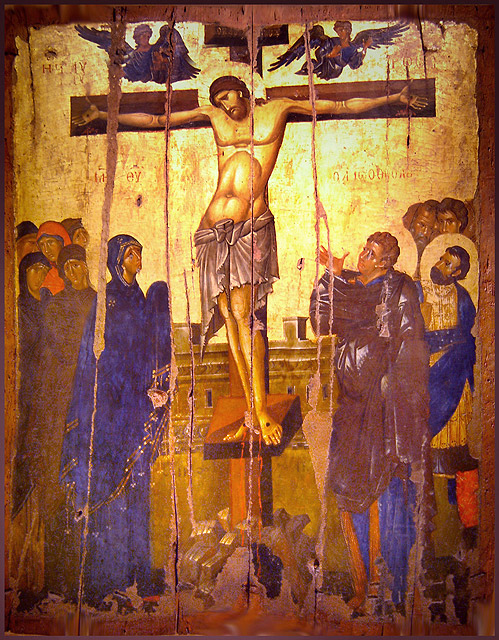
We recall especially that Mary suffered while Jesus suffered. When we suffer, Mary invites us to gaze at Jesus on the cross. Jesus, however, refers us back to Mary and says: “Behold your mother.” It’s as if he says, “Look at Mary; she’s your example; do as she did.” And what did Mary do? She stayed with Jesus at the foot of the cross. She didn’t run away. We can learn three things from this.
First, when we stay at the foot of the cross, we realize that we’re not alone in our suffering. We have a Lord who has suffered for us, and who suffers with us. This can be for us a source of consolation and strength.
Second, staying at the foot of the cross helps us to think not only about ourselves, something so easy to do when we suffer. By being at the cross, Mary was able to comfort her Son, in spite of her own pain. Her witness can teach us to be compassionate too.
Third, keeping the cross in sight reminds us that it was followed by an empty tomb- which is a cause for joy. As Mary learned, sorrow and joy can coexist, and sorrow will never have the final word. Through her witness, Our Lady of Sorrows embodies for us what Mother Teresa once wrote so beautifully: “Never let anything cause you so much sorrow that you forget the joy of Christ risen!”
Permit me to go in this post from serious sublimity, to silly stretching. But I saw a car ad the other day and recalled an insight of how God saves us. “How one earth?” you may say. Well, on the Feast of the Triumph of the Holy Cross lets look….
Let me begin with the sublime. And for that I turn to Archbishop Fulton J Sheen. Many years ago (more than 25) I got a series of 24 cassette tapes. They were wonderful recordings of a set of instructions he prepared for converts to the Catholic Faith. If you have never heard of that series you can find it here: A Sheen Catechism.
In this series, Archbishop Sheen made an insightful point that I am relating to you from memory. I beg mercy if I do not quote him exactly, but his point related to soteriology, the theology of how we are saved. Now to be clear, we are saved by the obedience of Christ. But not all the consequences of our sinful choice were eliminated. Some of these consequences the Lord takes up as a means to save us. It is of these consequences that Archbishop Sheen sepaks. Again, what I relate is not verbatim but is as close as I can remember:
Consider that God were conducting a great symphony, a symphony that He Himself composed, of sublime beauty. Now suppose he wrote that symphony in the Key of A. Having assembled His orchestra God brings them to attention and begins the symphony. But suppose in the front row, the first and second violinists, filled with a sense of rebellion and boredom by the third measure, insisted on playing the note A-Flat, rather than the A-natural called for by the score. This of course created a terrible dissonance. And so God, the great conductor and composer brought the orchestra to a halt by tapping his baton. Looking to the first and second violinists, he said, “My symphony has been ruined. I will forgive but the note has sounded and gone forth. It will not be recalled. So, what was that note you played?” The first and second violinists said “A-Flat!” “Fine then,” said God, “Let us begin our new Symphony in the key of A-Flat.” And raising his baton, he began.…
What is Archbishop Sheen saying here? He is saying that in saving us, God does not merely undo or cancel every effect of our choice. Jesus does obey, saying yes to the Father, whereas we had said no and hence we are saved by his obedience. But God does not merely come in and say, well, you got that wrong so I am just going to reverse everything you did and put it back to the way I want it. There is a very deep reverence that our all-powerful God has for our freedom we had to chose in this sense. And so he chooses to write straight with the crooked lines, the consequences of our sinful choice.
What then does God do? Using Sheen’s analogy he takes our “A-Flat,” the consequences of our choice and uses it as the key note in a new symphony. In other words, though God had given life, and paradise (A Natural), Adam and Eve chose the way of suffering and death (A-Flat). Hence, rather than merely erase what they had done, God said, “I will come and, through suffering and death, (A-Flat), compose a new symphony with an even greater ending. Through the suffering and death of my own Son, and by his obedience, I will compose a new symphony, one that ends with humanity not in some mere earthly paradise, but a heavenly one. One that ends with humanity not as just humanly perfect, but as sharers in Divine nature. Yes, my Son will take A-Flat and make of it a new song, an even greater song.” O felix culpa, O admirabile commercium (O happy fault, O wondrous exchange)!
Where our demise came through a man (Adam), a woman (Eve), and a tree, now too our redemption would would come from a new Adam (Christ) and include a new woman (Mary) and the tree of the cross. Suffering death, the chosen note of Adam and Eve (A-Flat) would now be the first note in a new symphony, bringing life and glory, all by God’s grace.
And our suffering and crosses too would do the same in this new symphony, this new song. As scripture says, This light, temporary nature of our suffering is producing for us an everlasting, weight of glory, far beyond any comparison (2 Cor 4:17). Yes, God took our sour note and and composed a new song, with a greater ending.
And that brings us the video below. I have to say, maybe I am just zany-brainy, but I saw Archbishop Sheen’s soteriological point in, of all places, a car ad for the “KIA Soul” (yes, aptly named). And I realize that what I am doing is pure eisegesis, that is, reading a meaning into the video that the originator likely never intended. But go with me on this little journey.
As the video opens a terrible war is raging between two unknown parties. A-Flat is in loud evidence. In fact, if you have a good Bose woofer, the pounding A-Flat explosions shake the floor. The whole landscape and almost everything is in shades of gray, and everything is in ruins. Yes, this is the sour note of A-flat alright: death, violence, barrenness, not a living thing in sight, even the warring parties are robots.
Suddenly into this scene drives a bright green “KIA Soul” with three occupants. Let the green represent life, and the three occupants, represent the Father, Son and Holy Spirit. (I know they’re hamsters, but stay with me).
The warring parties stop, stunned by this bright green car, and aim their weapons at it. Out emerge the three living creatures, the Trinity, far more alive than any of the fighting robots. A tense moment ensues.
The middle figure is a Christ figure, for he wears purple, a sign of his royalty and his passion.
Suddenly the Christ figure cries out and all three in the Trinity begin to stop their feet. It is the same pounding A-Flat beat that the robots have been creating by their killing, it is a kind of a sound of death.
But now the Trinity is using the A-Flat beat to dance!
Suddenly, one of the robots starts to tap his foot, other robots quickly join in and before long, all are dancing. Same A-flat beat, but the Trinity has composed a new symphony around it.
Weapons drop and the dancing ensues. Some of the dead even come back to life. The former flying war machines emanate rainbow patterns in the background.
In a very symbolic moment the Christ figure in purple stands atop a concrete circle in the shape of a tree stump, as if Christ on his Cross in triumph dancing to A-Flat. The A-Flat of suffering that leads only to death is becoming life. A-flat doesn’t need to lead to war, if accepted it can lead to glory. The Lord teaches them a new song to the same note.
In the final scene the “Trinity” drive down a road flanked by enthusiastic praises as the A-Flat dance continues.In the distance is the mountain where God dwells on high.
OK, too weird? Call me a dreamer but this is what I see. If all you choose to see is a car commercial, fine. But it never hurts to see Christ where ever we can. Man had disobeyed and ushered in an A-Flat world of suffering and death. God forgave us and Jesus undid our disobedience. But God, showing a reverence for us even in our struggle, takes our A-Flat of suffering and death and makes it a road to glory, the way to heaven.
Lamin Sanneh is a Gambian who teaches at Yale Divinty School. His grandfather and uncle are influential Muslim clerics, and Sanneh himself grew up a strict Muslim. He ultimately converted to Catholicism, however, primarily because of his fascination with the cross of Jesus. Specifically, Jesus’ crucifixion led him to conclude that suffering is not alien to God’s nature, as Islam teaches, but is at the heart of God’s compassion.
As Lamin Sanneh came to appreciate, we have a God who humbled himself on a cross, as today’s Scripture readings remind us, that we might have eternal life. This is why we need to exalt the cross. We need to lift it high and proclaim the good news it signifies for everyone to hear. It changed the life of Lamin Sanneh. It can change the world. And the world desperately needs to hear of the cross, especially during these days as we recall an anniversary of terror and violence.
Pope Benedict has said: “Precisely in this moment… we need the God who triumphs on the Cross, who wins not with violence but with his love. Precisely in this moment we need the face of Christ, to know the true face of God and thereby to carry reconciliation and light to this world.”
Permit me to go in this post from serious sublimity, to silly stretching. But I saw a car ad the other day and recalled an insight of how God saves us. “How one earth?” you may say. Well, on the Feast of the Triumph of the Holy Cross lets look….
Let me begin with the sublime. And for that I turn to Archbishop Fulton J Sheen. Many years ago (more than 25) I got a series of 24 cassette tapes. They were wonderful recordings of a set of instructions he prepared for converts to the Catholic Faith. If you have never heard of that series you can find it here: A Sheen Catechism.
In this series, Archbishop Sheen made an insightful point that I am relating to you from memory. I beg mercy if I do not quote him exactly, but his point related to soteriology, the theology of how we are saved. Now to be clear, we are saved by the obedience of Christ. But not all the consequences of our sinful choice were eliminated. Some of these consequences the Lord takes up as a means to save us. It is of these consequences that Archbishop Sheen sepaks. Again, what I relate is not verbatim but is as close as I can remember:
Consider that God were conducting a great symphony, a symphony that He Himself composed, of sublime beauty. Now suppose he wrote that symphony in the Key of A. Having assembled His orchestra God brings them to attention and begins the symphony. But suppose in the front row, the first and second violinists, filled with a sense of rebellion and boredom by the third measure, insisted on playing the note A-Flat, rather than the A-natural called for by the score. This of course created a terrible dissonance. And so God, the great conductor and composer brought the orchestra to a halt by tapping his baton. Looking to the first and second violinists, he said, “My symphony has been ruined. I will forgive but the note has sounded and gone forth. It will not be recalled. So, what was that note you played?” The first and second violinists said “A-Flat!” “Fine then,” said God, “Let us begin our new Symphony in the key of A-Flat.” And raising his baton, he began.…
What is Archbishop Sheen saying here? He is saying that in saving us, God does not merely undo or cancel every effect of our choice. Jesus does obey, saying yes to the Father, whereas we had said no and hence we are saved by his obedience. But God does not merely come in and say, well, you got that wrong so I am just going to reverse everything you did and put it back to the way I want it. There is a very deep reverence that our all-powerful God has for our freedom we had to chose in this sense. And so he chooses to write straight with the crooked lines, the consequences of our sinful choice.
What then does God do? Using Sheen’s analogy he takes our “A-Flat,” the consequences of our choice and uses it as the key note in a new symphony. In other words, though God had given life, and paradise (A Natural), Adam and Eve chose the way of suffering and death (A-Flat). Hence, rather than merely erase what they had done, God said, “I will come and, through suffering and death, (A-Flat), compose a new symphony with an even greater ending. Through the suffering and death of my own Son, and by his obedience, I will compose a new symphony, one that ends with humanity not in some mere earthly paradise, but a heavenly one. One that ends with humanity not as just humanly perfect, but as sharers in Divine nature. Yes, my Son will take A-Flat and make of it a new song, an even greater song.” O felix culpa, O admirabile commercium (O happy fault, O wondrous exchange)!
Where our demise came through a man (Adam), a woman (Eve), and a tree, now too our redemption would would come from a new Adam (Christ) and include a new woman (Mary) and the tree of the cross. Suffering death, the chosen note of Adam and Eve (A-Flat) would now be the first note in a new symphony, bringing life and glory, all by God’s grace.
And our suffering and crosses too would do the same in this new symphony, this new song. As scripture says, This light, temporary nature of our suffering is producing for us an everlasting, weight of glory, far beyond any comparison (2 Cor 4:17). Yes, God took our sour note and and composed a new song, with a greater ending.
And that brings us the video below. I have to say, maybe I am just zany-brainy, but I saw Archbishop Sheen’s soteriological point in, of all places, a car ad for the “KIA Soul” (yes, aptly named). And I realize that what I am doing is pure eisegesis, that is, reading a meaning into the video that the originator likely never intended. But go with me on this little journey.
As the video opens a terrible war is raging between two unknown parties. A-Flat is in loud evidence. In fact, if you have a good Bose woofer, the pounding A-Flat explosions shake the floor. The whole landscape and almost everything is in shades of gray, and everything is in ruins. Yes, this is the sour note of A-flat alright: death, violence, barrenness, not a living thing in sight, even the warring parties are robots.
Suddenly into this scene drives a bright green “KIA Soul” with three occupants. Let the green represent life, and the three occupants, represent the Father, Son and Holy Spirit. (I know they’re hamsters, but stay with me).
The warring parties stop, stunned by this bright green car, and aim their weapons at it. Out emerge the three living creatures, the Trinity, far more alive than any of the fighting robots. A tense moment ensues.
The middle figure is a Christ figure, for he wears purple, a sign of his royalty and his passion.
Suddenly the Christ figure cries out and all three in the Trinity begin to stop their feet. It is the same pounding A-Flat beat that the robots have been creating by their killing, it is a kind of a sound of death.
But now the Trinity is using the A-Flat beat to dance!
Suddenly, one of the robots starts to tap his foot, other robots quickly join in and before long, all are dancing. Same A-flat beat, but the Trinity has composed a new symphony around it.
Weapons drop and the dancing ensues. Some of the dead even come back to life. The former flying war machines emanate rainbow patterns in the background.
In a very symbolic moment the Christ figure in purple stands atop a concrete circle in the shape of a tree stump, as if Christ on his Cross in triumph dancing to A-Flat. The A-Flat of suffering that leads only to death is becoming life. A-flat doesn’t need to lead to war, if accepted it can lead to glory. The Lord teaches them a new song to the same note.
In the final scene the “Trinity” drive down a road flanked by enthusiastic praises as the A-Flat dance continues.In the distance is the mountain where God dwells on high.
OK, too weird? Call me a dreamer but this is what I see. If all you choose to see is a car commercial, fine. But it never hurts to see Christ where ever we can. Man had disobeyed and ushered in an A-Flat world of suffering and death. God forgave us and Jesus undid our disobedience. But God, showing a reverence for us even in our struggle, takes our A-Flat of suffering and death and makes it a road to glory, the way to heaven.
Some rather sobering, even shocking data is available over at the CARA (Center for Applied Research in the Apostolate) blog. The data stunningly refutes the claim that the way to reach young Catholics is via the Internet. I must say I was more and more startled as I read the data, thinking, “This can’t be so.” But the bottom line seems that if you are a Catholic, reading this or other Catholic blogs for information or encouragement about your faith, you are a very rare bird. If you are under 30, and reading Catholic blogs and news sites, you are the rarest of birds.
Let’s look at the data. The text from the CARA report is in bold black italics, my comments are plain text red. The full CARA post is here: CARA on New Media
Millennial Catholics (born after 1981) represent about one in five adult Catholics (19%) and….are sometimes described as the digital or new media generation. Many in the Church assume that the way to connect with this emergent generation of Catholics is not through traditional print media, television, or radio, but online—through blogs, Facebook, YouTube, and Twitter accessed on smart phones, tablets, and e-readers. The hope is often stated that we may be able to use new media to get this generation “back into the real world pews” that are more often populated by their parents and grandparents.
Yes, this is surely the premise in every discussion I have had, with anyone who has an opinion, and it is surely my own. It is widely assumed that within ten years paper books as we know them are going away, Catholic newspapers will all but disappear, and all Catholics will contribute their money to the parish electronically. The basic premise is that we are at the end of an era, and that many such things are simply going to disappear as younger people take their place. But not so fast, says the data. The landscape is a bit more complicated and pace of change less like lightening and more like a slow walk.
The Catholic Press Association (CPA) of the United States and Canada recently commissioned CARA to conduct a national poll of adult Catholics to measure their media use. CARA partnered with Knowledge Networks to conduct the survey in May and June 2011. The survey was completed by 1,239 self-identified Catholics who were 18 years of age or older (resulting in a sampling margin of error of ±2.8 percentage points)….. 1200 is a pretty normal sample size.
The findings from these studies suggest that the emerging picture for new media use by Catholic adults overall—and especially among the Millennials is not as promising as many hope or assume. The problem is…the Internet is a much more vast space and is navigated by search and social network….You likely won’t even get it on their computer screen or iPhone unless they are interested in it and looking for it.
It’s the same lesson we have to learn in evangelization. The “build it and they will come” days are over. We have to open our Church doors and go out and meet and engage people, not just hope they will come. We have to be in this work for the long haul, and realize that relationships, and connections are just as important, as spiffy content. Developing interest is more the key than simply being “out there” with jazzy stuff.
First, the study shows that only a slight majority of Catholics (52%) pay “a great deal” or “quite a bit” of attention to national news….In the new media age, they don’t have to. Thirty years ago many had only over-air television reception with three networks, and local radio and newspapers to choose from. The news was an inescapable part of the broadcast. With the development of cable television, satellite radio, the Internet, e-readers, etc. the content available to most has now expanded exponentially. In this new media environment, many have “narrowcasted” themselves into their interests—whatever these may be—and have largely tuned out the world that is not of their immediate interest. Entertainment has often trumped news, information, or other content when making these choices. Attention to news is lowest among young Catholics.
I wrote an article here at this blog on this very topic almost two years ago: Living in a Self Selected Universe. A paradoxical effect of the “global communication age” is that many people increasing set up their own world to live in. Shared experience is becoming more and more rare. Most people I know NEVER watch the news anymore, unless something shocking has happened. Otherwise they listen to music, have a steady diet of sports, or watch their favorite shows, and check in on only a very highly selective set of Internet sites that suit their pre-programmed interests. So, while more of everything is available, less is actually consumed or experienced, that’s the paradox.
What about use of religious and spiritual content?….When it comes to Catholicism, more often than not, traditional media still have a much broader reach in a “new media” age. Despite what conventional wisdom or anecdote may suggest, Millennials do not overwhelmingly prefer reading content online compared to print. A third of these respondents indicate a preference for online content (32%), while another third prefers reading print (33%). Thirty-five percent do not have a preference either way.
And here is a really big surprise. I am not surprised that younger Catholics do not read or view, a lot of Catholic content. We have to work on that. But I AM surprised that those who do, show no substantially higher preference for “new media.” In fact it would seem that more are content to make use of traditional printed media. I am still convinced that the number preferring new media will continue to grow, but am most surprised it is not far higher.
While 22% of adult Millennial Catholics have read a print copy of their diocesan newspaper in the last three months (compared to 26% of all adult Catholics) only 4% of those in this generation have sought this out and read it online. Seventy percent of Millennials have no awareness of any of the major national print Catholic magazines and newspapers. Only one title, Catholic Digest, garners more than 7 percent awareness among Catholics under 30 and this publication has among the lowest web traffic of any title listed, 423 visitors per day at the time of this post.
And here is double bad news. Not only do most Catholics not read or view Catholic materials, but having them in the “new” format has not helped. The bottom line remains that most Catholics are simply not that interested in what their Church or the faith teaches or offers. Secularism is very deep among even “pew sitters” it would seem, many of whom check off the “God-box” on Sunday and have little recourse or interest in their faith otherwise. Rare indeed, are those who go to Mass these days (27%) and rarer still are those who invest time in the faith and what the Church offers later in the week.
This disinterest in Catholic media also means that most Catholics who do hear about the Church, hear it through a secular and usually hostile media or format. That breads another whole set of problems.
Of those Catholics who do read religious or spiritual content, most are doing so in print, not online. Catholics are also more likely to watch religious or spiritual video content on television than online and to listen to religious or spiritual audio over the radio or on a CD than in online podcasts. Fascinating. I am feeling very odd and “different” right now.
Of the new media offerings, Millennials are generally no more likely (accounting for margin of error) than older Catholics to say they have done anything online or through the use of e-readers related to religion or spiritually.
I have sensed this for a while now too, that the so-called age gap is mistaken, and that most of my readers, and those who listen to my Podcasts, are closer to me in age (I am 50) and that those who are much younger, may be out on the Internet, but not at Catholic sites, or sites like mine. Frankly the same is true of my more than 4,000 Facebook friends. The majority are closer to me in age.
The news on YouTube is not much better….the Vatican’s channel ranks #3,562 on YouTube in video’s viewed globally…..Search for any video including a “Catholic” reference and sort by “most views.” But be very cautious as there is a vast amount of offensive content (with many, many views) and you’ll find much of it to be designed for entertainment rather than anything informational, educational, or devotional.
Yes, it really is a terrible experience to search on YouTube for anything Catholic. Some of the most hateful, anti-Catholic stuff is out there. Some of it is semi-pornographic or just plain lewd. It seems there are a lot of people on YouTube who really, I mean really, hate the Catholic Church. I also have a YouTube page and I get some of the most hateful comments on very innocent videos I post. YouTube is a real “wild west” kind of environment and it is very clear that anti-Catholic videos are far more popular than videos which celebrate or promote the Faith. Sad, really.
The current discourse surrounding Catholic new media is often very rosy and optimistic. The data just do not match this conversation—yet. There certainly is no shortage of very successful Catholic blogs with significant followings…But these typically do not reach audiences to where they would be considered mass media. The survey results indicate that only 6% of Catholic adults (and 8% of Millennials) read a religious or spiritual blog in the three months prior to being surveyed. But what can be concluded is that creating content for new media does not mean people will use it. The era of broadcasting is over. In a narrowcasted world, people have to be aware of and want to visit and use your content. Right now not enough Catholics seem interested or aware. Pretty straight-forward and cogent conclusion!
Although Millennial Catholics are using new media frequently, they have yet to use it for religion and spirituality in any great number. Will they ever? How can this be achieved? Those are unanswered and difficult questions for now. Is it the content? Is it the crowded media environment? Is it a culture consumed by pop media and entertainment? Is it secularization? This study generated just as many questions as it did answers. New media will require new research and a new understanding.
I am interested in what you think, and especially your answer to some of the questions raised here at the end.
Yes, if you are reading this blog or other Catholic sites, you are WAY above average 🙂 Yes, you are a rare bird. Please keep reading and encourage others to read Catholic sites. Otherwise, most of what they get is through hostile and secular sources. Many of the bigoted, and hateful anti-Catholic YouTube videos have millions of views. Many pro-Catholic videos are luck to break 5000 views. Do the math, and once again we realize, it’s not a new medium that’s going to spread the faith alone. It’s evangelization, pure and simple. Tell someone about the Lord and the faith, and draw them to the sites that will nourish their faith. It’s old fashioned, one to one, person to person, word of mouth Evangelization that wins the day in the end.
A woman attending a retreat for those struggling to heal after an abortion was asked: “What do you want from this retreat?” She responded, “I want- for just a moment- to believe that God loves me.” This hurting person was living proof of the philosopher Kierkegaard’s claim that life is not a question of belief versus unbelief; it’s a question of belief versus despair.
Today’s gospel spoke of a Roman centurion who did indeed believe. We heard that he was generous, concerned for others, respected by his community, and an accomplished professional. Jesus knew all these things about him. But when Jesus publicly praised him, what did he single out? Only his faith which, we’re told, left Jesus “amazed.” We might say, then, that the centurion had “amazing faith.”
I imagine that everyone reading this blog has faith! Nevertheless, Jesus calls each one of us to have “amazing” faith. He wants us to have a deep and unshakable belief in him. Jesus wants us to believe that he answers prayer; to believe in his power to heal; to believe in his forgiveness; to believe that he keeps his promises; to believe that he has a purpose for our life; and most of all, to believe in his love for us.
Faith, of course, is a gift of God’s grace, which means that we can ask God to give it to us. So maybe our prayer this and every day should be for “amazing grace” that we might have “amazing faith.”
Did you hear a good homily on forgiveness yesterday? Not only were the readings a great starting point for reflecting on the tenth anniversary of 9-11, the Gospel story is one of those that just hits home every time. It was one of those Gospels where we leave church thinking, I know I need to grapple with the fact I don’t want to forgive THAT person.” Or I want to believe that even though I may never see justice, I can do something so that the situation will stop eating at me. You may find yourself thinking I want to hear another homily on how I can forgive.
BUT HOW
As perfectly timed, as yesterday’s Gospel, is the publication of my fellow blogger and colleague, Fr. R. Scott Hurd’s book, Forgiveness: A Catholic Approach. In the spirit of full disclosure, Fr. Scott is a colleague and we have admired each other’s work for a number of years and I have written an endorsement for the book which all adds up to having lots of evidence that Fr. Hurd knows what he is talking about. The book is worth purchasing for yourself and for a friend who may be stuck in the awful cycle of anger and hurt. What makes Forgiveness such a good read is that it is also a manual. It answers the HOW question in a step-by step look at sin, forgiveness and reconciliation and how we can make it happen. If you are a regular reader of this blog or have had the good fortune to hear Fr. Hurd preach, you will recognize his gift for storytelling and you will appreciate that his example of people grappling with forgiveness and finding their way toward reconciliation come from his own experience in ministry, from the lives of the saints and ripped from the headlines of the news. They offer such a breadth of experiences that I can’t image you won’t see yourself in one of them.
Be An Instrument
Forgiveness is more than just stories; Fr. Hurd tackles the big questions as well. He writes of having to face the fact we may need to express anger with God, and he tackles how tough forgiving in a Christian way can be. He reminds us that prayer and participation in the other sacraments not only can help but are essential to the process. He helps us to honestly ask ourselves if the place to start is realizing we just may need to “lower the bar!” Fr. Hurd’s book is the kind of book that you could read together with a spouse or family member or friend with whom you are trying to find the way toward reconciliation but just can’t seem to get past an obstacle. Cardinal Wuerl, in his forward to the book, writes “…We are all called to even more than the passive reception of God’s mercy. Jesus asks us to be instruments of forgiveness.” In Forgiveness: A Catholic Approach we are given the tools to be instruments of forgiveness.