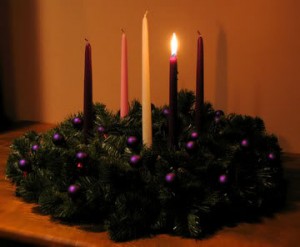
Advent is a time of preparation. But preparation for what? The Church only exists because Christ has already come to us, so Advent might just seem like a collective form of play-acting, where we pretend that we don’t know what’s coming, like naughty children who have long since found where their parents hide the presents, but still have to act surprised on Christmas morning. And that’s what Advent would be if Jesus Christ were just another historical figure whose birth we celebrate, like George Washington or Martin Luther King.
But Jesus is not just a historical man who lived in the distant past. Jesus is the Messiah, the Chosen One of God, God-made-man. His birth, life, death, and resurrection restructured human life in the world—eternity is now always present to us in the living person of Jesus Christ, reigning in heaven.
God became man and lived on this earth in Jesus Christ; in heaven he reigns now, present to us in the liturgy, the sacraments, and the life of prayer; at the end of time he will come again, glorious in his judgment of the living and the dead. Advent allows us to prepare for—to reflect on and be changed by—these three ‘comings’ of Christ: in history, in our hearts, and at the last judgment.
Throughout Advent we will be presenting a series of short meditations that focus on the transformation that God offers us in Jesus Christ. To prepare our hearts for Christ’s Second Coming, we will explore the New Law that Jesus gave us to transform us by his grace: the Beatitudes, the Law of the heavenly Jerusalem. At the same time, we will reflect on the historical coming of Christ, praying with the mysteries of Mary’s life and looking to be made like her, as she was made like Christ.
Today’s meditation: Ask God to show himself to you in a new way this Advent. Spend some time in prayer, reflecting on the three ‘comings’ of Christ.
Check back on Thursday for the next reflection of the Advent 2011: Live Anew Series.
While standing in a supermarket checkout line, I noticed a little sign warning that tobacco products would not be sold to anyone not born before today’s day in 1990. My first kneejerk thought was: “People born in 1990 are still in preschool!” But then I did some quick math in my head and realized that, no, people born in 1990 are now young adults. I was reminded quite forcefully of the old saying “Tempis fugit!” – Time flies.
Time does fly, and we need to be always mindful of the time. Not just so that we know what time it is, which is always important, or so that we’re not late, which is important too. We need to be mindful of time so we can appreciate how quickly it passes, realize how little of it we really have, and accept how short life is.
Before a Sunday Mass once, I was standing in the back of the church. I wanted to know if it was 8:00 o’clock yet so I could start the procession, but for some reason I had forgotten my watch that day. So I asked two different people walking past if they knew the time, but they didn’t have watches either. Then I turned to one of our regular ushers, and asked if he know the time. He held up his forearm, showed me his wristwatch, and said with a smile, “I’m watchful!”
I thanked him and said I would be using his words in my homily on this First Sunday of Advent, because in today’s gospel our Lord tells us very directly that we all need to be watchful. Not just in the sense of being aware of the time, of course, but being watchful for his coming, which could come at any time. We need to be alert and prepared to meet the Lord- whether it be at his second coming at the end of all time, or our meeting him and the end of our time, when we pass from this life into eternity. At both of those times we’ll be judged on how we’ve conducted our lives. We know it will happen; it’s an article of our faith. But we can’t be exactly sure when. And because time flies, the time when we meet Jesus may come more quickly than we think, or expect.
That’s why we need to be prepared; that’s why we need to be watchful.
At a deacon’s funeral I attended, an Irish priest preached the funeral homily in which he recalled a parish mission he had attended in Ireland as a boy. The priest who was leading the mission reminded the entire congregation that one day, everyone in the parish would die. When he said that, however, one woman in the pews began to giggle uncontrollably. At the end of the talk, the priest greeted everyone at the door as they left. When he met the woman who had giggled, he asked her why she had laughed when he said that everyone in the parish would die. “Well you see Father,” she explained, “I’m not from the parish!” The serious point was, however, is that one day we will indeed all die and be judged by the Lord, and for that we need to be prepared.
Preparing to meet the Lord means repenting- turning our lives around, seeking to grow closer to God, opening ourselves more to his grace, striving to follow his will more faithfully, and eliminating those attitudes, habits, and lifestyles that we know to be sinful. I’m reminded of the story of “Easy Eddie” O’Hare, who was the lawyer for Chicago mafia boss Al “Scarface” Capone. Easy Eddie was a crafty attorney whose legal skills managed to keep Capone out of jail and continue his illegal bootlegging, gambling, and prostitution operations. In gratitude for his services, Capone paid O’Hare lavishly and gave him plenty of extra perks, including a massive home that filled an entire Chicago city block.
O’Hare knew who he worked for and even took part in illegal activities himself. But he had a son for whom he wanted a better life. He was able to provide him with fine clothes and an expensive education, but he knew that he couldn’t give his son an honorable name or a good example. And so he made a decision to turn his life around. He met with federal authorities and testified against Capone. This led to Capone’s arrest. It also led to O’Hare’s assassination on a Chicago street. Police removed from his pockets a rosary, a crucifix, a religious medal and a poem clipped from a magazine. The poem read: “The clock of life is wound but once, and no man has the power to tell just when the hands will stop, at late or early hour. Now is the only time you own. Live, love, toil with a will. Place no faith in time. For the clock may soon be still.” O’Hare had seemingly realized that time flies, and that he needed to turn his life around while he still had time- both for himself and for his son. And as for his son, Butch O’Hare, he grew up win the Congressional Medal ofHonor as a Navy pilot. Chicago’s O’Hare Airport is named after him today.
Now, we here this morning aren’t lawyers for the mob, at least I don’t think so. And turning our lives around will probably not place us at risk of being assassinated. But not turning our lives around will place anyone at risk of death, because death is a consequence of sin, and a life lived at odds with God leads to eternal death. This shouldn’t scare us, because God is merciful and wants us to live in hope! But should instead motivate us to conversion, not later, but now, because time, whether we want it to or not, always flies.
The Gospel today surely announces a critical Advent theme: Watch! And while I want to comment primarily on the Reading from Isaiah, the Gospel admonition surely deserves some attention as well.
For it is too often the case that many today hold the unbiblical notion that most, if not all, are going to heaven. But for four weeks now we have been reading gospels wherein the Lord Jesus warns us that some (perhaps many, possibly even most) are not heading for heaven. There are wise and foolish virgins, industrious and lazy servants, sheep and goats, and today, those who keep watch and those who do not.
And though many today like to brush aside the teachings on judgment, or teachings that some are lost, to those who do, and to all, Jesus says, Watch! In other words, watch out, be serious, sober and prepared for death and judgment. Realize that your choices are leading somewhere.
Some have tried to tame and domesticate Jesus, but it is not the fake Jesus they have reinvented that they will meet, it is the real Jesus, the Jesus who warns repeatedly of the reality of judgment and the strong possibility of Hell. At the beginning of Advent we do well to heed Jesus’ admonition and realize our need to be saved.
And that leads to the first reading from Isaiah which rather thoroughly sets forth our need for a savior. Isaiah distinguishes five ailments which beset us, and from which we need rescue. We are: drifting, demanding, depraved, disaffected and depressed. But in the end Isaiah reminds us of our dignity. Lets look at each in turn.
1. Drifting – The text says, Why [O Lord] do you let us wander from your ways, and harden our hearts so that we fear you not? Return for the sake of your servants, the tribes of your heritage.
It is a common human tendency that we wander, or drift. It is a rarer thing that most people, in one moment, reject God, especially if they were raised with some faith. Rather, what usually happens is that we just drift away, wander off course. It is like the captain or pilot of a boat who stops paying close attention. Soon enough the boat is farther and farther off course. At first things are not noticed, but the cumulative effect is that the boat is now headed in the wrong direction. He did not suddenly turn the helm and shift 180 degrees, he just stopped paying attention and drifted, and drifted some more.
And so it is with some of us who may wonder how we got so far off course. I talk with many people who have left the Church, and so many of them cannot point to an incident or moment when they walked out of Church and said, “I’ll never come back here.” It is usually just that they drifted away, fell away, from the practice of the faith. They missed a Sunday here or there, and little by little, missing Mass became the norm. Maybe they moved to a new city and never got around to finding a parish. They just got disconnected and drifted.
Funny thing about drifting, the further off course you get, the harder it is to get back on course. It just seems increasingly monumental to make the changes necessary to get back on track. Thus Isaiah speaks of the heart of a drifter becoming hardened. Our bad habits become “hard” to break, and as God seems more and more distant, we lose our holy fear and reverence for Him.
Interesting how, in taking up our voice, Isaiah, “blames” God for it all. Somehow it is “His fault” for letting us wander for he lets us do it.
It is true that God has made us free and that he is very serious about respecting our freedom. How else could we love God, if we were not free. Compelled love is not love at all.
But what Isaiah is really getting at is that some of us are so far afield, so lost, that only God can find us and save us. And so we must depend on God being like a Shepherd who seeks his lost sheep.
Thus, here is the first way that Isaiah sets forth our need for a Savior. And so in Advent, reflecting this way, the Church cries out, Come Emmanuel, Come Lord Jesus! Seek and find us for many of us are drifting.
2. Demanding – The text says, Oh, that you would rend the heavens and come down, with the mountains quaking before you, while you wrought awesome deeds we could not hope for, such as they had not heard of from of old. No ear has ever heard, no eye ever seen, any God but you doing such deeds for those who wait for him.
There is a human tendency to demand signs and wonders. Our flesh demands to see. And when we do not see, in a fleshly sort of way, we are dismissive, even scoffing.
This human tendency has reached a peak in our modern times when so many reject faith because it does not meet the demands of empirical science and a materialist age. If something is not physical and measurable by some human instrument, many rejects its very existence. Never mind that many things that are very real (e.g. justice, or fear) cannot be measured on an atomic scale. What most moderns are really about doing is more specific: rejecting is God and the demands of faith. “Since we cannot see him with our eyes, he is not there and thus, we may do as we please.”
Isaiah gives voice to the human demand to see on our own terms. We demand signs and wonders, and then we will believe. It is almost as though we are saying to God, “Force me to believe in you” or “Make everything so certain that I don’t really have to walk by faith.”
Many of us look back to the miracles of the scriptures and think, “If I saw that, I would believe.” But faith is not so simple. For many who did see miracles (e.g. the Hebrew people in the desert), saw but still gave way to doubt. Many who saw Jesus work miracles, fled at the first sign of trouble or when he said something that displeased them.
Our flesh demands to see. But, in the end, even after seeing it usually refuses to believe.
Further, God does not usually do the “biggie-wow” things to overwhelm us. Satan does overwhelm us. But God is a quiet and persistent lover who respectfully and delicately works in us, if we let him. It is Satan who roars at us with temptation, fear, and sheer volume, so that we are distracted and confused. God more often is that still, small voice speaking in the depth of our heart.
Thus the Lord, speaking through Isaiah, warns us of this second ailment, the demand for signs and wonders. Our rebellious flesh pouts and draws back in resentful rebellion.
Thus our need for a Savior, to give us a new heart and mind, attuned to the small still voice of God in a strident world. And so in Advent, reflecting thus, the Church cries our, Come Emmanuel, Come Lord Jesus! Calm our souls and lets us find you in the daily and small things.
3. Depraved – The text says, Would that you might meet us doing right, that we were mindful of you in our ways! Behold, you are angry, and we are sinful; all of us have become like unclean people.
The word depraved comes from the Latin pravitas, meaning crooked or deformed. It means to be lacking what we ought to have. Hence, the Lord though Isaiah here describes our deformed state in the following ways. We are:
A. Unthinking – the text says that we are “unmindful” of God. Indeed our minds are very weak and we can go for long periods, so turned in on ourselves, that we barely, if ever, think of God. Our thoughts are wholly focused on things that are passing, and almost wholly forgetful of God and heaven which remain forever. It is so easy for our senseless minds to be darkened. Our culture too has “kicked God to the curb” and thus there are even fewer reminders of Him than in previous generations. We desperately need God to save us and give us new minds. Come Lord Jesus!
B. Unhappy – the text says of God “You are angry.” But, biblically we need to remember that the “wrath of God” is more in us, than in God. God’s anger is his passion to set things right. But God is not moody or prone to egotistical rage. More often than not, it is we who project our own unhappiness and anger on God. The “Wrath of God” is our experience of the total incompatibility of our sinful state before the holiness of God. God does not loose his temper, or fly into a rage, he does not lose his serenity. It is we who are unhappy, angry, egotistical, scornful etc. We need God to give us a new heart. Come Lord Jesus!
C. Undistinguished – the text says, we are sinful; all of us have become like unclean people. We are called to be holy, that is, “set apart” and distinguished from the sinful world around us. But too often we are indistinguishable. We do not shine forth like a light in the darkness, we seem little different than the pagan world around us. We divorce, fornicate, fail to forgive, support abortion, contraception, fail the poor, etc., in numbers akin to secular people who know not God. We do not seem joyful, serene or alive. We just look like “everybody else.” And we seem to have as our main goal to “fit in” and be like everyone. Save us O Lord from our mediocrity and fear. Come Lord Jesus!
4. Disaffected – The text says, There is none who calls upon your name, who rouses himself to cling to you; for you have hidden your face from us and have delivered us up to our guilt.
In other words we, collectively speaking, have no passion for God. We get all worked up about politics, sports, the lottery, a T.V. show, etc. But when it comes to God, many can barely rouse themselves to pray, go to Church, or read scripture. We find time for everything else, but God can wait.
Here too Isaiah gives voice to the human tendency to blame God, for he says (i.e. we say) God has hidden his face. But God has not moved. If you can’t see God, guess who turned away? If you’re not as close to God as you used to be, guess who moved?
Our heart and our priorities are messed up. We need a savior to give us a new heart, a greater love and better priorities and desires. Come Lord Jesus!
5. Depressed – The text says, All our good deeds are like polluted rags; we have all withered like leaves, and our guilt carries us away like the wind.
One of the definitions of depression is anger turned inward. And while Isaiah has given voice to our tendency to direct anger and blame at God, here he gives voice to our other tendency, to turn on ourselves.
Thus, our good deeds are described like polluted rags. It may be true that they are less than they could be, but calling them polluted rags is the kind of exaggeration that bespeaks a frustration with our seemingly hopeless situation, and addiction to sin and injustice.
Ultimately the devil wants us to diminish what little good we can find in ourselves and to lock us into a depressed and angry state. If there were no good in us at all, why bother?
There is such a thing as unhealthy guilt and a self loathing that is not of God, but from the devil, our accuser. It may well be this that Isaiah articulates here. And from such depressed self loathing (masquerading as piety) we need a savior. Come Lord Jesus!
And so the cry has gone up: Come Lord Jesus, save us, Savior of the world! We need a savior, and Advent is a time to mediate on our need.
But Isaiah ends on a final note and the song goes from D minor to D Major. And the final Note is our
Dignity – the text says, Yet, O LORD, you are our father; we are the clay and you the potter: we are all the work of your hands.
Yes, we are a mess, but a loveable mess. And God has so loved us, as to send his Son, who is not ashamed to call us his brethren.
We are not forsaken, and in Advent we call upon a Father who loves us. And our cry, Come Lord Jesus is heard and heeded by the Father, who loves us and is fashioning us into his very image. God is able and he will fix and fashion us well. Help is on the way!
Here’s a magnificent Advent Hymn that so beautifully expresses the longing of the Church for her savior to come. The second verse says:
Zion hears the watchmen shouting,
Her hearts leaps up with joy undoubting!
She stands and waits with eager eyes.
See! Her Love from heaven descending,
Adorned with grace and truth unending.
Her light burns clear her star doth rise!
Now come our precious Crown,
Lord Jesus, God’s own Son
Hosanna!
The video at the bottom of this post is a fascinating little exploration of the traditional habit of Religious Sisters. The video does not make it clear as to what Order the Habit belonged. There are many things I learned about a habit I never knew. Things like hidden “saddle bag” pockets, opening crucifixes, symbolism in the pleats, and the purpose of the outer veil. I hope you’ll take time an view a fascinating video.
Sadly, the sister who recounts the hidden and beautiful secrets of the habit does not herself wear one any longer. The abandonment of the habit by many orders has always puzzled me. Recent Popes have requested that priests and religious wear their distinctive garb. Further, I think any survey of the people of God would indicate an overwhelming preference that priests and religious wear a distinctive garb or habit. Lastly, from the standpoint of vocations it would seem that any order that has set aside the habit is doomed to eventual extinction. It is clear that the orders that preserve the wearing of the habit along with common life, common prayer, and a focused apostolate are doing better, some quite well, with vocations. Orders that have set aside the habit are largely dying out. It is not the habit alone, I am sure, but the habit (or lack thereof) does signify something important about the health of the religious community.
What is the purpose of a religious habit? Religious life is not hidden, neither is it occasional. To enter the priesthood or religious life is to publicly accept the consecration of one’s whole self to the service of God and neighbor. That is why the most traditional religious garb covers the whole body. It is more than a tee-shirt, a hat or an emblem of some sort. It is a covering of the whole body to indicate the entirety of the consecration.
Further, each habit is distinctive since each religious community has a particular charism or gift by which they collectively serve the Church. Religious and priests do not merely consecrate themselves for their own agenda. Rather they join others with a similar and proven charisms in communities recognized by the Church.
The word “habit” also suggests that religious life and priesthood are not an occasional activity, or even a 9 to 5 job. The are the habitual identity and life of the one who receives the call. That is also why the habit is usually worn at all times.
The widespread disappearance of clerical garb and religious habits back in the 1970s was a disturbing trend. Many religious and priests no longer saw themselves as set apart, as distinctive. Many wanted to blend in and also lost a sense of the charism of their order. Many also preferred anonymity since it made them less busy and they no longer had to live as “public” people. However, many newer orders have emerged which once again wear the habit faithfully. Further, many older orders either never wholly abandoned it or have re-emphasized its importance. This is praiseworthy. If you are a lay person, encourage priests and religious as you see them about bearing witness to the their consecration by the way they dress and reminding others of God and the Kingdom of God.
If this post seems familiar, it is, I have re-posted it from about a year ago since I had no time to write a blog for today. I also suppose some newer readers may have missed it.
One of the cultural challenges we face in both living and proclaiming the faith is that the true faith doesn’t often fit our frantic pace and instant expectations. Consider that may today, including we who believe, demand the “Quick Fix.” What ever the situation, be it sickness, a needed repair of something we own, the delivery of something we have purchased, a resolution of family troubles, or even deeper issues such as inner peace, we want a quick fix.
But many things do not admit of a quick fix, especially the deeper things of the human soul. And the faith we proclaim does not propose something so simple. In this sense, the faith is less “marketable” to our quick fix culture. We do not (cannot) say “Simply Come to Mass for six, sequential Sundays and your problems will be over.” Rather, we say, “Give your life to Christ.”
The solution of God and of the true faith insists on an often slow but steady movement toward God wherein he draws us in stages, ever deeper to Him, to holiness, to perfection. Little by little, our fears fade, sins diminish, we become more loving, patient, compassionate, chaste, serene and so forth. The process usually takes decades, no quick fix here.
And many medicines need to be consistently applied: daily prayer, daily Scripture and spiritual reading, weekly Mass and Communion, frequent confession, and communal life in the Church to include helpful friendships, faith-filled relationships and works of Charity.
There is an old saying that “Grace builds on nature.” That is to say, that God’s grace respects the way we are made by him. And just as it pertains to our physical nature to change slowly, almost imperceptibly, (but surely), so our spiritual nature usually follows the same pattern. And, while there may be growth spurts, it is more often the subtle and sure growth that makes the deepest difference.
I can surely say this has been my experience. I have been serious about my spiritual life for the last 28 of my 50 years: daily Mass, daily Scripture, daily holy hour, weekly confession, fellowship with my people, holy friendships and spiritual direction. And wow, what a change! But it has taken 28 years to get here, and most of my growth was imperceptible, day to day. I’m not what I want to be, but I’m not what I used to be, a wonderful change has come over me.
Not the quick fix, not the fast rush, just a inching along like a poor inch worm (as an old Spiritual says). But praise God I am where I am today.
Lifelong plans may not “sell” but they are the way God insists on working.
On Fridays I have often tried to keep the post a little shorter and have tried to use a commercial to make my point. So how about this one:
In the commercial, below the is a man, Jerry, who is in a “State of Regret.” In a certain sense (as we shall see), Jerry represents all who stray from the Church and God’s life long plan of faith, looking for a fast rush, and quick fix elsewhere, apart from the faith and the Church.
Sure enough, Jerry’s regret is that he has dropped his “State Farm” Insurance and went with the “other company,” let’s call that company “Quick Fix Auto Insurance.” I allowing State Farm to represent the Church, I intend no endorsement, but do recall that “farming” is no quick fix business. It involves a lot of patient waiting and persistent working. Such is the work of the Lord and his Church, no quick fix, but more like farming.
Jerry complains to his former agent “Jessica” (but lets call her “Mother Church”). His complaint is: It only took me 15 minutes to sign with that other company but it’s taking a lot longer to hear back. OK, so now he’s learned that there really is NO SUCH THING as a “quick fix” when it comes to many things. And so must we learn this same truth. The world, the flesh and the devil, often make such promises and sow seeds of impatience in us when God does not act instantly, when the Church bids us to be patient and persistent. But Now Jerry’s impatience has brought him further troubles, as we shall see.
Jerry explains he’s had a “fender bender” The truth is Jerry has bent far more than a fender. He is in real trouble. We too often like to minimize our state when we have made bad decisions.
Jessica (Mother Church) is sympathetic but wonders what she can do, for Jerry has ended his relationship with her. Without a relationship, how can she help him? Here too, Mother Church often wants to help us, but must have a relationship with us to help. God too, seeks communion with us, in order to help us. But communion, a relationship, with the Lord and his Bride the Church are necessary for help to be extended.
Indeed Jessica (Mother Church) knows Jerry well, and seems, like a mother, to know implicitly and exactly what he has done. She knows he’s in real trouble and has “put his car up a pole” (again). There’s just something about Mother Church, she knows her children and what we do, she knows, and understands.
Hearing Jessica’s (Mother Church’s) knowing but compassionate words Jerry breaks down and says “I miss you Jessica!” The ad then says, “Let it out Jerry! Then come back to State Farm.” Yes, indeed. And so too for us. Soulful and tearful repentance and a restoration of our relationship with the Lord and his Church, are the way out.
Quick Fix Insurance Company can’t cut the deal. Come back to the Lord and his Church. The solution may not be “quick” but it will be sure if we stay the course.
One of the dangers in presenting New Testament moral teaching is that the preacher or teacher risks reducing the Gospel to a moralism. In other words the moral truth that is proclaimed is reduced merely to another rule that I am supposed to keep out of my own flesh power. This is an incorrect notion since, for a Christian, the moral life is not achieved, it is received. The moral life is not an imposition, it is a gift from God.
In the Gospel chosen for the American Holiday of Thanksgiving we have the familiar story of the ten lepers who are healed by Jesus and only one returns to thank Him. This fact of the ingratitude of the other nine prompts an irritable response by Jesus who more than suggests that they should also have returned to give thanks. Now if we just read this Gospel on the surface we can come away merely with a moralism that we should do a better job about being thankful to God and others. Well, OK. But simply having another rule or being reminded of a rule that already exists isn’t really the Gospel, it’s just a rule or an ethic of polite society.
Where the Gospel, the Transformative Good News exists, is to receive from God a deeply grateful heart so that we do not merely say thank you, but we are actually and deeply moved with gratitude. We are not merely being polite or justly rendering a debt of obligation to say “thanks” we actually ARE grateful from the heart. True gratitude is a grace, or gift from God which proceeds from a humble and transformed heart. In such a case we do not render thanks merely because it is polite or expected, but because it naturally flows from a profound experience of gratitude. This is the Gospel, not a moralism, but a truth of a transformed heart.
Thus, an anointing to seek from God is a powerful transformation of our intellect and heart wherein we become deeply aware of the remarkable gift that everything we have really is. As this awareness deepens so does our gratitude and joy at the “magnificent munificence” of our God. Everything, literally everything, is a gift from God.
Permit a few thoughts on the basis for a deepening awareness of gratitude. Ultimately gratitude is a grace, but having a deeper awareness of the intellectual basis for it can help to open us more fully to this gift.
1. We are contingent beings who depend on God for our very existence. He holds together every fiber of our being: every cell, every part of a cell, every molecule, every part of a molecule, every atom, every part of an atom. God facilitates every function of our body: every beat of our heart, every organ and movement of our body. God sustains every intricate detail of this world in which we live: the perfectly designed orbit of this planet so that we do not cook or freeze, the magnetic shield around the planet that protects us from harmful aspects of solar radiation, every intricate visible and hidden process of this earth, solar system, galaxy and universe. All of this, and us, are contingent and thus sustained by God and provided for by Him. The depth, height, length and width of what God does is simply astonishing. And he does it all free of charge. As we ponder such goodness and providence we are helped to be more grateful. All is gift.
2. Every good thing you or I do is a gift from God. St. Paul says, What have you that you have not received. And if you have received, why do you glory as though you had achieved? (1 Cor 4:7). Elsewhere he writes, For it is by grace you have been saved, through faith—and this not from yourselves, it is the gift of God—not by works, so that no one can boast. For we are God’s workmanship, created in Christ Jesus to do good works, which God prepared in advance for us to do. (Eph 2:8-10). Hence even our good works are not our gift to God, they are His gift to us. And on judgment day we cannot say to God, "Look what I have done, you owe me heaven." All we can say on that day is “Thank You!” All is gift!
3. Gifts in strange packages – There are some gifts of God that do not seem like gifts. There are sudden losses, tragedies, natural disasters and the like. In such moments we can feel forsaken by God, and gratitude is the last thing on our mind. But here too, Scripture bids us to look again: And we know that all things work together for the good of those who love God and who have been called according to his purpose. (Romans 8:28). We don’t always know how, but even in difficult moments God is making a way unto something good, something better. He is paving a path to glory, perhaps through the cross, but unto glory. For now we may have questions but Jesus has said to us: But I will see you again and you will rejoice, and no one will take away your joy. On that day you will have no more questions to ask me. (Jn 16:22-23). Yes, even in our difficulties we are more than conquerors (Rm 8:37) because the Lord can write straight with crooked lines, and make a way out of no way. All is gift!
4. Yes, all is gift. Absolutely everything is gift. Even our failures, if we are in Christ and learn from them and they teach us humility. For what shall we give thanks? Everything! All is gift!
5. There is an old saying:Justice is when you get what you deserve. Mercy is when you don’t get what you deserve. grace is when you get what you don’t deserve. I like you get asked a dozen times a day, “How are you doing?” I have trained myself to often answer, “More blessed than I deserve.” Yes, All is gift.
6. Finally, the work “Thanks” in English is unfortunately abstract. But in the Latin and the Romance Languages, the word for “thanks” is far more tied to the fact of grace and gift. In Latin one says thank you as gratias ago tibi, or simply, gratias. Now gratias is translated as “thanks” But it is really the same word as “grace” and “gift” which in Latin is rendered gratia. Hence when one receives a gift they thus exclaim: “Grace!” or “Gifts!” It is the same with Spanish: Gracias and Italian: ‘Grazie. French has a slightly different approach but no less abstract when it says Thank you as Merci which is rooted in the Latin merces, meaning something that has been paid for or given freely. So all these languages vividly record the giftedness that underlies everything for which we are grateful. The English word “thanks” does not quite make the connections. About the closest we get are the words, gratitude and grateful. And again all these words (gratias, gracias, grazie, merci, gratitude) teach us that all is gift!
To be grateful is ultimately a gift to be be received from God. We ought ot humbly ask for it. We can dispose our self to it by reflecting on things like that above but ultimately gratitude comes from a humble, contrite and transformed heart. Saying thank you is not a moralism. True gratitude is a grace, a gift that comes from a heart deeply moved, astonished and aware of the fact that all is gift.
At the heart of thanksgiving is not just food, but also family and fellowship. And, in these busy and distracted times we don’t have enough of these. But communion with God and each other is a foretaste of heaven. On the road to Emmaus Jesus gave a poignant picture of heaven: walking, talking and dining. And though I suspect we’ll do little walking this Thanksgiving, surely talking and dining will be an important part of it for most of us.
Pushes back the Evil One – And be mindful of this, our intentional communion, our talking and dining, if done with charity, pushes back the incursion of the evil one and helps prepare us for heaven. And we also stress charity and be intentional about it. For the devil despises communion and will do what he can to destroy or limit what ever communion we seek or find among each other.
I am somehow mindful of a quote from Pope Benedict XVI:
If there were such a thing as a loneliness which could no longer be penetrated and transformed by the word of another; if a state of abandonment were to arise which was so deep that no “You” could reach into it any more, then we should have real, total loneliness and frightfulness, what theology calls “hell”. We can now define exactly what this word means: it denotes a loneliness which the word love can no longer penetrate…a night into whose solitude no voice reaches. (In Introduction to Christianity, commentary on “Descended to hell.”)
Yes, our Thanksgiving fellowship, our communion of love, is essential for us. A kind of a remedy for the soul and a protective embrace against the powers of Hell. It helps, by God’s grace, to push back the loneliness and alienation that easily envelop us today in this “communication age.” For, as we too easily discover, communication is not the same as communion. In this simple feast we are reminded that we were made for love and communion.
Allow God to work many graces in for you this thanksgiving, especially the grace to love and find deeper communion with Him and others.
On a lighter note, this T.V. commercial in the video below (from the 1950s) teaches you how to add at least a 1000 calories to your Turkey this year.
Despite the terrible dietary advice given herein, I must say this video gave me a warm memory of my father, mother and sister as I watched it. For when I was very young, my mother and sister would be in the kitchen preparing the bird, and bonding as only a mother an daughter can. And my father would be nearby sharpening the knives and preparing for his role in cutting the turkey and the roast. (Though he would never wear the silly apron seen in the ad). They are all deceased now, but I can almost see them in this look into the past; a communion still.
Most of you know that I have spent all but four of my years as a priest ministering in African American Parishes and that I am enthusiastic about my experiences. Like any pastoral setting, there are challenges, but there are also wonderful gifts. Chief among the gifts is the liturgical experience which is vibrant, life giving, joyful and filled with great expectation. There is support for the preacher, a great appreciation of musical gifts and an unmistakeable acknowledgment of the presence of the Lord in his Word and in Holy Communion. It has all been a wonderful blessing to me as a priest, and also as a Catholic and disciple of the Lord.
A study was recently published by Notre Dame and I’d like to offer a few excerpts of that study and comment on it. A full “executive summary” by William Gilroy is here: Notre Dame Survey of African American Catholics. As is usual with my commentaries, the original text is in Black, bold and italic typeface. My comments are in plain red text.
Among the key findings of the survey are:
On almost every measure of religious engagement, African American Catholics are considered stronger in their faith than white Catholics. For example, when asked how well their parish meets their spiritual needs, 78 percent of African American Catholics say their needs are being met, while 68.7 percent of white Catholics responded similarly. When asked if their parish meets their emotional needs, 75.7 percent of African American Catholics say their needs are being met, compared to 60.4 percent of white Catholics.
I generally think this is true. Black Catholics who attend Mass are generally very close knit to parish life at a variety of levels. Choirs are usually larger and well skilled, excited about what they do. Ushering is also a noble tradition. Women’s groups such as the Sodality are strong, to lesser but still clear extent, Men’s groups. Prayer groups are also strong since there is usually a strong “praying spirit” among African Americans.
“This finding also shows up among African American Catholics who attend predominantly black parishes,” Davis said. “A greater sense of community that comes from worshipping with others who share cultural heritage heightens religious engagement. Whatever forces are working against white Catholics’ religious identity and engagement were set in motion decades ago and those forces do not appear to be working against African American Catholics. Thus, it is quite possible that understanding African American Catholicity may inform us about the religious challenges of white Catholics. Too often we approach questions of religiosity in a vacuum. Comparable studies of religiosity are critical.”
Yes, here I strongly agree. Blacks, unlike most Whites, share a kind of “sacred culture.” What I mean by this is that spirituals and Gospel Music permeate Black culture. It is also more common to freely express and inquire about religious matters. Sometimes I’ll be the store, and an African American will come up and, seeing my Roman Collar, inquire joyfully of me where my church is and also share something of their own background or church. It is not uncommon for some one to come to me ask that I pray, “right here, right now Father.” And so there we are, standing in the main aisle of Safeway praying together. Another may come to me and say, “Preacher! You got a word for me today?” It’s just a part of the culture. This is rare in the White communities where I grew up.
And this shared “sacred culture” finds a vibrant expression in the Mass in the form of Gospel music, joyful exuberance, call and response, lively interaction with the preaching though affirmations like “Amen!….Yes!….Go on preacher!…..Yes Lord!…..Hallelujah…….applause, a stomp, raised hands and so forth.
I think it is this shared sacred culture which has made the “New Mass” work so well in the African American setting. The traditional Latin Mass had a kind of “built in” culture and ethos, a certain music that was prescribed and so forth. But the new Mass stripped a lot of that away, and allowed the local culture to supply more. That of course works well only when there is a sacred culture to draw on.
White America had become largely secularized by 1970 and so the “culture” we ended up drawing on was questionable at best, a kind of Peter Paul and Mary folk sound, and a hat tip to the “protest songs” of the 1960s college crowd.
But in the Black community a sacred music and culture was ready at hand for Catholics to draw on, a music and ethos that powerfully and creatively lifts up God and praises his glory, sings of our “troubles,” but also describes how God brings us “through.” And in Gospel music, the focus is always on God rather than the “gathered community” so often emphasized in Catholic contemporary music.
There were also many other elements I have already mentioned (e.g. spontaneous acclamations) that made the “participatory” element in the New Mass an easy transition for African American Catholics.
This sacred culture was a time tested tradition in the Black community and, as a general rule, highly esteemed even by those less prone to shout “Amen.”
On the often-used measure of Church attendance, 48.2 percent of African-Americans attend church at least once per week, compared to only 30.4 percent of white Catholics. I am not so sure of this number. Anecdotally, I think it is closer to 30%, especially among younger African Americans, who are far less “churched” than their parents and Grandparents.
While there is generally high satisfaction with various aspects of Mass and church service, such as preaching, music, readings and prayers, Catholics’ (both white and African Americans) level of satisfaction with these aspects of Mass are noticeably lower than Protestants.
Yes, frankly, we in the Church have not done so well in training priests and deacons to minister well in the things valued most highly by African Americans.
Preaching is highly valued among Blacks, and they generally prefer a longer sermon than most Whites. However, more than time, the sermon moment that is preferred is one in which the preacher carefully breaks open the Word of God in a way that is enthusiastic, creative, informative and easily applied for the up coming week. Most African Americans don’t what to hear only the “what,” but also the “so what” and the “now what” of God’s Word.
But too many Catholic priests and deacons (to include African American priests and deacons) are trained in a methodology of “informative” and “discursive” preaching as a goal, more than “transformative” and “kerygmatic” (from the Greek κηρύσσω (kērússō), to cry or proclaim as a herald)preaching.
The “say it in seven” mentality, common in Catholic training, that prizes brevity over anything else is also not a helpful approach. It is quite difficult to preach a transformative homily, (wherein the Word is read, analyzed, organized, illustrated and applied), in seven minutes.
Hence African Americans are often less than satisfied with the Sunday sermons they hear from most Catholic priests and deacons, especially compared to what they hear in the Protestant settings they often have contact with. There are many good and exceptional preachers in Black Catholic parishes but they are less in abundance than they should be.
It is sad, since good preaching can be learned, but most preachers usually think their preaching is just fine, and they are not open to being taught. It is also a fact that Blacks are not the only ones who rate Catholic preaching poorly. Frankly most Catholics think Catholic preaching leaves a LOT to be desired.
But until we work at training better preachers, and until the Catholic faithful are more open to Masses with slightly longer homilies, it does not seem that much will change. The 7-10 homily that says everything, covers all the things we need to hear, applies them creatively and with inspiration is going to be hard to find. In my own parish, homilies at the main Sunday mass are usually closer to 30 minutes, and it is a great luxury affored to me so that I can develop the entire passage and celebrate it with the People of God.
I know as I write this that I’ll get the usual comments on this that a sermon doesn’t have to be long to be good. This many be “true” in limited instances and settings, but it is not usually true. To really develop something takes longer than 7 minutes and I have never attended a public lecture that was 7 minutes, or even 10 minutes. A half an hour is more the norm among the Protestant preachers who, frankly rate higher in their abilities to preach effectively as a general rule.
The celebration “style” of priests is also an important matter. African American congregations generally value a celebrant who is praiseful but not clownish. Wooden and monotone proclamation of the prayers, a refusal to even attempt to sing the mass parts, and the look of the “frozen chosen” are not appreciated in most Black parishes. While some Catholics value a “somber” look as indicative of solemnity and prayerfulness, this is less the case among African Americans for whom piety is manifest in a more joyful and exuberant manner in the presence of God. It is not just the priest from whom this is expected or valued, but also the lectors and musicians.
African American Catholics see room for growth in the racial positions of the Catholic Church. A total of 36.6 percent are satisfied with the targeting of black vocations, 38.1 percent are satisfied with the Church’s emphasis on black saints, 39.9 percent are satisfied with promoting black bishops, 40.2 percent are satisfied with the Church’s support for issues like affirmative action, 44.2 percent are satisfied with the Church’s position on problems in Africa, and 45.1 percent are satisfied with the promotion of racial integration in the Church.
Not sure what to do with this information.
Black vocations are harder to come by since, frankly, the Black family, and especially the Black male are in crisis. There are many reasons for this, too long to explore here. But the fact is, in every ethnic and racial group, it takes strong and large families to produce vigorous vocations.
I know that this Archdiocese actively recruits Black vocations, so do I as a pastor. But the pool of “recruits” is smaller. Frankly many Black women have trouble finding a Black man to marry, only 37% of Black women have ever been married. Almost 1/3 of Black men are incarcerated, another 1/3 are unemployed. There are many issues to be resolved.
And lest we single out the African American community, the Latino and also the White community are not far behind as the crisis of the family becomes an American problem. Fewer and fewer of ALL Americans are raised in a traditional family. And all this is making it harder to find priests and help them stay priests, when broken homes are more and more the norm, from which we must seek vocations.
As for the other matters, I do not think numbers like these are unique to African Americans. Any number of groups and interests think the Church “isn’t doing enough” in some or many areas. I suppose we don’t do enough to promote the collection for the Church in Latin America or Eastern Europe either. The fact is, the Church in America is rather parochial and a collection of interests, and its hard to satisfy any one group well. I work with many Traditional Catholics who don’t think the Church does enough to promote the Traditional Latin Mass. I have also worked with the Neocatechumenal Way who don’t think there are enough communities of “The Way,” and so on. So I think this is a human problem. In the end it is up to members of various charisms and groups to promote themselves and stop waiting for “the Church” to do this work. They are the Church too.
The survey also uncovered notable national demographic trends that are evident within religious denominations that have great consequences for the future Church.
A total of 52.6 percent of African American Catholics and 53.3 percent of African American Protestants are at least 45 years-old, compared to 63.2 percent of white Catholics and 62 percent of white Protestants. There are also huge racial differences in the percentage that are married, reflecting another national trend. A total of 39.9 percent of African American Catholics are married, compared to 53.9 percent of white Catholics.
I have already noted these factors above. The African American parish has a slightly “younger” look than most White parishes. This is due to have slightly more children but also due to the higher mortality rates, especially among Black men who die significantly younger than the American norm. Further as we have noted, the problem with marriage and family is a growing concern. And, while the Black community has struggled with this problem a lot longer, the wider American family is also in trouble. Frankly it “ain’t no great shakes” that only 53% of Whites are married and it will be noted that 53 and 39 are only 14 points apart. These are numbers for all of us to sober about.
In the end, we see that, like any sector within the Church, African American Catholics have glories and struggles, gifts and needs. I personally think that, liturgically, there are tremendous gifts in the African American community and that the wider Church can learn much from the liturgical experience and practices on regular display at predominantly African American parishes. Joy, high expectation, participation, a focus on God, and experience of the powerful presence of God in Communion are things that should be evident in every Catholic parish. Too many Catholic parishes look more like a widow than a bride, and the “wedding feast of the Lamb” is perfunctory and minimalistic more than loving and generous. Brevity seems more the concern than worship, and the encounter with a living and true God. This is far less the case the predominantly African American parishes, and there is much for the wider Church to learn.
And, frankly, there are internal problems in the African American community that largely Black parishes need to do a better job of addressing. The decline in marriage, the rise in single motherhood, high abortion rates and other social problems need to be frankly addressed and turned back. Like any social difficulty, many of these trends go back to the early 1960s and are going to take time to reverse. But work at them we must.
Joys and struggles, gifts and needs, the human story.