The video below is a kind of retelling of the parable of the pearl of great price, and also a bit of the story of the Woman at the Well.
The parable of the pearl of great price is a brief one:
Jesus said, the kingdom of heaven is like a merchant looking for fine pearls. When he found one of great value, he went away and sold everything he had and bought it. (Matt 13:45-46)
And as for the Woman at the Well, that story is too long to reproduced here but the pertinent facts are that a woman comes every day to a well that symbolizes the world. And that well gives water, but a kind of water that keeps her thirsty. Every day she has to come back for more with her water Jar. Jesus asks her to consider how the well (i.e. this world) cannot really satisfy the God-sized hole in her heart, that He alone can ultimately fulfill her deepest longing. After leading her through stages of faith and repentance, Jesus brings her to the point that she leaves her water jar behind to go and tell others of the joy she has found in Christ.
The video below tells a similar story. A young girl is playing in the sandbox of this world, creatively building with its resources. Around her neck is a locket which symbolizes her greatest treasure from this world, her “idol,” if you will. What exactly that worldly treasure or idol is, that is for you to answer. Perhaps it is popularity, possessions, power, or some pleasure.
But as the world, with its false promises of lasting joy often does, her worldly creations and accomplishments are swept away in a moment by a huge wave. Her idol cannot save her, it too is swept away. Sic transit gloria mundi
But she must recover it! She must regain her foothold in this world’s passing pleasures and powerless idols! So she dives even deeper into this tumultuous world, as if willing to experiences its most deadly forces, if only she can get back what she lost, what the world cruelly took back! Her idol not only cannot help her, it is what leads her into the very jaws of death.
She dies in the process, never getting her idol back. She is like so many of us who will risk our eternal salvation, diving ever deeper into this world’s peril if only we can gain its treasures. Even if it kills us, and lands us in Hell, we want what it offers. Idols kill, only God gives life.
But then comes the paradox, the twist in the story. For her death becomes an image of baptism. In dying to this world, she awakens from the waters, to a new life. And the Lord has placed a gift in her hand, a pearl of great price! God has taken the very waters that led to her death and through them, drawn her through them to new life.
Awakening to this new life she looks into her hand and sees her pearl of great price. In an instant we can tell that she has forgotten her sand castles, and her locket/idol. And she runs forth to tell others what she has found.
And just like the woman at the well who left her water jar behind to run and tell others about Jesus who was now her living water, thus we see the once treasured locket washing up on shore, as the young girl, with her greater treasure, runs to share her joy, the locket forgotten and left behind.
Enjoy this video. It has the interesting quality of having been sketched out but not fully finished. Maybe that is because you have to finish it, and fill in its lively colors with your life.
The Feast of St. Mark that we celebrated today is a reminder that the Gospel occurs in the human setting and condition. Somehow I thought of this on this feast for Mark, also known as “John Mark” was at the center of tension between Paul and Barnabas and the differences were so severe that it led to a parting of way for the two.
And yet, St. Mark despite his less than stellar beginning in Church Leadership came to prove his worth and was reconciled to St. Paul.
Perhaps to work the back story a bit we should start by focusing on St. Barnabas for a moment, and then turn our Attention to St. Paul.
St. Barnabas was a Jew, a native of Cyprus, and was of the tribe of Levi. As such he likely served in the Temple as a priest, depending on his age at his conversion to Christianity. His given name was Joseph, but the Apostles called him Barnabas, which means “Son of Encouragement” (cf Acts 4:36).
Likewise he was probably a wealthy man, for St. Luke presents him early in the book of Acts as a generous man who sold land to support the growing Church.
Most critically, it was he who vouched for the new convert Saul of Tarsus later known as Paul. For Paul was viewed with suspicion by those in Jerusalem, including the Apostles, who only been recently targets of his persecutions (cf Acts 9:26).
Talk about one of the most pivotal introductions in history! Indeed it may be argued that this introduction changed the course of Western History and surely that of the Church. Barnabas smoothed the way for the Church’s most zealous missionary and her greatest Biblical Theologian, St. Paul. After Barnabas’ introduction, Paul was able to move freely about the disciples.
Some time after this, the apostles in Jerusalem sent Barnabas to Antioch which was now growing and thriving congregation of both Jews and Gentiles. It seems clear he was not considered yet to be of the rank of apostle or bishop, (for Acts 13:1 calls him a teacher), it appears he went more to observe and be of help. Under his leadership and the leadership of others, the Church there thrived and grew quite quickly.
So Barnabas sent for Paul to come and join him. They work together for the period of at least a year, and it was at Antioch the disciples were called Christians for the first time (Acts 11:26). In so doing he continues to advance and build up Paul’s ministry in the Church. Frankly this too is a stunning moment in Church history, given us by Barnabas. It is not wrong to call St. Paul the protege of Barnabas.
At a certain critical moment leaders at Antioch laid hands on Barnabas and Saul. And while it is debated by some, this is the clearest moment when we can now say they are ordained, and given the rank of Bishop and the title “Apostle.”
Missionaries – Having done this, the Church leaders at Antioch, directed by the Holy Spirit, send them forth on missionary work. This journey is what is now come to be known as Paul’s first missionary journey. It is interesting to note, that early in the missionary journey, Barnabas is always listed first, and then Paul. But rather quickly, in Acts 13:43, the order changes, and Paul is always listed first. This suggests a change in leadership.
They took with them on this first journey the cousin of Barnabas, John, who was called Mark. Somewhat early on this missionary journey, Mark decides he can no longer go on and turns away from the missionary trip. This will prove significant later on.
The last major role for Barnabas was in Acts, in the 15th chapter, at the Council of Jerusalem which was called to decide whether Gentile converts could become full members of the church without converting to Judaism. Barnabas, along with Paul, provided important evidence as to the zeal and conversion of the Gentiles.
A Sad moment – After the Council in Jerusalem Paul and Barnabas returned to Antioch in triumph, their ministry vindicated. They planned another missionary journey together. But here comes the critical and sad moment, that sets forth our teaching:
Some time later Paul said to Barnabas, “Let us go back and visit the believers in all the towns where we preached the word of the Lord and see how they are doing.” Barnabas wanted to take John, also called Mark, with them, but Paul did not think it wise to take him, because he had deserted them in Pamphylia and had not continued with them in the work. They had such a sharp disagreement that they parted company. Barnabas took Mark and sailed for Cyprus, but Paul chose Silas and left….(Acts 15:36-40)
A sad moment, but illustrating the human situation. Here are two men who have been like brothers. Paul owes his inclusion in leadership largely to Barnabas, and together they had taught together, and journeyed hundreds of miles by ship and then by foot into the northern mountains making converts in effective ministry together. And, more recently they have just returned from Jerusalem, their vision and ministry approved and vindicated against nay-sayers among the brethren. And yet, at this magnificent moment Paul and Barnabas argue and part company over Mark, the cousin of Barnabas.
One of the things I admire most about the Biblical text is that it does not “clean up” stuff like this. Our heroes are not perfect men, they are flawed, and emblematic of the human condition: gifted and strong, but struggling too with the same issues and demons that haunt us all.
The lesson? God uses us even in our weakness. Who was right and who was wrong here? It is difficult to say. Two gifted men unable to overcome an impasse, alas, the fallen human condition. But God will continue to work. He can make a way out of no way and write straight with crooked lines.
Even more sad, this is the last we hear of Barnabas in any substantial way. He who had been so instrumental in the life of his protege Paul, and in the early Church, now exits the stage in the heat of an argument. The text says he and Mark sailed for Cyprus, then silence……
There is mention of him in Galatians but, given the vague timeline it is difficult to assume it takes place after the disagreement. It likely took place earlier and may illustrate that there were already tensions between Paul and Barnabas before the “Mark incident.” For it would seem that Barnabas was following Peter’s weak example of not eating with Gentiles, and this clearly upset Paul (cf Gal 2:13).
Healing? Yet, It would also seem that Barnabas continued to labor as a missionary for Paul makes mention of him to the Corinthians (cf 1 Cor 9:6). And although his reference is passing, it is not unrespectful. This suggests some healing of the rift, even if it does not mean they labored together again.
More healing? And even for John, called Mark (likely the same Mark who became secretary to Peter and authored the Gospel of Mark), it would seem Paul and he overcame their difficulties. For St Paul wrote to Timothy, likely about the same Mark: Get Mark and bring him with you, because he is helpful to me in my ministry (2 Tim 4:11). Something of a redemption here for Mark and a healing for Paul. The “useless” deserter Mark, now one who is helpful to Paul.
Perhaps, though the loss and seeming disappearance of St. Barnabas is sad, there is still the Story of St. Mark’s growth to greater maturity and to leadership. Though less than reliable at first, he later proves hsi worth. It would seem we have St. Peter to thank for that, taking Mark as his secretary and age. We also have St. Barnabas to thank who did not give up on Mark. But at the end of the John Mark proves himself helpful in the ministry and St. Peter could call him “My son.” (1 Peter 5:14)
God can make a way out of no way. Even in our weakness, (and often only because our weakness keeps us humble), God can do great things.
At a recent meeting wherein an elderly relative was preparing advanced medical directives, a friend of the family, a secular Jew, expressed the discomfort the speaking about dying brings something to most people. I happened to mention in passing, that for a Christian, the day we die is really the greatest day of our life. She looked to me with some surprise and while I expected her to articulate that she thought that heaven was a dubious reality, instead she Said something quite different. She said, “Perhaps there is heaven for the faithful who believe after death. And perhaps then, to die is the greatest day of one’s life. But I do not observe the Christians live this way. It seems that they are just as anxious as anyone else about dying, and earnestly seek to avoid death just as much as anyone else.”
A very interesting observation, and one that I found mildly embarrassing, even as legitimate explanations quickly entered my mind. But even after giving her some of the legitimate explanations for this, I must say some mild embarrassment still lingered as to the kind of witness we Christians sometimes fail to give to our most fundamental values. Based on her remark, and I’ve heard it before, most of us Christians don’t manifest a very ardent longing for heaven. I have remarked on this before, but in today’s conversation this concern once again came home to roost.
There are of course some legitimate reasons that we do not rush towards death as well as some lesson illegitimate reasons. Briefly, I’d like to speak of a few legitimate reasons that we drawback from death, but also articulate some other reasons that are less legitimate and frankly a bit embarrassing.
As for some legitimate and understandable reasons we may draw back from dying, and may not at first think of dying is the greatest day of our life, there are some of these:
1. There is a natural fear of dying which is certainly part of our physical makeup, and it would seem, hard-wired into our psyche as well. Every sentient and physical being on this planet, man and animal, has a strong instinct for survival. Without this instinct, strongly tied to the hunger instinct, as well as to sexuality, We might not only die as individuals, but as a species. Further, the instinct also helps us to look not merely to the moment, but also to the future as we work to procure survival, even a thriving for our children and those who will come after. So this is a basic instinct for the human person and we ought not expect, even for believers, but this will simply disappear, since it has necessary and useful aspects.
2. Other things being equal, most of us would like to finish certain important things before we leave here. It makes sense, for example, that a parent would like to see their children well into adulthood before, as parents, they meet their demise. Parents rightly see their existence in this world as critical to their children. Hence we love life here and cling to it, but not only for our own sake, but because we understand that others to depend on us to a greater or lesser degree.
3. The Christian is called to love life at every stage. Most of us realize that we are called to love what we have here, and to appreciate it, for it is the gift of God. To so utterly despise the world that we are almost suicidal and wish only to leave it, manifests a strange sort of ingratitude.
It also manifests a lack of understanding that life here, somehow prepares us for the fuller life that is to come. I remember that at a low point in my own life, afflicted with anxiety and depression, I asked the Lord to please end my life quickly and take me home out of this trouble. And yet, without hearing words, I understood in the sort of infused way, the Lord’s rebuke: “Until you learn to love the life you have now, you will not love eternal life. If you can’t learn to appreciate the glory of the gifts of this life, then you will not and cannot embrace the fullness of life that is called eternal life.” Indeed, I was seeing eternal life merely In terms of relief, or an escape from life, rather than the full blossoming of a life that has been healed and made whole. We don’t embrace life by trying to escape from it.
Thus a healthy Christian attitude learns to love life as we have it now, even as we yearn for an strive for life that we do not yet fully comprehend, a life which eye has not seen, nor ear heard what God has prepared for those who love him.
4. Most of us seek to set our life in order to some degree before we go to face judgment. While it is true that we can procrastinate, there is a proper sense of wanting time to make amends and prepare in a fitting and growing way to meet God.
5. And finally, it is not necessarily death that we fear, but dying. Dying is something none of us have ever done before, and we tend to fear the unknown. Further, most of us realize the dying involves some degree of agony. Instinctively, and understandably, we draw back from such things.
Even Jesus, in his human nature, recoiled at the thought of the agony before him, so much so, that he sweat blood and asked if possible, that the cup of suffering could be taken from him. Manfully though he embraced Father’s will, and our benefit rather than his. Still, he did recoil humanly at the suffering soon to befall him.
So then, here are some reasons that explain and make understandable why we do not run toward death.
But it remains true, that for a faithful Christian, the day we die is the greatest day of our life. And while it is true that we go to judgment, a day that we ought to regard with sober reverence, nevertheless if we die in Grace, with joyful hope we go to the Lord who loves us and for whom we have longed. And that day of judgement, awesome though it is, will , for the future saint, disclose only that which needs final healing in purgation, not that which merits damnation.
But I wonder of my family friend’s observation that Christians do not seem to live as though dying is the greatest day of our life. I am not speaking here of the cheesy slogans and attitudes at Catholic funerals these days of how Uncle Joe is in heaven now playin’ cards with Jesus and Moses! But rather, of a serene and joyful march through life that rejoices that every step brings us closer to going home to live with God.
Instead we hear lots of fretting about how we’re “getting older” and lots of anxiety about health, even usual matters due to aging, and there are such grim looks as death approaches. Where’s the joy one might expect? Does our faith really make a difference for us, or are we like those who have no hope? Older prayers often spoke of this life as an exile, and expressed a long for God and heaven. But few of our prayers or sermons ever speak this way today.
Why is this? Perhaps a few reasons are:
1. We live comfortably. Comfort is not the same as happiness, but comfort is very appealing. It is also very deceiving, seductive and addictive. It is deceiving because it tends to make us think this world can be our paradise. It is seductive because it draws and shifts us from the God of comforts, to the comforts of God. We would rather have the gift than the Giver. It is addictive because we can’t ever seem to get enough, and we set our whole life on gaining more and more comforts. Comfort here becomes our preoccupation rather than attaining to our truest happiness which is to be with God in heaven.
2. Comfort leads to worldliness. Here worldliness means that the whole of our attention is to make the world more comfortable, and any notion of God and heaven recedes to the background. Even the so-called spiritual life of many Christians is almost wholly devoted to prayers asking to make this world a better place: “Fix my health…fix my finances….grant me the promotion…etc.” And while it is not wrong to pray about these things, the cumulative effect of them plus our silence on more spiritual and eternal things give the impression that we are saying to God, “Make this world a better place and I’ll just be happy to stay here forever.” What a total loss, because the world is not the point, it is not the goal, Heaven is, being with God for ever is the point.
3. Worldliness makes heaven and being with God seem more abstract and less desirable. With our magnificent comfort that leads to worldly preoccupation, heaven and any talk of heaven or going to be with God recedes to the background. In this climate few talk of heaven or even long for it. They’d rather just have the new cell phone, or the Cable upgrade with the sports package. Some say they never hear about Hell anymore in sermons, and that is regretfully true (though NOT from my pulpit thank you). But it is also true that they almost never of heaven either (except in the cheesy funeral moments mentioned above which really miss the target altogether and make heaven seem trivial rather than a glorious gift to be sought). Heaven just isn’t on most folks’ radar, except as a vague abstraction for some far off time, certainly not now, thank you.
And here then is the perfect storm of comfort+worldliness leading to slothful aversion to heavenly gifts. Thus, when I utter that dying is the greatest day of our life, or that I am glad to be getting older because it means I’m getting closer to the time I can go home to God, or I say that I can’t wait to meet God….people look at me strangely and wonder if I need therapy for depression or something.
No, I don’t need therapy, at least not for this. I am simply expressing the ultimate longing of every human heart. Addiction to comfort has deceived, and seduced us such that we are no longer in touch with our hearts greatest long and we cling to passing things and (I would argue, as does my family friend) we seem little different from those who have no hope. Put most regretfully, we no longer witness to a joyful journey to God that says, “Closer to Home!….Soon and Very Soon I am going to see the King….Soon I Will be Done with the troubles of this World….Going home to live with God!”
As stated, there are legitmate reasons to be averse to dying. But how about even a glimmer of excitiment from the faithful as we see the journey coming to an end. St Paul wrote to the Thessalonias regarding death We do not wnat you to be like those who have no hope (1 Thess 4:13). Do we witness to the glory of going how to be with God or not? It would seem not. Or am I just crazy?
This song says:
The golden evening brightens in the West,
Soon, soon to faithful warriors cometh rest
Sweet is the calm of paradise most blest. Alleluia!
There is a rather humorous aspect of the story of the Tower of Babel in the Book of Genesis. You likely know the basic story which begins with the men of that early time saying, Come, let us build ourselves a city, with a tower that reaches to the heavens, so that we may make a name for ourselves (Gen 11:4). It was an image of pride, of grandiosity. The humor comes, that when the tower is built, the great tower, with its top reaching to the heavens, the truth is, it is actually so puny that God has to come down from heaven to see it. The text says, And the LORD came down to see the city and the tower, which the children of man had built (Gen 11:5).
Now, of course, as omniscient, God clearly sees everything, and the humor in the text is not some primitive notion of God. Rather the humor is for our benefit. For in effect it says that our greatest, tallest, most prominent and glorious work that we saw as reaching heaven itself, is in fact so puny that God has to stoop to “see” it. He has to descend to get a glimpse of it. What ultimately DOES alarm God is how colossal our pride is, and he has to humble us, by confusing our language and scattering us about the planet.
I recalled this story as I flew to the Midwest today and observed that even the taller buildings of some bigger cities were hard to see from 30,000 feet. I also thought of the video below which I saw recently. It is wonderful footage of earth, taken from the Space Shuttle. There is verbal commentary and explanation by one of the astronauts, explaining some of the features we are seeing, and where on the globe we are looking as the pictures pass by. The view is remarkable. But what is more remarkable is what we do NOT see: us!
It is an astonishing thing that, even though the shuttle is passing over well populated areas, there is no visual evidence that we even exist. No cities or buildings are visible, no planes streaking through the skies, even large scale agricultural features seem lacking. There is only one mention of a color difference across the Great Salt Lake, due to a railroad bridge preventing lake circulation. But the bridge is in no way visible, only its effect.
We think of ourselves as so big, so impressive. And yet even in low earth orbit, we cannot be seen. It is true, at night, our cities light the view, but during the day – next to nothing says we are here. Even the magnified picture on my 30″ iMac screen shows no evidence of us below.
And having viewed the video I think of Psalm 8:
O Lord, our Lord, how majestic is your name in all the earth! You have set your glory above the heavens….When I consider your heavens, the work of your fingers, the moon and the stars, which you have set in place, what is man that you are mindful of him, the son of man that you care for him? Yet, You made him a little lower than the angels and crowned him with glory and honor. You made him ruler over the works of your hands; you put everything under his feet: all flocks and herds, and the beasts of the field, the birds of the air, and the fish of the sea, all that swim the paths of the seas. O Lord, our Lord, how majestic is your name in all the earth!
Yes, we are so powerful (by God’s gift), and yet so tiny as to be nearly invisible from a short distance into space. Our mighty buildings rise. But they rise on a speck of space dust called earth, revolving around a fiery point of light, called the sun. Yet our huge sun is but one point of light in the Milky Way Galaxy of over 100 Billion Stars. And the Milky Way Galaxy, so huge to us as to be incomprehensible, is but one Galaxy of an estimated 200 Billion Galaxies.
What is man O Lord that you are mindful of him? Jesus says of us: And even the very hairs of your head are all numbered (Matt 10:30). Yes, God who knows the numbers of the stars and calls them by name also knows the number of the hairs on each of our heads. Nothing escapes him.
And old preacher’s saying goes: “We serve a God who sits high, yet looks low!” Indeed, never forget how tiny you and I are, yet never cease to marvel that God knit you together in your mother’s womb and sustains every fiber of your being. We cannot even be seen from low earth orbit, but God who sees all, looks into our very heart. Do not cease to marvel that, though tiny, you and I are wonderfully, fearfully made (Psalm 139), and that He has put all things under our feet.
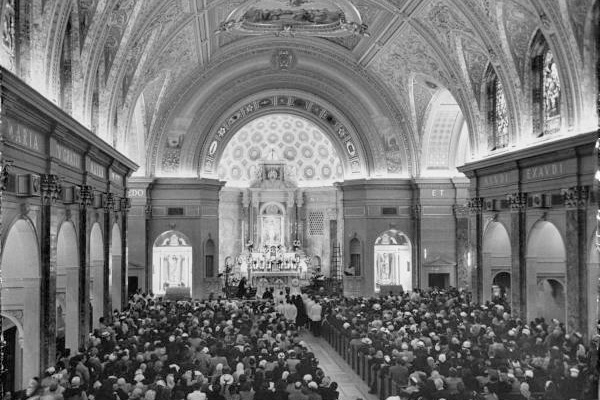
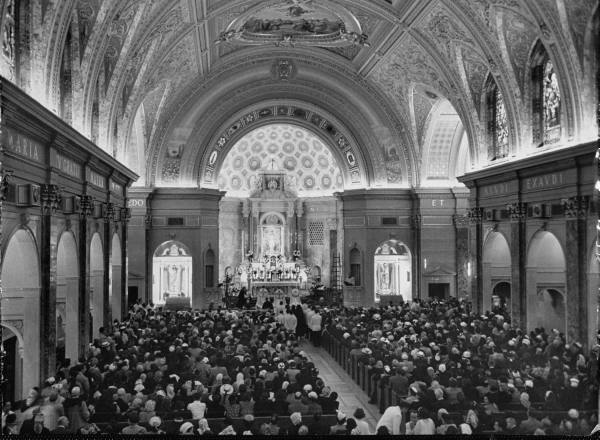
Many of us who are a bit older, say age 50 and older, remember a time when the Church, at least in terms of numbers, seemed much more vigorous. And those who remember even longer, who were born before 1950 and lived in the northern cities, remember a time when Catholic parishes were like enormous factories, some as large as 10 to 20,000 members with 15 or more masses celebrated on Sunday, all before noon.
The great influx of Catholic immigrants from Europe brought exponential growth to the Catholic population of this country making Catholicism the single largest religious group by far. And those Catholic immigrants huddled together largely in ethnic parishes which actually created ethnic neighborhoods, knitting together both faith and culture, seeking survival in the land, that at times, seemed hostile to them and the Catholic faith. All this made Catholics fiercely loyal to the faith and made the parish, the hub of the community, the center around which all else revolved.
Alas, this vivid reality receded between the 1950s and the 1980s, leaving large structures behind, difficult to maintain, which are now being closed in large numbers. Sweeping social changes, a cultural revolution, and the slow assimilation of Catholics into the wider American culture led to the demise of the system, that is hard not to admire for its organization, and effectiveness.
How things collapsed so quickly, is a matter for some speculation, but even in genius of the system of ethnic Catholicism, there were probably the seeds of its own destruction that were sown. For the fierce clinging of Catholics to their faith was as much due to ethnicity as it was the Catholic faith.
Ethnicity, made of many Catholics a kind of collection of fiercely independent groups whose allegiance to the local bishop, and connection to the wider Church, was often secondary and tenuous. At some point, fierce independence, comes home to roost.
Add to this, that ethnic identities which defined the first several generations of immigrants, tended to fade by the 3rd or 4th generation. It would seem however that the fiercely independent attitudes did not so easily fade. And thus, we still see that, among many Catholics today, their Catholicism is somewhat secondary, tucked under their political views, and world views.
As we shall see in the description below, and as most bishops know, shepherding Catholics is like herding cats. And this struggle is not all that new. It was well on display even in the glory years. Despite the outward appearances of deep unity, there were many fissures just under the surface.
As a brief study of this, I would like to quote somewhat extensively from the first chapter of a book by John McGreevey entitled Parish Boundaries: The Catholic Encounter with Race in the 20th Century Urban North wherein he rather vividly describes the strength of the immigrant church, but also describes some of the more negative trends within that vivid and powerful system of ethnic Catholicism. And while his overall book focuses more on the African American Catholic Experience, perhaps his writing in the first Chapter on the wider ethnic experience, might provide something of a opportunity for us to reflect on the roots of some of our modern struggles to maintain unity and discipline in the Church.
As always, the author’s work is in bold, black italics, my (Few) remarks are in plain, red text. I have reworked the order of some of his reflections, and am excerpting a much longer chapter. I hope you’ll find his description of the Urban Ethnic Church as thrilling and vivid as I do. The excerpt is long but well worth reading.
[From the late 1800s through the middle part of the 20th century] successive waves of European immigrants peopled a massive, and impressive church largely in the northern cities of America. In 1920, Catholics in Chicago could worship at 228 Catholic parishes… [The area of the city called] back of the yards area physically exemplified this. There, residents could choose between 11 Catholic churches in the space of little more than a square mile: two Polish, one Lithuanian, one Italian, two German, one Slovak, one Croatian, 2 Irish, and one Bohemian.… Their church buildings soared over the frame houses and muddy streets of the impoverished neighborhood in a triumphant display of architectural and theological certitude. Yes, I have always appreciated that older Church buildings to reflect a time of greater theological certitude. And while one may criticize the presence of opulent church structures in poor neighborhoods, the immigrants eagerly built them and thereby demonstrated a kind of priority of the faith which is less evident today.
[Even as late as the] 1950s, a Detroit study found 70% of the city’s Catholics claiming to attend services once a week, as opposed to only 33% of the city’s white Protestants , And 12% of the city’s Jews. Catholics really used to pack the Churches. I remember as a youth if you were late for mass you had to stand in the back.
The Catholic parishes, whether they were Polish, Italian, Portuguese or Irish, simply dominated the life and activities of the community with quite popular and well attended programs. Yale sociologists investigating in the 1930s, professed amazement at the ability of priest to define norms of everyday social behavior for the church’s members.
The Catholic world supervised by these priests was disciplined and local. Many parishes sponsored enormous neighborhood carnivals each year. Most parishes also contained a large number of formal organizations including, youth groups, mothers clubs, parish choirs, and fraternal organizations–each with a priest moderator, the requisite fund raisers, and group masses. Parish sports teams even for the youngest boys shaped parish identity, with fierce (and to outsiders incongruent) rivalries developing in sports leagues between parishes. CYO rivalries were still legendary even into the 1980s in many areas.
These dense social networks centered themselves around an institutional structure of enormous magnitude. Virtually every parish in the northern cities included a church (often of remarkable scale), a convent, a parochial school, a rectory, and occasionally, ancillary gymnasiums or auditoriums. Even hostile observers professed admiration for the marvelous organization and discipline of the Roman Catholic Church which carefully provided every precinct, Ward, and district, with churches, cathedrals, and priests. The parish I attended as a youth in Glenview Ill (North Chicago) had a rectory that was externally a replica of Mt. Vernon. The parish plant took up a whole city block. Every grade of the parochial school had its own separate building. There was an indoor pool, a credit union, a large indoor “playdium” that allowed for everything from roller skating, to basketball, to volleyball. The Church and convent were also magnificent.
Brooklyn alone contain 129 parishes, and over 100 Elementary schools. In New York City more generally, 45 orders of religious men, ranging from the Jesuits to the Passionist Fathers, lived in community homes. Nuns managed 25 hospitals. The clergy and members of religious orders supervised over 100 high schools, as well as elementary schools that enrolled 214,000 students. The list of summer camps, colleges and universities, retreat centers, retirement homes, seminaries, and orphanages was daunting. Absolutely incredible numbers. And remember its just Brooklyn being described.
St. Sabina in Chicago was a typical example of an immigrant parish. The parish was founded in 1916 upon request by Irish-Americans. The male members of the 7000 member parish were mostly policemen, streetcar operators, lower management persons, and teachers. Within the tenure of the very first pastor, the parish erected a church costing $600,000 and contracted the work to members of the parish to provide jobs during the depression. They built the school, convent, and rectory as well as founding a staggering array of athletic, religious, and social organizations. By 1937 the Parish plant also included a community center with a full basketball court that seated 1800 people. Attendance at rollerskating shows often climbed to over 10,000. Parishioners packed the church and a hall for 11 separate Sunday masses, and ushers organized large crowds at multiple Friday evening novena services. $600,000 in the 1930s was an enormous sum of money, almost 9 million dollars in inflation adjusted dollars for 2013. I am presuming that the 600K was for the whole plant, not just the Church.
[The Catholic system of neighborhood-based parishes had little equivalence among the Protestants.] When examining the splendidly organized system constructed by Roman Catholics, Protestant analysts bemoaned the parochial chaos in the fragmentation of membership which the Protestant groups had experienced. The general Protestant lack of geographical parish made it impossible to know who should be responsible, or to hold anyone responsible for the church and of any given area. Synagogues faced similar dilemmas. Most synagogues drew members from a broad area, and competed with neighboring synagogues in terms of ritual and programs.
[In the immigrant years, the Catholic parish made, cemented, and ruled over a local neighborhood]. An observer noted how the church building occupied an entire block, adding that the buildings resounding bells, with its immense throngs of worshipers, with its great tower so built that illumined it reveals by the night the outlines of the cross help define the area. Put another way, The neighborhoods were created not found. For the parishioners, the neighborhood was all Catholic, given the cultural ghetto constructed by the parish. Yes, the Church was the true hub of the community.
Catholics enacted this religiously informed neighborhood identity through both ritual and physical presence. A powerful indicator of the importance of the Catholic parish was found in the answer of Catholics (and some non-Catholics) to the question “where you from?” Throughout the urban North, American Catholics answered the question with parish names–Visitation, Resurrection, St. Lucy’s, etc. All of this meant that Catholics were significantly more likely to remain in a particular neighborhood than the non-Catholics. [And Catholic neighborhoods resisted strong demographic shifts and swings much longer than other urban neighborhoods]. This naming the neighborhood for the parish was common in Chicago.
For American Catholics, neighborhood, parish, and religion were constantly intertwined. Catholic parishes routinely sponsored parades and processions through the streets of the parish, claiming both the parish and its inhabitants as sacred ground. Catholic leaders also deliberately created a Catholic counterpart for virtually every secular organization. The assumption was that the Catholic faith could not flourish independent of the Catholic milieu; schools, societies, and religious organizations were seen as pieces of a larger cultural project. The instinct that faith and culture must be intertwined is a sound one. It is clear that as Catholic culture waned, so did the faith. More broadly, as a Judeo/Christian culture in the US has waned, so has belief and practice of the faith.
[Catholic life was also for deeper in daily life that most Protestant expressions]. Where both Jews and Protestants emphasized the reading of text, Catholics developed multiple routes to the sacred. Theologians describe this as a “sacramental” imagination, willing to endow seemingly mundane daily events with the possibility of grace. When asked, “Where is God?” Catholic children responded “Everywhere!” God was most visible during the mass, when the parish community shared Christ’s body and blood. But God was also visible in the saints lining the walls of the church, the shrines dotting the yards of Catholic homes, the statue of Mary carted from house to house, the local businesses shuttering their doors on the afternoon of Good Friday, the cross on the church steeple looming above the neighborhood rowhouses, the priest blessing individual homes, the nuns watching pupils on the playground while silently reciting the rosary, the religious processions through the streets, and the bells of the church ringing each day over the length of the parish. A magnificent description of sacramental imagination here. It is the genius of Catholicism and we have lost a lot of it to our peril. Thankfully we have recovered some of it in recent years.
And Yet, McGreevy goes on to describe some of the fissures that would later come home to roost, namely, a fierce independence and almost refusal to live in the wider Church.
Each parish was a small planet whirling through its orbit, oblivious to the rest of the ecclesiastical solar system.… All parishes, formerly territorial or not, tend to attract parishioners of the same national background. The very presence of the church and school buildings encouraged parishioners to purchase homes nearby helping to create Polish, Bohemian, Irish, and Lithuanian enclaves within the larger neighborhood.
[But] The situation hardly fostered neighborhood unity. Observers noted that various clergy had nothing but scorn for their fellow priests. Pastors were notorious for refusing to cooperate with (or even visit) neighboring parishes. A Washington Post reporter agreed, “the Lithuanians favored the polls as enemies, the Slovaks are anti-Bohemian. The Germans were suspected by all four nationalities. The Jews were generally abominated, and the Irish called everyone else a foreigner.”A kind of extreme parochialism
Most of the parish is also included parochial schools staffed by an order of nuns of the same ethnicity as the parish in which they served. Eastern European newcomers resolutely maintained their own schools instead of filling vacant slots in nearby Irish or German schools. Yes, and even I, born in 1961, remember how Irish and Italian Catholics were barely on speaking terms with one another. In one parish I knew, an Irish girl married an Italian man. There was quite a set-to about it and the couple could not worship in either of their home parishes, but had to find a third.
A 1916 Census survey revealed 2230 Catholic parishes using only a foreign language in their services, while another 2535 alternated between English and the parishioners native tongue. Even small towns divided the Catholic population into Irish, Italian, and Portuguese parishes. Detroit’s Bishop Michael Gallagher, himself the son of Irish immigrants, authorized the founding of 32 national parishes out of a total of 98. In 1933, Detroit Catholics could hear the gospel preached in 22 different languages. A kind of Balkanized scene.
Episcopal attempts to quash national parishes, schools, and societies only strengthened national identities. After one conflict with the local bishop and the Polish community, one participant in the revolt noted that such revolts “gave proof that we will not permit anyone to destroy a national dignity, pride and traditions. Another statement from a Polish group warned of ominous consequences if Poles were to be “deprived of the care of a Bishop from among our own race.” Cardinal Medeiros of Boston was never really accepted by that Archdiocese since he was not Irish. And his painful tenure there is detailed by Philp Lawler in his Book The Faithful Departed. And his tenure (1970-1983) was long after ethnic rivalries had largely abated in the US. The fact is, most American Bishops knew they had a huge mess on their hands, and beginning in the 1950s began to limit the formation of National Parishes and even outright closed some that were smaller and contentious. Even to this day a few breakaway Polish National churches still refuse the authority of the local bishop.
Rather than face outright revolt, bishops working with national groups pastoral appointments generally assigned an auxiliary bishop were senior cleric to handle and mediate intramural disputes. Outright revolt was a real possibility. Rebellion against Church authority did not begin in 1968. It had roots going way back. True, dissent from Church teaching was rare, but the rebellion against lawful Church authority likely set the stage later for what that authority taught.
Despite Episcopal concerns… 55% of Catholics in Chicago worshiped at national parishes as late as 1936. In addition, over 80% of the clergy received assignments in parishes matching their own national background.
Overall the period of ethnic Catholicism is glorious to behold. I am sorry I largely missed it. Such a vibrant and tight knit expression and experience of the faith! But it would seem, there was also a dark side. A local unity existed to be sure, but it was only 8 blocks wide. The overall experience was of balkanized Catholicism and hyper-parochialism.
The fierce and proud independence of the ethnic parishes reacted poorly with the rebellion against authority that was coming in American culture. And today, many of the problems that existed then have only grown: the resistance to the authority of the Bishop, the insistence on a perfect designer parish, and the tendency to tuck the faith under other loyalties that have taken the place of ethnicity such as politics and worldview. These things were certainly simmering in the vibrant ethnic years. And sometimes they weren’t simmering, they were right out in the open. Shepherding Catholics is like herding cats.
Still, I am sorry I missed it. But but at the end of the day, we ought resist the notion of overly idealizing any era. Scripture says, Say not, “How is it that former times were better than these?” For it is not in wisdom that you ask this. (Eccles 7:10)
Ah the Immigrant Church in all her glory, along with all that was gory.
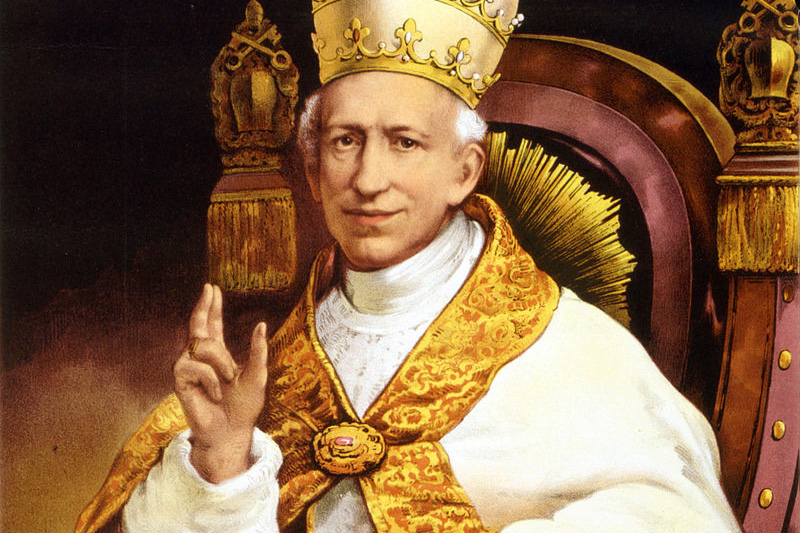
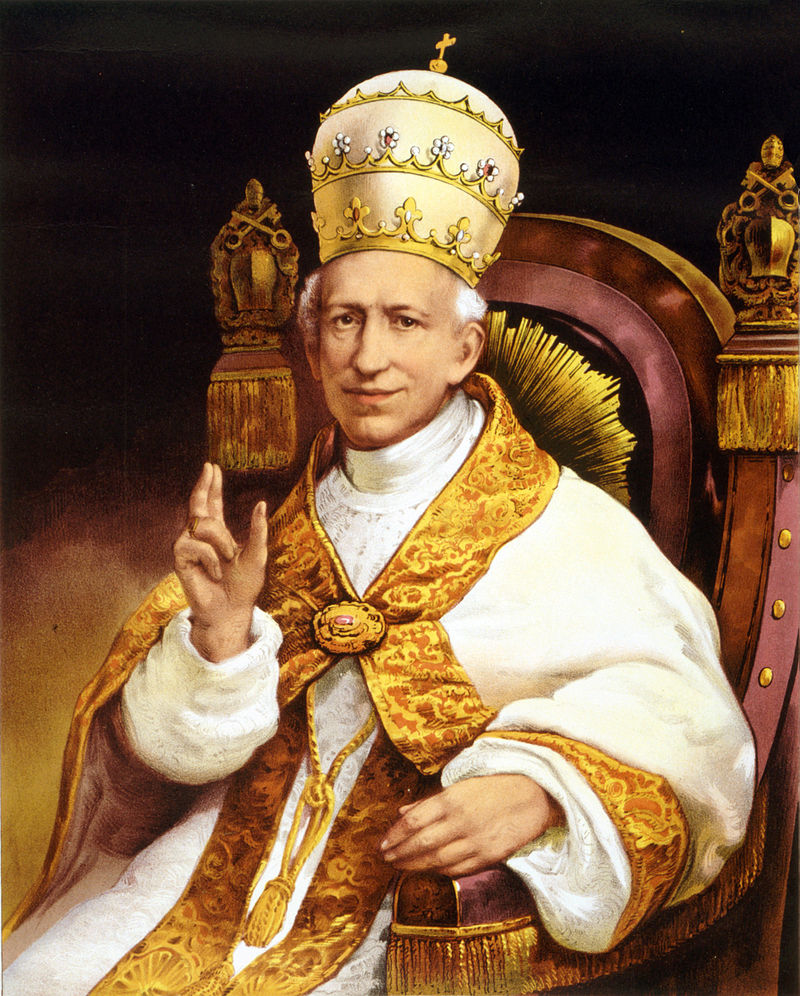
A reader alerted me to an interesting and insightful analysis by Pope Leo XIII of three trends that both alarmed him and pointed to future problems. He wrote of these three concerns in 1893 in the Encyclical on the Holy Rosary entitled Laetitiae Sanctae (Of Holy Joy). The Pope enunciates these three areas of concern and then offers the mysteries of the Rosary as a necessary remedy. Lets look at how the Pope describes the problems and then consider too what he sees as a solution. His teaching is in bold, italic, black. My remarks are in plain text, red.
There are three influences which appear to Us to have the chief place in effecting this downgrade movement of society. These are–first, the distaste for a simple and laborious life; secondly, repugnance to suffering of any kind; thirdly, the forgetfulness of the future life. (# 4)
Problem 1 – The distaste for a simple and laborious life– We deplore….the growing contempt of those homely duties and virtues which make up the beauty of humble life. To this cause we may trace in the home, the readiness of children to withdraw themselves from the natural obligation of obedience to the parents, and their impatience of any form of treatment which is not of the indulgent and effeminate kind. In the workman, it evinces itself in a tendency to desert his trade, to shrink from toil, to become discontented with his lot, to fix his gaze on things that are above him, and to look forward with unthinking hopefulness to some future equalization of property. We may observe the same temper permeating the masses in the eagerness to exchange the life of the rural districts for the excitements and pleasures of the town….(#5)
One of the truths that sets us free is to simply realize and come to accept that life is hard. It involves trials, arduous work, and setbacks, along with some of the progress we can and do experience. Very few things of true values come to us without a significant cost. Simply put, life is hard. But, coming to accept this is a freeing thing for many of our resentments are minimized or removed by this acceptance. The fact is, many today expect that life should be peachy. And when it is not, there is resentment, anger, even threats of lawsuits. Many today think of happiness as a God-given right. Our Founding Fathers recognized the pursuit of happiness as a goal. But today many expect that happiness to be the norm and to be a sort of right. When it does not exist for them, there has been a failure of the system somehow. Many today expect to live lives where there is little danger, and where things come easily. This has been one of the factors that influenced the growth of government. For as insistence on a comfortable life grows and hard work seems unreasonable, we expect government to ease our burdens and provide increasing levels of comfort and happiness, and we are less willing to work hard for these things. Rather we see happiness and comfort as things to which we are entitled.
But unrealistic expectations are premeditated resentments. And so, with often unrealistic expectations, people quickly grow resentful and even pout. It would seem that our ancestors who lived even as recently as 150 years ago had different notions. They looked for happiness alright, but largely expected to find that in heaven. Many of the old Catholic prayers bespeak a vision that this world was a place of travail, of exile, a valley of tears, where we sighed and longed to be with God. Most Catholics of those earlier times lived lives that were brutal and short. Most were peasants, and lived with far less creature comforts than we. There was no central air, electricity, running water, and medicines were few and far less effective. Entertainment was limited, houses were smaller, even tiny and transportation was far more limited.
We live so well compared to them. And though we are more comfortable, there is little evidence that we are happier. Indeed, we seem more resentful, because we expect more, a lot more. As the Pope notes, young people resent discipline and expect to be spoiled. The majority of parents seem willing to indulge them and shun giving correction since it raises tensions and causes difficulties.
The value of hard work and the satisfaction that comes from it seems lost on many today. Cardinal McCarrick used to counsel us priests that if we did not go to bed tired, something was wrong. We all need some rest and relaxation, sure, but hard work actually brings greater satisfaction to times of rest.
The fact is, high expectations of this world like we have today, breed discontent and resentments. For by it these unrealistic and high expectations, we really insist on living in a fantasy that this world is, or can be paradise. It cannot. A better strategy is to accept that life is difficult and, though it has its joys, it presents arduous difficulties to us that must be met with courage and acceptance. Though this is a hard truth it brings peace when it is accepted.
To the first error Pope Leo commend to our attention the Joyful mysteries and particularly a meditation on the implicit lessons of the home at Nazareth:
Let us take our stand in front of that earthly and divine home of holiness, the House of Nazareth. How much we have to learn from the daily life which was led within its walls! What an all-perfect model of domestic society! Here we behold simplicity and purity of conduct, perfect agreement and unbroken harmony, mutual respect and love….devotedness of service. Here is the patient industry which provides what is required for food and raiment; which does so “in the sweat of the brow,” which is contented with little….These are precious examples of goodness, of modesty, of humility, of hard-working endurance, of kindness to others, of diligence in the small duties of daily life, and of other virtues…., Then will each one begin to feel his work to be no longer lowly and irksome, but grateful and lightsome, and clothed with a certain joyousness by his sense of duty in discharging it conscientiously….home-life…loved and esteemed….(# 6).
Problem 2 – Repugnance to suffering of any kind– A second evil…. is to be found in repugnance to suffering and eagerness to escape whatever is hard or painful to endure. The greater number are thus robbed of that peace and freedom of mind which remains the reward of those who do what is right undismayed by the perils or troubles to be met with in doing so….By this passionate and unbridled desire of living a life of pleasure, the minds of men are weakened, and if they do not entirely succumb, they become demoralized and miserably cower and sink under the hardships of the battle of life. (# 7)
Yes, today more than ever, there is almost a complete intolerance to any sort of suffering. This has been fueled by the fact that we have been successful in eliminating a lot of suffering.
As noted, we have many creature comforts that protect us from the elements, medicines that alleviate physical pain and bodily discomforts, appliances and technology that provide unprecedented convenience and make a lot of manual labor all but unnecessary.
This, as we have also noted, leads to expectations which are ultimately unrealistic. Namely, that all suffering should be eliminated. There is almost an indignity expressed when one suggests that perhaps some things should be endured or that it is unreasonable to expect government, or doctors, or science to eliminate every evil or form of suffering.
Further, we seem to refuse the notion that accidents sometimes happen or that unfortunate circumstances will just occur. Instead we demand more laws that are often intrusive and oppressive, and we undertake huge lawsuits that often discourage the very risk taking that makes new inventions, medicines and medical techniques possible.
We often hold people responsible for things they can do little about. Sometimes economies just have cycles, climates too. Governments, laws and politicians cannot be expected to solve every problem or alleviate every burden. Sometimes accidents just happen.
Not a Padded room – While we can and should undertake to fix unnecessary hazards and seek to ease one another’s burdens, life isn’t a padded room. Suffering, sorrows, accidents, burdens and difficulties are part of life in this valley of tears. Acceptance of this truth leads to a kind of paradoxical serenity. Rejection of it and indulgence in unrealistic notions that all suffering is unreasonable leads to resentments and further unhappiness.
Here too, Pope Leo commend to us the rosary, in particular the sorrowful mysteries:
…If from our earliest years our minds have been trained to dwell upon the sorrowful mysteries of Our Lord’s life…we [may] see written in His example all the lessons that He Himself had taught us for the bearing of our burden of labor– and sorrow, and mark how the sufferings…He embraced with the greatest measure of generosity and good will. We behold Him overwhelmed with sadness, so that drops of blood ooze like sweat from His veins. We see Him bound like a malefactor, subjected to the judgment of the unrighteous, laden with insults, covered with shame, assailed with false accusations, torn with scourges, crowned with thorns, nailed to the cross, accounted unworthy to live….Here, too, we contemplate the grief of the most Holy Mother…”pierced” by the sword of sorrow…. (# 8 )
Then, be it that the “earth is accursed” and brings forth “thistles and thorns,”–be it that the soul is saddened with grief and the body with sickness; even so, there will be no evil which the envy of man or the rage of devils can invent, nor calamity which can fall upon the individual or the community, over which we shall not triumph by the patience of suffering….But by this patience, We do not mean that empty stoicism in the enduring of pain which was the ideal of some of the philosophers of old, but rather….It is the patience which is obtained by the help of His grace; which shirks not a trial because it is painful, but which accepts it and esteems it as a gain, however hard it may be to undergo. [Men and women of faith] re- echo, not with their lips, but with their life, the words of [the Apostle] St. Thomas: “Let us also go, that we may die with him” (John xi., 16). (# 9)
Yes, indeed, the cross is part of this life. But Christ has made it clear that the cross yields ultimately to glory if we carry it willingly and with faith.
Problem 3- Forgetfulness of the future life– The third evil for which a remedy is needed is one which is chiefly characteristic of the times in which we live. Men in former ages, although they loved the world, and loved it far too well, did not usually aggravate their sinful attachment to the things of earth by a contempt of the things of heaven. Even the right-thinking portion of the pagan world recognized that this life was not a home but a dwelling-place, not our destination, but a stage in the journey. But men of our day, albeit they have had the advantages of Christian instruction, pursue the false goods of this world in such wise that the thought of their true Fatherland of enduring happiness is not only set aside, but, to their shame be it said, banished and entirely erased from their memory, notwithstanding the warning of St. Paul, “We have not here a lasting city, but we seek one which is to come” (Heb. xiii., 4). (# 11)
I have become increasingly amazed at how little most modern people think of heaven. Even Church-going believers talk little of heaven, priest preach little on it. Our main preoccupation seems to be making this world a more comfortable and pleasant place. Even in our so-called spiritual life, our prayers bespeak a worldly preoccupation: Lord, fix my finances, fix my heath, get me a better job. Almost as though we were saying, “Make this world pleasant enough and I’ll just stay here.” It is not wrong to pray for better health etc. It is not wrong to work to make this world a better place. But in the end, our home is in heaven and we ought to be solicitous of it and eagerly seek its shores. It should be a frequent meditation, and to be with God forever, the deepest longing of our soul. Instead we fear getting “older” and hide death away in our culture. It ought to be that we can’t wait to see God. Sure, it would be nice to get a few things done that we’ve started, but as heaven and being with God draw closer, we ought to be happy that the years are ticking by faster. Each day is one day, closer to God!
Here too, our prosperity and creature comforts have mislead us into a love of this world that is unhealthy. A friend of the world is an enemy to God (James 4:4). We are distracted and too easily dismiss that this world is passing away. The fact is, we are going to die. Only a proper longing for heaven can correct the absurdity that an obsessional love for this world establishes in our soul.
Meditate on heaven often! Read the scriptures, such as Revelation 1, & 4-5, 20-21. Ask for a deeper longing from God.
Pope Leo commends the Glorious mysteries of the rosary to our attention as a medicine for this absurd attachment to this passing world and our forgetfulness of heaven:
These mysteries are the means by which, in the soul of a Christian, a most clear light is shed upon the good things, hidden to sense, but visible to faith, “which God has prepared for those who love Him.” From them we learn that death is not an annihilation which ends all things, but merely a migration and passage from life to life. By them we are taught that the path to Heaven lies open to all men, and as we behold Christ ascending thither, we recall the sweet words of His promise, “I go to prepare a place for you.” By them we are reminded that a time will come when “God will wipe away every tear from our eyes,” and that “neither mourning, nor crying, nor sorrow, shall be any more,” and that “We shall be always with the Lord,” and “like to the Lord, for we shall see Him as He is,” and “drink of the torrent of His delight,” as “fellow-citizens of the saints,” in the blessed companionship of our glorious Queen and Mother. Dwelling upon such a prospect, our hearts are kindled with desire, and we exclaim, in the words of a great saint, “How vile grows the earth when I look up to heaven!” Then, too, shall we feel the solace of the assurance “that this momentary and light affliction produces for us an eternal weight of glory beyond measure, exceedingly ” (2 Cor. iv., 17).
Here then are three diagnoses, and three remedies. It is interesting to see that the roots of them were already evident in 1893 and how they have come further to press upon us more than 100 years later. It is helpful to have a Doctor of Souls to help us name the demons that afflict us. For having named a demon, we have more power over it and learn its moves:
Demon, your name is “laziness” and “distaste” for hard work. By the joyful mysteries of the Lord’s Life, be gone.
Demon your name “refusal of any suffering” and an “resentment at the cross.” By the sorrowful mysteries of our Lord’s life, be gone.
Demon your name is “forgetfulness of heaven” and “obsession with the passing world.” By the glorious mysteries of Lord’s life and our Lady’s too, be gone.
The Lord says, “My Sheep hear my voice…” That’s right he called you a sheep. No come on, get a little indignant with me here! The Lord is comparing us, not to the swift eagle, , the beautiful gazelle, the mighty bear, the swift horse, the mighty lion, or the clever and intelligent dog. No, he looks at us as says we’re like sheep. Hmm… While reality may hurt, the truth can liberate. For the fact is, sheep are lowly animals, but they are valuable as well. Let’s consider this Gospel in three stages: The Sign of the Sheep, the Safety of the Sheep and the Salvation of the Sheep.
I.THE SIGN OF THE SHEEP –In the text, Jesus said: “My sheep…. “ What does the Lord mean in using sheep as a sign for us? Lets consider some qualities about sheep that may help illustrate what the Lord is teaching.
1. Sheep are WAYWARD – It means that they just tend to wander off. It just grazes awhile then looks up, and looks around and says, in effect, “Where am I?” A sheep will nibble here and browse there and get lost lost, he doesn’t know how to get back to the sheep fold unless the shepherd goes and brings him back. Sheep just keep on going and don’t come back. Dogs and cats can find their way home, The horse can find the barn, But not the old sheep. It doesn’t know how to get back to the sheep fold unless the shepherd goes and brings him back.
Now don’t tell me that doesn’t describe us. All we like Sheep have gone astray, every one to his own way (Isaiah 53:6). This is how it is with us. We get easily lost. We need the sheep fold of the Church and we need the Shepherd, who is Christ, ministering through his Pope, bishops and priests. Otherwise we just wander here and there.
2. Sheep are WITLESS – That is to say they just plain dumb. Ever hear of a trained sheep? We train dogs and birds, horses and even lions. But the sheep cannot be trained!
Now we human sheep like to think we are so smart. Sure we’ve been to the moon, and we have all this technical computer stuff. But too many of us aren’t even smart enough to pray every day, get to Church on Sunday, and follow God’s basic directions for life.
We’re so witless that we even do things that KNOW harm us. Even the simplest directions from God we either confuse or get stubborn about. We cop an attitude and say “We know a few things too.” That’s right, we do know a very few things.
We’re so dumb, we think we’re smarter than God! We think we have a better way than God’s way. No that’s really dumb.
3. Sheep are WEAK– A sheep just has no way to protect himself. The mule can kick, the cat can scratch, the dog can bite, the rabbit can run, and the skunk…you know what he can do. But the old sheep? Without the care of the Shepherd and the sheep dogs, the sheep is history. The wolf comes and all he can do is stand there and get killed.
And so it is with us, if it were not for the care of Jesus the Good Shepherd, the world, the flesh and the devil have got us cornered. And if it were not for the Lord, and the power of his grace, we would be toast.
We like to think we’re strong. We have armies, we amass political power, monetary power, star-power. It all gives us the illusion that we are strong. But then the slightest temptation arises and we fall. We need the Lord and his grace and mercy or we don’t stand a chance because by our self we are weak and prone to sin.
AND YET…
4. Sheep are WORTHWHILE animals. The sheep is a valued animal. In Jesus’ day many a man counted his wealth by sheep. Sheep give meat and milk, produce lambs and wool. Shepherds made many sacrifices in Jesus’ day to breed, herd, and protect these valuable animals. And so it is with us. We may not feel worthy at times, but apparently we were worth saving because the Lord paid the price of our redemption. He saw the price, and paid it all. And not with any diminishable sum of silver and gold but with his own precious blood (1 Peter 1:18-19).
5. Sheep WALK together – Sheep flock together, and thus are safer. To be a solitary sheep is dangerous. It’s a good way to get devoured.
Be sober, be vigilant; because your adversary the devil, as a roaring lion, walketh about, seeking whom he may devour (1 Peter 5:8). The scriptures also say Woe to the solitary man! For if he should fall, he has no one to lift him up (Eccles 4:10). Sheep are not supposed to go off on their own, neither are we.
We are called to part of a flock and to be under the care of a shepherd. Most of us realize this in a parish setting. But in the wider sense, we are under a bishop’s care and ultimately the care of the Pope who is the chief Shepherd and the Vicar of Christ, the Good Shepherd.
The Lord Jesus said there is to be one flock and one shepherd (John 10:16). God wants us to be in the protection of the flock with a shepherd watching over us. An old spiritual says, “Walk together children. Don’t you get weary. There’s a great camp meeting in the promised land.” Now too many like to say, “That old Pope doesn’t know this or that.” But again please consider that to wander from the care of the flock and the Shepherd is a mighty dangerous thing.
6. Sheep are WARY– Jesus says elsewhere, He who enters by the door is the shepherd of the sheep. To him the gatekeeper opens; the sheep hear his voice, and he calls his own sheep by name and leads them out. When he has brought out all his own, he goes before them, and the sheep follow him, for they know his voice. A stranger they will not follow, but they will flee from him, for they do not know the voice of strangers. (John 10:11-14).
Sheep have the remarkable quality of knowing their master’s voice and of instinctively fearing any other voice and fleeing from it.
In this matter, real sheep are smarter than most of us. For we do not flee voices contrary to Christ. Instead we draw close and say, “Tell me more.” In fact, we spend a lot of time and money to listen to other voices. We spend huge amounts of money to buy televisions so that the enemy’s voice can influence us and our children. We spend large amounts of time with TV, radio, Internet.
Yes, we can so easily be drawn to the enemy’s voice. And not only do we NOT flee it, but we feast on it. And instead of rebuking it, we turn and rebuke the voice of God and put his Word on trial, instead of putting the world on trial.
The goal for us is to be more wary, like sheep and to recognize only one voice, that of the Lord speaking though his Church, and to flee every other voice.
II. The SAFETY OF THE SHEEP – Jesus goes on to say, hear my voice; I know them, and they follow me. No one can take them out of my hand. My Father, who has given them to me, is greater than all, and no one can take them out of the Father’s hand.
Note the promises that Jesus will not be overpowered, no one can snatch from his hand. Dan 7:14 says, His kingdom is an everlasting kingdom that shall not be destroyed, his kingship shall not be destroyed. In other words, the devil can’t sheep-steal, in no way can he have power over Jesus or his flock.
But it’s all predicated on what’s been said. If we want protection and safety, we have to know only Jesus’ voice and stop running after all sorts of false shepherds and voices. We have to stay with the true Shepherd, Jesus, and in the protection of the flock. You want safety? Stay in the shelter of Jesus’ shepherding.
Let us be clear on this point, no weapon waged against us can ever prosper (Isaiah 54:17). Satan cannot harm or get to any of us, UNLESS we open the door. Satan is like a dog on a leash, he can only harm us if we get too close by our own foolish decisions! Satan is a chained dog…do not stray into his range or territory!
Yet so many do! They savor pop culture, with all its darkness, click over to pornographic sites, take a steady diet of revengeful “action” movies, and watch endless commercials telling them to buy the latest product with its promises of empty fulfillment. A steady stream of polluted water and then we wonder why we are sick and weak, full of the parasites of sin.
Is it any wonder that our thinking is distorted, unbiblical, dark and foolish? At least sheep know to flee a false shepherd. What about us. Too many of us are intrigued by the ranting of false shepherds. We glamorize evil, and have our minds filled with false teaching and improper priorities.
And thus, while no one can snatch from Jesus’ hand, this is not some magical protection that prevents us from foolishly and sinfully walking away from him. And if we walk, woe to us, if we stray, our strength will fail!
Every ancient city had walls and gates to protect its citizens. But that citizen was fool who thought he could enjoy the protection of the city by journeying outside its protective walls. Yet too many Christians think they should enjoy the promises and protections of Jesus, and yet stray form the safety of the protective walls of his kingdom. It simply doesn’t work that way.
Jesus calls anyone who hears his teaching and does not follow it a fool (Matt 7:26). Fools do not enjoy protection, since wisdom is of the Kingdom but foolery is of the world, headed for destruction.
And old spiritual says, Some seek God, don’t seek him right, they pray all day and fool at night! Well, living a double life is no way to enjoy the Lord’s protection. That only comes to those who live in the protection of His Kingdom, not for those who merely visit there. The Shelter of the Shepherd is the only safe harbor.
Yet another old song says, My mother taught me how to pray. My mother taught me how to pray. So if I die and my soul be lost, it’s nobody’s fault but mine. My savior taught me how to live, My savior taught me how to live. So if I die and my soul be lost it’s nobody’s fault but mine.
Pay attention fellow sheep: do not stray from the Shepherd. He can protect you. But if you want to live a double life or open doors in your heart to Satan, understand that the protection of the Lord is only for those who desire and freely choose such protection. The Lord is not a slave owner. He is a lover who invites us to freely accept his offer of new life rooted in a loving and trusting relationship to him.
Do you know his voice? Do you know ONLY his voice? Do you run form every voice contrary to is? Or do you collect counselors who tell you what your itching ears want to hear? (cf2 Tim 4:3).
If so, you have the protection of the Savior Jesus Christ, and nothing will ever harm you (Luke 10:19). But if you stray, be not surprised at the presence of wolves.
In deliverance ministry we look especially to the doors that the afflicted open to demons. For, unless they have opened a door does a demon have any power to be there. The key is to repent and close all doors, desiring only the care of the True Shepherd and Guardian of our souls (1 Peter 2:25).
III. THE SALVATION OF THE SHEEP – The text goes on to say, I give them eternal life, and they shall never perish.
Note that, for the flock of the Lord there is the gift of “eternal life.” Too many Christians equate this with some far off, distant future that they vaguely hope to attain.
But eternal life refers not only to the capacity to “live forever and never die.” It does mean this, but eternal life is so much more! It begins now. And “eternal” refers not only to length of life but toe the fulness of it.
In this sense, eternal life is now as we become ever more aware of an experience that, If anyone is in Christ, He is a new creation!” (2 Cor 5:17). Of this I am a witness, being far more alive at 51, than I ever was at 21!My body ages, but soul is younger and more vibrant than ever.
And here is the promise to lay hold of of: those who are in the shepherd’s care, come, by stages to experience life more fully, to become more fully alive. Jesus our Shepherd promises us eternal life. But this does not wait till heaven, it is now. The sheep are brought to salvation, to healing, we you will accept it. If we choose freedom and the shepherd’s cares, it is ours! If we reject some or all of it, then we live apra from his care and vision and too easily savage wolves come and attack.
Are you smarter than a sheep? Do you know how to recognize the shepherd’s voice and follow only him? Or are you foolishly running after worldly advice and sinful priorities? On this Good Shepherd Sunday, strive to be a good sheep.
Yes he said it, a “sheep.” But sheep have this going for them, they recognize only their shepherd’s voice and run from any other.
Back when I was in seminary (24+ years ago), I was an organist, and Music Director of the Seminary. And in those years I learned an important, albeit, frustrating reality, namely that many did not always appreciate what I considered to be the finer things of Church Music.
I remember one November having the Seminary Choir Sing a rather elegant piece by Palestrina. It was a difficult piece to master, but oh how wonderful it was, sung in four parts, acapella. Yes! The high water mark of Catholic music. I was so sure the men would love to hear it sung. And we sang it beautifully. That same feast day of all saints we also happened to chant the Litany of Saints. We used the simple tone. We rehearsed it only once and sang it with little effort.
After the Mass I awaited the accolades that would certainly come! And sure enough they did. On the way over to dinner some of the seminarians walked up and said in different ways,
Wow, that piece you sang was really beautiful….so moving….We need to do more of that! Ah, yes! I replied, Palestrina is the best!
To which they all responded, Pala..who? I was talking about the litany. Oh! said I, Well what did you think of the piece we sang at offertory?
Looking puzzled, as if they were trying to remember it, came the answer, Oh that was pretty good too…, What was it?
Sigh….
And thus I learned that sometimes the glory of finer things escapes the average listener. The Litany was beautiful, but, for a trained musician, its simplicity made it seem insignificant. And yet, sometimes, less is more, little things mean a lot, and the good is not the enemy of the better, it is its foundation.
At the end of the day, liturgists and Church musicians, do well to mix with simple and accessible with some of their more lofty offerings. While we might wish that everyone would appreciate the finer things instantly, frankly not everyone does. Some of the finer things are an acquired taste and require some background to appreciate.
I have found that certain types of music and art have grown on me over the years. I was not born appreciating Palestrina, or a Bach Fugue, or Gospel music for that matter. But over time I learned the intricate and internal moves of these sorts of music and came to appreciate them like fine wine.
That said, I still like a “good beer” every now and then too. My iPod has many offerings from 70s pop and rock, when I was in High School and College. Most of it is not high art, and lacks the intricacy of the Brandenburg Concertos, but I enjoy it. And frankly some of that music served as a foundation for my later appreciation of classical and Choral music.
One thing that Church liturgists and musicians should surely avoid is snobbery. Nothing can so slam the door on what they hope to inspire than snide remarks about what people clearly like. Snobbery is no way to inspire an openness to finer and more intricate things. Cheese snobs can sneer all they want at the rubbery plastic-wrapped Velveeta cheese all they want, but Americans eat it in abundance and with gusto. Sneering won’t get people to suddenly start liking Roquefort, or Gouda.
Once, I was drinking a glass of chillable red wine (the kind that comes from a box), and was rebuked by a wine connoisseur to the effect that what I was drinking was not even real wine. Frankly, I was less likely to try a “fine wine” with that sort of attitude. And my palate might not even be ready for some of the drier wines favored by connoisseur.
Work with me, don’t sneer at me. Perhaps my world of chillable red, boxed wine can be expanded. But my appreciation for it will likely grow in stages, rather than rushing to the dry red fine wine that, to me with my unrefined wine palate, currently tastes like liquid ashes going down.
It is the same with music and liturgy. Snobbery is highly to be avoided. I love the Traditional Latin Mass, but I do understand that appreciating it requires some history, some basic knowledge of Latin and so forth. I find that I can lead people in stages to it. But honestly, I wince every time on this blog or elsewhere, those who, like me appreciate the old, but sneer at those who like more modern forms, or simpler forms.
Snobbery wins few converts. I could listen to a Bach Fugue all day long, and enter deep prayer with Renaissance polyphony, but I do understand why not everyone is of the same mind, and I feel blessed to like what they like too. Perhaps, in stages and through friendship, rather than snobbery, I can open bigger worlds to others, and they to me.
Simple chanted Litanies are good! So is Victoria and Palestrina. Appreciation for fine things is built on an appreciation for other things. Life builds and expands, it need not narrow and become fussy. The Good is not the enemy of the better, it is its foundation.
This video illustrates these points well. A little girl sees in a baker’s window what she wants, a simple cherry. But the baker will have non of it! She must try this delicacy and that delicacy! But so fine is what he offers her that she barely recognizes it as food at all. It is really the simple red cherry she wants. At the end, the Baker finally meets her where she is, and presents her with the prettiest cherry she has ever seen! And thus, he builds on what she knows and likes. He shows her the finer things in stages, respecting the true and actual goodness of what she likes.
Pay attention liturgists and musicians, and all who appreciate the finer and more advanced things in many areas of life.