There are several Feasts of the Church wherein a “sequence” hymn may be sung. The sequence hymn is sung Just before the the Alleluia (Gospel acclamation). The feasts with sequence hymns are these:
Easter – Victimae Paschali Laudes (To the Paschal Victim give praise)
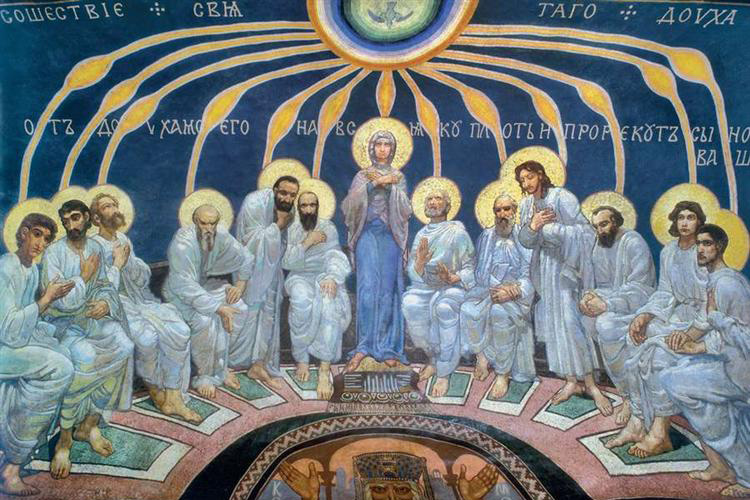
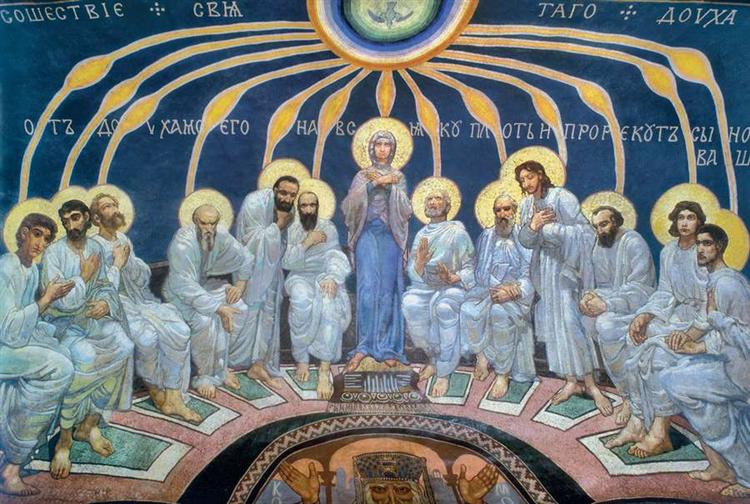
Pentecost – Veni Sancte Spiritus (Come Holy Spirit)
Corpus Christi – Lauda Sion (Praise O Sion)
Our Lady of Sorrows – Stabat Mater (Stood the Mother sad and weeping)
All Souls – Dies Irae (Day of Wrath)
Too many parishes simply omit the sequence hymn. But, for my money, they ought to be sung. Especially the ones that occur on Sunday. (I’ll admit that the Lauda Sion is rather long).
Most Sequence Hymns were written in the Middle ages and were sung just before the Gospel as the clergy processed to the place of Gospel. Sometimes, in larger churches, the Gospel was chanted midway down the nave so it could be heard, and these hymns, for special feasts helped fill the time of that procession. Many prominent feasts of the Church began to have these hymns composed in the period of the 11th- 13th Centuries.
However, after the Council of Trent, in the Missal of Pius V (published 1570), the number of sequences was reduced to four: Victimae paschali laudes sung at Easter, Veni Sancte Spiritus for Pentecost, Lauda Sion Salvatorem sung at Corpus Christi, and the Dies Irae for All Souls and in Masses for the Dead. In the 1700s Stabat Mater for the feast of Our Lady of Sorrows was added to this list. Later in the early 70s the Dies Irae was removed from the Requiem Mass of the revised Roman Missal and restored in the Liturgy of the Hours as an Advent hymn, which it originally was. It can still be sung on the Feast of All Souls. And thus we have the list we see above.
Since Pentecost has just passed we ought to sample the sequence hymn for Pentecost: Veni Sancte Spiritus.
The Hymn was likely written by Pope Innocent III (1161-1216). Written in Trachaic dimeter (catalectic), it is widely regard as one of the masterpieces of sacred Latin poetry. It was obviously written by one who had experienced many sorrows but also consolations in those sorrows. The rhyme in this hymn is quite rich and complex. Lines 1 & 2 always rhyme and the third line of every verse ends in “ium”
The sung version of this hymn is gorgeous and soaring. It starts subtly and then builds through the center with soaring notes. It sets us down gently at the end.
Here is the Latin text and a translation of my own, (fairly literal).
VENI, Sancte Spiritus,
et emitte caelitus
lucis tuae radium.
COME, Holy Spirit,
send forth from heaven
the rays of thy light
Veni, pater pauperum,
veni, dator munerum
veni, lumen cordium.
Come, Father of the poor;
Come, giver of gifts,
Come, light of [our] hearts.
It is one of the quirks of the post-conciliar liturgy, that the Octave of Pentecost was dropped. Generally the post-concilar age has tried to emphasize the Gifts and works of the Holy Spirit. But, paradoxically the octave of Pentecost was dropped. The feast, which ranks right up there with Easter, (which has an octave), and the nativity, (which has an octave). But strangely, the octave of Pentecost fell away. And thus, suddenly, on the Monday after Pentecost we are back to ordinary time and green vestments.
Priests however, have options, and I intend to exercise them, celebrating votive masses of the Holy Spirit for every day possible from now until next Monday.
On the blog this week I hope to reflect a bit on the Holy Spirit and His role in quickening the Church and empowering her from mission, the mission to make disciples from all the nations.
In this post I want to consider some of the biblical images for the Holy Spirit, and in so doing, strive to learn more about what God the Holy Spirit does for us. As metaphors, these descriptions do not simply reduce the Holy Spirit to fire, or water, or tongues, but rather, that the Holy Spirit is like unto these things, but also greater than them.
With that in mind, let us consider certain biblical images of the Holy Spirit.
Wind – Scripture says, When the day of Pentecost arrived, they were all together in one place. And suddenly there came from heaven a sound like a mighty rushing wind, and it filled the entire house where they were sitting. (Acts 2:1)
Note that the text speaks of the Spirit as being like a mighty rushing wind, but does not say He is a mighty rushing wind. For indeed, the Holy Spirit cannot be reduced to mere physical things, even if He is like unto them.
Yet, this text brings us to the very root meaning of the word “Spirit.” For “spirit” refers to “breath,” and we have this preserved in our word “respiration,” which means breathing. So, the Spirit of God is the breath of God, the Ruah Adonai (the Spirit, the breath of God).
Genesis 1:2 tells of this saying the Spirit (ruah) of God was moving over the face of the waters.
And Genesis 2:7 speaks even more remarkably of something God did only for man, not the animals: then the LORD God formed man of dust from the ground, and breathed into his nostrils the breath of life; and man became a living soul (Gen 2:7).
So the very Spirit of God was breathed into Adam! But, as we know, Adam lost this gift and died spiritually when he sinned. And thus we lost the Spirit of God and died spiritually. St. Paul says plainly, that we were dead in our sins (cf Col 2:13).
And yet in the text from Acts is described a kind of amazing and wonderful resuscitation of the human person as these first Christians (120 in all) experience the rushing wind of God’s Spirit breathing spiritual life back into them. God does a kind of resuscitation and brings humanity, dead in sin, back to life! The Holy Spirit comes to dwell in us once again as in a temple (cf 1 Cor 3:16).
And thus this image of the rushing wind, is an image that reminds us that the Holy Spirit brings us back to life and sustains us. If Christmas is the feast of God with us, and Good Friday is the Feast of God for us, then Pentecost is the Feast of God in us. The Holy Spirit, like a rushing wind, breathes life back into us.
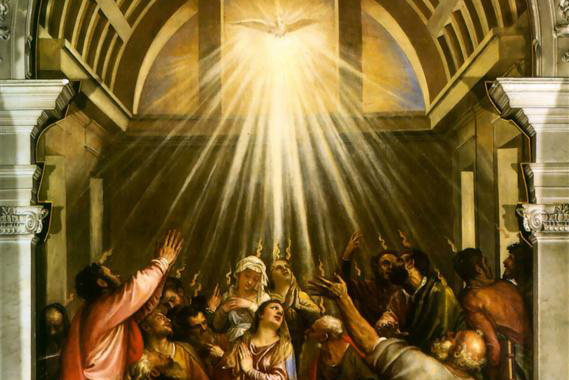
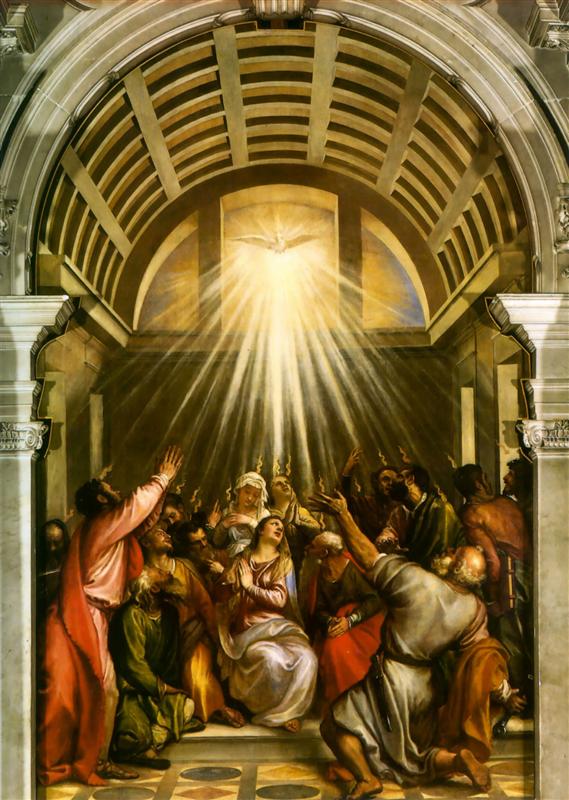
Fire – Scripture says And tongues, like flames of fire that were divided, appeared to them and rested on each one of them.
The Bible often speaks of God as fire, or in fiery terms:
Moses saw God as a burning bush. God led the people out of Egypt through the desert as a pillar of fire. Moses went up on to a fiery Mt. Sinai where God was.
Psalm 97 says, The LORD reigns; let the earth rejoice; let the many coastlands be glad! Clouds and thick darkness are round about him; righteousness and justice are the foundation of his throne. Fire goes before him, and burns up his adversaries round about. His lightnings lighten the world; the earth sees and trembles. The mountains melt like wax before the LORD, before the Lord of all the earth. The heavens proclaim his righteousness; and all the peoples behold his glory. (Ps 97:1-6).
Scriptures call God a Holy fire, a consuming fire (cf Heb 12:29) and a refining fire (cf Is. 48:10; Jer 9:7; Zec 13:9; & Mal 3:3).
And so it is that our God, who is a Holy Fire, comes to dwell in us through his Holy Spirit. And as a Holy Fire, He refines us by burning away our sins and purifying us. As Job once said, But he knows the way that I take; when he has tested me, I will come forth as gold (Job 23:10).
Fire changes everything it encounters. Nothing goes away from fire unchanged. Either is it consumed, converted or purified, warmed or mollified or steeled. But nothing goes way from fire unchanged.
And thus God the Holy Spirit, like a Holy Fire, is within, changing and transforming us. Burning away sin, refining us, enlightening us, stirring the flame of God’s love and bringing us up to the temperature of God’s glory. He is kindling a fire that gives light and warmth in our darkest and coldest moments. Little by little we become a burning furnace of God’s love and we give warmth to others around us.
And, as fire, He is also preparing us for judgement, for if God is a Holy Fire, then who may endure the day of his coming or of our going to Him? What can endure the presence of Fire Himself? Only that which is already fire. Thus we must be set afire by God’s love.
So, in the coming of the Holy Spirit God sets us on fire to make us a kind of fire. In so doing, he purifies and prepares us to meet him one, He who is a Holy Fire.
Tongues – the Fire is described as tongues. And thus we learn that one of the chief fruits of Spirit is to help us witness to others. What is a witness? A witness is one who speaks of what they have seen, heard, and experienced.
Of this need to witness the Lord said,
You will be my witnesses in Jerusalem, and in all Judea and Samaria, and to the ends of the earth. (Acts 1:8).
Again he Jesus says, You are witnesses of these things. I am going to send you what my Father has promised; but stay in the city until you have been clothed with power from on high (Luke 24:48-49).
And yet again the Lord said, When the Advocate comes, whom I will send to you from the Father—the Spirit of truth who goes out from the Father—he will testify about me. And you also must testify, for you have been with me from the beginning (John 15:26-27)
Thus the spirit comes as tongues to strengthen us for mission, for witness. And oh how this witness is needed today. Evil has triumphed since the good have remained silent. Pulpits and parents have been silent! The tongues of fire remind us that God wants fiery and bold saints who are courageous witnesses in a doubting, deceitful, and scoffing world.
Many martyrs have died courageously and too many of fear that some one might merely raise an eyebrow at us. Pray for the courage of tongues, the courage to speak.
Water –Jesus often used water as an image of the Spirit. for example:
On the last and greatest day of the festival, Jesus stood and said in a loud voice, “Let anyone who is thirsty come to me and drink. Whoever believes in me, as Scripture has said, rivers of living water will flow from within them.” By this he meant the Spirit, whom those who believed in him were later to receive. Up to that time the Spirit had not been given, since Jesus had not yet been glorified. (John 7:37-39)
And in John’s gospel the giving over of the Holy Spirit is described powerfully even at the moment of crucifixion:
Jesus said, “It is finished.” With that, he bowed his head and gave up his spirit. Now it was the day of Preparation, and the next day was to be a special Sabbath. Because the Jewish leaders did not want the bodies left on the crosses during the Sabbath, they asked Pilate to have the legs broken and the bodies taken down. The soldiers therefore came and broke the legs of the first man who had been crucified with Jesus, and then those of the other. But when they came to Jesus and found that he was already dead, they did not break his legs. Instead, one of the soldiers pierced Jesus’ side with a spear, bringing a sudden flow of blood and water. The man who saw it has given testimony, and his testimony is true. He knows that he tells the truth, and he testifies so that you also may believe. (John 19: 30-35).
And thus, in this flow, of water comes forth the Spirit in a kind of Johannine Pentecost. It is a classic Johannine play on words that he says Jesus “gave over his Spirit” a phrase which can mean “he died” or that he gave us of his Holy Spirit. Mel Gibson dramatically portrays this giving over of the Spirit in the video below.
The Fathers of the Church also see water as an apt image for the Spirit.
St Irenaeus says,Like dry flour, which cannot become one lump of dough, one loaf of bread, without moisture, we who are many could not become one in Christ Jesus without the water that comes down from heaven. And like parched ground, which yields no harvest unless it receives moisture, we who were once like a waterless tree could never have lived and borne fruit without this abundant rainfall from above. Through the baptism that liberates us from change and decay we have become one in body; through the Spirit we have become one in soul….the devil had been cast down like lightning. If we are not to be scorched and made unfruitful, we need the dew of God. (Against the Heresies Lib. 3, 17. 1-3: SC 34, 302-306)
St. Cyril of Jerusalem says, But why did Christ call the grace of the Spirit water? Because all things are dependent on water; plants and animals have their origin in water. Water comes down from heaven as rain, and although it is always the same in itself, it produces many different effects, one in the palm tree, another in the vine, and so on throughout the whole of creation. It does not come down, now as one thing, now as another, but while remaining essentially the same, it adapts itself to the needs of every creature that receives it. In the same way the Holy Spirit, whose nature is always the same, simple and indivisible, apportions grace to each man as he wills. Like a dry tree which puts forth shoots when watered, the soul bears the fruit of holiness when repentance has made it worthy of receiving the Holy Spirit. Although the Spirit never changes, the effects of this action, by the will of God and in the name of Christ, are both many and marvelous. The Spirit makes one man a teacher of divine truth, inspires another to prophesy, gives another the power of casting out devils, enables another to interpret holy Scripture. The Spirit strengthens one man’s self-control, shows another how to help the poor, teaches another to fast and lead a life of asceticism, makes another oblivious to the needs of the body, trains another for martyrdom. His action is different in different people, but the Spirit himself is always the same. In each person, Scripture says, the Spirit reveals his presence in a particular way for the common good. (Cat. 16, De Spiritu Sancto 1, 11-12.16: PG 33, 931-935. 939-942)
And thus, here is another fundamental image of the Holy Spirit. For all things are dependent on water to both sustain their existence and also to activate and empower their gifts. I cannot speak more profoundly than these two saints and fathers. So I shall let their words suffice.
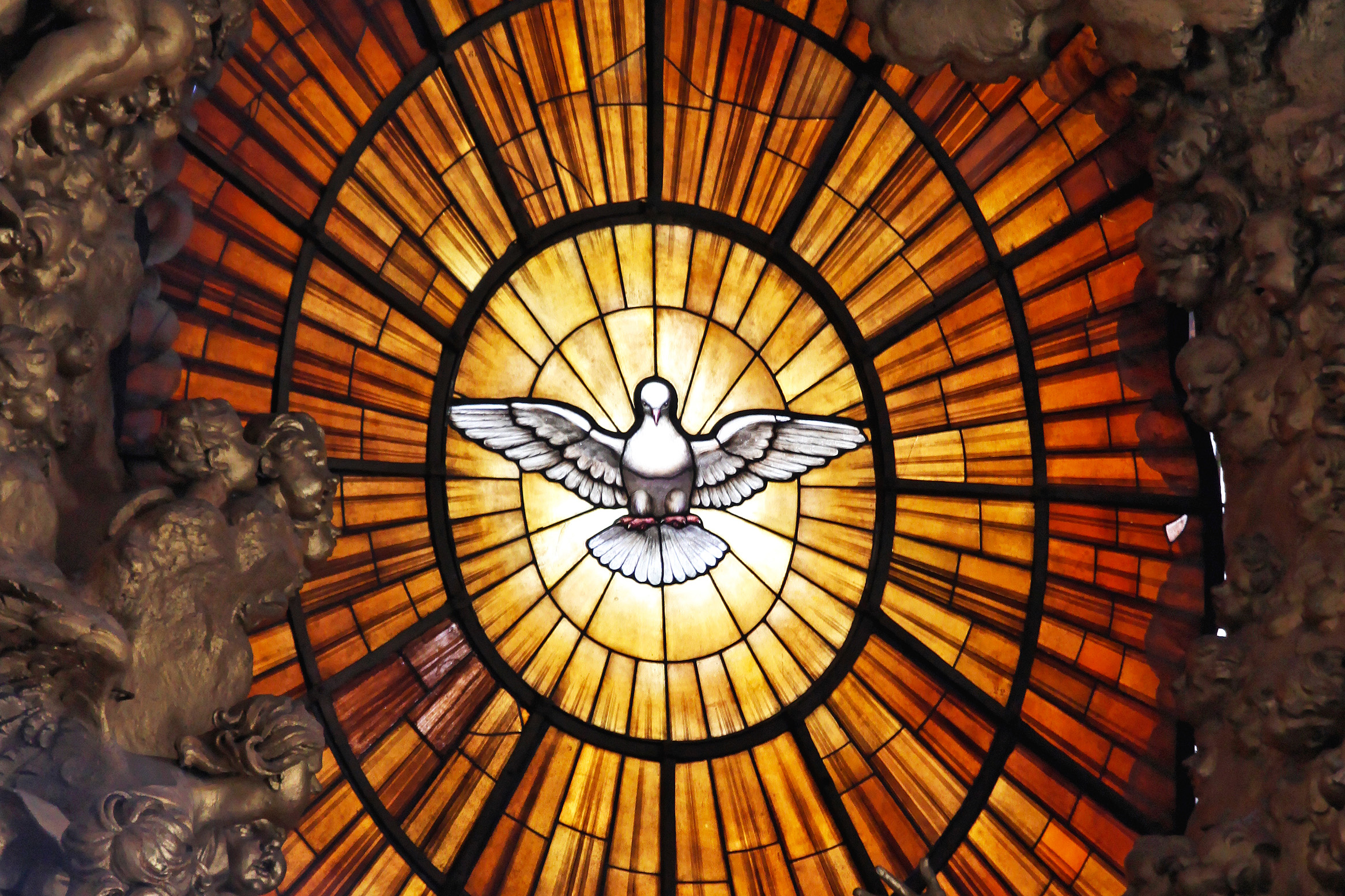
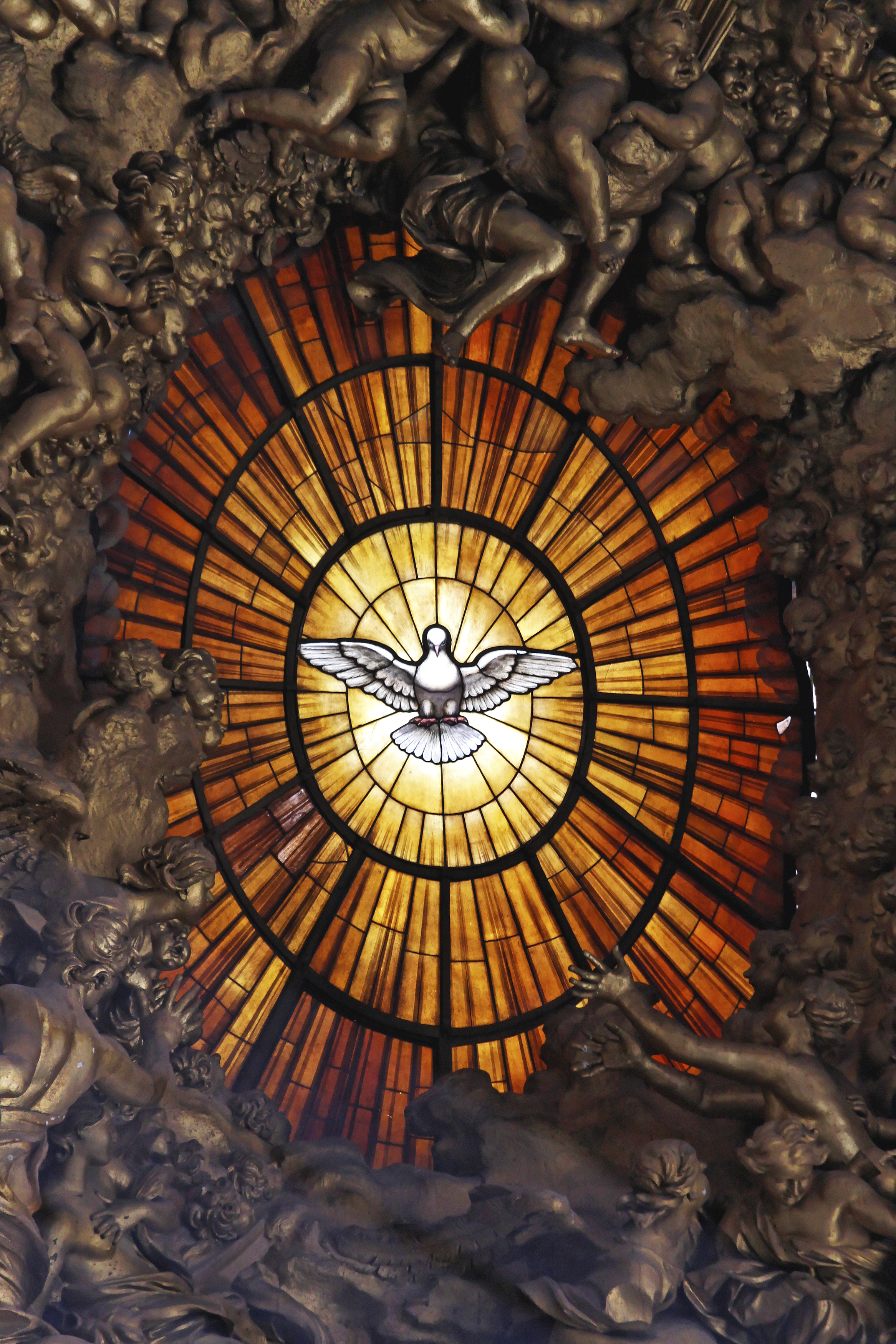
Dove –We know that the Holy Spirit descended on Jesus in the form of a Dove. Scripture says,
and the Holy Spirit descended on him in bodily form like a dove. And a voice came from heaven: “You are my Son, whom I love; with you I am well pleased. (Luke 3:22)
Again note the use of metaphor and analogy here. The Holy Spirit is not a bird or a body or any sort. Rather he is seen in bodily form, like a dove.The Holy Spirit is God, is the Third person of the Holy Trinity.
But in saying He is like a dove, we are reminded of the Story of Noah:
After forty days Noah opened a window he had made in the ark and sent out a raven, and it kept flying back and forth until the water had dried up from the earth. Then he sent out a dove to see if the water had receded from the surface of the ground. But the dove could find nowhere to perch because there was water over all the surface of the earth; so it returned to Noah in the ark. He reached out his hand and took the dove and brought it back to himself in the ark. He waited seven more days and again sent out the dove from the ark. When the dove returned to him in the evening, there in its beak was a freshly plucked olive leaf! Then Noah knew that the water had receded from the earth. (Genesis 8:6-11)
And thus the dove announced to Noah that the bitterness and death that overwhelming sin had brought was now at an end. The dove brought Noah a sign of peace and that the promise of God to cleanse the world was now fulfilled. Now Noah, having passed through the flood in the safety of God’s ark may walk in newness of life.
And so too for us. In the Holy Spirit is peace, is shalom. The long reign of sin is ended and grace is now available to us. And we too, having passed through the waters of baptism may walk in newness of life. The Holy Spirit descends on us like a dove, bringing peace, promise and every good grace.
And thus we have these five images to ponder the Holy Spirit’s work in us. Surely there are other images and ways of describing His work but these speak powerfully to us for now. Please add your own reflections.
Here is the Johannine “Pentecost” wherein the Lord gives over his spirit in both senses of the phrase. (Note the effects on the solider especially). Just as from Adam’s wounded side came forth his bride, so now from Christ’s wounded side, comes forth his Bride, the Church. Here is the fulfillment of John 7 quoted above.
What a wondrous and challenging feast we celebrate at Pentecost. A feast like this challenges us, because it puts to the lie a lazy, sleepy, hidden, and tepid Christian life. The Lord Jesus had said to Apostles, and still says to us: I have come to cast a fire on the earth! (Luke 12:49). This is a feast about fire, about a transformative, refining, and purifying fire that the Lord wants to kindle in us and in this world.
The Readings today speak to us of the Holy Spirit in three ways: The Portraits of the Spirit, the Proclamation of the Spirit and the Propagation by the Spirit. Let’s look at all three.
I. The Portraits of the Spirit – The Reading today speaks of the Holy Spirit using two images: rushing wind, and tongues of fire. These two images recall Psalm 50 which says, Our God comes, he does not keep silence, before him is a devouring fire, round about him a mighty tempest. (Psalm 50:3).
Rushing Wind – Notice how the text from Acts opens: When the time for Pentecost was fulfilled, they were all in one place together. And suddenly there came from the sky a noise like a strong driving wind, and it filled the entire house in which they were.
This text brings us to the very root meaning of the word “Spirit.” For “spirit” refers to “breath,” and we have this preserved in our word “respiration,” which means breathing. So, the Spirit of God is the breath of God, the Ruah Adonai (the Spirit, the breath of God).
Genesis 1:2 speaks of this saying the Spirit of God was moving over the face of the waters. And Genesis 2:7 speaks even more remarkably of something God did only for man, not the animals: then the LORD God formed man of dust from the ground, and breathed into his nostrils the breath of life; and man became a living soul (Gen 2:7).
So the very Spirit of God was breathed into Adam! But, as we know, Adam lost this gift and died spiritually when he sinned.
Thus we see in this passage from Acts an amazing and wonderful resuscitation of the human person as these first Christians (120 in all) experience the rushing wind of God’s Spirit breathing spiritual life back into them. God does C.P.R. and brings humanity, dead in sin, back to life! The Holy Spirit comes to dwell in us once again as in a temple (cf 1 Cor 3:16). It has been said that Christmas is the feast of God with us, Good Friday is the Feast of God for us, but Pentecost is the Feast of God in us.
Tongues of Fire – The text from Acts says, Then there appeared to them tongues as of fire, which parted and came to rest on each one of them.
The Bible often speaks of God as fire, or in fiery terms. Moses saw God as a burning bush. God led the people out of Egypt through the desert as a pillar of fire. Moses went up on to a fiery Mt. Sinai where God was. Psalm 97 says, The LORD reigns; let the earth rejoice; let the many coastlands be glad! Clouds and thick darkness are round about him; righteousness and justice are the foundation of his throne. Fire goes before him, and burns up his adversaries round about. His lightnings lighten the world; the earth sees and trembles. The mountains melt like wax before the LORD, before the Lord of all the earth. The heavens proclaim his righteousness; and all the peoples behold his glory. (Ps 97:1-6). Scriptures call God a Holy fire, a consuming fire (cf Heb 12:29) and a refining fire (cf Is. 48:10; Jer 9:7; Zec 13:9; & Mal 3:3).
And so it is that our God, who is a Holy Fire, comes to dwell in us through his Holy Spirit. And as a Holy Fire, He refines us by burning away our sins and purifying us. As Job once said, But he knows the way that I take; when he has tested me, I will come forth as gold (Job 23:10).
And he is also preparing us for judgement, for if God is a Holy Fire, then who may endure the day of his coming or of our going to Him? What can endure the presence of Fire Himself? Only that which is already fire. Thus we must be set afire by God’s love.
So, in the coming of the Holy Spirit God sets us on fire to make us a kind of fire. In so doing, he purifies and prepares us to meet him one, He who is a Holy Fire.
II. The Proclamation of the Spirit. – You will notice that the Spirit Came on them like “tongues” of Fire. And the reference to tongues is no mere accident. For notice how the Holy Spirit moves them to speak, and ultimately to witness. The text says: And they were all filled with the Holy Spirit and began to speak in different tongues, as the Spirit enabled them to proclaim. Now there were devout Jews from every nation under heaven staying in Jerusalem. At this sound, they gathered in a large crowd, but they were confused because each one heard them speaking in his own language. They were astounded, and in amazement they asked, “Are not all these people who are speaking Galileans? Then how does each of us hear them in his native language? We are Parthians, Medes, and Elamites, inhabitants of Mesopotamia, Judea and Cappadocia, Pontus and Asia, Phrygia and Pamphylia, Egypt and the districts of Libya near Cyrene, as well as travelers from Rome, both Jews and converts to Judaism, Cretans and Arabs, yet we hear them speaking in our own tongues of the mighty acts of God.”
So behold how the Holy Spirit moves them to proclaim, not just in the safety of the upper room, but also in holy boldness before the crowds who have gathered.
Notice the transformation! Moments ago these were frightened men who gathered only behind locked doors, in secrecy. They were huddled together in fear. But now they go forth to the crowds and boldly proclaim Christ. They have gone from fear to faith, from cowardice to courage, from terror to testimony!
And how about us? Too many Christians are silent, dominated by fear. Perhaps they fear being called names, or not being popular. Perhaps they are anxious about being laughed at, or resisted, or of being asked questions they don’t feel capable of answering. Some Christians are able to gather in the “upper room” of the parish and be active, even be leaders. But once outside the “upper room” they slip into undercover mode. They become secret agent Christians.
Well, the Holy Spirit wants to change that, and to the degree that we have really met Jesus Christ and experienced his Holy Spirit we are less “able” to keep silent. An old Gospel song says, I thought I wasn’t gonna testify, but I couldn’t keep it to myself, what the Lord has done for me. The Holy Spirit, if authentically received, wants to give us zeal and joy, and burn away our fear, so that testifying and witnessing are natural to us.
Note also how the Spirit “translates” for the apostles, for the crowd before them spoke different languages, but all heard Peter and the others in their own language. The Spirit therefore assists not only us, but also those who hear us. My testimony is not dependent only on my eloquence, but also on the grace of the Holy Spirit who casts out deafness and opens hearts. Every Christian should remember this. Some of our most doubtful encounters with others can still bear great fruit on account of the work of the Holy Spirit who “translates” for us and overcomes many obstacles that we might think insurmountable.
III. The Propagation by the Spirit – In the great commission the Lord said, Go, therefore, and make disciples of all nations, baptizing them in the name of the Father, and of the Son, and of the Holy Spirit, teaching them to observe all that I have commanded you. And behold, I am with you always, until the end of the age (Matt 28:19ff). He also said, as we have noted, I have come to cast a fire on the earth and How I wish the blaze were already ignited (Luke 12:49).
But how is the Lord going to do this?
Perhaps a picture will help. My parish church is dedicated to the Holy Spirit under the title: Holy Comforter. Above the high altar is the Latin inscription: Spiritus Domini, replevit orbem terrarum (The Spirit of the Lord, filled the orb of the earth). (See photo, above right, of our high altar).
And yet, we may wonder how He will do this.
But the walls of my parish Church answer the question. The clerestory walls are painted Spanish Red, and upon this great canvas are also painted the lives of 20 saints, surrounding us like a great cloud of witnesses (cf Heb 12:1). (See also, video below). And over the head of every saint is a tongue of fire.
THIS is how the Spirit of the Lord fills the earth. It is not “magic fairy dust,” it is in the fiery transformation of every Christian, going forth into the world to bring light and warmth to a dark and cold world. THIS is how the Lord casts fire on earth, THIS is how the Spirit of the Lord fills the orb of the earth: in the lives of saints, and, if you are prepared to accept it, in YOU.
In the end, the Great Commission (Matt 28) is “standing order No. 1.” No matter what else, we are supposed to do this. Parishes do not deserve to exist if they do not do this. We as individual Christians are a disgrace, and not worthy of the name, if we fail to win souls for Jesus Christ. The Spirit of the Lord is going to fill the orb of the earth, but only through us. The spread of the Gospel has been placed in your hands (scary isn’t it?).
In the Past two years, my own parish, after a year of training, stepped out into our neighborhood, and went door to door and into the local park. And we announced Jesus Christ, and invited people to discover him in our parish, and in the sacraments. And we were in the local park and the market last week doing sidewalk evangelization.
Before we count even a single convert, this is already success because we are obeying Jesus Christ who said, simply, “Go!” “Go make disciples.” And, truth be told, we ARE seeing an increase in my parish. Our Sunday attendance has grown from about 450 to 520, a 15% increase. We are growing, and our attendance, while average for a downtown city parish, is going in the right direction. God never fails. God is faithful.
Spread the news: it works if you work it, so work it because God is worth it. Go make disciples. Ignore what the pollsters tell you about a declining Church and let the Lord cast a fire on the earth through you! Fires have way of spreading! Why not start one today? The Spirit of God will not disappoint.
I know this, my parish has a future because we are obeying Jesus Christ, we are making disciples. How about you and yours? If parishes do not obey, they do not deserve to exist and can expect to close one day, no matter how big they are today. I, in my short 50 years on this planet, have seen it: parishes once big, booming, and, (frankly), arrogant, are now declining and some are near closure. It happens to the best, if they do not evangelize, if they do not accomplish “Job 1.” The Lord wants to light a fire. Why not become totally fire? Let the Spirit propagate the Church through you (I am not talking about the person next to you, I am talking to you).
Happy feast of Pentecost. But don’t forget that the basic image is very challenging, for it means getting out of the “upper room,” opening the doors, and proclaiming Christ to the world. Let the Holy Spirit light a fire in you, and then, you can’t help but spread light and heat to a cold and dark world.
Let the evangelization of the whole world begin with you.
This video features details from the clerestory (upper window level) of my parish of Holy Comforter here in DC. Notice the tongue of fire above each saint. The paintings show how the Spirit of the Lord fills the orb of the earth, (see photo above), through the lives of the lives of the saints (this means you). It is not magic, it is grace, working in your life, through your gifts, and your relationships, that the Lord will reach each soul. The cloud of witnesses on the walls of my Church say simply, You are the way he will fill the earth and set it on fire. Let the blaze be ignited in you!
The song says: We are surrounded by a great cloud of witnesses, looking on, encouraging us to do the will of the Lord. Let us stand worthy, and be faithful to God’s call….We must not grow weary…!
Here is another video I put together which has scenes from the Pentecost event and is set to Palestrina’s Dum Complerentur. I like this musical version since it is sung in dance time. The Latin text to the motet is below the video along with its English Translation.
Dum complerentur dies Pentecostes, erant omnes pariter dicentes, alleluia, et subito factus est sonus de coelo, alleluia, tamquam spiritus vehementis, et replevit totam domum, alleluia.
–
When the Day of Pentecost had fully come,
they were all with one accord in one place, saying: alleluia.
And suddenly there came a sound from heaven, alleluia,
as of a rushing mighty wind,
and it filled the whole house
where they were sitting, alleluia.
We tend to demonize the word “power” in our culture. But of itself, power is simply the capacity to act, a kind of energy to accomplish what must be done. Power in this sense can lead to magnificent and creative solutions to difficulties, wonderful breakthroughs and great progress.
God gives us all a certain degree of power to act. We have capacities, abilities, talents and charisms. And these powers, these capacities interact with our will and freedom. It is here that power can bring about great good or go terribly wrong.
Power gone wrong leads us to dominate and impose our self on others in a self-serving way. And power used in this way can lead to unimaginable human suffering and misery and the wars, conflicts, genocides, killing fields and high death tolls of the last century show. As many as 100 million people were put to death in that bloody century in the name of many secular ideologies, of ushering in secular “utopias” and the quest for raw and dominating power.
In the video below we see power gone wrong. A man comes to apply for the job of “superhero” and he is put through certain tests to discern if he has the temperament to handle power for good.
The first few tests seem to go well. But suddenly his use of power goes to his head and he gratuitously kills someone he is supposed to protect. Things go off the rails quickly and the result is utter destruction.
How did this happen? As already stated his power has gone to his head. He has forgotten that he has power for others, not for himself.
It frequently happens in history that those who stage revolutions for the “good of the people” or to end injustice, rise to power and then usher in their own reign of terror. Secular utopian notions of the last Century and their leaders while claiming to be “for the people” often created worse oppression and dictatorships than they claimed to replace. Iron curtains fell and a loss of freedom ensued, as killing on a mass scale was ushered in all “for the sake of the people.” Hitler killed millions, as did Stalin, Mao, Pol Pot and others.
There is a subtlety to the video as to how the power goes to his head. For on the face of it his turn to darkness is quite sudden. But I would suggest it is not and that we could see it coming.
How? In the fact that our “hero” uses deadly violence to solve every problem presented in his test sequence. It is not enough for him to rescue the victim, he must destroy the threat. Finally a threat sees his prepared response and back down. He has won without destroying. But by now he has a lust to kill. He must get the kill! But the kill has evaded him by retreat. Thus he turns his lust for power, his lust for the kill on the one he is supposed to protect. From there it is all downhill. No one will limit his power, tell him what to do or keep his blood lust in check. Power has corrupted him. He is addicted to it and must use it.
Here is power gone wrong in miniature, in a cartoon that well illustrates the dark side of power. Power is not wrong, but power can go wrong when it interacts with our sinful nature and its use is no longer measured, or its object is no longer helping others but merely serving the self.
One of the terribly destructive philosophies is a false notion of freedom. The sinful world, going all the way back to Satan’s deceit in the garden, thinks of freedom as being able to do whatever I please. In effect those who hold this, flaunt their false notion of freedom saying in effect, “I will do what I want to do, and I will decide if it is right or wrong. No one will tell me what to do.” It is freedom in the abstract, freedom for its own sake, rather than for the sake of being able to do what is right.
That this notion of freedom is false is evident from its fruits. For although many, in modern times, claim to march under the banner of freedom from being told what to do, it becomes clear that many of them end up it a terrible state of increasing slavery and bondage.
For this era when a false notion of freedom is exulted is also an era of increasing addiction to alcohol, drugs, pornography, sex, and a general lack of self control. And with greed and materialism, whatever we have is never enough. There is thus a bondage to things, a kind of incapacity to live without endless numbers of things and creature comforts. Therefore we also see increasing bondage to credit, both personally and nationally. We simply “cannot” stop our runaway spending. There is also an increasing lack of ability to make and keep commitments and many feel “compelled” to divorce, leave the priesthood and religious life.
None of this shouts the freedom that so many boast of. Rather there is evident, bondage, inability, compulsion, addiction, and an out of control quality to modern life.
You will thus know by its fruits that false freedom is not true freedom. It masquerades in the “sheep’s” clothing of liberty, but underneath it is the ravenous wolf of bondage. Many cry “Liberty!” when they really mean “libertine” and “licentious.” They are headed straight for bondage. St. Augustine said,
For of a perverse will, was a lust made; and a lust served, became custom; and custom not resisted, became necessity. (Confessions 8.5)
The Catechism also says,
The more one does what is good, the freer one becomes. There is no true freedom except in the service of what is good and just. The choice to disobey and do evil is an abuse of freedom and leads to “the slavery of sin.” (CCC # 1733).
And thus we arrive at the definition of true freedom which is “the capacity to obey God.”
And what are the fruits of true freedom? An increasing liberation from the power of sin, the increasing capacity to do what is right and just by the power of God. True freedom brings greater self control, the ability to moderate one’s desires and have them submitted to right reason. True freedom brings serenity, for one’s life is in greater balance and harmony.
By true freedom, the innumerable sorrows of false freedom listed above are largely avoided and one’s life is simpler, more focused, and one enjoys the results of a disciplined and reasonable life. Sorrows and suffering are not eliminated but are diminished for many of their sources in excess, addiction and compulsion are removed. True freedom ushers in, by God’s power, the life that Jesus Christ died and rose to give us.
So what do you want, the fake freedom of the world, or the glorious freedom of the children of God? (Rom 8:21)
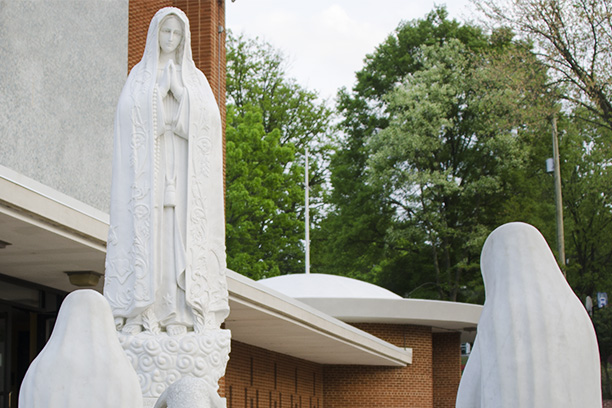
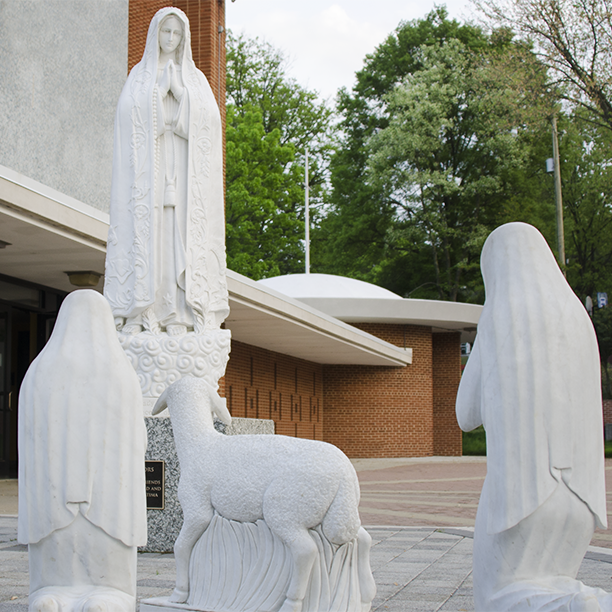
This past week we celebrated the feast of Our Lady of Fatima. (And, given my mention of Fatima, you may wonder why I have Our Lady of Guadalupe pictured here, but more on that in a moment). But as for Fatima, with all the emphasis on the magnificent teaching and prophetic fulfillment of that apparition, something that has always intrigued me is that she would appear of all places in a town called Fatima. Why Fatima, a town that recalls the daughter of Mohammed?
Indeed, I have often heard that Muslims hold our Blessed Mother Mary in high regard. This reverence may stop short of our devotion but there is said to be a respect for her in the Muslim tradition.
Now, I first learned this from the great Archbishop, Fulton Sheen in his book, The World’s First Love. I read it 25 years ago and have pondered it ever since. I would like to present excerpts from the chapter entitled “Mary and the Moslems” [sic], reflect on its significance and ask a few questions. Please note that the book was written in 1952 and therefore some of the spellings are not the modern ones. Here are the excerpts:
The Koran, which is the Bible of the Moslems, has many passages concerning the Blessed Virgin. First of all, the Koran believes in her Immaculate Conception, and also, in her Virgin Birth…..The Koran also has verses on the Annunciation, Visitation, and Nativity. Angels are pictured as accompanying the Blessed Mother and saying, Oh Mary, God has chosen you and purified you, and elected you above all the women of the earth. In the 19th chapter of the Koran there are 41 verses on Jesus and Mary. There is such a strong defense of the virginity of Mary here that the Koran in the fourth book, attributes the condemnation of the Jews to their monstrous calumny against the Virgin Mary.
Mary, then, is for the Moslems the true Sayyida, or Lady. The only possible serious rival to her in their creed would be Fatima, the daughter of Mohammed himself. But after the death of Fatima, Mohammed wrote: Thou shalt be the most blessed of women in Paradise, after Mary. In a variant of the text Fatima is made to say; I surpass all the women, except Mary.
This brings us to our second point; namely, why the Blessed Mother, in this 20th Century should have revealed herself in the significant little village of Fatima, so that to all future generations she would be known as “Our Lady of Fatima.” Since nothing ever happens out of Heaven except with a finesse of all details, I believe that the Blessed Virgin chose to be known as “Our Lady of Fatima” as pledge and a sign of hope to the Moslem people, and as an assurance that they, who show her so much respect, will one day accept her divine Son too.
Evidence to support these views is found in the historical fact that the Moslems occupied Portugal for centuries. At the time when they were finally driven out, the last Moslem chief had a beautiful daughter by the name of Fatima. A Catholic boy fell in love with her, and for him she not only stayed behind when the Moslems left, but even embraced the Faith. The young husband was so much in love with her that he changed the name of the town where he lived to Fatima. Thus the very place where our Lady appeared in 1917 bears a historical connection to Fatima, the daughter of Mohammed.
Missionaries, in the future will, more and more, see that their apostolate among the Moslems will be successful in the measure that they preach Our Lady of Fatima. Mary is the advent of Christ, bringing Christ to the people before Christ himself is born. In any apologetic endeavor, it is always best to start with that which the people already accept. Because the Moslems have devotion to Mary, our missionaries should be satisfied merely to expand and develop that devotion, with the full realization that our Blessed Lady will carry the Moslems the rest of the way to her divine Son. She is forever a “traitor,” in the sense that she will not accept any devotion for herself, bit will always bring anyone who is devoted to her to her divine Son.
A beautiful reflection by Archbishop Sheen and one we can surely hope will come to pass. Relations are much more tense however between Christians and Muslims today than in 1952.
This leads to my first question.
Do Muslims today still manifest the reverence to Mary that Sheen described in 1952? I have seen a few people in Muslim garb at the Basilica of the Immaculate Conception here in D.C., but I was not sure if they came to pay homage to Mary or just tour. I think we Catholics ought to be careful before we presume too much of what Muslims today think of Mary. The lines in the Quran quoted by Sheen are impressive but that does not mean that Muslims either know them well or interpret them as we would wish? Hence, I am merely posing a question here. If any of you know of good sources that answer the question of the Muslim stance on Mary I would be grateful if you can point it out. The answer to this question has a lot of bearing on my speculations to follow.
Astonishing Fact – I have already noted that it nothing less than astonishing that Mary should appear in a town called “Fatima.” Surely this is no mere coincidence and, as Sheen aptly points out, heaven does nothing without purpose. That we are not to merely pass over this detail, is very clear to me. “Our Lady of Fatima,” has a different ring when we think that Fatima is more that a place, Fatima is the Daughter of Muhammad, and the greatest woman in Islam. “Our Lady of Fatima” sounds and feels so different when it is heard in this context of person not place. It is hugely significant.
Third Secret of Fatima? For many years, before its revelation, I was sure that the Third Secret of Fatima had something to do with the Muslim question. Frankly I figured it likely described a great conflict with the Muslim world that would arise and lead to great suffering for the Church, even a kind of Babylonian captivity, but that ultimately Mary’s Immaculate Heart would triumph by the power of God. Imagine my chagrin when the third secret was finally revealed with a less than worldwide, apocalyptic content. Granted, the assassination attempt on Pope John Paul II was a serious and significant matter but it was less than the worldwide conflict I had expected. It is also true that his would-be assassin was Muslim, but the plot was likely more communist and Russian in origin. In the end my theory was rocked back on its heels and fell flat.
But still we are left with Fatima. Why Fatima? Why a town bearing the namesake of Muhammad’s daughter? It seems clear that Mary will play an important role in the years ahead as the Muslim/Christian conflict likely grows sharper. Perhaps, as Sheen notes, she will be the bridge that connects two vastly different cultures, the common mother who keeps her children talking. Right now this connection seems little pursued, even, as far as I can tell, by the Vatican. But here too allow a question from me. Are there any of you who know if Our Lady of Fatima has any role in Vatican-Muslim dialogue?
The Guadalupe connection – I wonder too if the history of Our Lady of Guadalupe presents some historical parallels to our current struggle with the Muslim world. In the early 16th Century in Mexico, missionaries had made only meager progress in bringing the Aztec people to Christ. It was a combination of the sometimes rude and cruel treatment of the indigenous people by the Spanish soldiers, and also of the fearful superstition surrounding the Aztec gods. These gods required horrific human sacrifices and kept the people locked in with this fear that, unless they fed these gods, their greatest god, the sun, would no longer shine.
Into this fearful and suspicious setting entered Mother Mary. The miraculous image she left in 1531 was richly symbolic: Her face is a mother’s face, gentle and compassionate, unlike the frightful Aztec gods who wore fierce masks. Her features seem to be both an Aztec and European, two cultures are combined in kindness and peace. Her attitude is one of humble prayer, so she is clearly not a god. She is a merciful mother who consoles and prays for us. She is to be honored but not adored. The black band around her waist means that she is with child and offers Jesus to the people. Her message is about him. The sun was the greatest of the Aztec gods and, by standing in front of the sun, Mary shows that she is greater than all their gods. The moon represented to them the god of darkness and death. That she is standing on the moon is a sign that these powers too have been defeated by the son she bears.
Mary brought the breakthrough. Within ten years over 12 million Mexicans came to Christ and entered the Catholic Church.
This history is paralleled in many ways today in the current tensions with the Muslim World. In many Muslim lands today conversions are few. Part of the reason for this is a strong aversion for the western culture from which Catholicism comes. Another reason includes many alleged grievances that Muslims have of American and Western “mistreatment.” Finally, a large factor is fear. Leaving the Muslim faith is likely to get you killed in many parts of the Muslim world. So, it is a combination of a wide cultural gulf, alleged grievances, and fear, that keep conversions low. All not unlike 16th Century Mexico.
Is Mary key? It took Mary to bridge all these similar gaps between the Aztecs and the Christian Missionaries. Might Mary also be that bridge today when similar gaps divide? Time will tell, but one of her greatest Modern titles is Our Lady of Fatima. And then, there is the crescent moon upon which Mary stands in the image of Guadalupe. In modern times the crescent moon is the symbol of Islam. Mother Mary of Guadalupe, by God’s grace, was victorious and overcame the false religion of the Aztecs with love and humility.
Might this crescent moon on which Our Lady of Guadalupe stands also point to our times, and the crescent moon of Islam? Might it indicate that her victories, by God’s grace, are not at an end. Perhaps we can hope that what our Lady of Guadalupe was to the Aztec people of Mexico, Our Lady of Fatima will be to the Muslim people of the world.
As always, I invite your comments and answers to my questions.
I also want to invite any of you who would like to accompany me and some other folks from my Parish and Washington DC as we go to Gaudalupe in in October 8-15. For more info contact my parishioner, Deborah Vanzego at [email protected] or 202-408-4641. We’d love to have you come and still have space available.
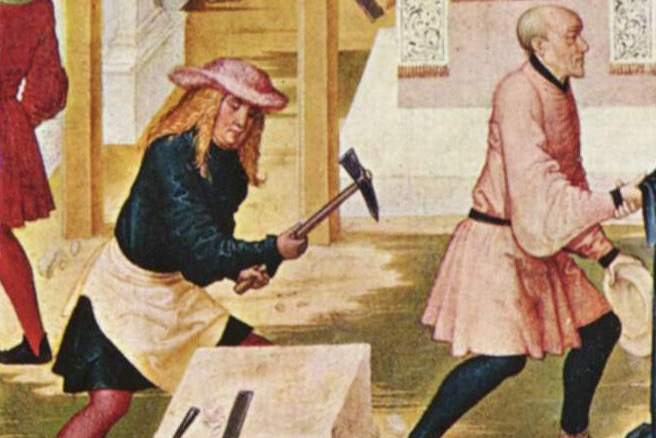
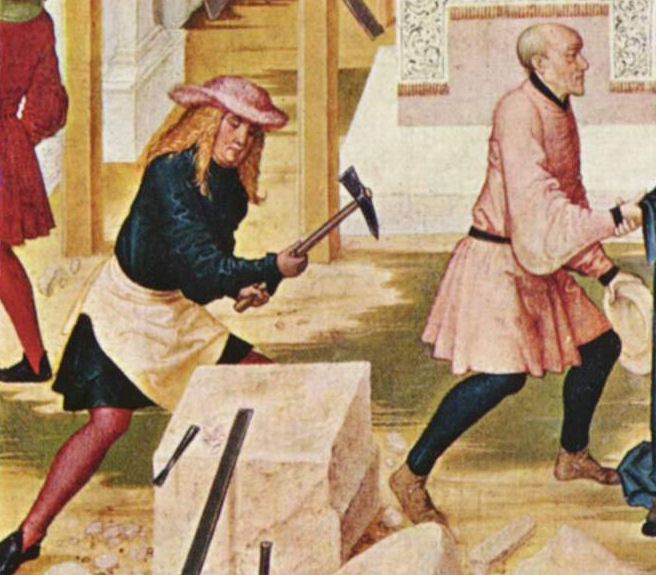
Michelangelo was asked the question how he could make a beautiful sculpture like his “Moses” out of a large block of marble. He famously answered that he simply began and chipped away everything that wasn’t Moses.
And this is a paradigm for us, into senses.
Clearly for us, the Lord must chip away everything in us which is not Jesus. Yes, everything that is not of the Lord must go. St. Paul said, “I live, no not I, Christ lives in me! (Gal 2:20). And thus, the Lord chips away at all in us that is not of him that we may become the image of God in Christ.
And yet, there is also very personal sense too, in which not only must we become Christ, but we must also authentically become our very selves. Each of us is called to reflect Christ, but the Lord has made us, as individuals, to reflect something particular about him in a unique way. You and I therefore must become the man or the woman that God made us to be.
Every now and again I might think, as do you, “Would that I were more like St. John Vianney, or St. Francis Xavier, and so forth.” But to this lament, the Lord may likely respond, “I already have a St. John Vianney, I have a Francis Xavier, what I need is you.
And thus, for me, the Lord must chip away me everything that is not Charles Pope. For He made me, and you as well, to be a particular reflection of his glory. Yes, ultimately, we are all called to reflect Christ, but in the particular way that only we can.
Part of our journey is to discover our true self, as God has made us to be, and become that true self. We must allow the Lord to Chip away everything that is is not of God, or of our very selves as he is made us to be.
This is not an invitation to strange idiosyncrasies, or a hyper-individualized version of the truth. No, God does not speak out of both sides of his mouth, and the truth about us will ultimately always be subsumed into the fundamental truth of who Jesus is, who he has created the human person to be in his likeness. And thus, as the Lord sculpts, he is not doing abstract art. Rather, he is working in the context of his revealed truth, but also realizing it in a very particular way in each one of us, with particular some particular reference to the whole truth.
A few final thoughts about carving and chipping away.
First, it is slow and painstaking. Great care and thoughtfulness is required of the artist. And so it is with us who are being sculpted by the Lord. We must learn to be patient and allow him to do his work carefully and creatively. Too often we are impatient. But true art requires that the artist step back and look, work and then reflect. Give the Lord the time and authority he needs.
Secondly, there is a kind of pain in sculpting and it is bewildering. Sculpting and shipping away is difficult, even painful. At the time we may not know or appreciate what the Lord is doing and we all may also worry as to what our final appearance will actually be. But no more than the stone can claim greater wisdom than the sculptor, should we claim a greater wisdom than God who sculpts us.
The Lord admonishes,
Woe to those who quarrel with their Maker, those who are nothing but potsherds among the potsherds on the ground. Does the clay say to the potter, ‘What are you making?’ Does your work say, ‘The potter has no hands’? Woe to the one who says to a father, ‘What have you begotten?’ or to a mother, ‘What have you brought to birth? “This is what the Lord says—the Holy One of Israel, and its Maker: Concerning things to come, do you question me about my children, or give me orders about the work of my hands? It is I who made the earth and created mankind on it. (Isaiah 45:9-12)
Somewhere, and somehow we must allow the Lord to do his work. In the end, everything that is not Jesus must be chipped away, and everything that is not our very self which God has made us to be must be chipped away.
In the end, God must be able to say to you I simply chipped away everything that was not of my Son, and everything that was not of you, as I made you to be from all eternity.
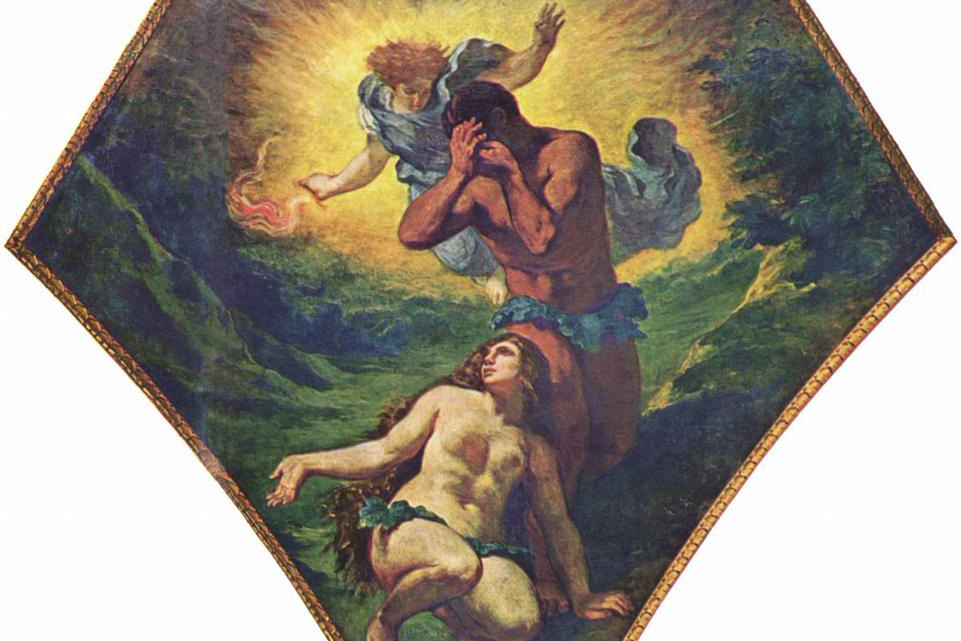
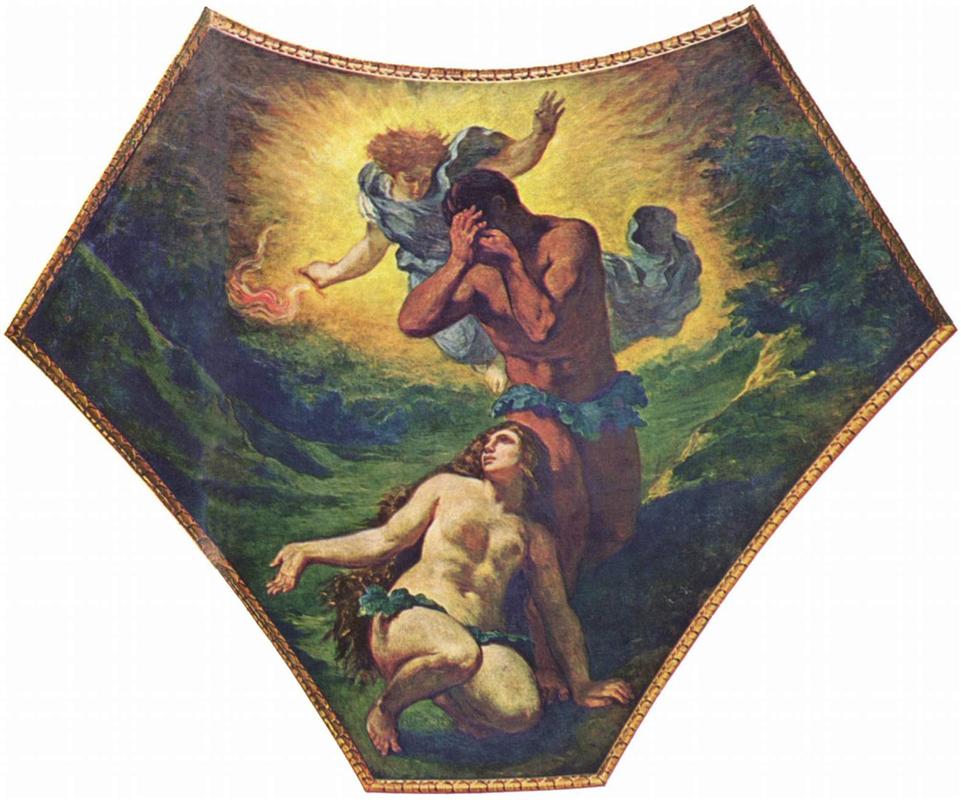
One of the darker passages in the Scriptures comes just after the Fall of Adam and Eve. God is announcing the consequences they have ushered in, and, having spoken to Adam of the arduous quality of work and the hostility of the natural world, God turns to Eve and says,
I will greatly multiply your sorrow and your conception; in sorrow you shall bring forth children; yet your desire shall be to your husband, and he shall rule over you. (Gen 3:16)
The Hebrew word מָשַׁל (mashal) means variously, “to have dominion, reign, or have ruling power over another.” The New Jerusalem Bible Says, “He will dominate you.”
While the text is not absolutely clear, the “rule” spoke of here does not seem to be a mere benign rule of headship by the husband, but rather, a headship marked by tension, domination and easily open to abuse.
The Catechism of the Catholic Church says of this passage:
The harmony in which they had found themselves, thanks to original justice, is now destroyed: the control of the soul’s spiritual faculties over the body is shattered; the union of man and woman becomes subject to tensions, their relations henceforth marked by lust and domination.(# 400).
Every man experiences evil around him and within himself. This experience makes itself felt in the relationships between man and woman. Their union has always been threatened by discord, a spirit of domination, infidelity, jealousy, and conflicts that can escalate into hatred and separation. This disorder can manifest itself more or less acutely, and can be more or less overcome according to the circumstances of cultures, eras, and individuals, but it does seem to have a universal character.
According to faith the disorder we notice so painfully does not stem from the nature of man and woman, nor from the nature of their relations, but from sin. As a break with God, the first sin had for its first consequence the rupture of the original communion between man and woman. Their relations were distorted by mutual recriminations; their mutual attraction, the Creator’s own gift, changed into a relationship of domination and lust…Nevertheless, the order of creation persists, though seriously disturbed. To heal the wounds of sin, man and woman need the help of the grace that God in his infinite mercy never refuses them. (#s 1606-1608)
In calling this a “dark passage” I merely call to attention the concern and critique by some that God seems to speak of this domination by way of approval, that Eve is somehow deserving of this, and that abuse and exploitation by men is to be her lot, by God’s will.
I do not agree with this concern since, as is the case with many of the dark passages of Scripture, we must be careful to distinguish that not everything the Bible reports or describes, means it is reported with approval. Eve’s experience is the result of Original Sin and the poisonous climate it has introduced. And, while God reports the effect, and even connects himself to it by way of primary causality, it is this sin and its poisonous climate that God spends the rest of scripture addressing and healing.
Thus the thought that this passage gives even tacit approval to the abuse of women cannot stand. Yet, some in the past may have invoked it as such, and some today, mainly feminists, critique it for such a possible misinterpretation.
That said, I have seen this passage strangely and sadly fulfilled in a small number of women who struggle with on-going issues of physical and emotional abuse by husbands and “boyfriends.” The vast majority of women are able to break free from physical abuse, unless and until the abusive man gets help to assuredly end his sinful behavior.
But there are a certain number of women I have met and counseled who habitually return to men who abuse them. In this, there is a kind of literal fulfillment of the text that her desire will be for her man, but he will (abusively) dominate her. There are, of course, many factors, such as low self esteem, poor family modeling, financial pressures and so forth.
Yet, one of the stranger and darker reasons I have gleaned from the women who return to abusers is caught up in the phrase, “your desire shall be to your husband.” There is something of a fine line between anger and passion, between a man who is virile and a “go-getter” and one who, on a dime, turns to anger and abuse. Powerful men are attractive to some women. Yet many (not all) powerful men are also aggressive and possessed of a temper. Their strength and their struggle are closely related. Many women intuitively know this, even if they have not consciously worked it all out. What they like in their man is closely related to what they hate and suffer from.
So, I am not so sure that every woman who returns to an abuser is simply lacking in self esteem or financially trapped etc. Some return knowing exactly what they are doing, despite counsel to the contrary. Their reasons are caught up in the complicated intersections of desire described above.
Please note dear reader that I am not reporting this with approval, I am simply observing it and trying to understand it. I, like most of you, would counsel a woman who is being physically abused to stay away unless and until the problem can be resolved. But some do not, and I cannot merely write them off as foolish for it.
But let us be clear, what ever the choice of the woman ultimately is, we cannot forget that the one who abuses is guilty of a great sin and in no way can the scriptures be seen to grant any approval whatsoever.
All of this makes me mindful of a very popular but dark song from the 1970s when I was in High School. It was by Jackson Brown and was called “You Love the Thunder.” My understanding of the words, in effect, have the man who is singing say to the woman, “You really like my anger (thunder) and my abuse (rain) and they’re really worth it, given what else you get with me.”
I remember being quite alarmed by the words and also troubled that no one else seem bothered. (Frankly, most of my High School peers never paid much attention to the words of songs, they just like the melodies. But I have always been very sensitive to the words). I also understand that the words can be interpreted differently by others. But I remain alarmed by the words seem at best arrogant, and at worse celebrating of anger and abuse.
Consider the darkness of these words:
You love the thunder and you love the rain What you see revealed within the anger is worth the pain And before the lightning fades and you surrender You’ve got a second to look at the dark side of the man …. You love the thunder, you love the rain You know your hunger, like you know your name I know you wonder how you ever came To be a woman in love with a man in search of the flame Draw the shades and light the fire For the night, it holds you and it calls your name And just like your lover knows your desire And the crazy longing that time will never tame…
These words are, to me, an “affirmation” of Genesis 3:16, but a Genesis 3:16 that is frozen there, having made no progress out of the climate of sin that caused it. Yet Jesus came to heal that and restore God’s original plan for marriage where a man clings to his wife in love and out of his delight says “She is bone of my bone and flesh of my flesh.” Loving the thunder and lightning (i.e. what they represent) is not the way forward, it is backward.
So, no, God does not approve or affirm the abuse of women, or of men for that matter. God points to it, only to set about healing it.

 There are several Feasts of the Church wherein a “sequence” hymn may be sung. The sequence hymn is sung Just before the the Alleluia (Gospel acclamation). The feasts with sequence hymns are these: