Some years ago (2009) I published on this blog a recollection of my youth in those critical years of the changeover from the “old Mass” to the “new” Mass. And, while I recall some puzzlement in those years about the changes and how they violated my training, I do not recall big protests from adults to the changes.
And while many people today who prefer the Traditional Latin Mass speak of the changes forced on us after the Council, I do not recall big protests, or objections as the changes came in swiftly in those years from about 1965 -1975. Granted, I was a pre-teen kid. But I do not recall protestors outside with signs, any even any vocal objections, that reached me at the time.
It is my recollection that the objections to the new Mass came largely about ten years later (mid to late 70s). By that time radical priests and nuns had abandoned all show and were either leaving in droves or were staying and causing all sorts of trouble with dissent and rebellion.
At any rate, I am interested in your experiences if you are a bit older, say 55+ and recall the changeover. My thesis is that the true reaction did not happen on “Sunday 1” when the altar was changed to face the people etc. Rather the negative reactions came later. For those were times when “Father says…” was enough to quell most concerns or protests. Only later when, for many “Father” had left with “Sister” to get married or, if he stayed he was misbehaving and commanded little respect, only then did the protests from some mount.
Anyway, tell me your experiences. It is also helpful if you can point to anything written at the time (65-75) that documents concerns.
What follows are my own recollections and a cool (strange) video from the era.
I received my First Holy Communion in 1968 on my knees at the altar rail in our parish church of Our Lady of Perpetual Help in a suburb North of Chicago called Glenview. I received from a very elderly pastor, Fr. Dussman, whose hands shook from Parkinson’s. It was an awesome and fearsome event. I was more nervous since Father’s hands shook and receiving communion from him could be a challenge, especially for the first time.
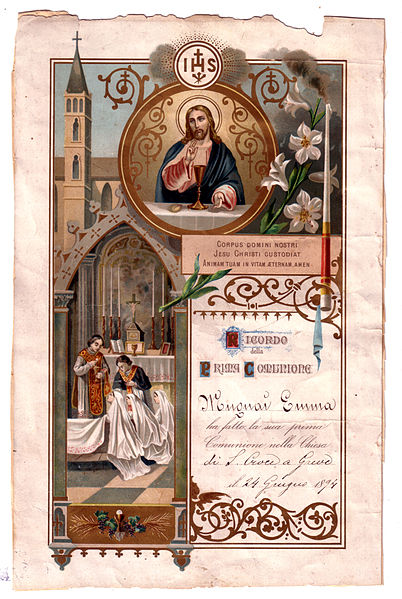
I remember well how seriously we took Church in those days. We had special Church clothes (always a coat and tie), special Sunday shoes and approaching the altar rail was something quite wonderful but very formal: hands folded before the chest, fingers straight, right thumb crossed over left. Kneeling and waiting for the priest and altar boy to pass by was a time of anticipation, a kind of distracted prayer, alert and ready, don’t make the priest wait! Suddenly a altar boy slid a Paten under your chin. Head back, tongue out (not too far!) just over the lower lip! The priest spoke in an ancient language (Latin). Only years later did I learn exactly what he said. I am sure the Sisters taught me but I couldn’t remember(I was only 7 going on 8): Corpus Domini Nostri Jesu Christi custodiat animam tuam in vitam aeternam (May the Body of our Lord Jesus Christ guard your soul unto life eternal). And suddenly there he was, Jesus in Holy Communion. Pretty awesome, very special, beyond my comprehension but no doubt this was holy, this was serious and sacred.
But little did I know I was at the end of an era. Within a year strange things began to occur that I did not understand, things that did not comport with my training. I remember my mother telling me that we were going to a special youth mass. I had heard of a school mass, but not a youth Mass. We got there early and I noticed something that confused me. “Mom!” I whispered, (you always whispered in Church in those days), “What are those drums doing there? Right in front of the Mary Altar, behind the rail too, were electric guitars, a drum set and chairs. Then out came these guys I had never seen before, a couple of them were wearing jeans too (a major no-no in the old days).
After Church my mother asked me if I liked it. I said no and she was surprised. “But Mom, I don’t know those songs and they were so loud.” I was confused. The sisters said we should dress well, be very quiet in Church so others could pray and only talk or sing when it was time to do that. It all seemed “a violation of my training.”
But little did we know (I would argue) that it was the end of an era. Something was taking the place of what came to be call the “old Mass.” But none of us call it that then. And if some one were to mention in those days the Missal of 1962, blank stares would have resulted. These were all later terms and distinctions. We certainly talke about Mass in the vernacular etc. But it was Mass. And yet little by little the familiar gave way to the new. The transition was at times startling, at times exciting. But I don’t remember a lot of protests at first. That came later when for some “a bridge too far” had been reached. Anyway I am interested in your remembrances and experiences from that time if you’re old enough to remember.
I do not write this post to “bash” the liturgical changes. Just to document an experience. I have become quite accustomed to the “new” Mass. I am also privileged to say the Traditional Latin Mass. I guess I am blessed to enjoy the best of both worlds. I am proud of the of how the new Mass is celebrated in my parish. We have a wonderful gospel choir which also does classical very well. There is great joy at every Mass. I am also so happy to be able to celebrate ancient Latin Mass that reminds me of the joy of my youth (quilaetificat juventutem meam). I merely document here, I leave the judgements to you my faithful readers.
The following video depicts a Mass in the year 1969. It is from an Elvis movie entitled “Change of Habit.” What an amazing little video for me! It’s just as I remember it as the changes set it. Notice the still strong presence of traditions: people all dressed up for Church, nuns in traditional habits, the priest at the high altar facing east. But notice too the guitars and “informality” of the musicians. The music is up front not back in the choir loft. And many struggle to understand the new lay of the land. It was 1969. It was the end of an era. But I wonder if we knew that?
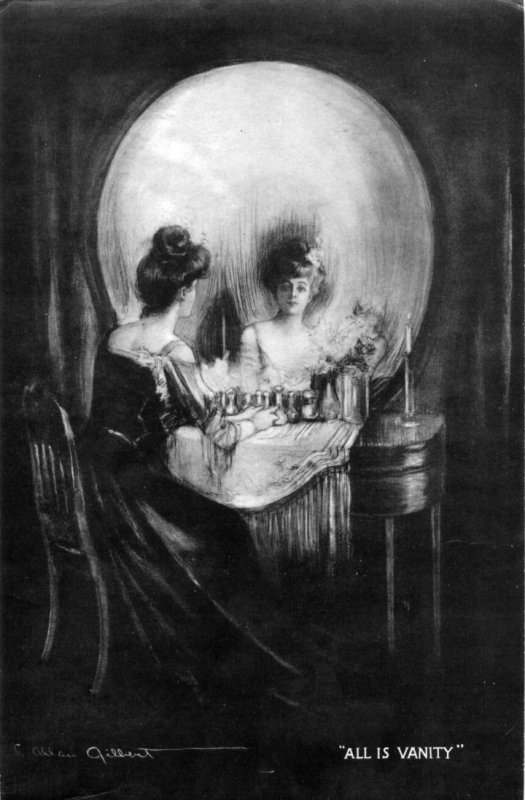
Most people associate the word “vanity” with an excessive concern or pride in ones appearance, or sometimes with ones own qualities. But at its root the word “vain” or “vanity” refers to emptiness. To say that something or someone is “vain” is to say that it, or they, are empty or largely lacking in meaning, depth or substance.
It makes sense that people get worked up about externals when there isn’t much happening on the inside. And thus it makes sense that we connect emptiness (vanity) to excessive show.
There are lots of expressions that enshrine this connection:
All form and no substance That Texan is all hat and no cattle All bark and no bite All booster, no payload All foam, no beer All sizzle and no steak All talk Show me the money
The Wisdom Tradition in the Bible, especially the Book of Ecclesiastes, speaks of vanity at great length. And there the word tends to refer to the ultimate futility of whatever this world offers, that the world is ultimately empty and vacuous. For example –
Eccl 2:11 Then I considered all that my hands had done and the toil I had expended in doing it, and behold, all was vanity and a striving after wind, and there was nothing to be gained under the sun.
Eccl 5:10 He who loves money will not be satisfied with money, nor he who loves wealth with his income; this also is vanity.
And thus the world which so mesmerizes our senses shows itself ultimately to be empty of power, or any lasting substance:
We have here, no lasting city (Heb 13:14).
As for man, his days are like grass: or as the flower of the field. Behold, he flourishes. But the wind blows and he is gone; and his place never sees him again. (Ps 103:15-16)
I thought of these notions of vanity when I saw this admittedly very funny commercial. It shows a man concerned only with his appearance. Actually, he is even more vain than that! It is how he smells that concerns him (this is an Old Spice commercial). He is so vapid, so vain, that even if he doesn’t look good, at least he smells like some one who looks good!
As he moves through the scenes of the commercial he becomes increasingly devoid of substance (literally)!
Symbolically we can see him as the vain person who goes through life carelessly, paying no attention to the way in which the world, the desires of the flesh, and the devil strike at, and eat away at him. But again, never mind all that, at least he smells like some one who looks good! His only real substance is to be lighter than air, a whiff. It is form over substance, impression over reality. It is empty show, it is vanity on steroids.
Here is a humorous look at vanity, a vanity so vain that it exists even beyond appearance and extends into the vapid, vacuous and vaporous vanity of merely “smelling like some one who looks good.” A remarkable portrait really of the empty show that vanity ultimately is. Enjoy!
The Gospel from Thursday’s Mass contains one of the most shocking parables Jesus ever told. It is the Parable of the Wedding Banquet a King gives for his Son. Most know it well, but in case you want to review it, the full text of the Gospel is here: Parable of the Wedding Feast
It does not take a degree in biblical theology to understand that the Parable is an allegory. The “King” is God the Father, the “Son” is Jesus, and the Wedding feast is the Great Wedding Feast of the Lamb further described in Revelation:
Then I heard what sounded like a great multitude, like the roar of rushing waters and like loud peals of thunder, shouting: “Hallelujah! For our Lord God Almighty reigns.Let us rejoice and be glad and give him glory! For the wedding of the Lamb has come, and his bride has made herself ready. Fine linen, bright and clean, was given her to wear.” (Fine linen stands for the righteousness of God’s holy people.) Then the angel said to me, “Write this: Blessed are those who are invited to the wedding supper of the Lamb!” And he added, “These are the true words of God.” (Revelation 19:6-9)
The invited guests are the Jewish people of that time who, when the feast is ready, ignore or reject it for various reasons. There are concerns for land (I just bought a farm), profit (another owns a business), and third group who, for indeterminate reasons lay hold the the King’s servants (who represent the prophets), to beat and even kill them.
And in this rejection is illustrated, not just the Jews of history, but also the long human history of ignoring or rejecting God in favor of worldliness (the land), profit (the business) and hostility to the truth, (the beating and killing of the profits).
And yet, the rejection, while not unique to Jews, does focus on their historical rejection. For the parable calls them the “invited guests.”
Further, upon their rejection comes the horrible detail, told by Jesus himself, that the King (God the Father) was enraged and sent his troops, destroyed those murderers, and burned their city. (Matt 22:6).
This detail shocks many modern readers especially for we have bought into a watered down notion of the holiness of God, and the significance of human choice for or against God. Our common modern vision of the Father is of a kind of doting older man (such as George Burns, or Morgan Freeman) who exists more to get us out of trouble and offer friendly advice, than to summon us to holiness, obedience and a critical choice.
But take note! This detail of the King burning their city is told by Jesus. And as we shall see in Sunday’s Gospel about the wide and narrow road, he is not playing around either. However we want to rework God, and render him harmless, however we want to try and hold opposed God’s love and justice, however we want to render human choice insignificant, the biblical text will have none of it. The bottom line fact is that no one loves you more than Jesus Christ, and yet no one warned of judgement and Hell more than Jesus Christ.
If this parable shocks, it is meant to. It is a call to sobriety in the face of the four most critical truths of our life: death, judgment, heaven and hell. In effect, this parable teaches that we will either enter the wedding feast and celebrate with the Father, or we will be caught up in the conflagration when the Lord comes to judge this world by fire (e.g. 2 Pet 3:7; Malachi 4:1; 2 Thess 1:7).
The choice is ours, but the judgement is certain to come:
God gave Noah the rainbow sign, no more water but the fire next time! (Negro Spiritual)
The only safe place to be is in the wedding feast of the Jesus the Lamb, who saves us from the wrath to come (1 Thess 1:10).
Add to this shock the fact that the parable was actually fulfilled in 70 AD (as a kind of precursor of the final end of the age) when, after forty years of pleading with the Jewish people to come to Christ, a fiery destruction came on Jerusalem. Rejecting the Lord’s warnings (cf Matthew 24, 25; Mark 13; Luke 21), rejecting the call of the early Apostles and Church, and picking a pointless war with the Romans, the Jewish nation was utterly defeated. Jerusalem was sacked and burned, killing over 1.2 million Jews.
Jesus with weeping had warned:
Jerusalem, Jerusalem, you who kill the prophets and stone those sent to you, how often I have longed to gather your children together, as a hen gathers her chicks under her wings, and you were not willing. Look, your house is left to you desolate. (Matt 23:37)
The next shocking part of the parable comes in the second half. The enraged King (The Father) orders his servants to go into the streets and gather everyone they can. And in this detail is an allegory for the going unto the Gentiles and the Great Commission.
And thanks be to God the response is good and the banquet is filled. But then comes the second shock:
When the king came in to meet the guests he saw a man there not dressed in a wedding garment. He said to him, ‘My friend, how is it that you came in here without a wedding garment?’ But he was reduced to silence. Then the king said to his attendants, ‘Bind his hands and feet, and cast him into the darkness outside, where there will be wailing and grinding of teeth.’ Many are invited, but few are chosen.”
Here too, we moderns with our soft notions, wince. Perhaps part of our trouble with these verses is that we may think that the newly invited guests were dragged in, right off the street with no chance to change clothes. But there is nothing in the text to suggest they had no time to don their wedding clothes. The other guests all seem clothed properly. But the focus shifts to one man, not properly dressed.
Whatever the debated cultural parameters of the story, the theological parameters are more clear. The wedding garment is provided by the King (the Father), who clothes us in righteousness at our baptism. as we saw in the quote above from Revelation:
For the wedding of the Lamb has come, and his bride has made herself ready. Fine linen, bright and clean, was given her to wear.” (Fine linen stands for the righteousness of God’s holy people. (Rev 19:8)
Yes, here is the baptismal gown, the robe of righteousness, which God gives to the baptized who have been washed in the blood of the Lamb! In the baptismal rite the celebrant says to the newly baptized, pointing to their white garment:
You have clothed yourself in Christ. Receive this baptismal garment and bring it unstained to the judgment seat of our Lord Jesus Christ, so that you may have everlasting life. (# 578)
Hence, in the parable, the man is not clothed properly not because he is poor or was pulled in off the street. He is not clothed properly because he has cast aside the garment he was given. Now again recall the garment is no mere cloth. It is an allegory for righteousness. And this righteousness is received and must be cherished. Without it, we cannot endure or remain in the Wedding Feast of the Lamb, which is heaven.
And thus ends one of the most shocking parables Jesus ever told. (We will examine the “many are called, few are chosen” aspect of the text this Sunday). And though the parameters of this parable do shock, Jesus speaks them with an urgent love to bring forth godly repentance from us and to stir an evangelical urgency in us to reach others before “Great and Terrible Day of the Lord” comes (cf Joel 2:31; Mal 4:5 inter al). On that day there will be only two places: safe in the wedding feast with the Lord, or outside in a fiery judgement that is coming on this world.
An old spiritual says, God’s gonna set this world on Fire one of these days. Another old spiritual says, I got a robe, you got a robe, all God’s children got a robe. When I get to heaven gonna put on my robe and go wear it all over God’s heaven! Everybody talkin’ bout heaven ain’t a goin’ there!
Make sure you’ve got your robe and keep it washed in the blood of the Lamb.
One of the beatitudes taught by Jesus is often misunderstood today, largely due to the most popular translations of it from the Greek text. The Beatitude is, “Blessed are the pure of heart.” Or sometimes rendered, “clean” of heart.”
While the word “pure” or “clean,” is not an inauthentic translation of the Greek word καθαρός (katharos). A more literal translation of the word is to be without admixture, to be simply one thing, and hence, on that account to be purely and simply that thing, with nothing else mixed in. Hence, another helpful way of translating the Greek μακάριοι οἱ καθαροὶ τῇ καρδίᾳ (makarioi hoi katharoi te kardia) is “Blessed are the single-hearted.”
The reason to suggest, as more descriptive, the phrase “single-hearted” is that, in modern English, the words “pure” and “clean” tend to evoke a merely moral sense of being free of sin, of being morally upright. And this is good, and is surely a significant part of being single-hearted. But being single-hearted is it a deeper and richer concept than simply being well behaved, since to be well behaved is the result of the deeper truth of being one thing, not duplicitous, or with a divided heart.
To be single-hearted, means to have my life focused on what Jesus calls “the one thing necessary” (Luke 10:42). It is to have my life focused on the Lord, and my one goal of reaching heaven and being with him forever.
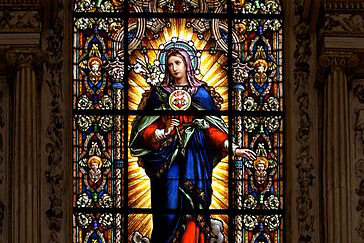
The image of the Rose window that the upper right, which I have used before on this blog, is a good illustration of what it means to be single-hearted. It does not mean that there are not different facets to my life, but rather, that every facet of my life is ordered around, and points to Christ, is subsumed to Jesus, and his heavenly kingdom along with the Father and the Spirit as the ordering principle of every other thing. And thus, career, family, marriage, finances, spending priorities, use of time, where I live, and any other imaginable aspect of life, is subsumed in Christ; it points to him, and leads to the Lord and his kingdom on high.
The single-hearted life, is a well ordered life. Each step, and each decision leads me in the right direction. St. Paul says, This one thing I do: forgetting what lies behind and reaching forward to what lies ahead, I press on toward the goal for the prize of the upward call of God in Christ Jesus (Philippians 3:13-14). And hence, while Paul made many journeys to many places, he was really on one journey and heading to one place. This simplified and ordered his life. He was single-hearted.
We can see why the beatitude often gets translated as pure or clean of heart. As noted, to be pure or clean means to be the one thing, not admixed with lots of other impurities, or things which cause me not to be what I really meant to be. And perhaps this is how we get the connection in the phrase, “pure and simple.”
Consider for example that the impurities of a copper wire, will reduce its effectiveness in carrying electrical current. When the copper is not pure, it is not its very self, the electrical energy which is meant to be directed through it becomes more scattered or hindered from its goal.
And this image of scattering or being hindered, unfortunately describes the lives of many Christians whose lives are not ordered on the one thing necessary, whose hearts are not single, whose hearts are not focused on the one thing they should be. Such a one has a life which is often scattered, confused, disordered, and a jumble of many conflicting and contrary drives which hinder one from the goal of life. And thus the Lord Jesus says, He who does not gather with me, scatters (Luke 11:23). And the Book of James says, The double minded man is unstable in all his ways (James 1:8).
Finally, being single-hearted, being pure of heart not only orders our life, but it also grants freedom. In modern, Western thinking, we often equate freedom with doing more, not less. So freedom is equated with being able to “do anything I please.” And this attitude has led to the kind of jumble that much of modern life has become, the kind of tangled web of many contrary wishes and desires, but with little unifying direction or purpose. We think of freedom in very abstract terms. And hence we tend to get very abstract and disconnected results
But biblically and spiritually, freedom is the capacity or ability to do what is right, best and proper. And thus, paradoxically, freedom often means doing less, not more.
Being single-hearted, helps to focus us and to pare away a lot of the excess growth and unnecessary baggage of modern life. And life gets simpler, and simplicity is a form of freedom, such that we focus on what is important more than what is urgent. And we discover that what often claims to be urgent, is not really necessary or urgent after all.
Life, especially modern life, has many options. And not all these options are simply distinguished by being good or bad, moral or immoral. Many of them are altogether good options. But how to sort through, to choose, and to focus my life on the one thing necessary?
Being single-hearted is the beatitude which helps us to do this. As St. Paul says, regarding the good options in life: All things are lawful to me, but not all things are expedient (1 Cor 6:12).
To be single-hearted is to become more free, not (paradoxically) by doing more, but by doing less, by becoming more focused on the Lord, hearing his voice, and basing my life simply on what he says and teaches me,
Pray for the gift to become more single-hearted. More than ever, in our modern age, with its distractions and endless possibilities, we need to learn the lesson of the Rose window, and center our lives increasingly on Christ, the one thing necessary.
I have used this clip in other posts before. Pardon a brief profane word, but it does help emphasize the point being made:
The Gospel of Matthew features two hard sayings, or expressions, of the Lord. They are “hard” because they offend against modern notions. And since they are difficult for us “moderns” to hear and we are easily taken aback by their abrupt and coarse quality. Here is the “offending” verse:
Do not give what is holy to dogs, or throw your pearls before swine, lest they trample them underfoot, and turn and tear you to pieces.” (Mt 7:6)
The modern notion offended against here is: You’re not supposed to call people ugly names. This notion, though not wrong in itself, has become a rather excessively applied norm in our times and also misses the point in terms of this passage.
We live in what I would call “dainty” times where many people are easily offended. These are thin-skinned times of fragile egos where the merest slight often brings threats of lawsuits. Even observations intended as humor are excoriated and hurtful and out of line. And so, horror of horrors, here we have Jesus calling certain (unnamed) people “dogs” and “swine!” Explanations are demanded in times like these of such horrible words coming forth from the sinless Lord Jesus. Older commentaries felt less need to comment extensively on these verses.
Sophistication is needed – One of the reasons we are so easily offended in our modern age is, frankly, that we lack sophistication. We seem to have lost understanding, to a great extent, of simile and metaphor.
A simile is a figure of speech comparing two unlike things and normally includes words such as “like” and “as.” For example: “He is as swift and strong as a horse!” Similes have the two ideas remain distinct in spite of their similarities.
Metaphors compare two things without using “like” or “as”. For example, “He’s a real work-horse!” Metaphors are usually more forceful than similes since the distinction intended between the compared things is often ambiguous. For example if I were to observe someone doing something mean or cruel I might say, “Wow, what a dog!” Now the expression does not mean I have gone blind and think that this person is actually a dog. I mean that he is manifesting qualities of a (wild or mean) dog. However, just how distinct he is from an actual dog is left open to interpretation. But for the record, I am NOT saying he is a dog.
The point here is that some sophistication and appreciation for the nuances of language and the art of comparison are necessary as we negotiate life’s road. In modern times we seem to have lost some of this and so, are easily offended.
This does not mean that no one ever intends offense, it only means that more is necessary than simply hearing everything in a crudely literal way. The usual modern person in my example would object, “Hey, he called me a dog!” No, what he means is that you have taken on some of the qualities of a wild dog. Now to what extent he means you are like a dog is intentionally ambiguous, and an invitation for you to think of how you may have surrendered some of your humanity and become more like baser creatures.
Examining what the Lord says – This sort of sophistication is necessary as we examine these two of the Lord’s “offensive” sayings here. Let’s look at them both in terms of their historical root and then to what is being taught.
1. First of all let’s be clear that the Jewish people were not indicating positive traits when they used the term dog or swine to refer to someone. Dogs in the ancient world were not the pets of today. They were wild, and ran in packs. Pigs were unclean animals and something no Jew would ever touch, let alone eat. These are strong metaphors indicating significant aversion to some aspect of the person.
2. Do not give what is holy to dogs– This was a Jewish saying that was rooted in tradition. Some of the meat that had been sacrificed to God in the Temple was returned to the family to be eaten by them, and some was retained to be eaten by the Levites. But in no way was this meat that had been consecrated to God ever to be thrown to dogs or other animals to eat. If, for some reason, it was not eaten by humans it was to be burned. Hence holy and sanctified meat was not to be thrown to dogs because it was holy.
3. [Do not] throw your pearls before swine, lest they trample them underfoot – Pearls were an image for wisdom in the Old Testament. Now the point here is that pigs value nothing they cannot eat. Pearls could not be eaten, thus if they were placed before pigs they would sniff them, determine they were not food, and simply trample them underfoot. The pigs have no appreciation of pearls.
4. So what is being said? Sacred matters, sacred things, wisdom, and participation in sacred things should not be easily offered to those who are incapable of appreciating them. There are those who despise what we call holy. There is little that can be done in such cases except deny them the pleasure of tearing apart holy things or trampling them underfoot.
Jesus is saying that some people are like dogs who tear apart sacred things and have no concept of their holiness. Some people are like pigs who do not appreciate anything they cannot eat or use for their pleasure. They simply trample under foot anything that does not please them or make sense to them, in the same way that pigs would trample pearls underfoot or dogs irreverently tear apart blessed food dedicated to God.
Further, there are some who, though not hostile, are ignorant of sacred realities. They do not perhaps intend offense but it is necessary that they should be taught, and then admitted to sacred rites or further instructed in deeper mysteries. Children, for example in the Western Rite, are not given the Holy Eucharist until they can distinguish it from ordinary food. Further, it is a necessary truth that some more advanced spiritual notions such as contemplative prayer are not often appreciated by those who have not been led there in stages.
The Lord is thus indicating that holy things are to be shared in appropriate ways with those who are able to appreciate them. It is usually necessary to be led into the Holy and just walk in unprepared or unappreciative.
In the ancient Church there was something known as the disciplina arcani (discipline of the secret) wherein only the baptized and confirmed would be admitted to the sacred mysteries of the Liturgy. Given the holiness with which the early Christians regarded the Mass, they exactly observed what the Lord is saying here. Careful instruction and gradual introduction to sacred truth was necessary before entering something so holy as the Sacred Liturgy. Even the unintentional trampling underfoot of sacred realities through simple ignorance was to be strictly avoided. To be sure, these were difficult times for the Church and persecution was common. Hence the Lord’s warning to protect the holy things was not just that they might be trampled underfoot but also that those who were like unto wild dogs and swine might not turn and tear you to pieces (Mat 7:6).
In the centuries after the Edict of Constantine the disciplina arcani gradually dissipated. Some remnants of it revived in the modern RCIA wherein the Catechumens are dismissed halfway through the Mass to reflect more fully on the Liturgy of the Word. And yet we have much to relearn in modern times about a deep reverence for the Sacred Liturgy. While it would not seem opportune to lock our Church doors as in ancient times, but preserving good order in the Liturgy, encouraging reverence, proper dress, and instilling deeper knowledge of the true meaning of the Sacred Liturgy are all important ways to ensure that we do not trample underfoot what is sacred.
Regarding this video, the Text says, Sinner please don’t let this harvest pass, and die and lose your soul at last. One of the things I like about the old spirituals was that they still used older biblical language that had fallen out of fashion. For example calling people “Sinner.” You don’t hear preachers speak like this much today in these hypersensitive times. But the truth is we are all sinners.
It would seem, according to how some people measure intelligence, that those of us who believe in God rank as “less intelligent” than those who do not. A recent report in the “Mail” (a U.K. paper) reports this “fact” as the result of extensive and scientific IQ testing and summarizes what I would call the rather “non-scientific” conclusions of the researchers.
You know the usual drill when I comment on texts. The text of the original report is in bold, black italics, my remarks are in plain red text. I am excerpting a longer article.
The full article by Daniel Bates is HERE. – However, be forewarned, there are a lot of unchaste and risque photos often appear in the margins of this “news”paper.
Reporter Bates begins:
Atheists tend to be more intelligent than religious people, according to a US study. Researchers found that those with high IQs had greater self-control and were able to do more for themselves – so did not need the benefits that religion provides.
OK, so lets just stipulate that IQ tests are a common way of measuring at least some aspects of intelligence. Of course having a high IQ is no guarantee that one will necessarily navigate life well.
I do terribly on IQ tests, and tests in general. But I do a pretty good job of navigating life. My “smarts” are more verbal and less numerical. I love etymology, I also have a more keen sense of paradox and symbol, and the mystical connections of many apparently dissimilar things. Not bad strengths for a preacher, teacher and occasional writer. Of course this type of “smarts” is less easily measured in IQ tests, since this sort of intelligence is harder to quantify.
But OK, lets just stipulate that IQ tests have some validity in measuring a certain kind of mechanistic and basic intelligence.
But then our intrepid reporter goes on to claim that the “science” shows that atheists had “greater self control.” Now honestly, how did they measure that? I am going to guess that “self control,” at least as defined by our reporter, has little to do with what most of us traditionally meant by the term.
I would tend to think that the term means things like drinking in moderation, not being given to wild carousing and fornication, having authority over one’s emotions like anger and love, being moderate in behavior, frugal in spending, and so forth.
But something tells me that this understanding of self control has little to do with our author means, or what the “scientists” he claims to reference mean. For it is clear that the modern, and I would add secular and increasingly unbelieving West, is collectively given to almost every excess and lack of self control: drinking, fornication, pornography, addictions, fornication, carousing, overspending, excesses of every kind. And did I mention fornication?
Of course our intrepid reporter does not define what is meant by self control or how it is measured. But how anyone can connect our modern secular (unbelieving) culture to greater self control is puzzling, to say the least.
Again, I realize that I am among those of lesser intelligence, as a believer, but the correlation between atheism and self control seems to be an inverse one to this observer. In other words, as atheism and secularism have increased in the West, self control has demonstrably decreased during that same period. Just a simple analysis of the debt crisis shows that. Add divorce rates, addiction rates, STD rates etc. and the picture of low self control is consistent. There are many reasons for this but an inverse relationship seems the logical conclusion than to assert unbelievers ipso facto have more self control.
Similar puzzlement arises at the observation that atheists “do more for themselves.” First of all, what does that mean? It is true that Christian believers speak of depending on God. But this does not mean we expect God to be some sort of divine butler. Rather it means that we attribute our strength to God and seek his grace to do our work.
But theology aside, I must say I am mystified at the claim, however it can possibly be measured, that atheists “do more for themselves.” For again the evidence seems (to this admittedly less intelligent believing observer), that as atheism and secularism have risen, so has socialism, wherein increasing numbers expect the central government to do more and more for them.
What evidence is there that (globally) unbelievers and seculars do more for themselves? The big picture suggests just the opposite and correlates the nanny state with increasing secularism and unbelief. Maybe they don’t turn to God, but the State sure has grown.
I realize that the growth of socialism is not wholly attributable to unbelievers. But again I remain puzzled at any claim that anyone, or any group is “doing more for themselves” these days. The whole trend is away from personal responsibility, as it is from self control.
They also have better self esteem and built more supportive relationships, the study authors said.
Here too I would have loved for our intrepid reporter to have asked the “scientists” how “self esteem” is defined and then measured. I do think that Christians may test lower in this area, not because we actually do lack self esteem, but because we have a traditional language that emphasizes humility.
Many modern notions (not all) of self esteem are far too close to simple “pride” and we believers will be less likely to affirm vague modern notions and statements like: “I feel good about myself…..I like myself just the way I am…” If our tendency to caution regarding pride makes us “less intelligent,” then so be it.
As to “supportive relationships” again, please define. I suppose this could include anything from bowling leagues, to labor unions, to group therapy, and 12-step programs. But how would I know, since the term is undefined. I wonder if “Church” counts, because, frankly that is my biggest source of supportive relationships. I have a funny feeling the testers don’t consider “Church” to be in the realm of “supportive relationships.”
The conclusions were the result of a review of 63 scientific studies about religion and intelligence dating between 1928 and last year. –
Notice these are called “scientific” studies. But again many of the claims, at least as reported, are presented in very vague and non-scientific language. Might I even say some of the claims are metaphysical?
Honestly are terms such as “self-control,” “supportive relationships,” “self-esteem,” “benefits,” “do more for themselves” scientific terms at all? Calling a study “scientific” does not make it so.
All the terms above contain a priori and metaphysical judgments about what is good or not good. And while there may be some methodologies from the social sciences at work, most people have (sadly) reduced the word “science” and “scientific” to the physical sciences. And thus to speak of atheists being more intelligent that believers as being “scientifically” demonstrated is misleading because it is not how most people use the word today.
The judgment of this scientific study is filled with many non-scientific judgments about things that cannot simply be quantified, measured or compared. There are complicated social realities at work. Words such as “better” worse” “esteem” and so forth bespeak a more Metaphysical stance.
Now don’t get me wrong, I am all for metaphysics, but calling a report “scientific” that indulges in so many metaphysical concepts and judgements is not how people use the word “science” today. As such it is misleading to call this report a “scientific study.”
So finally here comes the money quote:
In 53 of these (studies) there was a ‘reliable negative relation between intelligence and religiosity’. In just 10 was that relationship positive. Even among children, the more intelligent a child was the more probable it was that they would shun the church. The University of Rochester psychologists behind the study defined religion as involvement in some or all parts of a belief.– Vague, to say the least.
They defined intelligence as the ‘ability to reason, plan, solve problems, think abstractly, comprehend complex ideas, learn quickly, and learn from experience’.–
Also vague. For example define “ability.” Some people are “genius” at intuition, others at analysis of data, still others are said to have empathic abilities, emotional intelligence, photographic memory and so forth.
Also define “comprehend,” and who gets to say something is complex? For some a Bach fugue is complex but a car engine is easy. For others it is the reverse. etc.
Vague, vague and more vague.
So, if you’re going to call me stupid or even less intelligent, I want clearer parameters.
In their conclusions, they said: ‘Most extant explanations (of a negative relation) share one central theme – the premise that religious beliefs are irrational, not anchored in science, not testable and, therefore, unappealing to intelligent people who ‘know better’. –
Well I guess it takes one to know one. For as we have seen, this study commits the very errors it claims we do. But at least we admit to being in the realm of metaphysics and do not claim to be able to measure things that defy simple measurement. The arrogance of this final quote is so bold as to require little response, res ipsa loquitur (the thing speaks for itself).
And perhaps a final thought from yours truly. I want to say that how ever some one wants to regard my intelligence compared to theirs, or my group (believers) compared to theirs, I will probably take little real offense.
For, at the end of the day it is not so much intelligence that I value as wisdom. Intelligence has its place, and is nice to have. But intelligence is a human thing. Wisdom comes from God and as such is a greater gift. And wisdom need not depend on a lot of formal education. I have met some very wise people who had little formal education. I have also met people who were highly educated, but possessed of little wisdom. I have also met every combination in between.
Wisdom pertains to the things of God, to heaven and our final goal. To be wise is to discover God, to learn of Him and know Him, It is to know also, who I am in God, to grasp the meaning of my life and to move steadily toward my goal of the upward calling in Christ. Wisdom is infused by God who is able to grant it to the simplest and undereducated, or to the most intellectually astute.
But Wisdom is always gift. Intelligence, how ever we adduce it, too easily leads to pride. But Wisdom requires humility and thrives only on it. To be wise is to know that I know only very little, no matter how high my intellectual ranking among men. For as St. Paul once boldly said,
For the foolishness of God is wiser than human wisdom, and the weakness of God is stronger than human strength….But God chose the foolish things of the world to shame the wise; God chose the weak things of the world to shame the strong. God chose the lowly things of this world and the despised things—and the things that are not—to nullify the things that are, so that no one may boast before him. It is because of him that you are in Christ Jesus, who has become for us wisdom from God—that is, our righteousness, holiness and redemption. Therefore, as it is written: “Let the one who boasts boast in the Lord.” (1 Cor 1:26-31)
So you may call me stupid, or less intelligent. You may call me a fool, but at least add that I was a fool for Christ.
Oremus: Intelligence has its place, but above all Lord, give me your wisdom. Indeed, you have hidden from the learned and clever, what you have reveled to the merest children. Thank you Lord for holy Wisdom. Thank you.
There’s a common thread among many traditional Catholics (and some left-wingers too) that “the Church has gone down the tubes.” This seems to be a basic set point in too many conversations, and if one runs too far afield from this view they are “one of them” or are “off message.”
But I want to say to all the negative ones: the Church is a Bride, not a widow.
I have, in twenty-five years as a priest, found a great deal of affinity with traditional Catholics. I love the Traditional Latin Mass (and have celebrated it since 1989), chant, polyphony, traditional churches, stained glass, and I toe a line in rather strict conformity to the Church’s teachings and Scripture’s admonitions. I preached Hell and Purgatory even when it wasn’t cool.
But in recent years I have found my relationship to many (not all or even most) traditional Catholics tested and strained. I say “tested” because I have found that if I do not adhere to a rather strict, and I would say “narrow” line, I am relegated to be thrown out of the feast, and there in the “outer darkness” to wail and grind my teeth.
It would seem that for some, I am required to bash bishops, lament that the Church has “never been in worse shape,” and that every single solitary problem in the Church today is “due to Vatican II” and the “Novus Ordo” Mass. Stray too far from this, either by omission or commission, and I am in the hurt locker, the penalty box, and relegated to being no better than one of “them.”
Last week on the blog was especially hurtful. All I did was quote what I thought was an interesting statistic, that the average number of priests per parish in 1950 was “1” and that in 2013, the average number of priests per parish is also “1”. There are many interesting questions that can be raised about this number. Perhaps there were more ethnic parishes then, perhaps church closings now are a factor, perhaps many of us remember the Northeastern Urban experience, but knew little of the rural experience back then which balanced our reality. Yes, there have been closings and declines of late, but overall there are 17K parishes nationwide today, slightly more than in 1950, and double the number of putative Catholics. And at the end of the day, the number averages out to “1” priest per parish. More here: [01] and here: [02]
Anyway, while one may dispute how helpful or illuminating the statistic is, the real grief came to me with just how hostile and even nasty some comments (many of which I had to delete) were. There were personal accusations against me, there was a bevy of bishop-bashing, and Pope-bashing statements, and any number and variety of venomous attacks against perfectly legitimate Church realities, liturgical forms, and the Second Vatican Council itself.
Wowza! What a hornet’s nest. And all over a simple statistic that I found interesting. But it would seem that many found the statistic troubling, and generally seemed to find it, (and me) “off message.” It didn’t fit into, or help the narrative that some wish to cling to that the “the Church has gone down the tubes.” It got so bad and wearying in the combox that I finally had to shut it down. I was having to delete more comments than I approved.
It was even more discouraging since I have never shied away from talking about the need for reform and what does trouble the Church today. We have covered quite a lot of the “what ails the Church” territory here at the ADW Blog. I am no cheerleader for the Church of Wonderful. There are problems, and we discuss them.
But that said, the Church has not gone down the tubes, and things were not all wonderful (or all bad) before 1965. And frankly, we have NO WAY of knowing if the Second Vatican Council “ruined things” or saved things from being even worse. Those who say they do know, are just speculating, and some are also engaging in a post hoc-propter hoc fallacy. The fact is, we are where we are today, and we need to live now, and move forward. All the blame, bickering and murmuring generates more heat than light.
I was pleased to read an article by Jeff Mirus over at Catholic Culture.orgbecause he says well what I have tried to say here, namely, that we are not without problems, but things are getting better, and there is a lot to be excited about today. Here are excerpts from what Mr Mirus writes:
A few of our readers seem intent on rebuking me for not taking every possible opportunity to condemn bishops for their weak leadership, as if my job is to be a whistle blower. Of course, I’ve offered my fair share of criticism, and that is unlikely to end any time soon. But it is probably true that I was quicker to criticize when I was younger…..
I suppose most readers are familiar with the tale of woe which haunted the Church, especially in the rapidly declining West, after the call for renewal in the 1960s was distorted to justify a neo-Modernist accommodation with rampant secularism. In the 1960s, 1970s and 1980s, we rapidly lost our Catholic institutions—religious communities, dioceses, parishes, schools, social services—to a false and highly accommodated vision of the Faith….But that is simply untrue today…..The institutional Church, in the West generally and in the United States without question, is substantially healthier now than thirty years ago….
Today the institutional effort at genuine renewal is palpable. There are notorious holdouts—especially among women religious, the Jesuits and the universities they influence (along with others like them), wide swaths of academic theologians, and some sectors of Catholic health and social services. But most dioceses have better leadership now than then, the seminaries have been largely reformed, the priesthood substantially revitalized, and the push for both the recovery of lost territory and a new evangelization is both very real and very strong. Happily, this is no longer your father’s Church. [03]
Well said! I remember how awful it was back in the 70s and 80s. Things are so much better today. I am sorry if this insight is “off message” but I am quite convinced it is true.
Mr. Mirus goes on in his article to cite a particular case of the Dominicans, and how reform has blessed them. And to his focal instance I can add that there are great new seminarians here, and younger priests overall who love the Church and are solidly formed. The seminaries are in better shape, and many new and reformed religious orders of men and women are coming alive and and making their mark.
Add to this many great new lay movements, publications, EWTN, and its nationwide radio affiliates, Catholic Answers, and some great new and reformed Catholic Colleges. I am humbled too, and gratefully pleased at the wonderful caliber of converts from the Evangelical denominations who bring with them love for Jesus and the Scriptures, and are so enriching us with a zeal for the faith, and who make up a great percentage of our most effective apologists.
Every day I also meet many younger adults who are alive, focused and enthusiastic about the faith, and who do not want to make the same mistakes that their parent’s generation made. Some are turning to traditional forms, other to more contemporary worship, but either way, they are alive and eager for the truth and to spread it.
I have little doubt that our overall numbers may continue to drop in the Church for a while more. But the reform is in place, underway, and deepening. And the Holy Spirit is accomplishing this in many varied ways. We’re getting our “mojo” back and I am happy to see it.
Again, sorry if this is “off message” for some. But I speak to what I see and experience and I don’t think I am wrong. I walk in the wide Church and see a lot of variety, and what I see looks better every day.
All of us ought to be careful about ingesting too much of a steady diet of negativity. It tends to make us negative, even hostile to the good and surprising work of the Holy Spirit.
Rejoice with me! We’ve been through a lot, and there are sure to be more troubles (for there always are), especially as our culture has not recovered in many ways. But God is faithful and his Church is ever young. Great reforms are underway and seem destined to continue, perhaps in spite of us!
Again I say, rejoice! The Church is a Bride, not a widow!
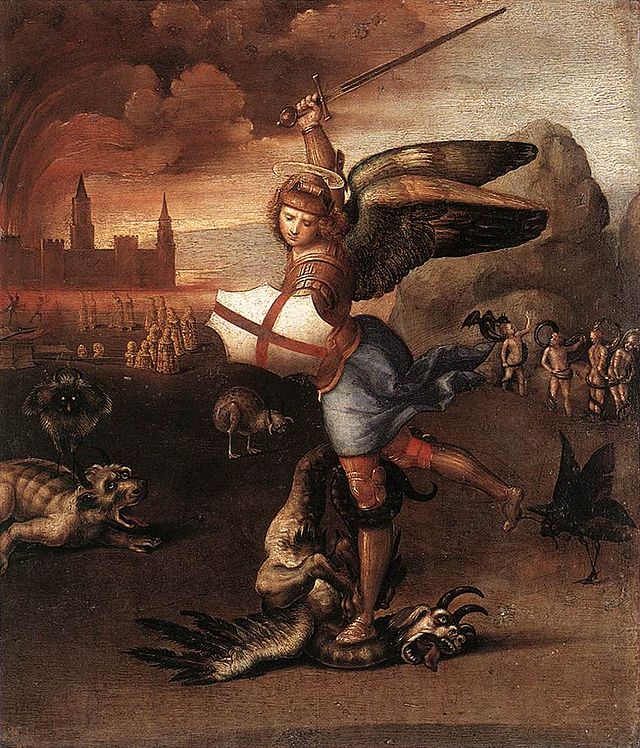
The readings today speak of a great cosmic battle that is taking place all around us. In the Gospel, Jesus speaks vividly of it, and of his own mission to engage our ancient foe and to gather God’s elect back from the enslaving clutches of Satan, who was a murder and a liar from the beginning (cf John 8:44).
And so, as Jesus approaches Jerusalem for the final time, He describes the battle that is about to unfold. It is a battle he wins at the Cross and Resurrection, but it is a battle whose parameters extend across time to our own era.
We also do well to look at the second reading, which describes what ought to be our stance in reference to the great cosmic battle. Though the victory is ours, we can only lay hold of it by clinging to Christ and walking with him. The Hebrews text gives us a kind of battle plan.
But we begin this reflection on the readings by considering Jesus’ description in the Gospel of the cosmic battle and of his own great mission as the great Shepherd of the sheep, and the Lord of armies (Dominus Deus Sabaoth!).
I. Passion to Purify – Jesus begins by saying, I have come to set the earth on fire, and how I wish it were already blazing!
Fire is a powerful and transformative reality. Nothing goes away from fire unchanged. Fire does gives warmth, and it makes food palatable, but it also consumes and destroys. But nothing goes away from fire unchanged!
The Lord has come to purify us, by the fiery power of his love, of his grace, and of his Word. He has a passion to set things right.
But purification is seldom easy or painless, and hence, there is the image of fire. In this great cosmic battle, fire must be cast on the earth, not only to purify, but also to distinguish. There are things that will be made pure, but only if other things are burnt away and reduced to ashes.
This image of fire is important, because many people today have reduced faith to seeking enrichment and blessings. And faith does surely supply these. But it is also true that faith demands that we take up our cross and follow Christ without compromise. And many, if not most enrichment and blessings come only through the fiery purification of God’s grace, which burns away sin and purifies us of our adulterous relationship with this world. Fire incites, demands and causes change. And change is never easy.
Therefore, Jesus announces the fire by which he will judge and purify this earth, and all on it, rescuing us from the power of the evil one.
And this is no mere campfire around which we seeing cute songs. Jesus describes it as a blaze which must set the whole world on fire!
So, how do you get ready for fire? By letting the Lord set you on fire! John the Baptist had promised of the Lord: He will baptize you with the Holy Spirit and fire (Matt 3:11) And indeed, the Lord sent forth his Spirit on the early Church as tongues of fire (cf Acts 2:3) so as to bring them up to the temperature of glory and to prepare them for the coming judgment of the world by fire.
The battle is engaged! Choose sides. And if you think you can remain neutral or stand on some “middle ground,” I’ve got news for you about which side you are really on. No third way is given. You’re either on the Ark or you’re not. You’re either letting the fire purify you or being reduced to ashes. You’re either on fire by God’s grace, and thereby ready for the coming judgment of the world by fire or you are not. But the choice is yours. Jesus is passionate to set things right. He has come to cast fire on the earth.
II. Painful path.The text says, There is a baptism with which I must be baptized, and how great is my anguish until it is accomplished!
In coming among us, the Lord does not merely come to get us out of trouble, but to get into trouble with us. Though himself sinless, Jesus takes upon himself the full weight of human sinfulness and manfully carries it to the cross. He accepts a “baptism” in his own blood on our behalf.
In waging war on our behalf against the evil one, he does not sit in some comfortable headquarters behind enemy lines, he goes out “on point,” taking the hill of Calvary, and leading us over the top to the resurrection glory. He endures every blow, every hardship on our behalf.
And by his wounds we are healed by being baptized in the very blood he shed in the great cosmic war.
It is a painful path he trod, and he speaks of his anguish in doing it. But having won the victory, he now turns to us and invites us to follow him, through the cross the glory.
But the choice to follow is ours, and in this sense the cosmic battle continues as Jesus describes in the verses that follow.
III. Piercing Purgation – In words that are nothing less than shocking, the Lord says, Do you think that I have come to establish peace on the earth? No, I tell you, but rather division. From now on a household of five will be divided, three against two and two against three; a father will be divided against his son and a son against his father, a mother against her daughter and a daughter against her mother, a mother-in-law against her daughter-in-law and a daughter-in-law against her mother-in-law.”
The words shock but they speak a truth which sets aside worldly notions of comprise and coexistence with evil. In order for there to be true peace, true holiness and true victory over Satan, there must be distinction, not equivocation, there must be clarity, not compromise. Fire and water do not mix. One hears the conflict when they come together of hissing, popping, searing and steaming. One must win, the other must lose. Compromise and coexistence are not possible.
The Lord said (back in Matthew 10:34) that he came not for peace but for the sword. And thus there is a kind of analogy to a surgeon’s scalpel. The surgeon must wield this “sword” to separate out healthy flesh from that which is diseased or gangrenous, cancerous growth cut away from that which is normal flesh. Coexistence is not ultimately possible, the diseased flesh has to go. The moment one talks of “coexisting” with cancer or gangrene, the disease wins. Were a doctor to take this stance he would be guilty of malpractice. When there is cancer or gangrene, the battle must be engaged.
And thus the Lord, in this great and cosmic battle cannot and will not tolerate a false peace based on compromise or a non-critical coexistence. He has come to wield a sword, to divide. Many moderns do not like it, but scripture is clear, there are wheat and tares, sheep and goats, those on the Lord’s right and those on his left, the just and wicked, the lowly and the proud, the wide road to damnation and the narrow road to salvation, and those on each of them.
And these distinctions, these divisions extend into our very families, unto our most intimate relationships. This is the battle. And there are two armies, two camps. No third way is given. Jesus says elsewhere, Whoever is not with me is against me, and whoever does not gather with me scatters. (Matt 12:30)
Of all this we must be sober and work for our salvation, and the salvation of all. For while there may no be a season of mercy and patience now, the time is short for us all when the distinction between good and evil, righteousness and sin will be definitive and the sword must be wielded.
And thus the Lord speaks to us of a cosmic battle in the valley of decision (cf Joel 3). Jesus has won, and it is time to choose sides. And even if family members reject us, we must choose the Lord. The cosmic battle is engaged, the fire is cast, sword of the Spirit and God’s words is being wielded. The Lord has come to divide the good from the wicked, the sheep from the goats and judgement begins now, with the house of God. Scripture says,
For it is time for judgment to begin with God’s household; and if it begins with us, what will the outcome be for those who do not obey the gospel of God? (1 Peter 4:17)
If this be the case, How do we choose sides, practically speaking. And having chosen sides, how do we fight with the Lord in the cosmic battle. For this it is helpful to turn to the Letter to the Hebrews from today’s Mass, a magnificent text that summons us to courage and constancy. Note four prescriptions in this letter for a solider in the Army of the Lord:
A. Lay Hold of the The PROOF of faith – The Text begins Since we are surrounded by a great cloud of witnesses.
What do witnesses do? They testify to what is true, to what they have seen, heard and experienced. In the previous Chapter of Hebrew (11), we were given a litany of witnesses from the Old Testament who learned to trust God and were rescued from ungodly men and innumerable snares. And individually and collectively they stand before us summoning us to courage and declaring that God can make a way out of no way, that he can move mountains and deliver his people, that He can do anything but fail.
And thus we are to hear their testimony and be summoned courageously to the Battle and to choose the Lord’s side, knowing that the Lord has already won the Victory. To the litany of Old Testament heroes is an innumerable list of saints in our Catholic experience who speak to us of victory and summon us to faith and steadfast courage. Yes there is the Cross, but Resurrection always follows!
These witnesses say, Choose the Lord, he has already won the victory. Live the life of faith by adhering to the Scriptures and the teachings of the Church, let the Sacraments strengthen you, rest in prayer, and walk in fellowship with other Catholic believers in the Army of the Lord.
Jesus is the Lord of Hosts, he is the King of Glory, he is the Head of the Body, the Church. We ought to listen to the testimony of these heroes and accept their witness as a proof of faith.
B. Live The PRIORITY of faith – The text says, let us rid ourselves of every burden and sin that clings to us and persevere in running the race that lies before us while keeping our eyes fixed on Jesus, the leader and perfecter of faith..
We are given the example of a runner in a race. What does a runner do? He runs the race! Runners do not stop to watch TV, they do not stop to make small talk or take stupid detours or go in the opposite direction. They do one thing: they run the race. So too with our faith, it has priority. Nothing should be allowed to hinder us.
Runners also know where the finish line is and what the goal is. They do not run aimlessly. They keep their eyes on the prize and single-hardheartedly pursue the goal. Not one step is wasted. No extra baggage is carried that would hinder them of weigh them down.
And so it must be for us. We must have our eyes on Jesus. He and the glory he offers are our goal. every step must be toward him. All that weighs us down or hinders us must be set aside. Increasingly our life s to center on one thing, one goal. As St. Paul says,
This one thing I do: forgetting what lies behind and reaching forward to what lies ahead, I press on toward the goal for the prize of the upward call of God in Christ Jesus (Phil 3:13-14)
The Rose window at the upper right (from my parish Church) depicts the Medieval world’s Christocentric vision of all things centered on Christ. Every petal of the window is precious: family, spouse, children, work, career, vocation, but all centered on Christ, flowing from him and pointing back to him. How different this Medieval notion is from the modern anthropocentric and egocentric world, with man at the center, the ego on throne and God relegated to the edges.
Let Christ be your center. An old song says, “Jesus you’re the center of my joy.”
C. Learn the PERSPECTIVE of faith. The text says, For the sake of the joy that lay before him he endured the cross, despising its shame, and has taken his seat at the right of the throne of God.
It is clear that there are crosses, setbacks, disappointments and suffering in life. But do you know where these lead? To glory, if we are faithful! And thus the text reminds us that the Lord Jesus endured shame and the cross for the sake of the joy and glory that lay ahead.
There is no place in the Christian life for a discouraged hang-dog attitude of defeat. We’re marching to Zion, beautiful Zion! Glories untold await us. Whatever the cost, as Scripture says, For our light and momentary troubles are producing for us an eternal glory that far outweighs them all. So we fix our eyes not on what is seen, but on what is unseen, since what is seen is temporary, but what is unseen is eternal. (2 Cor 4:17-18)
So keep this perspective of faith. The devil wants you to be discouraged, but just rebuke him, and tell him you’re encouraged because whatever you are going-through, it’s producing.
D. Last unto the end through the PERSEVERANCE of Faith – the Text says, Consider how [Jesus] endured such opposition from sinners, in order that you may not grow weary and lose heart. In your struggle against sin you have not yet resisted to the point of shedding blood.
It is not enough to answer an altar call or get Baptized. It is necessary to persevere. In this cosmic battle Jesus says, At [the end] time many will turn away from the faith and will betray and hate each other, and many false prophets will appear and deceive many people. Because of the increase of wickedness, the love of most will grow cold, but the one who stands firm to the end will be saved. (Matt 24:10-13)
And thus, in a cosmic war like this, endurance to the end is essential. We must make it over the hill of Calvary with Jesus and unto the resurrection. Victory is promised, but we must make the journey, and make it with Jesus.
Scripture says, Now I would remind you, brothers, of the gospel I preached to you, which you received, in which you stand, and by which you are being saved, if you hold fast to the word I preached to you—unless you believed in vain. ( 1 Cor 15:1-2)
OK, a tough Sunday. Not exactly the prosperity gospel, or a “Consumer Christianity” focused on enrichment without sacrifice, and crowns without crosses. But this is the real Christianity and the only faith that can save. Jesus describes the cosmic battle, and moves forward manfully to vanquish our ancient foe. But then he turns and says follow me: hear the Proof of faith, make it your Priority, see by its Perspective and Persevere unto the end.
At the end of the day there will be only two groups: the victors and the vanquished. Since you know the outcome by faith, why not pick the winning team?
The Battle is Engaged, Choose sides!
This video shows pictures from my Parish Church which features the “Great Cloud of Witnesses” up on the clerestory level.