St. Paul wrote, All things are lawful for me, but not all things are expedient (1 Cor 6:12). “Expedient” here means useful, profitable, or helpful.
Of course St Paul does not refer in this verse to things which violate the moral law of God, but rather to things which, while lawful, may not be helpful. For it sometimes follows that was is fine for others causes harm to me. A glass of wine is good, but not for an alcoholic. A few potato chips are tasty and good, but some struggle to eat them in moderation and should stay away. Others struggle with salt or or sugar, both gifts of God but not helpful for those with hypertension or diabetes. I love peanut butter, but I cannot eat it in moderation so I don’t eat it at all. Making extensive travels may be fun and enriching, but not perhaps for someone who has duties to stay close to home and care for children.
Learning that all things are not helpful or expedient is a wisdom that saves us a lot of trouble.
Let us be clear again, this this does not refer to transgressions of the moral law. St Paul is not saying unchastity, or wrathful anger, or greed etc are “lawful” and thus above criticism. These sorts of things ought be critiqued and corrected along with a call to repent.
But even for lawful pleasures, a certain care is necessary. And thus Paul speaks of accepting that not all available pleasures are for us, or to be indulged just because we want them. Other factors such as health, safety, charity toward others, cost, the relationship of some pleasure to other duties, etc are all factors that may make a lawful pleasure inexpedient.
I thought of all this when I saw this video. It features a youngster with a strange horn protruding from his head. Perhaps it is a devilish horn of some sin or addiction. At any rate he sees others eating ice cream and seeks some for himself. But the ice cream man warns him that this pleasure is not for him for some unknown reason related to the horn. This pleasure is lawful, but for him it is not expedient.
But the youngster has a melt down, a temper tantrum and the ice cream man relents. As you will see in the video, the youngster suffers the effects. For, as St. Paul says, “All things are lawful for me, but not all things are expedient.”
I’ve spent the last few days putting the Parish Sunday School curriculum together. As is often the case, every three or four years, I am returning to a back to basics approach in the parish that emphasizes the fundamental kerygma and its message of sin, redemption and grace. Perhaps a little background:
About eight years ago I was speaking to sixth grade Sunday School students and I mentioned Adam and Eve. It became evident to me within a few moments that they didn’t really know who Adam and Eve were. One of the students was able to say that he thought they were in the Bible or something, but no details could be given.
It became clear to me in that moment that we could no longer do business as usual when it came to catechesis. Luckily my Director of Religious Education had similar concerns and did not resist my notions that we had to try something radically new.
That “something new” was really “something old” and amounted to a back to basics approach which taught of sin, redemption and grace, in that order.
Clearly if God’s people have lost touch with the awful disaster of Original Sin and all our personal sins, the gift of redemption and the glory of grace are under-appreciated and and even dismissed as of no value. Further, how can someone experience Jesus as their Savior if they don’t even think or know that they need to be saved?
So we have to go back to basics and tell the “old, old stories” again of mankind lost in sin, living in the dark shadows of death and ensnared in the mystery iniquity. Yes, It was time to re-read the Genesis account of Original Sin and all the old stories.
We have also developed a “whole family catechesis” approach wherein every grade level is on the same subject and are reading the same Bible stories and following the same curriculum. And while the kids are in Sunday School class, I am out in the cafeteria teaching the parents the same material.
I teach the parents both method and material. For material we use the old Classic My Catholic Faith which provides a great summary and curriculum of the faith in a kind of flyer format that is both handy and properly detailed.
But in each session we also read a Bible Story. One of the great losses in modern times is the loss of story-telling. And the Bible has great stories.
Standing instruction # 1 for the parents is “READ THE BIBLE TO YOUR CHILDREN.” Every day if possible! And I model that with the parents. In each class we spend the first 20 minutes reading a Bible story, usually from the Catholic Children’s Bible which does a good job presenting the whole Bible in story form. And, having read a story (e.g. of the tower of Babel) we discuss its teaching and I link it to the catechetical material specified in the curriculum.
In modelling this, I hope to show how they can do the same with their children at home. Bible Stories are both memorable, and teach fundamental truths in ways that reach deeper than merely the intellect. They touch the heart and draw the children into the world and mind of God.
Bible Stories don’t just teach they imbue. To “imbue” means to inspire or permeate with a feeling or quality; to saturate, suffuse, or steep one in what is taught or presented.
Thus Bible Stories are essential if we want to communicate the culture and world of the Bible to our children and help them make sense of our glorious faith.
The back to basics approach is broken into three main sections, based on the words of an old hymn:
I once was lost in sin, but Jesus took me in, and then a little light from heaven filled my soul!
Part 1 (Sept to January) – SIN –I once was lost in sin – Here we start with the story of Original Sin and read the early chapter that show how God made all things to be very good, But in Original Sin and all the other sins committed and described in the early chapters of Genesis, both creation and man were devastated. Sin and our conniving with the devil is responsible most of the suffering in the world. Through Bible stories and about forty pages of the “My Catholic Faith” catechism we learn of sin’s devastating effects We distinguish Original Sin, Actual sin, mortal and venial sin, the seven deadly sins and so forth. In so doing we paint of picture of how we were lost in Sin.
Part 2 (From Pre-Lent through early Easter) – Redemption –but Jesus took me in. Having welcomed Jesus as savior of the world at Christmas we now look to the paschal mystery wherein Jesus undertakes to save us from our wretched condition. Here too we read Bible stories and connect to the elements of Jesus ministry to heal us, drive out demons and ultimately to take the hill of Calvary engage Satan in battle, suffer die, rise and ascend for us. The goal here is gratitude more than information. We strive to “remember,” that is, to have so present in our mind and heart what Jesus has done for us so that we are grateful and different.
Part 3 – (Early Easter through Pentecost). – Grace–And then a little light from heaven filled my soul! In saving us, Jesus gives us a new mind and heart, a whole new life. The graces of the Christian life are explored: Faith, Hope, Charity, patience, joy, chastity, forgiveness, mercy, and so many other virtues and gifts. We reflect on the whole new Life Jesus has given us and encourage testimony about the transformation brought about by God’s grace working through Scripture, Sacraments, fellowship and prayer. If anyone is in Christ he is a new creation.
Its a back to basics approach rooted in the basic kerygma and meant to draw people into the great drama of life: sin, redemption, grace.
Pray for our Sunday School. This evening I spend a couple of hours reviewing the first section of our curriculum with our teachers. In effect I teach the teachers.
Back to basics! Parents, are you reading bible stories to your children? How are you growing in your own faith? And don’t be anxious. The basic curriculum is not that hard. Its easily memorized in the words of the old song
I once was lost in Sin But Jesus took me in. And then a little light from heaven filled my soul!
Sin, redemption, grace. Keep it simple, don’t complicate it. Details can come later after the mastery of the basic elements. In two weeks I will scan the curriculum and post it on my Parish Website.
But don’t wait. Get a children’s Bible and start reading the Genesis stories to your kids (and to yourself)!
Here’s a kind of jazzed up version of the Hymn I reference. Looks like it was filmed in the 1970s so take that into consideration 🙂
I was recently at the beach. It was a fairly nice “family beach” which dials back the loud youth culture and caters more to quiet things like dining, and more homespun entertainment on the boardwalk.
Please pardon me for what I write here. It is a little plain spoken. But at the end of the day, I wonder if a little plain talk isn’t necessary when it comes to beach”wear” (I put “wear” in quotes, because, frankly, there isn’t a lot wearing going on, more nudity really).
Yes I must say, I always remained astonished at the tiny and revealing swimwear worn by many women. Frankly it’s so revealing and over the top that I don’t even find most of it attractive, just lust provoking, and lust isn’t pretty. There is something about modesty that I find more attractive. Maybe its the mystery that modesty protects which appeals. But when almost 98% is “on display” I just feel more sad and alarmed than anything.
I know that some of you will say, “But Father, but Father, what about the men? Are you just going to criticized the females?” Well, to some extent, yes. Frankly most men at the beach cover up a lot more than women do. Most men wear baggy swim trunks that reach often to the knees. And even though men don’t need to cover their chests, (at least in our culture), frankly most of our one piece swimsuits have a lot more fabric than the two piece bikinis of women. And even the one piece swimsuits of most women fit very tightly so that every curve is accentuated.
But for the record, and for the sake of equality let me be clear, if a man wears a tight speedo I am going to say he is out of line and is dressed immodestly. But frankly, I almost never see that today. Most men would not be caught dead in such a silly thing.
At a personal level it is a very great puzzlement to me why anyone, male or female, would desire to walk around in public with barely a stitch of clothes on. I admit that I am a rather shy person. I almost never wear shorts and would never dream of taking my shirt off in public. Even on the beach I wear baggy shorts that extend beyond my knees and a t-shirt. If I remove the shirt at all, it is just for a brief swim, then I put it right back on.
So I admit, I am shy. But even factoring in my shyness, the question remains, What gets into a person that they are not embarrassed to walk around all but naked? Tiny low cut bikinis that almost shout “Look here at this part of my body!”
It is all odd to me and strangely sad. When I go to the beach I usually spend little time out on the sand, and only walk there at all to be polite to friends. Normally I stay back at the house and enjoy a quiet porch and a book. But out on the beach and boardwalk a kind of sadness envelopes me as I see so many young girls and women denude themselves. I walk, I do not sit on the beach, lest my celibate eyes, were to alight on a particular woman and stare too long.
It was not always this way at the beach. In fact the near nudity of current beaches was all but unthinkable until about the 1950s. As the video shows below, swim wear and modesty at the beach were carefully maintained and swimwear for both men and women covered most of the body. This began to change mid century as swimwear, especially for women, became tighter and gradually more abbreviated.
The present insanity and imprudence has been around since the late sixties, so its not new, but there were times, not so long ago, before the revolution, when sanity, modesty, prudence and respect were maintained even at the beach.
OK, I can hear some saying now, “Father, you are judging me…you are old fashioned….I am a modest woman and I wear bikinis….you’re a dirty old man.”
Well, I am judging, yes I am. Although it is your behavior I am judging. As for you personally, I am actually speaking, presuming you are a reasonable person who would give consideration to what I am saying, namely, that a lot of swimwear offends against modesty and tempts people to impurity. But if you still insist I am judging, fine, but you are judging me in what you say. You are breaking your own rule. So it looks like there’s a pair of us.
As for being old fashioned, yes I am, I admit the charge. Older fashions are better, more attractive. Modesty is reverence for mystery and is very beautiful. I tell you folks used to know how to dress up real nice. It was all so much nicer than the cut off jeans, sloganed t-shirts and sandals that predominate the scenes of shopping malls and public squares today. In the “old days” folks knew how to put on some decent clothes to go out in public. Today, most don’t seem to care and we almost never dress up. I’m gonna say, it doesn’t look pretty, collectively we look like slobs.
As for saying you are modest but wear a bikini, sorry I don’t see it, at least not when you’re wearing a bikini. No, I see a naked woman, not a modest one. Wearing a bikini is not modest. It just isn’t. And frankly a lot of the tight fitting, low cut, one-piece suits aren’t all that modest either.
As for being a dirty old man, I’ve got news for you. Young “clean” men also have “dirty” thoughts when they see naked and provocatively dressed women. They just do. And if you know this, (and deep down you do), why do you do it?
OK, some plain talk. I apologize. But at the end of the day, come on y’all, lets put on some clothes at the beach, and lets call most beachwear what it is: Immodest.
I have written elsewhere that the word modesty comes from “mode” referring to the center or middle. Hence I recognize that there is going to be some leeway when it comes to fashion and that we should not require extreme coverup for women. However, the nudity (and that’s what it too often is) at beaches is not the “mode” of modesty. It is the extreme of immodesty.
Now since I have been plain spoken here, I am going to step back and let you comment with little interference from me. Its your turn.
This video gives some history of swimwear and points a way back. Enjoy it and spread the word.
I cannot draw or paint. Yet I have always marveled at how some can take an empty canvas and bring it to life with color, form, depth, and shadow. And, little by little, from the painter’s brush and soul a picture emerges. So too with sculpting. A mere block of marble, with each blow of the sculptor’s tools, it comes to resemble the form of a human being or some other reality with nature.
Some years ago, there was a painter, on PBS (Bob Ross) who would, over the course of a half hour paint a picture and describe what he was doing as he went. I watched that show most every week for a number of years and, though I watched him, saw what he did, and even heard him describe the techniques, I never really ceased to be amazed by the mystery before me. How did he do it? Yes, he spoke of method and technique, but there was some deeper mystery at work; a power of the soul, a gift. He claimed we all have it. But I am more inclined to think some have it as a special gift.
Michelangelo famously said, Every block of stone has a statue inside it and it is the task of the sculptor to discover it. He also said, I saw the angel in the marble and carved until I set him free. Yes, but how does he see it? How does he set it free? Indeed, another great mystery and faculty of the human soul of some.
As with music, the art of painting and sculpting seems a unique capacity of the human soul. Animals do not draw, they do not sculpt, they do not even appreciate art. It is a special gift to the human person to be captivated by beauty, and also for beauty, once it is seen and experienced, to emerge from his soul in expressive praise. There are special glories and a unique gifts given only to the human person, a mysterious gift to be sure. It is caught up in our desire for what is good, true and beautiful, caught up in our soul’s ultimate longing for God.
Perhaps Michelangelo should have the last word: Every beauty which is seen here by persons of perception resembles more than anything else that celestial source from which we all are come.
Picture: A Painter in his Studio by Francois Boucher
Here’s a painter at work on a speed painting with a surprise end:
–
Here’s a video of Bob Ross, the Joy of Painting show I mentioned above. In this brief passage he teaches us to paint a mountain and gives a little philosophy as well.
–
–
If you have time this video shows a remarkable transformation of a block of marble to a face.
–
It happens, quite often, that our strengths are very closely related to our struggles. And one of our strengths, clearly, is our capacity to speak and to write, to use words to symbolize reality, and thereby convey thoughts. So also our ability to think, to abstract and conceptualize, and interpret reality. I of course am a great believer in the magnificent thing we call speech, for I write every day, and I preach every day and like to consider myself a reasonably thoughtful person. .
To speak and to write, such a magnificent mysterious capacity within our soul. Somehow with our senses, and our mind we are able to grasp the physical realities, people places and things, as well as metaphysical realities such as justice, love , nature, and purpose. And we are also able to think and to abstract. There is not just nature, there is what is “natural,” there are not just trees, there is “tree-ness”, there are not just humans, there’s something called humanness. Yes, such a miracle, thought, language, speech, and writing. By it we communicate facts, ideas, feelings, longings, and yearnings.
Yet our language and even out thoughts have a fatal flaw that introduces a great human struggle. For “words” and thoughts, by their nature, reduce complex realities to a simple sounds (i.e. words), and concepts (i.e. thoughts). Words are little more than a grunt, a mere sound. And words in written form are the mere combination of letters we call a word. But words and even thoughts are not the reality we describe, they are merely a symbol pointing to that reality.
To say the word “tree,” neither produces the reality of a tree, nor fully describes it. The word “tree” can only summarize the whole range of realities and ideas such as: wood, roots, leaves, photosynthesis, strength, shade, green, autumn colors, things made of wood, paper, furniture, and on and on. What a tree is, potentially or actually, cannot be reduced to a mere sound.
If this simple word, “tree,” referring to a relatively simple reality is inadequate, how much more so far more complex realities such as the human person, justice, love, poetry, and above all else, God.
Yes, words are wonderful things, a kind of shorthand. But words can also get in the way, especially when we think that because we have named something, we have fully described or comprehended it. Not so, reality is always richer than the words or thoughts that we “reduce” it to. It is perhaps necessary for us to do this sort of reduction in order to manage, and not be overwhelmed, but, again reality is always richer than the thoughts or words we reduce it to.
In this sense, there is an old saying which goes “Don’t think, look!” In other words, we tend to rush to analysis, rather than to savor reality. And while analysis is ultimately essential, we ought to try to experience reality as fully as we can, before we “reduce” it by analyzing it, before reducing it to thoughts and words.
Another related saying is, “Don’t just do something, stand there!” For too often we rush to respond to reality, rather then to experience and savor it. Reality is always richer in our analysis in our thoughts or words about it. And without experiencing it as fully as possible, reactions are often mistaken, or off the mark.
In a noisy age, it is important to rediscover the need to slow down and experience reality, and also the need for silent contemplation before quick analysis and the “necessary evil” of reducing reality to words and concepts.
There’s yet another old saying, likely from the far East, which says, “Those who know do not say, those who say do not know.” That is, words for fall short of the reality of what is known, and the wise person grasps this.
One of the Eastern fathers, when asked to explain this saying to his disciples said, “How many know the smell of a rose?” And all of his disciples raised their hands. But when he said to them, “Put it into words” everyone remained silent.
There is a humility and recognizing the limits of words. Some things cannot be reduced to words at all, other things only partially. The wise and humble person appreciates this. St. Augustine, when asked about Grace said, “If you ask me I don’t know, if you don’t ask me, I know.” In other words, this is a truth best appreciated, and savored, apart from words.
Silent contemplation of the very deep mysteries of God is a more proper disposition than many words. And while words are eventually necessary, the silence between the words when we speak of God, are probably more instructive than the words themselves.
St. Thomas said in the prologue to question three in part one of the Summa: “Now, because we cannot know what it God is, but rather what he is not, we have no means for considering how God is, but rather how he is not” (Prima pars, q. 3, prologue). Since God is hidden, and we could never even come close to comprehending Him. His essence is therefore beyond anything we can describe with words. Words and analogies about God fall so far short, as to be more unlike him than they are like him. And thus we are reduced more to describing what God is not, than what he is.
And even when we say what he is, we really have little idea of what we are talking about. God is not just wise or like some wise man, He is wisdom itself. God is not just good or like some good person, He is goodness itself. He does not exist like we exist, He is not just some other object in the universe, he is existence itself. And while we are using these words, we do not really fathom what they really or fully mean. To some extent we know what it means to exist, but we do not know existence itself. We know good things, and good people, but we do not know goodness itself. These realities are too rich to be reduced to a manageable concept. or mere word.
St. Thomas Aquinas also said in his commentary on Boethius’ De Sancta Trinitate that while we can know God through His creation, and in God’s actions through history, the highest form of the knowledge of God is to know God as the Unknown (tamquam Ignotum). That is, to have the wisdom and humility to say that the highest form of talking about the Holy Trinity is to know that one does not know, that one does not comprehend or grasp the essence about that which we speak. We can say what God is not, but we cannot say comprehensively what He is, in essence.
Now this is humility. It does not mean that we know nothing, but it does mean that we must approach God with humility, realizing that we know very little. And what we do know is more by negation, than by positively grasping that of which we speak.
Yet because we frequently are not humble, because we forget that what we know is very limited, because we forget that our words reduce even natural concepts to simplistic signs called words, and thoughts…because we forget all of this, we often get into hideous and prideful arguments.
An old saying goes, “The wise man may point to the moon, but the fool sees only the finger.” That is, words are like the finger, our thoughts are also like the finger, but our thoughts and our words are not the reality, they only point to the reality.
But instead of seeking the reality, we debate about the words, about the reduction that we call thought. Surely this is unavoidable in an absolute sense, but if we can humbly realize that our words and concepts are not the reality, but only that which points to the reality, perhaps in this humility, arguments about “the finger” (to use our analogy) will become less destructive and hateful.
It is true, some words, and ideas are simply wrong, are not in conformity with the truth, and are quite out of touch with reality or revelation. In such cases, we must critique, debunk, and demonstrate the error of such notions.
But in so many other cases, we end up debating things that we ought not to debate. And we do so, not because the words that are spoken by others are untrue, but simply because they are not precisely the words we would use, or the formula that we prefer. Someone may speak poetically, but we prefer science, and so we scoff. Someone speaks in terms of Carmelite spirituality, but we prefer Ignatian, so we scoff. Someone encounters God charismatically but another, more traditionally. And out come the long knives.
How foolish. God and the life he offers is so much richer than our words, concepts, and thoughts. Of course there will be legitimate diversity, there has to be. The Church, in Her Scripture and Tradition certainly sets up guardrails, beyond on which we shall not go. But within the guard rails is a road with different lanes, different traditions, both intellectual and spiritual.
Perhaps an old story I heard once on retreat will help. It is about two blind men. Each of them went separately to a man who could see and asked, “What is this thing called Green?” But of course. how does one describe the color green to a man who is never seen? All one can do is use analogy. So the man who could see, said to the first man, “The color green is like soothing and soft music.” To the other man who came to him later, he said, “The color green is like the smell of cool mint.” Both men went away reasonably content. Of course, neither of them had really experienced the color green, but had only heard an analogy of it. But when the two blind men got together they were heard to be screaming at one another, and even threatening violence as the one shouted, “Green is like cool mint!!” and the other said, “No! is is like soft music!”
Of course those of us who know the color green, know that it is a far richer concept than either cool mint or soft music. We easily laugh at the the blind men debating which analogy was the correct one. Neither analogy was correct, nor incorrect, they’re just analogies, describing some aspect of “Green”, but not even close to the whole meaning. So we laugh. To use the previous analogy, the blind men were “seeing” only the finger, and missing the moon to which it points. Green is not cool mint or soft music, it is only like them in some distant way. In fact, green is more unlike cool mint than like it, more unlike soft music than like it.
But though we laugh at the blind men, we are so much like them in so many ways. We think we see so well, but much of reality is hidden to us. So many of the words and concepts on which we insist are but reductive analogies of a far richer reality. And while we may find certain approaches, certain words, certain traditions, certain analogies, to be more helpful than others, the reality to which these things point is so much richer than any reductive word, thought or analogy of them.
It is too easy, even in matters which the Church grants us freedom, to be like the two blind men savaging each other and threatening violence over whose analogies are the best. And yet, neither analogy is even close to the actual reality. More unlike it and like it!
Perhaps it is best to end were we began: Our strengths are often our struggles. Our capacity for language, for words, for signs, analogies, and all sorts of intellectual concepts, is a remarkable and magnificent capacity. But too easily our strength also becomes our struggle because we forget that our signs, words, analogies and intellectual concepts are not the reality they describe, but merely point to the reality, a reality that is far richer the words or concepts.
Only humility can help us, so that our strengths do not turn to become the very thing over which we struggle!
The LORD is in his holy temple; let all the earth be silent before him. (Habakkuk 2:20)
We live in times collectively marked by pride. And, while pride is a problem of the human condition that has beset us from the very beginnings of paradise lost, our modern age, with the rise of atheism, rejection of God, scorn for the metaphysical, and a hyper-emphasis of the “autonomous” self, pride has taken an even more prominent place.
Largely absent from the modern psyche is any deep notion that we are contingent beings, radically dependent on things, people and factors outside our “autonomous” self. Even before we bring God into the discussion, we seem less aware today that our existence and capacity to survive is deeply rooted in thousands, if not millions of factors outside us and beyond our immediate control.
Thank God (oops, did I say that?!), that your parents met, and your great grandparents, and your great, great, great, great…grandparents met, in all the combinations necessary for you to exist. Otherwise, no you!
And let us not forget the trillions of other things necessary for all those human combinations to have happened. The earth has kept its almost perfect circular orbit at just the right distance from the Sun; the Sun and all that is necessary for its working has kept its stable burn, with no big flares or dimishments; the Van Allen belts have been up and running in the high atmosphere to deflect harmful radiation from the earth; the asteroid belt has collected asteroids and kept then from hurling on earth, Jupiter and Saturn are out there catching comets for us and keeping them away; every part of every cell of your body is functioning at a high rate of success, every molecule, and every atom too….well you get the point. We are very contingent beings.
To say that we are contingent beings is to say that our existence is not necessary, does not explain itself, and is the result of other factors and people, not us. Our existence is neither necessary, likely, nor even all that predictable.
We have discussed on the blog before that, according to the playful (but probably understated) odds of a mathematician the probability of you or I existing at all is 1 in 102,685,000. That’s a number so huge it hurts to think about it. (More on that article here: On the “Non-Probability” of your existence). There is no such thing as a “self-made man.” We are contingent, VERY contingent.
Our existence, is astonishingly unlikely and I would say miraculous. That you or I am here at all is almost inexplicable, given the number of things and people necessary for us to exist.
Even before one brings God into the picture, a little humility is called for here based on how remarkably contingent and dependent we are are. For all the braggadocio of modern man, and all our talk about autonomy, Nietzschean Existentialism, “uberman”, self-determination, self-referentialism and all other anthropocentric, prideful and bold assertions, we look pretty pathetic, when we realize how dependent and contingent we really are.
In a certain sense we barely exist at all, so dependent are we on things and people outside our self. If you can read this, thank a teacher, If you exist at all thank ten trillion (I am not exaggerating) other factors, forces and people.
And how about thanking God? Frankly everything that exists in this created world is contingent and highly unlikely by itself. At some point everything cannot exist based on nothing. There must be some one or something that is “existence itself” and does not depend on, or stand on anything, or anyone before it. And that something, that someONE we call God.
God is not some other thing in the universe, or even outside the universe. He is existence itself. To deny the existence of a non-contingent being is to deny yourself, for something cannot ultimately stand on nothing. There has to be a foundation that depends on nothing else to stand, that explains itself. For other things to subsist, there must be one who exists, who is existence itself. And that someone we call God.
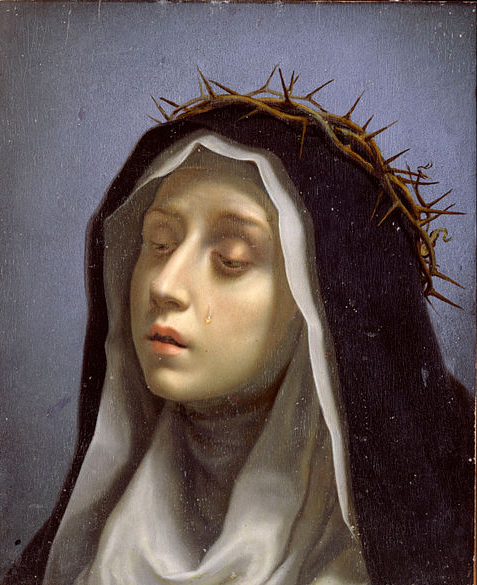
All of this came to mind the other day as I was reading The Life of St Catherine of Siena by her confessor, Blessed Raymond of Capua. In that work he relates a conversation that St. Catherine had with Jesus (which Catherine also relates in the Dialogue). In this conversation Jesus reminds Catherine of her contingency and dependance. He also gives Catherine the secret of overcoming pride so that our ancient enemy will never outwit us. Blessed Raymond recounts the dialogue of Jesus with Catherine in this way:
The holy Virgin told her confessors, of who, though unworthy, I was one, that, at the beginning of her visions, when the Lord Jesus Christ first began to appear to her, he said, “Do you know, daughter, who you are, And who I am? If you know these two things, you will be blessed. You are she is not; whereas I am He who is. Have this knowledge in you and the enemy will never deceive you…“
[Blessed Raymond continues]: A succinct doctrine… Oh, Immeasurable wisdom, wrapped in a few brief syllables…”You,” said the Lord, “are she who is not.” Indeed, all creatures are made from nothing, for “to create” means to make something from nothing. When creatures are left to themselves they tend to return to nothing, and if the creator ceased for one moment to preserve them in existence, they would rapidly be reduced to nothing again. … The Apostle says, “…for if any man think himself to be something, whereas he is nothing, he deceives himself” (Galatians 6:3). … And Jesus says “For without me you can do nothing” (John 15:5).
And [Blessed Raymond continues] here is a healing remedy, for what wound of pride can enter into a soul that knows itself to be nothing? Who can glory in anything he does? And thus, all vices are driven out by the words, “You are not”.
And here too are many anxieties diminished. For, as Blessed Raymond attests, “Whenever I or any of the other friars was afraid of any danger, Catherine would say, “What have you to do with yourselves? Leave it to Divine Providence. However much afraid you are, Providence still has his eyes on you and is always aiming at your salvation.” [Pages 62-65, selected verses].
And thus, a sense of our contingency, that compared to God, you and are “are not”; is a remedy for pride. In an era of pride, of a false and excessive sense of self-sufficiency, autonomy, and that we can “craft” reality and answer to no one, a simple reminder of our contingency is essential. And here it is given and it is put in a way that only a Saint can relate: “You are she who is not… I (the Lord) am He who IS.”
Have this knowledge in you you and you will be blessed, and the ancient enemy will never deceive you. For by this knowledge is the back of pride broken and is the basis for all humility formed.
In the Gospel for this weekend’s Mass the Lord Jesus summons us to a deeper appreciation for what brings true honor, for what makes a person truly great. As you may imagine, what the world thinks of as great and honorable is rather different that what God thinks and sees. Let’s look at this Gospel in three parts and discover it’s paradoxical vision.
I. THE PERSON who HONORS – The Lord is at a banquet and notices how people vie for seats of honor. He gives the following teaching: When you are invited by someone to a wedding banquet, do not recline at table in the place of honor. A more distinguished guest than you may have been invited by him, and the host who invited both of you may approach you and say, ‘Give your place to this man,’ and then you would proceed with embarrassment to take the lowest place.
Now what the Lord is really reminding us is, that at formal banquets, it is the host who determines where we sit. This is of course most common in our culture at wedding receptions where seats are determined and assigned by the couple ahead of time. For someone to walk in and sit at the head table reserved for the wedding party is both rude and pompous. The polite and expected thing is to report to the entrance table, and receive a table number and graciously take your seat.
And of course the banquet we are invited to is God’s Kingdom. And in that kingdom God has a place for us, but we must be clear that it is God who assigns each his place.
Recall that, when a dispute arose among the apostles as to who was the greatest Jesus responded: I assign to you, as my Father assigned to me, a kingdom, that you may eat and drink at my table in my kingdom (Luke 22:29).
Another time James and John approached and asked for seats at Jesus right and left (i.e. the places of honor) and Jesus responded: But to sit on my right hand and on my left hand is not my to give; but it shall be given to them for whom it is prepared (Mk 10:40).
So, our places in the Kingdom are determined by God.
It is a true fact that many miss this point and like to assign themselves places and honors in God’s kingdom. But in the end, that belongs to God. Some go through life resentful that they are not as rich as others, or as powerful, or as advantaged. Others wish they were taller, thinner, prettier, smarter etc. They are jealous of what they see as the advantages of others.
But be very careful here. It is not for us to determine what is best for us. It is not for us to assign our own seat. Just because we think it is better to be rich than poor does not mean this is correct. The Lord warns how difficult it is for the rich to inherit the Kingdom of God. So being rich isn’t necessarily the blessing we think it is. It is for God to decide what is best for us. Riches, power, popularity, good looks etc. are all things that tend to root us in the world. These things are not necessarily blessings. Having a “good” job like some one else, a family like someone else, a talent like someone else, may not be what is best for us.
God decides all that and gives us the talents and blessings, as well as burdens and challenges he knows are best. So don’t just walk into God’s Kingdom and seat yourself! Check in with the host and find His will in terms of your seat. He’s got just the right one for you.
II. THE PARADOX of HONORS– Now another thing to note about this Gospel is that Jesus was noticing how they were choosing the places of honor at the table. In effect he is struck at how people perceive honor, and vie for what they think is honor. They want to impress folks and be thought of as important.
But remember, this is God’s banquet and the qualifications for the seats of honor are very different from worldly honors. In the world, we are impressed by things like: bling, brawn, beauty and bucks. We’re impressed by big cars, big houses, big hair, and a big entourage. The limo pulls up and watch the eyes turn. Out come the popular, the powerful, the glitterati and game changers. The cameras flash and the applause ensues. We’re quite impressed actually. This is what WE notice, this is what draws OUR eyes.
But what of God? At the banquet of God’s kingdom, who draws his eye? As God looks around the banquet hall of the Kingdom who catches his eye? The Lord gives that answer in many places in Scripture:
Mark 10:43 Whoever would be great among you must be the servant, and whoever would be first among you must be slave of all. For the Son of man also came not to be served but to serve, and to give his life as a ransom for many.”
Luke 22:26 Rather let the greatest among you become like the youngest, and the leader like one who serves. For who do you think is the greater, one who sits at table, or one who serves? Is it not the one who sits at table? But I am among you as one who serves.
Ps 138:6 Though the LORD is on high, he looks upon the lowly, but the proud he knows from afar.
1 Cor 1:27 But God chose the foolish and low born things of the world to shame the wise; God chose the weak things of the world to shame the strong. He chose the lowly things of this world and the despised things–and the things that are not–to nullify the things that are, so that no one may boast before him.
James 2:5 Listen, my beloved brethren. Has not God chosen those who are poor in the world to be rich in faith and heirs of the kingdom which he has promised to those who love him?
Luke 13:30 Many who are last shall be first, and many who are first shall be last.
Luke 1:52 He has cast down the mighty from their thrones and lifted up the lowly.
So, back to our question: In the banquet hall of God’s Kingdom, who catches his eye? Is it those at the “Head table?” It is those on the red rug and behind the rope line? No. If we apply God’s works, those who catch God’s eye are not even at the table, but are those who wait on the tables, those who serve, those back in the kitchen cooking and washing dishes! It is the lowly, the humble and the servants of all.
Here is the paradox of honor in God’s kingdom: It is not about being powerful in the worldly sense. God is not impressed by the size of our house, car or bank account. Our popularity does not impress him. It is our service, our humility, our love for others that catches his eye. Here are the seats of honor, the places closest to God’s heart, they are for those who serve.
You gotta serve before you sit in any place of honor in God’s banquet.
III. THE PRESCRIPTION for HONORS – And hence the prescription is clear enough. Jesus instructs us in today’s Gospel: when you are invited, go and take the lowest place so that when the host comes to you he may say, ‘My friend, move up to a higher position.’
Now what all this adds up to is that if we want to be great in the Kingdom of God then we had better become a servant. Jesus says, take the lowest place. Serve before you sit. What makes you great is to serve. The greatest thing about us is not our paycheck, our fancy house or any of that stuff. What is greatest about us is that we serve.
We are great when we identify with the lowly and humble and seek to serve rather than to be served. We are great when we use our wealth, power, talents and abilities to build up the people of God and extend God’s Kingdom. Even in things which we are paid to do can still be service if serving is the primary reason we do it.
Jesus then adds: When you hold a banquet, invite the poor, the crippled, the lame, the blind; blessed indeed will you be because of their inability to repay you. For you will be repaid at the resurrection of the righteous. What this amounts to is a complete change in the way we see what is great in this world.
Jesus is giving us more than a moralism here (i.e. be generous to the poor). He is offering us a new vision for who is greatest in his Kingdom. We ought to run to the poor, the blind the lame, the afflicted, for they give us the ability to serve and this, in the end, is our greatest honor: to serve others, especially the poor and afflicted who cannot repay us.
A final dimension of all this is to learn that some of the greatest and most honorable people we know are those who serve us. Since to serve is the greatest honor in the Kingdom of God, we ought to hold in high honor those who wait on our tables, who clean our houses and work places, who do the “dirty work,” those also who serve in our hospitals and all those who care for us and serve us in countless ways. They are doing something honorable and we ought to treat them with respect, kindness, and honor. We ought to give generous tips where that is appropriate, but above all we are to honor them.
For the greatest among you is the servant, and whoever would be first among you must be slave of all. (Mk 10:43)
You gotta serve before you sit.
This song says, “Sit down servant, I can’t sit down….My soul’s so happy that I can’t sit down. And this video also depicts a wide cultural expression, a Thai Choir singing and African American Spiritual!
The video below humorously illustrates a biblical principle of our hidden faults. Indeed we all have sins and behaviors that are often clear to others but of which we are unaware. Indeed there are even deeper faults of which no one is aware except God himself who sees our innermost heart. Consider some of the following quotes:
By [your ordinances] your servant warned; in keeping them there is great reward. But who can discern his errors? From my hidden faults acquit me, O Lord. Keep your servant also from willful sins; may they not rule over me. (Psalm 19:11-13)
You have set our iniquities before you, our secret sins in the light of your presence. (Psalm 90:8)
For God will bring every deed into judgment, including every hidden thing, whether it is good or evil. (Eccl 12:14)
Mind you, I have nothing on my conscience, but I do not stand thereby acquitted. It is the Lord who judges me. (1 Cor 4:4).
The sins of some men are conspicuous, going before them to judgment, but the sins of others appear only later. (1 Tim 5:24)
Call no man happy before he dies, for by how he ends, a man is known. (Sirach 11:28)
Yes, some of our sins are obvious to us and we may rightfully work upon them. But lest we sin through pride, we ought always recall that we have sins and faults that are often hidden from us. Others may see them, or perhaps only God.
At the end of the day we’re all going to need a lot of grace and mercy!
Enjoy this commercial that well illustrates this fact. And enjoy a little humor, it’s been a tough week on the blog!