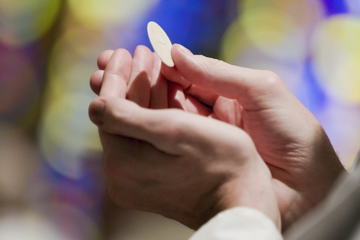
But one of the nicest and briefest descriptions of prayer that I have read comes from Dr. Ralph Martin in his book The Fulfillment of All Desire. Dr. Martin says beautifully, in a way that is succinct and yet comprehensive and inclusive of diverse expression,
Prayer is, at root, simply paying attention to God (p. 121).
Such a wonderful image: paying attention to God. Imagine that, actually paying attention to God! So simple, yet so often overlooked.
More traditionally, I have heard prayer defined as “conversation with God.” True enough, and well attested. But to me, this definition seems to shed less light on its meaning. While most people easily grasp the “talking” part of conversation, fewer are able to appreciate the “listening” part. And thus there can be a lot of emphasis on recited prayers, intercessory prayers, etc. These are all good in themselves—even required—but when and how does one listen?
One could theoretically recite long prayers, but in the end pay little attention to God. This is not usually due to malicious or prideful motives, but rather to the fact that our minds are weak. And thus the “conversation” definition has its pitfalls and limits.
How different it is to go to prayer saying, “I am going to go aside now and spend some time paying attention to God. I am going to sit still and listen while he speaks. I am going to think about His glory, rejoice in His truth, and ponder His presence as deeply as I can.”
Paying attention to God can take many forms. One outstanding way is through the slow, thoughtful, and deliberate reading of Scripture called lectio divina. We are not merely reading a text; we are listening to God speak; we are paying attention to what He says. And as we listen, as we pay attention to Him, our minds begin to change, and the Mind of Christ becomes our gift.
Another preeminent way of paying attention to God is through Eucharistic Adoration: a thoughtful, attentive, and loving look to the Lord as our thoughts gently move to Him, and His loving look returns often wordless but powerful presence.
Further, in authentic and approved spiritual reading we pay attention to God in a way that is mediated through His Saints, mystics, and other reputable sources. Good, wholesome, and approved spiritual reading presents to us the Kingdom of God, His Wisdom, and His vision. And in carefully considering holy teaching, we are paying attention to God.
And of course the highest form of paying attention to God is attending to Him in the Sacred Liturgy, experiencing His presence and power, listening to His Word proclaimed thoughtfully and reflectively, attending to His presence on the sacred altar, and receiving Him with attentiveness and devotion.
Throughout the day there are countless ways that we can take a moment and pay attention to God: momentary aspirations, a quick thought sent heavenward, or a look of love.
I will say no more here. For so much is beautifully and simply conveyed in these words: Prayer is, at root, simply paying attention to God.
The first reading for daily Mass on Monday (18th week of the year) was taken from the Book of Numbers. It features the Israelites grumbling about the manna in the wilderness:
Would that we had meat for food! We remember the fish we used to eat without cost in Egypt, and the cucumbers, the melons, the leeks, the onions, and the garlic. But now we are famished; we see nothing before us but this manna (Numbers 11:4-5).
While it is possible for us to marvel at their insolence and ingratitude, the scene presented depicts very common human tendencies. It is not unique to these people once in the desert. Their complaints are too easily our own.
Let’s look at a number of the issues raised and see how it is possible for many of us today to struggle in the same way.
I. They prefer the abundance of food and creature comforts that come along with slavery in Egypt, to the freedom of children of God and the chance to journey to the Promised Land. And this, too easily, is our struggle as well. Jesus points to the Cross, but we prefer the pillow. Heaven is a nice thought, but it is in the future and the journey is a long one.
Too easily we prefer our own version of melons and leeks. Perhaps it is possessions, or power, or popularity. Never mind that the price of them is a kind of bondage to the world and its demands. For when the world grants its blessings, we become enslaved by the fact that we have too much to lose. Hence we will compromise our freedom, which Christ died to purchase for us, and enter into a kind of bondage of sin. We will buy into lies, or commit any number of sins, or perhaps suppress the truth, all in an attempt to stay popular and well-connected. Why? Because we have become so desperate for the world’s blessings that we will make compromises that harm our integrity or hurt other people just to get those things we think we can’t live without.
But we don’t call it bondage. We call it being “relevant,” “modern,” “tolerant,” and “compassionate.” Yes, as we descend into deeper darkness and bondage to sin and our passions, we are pressured to call it “enlightenment,” “choice,” and “freedom.” So, we use other terms, but it is still bondage for the many who fear breaking free from it.
We are in bondage to Egypt, enslaved to Pharaoh. We prefer that to the freedom of the desert, with its difficult journey to a Promised Land (Heaven) we have not yet fully seen. The pleasures of the world, its melons and leeks, are currently displayed and available for immediate enjoyment.
And so the cry still goes up: “Give us melons; give us leeks; give us cucumbers and fleshpots! Away with the desert; away with the Cross; away with the Promised Land, if it exists at all. It is too far off and too hard to get to. Melons and leeks, please. Give us meat; we are tired of manna!”
II. There is boredom with the manna. While its exact composition is mysterious to us, it would seem that manna could be collected, kneaded like dough, and baked like bread. But as such, it was a fairly plain substance. It seems it was meant more to sustain than to be enjoyed.
The people remembered the melons, leeks, and fleshpots of Egypt, and were bored with this plain manna. Never mind that it was miraculously provided every day by God, in just the right quantity. Even miracles can seem boring after a while to our petulantly demanding desires. The Lord may show us miracles today, but too easily do we demand even more tomorrow.
We are also somewhat like little children who prefer Twinkies and cupcakes to vegetables and other more wholesome foods. Indeed, the Israelites’ boredom with and even repulsion to the miracle food from Heaven does not sound so different from the complaint of many Catholics today that “Mass is boring.”
While it is certainly true that we can work to ensure that the Liturgy reflects the glory it offers, it is also true that God has a fairly stable and consistent diet for us. He exhorts us to stay faithful to the manna: the wholesome food of prayer, Scripture, the Sacraments, and stable, faithful fellowship in union with the Church.
In our fickle spirits, many of us run after the latest fads and movements. Many Catholics say, “Why can’t we be more like the mega-churches with all the latest, including a Starbucks Coffee Café, contemporary music, a rock-star-like pastor delivering sensitive, toned-down preaching with many promises and few demands, and all that jazz?”
But as an old spiritual says regarding this type of person, “Some go to church for to sing and shout, before six months they’s all turned out!” And thus some will leave the Catholic Church and other traditional forms that feature the more routine but stable and steady manner, for the hip and the latest, the melons and leeks. But frequently they find that within six months they’re bored again.
And while the Church is always in need of reform, there is a lot to be said for the slow and steady pace as she journeys through the desert, relying on the less glamorous but more stable and sensible food: the manna of the Eucharist, the Word of God, the Sacred Liturgy, prayer, and fellowship.
III. Who Feeds You?Beyond these liturgical preferences of many for melons and leeks over manna, there is also a manifest preference for the food of this world. There is a tragic tendency for many Catholics, even regular church-goers, to get most of their food not from the Lord, not from Scripture, not from the Church, but from the Egypt of this world.
Most eat regularly at the banquet table of popular entertainment, secular news media, secular talk radio, etc. And they eat this food quite uncritically! The manna is complained about, but the melons and leeks are praised without qualification.
And while it is true that Christians cannot wholly avoid all contact with the world or eschew all its food, when do the melons and leeks ever come up for criticism? When do Christians finally look closely and say, “That is not the mind of God!” When do they ever conclude that this food is inferior to what God offers? When do parents finally walk into the living room, turn off the TV, and tell their children that what they have just seen and heard is not the mind of God?
Tragically, this is rare. The food of this world is eaten in amounts far surpassing the consumption of the food of God. The melons and leeks of the world are praised, while the manna of God is put on trial because it’s not like the food of the world.
For a Christian, of course, this is backwards. The world should be on trial based on the Word of God. Instead, even for most Catholics, the Word of God and the teachings of the Church are on trial by the standards of the world.
So the question is, who is it that feeds you? Is it the world or the Lord? What proportion of your food comes from the Lord and what from the world? Answer honestly! Which is more influential in your daily life and your thinking: the world or the Lord? Who is really feeding you, informing you, and influencing you? Is it the melons and leeks of this world? Or is it the faithful, stable, even miraculous manna of the Lord and His Church?
These are some probing questions for all of us, drawn from an ancient wilderness. God’s people, who tired of the manna, harmed themselves and others as well. It is easy to blame others for the mess we’re in today, but there are too many Catholics who prefer the melons and leeks of this world and have failed to summon others to the manna given by the Lord.
Have mercy on us, Lord our God. Give us a deep desire for the manna you offer. And having given it to us in abundance, help us to share it as well!
What are we to make of cruelty in our culture? At one level, there is demonstrably less cruelty on a daily basis. Many hundreds of years ago, before the emergence of a common civil law, settled governments, and national boundaries, villages were often overrun by roving bands of plunderers or the armies of nearby towns. Feudal lords or landed families were either venting grievances or seeking to increase their territory. City-states had high walls, moats, and embattlements for a reason. Brutality, rape, torture, banishment, pillaging, and enslavement were common features of the ancient world and continued well into the 16th Century in Europe and even to this very day in some parts of the world.
With the emergence of civil law and more common standards of justice (thanks in part to the Church), along with more settled nation-states and boundaries, order in daily life, of the kind not experienced since the Pax Romana, began to develop.
Few of us today fear to venture outside our cities, which no longer have protective walls, or far from our homes. A drive out in the country is not something we undertake with trepidation, wondering if we will ever return.
And yet from the perspective of a “body count,” we have never lived in bloodier times. Even as we call ourselves “civilized” we kill in numbers unimaginable to the ancient world or feudal Europe. In the 20th century alone, tens of millions were killed in the two world wars. And the dead were not found only on the battlefields, but in fire-bombed and carpet-bombed cities as well. “Civilized” Germany ran death camps that killed millions more. The “Cold War” that followed World War II and atheistic communism killed millions more. Even by conservative estimates, some 200 million people died in the 20th century for ideological reasons: at the hands of Stalin, Mao, and Pohl Pot, and as a result of wars in Vietnam, Cambodia, and Korea. The 20th century was surely the bloodiest century this world has ever known.
Add to this the cruelest killing of all, in numbers almost unfathomable: abortion. Whatever euphemism we may wish to use (“reproductive choice,” “women’s healthcare,” etc.), the fact remains that abortion is a brutal thing. Infants are scalded to death by saline or dismembered by suction. And regardless of what women are told or what they think going in, no post-abortive woman I have ever spoken with would describe abortion as anything less than an act of terrible violence. They themselves are also the victims of the lies and euphemisms. Reality hits hard.
The recently released undercover Planned Parenthood videos show the brutality and the callous disregard for human life and dignity in some people. The actions of Planned Parenthood are reprehensible, but not surprising. When a person or an organization unrepentantly engages in any objectively sinful practice, the sin has a way of growing, and the darkness and rationalizations get ever deeper. And if this is the case with lesser sins, how much more so with the extremely grave sin of unrepentantly killing infants in the womb.
Planned Parenthood’s organizational response to the videos, while less glib than the “doctors” in the videos, demonstrates a lack of remorse and no desire to end the practice. But what remorse can we expect from Planned Parenthood when it supports and profits from the killing of over 300,000 infants a year?
Yes, in this country the darkness is growing ever deeper in many hearts. And thus we see the most abominable practices celebrated by those who have lost their moorings, who lack even simple human tenderness toward the most innocent among us: our infants. Many even justify selling aborted infants for the sake of “medical research.”
So here is the great paradox of cruelty in our times. At one level we experience less brutal and random violence. Law and order, national boundaries, etc. have reduced the daily violence that most (not all) of us experience. Indeed, we talk endlessly and to a fault about being kind and “nice” and of the obligation not to hurt anyone’s feelings. We lament the killing of whales, the baby seals, and Cecil the lion. And yet, by the numbers, we are more brutal and cruel than ever. While we call ourselves civilized, the numbers show that the modern world is a killing machine the likes of which the world has never known.
In pondering the enormous violence in a culture that talks “nice” and prizes tolerance and kindness, Dr. Peter Kreeft makes a valuable observation:
How [is our civilization] weak? Not technologically … not intellectually … Nor are we morally weaker. I do not think we are necessarily more wicked than our ancestors overall. True, we are less courageous, less honest with ourselves, less self-disciplined, and obviously less chaste than they were. But they were more cruel, intolerant, snobbish, and inhumane than we are. They were better at the hard virtues; we are better at the soft virtues. …
But though we are not weaker in morality, we are weaker in the knowledge of morality … We know more about what is less than ourselves, but less about what is more than ourselves. When we act morally, we are better than our philosophy … Our ancestors were worse than theirs. Their problem was not living up to their principles. Ours is not having any.
We talk a good game of ethics … but it has the effect of an inoculation. [Professing] a little ethics or pseudo ethics we build up an immunity to the real thing. Those who obviously have no ethics … are ripe for conversion. Those who seem to have ethics but actually do not [because they have merely inoculated themselves from true ethics by a little ethics] are comfortably ensconced in illusion (Peter Kreeft, Back to Virtue, Ignatius Press, 1992, pp. 23-32).
Kreeft’s basic explanation for our paradoxical “kind, yet brutal” culture comes down to an analogy of immunization. In immunization we “inoculate” ourselves. That is, we take a little portion of a disease in order to avoid the whole disease. Taking this little portion immunizes us and helps us to resist the big portion.
And thus those who use a little ethics, i.e., selective ethics, take it as something relatively harmless and less demanding than the whole of ethics or morality, which they shun like a disease. So, they take a little ethics (and selective ethics at that) and then congratulate themselves for being tolerant, kind, and nice, ignoring the rest of ethics and morality with its more frightening, consistent, and sweeping demands.
Yes, have a little ethics, get congratulated, and ignore the rest. Tell folks that you love the whales and think the poor should be fed; be polite and kind to most people, and you’re inoculated. Now, never mind that you are unchaste, think abortion should be legal, think that the selling of body parts obtained by killing is OK or even virtuous. No, never mind any of that. You are inoculated and therefore immune from the “disease” of a full moral vision. Indeed, those who do have the full symptoms of the full “disease” of morality and ethics are referred to with the disease-like term, “fanatic.”
Yes, what are we to make of the cruelty in our culture? Why is there such an astonishing death toll in a culture in which kindness and politeness are so prized? What are we to make of a culture that eschews violence and yet finds it even debatably “OK” to crush infants in the womb “carefully” and then harvest their organs? What are we to make of a culture that thinks it’s OK to abort infants at all, while we still talk about justice and fairness out of the other side of our mouth?
I think Dr. Kreeft’s analogy with inoculation helps explain some of the paradox. Our kindness and politeness, our sense of “civil” discourse, and our rejection of localized violence, good in themselves, are taken by many like an inoculation to immunize them from the broader expectations of a fully biblical morality or natural law ethics. Some think and would say, “I’ve done a little. I hold to the minimally correct, publicly approved view. I’m inoculated. So now leave me alone and take your fanatical and diseased extremism out of here.”
Little things may mean a lot, but not if they are used to exclude and excuse one from the greater. In this case, the good is the enemy of the perfect. And hence our politely cruel culture.
In the midst of explaining a parable to the disciples, Jesus stopped and asked them a question: “Do you understand these things?” (Mt. 13:52)
Now, rule number one in reading Scripture is when Jesus asks a question, you answer it. You don’t keep reading to see how the Apostles or disciples answered it. You stop, put down the Bible, and answer it yourself.
I have deliberately not provided any context to the question Jesus asks above (you can look it up later if you’d like). But for now just stay with this question and apply it to any or all of Scripture. Do you understand these things?
What does it mean to understand? The Greek word that is translated as “understand” is οἴδατε (oidate), which refers to seeing that becomes knowing, seeing and laying hold of something that is a gateway to grasping spiritual truth.
So the question remains: Do you understand these things?
One of the problems for those of us who have some familiarity with the Scriptures is that they are familiar. And while it is good that the Scriptures are well known to us, it is also a problem. A passage begins and we just say, “Oh yeah, that story” and we either tune out or fail to reflect deeply.
But Scripture is always more than just a story or the facts of a text. Even ordinary human acts or words are seldom merely what they seem to be on the surface.
Consider an example my Scripture teacher, Fr. Martin, once gave. You and I are at a gathering and we observe Smith enter the room and immediately go across the room and greet Jones warmly. And I say, “Wow, look at that!” And you say, “What’s the big deal? People shake hands all the time.” And then I reply, “Smith and Jones have been enemies for thirty years.” So there is a depth and a mystery to that simple act that mere observation does not supply. The act occurs at a specific moment in time, but it has a past and points to a future. It also has a depth that must be perceived and appreciated.
And this is what Jesus is calling for when he asks, Do you understand these things? Do you grasp these parables, these teachings, these accounts and stories from Scripture? Do you perceive them with a seeing and a hearing that lead to knowledge and are a gateway to grasping spiritual truth? Or are you just seeing the surface of the text, noting the event, and then moving on?
Further, our “understanding” of them is not a static thing, but a dynamic and growing reality. With each year that we hear the familiar stories and teachings of Scripture, our understanding can and should become deeper and richer.
The Latin Fathers of the Church had a saying that the Scriptures were Non nova, sed nove (not new things, but understood newly). In other words, though the stories and teachings do not change (non nova) our appreciation of them, our grasp and understanding of them is ever new; they are seen newly (nove), appreciated more deeply.
So, as you read the Scriptures, Jesus has a question for you, “Do you understand these things?” Are you just hearing and reading ancient words and events, or are you plumbing their depths? Where are your mind and heart as you perceive the Word of God? Do you ponder it in your heart?
It is not enough to know what something meant for the Apostles or the people of Jesus’ time, or some commentator. What does it mean for you, now? How have you experienced the truth that is announced? What are the implications of the text, teaching, or story for you? Do you see something new that you never saw before?
Do you understand these things?
Here are some other questions Jesus asked: 100 Questions Jesus Asked
All of the readings in today’s Mass speak of human desire. The Israelites in the desert are hungry, so are the people by the lakeside with Jesus. And in the Epistle, St. Paul warns of corrupted desires. In all of the readings, God teaches us that our desires are ultimately directed to Him, who alone can truly satisfy us. Why is this? Because our desires are infinite, and no finite world can satisfy them.
Let’s look at what the Lord teaches by focusing especially on the Gospel, but also including insights from the other readings. There are three basic parts to the teaching on desire. The notes that follow are more extensive than I could preach in a Mass. They are really more in the form of an extended Bible Study on this passage.
I. THE HUNGER OF DESIRE –Today’s gospel begins where last week’s left off. To refresh your memory, Jesus had multiplied the loaves and fishes and satisfied the crowd with abundant food, but then slipped away and headed across the lake to Capernaum. Today’s text begins, When the crowd saw that neither Jesus nor his disciples were there, they themselves got into boats and came to Capernaum looking for Jesus.
Thus we begin by simply noting the hunger of the people. Allow hunger here to represent all of our desires. Desires, of themselves, are good and God-given. It is the people’s hunger, their desire, that makes them seek Jesus. Further, their desire is very deep and strong; they are willing to journey a significant distance to find Jesus.
As such, desire has something important to teach us. It is easy to see that our desired motivate us. But we should also recognize that they are infinite, unlimited. For no matter how much we get, we always want more. We may experience some momentary satisfaction with certain things like food, but it doesn’t last long. Taken together, our desires are limitless.
This limitless, infinite quality demonstrates God’s existence, for a finite world cannot give what it doesn’t have, namely, infinite longing. Thus, our infinite longings point to God and must come from Him. Our hearts, with all their infinite longings, teach us that we were made for God and will not find rest apart from Him.
Purification is needed. The journey of the people around the lake to find Jesus is good in itself, but as we shall see, their hunger needs purification and a more proper focus. They do not seek Jesus as God, but rather as the “bread king.” They seek mere bread, mere food for their stomachs. But the Lord wants to teach them that all their desires really point higher. And that leads us to the second movement of today’s gospel.
II. THE HEALING OF DESIRE – As we have already noted, desire is good and God-given. But, in our fallen condition, our desires are often unruly, and our darkened minds often misinterpret what our desire is really telling us.
Desires are unruly because we desire many things out of proportion to what we need, and to what is right and good.
Our minds are darkened in that we consistently turn to the finite world in a futile attempt for satisfaction, and, when it fails, we keep thinking that more and more of the finite world will satisfy our infinite longing. This is futile and is the sign of a confused and darkened mind, because the world cannot possibly satisfy us. More on this in a moment.
For now, Jesus must work with these bread-seekers (us) and help them to realize that their desire for bread is about much more than mere food; it is about God. He is the Lord whom they really seek. Let’s observe how He works to heal their desires.
A. The Doctor is in – The text says, And when they found him across the sea they said to him, “Rabbi, when did you get here?” Their question is somewhat gratuitous, since they know exactly when He got there; they are simply trying to strike up a conversation in order to get more bread. As we shall see, Jesus calls them on it. But note this much: they are looking for Jesus and they do call him “Rabbi.” Both these facts are good. Their desire, though imperfectly experienced, has brought them to Jesus, who, as Lord, can now teach them (and us) about what their longing is really telling them. The doctor is in.
B. The Diagnosis – The text says, Jesus answered them and said, “Amen, amen, I say to you, you are looking for me not because you saw signs but because you ate the loaves and were filled.”In other words, “You are not looking for me because you saw signs and want to believe in me, but because you want your bellies filled.”
And this is our essential problem: we focus on our lower desires, our bodily needs, neglecting our higher, spiritual desires. We have a deep, infinite longing for God, for His love, goodness, beauty, and truth. But instead of seeking these things, we think another hamburger will do the trick. Or if not that, a new car, a new house, a new job, more money, more sex, more power, or more popularity. We think that if we just get enough of all this “stuff” we’ll finally be happy. But we will not; it’s a lie. A finite world cannot possibly satisfy our infinite longing.
In the second reading from today’s Mass, St. Paul warns,I declare and testify in the Lord that you must no longer live as the Gentiles do, in the futility of their minds … that you should put away the old self of your former way of life, corrupted through deceitful desires, and be renewed in the spirit of your minds (Eph. 4:17, 20-23).
Note St. Paul’s use of the word “futility.” The Greek word is ματαιότης (mataiotes), here meaning unreality, purposelessness, ineffectiveness, a kind of aimlessness due to a lack of purpose or any meaningful end, nonsense because it is transitory and not enduring.
In other words, it is exactly what the Lord is getting at in telling them that their desires are messed up. It is the sign of a darkened mind to pile up finite, earthly goods in a futile attempt to satisfy infinite desires.
St. Paul goes on to say that some of our desires are deceitful. They are so because they bewitch us into thinking that our life is about them, and that if we attend to them only, we will be happy. We will not; this is a deception. Simply getting more food, sex, drink, houses, money, power, etc. will not cut it. These are finite things, while our desires are ultimately infinite.
Thus the doctor, along with his assistant, St. Paul, has made the diagnosis: You and I are seeking bread (not evil in itself) when we should also be seeking Him who is the True Bread of Life. They say to us, in effect, “You seek the consolations of God, but not the God of all consolation. You want good things, but do not seek the giver of every good and perfect gift.”
So we have our diagnosis. Our desires are our out of whack and/or our darkened minds misinterpret the message that our lower desires are really giving us. Next come the directives.
C. The Directives– The Lord gives three essential directives:
1. Fix your focus– Jesus says, Do not work for food that perishes but for the food that endures for eternal life, which the Son of Man will give you. The point is that we should attend more to things that endure unto life eternal than to the passing things of this world.
Most of us do just the opposite. The passing world and its demands get all our attention and things like prayer, scripture, sacraments, building our relationship with the Lord, learning His will, and obeying His will, all get short shrift. We attend to “the man” and tell God to “take a number.” It’s kind of dumb, really.
The passing world, a sinking ship, gets all our attention. Calling on the one who can rescue us and learning His saving directives and following them gets little attention. Instead we “rearrange the deck chairs on the Titanic,” indulge ourselves on the “lido deck,” and get angry that we don’t have a first class cabin.
The Lord says, “Hey! Fix your focus! That ship is going down. What will you do then? Why obsess about that stuff? Turn to me and listen carefully; I alone can save you.” Fix your focus: worry less about things that perish and focus more on the things that last and can save.
2. Firm Up your Faith– Jesus goes on to say, For on him the Father, God, has set his seal.” So they said to him, “What can we do to accomplish the works of God?” Jesus answered and said to them, “This is the work of God, that you believe in the one he sent.”
Okay, so the ship is going down; the world is perishing. So how do we get saved from it? The answer is faith.
But faith here must be understood as more than just answering a mere altar call or the recitation of a creed. And surely it is more than “lip service.” Faith here is understood as being in a life-giving, transformative relationship with Jesus Christ.
Real faith puts us into a relationship with the Lord that changes the way we walk, that gives us a new mind and heart, new priorities, indeed, a whole new self. To be in a relationship with Christ, through faith, is to be changed by Him. And it is this change, this obedience of faith, this transformation that saves us and gets us ready to meet God.
So the Lord says, “Come to me and firm up your faith.”
3. Find your Food – But as the discussion with them continues, they show themselves to be a stubborn lot. They say, “What sign can you do, that we may see and believe in you? What can you do? Our ancestors ate manna in the desert, as it is written: He gave them bread from heaven to eat.”
In effect they are still back to demanding bread. It’s as if to say, “Sure, fine, all that higher stuff is fine, but I want bread for my belly. So give me that and then we’ll talk about all that higher stuff and that bread that endures and does not perish. If you want me to have faith, first give me bread for my belly.”
They’re still more interested in the stuff of a sinking ship.
So Jesus says to them, “Amen, amen, I say to you, it was not Moses who gave the bread from heaven; my Father gives you the true bread from heaven. For the bread of God is that which comes down from heaven and gives life to the world.” And in saying this, Jesus is saying, in effect, “Don’t you see that the ancient bread in the wilderness was about GOD? It was not merely food to fill their bellies; it was food to draw them to deeper and saving faith. It was food to strengthen them for the journey to the Promised Land. And so it must be for you: that you understand that even your lower desires are ultimately about God. If mere grain is your food, you are doomed, for food perishes and you along with it. But if God himself is your food, now you can be saved, for I, the Lord and the Bread that endures, will draw you with me to eternal life.”
And in these ways the Lord seeks to heal their desires. But now comes the main point.
III. THE HEART OF DESIRE– So they said to him, “Sir, give us this bread always.” Jesus said to them, “I am the bread of life; whoever comes to me will never hunger, and whoever believes in me will never thirst.“
And thus we see that the Lord now makes it plain: I AM your food. I AM the fulfillment of all your desires. I AM the only one who can really fulfill your infinite longings, for I AM the Lord and I AM infinite. Yes, I AM your true bread.
So what does the Lord mean in saying we will never again hunger or thirst? To some extent we must see that Jesus is employing an ancient “Jewish way of speaking,” which looks to the end of things and adopts them as now fully present. There is no time to fully develop this here and describe how it is used elsewhere, but in short, it is the capacity to see things as “already but not yet,” and to begin to live out of the “already” in the here and now.
Thus Jesus is saying, in more modern terms, “To the degree that you enter into a life- changing and transformative life with me, and to the degree that I become your bread, that I become that which satisfies you, your desires will come more and more into line and you will find them being satisfied more and more with each passing day. You will find in your life a satisfaction that a new iWatch could never give, that money, power, sex, possessions, and all other passing goods could never give. And one day, this satisfaction will be full and never pass away when you are with me in heaven.”
Of this I am a witness, for with each passing day in my life of faith with the Lord, I can truly say that I am more and more satisfied. The things of this passing world are of less interest to me and the things of God and Heaven are increasingly the apple of my eye. I have a ways to go, but the Lord has been good to me and His promises are true, for I have tested them in the laboratory of my own life.
The old song is increasingly mine, which says, “I heard my mother say, Give me Jesus. You may have all this world, just give me Jesus.”
In the gospel in the weeks ahead, the Lord Jesus will develop how He is bread for us in more than a metaphorical way. Rather, He is our True Bread in the Eucharist and the Bread He will give is His flesh for the life of the world. Yes, His Body and Blood are our saving food for the journey to the Promised Land.
I am mindful of an old gospel hymn that I’d like to give a Catholic spin. For I have it on the best of authority that when Jesus was speaking to the crowd in today’s gospel, He started to tap his toe and sing this song:
Below is a touching video of a hearing-impaired infant who, after being fitted with a hearing aid, hears the voices of his parents for the very first time. Initially, the child fidgets, afraid of what is happening. But as the voices of his parents reach his soul, a smile of joy and recognition blossoms on his face.
In the Fourth Eclogue of Virgil is a beautiful line regarding an infant’s first recognition of his mother. In this case it refers to seeing, but the same could be said of hearing.
Incipe, parve puer, risu cognoscere matrem.
Begin, little boy, to recognize the face of your mother with a smile.
Spiritually, this video speaks to those of us who may have fidgeted as we were introduced to the voice of our Heavenly Father and Holy Mother Church. At first, we objected to the voice of truth and resisted those who sought to help us to hear. But, prayerfully (and I am a witness), many of us adjusted and began to smile at the beautiful voice of truth.
Faith comes from hearing, and hearing comes through the Word of Christ (Romans 10:17).
In yesterday’s readings at Mass we read about how Moses laid out the “tent of meeting” exactly according to the pattern God gave him up on the mountain. A millennium later John described a similar scene of the sanctuary in Heaven.
Few Catholics today realize that God actually did indicate a good deal about how He expects our churches to be designed. And while some degree of variation is allowed and has existed, most modern churches have significantly departed from the instructions God gave. We do well to ponder church architecture not merely as an aesthetic question, but also as a question of fidelity to what God expects.
For the Church, the Scriptures are more than just ink spots on a page. The Scriptures are manifest in proclaiming how we live, how we are organized hierarchically, our sacraments, our liturgy, and even the design of our buildings.
Long before most people could read, the Church was preaching the Gospel. And to do so, she used the very structure of her buildings to preach. Many of our older buildings are sermons in stone and stained glass.
The Scriptures come alive in our art, statues, paintings, and in the majestic stained glass windows that soar along the walls of our churches like jewels of light. Even the height and shape of our older churches preach the Word. The height draws our eyes up to Heaven as if to say, Since you have been raised to new life with Christ, seek the things that are above, where Christ is seated at God’s right hand (Col 3:1). And the shape of most of our older churches is that of a cross, as if to say, May I never glory in anything save the Cross of my Lord Jesus Christ (Gal 6:14).
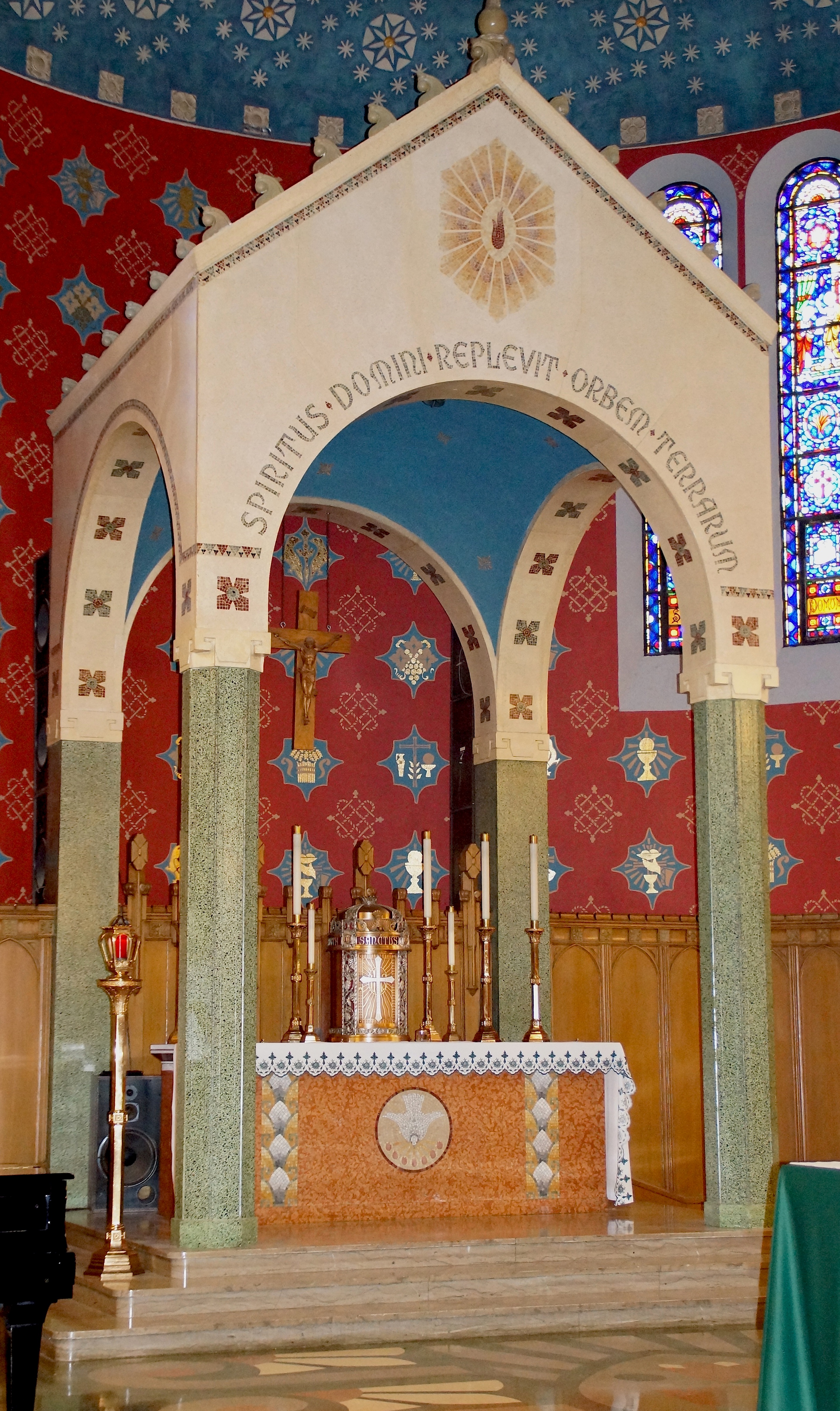
My own parish church is a sermon in stone, wood, and glass. It is designed around the Book of Revelation (Chapters 4 and 5), in which John is caught up into Heaven and describes it in detail. The fundamental design of the sanctuary drawn from Revelation 4 and 5 includes the throne-like altar (Rev 4:2), seven tall candles around the throne (Rev 4:5), and the four living creatures in the clerestory windows above the altar (Rev 4:6-8). At the center of the altar is the tabernacle, wherein dwells the once-slain Lamb who lives forever, Jesus (Rev 5:6). Around the throne (altar) are seated the 24 elders (Rev. 4:4), symbolized by the 12 wooden pillars on the back sanctuary wall and the 12 stained glass windows of the Apostles in the transept. The multitude of angels surrounding the throne (Rev 5:11) are symbolized by the blue and gold diamonds on the apse wall.
In effect, the builders of my church (built in 1939) were saying, when you walk into this church, you have entered Heaven. Indeed, it is a replica of the heavenly vision of John. And when we celebrate the Liturgy it is more than just a replica, for we are taken up to Heaven in every Mass, where we join countless angels and saints around the heavenly altar. There, we worship God with them. We don’t have to wait for some rapture; we go there in every Mass.
But there is more! For what John saw in Heaven is none other than what God prescribed to Moses. God told Moses quite explicitly how to construct the ancient sanctuary, the tent of meeting in the desert. The layout, materials, and elements were all carefully described.
And, having given these details, God said, Now have them make a sanctuary for me, and I will dwell among them. Make this tabernacle and all its furnishings exactly like the pattern I will show you (Exodus 25:8-9). And God later said, See that you make them according to the pattern shown you on the mountain (Ex 25:40). And God repeated, Set up the tabernacle according to the plan shown you on the mountain (Ex 26:40).
The Book of Hebrews explained why God insisted that the pattern be followed so exactly: They serve at a sanctuary that is a copy and shadow of what is in heaven (Heb 8:5). In other words, the Ancient Temple was meant to be a replica, or pattern of the heavenly sanctuary.
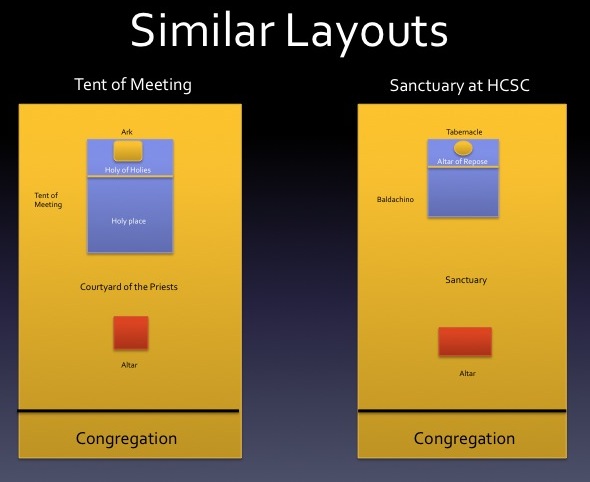
Most older Catholic churches maintain the basic pattern of what Moses was shown. This diagram compares the layout of the sanctuary in my parish church, Holy Comforter St. Cyprian (HCSC), with the layout of the temple:
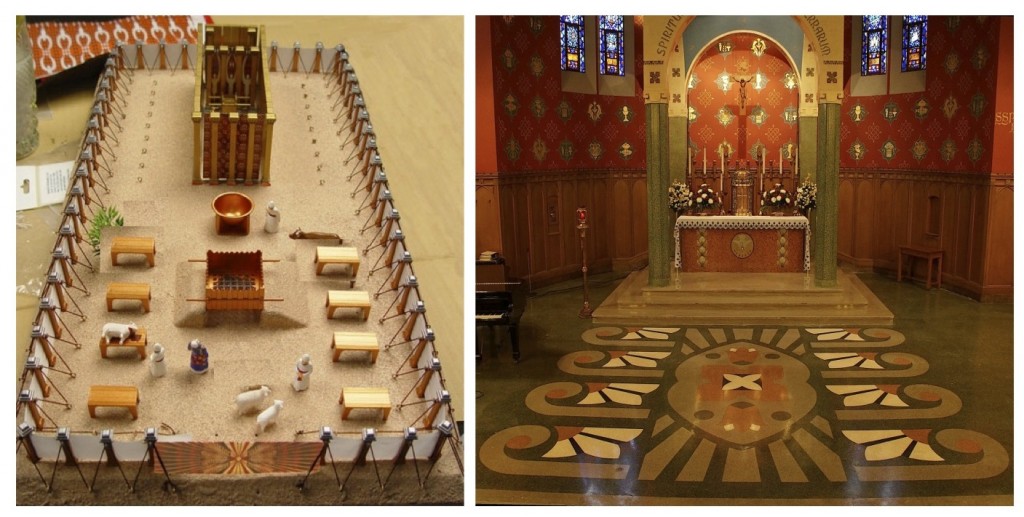
In the photo just below, you can see the remarkable similarity more visually. The pattern is even etched on the floor of my church, echoing a detail about the layout of the temple that Ezekiel described:
So there were four tables on one side of the gateway [of the sanctuary] and four on the other—eight tables in all—on which the sacrifices were slaughtered (Ez 40:41).
On the left below is a depiction of the setup of the tent of meeting as it was when the people were still in the desert. Next to it is a photo of my parish church sanctuary. You can see the remarkable similarity.
Note the way the scrollwork on the floor of my parish matches the four tables on either side in the sanctuary where the animals were slaughtered. The fiery square and horned altar in the diagram of the temple are represented by the horned square on the floor of my church. In the diagram of the ancient sanctuary, the holy place, the holy of holies towers in the back, as do the high altar and tabernacle in my parish church.
Simply put, the builders of my parish church remarkably depicted the ancient temple as well as the vision of Heaven from the Book of Revelation. This is what church buildings should do: exemplify the heavenly sanctuary, the plan for which God Himself gave. Sadly, modern architecture has departed from that plan significantly. But in recent years, there has been something of a return to that plan, a trend for which we can only be grateful.
The Catholic Church is surely a biblical Church. My very building shouts the Word! We Catholics preach the Word not only with ink and in speech, but also in stone, wood, glass, liturgy, and the arts—all to the glory of God.
Here is a video of some of the details of my parish.
CS PHOTO BY JACLYN LIPPELMANNI wrote yesterday in a general way about the part of the Mass that is called the “preface.” It is called this because it introduces the Eucharistic Prayer by stating a theme or reason for our gratitude. The text of the preface has a standard opening and closing which surround a varying text that speaks to the time of year, the feast, or the theme of the votive Mass.
As I remarked in yesterday’s post, I consider the prefaces to be minor masterpieces, stating succinctly, creatively, and beautifully some of our most fundamental Catholic themes from Scripture and Tradition. Many of the prefaces are ancient, while some are newly composed. Don’t miss these short gems of the Liturgy. Listen carefully to them as they are sung or proclaimed.
I would like to look in detail at the first four prefaces for the Sundays of the year. Each of these focuses on the Paschal mystery: the passion, death, and resurrection of Jesus.
In each case below, the text of preface itself is shown in bold italics, followed by my commentary in plain text. In the case of the first preface, I have included both the opening and closing sections as well as the varying, “middle” section, which is its core. In the other three prefaces, I have included only the middle section.
Enjoy these beautiful prefaces!
Preface 1 of the Sundays in Ordinary Time
It is truly right and just, our duty and our salvation,
Always and everywhere to give you thanks,
Lord, Holy Father, almighty and eternal God,
Through Christ our Lord.
For through his Paschal Mystery,
he accomplished the marvelous deed,
by which he has freed us from the yoke of sin and death,
summoning us to the glory of being now called
a chosen race, a royal priesthood,
a holy nation, a people for your own possession,
to proclaim everywhere your mighty works,
for you have called us out of darkness
into your own wonderful light.
And so, with Angels and Archangels,
With Thrones and Dominions,
And with all the hosts and Powers of heaven,
We sing the hymn of your glory,
as without end we acclaim,
Holy, Holy, Holy …
In this preface, the Paschal mystery is not described in detail, as it is in some of the other prefaces to follow. Here it is called, simply and beautifully, a “marvelous deed.” The Latin word used is mirificum, meaning something that is amazing or wonderful. Indeed, it was glorious work of Jesus’ to save us as He did. We must spend the whole of our life meditating on the Cross such that we are grateful and different.
The preface goes on to say that this work of the Lord freed us from the yoke, the heavy and crushing weight, of sin and death. We had a debt that we could not pay, a burden that we could not carry; an eternal death or exile from the Lord awaited us. But Jesus has freed us, Hallelujah!
And yet salvation is not merely being freed from something; it is being freed for something. We are not merely restored; we are exulted, raised higher. The preface goes on to teach of the positive and exalting effects of the Paschal mystery. In Christ we are all able to join the chosen people. Christ has chosen us for redemption, we are chosen by Him and bought at the price of His blood. We attain to a royal priesthood, for in Baptism we are made members of the Body of Christ, who is High Priest. All of us are now, by Christ’s grace, able to offer sacrifices acceptable to the Father; sacrifices of praise, time, talent, and treasure, the sacrifice of our very own self. For indeed, in the priesthood of the new covenant, the priest and victim are one and the same. Through the grace of ordination, ministerial priests also attain to make the once for all perfect Sacrifice of Jesus’ present to us in the Liturgy, and by extension, in all the sacraments.
And by the great work of God we are rescued … from the domain of darkness and transferred to the kingdom of His beloved Son (Col 1:13). And thus, when we light a light on a lampstand or a bright city on a hill, we proclaim the mighty works and power of God.
Thus this preface paints a beautiful picture of the effects of our redemption in Christ Jesus.
Preface 2 of the Sundays in Ordinary Time
For out of compassion for the waywardness that is ours,
He humbled himself and was born of the Virgin;
By the passion of the Cross he freed us from unending death,
And by rising from the dead he gave us life eternal.
This preface states clearly enough why we need the work of the Paschal mystery: we are wayward; we wander; we stray. Like the sheep we are compared to in Scripture, we are wayward creatures. Left to our own devices, we will wander off and into trouble every time. And sure enough the wolf is not far behind, stalking us. Thanks be to God for Jesus the Good Shepherd, who seeks us and draws us back away from error, away from danger and the wolf.
The Latin word used here is erroribus, meaning a wandering, or a straying. Thus the root meaning of the English word “error” is a deviation from a standard or goal, a missing of the mark by straying into the weeds.
The text speaks of the Lord’s compassion for us due to this tendency of ours. So easily and arrogantly we claim to be so smart! And then the next thing we know, we’re lost in confusion and our senseless minds are darkened.
Without this work of Jesus’ to shepherd us back, we would surely die spiritually, carried off by the wolf (Satan), the deceiver and a liar from the beginning. So Christ, by His passion, has saved us from death and restored us to life. Even more, He has offered us eternal life: a fuller life than we had in the Garden before the fall!
Preface 3 of the Sundays in Ordinary Time
For we know it belongs to your boundless glory,
That you came to the aid of mortal beings with your divinity
And even fashioned for us a remedy out of mortality itself.
That the cause of our downfall,
Might become the means of our salvation,
Through Christ our Lord.
This preface states why God became man much in the same way that St. Anselm did in Cur Deus Homo? It was necessary and fitting for Jesus to become man in order to be our representative, to have something to do with our case. But it was also necessary for him to Be God, in order to have the power to save us. Thus the preface points to Jesus’ divinity as the glorious power by which He saves us.
But in terms of developing the Lord’s humanity, the text not only points to it but adds a respectful reason. God, in effect, does not undo our choice or its effects. The wages of sin is death. So Jesus takes death and from it fashions the very remedy of our salvation. And, as the cause of our downfall was a man, a woman, and tree, so, too, are these the means of our salvation. The new Adam (Christ) cancels the no of the old Adam by His yes to the Father. The new Eve (Mary) says yes where the old Eve said no. And the tree in the garden that bore our rebellion is replaced by the tree of the Cross that bears the fruit of obedience in Christ Jesus our Lord.
This is a very compact theology of reversal, in which death brings life and rebellion is cancelled by obedience.
Preface 4 of the Sundays in Ordinary Time
For by his birth he brought renewal
To humanity’s fallen state,
And by his suffering, canceled out our sins;
By his rising from the dead
He has opened the way to eternal life,
And by ascending to you, O Father,
He has unlocked the gates of heaven.
This preface indicates that Jesus brought renewal to our “fallen state.” The Latin word used is vetustatem, which has within it the nuance of having grown old (vetus) in sin. Hence not only is the Lord born as an infant, but His infancy represents a new life, a fresh and innocent start for humanity. The infant Jesus overtakes the old man in us, the Adam grown old in sin. An ancient hymn by St. Ambrose says,
Thy cradle here shall glitter bright
And darkness breathe a newer light;
While endless ages shine serene;
And twilight never intervene.
And thus into the dark world of man, grown old in sin, comes the cry of an infant, sounding new life and innocence.
Note again the other parallelisms and progressions. Jesus’ sufferings cancel the sufferings of sin. His rising is not merely a return to earthly life, but a rising to eternal life: a fuller, richer, a supernatural life far surpassing what we ever had in the garden.
The reference to the Ascension completes the picture painted by this preface. The condescension by Christ to be born an infant and suffer death at our hands is followed by His rising and ascending to Father to open even the very heavens for us. Here, too, the same hymn by St. Ambrose says,
From God the Father he proceeds,
To God the Father back he speeds,
Runs out his course to death and hell,
Returns on God’s high throne to dwell.
Indeed, there is a great circular movement of the Paschal mystery described in this preface!

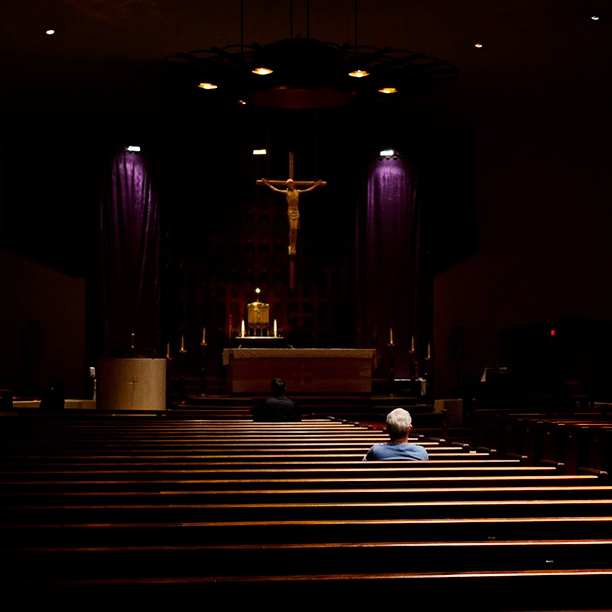 I have read many definitions of prayer, and I am especially fond of St Therese’s description.