Sometimes Original Sin gets simplified into the eating of an apple. But the core of the apple is not the “core” I speak of in the title. Actually an apple is not mentioned. It is fruit surely but what fruit we do not know. But what’s the big deal about eating an apple or piece of fruit? OK, maybe they shouldn’t have eaten it. But really, did an apple lead to all the pain and grief we experience today?
As you may have guessed, No, it was not an apple or fruit per se that led to all this. What was the Original Sin, what did it consist of? Consider that Original Sin was actually of cluster of sins: pride, disobedience, ingratitude, lack of trust, and a complete disregard for the wisdom and love of God. I am struck by how the Catechism describes Original Sin:
Man, tempted by the devil, let his trust in his Creator die in his heart and, abusing his freedom, disobeyed God’s command. This is what man’s first sin consisted of. All subsequent sin would be disobedience toward God and lack of trust in his goodness. In that sin man preferred himself to God and by that very act scorned him. He chose himself over and against God…Seduced by the devil, he wanted to “be like God”, but “without God, before God, and not in accordance with God” (CCC #s 397-398)
Notice the cascading effect that begins with a lack of trust. How did Adam and Eve (and all of us) fail to trust God? Simply in this, God had warned them of a certain tree, the tree of the Knowledge of Good and Evil. Pure and simple he warned they stay away from it for it would bring death to their souls. Now to “know” in the Bible always means more than intellectual knowing. To ”know” in the Bible means to have deep intimate and personal experience of the the thing or person known. Hence it is clear that God did not want Adam and Eve ever to have to experience the horrible reality of evil. He sought to protect them from its devastating effects. So God’s forbidding was made in protective love. We were called simply to trust God that evil is dreadful and we shouldn’t insist on knowing that for ourselves, just trust God.
But the Devil tempted us in this sort of way:
“You can’t trust God! He is hold something back from you. Sure he gave this nice garden and all but that is just to placate you. He knows that if you eat that fruit you will become like gods and begin to rival him. No! God is trying to keep you from your true destiny, to rule and even to tell him what to do! Do not trust Him or what he is telling you. it is only to keep you down, he isn’t really good at all. Listen to me. I promise you will not die, you will become like gods!
So there it is Adam and Eve. Who are you going to trust? God who gave you everything or the Devil who has given you nothing but promises something on the other side of the sin? Who will it be?
Sadly, you know the rest of the story. And Adam and Eve’s temptation is repeated in every sin we are tempted to commit.
”Come on” says the Devil, “God is trying to limit your freedom, keep you down and doesn’t want you to be happy! His demands are unreasonable, he is trying to take away your fun and fulfillment. Sin will make you happy. God’s way is restrictive. Do as you please. Don’t let anyone tell you what to do!”
And so often we buy into it. And are we happy? Maybe for a moment, but the misery of sin is too clear to be denied. The Devil is a liar. But what do we do when we sin? We trust him over God. In so doing the Catechism says we abuse our freedom. How? Because freedom for a Christian is “the capacity to obey God.” We are free when are able to carry out what God says. Now the world and the Devil say that freedom is about doing whatever you please. No, not if it is sin because sin never leads to freedom, it leads to bondage. Jesus says, “Whoever sins is a slave to sin.” (Jn 8:34) Look at the world today and try to tell me that sin leads to freedom. Look at the addiction to drugs, alcohol, sex, anger, revenge and greed and tell me that sin leads to freedom. No, sin is never freedom, it is bondage and many get so stuck in destructive behaviors that they don’t know how to stop. The video below powerfully illustrates the horror and bondage of sin, it shows its awful reality. It is not freedom at all, it is sorrow, bondage and humiliation.
In sin, we choose ourselves over God as the text from the Catechism says. We think we will become like gods, but in reality we sink lower than the animals and do things to each other and ourselves that even animals don’t do. God wants to raise us to share in his nature to be sure but we insist that we can do it ourselves. We cannot. Look at our grandiose attempts and tell me if you think we have been successful.
The following video does a pretty good job of depicting where Satan’s promises to Adam and Eve led. Watch it if you dare and remember that the Devil is a liar. And God is still calling you!
As a kind of follow-up to yesterday’s post on testing everything based on the truth of the Gospel, we might do well to consider that Jesus says, To what shall I compare the people of this generation? What are they like? They are like children who sit in the marketplace and call to one another, “We played the flute for you, but you did not dance. We sang a dirge, but you did not weep.” He goes on to observe that people said that John the Baptist was crazy because he did not eat or drink, yet when Jesus both ate and drank they called Him a glutton and a drunkard (see Matt 11:16-19).
Indeed, this world has many bewildering and often contradictory standards. This is another very good reason why we should test everything that this world says. The world is fickle in its judgments, but the Word of the Lord is tested and true.
And thus the world should not be used to judge the Word, but the Word to judge the world. In the passage above, Jesus reminds us not even to let the world judge us. God alone, with His standards, will be our final judge.
One of the great human struggles is to become free from allowing ourselves to be defined by others, from being so much under the world’s judgment that we lack personal conviction or a deep, stable, serene core.
An old African proverb says, “If I don’t know who I am, anyone can name me.”
Somewhere in the midst of the world’s demands for conformity to its fleeting and ever-changing standards, each of us must come to know the man or woman God created us to be.
Now this does not mean, particularly when we are young, that we should not seek guidance from people (especially our elders) whom we trust. But in the end, each of us must make that very private journey with God that every person must. It is the journey to discover one’s true self, as God gently reveals.
It is to this deep truth that Jesus refers in the passage referenced above. The world cannot be our measure. Too often its standards are passing, foolish, and highly inconsistent. To hearken to its cacophonous voice is a sure invitation to high anxiety and deep inner conflict.
There is a saying, “A man with one watch knows what time it is; a man with two watches is never quite sure.”
Jesus, too, warns, “No one can serve two masters.” But, sadly, most of us try. And, frankly, it is not merely two masters but two hundred!
Not so with Jesus.
Jesus resisted and even defied most of the ways in which people tried to define him. He was the Messiah, but He would not be the Messiah in any way that they understood. He would not ride in on a war horse and usher in a bloodbath. He would not follow a career of conquest. He would die as a suffering servant. Neither would He simply be reduced to being the “bread king” (Jn 6:15) or the “medical miracle worker” (Mk 1:38). Jesus was sure to move on to the next town before others could label Him as such. He came to bear witness to the truth and to save us, not so much from economic calamity, health problems, or political enemies, but rather from our very selves, from our own sinfulness.
No, Jesus would not be defined by this world. He was free from its grip; it had no power over Him. And to that same freedom the Lord ultimately summons us.
To be sure, this personal journey with the Lord, this journey to discover our true self, is not an invitation to hideous idiosyncrasies or sociopathic behavior. Holiness may, and often does, startle this world. But it is not unnecessarily disruptive; it is not simply “weird.” Discovering our true self leads to serenity, a peace that this world cannot give but that it also cannot deny.
So, a man with one watch knows what time it is, but a man with two watches is never quite sure.
Whom are you watching? What time is it in your life? Is it a time of teenage conformity and capitulation to peer pressure? Or is it a time of serene and mature self-understanding, rooted in the Father?
How do you and I regard this world? How do we perceive its offerings, philosophies, and standards? I pray that we soberly assess the things of this world. Sadly, many Christians pass through their days in this world in a very unreflective manner, accepting without critique many ungodly and harmful notions. Almost anything can be spewed forth from the television, the radio, or some celebrity’s mouth and many people will accept it uncritically, even with applause. Many will look at, read, and purchase material that is not only contrary to what our faith teaches, but even ridicules it or presents it in an unfair, unbalanced, or distorted way. Many parents pay far too little attention to what their children are being taught in school, what they are viewing, and to what they are listening.
St. Paul exhorted, Test everything; hold fast what is good (1 Thess 5:21). Do we?
Note that St. Paul does not say that everything is bad (in this instance he was referring more specifically to prophecy). Rather, he says that we should test everything. And how should that be done? For us who believe, everything should be tested by the revealed Word of God in Sacred Scripture and the Doctrine of the Church.
And yet not only do many Catholics fail to do this, they have things precisely backward. We should put the world and its ways on trial, judging it by the Word of God. But instead, many put the Word of God on trial, judging it by the world and its standards. Many will accept uncritically almost anything that is “popular,” but quickly cop an attitude when the priest in Church says something that does not conform to commonly prevailing opinion.
And it is not just in matters of sexuality, life, and marriage that this happens. Other biblical concepts such as forgiveness, love of one’s enemies, generosity, submission to authority, and obedience are too often dismissed as naïve and even foolish. And though we live in a world deeply wounded by greed, violence, the lack of forgiveness, promiscuity, rebellion, and hatred; though we are Christians and should know better; still many of us scoff at God’s wisdom and prefer the world’s folly.
In the Liturgy of the Hours, we recently read an excerpt from The Imitation of Christ addressing this unfortunate tendency among believers. In the following passage, the author takes up the voice of Jesus:
The Lord says, I have instructed my prophets from the beginning and even to the present time I have not stopped speaking to all men, but many are deaf and obstinate in response.
Many hear the world more easily than they hear God; they follow the desires of the flesh more readily than the pleasure of God…. [Yet] who serves and obeys me in all matters with as much care as the world and its princes are served?
Blush, then, you lazy, complaining servant, for men are better prepared for the works of death than you are for the works of life. They take more joy in vanity than you in truth ….
Write my words in your heart and study them diligently, for they will be absolutely necessary in the time of temptation. Whatever you fail to understand in reading my words will become clear to you on the day of your visitation.
He who possesses my words yet spurns them earns his own judgment on the last day (The Imitation of Christ, 3.3).
This is a pretty tough assessment to be sure. But, sadly, it is a common problem among believers living in a world that mesmerizes and can offer only fleeting pleasures.
The Lord Jesus once lamented, The sons of this world are more shrewd in dealing with their own generation than the sons of light (Lk 16:8).
The Greek word translated here as “shrewd” is phrónimos, an adjective referring to how we “size things up.” It is related to the word for wisdom, but refers here not to godly wisdom but rather to worldly wisdom and thinking. Hence modern translators rightly translate it as “shrewd” or “cunning.” And indeed so many, even among believers, are far more savvy in dealing with the world than with the faith. They can tell you all about the stock market, the local sports team, the current political situation, or the latest movie, but can’t say much about Scripture or the central truths of our faith. Many have PhDs in worldly matters, but barely a 3rd grade knowledge of the faith.
But, thanks be to God, many Catholics today, like a faithful remnant, are waking up and realizing that they cannot go on living with an undiscerning mind. Some fervent groups of Catholics are studying the faith in depth, attending Bible studies and lectures.
More and more, I meet large groups of people who are hungry for the faith and are willing to test everything by it. Catholic television, Catholic radio, and Catholic presence on the Internet are all growing. It is my privilege to encounter many of you through this blog and my columns at Our Sunday Visitor and The National Catholic Register. I have been honored to be able to do a lot of work with Catholic Answers Radio and with the Institute of Catholic Culture. I have also been privileged to travel around the country from time to time giving retreats for priests and leading parish missions. Yes, I can testify that many Catholics have become more earnest in knowing their faith and testing everything by it. And many of these are young adults.
So please help us, Lord! For too long, many of us (your flock) have been compromised by this world; we have become enamored of it even to the point of scorning your beautiful teachings. But many of us are finally waking up. Keep us sober and alert. Help us to test everything by your glorious truth. Increase the number of strong and dedicated believers. Equip us not only to test this world, but to transform others by touching them and drawing them more deeply to your truth. Help us. Save us. Have mercy on us and keep us by your grace!
As a priest I am called to preach and teach, and as such I must look to Jesus Christ as my model. In this I refer to the real Jesus of Scripture. Too many people today have refashioned Jesus into a sort of “harmless hippie,” an affable affirmer, a pleasant sort of fellow who healed the sick, blessed the poor, and talked about love but in a very fuzzy and “anything goes” manner. But absent from this image is the prophetic Jesus, who accepted no compromise and called out the hypocrisy in many of His day.
Thus I must look to the real Jesus of Scripture. The real Jesus clearly loved God’s people, but on account of that love could not suffer some limited notion of salvation and healing for them. Rather, He zealously insisted that they receive the whole counsel of God. He insisted that dignity for them that was nothing less than the perfection of God Himself (cf Mat 5:41).
As a teacher, Jesus often operated in the mode of the prophets. Prophets have a way of comforting the afflicted and afflicting the comfortable. Truth be told, we are all in both categories. We must be able to accept the Jesus who one moment says, “Blessed are you,” and the next adds, “Woe to you.” Jesus the teacher and prophet will affirm whatever truth there is in us, but, like any good teacher, He will put a large red “X” beside our wrongful answers and thoughts.
Yet despite Jesus’ often fiery and provocative stance, the scriptures speak of his renown as a preacher and the eagerness with which many heard Him.
And when Jesus finished these sayings, the crowds were astonished at his teaching, for he taught them as one who had authority, and not as their scribes (Mat 7:28).
Sent to arrest him the temple guard returned empty handed saying: No one ever spoke like that man (Jn 7:46).
And all spoke well of him, and wondered at the gracious words which proceeded out of his mouth (Luke 4:22).
And the common people heard him gladly (Mark 12:37).
But even Jesus could have a bad day in the pulpit. In Nazareth, they tried to throw him off a cliff for suggesting that Gentiles might have a place in the Kingdom (Lk 4:29). In Capernaum, many left him and would not follow him any longer because of His teaching on the Eucharist (Jn 6:66). In Jerusalem, the crowd said that He had a demon because He called Himself “I AM” (Jn 8:48). And thus Jesus warns all who would teach and preach: Woe to you when everyone speaks well of you, for that is how their ancestors treated the false prophets (Lk 6:26).
And thus Jesus was a complex preacher and teacher. He was no mere affirmer; He often unsettled and troubled people, even as He consoled and comforted at other times.
Let’s consider some of the qualities of Jesus as a teacher and ponder the sort of balance that He manifests. It is a balance between His love for us, His students, and His zeal to tolerate no lasting imperfection or error in the pupils whom He loves too much to deceive. These qualities of Jesus as a teacher are presented in no particular order. Some are “positive” in the sense of being aspects of His kindness and patience. Others are “negative” in the sense that they illustrate His refusal to accept anything less than final perfection in us.
I. His authority – The Scriptures often speak of the “authority” with which Jesus taught. For example, Scripture says of Jesus, he taught as one who had authority, and not as their teachers of the law (Mat 7:29). For indeed the teachers of Jesus’ time played it safe, quoting only reputable authorities in a wooden sort of way. But Jesus taught with authority.
The Greek word translated as “authority” is exousia, meaning to teach out of (one’s own) substance, to speak to the substance of what is taught. Jesus would often say, “You have heard that is was said … But I say to you” (cf Mat 5 inter al). And so Jesus spoke from His experience of knowing His Father and of knowing and cherishing the Law and its truth in His own life. He brought a personal weight to what He said. He “knew” of what He spoke; He did not merely know “about” it.
This personal authority was compelling and, even today, those with this gift stand apart from those who merely preach and teach the “safe” maxims of others but do not add their own experience to the truth that they proclaim. Jesus personally bore witness in His own life to the truth He proclaimed; and people noticed the difference.
How about you? You and I are called to speak out of the experience of the Lord in our own life and to be able to say with authority, “Everything that the Lord and His Body, the Church, have declared is true because, in the laboratory of my own life, I have tested it and come to experience it as true and transformative!”
II. His witness – A witness recounts what he has seen and heard with his own eyes and ears, what he himself knows and has experienced. Jesus could say to the Jews of his time, If I were to say that I do not know him, I would be a liar like you, but I do know him and I keep his word (Jn 8:55). He thus attests to what he personally knows. He is not just reciting facts that others have said.
In a courtroom, a witness must attest to what he has seen and heard for himself. If he merely recounts what others have said it is “hearsay.” A witness can raise his right hand and say, “It is true, and I will swear to it. I have seen it for myself.”
And thus Jesus could witness to what He had heard and seen, of His Father and of us.
It is true that we cannot witness immediately to all that Jesus could, for He had lived with the Father from all eternity. But, as we make our walk, we can speak to what the Lord has done in our life and how we have come to know Him in conformity with His revealed. Word.
III. His respect for others – The Latin root of the word “respect” gives it the meaning “look again” (re (again) + spectare (to look)). Frequently in Scripture, especially in Mark’s Gospel, there appears the phrase, “Jesus looked at them and said …”
In other words, Jesus was not merely issuing dictates to an unknown, faceless crowd. He looked at them; and He looks at you and me as well. It is a personal look, a look that seeks to engage you and me in a very personal way. He is speaking to you, to me. His teaching in not merely for an ancient crowd; it is for you and for me. He looks to you, and He looks again. Are you looking? Are you listening?
Do you look with respect to those whom you are called to teach, or to the children you are called to raise? Do you engage them by your look of respect and love?
IV. His love and patience for sinners – Jesus could be very tough, even exhibiting impatience. But in the end, He is willing to stay with us in a long conversation. One text says, When Jesus went ashore he saw a great crowd, and he had compassion on them, because they were like sheep without a shepherd. And he began to teach them at great length (Mk 6:34). Yes, He teaches us at great length; He stays in long conversations with us. He knows that we are dull of mind and hard of heart, so He persistently and consistently teaches.
Do we do that? Or do we quickly write people off? Jesus had a long conversation with a Samaritan woman who, frankly, was quite rude to Him at first (John 4). He had a long conversation with Nicodemus, who was also at times resistant and argumentative (Jn 3). He had a long conversation with His Apostles, who were slow and inept.
How about us? Are we willing to experience the opposition of sinners, the resistance of the fleshly and worldly? Do we have love and patience for those whom we teach? I have met some great Catholics who were once enemies of the Faith. Someone stayed in a conversation with them. What about us?
V. His capacity to afflict and console – Jesus said, “Blessed are you,” but just as often said “Woe to you.” Jesus comforted the afflicted and afflicted the comfortable. All of us fall into both categories. We need comfort but are often too comfortable in our sins. A true prophet fears no man and speaks to the truth of God.
Thus for a true prophet (as Jesus was) there are no permanent allies to please and no permanent enemies to oppose. The determination of every moment is based on conformity or lack of conformity to the truth of God. Jesus said to Peter, “Blessed are you, Simon bar Jonah” (Mat 16:17). And He gave him the keys to the Kingdom and the power to bind and loose. But in the very next passage, Jesus says to him, “Get behind me, Satan!” (Mat 16:23)
No true prophet or teacher can say, “Correct,” or “Blessed are you” every moment, because we all fall short of the glory of God! Jesus had absolute integrity when it came to assessing everything by the stand of God’s truth and Word. Do we?
VI. His parables – Stories are an important way to teach. A story that registers with us will rarely be forgotten. It is said that Jesus used more than 45 parables; some are full stories while others are just brief images. He used parables to link His sometimes complex teaching to everyday life and to plant a seed of truth for our further reflection.
What stories and examples do you use? Teachings that consistently fail to make use of these risk being seen as merely abstract and can easily be forgotten.
That said, parables are somewhat like “riddles.” They admit of various understandings and interpretations. A good parable leaves its listener wanting more, seeking a definitive interpretation.
For example, a movie will sometimes have an ambiguous ending, stirring hopes for a sequel that will provide more information. Some stories and parables are compact and definitive. Others are open-ended and ambiguous, craving for an ending.
Consider that the parable of the Prodigal Son is not really finished. It ends with the Father pleading for the second son to enter the feast. Does the son enter, or refuse to do so? This detail is not supplied. That’s because you are the son and you have to supply the answer. Will you enter? Or will you stay outside sulking that if the kingdom of Heaven includes people you don’t like you’d just as soon stay outside.
Parables are powerful, but for various reasons. Learn stories and learn to share them!
VII. His questions – Jesus asked well over a hundred questions in the gospel. Here are just a few: “What did you go out to the dessert to see? “Why do you trouble the woman?” “How many loaves do you have?” “Do you say this of me on your own, or have others told you of me?”
Good teachers ask questions and do not rush to answer every question. A question is pregnant with meaning; it invites a search. The “Socratic method” uses questions to get to the truth, especially on a personal level: “Why do you ask that? “What do you mean by this?” “Do you think there are any distinctions needed in your claim?”
This method makes a person look inward to his attitudes, prejudices, and presumptions. Good teachers ask their students a lot of questions; questions make us think.
Here is a list of one hundred Questions that Jesus asked: 100 Questions Jesus Asked. Read them; they will make you think—a lot!
VIII. His use of “focal instances” – Jesus does not propose to cover every moral situation a person might encounter or teach every doctrinal truth in an afternoon.
For example, many today say that Jesus never mentioned homosexual acts and concludefrom His silence that He must therefore approve of them. Really? He also never mentioned rape. Do you suppose that He approves of rape? Further, He did speak of homosexual acts, through His appointed spokesmen (the Apostles), and thereby condemned them.
But no teacher can cover every possibility, every sin, or every scenario. So Jesus uses “focal instances,” in which He illustrates a principle.
This is most commonly done in the Sermon on the Mount (Matthew 5-7) where, to illustrate the principle that we are to fulfill the law and not merely keep its minimal requirements, He uses six examples or “focal instances.” He speaks to anger, lust, divorce, oaths, retaliation, love of enemies, prayer, fasting, and almsgiving. And in Mathew 25:31ff, the Lord uses the corporal works of mercy to illustrate the whole of the Law.
These are not an exhaustive treatments. of the moral life. Rather, through the use of illustrations, the Lord asks us to learn the principle of fulfillment and then apply it to other instances.
Good teachers teach principles, since they cannot possibly envision every scenario or situation. Having instructed their students in first principles, they can trust that their students will make solid decisions in many diverse situations.
Good teachers teach students to think for themselves, not in isolation, but in ongoing communion with the principles learned, and through dialogue with authorities when necessary for assistance and accountability.
IX. His use of hyperbole – Jesus uses a lot of hyperbole. It is easier, He tells us, for a camel to go through the eye of a needle than for a rich person to enter heaven (Mk 10:25). If your eye scandalizes you, gouge it out (Mat 5:29). There was a man who owed ten thousand talents (a trillion dollars) (Mat 18:24). It would be better for you to be cast into the sea with a great millstone about your neck than to scandalize one of my little ones (Mat 18:6).
Hyperbole has memorable effect. It’s hard to forget effective hyperbole. Who of us can forget Jesus’ parable about a man with a 2×4 coming out of his eye who rebukes his neighbor for the splinter in his? I often tell my congregation, “Go to church or go to Hell,” which is my way of saying that missing Mass is a mortal sin.
One of my seminary professors once signaled me that I was giving an incorrect and heretical answer to a complex theological issue. He did this by saying, “Charles, you are on the edge of an abyss.” I stopped immediately and gave the correct and orthodox answer!
Good teachers use hyperbole at the right moments.
X. His use of servile fear – Jesus made frequent use of “fear-based arguments.” He warned of Hell, of unquenchable fire, and of the worm that does not die. His parables feature of a lot of summary judgements wherein people are found unprepared, are excluded from Heaven, or are cast into darkness. One parable ends with a king burning the town of those who failed to accept his invitation to his son’s wedding banquet (Mat 22:7). Another has a king summoning those who rejected him to be slain before his eyes (Lk 19:27). Jesus warns of the wailing and grinding of teeth. He also warns of a permanent abyss between Heaven and Hell that no one will be able to cross.
Many today are dismissive of fear-based arguments. But Jesus used them; He used them a lot. So Jesus never got the memo that this is a poor way to teach. It is true that, for the spiritually mature, love can and does replace the need for fear-based arguments. But, frankly, many are not that mature, and a healthy dose of fear and the threat of unending regret is often necessary.
We ought not to exclude, as many do, the voluminous verses in which Jesus warns in vivid language of the consequences of repeated, un-repented sin. He is not playing games; He is speaking the truth.
To teach as Jesus did is to include warning of judgment and of Hell.
XI. His anger and zeal – Jesus does not hesitate to express His anger and grief at the hardness and stubbornness of many. One day He said, You unbelieving and perverted generation, how long shall I be with you? How long shall I put up with you? (Matt 17:17) And in Mark’s Gospel we read, And they were bringing children to Him so that He might touch them; but the disciples rebuked them. But when Jesus saw this, He was furious and said to them, “Permit the children to come to Me; do not hinder them” (Mk 10: 13-14). Another day, in the synagogue, Jesus was angry at their unbelief: After looking around at them with anger, grieved at their hardness of heart, He said to the man, “Stretch out your hand.” And he stretched it out, and his hand was restored (Mk 3:5).
Yes, Jesus memorably cleansed the temple and drove out iniquity there. He engaged in heated debates with the Jewish leaders and with unbelievers. He did not hesitate to call them hypocrites, vipers, liars, and the sons of those who murdered the prophets.
Here, too, is a teaching moment that renders what is taught memorable and meaningful.A parent who never reacts with anger risks misleading his child into making light of or not being serious enough about wrongdoing, disrespect, or stubborn unrepentance.
We must be careful of our anger. We do not have the kind of sovereignty over it that Jesus did; neither are we as able to see into people’s hearts as He was.
But there is a place for anger, and Jesus uses it—a lot, actually. Anger signals an important teaching and rebukes a lighthearted response.
XII. His refusal to compromise – There was in Jesus very little compromise about the serious teachings of doctrine or those issues related to our salvation. He said that either we would believe in Him or we would die in our sins (Jn 8). Jesus also said that He was the only way to the Father and that no one would come to the Father except through Him. He declared that no one who set his hand to the plow and looked back was fit for the reign of God. Jesus said that no one who would not deny himself, take up his cross, and follow Him was worthy of Him. We are told to count the cost and decide now, and we are warned that delay may be a deadly thing.
Much of this is countercultural today, a time of uncertainty, in which there is an inappropriate sort of pluralism that thinks that there are many ways to God. Many insist on a softer Christianity, in which we can love the world and also love God. Sorry, no can do. A friend of the world is an enemy to God.
Jesus teaches His fundamental truths in an uncompromising way. This is because they are truths for our salvation. Following these truths vaguely or inconsistently will not win the day. Some disciplines need to be followed precisely.
To teach as Jesus did involves insisting that the fundamental doctrines of our faith be accepted fully and wholeheartedly.
XIII. His forgiveness – Forgiveness may not at first seem to be an obvious way of teaching. But consider that teachers often have to accept that students don’t get everything right the first time. Teaching requires a patient persistence as students first acquire skills and then master them.
A good teacher does not compromise the right method or the correct answer; He assists students who fall short rather than immediately excluding them. In an atmosphere where there is no room for error, very little learning can take place due to fear.
Again, forgiveness does not deny that which is correct; it continues to teach what is correct. Forgiveness facilitates an environment in which learning can thrive and perfection can at last be attained.
Jesus, while setting high standards, offers forgiveness, not as a way of denying perfection but as a way to facilitate our advancement by grace and trust.
XIV. His equipping and authorizing of others – Good teachers train new teachers. Jesus trained the Twelve and, by extension, other disciples as well. He led and inspired them. And He also prepared them for a day when He would hand on the role of teacher to them. We who would teach need to train our successors and inspire new and greater insights.
Teach me, Lord, by your example, to teach as you taught and to preach as you would have me preach.
One of the most concise and cogent descriptions of these often strident times came from Joseph Cardinal Ratzinger in 1986. It is contained in, of all places, his treatise on the theology of sacred music in a book called The Feast of Faith (Ignatius Press, 1986). His comments have recently been republished in a larger compendium of his works: Collected Works: Theology of the Liturgy (Ignatius Press, 2014, Vol 11).
It hard to describe our times as anything but contentious. Loud, strident protests often predominate over reasoned discourse and thoughtful argumentation.
To be sure, every era has had, and needed, protest and public opposition to injustices that are too often hidden. There is a time and place for loud protest and the use of memorable sound bites.
But it is the predominance of loud protest and civil disobedience that stands out. Sound bites, slogans, and simplistic “war cries” have to a large extent replaced thoughtful, reasoned discourse. Volume, power, and visually flashy techniques are prized and used more and more. Such approaches too frequently produce more heat than light.
Consider, then, this remarkable analysis by Joseph Cardinal Ratzinger, written back before the Internet and social media had turned up the volume even more. He paraphrases an insight by Gandhi, applies it to his analysis of our times, and then proposes a healing remedy to restore balance:
I would like to note a beautiful saying of Mahatma Gandhi … Gandhi refers to the three habitats of the cosmos and how each of these provides its own mode of being. The fish live in the sea, and they are silent. The animals of the earth scream and shout; but the birds, whose habitat is the heavens, sing. Silence is proper to the sea, shouting to the earth and singing to the heavens. Man has a share in all three of them. He carries the depths of the sea, the burden of the earth, and the heights of the heavens in himself. And for this reason, all three properties also belong to him: silence, shouting, and singing.
Today—I would like to add—we see only the shouting is left for the man without transcendence, since he only wants to be of the earth. …
The right liturgy, the liturgy of the Communion of the Saints, restores totality to him. It teaches him silence and singing again by opening him to the depths of the sea and teaching him to fly, the angels’ mode of being. It brings the song buried in him to sound once more by lifting up his heart. …
Right liturgy … liberates us from ordinary, everyday activity and returns to us once more the depths and the heights, silence and song … Right liturgy … sings with the angels … is silent with the expectant depths of the universe, and that is how it redeems the earth (Joseph Cardinal Ratzinger Collected Works, Vol 11, Theology of the Liturgy, Ignatius Press, p. 460).
This is a remarkable analysis and application of liturgy and cosmology to the issues and imbalances of our day! It is in the vein of “Save the Liturgy, save the world.” For indeed, only in the worship of God do we find our true selves. Only in the liturgy is our true personality formed. The human person in his glory unites the material and spiritual orders. We are capable of pregnant, expectant silence; of the joyful shout of praise and the Gospel going forth; and of the song of Heaven.
But as Ratzinger points out, we are too often reduced to a preoccupation with and a valuing of only one aspect: the shouting of the earthbound creatures of this world.
But the liturgy—good and proper liturgy—trains us in all three and accomplishes the balance that is often lost today. The liturgy is a training ground, not only for our heavenly destination, but also in what it means to be truly human.
Read the good Cardinal’s reflection; consider carefully what the Pope Emeritus teaches. It will bless your soul. I know it has blessed mine.
Here is a song of the heavens:
Today’s readings teach a proper understanding of the Law and its relationship to our hearts. The readings go a long way toward addressing the false dichotomy that many set up between love and law, as though the two were opposed; they are not. For if we love God, we want what He wants and love what He loves. And the Law goes a long way toward describing what God wants and loves. Indeed, the Law is letting love have its way.
God is Love and His Law (no matter how averse we are to “rules”) is ultimately an expression of His love. In all of the readings today God asks (even as He commands it) that we let love have its way. Let’s look at four teachings on the relationship of Law to God, who is Love.
I. The PROTECTION of the Law – Note that the text from today’s first reading frames the Law, and the obedient hearing of it, in terms of a promise of God, seeing the Law as a doorway to the loving blessings and promises of God. The text says, Moses said to the people: “Now, Israel, hear the statutes and decrees which I am teaching you to observe, that you may live, and may enter in and take possession of the land which the LORD, the God of your fathers, is giving you.”
So the Law comes with a promise. It is the basis of life and the doorway to the further blessings of the land. Many today see God’s Law as prison walls, as a limitation on our freedom to “do as we please.” But the walls are not prison walls; they are defending walls.
Every ancient city had walls, not to imprison its citizens, but to protect them from the enemy. Within the walls there was security and the promise of protection. Outside the walls lurked danger; there were no promises of safety.
It is like this with God’s Laws. For those who keep them, they are a great source of protection and also contain the promise of ultimate victory. But outside this protective wall there is every danger and no promise of victory.
In his famous book Orthodoxy, G.K. Chesterton wrote,
Catholic doctrine and discipline may be walls; but they are the walls of a playground … We might fancy some children playing on the flat grassy top of some tall island in the sea. So long as there was a wall round the cliff’s edge they could fling themselves into every frantic game and make the place the noisiest of nurseries. But the walls were knocked down, leaving the naked peril of the precipice. They did not fall over; but when their friends returned to them they were all huddled in terror in the center of the island; and their song had ceased. [1]
God didn’t give the Law to take away our fun, but that we might find life and happiness. The devil, of course, is a liar; he tells us that we’ll be happier if we sin, that God is limiting our freedom by hemming us in with His Law. But sin does not make us free. Jesus says, Truly, truly, I say to you, every one who commits sin is a slave to sin (John 8:34). Indeed, how much suffering and pain would vanish if we all just kept the commandments? Most of our wounds are self-inflicted, by insisting on journeying outside the walls of God’s loving and protecting commandments.
Moses reminds us that our decision for or against the Law brings either blessing or curse:
See, I set before you today life and prosperity, death and destruction. For I command you today to love the LORD your God, to walk in his ways, and to keep his commands, decrees and laws; then you will live and increase, and the LORD your God will bless you in the land you are entering to possess. But if your heart turns away and you are not obedient, and if you are drawn away to bow down to other gods and worship them, I declare to you this day that you will certainly be destroyed. You will not live long in the land you are crossing the Jordan to enter and possess. This day I call heaven and earth as witnesses against you that I have set before you life and death, blessings and curses. Now choose life, so that you and your children may live and that you may love the LORD your God, listen to his voice, and hold fast to him. For the LORD is your life, and he will give you many years in the land he swore to give to your fathers, Abraham, Isaac and Jacob (Deut 30:15-20).
II. The PRECISION of the Law – Regarding the Law of God, Moses says, In your observance of the commandments of the LORD, your God, which I enjoin upon you, you shall not add to what I command you nor subtract from it.
Here we mightthe Law to be like a set of directions to a destination. If you give me directions to get to your house, I am probably not going to get there if I only follow half of the directions. The compliance must be complete to bring me to the right place. And so we are directed the follow the Law of God wholly. Scripture says elsewhere,
Instruct me O Lord, in the way of your statutes, that I may exactly observe them (Ps 119:33).
I intend in my heart to fulfill your statutes always to the letter. I have no love for half-hearted men, my love is for your law (Ps 119:112-113).
For whoever keeps the whole law and yet stumbles at just one point is guilty of breaking all of it (James 2:10).
Here we must see God as a healer who is not exacting and precise for His sake, but for ours. Imagine a man who goes to a doctor with two broken legs and the doctor says, “We’re gonna aim for 50% here. I’ll set one leg but leave the other one broken. But don’t worry about the broken leg; that’s why God gave you two!” We would surely hold such a doctor in contempt. God, who is our healer, points to full health, not crippled or partial health.
When Jesus says, You, therefore, must be perfect, as your heavenly Father is perfect (Matt 5:48), He is indicating the kind of healing He offers. And St. Paul adds, [God who] began a good work in you will carry it on to completion until the day of Christ Jesus (Phil 1:6).
Thus the precision of the Law is taught to indicate the healing power of God’s law with grace.
III. The PRIORITY of the Law – In today’s gospel, Jesus rebukes the Scribes and Pharisees saying, “[You] teach as doctrines human precepts. You disregard God’s commandment but cling to human tradition.”
Now, as then, many set aside the priority of God’s Law in favor of human thinking. Politics has become a pernicious influence in this regard. Many Catholics of both parties are more passionate about their political views than about God’s teachings as revealed through Scripture and Church teaching. And if there is a conflict between what God teaches and the political party view, guess which gives way and which gets unexamined allegiance?
Be it questions of abortion, immigration, or same-sex “marriage,” all too easily Catholics will turn a deaf ear to what God teaches, never rebuking their own party when correction is needed, and even cheering as their political leaders champion positions contrary to God’s Law. Too many Catholics place political priorities and popularity, human traditions and agenda, over God’s Law.
The Lord Jesus goes on to say, Well did Isaiah prophesy about you hypocrites, as it is written: This people honors me with their lips, but their hearts are far from me; in vain do they worship me. He says elsewhere, [you] make void the word of God through your tradition which you hand on. And many such things you do (Mk 7:13).
Be very careful; the pernicious effects of partisan political thinking, worldviews, and mere cultural preferences have caused too many Catholics to cease to be the leaven, the prophetic voice they are supposed to be in this world. All of the political parties, most worldviews, and many cultural trends need purification. A Catholic must be a Catholic before he is a Democrat, a Republican, or a Libertarian; before he is a fan of a Hollywood star or musician; before he touts the latest trend or raves about the most recent bestselling book. None of these things usually stand blameless before God, and the unquestioning, unqualified, and silent allegiance from Catholics and other Christians toward such worldly things is a huge problem today. We are too easily compromised and have often elevated human teachings and movements above God’s Law.
To all of this, the Lord gives rebuke and reminds us that His Law must the standard by which every other thing is judged. A Christian should see everything by the Light of God’s Law, exposing error and evil, approving goodness and truth wherever they are found. Nothing has priority over what God teaches.
In the end it is a question of what and whom we love more: God and His Law, or this world and its ways of sin and compromise.
IV. The PLACE of the Law – The Lord goes on to indicate that our fundamental problem can be that the Law of God is not in our heart. He warns that the heart, since it is the locus of human decision and action, must be the place of His Law for us. The Lord says, Hear me, all of you, and understand. Nothing that enters one from outside can defile that person; but the things that come out from within are what defile. From within people, from their hearts, come evil thoughts, unchastity, theft, murder, adultery, greed, malice, deceit, licentiousness, envy, blasphemy, arrogance, folly. All these evils come from within and they defile.
Hence there is the need to have God’s law in our heart. It is not enough to have a cursory and intellectual awareness of God’s Law. The Law must drop the 15 inches from the intellect to the heart.
And what is the human heart? While there ambiguities in the biblical text distinguishing mind and heart, this much is clear: the heart is the deepest part of the human person, the place where we are alone with our thoughts and deliberations. The heart is the place where we discern, ponder, and ultimately decide. The heart is “where we live.” It is in this deepest part of ourselves that the Law of God must find a home.
Jesus makes it clear that it is from the deep heart of the individual that come forth the behaviors that determine our character and our destiny. It is here that the Law of God must find a home. And it will only find a deep home here through prayer and meditation; through the careful, persistent, and thoughtful reading of God’s revealed truth, coupled with gratitude and love of God.
It is no mistake that the summary of God’s Law is simply, “Love the Lord the your God with all your heart and your neighbor as your very self.” For it is only love that unlocks the door of our heart. And in loving God we begin to love what and whom He loves. To love God is to love His Law. Scripture says,
My soul is consumed with longing for your laws at all times (Ps 119:20).
Your statutes are my delight; they are my counselors (Ps 119:24 24).
The law from your mouth is more precious to me than thousands of pieces of silver and gold (Ps 119:72).
For I love your commands more than gold, however fine (Ps 119:127).
I open my mouth and sigh, longing for your commands (Ps 119:131).
Yes, in the end, the Law comes from Love, the God of Love, who is Love. And thus it is love that unlocks the Law, love that makes us realize that the Law is a gift of God’s love. He gives us His law in order to protect us, precisely guide us, and heal us. Thus He asks us to make His Law a wholehearted priority.
Love the Law and come to experience the Love that the Law is.
This song says,
We need to hear from you We need a word from you If we don’t hear from you What will we do? Wanting you more each day Show us your perfect way There is no other way That we can live
Destruction is now is now in view Seems the world has forgotten all about you Children are crying and people are dying They’re lost without you, so lost without you But you said if we seek Lord if we seek your face And turn from our wicked, our wicked ways You promised to heal our land Father you can!
When my father lay dying, I remember that one of the losses I began to grieve was that he was the keeper of so many family stories. He was the one who could look at an old family photograph, identify all the people, and tell you something about each one. As I saw him lying there, no longer able to talk much, I thought of all the memories stored up in his mind, all the stories, all the people he once knew and had spoken of so vividly.
And it was not just the family stories he held; he was also a great historian and a great wellspring of the classics. He had read all of the “Great Books,” all of Shakespeare, all of Sacred Scripture, and so many other worthy writings. And he had memorized many lengthy quotes from each.
Such an encyclopedic mind! He was full of vivid thoughts and vivid memories. He was the keeper of our family story. And though I knew he would take it with him in his soul, I grieved that his magnificent mind was now closing to me. I regret that I did not more carefully retain all he told me over the years.
Thankfully, he wrote a family history that stays with us. All his many photos and family films, that we worked to preserve, stay with us. We, his sons, are moving much of this to the digital realm, but it took Dad’s living presence to really bring these things home.
The video below put me in this reflective mood. It depicts an old man who lies dying in a hospital bed. In various flashbacks we see his life, told almost as if from God’s perspective. We see his story, his good moments and his tragedies—and then he passes.
I remember a Bible verse my father jotted down on the frontispiece of a book he was reading at the time of his own father’s death:
But as for man, his days are like the grass, or as the flower that flourishes in the field. The wind blows, and he is gone, and his place never sees him again (Psalm 103:16).
Reading that as a young teenager, I realized for the first time that the Bible was very beautiful. And I was startled to think that the house in which I was sitting would one day “never see me again.” All the stories, all the memories would be gone with the proverbial winds.
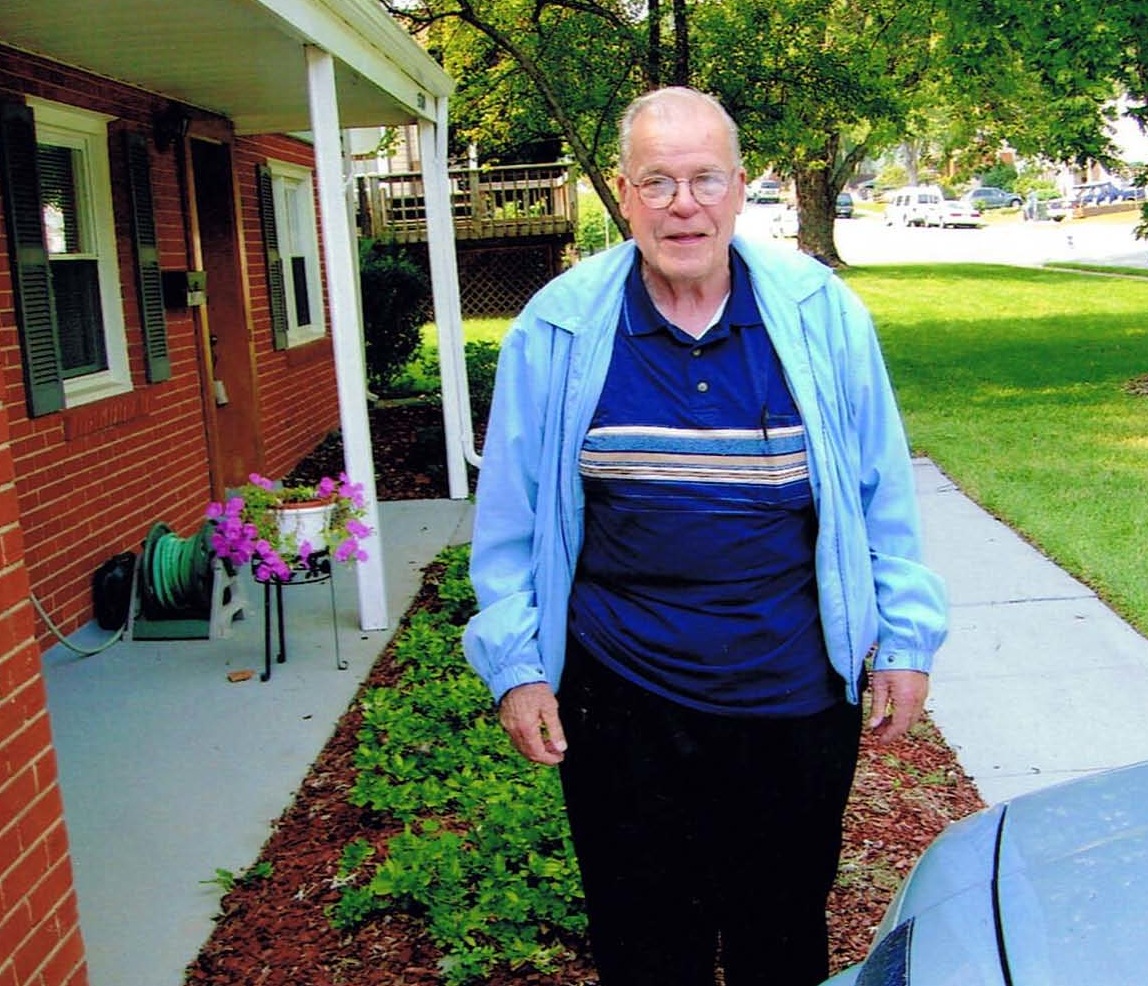
The photo at the upper right is the last one I ever took of my father. He standing in front of our family home. I took the picture as he was leaving it for the last time. He moved into a retirement community for a brief time, but was not much longer for this world. There he is, standing in front of the place that would “never see him again.”
Yes, there is something very precious about our memories, our stories. They are meant to be shared, handed down. But there is something irreplaceable, something that dies with each person: a personal glimpse of history, a personal story, something that can never be fully shared with anyone but the Lord.
Only the Lord really knows our story, and he knows it better than we ourselves do:
O LORD, you search me and you know me.
You yourself know my resting and my rising;
you discern my thoughts from afar.
You mark when I walk or lie down;
you know all my ways through and through.
Before ever a word is on my tongue,
you know it, O LORD, through and through …
For it was you who formed my inmost being,
knit me together in my mother’s womb.
I thank you who wonderfully made me;
My frame was not hidden from you,
when I was being fashioned in secret
and molded in the depths of the earth.
Your eyes saw me yet unformed;
and all my days were recorded in your book,
before one of them came into being …
at the end I am still at your side … (Ps 139:varia)
Yes, the Lord knows. He knows all about us.
An old spiritual says, “Nobody knows the trouble I seen, nobody but Jesus.” For in the end, He is the keeper of every story: my father’s, mine, and yours. And whatever is lost in death will be restored a hundredfold, with understanding besides, in the great parousia. Not a story, not a word will be lost. We shall recover it all and tell the old, old stories once again.
Enjoy this poignant and moving video of a man’s life, told almost as if from the standpoint of God, the God who knows. Though the man seems to die alone, someone is remembering his story. Maybe it’s God who is doing the remembering.
On this Feast of St. Monica, who prayed at length for her son, I’d like to say that my mother prayed for me, too! And I really needed (and still need) her prayers.
Satan hates priests and seeks above all to get to us. Jesus remarked laconically and pointedly, quoting from Zechariah (13:7), Strike the shepherd, and the sheep of the flock will be scattered. This is why Satan hates priests and seeks to topple them. Corruptio optime pessima (The corruption of the best is the worst.)
I have always felt my mother’s prayers very powerfully. I pray that my mother, Nancy Geiman Pope, who died in 2005, and is now at home with the Lord. She always told me that she was praying for me! I often attributed her prayers to her tendency to worry. But I have learned of the power of her prayers and of their necessity. She told me that the Lord had told her that Satan wanted me and all priests and that she had better pray for me. I never doubted that she did and I’m sure she still does.
I remember once, a week before my ordination in 1989, I was up on the roof of our family house cleaning out the gutters. My mother came out and told me to “Come down from the roof at once!” and that she would hire someone to clean them. She later explained that her concern was that I, so near to my ordination, was now a special target of the Evil One and that I might have fallen from that roof by his evil machinations.
Yes, she always told me she was praying for me. I have come to see both her wisdom and my need for her prayers. I have also come to value the prayers of so many of my parishioners, who have told me that they were praying for me. Yes, I need a hedge of protection—and so do all other priests. Pray for priests! Pray, pray, pray!
And though my mother has long since gone home to the Lord, I still feel her prayers.Somehow she knew that I needed them in a way that I, in my pride, did not. But I have come to know.
Thanks be to God; I have been a faithful and fruitful priest for 26 years. But I know that it was not I who accomplished this. It was the Lord and so many people, like my mother, who have prayed for me.
Back in my 33rd year of life and my 5th year of priesthood, I was severely attacked by the Evil One. He made his move and sought to discourage and destroy me; he did not succeed. My mother and others were praying for me. My parishioners, too, saw my distress and rallied to pray for me and hold me up. And now, almost 20 years later, I feel strong, alive, joyful, and grateful. Sometimes I’m weary in the work, but never weary of the work.
But I am no fool; I know that Satan will try again. I pray only for the prayers of God’s holy people and for my own sober awareness of the need to pray and to fulfill the mandate of the Lord who said, Watch and pray so that you will not fall into temptation. The spirit is willing, but the flesh is weak (Matt 26:41).
So today on this Feast of Monica, my thoughts stretch to my mother. Thanks, Mom, for your prayers and for your wisdom. You knew that precious gifts, like the priesthood, also come with crushing burdens and temptations that require sober and vigilant prayer. One day you called me down from the “roof” of my pride and told me to keep my feet on solid ground. Yes, you knew and you prayed. You warned me and then prayed some more.
And thank you, dear readers and beloved parishioners, for your prayers. They have sustained me. Better men than I are suffering and better men than I have fallen under the burden of office. It is only your prayers that have kept me. Yes, pray, pray, pray for priests! Join your prayers to those of my mother, Nancy Geiman Pope, others in the great beyond, and many others still here on this earth. Pray for priests! Pray, pray, pray!
The photo at the top? Yeah, that’s yours truly, in a needy moment; my mom is holding me up in prayer and care. She still does this from her current location, closer to the Lord. Her prayers still hold me, as mine hold her. Requiescat in Pace.

 Sometimes Original Sin gets simplified into the eating of an apple. But the core of the apple is not the “core” I speak of in the title. Actually an apple is not mentioned. It is fruit surely but what fruit we do not know. But what’s the big deal about eating an apple or piece of fruit? OK, maybe they shouldn’t have eaten it. But really, did an apple lead to all the pain and grief we experience today?