The Bible has within its pages many literary forms: history, poetry, prayer, prose, theology, liturgical instruction, cosmology, genealogy, philosophy, parable, moral tale, and so forth. How exactly to read its pages and understand them is often a matter of understanding the genre.
The word genre comes directly from the French word meaning “kind” or “sort.” Further back, it stems from the Latin word genus and the Greek word genos (γένος). Genre is the term for a category of literature, art, or culture (e.g., music) based on a set of stylistic criteria.
Now someone might ask me, “Do you read the Bible literally?” That’s like someone asking, “Do you interpret the library literally?” I would respond by saying that it depends on what section I’m in. If I’m in the science or history section, I might well read a book there literally. But if I’m in the poetry, fiction, or children’s storybook section, I would not likely read a book there literally. In those sections I would understand that stories and images are being used to make a point rather than merely to present facts.
We know how to exercise some sophistication when it comes to the library, but many seem to lose this perspective when it comes to the Bible. Often we can fail to distinguish literary forms and thus try to force a book or passage to be what it is not.
In reading the Book of Genesis, especially the early chapters, many fail to appreciate the different literary forms. They want the creation stories to be science or exact history when in fact they are more poetic and theological than scientific. The stories advance the real and true point that God alone created everything there is out of nothing, and did so in an intentional and systematic way in which He was involved at every stage. This is the sacred and theological truth set forth by the Genesis accounts.
The text does not propose to be in the form of a science textbook. Consider, for example, the accounting of the “days” of creation. Although light is created on the first day, the Sun and Moon are not created until the fourth day. So what does it mean to speak of a “day” when the very sun by which we define the length of the day does not even exist yet? Further, the notion of light apart from the Sun, is a somewhat abstract concept.
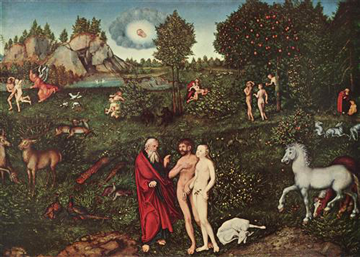
If someone asks me if I read the account of creation literally I ask them, “Which one?” This usually leads to a puzzled look. But the fact is, Genesis sets forth two accounts of creation that are very different.
In the first account (Gen 1:1-2:4) we see a period of seven days. First there is the creation of light, then the sky and the ocean, then vegetation, then the Sun and the Moon, then fishes and birds, then the animals, and finally Adam and Eve.
The second account of creation (Gen 2:4-25) does not mention a time frame. It begins with the creation of Adam, then the planting of a garden, then the creation of animals, and then the creation of Eve.
Hence, we have two very distinct versions of creation. In no way can they be harmonized, yet neither are they in absolute conflict. Each describes the same event, but from a different angle and with a different level of focus on detail. Neither account alone contains all the details. But together, they contain all God wants us to know about the creation of the cosmos.
If asked to describe the visit I made to the Holy Land I could start at the beginning and give a day-by-day account, or I could choose to start at the end and work backward. Or instead of responding chronologically, I could just present some highlights. I could also describe the trip according to themes (e.g., Old Testament sites and New Testament sites). I might select the method of presentation depending on the particular audience. Each of my responses would be true and yet they are all different. My response would depend on my purpose and the audience to whom I am presenting.
So then a little sophistication is required in dealing with the accounts of creation. If we take a literal and rigid notion of history, we can err by trying to make Genesis what it is not. It does not conform to the modern genre of historical writing, which tends to be comprehensive and strictly chronological. These Genesis accounts are quite willing to speak to us of creation poetically and selectively, even reversing the timeline. This is because their purpose is not to give us a blow-by-blow account of precisely how God created everything. Exact times and dates are not the point. The point is that God is the purposeful, sole, and sovereign Creator. God, who is present and active at every stage, is the point. Another important point is the dignity of the human person. The first account accomplishes this by making man the culmination of the creation story; he is created on the seventh day. The second account makes this point, but by beginning with man and having everything formed around him and for him.
The Catechism of the Catholic Church says of these accounts,
Among all the Scriptural texts about creation, the first three chapters of Genesis occupy a unique place. From a literary standpoint these texts may have had diverse sources. The inspired authors have placed them at the beginning of Scripture to express in their solemn language the truths of creation—its origin and its end in God, its order and goodness, the vocation of man, and finally the drama of sin and the hope of salvation. Read in the light of Christ, within the unity of Sacred Scripture and in the living Tradition of the Church, these texts remain the principal source for catechesis on the mysteries of the “beginning”: creation, fall, and promise of salvation (CCC # 289).
This all leads to an interesting question that I was asked recently by a parishioner: “How did Adam and Eve’s kids have kids?” The questioner seemed to imply that since only Cain and Abel were mentioned (no females) there couldn’t have been other kids. In other words, the premise seemed to be that Genesis represents an exact and fully inclusive history, like modern history texts. Since only Cain and Abel were mentioned, then only Cain and Abel existed. But this premise is flawed; Genesis is not meant to be a complete, seamless, chronological account. Just because daughters were not mentioned does not mean that they did not exist. Genesis 4:17 does mention the wife of Cain. Other women are mentioned in the genealogy that is in Genesis 4. (Note the problem of incest is too long to be addressed here and will be the subject of another post. It is wrapped up in the question of monogenism/polygenism.)
The fact is, Genesis does not propose to give us all the details or to answer all of our questions. Something is left to the reader: a sophistication that recognizes that Genesis is historical yet not written in the form of modern history texts. We cannot expect all the details and must presume the presence of other children (especially daughters born to Adam and Eve).
So, in the end, there must be some sophistication used in understanding of Scripture. Genesis is neither a scientific account nor was it written in the way of a modern history text. It does speak of historical facts, but in a selective and poetic manner. Accepting this distinction is critical, lest we go down all sorts of rabbit holes, expecting Genesis to provide a complete and seamless account that it does not propose to give in the first place.
As a young child I was very close to God. I spoke to Him in a very natural way and He spoke plainly to me. Although I have very few memories of my early childhood, I vividly remember how close I was to God. When early puberty approached, though, I began to slip away, drifting into the rebellious and angry years of my teens. As the flesh came more alive, my spirit submerged.
The culture of the time didn’t help, either. It was the late 1960s and early 1970s and rebelliousness and the flesh were celebrated as “virtues.” Somehow we thought ourselves more mature than our pathetic forebears, who were hopelessly “repressed.” There was the attitude among the young that we had come of age somehow. We collectively deluded ourselves, aided by the messages of rock music and the haze of drug use, that we were somehow “better.”
So it was the winter of my soul. The vivid faith of my childhood gave way to a kind of indifferent agnosticism. Though I never formally left Church (my mother would never had permitted that as long as I lived in under my parents’ roof), I no longer heard God or spoke to Him. I’ve mentioned in previous posts that when I was in high school I joined the youth choir of my parish church. This was not precipitated by a religious passion, but rather by a passion of another kind: there were pretty girls in the choir and I “sought their company,” shall we say. But God has a way of using beauty to draw us to the truth. Week after week, year after year, as we sang those old religious classics a buried faith began to awaken within me.
But what to do? How to pray? I heard that I was supposed to pray. But how? As a child it had been natural to talk with God. But now He seemed distant, aloof, and likely angry with me. And I’ll admit it, prayer seemed a little “goofy” to me, a high school senior still struggling to be “cool” in his own eyes and in the eyes of his friends. Not only that, but prayer was “boring.” It seemed an unfocused, unstructured, and “goofy” thing.
But I knew someone who did pray. My paternal grandmother, “Nana,” was a real prayer warrior. Every day she took out her beads and sat by the window to pray. I had seen my mother pray now and again, but she was more private about it. But Nana, who lived with us off and on in her last years, knew how to pray and you could see it every day.
Rosary Redivivus – In my parish church of the 1970s, the rosary was non-existent. Devotions and adoration were on the outs during that sterile time. Even the Crucifix was gone. But Nana had that “old-time religion” and I learned to appreciate it through her.
Ad Jesum per Mariam – There are some, non-Catholics especially, who think that talking of Mary or focusing on her in any way takes away from Christ. It is as though they consider it a zero-sum game, in which our hearts cannot love both Mary and Jesus. But my own experience was that Mary led me to Christ. I had struggled to know and worship Christ, but somehow a mother’s love felt more natural, safer, and more accessible to me. So I began there, where I could. Simply pole-vaulting right into a mature faith from where I was did not seem possible. So I began, as a little child again, holding my Mother’s hand. And gently, Mother Mary led me to Christ, her son. Through the rosary, that “Gospel on a string,” I became reacquainted with the basic gospel story.
The thing about Marian devotion is that it opens up a whole world. For with this devotion comes an open door into so many of the other traditions and devotions of the Church: Eucharistic adoration, litanies, traditional Marian hymns, lighting candles, modesty, pious demeanor, and so forth. So as Mary led me, she also reconnected me to many things that I only vaguely remembered. The suburban Catholicism of the 1970s had all but cast these things aside, and I had lost them as well. Now in my late teens, I was going up into the Church “attic” and bringing things down. Thus, little by little, Mother Mary was helping me to put things back in place. I remember my own mother being pleased to discover that I had taken some old religious statues, stashed away in a drawer in my room, and placed them out on my dresser once again. I also took down the crazy rock-and-roll posters, one by one, and replaced them with traditional art, including a picture of Mary.
Over time, praying the Rosary and talking to Mary began to feel natural. And, sure enough, little by little, I began to speak with God. It was when I was in the middle of college that I began to sense the call to the priesthood. I had become the choir director by that time and took a new job in a city parish: you guessed it, “St. Mary’s.” There, the sterility of suburban Catholicism had never taken hold. The candles burned brightly at the side altars. The beautiful windows, marble altars, statues, and traditional novenas were all on display in Mother Mary’s parish. The rest is history. Mary cemented the deal between me and her Son, Jesus. I became His priest and now I can’t stop talking about Him! He is my hero, my savior and Lord. And praying again to God has become more natural and more deeply spiritual for me.
It all began one day when I took Mary’s hand and let her lead me to Christ. And hasn’t that always been her role? She, by God’s grace, brought Christ to us, showed Him to us at Bethlehem, presented Him in the Temple, and ushered in His first miracle (even despite His reluctance). She said to the stewards that day at Cana, and to us now, “Do whatever he tells you.” The Gospel of John says, Jesus did this as the beginning of his signs in Cana in Galilee and so revealed his glory, and his disciples began to believe in him (John 2:11). And so Mary’s intercession strengthened the faith of others in her Son. That has always been her role: to take us by the hand and lead us to Christ. Her rosary has been called the “Gospel on a string” because she bids us to reflect on the central mysteries of the Scripture as we pray.
One of the questionable, and unfortunately common, forms of moral reasoning today is the rather narcissistic notion that God wants each of us to be happy. Sometimes it is put in the form of a rhetorical question: God wants me to be happy, doesn’t He?
And this sort of reasoning (if you want to call it that) is used to justify just about anything. Thus, in pondering divorce, a spouse might point to his or her misery and conclude that God would approve of the split because God wants me to be happy, doesn’t He? Many seek to justify so-called same-sex marriage, and other illicit sexual notions in the same way.
Further, other responsibilities are often blithely set aside as too demanding, under the pretext that God would not make difficult demands because, after all, He wants me to be happy. Since getting to Mass is difficult for me, God will understand if I don’t go; He wants me to be happy, not burdened. Forgiving someone is hard and God does not ask hard things of us; He wants me to be happy. Refusing to cooperate with some evil at work would risk my income; surely God would not demand that I withstand it since He wants me to be happy, content, and financially secure.
The notion that God wants me to be happy thus becomes a kind of trump card, some sort of definitive declaration that obviates the need for any further moral reflection. Practically speaking, this means that I am now free to do as I please. Since I am happy, God is happy, and this is His will … or so the thinking goes.
There are, of course, multiple problems with the “God wants me to be happy” moral stance. In the first place, happiness is a complex matter that admits of many subjective criteria including personal development, temporal dimensions, and worldview. For example, a spiritually mature person can find happiness simply in knowing that he is pleasing God by follow His Commandments. On an interpersonal level, many are happy to make sacrifices for the people they love. To others who are less mature, even the smallest sacrifice can seem obnoxious and bring on unhappiness; pleasing God is not even on their radar, let alone something that would make them happy.
Happiness is also temporally variable. Most of us are well aware that happiness tomorrow is often contingent upon making certain sacrifices today. For example, the happiness one gets in taking a vacation is usually dependent upon having saved up some money beforehand. Making sacrifices today enables happiness tomorrow. If all I do is please myself in the moment, insist on being happy right now, my ability to be happy in the future will likely be seriously compromised. Setting no limits today might mean that I am broke tomorrow, or addicted, or unhealthily overweight, or afflicted with a sexually-transmitted disease. True, lasting, deep happiness in the future often requires some sacrifice today, some capacity to say “No” right now. Without any consideration of the future or of eternal life, “happiness” in the moment is vague, foolish, and meaningless, if not outright destructive. God desires our happiness, all right, but the happiness He wants for us is that of eternal life with Him forever. He has clearly indicated that this will often involve forsaking many of the passing pleasures and the “happiness” of this world.
More troubling still is the self-referential and narcissistic aspect contained in the simple little word “me.” God wants me to be happy.
Those who expresses this “me” notion might be surprised to discover that God has bigger things in mind. God actually cares about other people, too! He also cares about future generations and about the common good. Yes, there’s just a little more on God’s radar than you.
So the divorced man who might say, “God wants me to be happy” should consider that God might actually care about his children too; He might care about the culture that suffers due to rampant divorce; He might care about future generations that would inherit a culture shredded by destroyed families.
Wow, God might actually want others to be happy besides me! Even more shockingly, God might want me to sacrifice my happiness for them! He might actually want me to consider them and even regard them as more important that I am.
As a moral reference point, “me” is remarkably narrow and usually self-serving. And yet many today use this almost reflexively and authoritatively. “God wants me to be happy, so all discussions and further deliberations are over. God has spoken through my desires. He wants me to be happy. Who are you to dispute that? We’re done here; I will not be judged by you.”
“God wants me to be happy” is not a legitimate moral principle. It bespeaks a narcissism that is, sadly, too common today. Call it “Stuart Smalley theology.” You don’t know who Stuart Smalley is? This video shows it plainly enough. The bottom line is, don’t be Stuart Smalley.
A text that was read at daily Mass last week features Jesus describing remarkable blessings received by the disciples. He states these blessings as a simple and obvious fact for them, blessings never before received by anyone!
Do you see your life this way? Are your blessings obvious to you? Do they distinguish you from those who never knew Christ? Does your relationship with Jesus Christ grant you obvious transformation or is that just misinformation and exaggeration?
Consider the following, which Jesus said to the disciples:
Blessed are the eyes that see what you see. For I say to you, many prophets and kings desired to see what you see, but did not see it, and to hear what you hear, but did not hear it (Lk 10:22-24).
What did they see and hear?
At one level, they saw and heard the fulfillment of hundreds of prophesies of the Messiah. What prophets pointed to and longed to see, these disciples were seeing fulfilled before their very eyes.
But more richly, what they saw and heard was the experience of having their lives changed—by having met, seen, and heard the Lord Jesus. They felt the God-sized hole in their heart beginning to fill, the deepest longings of the heart being satisfied. For the first time, they began to experience what the first Christians called “grace.”
Grace is the free gift of God that ushers forth in us a life-changing, transformative relationship with Jesus Christ. And by this relationship we begin to experience the life, love, joy, and serenity of God. God’s thoughts and priorities gradually become ours. We think more as He thinks and love more as He does. We start to see our life change. Sins are put to death and many particular graces spring from the sanctifying grace we receive. We become more joyful, confident, serene, chaste, patient, loving, forgiving, and generous. We are more courageous. We love the truth more and proclaim it with love and clarity less than with fear; we proclaim it with greater conviction and knowledge.
In short, by sanctifying grace and the actual graces that flow from and support it, we see our life changed. The old Adam dies and is buried in Baptism. In that same baptism we rise with Christ to new life, to His life, to the life of the New Adam; this becomes ours.
It was to the early apostles and disciples that Jesus spoke the words above. Indeed, they had seen their lives changed by the Lord whom they had met. His teachings set their hearts ablaze. They saw wonders and witnessed countless scriptures fulfilled. They heard a Word that unsettled them at times, but also undeniably gave them peace. They would never again be the same; they had met Jesus, the desire of the everlasting hills. For indeed, Scripture had said,
The blessings of thy father are strengthened with the blessings of his fathers: until the desire of the everlasting hills should come (Gen 49:26).
And now they looked upon Jesus, whom their forbearers had longed to see. Here was the desire of the everlasting hills. And they were blessed; they were whole, complete, and changed (all but the one who would betray Him).
But again, for us the question remains. Are your eyes and ears blessed?Is your life really all that different from the prophets, who longed to see what you see but did not see it, who longed to hear what you hear but did not hear it? Has your life been changed? Have you met Christ? Are you different and blessed, changed and transformed?
Many people I talk to wonder how such a text of Christ’s is really true in their own lives. They know they are blessed somehow in a way that exceeds the faithful of the Old Testament, but they are not sure how. Is their life really all that different from that of a Jew who lived in 290 B.C.? Jesus says it is and calls it being “blessed.” The theologians say it is and call it “grace.” But honestly, is there a noticeable difference?
There is! And any saint will swear it is so. So, too, will those who have met Christ and are experiencing deeper prayer and the first stages of contemplative prayer. Yes, I will testify and say to you, along with the saints and those blessed with deeper prayer, Jesus is real! He is changing my life and filling the God-sized hole in my heart. Yes, Jesus is real; grace is real. The difference is enormous; the desire of the everlasting hills has come. Blessed, blessed are we.
But why do so many, including faithful Catholics, never experience this? Perhaps because they have never been taught to expect it! Yet of course Jesus says it in the text above. But, sadly, few priests preach new life or total transformation. Low expectations bring poor results.
But then, too, there is also the mediocrity that sin so easily causes in us. This stymies the work of the Holy Spirit in us and means that many of us never attain to the normal Christian Life. Consider a text from Fr. Reginald Garrigou-LaGrange:
How is it possible that so many persons, after living forty or fifty years in the state of grace, receiving Holy Communion frequently, give almost no indication of the gifts of the Holy Spirit in their conduct and actions, take offense at a trifle, show great eagerness for praise, and live a very natural life?
This condition springs from venial sins which they often commit without any concern for them; these sins, and the inclinations arising from them, lead the souls toward the earth and hold the gift of the Holy Spirit as it were, bound like wings that cannot spread. These souls lack recollection; they are not attentive to the inspiration of the Holy Spirit which passes unperceived … (The Three Ages of the Interior Life, Vol II, Tan Publications, P 233)
So, even venial sins have a way of clouding the lightsome work of the Holy Spirit in bringing us to the new life that prophets and kings longed for, that desire of the everlasting hills. Too easily do we minimize venial sins simply because they are not mortal. And while this is good, venial sins too easily accumulate like soot on a window and hinder the light from getting through.
The problem with venial sins is that because they are light, we make light of them. A BB is not a bowling ball. But thousands of BBs can add up to more than a bowling ball and weigh down the soul. Venial sins can be to us like the death by a thousand cuts. Individually, a venial sin is a small cut, but the collective loss of blood from many of them can leave one increasingly lifeless.
Fr. LaGrange also details another issue that hinders spiritual growth and the enjoyment of the new order grace:
If silence does not reign in our soul, if the voice of excessively human affections troubles it, we cannot of a certainty hear the inspiration to our interior Master. For this reason, the Lord subjects our sensible appetites to severe trials and in a way crucifies them that they may eventually become silent or fully submissive to our will animated by charity. If we are ordinarily preoccupied with ourselves, we shall certainly hear ourselves or perhaps a more perfidious, more dangerous voice which seeks to lead us astray. Consequently our Lord invites us to die to ourselves like the grain of wheat placed in the ground (Ibid).
So the lack of living a reflective life stymies growth and the inheritance of the blessings that the Lord offers. Most people today are in a big hurry. Most people reflect little, if at all. There is little or no interiority. An unreflective life is unmoored. It has little in the way of a destination and little sense of how to progress let alone measure that progress.
But the blessings of the Lord require a stillness and a recollection that says, “Here am I, Lord. Speak, your servant is listening.” Here is the quiet place where we meet the true desire of our heart and of the everlasting hills. Here is where we can finally hear the Lord say, “Blessed are your eyes and blessed are your ears. Indeed, blessed are you.”
In our hurrying about and our preoccupation with the world and our own self, we forfeit many blessings. Dulled in mind by overstimulation and lack of recollection, we cannot have eyes that are blessed because they see the Lord, or ears that are blessed because they hear the Lord, who alone can satisfy.
Tragically, as Fr. LaGrange notes, we hear only our own self and other even more sinister voices. Indeed, how pitiable it is to be no different from our ancestors, who lived before Christ and had not grace!
Don’t block your blessings! Find time to pray and reflect. Find time to seek Him, who alone can fill the God-sized hole in your heart.
Are you blessed more than were the kings and prophets of old who longed for what you have? Only if you have it! Pray and work for that blessedness that Jesus described:
Blessed are the eyes that see what you see. For I say to you, many prophets and kings desired to see what you see, but did not see it, and to hear what you hear, but did not hear it (Lk 10:22-24).
Here at Holy Comforter-St. Cyprian Parish in Washington D.C., we celebrated the Feast of St. Francis of Assisi (one day early, on Saturday, Oct 3rd) with the blessing of the animals. Although most folks bring dogs to be blessed, there are usually some cats and a few other animals like ferrets. Once, someone even brought a snake!
Over the years, I have shared with the dog owners a list of “Things we can learn from dogs” (see below). When I was growing up, we always had a dog, so although I did not personally compose the list, I can vouch for its accuracy.
But over my years of city living I have grown accustomed to having cats (they are great mousers in old rectories). So I set my thoughts toward composing a similar list of what I have learned from cats. They are such independent and self-assured animals! They really let you know who is boss, but mitigate their arrogance somewhat with clownish play and affectionate head-butts.
God speaks to us in all of creation, including our pets, to whom we are often so close. What is God saying? Many things!
So I’ve composed a list of what I have heard God say through the cats I have adopted and loved over the years: Tupac, Katy Bell, Jenny June, Gracie Girl, Rita Hayworth, Ellen Baine, Jerry McGuire, Benedict (Benny), and Daniel (That’s Daniel’s picture at the upper right). Some of them have lived in the alley, some in the house, but they have all taught me things. Here are a few pearls of wisdom they have conveyed:
If you can’t get your way, lie across the keyboard until you do. (Be persistent.)
Keep them guessing with meows and long looks to keep their attention. (Mystery attracts.)
When you’re hungry, meow loudly so they feed you just to shut you up. (Get your needs met.)
Always find a good patch of sun to lie in. (Simple pleasures have their place.)
Life is hard and then you nap. (Be well-rested.)
Climb your way to the top; that’s why the curtains are there. (Be resourceful and creative.)
We are Siamese if you please. We are Siamese if you don’t please. (Be yourself.)
Purr often and use judicious head-butts. (Express gratitude.)
Sleep on their clothes and personal items to leave your scent. (Forget-me-nots have their place.)
Use your litter box. (Be clean and polite.)
Be a mouser. (Earn your keep.)
Clown around and do silly stuff. (Be humble.)
Run wildly for no apparent reason; chase toys and laser pointers. (Exercise often.)
Rest in hidden places. (Solitude has its place.)
Dogs, generally speaking, have a great outlook on life. The following list of things we can learn from dogs has been making the rounds on the Internet for years, but it really is rather instructive. Dogs do have a lot to teach us, and I thank God for the dogs to whom I have been close over the years: Prince, Missy, Molly, Taco, Salsa, Chili, Kaila, Lucy, Clancy, and many others. And again, although others compiled this second list, I can affirm through much experience how true it is!
Fifteen things we can learn from dogs:
Never pass up the opportunity to go for a joy ride.
Allow the experience of fresh air and the wind in your face to be pure ecstasy.
When loved ones come home, always run to greet them.
Let others know when they’ve invaded your territory.
Take naps and stretch before rising.
Run, romp, and play daily.
Eat with gusto and enthusiasm.
Be loyal.
If what you want lies buried, dig until you find it.
When someone is having a bad day, be silent. Sit close by and nuzzle them gently.
Thrive on attention and let people touch you.
Avoid biting when a simple growl will do.
When you’re happy, dance around and wag your entire body.
No matter how often you’re scolded, don’t buy into the guilt thing and pout … run right back and make friends.
Delight in the simple joys of a long walk.
Happy feast of St. Francis!
All creatures of our God and king Lift up your voice and with us sing, Alleluia! Alleluia!
Both today’s first reading and the gospel speak to us of the miracle of marriage. If your marriage is working even reasonably well, it is a miracle! We live in an age that is poisonous to marriage. Many people look for marriage to be ideal, and if there is any ordeal, they want a new deal. Our culture says, if it doesn’t work out, bail out. Thus, successful marriages today are a miracle. But marriages are also a miracle because they are, ultimately, a work of God.
Today’s readings bring before us some fundamental teachings on marriage. The following homily is not short. But many problems beset Holy Matrimony today and the vision of God must be set forth clearly and thoroughly. Let’s look at today’s gospel in five stages.
I Rejection – The gospel opens with the Pharisees approaching Jesus and asking, somewhat rhetorically, “Is it lawful for a husband to divorce his wife?” Jesus, aware of their hypocrisy (they do not really want an answer from Him on which to base their lives), asks them in return, “What did Moses command you?” They gleefully respond, in essence, that Moses permitted a husband to divorce his wife as long as he “filled out the paperwork.”
But Jesus will have none of it, telling them that Moses only permitted this very regrettable thing called “divorce” because of their hardened hearts.
Among the rabbis of Jesus’ time, there was the belief that this seemingly lax provision permitting divorce resulted because Moses had reasoned that if he were to say to the men of his day that marriage was until death then some of them might very well have arranged for the death of their wives. So, in order to prevent homicide, Moses permitted the lesser evil of divorce. But it was still an evil and still something deeply regrettable. God Himself says in the book of Malachi,
And this again you do. You cover the Lord’s altar with tears, with weeping and groaning because he no longer regards the offering … You ask, “Why does he not?” Because the Lord is witness to the covenant between you and the wife of your youth, to whom you have been faithless, though she is your companion and your wife by covenant. Has not the one God made and sustained for us the spirit of life? And what does he desire? Godly offspring. So take heed to yourselves, and let none be faithless to the wife of his youth. For I hate divorce, says the Lord, the God of Israel, and covering one’s garment with violence, says the Lord of hosts. Yes … take heed to yourselves, and do not be faithless” (Malachi 2:13–16).
Thus, in the opening lines of today’s gospel, Jesus spends time highlighting how the Pharisees and many other men of His time have rejected God’s fundamental teaching on marriage. Jesus is about to reiterate that teaching. For now, though, just note the rejection evidenced in the question of the Pharisees, a rejection that Jesus ascribes to hearts that have become hardened by sin, lack of forgiveness, and rejection of God’s plan.
God hates divorce not only because it intrinsically rejects what He has set forth, but also because it is symptomatic of human hardness and sinfulness.
II. Restoration– Jesus, having encountered their hardened hearts, announces a restoration, a return to God’s original plan for marriage. The Lord quotes the Book of Genesis, saying,
But from the beginning of creation God made them male and female. And for this reason a man shall leave his father and mother, and be joined to his wife, and the two shall become one flesh. So they are no longer two, but one flesh. Therefore, what God has joined together, no human being must separate.
Note that Jesus begins with the phrase, “but from the beginning of creation.” In other words, anything that may have happened in the aftermath of Original Sin, any compromises or arrangements that have emerged during the reign of sin, are now to be done away with in the reign of grace that will come as the result of Jesus’ saving death and resurrection.
On account of the grace that will be bestowed, we are now able, and expected, to return to God’s original plan for marriage: one man and one woman in a lifelong, stable relationship that is fruitful, bringing forth godly children for God and His kingdom. This is God’s plan, a plan that has no room for divorce, contraception, or anything other than fruitful, faithful, stable love.
In today’s Western culture there have been many attempts to redefine God’s original and perfect plan for marriage, substituting something erroneous, something humanly defined. And while current endeavors to redefine marriage to include same-sex unions are a particularly egregious example, they are not the first or only way in which God’s plan for marriage has been attacked:
The first attempts happened in the 1950s, when divorce began to occur among celebrities in Hollywood (e.g., Ingrid Bergman, followed by many others). Many Americans, who seem to love and admire their Hollywood stars, began to justify divorce. “Don’t people deserve to be happy?” became the refrain. And thus marriage, which up to that point had as its essential focus what was best for children, began, subtly but clearly, to be centered on what was best for adults. The happiness of the adults, rather than the well-being of the children, began to take precedence in most people’s thinking about marriage.
During the 1950s and 1960s pressure began to build to make divorce easier. Until the late 1960s, divorces had been legally difficult to obtain in America; wealthier people often went to Mexico in order to secure them. In 1969, California Governor Ronald Reagan signed the first “no-fault” divorce law, making divorce a fairly easy thing to obtain. Within ten years, most of the fifty states had similar laws. As a result, divorce rates skyrocketed.
This was the first redefinition of marriage. No longer was a man to leave his father and mother and “cling to his wife.” Now, at the first sign of trouble, men and women could just sever their marriage vows. But this is in direct contradiction to God’s plan, which tells them to cling to each other. Thus we engaged in what amounts to a redefinition of marriage.
The second redefinition of marriage occurred when the contraceptive mentality seized America. It began in the late 1950s and continues to this day. Though God said to the first couple, Be fruitful and multiply, fill the earth … (Genesis 1:28), children have become more of a way of “accessorizing” a marriage rather than an integral part and an expected fruit. Children are no longer seen as an essential purpose of marriage, but only an optional outcome based on the wishes of the adults. This, too, is a redefinition of marriage; it is in direct contradiction to God’s instruction to “be fruitful and multiply.” The happiness and will of the adults is now preeminent; children, rather than being an essential fruit, are only a possible outcome.
The third redefinition of marriage, the current rage, is the attempt to extend it to include same-sex unions. The absurdity of this proposal flows from the sinful conclusions of the first two redefinitions, which in effect state that marriage is simply about two adults being happy and doing whatever pleases them.
And if that is the case, there seems little basis in most people’s mind to protest same-sex couples getting “married,” or, frankly, any number of adults in any combination of sexes, getting “married.” (Polygamy and/or polyandry are surely coming next.)
We in the heterosexual community have misbehaved for over fifty year now, redefining essential aspects of marriage. And the latest absurdity—and it is an absurdity—of gay marriage flows from this flawed and sinful redefinition. We have sown the wind; now we are reaping the whirlwind.
In the end, Jesus will have none of this. He rejects the attempts of the men of His time to redefine marriage. And He, through His Church, His living voice in the world today, also rejects the sinful and absurd redefinitions that we in our culture propose, be it divorce, contraception, or homosexual “marriage.”
God has set forth that a man should leave his father and mother and cling to his wife, and that the two of them become one flesh. In making a suitable partner for Adam, God created Eve, not Steve. And hence homosexual unions are excluded. A man is not a suitable partner for a man; a woman is not a suitable partner for a woman. Further, in making a suitable partner for Adam, God did not make Eve and Ellen and Jane and Sue and Beth. Hence, polygamy, though mentioned and tolerated for a time in the Bible (but always a source of trouble) is also not part of God’s plan.
God intends one man, for one woman, in a relationship of clinging; that is, in a stable relationship that bears the fruit of godly offspring.
This is the Lord’s plan; the Lord Jesus does not entertain any notion from the people of His day that will alter or compromise His original design for marriage. He thus announces a restoration of God’s original plan for marriage, as set forth in the book of Genesis.
III. Reality – As is true today, Jesus’ reassertion of traditional, biblical marriage was met with controversy. In Matthew’s account, many of the disciples react with disdain, saying, If that is a case of a man and his wife, it is better never to marry! (Matt 19:10)
In today’s gospel we see that the disciples are somewhat troubled by what Jesus says and ask Him about it again later. But Jesus does not back down; He even intensifies His language, saying, Whoever divorces his wife and marries another commits adultery against her; and if she divorces her husband and marries another, she commits adultery.
There will be no apology from Jesus: divorce and remarriage is adultery. There may have been some in Jesus’ time (and today) who would hold up their divorce papers and say that they have a divorce decree. Jesus implies that He is not impressed with some papers signed by a human judge and is not bound by the decision of some secular authority. What God has joined together, no man must separate. In other words, Jesus once again establishes that once God has in fact joined a couple in Holy Matrimony, the bond which God has effected is to be respected by all, including the couple.
Marriage has a reality beyond what mere humans bring to it or say of it. Marriage is a work of God; it has a reality and an existence that flows from God’s work, not man’s. All of our attempts to redefine, obfuscate, or alter marriage as God has set it forth is sinful and is something that God does not recognize as a reality.
IV. Reemphasis – Now comes an interesting twist, which includes a reminder of one of the most essential purposes of marriage. The gospel text says,
And people were bringing their little children to Jesus that he might touch them, but the disciples rebuked them. When Jesus saw this, he became indignant and said to them, “Let the children come to me; do not hinder them, for the kingdom of God belongs to such as these.”
This is not a new element to the story, neither have we gone into a separate pericope. Rather, Jesus’ remarks about children remind us of the essential reason why marriage is structured the way it is. Why should marriage be between two heterosexuals? Why should it be stable? Why should it include a father and a mother rather than two fathers, or two mothers, or just a mother, or just a father?
The fundamental answer is that the essential work of marriage is to procreate and then raise those children! Since children remain marriage’s most fundamental fruit, it makes sense that marriage should be structured based on what is best for them. And the fact is, children are best raised in a stable, lasting environment in which their parents have committed to one another in mutual support and partnership in raising them. Further, it makes sense psychologically that a child should be receiving influence from both father and mother, the male parent and the female parent. There are things that a father can teach a child that a mother cannot; there are things that a mother can teach a child that a father cannot. Psycho-social development is best achieved in the environment that God and nature have set forth: every child growing up with both a father and a mother; a male and a female influence.
Anything else amounts to something that is less than ideal. To the degree that we intentionally impose the less-than-ideal on children, we are guilty of doing them an injustice. Bringing children into the world prior to marriage or apart from it, such that they will be raised in a single-parent home, is an injustice. It is an even greater injustice that children conceived under these promiscuous circumstances are far more likely to be aborted. To kill a child through abortion is a horrific injustice; it is also an injustice to raise a child apart from a marriage situation.
This preference for stable, lasting, heterosexual unions clearly excludes homosexual ones. Same-sex “parents” are far from ideal for a child. To raise a child in such circumstances intentionally is an injustice, for it is to subject the child to that which is unnatural and far from ideal.
Catholics have every obligation both to uphold and insist upon traditional marriage as what is right and just, not only because it is God’s plan, but because it is clearly what is best for children. And marriage is fundamentally about children. It is not simply religious sensibility that should lead us to this position; it is a position deeply rooted in natural law, common sense, and what is best for children.
Traditional marriage should be encouraged in every way. Becoming more “fuzzy” about what marriage is, or “defining it down” does not help our culture to esteem traditional marriage. Traditional marriage has pride of place because it is focused on raising the next generation and is critical to the essential functioning of our society.
There is much talk today about the rights of people to do as they please. So-called gay “marriage” is presented within this framework. But, sadly, many who discuss rights only refer to the rights of adults; they seem to care less about what is really best for children. What is good and right for children needs to have a much higher priority in our culture today than it currently does.
Jesus reemphasizes the teaching on marriage by pointing to the young children before them and telling the disciples not to hinder the children. One of the clearest ways we hinder children from finding their way to God and to His kingdom is with our own bad behavior: promiscuous sexual acts (endangering children through abortion or single-parent households), divorce (placing children in divided situations and saddling them with confused loyalties), and insistence on adult rights over what is best for children. To emphasize all of this bad behavior, Jesus points out the young children to us and says, “Do not hinder them.” Our bad behavior does hinder them.
IV. Reassurance – To be sure, this teaching about marriage is to some degree “heavy weather.” Indeed, many in our culture have tried, and failed, to attain to the vision of marriage that the Lord teaches. There are complicated reasons, too many to note here, why so many people struggle to live this teaching today.
But whatever our own failures have been, we need to go to the Lord with a childlike trust, a trust that cries out for help. Thus, Jesus says at the conclusion of today’s gospel, Amen, I say to you, whoever does not accept the kingdom of God like a child will not enter it.
Children often feel overwhelmed, but in the midst of that, they run to their parents and seek help. It is in this spirit that the Lord asked us to receive this teaching. Indeed, many may well have to run to God and say “Abba, God, I don’t know how to live this teaching. My marriage is in ruins, and I don’t know how to save it. I’ve tried, but my spouse is unwilling. I can’t go back and undo what I did years ago.”
But note how the Lord embraces the child in this gospel. He is willing to embrace us as well, in our failures and our difficulties. If we have failed, we should be like a young child and run to the Father. What we should most avoid is being relentlessly adult-like, digging in our heels and saying, “God is unreasonable; the Gospel is unreasonable!”
In the end, only God can accomplish strong marriages and strong families for us. We must run to Him as a Father and seek His help. If we have failed, we must not fail to tell the next generation what God teaches, even if we have not been able to live it perfectly.
God’s plan still remains His plan for everyone, whatever our personal failings. We have every obligation to run to Him, trust Him, and ask for His help. But even in the midst of our own personal failures, we can and must announce and celebrate the truth to others. In the end, God does not give us His teaching in order to burden us, or to accuse us, but rather to bless us. Our assurance must be in His mercy and His ability to write straight, even with the crooked lines of our lives.
If we in this generation have failed, and many of us have failed, we must still announce God’s plan for marriage to the next generation. We must not cease to hand on God’s perfect plan.
Most of us struggle with the fact that God allows bad things to happen to us. Why does He not intervene more often to protect us from attacks of various sorts and from events that cause sadness, setbacks, or suffering?
While mysterious, the clearest answer is that God allows suffering in order that some greater blessing may occur. To some degree I have found this to be so in my own life; some of my greatest blessings required that a door slam shut or that I endure some suffering. For example, if my college sweetheart had not dumped me, it is likely that I would not now have the very great blessing of being a priest. Had I received some of my preferred assignments in my early years as a priest I would not have been enriched by the assignments I did have. Those assignments have drawn me out and helped me to grow far more than the cozy, familiar placements I desired would have. Had I not entered into the crucible of depression and anxiety in my 30s I would not have learned to trust God as much as I do and would not have learned important lessons about myself and about life.
So despite that fact that we understandably fear and dislike suffering, for reasons of His own (reasons He knows best) God does allow some degree of it in our lives.
Yet I wonder if we really consider often enough the countless times that God does step in to prevent disasters in our lives. We tend to focus on the negative things in life and overlook an enormous number of often-hidden blessings: every beat of our heart, the proper function of every cell in our body, and all the perfect balances that exist in nature and the cosmos in order to sustain us.
Just consider the simple act of walking and all the possible missteps we might make but do not. Think of all the foolish risks we have taken in our life, especially when we were young, that did not end in disaster. Think of all the poor choices we made and yet escaped the worst possible outcomes.
Yes, we wonder why we and others suffer, and why God allows it. But do we ever wonder why we don’t suffer? Do we ever think about why and how we have escaped enduring the consequences of some awfully foolish things we have done? In typical human fashion, we minimize our many, many blessings, and magnify and resent our sufferings.
I have a favorite expression, one I’ve adopted over the years, that I use in response to people who ask me how I’m doing: “I’m pretty well-blessed for a sinner.” I’ve heard others put the same sentiment this way: “I am more blessed than I deserve.” Yes, we are all well-blessed indeed!
I thought of all that as I watched the commercial below (it aired during the Super Bowl). And while it speaks of the watchfulness of a father, it also makes me think of my guardian angel, who has surely preserved me from many disasters.
As you watch the commercial, don’t forget to thank God for the many times He has rescued you, through the interventions of your guardian angel. Thank Him, too, for His hidden blessings—blessings that, though you know nothing of them, are bestowed by Him all the same. And think, finally, of the wonderful mercy He has often shown in protecting you from the worst of your foolishness.
The first reading at Mass today (Thursday of the 26th week of the year) from Nehemiah 8 is a wonderful meditation on the glory and wonder of the Word of God; it deserves our attention.
The background of the text is that Israel had been conquered by the Babylonians (in 587 B.C.) and the survivors of that war were led into exile in Babylon. After 80 years the Persians conquered the Babylonians and Cyrus, the king of Persia, permitted the Jews to return to the Promised Land. Sadly, only a small number chose to return and rebuild the ruined land and city. Among them was Nehemiah, a royal official and Jew, who led the small band back and oversaw the rebuilding of Jerusalem.
He, along with Ezra the priest, also led a spiritual renewal that was spurred on not only by the purification of exile, but also by the rediscovery of certain “lost” or forgotten sacred books. On one occasion the people gathered to hear the proclamation of one of the lost books. That is where we pick up the text today.
I. HUNGER for the Word of God – The text says, And all the people gathered as one man into the square before the Water Gate; and they told Ezra the scribe to bring the book of the law of Moses which the LORD had given to Israel.
Note that the people are hungry for the Word of God. They have gathered and now make the unified request (“as one man”) that the Book of the Law be brought and proclaimed to them.
The “book” that is likely referred to here is the Book of Deuteronomy. It would seem that the book had either been “lost” or at least severely neglected in the time prior to the Babylonian exile of Israel. In Deuteronomy was contained not only a development of the Law, but also a list of blessings for following it and grave warnings for not doing so. After the painful experience of exile, the people gathered are aware that they could have avoided the terrible events of the Babylonian conquest and captivity of Israel, had they only heard and heeded Deuteronomy.
Chastised and sober, they are now hungry for this Word from God. As the Book of Psalms says, Before I was afflicted I went astray, but now I obey your word (Psalm 119:67).
Are you hungry for the Word of God? More so than for money? More than for bodily food? Scripture says,
The ordinances of the LORD are true, and righteous altogether. More to be desired are they than gold, even much fine gold; sweeter also than honey and drippings of the honeycomb (Psalm 19:9).
Man does not live by bread alone, but that man lives by everything that proceeds out of the mouth of the LORD (Deut 8:3).
I have esteemed the words of his mouth more than my necessary food (Job 23:12).
I rejoice at thy word like one who finds great spoil (Ps 119:162).
Are we hungry for the Word like this? It seems we won’t miss a meal for our bodies but we’ll go days without the Word. Our bodies gain weight; obesity is rampant in our culture. But too easily we allow our souls to languish, enduring famine from the Word of God and the Sacrament of Holy Communion.
Are you hungry for His Word? An old song says, More about Jesus in his word, holding communion with my Lord, hearing his voice in every line, making each faithful saying mine. More, more about Jesus, more of his saving fullness see more of his love who died for me.
II. HEARING of the Word of God – The text says, And Ezra the priest brought the law before the assembly, both men and women and all who could hear with understanding, on the first day of the seventh month. And he read from it facing the square before the Water Gate from early morning until midday, in the presence of the men and the women and those who could understand; and the ears of all the people were attentive to the book of the law. And Ezra the scribe stood on a wooden pulpit which they had made for the purpose.
Notice two things here:
ASSEMBLY – There is a communal dimension to the celebration of God’s Word here. It’s not just a private celebration or reading. And while there is in today’s more literate culture the possibility of reading the Scriptures alone, we cannot neglect to gather with the Church and be taught the Word of God by others, especially the clergy, who are trained and anointed unto this task. Scripture says, And let us consider how to stir up one another to love and good works, not neglecting to meet together, as is the habit of some, but encouraging one another, and all the more as you see the Day drawing near (Heb 10:24). Too many think that all they need is the Bible. But notice that the proclamation of the Word is communal here. We’ll develop this theme more fully later on.
AMOUNT of time – The text says that the proclamation and explanation of this Word took place from “morning until midday”! This is obviously no “say it in seven minutes sermon.” This is an extended time spent studying, praying, and hearing the word of God. Many today consider a Mass that runs longer than 45 minutes to be counterproductive. Funny how we get thrilled when a three-hour football game goes into overtime, but we complain when a sermon runs a little longer than usual. We find so much time for other things and so little time for the Word of God. We have no problem sitting riveted to the television, but get impatient at Mass, hoping that the reflection will be over sooner rather than later. Yes, we can find time for everything else. You can blame the preacher (and we may deserve it), but there’s usually more to the picture. Notice what comes next:
III. HONOR for the Word of God – The text says, And Ezra opened the book in the sight of all the people, for he was above all the people; and when he opened it all the people stood. And Ezra blessed the LORD, the great God; and all the people answered, “Amen, Amen,” lifting up their hands; and they bowed their heads and worshiped the LORD with their faces to the ground.
A remarkable honor is given to the Word here through active listening. While it is true that many today, especially in the more traditional Catholic fashion, see silent and passive listening as the proper, pious, and respectful demeanor during the readings and sermon, this is not the cultural setting described in this text. Neither is this quiet demeanor the norm in the Church today. It is not a question of which is right or wrong, but rather of whether the Word of God is being honored.
Note that the listeners on this morning (some 2,500 years ago) stand and say “Amen, Amen.” They lift up their hands and even prostrate themselves while the Word is read. They are engaged in active listening, giving the Word their undivided attention and interacting with its sounds as it resonates within them. This is a listening that is attentive, reflective, and responsive; a hearing with thoughtful attention.
There are different cultural expression of attentiveness, but you can tell a lot by looking at peoples’ faces. Even in cultures that exhibit prayerful silence, the people still get excited at football games and even jump to their feet. So excitement and exuberant joy are not unknown even in cultures in which religious reserve is the norm. Thus one would hope to rule out, even among the more reserved, that such reservation is merely a sign of boredom. We want to be sure that we are not simply dealing with sour-faced saints, bored believers, distracted disciples, or cold Christians. Thus, while reverence is expressed by many with prayerful and attentive silence, we want to be sure it is not simply the face of the “frozen chosen.”
And for those who are more demonstrative, we also want to be sure that it is not merely formulaic recitations of “Amen,” or a sort of egocentric, theatrical acting. Neither should one simply seek to exalt the preacher or the people in the pew just in to get everyone “pumped up.” Where it exists, the “Amen corner” should be sincere.
The key point is to honor the Word of God, whether by reverent silence or exuberant response. But in no way should the Word of God leave one bored and unmoved.
IV. HELP unto the Word of God – The text says, The Levites also, helped the people to understand the law, while the people remained in their places. And they read from the book, from the law of God, clearly; and they gave the sense, so that the people understood the reading.
So, the Word is not alone; it is explained and interpreted. We need the Church in order to properly understand the Word of God, to have it authentically interpreted. And while devotional reading is to be encouraged, the Word of God is not meant to be read apart from the Church. As the Protestant experiment has shown, an attempt to have the Scriptures without the Church and the Magisterium from whence the Holy Spirit uttered them, is to usher in disastrous and never-ending division. This truth is expressed well in the story about the Ethiopian official: So Philip ran to him, and heard him reading Isaiah the prophet, and asked, “Do you understand what you are reading?” And he said, “How can I, unless some one guides me?” And he invited Philip to come up and sit with him (Acts 8:30).
And thus the authoritative preachers of God’s Word, the bishops, priests, and deacons, have the task to read, analyze, organize, illustrate, and apply the Word of God in the liturgical setting.
Beyond authoritative teaching, there is also the pastoral assistance provided by others in the task of proclaiming the Word of God. In my own community there are some excellent lectors who read the Word with such power and inflection that I hear it as I have never heard it before. Further, I have a wonderful choir that often sings songs and passages rooted in Scripture so that I come to know it as never before. It’s really pressed to my heart. The congregation, too, by its vivid response to the proclaimed Word and the preached Word, also brings forth insight and makes the Word of God an experienced reality.
V. HEARTFELT reaction to the Word of God– The text says, And Nehemiah, who was the governor, and Ezra the priest and scribe, and the Levites who taught the people said to all the people, “This day is holy to the LORD your God; do not mourn or weep.” For all the people wept when they heard the words of the law. Then he said to them, “Go your way, eat the fat and drink sweet wine and send portions to him for whom nothing is prepared; for this day is holy to our Lord; and do not be grieved, for the joy of the LORD is your strength.” So the Levites stilled all the people, saying, “Be quiet, for this day is holy; do not be grieved.”
Notice that they are so moved by what is proclaimed that they weep. Their weeping is due to the fact that they realize what their past stubbornness has gotten them: disaster, decline, and exile. Had they but heard and heeded God’s Law, this terrible period of Israel’s history could have been avoided.
The desired outcome of preaching it is to bring forth a response. The Word of God is not only meant to inform; its purpose is to transform. It might make you mad, sad, or glad, but if you are listening to the authentic Word of God, you cannot remained unmoved. Scripture says,
For the word of God is living and active, sharper than any two-edged sword, piercing to the division of soul and spirit, of joints and marrow, and discerning the thoughts and intentions of the heart. And before him no creature is hidden, but all are open and laid bare to the eyes of him with whom we have to do (Heb 4:12).
VI. HEEDING of the Word of God– The text that extends beyond what the lectionary appoints to today goes on to say, On the second day the heads of fathers’ houses of all the people, with the priests and the Levites, came together to Ezra the scribe in order to study the words of the law. And they found it written in the law that the LORD had commanded by Moses that the people of Israel should dwell in booths during the feast of the seventh month, and that they should publish and proclaim in all their towns and in Jerusalem, “Go out to the hills and bring branches of olive, wild olive, myrtle, palm, and other leafy trees to make booths, as it is written.” So the people went out and brought them and made booths for themselves, each on his roof, and in their courts and in the courts of the house of God, and in the square at the Water Gate and in the square at the Gate of Ephraim. And all the assembly of those who had returned from the captivity made booths and dwelt in the booths; for from the days of Joshua the son of Nun to that day the people of Israel had not done so. And there was very great rejoicing. And day by day, from the first day to the last day, he read from the book of the law of God. They kept the feast seven days; and on the eighth day there was a solemn assembly, according to the ordinance.
Thus, among the things they discovered, was that Israel had not been celebrating an important feast day: the Feast of Tabernacles (or Booths). This feast, while a harvest festival, was also a celebration that acknowledged the gift of the Law on Mt. Sinai. It’s pretty symbolic that they had stopped celebrating it. And thus the leaders, having studied the Word of God, reestablished the feast and commanded the people to observe it carefully. In this is illustrated a heeding of the Word of God.
Notice all the respect we’ve seen for the word of God: they hungered for it, heard it, honored it, helped in its proclamation, and had a heartfelt reaction to it. But here’s where the real honor is given: now, they HEED it. There’s a lot of “lip service” paid to the Word of God, a lot of praise. Some even shout “Amen” when in Church. But the real acid test is whether or not we heed the Word. An old spiritual says, Some go to Church for to sing and shout. Before six months they’s all turned out. Another says, Some seek God don’t seek him right, they fool all day and pray at night.
We are warned of the danger of failing to heed:
And every one that hears these sayings of mine, and does them not, shall be likened unto a foolish man, who built his house upon the sand: And the rain descended, and the floods came, and the winds blew, and beat upon that house; and it fell: and great was the fall of it (Mat 7:26).
And that servant who knew his master’s will, but did not make ready or act according to his will, shall receive a severe beating. But he who did not know, and did what deserved a beating, shall receive a light beating. Every one to whom much is given, of him will much be required; and of him to whom men commit much they will demand the more. (Luke 12:47).
An hour is coming, has indeed come, when the dead shall hear the voice of the Son of God, and those who have heeded it shall live (John 5:25).
There is wonder in the Word of God, but only if we heed it.

 The Bible has within its pages many literary forms: history, poetry, prayer, prose, theology, liturgical instruction, cosmology, genealogy, philosophy, parable, moral tale, and so forth. How exactly to read its pages and understand them is often a matter of understanding the genre.