As a priest and pastor I work very closely with others: clergy, religious, laity who work for the Church, and laity who volunteer. We all work for the Church because we love her and her people.
But along with that love comes, at times, disappointment, hurt, or even disillusionment. Perhaps these feelings result from issues in the wider Church such as the betrayal of sexual abuse by clergy, the lack of courage and leadership from some bishops and priests, the scandal of dissent at the highest levels; the breakdown of discipline, and the strange severity of response to some infractions contrasted with the almost total laxity or oversight in the face of others.
Perhaps they are just the result of basic problems that are found in any gathering of human beings: gossip, hurtful actions, hypocrisy, power struggles, wrongful priorities, favoritism, and injustice.
And while these things happen everywhere, many somehow hope there will be fewer of them in the Church. Some who have come to work for the Church began by thinking, “What a wonderful thing it will be to work for the Church (instead of out in the cutthroat business world)!” Maybe they envisioned a place where people prayed together and supported each other more. Perhaps they thought the Church was a place where there was less competition and strife.
Alas, such hopes are usually set aside early for any who work for the Church. We are, after all, running a hospital of sorts. And just as hospitals tend to attract sick people, so the Church attracts sinners and those who struggle. Jesus was found in strange company, so much so that the Pharisees were scandalized. He rebuked them by saying, People who are well do not need a doctor, sick people do. I have come to call sinners, not the righteous (Mk 2:17).
And thus idealistic notions of working in and for the Church often give way quickly when the phone rings with an impatient parishioner on the line, or when two group leaders argue over who gets to use the hall, or when the pastor is irritable and disorganized, or when the maintenance engineer is found to be drinking on the job, or when certain members of the choir are making anything but harmony, or when some favorite parishioners get attention from and access to the old guard leaders while newcomers are resisted.
For all these sorts of situations that engender irritation, disappointment, or deep disillusionment, I keep a little prayer card near my desk. I sometimes read it for my own benefit and sometimes share it with those who feel discouraged at what happens (or doesn’t happen) in the Church. At critical moments, I pull the card out and read it to myself or to others, especially those who love the Church and work closely with her.
It is a beautiful mediation; it recalls that great love often generates the deep disappointment, but that in the end love still abides.
Consider, then, the following words. They are perhaps overstated in places. But love has its excesses. Take these words as a kind of elixir that, even if excessive, will hopefully speak to the pain that love sometimes causes. In the end, though, love is what remains. Here are the words I often share with those who are freshly hurt:
How baffling you are, Oh Church, and yet how I love you! How you have made me suffer, and yet how much I owe you! I would like to see you destroyed, and yet I need your presence. You have given me so much scandal and yet you have made me understand what sanctity is. I have seen nothing in the world more devoted to obscurity, more compromised, more false, and yet I have touched nothing more pure, more generous, more beautiful. How often I have wanted to shut the doors of my soul in your face, and how often I have prayed to die in the safety of your arms.
No, I cannot free myself from you, because I am you, though not completely. And besides, where would I go?
Would I establish another? I would not be able to establish it without the same faults, for they are the same faults I carry in me. And if I did establish another, it would be my Church, not the Church of Christ.
There was a puzzling reference in Saturday morning’s Gospel (Saturday of the 31st week in Ordinary Time) in which Jesus says,
I tell you, make friends for yourselves by your use of dishonest wealth, so that, when it fails, they will welcome you to eternal dwellings (Luke 16:9).
What does He mean by “dishonest wealth”?
The Greek expression μαμωνᾶ τῆς ἀδικίας (mamona tes adikias) is more literally translated as “mammon of unrighteousness.” Mammon is a Hebrew and Aramaic word that has a wider meaning than just “money.” It refers to wealth in general and, even further, to the things of this world on which we rely. But what is meant by the expression “dishonest (literally, unrighteous) wealth”?
There are various opinions and theories. None of them absolutely excludes the others, but each has a different emphasis. Here are three theories about the meaning of “dishonest wealth.”
1. It refers to wealth that has been obtained in dishonest or illegal ways. Now I personally think that this is unlikely, since the Lord’s advice is to take this “dishonest wealth” and give it to others. If one has stolen, the usual remedy is to return the stolen items, not give them away to others. While it is true that the Lord’s advice follows a parable in which a man stole (or embezzled) money, He is not praising the man’s theft, but rather his determination to be clever in worldly matters. The Lord wishes that his disciples were as clever and thoughtful in spiritual matters. So it seems unlikely to me that when the Lord refers to “dishonest wealth,” He means things that we have stolen. If we steal we ought to return the items to their rightful owner, not give them away in order to ingratiate ourselves with third parties for our own gain.
2. It refers to the fact that money and wealth tend to lead us to dishonesty, corruption, and compromise. Because it tends to lead to iniquity, it is called, literally, the mammon of iniquity. It is a fact that Scripture generally has a deep distrust of money. For example,
How hard it is for the rich to enter the kingdom of God (Luke 18:24).
Those who desire to be rich fall into temptation and a trap and into many foolish and harmful desires that plunge men into ruin and destruction. For the love of money is a root of all kinds of evil. Some people, eager for money, have wandered from the faith and pierced themselves with many griefs (1 Tim 6:9-10).
Give me neither poverty nor riches, but give me only my daily bread. Otherwise, I may have too much and disown you and say, “Who is the Lord?” Or I may become poor and steal, and so dishonor the name of my God (Prov 30:8).
It’s funny that despite knowing passages like these, most of us still want to be rich! But at any rate, this interpretation sees the expression as referring more to where money and wealth lead us rather than to the money and wealth themselves. Of itself, money is not evil; neither is wealth. But they do tend to lead us into many temptations, to corruption, and to unrighteousness. Hence mammon is called “unrighteous” or is followed by “of iniquity.”
3. It refers to the fact that this world is unjust and thus all its wealth has injustice and unrighteousness intrinsically attached. We live in a world in which the distribution of wealth, resources, and money is very uneven and unjust. Now economies around the world are very complicated matters and there may be any number of reasons for this. Some areas are just more fertile than others; some regions have more oil, etc. Corrupt governments often play a role in unjust distribution as well. We are sometimes unable to help the needy effectively in certain countries because corrupt governments and individuals divert what is intended for the poor. We in America live at the top of the economic system and cannot ignore the fact that our ability to buy inexpensive goods is often due to the fact that workers in other parts of the world are paid a mere pittance to manufacture or harvest those goods. Many of the conveniences and comforts of our lifestyle are provided by people who earn very little for what they do, often without medical benefits, pensions, and the like.
Now again, economies are very complicated; we may not be able to do a great deal to suddenly change all this. But we ought to at least be aware that we live very well while many others do not. Our high standard of living is often the result of cheap labor elsewhere. When I buy a shirt in the air-conditioned store and take it in my air-conditioned car back to my air-conditioned house with its walk-in closet, it ought to occur to me that the people who made and packaged this shirt probably don’t live nearly as well as I do. And the fact that they earned very little for their work is part of the reason that I can buy the shirt for less than $20.
Now I’m not calling for boycotts (they probably just hurt the poor anyway), and I’m not sure exactly how we got to such inequity in the world. I also know that it annoys me when some people want to blame America for every ill there is in the world; there are other factors such as international corruption, poor economic theory, etc. There’s certainly plenty of blame to go around. But the fact is, this world is an unjust place and every bit of wealth we have is somehow tainted by that injustice.
So this final theory is not so quick to call Jesus’ expression “Jewish hyperbole.” Rather, it considers as quite real the notion that the inequities in our world are so vast and exist on so many levels that all the goods, comforts, and conveniences of this world are tainted, are steeped in unrighteousness and inequity. None of it is clean; none of it is fully righteous. In this sense, Jesus rightly calls it “dishonest wealth.”
If that is the case, then what are we to do? Jesus is not unclear: He counsels that we befriend the poor with our “unrighteous mammon,” that we be generous to others who are less fortunate. We who live so well need to remember that the monetary cost of a product may not fully express its true human cost. If we have been blessed (and boy, have we been blessed!) then we are called to bless others. In this world the poor need us, but in the next we are going to need them. If we have been good to them here, then they will testify for us on the Day of Judgment and welcome us to our eternal dwelling. For indeed, the Lord hears the cry of the poor. If they say, “Be merciful to this one, Lord. He was good to us,” then God will hear them. While we cannot buy our way into Heaven, God will be more merciful to us if we are merciful to others. For indeed, the measure we measure out to others will be measured back to us. We should befriend the poor and needy here, because they will be powerful intercessors for us there. Jesus said to the greedy leaders of his time, Give alms and all will be made clean for you (cf Lk 11:41).
There is a powerful passage in Scripture that is addressed to us who have so much. If we follow its plan, it seems to offer hope for us.
Command those who are rich in this present world not to be arrogant nor to put their hope in wealth, which is so uncertain, but to put their hope in God, who richly provides us with everything for our enjoyment. Command them to do good, to be rich in good deeds, and to be generous and willing to share. In this way they will lay up treasure for themselves as a firm foundation for the coming age, so that they may take hold of the life that is truly life (1 Tim 6:17-19).
I would value your thoughts, distinctions, and additions.
About 20 years ago I toured an old coal mine near Scranton, PA. I was amazed at the conditions and hardships the coal miners had to endure. I often think of them and that tour when I turn on a light or an appliance since our local power plant is fueled by coal. My comfort comes at a higher cost than my bill suggests.
The first reading in today’s Mass, from 1st Kings, speaks to us of the paradox of poverty. And the paradox is this: it is often our poverty, our neediness, that provides a doorway for God to bless us with true riches. It is our emptiness that provides room for God to go to work.
Yes, in our riches we have “too much to lose.” To the rich and worldly minded, the Gospel seems too demanding. But in our poverty, emptiness, and detachment from this world, there comes a strange and unexpected freedom that makes it easier to step out in faith. And stepping out in faith is the only thing that can save us.
Yes, poverty brings a kind of freedom. You can’t steal from a man who owns nothing. You can’t threaten a woman who has nothing to lose. You can’t kill someone who has already died to this world.
Are you poor enough to be free? There’s a strange blessing in poverty. Let’s look at today’s first reading to see how poverty can usher in unexpected blessings.
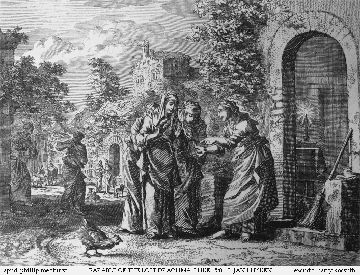
I. The Desire Portrayed – In the first reading, the prophet Elijah encounters a widow at a city named Zarephath, a name that means “refining fire.” In those days, Elijah the prophet went to Zarephath. As he arrived at the entrance of the city, a widow was gathering sticks there; he called out to her.
Both Elijah and the woman are hungry, for there is famine in the land. But Elijah, as God’s prophet, speaks not only for himself, but also for God when he asks this very poor woman to share her meager food. For, truth be told, God has a desire, a hunger for us. The woman, too, as many desires, but her desires need to be purified in this place called “refining fire.”
Her hunger for earthly food must be seen as a symbol of a deeper hunger, a hunger for communion with God. At some point, our hunger must meet God’s hunger—and that point is Holy Communion. It is the place where our hunger for God and God’s hunger for us meet and we find serenity. Every other hunger only points to this deeper hunger; every other food is but a cruel and temporary morsel until this deeper hunger is satisfied.
Thus, two people meet at a place called “refining fire.” It is desire that has drawn them, a desire that is ultimately satisfied only in God.
II. The Dimensions of Poverty – When Elijah makes his request, the woman articulates her poverty: “Please bring me a small cupful of water to drink.” She left to get it, and he called out after her, “Please bring along a bit of bread.” She answered, “As the LORD, your God, lives, I have nothing baked; there is only a handful of flour in my jar and a little oil in my jug. Just now I was collecting a couple of sticks, to go in and prepare something for myself and my son; when we have eaten it, we shall die.”
We may wonder why God allows poverty and suffering. A partial answer is because there is such a grave risk in riches and comfort. The Lord is well aware of how hard it is for the wealthy and comfortable to enter the Kingdom of God. In riches we trust in ourselves, in poverty we can only trust God.
And it is only by trusting faith that we can ever be saved. And, as we have noted, there is a kind of freedom in poverty. The poor have less to lose. They can operate in wider dimensions and have a sort of freedom that the wealthy often lack.
Not only is it hard to steal from a poor man, but it also takes little to enrich him. A man who has lived in a great palace with cathedral ceilings and marble wainscoting may be discouraged with a humble domicile, whereas a poor man may be satisfied with a mere 8 x 10 room to call his own. A man who has had nothing to eat may appreciate sardines, whereas a well-fed man may need caviar to be grateful. The rich may miss many of life’s little blessings and suffer from boredom. The poor are less likely miss the brilliant color purple and delight even in small pleasures. The rich man’s world gets ever-smaller and less satisfying, while the poor man is more likely to have a wide appreciation for even the humblest things.
Here, again, is the paradox of poverty, wherein less is more, gratitude is easier to find, and losses are less painful. And, as we shall see in this passage, it is the woman’s poverty that opens her to lasting blessings. Having little to lose, she is free enough to accept the next stage of our story.
III. The Demand that is Prescribed – God’s prophet, Elijah, summons her to trusting faith: “Do not be afraid. Go and do as you propose. But first make me a little cake and bring it to me. Then you can prepare something for yourself and your son. For the LORD, the God of Israel, says, ‘The jar of flour shall not go empty, nor the jug of oil run dry, until the day when the LORD sends rain upon the earth.’”
Elijah tells her not to be afraid to share. In effect, he teaches her that the Lord will not be outdone in generosity. On a merely human level, Elijah’s request may seem almost cruel. But from a spiritual perspective, Elijah is summoning her to the faith that alone can truly save her.
Notice that although she expresses a fear, it is easily overcome. Why? Again, because she has little to lose. So many of our fears boil down to a fear of loss. And the more we have, the more we have to be anxious about. We have grown quite wealthy in recent decades. And what are our chief problems these days? Fear and anxiety about loss, and the maintenance and protection of our “stuff.” Scripture says, The sleep of a laborer is sweet, whether he eats little or much, but the abundance of a rich man permits him no sleep (Eccl 5:12). The wealthier we have become, the more we spend on psychotherapy and psychotropic drugs. We are anxious about so many things that sleepiness and stress are common problems.
We have too much stuff, too much to lose. Upon hearing Elijah’s request, most of us would call him crazy, cruel, or both. It’s a funny thing, though, this woman is free enough to take him up on his offer. How about you? How about me?
We, too, must come to realize that looking after merely our own interests will only feed us for a day. Only in openness to God and others can we procure a superabundant food, that which will draw us to life eternal.
IV. The Deliverance Produced – Having little to lose, the woman trusts in God’s Word (through Elijah) and shares her food: She was able to eat for a year, and he and her son as well; the jar of flour did not go empty, nor the jug of oil run dry, as the LORD had foretold through Elijah.
If we learn to trust God, we come to discover that He never fails. Of course it takes faith, and faith involves risk. This is where poverty can have its advantages. The woman takes the risk and shares what little she has. For her, though the risk is immediate, it is ultimately lower since she has less to lose.
And so the woman is free enough to risk it all. Her only gamble is trusting God, and God does not fail. Scripture says,
Cast your bread upon the waters, for you will find it after many days (Eccles 11:1).
Give, and it will be given to you. A good measure, pressed down, shaken together and running over, will be poured into your lap. For with the measure you use, it will be measured to you (Luke 6:38).
And if anyone gives even a cup of cold water to one of these little ones because he is my disciple, I tell you the truth, he will certainly not lose his reward (Matt 10:42).
Whoever sows sparingly will also reap sparingly, and whoever sows generously will also reap generously (2 Cor 9:6).
Give generously to him and do so without a grudging heart; then because of this the LORD your God will bless you in all your work and in everything you put your hand to (Deut 15:10).
He who is kind to the poor lends to the LORD, and he will reward him for what he has done (Prov 19:17).
A generous man will himself be blessed, for he shares his food with the poor (Prov 22:9).
He who gives to the poor will lack nothing, but he who closes his eyes to them receives many curses (Prov 28:27).
Do you believe all this? Or are these just slogans for someone else? Well, you don’t know until you try! And if you don’t think you can try, maybe you have too much to lose.
Consider this woman who was poor enough to be free, and free enough to try the Lord. And God did not fail. God never fails. I am a witness. How about you?
Here’s a fun song reminding us that too much “stuff” will wear us out.
We live in a litigious culture, especially here in America, where we think of most things in terms of the law and legislation. If there is a problem, one of our first thoughts is to have lawmakers or judges craft a solution.
This is also true with assessing blame for things. Not long ago, perhaps fifty years or so, we were more accepting of the fact that accidents sometimes happen, and that they are the fallout of many factors, including the involvement of human beings in the situation. I use the word “fallout” deliberately, since the word “accident” comes from the Latin accidens, meaning “that which ‘falls alongside’ of something.” Many unfortunate events have complex origins, a kind of witch’s brew or perfect storm of factors that come together. For example, an accident at a processing plant might involve a combination of human error, improper maintenance, lax safety precautions, poor training, a sleepy employee, a rush order, etc. It is almost never just one thing.
In the absence of malice or extreme negligence, we were once more willing to admit that sometimes accidents just happen and that we should concentrate on improving the situation. Today the more frequent response is to look for someone (hopefully someone with deep pockets) to blame so that lawsuits can be brought.
Further, there was more acceptance of so-called “acts of God” such as storms and earthquakes. These, too, were things we chalked up to unfortunate circumstances, which we all had to expect and factor in. For example, if it snowed everyone was expected to use caution by walking more carefully, discerning whether work or other activities should be cancelled, and generally factoring in the presence of snow and ice. Today, however, if someone slips and falls on my sidewalk it is assumed to be my fault for not shoveling it well enough. Even if I made some effort to clear it, if I didn’t achieve a perfect surface I might be sued.
I remember one bitter cold morning when an angry parishioner pointed to ice in the parking lot and said, “Look at your parking lot; it’s covered with ice!” I responded to her with some mirth, “I swear I didn’t do it!” She smiled, realizing that we all too often look for someone to blame. Sometimes ice just can’t reasonably be removed in time or even at all. So we all need to adjust and proceed with caution.
Today we frequently look for someone to blame; we expect comfort and a sort of perfection without any difficulties or dangers. Life is a little more complex than that.
In this post, I do not propose to find the definitive answer as to what should be punished/fined and what should be chalked up to unfortunate circumstances. This is more of a light-hearted reflection that occurred to me as I watched this video, which I hope you will enjoy.
To most of us, parables are stories told by Jesus to illustrate and clarify what He teaches. We have read the parables in the context of two thousand years of a tradition that interprets them in a certain way. But in their original context, parables are really more like riddles. The apostles noted that while Jesus would speak to the crowds in parables, when He retreated into the house with the apostles He would explain the meaning (cfMat 13:36). Plain teaching is given “in the house,” in the Church, but among the crowds it’s parables.
To experience the riddle-like quality of a parable consider this made-up parable (without millennia of preaching tradition to explain it):
A man went out to wash his car. He took with him a bucket filled with soapy water and some sponges. As he washed the car, some of the dirt came off at once. Some of it came off only after much scrubbing. Some of the dirt didn’t come off at all. Let him who has ears to hear, take heed.
Hmm… It’s a bit of a riddle. You sort of get it, but much is also unclear. Perhaps there are several interpretations. But what does the author really want us to learn here? In a sense we are left with more questions than answers, but at least it makes us think.
This was likely the first reaction to many of the parables. Frankly, some of them still puzzle and admit of various interpretations.
Take for example the parable of the man with a hundred sheep, or the woman with ten coins (which we read at daily Mass on Thursday). In one sense the parables clearly emphasize God’s care for even one lost sinner.
But the stories in themselves don’t make a lot of sense. They challenge our conventional thinking; they are quirky and describe people doing things that we most likely would not do. Who would ever do what the shepherd of the lost sheep or the woman with the lost coin did? No one, really. One one level, they’re just plain crazy.
Perhaps that is one of the most fundamental points Jesus is making here. Our heavenly Father’s love for us is just plain crazy. By using the word “crazy,” I do not mean that it is irrational, but it does stretch the limits of our human thinking. So permit a preacher’s hyperbole so that we can enter into the astonishing quality of God’s love and mercy. It cannot be understood or really explained in human terms. Who really understands unlimited and unconditional love? Who can really grasp the depths of God’s mercy? His grace is amazing in that it goes completely beyond our ability to comprehend; it transcends human concepts. Thank God! If God were like us we’d all be in trouble. Frankly, we’d all be in Hell!
Let’s look at both parables. The full texts can be found here: Luke 15.
I. The Parable of the Lost Sheep – The Lord speaks of a shepherd who leaves ninety-nine sheep in order to search for one that is lost. Would a shepherd really do this? Probably not! The passage drips with irony, even absurdity. Perhaps if the shepherd thought that the lost sheep was likely nearby he might venture over the next hill, but the average human shepherd would probably cut his losses and stay with the ninety-nine. Many of us might even consider it irresponsible to leave ninety-nine in order to search for one.
Some people try to make sense of this parable by appealing to possible shepherding practices of the first century. Many of the Fathers of the Church postulated that the “ninety-nine” were the angels in Heaven and we, fallen humanity, the straying sheep that God goes off to find. The angels in turn rejoice when the “lost sheep” is found. Perhaps.
But what if trying to “solve” the parable or have it make sense misses the point: that God’s love for us is extravagant, personal, puzzling, and just plain “crazy.” Maybe it is teaching that God loves us for “no good reason.” He seems to love us even more when we stray. He intensifies His focus on the one who strays. To us this is not only crazy, it is dangerous and possibly enabling. Don’t try to figure it out. Don’t analyze it too much. Just be astonished, be amazed. Yes, this is crazy. That God loves me is crazy, unexplainable.
II. The Woman and the Lost Coin– A woman loses a drachma, a small coin. It’s not worth that much, really, perhaps one day’s wages. In modern terms, it would equate to less than a hundred dollars. It’s not insignificant, but not really a huge amount either. She sweeps diligently for it. So far, this seems reasonable. I’d probably look around a while for a missing “Benjamin.”
But then it gets crazy. She finds it and rejoices to such an extent that she spends most, if not all of it, on a party celebrating the found coin!
But that is exactly the point. God doesn’t count the cost. He doesn’t weigh His love for us in terms of whether it is “worth it.” Some try to explain the craziness away by suggesting that perhaps the coin had sentimental value as part of her dowry or a ceremonial head-dress of ten coins. But here, too, overanalyzing and trying to explain or make sense of it may well miss the point.
This woman is crazy because God is crazy. He is crazy to love us this much. His love for us is extravagant beyond what is humanly reasonable or explainable. Don’t try to figure it out. Don’t analyze it too much. Just be astonished, be amazed. Yes, this is crazy. That God loves me is crazy, unexplainable.
Some will object to this reading of the parables, preferring the authority of the Church Fathers or of other traditional readings. But these interpretations are not dogmatic and parables of this nature may admit of various interpretations.
Remember, too, that Jesus addressed this parable to: the Pharisees and the teachers of the law who muttered, “This man welcomes sinners and eats with them” (Lk 15:1). These were men who thought they had it figured out: God loves us because we keep the precepts of the Law. Isn’t it possible that to them, Jesus gives this retort: “What if God loves you for no human reason at all? What if God loves because God is love and that is what love does: it loves? What if you cannot simply account for God’s love in human terms?”
You can take this theory or leave it, but at least allow it to illustrate that many of the parables had and still have a riddle-like quality, and that simply settling in on one explanation may sacrifice that. Jesus gave us parables in order to challenge us and to provoke conversation both among and within ourselves. Don’t end the conversation too quickly. Even after hearing the usual explanation, consider asking, “What else could this parable mean?”
In the posts of the past two days, we’ve looked at the sins of the priests and those of all the people. Clearly, we all have a lot on which to reflect.
The prophets do not write merely to denounce, but rather to draw people back to the Lord, who alone can save them. Malachi is no exception.
God wants His people to be ready for the Day of Judgment. That day is coming upon us all. Either we are going to Him for individual judgment or He is coming to us and the world in general judgment. But either way, the day is surely coming. How will God make ready His people?
The vision is laid out in the central section of Malachi, in the early part of the 3rd chapter. There are four basic elements of the plan there, and then a final plea in chapter 4. Let’s look at each in turn.
I. The Preparation– The text says, Behold, I send my messenger to prepare the way before me (Mal 3:1).
Like any good father, God prepared by first teaching His children. Historically, He gave us the Law (Natural Law) in the book of creation, and more specifically in the Decalogue on Mt. Sinai and its explication in the Pentateuch. Therefore, Moses and those who recorded his teaching were like great messengers, setting before the people the holiness of God.
But time and time again they fell short, not living the teachings given by God. So He sent more messengers, the Prophets, who summoned the people to repentance. Scripture says, The Lord gave the word, great was the company of the Preachers! (Ps 68:11)
Yes, messengers, many messengers, were sent to prepare the people for the day of His coming.
God sent His own Son, who in our own times, through His Church, speaks to us, teaches us, and sends countless prophets to prepare us. These prophets are the Apostles and their successors, bishops, priests, deacons, catechists, parents, saints, godparents, and many others (bloggers, too?).
And the message remains the same: repent and believe the Good News! Come to a new mind, come to new and different priorities, and accept the life-changing message that Jesus offers you! Enter into a life-changing, transformative relationship with Jesus Christ. Let Him, who alone can heal, prepare you through Word, Sacrament, and witness.
Yes, everywhere the cry of true prophets can and does go forth. In the words of an old spiritual, “Sinner, please don’t let this harvest pass, and die and lose your soul at last!” It is God, through His messengers, teaching and exhorting us in order to prepare us. The listing of the sins of the priests and the people is a clarion call to prepare us for the day of encountering God that is surely coming.
II. The Purpose – The text says, For the Lord whom you seek will suddenly come to his temple; the messenger of the covenant in whom you delight, behold, he is coming, says the Lord of hosts. But who can endure the day of his coming, and who can stand when he appears? (Mal 3:2-3)
God is preparing us so that we can endure and withstand the day that is surely coming upon us all, the day when we will “suddenly” encounter the Lord.
Many modern people have little notion that this day is something to be very sober about. God is very holy; He is like a blazing fire of charity. Fire either transforms or burns up whatever it touches, but nothing goes away from fire unchanged and no one goes away from God unchanged.
Unrepentant sinners in the presence of an all-holy God will not be able to endure or withstand God. They are like wax before a fire. They are like those in a dark room who are suddenly brought out into the noonday sunlight. There are stabbing pains in their eyes and loud protests from their mouths at the light. The noonday sun is beautiful and good, but not to those accustomed to the darkness; the day of His coming will be torturous for them.
Even repentant sinners will likely undergo some painful purification. As St. Paul says,
Their work will be shown for what it is, because the Day will bring it to light. It will be revealed with fire, and the fire will test the quality of each person’s work. If what has been built survives, the builder will receive a reward. If it is burned up, the builder will suffer loss but yet will be saved—even though only as one escaping through the flames (1 Cor 3:13-15).
Thus, God’s purpose is to prepare us for the day of His coming, a day to be very sober about. He has a purpose to prepare us because there is a lot to be prepared for! God isn’t going to change (and we would be foolish to want Him to change). Se we have to change—a lot. More accurately, we have to be changed by God, because in no way are we capable of readying ourselves.
Will you be able to stand when He appears? Will you be able to endure? God’s purpose is to get you ready to withstand and endure, for judgment day comes suddenly.
III. The Prescription – The text says, For he is like a refiner’s fire and like fullers’ soap; he will sit as a refiner and purifier of silver, and he will purify the sons of Levi and refine them like gold and silver, till they present right offerings to the Lord. Then the offering of Judah and Jerusalem will be pleasing to the Lord as in the days of old and as in former years (Mal 3:3-4).
So there it is, a kind of fiery purification, a wash of lye or bleach. It’s not all that pleasant, but it’s necessary.
-Paul says, Through many tribulations we must enter the kingdom of God (Acts 14:22).
-Jesus says of Paul, I will show him how much he must suffer for my name (Acts 9:16).
-Job says, But God knows the way I take; When He has tried me, I shall come forth as pure gold (Job 23:10).
-St Peter says, You have been distressed by various trials, so that the proof of your faith, being more precious than gold which is perishable, even though tested by fire, may be found to result in praise and glory and honor at the revelation of Jesus Christ (1 Peter 1:7).
Such purifications are necessary for us. God adds consolations to encourage us, but this world more often remains a valley of tears; an exile; a crucible in which we are tested, purified, and made ready for something far greater.
Indeed, we must look beyond the cross to the glory that follows, lest we be discouraged. St. Paul says,
Therefore we do not lose heart. Though outwardly we are wasting away, yet inwardly we are being renewed day by day. For our light and momentary afflictions are achieving for us an eternal glory that far outweighs them all. So we fix our eyes not on what is seen, but on what is unseen, since what is seen is temporary, but what is unseen is eternal (2 Cor 4:16-18).
This is the prescription: that we take up our cross daily and follow the Lord. He is purifying us through our share in His cross. And if you think that there should be a better way, remember that God offered us paradise but we wanted a better deal. Well, welcome to the better deal. We chose one tree over all of paradise. But God mercifully took that tree and turned it into a cross, reopening to us not just paradise, but Heaven! And our share in the cross is but a sliver of what Jesus endured.
So the prescription is our share Jesus’ cross and the purification it effects!
IV. The Produce – The text says, Then those who feared the Lord spoke with one another; the Lord heeded and heard them, and a book of remembrance was written before him of those who feared the Lord and thought on his name. “They shall be mine, says the Lord of hosts, my special possession on the Day when I act, and I will spare them as a man spares his son who serves him. Then once more you shall distinguish between the righteous and the wicked, between one who serves God and one who does not serve him (Mal 3:16-18).
So, the Lord’s work brings about a purification that in turn elicits a holy reverence or fear. Praise God! And not only do the righteous alone receive this gift, they also “spoke with one another.” In other words, they become evangelical, drawing other souls to God and making sure their names are written in the Book of Life.
Purifying them, the Lord can say of them, “They shall be mine … I will spare them as my own dear children on the Day I act. They shall be distinguished from the wicked and by my grace be righteous. They shall be among those who have served me and not among those who have spurned my purifications …”
This is the produce that the Lord seeks: sons and daughters to live with Him forever, purified of their sins and lacking nothing! They shall be His own and share in Godly perfection.
V. The Plea – At the end of the Book of Malachi, the Lord lays out two alternatives for us:
Choice 1:For behold, the day comes, burning like an oven, when all the arrogant and all evildoers will be stubble; the day that comes shall burn them up, says the Lord of hosts, so that it will leave them neither root nor branch (Mal 4:1).
Choice 2:But for you who fear my name the sun of righteousness shall rise, with healing in its wings. You shall go forth leaping like calves from the stall. 3 And you shall tread down the wicked, for they will be ashes under the soles of your feet, on the day when I act, says the Lord of hosts (Mal 4:2).
Which one do you want? (Hint: Pick the second choice; it’s a lot better!)
Meanwhile, God waits and quietly acts:
Still pleading:Remember the law of my servant Moses, the statutes and ordinances that I commanded him at Horeb for all Israel (Mal 4:4).
Still preparing: Behold, I will send you Elijah the prophet before the great and terrible day of the Lord comes. And he will turn the hearts of fathers to their children and the hearts of children to their fathers (Mal 4:5-6a).
Still plaintively warning: Lest I come and smite the land with doom (Mal 4:6b).
In yesterday’s post, we considered the sins of the priests (and they were numerous enough). Today we examine the sins of the people that the Lord sets forth in the Book of Malachi. Here, too, please understand that not everyone is guilty of all of these things. However, they are common human sins and sinful attitudes. So consider this inspired list (for it is from the Lord) and pray for conversion and repentance, for the picture here is all too familiar.
I. The Attitude of Ingratitude – The text says,
1 The oracle of the word of the Lord to Israel by Malachi. 2 “I have loved you,” says the Lord. But you say, “How hast thou loved us?”… I have laid waste the hill country [of the sons of Esau] and left its heritage to jackals of the desert.” 4 If Edom says, “We are shattered but we will rebuild the ruins,” the Lord of hosts says, “They may build, but I will tear down, till they are called the wicked country, the people with whom the Lord is angry for ever.” 5 Your own eyes shall see this, and you shall say, “Great is the Lord, beyond the border of Israel!” (Malachi 1:1-5)
God gives us astonishing gifts: life, air, water, food, and family—the list could go on and on. Mysteriously, even the burdens of life are gifts for us in the way they bring us wisdom, grant us humility, connect us more deeply to one another, and bring forth strengths that we never knew we had. Every day, trillions of things “go right.”
This is not an exaggeration when we consider the intricate functioning of every cell in our body, the delicate balance of the earth’s ecosystems, and even the balances and fortunes of our solar system and the cosmos. Trillions of things, large and small, go into every moment of our existence.
Each day a few things go wrong: a health setback, a missed opportunity, bad traffic, etc. But a few things compared to trillions? And yet we are so easily resentful at the slightest wrinkle in our plans, the smallest trial or difficulty.
We are like the ancient Israelites boldly rebuffing God, “How have you loved us?” God replies by simply declaring that he has rebuffed our enemies. Are you and I grateful that God has snatched us from Satan’s grasp? Through grace and mercy, we now stand a chance. Yes, we have a desert (a desert of our own making) to get through, and there are trials to be endured, but in Christ Jesus we have overcome and can make it.
II. Foolish Faithlessness – the text says,
10 Have we not all one father? Has not one God created us? Why then are we faithless to one another, profaning the covenant of our fathers? 11 Judah has been faithless, and abomination has been committed in Israel and in Jerusalem; for Judah has profaned the sanctuary of the Lord, which he loves, and has married the daughter of a foreign god. 12 May the Lord cut off from the tents of Jacob, for the man who does this, any to witness or answer, or to bring an offering to the Lord of hosts! (Malachi 2:10-12)
The remarkable insight of this text is that rejecting our covenant with God is not only being unfaithful to God, but also to one another. In the ancient context of this text, every individual who was faithless to the Covenant and its demands affected not only himself, but also everyone around him.
In 721 B.C., Israel had already been weakened and destroyed by the Assyrians. And now faithless Judah was threatened with ruin, stubborn and still unrepentant despite the warning of the destruction of the northern kingdom.
A nation cannot stand when its individuals fail to repent. Nations do not repent unless individuals do so.
In our own time, the United States is living on the fumes of former faith and sacrifices. Our Declaration of Independence and Constitution are demonstrably the fair flowers of the biblical teachings of justice and the dignity of the human person. The Judeo-Christian faith produced what we call “the West.” But Democracy has this weakness: it depends to a great degree on the virtue of the populace. Remove a solid moral grounding and freedom quickly devolves into licentiousness. Remove the anchor to the truth of Judeo-Christian moral precepts and the result is the tyranny of relativism.
And this is where we are today. Our country and culture were once deeply rooted in the biblical vision; belief in God was once evident on Sunday mornings, when most people went to Church. But we are now increasingly secular. Indeed, there is even a growing hostility to faith.
A country cannot undermine its principles and expect them to stand. The text from Malachi says that we have been faithless to one another, profaning the covenant of our fathers. Indeed we have—and our whole country and culture have suffered as a result.
The text also says we have married the daughters of a foreign god. Indeed, we have married many daughters of the gods of this world, of the prince of this world. These daughters go by names like greed, fornication, sexual confusion, secularism, relativism, materialism, and narcissism, just to name a few. We have collected many such foreign wives and given our hearts to them. We have been faithless and committed every kind of abomination with them.
And in all this we sin against not only God, but ourselves and one another.
III. Mangled Marriages – The text says
13 And this again you do. You cover the Lord’s altar with tears, with weeping and groaning because he no longer regards the offering or accepts it with favor at your hand. 14 You ask, “Why does he not?” Because the Lord was witness to the covenant between you and the wife of your youth, to whom you have been faithless, though she is your companion and your wife by covenant. 15 Has not the one God made and sustained for us the spirit of life? And what does he desire? Godly offspring. So take heed to yourselves, and let none be faithless to the wife of his youth. 16 “For I hate divorce, says the Lord the God of Israel, and covering one’s garment with violence, says the Lord of hosts. So take heed to yourselves and do not be faithless” (Malachi, 2:13-16).
Yes, God hates divorce. Do we grasp this? Too many do not, even boldly saying that God told them He wants them to be happy, or claiming God’s “blessing” on their desire to divorce.
Necessary separations for safety’s sake are one thing, but in our culture people walk away from marriages at an astonishing rate. Even in the Church many shrug and even want to settle down with “the reality” of divorce instead of insisting, along with God, that divorce is something to be resisted, to be shocked by, and to do everything possible to avoid. Too many also do not take into consideration how their individual decision to walk away from marriage harms others, especially children.
Divorce, along with all the other “mangling” of marriage that we do and approve in our culture (e.g., cohabitation, single motherhood, and adoption by homosexual couples) harm children. Every child has the need and the natural right to be conceived in a home in which his father and mother have married, committed to each other, and stay married—working out their difficulties and preserving their union for the sake of the children. To intentionally subject children to anything less than this is an injustice and is harmful to them. And when children are harmed, the whole culture is harmed. Wounded children grow older and too easily become delinquent adolescents, underachievers, and then dysfunctional adults.
IV. Delight in Disorder – the text says,
17 You have wearied the Lord with your words. Yet you say, “How have we wearied him?” By saying, “Every one who does evil is good in the sight of the Lord, and he delights in them.” Or by asking, “Where is the God of justice?” (Malachi, 2:17)
Too often in our times we glamorize evil or excuse grave sin as “no big deal.” Our movies and many other forms of entertainment glamorize violence, greed, and fornication. There is “gangsta rap” all the way up to the “high-class” House of Cards. Bad and foolish behavior, scurrilous comedians, and the like round out the debasement.
We glamorize evil, laugh at it, and dance to it.
The text here says that the people wearied the Lord by claiming that even those who do evil in the sight of the Lord are good and that God delights in them. Too many people today think that God does not care that they sin and that “He loves me no matter what.” Of course this is a terrible presumption and a highly distorted view of love. Love never delights in what is wrong and wants for the beloved only what is good, true, and beautiful. And God has made us free.
Thus St. Paul rightly says,Do not be deceived, God is not mocked; for whatever a man sows, this he will also reap. For the one who sows to his own flesh will from the flesh reap corruption, but the one who sows to the Spirit will from the Spirit reap eternal life (Gal 6:7-8). The Greek word translated here as “mock” more literally means “to turn up one’s nose, to sneer.” St. Paul is telling us that God will not be disregarded in this manner. He tells us that our decisions build our character and our character ushers in our destiny. Either we will love God and His Kingdom’s values, or not. And that will determine where we prefer to spend eternity.
Turning up our nose at God and saying it doesn’t matter, when He has said that it does, will not change the facts; our decisions form who we are and will be for all eternity. Those who contemptuously ask, “Where is this God of Justice?” are going to be surprised. Sr. Faustina reported that Hell was quite full of people who had denied that there was a Hell.
V. Injurious Injustice – the text says,
5 “Then I will draw near to you for judgment; I will be a swift witness against the sorcerers, against the adulterers, against those who swear falsely, against those who oppress the hireling in his wages, the widow and the orphan, against those who thrust aside the sojourner, and do not fear me,” says the Lord of hosts. 6 “For I the Lord do not change; therefore you, O sons of Jacob, are not consumed …” (Malachi 3:5-6).
The list here is too large to permit commentary on each item, but fundamentally it describes injustice to the poor and vulnerable. Payment of unjust wages, oppression, and insensitivity to the poor, the migrant, and the immigrant, children, and the unborn—those who do such things do not fear the Lord, according to the text. They have forgotten that the Lord hears the cry of the poor and is close to those who are oppressed.
The connection of sorcery and adultery to sins of injustice may not be clear. However, the sorcerers used potions and spells. The Greek Septuagint uses the word φαρμακοὺς (pharmakous) in this text. This is where we get the word “pharmacy.” Sorcery was often connected with abortifacients and contraceptive potions and drugs. As such children, in the womb were threatened and killed by such things.
Adultery always harms marriage and family, and as such, harms children. Thus the notion of injustice to the poor, the vulnerable, and the needy is a rather complete picture. All these sins of injustice are sadly common in our day—and God says that He will judge us for them.
VI – Tightfisted in Tithes – The text says,
7 From the days of your fathers you have turned aside from my statutes and have not kept them. Return to me, and I will return to you, says the Lord of hosts. But you say, ‘How shall we return?’ 8 Will man rob God? Yet you are robbing me. But you say, ‘How are we robbing thee?’ In your tithes and offerings. 9 You are cursed with a curse, for you are robbing me; the whole nation of you. 10 Bring the full tithes into the storehouse, that there may be food in my house; and thereby put me to the test, says the Lord of hosts, if I will not open the windows of heaven for you and pour down for you an overflowing blessing. 11 I will rebuke the devourer for you, so that it will not destroy the fruits of your soil; and your vine in the field shall not fail to bear, says the Lord of hosts. 12 Then all nations will call you blessed, for you will be a land of delight, says the Lord of hosts (Malachi 3:7-12).
I have written more extensively on the topic of tithing, recommending it wholeheartedly. It is true that the Church today does not strictly require that one-tenth be devoted to the Church. However, Jesus did commend tithing (cf Luke 11:42) and Catholics ought not to be so quick to set it aside as a practice.
The fundamental point in this text is that the worship and praise of God were being neglected. And this is often the case today as well. Many give little to the Church in terms of time, talent, or treasure. Meanwhile, secular causes and pursuits are well-supported. As our houses, banks, and government buildings have gotten bigger, our churches have gotten smaller. In fact, many are closing. Newer churches often fail to inspire and are utilitarian in nature.
Our immigrant ancestors had far less material wealth than we do today, yet they built beautiful Churches, Catholic schools, and hospitals. Their priorities were different—they were better.
Many people expect more and more from the Church while giving less and less. It doesn’t work that way. God says, Bring the full tithes into the storehouse, that there may be food in my house.
Again, this is less about money than it is about our hearts, our priorities, and our faith. If those are intact, the resources will flow.
VII. Weary in Well-doing – the text says,
13 “Your words have been stout against me,” says the Lord. “Yet you say, ‘How have we spoken against thee?’ 14 You have said, ‘It is vain to serve God. What is the good of our keeping his charge or of walking as in mourning before the Lord of hosts? 15 Henceforth we deem the arrogant blessed; evildoers not only prosper but when they put God to the test they escape’” (Malachi 3:13-15).
This is similar to what was said above insofar as glamorizing evil. But here the focus is more on the selfish notion that “I don’t get rewarded enough for doing good.”
But of course we do not obey God just because we will benefit; we obey God because God is God.
That said, there are rewards for following God. However, the rewards may not be in line with the preferences of our earthly passions. We often think of rewards in terms of money, advancement, good health, popularity, and so forth. But sometimes the best blessing is the cross and whatever it takes to kill our pride and prepare us for eternal glory.
We think that we know what is good or best for us, but usually we don’t. We only want things to spend on our passions (cf James 4:3). God does reward those who serve Him, but He rewards us with what will open us up for the best that is yet to come. Too often we are dismissive of spiritual blessings and prefer the toys, trinkets, and tender meats of the world and fleshly desires.
Well, that’s quite a little catalogue of sins! But be of good cheer, God does have a plan. We can conclude our tour through Malachi by looking at some of those remedies tomorrow.
Here is a performance of Carrissimi’s “Peccavimus Domine” (We have sinned, O Lord).
The Book of the Prophet Malachi is set forth as a kind “riv” (a Hebrew word for a lawsuit, indictment, or controversy) by God. The Lord sets forth a legal case of sorts, which convicts ancient Israel of numerous deficiencies and calls for their repentance. The case that God presents shows a body of evidence that is just as true today as it was then. God has plenty to say and we have much to hear, much to repent of.
I am going to examine the Book of the Prophet Malachi in two successive posts. Today’s post is about the sins of the priests. Tomorrow’s post will focus on the sins of the people.
As we look to the sins of the priests enumerated here, please understand that neither the biblical text nor my commentary should be construed to mean that all or even most priests are like this. But, sadly, the sins and shortcomings of the clergy are far too common. As priests must strive to be better and more holy, so also must the laity remember to pray for us.
With that in mind, let’s consider the sins of the priests (as listed by Malachi) in three basic areas.
I. Shoddy Sacraments
6 “A son honors his father, and a servant his master. If then I am a father, where is my honor? And if I am a master, where is my fear? So says the Lord of hosts to you, O priests, who despise my name. You say, ‘How have we despised thy name?’ 7 By offering polluted food upon my altar. And you say, ‘How have we polluted it?’ By thinking that the Lord’s table may be despised. 8 When you offer blind animals in sacrifice, is that no evil? And when you offer those that are lame or sick, is that no evil? Present that to your governor; will he be pleased with you or show you favor? says the Lord of hosts. 9 And now entreat the favor of God, that he may be gracious to us. With such a gift from your hand, will he show favor to any of you? says the Lord of hosts. 10 Oh, that there were one among you who would shut the doors, that you might not kindle fire upon my altar in vain! I have no pleasure in you, says the Lord of hosts, and I will not accept an offering from your hand. 11 For from the rising of the sun to its setting my name is great among the nations, and in every place incense is offered to my name, and a pure offering; for my name is great among the nations, says the Lord of hosts. 12 But you profane it when you say that the Lord’s table is polluted, and the food for it may be despised (Malachi 1:6-12).
Those are strong words indeed. And while the injunction regarding blemished and polluted animals has changed, the intrinsic problem too often remains: the shoddy celebration of the Liturgy and the sacraments.
One of the most common complaints from the faithful regards priests who violate liturgical norms and/or allow others to do so. Few things offend charity and unity as much as the open and often egregious violation of liturgical norms. And while it is true that some violations are smaller matters in themselves, why not just celebrate the Liturgy as it is set forth in the books? There are of course options, and not every complaint of the faithful is accurate or fair, but God’s people have endured several decades of exotic and often egocentric liturgical experiments, which are not approved and which take the focus off God and the proper worship due Him.
Not every priest can clear up every problem in the Liturgy the day he walks through the door, but proper liturgical formation of God’s people with due regard to charity and patience is an essential task for the pastor of souls. And the priest should begin with himself. The liturgy, both in terms of its mechanics and its deeper spiritual significance, should be his study and his great love.
Another problem that can emerge is inattentiveness to the dignity and beauty of the Mass and the sacraments. Beauty and decorum are important ways that we communicate our love for God and one other. Priests should be properly vested, prayerfully prepare their sermons, and avoid mannerisms that are inappropriate or overly casual. Opulence is not necessary, but priests should ensure that liturgical appointments are clean, in good repair, and of proper dignity.
Decades ago, poor immigrant communities were responsible for building of some of the most beautiful churches. They also supplied some of the finest liturgical implements and art. It is important that we keep what they have bequeathed to us in good repair. Further, priests can and should teach today’s faithful to follow the example of these recent ancestors of ours by seeking to build and maintain worthy Churches, erected for the glory of God not just the utility of man. In the recent past, many of the faithful have been shocked and hurt by senseless “wreckovations” of sanctuaries and altars. Thanks be to God that many today are growing in appreciation for the older churches and are seeking to preserve them.
If God was offended by the offering of a lame or sick animal, why should we think He is pleased with “just any old stuff” in the Sacred Liturgy? God does not need our gold chalices or our tall churches, but He knows how we are made. And the shoddy, perfunctory, “anything goes” celebration of the Sacred Liturgy says something about our hearts, our priorities, and what we value.
Priests above all must avoid all conscious violation of liturgical norms, make central the devoted study of liturgy, and inspire respect among the faithful for the Sacred Liturgy. St. Paul summarizes well his liturgical teaching of 1 Cor 11-14 by saying, But all things should be done decently and in good order (1 Cor 14:40).
II. Burdens not blessings? Behold your Barrenness!
13 ‘What a weariness this is,’ you say, and you sniff at me, says the Lord of hosts…. 21 “And now, O priests, this command is for you. 2 If you will not listen, if you will not lay it to heart to give glory to my name, says the Lord of hosts, then I will send the curse upon you and I will curse your blessings; indeed I have already cursed them, because you do not lay it to heart. 3 Behold, I will rebuke your offspring, and spread dung upon your faces, the dung of your offerings, and I will put you out of my presence. 4 So shall you know that I have sent this command to you, that my covenant with Levi may hold, says the Lord of hosts. 5 My covenant with him was a covenant of life and peace, and I gave them to him, that he might fear; and he feared me, he stood in awe of my name (Malachi 1:13, 2:1-5).
The priests of that ancient Jewish time had families, and God warned that if the fathers did not obey, the children would surely suffer many curses. And while priests today do not have children of their own, thousands call us “Father”!
And here in our times is the warning of God that the sins and omissions of the priests surely have brought trouble upon the faithful. We have been through a period in which too many priests have been rebellious, unfaithful to Church teaching, slothful, unprepared to preach, un-prayerful, irreverent, and even guilty of grave sins and violations of their state in life. Far too many priests and religious have also left the sacred call they agreed to live for life.
All of this has resulted in many troubles for the faithful. Some have been left discouraged and angry, most are poorly catechized and ill-informed on critical moral issues. Many are confused by priests and bishops who have openly dissented and, as the text says, who do not listen to God or lay to heart His teaching and stand in awe of God’s name.
As such, the flock is often cursed by this poor priestly leadership and example. Eighty percent of Catholics no longer attend Mass. Many of those who do attend are barely in communion with the Church’s teaching, and struggle to live the glorious vision set forth in the Gospel.
Sadly, this text from Malachi echoes a similar text from Zechariah,Strike the shepherd, and the sheep will be scattered (Zech 13:7). This is why the sins of the priests are so serious and why the faithful must pray especially for them. For indeed not only are priests subject to targeted attack by Satan, they are also especially susceptible to grandiosity, pride, and the sin of craving human respect.
Pray that priests do not become weary of exhortation, or speak of their office as a “burden.” Pray, too, that they do not succumb to modern and soft notions that the Gospel is too “burdensome” for the faithful to live, and therefore fail to preach it or to encourage the faithful.
This leads to the third sin of the priests that is mentioned by Malachi.
III. Sacerdotal Silence
6 True instruction was in [Levi’s] mouth, and no wrong was found on his lips. He walked with me in peace and uprightness, and he turned many from iniquity. 7 For the lips of a priest should guard knowledge, and men should seek instruction from his mouth, for he is the messenger of the Lord of hosts. 8 But you have turned aside from the way; you have caused many to stumble by your instruction; you have corrupted the covenant of Levi, says the Lord of hosts, 9 and so I make you despised and abased before all the people, inasmuch as you have not kept my ways but have shown partiality in your instruction.” (Malachi 2:6-9)
Silent pulpits are all too common in the Church today. Some priests prefer to “play it safe,” fearing to preach about the issues of the day out of human weakness. Other priests do not believe certain teachings themselves or think them impractical in modern times. Still others, as the text says, have turned aside from the truth, preaching and teaching outright dissent. As such, the text further says, they cause many to stumble by preaching corruption.
It is tragic as well that so many are permitted to mislead the faithful and are not disciplined for it by their religious superiors.
The text says that a priest should guard knowledge. That is, he should protect it from those who would distort it and should refute error. He must also guard it from misunderstanding and see that it is presented in the balance of others truths in the Scripture and in Tradition. St. Paul says of a presbyter (a priest), He must hold firmly to the trustworthy message as it has been taught, so that he can encourage others by sound doctrine and refute those who oppose it (Titus 1:9).
The text of Malachi also warns against partiality, wherein a priest picks and chooses what truths he will teach or emphasize. St. Paul said to the elders at Miletus, Therefore I testify to you this day that I am innocent of the blood of all, for I did not shrink from declaring to you the whole counsel of God (Acts 20:26-27). Yes, the whole counsel, the complete truth, is to be taught by the priest.
Malachi rebukes the priests of his day for their partial preaching and, sadly, some of these rebukes must still be made. Encourage your priests when they speak confidently and clearly. Thank them and give them support, even if they challenge you. The job of a priest is not to be popular but to be a prophet. It’s tough work and it doesn’t always bring cheers. But even the prophets need support from the 7000 who have still not bent the knee to Baal or kissed him (cf1 Kings 19:18). Pray for priests and encourage them to announce the whole counsel of God.
These are some of the sins of the priests that God sets forth. Let us not forget that the world also has many hard-working, dedicated, loyal, and holy priests. Yet, as these texts remind us, too easily priests can lose their way; forgetting the glory of the liturgies they celebrate; referring to their office and the gospel as burdensome; and growing too silent out of either fear or laziness.
Pray for priests!
In tomorrow’s post, I will discuss the sins of the faithful, as listed in the Book of Malachi.

 As a priest and pastor I work very closely with others: clergy, religious, laity who work for the Church, and laity who volunteer. We all work for the Church because we love her and her people.