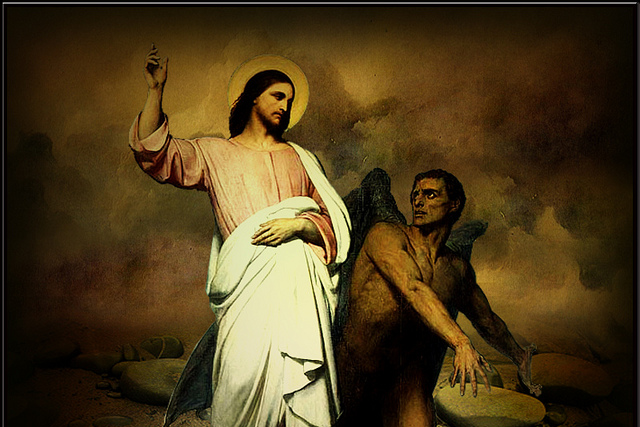
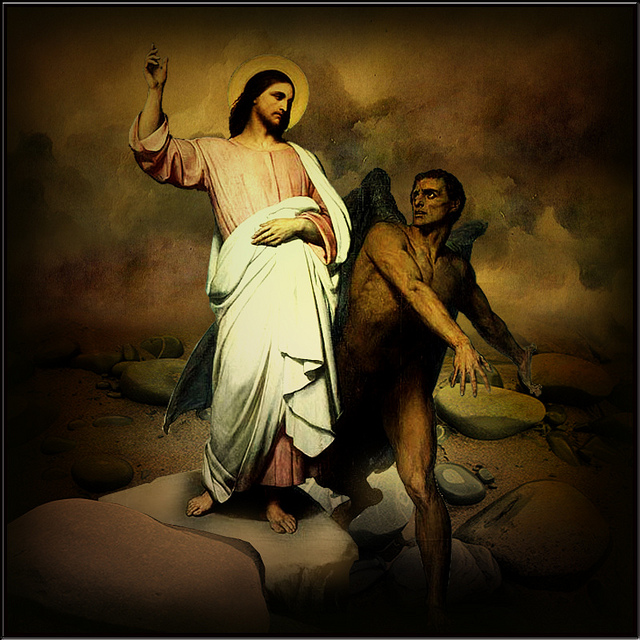
Why Did Jesus “Mean to Pass by” His Disciples When He Was Walking on the Water?

blog1-7The gospel for daily Mass on Wednesday recounted the familiar story of Jesus walking on the water after having multiplied the loaves and fishes.

There is an odd turn of phrase (to modern ears) midway through the gospel: About the fourth watch of the night, [Jesus] came toward them, walking on the sea. He meant to pass by them (Mark 6:48).

This seems odd. Why would Jesus approach them, walking on the water (astounding miracle that it is), and simply mean to pass on by?

We may think that this means that Jesus will not to stop, but will keep on walking past them. However, this is not what it means.

This expression of God “passing by” is a common one in the theophanies of the Old Testament. For example, when Moses was up on the mountaintop, God revealed himself by “passing by.” The text says,

Then Moses said, “Now show me your glory.” And the Lord said, “I will cause all my goodness to pass in front of you, and I will proclaim my name, the Lord, in your presence. I will have mercy on whom I will have mercy, and I will have compassion on whom I will have compassion. But,” he said, “you cannot see my face, for no one may see me and live.” Then the Lord said, “There is a place near me where you may stand on a rock. When my glory passes by, I will put you in a cleft in the rock and cover you with my hand until I have passed by. Then I will remove my hand and you will see my back; but my face must not be seen” (Exodus 33: 18-23).

Another example of this is in the appearance the Lord made to Elijah, who was hiding in a cave after his flight from Jezebel. At one point, God called him out of the cave so that He could “pass by.” The text says,

The Lord said, “Go out and stand on the mountain in the presence of the Lord, for the Lord is about to pass by.” Then a great and powerful wind tore the mountains apart and shattered the rocks before the Lord, but the Lord was not in the wind. After the wind there was an earthquake, but the Lord was not in the earthquake. After the earthquake came a fire, but the Lord was not in the fire. And after the fire came a gentle whisper. When Elijah heard it, he pulled his cloak over his face and went out and stood at the mouth of the cave (1 Kings 19:11-13).

Here are some other example of this “passing by.”

  1. When John the Baptist saw Jesus passing by, he said, “Look, the Lamb of God!” (Jn 1:36)
  2. Now hearing a crowd going by, [the Blind Man] began to inquire what this was. They told him that Jesus of Nazareth was passing by. And he called out, saying, “Jesus, Son of David, have mercy on me!” (Lk 18:37-38)

Hence, for Jesus to “pass by” is not for Him to walk past us in hiding. Rather, it is for Him to reveal Himself to us and summon us to faith. Similarly, in the Old Testament texts God “passes by” not to hide but to reveal Himself and summon us to faith.

Some may argue that these phrases should be translated differently so that we can better grasp their meaning. Why not just say, “He came toward them to reveal himself to them?”

Perhaps there is some merit in this argument. But I would counter that a text often has a greater effect on us if it causes us to ponder and pray. Consider that in trying to “decode” this text, we have looked at four other passages. Further, we have deepened our appreciation of what it means for God to “pass by.”

What is easy is not always what is best for us.

New Year’s Resolve: Stand Against Physician-Assisted Suicide

blog1-6In the coming year it looks as if there will be very aggressive attempts in both courts and legislatures to advance physician-assisted suicide (or as its proponents prefer to call it, the “right to die”). The recent legalization of physician-assisted suicide in California was a sad harbinger of what is being attempted in other states as well. Here in the Archdiocese of Washington, both the D.C. City Council and the Maryland state legislature are debating bills to make it legal.

Thankfully, a rather significant coalition of disabilities advocates, medical professionals, pro-life organizations, and faith communities opposes this so-called “right-to-die” legislation. The American Medical Association (AMA) also opposes euthanasia and physician-assisted suicide, stating that they are “fundamentally incompatible with the physician’s role as healer, would be difficult or impossible to control, and would pose serious societal risks.”

Why should we as Catholics oppose the legalization of assisted suicide/euthanasia? There are many reasons. Some of them are informed by our faith, others are more rooted in natural law or reason, and still others flow from the consequences that would ultimately result from the legalization.

Let’s consider first what the Catechism teaches about euthanasia/assisted suicide:

Those whose lives are diminished or weakened deserve special respect. Sick or handicapped persons should be helped to lead lives as normal as possible. Whatever its motives and means, direct euthanasia [or assisted suicide] consists in putting an end to the lives of handicapped, sick, or dying persons. It is morally unacceptable. Thus an act or omission which, of itself or by intention, causes death in order to eliminate suffering constitutes a murder gravely contrary to the dignity of the human person and to the respect due to the living God, his Creator. The error of judgment into which one can fall in good faith does not change the nature of this murderous act, which must always be forbidden and excluded.

Discontinuing medical procedures that are burdensome, dangerous, extraordinary, or disproportionate to the expected outcome can be legitimate; it is the refusal of “over-zealous” treatment. Here one does not will to cause death; one’s inability to impede it is merely accepted. The decisions should be made by the patient if he is competent and able or, if not, by those legally entitled to act for the patient, whose reasonable will and legitimate interests must always be respected.

Even if death is thought imminent, the ordinary care owed to a sick person cannot be legitimately interrupted (CCC 2277-2279).

Thus the Catechism defines euthanasia/assisted suicide as the intentional ending of a life, whether by direct means such as injection with deadly drugs, or indirectly through the refusal to provide food and/or water. The distinction between euthanasia and assisted suicide lies in who initiates the final act that actually causes death, the patient himself (assisted suicide) or a third party (euthanasia).

One cannot emphasize enough that allowing a person to die by refusing or withdrawing burdensome treatments, or by not providing machines such as ventilators that are unlikely to be therapeutic, is not euthanasia/assisted suicide. Church teaching does not require that one pursue every treatment possible. The patient must discern carefully with information supplied by his medical team along with an assessment of his personal resources—spiritual, psychological, emotional, familial, and financial—whether or not a particular treatment is excessively burdensome. However, even for an imminently dying person, basic care (which usually includes nutrition and hydration, even if administered through a tube) must be provided.

Pain management for those with terminal illnesses, for those with degenerative diseases, and for the dying is allowed and encouraged, even if the medication has the unintended side effect of shortening life. Arguments that dying is too painful and therefore a patient should be euthanized or assisted in dying are not valid, because it is very rare today that pain cannot be managed reasonably through advancements in the growing specialty of palliative care.

Let’s consider some other reasons, both religious and natural, that we should oppose assisted suicide/euthanasia. I’ll begin with the natural reasons that should concern us all, including those of different faiths and those with no faith tradition. Then I’ll move to the religious reasons that should influence us who believe.

  1. Legalized assisted suicide grants, by government decree, certain citizens, i.e. medical professionals, death-dealing authority; this in turn results in irreparable damage to the doctor-patient relationship. Introducing death as a medical treatment option that can be offered by health care professionals transforms a trusted profession that has been solely dedicated to healing for millennia. It is because of this dedication to healing that doctors have enjoyed such respect and trust from their patients and society as a whole. The idea that government can give death-dealing power to certain individuals means that they can also enforce and regulate it. With an already broken healthcare system plagued with a spending problem, it is not difficult to imagine that assisted suicide will be an easy “fix” to our spending problem and legitimate treatment options will be refused.

    In an attempt to limit who “qualifies” for assisted suicide, the legislation states that an individual must have been given a prognosis of six months or less left to live. All doctors who deal with terminal illnesses on a regular basis will tell you that these prognoses are an educated guess at best. It is dangerous and irresponsible to allow patients who have received such a prognosis (and who may be disoriented and vulnerable) to make lethal decisions based upon a “guess.”
  2. Legalized assisted suicide will likely lead to poorer healthcare and increased pressure on the sick, the elderly, the disabled, and the traumatically injured. Those who advocate for the physically and mentally disabled have good reason to fear that pressure will be applied to euthanize the disabled and those who have been in traumatic accidents. As the concept of “a life not worth living” grows, and as the idea gains traction that disability (even milder forms) is a fate worse than death, those who struggle with disability may well be easy targets for those who advise suicide. Some may feel pressured to no longer be a “burden.” Many will have the sense of their dignity being lessened. More can be read here: Disability and Euthanasia – History and Concerns.
  3. Granting individuals the right to end their life ultimately threatens us all because it implicitly denies the dignity of the dying. Failing to understand this dignity will lead to poorer care and will increase pressure on the elderly and dying to end their lives prematurely so that they are no longer a burden.
  4. In other words, the “right to die” too easily becomes the “duty to die.” What begins sociologically through pressure not to be a burden, soon enough becomes economically necessary because insurance benefits may vanish. And one can’t ignore the possibility of eventual legal pressure. The experience in the Netherlands is particularly sobering. More can be read on that here: Euthanasia Law in the Netherlands.

There are many more reasons to oppose euthanasia/assisted suicide purely on rational grounds. You can find more of these here: www.noDCSuicide.org.

Now I would like to move on to those reasons that originate from our faith in Jesus Christ.

One of my privileges as a priest is to have accompanied many people on their final journey toward death. I’ve also accompanied their family members. In making these journeys, I have discovered that some of God’s greatest and most necessary work takes place in and during the process of natural death.

  1. Natural death is an important part of life that should be respected and accepted, not rejected. Some very important things happen on our deathbed that assist us spiritually, psychologically, and emotionally. These things happen not only to us but to our loved ones as well.I have seen pride melt away; I have seen powerful contrition for past sins emerge. I have seen gratitude intensify, both in the one who is dying and in the loved ones who surround him or her. I have heard beautiful words like, “I love you,” “I am proud of you,” “I will miss you.” I have seen people let go and let God take over. I have seen forgiveness, tenderness, appreciation, and love being shared as never before. There is also the beautiful gift of listening and waiting, along with the learning of lessons that will never be forgotten.I do not say that there is not grief and emotional pain; there is. But that is not all there is; there is beauty and love, too. And these are important and necessary. Perhaps some of the most necessary and profound things take place on our deathbed and at the deathbed of others.Supporters of the legalization of assisted suicide and/or euthanasia might argue that these beautifully human and transformative moments also occur when one takes death into his own hands. I have no doubt that many tearful goodbyes are shared and some reconciliation among family members occurs as well. But there is a very different quality and a transparent authenticity within these moments when one has surrendered his/her life and control of it over to God.
  2. The dying process helps us to receive the Kingdom of God like a little child, and God says this is necessary for us. As God directs Samuel, Do not look at his appearance or at his physical stature … For the Lord does not see as man sees; for man looks at the outward appearance, but the Lord looks at the heart (1 Sam 16:7). Even in the painful sight of once-strong individuals reduced to weakness, there is a kind of strange beauty and we must ask the Lord to give us the “eyes to see” (cf. Mt 13:16). In the nursing homes of this land are people who once ran businesses, raised families, and led communities. Now many have returned to a kind of childhood, even infancy. Some cannot walk, some have to be fed, some can no longer talk, some clutch dolls, and some must wear diapers.All this seems so horrible to many, but important things are happening. These are not conditions that any of us would willingly choose or wish upon another. However, not one of these losses, even the significant loss of intellectual capacity in such diseases as Alzheimer’s, diminishes worth or dignity. I do not want to minimize the pain that accompanies these losses—and the pain is not limited to the patient alone. Often family members and caregivers undergo significant stress and experience the pain of our Blessed Mother at the foot of the cross.But again, something important is happening.Are those in nursing homes really so different from you and me?  Maybe death and dying are the “place” where all worldly status, all privilege, all inequalities are leveled and we simply become who we are. Are we not all little children to God? Does He not have to provide for every one of us in our need? Does He not have to feed us, clothe us, and enable us to speak? Perhaps it is just that with the elderly and dying the illusion of self-sufficiency has been shed. The Lord says, Unless you change and become like little children you will not inherit the kingdom of God (Mat 18:3).
  3. As Catholics, we can never affirm the world’s claim “My body is my own and I can do with it as I please.” For a believer, this is simply not true. Scripture says, You are not your own. For you have been bought with a price: therefore glorify God in your body (1 Cor 6:19). We are the steward, not the owner, of our body; we belong to God. As disciples, we seek to imitate Christ as He surrendered to His own impending death and gave us His Body at the Last Supper: This is my body which is given for you. Do this in remembrance of me (Lk 22:19).
  4. As Christians, we must once again reaffirm our acceptance of the cross. No one likes the cross—it is a stumbling block to Jews and folly to Gentiles (1 Cor 1:22)—but we have been taught by Christ that the cross is both necessary and saving. And we must insist, at least among our own number, upon the belief expressed by St. Paul: So we do not lose heart. Though our body is wasting away, our inner self is being renewed day by day. For this momentary affliction is producing for us an eternal weight of glory beyond all comparison, as we look not to the things that are seen but to the things that are unseen. For the things that are seen are transient, but the things that are unseen are eternal (2 Cor 4:16-18).

Think carefully before you support assisted suicide/euthanasia through some notion of “compassion.” The truest compassion is to want for someone what he or she truly needs in order to be saved. Ultimately, only God can say what this is. We do not have dignity because we can control our own lives; we have dignity because our life is in God’s hands.

The Maryland Catholic Conference and the Washington D.C. Catholic Conference have been working with the coalitions Maryland Against Physician Assisted Suicide (www.stopassistedsuicidemd.org) and No DC Suicide (www.nodcsuicide.org) to warn people about how the bills threatens vulnerable populations, including those who are sick, elderly, disabled, or who lack adequate, affordable healthcare.

Please become informed and act against the legalization of assisted suicide/euthanasia.

Biblical Teaching on the Problem of Deception

lamb-451982_1920One of the more troublesome and damaging human traits is our susceptibility to deception. Scripture speaks often of this problem and we do well to examine some of those texts and consider what they teach us.

Perhaps it is good to look first to the Latin and Greek roots of the word deceive.

Latin: The Latin root of deceive is decipere, meaning to ensnare (de (of or up) + capere (to seize or take)). And thus the Latin emphasizes our tendency to be easily caught up or carried away, to be ensnared by error. It evokes the image of an animal being carried off as prey in the mouth of a lion. We are so easily are we carried away by the latest fashions, trends, and thinking of the world. And having been carried away, we are ensnared by error and to some degree cut off from the truth.

Greek: There are several words in the Greek New Testament that are translated as deceive in English. By far the most common is πλανάω (planao), meaning to go astray, to wander off course, to deviate from the correct path, to roam into error, to be misled. (Planao is the also the Greek root of the English word planet (literally, wandering body)). In the Greek New Testament, this term nearly always conveys the sin of roaming from the truth. And thus we see that the Greek emphasizes that we go astray or are led astray, that we wander off. Isaiah the prophet lamented, All we like sheep have gone astray; every one to his own way (Is 53:6). Yes, and if sheep are wayward animals, human beings are more so, for at least a sheep knows its master’s voice. Too many of us will listen to and follow anyone but the Lord.

We humans are involved in deception in three different ways.

I. We are sometimes the victim of deception. The Scriptures frequently warn, “Do not be deceived.” Jesus warned, At that time many will fall away and will betray one another and hate one another. Many false prophets will arise and will mislead many (Mat 24:11).

St. Paul also lamented false apostles and Judaizers who misled many. He warned of savage wolves will come in among you, not sparing the flock; and from among your own selves men will arise, speaking perverse things, to draw away the disciples after them (Acts 20:29-30). He also spoke of some who will fall away from the faith, paying attention to deceitful spirits and doctrines of demons (1 Tim 4:1).

St. John warned of the spirit of the antichrist, which you have heard is coming and even now is already in the world (1 John 4:3).

Thus to some degree we are victims of deceivers. The Scriptures warn us to be on our guard: Do not be deceived! We are not to allow these deceivers to lead us astray, to make us wander about in error and sin. We are to resist them and see them for the deceivers they are.

II. We can be among those who deceive (though hopefully this is less frequent). This refers to something deeper than the more common human foible of lying. The deception here involves misleading people in matters of the true faith.

God warns deceivers, Why do you boast of evil, you wicked man? Why do you boast all day long, you who are a disgrace in the eyes of God? You who practice deceit, your tongue plots destruction; it is like a sharpened razor. You love evil rather than good, falsehood rather than speaking the truth. You love every harmful word, you deceitful tongue! Surely God will bring you down to everlasting ruin (Psalm 52:1-5).

God declares a curse on those shepherds who mislead their flocks: “Woe to the shepherds who mislead and scatter the sheep of My pasture!” declares the LORD. Therefore thus says the LORD God of Israel concerning the shepherds who are tending My people: “You have scattered My flock and driven them away, and have not attended to them; behold, I am about to attend to you for the evil of your deeds” (Jer 23:1-3).

Jesus declares, If anyone causes one of these little ones—those who believe in me—to stumble, it would be better for them to have a large millstone hung around their neck and to be drowned in the depths of the sea (Mat 18:6).

St. Paul speaks of the lot of deceivers: But evil men and impostors will proceed from bad to worse, deceiving and being deceived (2 Tim 3:13).

III. The final category is perhaps the most troubling of all: a middle ground between being a victim and a victimizer. It is that middle ground where we connive in deception. When deceivers speak to us, not only do we fail to rebuke them for their deception, we perk up our ears and in effect say, “Tell me more.”

We do this because, to some degree, we want to be deceived; we want to be affirmed in our sin, in our weakness. Many want the truth to be watered down and are delighted to listen to those who call into question the demands of righteousness. Yes, many of us connive; we enter into partnership with the deceivers.

Many of the warnings that we “not be deceived” are not simply alerting us to the presence of deceivers; they are cautioning us to be wary our own tendency to enter into agreement with those would deceive us. In this context, the warning, “Do not be deceived,” takes on more of this tone:

“Don’t kid yourself; don’t tell lies to yourself; don’t go on playing the fool or the ignoramus. You know better. The voice of God echoing in your conscience bears witness to the fact that you’re lying to yourself and you’re letting others lie to you.”

Premier among the conniving texts is St. Paul’s warning to Timothy: For the time will come when people will not tolerate sound doctrine. Instead, to suit their own desires, they will gather around them a great number of teachers to say what their itching ears want to hear, and will turn away from the truth (2 Tim 4:3).

What are some of the common things people “want” to be deceived into believing? A brief survey of Scripture reveals this. (I have boldfaced the various forms of the word deceive to illustrate that God is teaching us about the various forms of this sinful connivance.

A. That our actions will not have consequences:   Do not be deceived: God is not mocked, for whatever one sows, that will he also reap. For the one who sows to his own flesh will from the flesh reap corruption, but the one who sows to the Spirit will from the Spirit reap eternal life. (Galatians 6:7-8)

B. That faith can be perfunctory, intellectual, or mere lip service; that good intentions are enough; that one can love the world:  But be doers of the word, and not hearers only, deceiving yourselves If anyone thinks he is religious and does not bridle his tongue but deceives his heart, this person’s religion is worthless. Religion that God our Father accepts as pure and faultless is this: to look after orphans and widows in their distress and to keep oneself from being polluted by the world (James 1:22-27).

Hear the word of the Lord, all you men of Judah who enter these gates to worship the Lord. Thus says the Lord of hosts, the God of Israel: Amend your ways and your deeds, and I will let you dwell in this place. Do not trust in these deceptive words: “This is the temple of the Lord, the temple of the Lord, the temple of the Lord.” If you really change your ways and your actions and deal with each other justly, if you do not oppress the foreigner, the fatherless or the widow and do not shed innocent blood in this place, and if you do not follow other gods to your own harm, then I will let you live in this place, in the land I gave your ancestors for ever and ever. But look, you are trusting in deceptive words that are worthless. Will you steal and murder, commit adultery and perjury, burn incense to Baal and follow other gods you have not known, and then come and stand before me in this house, which bears my Name, and say, “We are safe—safe to do all these detestable things?” Has this house, which bears my Name, become a den of robbers to you? But I have been watching! declares the Lord (Jeremiah 7:1-11).

C. That sexual sin is no big deal: Do not be deceived: Neither the sexually immoral nor idolaters nor adulterers nor men who have sex with men, nor thieves nor the greedy nor drunkards nor slanderers nor swindlers will inherit the kingdom of God (1 Cor 6:9-10).

Be sure of this, no fornicator, impure or greedy person—such a person is an idolater—has any inheritance in the kingdom of Christ and of God. Let no one deceive you with empty words, for because of such things God’s wrath comes on those who are disobedient. Therefore do not be partners with them. For you were once darkness, but now you are light in the Lord. Live as children of light … and find out what pleases the Lord. Have nothing to do with the fruitless deeds of darkness (Eph 5:5-11).

When lust has conceived, it gives birth to sin; and when sin is accomplished, it brings forth death. Do not be deceived, my beloved brethren (James 1:16).

D. That regular consort with sinners will not affect us: Do not be deceived: “Bad company corrupts good morals.” Become sober-minded as you ought, and stop sinning; for some have no knowledge of God. I speak this to your shame (1 Cor 15:33).

But encourage each other daily, while it is still today, so that none of you is hardened by sin’s deception (Heb 3:13).

E. That we can wholly avoid deception and error apart from Scripture and the teaching of the Church: Jesus answered them, “You are deceived, because you don’t know the Scriptures or the power of God” (Matt 22:29).

Wickedness deceives those who are perishing. They perish because they refused to love the Truth and so be saved (1 Thess 2:10).

Here then is a brief excursus on the lamentable human tendency to wander, to be carried off, to be deceived. And frankly, too many of us want to be deceived. Be alert to this deep drive rooted in sloth and pride; learn its moves and despise its lures.

This video shows a performance of the classic movement from the Messiah that says, “All we like sheep have gone astray, every one to his own way. And the Lord laid on Him the iniquity of us all.” This movement is a kind of musical onomatopoeia (the music sounds like the scattering and wandering off that the lyrics describe).

Enjoy, but beware: it is referring to us!

What Is Meant by the “Sacrifice of Praise” in Scripture?

Corpus Christi

Please consider the following reflection more of a pastoral meditation than a formal exegesis. I do not seek here to compare every use of the phrase in the Scriptures but rather to ponder how we seem to have lost the connection of personal sacrifice to liturgy and worship. Scripture clearly connects them. Let’s look at a few examples from Scripture and then examine how we have strayed from the concept.

So Jesus … suffered outside the gate in order to sanctify the people through his own blood. Therefore, let us go to him outside the camp and bear the reproach he endured. For here we have no lasting city, but we seek the city that is to come. Through him then let us continually offer up a sacrifice of praise to God, that is, the fruit of lips that acknowledge his name. Do not neglect to do good and to share what you have, for such sacrifices are pleasing to God (Heb 13:12-16).

The fundamental principle is that praise (or worship) is connected to sacrifice. Scripture notes this in many places, using expressions such as “a sacrifice of praise” and “a sacrifice of thanksgiving.”

On one level, Tradition insists that there be a connection to true worship of God and to living a holy life in charity to the poor.

If anyone thinks he is religious and does not bridle his tongue but deceives his heart, this person’s religion is worthless. Religion that is pure and undefiled before God, the Father, is this: to visit orphans and widows in their affliction, and to keep oneself unstained from the world (James 1:26-27).

Now consider this, you who forget God, Or I will tear you in pieces, and there will be none to deliver you. He who offers a sacrifice of thanksgiving honors Me. And to him who orders his way aright I shall show the salvation of God (Psalm 50).

Thus, the first meaning of a “sacrifice of praise” is that our worship, our praise and thanksgiving, must flow from a heart that is obedient to God, generous to the poor, and unsullied by worldly affections. There is an intrinsic connection between worship and holiness. The greatest risks of worship and praise are that we think we can use it to “buy God off,” or that mere lip service in worship is sufficient. True worship should lead to integrity, such that we become more and more like the One we praise.

There is also some value in pondering the sacrificial nature of the act of worship/praise itself. This is surely the case for Christ, who as our High priest is also the victim. In the Old Covenant the priest and victim were distinct, but in the New Covenant they are one and the same. Jesus did not offer up some poor animal; He offered Himself. And so, too, for us, who are baptized into the priesthood of Jesus Christ as members of the royal priesthood of the baptized or who are ordained to the ministerial priesthood.

Simply put, our worship and praise does cost something—and it should. It takes some effort; there is a cost to worshiping God in the way He is worthy of. Though it is not easy, it is our obligation; it is something that can and ought to challenge us.

This obligation is underappreciated today, when too often the notion is that “going to Church” should entertain me, feed me, minister to me, and be relevant to me. The focus is on man and what pleases him or is sensible to him, rather than on God. Liturgy today seems far more about man than about God. Modern worship too easily resembles a closed circle in which we congratulate, entertain, and excessively reference one another. Either God is something of an afterthought, or it is presumed that He will be pleased simply by the fact that we are there regardless of what we actually do when there.

The first goal seems to be to please and “reach” the faithful. The faithful are seldom asked to make sacrifices of any sort. For indeed, worship that elevates may also challenge. The challenge might be in listening to the content of the sermon, or ancient language, or complex concepts, or something lasting more than a sound bite. Many Church leaders simply reject what challenges or requires sacrifice on the part of the faithful. Heaven forfend one might be required to attend patiently to the worship of God, or to consider things that are of a higher order than the merely banal, or to devote a little time and study!

If Mass must last no longer than 45 minutes, if sermons ought not challenge, if attending Mass on holy days is “too hard,” then where is the sacrifice? And what about tithing or sacrificial giving? Is the way we worship God merely what pleases me or us? Is the purpose of liturgical music to please and edify me or is it to praise God in a dignified way? Is the liturgy today really about God or is it more about us?

Such a non-sacrificial, misdirected notion of worship is certainly much on display in certain “mega-churches,” whose services resemble rock concerts and motivational talks more than a sacrifice of praise. But these notions have infected the Catholic setting, too, in the ways described above.

Worship should involve work. It is not merely an experience akin to going to a movie or concert and sitting in one’s seat being passively entertained or pleased. Some demands should be made of us beyond the collection plate. Higher things are less easily understood than the merely mundane, and to comprehend them we must be drawn out of our comfort zone and challenged.

I was not born loving either Bach fugues or the intricacies of renaissance polyphony. But, like fine wine, they have attained pride of place in my life—through the power of the liturgy (patiently prayed and experienced) to elevate my mind and personality to higher things. Further, in my earlier years, the joy of gospel music was not relevant to me; today it is. The sacrifice of praise is not, therefore, merely arduous and painful to no end. Like most sacrifices, it brings forth new life.

Mahatma Gandhi (a Hindu) recognized the strange development in the West of worship without sacrifice and called it one of the seven deadly sins of culture. In the West, “going to church” has increasingly come to resemble entertainment. And the attitude seems to be that if things don’t please me and cater to my tastes, I have a perfect right either to go somewhere else or to not go at all.

Where is the sacrifice of praise of which Scripture speaks?

Granted, parishes should strive for excellent liturgy and preaching. Every liturgical aspect should be done well, first and foremost because it is directed to God, who is worthy of our very best. But at the end of the day, no liturgy will be 100% pleasing to everyone. It is not the job of the liturgy to please the faithful. The purpose of the liturgy is to worship God fittingly. It is my task (and dignity) to offer a sacrifice of praise to God the Father through Jesus Christ. Priest and victim are one and the same.

I will end by posing a few questions:

  1. Do we go to the Mass with the attitude “Peel me a grape” (i.e., please me), or ready to offer God a sacrifice of praise?
  2. Is our liturgy focused on God or merely on us?
  3. Do the liturgy and the clergy place proper demands on God’s faithful? Are the faithful willing to accept those demands?
  4. If you are a priest, whom do you hope to please on Sunday? Is it God or just your parishioners?
  5. Is God central in our liturgy today? How is He or is He not?
  6. Are we willing to accept that the primary purpose of the liturgy is not to please us or even to speak in ways relevant to us?
  7. What do you think it means for you to offer God a sacrifice of praise?

Psalm 116 offers a good description of the attitude we should bring to worship and the Liturgy:

LORD, surely I am Your servant, I am Your servant, the son of Your handmaid, You have loosed my bonds. To You I shall offer a sacrifice of thanksgiving, And call upon the name of the LORD. I shall pay my vows to the LORD, in the presence of all His people … (Psalm 116:16-18).

Amen.

On the Demise of the True Love of Friends in an Age of Lost Innocence

One of the casualties of the sexual revolution has been the love that is friendship.

The Greek language has several different words for love. The love between friends is phileo, and is different from eros (physical, sensual love), storge (family love), and agape (selfless, sacrificial, unconditional love of God or another). Modern English sadly lacks such distinctions. However, in the past we were pretty well able navigate the different types of love and not read inaccurate motivations into them.

But in this hypersexualized world our capacity to distinguish among them has largely been lost and “love” between two human beings is simply presumed to mean erotic attraction.

Consider the awkward moment that might well be generated if one man were to say of another “I love that guy!” Or if a man says to another as he punches him on the shoulder, “Love you, man!” Even two (blood) brothers are almost forbidden to say to each other “I love you.” These once-common expressions from men might today create an awkward moment at best, perhaps arousing suspicions of homosexuality or unwanted advances.

Women also suffer. Consider the following incident, related by Denise C. McAllister in a recent piece in The Federalist.

Bye, I love you!” I said as I hung up the phone. My 15-year-old daughter was in the car at the time and asked who I was talking to. “My friend, Leslie, from Texas.” “A woman?” she said. “That’s just weird, mom.” I laughed. “No it’s not. She’s my friend and I do love her very much. Why shouldn’t I tell her that?” My daughter just shook her head and said, “It’s kinda gay, don’t you think?”

“No, it’s not gay … I have friends who captivate me with their beauty and intelligence. I tell them so. I tell them I think they’re beautiful and amazing. It’s nothing sexual. It’s phileo.”

“What’s phileo?” she asked. “It’s friendship love,” I explained. “It’s passionate, but not like erotic love. It’s wonderful and stimulating. It’s probably the best kind of love when you really experience it, but so few of us do.” She shook her head again. “Mom, you’re weird.”

Ms. McAllister goes on to lament,

I guess I am kind of weird. I confess: I’m very passionate about my friends. But am I the abnormal one, or is there something wrong with our society? My daughter isn’t unusual, and her response was pretty typical. Many people have that reaction to women who are passionate about their friends—and even more so for men!

Instead of friendship being noble, nonromantic, and normal, it has become the exception … [Friendship love is] a kind of love we desperately need in our lives—passionate, nonsexual love.

Anthony Esolen, writing in his book Defending Marriage, expresses the same concern regarding the demise of the love of friendship, but focuses more on its impact on men. Esolen begins by recalling the love of friendship between David and Jonathan in the Bible:

Your love to me was finer than the love of women,” laments David in a public song, when he learns of the death of his friend Jonathan.

Observing that such language (quite common, normal, and non-homosexual in the past) today shocks people, Esolen then ponders,

How have we come to this pass? For corrupted language has driven out the natural. We no longer have words to describe these friendships, or even conceive of them …

Friendship and the signs upon which it most subsist are in a bad way … The sexual revolution has nearly killed male friendship … beyond drinking and watching sports. (pp. 65-66)

He goes on to describe the mechanism by which hypersexualizing and “celebrating” aberrant sexual behavior has led to a loss of innocence. Once-innocent words and behaviors are now charged with meanings that are far from innocent; suspicion is everywhere. Esolen writes,

The bad behavior condoned is [now] suspected everywhere … At the same time, the defiant promotion of homosexuality makes the natural and once powerful friendships among boys [and men] virtually impossible (p. 69).

Thus the libertine views meant to “free” a small minority of men to openly celebrate disordered sexual passions, restricts most other men and hinders their ability to even speak of the love of friendship let alone develop deep (non-sexual) male friendships. If they do develop such friendships, the result is often awkward and leads to many untoward suspicions. It is largely the same with women now as well.

Esolen proposes the following analogy:

Imagine a world where the taboo [of incest] has been broken, and is loudly and defiantly celebrated. [Now imagine] your wife’s unmarried brother [putting] his hand on your daughter shoulder … [or] a father hugging his teenaged daughter … That gesture, once innocent, now means something (p. 63).

In a hypersexualized world, nothing is innocent. Denise McAllister makes the same point in her article and also adds some other causes:

The problem with our modern culture is friendship has been corrupted. C.S Lewis says it began with the age of sentimentality and romanticism … with its return to nature and exaltation of sentiment, instinct, and the “dark gods in the blood.” … A culture riding the wave of passion abandoned phileo for eros, and the effects on society have been devastating in ways people don’t begin to understand …

Puritanism and Victorian sensibilities have also played a role in friendship’s decline. Puritanism put a damper on passions as if they are the seat of evil within the soul … This tight control on feelings seeped into our culture, worsened by Victorian aloofness … Posture, decorum, and propriety put space even in the most intimate associations …

The sexual revolution, [is] a reaction to America’s puritanical attitudes. Everything became about sex, and this sexualization of our culture has become more intense over time. Just look at advertising … Everything is about sex. We’re saturated with it.

The effect of these two warring attitudes—Puritanism and sexualization—has had a distorting effect on friendship. On the one hand, people don’t feel free to show emotions. On the other, when they do, those feelings are sexualized. The more friendship is misunderstood and ignored, the more people will identify as homosexual and bisexual.

The more we condition our perceptions in a sexual way and the more children are exposed to sex even before they develop meaningful friendships, the less likely they will be able to separate healthy nonsexual feelings from sexual ones. Sex will become the defining feature of all their feelings. Eros will have slain phileo (op. cit.).

Anthony Esolen agrees. While not excluding the issue among women his chapter focused more on men and he concludes:

On three Greek bonds of love all cultures depend: the love between man and woman in marriage; the love between a mother and her child; and the camaraderie among men, a bond that used to be strong enough to move mountains; the first two have suffered greatly; the third has almost ceased to exist (op. cit.).

The demise of friendship is serious; it has deprived many of us of one of the more essential ingredients for life. Friends are not the same as acquaintances. True friends know almost everything about each other. Friendship involves deep sharing, loyalty, honesty, and commitment.

The ancient philosophers often spoke of the love of friendship as being deeper and greater than romantic love. Romantic love (a love that our culture overemphasizes in relation to marriage) is rife with tension, elevated feelings, and quick resentments. It is complex to say the least. Friendship is often less tense, more honest, and less easily offended. Friends can often be powerfully truthful in ways that romantic lovers cannot. The ancient philosophers had some of this in mind when they spoke of the love of friendship in a very elevated way:

  1. Seneca said, “Friendship always benefits; love sometimes injures.”
  2. Euripides said, “Life has no blessing like a prudent friend.”
  3. Plautus said, “Nothing but heaven itself is better than a friend who is really a friend.”
  4. And speaking of the piercing truth of true friendship, Plutarch said, “I don’t need a friend who changes when I change and who nods when I nod; my shadow does that much better.”

Scripture praises friendship in places too numerous to mention, but here are just a few:

  1. Oil and perfume make the heart glad, So a man’s counsel is sweet to his friend (Prov 27:9).
  2. A friend loves at all times, And a brother is born for adversity (Prov 17:17).
  3. A man of many acquaintances may be ruined, but there is a friend who sticks closer than a brother (Prov 18:24).
  4. Let those who are acquaintances to you be many, but one in a thousand your confidant … Faithful friends are a sturdy shelter; whoever finds one finds a treasure. Faithful friends are beyond price, no amount can balance their worth. Faithful friends are life-saving medicine; those who fear God will find them. Those who fear the Lord enjoy stable friendship (Sir 6:6, 14-17).

Do not underestimate the need to reestablish in our culture a healthy notion of friendship and the love of friends. As Anthony Esolen points out, strong, healthy, loyal friendships are a pillar of culture. Yet the demise of friendship and friendship love (phileo) is well-advanced today.

Some may object, saying, “That’s not true; I have lots of friends.” Perhaps you are an exception. But be clear that an acquaintance is not the same as a friend. A friend knows almost everything about you. A friend is someone with whom you can be yourself. A friend is able to affect the very core of your life through consolation and rebuke alike.

The loss of friendship and of our ability to speak openly of loving our friends is yet another way that the sexual revolution has wreaked havoc on us. Waving the banner of freedom, the revolution has actually eclipsed our freedom. By sexualizing almost everything, the revolution has sullied the innocence necessary to pursue rich, deep, satisfying non-sexual relationships.

Love is not a word that should be equated with sex. There were once many relationships that people spoke freely of as involving deep love and appreciation that had nothing to do with sex. In fact, the thought of sex even entering the minds of such friends would have been shocking and rejected with confusion or even revulsion.

We are not more free after the sexual revolution; we are less free. Expressing tenderness between friends and speaking of love between friends were both once possible with little or no fear of misunderstanding. In today’s hypersexualized world, they are met with cynicism and suspicion.

Here’s to friendship and the love of friendship, properly understood! Oh, how we miss you!

Walking with the Wise – A Homily for Epiphany

the-adoration-of-the-wise-men-1524There are so many wonderful details in the Epiphany story: the call of the Gentiles, their enthusiastic response, the significance of the star they seek, the gifts they bring, the dramatic interaction with Herod, and their ultimate rejection of Herod in favor of Christ.

In this meditation I would like to follow these Magi in their journey of faith to become “Wise Men.” As magi, they followed the faint stars, distant points of light; as wise men they follow Jesus, who is the ever glorious Light from Light, true God from true God.

We can observe how they journey in stages from the light of a star to the bright and glorious Light of Jesus Christ. And, of course, to authentically encounter the Lord is to experience conversion. All the elements of this story ultimately serve to cause them to “return to their country by another route.” Let’s look at the stages of their journey from being mere magi to becoming, by God’s grace, wise men.

Stage 1: The CALL that COMPLETES – The text says, When Jesus was born in Bethlehem of Judea, in the days of King Herod, behold, magi from the east arrived in Jerusalem, saying, “Where is the newborn king of the Jews? We saw his star at its rising and have come to do him homage.”

Notice the identity of these individuals: they are called magi (μάγοι (magoi) in Greek) and are from the East.

Exactly what “magi” are is not clear. Perhaps they are learned men; perhaps they are ancient astronomers. We often think of them as kings, though the text of this gospel passage does not call them that. It also seems likely that Herod would have been far more anxious had they been actual potentates from an Eastern kingdom. We often think of them as kings because Psalm 72 (read in today’s Mass) speaks of kings coming from the East bearing gifts of gold and frankincense. However, for the record, the text in today’s gospel does not call them kings, but rather “magi.”

Yet here is their key identity: they are Gentiles who have been called. Up until this point in the Christmas story, only Jews had found their way to Bethlehem. This detail cannot be overlooked, for it is clear that the Gospel is going out to all the world. This call completes the Church, which needs both Jews and Gentiles.

In today’s second reading, St. Paul rejoices in this fact, saying, the Gentiles are coheirs, members of the same body, and co-partners in the promise in Christ Jesus through the gospel (Eph 3:6). Because most of us are not Jewish by ancestry we ought to rejoice, for the call of these Magi prefigures our call.

Notice that God calls them through something in the natural world: a star. God uses something in creation to call out to them.

We do well to wonder what is the “star” that God used (and uses) to call each of us? Perhaps it was Scripture, but more typically God uses someone in our life in order to reach us: a parent, a family member, a friend, a priest, a religious sister, or a devoted lay person. Who are the stars in your life through whom God called you?

God can also use inanimate creation, as he did for these Magi. Perhaps it was a magnificent church, or a beautiful painting, or an inspirational song that reached you. By something or someone, God calls each of us; He puts a star in our sky. These Wise Men, these Magi, followed the call of God and began their journey to Jesus.

Stage 2: The CONSTANCY that CONQUERS – Upon arriving in Jerusalem, the Magi find a rather confusing and perhaps discouraging situation. The reigning king, Herod, knows nothing of the birth of this new King. The Magi likely assumed that the newborn King would be related to the current king, so Herod’s surprise may have confused them. And Herod seems more than surprised; he seems threatened and agitated.

Even more puzzling, Herod calls in religious leaders to get further information about this new King. They open the sacred writings and the Magi hear of a promised King. Ah, so the birth of this King has religious significance! How interesting!

But these religious leaders seem unenthusiastic about the newborn King, and after providing the location of His birth, seem to make no effort to follow the Magi. There is no rejoicing, no summoning of the people to tell them that a longed-for King has finally been born, not even further inquiry!

So the wicked (i.e., Herod and his court) are wakeful while the saints are sleepy. How odd this must have seemed to the Magi! Perhaps they even thought about abandoning their search. After all, the actual king knew nothing of this new King’s birth, and those people who did know about it seemed rather uninterested.

Ah, but praise the Lord they persevered in their search; they did not give up!

Thanks be to God, too, that many today have found their way to Christ despite the fact that parents, clergy, and others who should have led them to Jesus were either asleep, ignorant, or just plain lazy. I am often amazed at some of the conversion stories I have heard: people who found their way to Christ and His Church despite some pretty daunting obstacles (e.g., poor religious upbringing, scandalous clergy, and poor role models). God sometimes allows our faith and call to be tested, but Those who persevere to the end will be saved (Matt 24:13).

To persevere is to open the door to wisdom, which often must be sought in spite of obstacles. This constancy is often what it takes to overcome the darkness and discouragements of the world.

Stage 3: The CONDESCENSION that CONFESSES – The text says, After their audience with the king they set out. And behold, the star that they had seen at its rising preceded them, until it came and stopped over the place where the child was. They were overjoyed at seeing the star, and on entering the house they saw the child with Mary his mother. They prostrated themselves and did him homage.

With what little information they have, the Magi set out and continue to follow the call of God through the star.

Note that they enter a “house.” We often think of the Magi as coming that same Christmas night to the cave or stable, but it seems not; Mary, Joseph, and Jesus are now in a house. Apparently they have been able to find decent lodging. Has it been days or weeks since Jesus’ birth? Regardless, it is likely not Christmas Day itself.

Notice, too, that they “prostrate” themselves before Jesus. The Greek word used is προσεκύνησαν (prosekunēsan), which means “to fall down in worship” or “to give adoration.” This word is used twelve times in the New Testament and it is clear each time that religious worship is the reason for the prostration.

This is no minor act of homage or sign of respect to an earthly king; this is religious worship. This is a confession of faith. The Magi manifest faith! The beginning of wisdom is the fear of the Lord. And these Magi are well on their way from being mere magi to being wise men!

But is their faith a real faith or just a perfunctory observance? It is not enough to answer an altar call or to get baptized. Faith is never alone; it is a transformative relationship with Jesus Christ. So let’s look for the effects of a real and saving faith.

Stage 4: The COST that COMES – There is a cost to discipleship. The Magi are moved to give three symbolic gifts that show some of what true faith includes. They are costly gifts.

Gold symbolizes all of our possessions. In laying this gift before Jesus, they and we are saying, “I acknowledge that everything I have is yours. I put all my resources and wealth under your authority and will use them only according to your will.” A conversion that has not reached the wallet is not complete.

Frankincense is a resin used in incense and symbolizes the gift of worship. In the Bible, incense is a symbol of prayer and worship (e.g., Psalm 141). In laying down this gift, we promise to pray and worship God all the days of our life, to be in His holy house each Sunday, to render Him the praise and worship He is due, to listen to His word and consent to be fed the Eucharist by Him, to worship Him worthily by frequent confession, and to praise Him at all times.

Myrrh is a strange gift for an infant; it is usually understood as a burial ointment. Surely this prefigures Jesus’ death, but it also symbolizes our own. In laying this gift before Jesus we are saying, “My life is yours. I want to die so that you may live your life in me. May you increase and may I decrease. Use me and my life as you will.”

Yes, these three gifts are highly symbolic.

The Magi manifest more than a little homage to Jesus. They are showing forth the fruits of saving faith. And if we can give these gifts, so are we.

In their holy reverence for God is wisdom in its initial stage!

Stage 5: The CONVERSION that is CLEAR – The text says, And having been warned in a dream not to return to Herod, they departed for their country by another way.

Here, then, is essential evidence for faith: conversion. It is not enough to get “happy” in Church; we have to obey. These Wise Men are walking differently now. They are not going home by the same way they came. They’ve changed direction; they’ve turned around (conversio). They are now willing to walk the straight and narrow path that leads to life rather than the wide road that leads to damnation. They are going to obey Christ. They are going to exhibit what St. Paul calls the “obedience of faith” (Rom 1:5; 16:26). They have not just engaged in perfunctory worship; they are showing signs of a true and saving faith. They are not just calling Jesus, “Lord, Lord!” They are doing what He tells them (cf Luke 6:46).

No longer mere magi, now they are wise men!

So there it is. Through careful stages, the Lord has brought the Gentiles (this means you and me) to conversion. He called these Magi to wisdom. They remained constant, confessed Him to be Lord, accepted the cost of discipleship, and manifested conversion. Have you? Have I?

Walk in the ways of the Wise Men! Wise men still seek Him; even wiser ones listen to and obey Him. Are we willing to go back to our country by another route? Is ongoing conversion part of our journey home to Heaven? Epiphany means “manifestation.” How is our faith made manifest in our deeds and conversion?

I have it on the best of authority that as the (now) Wise Men went home by another route, they were singing this Gospel song:

“It’s a highway to heaven! None can walk up there but the pure in heart. I am walking up the King’s highway. If you’re not walking start while I’m talking. There’ll be a blessing you’ll be possessing, walking up the King’s highway.”

Remembering and the Holiday Season – As Seen in a Touching Video

blog 1.1.16Christmas is a beautiful time of the year for most of us, most of the time. But it can be a very painful time of year for some, especially those who have experienced recent loss or who (for various reasons) have fewer family options. Yes, Christmas can be the best of times or the loneliest of times, the most wonderful time of the year or the most painful.

The video below reminds us that this can be a time to reach out to others who have a hard time experiencing Christmas. Perhaps it is a relative or friend who has recently lost a spouse and who will be alone for the first time this Christmas. Perhaps it is someone who is left out because his family is far away. Perhaps it is someone who is just shy or even a little antisocial, but whose pain can be seen underneath that reticence or grouchiness. I know that I have some sick parishioners who need a special visit this week.

There are always those who need to be included, those who, for various reasons, feel excluded.

This video features a hare and a bear who are fast friends. Unfortunately, the bear always misses Christmas because he is in hibernation. Something inside the hare tells him that Christmas will not be Christmas without his friend, without the bear being able to experience the joy of Christmas. It occurs to the hare that there is a particular gift that would help his friend to enjoy Christmas, even if only for a moment. And so he gives the gift, which you will see at the end of the video.

I leave it to you to watch the touching conclusion and to ask yourself who the bear is in your life. Who is it that you need to reach out to this Christmas season? For me it was an old family friend with whom I had lost touch during this past year and whose mind is beginning to fade with age. She was good to my father in his dying process and so I sought her out and we had a nice talk.

How about you? Who is that someone in your life who needs some special attention this Christmas and New Year? Christ will surely be pleased if you give the gift of love.

Does Anybody Really Know What Time It Is? A Meditation on the Mystery of Time

I open our New Year’s Eve late night Mass (11:15 PM) with the observation that we begin Mass in one year and end in the next. New Year’s Eve highlights the mysterious passage between years. In a way I suppose it is no more mysterious than the passage from Thursday to Friday or from 10:00 AM to 10:01 AM.

In one sense, nothing could be simpler than time. I might ask you, “What time is it?” You might reply, “It’s 1:15.” Simple! But time has mysteries about it.

What is time? Some say it’s merely a measure of change. But that doesn’t really make a lot of sense because change doesn’t occur at a steady pace at all.

Some say it’s just another way of measuring distance in the space-time continuum. Time and distance are certainly related. To look out at the stars at night is to look into the past; it has taken millions of years for the light from some stars to reach us over vast distances through the vacuum of space. Even the light from our sun is eight minutes old before it reaches us.

But there’s more to time than distance and we all know it. There are several different words for time in Greek. Chronos refers to clock time. Kairos encompasses a complex notion of time experienced subjectively. Sometimes ten minutes can seem like an hour, but there are other times when an hour can pass by swiftly. Further, things can seem fitting at certain times but not at others. Kairos thus expresses an elastic notion of time. Lastly, there is aeon (eternity, or the fullness of time). I’ll comment more on aeon below.

Every year at this point I ponder the mystery of time, probably because time is so much on our minds. As I do so, I am mindful that most of us think we know what time is until we’re asked to define it in some meaningful way. It reminds me of what St Augustine once said about another mystery: the Trinity. If someone asks me to define time I am tempted quote St. Augustine: “If you don’t ask me, I know. If you ask me, I don’t know.” So time, while plain and simple at one level is mysterious at others.

I cannot list all such mysteries, but consider a few:

  1. The Mystery of Time’s Elasticity – We like to think that time is unvarying, that 10 minutes here is the same as 10 minutes there. But science has largely disproved that. For example, as an object approaches the speed of light, time slows down. Further, strong gravitational forces also slow down time. On a very large planet with strong gravitational forces I would age less rapidly than on a smaller planet. Granted, it would take a huge difference in speed or gravity to be able to observe much of a difference, but the law of relativity does demonstrate that time does not pass equally everywhere. In a way, it is almost like a comparing a large, lumbering elephant to a tiny mouse. As the mouse scurries across the floor (pursued by my cat!) its speed is amazing, almost as if the mouse were operating in a different time frame.
  2. The Mystery of Life Spans – Why are the life spans of different species so different? Like me, my cat Daniel is a mammal; our physiology is quite similar in most respects. Yet his clock is likely to expire after about 15 years while mine is more likely to make it closer to 80 years. Certain turtles can live up to 150 years. Many types of parrots can live to be over 100, while other birds live only 10 to 15 years. Most fish live only a few years, but carp can live up to 100 years. We all seem to have a clock, a designated life span. But that life span seems quite variable even among very similar animals. We seem to carry the mystery of time within us. I have never heard a satisfying explanation of the wide variability in life spans.
  3. The Mystery of our “Inner Clock” – Most of our demarcations of time are clearly rooted in the celestial cycle. A day is the cycle of the earth rotating on its axis. A year is the cycle of the earth orbiting the sun. A month (a least originally) is rooted in the cycle of the moon orbiting the earth (“month” is just a mispronunciation of “moonth”). Seasons result from the earth’s trajectory around the sun as well as the tilt of the earth’s rotational axis in relation to the plan of its orbit. More mysterious is the 7-day cycle we call the “week.” Where does it come from? Human beings in most cultures seem to have a need to “reset the clock” every seven days. The Genesis account of creation in seven days, surely influenced the Judeo-Christian culture, but other cultures show a similar tendency toward seven days. Where does the seven-day week come from? It’s mysterious. As humans, we seem have some inner clock that needs resetting at about that frequency.
  4. The Mystery of Eternity – Lastly, there is the mystery of what we call “eternity.” Most people misunderstand the word simply to mean a very long time. But that is not what is meant by the word. When the Greeks coined the word eternity (aeon) they meant by it “the fullness of time.” Eternity is the past, present, and future all being experienced at once. I cannot tell you what this is like but I can illustrate it. Look at the graphic of the clock at the upper right. It shows 2:00 (let’s assume in the afternoon). That means that 10:00 AM is in the past while 6:00 PM is in the future. But consider the dot at the center of the clock. At that spot, 10:00 AM, 2:00 PM, and 6:00 PM are all the same; they are equally present to the center. We live our life in serial time, on the outer edge of the clock. But God does not; He lives in eternity. God lives in the fullness of time. For God, the past and the future are the same as the present. God is not “waiting” for things to happen. All things just are. God is not waiting and wondering whether you or I will get to Heaven. He is not watching history unfold like a movie. In eternity, thousands of years ago is just as present as is thousands of years from now. Scripture hints at God’s eternity in numerous passages.

But do not ignore this one fact, beloved, that with the Lord one day is like a thousand years and a thousand years like one day (2 Peter 3:8).

Your eyes foresaw my actions; in your book all are written down; my days were shaped, before one came to be (Ps 139, 15).

For a thousand years in your sight are like a day that has just gone by, or like a watch in the night (Ps 90:4).

And then there is simply the God’s name: “I AM.” In this name there is no past and no future, just an eternal now (the present tense). Jesus declared to the crowds, Before Abraham ever was, I AM (John 8:58). So here is the most awesome mystery of time: the fullness of time, eternity.

Ponder God’s glory and the mystery of time!

Here’s a remarkable video on the mystery of time: