In the first reading of Mass on Sunday (the 2nd Sunday of Lent), we read,
The Lord God took Abram outside and said, “Look up at the sky and count the stars, if you can. Just so,” he added, “shall your descendants be” (Gen 15:5-6).
I wonder if any of us city-dwellers have any idea of the glory that Abram saw as he looked upward that night, indeed most nights.
Most of us don’t realize what we’re missing when it comes to the night sky. Up until about 100 years ago the night sky was illumined with billions of points of light; it was a breath-taking display that most of us probably haven’t experienced.
My first and only real glimpse of the magnificent Milky Way was about 20 years ago. I was visiting a priest friend (recently deceased) in rural North Dakota. It was mid-January, the very heart of winter. The sky was cloudless, the temperature was just below zero, and the humidity was very low (thus, no haze). But the wind was light so we took a nighttime walk. Only the light from an occasional house illuminated the ground. As we away from the town, only about half a mile, I looked up and couldn’t believe my eyes.
“What is that?” I asked. “Are clouds coming in?”
“What do you mean?” my friend responded. “There are no clouds.”
“Well then, what is all that?” I asked, arching my arm upward.
He smiled and replied, “Those are the stars. That’s the Milky Way.”
I was astounded, but also felt a tinge of anger that I’d been deprived of such a magnificent view all my life. So this is what the ancients saw every night! This is what inspired the psalmist to write, The heavens declare the glory of God; the firmament shows forth the work of His hand … night unto night takes up the message (Ps 19:1ff).
This is what God meant when he told Abraham, “Look up at the heavens and count the stars–if indeed you can count them.” Then he said to him, “So shall your offspring be” (Gen 15:5).
Frankly, on the East Coast of the U.S. I can count the stars. But the true night sky has an astonishing number. An old hymn says,
The spacious firmament on high, With all the blue ethereal sky, And spangled heavens, a shining frame Their great Original proclaim …
Soon as the evening shades prevail The moon takes up the wondrous tale … While all the stars that round her burn And all the planets in their turn, Confirm the tidings as they roll, And spread the truth from pole to pole.
What though in solemn silence all Move round our dark terrestrial ball? What though no real voice nor sound Amid the radiant orbs be found? In reason’s ear they all rejoice, And utter forth a glorious voice, Forever singing as they shine, “The hand that made us is divine.”
If there is ever a widespread power outage on the East Coast, I pray that it will happen on a cloudless night with low humidity. If it does, I will ask my neighbors to join me outside and behold the gift above.
We moderns may think we know what Abram saw when he looked up, but I believe that most of us city-dwellers really have little idea of what he could see. The sky that the ancients saw every night and that some in rural regions see even today is more glorious than most of us can imagine: the stars in unbelievable numbers forever singing as they shine, the hand that made us is divine.
Here’s a video I put together featuring real photographs of the night sky, interspersed with more fanciful images. Some of the pictures depict what the night sky would look like if there without light pollution.
The second half of this next video (in high definition) shows some wonderful views of the stars in the night sky. If your monitor is a good one, you might want to maximize the view of this video; it shows nicely even on large screens.
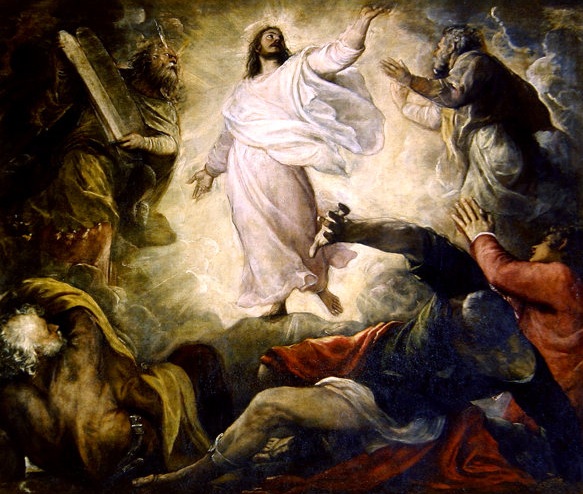
The second Sunday of Lent always features the Transfiguration. The first reason for this is that the trek up Mt. Tabor was one of the stops Jesus Himself made with Peter, James, and John on His final journey to Jerusalem. It is commonly held that Jesus did this to prepare His apostles for the difficult days ahead. There’s a line from an old spiritual that says, “Sometimes I’m up, sometimes I’m down, sometimes I’m almost to the ground … but see what the end shall be.” And this is what the Lord is doing here: He is showing us what the end shall be. There is a cross to get through, but there is glory on the other side.
There also seems a purpose in placing this account here in that it helps describe the pattern of the Christian life, which is the Paschal mystery. For we are always dying and rising with Christ in repeated cycles as we journey to an eternal Easter (cf 2 Cor4:10). This gospel passage shows forth the pattern of the cross in the climb, the rising, and in the glory of the mountaintop; then it is back down the mountain again, only to climb another one (Golgotha) and through it find another glory (Easter Sunday). Yes, this is the pattern of the Christian life: the Paschal mystery. Let’s look a little closer at three aspects of today’s gospel passage.
I. The Purpose of Trials – The text says, Jesus took Peter, John, and James and went up the mountain to pray. We often pass over the fact that they had to climb the mountain, and the climb was no easy task. Anyone who has been to Mt. Tabor knows just what a high mountain it is. The climb to the top is almost 2000 feet, and steep as well. It would have taken the better part of a day and probably had its dangers. Looking down from the top is like looking from an airplane window out on the Jezreel Valley (a.k.a. Megiddo or Armageddon).
So here is a symbol of the cross and of struggle. The climb was up the rough side of the mountain; it was exhausting, difficult, and tested their strength.
I have it on the best of authority that as they climbed they were singing gospel songs like these: “I’m comin’ up on the rough side of the mountain, and I’m doin’ my best to carry on!” and “My soul looks back and wonders how I got over!” and “We are climbing Jacob’s ladder, every round goes higher, higher.”
This climb is reminiscent of our life. We have often had to climb, to endure, and to have our strength tested. Perhaps it was the climb of earning a college degree. Perhaps it was the climb of raising children, or building a career. What do you have that you really value that did not come at the price of a steep climb, of effort, and of struggle?
Most of us know that though the climb is difficult there is glory at the top if we but persevere. Life’s difficulties are often the prelude to success and greater strength.
Though we might wish that life had no struggles, it would seem that the Lord intends a climb for us. For the cross alone leads to true glory. Where would we be without some of the crosses in our life? Let’s ponder some of the purposes of problems in our life.
1. God uses problems to DIRECT us. Sometimes God must light a fire under you to get you moving. Problems often point us in a new directions and motivate us to change. Is God trying to get your attention? Sometimes it takes a painful situation to make us change our ways. Proverbs 20:30 says, Blows and wounds cleanse away evil, and beatings purge the inner most being. An old gospel song speaks of the need for suffering to keep us focused on God: “Now the way may not be too easy. But you never said it would be. ‘Cause when our way gets a little too easy, you know we tend to stray from thee.” It’s sad but true: God sometimes needs to use problems to direct our steps toward Him.
2. God uses problems to INSPECT us. People are like tea bags; if you want to know what’s inside them just drop them into hot water! Has God ever tested your faith with a problem? What do problems reveal about you? Our problems have a way of helping to see what we’re really made of. Through trials, I have discovered many strengths I never knew I had. There is a test in every testimony. Trials have a way of purifying and strengthening our faith as well as inspecting it to see whether it is really genuine. 1 Peter 1:6 says, In this you greatly rejoice, though now for a little while you may have had to suffer grief in all kinds of trials. These trials are only to test your faith, to see whether or not it is strong and pure.
3. God uses problems to CORRECT us. Some lessons we seem to learn only through pain and failure. It’s likely that when you were a child your parents told you not to touch the hot stove. But you probably really learned by being burned. Sometimes we only realize the value of something (health, money, a relationship) by losing it. Scripture says. It was good for me to be afflicted so that I might learn your decrees (Psalm 119:71-72), and Before I was afflicted, I strayed. But now I keep you word (Psalm 119:67).
4. God uses problems to PROTECT us. A problem can be a blessing in disguise if it prevents you from being harmed by something more serious. A man was fired for refusing to do something unethical that his boss had asked him to do. His unemployment was a problem for him and his family, but it saved him from being sent to prison a year later when management’s actions were discovered. In Genesis 50:20 Joseph says to his brothers, You intended to harm me, but God intended it for good to accomplish what is now being done, the saving of many lives.
5. God uses problems to PERFECT us. Problems, when responded to correctly, are character-building. God is far more interested in your character than your comfort. Romans 5:3 says, We can rejoice, too, when we run into problems and trials, for we know that they are good for us they help us learn to be patient. And patience develops strength of character in us and helps us trust God more each time we use it until finally our hope and faith are strong and steady. And 1 Peter 1:7 says, You are being tested as fire tests gold and purifies it and your faith is far more precious to God than mere gold; so if your faith remains strong after being tried in the fiery trials, it will bring you much praise and glory and honor on the day of his return.
So the climb symbolizes the cross, but after the cross comes the glory.
II. The Productiveness of Trials – The text says, While he was praying his face changed in appearance and his clothing became dazzling white. And behold, two men were conversing with him, Moses and Elijah, who appeared in glory and spoke of his exodus that he was going to accomplish in Jerusalem. Peter and his companions had been overcome by sleep, but becoming fully awake, they saw his glory and the two men standing with him. As they were about to part from him, Peter said to Jesus, “Master, it is good that we are here; let us make three tents, one for you, one for Moses, and one for Elijah.” But he did not know what he was saying. While he was still speaking, a cloud came and cast a shadow over them, and they became frightened when they entered the cloud. Then from the cloud came a voice that said, “This is my chosen Son; listen to him.”
All the climbing has paid off. Now comes the fruit of all that hard work! The Lord gives them a glimpse of glory! They get to see the glory that Jesus has always had with the Father. He is dazzlingly bright. A similar vision from the Book of Revelation gives us more detail:
I turned around to see the voice that was speaking to me. And when I turned I saw seven golden lampstands, and among the lampstands was someone like a son of man, dressed in a robe reaching down to his feet and with a golden sash around his chest. The hair on his head was white like wool, as white as snow, and his eyes were like blazing fire. His feet were like bronze glowing in a furnace, and his voice was like the sound of rushing waters. In his right hand he held seven stars … His face was like the sun shining in all its brilliance. When I saw him, I fell at his feet as though dead. Then he placed his right hand on me and said, “Do not be afraid. I am the First and the Last. I am the Living One; I was dead, and now look, I am alive for ever and ever! And I hold the keys of death and Hades” (Rev 1:12-17).
Yes, all the climbing has paid off. Now comes the glory, the life, the reward for endurance and struggle. Are you enjoying any of the fruits of your crosses now? If we carried our crosses in faith, they have made us stronger and more confident. Some of us have discovered gifts, abilities, and endurance we never knew we had. Our crosses have brought us life!
The other night I went over to the church and played the pipe organ. It was most enjoyable, but it was the fruit of years of hard work.
Not only have my own crosses brought me life, but the crosses of others have done the same for me. I live and work in buildings that others scrimped, saved, labored to be able to erect. I have a faith that martyrs died to hand on to me and that missionaries journeyed long distances to proclaim. See, trials do produce; enjoy it!
Paul says that this momentary affliction is producing for us a weight of glory beyond all compare (2 Cor 4:14). And in Romans he says, For I consider that the sufferings of this present time are not worth comparing with the glory that is to be revealed to us (Rom 8:18).
An old gospel song says, “By and by, when the morning comes, and all the saints of God are gathered home, we’ll tell the story, of how we’ve overcome. And we’ll understand it better, by and by.”
So the glory comes after the climb. This is the life that comes from the cross. This is the Paschal mystery: Always carrying about in our selves the dying of Christ so also that [the rising of Christ] the life of Christ may be manifest in us (2 Cor 4:10).
III. The Pattern of Trials – The text says, After the voice had spoken, Jesus was found alone. They fell silent and did not at that time tell anyone what they had seen.
Notice that although Peter wants to stay, Jesus makes it clear that they must go down the mountain and then walk a very dark valley to another hill: Golgotha. For now, the pattern must repeat. The cross has led to glory but more crosses are needed before final glory. An old spiritual says, “We are climbing Jacob’s ladder … every round goes higher, higher, soldiers of the cross!”
Yes, this is our life: Always carrying about in our selves the dying of Christ so also that [the rising of Christ] the life of Christ may be manifest in us (2 Cor 4:10).
There are difficult days ahead for Jesus and the apostles, but the crosses lead to a final and lasting glory. This is our life, too: The Paschal mystery, the pattern and rhythm of our life.
Here is a rendition of the song We Are Climbing Jacob’s Ladder. The lyrics say that “every round goes higher, higher!” One can picture a spiral staircase as each round is pitched higher and higher musically. For this is the pattern of our life: we die with Christ so as to live with Him. And each time we come back around to the cross, or back around to glory, we are one round higher and one level closer to final glory.
There was a movie that came out in 1999 called Blast from The Past. The movie begins in the early 1960s at the height of the Cuban Missile Crisis. An eccentric man and his pregnant wife have built an elaborate fallout shelter underground in their backyard. It is no ordinary bomb shelter, but a large, well-stocked one that has many amenities, including the ability to grow food and raise fish.
When a plane crashes nearby, they think that the country is under attack and that an atomic bomb has hit. They run into the shelter and lock it behind them, setting the automatic locks not to open for 35 years when the radiation will have dissipated.
During this time the wife gives birth to their son, Adam, whom they raise in the shelter. Adam receives the usual education one would expect for the time, with a strong emphasis on reading, writing, arithmetic, and history. He also obtains a liberal arts college education from his father, who had been a professor. This education included learning Latin, Greek, French, and German. Adam also learns the social skills of that time such as basic manners, the proper treatment of a lady, ballroom dancing, and the meaning of life. He is also raised to reverence God.
In a way the family was frozen in time and preserved the value of the early 1960s. The film does not present that era as being flawless: the mother has a bit of a drinking problem and the father is rather eccentric and xenophobic.
Suddenly it is 1997 and the locks open. The family makes its first excursion out into the world since the bomb (supposedly) went off. The father expects to find that those who survived will show the effects of radiation poisoning and that the world will manifest many signs of the destruction the bomb surely wrought. So they go forth from the shelter cautiously.
Now, you and I know that no atomic bomb did go off. Or did it?
As they emerge from the bomb shelter, they see that their once quaint neighborhood has become a red-light district. They see shocking things: not only prostitutes and adult book stores, but also drug addicts, trash-filled streets, and signs of grave disorder. People are coarse in their behavior. The family runs back into the shelter, concluding that things are even worse than they had expected. They send their son Adam out to get provisions and possibly find a wife (if he can locate a woman who has been less affected by the “radiation”). Then they will once again throw the locks on the shelter and wait for things to improve on the outside before venturing out again, lest they be poisoned by it all. In the following scene, Adam emerges from the shelter and encounters a drug addict who thinks Adam is God. Adam proceeds farther and sees things and people outside for the first time.
As Adam goes forth, he discovers that beyond the red-light district there are other less-devastated areas, but he still struggles with what he experiences. Families seem to be in disarray; people are coarse, cynical, and use God’s name in vain. The technology amazes him, but so do simple things like rain, the open sky, and the ocean. In this scene he is troubled by some modern cultural trends, but then is overwhelmed with awe upon seeing the ocean for the first time:
As the movie progresses, it becomes quite clear that much has been lost. Adam is head and shoulders above the modern people who surround him. He is kind, respectful, polite, and innocent in his interpretation of the world. He is much better educated than those around him as well, having amassed quite an encyclopedic knowledge in comparison. In the following scene, two things are illustrated: Adam’s superior education and his coming to grips with modern technology. How can a computer (a giant thing in his world) be inside a house?
And Adam can dance, really dance! It’s not the gyrating that is common on modern dance floors but 1940s swing, flawlessly executed, which is natural to him due to the daily training he received from his parents. Here is a dance scene showing that although dancing was a little risqué even back then, it still required training and talent. Pardon some of the language in this clip, but remember that the coarsening of culture is what is on display here.
Adam is befriended by a young lady named Eve and her brother. At first they think Adam to be strange and naive but come to discover that he has much to teach them. In this scene, they ponder something he has taught them about graciousness, kindness, and the blessing of strong family ties.
This movie is well worth seeing. Unlike me, it is not “preachy.”It gently suggests to us that we have lost some important things in the past 50 years or so: things like kindness, optimism, the value of traditional education, and the importance of parents teaching and raising their children. In many ways the movie intimates that we have become coarse and cynical—even vulgar. Family ties have often been severed and our culture has melted down to a more base level. Education is less thorough and broad. Simple things like learning to dance have been lost.
As I have already said, the early 1960s was not a perfect time. Many troublesome cultural trends were already well underway. These do not go unreported in the movie. But still the point remains: some things of great value have been lost. The family entered the shelter at the end of an era; when they emerge they step out of the past and are bewildered by what they find. Technology is impressive, but people seem lost and cynical. The world is hostile and disordered. Adam brings with him out of the shelter some healing balm, some of the best virtues of the past to remind us all that we have lost some important things along the way.
A bomb did go off—not an atomic bomb, but an even more devastating, cultural one. Rebuilding will take time.
Last Sunday, we read the passage from the Gospel of Luke about the testing of Christ in the desert by Satan. In his Summa Theologica, St. Thomas Aquinas makes some interesting observations. He treats the temptations as having occurred in an escalating manner; he also connects Christ’s experience to that of Adam in the Garden of Eden.
St. Thomas writes,
Thus, too, did the devil set about the temptation of the first man. For at first he enticed his mind to consent to the eating of the forbidden fruit, saying (Genesis 3:1), “Why hath God commanded you that you should not eat of every tree of paradise?” Secondly [he tempted him] to vainglory by saying, “Your eyes shall be opened.” Thirdly, he led the temptation to the extreme height of pride, saying, “You shall be as gods, knowing good and evil.”
This same order did he observe in tempting Christ. For at first he tempted Him to that which men desire, however spiritual they may be—namely, the support of the corporeal nature by food. Secondly, he advanced to that matter in which spiritual men are sometimes found wanting, inasmuch as they do certain things for show, which pertains to vainglory. Thirdly, he led the temptation on to that in which no spiritual men, but only carnal men, have a part—namely, to desire worldly riches and fame, to the extent of holding God in contempt (Summa Theologica III, 41.4).
Notice the escalating quality of the temptations. There is the baser temptation of the body. Then there is the temptation of the psyche with its interest in interpersonal relationships. Finally, there is the highest temptation, which attacks our relationship with God.
Let’s look at each in more detail.
The first (and most base) temptation is one of the body.It seeks to destroy the proper relationship of a person with his or her own soul and body. Jesus is tempted to consider eating bread, which was forbidden because the Holy Spirit had led Him to fast. Adam is bodily tempted by the offer of fruit, forbidden to him by God. But the fruit seems to Adam and Eve as: good for food, and [that it was] a delight to the eyes (Gen 3:6).
To us, too, come temptations to gratify the faculties of the body and our baser passions. These sorts of temptations seek to destroy the right relationship we need to have with our bodies and with the physical world of creation.
The second temptation attacks the intellect through an appeal to vainglory. Satan says that if Jesus will worship him, it will be granted to Him that all nations will glorify Him and He will have authority over them (Lk 4:6). Similarly, Adam is told, Your eyes shall be opened (Gen 3:5).
These sorts of temptations appeal to our excessive pride, encouraging us to seek things that are beyond us and to esteem ourselves more than we ought. We also have a tendency to seek fame and the praise of other men. This distorts the proper and well-ordered sense of ourselves as well as our relationships with others; we inordinately seek their praise and, even more darkly, desire to have power over them.
The third and highest temptation is one that attacks our soul and its proper relationship with God. It seeks to have us hold God in contempt. Satan tells Jesus to cast Himself recklessly from the highest pinnacle and thereby sinfully presume that God will rescue Him no matter what He does. Similarly, Adam and Eve are told, You will be as gods (Gen 3:5). Adam is tempted to hold God in contempt by sinfully presuming that he is God’s equal or rival.
We, too, are tempted to trivialize God and to hold Him in contempt by disregarding His warnings about the inevitable consequences of serious and unrepented sin, and by substituting our own notions over and against His truth. We think we have a better understanding of justice than He does and that His warnings about sin can be lightly set aside, that He will save us no matter how blatant our rejection of His plan.
Thus we see how the temptations of Adam and Jesus (and us) are not simply three categories of temptation, but a sequence that escalates in seriousness.
For us, the lesson is clear: as we allow baser temptations to take hold, more serious temptations aimed at our higher faculties also set in. As we give way to these lower sinful desires, our intellect becomes darkened and our will weakened. And as the intellect and will are attacked, so also is our relationship with God. With the mind and will wounded by baser bodily desires, the higher things of God seem more difficult and we can become contemptuously dismissive of His teachings and of our need for His grace and mercy.
It is a threefold, escalating attack of which we must be aware. Heed the wisdom of Scripture, as explained by St. Thomas!
My blog is usually posted in the evening at about 21:00 (9:00 PM) U.S. Eastern Time. But in Sydney, Australia, it is 1:00 in the afternoon of the following day. As I prepare for bed, they are eating lunch on a day that has not even begun for me. And proceeding farther west from there, in the Philippines and Japan the afternoon is winding down and the workday is coming to an end!
Time. What could be simpler than for me to look at the clock and say that it is 9:00 PM on Wednesday, February 17th? But on the other hand, what could be more mysterious? Time is a human reckoning of a mysterious passage.
And yet the mystery is also beautiful. At any given time, some people are asleep in the night, while others are at midday. There is a wonderful verse in an old English hymn that says,
The sun that bids us rest is waking Our brethren ‘neath the western sky, And hour by hour fresh lips are making Thy wondrous doings heard on high.
Here are two other beautiful verses from the same hymn:
We thank Thee that thy Church unsleeping, While earth rolls onward into light, Through all the world her watch is keeping, And rests not now by day or night.
As o’er each continent and island, The dawn leads on another day, The voice of prayer is never silent, nor dies the strain of praise away.
Magnificent lines! The hymn contains a beautiful and poetic description of the Church: always praising, always sighing, always at worship. Although some are asleep, the praises continue. One of the Psalms says, Let the name of the Lord be praised, both now and forevermore. From the rising of the sun to the going down of the same, the name of the Lord is to be praised. The Lord is exalted over all the nations (Psalm 113:2-4). The praises never end, for the sun is always rising somewhere even as it is setting somewhere else.
Malachi, prophesying the glory of the Mass celebrated worldwide says, My name will be great among the nations, from the rising to the setting of the sun. In every place incense and pure offerings will be brought to my name, because my name will be great among the nations,” says the LORD Almighty (Mal 1:11). At any given time, Mass is surely being offered somewhere on this earth. The Liturgy of the Hours, too, always uttering forth from the lips of the faithful somewhere. Yes, in the mystery of time, this planet of ours is a place of perpetual praise. And our praises join the perpetual praises of Heaven, for as the Liturgy proclaims (in the words of the new translation), And so, Angels and Archangels, with Thrones and Dominions, and with all the host and Powers of heaven, as we sing the hymn of your glory, without end we acclaim: Holy, Holy, Holy Lord God of hosts …
Yes, the mystery of time and our praises caught up in the ever moving sweep of time. What St. Paul says to us as individuals is fulfilled by the worldwide Church. His advice is so simple and yet so profound. St. Paul says, Pray always (1 Thess 5:17).
Here is a rendition of the entirety of the hymn (The Day Thou Gavest, Lord, is Ended) that was quoted above. The complete lyrics are available here: The Day Thou Gavest.
With the renewed interest in demonology, Jesus’ instruction that demons must be driven out with prayer and fasting (cf Mk 9:29, Matt 17:21) is frequently quoted. And many people are acquainted with this text in this form.
But a problem emerges for some people when they go to their Bible to look up those texts. Some Bibles include the reference to fasting while others do not. For example, the two most common Catholic Bibles, the Revised Standard Version Catholic Edition (RSVCE) and the Revised New American Bible (RNAB), render Mark 9:29 differently.
This kind cannot be driven out by anything but prayer and fasting (RSVCE).
This kind can only come out through prayer (RNAB).
And in Matthew 17:21, which recounts the same incident that Mark 9:29 does, prayer and fasting aren’t mentioned at all in either the RSVCE or the RNAB version. Older Bibles such as the Douay Rheims (DR) and the King James (KJV), however, do:
But this kind is not cast out but by prayer and fasting (DR).
Howbeit this kind goeth not out but by prayer and fasting (KJV).
So what is going on here?
The ancient Greek manuscripts of the New Testament are remarkably consistent, especially considering that they were handwritten by scribes, who might accidentally skip or misspell a word. But there are some discrepancies. Most textual variations are easily resolved by comparing several ancient manuscripts to identify misspellings and/or dropped words. There are some variations, however, that are not as easily resolved, especially when it is a case of one erroneous manuscript being copied numerous times and distributed. But even in that situation, a little detective work can usually find the root problem and distinguish between an erroneous text and a correct one.
But there are times when certain textual variations cannot be resolved and biblical scholars either do not agree or cannot be certain as to which is the most authentic version. Mark 9:29 is one of those texts. Some ancient manuscripts include the words “and fasting” (και νηστεια) while others do not.
For the benefit of the technocrats who are reading this, the following manuscripts support the translation that includes both fasting and prayer: P45vid ℵ2 A C D K L N W Γ Δ Θ Ψ ƒ1,13 28. 33. 565. 579. 700. 892. 1241. 1424. 2542. ℓ 2211 ???? lat syh co (sys.p boms). These ancient manuscripts, however, support the translation that does not include fasting: ℵ B 0274 k.
While the manuscripts that favor including fasting are far more numerous, it is not necessarily a question of mere numbers. This is because not all ancient manuscripts are considered to be of equal value. Most modern scholars favor the translation that excludes the reference to fasting because the manuscripts that do not mention it are ones that they weight more heavily. So even though many manuscripts do include the words “and fasting,” the earliest and “best” manuscripts do not include it. Critics of this current consensus view object to the presumption that fasting reflects a later concern of the Church. They also think that the most common “go-to” source (Metzger’s A Textual Commentary on the Greek New Testament) has been too influential. Welcome to the wonderful world of biblical textual criticism (analysis)!
The issue with Matthew 7:21 being wholly lacking in most modern Bibles has a similar explanation, though in this case the consensus is even stronger because the oldest and best Greek manuscripts lack the verse. And even those manuscripts that do, seem to show it in the margins as more of a side comment or a reference back to Mark 9:29.
So, all of this goes toward explaining why some of our modern Bibles report Jesus as saying that certain types of demons must be driven out by “prayer and fasting,” while others simply say “prayer.”
But is this just an academic exercise? What are there pastoral considerations?
The main pastoral (and liturgical) question would seem to be this: “Is fasting required to drive out demons or not?” The ambiguity of the textual evidence (as described above) allows that reasonable people may differ as to whether strict fasting is required and to what extent it is helpful. There are certain considerations to be made.
Even if certain demons are best driven out by prayer and fasting, we must never forget that it is God who drives out demons, and He doesn’t need our fasting to do so. Any prideful notions about the effects of our fasting should be strictly avoided.
Indeed, we ought to have a kind of humility regarding fasting. Fasting is certainly recommended, and the Lord Himself says that there is a time for fasting (cf Mk 2:20, Luke 5:35). But fasting can also be a source of pride (Lk 18:12, Lk 5:33). Fasting done out of pride or superiority isn’t going to drive out any demons; in fact it will likely attract them.
In longer exorcisms (which can go on for months), fasting may need to be mitigated or else assigned to members who are not part of the team directly involved in the exorcism. Physical strength is often needed to withstand the grueling work of major exorcism.
With such precautions in mind, and in spite of the textual variations in the “prayer and fasting” text of Scripture, the instinct of the Church is that casting out demons is best assisted by both prayer and fasting. The current Rite of Exorcism (2004) says,
The Exorcist, mindful that the tribe of demons cannot be cast out except through prayer and fasting, should take care that these two most effective remedies for obtaining divine help be used, after the example of the Holy Fathers, both by himself and by others, insofar as is possible (De Exorcismis # 31).
The Older Rite (1614) also advises,
Therefore, he will be mindful of the words of our Lord (Mt. 17:20), to the effect that there is a certain type of evil spirit who cannot be driven out except by prayer and fasting. Therefore, let him avail himself of these two means above all for imploring the divine assistance in expelling demons, after the example of the holy fathers; and not only himself, but let him induce others, as far as possible, to do the same (De Exorcizandis # 10).
Why or how does fasting add power to prayer? One reasonable (and biblical) answer is that prayer and worship should generally involve sacrifice. Scripture says,
Understand these things, you that forget God; lest he snatch you away, and there be none to deliver you. The sacrifice of praise shall glorify me: and there is the way by which I will show him my salvation, says the Lord (Psalm 50:22-23).
Through him then let us continually offer up a sacrifice of praise to God, that is, the fruit of lips that acknowledge his name. Do not neglect to do good and to share what you have, for such sacrifices are pleasing to God (Heb 13:15-16).
You shall observe the Feast of Unleavened Bread … And none shall appear before Me empty-handed. Also you shall observe the Feast of the Harvest of the first fruits of your labors (ex 23:15-16).
There has developed in Western world the strange notion of worship and praise without sacrifice. In many sectors, worship has devolved to little more than a form of entertainment, wherein the whims and preferences of the faithful are expected to be catered to. Worship, by this notion, should be brief and should take place in comfortable, air-conditioned churches with padded pews and convenient parking. The “message” and liturgy should not be intellectually or morally challenging; rather they should be encouraging and pleasing. The music and “style” of liturgy should meet the preferences of those assembled.
Missing in all of this is the concept that liturgy and prayer should involve sacrifice, that they should “cost” us something. Yet Scripture clearly links prayer and sacrifice and indicates that they should, to some degree, be found together. Sacrifice is a way of establishing greater sincerity in, and integrity to, our worship. Indeed, worship without sacrifice too easily becomes lip service or turns God into a kind of divine butler, whom we expect to wait on us. God surely does supply our needs but He is no butler; He is God, who is worthy of our worship and the sacrifice of praise.
It is in this sense that prayer and fasting belong together, especially in the difficult work of driving out demons. Prayer and fasting become the sacrifice of praise that confounds and disturbs the evil one to no end. Scripture says, And now my head shall be lifted up above my enemies all around me, for I will offer in his tent sacrifices of praise with shouts of joy; I will sing and make melody to the LORD (Psalm 27:6).
It is the instinct of the Church that prayer is good, but that prayer with sacrifice (fasting is sacrificial) wins through, especially in that most difficult work of expelling demons and repelling the enemy.
The question of how best to translate Mark 9 and Matthew 17 is a legitimate one. But the long experience of the Church ought not to be neglected. And experience teaches plainly enough that as a general norm,
This kind cannot be driven out except by prayer and fasting (Mk 9:29).
truth word in mixed vintage metal type printing blocks over grunge wood
The following three nuggets of wisdom come from Ecclesiastes and are especially appropriate for those of us who engage and struggle with our troubled culture. They can help us to keep things in perspective.
Do not in spirit become quickly discontented, for discontent lodges in the bosom of a fool (Eccl 7:9).
We certainly do live in times that challenge our sense of well-being. There is much to lament in these times: broken families, confused sexuality, secularism, and growing hostility to the teachings of our holy faith.
And yet we must not yield to the temptation to become too sour. As the proverb says, we ought not to become too “quickly discontented.”
At the center of every Christian heart should be a deep and abiding gratitude to God for his many—indeed countless—gifts. Every life, every family, every community, every culture, and every nation experiences a mixture of many beautiful blessings along with struggles and hardships.
The proverb here warns us against “discontent,” a word that is derived from the Latin continere, meaning to contain or hold. Thus to be discontented is to refuse to hold within us the joy and gratitude that we ought to have for so many rich blessings, even in the midst of difficulties.
Every day, trillions of things go right and only a handful go wrong. It is no exaggeration to speak of “trillions” of things going right when we consider that every aspect of every cell within our body, every molecule that makes up every cell, and every atom that makes up every molecule are all functioning by the grace of God.
And beyond our bodies is a vast ecosystem with myriad complex interactions such as photosynthesis enabling plants to produce oxygen for us to breathe, the Gulf Stream moderating our temperature, the Van Allen belts protecting us from the harmful radiation of the sun, Jupiter and Saturn out there catching comets, and the Earth carefully maintaining its nearly circular orbit thus keeping the temperature change between the seasons relatively small. Our sun remains stable, unlike many other stars, and we live in a relatively quiet section of the Milky Way galaxy, largely free from the space debris that flies about in most other areas.
And troubled though America is, people are still (literally) dying to get here. Our roads are paved and we have a reliable electrical grid, a stable government, and a good market system.
We ought to be filled with immense gratitude as well as wonder and awe at the countless blessings that God bestows on us from moment to moment.
To become quickly discontented, or worse, to allow discontent to lodge in our hearts, is deeply foolish. First of all, it is foolish because it is so myopic. Refusing to see or to reflect frequently on our manifold blessings is a kind of self-imposed blindness.
Consider a rich man who thinks himself poor. Only a fool would close his eyes and refuse to see the millions he actually has in the bank. Why live as a poor man, always running from creditors? A man with such resources who believes he is poor must be blind, a fool, or both.
And this is true for us, who have so many blessings. How easily we become discontented and negative!
Thus, even though there are things about which we must be very sober, there are many others about which we must be exuberantly joyful. If we don’t maintain this balance we are, as the proverb says, foolish.
Do not say: How is it that former times were better than these? For it is not in wisdom that you ask about this (Eccl 7:10).
This is an important caution for those of us who lament the current times and compare them unfavorably to the past. We tend to look back at previous decades and see them as more idyllic than they actually were. All ages have struggles particular to them, but they have blessings too. Some look to the 1950s with nostalgic affection but they forget the nuclear arms race, the Korean War, and the Cold War. The 1940s had the Second World War. The 1930s had the Great Depression. The 1920s were a time of rather widespread immorality and a great deal of organized crime. The 1910s had the First World War. The decade of the 1900s was a time of great economic recession; waves of immigrants were often made to live and work in horrifying conditions. One could continue pointing out the problems in every decade going backward in time. But each of these decades also had its blessings.
Regardless of how the struggles and strengths of the present day compare to those of the past, we are living now. Accept your assignment with humility and seek to influence positively the many difficulties we currently face. And do not fail to be grateful for the many blessings we have today: advanced medicine, high technology, and numerous creature comforts that make life a little more pleasant.
Be actively grateful and gratefully active.
Finally, then, comes the following counsel from Ecclesiastes, which is particularly appropriate during Lent as we ponder the essential goal of our life:
The last word, when all is heard: Fear God and keep his commandments, for this is man’s all; because God will bring to judgment every work, with all its hidden qualities, whether good or bad (Eccl 12:13).
Yes, look to your own impending judgment. Have a healthy fear of God and a sober appreciation of the fact that judgment awaits us all. Prepare for your own judgment and help others to prepare for theirs, insofar as it is your duty to remind and prepare them.
If you have suffered injustice or if you grow weary of these sinful times, remember that God sees all. Others will answer to God for what they have done if they have not repented. Pray that they do repent, for nothing will be unrequited and every idle word will have to be accounted for (see Mat 12:36).
Do not delay your own repentance, either. Tomorrow is not promised, but judgment is.
Jesus our Judge says, For there is nothing hidden that will not be disclosed, and nothing concealed that will not be known or brought out into the open. Therefore consider carefully how you listen (Luke 8:17-18).
Jesus gets the last word!
This video is an allegory of a woman who rejects the offer of truth and order. Truth offers his friendship to her. After being rejected, he warns her, admonishes her, and offers it to her again. But the woman’s rejection of truth persists and great is her ruin.
We live in largely skeptical times, steeped in a relativism, in which many scoff at the idea that we can know the truth or even that there is a truth to be known. Never mind that in so doing they are in fact making a truth claim of their own! But the ability to perceive one’s own logical inconsistencies is not is not a common trait these days.
Nevertheless, despite the tenor of our times, it does not follow that we should overcorrect by declaring certainty about everything, or even most things, we know. Illusion remains a pervasive human problem. And, as we shall see, illusion is more of a moral problem than an epistemological one. The problem of illusion does not mean there is no truth to be found or known; rather, it means that the human mind, and will wounded by sin have a tendency to entertain illusion.
The word “illusion” comes from the Latinin + ludere (to play games or mock), thus “to engage in games or play.” And so illusion is, by extension, a manner in which one tries to trick another, as in optical illusions or magic tricks. But internally, illusion is our own tendency (conscious or unconscious) to play games with ourselves, to play loosely with the facts, to indulge in logical gamesmanship or even entertain outright foolishness.
We are masters at this game. We can lie to ourselves for so long that we no longer even realize that we’re doing it. Yes, our minds are very wily. So easily our greatest strength and gift—our mind—can become the source of our greatest flaws. We can rationalize some of the most awful things by cloaking them in euphemisms and explanations that obfuscate rather than elucidate. Abortion becomes “reproductive choice,” lying becomes “mental reservation,” euthanasia becomes “death with dignity,” mutilation becomes “sexual reassignment surgery,” etc.
And then there are the smaller the illusions that apply to our daily lives. Fr. Thomas Dubay described some of these as follows:
If illusion means unrealized, possibly sincere, even enthusiastic error, there is far more of it in each of our lives than we are prepared to admit. All the way from our petty vanities to suppositions about our motivations, we are subject to all sorts of misjudgments concerning the way things are. There are the illusions of exaggerated self-esteem and its opposite, a weak self-image. There are the hundreds of illusory desires of which St. Paul speaks in Ephesians 4:22, desires for things we imagine we need. There are our illusory fears of things we ought not at all to fear (“What will they think of me? How will I look?”) and the illusory non-fear of things we ought dreadfully to fear. There are the many misjudgments of what is important in life and what is trivial—and who, if he be less than a saint does not err in these judgments many times each day? (Authenticity p. 35)
But where does this tendency toward illusion come from? Although our intellects are darkened by Original Sin and the cumulative effects of personal sin, illusion is more than just an intellectual problem. The roots of illusion are much deeper, in the center of the human person. Though we may not like to admit it, careful analysis shows that illusion and our tendency to entertain error stem fundamentally from sin. Illusion is something that, to some degree, we will; we decide to engage in it as a tactic. In most cases we don’t really want to know the full story or all the facts, or else we are simply too lazy to seek the complete truth.
To illustrate that illusion is more a problem of the will than a failure of our perception, Fr. Dubay uses the following example in his essay (Authenticity, p. 36): One sees a fruit tree in the distance with round, red fruits hanging in its branches. Upon seeing this tree, one might remark to the person standing next to him, very often in a hasty way, that it is clearly an apple tree. But of course it could actually be a plum tree. Rarely will someone humbly admit or say, “It could be an apple tree, but I’m not sure, so I’ll need to get a closer look.”
Our tendency is to draw a conclusion quickly, based only on limited evidence, so that we appear to know what we’re talking about. So we say, “That is clearly an apple tree.” We may do this out of pride, or vanity (to look like Mr. Know-it-all), or simply because we’re lazy and it’s too much trouble to go get all the facts.
Of course this example features a small matter. But we take this tactic with much more significant matters as well. We will often make sweeping conclusions about other people’s motivations, significant events in the news, scientific matters, or geopolitical matters based on very little evidence or information. And then based only on this small amount of information we entertain the illusion that we quite certainly and comprehensively know what is actually going on, what everything means, and what exactly should be done (if only people would ask us). There’s an old saying, “Don’t believe everything you think.” But this doesn’t stop most of us from doing that most of the time!
Why do we do this? Some of the reasons have already been presented, but let’s list them again along with some others.
Haste (sloth) – It’s a lot easier to entertain the illusion that we know all the facts than to actually go out and find them. Certainly we have time limitations and cannot research everything completely, but that is all the more reason to resist the illusion that we know it all and to be more careful in drawing conclusions. We can and should make reasonable conclusions about the data we have, but we should also be open to receiving more information that may clarify or even challenge some of what we think we know. So it’s not a problem of the intellect per se, but of the will, influenced by sloth. We often decide to make hasty conclusions out of laziness.
Vanity – Not only do we like to entertain the illusion that we know everything, we want others to entertain it as well. Because of this we like to impress others with our perceived knowledge and are slow to admit ignorance. Here, too, entertaining this illusion is something we decide to do. Our will (and intellect) are weighed down by vainglory. Sometimes we delude ourselves unconsciously while at other times it is a more conscious effort. Seeking to perpetuate this exalted vison of ourselves we also advance other illusions and errors by sermonizing, opining, and declaring things of which we are not really all that certain. Thus one illusion begets another.
Social Ease – There is another form of sloth in which we pick up popular notions and simply parrot them. This usually wins us approval (more vainglory). We prefer to presume that popular notions are true rather than thinking things through more thoroughly and pondering whether they are true, or untrue, or perhaps need some distinctions applied. But all of this is just too much trouble; it also tends to put us out of favor with the many who would prefer that popular illusions not be challenged. And so we simply slip into the tendency to assume that popular ideas are true simply because most people think so. Behaving this way gives us a sense of social ease and helps us to feel safe even if, deep down, we know that a lot of it is illusion.
Preference for lies (fearing the truth) – The truth tends to challenge us in ways that lies do not. Illusion is often a form of simplification. The truth is usually much more complex. We prefer the simplification that illusion provides. Our fantasy world is easier to navigate (because it is of our own making) than the real world. The truth often challenges our simplified culture, addicted as it is to the sound bite. And thus we introduce all sorts of mental filters and other forms of illusion so that we can hide from the truth, water it down, or outright resist it.
Emotional satisfaction – It is generally easier (or at least more pleasing) to follow the whims of our emotions than to seek out hard facts. The truth might summon us to do something hard such as to resist what our emotions are demanding of us. Especially in this modern age, we live under the illusion that strong emotions, of themselves, convey truth. They do not necessarily do this at all. In fact, they may often be an overreaction of our psyche to the truth. Our passions and emotions have their place, but they can be very unruly and very deceptive.
We live in times in which many speak dreamily about the authority of emotions. Some will say, as if it were profound, “How can something that feels so good be wrong?” Others will claim that because some hard course of action might make someone feel sad or anxious means that that course of action should not be undertaken or insisted upon. Much of this is illusion because it exalts the lower faculties and would have them overrule (rather than be ruled by) the higher faculties such as the intellect and a properly disposed will.
Despite this, many people today prefer the dreamy illusions that emotions can supply. Moviemakers and advertisers know this well. A good tearjerker of a movie or a powerful song can confound reason and make us sympathize with the strangest causes. At the other end of the spectrum, advertisers often use fear to incite us to buy their products: you’re not pretty enough; you don’t drive the right kind of car; your hair is too gray; your life is somehow incomplete and you’re basically pathetic. Just buy our product and you’ll rise in the ranks and not be such a loser. Never mind that most of the fears incited are themselves illusions.
But that is just the point: emotionalism uses illusion to feel better even though illusion is part of the problem that drives excessive emotionalism. The solution is always more of the same: “More illusion please; the truth is mean and it hurts.”
So what is the solution? First it is essential to say that the solution is not to conclude that the truth cannot be known and that we are all somehow lost in illusion. We are equipped to know the truth and to come to love it. And because the problem is in our will more so than in our intellect, the solution is to make the decision to renounce our sinful tendency to indulge in illusion.
How do we do this? First and foremost, we love. If we learn to love God, by extension, we will learn to love His truth. When we love God we start to love the things and people He loves. We love our neighbor, but we also come to love the truth that God has set forth. We love what He loves: the truth that He has set forth in Sacred Scripture and Tradition. Out of love, we zealously seek the truth and joyfully embrace it more and more deeply.
This makes good sense because while we can be deceived, God cannot. His revealed truth is the surest and most certain source of truth. It is not admixed with error, nor is it trendy or changing. The solution to our foggy illusions is the clear light of God’s eternal and time-tested truth. And while some of us may entertain illusion even about God’s truth we cannot stay in this illusion for very long. The Lord teaches infallibly through His revealed Word, the testimony of the saints, and the Magisterium of his Church.
We suffer from illusions, but God does not. Love Him, run to Him, and listen to Him attentively as He speaks through His Word and His Body, the Church. Only this can save us from the fog of our illusions.
N.B. Many of the thoughts in this essay come from Fr. Thomas Dubay in his work Authenticity, cited above. The best thoughts in the essay are his; the inferior ones are mine.

 In the first reading of Mass on Sunday (the 2nd Sunday of Lent), we read,