Last week as we finished the Easter Cycle and crowned it with Pentecost. We also finished the lengthy reading of the Acts of the Apostles. There are two parts of the Acts of the Apostles: The Acts of Peter and those of Paul. But to be honest, the book has an unfinished quality to it. Let’s consider that.
First, a quick summary: The second part of Acts is focused on the evangelical mission of St. Paul as he made four journeys into Asia Minor and then into Greece. The final chapters of Acts deal with Paul’s arrest, imprisonment, and appearance before Roman officials (e.g., Felix and Festus, Herod Agrippa in Jerusalem and Caesarea).
Paul appeals his case to Rome and is sent there on an ill-fated journey that ends in shipwreck at Malta). After finally making it to Rome, Paul is imprisoned and awaits trial. The story seems to be building to a climactic conclusion, but then the story just ends! Here is the concluding line of the Acts of the Apostles:
[Paul] remained for two full years in his lodgings. He received all who came to him, and with complete assurance and without hindrance he proclaimed the kingdom of God and taught about the Lord Jesus Christ (Acts 28:30-31).
And that’s it. Acts just ends. But Luke, don’t just leave us hanging! Did Paul ever go on trial? Was he acquitted (as some traditions assert) and then made his way to Spain as he wanted? Or did he lose his appeal and suffer beheading right away? What was the outcome of the trial?
How can we answer this exasperating and unsatisfying end?
The simplest answer is that the Acts of the Apostles is not really about Paul. It’s about the going forth of the Gospel of Jesus Christ to all the nations. Luke chose to recount this going forth of the Gospel by focusing first on Peter and then on Paul.
Once Paul reaches Rome (and though under house arrest is able to freely preach the Gospel there) the story reaches its natural conclusion. While others had preached the Gospel in Rome before, Luke chose to illustrate the going forth of the Word of God through Paul’s activities, and so once Paul arrives there the goal has been accomplished. From the central hub of Rome, the Gospel would now radiate outward, by the grace of God, to every part of the Roman Empire.
But what about Paul’s fate? The answer is that it doesn’t matter. It never was about Paul; it was about the Gospel. Paul himself testified to this when he said, I consider my life worth nothing to me, if only I may finish the race and complete the task the Lord Jesus has given me—the task of testifying to the gospel of God’s grace (Acts 20:24).
We are often focused on personalities, and in so doing lose track of what is most important. Frankly, the person we are most focused on is often our own self. Acts never really was about Paul. And your life is not about you; it is about what the Lord is doing for you and through you. We often want things to revolve around us: around what we think and what we want. But truth be told, we are not all that important. We must decrease and the Lord must increase (Jn 3:30).
Some of these notions hit hard in today’s culture that is so focused on bolstering self-esteem. But in the end, our true glory is not our own; it is the glory of God radiating in us. If we decrease, the Lord increases. That does not mean that we are swallowed up and lost in Christ. Rather, it means that we truly become the man or woman God has always made us to be, one who reflects the very glory of God. Perhaps it is best to let Paul himself have the final word:
For we do not preach ourselves but Jesus Christ as Lord, and ourselves as your slaves for the sake of Jesus. For God who said, “Let light shine out of darkness,” has shone in our hearts to bring to light the knowledge of the glory of God on the face of (Jesus) Christ (2 Cor 4:5-6).
This video is a depiction of the conclusion of the Acts of the Apostles. The scene begins with Paul speaking to Jewish leaders in Rome. (Note that the epilogue, which shows Luke leaving Rome, is not part of the Acts of the Apostles.)
Some of you have heard the news that a local school board in Charlotte, North Carolina voted to eliminate the naming of valedictorians. The following appeared on FoxNews.com:
Citing what it calls “unhealthy” competition among students, the Wake County school board is the latest in the country to make valedictorians and salutatorians a thing of the past, The News & Observer of Charlotte reports. … [S]chool officials say singling out two people for their grade point averages just encourages students to take easy classes and to not help their classmates study.
It seems unlikely to me that there would be a lot of “competition” for just two slots. I think it’s more likely that 99% of the students would never even think they stood a chance and so would not engage in the competition described. Why work so hard for something that you’re not likely to get?
I graduated at the top of my class in Seminary and received a cash award (not a large one, I promise you) but it wasn’t as if I postured or took easy classes to get it. In fact, it never occurred to me that I would get a prize; I just studied hard because I enjoyed learning the faith.
Thus something tells me that the “explanation” offered by the school board is not the real reason. To quote an old Nat King Cole song, “Your story’s so touching, but it sounds just like a lie.”
Pardon me if I suspect old fashioned envy at work here. There are some who despise the fact that others excel because it makes them look worse by comparison. But such an attitude is classic envy: sorrow or sadness at the excellence of someone else because I take it to lessen my own.
Excellence is a beautiful thing, something to esteem and hold up before all. I would argue that it is yet another sign of the decline of our culture that we can’t seem to “tolerate” the celebration of excellence and achievement. Why is this? One reason is the tyranny of relativism. Another is obsessive, excessive concern for the feelings of others. But a more fundamental answer lies in the cardinal or deadly sin of envy.
What is envy? Most people today use the word as a synonym for jealousy. But traditionally, jealousy is not the same as envy.
When I am jealous of you, I want something that you have and wish to possess it, inordinately so. But the key point is that there is something good about you or something good you possess, which I want to have for myself.
In traditional theology, envy is quite different (cf. Summa Theologica, III IIae 36.1). Envy is sorrow, sadness, or anger at the goodness or excellence of someone else, because I take it to lessen my own. The key difference with envy is that (unlike with jealousy) I do not want to possess the good or excellence you have; rather, I want to destroy it.
Envy is diabolical – St. Augustine called envy the diabolical sin (De catechizandis rudibus 4,8:PL 40,315-316), because it seeks to minimize, end, or destroy what is good. Scripture says, By the envy of the Devil death entered the world (Wis 2:24). Seeing the excellence that Adam and Eve (made in the image of God) possessed, and possibly knowing of plans for the incarnation, the Devil envied Adam and Eve. Their glory lessened his, or so he thought, and he set out to destroy the goodness in them. Yes, envy is very ugly; it is diabolical.
The effect of the Wake County school board’s decision is to further suppress the praise of excellence. Excellence should be praised both for the gift that it is to the whole community as well as for the way it acts to encourage excellence in others! Decisions like this further minimize esteem for excellence and mute the encouragement of it.
Some will argue that academic excellence is but one sort of excellence. Is there not artistic excellence, emotional intelligence, and so forth? Certainly. Then find ways to honor those sorts of excellence as well. I paraded around my high school for three years sporting a “letter jacket” that broadcast my athletic excellence as part of the track and field team. The band issued “letter sweaters” to their best students.
Excellence is a blessing. I’m sorry if this implies that some are less excellent, but life is like that. Some people excel, some are also-rans, and some are even poor at certain things. (I never made the cut to become part of the math club but somehow I survived the blow to my ego.)
Count me among those who see the elimination of honors as another sign of an ailing culture. If we cannot honor excellence and achievement we have tipped our hat to what a great saint and learned man, St. Augustine, called a diabolical sin.
Is it too strong for me to say that Satan must be having a good laugh? When we are embarrassed or alarmed by excellence and even call it “unhealthy,” I can hear Satan gleefully crowing, “My perversion of them is almost complete. They are ashamed of their glory and they glory in their shame.”
In my over 26 years as a priest (even longer serving in some capacity at the Holy Liturgy) I have witnessed more than a few people faint. Some just slump over; others go out with a real bang. Weddings are a big source of fainting spells, but just about any long Mass produces its share of “lights out” experiences. Some years ago, when I was serving as First Assistant Deacon for a Pontifical Solemn High Mass in the Basilica, we predicted prior to the Mass that at least one person would pass out. It’s usually one of the torch bearers because they have to kneel on the marble for so long. Sure enough, right at Communion time, one of them went down, torch and all. It seems that such a Mass wouldn’t be complete if at least one person didn’t pass out!
In the warmer weather fainting spells are more common. Further, the height of wedding season is approaching. It might not be bad to ponder the topic of fainting.
OK, so what’s going on here? Are people overwhelmed by the presence of God and then they just “rest in the Spirit?” Well, that’s a fine and holy thought; perhaps I should just stop the article here! However, there are probably other explanations.
Dehydration – The heat in some churches can cause dehydration. Dehydration lowers blood volume, which causes blood pressure to drop and makes it harder to get the blood to the brain. And then out you go!
Anemia – Some women are borderline anemic, especially at certain times of their monthly cycle. This reduces the number of red blood and thus lowers the ability of the blood to deliver oxygen to the brain. And then out you go!
Stress – In order to maintain appropriate blood pressure, there must be a proper balance between two chemicals: adrenaline and acetylcholine. Adrenaline stimulates the body, including making the heart beat faster and making the blood vessels narrower, thereby increasing blood pressure. Acetylcholine does the opposite. Fainting can happen when something stimulates the vagus nerve and causes too much acetylcholine to be produced at the wrong time. Pain can do this; so can “situational stress” such as seeing blood or just the prolonged stress that often occurs at funerals and weddings. Such things cause too much acetylcholine, which slows the heart, dilates the blood vessels, and decreases blood pressure. Because of this, not enough blood reaches the brain. And then out you go!
Prolonged standing or kneeling – This can also cause the blood to collect in the lower legs. The movement of the blood back from the limbs is assisted by the movement of those limbs. I was always taught never to lock my knees when standing because this slows blood flow and makes blood accumulate in the legs. It is important when standing to bend your knees slightly in order to allow for some movement of the legs by shifting your weight. This improves circulation and keeps blood pressure at a proper level. If you don’t do that, then standing for long periods of time can result in more blood in the legs and less going to the brain. And then out you go!
Low blood sugar – In some cases, this can cause a person to faint. The brain requires blood flow in order to provide oxygen and glucose to its cells. Excessively low blood sugar can cause one to feel drowsy and weak, and in some cases to faint, especially if some of the other factors are present. Hence, if you have been fasting (rare today!) before Communion and also have a tendency to be hypoglycemic … out you go!
There are surely other causes of fainting (some of them very serious (though rare)), but let this list suffice. It would seem that Masses and other church services are overrepresented in the fainting department, due to any combination of the above factors.
It is surely a strange experience to faint. I have done so a number of times in the past, due to an asthmatic cough that I used to get. During an extreme coughing episode, the rhythm of the heart is disturbed, blood pressure drops, and then out you go. When I faint, everything seems to fade to black; the lights just go out. Sometimes I can even feel myself falling but can do little about it. I just hope I fall gracefully! I usually come to a moment or so later but it is a strange experience to say the least. The brain can only go without blood (oxygen) for a few seconds before unconsciousness ensues, and then out you go!
We are wonderfully, fearfully made, to be sure. And yet we are earthen vessels, fragile and in need of delicate balance. We are contingent beings, dependent upon God for every beat of our heart and every function of every cell in our body. Maybe fainting in Church isn’t so bad after all because it helps keep us humble—and that is always a good “posture” before God. Before the immensity of God, it is good to be reminded of our fragility and our dependence upon Him for all things, even the most hidden processes of our body.
Enjoy this video compilation of people fainting (many of them occurring in Church) and consider well that “To be absent from the body is to be present to God” (2 Cor 5:8).
Many of you know that I write the Question and Answer column for Our Sunday Visitor. Given the celebration of Trinity Sunday this past Sunday, I thought I might reproduce here on the blog a question/answer regarding the Trinity. It is a fairly common question; perhaps you have it, too. Remember that my answers in the column are required to be brief.
We read in a recent Sunday Gospel (May 1, 2016) that Jesus says that the Father is greater than He (Jn 14:28). Since we are all taught that each Divine Person of the Blessed Trinity fully possesses the nature of God, equally to be adored and glorified, what did Jesus mean by such a statement?” – Dick Smith, Carrolton, TX.
Theologically, Jesus means that the Father is the eternal source in the Trinity. All three persons of the Trinity are co-eternal, co-equal, and equally divine. But the Father is the Principium Deitatis (the Source in the Deity).
Hence, Jesus proceeds from the Father from all eternity. He is eternally begotten of the Father. In effect, Jesus is saying, “I delight that the Father is the eternal principle or source of my being, even though I have no origin in time.”
Devotionally, Jesus is saying that He always does what pleases His Father. Jesus loves His Father; He’s crazy about Him. He is always talking about Him and pointing to Him. By calling the Father greater, He says (in effect), “I look to my Father for everything. I do what I see Him doing (Jn 5:19) and what I know pleases Him (Jn 5:30). His will and mine are one. What I will to do proceeds from Him. I do what I know accords with His will.”
So although the members of the Trinity are all equal in dignity, there are processions in the Trinity, such that the Father is the source, the Son eternally proceeds from Him (Jn 8:42), and the Holy Spirit eternally proceeds from the Father and the Son as from one principal (Jn 15:26).
St Thomas speaks poetically of the Trinity as follows:
Genitori, Genitoque … Procedenti ab utroque … compar sit laudautio
(To the One Who Begets, and to the Begotton One, and to the One who proceeds from them both, be equal praise.)
The Athanasian Creed says the following regarding these processions:
The Father is made by none, neither created nor begotten.
The Son is of the Father alone, neither made nor created, but begotten.
The Holy Spirit is of the Father and of the Son, not made, nor created, nor begotten, but he proceeds from them.
So although equal, processions do have an order. The Father is “greater” (as source), but is equal in dignity to Son and Holy Spirit.
Please consider subscribing to Our Sunday Visitor. I also write for the National Catholic Register. These are two great publications that deserve your support.
And while I am pointing out my “extra-blogical” activities, I also ask you to consider coming to the Holy Land in March of 2017 with me and Patrick Coffin of Catholic Answers.
There is an old saying that the opposite of love is not hate; it is indifference. Indeed, it’s pretty hard to hate or even to have a strong aversion to something or someone we don’t really care about. But when we do love, we care. And the stronger our love, the more intense our concern, anger, or even hatred for what is wrong.
But does this mean that love is the cause of hatred? Our instinct is to recoil and say, “Of course not!”
As usual, St. Thomas provides help in sorting out some of the details and making proper distinctions. He takes up the question in the Prima Secundae (question 29 and Article 2): “Is Love the Cause of Hatred?”
Love … precedes hatred; and nothing is hated, except through being contrary to a suitable thing which is loved. And hence it is that every hatred is caused by love (Summa Theologica, I IIae 29.2, respondeo).
In other words, St. Thomas is saying that we would not hate that which is wrong, deformed, unjust, or dissonant unless we first loved what it was supposed to be. And thus love precedes hatred. It causes hatred by first instilling the love for what is right and then engendering a detestation of what is wrong.
An important distinction – If the word “hate” is tripping you up, understand that “hate” as used here is not referring to a vengeful wrath that seeks to destroy others. That sort of hate is, of course, forbidden; it flows not from wanting the good, true, and beautiful for others, but from a desire to destroy them. This is diabolical hatred: a hatred that hates, not the sin, but the sinner.
The hate referenced here is more akin to grief, or to the sorrow and anger we feel when someone or something is not as it should be. It is grief and a passion to set things right. This is the sort of hatred that love causes.
St. Thomas adds in his reply to objection 2:
Love and hatred are contraries … [and so] it amounts to the same that one love a certain thing, or that one hate its contrary. Thus love of one thing is the cause of one’s hating its contrary (I IIae 29.2, ad 2).
If we don’t love, we don’t care. But when we love, we care, and we experience indignation when what we care about is deformed, cast aside, or contrary to what it should be. And in this way loves causes hatred.
Love wills the good of the other, for his or her own sake. Love does not will the good of the other in order to win an argument or to be proved right. It wills the good simply for the sake of the other. St. Thomas says that love hates what is contrary to what is suitable and proper. But since no person, human or angelic, is in himself contrary to what is proper, we do not hate the person but rather what is deformed or contrary to what it should be. Therefore, a human (or angelic) person can never be the object of our hatred, per se.
One might object that correlation is not causation, and that is true, but in this case the hatred would not exist at all were the thing not first loved in its ideal form. It is this love of the ideal that causes the hatred of what is deformed. Thus love is the cause of the hatred, not merely correlated to it.
Why is this important for us to grasp? There are many reasons, but of special importance is understanding it in relation to one another.
In modern times, we have tended to reduce love to kindness, warm feelings, affirmation, and approval. But this is a drastic reduction of love. Kindness is an aspect of love, but so is rebuke. Approval and affirmation have their place, but so do forbiddance and insistence on what is right. Love can produce warm feelings but it can also bring about the deepest indignation.
When we love others we want for them what is good, true, just, proper, and beautiful—not what is deformed. And given the fact that we live in a fallen world, governed by a fallen angel, and are ourselves fallen and prone to sin, true love for others will have tensions. But tension is not always bad. No tension, no change. And change is going to be necessary for us to reach the perfection to which we are called.
So true love, properly understood, is capable of great indignation—yes, even of hatred. We ought to hate anything that is deformed or that is less than that to which we are called. Scripture says that if we love the world (a lesser thing) then we are enemies of God—yes, even adulterers! For God is our true love; anything less than loving God above all else is to be hated. Jesus gets even more personal when he says, If anyone comes to me and does not hate father and mother, wife and children, brothers and sisters—yes, even his own life—such a person cannot be my disciple (Lk 14:26). Jesus is insisting on the same truth: that He is to be loved above all. Any lesser love that takes His place is a hateful and harmful thing.
Such strong language! And we in these dainty times wince at it. But vigorous love causes a hatred of deformity and a jealousy for the fullness of what love should be. Much of our problem today is that we do not hate our sins or those of others nearly enough. From this perspective, our modern notion of kind, tolerant “love” is really slothful, weak love that seeks what makes everyone feel good rather than what is best. Feeling good becomes more important that doing good or being good. The ancient motto esse quam videri (to be rather than to seem (to be)) is reversed and it becomes more important to seem to be than it is to actually be.
Thus our modern notion of love is weak at best and a lie at worst. St. Thomas’ teaching that love is the cause of hatred indicates that our lack of hate for sin and other deformities of what is good, true, and beautiful is caused by a lack of love. It is not a display of open-mindedness or tolerance; it is a lack of love.
True love admits of jealousy, indignation, and hatred for what is deformed, deficient, untrue, or obtuse. True love is fiery; it has a passion to set things right and to insist on what is truly good rather than what is merely adequate.
How deep is your love? Is it capable of being the cause of hatred? It ought to be (if properly understood).
Does this sort of talk unnerve you? Let me finish by simply requoting St. Thomas:
Love … precedes hatred; and nothing is hated, except through being contrary to a suitable thing which is loved. And hence it is that every hatred is caused by love.
There is an old spiritual that says, “My God is so high you can’t get over Him. He’s so low you can’t get under Him. He’s so wide you can’t get around Him. You must come in, by and through the Lamb.”
It’s not a bad way of saying that God is “other.” He is beyond what human words can describe, beyond what human thoughts can conjure. And on the Feast of the Most Holy Trinity, we do well to remember that we are pondering a mystery that cannot fit in our minds.
A mystery, though, is not something wholly unknown. In the Christian tradition, the word “mystery” refers (among other things) to something that is partially revealed, something much more of which remains hidden. Thus, as we ponder the Trinity, consider that although there are some things we can know by revelation, much more is beyond our understanding.
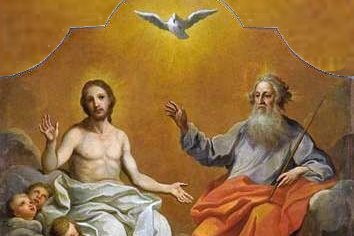
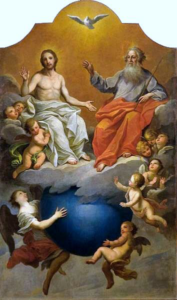
Let’s ponder the Trinity by exploring it, seeing how it is exhibited in Scripture, and observing how we, who are made in God’s image, experience it.
I. The Teaching on the Trinity Explored – Perhaps we do best to begin by quoting the Catechism, which says, The Trinity is One. We do not confess three Gods, but one God in three persons: [Father, Son, and Holy Spirit] … The divine persons do not share the one divinity among themselves but each of them is God, whole and entire (Catechism, 253).
So there is one God, and each of the three persons of the Trinity possesses the one divine nature fully. The Father is God; He is not one-third of God. Likewise, the Son, Jesus, is God; He is not one-third of God. And the Holy Spirit is God, not merely one-third of God.
It is our human experience that if there is only one of something and someone possesses it fully, then there is nothing left for anyone else. Yet, mysteriously, each of the three persons of the Trinity fully possesses the one and only divine nature, while remaining a distinct person.
One of the great masterpieces of the Latin Liturgy is the preface for Trinity Sunday. It compactly and clearly sets forth the Christian teaching on the Trinity. The following translation of the Latin is my own:
It is truly fitting and just, right and helpful unto salvation that we should always and everywhere give thanks to you O Holy Lord, Father almighty and eternal God: who, with your only begotten Son and the Holy Spirit are one God, one Lord: not in the oneness of a single person, but in a Trinity of one substance. For that which we believe from your revelation concerning your glory, we acknowledge of your Son and the Holy Spirit without difference or distinction. Thus, in the confession of the true and eternal Godhead there is adored a distinctness of persons, a oneness in essence, and an equality in majesty, whom the angels and archangels, the Cherubim also and the Seraphim, do not cease to daily cry out with one voice saying, Holy, Holy, Holy …
Wow! A careful and clear masterpiece, but one that baffles the mind. So deep is this mystery that we had to “invent” a paradoxical word to summarize it: triune (or Trinity). Triune literally means, “three-one” (tri + unus) and “Trinity is a conflation of “Tri-unity,” meaning the “three-oneness” of God.
If all this baffles you, good! If you were to say that you fully understood all this, I would have to call you a likely heretic. For the teaching on the Trinity, while not contrary to reason per se, does transcend it and it is surely beyond human understanding.
And now a final image before we leave our exploration stage. The picture at the upper right is from an experiment I remember doing when I was in high school. We took three projectors, each of which projected a circle: one red, one green, and one blue (the three primary colors). At the intersection of the three circles the color white appeared (see above). Mysteriously, the three primary colors are present in the color white, but only one shows forth. The analogy is not perfect (no analogy is or it wouldn’t be an analogy) for Father, Son, and Spirit do not “blend” to make God. But the analogy does manifest a mysterious “three-oneness” of the color white. Somehow in the one, three are present. (By the way, this experiment only works with light; don’t try it with paint!)
II. The Teaching on the Trinity Exhibited – Scripture also presents images of the Trinity. Interestingly enough, most of the pictures I want to present are from the Old Testament.
I’d like to point out as a disclaimer that Scripture scholars debate the meaning of the texts I am about to present; that’s what they get paid the big bucks to do. I am reading these texts as a New Testament Christian and seeing in them a doctrine that later became clear. I am not getting into a time machine and trying to understand them as a Jew from the 8th century B.C. might have. Why should I? That’s not what I am. I am reading these texts as a Christian in the light of the New Testament, as I have a perfect right to do. You, of course, are free to decide whether you think these texts really are images or hints of the Trinity. Here they are:
Then God said, “Let us make man in our image, after our likeness …” (Gen 1:26)
God speaks of himself in the plural: “Let us … our …” Some claim that this is just an instance of the “royal we” being used. Perhaps, but I see an image of the Trinity. There is one (“God said”) but there is also a plural (us, our). Right at the very beginning in Genesis there is already a hint that God is not all by himself, but rather is in a communion of love.
Elohim
In the passage above, the word used for God is אֱלֹהִ֔ים (Elohim). It is interesting to note that this word is in the plural form. From a grammatical standpoint, Elohim actually means “Gods,” but the Jewish people understood the sense of the word to be singular. This is a much debated point, however; you can read more about it from a Jewish perspective here: Elohim as Plural yet Singular.
(We have certain words like this in English, words that are plural in form but singular in meaning: news, mathematics, acoustics, etc.) My point here is not to try to understand it as a Jew from the 8th century B.C. or even as a present day Jew. Rather, I am observing with interest that one of the main words for God in the Old Testament is plural yet singular, singular yet plural. God is one yet three. I say this as a Christian observing this about one of the main titles of God. I see an image of the Trinity.
And the LORD appeared to [Abram] by the oaks of Mamre, as he sat at the door of his tent in the heat of the day. He lifted up his eyes and looked, and behold, three men stood in front of him. When he saw them, he ran from the tent door to meet them, and bowed himself to the earth, and said, “My Lord, if I have found favor in your sight, do not pass by your servant. Let a little water be brought, and wash your feet, and rest yourselves under the tree, while I fetch a morsel of bread, that you may refresh yourselves, and after that you may pass on—since you have come to your servant.” So they said, “Do as you have said” (Gen 18:1-5).
From a purely grammatical standpoint this is a very difficult passage because it switches back and forth between singular and plural references. The Lord (singular) appears to Abram, yet Abram sees three men (some have said that this is just God and two angels, but I think it is the Trinity). And then when Abram addresses “them” he says, “My Lord” (singular). The tortured grammar continues as Abram suggests that the Lord (singular) rest “yourselves” (plural) under the tree. The same thing happens in the next sentence, in which Abram wants to fetch bread so that you may refresh “yourselves” (plural) In the end, the Lord (singular) answers, but it is rendered as “So they said.” Plural, singular … which is it? Both. God is one; God is three. For me as a Christian, this is a picture of the Trinity. Because the reality of God cannot be reduced to mere words, we have here a grammatically difficult passage. But I can “see” what is going on: God is one and God is three; He is singular and He is plural.
Having come down in a cloud, the Lord stood with Moses there and proclaimed his Name, “Lord.” Thus the Lord passed before him and cried out, “The Lord, the Lord, a merciful and gracious God, slow to anger and rich in kindness and fidelity” (Exodus 34:5).
When God announces His name, He does so in a threefold way: Lord! … The Lord, the Lord. There is implicit a threefold introduction or announcement of God. Is it a coincidence or is it significant? You decide.
In the year that King Uzziah died I saw the Lord sitting upon a throne, high and lifted up; and his train filled the temple. Above him stood the Seraphim; each had six wings: with two he covered his face, and with two he covered his feet, and with two he flew. And one called to another and said: “Holy, holy, holy is the Lord of hosts; the whole earth is full of his glory” (Is 6:1-3).
God is Holy, Holy, and yet again, Holy. Some say that this is just a Jewish way of saying “very Holy,” but as Christian I see more. I see a reference to each of the three persons of the Trinity. Perfect praise here requires three “holys.” Why? Omni Trinum Perfectum (all things are perfect in threes). But why? As a Christian, I see the angels praising each of the three persons of the Trinity. God is three (Holy, holy, holy …) and yet God is one (holy is the Lord …). There are three declarations of the word “Holy.” Is it a coincidence or is it significant? You decide.
Here are three (of many) references to the Trinity in the New Testament:
Jesus says, The Father and I are one (Jn 10:30).
Jesus also says, To have seen me is to have seen the Father (Jn 14:9).
Have you ever noticed that in the baptismal formula, Jesus uses “bad” grammar? He says, Baptize them in the name (not names (plural)) of the Father and of the Son and of the Holy Spirit (Matt 28:19). God is one (name) and God is three (Father, Son, and Holy Spirit).
Thus Scripture exhibits the teaching of the Trinity, going back even to the beginning.
III. The Teaching of the Trinity Experienced– We who are made in the image and likeness of God ought to experience something of the mystery of the Trinity within us. And sure enough, we do.
It is clear that we are all distinct individuals. I am not you; you are not I. Yet it is also true that we are made for communion. We humans cannot exist apart from one another. Obviously we depend on our parents, through whom God made us, but even beyond that we need one another for completion.
Despite what the Paul Simon song says, no man is a rock or an island. There is no such thing as a self-made man. Even the private business owner needs customers, suppliers, shippers, and other middle men. He uses roads he did not build, has electricity supplied to him over lines he did not string, and speaks a language to his customers that he did not create. Further, the product he makes was likely the result of technologies and processes he did not invent. The list could go on and on.
We are individual, but we are social. We are one, but we are linked to many. Clearly we do not possess the kind of unity that God does, but the “three-oneness” of God echoes in us. We are one, yet we are many.
We have entered into perilous times where our interdependence and communal influence are under-appreciated. That attitude that prevails today is a rather extreme individualism wherein “I can do as I please.” There is a reduced sense at how our individual choices affect the whole of the community, Church or nation. That I am an individual is true, but it is also true that I live in communion with others and must respect that dimension of who I am. I exist not only for me, but for others. And what I do affects others, for good or ill.
The attitude that it’s none of my business what others do needs some attention. Privacy and discretion have important places in our life, but so does concern for what others think and do, the choices they make, and the effects that such things have on others. A common moral and religious vision is an important thing to cultivate. It is ultimately quite important what others think and do. We should care about fundamental things like respect for life, love, care for the poor, education, marriage, and family. Indeed, marriage and family are fundamental to community, nation, and the Church. I am one, but I am also in communion with others and they with me.
Finally, there is a rather remarkable conclusion that some have drawn: the best image of God in us is not a man alone, or a woman alone, but, rather, a man and a woman together in lasting a fruitful relationship we call marriage. For when God said, “Let us make man in our image” (Genesis 1:26), the text goes on to say, “Male and female he created them” (Genesis 1:27). And God says to them, “Be fruitful and multiply” (Gen 1:28). So the image of God (as God sets it forth most perfectly) is the married and fruitful couple.
We must be careful to understand that what we humans manifest sexually, God manifests spiritually. For God is neither male nor female in His essence. Thus, we may say, The First Person loves the Second Person and the Second Person loves the First Person. And so real is that love, that it bears fruit in the Third Person. In this way the married couple images God, for the husband and wife love each other and their love bears fruit in their children [1].
So today, as we extol the great mystery of the Trinity, we look not merely outward and upward so as to understand, but also inward to discover that mystery at work in us, who are made in the image and likeness of God.
The video below is a bit over the top, but it still communicates a basic point that is too often absent today: a father ought to protect his daughter’s honor. I was a teen in the late 1970s, and though it was towards the end of an era, most of us young men still knew that any young lady we dated had a father to whom we were answerable for our actions. We knew that we were expected to return her to her home at a reasonable hour and that we were going to be held accountable for any transgressions, sexual or otherwise.
Frankly, it helped to remember that this young lady was someone’s daughter. And while the system wasn’t perfect, it was helpful. Accountability is always helpful.
Much has changed today. Fathers are often absent, or if not absent, at least more passive than in the past. Further, young people today marry later in life, when the influence of a father may well have decreased.
I offer simply this observation: parents (and other adults) no longer do so well by their teens and twenty-somethings. We used to offer dances so that they could meet. We used chaperone the younger ones so that imprudence did not destroy them. Yes, we used to act like parents/adults. Too often today there is little involvement either in helping young people to meet good candidates for marriage or in protecting them from their all-too-new passions, over which they need to develop mastery.
It’s time to recover the pivotal role of parents, to which this video points, even if in a comical way.
Words, while an important part of our toolset, can also get in the way of reality. But how can we live without them? On some level we must allow a deep level of language to help us in sorting out reality; words are something that help us to form a mental picture. In particular, we sometimes turn to metaphors and extended metaphors (parables, allegories, stories, etc.).
A metaphor is a figure of speech in which two different things are equated for rhetorical effect. It can be used to provide clarity to something unfamiliar by comparing it to something familiar, or to point out hidden similarities between two unlike things. The word comes from the Greek metapherein (meta (beyond) + pherein (to bear or carry)) meaning “to transfer,” or, more literally, “to carry something beyond.”
A metaphor often seeks to capture something deeper by comparing it to something that is more easily grasped. In the metaphor “All the world’s a stage,” Shakespeare takes a deep concept (the world (or life)) and frames it in the context of something more manageable (a stage). This is not to say that a stage is precisely the equivalent of the world, but rather to capture some truth about the world and highlight it for understanding.
Similarly, stories can be used to communicate what is complex or to some degree inexpressible, by relating memorable experiences that disclose truth. Good stories often convey many complex truths at once. The best stories use surprise, irony, conflict, or some combination thereof to convey truth and wisdom in a memorable way.
Stories and metaphors can expose a unity between seemingly unlike things that exists beneath the surface level. On these deeper levels, things often shift, surprise, and even amuse us. Not everything in life is as it first appears; God does not easily fit into a convenient little box. Stories and metaphors can open windows onto wider vistas and expose deeper mysteries.
With this background in mind, consider the following stories. There is a wide collection of such stories from both the Rabbinic tradition and the Desert Fathers. The saints, too, have supplied us with many. The following selections are somewhat random as I drew them from various sources. Many of them were taken from The Spirituality of Imperfection: Story Telling and the Search for Meaning. They are a rich stories of the magnificent and mysterious reality called life.
In each case, the “story” is presented in bold, black italics. I have limited myself to very brief comments, shown in plain, red text.
When the disciples of the Rabbi Baal Shem Tov asked him how to know whether a celebrated scholar whom they proposed to visit was a true wise man he answered, “Ask him to advise you what to do to keep unholy thoughts from disturbing you in your prayers and studies. If he gives you advice, then you will know that he belongs to those who are of no account.”
Not all things have a solution. God sometimes allows things to happen in order test us and He asks us to live with difficulties. If there really were a solution to the problem of distraction and temptation, spiritual teachers would long ago have provided it. Therefore, those who claim some insight into this common human problem are of little account.
2. When the Rabbi Bunam was asked why the first of the Ten Commandments speaks of God bringing us out of the land of Egypt, rather than of God creating heaven and earth, the Rabbi expounded, “‘Heaven and earth!’ Then man might have said, ‘Heaven—that is too much for me.’ So God said to man, ‘Look, I am the one who fished you out of the mud. Now come over here and listen to me!’”
We often relate first to earthly things and then to higher spiritual matters.
3. A woman sought out a confessor of long experience. In her confession she recounted the behaviors that troubled her. She then began to detail how these behaviors seemed somehow connected with her experience of having grown up in an alcoholic home. At that point the grizzled veteran confessor reached out and, gently patting her hand, asked: “My dear do you want forgiveness or an explanation?”
Some people confuse confession and spirituality with therapy. Therapy offers explanations; confession seeks mercy and forgiveness.
4. Concepts create idols; only wonder comprehends everything. People kill one another over idols. Wonder makes us fall to our knees (St. Gregory of Nyssa).
Too often our certitude is rooted not in God or in true faith but in our own thoughts. Our thoughts can become idols and we can become ideologues. Wonder is able to bring us to our knees in humility and gratitude. Wonder opens us to all that God has done. Blind adherence to ideology can close us in on ourselves and our own limited thoughts.
5. The philosopher Diogenes was eating bread and lentils for his supper. He was seen by the philosopher Aristippus, who lived comfortably by flattering the king. Said Aristippus to Diogenes, “If you would learn to be subservient to the king, you would not have to live on lentils.” Said Diogenes in reply, “Learn to live on lentils, and you will not have to be subservient to the king.”
This is analogous to our serving of this world and our consequent slavery to it.
6. A man of piety complained to Baal Shem Tov, saying, “I have labored hard and long in the service of the Lord, and yet I am little improved. I’m still an ordinary, ignorant person.” The rabbi answered, “You have gained the realization that you are ordinary and ignorant, and this in itself is a worthy accomplishment.”
Humility, reverence for the truth about ourselves, is the door.
7. One day some disciples of Abba Besarian ceased talking in embarrassment when he entered the house of study. He asked them what they were talking about. They said, “We were saying how afraid we are that the evil urge will pursue us.” “Don’t worry,” he replied, “You have not gotten high enough for it to pursue you. For the time being you are still pursuing it.”
Too often we determine the cause of our problems to be the devil, when, more truly, it is our own flesh.
8. The priest put this question to a class of children: “If all the good people in the world were red, and all the bad people were green, what color would you be?” A young girl thought hard for a moment, then her face brightened, and she replied, “I’d be streaky!”
We are all a mixed bag, neither wholly good, nor wholly bad. The journey from evil to good is not yet complete. God alone is wholly good.
9. For me, prayer is a surge of the heart; it is a simple look turned toward heaven; it is a cry of recognition and of love, embracing both trial and joy (St. Therese of Lisieux).
Too often we make of prayer a complicated thing.
Please feel free to add your own insights. I hope to post more of these in the near future.
Here is a collection of sayings, most of which ring true to me, set to music:

 Last week as we finished the Easter Cycle and crowned it with Pentecost. We also finished the lengthy reading of the Acts of the Apostles. There are two parts of the Acts of the Apostles: The Acts of Peter and those of Paul. But to be honest, the book has an unfinished quality to it. Let’s consider that.