Overlooking the Obvious, As Seen in a Commercial

In the humorous commercial below the police investigator cannot seem to draw the obvious conclusion even when the evidence is literally sitting right in front of him. He just dismisses the evidence a priori; it cannot be so since he has decided ahead of time that any such conclusion would be impossible.

Although the commercial is funny, it highlights the common tendency today to make conclusions without evidence or to exclude evidence based on preconceived notions, which is far from humorous.

For example, despite mounting evidence that abortion kills a living human being, many will simply ignore the evidence and declare the unborn child to be a non-person or a mere clump of cells. No amount of pictorial or medical evidence will even be considered.

Another example is the refusal to accept the possibility that Hell is a reality for some, or as Jesus says, “many” (see Matt 7:13). No amount of scriptural evidence (and there are quite a few passages that can be cited) will convince them. In the words of the commercial, God is “the nicest guy.” He wouldn’t do such a thing!

There are many, many other examples. To some degree, we are all guilty of overlooking the evidence right in front of us and instead insisting on our preconceived ideas and opinions. Enjoy the commercial, but takes some time to ponder this human tendency.

Injustice to the Poor and the Coming Judgment

Blog-06-30As we continue to read from the Book of the Prophet Amos it becomes clear that a grave sin among the people of that age was injustice to the poor. Consider an excerpt from today’s passage (Friday of the 13th Week of the Year):

Hear this, you who trample on the needy and bring the poor of the land to an end … [you] buy the poor for silver and the needy for a pair of sandals and sell the chaff of the wheat. The Lord has sworn by the pride of Jacob: Surely I will never forget any of their deeds. Shall not the land tremble on this account, and everyone mourn who dwells in it? (Amos 8:4-8)

Elsewhere in the Book of Amos, the Lord also denounces injustice to the poor:

  1. They trample on the heads of the poor as on the dust of the ground and deny justice to the oppressed (Amos 2:7).
  2. Therefore, because you impose heavy rent on the poor and exact a tribute of grain from them, Though you have built houses of well-hewn stone, yet you will not live in them! You have planted pleasant vineyards, yet you will not drink their wine! For I know your transgressions are many and your sins are great; You who distress the righteous and accept bribes, and turn aside the poor at the gate (Amos 5:11-12).
  3. Hear this word, you cows of Bashan, who are on the mountain of Samaria, who oppress the poor, who crush the needy, who say to your husbands, “Bring now, that we may drink!” The Lord God has sworn by His holiness, “Behold, the days are coming upon you when they will take you away with meat hooks, and the last of you with fishhooks” (Amos 4:1-2).

Yikes, that last one was insulting—and scary! Actually all of them are scary, because the Lord indicates that injustice to the poor is a big part of what is causing the coming destruction. We, too, who often live in luxurious houses and enjoy choice food and drink, should be sober and not neglect justice to the poor.

What exactly is injustice toward the poor? If we have more than we need, we owe certain things to the poor. Whoever has two cloaks should share with the person who has none. And however has food should do likewise. (Luke 3:11).

In our times we often speak of our care for the poor under the themes of mercy and kindness. But the biblical truth is that we also have duties to them in justice.

Pope St. Gregory the Great puts it this way:

They [i.e., those who are stingy] should be advised to learn carefully that the earth from which they come is common to all. Therefore, it is foolish to presume themselves innocent who proclaim that the common gift of God belongs in their own private stocks …. They are daily responsible to the poor. And when we minister what is necessary to the indigent, we bestow not what is ours, but what rightly belongs to them. In fact, we pay a debt of justice, not an act of mercy (Pastoral Rule III.21).

The Catechism speaks to the theme of injustice to the poor by placing the consideration of this sin in the treatise on 7th Commandment, “Thou shall not steal.” To fail to care for the poor when one can reasonably do so amounts to a form of theft. Our excess belongs to the poor because God intends all the goods of the earth for all the people of the earth. The Catechism refers to this principle as “The Universal Destination of Goods” and says,

In the beginning God entrusted the earth and its resources to the common stewardship of mankind to take care of them, master them by labor, and enjoy their fruits. The goods of creation are destined for the whole human race. However, the earth is divided up among men to assure the security of their lives, endangered by poverty and threatened by violence. The appropriation of property is legitimate for guaranteeing the freedom and dignity of persons and for helping each of them to meet his basic needs and the needs of those in his charge. It should allow for a natural solidarity to develop between men …. In his use of things man should regard the external goods he legitimately owns not merely as exclusive to himself but common to others also, in the sense that they can benefit others as well as himself. The ownership of any property makes its holder a steward of Providence, with the task of making it fruitful and communicating its benefits to others, first of all his family (CCC 2402, 2404).

This does not mean that all excess should be recklessly and indiscriminately cast about. There may be value in using excess to develop businesses and other enterprises that can benefit others with employment or other resources. Further, there are legitimate concerns that the destitute not simply become dependent on welfare, something that indiscriminate giving can cause. The poor are usually best assisted by finding solutions to the causes of their destitution. The poor are to be treated justly, to be respected and assisted in a way that regards their humanity and moral agency.

Note that the Scriptures, the text from Pope Gregory, and the quote from the Catechism, all speak to us as individuals. This is a duty each of us has in justice. Too often we seek to push this obligation to the government. There may be a prudential assessment, in certain times and places, that government can play a role in rendering justice to the poor. But none of the texts above necessarily calls for big government solutions.

Whatever the prudential decisions, the point remains that individuals, communities, nations, and cultures are bound in justice to give to the poor. Amos makes it clear that the coming judgment of destruction on Israel is due in good part to its injustice to the poor. We live in times of abundance today and many live excessively. This is surely part of the judgment of God that is upon us today, along with our sexual promiscuity, abortion, easy divorce, widespread unbelief, lack of worship, narcissistic self-centeredness, etc.

What do I have that really belongs to the poor? What excesses could I end so that I would be more able to contribute to the good of the poor and others? Do I really need that latest upgrade, the addition to the house, etc.?

The Lord speaks to us through Amos in these recent daily readings. Are we listening or is greed always the other guy’s problem?

Finally, here is a quote attributed to St. Vincent De Paul that is almost shocking (and Amos-like) in its final sting:

You will find out that Charity is a heavy burden to carry, heavier than the kettle of soup and the full basket. But you will keep your gentleness and your smile. It is not enough to give soup and bread. This the rich can do. You are the servant of the poor, always smiling and good-humored. They are your masters, terribly sensitive and exacting masters you will see. And the uglier and the dirtier they will be, the more unjust and insulting, the more love you must give them. It is only for your love alone that the poor will forgive you the bread you give to them.

Peter in Jail – Five Facts of Faith We Learn from His Story

Blog-06-29Today’s Feast of Saints Peter and Paul honors two pillars of the early Church. While all the Apostles form the foundation, Peter and Paul stand out profoundly in terms of their influence and their work. And while some suggest a division between them, the Church insists that they must been seen together; hence their feast is set forth in this way.

Indeed, those who see division between them base it on only one text (Galatians 2:11), in which St. Paul withstood Peter so as to correct him. Peter had taught rightly concerning the inclusion of the Gentiles, but (at least according to St. Paul) he struggled to associate with them more freely and was fearful of the Judaizers. Yes, even popes are not beyond reproach. We hold that popes are prevented from formally teaching error in faith or morals, not that they are sinless.

The same St. Paul had gone to visit St. Peter in order to get to know him (Gal 1:18) and later submitted his teachings to Peter and others in Jerusalem for scrutiny (Gal 2:1-10). And at the Council of Jerusalem, Paul and Peter were allies (Acts 15).

Thus we ought not to exaggerate differences beyond the evidence. The Church today bids us to celebrate them together.

There are many different approaches that could be taken to today’s first reading. But since the chief work of the Church and the apostles is to draw us to faith, it behooves us to look at it in detail and see in it a kind of roadmap to growing in faith. Peter’s story and experience were not just for him; they were for us as well. Let’s see what we can learn as we focus on five facts of faith from the story of St. Peter in today’s first reading (Acts 12:1-11).

I. The Persecution of Faith – Peter is in jail. A persecution, driven by Herod, had broken out in Jerusalem. In this persecution, James (of “Peter, James, and John” fame) was killed. Peter was also rounded up and slated for death. Thus we see him sitting in prison awaiting his fate.

Persecution is the normal state of affairs for a Christian. Not every Christian suffers equally at every stage and place in history, but Jesus spoke often about the need to be willing to endure persecution for His sake. He said, A servant is not greater than his master. If they persecuted me, they will persecute you also (Jn 15:20). He added, If you belonged to the world, it would love you as its own. As it is, you do not belong to the world, but I have chosen you out of the world. That is why the world hates you (Jn 15:19). He said elsewhere, In the world ye shall have tribulation: but be of good cheer; I have overcome the world (Jn 16:33). He also warns, Woe to you when everyone speaks well of you, for that is how their ancestors treated the false prophets (Lk 6:26).

II. The Prayer of Faith – In the midst of this, we note that the Church is described as praying fervently to God. The Greek word translated here as fervent is ἐκτενῶς (ektenos), which means fully stretched. The image of a taught rope comes to mind. This is prayer that is stretched out, that is costly, that involves more than a brief moment. This is praying that is persevering. This sort of prayer involves more than an honorable mention in the Prayers of the Faithful at Mass. This is the sort of prayer that involves long hours. Time is invested; effort is expended; energy is invested. It is the sort of prayer that nags God until the solution is at hand.

A popular expression in the African-American community is “by and by.” It refers to the need to be patient and persevering in prayer while waiting for God to answer. In other words, God will answer in His own time; it is for us to keep praying. This is prayer without ceasing; it does not give way to discouragement, but just keeps on praying.

III. The Prescription of Faith – In the midst of this fervent prayer of the Church, a hidden process begins. An angel is dispatched from Heaven, enters the jail, and comes to Peter. His instructions to Peter amount to a kind a prescription for a life of faith, and we note it in five stages:

Rise  The angel says, “Get up”. This is a call to rise from death, to rise from despairing and doubt, to stand up! Every Christian must die to sin and rise to new life; he must die to slavery and despair and rise as a free and active agent, ready to walk with God.

Restrain The angel then tells Paul to put on his belt (cincture), which is traditionally a sign of chastity and continence. The Christian life cannot be riddled with unchasteness or other excesses of this world (e.g., greed, gluttony, intemperance). These hinder the journey; they weigh us down. And thus the instruction to tighten our belt.

Ready – Peter is also told to put on his sandals. This is a symbol of readiness to make a journey. When I was a child, my mother would often signal me by saying, “Put on your shoes and get ready to go.” Christians must be ready to make the journey with their feet shod with the gospel of peace, with their shoes on and ready to set out on the great pilgrimage with Jesus to Heaven. The pilgrimage goes up over the hill of Calvary and into glory. Put on your shoes and get ready to go!

Righteous Peter is then told to put on his cloak. In Scripture, the robe is often equated with righteousness. For example, the book of Revelation says that it was given to the bride to be clothed in fine linen. The text goes on to say that the linen robe is the righteousness of the saints (Rev 19:8). There is also the parable of the wedding guests, one of whom was not properly clothed, and was therefore thrown out (Mat 22:11). At a baptism, the priest points to the white garment worn by the infant and tells everyone to see in this white garment the outward sign of his or her Christian dignity, and says that the child is to bring this garment unstained to the great judgment seat of Christ. Thus the instruction of the angel reminds us that every Christian is to be clothed in righteousness, and is to be careful to keep this robe, given by God, unsoiled by the things of this world.

Run – Finally, the angel commands, “Follow me.” In other words, run the race of faith. Toward the end of his life, St. Paul said, “I have fought the good fight. I have finished the race. I have kept the faith” (2 Tim 4:7).  Jesus told His disciples, simply, “Follow me.”

IV. The Procession of Faith –  Following this there comes a series of instructions from the angel to Peter. These instructions amount to a type of direction to make the procession of faith. We see three things:

Not easy  The text says that they passed the first guard, then a second, and finally came to an iron gate. In our journey, there are always obstacles and dangers. We must recall that we live in paradise lost. Life is not easy; it is hard. There are hurdles and perils. We are called not to avoid them, but to face them with courage. God allows these obstacles in our life in order to test us, to see if we will follow Peter’s example and move past the one guard, then the second, and then the apparently locked gate (which God opens for us). Life is not easy, but if we only trust Him, God’s grace conquers the challenge.

Narrow  The text describes a narrow alley through which Peter and the angel pass. Jesus spoke of the way that leads to salvation as a narrow way (e.g., Mat 7:14). Why is this so? Because the narrow way is the cross! Most are not interested in this difficult path, the one that is steep and narrow. Most look for the broad highway through the valley, the easy way. The world still insists that we live in paradise (which Adam rejected) and that life should be easy. It is a lie; the path now is over the hill of Calvary. It is a narrow and steep path, but it is the only way to glory. Avoid preachers who never mention sin, who never speak of repentance, who never speak of struggles and difficulties. Avoid them! The tuning fork, the A440 of the Gospel is the cross. There are glories and joys in this life to be sure, but the fundamental path to Heaven and glory is through the cross; it cannot be avoided. Walk the narrow way, the way of the cross. Do not listen to “prosperity preachers,” who exaggerate one truth and exclude all others.

Need an angel As soon as Peter emerges from the prison and out into the openness of freedom, the angel disappears. Up until this point he needed an angel—and so do we. Though demons are roaming and patrolling this earth, so are God’s angels. We all have an angel assigned to us as well as many other angels along the way to help us. Never forget this. We do not journey alone. For every demon, there are two angels (Rev 9:15). Stop fearing demons and call on God’s angels, trusting in God’s grace.

V. The Product of Faith – Finally comes the product of faith: Peter is able to assert confidently, Now I know without a doubt that the Lord has sent his angel and rescued me (Acts 12:11). Do you know this yourself, or is it only true because others have said so? Do you experience God’s saving glory? Have you experienced him rescue you? How? Do you have a testimony? The normal Christian life is to know and experience that our God can and does rescue us from this hell-bound, sin-soaked world. We have a God who can make a way out of no way, and can, as St. Paul says, rescue us from this present evil age (Gal 1:4). Do you know this? Have you experienced this? If so, then tell someone; it is the product of faith!

A Warning from Amos – What Do We Face?

June 28Though he lived in the Southern Kingdom of Judah, the prophet Amos was sent north by God to preach to the Northern Kingdom of Israel. Perhaps no other prophet was as searing in his condemnation and as demanding in his call as was Amos. His prophecies of doom largely came true in the form of a huge earthquake that struck the region in 760 B.C. (two years after his death) and forty years later in the utter conquest and destruction of Israel in 721 B.C. The message is clear: unrepented sin brings dire consequences. When a nation refuses to repent it seals its own doom.

This theme was clearly announced by Amos in the reading from daily Mass (Tuesday of the 13th Week), excerpted here:

Hear this word, O children of Israel, that the LORD pronounces over you,
over the whole family that I brought up from the land of Egypt:

You alone have I favored,
more than all the families of the earth;
Therefore I will punish you
for all your crimes. …

If the trumpet sounds in a city,
will the people not be frightened?
If evil befalls a city,
has not the LORD caused it?
Indeed, the Lord GOD does nothing
without revealing his plan
to his servants, the prophets.

The lion roars—
who will not be afraid!
The Lord GOD speaks—
who will not prophesy! …

I brought upon you such upheaval
as when God overthrew Sodom and Gomorrah:
you were like a brand plucked from the fire;
Yet you returned not to me,
says the LORD. …

So now I will deal with you in my own way, O Israel!
and since I will deal thus with you,
prepare to meet your God, O Israel. …

Therefore, thus says the Lord God:

… An adversary shall surround the land
and bring down your defenses from you,
and your strongholds shall be plundered.
(Amos 3:1-8; 4:11-12; 3:11-12)

Within a generation, Assyria did in fact invade and destroy the ten Northern tribes that made up Israel, leaving only Judah in the South, along with some Levites and Benjaminites. The “Ten Lost Tribes” were effectively gone and not heard from again.

What of a nation and culture such as ours? As political entities, the United States and the countries of Europe are not covenanted with the Lord. But surely Western culture (once called Christendom) has a special relationship with God through faith in Christ and in the moral vision that once united us, albeit imperfectly. What of us? Do readings like this speak to us?

There has come upon the West a hardening and unrepentant spirit. Even having been warned to pray (e.g., through the proclamation of the Gospel and through special apparitions such as at Lourdes and Fatima), we collectively refuse to repent, instead doubling down on sin. Rates of unbelief have skyrocketed and there has been a massive falling away from the practice of the faith. The “right” to the grave injustice of abortion continues to sail through the courts. Families are in ruins; sexual promiscuity, confusion, and the celebration of every sort of disorder grow daily.

As early as the 1940s, C.S. Lewis lamented the loss of the faith in Europe and observed that it was worse than a return to paganism: At least pagans and barbarians had belief in deities and some respect for Natural Law. Whereas pagan Europe was like a virgin awaiting her groom, modern Europe of the 1940s was an angry divorcee, a bad scene. And things have only further declined in what we call the West.

Amos reminds us that our sins and injustices cannot go on forever. God hears the cries of the poor, the aborted, the victims of the sexual revolution, the children who suffer from their parents’ misbehavior, those who suffer on account of our greed, and many others.

I am not able to see the future in detail, but it is biblically and historically true that indulged evil and sin cannot last. They carry the seeds of destruction because they are rooted in selfishness. And selfishness does not build families, nations, or cultures. While evil has its day, it also has its end, which is destruction.

There seem to be two models (in antiquity and in Scripture) through which this collapse that Amos and others describe occurs.

I. The Disease Model – As unrepented sin accumulates in a person and in a culture, its effects grow in stages like a cancer; eventually the condition becomes irreversible. The punishment for sin is more sin. The darkness grows ever deeper. The light seems obnoxious and is rejected. Hope for a cure fades as the very medicine necessary (faith) is rejected and scoffed at. Disorders of every kind multiply. Systems like the family start to fail, falling under the burden of growing sin and selfishness. Low birth rates and abortion reflect this selfishness and destroy one of most basic instincts: survival. Under the load of sin, fewer and fewer people in such a culture can rouse themselves to make the necessary changes.

People and cultures like this just fade away, replaced by others who still have basic virtues and values that make for a culture. Even if the replacing people have those virtues in a fierce and unrefined way, they do at least have them.

In many ways, this is what happened to the Greco-Roman world. Rome was not so much conquered as it faded away. (Yes, there were skirmishes with the barbarians, but no big, final showdown.) The Romans became soft; they lost family virtues and a solid work ethic. They declined into sexual immorality and infanticide. They depended on imported slave labor to do their work and took to an increasingly decadent leisure. Little by little Rome faded as Europe was overtaken by barbarians, who though fierce, still had the natural virtues needed to form a culture.

This also seems to be happening to Europe today as they are simply being replaced by Muslims and others from the south. And though sadly they are not Christians, they do actually believe in something. Though often fierce, they are at least passionate and willing to make sacrifices for their vision, however flawed. Let us pray that the Church can convert them to Jesus, as happened with the barbarians of old.

This is the disease model, in which God seems to sit back and allow sin to run its course, bringing an end to an unrepentant culture and nation.

II. The Destruction Model – In this model, God brings a swifter and more decisive end to sin and unrepentance; it is largely what Amos describes in the passage above. There is a general weakness that is introduced into a nation or culture. Through unrepentance that weakness grows, making that nation an easy target for its enemies. A nation that is sinful becomes conflicted within because, as already noted, sin is rooted in selfishness. Thus, in a nation of unchecked and unrepented sin, there is diminishing unity. As enemies begin to attack, there is no agreed upon strategy or even resolve to repel the threats.

In Ancient Israel God sent prophets to secure a repentance that would strengthen it. Most of the reforms undertaken, however, were fleeting and tepid. God then sent final warnings of imminent destruction, as we saw in the Amos text above.

Over time, but also with a suddenness, Israel and Judah suffered stunning defeats, first in 721 B.C., and later in 587 B.C.

Jesus also warned the Jewish people of His day of the looming destruction of their country if they did not repent and come to faith in Him. Forty years later Jerusalem was destroyed, the Temple burned (never again to be rebuilt), and 1.2 million Jews lost their lives in the war.

This is the destruction model, which begins a bit like the disease model but ends in a sudden crisis (brought on by sin) rather than a gradual fading away and replacement.

In our times, the disease model seems more evident. In terms of our moral condition, it is “Zero Dark Thirty” in the West. Just when we think things can’t get any stranger, they do; disorders are multiplied. But instead of being addressed as problems, they are celebrated. The decadence of leisure and the selfishness of sin are progressing, and things that make for a solid culture and nation are lacking. A kind of replacement seems to be underway in Europe despite a certain awakening by some in terms of concern for low birthrates, etc.

In the United States, it is less clear what will happen. Politically, our Constitution, rooted in biblical values, once guided us. But it has become the personal plaything of judges and seems doomed to be interpreted out of existence. On the moral front, Americans no longer look collectively to the Judeo-Christian heritage that birthed our nation and sustained in its citizens the virtues necessary to support a republic. A nation cannot withstand such trends. Exactly how it will play out is less clear to me, but that it will play out is without doubt.

Consider carefully the words of Amos as relevant for us all, not just the Church, but also the nation!

What Does It Mean When Scripture Says That God Hardens Certain Human Hearts?

Blog-06-27One of the more difficult biblical concepts to understand is that of God hardening the hearts and minds of certain people. The most memorable case is that of Pharaoh: before sending Moses to him, God said that He would “harden Pharaoh’s heart” (Ex 4:21). And there are other instances in which biblical texts speak of God hardening the hearts of sinners, even from among his own people.

What are we to make of texts like these, which explicitly or implicitly speak of God hardening the hearts of people? How can God, who does no evil, be the source of a sinful mind or a hard heart? Why would God do such a thing when He has also said the following?

  1. As surely as I live, declares the Sovereign LORD, I take no pleasure in the death of the wicked, but rather that they turn from their ways and live. Turn! Turn from your evil ways! Why will you die, O house of Israel? (Ez 33:11)
  2. God our Savior … wants all men to be saved and to come to a knowledge of the truth (1 Tim 2:4).

To be sure, these questions involve very deep mysteries, mysteries about God’s sovereignty and how it interacts with our freedom, the mysteries of time, and the mysteries of causality. As a mystery within mysteries, the question of God hardening hearts cannot be resolved simply. Greater minds than mine have pondered these things and it would be foolish to think that an easy resolution can be found in a blog post.

But some distinctions can and should be made and some context supplied. We do not want to understand the “hardening texts” in simplistic ways or in ways that use one truth to cancel out other important truths that balance it. So please permit a modest summary of the ancient discussion.

I propose that we examine these sorts of texts along four lines:

  1. The Context of Connivance
  2. The Mystery of Time
  3. The Mystery of Causality
  4. The Necessity of Humility

To begin, it is important simply to list a few of the “hardening texts.” The following are not the only ones, but they provide a wide enough sample:

  1. The LORD said to Moses, “When you return to Egypt, see that you perform before Pharaoh all the wonders I have given you the power to do. But I will harden his heart so that he will not let the people go” (Ex 4:21).
  2. Moses and Aaron performed all these wonders before Pharaoh, but the LORD hardened Pharaoh’s heart, and he would not let the Israelites go out of his country (Ex 11:10).
  3. Why, O LORD, do you make us wander from your ways and harden our hearts so we do not revere you? Return for the sake of your servants, the tribes that are your inheritance (Is 63:17).
  4. He [God] has blinded their eyes and deadened their hearts, so they can neither see with their eyes, nor understand with their hearts, nor turn–and I would heal them (Jesus quoting Isaiah 6:9-10, in John 12:40).
  5. They perish because they refused to love the truth and so be saved. For this reason, God sends them a powerful delusion so that they will believe the lie (2 Thess 2:11).
  6. Therefore God gave them over in the sinful desires of their hearts to sexual impurity for the degrading of their bodies with one another … Furthermore, since they did not think it worthwhile to retain the knowledge of God, he gave them over to a depraved mind, to do what ought not to be done (Rom 1:24, 28).

I. The Context of ConnivanceIn properly assessing texts like these, we ought first to consider the contexts in which they were written. Generally speaking, most of these declarations that God “hardens the heart” come after a significant period of disobedience on the part of those whose hearts were hardened. In a way, God “cements the deal” and gives them what they really want. For seeing that they have hardened their own hearts to God, He determines that their disposition is to be a permanent one, and in a sovereign exercise of His will (for nothing can happen without God’s allowance), declares and permits their hearts to be hardened in a definitive kind of way. In this sense, there is a judgment of God upon the individual that recognizes the person’s definitive decision against Him. Hence this hardening can be understood as voluntary on the part of the one hardened one, for God hardens in such a way that He uses the person’s own will for the executing of His judgment. God accepts that the individual’s will against Him is definitive.

In the case of Pharaoh (e.g., #1 and #2 above), although God indicated to Moses that He would harden Pharaoh’s heart, the actual working out of this is a bit more complicated. We see in the first five plagues that it is Pharaoh who hardens his own heart (Ex 7:13; 7:22; 8:11; 8:28; & 9:7). It is only after this repeated hardening by Pharaoh of his own heart that the Exodus text speaks of God as the one who hardens (Ex 9:12; 9:34; 10:1; 10:20; 10:27). Hence the hardening here is not without Pharaoh’s repeated demonstration of his own hardness. God “cements the deal” as a kind of sovereign judgment on Pharaoh.

The Isaiah texts (many in number) that speak of a hardening being visited upon Israel by God (e.g., #3 and #4 above),  are  also the culmination of a long testimony by Isaiah of Israel’s hardness. At the beginning of Isaiah’s ministry, God describes (through Isaiah) Israel’s hardness as being of their own doing: For the LORD has spoken: “I reared children and brought them up, but they have rebelled against me. The ox knows his master, the donkey his owner’s manger, but Israel does not know, my people do not understand.” Ah, sinful nation, a people loaded with guilt, a brood of evildoers, children given to corruption! They have forsaken the LORD; they have spurned the Holy One of Israel and turned their backs on him (Is 1:2-4). There follows a long list of their crimes, their hardness, and their refusal to repent.

St. John Chrysostom – Of the numerous texts later in Isaiah (and also referenced by Jesus (e.g., Jn 12:40)) that speak of Israel being hardened by God (and having their eyes shut by Him), St John Chrysostom said, That the saying of Isaiah might be fulfilled: that here is expressive not of the cause, but of the event. They did not disbelieve because Isaiah said they would; but because they would disbelieve, Isaiah said they would … For He does not leave us, except we wish Him … Whereby it is plain that we begin to forsake first, and are the cause of our own perdition. For as it is not the fault of the sun that it hurts weak eyes, so neither is God to blame for punishing those who do not attend to His words (in a gloss of Is. 6:9-10 at Jn 12:40, quoted in the Catena Aurea).

St. Augustine – This is not said to be the devil’s doing, but God’s. Yet if any ask why they could not believe, I answer, because they would not … But the Prophet, you say, mentions another cause, not their will; but that God had blinded their eyes, and hardened their heart. But I answer that they well deserved this. For God hardens and blinds a man by forsaking and not supporting him; and this He makes by a secret sentence, for by an unjust one He cannot (quoted in the Catena Aurea at Jn 12:40).

In the text of 2 Thessalonians (# 5 above), God sends them a powerful delusion so that they will believe the lie. While this verse speaks of God as having sent the delusion, the verses before and after make clear the sinful role of the punished: They perish because they refused to love the truth and so be saved … so that all will be condemned who have not believed the truth but have delighted in wickedness (2 Thess 2:10,12).

St. AugustineFrom a hidden judgment of God comes perversity of heart, so that the refusal to hear the truth leads to the commission of sin, and this sin is itself a punishment for the preceding sin [of refusing to hear the truth] (Against Julian 5.3.12).

St. John Damascus[God does this] so that all may be condemned who did not believe the truth but had pleasure in unrighteousness (The Orthodox Faith 4.26).

The texts from Romans 1 (e.g., # 6 above) speak of God handing them over only after they have suppressed the truth (1:18), persevered in their wickedness (1:18), and preferred lust and idolatry (1:23-24). Hence, as a just judgment, God hands them over to sexual confusion (homosexuality) and countless other destructive drives. So here, too, though it is said that God hands them over, it is really not that simple. Again, God has “cemented the deal.” They do not want to serve Him and so God, knowing their definitive decision, gives them what they want.

Thus our first point in understanding the “hardening texts” is that the context of connivance is important in assessing them. Scripture does not assert that God takes a reasonably righteous man and, out of the blue, hardens his heart, confuses his mind, or causes him (against his will) to become obstinate. The texts are usually presented as a kind of prevenient judgment by God, such that the state of the person’s hardness becomes permanent. God “cements the deal” and “causes” the person to walk in his own sinful ways since he has insisted on doing so.

II. The Mystery of Time – In understanding these “hardening texts” (which we have seen are akin to judgment texts) we must strive to recall that God does not live in time in the same way that we do. Scripture speaks often of God’s knowledge and vision of time as being comprehensive rather than speculative or serial (e.g., Ex 3:14; Ps 90:2-4; Ps 93:2; Is 43:13; Ps 139; 2 Peter 3:8; James 1:17).

To say that God is eternal and lives in eternity is to say that He lives in the fullness of time. For God past, present, and future are all the same. God is not wondering what I will do tomorrow; neither is He waiting for it to happen. For Him, my tomorrow has always been present. All of my days were written in His book before one of them ever came to be (Ps 139:16). Whether and how long I live have always been known to Him. Before He ever formed me in my mother’s womb He knew me (Jer 1:5). My final destiny is already known and present to Him.

Hence when we strive to understand God’s judgments in the form of hardening hearts, we must be careful not to think that He lives in time the way we do. It is not as though God is watching my life unfold like a movie. He already knows the choices I will make. Thus, when God hardens the hearts of some, it is not that He is trying to influence the outcome by “tripping them up.” He already knows the outcome and has always known it; He knows the destiny they have chosen.

Now be very careful with this insight, for it is a mystery to us. We cannot really know what it is like to live in eternity, in the fullness of time, where the future is just as present as is the past. And even if you think you know, you really don’t. What is essential for us to realize is that God does not live in time the way we do. If we try too hard to solve the mystery (rather than just accepting and respecting it) we risk falling into the denial of human freedom, or double predestination, or other misguided notions that sacrifice one truth for another rather than holding them in balance. That God knows what I will do tomorrow does not destroy my freedom to choose what I do. How this all works out is mysterious, but we are free (Scripture teaches this) and God holds us accountable for our choices. Further, even though God knows our destiny already, this does not mean that He is revealing anything about that to us, such that we should look for signs and seek to call ourselves saved or lost. We ought to work out our salvation in reverential fear and trembling (Phil 2:12).

The key point here is mystery. Striving to understand how, why, and when God hardens the heart of anyone is caught up in the mysterious fact that He lives outside of time and knows all things before they happen. Thus He acts with comprehensive knowledge of all outcomes.

III. The Mystery of Causality – One of the major differences between the ancient and the modern worlds is that the ancient world was much more comfortable dealing with something known as primary causality.

Up until the Renaissance, people thought that God was at the center of all things and they instinctively saw the hand of God in everything—even terrible things. Job said, The LORD gave and the LORD has taken away; may the name of the LORD be praised … if we have received good things at the hand of God, why should we not receive evil? (Job 1:21; 2:10) Thus the ancients would commonly attribute everything as coming from the hand of God, for He was the “first cause” of everything that happened. This is what is meant by primary causality. The ancients were thus much more comfortable attributing things to God than we are. In speaking like this, they were not being superstitious or primitive in their thinking; rather, they were emphasizing that God was sovereign, omnipotent, and omnipresent, and that nothing happened apart from His sovereign will. They believed that God was the primary cause of all that existed.

Of this ancient and scriptural way of thinking the Catechism says, And so we see the Holy Spirit, the principal author of Sacred Scripture, often attributing actions to God without mentioning any secondary causes [e.g., human or natural]. This is not a “primitive mode of speech,” but a profound way of recalling God’s primacy and absolute Lordship over history and the world, and so of educating his people to trust in him (CCC # 304).

We need to understand that the ancient biblical texts, while often speaking of God as hardening the hearts of sinners, do not mean to say that man had no role, no responsibility. Neither do they mean to say that God acts in a merely arbitrary way. Rather, the emphasis is on God’s sovereign power as the first cause of all that is. Hence He is often called the cause of all things and His hand is seen in everything.

After the Renaissance, man moved himself to the center and God was gradually “escorted” to the periphery. Man’s manner of thinking and speaking began to shift to focusing on secondary causes (those related to man and nature). If something happens we look to natural causes, or in human situations, to the humans who caused it. But these are actually secondary causes, because I cannot cause something to happen unless God first causes me.

Today, we have largely thrown primary causality overboard as a category. Even believers do this (unconsciously for the most part) and thus exhibit three related issues:

  1. We fail to maintain the proper balance between two mysteries: God’s sovereignty and our freedom.
  2. We exhibit shock at things like the “hardening texts” of the Bible because we understand them poorly.
  3. We try to resolve the shock by favoring one truth over the other. Maybe we just brush aside the ancient biblical texts as “primitive” and say, inappropriately, that God didn’t have anything to do with this or that occurrence. Or we go to the other extreme and become fatalistic, denying human freedom, denying secondary causality (our part) and accusing God of everything (as if He were the only cause and should shoulder the sole blame for everything). We either read the hardening texts with a clumsy literalism or we dismiss them as misguided notions from an immature, primitive, and pre-scientific age.

The point here is that we have to balance the mysteries of primary and secondary causality. We cannot fully understand how they interrelate, but they do. Both mysteries need to be held. The ancients were more sophisticated than we are in holding these mysteries in the proper balance. Today, we handle causality very clumsily; we do not appreciate the distinctions between primary causality (God’s part) and secondary causality (our own and nature’s part). We try to resolve the mystery rather than holding the two in balance and speaking to both realities. Thus we are poor interpreters of the “hardening texts.”

IV. The Necessity of Humility – We are dealing with the mysterious interrelationship between God and Man, between God’s sovereignty and our freedom, between primary and secondary causality. In the face of such mysteries we have to be very humble. We ought not to think more about the details than is proper for us, because, frankly, they are largely hidden from us. Too many moderns either dismiss the hardening texts outright, or accept them and then sit in harsh judgment over God (as if we could do such a thing). Neither approach bespeaks humility. Consider a shocking but very humbling text in which St. Paul warns us about this very matter:

What then shall we say? Is God unjust? Not at all! For he says to Moses, “I will have mercy on whom I have mercy, and I will have compassion on whom I have compassion.” It does not, therefore, depend on man’s desire or effort, but on God’s mercy. For the Scripture says to Pharaoh: “I raised you up for this very purpose, that I might display my power in you and that my name might be proclaimed in all the earth.” Therefore God has mercy on whom he wants to have mercy, and he hardens whom he wants to harden. One of you will say to me: “Then why does God still blame us? For who resists his will?” But who are you, O man, to talk back to God? “Shall what is formed say to him who formed it, ‘Why did you make me like this?’” (Romans 9:14-20)

None of us can demand an absolute account from God for what He does. Even if He were to tell us, could our small, worldly minds ever really comprehend it? My thoughts are not your thoughts, and my ways are not your ways, says the Lord (Is 55:8).

Summary – In this (rather too long) post, we have considered the “hardening texts,” in which God hardens the hearts of certain people. But texts like these must be approached carefully, humbly, and with proper distinctions as to the scriptural and historical context. At work here are profound mysteries: God’s sovereignty, our freedom, His mercy, and His justice.

We should be careful to admit the limits of our knowledge when it comes to interpreting such texts. As the Catechism so beautifully states, texts like these are to be appreciated as a profound way of recalling God’s primacy and absolute Lordship over history and the world, and so of educating his people to trust in him (CCC # 304).

This song says, “Be not angry any longer, Lord, and no more remember our iniquities. Behold and regard us; we are all your people!”

In the Presence of a True Prophet, No One Escapes

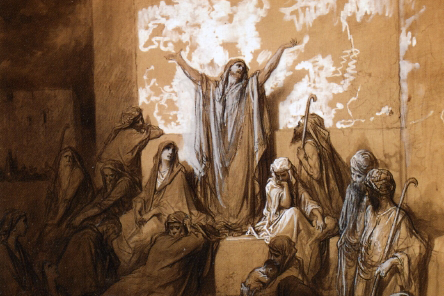
prophetsIn daily Mass, we have begun reading from the prophet Amos. Amos was perhaps among the sternest of the prophets of old. But if you’ve ever met a real prophet, you know that being in the presence of one can be very disturbing. Prophets love God’s people, but they love them too much to withhold the truth.

Prophets were famous for goring everyone’s ox. No one left the presence of a prophet untouched. Prophets didn’t choose sides; they didn’t excoriate only popular targets like the rich and powerful. They were on God’s side and realized that the poor had sins as well, and that those sins often contributed to the very injustices they faced.

So troubling were the prophets of old (including Jesus) that most of them were persecuted, jailed, stoned, exiled, and/or killed. Most of the Biblical prophets were beyond controversial; they were way over the top. Prophets denounced sin and injustice in the strongest language, announcing doom to a nation that refused to repent. Because of this, many Israelites considered them unpatriotic, even downright dangerous. They justified throwing them into prison for their lack of patriotism and for the way their words questioned and upset the status quo and the judgments of those who held power.

To many, the prophets were dangerous men who had to be stopped.

Jesus, though essentially our savior, also adopted the role of a prophet. Listen to the words He directed to the people of His day in response to their rejection of His prophetic message. Jesus likens their behavior to that of their forebears, who rejected the prophets.

Woe to you, scribes and Pharisees, you hypocrites. You build the tombs of the prophets and adorn the memorials of the righteous, and you say, “If we had lived in the days of our ancestors, we would not have joined them in shedding the prophets’ blood.” Thus you bear witness against yourselves that you are the children of those who murdered the prophets; now fill up what your ancestors measured out. You serpents, you brood of vipers, how can you avoid being sentenced to Hell? (Matt 23:29ff)

Many of us like to think that, had we lived in Jesus’ time, we would surely have been on His side. But prophets can be hard to endure, and Jesus had “difficult” things to say to everyone. For example, the Sermon on the Mount and the parables warning of judgment and exclusion from the kingdom were directed to ordinary people.

Most of us struggle with the truth to some extent, especially those of us who prefer a more gentle discourse with large doses of honey and very little vinegar. We would probably wince as we walked along with Jesus. Jesus was very disconcerting. He spoke more bluntly than we are usually comfortable with. If we read the words of the prophets and Jesus and consider them honestly, we will come away with much to repent of.

A picture is worth a thousand words. Consider the video clip below of a modern prophet named Vernon Johns. In the early 1950s he was pastor of the Dexter Avenue Baptist Church in Montgomery, Alabama. The black congregation that hired him was a rather sleepy one; in the face of rather severe racial discrimination, they preferred to remain silent and therefore safe. Johns tried to awaken them from their sleep, but to no avail. They were too afraid (at that point) to take a prophetic stand. Eventually, Vernon Johns was arrested as a troublemaker and subsequently fired by the Board of Deacons.

But Johns had laid a foundation for the next pastor of Dexter Baptist, Dr. Martin Luther King, Jr. Within a few years, Rosa Parks refused to give up her bus seat to a white woman, and the bus boycott was on. The rest is history.

This clip is of Vernon Johns’ final sermon, in which (in finest prophetic tradition) he denounces racism. Note that no one escapes his denunciations, even his own congregation. Watch this clip and behold what it must have been like to be with the prophets of old, or even with Jesus.

Behold the prophet; no one escapes! At the end of the clip, Johns’ daughter, who had stood against her Father’s zeal, sings “Go Down Moses.” The choir director, who had also opposed him, likewise stands up to sing. The seed has been planted even as the prophet is led away by the police.

Disclaimer: Vernon Johns’ speech should be understood in its particular historical context. In recent years we have seen in this country a sometimes riotous response to perceived abuses of power by the police. Note that in his speech Johns does not call for rioting. Rather he calls for proper and vigorous protest, which at that time was muted by fear and social convention. In posting this video, I intend no direct commentary on the current problems, which are often complex and admit of differing prudential judgments and responses. But as a video like this shows, there is a long history that is easily awakened. We do well, at the very least, to be aware of it.

Five Disciplines of Discipleship – A Homily for the 13th Sunday of the Year

Blog-06-25The Gospel today portrays for us some disciplines that are important for disciples. They are portrayed in the life of Jesus, but are to be applied in our lives. Let’s look at each of them in turn.

I. Purposefulness – The text says, When the days for Jesus’ being taken up were fulfilled, he resolutely determined to journey to Jerusalem, and he sent messengers ahead of him.

Note that Jesus was resolute. He was heading to Jerusalem to suffer, die, and rise, just as He announced in last week’s Gospel. He is heading there to undertake the great battle, and the great mission entrusted to Him. Everything He did was to be oriented toward this goal.

What about us? Are we as resolute in our determination to seek Christ and head for His Kingdom? Is our direction clear? Have we set our sights resolutely, or do we meander about chasing butterflies? Are we on the highway to Heaven, or do we make easy compromises with this passing world, seeking to serve two masters? Notice how easily we take exits for sin city, vicious village, and injustice junction.

Our goal is to set our face like flint and pursue the Jerusalem of Heaven, as Jesus set His face toward the Jerusalem of this earth to accomplish His mission.

Scripture speaks often of developing a firm and unequivocal resolve, of being purposeful and single-hearted in our determination to follow Jesus and set our sights on Heaven.

This one thing I do, forgetting those things which are behind, and reaching forth unto those things which are before, I press toward the mark for the prize of the high calling of God in Christ Jesus (Phil 3:13).

A double minded man is unstable in all his ways (James 1:4).

No one can serve two masters; for either he will hate the one and love the other, or he will be devoted to the one and despise the other. You cannot serve God and mammon (Mat 6:24).

There is one thing I ask of the LORD, this alone I seek: that I may dwell in the house of the LORD all the days of my life and gaze upon the beauty of the LORD (Ps 27:4).

Are you focused? Purposeful? What is the one thing you do? Concentration is the secret of power. Water over a large area is a stagnant pond, but in a narrow channel it is a powerful river.

The first discipline of discipleship is to be purposeful, determined, single-hearted, and focused in our pursuit of the Lord and His kingdom.

II. Perseverance – The text says, On the way they entered a Samaritan village to prepare for his reception there, but they would not welcome him because the destination of his journey was Jerusalem. When the disciples James and John saw this they asked, “Lord, do you want us to call down fire from heaven to consume them?” Jesus turned and rebuked them, and they journeyed to another village.

Note that James and John are angry and discouraged at the rejection of Jesus and the values of the Kingdom. But Jesus rebukes their desire for retaliation.

Notice how Jesus stays focused on His task. Rejected here, He moves forward. He does not let the devil distract Him or His disciples from the task of persistently proclaiming the Word, in season or out of season, popular or unpopular, whether accepted or rejected. Just persevere. Keep preaching; keep plowing; keep walking. Do not give up; do not grow angry; just keep working. Leave judgment to God. For now, just preach, teach, instruct, warn, and admonish.

Scripture says,

And if any one will not receive you or listen to your words, shake off the dust from your feet as you leave that house or town. Truly, I say to you, it shall be more tolerable on the day of judgment for the land of Sodom and Gomorrah than for that town. … and you will be hated by all for my name’s sake. But he who endures to the end will be saved. When they persecute you in one town, flee to the next (Matt 10:14, 22).

Yes, persevere! Remember, we’re called to be faithful, not successful. We need to persevere not just in the face of rejection, but in the face of trials, temptations, setbacks, sorrows, hurts, hardships, failures, and frustrations. Preach, teach, and be tenacious. And remember to trust in Jesus. They killed Him, but He rose.

Many have announced the end of faith. Many have sworn that they will bury the Church. But the Church has buried every one of her would-be undertakers. They dug our grave, but fell into it themselves. Yes, we read the funeral rite over them instead. We have outlived every opponent.

No weapon waged against us will prevail. Long after the current confusion and pride of the decadent West is gone, the Church will still exist, preaching Christ and Him crucified. Persevere! It is a critical discipline of discipleship.

III. Poverty – The text says, As they were proceeding on their journey someone said to him, “I will follow you wherever you go.” Jesus answered him, “Foxes have dens and birds of the sky have nests, but the Son of Man has nowhere to rest his head.”

Here is another critical discipline of discipleship: following Jesus even if worldly gain not only eludes us, but is outright taken from us. Do you love the consolations of God or the God of all consolation? Do you seek the gifts of God, or the Giver of every good and perfect gift? What if following Jesus gives you no earthly gain? What if, in fact, being a disciple brings you ridicule, loss, prison, or even death? Would you still follow Him? Would you still be a disciple?

In this verse Jesus’ potential disciple seems to have had power, prestige, or worldly gain in mind. Perhaps he saw Jesus as a political messiah and wanted to get on the “inside track.” So Jesus warns him that this is not what discipleship is about. The Son of Man’s kingdom is not of this world.

We need to heed Jesus’ warning. Riches are actually a great danger. Not only can riches not help us in what we really need, they can actually hinder us! Poverty is the not the worst thing. There’s a risk in riches, a peril in prosperity, and a worry in wealth.

The Lord Jesus points to poverty and powerlessness (in worldly matters) when it come to being disciples. Frankly, this is not merely a remote possibility or an abstraction. If we live as true disciples, we are going to find that piles of wealth are seldom our lot. Why? Well, our lack of wealth comes from the fact that if we are true disciples, we won’t make easy compromises with sin or evil. We won’t take just any job. We won’t be ruthless in the workplace or deal with people unscrupulously. We won’t lie on our resumes, cheat on our taxes, or take easy and sinful short cuts. We will observe the Sabbath, be generous to the poor, pay a just wage, provide necessary benefits to workers, and observe the tithe. The world hands out (temporary) rewards if we do these sorts of things, but true disciples refuse such compromises with evil. In so doing, they reject the temporary rewards of this earth and may thus have a less opulent place to lay their head. They may not get every promotion and they may not become powerful.

And thus “poverty” is a discipline of discipleship. What is “poverty”? It is freedom from the snares of power, popularity, and possessions.

Jesus had nowhere to rest his head. Now that’s poor. But it also means being free of the many duties, obligations, and compromises that come with wealth. If you’re poor no one can steal from you, or threaten take away your stuff. You’re free; you have nothing to lose.

Most of us have too much to lose and so we are not free; our discipleship is hindered.

Poverty is an important discipline of discipleship.

IV. Promptness (readiness) The text says, And to another he said, “Follow me.” But he replied, “Lord, let me go first and bury my father.” But he answered him, “Let the dead bury their dead. But you, go and proclaim the kingdom of God.”

The Lord seems harsh here. However, note that the Greek text can be understood in the following way: “My Father is getting older. I want to wait until he dies and then I will really be able to devote myself to being a disciple!”

Jesus’ point is that if the man didn’t have this excuse, he’d have some other one. He does not have a prompt or willing spirit. We can always find some reason that we can’t follow wholeheartedly today because we have to get a few things resolved first.

It’s the familiar problem: I’ll do tomorrow!

There is a peril in procrastination. Too many people always look to tomorrow. But tomorrow is not promised. In the Scriptures there is one word that jumps out over and over again; it’s the word now.

Come now, and let us reason together, saith the LORD (Isaiah 1:18).

behold, now is the day of salvation (2 Cor 6:2).

Today if ye will hear his voice, Harden not your heart (Ps 95:7).

Boast not thyself of tomorrow; for you know not what a day may bring forth (Prov 27:1).

That’s right, tomorrow is not promised! You’d better choose the Lord today, because tomorrow might very well be too late. Now is the day of salvation.

There were three demons who told Satan about their plan to destroy a certain man. The first demon said, “I am going to tell him that there is no Hell.” But Satan said, “People know that there is a Hell and most have already visited here.” The second demon said, “I am going to tell him that there is no God.” But Satan said, “Despite atheism being fashionable of late, most people know, deep down, that there is a God, for he has written his name in their hearts.” The third demon said, “I am not going to tell them that there is no Hell or that there is no God; I am going to tell them that there is no hurry.” And Satan said, “You’re the man! That’s the plan!”

Yes, promptness is a discipline of discipleship. It is a great gift to be sought from God. It is the gift to joyfully run to what God promises without delay.

V. Permanence – The text says, And another said, “I will follow you, Lord, but first let me say farewell to my family at home.” To him Jesus said, “No one who sets a hand to the plow and looks to what was left behind is fit for the kingdom of God.”

When we accepted Christ, we set our hand to the gospel plow and we left certain things behind. We are not to return to those things, things like harmful habits, ruinous relationships, soul-killing sinfulness, and perilous pleasures.

Yes, there are some things that we used to do that we have no business doing now. We need to give up our former ways and not look back.

Scripture says,

Now this I affirm and testify in the Lord, that you must no longer live as the Gentiles do, in the futility of their minds; they are darkened in their understanding, alienated from the life of God because of the ignorance that is in them, due to their hardness of heart; they have become callous and have given themselves up to licentiousness, greedy to practice every kind of uncleanness. You did not so learn Christ, assuming that you have heard about him and were taught in him, as the truth is in Jesus. Put off your old nature which belongs to your former manner of life and is corrupt through deceitful lusts, and be renewed in the spirit of your minds, and put on the new nature, created after the likeness of God in true righteousness and holiness (Eph 4:17-23).

Therefore, brothers, make every effort to make permanent your calling and election, because if you do these things you will never stumble (2 Peter 1:10).

An old spiritual says,

Hold on, Hold on! If you want to get to heaven let me tell you how, keep your hands on the Gospel plow! Keep your hands on the plow and hold on! Hold on. When you plow that field don’t lose your track, Can’t plow straight and keep a-lookin’ back. Keep your hands on the plow and hold on, Hold on!

Persevere, hold on, don’t let go. Keep a-inchin’ along like a poor old inchworm. Stay, hold, keep walkin’, and don’t look back!

Perseverance is a discipline of discipleship.

Here then are five disciplines of discipleship. Learn about them and seek them from the Lord. Without them we will surely perish.

What If God Stopped Watching?

Blog-06-24The commercial below imagines that God’s cell phone battery has run out of juice and He can no longer “watch” the earth. The result? Complete chaos!

Of course if God really were to stop watching or regarding His creation, the actual result would be much worse than chaos; it would be complete annihilation. Fortunately, the truth is that He will not stop watching us.

What is common, though, is for us to stop watching Him. The result? Complete moral chaos! Utter confusion! Welcome to the post-modern, secular West. God is the source of our truth, but many have stopped watching Him, and so have become confused about even the most basic moral and physical realities. It’s time to replace our batteries and reconnect with God.