On Fridays, I typically feature a short video that illustrates the faith, usually in some unintentional ways. Today, I’d like to call to your attention to a new series of videos by Bishop Robert Barron, which intentionally set forth the faith: Catholicism: The Pivotal Players. The first volume of the series has been released and covers St. Francis of Assisi, St. Thomas Aquinas, St. Catherine of Siena, Michelangelo, Blessed John Henry Newman, and G.K. Chesterton. One or more future volumes will be forthcoming.
There are various ways of relating Church history. One can emphasize themes, take a strict chronological approach, or focus on key historical figures and the times in which they lived. It is this last approach that Bishop Barron takes.
As we have come to expect with Bishop Barron’s projects, “The Pivotal Players” is wonderfully done. The visuals are stunning. Beauty, goodness, and truth belong together, and Bishop Barron gets the balance right. Words and images support each other and summon us to goodness. For those who cannot afford pilgrimages to distant lands, Bishop Barron’s series provides a way to almost be there!
The biographical material presented is richly informative without being overwhelming. Word and image together paint a full picture. The material is broken up into manageable 12-15 minute segments, allowing a parish group or family to stop and discuss along the way.
There are the wonderful cutaways in which Bishop Barron speaks informally to a man off-camera, decoding the material and framing it well. He applies the material to modern times and helps us to understand the original context as well as its historical significance. These interludes are some of the best moments in the videos; he makes very memorable observations. As a small example, Bishop Barron likens St. Francis of Assisi to a bomb or a clanging bell that God used to wake up the Church. What a memorable, cogent remark!
I highly recommend that you watch the series. I am currently viewing it with a small group of parishioners. As we watch, a great deal comes alive for us: hagiography, to be sure, but also history, liturgy, ecclesiology, spirituality, and new perspective. It is a rich meal provided by the good Bishop—a feast for both the eyes and the soul. I’m glad to know this is just the first volume!
I am teaching out of the Book of Job for our parish bible studies. Consider the following insight by Job on the spiritual life:
God is wise in heart and mighty in strength;
who has withstood him and remained unscathed? (Job 9:3)
At first glance, we might read this to mean that we don’t dare talk back to God or resist Him lest He punish us, but this would be a superficial interpretation. The text surely speaks more richly, of the spiritual life and the journey we must make with God.
It recalls a story about Jacob, told in the 32nd chapter of Genesis. Jacob is in the desert (often a place of testing and encounter) and is returning to make amends with his brother Esau, from whom is estranged. During the night Jacob has a mysterious encounter with God. The text recounts that he wrestles with a man, but is it a man, an angel, or God? Through the night, Jacob wrestles with this man. Even more mysteriously (if the “man” is God), the text says that Jacob “prevails,” or at least holds his own. To end the struggle, God disables Jacob by touching his hip. Out of respect, God then gives Jacob a new name:
Your name will no longer be Jacob, but Israel, because you have struggled with God and with humans and have overcome (Gen 32:28).
The name “Israel” means “he who wrestles (strives) with God.”
As a result of this encounter, Jacob would limp for the rest of his life, leaning on a staff for support. It was as if to say that he would have to learn to lean on God and strive with God rather than against Him. Injured or not, this would be a blessing for Jacob, a new and deeper stage in his walk with God.
And so Job rightly said, Who has withstood God and remained unscathed? Our spiritual life can be seen as this kind of struggle. God respects our freedom and is “glad” to engage us. At least we are willing to stay in a conversation with Him rather than running from Him or refusing to be engaged at all.
As for Job, Jacob, and countless others before us, so too for us. We will not emerge from this spiritual relationship with God unchanged or unscathed. This is because our life with God is no mere friendship, or only a source of consolation. God is Lord and Father, and He has a difficult work to accomplish in us, who (like Jacob) can be stubborn, prideful, and resistant.
As an example, consider how in this world the relationship between parents and children is one of love but also one that is filled with tensions. This is due to the nature of the relationship. Parents, in addition to giving good and pleasant things to their children, also have difficult tasks in their formation. Children must be disciplined and disabused of selfish or destructive behaviors. Children must be taught things that do not necessarily please them. Parents must often make demands on their children that summon them to greater things requiring sacrifice and effort.
None of this is easy—and neither is our relationship with God. Our relationship is not merely about pleasantries. God must work to break sinful, selfish, and harmful drives within us. He must often imbue us with teachings that go against our desires and priorities.
Are you willing to struggle and to strive with God? You will be blessed! No one goes away from Jesus unchanged. No one who has God for his true Father will be unchanged, or “unscathed” as Job puts it. Jacob limped and leaned on a cane for the rest of his life (as a sign of humility). How do you limp? Where are your healing wounds in the saving struggle with God?
The song in this video is a bit over the top; I don’t think Jesus was conflicted, as this song implies. But we often are. The struggle can be difficult, but stay in it!
The first reading for today (Wednesday of the 27th Week) says,
The LORD alone stretches out the heavens.
He made the Bear and Orion,
the Pleiades and the constellations of the south;
He does great things past finding out,
marvelous things beyond reckoning (Job 9:8-10).
Due to the light pollution common in our cities today, we urbanites really don’t have any idea what we’re missing when it comes to the night sky. Up until about a hundred years ago, the night sky was illuminated by billions of points of light; it’s a breathtaking display many moderns have never experienced.
My first and only real glimpse of the magnificent Milky Way was nearly twenty years ago. I was visiting a priest friend in rural North Dakota. It was mid January, the very heart of winter. The sky was cloudless, the temperature was just below zero, and the humidity was very low (thus, no haze). We decided to take an evening walk. Only an occasional street lamp lit the ground. As we got farther away from the town, about half a mile, I looked up and could scarcely believe my eyes.
“What is that?” I asked, “Are those clouds coming in?”
“What do you mean?” asked my friend, “There are no clouds.”
“What is all that then?” I asked, gesturing upward with my arm.
He smiled and replied, “Those are stars. That’s the Milky Way.”
On the one hand I astounded by the sight, but at the same time I felt a tinge of anger that I’d been deprived of such a view all my life. Is that what the ancients saw every night? This is what inspired the psalmist to write, The heavens declare the glory of God, the firmament shows forth the work of His hand … night unto night takes up the message (Ps 19:1ff). This is what God meant when he told Abraham, “Look up at the heavens and count the stars—if indeed you can count them.” Then he said to him, “So shall your offspring be” (Gen 15:5).
Frankly, where I live in Washington, D.C. I can count the stars. But the true night sky is astonishing in the number of stars it contains.
An old hymn says,
The spacious firmament on high,
With all the blue ethereal sky,
And spangled heavens, a shining frame
Their great Original proclaim …
Soon as the evening shades prevail
The moon takes up the wondrous tale …
While all the stars that ‘round her burn
And all the planets in their turn,
Confirm the tidings as they roll,
And spread the truth from pole to pole.
What though in solemn silence all
Move round our dark terrestrial ball?
What though no real voice nor sound
Amid the radiant orbs be found?
In reason’s ear they all rejoice,
And utter forth a glorious voice,
Forever singing as they shine,
“The hand that made us is divine.”
If there is ever a widespread power outage in the greater Washington area, I pray that it happens on a cloudless night. If it does, I will ask my neighbors to join me outside and behold the gift above.
As Job beheld the stars and expressed his marvel, we moderns may think we know what he saw. But I have come to discover that most of us city dwellers really have little idea. The sky the ancients saw each night (and some in rural areas see even today) is more glorious than most of us could ever imagine: the stars in unbelievable numbers forever singing as they shine, “The hand that made us is divine.”
Here are some pictures of the stars, set to an old Al Bowlly song:
The second half of the high-definition video below shows some wonderful views of the stars in the night sky. If your monitor is a good one, you might want to maximize the view, which displays nicely even on fairly large screens.
The first reading from last Sunday’s Mass was a stunning and sobering analysis of the human tendency to be complacent. It also showed how this complacency is fueled by a series of denials that are listed in a tightly woven tapestry. Here is the passage, followed by some basic analysis.
Thus says the LORD the God of hosts: Woe to the complacent in Zion! Lying upon beds of ivory, stretched comfortably on their couches, They eat lambs taken from the flock, and calves fromthe stall! Improvising to the music of the harp, like David, they devise their own accompaniment. They drink wine from bowls and anoint themselves with the best oils; yet they are not made ill by the collapse of Joseph! Therefore, now they shall be the first to go into exile, and their wanton revelry shall be done away with. (Amos 6:1.4-7).
The Diagnosis
The fundamental diagnosis is that many are complacent. To be complacent means to feel satisfied with the current state and to be disinclined to try to make things better. It is self-satisfaction accompanied by a lack of awareness of dangers or deficiencies. It is a kind of myopic condition in which one cannot see beyond one’s own situation to recognize the plight of others.
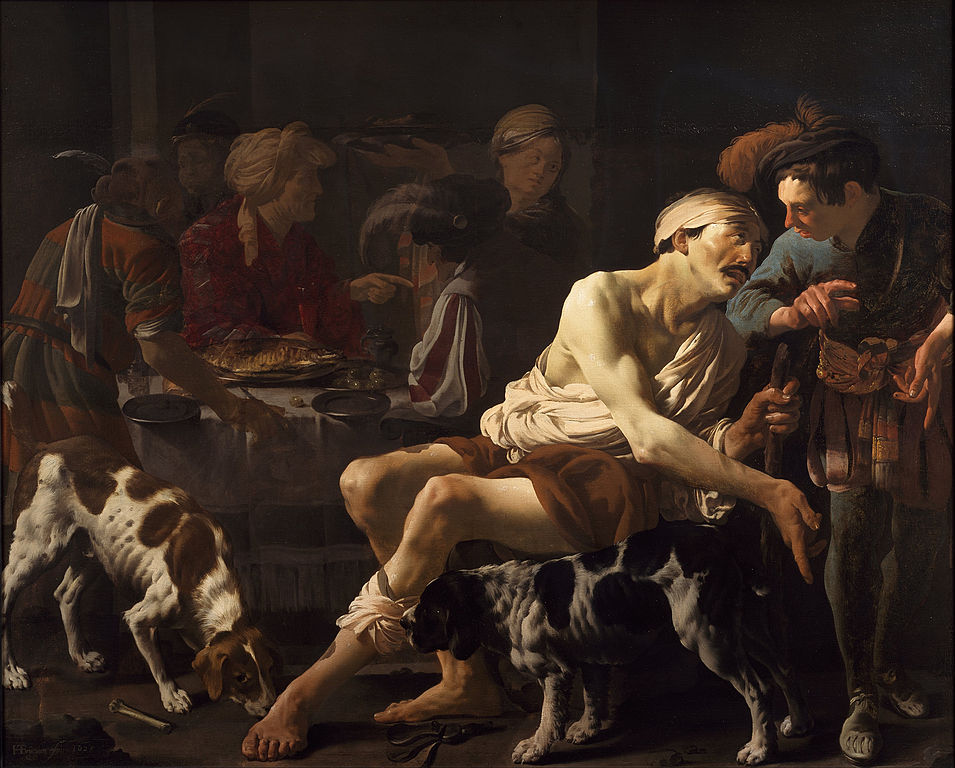
It is like the rich man who could not see beyond his feast to the starving Lazarus at his very door. Perhaps the meats where piled too high or the wine blurred his vision. All of this is a form of denial. Lazarus was still there even if the rich man couldn’t or wouldn’t see him.
And what of us? Is it possible that our possessions block our view as well? Are we possibly lost in the rooms of our 5,000 square foot homes? What does our life amount to? Do we spend most of our time and money pleasing ourselves? Are we rich in what matters to God or just in what pleases us? Are we aware of the sufferings of so many others? Though we cannot help everyone, whom do we help? Does the moral collapse of our country bother us? What are we more upset about, that our children do not go to Mass or that our favorite sports team did not win? What makes us passionate and mournful, that 50 million children have been killed through abortion or that we didn’t get our own way in some matter?
Yes, woe be to the complacent. Woe be to those who life amounts to little more than pleasing themselves and living insular lives among their trinkets. Life has a funny way of closing in on them, for the world they ignore does not get better magically.
Indeed, no form of denial can ultimately last. The text announces woe because it does come eventually to the complacent; the ignored problems of others overflow into their insular world. Islands have a funny way of eroding when the tides of the sorrow of others rise.
The Drowsiness
Not only are they described as complacent, but as drowsy. They recline on couches and beds. They sleep through storms the way Jonah slept through the storm he had caused; the pagan sailors eventually had to rouse our Jewish prophet Jonah to “call on his God.”
Catholics today prefer to sleep though the ruinous storms in our culture. This, too, is denial. To be drowsy is to be sleepy and unware. All throughout our culture there is confusion, deception, and moral darkness. Many have fallen away from the faith and are in error and mortal sin.
Yet for most Catholics and most parishes it is “business as usual.” Spaghetti dinners, parish picnics, and raffles have their place, but in the midst of a great storm it is unforgiveable that we are not urgently seeking to save souls through clear instruction and unambiguous calls to repentance. Instead of being wide awake ourselves and summoning others to rise from their slumber, too often we resemble a sleeping giant or behave like the Apostles in the Garden of Gethsemane, who slept while Christ was in agony.
Imagine, the Son of God was about to engage in the most pivotal battle of all human history and the apostles were asleep! Later, at the moment of crucifixion, all but one of them would hide. Things have not changed, my friends. Too many of us are asleep and are uninvolved in the crucial battle for souls.
The Decadence
The text says, They eat lambs taken from the flock, and calves from the stall! The frugal and wise stewards of God’s gifts typically did not eat lambs and calves. Lambs were raised to be sheep so that their wool and milk could bless; only when they were older and nearing the end were they slaughtered for meat. Calves, too, were valuable and raised to be beasts of burden and perform other valuable functions; only when they were older and near the end of their useful life were they fattened and taken for meat. In those days, eating the meat of lambs and calves was a sign of waste and usually of decadence. The slaughter of young animals was only considered reasonable for the purpose of sacrifice to God.
Consider the insensitivity of decadence and waste; they are signs of grave excess. Yet this is quite common in our throwaway culture. And while many do strive to donate unneeded items and to recycle what can reasonably be recycled, so much is still wasted.
Consider, too, the root meaning of the word decadence: de (from, apart, or concerning) + cadere (to fall). The word describes how we figuratively trip over our excessive things. All this “stuff” preoccupies us and keep us from seeing beyond our trinkets and preoccupations to the wider world and what is going on. And here, too, is denial of our failure to see as we trip over our excesses.
The Distractions
The text says that they are improvising to the music of the harp. Permit such a text to mean that too often we pipe little tunes for ourselves, we distract ourselves with various distractions. “OK, so the euthanasia bill is being voted on next week. My son is shacked up with his girlfriend. None of my siblings attend Mass. But what’s on TV tonight? I wonder who’s posted on Facebook today?” We have distractions today that the ancients couldn’t have even dreamed of as they partook of their bread, circuses, and gladiatorial contests. All these distractions we have help us to ignore or deny the collapse and ruin around us.
The Drunkenness
Drinking wine from bowls! The ancient Greeks and Romans consumed food and drink so excessively that they would force themselves to vomit in order to be able to continue consuming. Lots of excess there! But most of our excess today in the realm of food and drink is for the purpose of anesthetizing ourselves.
Sobriety is painful in a sinful and fallen world. If we are sober we might actually know what is going on and feel some more responsibility. Because that is painful we embrace a sort of denial by medicating and tuning out. To be sober is to have a clear mind that is alert to what is going on. But being alert and aware can hurt—I might have to actually care about things, events, and people.
In a little wine there may be truth, but a lot of wine brings an altered reality, and many prefer it. It is part of the picture of complacency that one is tuned out and unware. It is easier to stare into the bottom of a glass than to look into the condition of others and soberly assess what is really going on. Bottoms up!
The “Doll Up”
The text says that they anoint themselves with the best oils; today, we us perfume, cologne, or aftershave. The notion is that to look good is better than to be good; it is just too much trouble to actually be good. The emphasis on appearances is just another way to deny or avoid confronting reality.
The Disconnect
All of this leads to the most central denial of all: They are not made ill by the collapse of Joseph! Historically this is a reference to the destruction of the Northern Kingdom of Israel in 721 B.C. For a brief time, the Southern Kingdom of Judah did embrace some reforms, having seen that the moral collapse of the North and her failure to heed the calls of the prophets for reform led to her demise. But the reforms were short-lived. Even acknowledging what destruction impenitence can bring, too many just to take to their couches. The clock is ticking toward destruction. “But never mind all that. What’s on TV tonight, and would you please bring me some more wine?”
The fact is, we should be greatly saddened by the moral collapse of our country. Many souls are being lost and hurtful errors are multiplying. The beatitude says, Blessed are those who mourn, for they will be comforted (Mat 5:4). Who are those who mourn? They are those who see the awful state of many of God’s people: lost, confused, scattered, hurt, and on a path leading to Hell. Those who mourn are comforted (more literally, strengthened), to work earnestly for the salvation of souls.
Yet too many today do not mourn. Too many are not made ill by the collapse of Joseph. Few indeed will get off their couches to work to save souls and to spread the truth of the Gospel. The denial of the problem by now is too deep; their couches have claimed them.
The Destruction
The text says that the complacent will be the first to be driven into exile when the destructiveness of their ways sets in. Denial will no longer be possible as the couch is swept away in the coming storm. Denial of reality does not make it not exist. Judah, to whom this text was addressed, did collapse in 587 B.C. and the nobles led the parade into exile.
If we will not arise and drive back our enemies—Satan and his minions—if we deny that there is any problem, we will soon discover that reality has a strange way of being stubbornly there. It will either reach us here and now (if we are lucky) or on our judgment day (when repentance is no longer possible).
The Lord has painted a sobering but realistic portrait through Amos. Complacency and denial are very serious evils because of their capacity to lull us into ever deeper sleep. Be not deceived into continued moral slumber.
And do this, understanding the present time: The hour has already come for you to wake up from your slumber, because our salvation is nearer now than when we first believed. The night is nearly over; the day is almost here. So let us put aside the deeds of darkness and put on the armor of light. Let us behave decently, as in the daytime, not in carousing and drunkenness, not in sexual immorality and debauchery, not in dissension and jealousy. Rather, clothe yourselves with the Lord Jesus Christ, and do not think about how to gratify the desires of the flesh (Rom 13:11-14).
We are beginning to read from the Book of Job in daily Mass. One of its core issues is the problem of suffering and why God allows it. If God is omnipotent and omniscient then how can He tolerate evil, injustice, and suffering of the innocent? Where is God when a woman is raped, when genocide is committed, or when evil men hatch their plots? Why did God even conceive the evil ones and let them be born?
The problem of evil cannot be answered simply; it is a mystery. Its purpose and why God permits it are caught up in our limited vision and understanding. Scripture says that “all things work together for the good of those who love and trust the Lord and are called according to his purposes” (Rom 8:28). But how this is often difficult for us to see. Anyone who has ever suffered a tragic and senseless loss or has observed the disproportionate suffering that some must endure cannot help but ask why. And the answers aren’t all that satisfying to many.
As in the days of Job, we cry out for answers but few are forthcoming. In the Book of Job, God speaks from a whirlwind, questioning Job’s ability to even ask the right questions. In the end, though, He is God and we are not. This must be enough for us and we must look with trust to the reward that awaits the faithful.
One of the most perplexing aspects of suffering is its uneven distribution. In America as a whole, there is much less suffering than in many other parts of the world. And even here, some go through life strong, wealthy, and well-fed while others suffer crippling disease, sudden losses, financial setbacks, and burdens. And while a lot of our suffering comes from our own poor choices and/or lack of self-control, some of it seems unrelated. The most difficult suffering to accept is that inflicted on the innocent by third parties who seem to suffer no ill effects: parents who mistreat or neglect their children, those who exploit the poor or unsuspecting for their own gain exploited, etc.
Suffering is hard to explain simply or to merely accept. I think this just has to be admitted. Simple slogans and quick answers are seldom sufficient in the face of great evil and suffering. When interacting with those who are deeply disturbed by the problem of evil, a healthy dose of sympathy, understanding, and a call to humility will be more fruitful than forceful rebuttal.
A respectful exposition of the Christian understanding of evil might include some of the following points. (Note that these are not explanations per se (for suffering is a great mystery) and they are humble for they admit of their own limits.)
The Scriptures teach that God created a world that was as a paradise. Although we only get a brief glimpse of the Garden of Eden, it seems clear that death and suffering were not part of it and that Adam and Eve caused their entry, despite being warned that this would be the result of eating from the forbidden tree.
Even in Eden the serpent coiled from the branch of a tree called the Tree of the Knowledge of Good and Evil. So even in paradise the mystery of evil lurked.
In a way, the tree and the serpent had to be there. We were made to love; love requires freedom; and freedom requires choice. The yes of love must permit of the no of sin. In our rebellious no both we and the world unraveled, ushering in death and chaos. Paradise was lost and a far more hostile and unpredictable world remained. From this fact came all of the suffering and evil we endure. Our sins alone cause an enormous amount of suffering on this earth, the vast majority of it by my reckoning. The suffering caused by natural phenomena is also linked to sin—Original Sin, wherein we preferred to reign in a hellish imitation rather than to serve in the real paradise.
The link between human freedom and evil/suffering also explains God’s usual non-intervention in evil matters. To do so routinely would make an abstraction of human freedom and thus remove a central pillar of love. But there is mystery here, too, for the Scriptures frequently recount how God did intervene to put an end to evil plots, to turn back wars, and to shorten famines and plagues. Why does He sometimes intervene and sometimes not? Why do prayers of deliverance sometimes get answered and sometimes not? Here, too, there is a mystery of providence.
The lengthiest Biblical treatise on suffering is the Book of Job. There, God shows an almost shocking lack of sympathy for Job’s questions and sets a lengthy foundation for the conclusion that the mind of man is simply incapable of seeing into the depths of this problem. God saw fit to test Job’s faith and strengthen it. In the end Job is restored and re-established with even greater blessings; it is a kind of foretaste of what is meant by Heaven.
The First Letter of Peter also explains suffering in this way: In this you rejoice, although now for a little while you may have to suffer through various trials, so that the genuineness of your faith, more precious than gold that is perishable even though tested by fire, may prove to be for praise, glory, and honor at the revelation of Jesus Christ (1 Peter 1:6-7). In other words, our sufferings purify us and prepare us to meet God.
Does this mean that those who suffer more are in need of more purification? Not necessarily. It could also mean that greater glory is awaiting them. The Scriptures teach, Therefore, we are not discouraged; rather, although our outer self is wasting away, our inner self is being renewed day by day. For this momentary light affliction is producing for us an eternal weight of glory beyond all comparison (2 Cor 4:16-17). Hence suffering “produces” glory in the world to come. Those who suffer more, but endure it with faith, will have greater glory in the world to come.
Regarding the apparent injustice of uneven suffering it will be noted that the Scriptures teach of a great reversal when many who are last shall be first (Mat 20:16), when the mighty will be cast down and the lowly exalted, when the rich will go away empty and poor be filled (Luke 1:52-53). In this sense, it is not necessarily a blessing to be rich and well-fed, unaccustomed to suffering. The only chance the rich and well-heeled have to avoid this is to be generous and kind to the poor and those who suffer (1 Tim 6:17-18).
As to God’s apparent insensitivity to suffering, we can only point to Christ, who did not exempt Himself from the suffering we caused by leaving Eden. He suffered mightily and unjustly but also showed that this would be a way home to paradise.
I’m sure you can add to these points. Be careful with the problem of evil and suffering; there are mysterious dimensions that must be respected. The best approach in talking to others may be with an exposition that shows forth the Christian struggle to come to grips with it. The “answer” of Scripture requires faith, but the answer appeals to reason. Justice calls us to humility before a great mystery of which we can see only a little. The appeal to humility in the face of a mystery may command greater respect from an atheist than would “pat” answers, which could alienate them.
Today I would like to discuss the Gospel from last Saturday morning’s daily Mass (25th Week of the Year). For indeed one of the more beautiful passages in the Old Testament is the 12th Chapter of Ecclesiastes. It is a melancholy but soulful meditation on old age. Its poetic imagery is masterful as it draws from the increasingly difficult effects of old age such as hearing loss, fading eyesight, difficulty walking, digestive issues, and even gray hair.
Remember your Creator in the days of your youth, before the evil days come And the years approach of which you will say, I have no pleasure in them; Before the sun is darkened. and the light, and the moon, and the stars, while the clouds return after the rain; When the guardians of the house tremble, and the strong men are bent, And the grinders are idle because they are few, and they who look through the windows grow blind; When the doors to the street are shut, and the sound of the mill is low; When one waits for the chirp of a bird, but all the daughters of song are suppressed; And one fears heights, and perils in the street; When the almond tree blooms, and the locust grows sluggish and the caper berry is without effect, Because man goes to his lasting home, and mourners go about the streets; Before the silver cord is snapped and the golden bowl is broken, And the pitcher is shattered at the spring, and the broken pulley falls into the well, And the dust returns to the earth as it once was, and the life breath returns to God who gave it. Vanity of vanities, says Qoheleth, all things are vanity! (Ecclesiastes 12:1-8)
And now some commentary on each verse (my comments are in red)
Remember your Creator in the days of your youth, before the evil days come And the years approach of which you will say, I have no pleasure in them;
We are advised to give thanks to God for the vigor of youth because “evil” days will come. Here evil does not mean “sinfully evil.” Rather, it refers to days that are difficult and bad, days that bring challenge and pain.
We might want to be thankful for living in the modern age, because the burdens of old age are far less than they were in ancient times. Consider all the medicines and aids that make aging less difficult: Pain medicines alleviate arthritis; calcium supplements help with osteoporosis; blood pressure medication helps prevent stroke and partial paralysis; motorized scooters increase mobility; eyeglasses and hearing aids improve our ability to interact. In the ancient world, age only brought increasing and cumulative burdens, so that our author says regarding these days, “I have no pleasure in them.”
Before the sun is darkened. and the light, and the moon, and the stars, while the clouds return after the rain;
This is a poignantly poetic description of eyesight going bad. The light darkens, the moon and stars are less visible (perhaps they are blurry), and the clouds of cataracts begin to afflict the elderly.
When the guardians of the house tremble, and the strong men are bent, And the grinders are idle because they are few, and they who look through the windows grow blind;
The “guardians of the house” are the arms. They begin to tremble with the tremors common to old age, even without Parkinson’s disease.
The “strong men” are the legs. They are bent, less able to carry the weight of the body. Bent also describes the legs when we are seated, unable to walk.
The “grinders” are the teeth and they are few! We have far better dental health today. In ancient times, it was common for the elderly to have lost many if not most of their teeth. This made it difficult to eat and required food to be mashed.
The image of an elderly person sitting by a window looking out, but able to see less and less, is surely sad, but also vivid. I remember my grandmother in her last years. She could no longer read much because her eyesight was so poor and her mind could not concentrate on the text. So she sat for hours and just looked out the window.
When the doors to the street are shut, and the sound of the mill is low; When one waits for the chirp of a bird, but all the daughters of song are suppressed;
The “doors to the street” are the tightly compressed lips common to the very elderly, especially when teeth are missing. It also depicts how many of the elderly stop talking much. Their mouths seem shut tight.
The sound of the mill may be another reference to chewing. Many of the elderly lose their appetite. One the psalms says regarding the elderly, “I moan like a dove and forget to eat my bread” (Psalm 102:4).
Waiting for the chirp of the birds may be a reference to the silence of the elderly, but it may also be a reference to deafness, as many can no longer hear their singing and chirping, something the young often take for granted.
And one fears heights, and perils in the street; When the almond tree blooms, and the locust grows sluggish and the caper berry is without effect,
Walking is difficult, sometimes treacherous, and requires great effort for many of the elderly. Whereas the young may not think twice about climbing a flight of stairs, the elderly may see them as an insurmountable obstacle.
Perils in the street like loose or upturned stones cause fear because falls for the elderly can be catastrophic. They may also not be able to get up if they fall.
The almond tree blooming is a symbol for gray hair because almond trees had white blooms.
The caper berry had several uses in the ancient world. It was an appetite stimulant, an aphrodisiac, and was also used to treat rheumatism! But in old age, it would seem that the desired effects are hard to come by.
Because man goes to his lasting home, and mourners go about the streets; Before the silver cord is snapped and the golden bowl is broken, And the pitcher is shattered at the spring, and the broken pulley falls into the well, And the dust returns to the earth as it once was, and the life breath returns to God who gave it.
Finally, death comes, as symbolized by the mourners in the street. The silver cord and the golden bowl, symbols of life, are now snapped and broken.
The broken pitcher symbolizes that the body no longer contains the soul.
The pulley, a device used to lift, is now broken, indicating that the body will no longer rise from its place but rather fall into the well of the grave.
And we return to the dust and the soul goes to God.
Vanity of vanities, says Qoheleth, all things are vanity!
In the end, all things pass. Nothing remains. Because all things are to pass, they are vain (empty). The physical world is less real than the spiritual world, because the physical passes while the spiritual remains. Since you have been raised to new life with Christ, seek the things that are above, where Christ is seated at God’s right hand (Col 1:3).
This chapter from Ecclesiastes is a sad but powerfully beautiful description of old age. I have often shared it with the very elderly and those who are suffering the ill effects of old age. I remember reading it slowly to my father as he lay dying in his hospital room. He could no longer talk much, but as I read it to him I saw him nod and raise his hands as if to say “Amen!” It was almost as if he meant to say, “Somebody understands; God understands.” Perhaps you also know an elderly person who could benefit from this passage. I know that it is sad and that not everyone is in a condition that they can hear such a stark and sad description, but some are in a frame of mind such that they can derive peace from it, as God, through His word, tell them that He knows exactly what they are going through.
The Rich Man and the Poor Lazarus by Hendrick ter Brugghen
In the Gospel for today about the rich man and Lazarus the Lord gives us some important teachings on judgment and Hell. We live in times in which many consider the teachings on Hell to be untenable. They struggle to understand how a God described as loving, merciful, and forgiving can assign certain souls to Hell forever. Despite the fact that the Doctrine of Hell is taught extensively in Scripture as well as by Jesus Himself, the doctrine does not comport well with many modern notions and so many think that it has to go.
Today’s Gospel goes a long way toward addressing some of the modern concerns about Hell. Prior to looking at the reading, it is important to understand why Hell has to exist. I have written on that topic extensively here: http://blog.adw.org/2010/07/hell-has-to-be/. Here is a brief summary of that lengthier article:
Hell has to exist essentially for one reason: respect. God has made us free and respects our freedom to choose His Kingdom or not. The Kingdom of God is not a mere abstraction. It has some very specific values and these are realized and experienced perfectly in Heaven.
The values of the Kingdom of God include love, kindness, forgiveness, justice to the poor, generosity, humility, mercy, chastity, love of Scripture, love of the truth, worship of God, and the centrality of God.
Unfortunately, there are many people who do not want a thing to do with those values, and God will not force them to adopt and live them. While everyone may want to go to Heaven, Heaven is not merely what we want it to be; it is what it is, as God has set it forth. Heaven is the Kingdom of God and the values thereof in all their fullness.
Hence there are some (many, according to Jesus) who live in such a way that they consistently demonstrate that they are not interested in Heaven, because they are not interested in one or many of the Kingdom’s values. Hell “has to be,” because God respects people’s freedom to choose to live in this way. Because they demonstrate that they do not want Heaven, God respects their freedom to choose “other arrangements.”
In a way, this is what Jesus says in John’s Gospel when He states that judgment is about what we prefer: And this is the judgment: the light has come into the world, and people loved the darkness rather than the light because their works were evil (John 3:19). In the end, you get what you want: light or darkness. Sadly, many prefer the darkness. The day of judgment discloses our final preference and God respects that, even if it is not what He would want for us.
This leads us to today’s Gospel, which we will look at in three stages.
I. The Ruin of the Rich Man – As the Gospel opens we see rich man (some call him Dives, which simply means “rich”). There was a rich man who dressed in purple garments and fine linen and dined sumptuously each day.
It is clear that he lives very well and has the ability to help the poor man, Lazarus, who is outside his gate. But he does not do so.
The rich man’s sin is not so much one of hate as of indifference. He is living in open rejection of one of the most significant Kingdom values: love of the poor. His insensitivity is literally a “damnable sin,” as it lands him in Hell. The ruin of this rich man is his insensitivity to the poor.
The care of the poor may be a complicated matter, and there may be different ways of approaching it, but in no way can we ever consider ourselves exempt if it is within our means to help them. We simply cannot avoid judgment for our greed and insensitivity. As God said in last week’s reading regarding those who are insensitive to the poor: The LORD has sworn by the pride of Jacob: Never will I forget a thing they have done (Amos 8:7). God may well “forget” many of our sins (cf Is 43:23; Heb 8:12), but apparently disregarding the needs of the poor isn’t one of them.
Hence this rich man has willfully and repeatedly rejected the Kingdom and is ruined by his greed and insensitivity. He lands in Hell because he doesn’t want Heaven, where the poor are exalted (cf Luke 1:52).
Abraham explains the great reversal to him: My child, remember that you received what was good during your lifetime while Lazarus likewise received what was bad; but now he is comforted here, whereas you are tormented.
II. The Rigidity of the Rich Man – You might expect the rich man to be repentant in the end and to have a change a heart, but he does not. Looking up into Heaven he sees Lazarus next to Abraham, but rather than finally recognizing Lazarus’ dignity and seeking his forgiveness, he tells Abraham to send Lazarus to Hell with a pail of water to refresh him. The rich man still sees Lazarus as beneath him (even though he has to look up to see him); he sees Lazarus as an errand boy and wants him to come to Hell with water.
Notice that the rich man does not ask to be admitted to Heaven! Although he is unhappy with where he is, he still does not seem to desire Heaven and the Kingdom of God with all its values. He has not really changed. He regrets his current torment, but does not see or desire Heaven as a solution to that. Neither does he want to appreciate Lazarus’ exalted state. The rich man wants to draw him back to the lower place he once occupied.
This helps to explain why Hell is eternal. It would seem that there is a mystery of the human person that we must come to accept: that we come to a point in our life when our character is forever fixed, when we no longer change. When exactly this occurs is not clear; perhaps it is at death itself.
The Fathers of the Church often thought of the human person as clay on a potter’s wheel. As long as it is on the wheel and moist it can be molded, changed, and fashioned. But there comes a point when the clay is taken off the wheel and placed in the fiery kiln (fire is judgment day (cf 1 Cor 3:15)), at which time its shape is forever fixed and cannot be changed.
The rich man now manifests this fixed quality. He has not changed one bit. He is unhappy with his torments, even wanting to warn his brothers. But he apparently does not intend to change, or somehow he is unable to change.
This is the basis for the teaching that Hell is eternal: once having encountered our fiery judgment, we will no longer be able to change. Our decision against the Kingdom of God and its values (a decision that God, in sadness, respects) is forever fixed.
III. The Reproof for the Rest of Us – The rich man, though he cannot or will not change, would like to warn his brothers. He thinks that perhaps if Lazarus would rise from the dead and warn them, they would repent!
We are the rich man’s brethren, and we are hereby warned. The rich man wanted exotic measures but Abraham said, “They have Moses and the prophets. Let them listen to them.” “Oh no, father Abraham, but if someone from the dead goes to them, they will repent.” Then Abraham said, “If they will not listen to Moses and the prophets, neither will they be persuaded if someone should rise from the dead.”
Of course this reply is dripping with irony, given Jesus’ resurrection from the dead.
That aside, the fact is that we should not need exotic signs to bring us conversion. The phrase “they have Moses and the prophets” is a Jewish way of saying that they have Scripture.
The Scriptures are clear to lay out the way before us. They give us the road map to Heaven and we only need to follow it. We ought not need an angel, or a ghost, or some extraordinary sign. The Scriptures and the teachings of the Church should be sufficient.
Their message is clear enough: daily prayer, daily Scripture, weekly Eucharist, frequent confession, and repentance all lead to a change of heart wherein we begin to love the Kingdom of God and its values. We become more merciful, kind, generous, loving toward the poor and needy, patient, chaste, devout, and self-controlled.
In the end we must be clear: Hell exists. It has to exist, because we have a free choice to make, and God will respect that choice even if he does not prefer it.
You and I are free to choose the Kingdom of God, or not. This Gospel makes it clear that our ongoing choices lead ultimately to a final and permanent choice, at which time our decision is forever fixed.
The modern world needs to sober up. There is a Hell and its existence is both reasonable and in conformity with a God who both loves us and respects our freedom.
If we have any non-biblical notions in this regard,we ought to consider ourselves reproved. Popular or not, Hell is taught, as is the sobering notion that many prefer its darkness to the light of God’s Kingdom.
The care of the poor is very important to God. Look through your closet this week and give away what you can. Look at your finances and see if they are pleasing to God. The rich man was not cruel, just insensitive and unaware. How will you and I respond to a Gospel like this?
The commercial below is a good illustration of a description of reality supplied by St. Paul.
Finally, be strong in the Lord and in the strength of his might. Put on the whole armor of God, that you may be able to stand against the schemes of the devil. For we do not wrestle against flesh and blood, but against the rulers, against the authorities, against the cosmic powers over this present darkness, against the spiritual forces of evil in the higher realms (Ephesians 6:10-12).
As the video opens we see a man and woman approaching each other, each surrounded by cartoonlike demons. I call them demons because although they appear to be “cute” they are nothing of the sort. Like the biblical “wolves in sheep’s clothing,” they are influencing the two humans in the video in a hidden but very real way. Demons surely do this to all of us, tempting us to sin and seeking to influence our thoughts and actions. The two people in the commercial seem oblivious to the presence of these creatures, just as we are often unaware of the demons who seek to influence us.
When they meet, the man and woman confront each other with hostility. St. Paul would remind us that they ought to set aside their petty “turf war” and realize that they are being manipulated by dark forces from higher realms.
But they do not do so; much as we often do, they begin to fight.
In a moment of revelation, though, they both see their common enemy and join forces against him. There’s an old saying, “Warring brothers reconcile when there is a maniac at the door.”
As St. Paul says, our battle is not so much against one another, but against powers and dark forces from higher realms. Would that we could all see this more clearly.
Scripture is a prophetic declaration of reality; it tells us what is really happening. Enjoy this brief depiction of an archetypal biblical teaching. Even if the commercial’s creators did not intend to convey this understanding, the eyes of faith can see it.

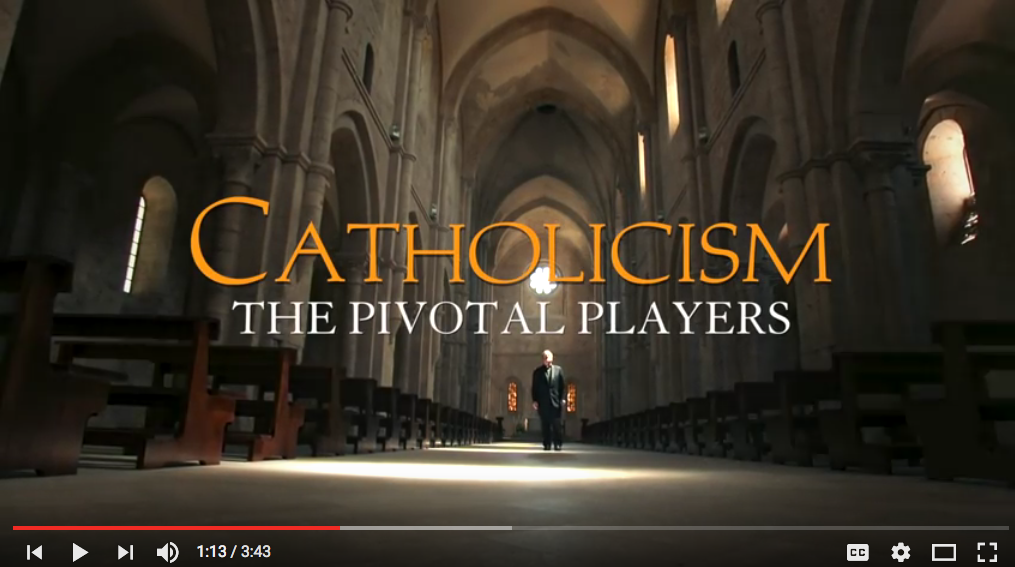
 On Fridays, I typically feature a short video that illustrates the faith, usually in some unintentional ways. Today, I’d like to call to your attention to a new series of videos by Bishop Robert Barron, which intentionally set forth the faith: Catholicism: The Pivotal Players. The first volume of the series has been released and covers St. Francis of Assisi, St. Thomas Aquinas, St. Catherine of Siena, Michelangelo, Blessed John Henry Newman, and G.K. Chesterton. One or more future volumes will be forthcoming.