Learning the Lessons of Lazarus and the Rich Man

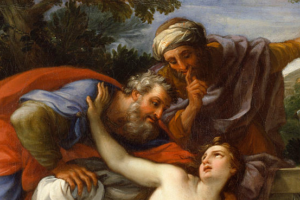
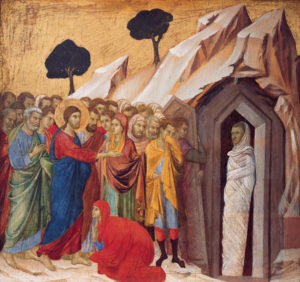
Lazarus and the Rich Man – Hendrick ter Brugghen

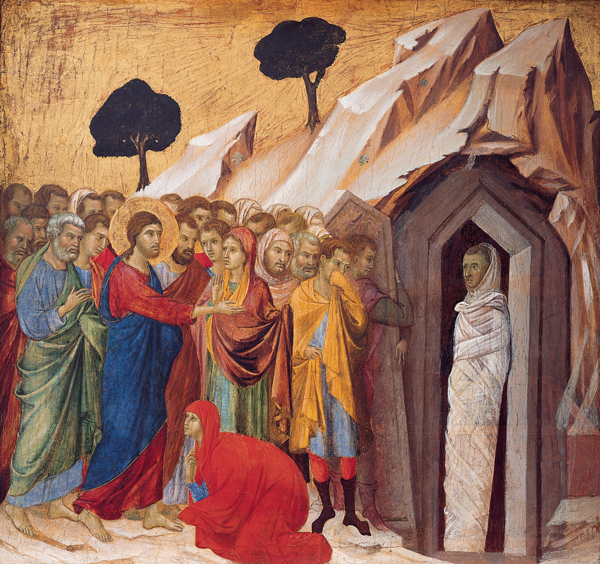
The well-known story of Lazarus and the rich man was read at Mass this morning (Thursday of the Second Week of Lent). On one level the message of the story seems plain enough: neglecting the poor is a damnable sin. However, there are other important teachings: about death, judgment, Heaven, and Hell. Those teachings are hidden in the details, but the subtlety is part of the story’s beauty. Let’s take a look at some of the teachings, beginning with the obvious one.

1. Neglect of the poor is a damnable sinThere was a rich man who dressed in purple garments and fine linen and dined sumptuously each day. And lying at his door was a poor man named Lazarus, covered with sores, who would gladly have eaten his fill of the scraps that fell from the rich man’s table. Dogs even used to come and lick his sores.

The vision of Lazarus’ poverty is dramatic indeed. The unnamed rich man (dubbed Dives by some because it means “rich” in Latin) does not so much act in an evil way toward Lazarus as he does commit a sin of neglect and omission. He seems undisturbed by and removed from Lazarus’ suffering. This neglect, this omission, this insensitivity, lands him in Hell. The rich man died and was buried, and from the netherworld, where he was in torment, he raised his eyes.

Care for the poor will be a central theme of our judgment, as is made clear in the Gospel of Matthew (25:31 ff), in which Jesus separates the sheep from the goats, the just from the unrighteous, based on whether they cared for the least of their brethren. To those who failed in this regard the Lord Jesus says, Depart from me, you who are cursed, into the eternal fire prepared for the devil and his angels (Matt 25:41).

How best to care for the poor is a matter of some dispute, but that we must care for them is clear. Hence, the rich man who neglected Lazarus is now in Hell. This is a call to sobriety about the reality of judgment; we must consider whether our care for the poor is what it should be.

2. Although he is in torment, the rich man has not changed The rich man, in torment, raised his eyes and saw Abraham far off and Lazarus at his side. And he cried out, “Father Abraham, have pity on me. Send Lazarus to dip the tip of his finger in water and cool my tongue, for I am suffering torment in these flames.”

Notice that the rich man still fails to see Lazarus’ dignity. In effect, he still sees Lazarus as an errand boy. Though he has to look up to see him, the rich man still looks down on Lazarus. He does not ask Abraham to send Lazarus to him so that he can apologize for his sinful neglect and seek his forgiveness. Rather he merely wants Lazarus to serve him. Even though he is in torment, the rich man is unrepentant. Although doesn’t like where he is, he does not reconcile with Lazarus or even realize that he should do so. This rich man is hardened in his sin. While Lazarus was alive, the rich man never recognized his dignity, and he remains blind to it.

Over time, sin hardens our heart. The more we remain in sin, the harder our hearts become, and the less likely it is that we will ever change. Why is Hell eternal? Look at the rich man: He cannot and will not change; his decision, character, and demeanor are forever fixed.

There is an old litany that goes like this: Sow a thought, reap a deed; sow a deed, reap a habit; sow a habit, reap a character; sow a character, reap a destiny. The mystery of the world to come is that our character is forever fixed. The Fathers of the Church described this mystery as being like clay on a potter’s wheel. As long as the clay is moist and on the wheel, the potter can shape and reshape it, but there comes a time when the clay form is placed in the kiln to be fired, fixing its shape forever. It is this way for us when we come before God, who judges us by fire (cf 1 Cor 3:12-15).

Fire will forever fix our character; this judgment through fire will either purify us or bring us condemnation. The fixed quality of the human person is illustrated in the rich man’s unchanged attitude.

3. The rich man does not ask to come to Heaven – It is very strange that the rich man does not ask that he might come to Heaven; rather, he asks that Lazarus be sent to Hell.

One of the saddest facts about the souls in Hell is that they would not be happy in Heaven anyway. After all, Heaven is about being with God. It is about justice, love of the poor, chastity, the heavenly liturgy, the celebration of the truth, the praise of God. God is at the center rather than us. The fact is, many show by the way that they live that they do not want many of these things. Why would someone who has disliked, even hated, these things will suddenly become enamored of them at the moment of death? Someone who ignores or disdains God and considers His faithful to be hypocrites would hardly be happy in Heaven.

The rich man demonstrates this by the fact that he does not ask to come to Heaven. He surely does not like where he is, but he shows no repentant desire for Heaven, either. The teaching, though subtle, seems clear enough: the souls in Hell have little interest in Heaven despite their dislike of Hell.

4. The Great Reversal – Abraham further indicates to the Rich Man and to us the “great reversal”: My child, remember that you received what was good during your lifetime while Lazarus likewise received what was bad; but now he is comforted here, whereas you are tormented.

We spend a lot of time trying to be on top in this world. We want comfort, wealth, position, and power. The Lord warns here that we ought to beware the great reversal that is coming. Lazarus, who was poor, is now rich; and the rich man is now poor.

Jesus teaches this elsewhere: But many who are first will be last, and the last first (Mk 10:31). Mary remarked that He has scattered those who are proud in their inmost thoughts. He has brought down the mighty from their thrones but lifted up the humble. He has filled the hungry with good things but has sent the rich away empty (Lk 1:51-53).

This is the great reversal. We so want to be rich and comfortable in this world, running from any suffering or setback. But the Lord warns of riches, How hard it is for the rich to enter the kingdom of God (Mk 10:23). Yet still we want to be rich. He also says, Anyone who does not carry his cross and follow me cannot be my disciple (Luke 14:27) Yet still we run from the cross and suffering. In the great reversal, many who are first in this world will be last in the world to come.

We cannot assert a direct correlation between success here and loss in the world to come, but neither should we ignore the teaching that striving to “make it” in the world and “be somebody” can be a dangerous path. And if we have amounted to something, we’d better humble ourselves through generosity to the poor and associating with the humble. The goal of worldly success is a dangerous one, for the great reversal is coming. Better to be found among the humble and the poor, or at least well-associated with them, than to be mighty and high. Yes, beware the great reversal!

5. Refusing the truth of Revelation is a damnable sin – The rich man does not repent to God, nor does he seek to be reconciled with Lazarus; but he does have some concerns for his brothers, for his family. We need not assume that the souls in Hell have no affections whatsoever. However, their affections are not for God and what He esteems. And so the rich man, still viewing Lazarus only as an errand boy, asks Abraham to dispatch Lazarus to his family carrying a warning. Perhaps a vision from the grave will convince them!

But Abraham indicates quite clearly that they have the clear witness of God through Moses and the prophets. In other words, they have the Scriptures, the very Word of God, to warn them. The rich man insists, “Oh no, father Abraham, but if someone from the dead goes to them, they will repent.” Then Abraham said, “If they will not listen to Moses and the prophets, neither will they be persuaded if someone should rise from the dead.”

The last point is dripping with irony, considering the fact that Jesus would rise from the dead. Abraham says clearly that there are many sinners who are so hardened in their sin that no matter what the Scriptures say or what the Church solemnly teaches, they will never be convinced. This is so very true today; many remain hardened in their sins. No amount of Scripture or Church teaching will convince them that they are wrong. This is what happens to us if we remain in unrepented sin: Our hearts are hardened, our minds are closed, and our necks are stiffened. In the end, this story teaches that such hardness is damnable.

These are five basic teachings from a well known parable. We do well to heed these lessons!

This song, “Rocka My Soul in the Bosom of Abraham” amounts to a wish that we will find our way to glory. Heeding the lessons of this parable is surely one way to find our rest in God.

Why Did Jesus Die in His Thirties?

Why did Christ die in his early thirties rather than as an older man? This would have permitted Him more time to teach and to set forth His Church. St. Thomas Aquinas answered the question in the following way:

Christ willed to suffer while yet young, for three reasons. First of all, to commend the more His love by giving up His life for us when He was in His most perfect state of life. Secondly, because it was not becoming for Him to show any decay of nature nor to be subject to disease …. Thirdly, that by dying and rising at an early age Christ might exhibit beforehand in His own person the future condition of those who rise again. Hence it is written (Ephesians 4:13), “Until we all meet into the unity of faith, and of the knowledge of the Son of God, unto a perfect man, unto the measure of the age of the fullness of Christ” (Summa Theologica III, 46, 9 ad 4).

Speculations such as these strike some as purely arbitrary. Others consider the reasoning to be a post hoc justification: Christ died at the age of 33, so let’s make something up to try to explain it.

St. Thomas’ reasoning, however, is not based on wild speculation. There are premises to his reasoning.

First, there is the premise that God does nothing arbitrarily and we do well to allow even seemingly minor details in Scripture (e.g., the time of day) to teach us.

Another premise is based on the nature of perfection. Perfection can be harmed by either excess or defect. Consider the case of age: A young person may lack physical and intellectual maturity (youth being a “defect” in age), but there comes a time when age becomes problematic in the other direction as time takes its toll on the body and the mind becomes less sharp (old age being an “excess” in age). Thus, there is a period of time when one’s age is in the “perfect” range: harmed neither by excess nor defect.

In St. Thomas’ time one’s thirties was considered to be that time of perfection. This is arguably still so, though we do seem to take a lot longer to reach intellectual and emotional maturity these days.

St. Thomas notes that because Jesus died while in the prime of His life, the sacrifice was greater. His apparent lack of any disease or physical imperfections also increased His sacrifice. This is a model for us. We are to give the best of what we have to God in sacrifice; not merely our cast-offs, or things of which we might say, “This will do.” The Lord once lamented, through Malachi,

If I am a Father, then where is my honor? When you offer blind animals in sacrifice, is that not evil? And when you offer those that are lame or sick, is that not evil? Present that to your governor; will he accept you or show you favor? says the Lord of hosts (Mal 1:8).

And thus what might seem to some to be an unremarkable detail (Jesus’ age) actually provides important teachings to the sensitive soul. Christ gave His all, His best—and He did so when He was in the prime of His life. We too are summoned to increasing perfection

On the Need for Curiosity in Evangelization (Part Two)

This is part two of an article on curiosity. We are considering the following four aspects:

I. Premises Related to Curiosity
II. Problems Regarding Curiosity
III. Pictures Reinforcing Curiosity
IV. Personal Requirement of Curiosity

Please see yesterday’s post for an introduction to the topic and a discussion of the first two items. In today’s post, we consider the third and fourth.

III. Pictures Reinforcing Curiosity – We have already reflected a good deal on this aspect in the introduction. Jesus generated a lot of curiosity because of the mystery of His person. How did this simple Galilean “get all this?” This was a cause of wonder in the people of His time. Jesus also generated a lot of curiosity; He cultivated it because He saw the value in doing so.

Jesus seldom gave straight answers to questions. Instead, He would say things like “Come and see.” Or He would answer questions with questions, or respond using parables which were often riddle-like and far from straightforward.

Consider how Jesus deals with this simple question:

[The Temple leaders said] “Who are you?” Jesus said to them, “Just what I have been telling you from the beginning. I have much to say about you and much to judge, but he who sent me is true, and I declare to the world what I have heard from him.” They did not understand that he had been speaking to them about the Father. So Jesus said to them, “When you have lifted up the Son of Man, then you will know that I AM” (Jn 8:25-28).

Notice that when asked who He is, the Lord does not answer pedantically by saying, “I am God, the Second Person of the Blessed Trinity, the Word made Flesh hypostatically united to my human nature.” Instead, He holds the mystery and refers them to their own hearts, which have stubbornly refused to listen to Him and accept the evidence of who He is.

Indeed, Jesus asserted elsewhere (Jn 5:30-46) that John the Baptist testified to Him. Scripture testifies to who Jesus is because it is clear that He fulfilled countless scriptural passages. He has worked miracles, which testify to His divinity. And finally, the Father is testifying to Him in their hearts. If they will but search their hearts, they will know who He is. They have fourfold evidence and testimony.

Jesus’ reluctance to provide straight answers unnerves even many of us true believers, but it is this very mystery that keeps us curious and ever studying His teachings. The implicit yet clear admonition in this approach is that we should come and see more, come and listen more. We are to ponder more deeply and spend our lives going ever deeper into the meanings of our questions and the answers the Lord provides, which are far richer than a simple one-line response.

While quick apologetics has an important place in this information age, so does holding on to the mystery of what questions really point to so as not to stifle the power of mystery to elicit curiosity.

IV. Personal Requirement of Curiosity This leads us to the personal challenge and charge. We cannot simply wait for mystery to be rediscovered or to emerge. We are called to be the mystery, to be the one who brings out curiosity in others! There ought to be something of a deep mystery in us as we live among our fellow denizens of the world. If we are truly living in Christ, we will not fit neatly into worldly categories and distinctions. There were at least three “political parties” in Jesus’ day: Sadducees (Herodians), Pharisees, and Zealots. Jesus did not fit into any of their little boxes. The parties only agreed on one thing: this Jesus must go. How about you? Are you worthy of Jesus Christ or just “the party”? Are you worthy of Jesus Christ or just the world?

If we are to be a mystery to the world, we cannot simply desire to fit in, desperately seeking worldly approbation. We will defy categorization because we serve a higher, broader, and transcendent vision.

As such, we will be a mystery to others. Seeing our integrity, they cannot understand us in worldly ways, but neither can they simply discredit us “hacks” or shills for political parties. Jesus is broader, higher, and deeper than worldly parties or categories—and so are those who truly follow Him.

This elicits curiosity because it is a mystery. Of this, Sherry Weddell writes,

The Catholic life is meant to be a “sign of contradiction” in this world. That doesn’t mean that we are to be nay-saying curmudgeons. Rather, it means that we are to live lives of such inexplicable joy, love, faith, and peace (even in trial) that all the normal categories by which nonbelievers try to classify us won’t work. We are neither Jew nor Gentile, fish nor fowl, “conservative,” nor “liberal,” nor any of the other tribes of this world.

Living curiously means more than being “nice.” It requires that we think and act in Kingdom-oriented and countercultural ways in our daily lives. For instance, forgiving and asking forgiveness of those who have betrayed and abused us are perhaps the most countercultural things we can do. … Likewise, being in healthy relationships, caring for the poor, sharing possessions freely, praying for healing and provision, and even simple family prayer times can be startling countercultural witnesses.

To be a witness … means to live in such a way that one’s life would not make sense if God did not exist (Forming Intentional Disciples, p. 148, 151).

Scripture affirms this as well:

Always be prepared to render an account to anyone who asks the reason for the hope that is in you; do it with gentleness and respect (1 Peter 3:15).

This text presupposes that people notice a hope in us, a stable, serene, and confident joy or hope. This is mysterious and elicits curiosity. In curiosity, one might remark, “When all of the rest of us are worn out by stress, complaints, gossip, and office politics, you don’t seem anxious, or obsessed with position, or hungry to hear all the gossip. In fact, I’ve never heard an ugly word come out of your mouth. What is it about you? What keeps you so calm and charitable?”

In a world where so many lead disordered lives (sexually, emotionally, and intellectually); where envy, jealousy, greed, power, and position consume so many; a person that is not disordered and beset with the deep drives of sin and negativity is a mystery. People who get married and stay married and who actually seem to love their spouse and children are increasingly mysterious to others. They elicit the question, “How do you do it?” People who don’t just parrot the angry and often-foolish slogans of the world or who are not endlessly distracted and controlled by the news and the entertainment culture are often mysterious to those around them.

Distinction: Of course, pointing out the value of mysteriousness is not an encouragement to become some sort of spooky oddball. Mystery is not spooky, it is attractive and evokes wonder and curiosity.

There is a remarkable passage in the Acts of the Apostles in which Peter and John elicit this sort of response:

When [the Sanhedrin] saw the courage of Peter and John and realized that they were unschooled, ordinary men, they were astonished and they recognized that these men had been with Jesus (Acts 4:13).

Here is the goal and challenge for us: Do we provoke astonishment or even surprise from people around us? Are we a mystery that engenders curiosity? Would anyone conclude that we “have been with Jesus?”

The point is that we cannot simply ponder mystery and curiosity as a tool for “the Church.” We must also be the mystery, be the one who evokes curiosity and attracts others to Christ and to the faith.

Summation: In this two-part essay, we have pondered the powerful effect of mystery and curiosity in evangelization. In most cases mystery is very attractive. Curiosity, while not discipleship itself, assists in a process that leads to discipleship; we should not too quickly diffuse its power with simple or pat answers. We must learn to teach and spread the faith not merely by answering questions, but also by asking them. Replies are good, but invitations are often even better. “Come and see” can be a rich response that provides some answers but also insists that there is more to the story. This mystery is not merely to be found in the pages of a catechism, or in the sacred liturgy; it must also be found in us who live in the world but are mysteriously not of the world.

On the Need for Curiosity in Evangelization (Part One)

Curiosity

CuriosityIn the world of evangelization, the concept of curiosity is almost never discussed. If anything, evangelizers are encouraged to quickly satisfy any curiosity by supplying all sorts of answers to questions that arise about the faith. Apologetical tracts, books, catechisms, and videos abound. Curiosity, it would seem, is something to be quashed or at least overcome quickly. Allowing a person to wonder why for any length of time seems almost dangerous, especially in a “search-engine” culture. Quick answers, please!

How different this is from the more mysterious and “parabolic” way Jesus handled questions. Ask him a question and you might get another question back from Him. “Are you a King?” asked Pilate. Jesus, on trial for his life replied, “Are you saying this on your own or have others been talking about me?” (Jn 18:33-35) Sometimes Jesus answered obliquely. As Jesus was walking by, Andrew asked Him, “Rabbi, where do you stay?” Jesus just kept on walking and said, “Come and see” (Jn 1:38-39). On other occasions Jesus answered questions or supplied information through enigmatic stories, called “parables” because they do not provide straight answers but are more “parabolic.” They are full of twists and turns, paradoxes and puzzles.

Curious indeed! Come on, Jesus; the people want to know; let’s have some straight answers here! But Jesus, the Master Evangelist and Lord, has something to teach us. Curiosity is important and should not be crushed too soon with lots of stiff or overwhelming answers.

To her great credit, Sherri Waddell in her book Forming Intentional Disciples devotes an entire chapter to this topic. She ranks it as the second threshold to conversion (after trust and before openness). I’d like to combine her insights with some of my own and consider curiosity under four headings:

I. Premises Related to Curiosity
II. Problems Regarding Curiosity
III. Pictures Reinforcing Curiosity
IV. Personal Requirement of Curiosity

Given the length of my reflections, I will cover them in two separate posts. Are you curious yet? Let’s begin!

I. Premises Related to Curiosity

What is curiosity? At its heart, curiosity is a response to an encounter with mystery. The Latin root of curiosity is cur, meaning “why.” Having encountered mystery, we ask questions such as “Why?”, “What is this?”, “What does this mean?”, “Who are you?”, or “Why are you this way?” Mystery engenders curiosity. This analysis of curiosity raises another question:

What is mystery? At its heart, mystery refers to something we see only partially, something that is mostly hidden from us. Almost no person, thing, or event is entirely devoid of mystery. Even something as simple as a tree elicits questions. Why is this tree here? Who planted it and why? Why this kind of tree and not another? Is the tree healthy inside or rotted? Isn’t it amazing that trees breathe our expelled carbon dioxide and give us back the oxygen we need! How has this remarkable symbiosis come about? Yes, even a simple tree has mysteries that pique our curiosity. There is almost always more than meets the eye.

Far deeper are the mysteries related to the people and complex human interactions. Fr. John Le Croix gives the following definition of mystery: Mystery is that which opens temporality and gives it depth. It [also] introduces a vertical dimension and makes of it a time of revelation.

While this definition may seem complex, a simple example might help. Suppose you and I are at a gathering. Smith enters the room and immediately walks up to Jones, enthusiastically shaking his hand. I comment, “Wow!” You say, “What’s the big deal? People shake hands all the time.” I reply, “Smith and Jones have been enemies for thirty years.” The handshake between the two men has a mysterious dimension, one that the eyes cannot see. Yet that mystery is still real, giving the physical handshake both a depth of meaning and a vertical dimension of revelation.

Mystery is rich, fascinating. It can bestow an aura of wonder and awe upon even ordinary things, people, interactions, and events.

Yes, mystery is wonderful. Mystery attracts! It is mystery that generates curiosity, the desire to know more and experience the depths and heights of what is.

Because mystery is important, so is the curiosity that arises as a response to it. It deserves more attention than it usually gets in our theological and pastoral reflections.

II. Problems Regarding Curiosity

Although mystery attracts, we live in times in which there are many factors diminishing its appreciation and the consequent curiosity. This is especially true when mysteries are not quickly “solved” and curiosity cannot be satisfied quickly. There are a number of factors to mention.

First, there is the notion that a mystery is something merely to be solved rather than savored. When we hear the word mystery today we tend to think of crime novels or police shows on television. A crime is committed; the mystery is who did it and for what reason. The “hero” must get to the bottom of this!

While this may be the case for a crime, the mysterious depths of the human person, the significance of human events, and the truths of our faith, are not things to be figured out or solved.

When it comes to the truths of our faith, there are many mysteries that cannot simply be solved. For example, how can Jesus be God and Man? God, of His nature, is eternal and omnipresent and cannot “fit” in space and time. Yet Jesus, as man, is in time and in space. This is not a mystery we can solve. We must savor it. The early Church knew this and the faithful fell to their knees at the words in the creed that announced the incarnation. Wonder and awe are natural reactions to mystery.

Second, we live in an age of empiricism and rationalism. We often demand that everything be explained, that everything be understood within our categories and on our terms. But not all mystery can be explained or understood in this way, which many find irritating and unsettling. Often, the questions raised by mysteries—especially those not easily answered—are brushed aside with the nebulous statement that “science will eventually be able to explain this.”

But of course the physical sciences cannot really address metaphysical realities; or the moral, historical, or emotional significance of things; or why something is meaningful, beautiful, or upright, or even exists at all.

In an age of rationalism, materialism, empiricism, and reductionism, mystery is often underappreciated—seen as a problem when it is not. Deep down, we are more fascinated with mystery than we like to admit, even in times like these.

Third, we live in an age that demands quick satisfaction and instant answers. In the past, we often had to ponder and research things at length; today we “Google it” and are immediately presented with numerous resources and answers. Reflection suffers because of this; we often fail to ponder the deeper aspects of our questions.

Information gathering is not the same as study and reflection. Quick answers often stifle deeper scrutiny and discernment. As a result, we often miss the more mysterious and deeper dimensions of people, places, events, and life itself.

Similarly, in the Church, if all we do is provide quick answers to questions in an inquiry class, or we engage in cursory apologetics, we miss the depths of Jesus’ reply to Andrew’s question: “Rabbi where do you stay?” Jesus did not give Andrew an address or map coordinates. He extended the mystery and deepened Andrew’s curiosity by saying, “Come and see.”

Apologetics has its place, but the true desire driving every question is not merely information, but a transformation in Christ. “Come and see” is not an invitation that can be forever put off by one-off answers.

Fourth, we live in immodest times. Modesty is reverence for mystery. We live in times of overexposure. This is a broader concept than clothing. Many people both demand and provide too much information. They discuss private matters on national television. What should be discreet is shared indiscriminately. There are constant demands for “transparency.” The people’s “right to know” has very few limits today. While curiosity is a good thing in itself, excessive curiosity is sinful.

Mystery is attractive. Modesty is a virtue that governs access to and protects a great gift. The curiosity incited by it should be satisfied at appropriate times and in appropriate ways. Yes, mystery is a gift to be savored, not merely a problem to be solved or a hidden thing to be exposed willy-nilly.

I wonder if, in the Church, we have not overly exposed our sacred liturgies and other mysteries. Who can deny the evangelical power of televised masses and other expositions of our faith and liturgies?

Yet is there nothing left of the disciplina arcanis (discipline of the secret) of the ancient Church? Until relatively recently, our liturgies were conducted in Latin while facing east. These days, little that is secret or even discreet remains. Everything is casual, in the vernacular, and intentionally ordinary. The sacred mysteries seem almost washed out in the light of scrutiny and overexposure. There is nearly an obsession with explaining all mystery; if there is any curiosity at all, it is seen as a failure in catechesis.

With little appreciation for the mystery we truly celebrate at Mass; curiosity, interest, and attendance have dropped. Few dress up for Mass anymore; little seems special about it. All the more reason to re-emphasize the true mysteries we celebrate.

Mystery is attractive! Curiosity is the natural response to mystery. If we try to make everything understandable (which is impossible), we lose our way.

To be continued tomorrow …

Every Round Goes Higher, Higher – A Homily for the Second Sunday of Lent

The second Sunday of Lent always features the Transfiguration. This is because we are following the Lord on His final odyssey to Jerusalem, and this journey up Mt. Tabor was one of His stops (with Peter, James, and John).

It is commonly held that Jesus did this to prepare His apostles for the difficult days ahead. There’s a line from an old spiritual that says, “Sometimes I’m up, sometimes I’m down, sometimes I’m almost on the ground … but see what the end shall be.” This is what the Lord is doing here: He is showing us what the end shall be. There is a cross to get through but there is glory on the other side.

The purpose in placing the account of the Transfiguration here is that it helps describe the pattern of the Christian life, which is the paschal mystery. We are always dying and rising with Christ in repeated cycles as we journey to an eternal Easter (cf 2 Cor4:10). This Gospel shows forth the pattern of the cross: the climb, the rising, and the glory of the mountaintop. Then it is back down the mountain again only to climb another one (Golgotha), and through it find another glory (Easter Sunday). Let’s look at today’s Gospel in three stages.

I The Purpose of Trials Jesus took Peter, James, and John and led them up a high mountain apart by themselves.

We often pass over the fact that they had to climb that mountain, no easy task.

Anyone who has been to Mt. Tabor can attest to its altitude: almost 2000 feet. Ascending it likely took the better part of a day and was probably somewhat dangerous. Looking down from the top on the Jezreel Valley (a.k.a. Megiddo or Armageddon) provides a view similar to what one would see out an airplane window.

So we have here a symbol of the cross and of struggle. A climb up the rough side of the mountain was likely exhausting, testing their strength.

I have it on the best of authority that as they climbed they were singing gospel songs like this one: “I’m comin’ up on the rough side of the mountain, and I’m doin’ my best to carry on!” Another song says, “My soul looks back and wonders how I got over!” Yet another says, “We are climbing Jacob’s ladder, every round goes higher, higher.”

This climb reminds us of life. Often we have had to climb, to endure, to have our strength tested. Perhaps it was the climb of earning a college degree. Perhaps it was the climb of raising children or building a career. What of real value do you have that did not come at the price of a climb, of effort and struggle?

Most of us know that although the climb is difficult, there is glory at the top if we but endure. Life’s difficulties are often the prelude to success and greater strength.

Although we might wish that life had no struggles, it would seem that the Lord intends them for us, for the cross alone leads to true glory. Where would we be without some of the crosses in our life? Let’s ponder some of the purposes of problems:


  1. God uses problems to DIRECT us. Sometimes God must light a fire under you to get you moving. Problems often point us in new directions and motivate us to change. Is God trying to get your attention? Sometimes it takes a painful situation to make us change our ways. Proverbs 20:30 says, Blows and wounds cleanse away evil, and beatings purge the inner most being. Another old gospel song speaks of the need for suffering to keep us focused on God: “Now the way may not be too easy, but you never said it would be. ‘Cause when our way gets a little too easy, you know we tend to stray from thee.” Yes, God sometimes uses problems to direct our steps to Him.
  2. God uses problems to INSPECT us. People are like tea bags: if you want to know what’s inside them, just drop them into hot water! Has God ever tested your faith with a problem? What do problems reveal about you? Our problems have a way of helping to see what we’re really made of. I have discovered many strengths I never knew I had through trials. There is a test in every testimony and trials have a way of purifying and strengthening our faith as well as inspecting it to see whether it is genuine. 1 Peter 1:6 says, In this you greatly rejoice, though now for a little while you may have had to suffer grief in all kinds of trials. These trials are only to test your faith, to see whether or not it is strong and pure.
  3. God uses problems to CORRECT us. There are some lessons we learn only through pain and failure. When you were a child, it’s likely that your parents told you not to touch a hot stove, but you probably really learned by being burned. Sometimes we only learn the value of something (e.g., health, money, a relationship) by losing it. Scripture says, It was good for me to be afflicted so that I might learn your decrees (Psalm 119:71-72). Before I was afflicted, I strayed. But now I keep you word (Psalm 119:67).
  4. God uses problems to PROTECT us. A problem can be a blessing in disguise if it prevents you from being harmed more seriously. A man was fired for refusing to do something unethical that his boss had asked him to do. Although his unemployment was a problem, it saved him from being sent to prison when management’s actions were finally discovered. In Genesis 50:20, Joseph speaks to his brothers: You intended to harm me, but God intended it for good to accomplish what is now being done, the saving of many lives.
  5. God uses problems to PERFECT us. When responded to properly, problems are character builders. God is far more interested in your character than your comfort. Romans 5:3 says, We can rejoice, too, when we run into problems and trials, for we know that they are good for us they help us learn to be patient. And patience develops strength of character in us and helps us trust God more each time we use it until finally our hope and faith are strong and steady. Peter 1:7 says, You are being tested as fire tests gold and purifies it and your faith is far more precious to God than mere gold; so if your faith remains strong after being tried in the fiery trials, it will bring you much praise and glory and honor on the day of his return.

So here it is, the cross symbolized by the climb; but after the cross comes the glory.

II The Productiveness of Trials And he was transfigured before them, and his clothes became dazzling white, such as no fuller on earth could bleach them. Then Elijah appeared to them along with Moses, and they were conversing with Jesus. Then Peter said to Jesus in reply, “Rabbi, it is good that we are here! Let us make three tents: one for you, one for Moses, and one for Elijah.” He hardly knew what to say, they were so terrified. Then a cloud came, casting a shadow over them; from the cloud came a voice, “This is my beloved Son. Listen to him.”

All the climbing has paid off. Now comes the fruit of all that hard work. The Lord gives them a glimpse of glory! They get to see the glory that Jesus has always had with the Father. He is dazzlingly bright. A similar vision from the Book of Revelation gives us more detail:

I turned around to see the voice that was speaking to me. And when I turned I saw seven golden lampstands, and among the lampstands was someone like a son of man, dressed in a robe reaching down to his feet and with a golden sash around his chest. The hair on his head was white like wool, as white as snow, and his eyes were like blazing fire. His feet were like bronze glowing in a furnace, and his voice was like the sound of rushing waters. In his right hand he held seven stars, … His face was like the sun shining in all its brilliance. When I saw him, I fell at his feet as though dead. Then he placed his right hand on me and said: “Do not be afraid. I am the First and the Last. I am the Living One; I was dead, and now look, I am alive for ever and ever! And I hold the keys of death and Hades” (Rev 1:12-17).

Yes, all the climbing has paid off. Now comes the glory, the life, the reward for endurance and struggle. Are you enjoying any of the fruits of your crosses now? If we have carried our crosses in faith, it has made us more confident, stronger. Some of us have discovered gifts, abilities, and endurance we never knew we had. Our crosses have brought us life! St. Paul said, that this momentary affliction is producing for us a weight of glory beyond all compare (2 Cor 4:14). He also said, For I consider that the sufferings of this present time are not worth comparing with the glory that is to be revealed to us (Rom 8:18).

So here is the glory that comes after the climb. Here is the life that comes from the cross.

III. The Pattern of Trials – Suddenly, looking around, they no longer saw anyone but Jesus alone with them. As they were coming down from the mountain, he charged them not to relate what they had seen to anyone, except when the Son of Man had risen from the dead.

Although Peter wanted to stay, Jesus makes it clear that they must go down the mountain for the time being and walk a very dark valley to another hill (Golgotha); for now, the pattern must repeat. The cross has led to glory, but more crosses are needed before the final glory. An old spiritual says, “We are climbing Jacob’s ladder … every round goes higher, higher, soldiers of the cross!

This is our life. Always carrying within our self the dying of Christ so also that [the rising of Christ], the life of Christ may be manifest in us (cf 2 Cor 4:10).

There are difficult days ahead for Jesus and the Apostles, but the crosses lead to lasting glory. This is our life too. The paschal mystery is the pattern and rhythm of our life.

Here is an excerpt from the song “We Are Climbing Jacob’s Ladder.” The song repeats, “… every round goes higher, higher.” One can almost imagine a spiral staircase as the rounds get pitched higher musically. This is the pattern of our life: we die with Christ so as to live with Him. Each time we come back around to the cross, or back around to glory, we are one round higher and one level closer to final glory.

Seeing the Great Spiritual Battle and the Woman at the Well in a Commercial

In the commercial below, a man is easily talked out of his meal by Yoda, the Star Wars Jedi Master. However, when the Jedi Master continues on to try to talk him out of his Pepsi, the man realizes that this is a bridge too far. He refuses to give way any longer.

I wonder if this is not an image for Christians in their battle against the world and the devil. Indeed, too often we are willing to give way to those in the world (and the devil himself), who ask us to surrender our dignity, make compromises, and give way to sin. So easily we surrender our serenity to a world that provokes anxiety and anger; we surrender our chastity to a world that exalts lust; we give over our generosity to a world that instills in us a fear that drives us to hoard; we hand over our prophecy to a world that demands our silence; we neglect our soul and hand over its care to a world that demands we be fixated on our body, on good looks and our physical health; we hand over prayer and the celebration of the sacraments to a world that demands all of our time.

In effect, the world and the devil say to us, “All you have is mine … now hand it over.”

After surrendering his meal, the man wakes up to what is happening and stops handing things over. For him, it is prospect of losing his Pepsi that brings about this awakening. But what about us? Have you reached this point? How? When? What was the “bridge too far” for you? For addicts, this point is called “hitting bottom,” when the insanity of their lifestyle finally becomes too much to handle and they are finally willing to say “No!” or “Enough!”

For most of us, perhaps the wake up moment comes when we finally begin to see that the world asks too much of us, takes too much of us without offering us anything of real or lasting value in return. Perhaps we, like the man in the commercial, start to recognize the lies, deception, and theft taking place as the world tries to have us ignore our true hunger and give away the Eucharistic meal and Holy Communion that is our baptismal right.

Yoda tries to mesmerize the man in the commercial, saying about the meal, “You do not want.” The world and the devil also say of God, “You do not want.” It’s as if to say, “Your desires are not about God and the things awaiting you in Heaven; they are about me. Give me your heart, your loyalty, your life.”

When the man in the commercial finally does wake up, it’s because of a drink. In this I am reminded of the woman at the well in the Gospel of John. Jesus finally reaches her through thirst and teaches, Everyone who drinks this water will be thirsty again. But whoever drinks the water I give him will never thirst. Indeed, the water I give him will become in him a spring of water welling up to eternal life (Jn 4:13-14). For her and for the man in the commercial, it is thirst that awakens them to the lies and deceptions of the world.

What Does Jesus Mean by Calling Us Evil?

In the Gospel for today’s Mass (Thursday of the First Week of Lent) Jesus says,

If you then, who are wicked, know how to give good gifts to your children, how much more will the Father in heaven give good things to those who ask him? (Mt 7:11)

A similar verse occurs in the Gospel of Luke: If you then, though you are wicked, know how to give good gifts to your children, how much more will your Father in heaven give the Holy Spirit to those who ask him? (Lk 11:13)

I received an e-mail once regarding this verse:

“This line bugs me. I think I know the larger point that Jesus makes here, and/or perhaps it’s poorly translated, but it seems a bit harsh for Jesus to refer to mankind as ‘evil’. Evil? That’s tough stuff! But perhaps, to Jesus, we are evil.”

So what is going on here? Why does Jesus call us evil?

First let’s make sure that the translation from the Greek is a good one. The Greek expression used in Luke’s version (the Matthean uses very similar language) is πονηροὶ ὑπάρχοντες (poneroi hyparchontes). Poneroi is defined as “bad, of a bad nature or condition,” but it is also defined as “full of labors, annoyances, hardships.” Hyparchontes is defined as “from the very beginning” or “being inherently.”

Thus the translation “you who are evil” is accurate. It might be more precisely translated as “If you, then, being inherently bad (or evil) …” Or perhaps it could be rendered as “If you, then, being bad (or evil) from the beginning …”

If we use the secondary definition of poneroi, the phrase could be rendered this way: “If you, then, being full of labors (or hardships) …” However, I checked over a dozen different translations on biblos.com and none of them render it in this way; all of them simply say, “If you, then, who are evil …”

So it seems that we’re stuck with the fact that the Lord is calling us “evil.”

What do the commentaries say? It is interesting that of the seven modern commentaries I consulted, not one of them mentions this phrase. However, some of the ancient Fathers did:

  1. Cyril of Alexandria wrote, When he says, “You who are evil” he means, “You whose mind is capable of being influenced by evil and not uniformly inclined to good like the God of all” (Commentary on Luke, Homily 79).
  2. In one of his homilies, Bede had this to say: Any human mortal, weak and still burdened with sinful flesh, does not refuse to give the good things which he possesses, although they are earthly and weak, to the children whom he loves (Homilies on the Gospel 2.14).
  3. Elsewhere Bede is quoted as follows: He calls the lovers of the world evil, who give those things which they judge good according to their sense, which are also good in their nature, and are useful to aid imperfect life. Hence he adds, “[They] know how to give good gifts to [their] children.” The Apostles even, who by the merit of their election had exceeded the goodness of mankind in general, are said to be evil in comparison with Divine goodness, since nothing is of itself good but God alone (Quoted in the Catena Aurea at Luke 11:13).
  4. Athanasius said, Now unless the Holy Spirit were of the substance of God, Who alone is good, He would by no means be called good, since our Lord [Jesus] refused to be called good, inasmuch as He was made man (Quoted in the Catena Aurea at Luke 11:13).

Therefore, if I can be so bold as to enter into the company of these ancient and approved Fathers of the Church, I would like to draw a conclusion on the meaning of this phrase.

Jesus seems to be speaking by comparison or degree. He may not mean that we are evil in an absolute sense, rather that we are evil in comparison to God, who is absolute good. The Hebrew and Aramaic languages have fewer comparative words, so the ancient Jews would often use absolute categories to set forth comparison or degree. For example, elsewhere Jesus tells us that we must hate our father, mother, children, and even our very self and that we must love Him (e.g., Luke 14:26). This does not mean that we are literally to despise our family and others; it means that we are to love Jesus more than we love them. Because of the paucity of comparative words available, the ancient Jews used a lot of what we would consider to be hyperbole. Hence, in calling us “evil,” the Lord may be setting forth a comparison in the way the ancient Jews would. In modern English we might say, “If you, then, who are not nearly as holy as God and are prone to sin, know how to give good gifts to your children, how much more will God, who is absolutely good and not prone to sin, give the Holy Spirit to those who ask Him?”

However, we ought to be careful not to simply discount Jewish hyperbole and rewrite the words as I have done. The point of the hyperbole cannot be completely set aside. Created things may share in God’s goodness, but God alone is absolutely good. So good is God, that everything else is practically evil in comparison to Him. The hyperbole places the emphasis on God’s absolute goodness. We have no goodness apart from God’s goodness. If we do share in His goodness, it is infinitesimal in comparison. Hence, as Bede says above, The Apostles even, who by the merit of their election had exceeded the goodness of mankind in general, are said to be evil in comparison with Divine goodness, since nothing is of itself good but God alone.

Even Jesus refused the label “good” for Himself in terms of His humanity. The Gospel of Mark contains the following dialogue: As Jesus started on his way, a man ran up to him and fell on his knees before him. “Good teacher,” he asked, “what must I do to inherit eternal life?” “Why do you call me good?” Jesus answered. “No one is good except God alone (Mk 10:17-18). As God, Jesus is good—absolute good. One could also argue that in His sinless humanity Jesus is also good; but Jesus, presuming the man merely regarded Him as ordinarily human, rebukes him and declares that God alone is good.

In the end, it’s time for us to eat some humble pie. Jesus probably does not mean we are absolutely evil and have nothing good in us, but God alone is absolutely good. He is so good that we can barely be thought of as anything but evil in the face of His immense goodness. Humble pie doesn’t have much sugar in it, does it?

What is the Sign of Jonah?

In the Gospel for Wednesday (Wednesday of the First Week of Lent) the Lord says, This generation is an evil generation; it seeks a sign, but no sign will be given it, except the sign of Jonah (Lk 11:30). What is the sign of Jonah? Does it apply today?

The Gospels of Matthew and Luke present two signs of Jonah, one of which particularly concerns us here.

  • First Sign: In the Gospel of Matthew, Jesus invokes Jonah in a twofold way: For as Jonah was three days and three nights in the belly of the whale, so the Son of Man will be three days and three nights in the heart of the earth (Matt 12:40). In this image, Jonah’s descent into the belly of the whale is a sign of the Lord’s descent to Sheol. For the sake of brevity, I would like to set aside this first sign and go on to discuss the second sign of Jonah. (Matthew’s Gospel sets this second sign forth in essentially the same way as does the Lucan version.)
  • Second Sign: In the Lucan version, read at today’s Mass, the mention of the whale is omitted and only this second sign is declared: This generation is an evil generation; it seeks a sign, but no sign will be given it, except the sign of Jonah. Just as Jonah became a sign to the Ninevites, so will the Son of Man be to this generation. At the judgment the queen of the south will rise with the men of this generation and she will condemn them, because she came from the ends of the earth to hear the wisdom of Solomon, and there is something greater than Solomon here. At the judgment the men of Nineveh will arise with this generation and condemn it, because at the preaching of Jonah they repented, and there is something greater than Jonah here (Luke 11:29-32).

But what exactly is this (second) sign of Jonah? On one level, the text seems to spell it out rather clearly. Jonah had gone to the Ninevites with this message: Forty days more and Nineveh shall be destroyed (Jonah 3:3). In response, the Ninevites (led by their King) repented, fasted, and prayed. Seeing their actions, God relented and did not destroy them. So on one level the sign of Jonah is the message “Repent or die.” Just as the Ninevites heard Jonah’s warning, put faith in it, and were spared, so the people of Jesus’ time should put faith in His warning to repent and believe the Good News. If they do not, they will meet with great disaster.

What would cause this disaster? The description of the sign of Jonah taps into the historical context of Jonah’s ministry, but applied to the people of Jesus’ time it has a polemical tone. Let’s consider why.

  1. When Jonah was told to go to Nineveh, he resisted. He must have thought that it was a no-win situation for him: either they would rebuff his prophecy (and likely kill him) or they would heed his message and grow stronger. (Nineveh was the capital of Assyria, the mortal enemy of Israel, and Jonah had no interest in seeing them strengthened.)
  2. When Jonah made his announcement of imminent destruction, Assyria did repent, and in their strength they would become a rod in God’s hand to punish Israel. Isaiah the Prophet had well described Israel’s crimes and said that punishment would surely come upon her from Assyria. God would use Assyria to humble and punish His people, Israel. Here is a key passage in which Assyria is described in this way: … Assyria, the rod of my anger, in whose hand is the club of my wrath! I send him against a godless nation, I dispatch him against a people who anger me, to seize loot and snatch plunder, and to trample them down like mud in the streets (Isaiah 10:5-6).

Here, then, is a deeper meaning of the sign of Jonah: if Israel will not repent, then God will take their power and strength and give it to a foreign land that knows Him not. These foreigners will shame and humiliate Israel, inflicting God’s punishment on them.

This is humiliating to Israel on two levels. First, a pagan country would repent while God’s own people would not. Second, they are conquered by a foreign and unbelieving people. The destruction by Assyria was a devastating blow to the Northern Kingdom of Israel and resulted in the loss of the ten tribes living there. They became the “Ten Lost Tribes of Israel.” Only Judah and the Levites were left in the South as a remnant.

Let’s apply this understanding of the sign of Jonah, first to Jesus’ time and then to our own.

  1. In Jesus’ time the sign of Jonah meant that if Israel would not repent and accept the Gospel, God would take it from them and give it to the Gentiles. Jesus says elsewhere to his fellow Jews, Therefore I tell you that the kingdom of God will be taken away from you and given to a people who will produce its fruit (Matt 21:43). Just as ancient Israel’s refusal to repent led to its destruction by the Assyrians, so Israel’s refusal to repent in Jesus’ time would mean destruction by the Romans (in 70 A.D.). This was prophesied by Jesus in the Mount Olivet discourse (Matthew 24:1-25:46, Mark 13:1-37, and Luke 21:5-36). According to Josephus, more than a million Jews were lost in this horrible war.
  2. In our time, I suggest that the sign of Jonah may be active. I know that this may be controversial, but it seems to me that many Christians and Catholics in the decadent West have stopped loving life. Birth rates have dropped dramatically and are well below replacement level. We are on our way to aborting and contracepting ourselves right out of existence. God has loosed judgment on us in the form of the sign of Jonah. He seems to be saying this to us: “Fine, if you do not love life and are not zealous for the faith I have given you, then disaster is upon you. Others still do appreciate larger families and are zealous for their faith. And even if they (like the Assyrians of old) are not my people as you are, I will use them to humble and punish you. They will grow and increase while you decrease. Perhaps when you are punished by a people who do not respect your religious liberty, you who remain will repent and begin to love life.”

In the European Union today, the birth rate is about 1.6 children per woman. Globally, Muslim women average 3.1 children. Do the math and realize that Europe as we have known it is coming to an end. In the United States the birth rate is higher, but still only about 1.9 children per woman. In general, the Catholic world in the West is in decline, both in terms of our birth rates and our zeal for the faith. We are surely being diminished by our culture of death and decadent sloth. Is it the sign of Jonah? You decide.

An interesting footnote: Isis Destroyed the Tomb of Jonah in 2014