Usually we don’t like to know the end of the story. When someone blurts out the ending it’s called a “spoiler.” What fun is it to read a whodunit when you already know who done it?
When it comes to the faith, though, not only should we know the end of the story, but we must never forget it and must base our very lives upon it. As we look about the world, it is easy to get discouraged and think that evil is winning. Yet Scripture plainly states that Satan’s plans are going nowhere, that Jesus has already won the victory. Mysteriously, the Lord allows Satan a little time to sift through the ruins of his former kingdom. Do not be deceived—Satan has lost and so have all who are allied with him.
Some lines from Psalms come to mind:
Wait a little, and the wicked will be no more;look for them and they will not be there.But the poor will inherit the earth,will delight in great prosperity.But my Lord laughs at the wicked,because he sees that their day is coming.Wait eagerly for the LORD,and keep his way;He will raise you up to inherit the earth;you will see when the wicked are cut off.I have seen a ruthless scoundrel,spreading out like a green cedar.When I passed by again, he was gone;though I searched, he could not be found.mark the upright;Because there is a future for a man of peace.Sinners will be destroyed together;the future of the wicked will be cut off (Psalm 37).
Spoiler alert! Yes, dear brethren, I checked. I went to the end of the story and, sure enough, Jesus wins! There it is, right at the end of the Bible. This is a spoiler you need to know, because you have to choose which team you’ll be on and it’s nice to know ahead of time whose team has already won. It’s like going to today’s horserace armed with tomorrow’s newspaper. You’d be a fool to bet on any horse other than the winning one. Well, you have tomorrow’s paper, and here’s what it says:
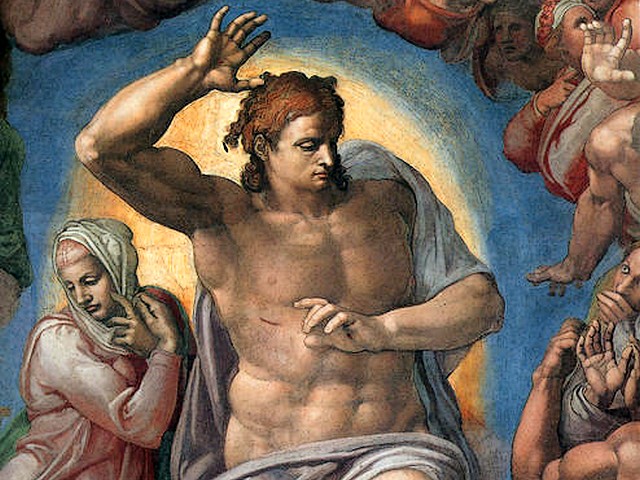
When the thousand years are completed, Satan will be released from his prison. He will go out to deceive the nations at the four corners of the earth, Gog and Magog, to gather them for battle; their number is like the sand of the sea. They invaded the breadth of the earth and surrounded the camp of the holy ones and the beloved city. But fire came down from heaven and consumed them. The Devil who had led them astray was thrown into the pool of fire and sulfur, where the beast and the false prophet were. There they will be tormented day and night forever and ever. Next I saw a large white throne and the one who was sitting on it. The earth and the sky fled from his presence and there was no place for them. I saw the dead, the great and the lowly, standing before the throne, and scrolls were opened. Then another scroll was opened, the book of life. The dead were judged according to their deeds, by what was written in the scrolls. The sea gave up its dead; then Death and Hades gave up their dead. All the dead were judged according to their deeds. Then Death and Hades were thrown into the pool of fire. (This pool of fire is the second death.) Anyone whose name was not found written in the book of life was thrown into the pool of fire (Rev 20:7–15).
Then I saw a new heaven and a new earth. The former heaven and the former earth had passed away, and the sea was no more. I also saw the holy city, a new Jerusalem, coming down out of heaven from God, prepared as a bride adorned for her husband. I heard a loud voice from the throne saying, “Behold, God’s dwelling is with the human race. He will dwell with them and they will be his people and God himself will always be with them [as their God]. He will wipe every tear from their eyes, and there shall be no more death or mourning, wailing or pain, [for] the old order has passed away.” The one who sat on the throne said, “Behold, I make all things new.” Then he said, “Write these words down, for they are trustworthy and true.” He said to me, “They are accomplished. I [am] the Alpha and the Omega, the beginning and the end. To the thirsty I will give a gift from the spring of life-giving water. The victor will inherit these gifts, and I shall be his God, and he will be my son. But as for cowards, the unfaithful, the depraved, murderers, the unchaste, sorcerers, idol-worshipers, and deceivers of every sort, their lot is in the burning pool of fire and sulfur, which is the second death” (Rev 21:1–8).
And he said to me, “These words are trustworthy and true, and the Lord, the God of prophetic spirits, sent his angel to show his servants what must happen soon.” “Behold, I am coming soon.” Blessed is the one who keeps the prophetic message of this book. … The one who gives this testimony says, “Yes, I am coming soon.” Amen! Come, Lord Jesus! The grace of the Lord Jesus be with all (Rev 22:6–7; 20-21).
Keep this in mind; keep it always on your mind. The result of this victory is obtained in the paradox of the cross. Jesus destroyed death by dying and tells us that to save our life we must lose it to this world. Whatever your struggles and setbacks, do not be dismayed. Love and humility have already overcome hatred and pride. Darkness cannot drive out darkness; only light can do that. Hate cannot drive out hate; only love can do that. Pride cannot drive out pride; only humility can do that. The Lord allows opportunities for the light of truth to shine in the error of darkness, for love to endure in the face of hatred, and for humility to put pride to shame.
Until the last day when the trumpet shall sound, the drama carries on. But see what the end shall be. You already know the end of the story; make sure that you serve in the Lord’s army and wield the weapons of light, love, and humility.
I know this video is going to seem strange after such a serious reflection, but what could be more humble than a pig “spoiling” the movie for the entering patrons? If you listen to his advice, though, he’s basically saying what I just did: “Don’t waste your time on losers. Don’t waste your time going down a path of wrong ideas or theories. Don’t get all worked up about characters and things that don’t matter—here’s what’s really going on in the movie.”
It’s not bad advice for life, either. If you know the end of the story, there’s a lot you can disregard along the way. You’ll know where to set your focus. Keep your eyes on Jesus and the truth of His Gospel.
There has been a steady erosion of religious liberty in the United States in recent years. It has been challenged through a broad range of incidents, requirements from the medical world, health insurance mandates, and court decisions. We often take our religious freedom for granted, but it is under substantive though sometimes subtle challenge. We are in the midst of a sea change; we are being told that religion has no place in the marketplace, in the public forum.
It is one thing to request that the government, in its official capacity, refrain from sponsoring sectarian prayer, but it is quite another to tell believers that they are not allowed to express their religion, refer to God, or pray in any sort of public way.
Further, religious exemptions — historically granted when religious beliefs and government policy collide — are gradually being removed, not included at all, or interpreted so strictly that they can never apply. Catholic institutions are gradually being pressured to provide contraceptives in medical plans, to cooperate in adoptions by gay couples or single parents, to provide spousal benefits to gay couples, and to cooperate in providing abortion coverage (by not being able to opt out of plans that provide such coverage).
Some of the erosion of religious liberty is subtle, hidden deep in the details of legislation and the strict interpretations of various judges. It requires the Church and other religious organizations to fight on multiple fronts in a wearying number of cases involving (arcane but significant) legal minutia.
On some level, the erosion of religious liberty is simply due to the sheer number of legal maneuvers occurring in multiple jurisdictions simultaneously. The Church and other religious entities may win an individual battle in one case only to have to face multiple appeals and similar battles in other jurisdictions. Keeping the faithful organized and alert, and maintaining the legal resources to meet every challenge is difficult. It is a kind of death by a thousand cuts.
Consider the following small sample involving the Church and/or fellow Christians:
• Catholics Charities no longer able to provide adoption services – As reported by the United States Conference of Catholic Bishops (USCCB), “Catholic Charities of the Archdiocese of Washington — which has provided support to children and families for over eighty years — had a partnership with the District of Columbia for its foster care and public adoption program. However, in 2010, a law redefining legal marriage to include two people of the same sex took effect. The District then informed Catholic Charities that it would no longer be an eligible foster care and adoption partner. Why? Because, as a Catholic organization, Catholic Charities was committed to placing children with married [opposite sex] couples so that each child would have the experience of a mom and a dad.” Similar “decertification” occurred in foster care/ adoption services in Boston, San Francisco, and Illinois. “In the name of tolerance, we’re not being tolerated,” said Bishop Thomas J. Paprocki of the Diocese of Springfield, Illinois.
• Christian business owners threatened with fines and/or decertification – Increasing numbers of laws are being passed which seek to force business owners with firmly held religious beliefs to choose between providing services that violate those religious beliefs and suffering potentially devastating legal/financial consequences. A few such cases follow:
oNew Mexico – The owners of a photography studio refused to photograph a same-sex “commitment ceremony” because they did not want to participate in a ritual that contradicted their beliefs. In 2013, the New Mexico Supreme Court denied the owners’ appeal, affirming the lower court opinion that the studio violated the New Mexico Human Rights Act. oIdaho – In 2014, two Protestant ministers (a husband and wife) who operate a wedding chapel in Coeur d’Alene refused to officiate at a same-sex “wedding.” City officials informed the ministers that this violated the city’s ordinance outlawing discrimination in public accommodations on the basis of “sexual orientation.” The city eventually chose not to prosecute the ministers. oWashington – A florist who turned down a request to provide flowers for a same-sex “wedding” was sued by the Washington State Attorney General. In February 2017, the Washington Supreme Court ruled against the florist on the basis that she had violated the state’s anti-discrimination laws, despite the fact that she had served this particular customer (who she knew was in a same-sex relationship) for almost ten years before declining to participate in this particular event. oColorado – Two men “married” in Massachusetts approached a Denver bakery to make a “wedding” cake for their “wedding” reception in Denver. For religious reasons, the owner of the bakery declined to make the cake. The two men filed a complaint with the Colorado Division of Civil Rights, which found that the bakery had violated the law. The Colorado State Attorney General’s office then filed a complaint against the bakery, resulting in further rulings against the bakery. The baker has appealed to the U.S. Supreme Court. oVermont – For allegedly not hosting a “wedding” reception for a same-sex “couple,” the Catholic owners of a bed and breakfast establishment settled a discrimination lawsuit, requiring them to (1) pay a $10,000 civil penalty, (2) pay $20,000 to a charitable trust, and (3) not host wedding receptions of any kind. Upon settling the lawsuit, the owners of the bed and breakfast said, “No one can force us to abandon our deeply held beliefs about marriage.” oNew Jersey – The New Jersey Division on Civil Rights found that a Methodist organization violated a public accommodations law by not allowing a same-sex civil union ceremony to take place at its boardwalk pavilion.
Business owners should not be compelled to act against their deeply held religious beliefs. There are plenty of businesses willing to serve those who wish to engage in these controversial behaviors, which challenge long-held (even ancient) moral understandings. If a Christian baker refuses to serve a person with same-attraction who seeks to buy a cake, simply due to the customer’s sexual orientation, that would constitute an unreasonable act of discrimination by the part of the baker. However, if this same person seeks to engage the Christian baker to provide a cake that directly celebrates and/or affirms an act that the baker considers sinful, that would impose an undue and unnecessary burden on the baker. This is because it compels the baker to either violate his conscience or face serious legal and/or financial consequences.
• Catholic employers required to cover objectionable medicines and “medical” procedures – The Health and Human Services (HHS) mandate — which requires coverage for sterilization, contraception, and abortifacients, abortion-inducing drugs — still contains language requiring religious institutions to facilitate or fund such coverage even if it is contrary to their moral teaching. This is because the federal government claims the right to define which religious institutions are “religious enough” to merit protection of their religious liberty.
• Catholic humanitarian services organization required to provide or refer for objectionable medicines and “medical” procedures – After years of excellent performance by the U.S. Conference of Catholic Bishops’ Migration and Refugee Services (MRS) in administering contract services for victims of human trafficking, the federal government changed its grant specifications such that MRS was required to provide or refer for contraceptive and abortion services, in direct violation of Catholic teaching.
• Christian student organizations not officially recognized on campus – In its history of over 100 years, the University of California Hastings College of Law has denied official recognition to only one student group — the Christian Legal Society — because it requires its leaders to be Christian and to abstain from sexual activity outside of marriage.
• Christians may not rent school buildings to hold services – In 1994, New York City’s Department of Education denied the request of the Bronx Household of Faith and several other Christian Churches to rent space from public schools on weekends for worship services, even though non-religious groups were permitted to rent the same space for numerous other purposed. In 2011, a federal appellate court upheld New York City’s ban (on allowing private worship services to be conducted in vacant public schools on weekends) and the U.S. Supreme Court refused to hear the case. The city’s policy is a simple case of discrimination against religious believers: people may assemble in vacant school space for any peaceful purpose—except religious worship.
These sorts of bans, legal motions, suits, and fines, are becoming increasingly widespread, and the legal landscape is often shifting. This steady “drip, drip, drip” is helping to erode religious liberty and free speech related to religion.
It is essential that we remain vigilant in these matters. Some want to exclude Christians — indeed all believers — from the public marketplace of ideas. There are increasing numbers of strident secularists who insist that the only legal place for religious expression is inside of a church building or on church-owned property. This is not right and it is not constitutional:
Congress shall make no law respecting an establishment of a religion, or prohibiting the free exercise thereof; or abridging the freedom of speech, or of the press; or the right of the people peaceably to assemble, and to petition the Government for a redress of grievances. (First Amendment to the U.S. Constitution).
Christians and other religious individuals have no less right to free speech, to assemble peaceably, or to petition the government, than any other individuals or groups. Yet many are increasingly arguing that the mere fact that a religious perspective is involved (or that this perspective is not in keeping with recent moral shifts in our culture) should exclude religious people altogether from having a place in the public square. Indeed, in many cases they argue that we should be fined and forced out of the marketplace.
Recognize that in many public schools, our children can be exposed to almost any philosophy, some of them aberrant and with limited supported from the general populace. At the same time, even referring to the Bible as an historical factor in this nation’s history may trigger a lawsuit. Condoms are freely distributed in most schools, yet the mere presence of a Bible is often greeted with hostility by school administrators. Providing information about (and even celebrating) “gay pride,” “transgenderism,” and “gender diversity” is often required in schools, but the mere mention of Jesus (or Christianity) or Christian students quietly praying voluntarily in the school courtyard is often forbidden. This is exclusion of the Catholic and biblical vision is both inequitable and illegal.
Religious Liberty is about more than institutions such as the Catholic Church having rights. The point is that you have a right to the free exercise of your faith. There are people, organizations, and governments agencies seeking to limit or even eliminate your right to religious liberty.
You also have the right to free speech, and there is nothing in the Constitution that says your free speech rights don’t include religious topics or references to God and the biblical moral view. Many people and organizations are seeking to legally silence any religious speech and any religiously based motivations.
Don’t let this happen. Be sober and vigilant about these threats to your liberties. Insist that Christians have the same rights that other citizens do in speaking to their values publicly and in seeking to influence public discussion and public policy.
We need to be alert in these matters and stay thirsty for justice. Work with your local diocese and take part in needed actions such as contacting your representatives when laws are under consideration.
The USCCB maintains a website with a wealth of information on this topic, and it is updated frequently: Fortnight for Freedom.
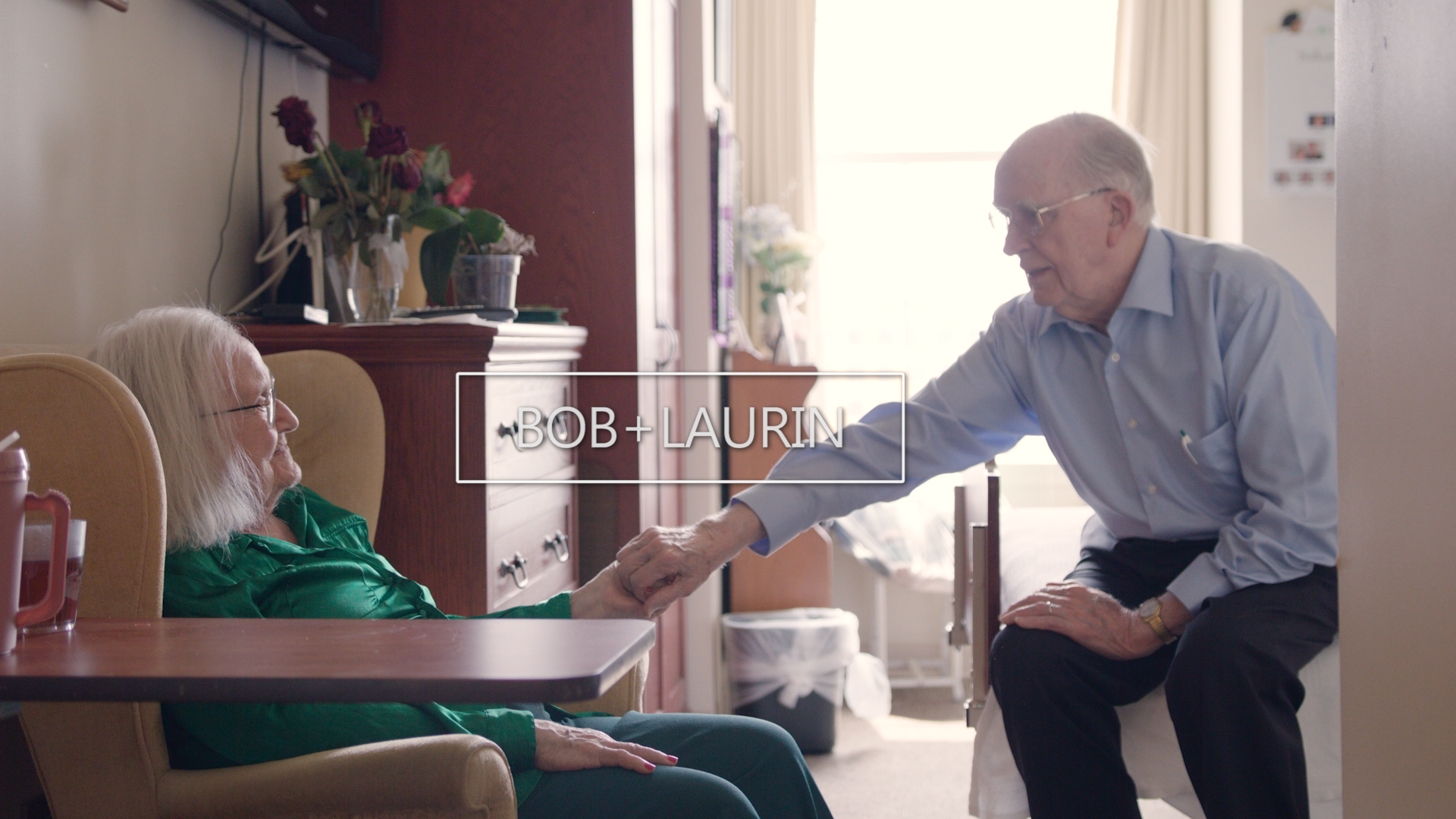
Last week, in preparation for our celebration of the Archdiocese of Washington’s Marriage Jubilarian Mass, we produced this video about Bob and Laurin Balkam, a husband and wife from the Greatest Generation.
Before the interview could start, Bob said, “I’ll tell you my life story and you see what you think. And I’ll try to do it in about five minutes.” But you can neither tell a 75-year love story in five minutes, nor help but take away some life lessons.
The first lesson to take away is the transformative power of faith. Bob and Laurin were not Catholic when they married. They were Protestant. And that’s just how Bob liked it. Until one day, that is, when he came home and Laurin was reading a book about the Blessed Mother. “Uh oh,” he thought. Laurin then went on to tell Bob that she had met a Catholic priest … and that he was coming for dinner. Bob wasn’t happy.
Even worse for Bob: after meeting the priest, he really liked him and would go on to meet with him several times. Bob said after that, he “knew in the soles of his feet” that God wanted him to become Catholic. The Balkams converted and raised all eight of their children in the faith, with God guiding, correcting, loving and just being present with them.
The second lesson involves the power of marriage. In the video, Bob says of his union, “Like the faith, Laurin has enriched me, instructed me, corrected me and encouraged me. She loves me.”
When they were first married Bob was about to take a job until Laurin told him, “No, Bob, you’re not going to take that job. It’s not good enough for you.” He went back the next day and asked for another position and got it. He ended up staying in that job for 20 years, but the most important thing that he received, he said, “was a gift from my wife … a transformation in my view of myself.”
The third lesson is the true meaning of “visible signs.” A few years ago, Laurin was diagnosed with Alzheimer’s disease. For both Laurin and Bob it was a terrible shock. There is little doubt that their faith has helped carry them through challenging times. But if ever there were a couple who serve as a visible sign of an abiding faith in the love of God and faith in the path that He presents each of us – should we choose to follow – it is the Balkams.
For example, Laurin is no longer able to speak, and I wondered how they communicated. Bob showed me. As I watched from a distance so as not to intrude, Bob began speaking to her in their own “language.” He took his bride’s hand and looked into her eyes, and she responded immediately, full of life and animated. It is a language of joy and of laughter; it is their language of love. It is the language of a 75-year marriage that Bob calls, “a glorious, glorious life.”
* * *
Join us for the Archdiocese of Washington’sJubilarian Mass for Married Couples, celebrated by Cardinal Donald Wuerl, Archbishop of Washington, on Sunday, June 25, at 2 p.m., at the Basilica of the National Shrine of the Immaculate Conception in Washington, D.C.
Christopher Baker is Director of Multimedia Production for the Archdiocese of Washington. To view more inspiring videos produced by the Office of Multimedia Production, please go to theWashArchdiocese YouTube page.
One of the great paradoxes of creation and our existence in God’s world is that many blessings are unlocked by explosive, even violent forces. The very cosmos itself is in a kind of process of hurtling outward in a massive explosion. And here we are, living midway (?) through that explosion.
When I see fireworks on the Fourth of July, I often think that each of those beautiful, fiery explosions is a miniature replica of the cosmos. Everywhere in the universe, the burning embers we call stars and galaxies glow brightly as they hurtle outward at close to one hundred million miles per hour. Yes, from one great singularity, God sent the power of His fiery, creative love expanding outward, giving life, and seeming almost limitless. The cosmos is unimaginably large, and yet its creator is infinitely large.
Even here on Earth, a relatively cool and stable bit of dust compared to the Sun, we stand upon a thin crust of land floating over an explosive sea of molten, fiery rock. The Book of Job says,
As for the earth, out of it comes bread; Yet underneath it is turned up as it were by fire (Job 28:5).
This fiery cauldron produces the rich soil in which we grow our very bread. The smoke and gases of the fires provide essential ingredients of the atmosphere that sustains us. The molten fires beneath us also create a magnetic field that envelops Earth and deflects the most harmful of the Sun’s rays.
Yes, all around us there is fire with its explosive violence, yet from it come life and every good gift.
To such small creatures like us, God’s expansive love can seem almost violent. Indeed, there are terrifying experiences near volcanos and from solar bursts that remind us that love is both glorious and unnerving. It is an awesome thing to fall into the hands of a living God (Heb 10:31).
We, too, in some of our greatest works, use violent means. The blades of our plows cut into the earth, violently overturning it. We raise animals and yet lead them to slaughter for food and clothing. We break eggs to make omelets. We stoke fires to cook our foods and warm our homes. We smelt the iron and other ore we violently cut from the earth. Even as we drive about in our cars, the ignition of the fuel/air mixture in the engine causes explosions, the energy from which is ultimately directed toward moving the vehicle.
Violent though much of this is, we do these things (at least in our best moments) as acts of love and creativeness. By them we bring light, warmth, and food. We build and craft; we move products and people to help and bless.
Yes, there is a paradoxical “violence” that comes from the fiery heat of love and creativity. The following is an excerpt from Bianco da Siena’s 14th century hymn to the Holy Spirit, “Come Down, O Love Divine”:
Come down, O Love divine,
seek thou this soul of mine,
and visit it with thine own ardor glowing;
O Comforter, draw near,
within my heart appear,
and kindle it, thy holy flame bestowing.
O let it freely burn,
till earthly passions turn
to dust and ashes in its heat consuming;
and let thy glorious light
shine ever on my sight,
and clothe me round, the while my path illuming.
Fire—you can’t live with it, can’t live without it. Let the fire burn; let the seemingly transformative “violence” have its way. It makes a kind of paradoxical sense to us living in a universe that is midway through its fiery, expansive explosion of God’s love and creativity.
Disclaimer: Gratuitous violence for selfish and/or merely destructive ends is not affirmed in this post. The term “violence” is used here in a qualified manner, as an analogy to convey the transformative and creative power of love phenomenologically.
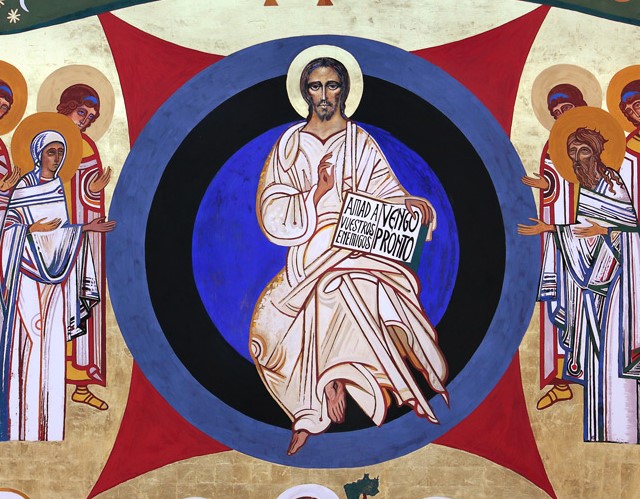
There is a specific depiction of Christ known as Christ Pantocrator. It was widespread in the ancient world and still is today. The title “Pantocrator” is most often translated as “The Almighty One” or “The Omnipotent One.” It comes from the Greek words παντός (pantos, meaning all) and κράτος (kratos, meaning strength, might, or power).
In the particular image at right, Christ is seated (as a sign of authority). In many of the specific images he holds a book, sometimes open and sometimes closed. If the book is open, there can be a few of many different texts displayed. In some of the images there is an interesting juxtaposition of texts meant to provoke thought and lead to both catechesis and repentance.
Among the more interesting and provocative juxtapositions of texts is the one commonly used in the Neocatechumenal communities (see above right). On the left-hand page of the open book is the Gospel from today’s mass (Tue. of 11th Week), in which Jesus says, “Love your enemies” (Matt 5:44). On the right is the one in which Jesus says, “I am coming soon” (Rev. 22:7).
Provocative, indeed—and a sober call repentance! It is hard to see how we could hope to enter Heaven with hatred or vengeful anger for our enemies in our heart. With that eating away at our heart it wouldn’t be Heaven! Therefore, we should consider our final end and beg for the grace to love our enemies by praying for them, working for their conversion, and supplying their basic human needs (cf Rom 12:20; Prov. 25:21). Our goal is to be at one with them in Heaven, and even here in this life if it be possible and rooted in the truth.
Jesus sets apart the love of one’s enemies as the “acid test” for Christians:
Love your enemies and pray for those who persecute you,so that you may be sons of your Father who is in heaven. For he makes his sun rise on the evil and on the good, and sends rain on the just and on the unjust. For if you love those who love you, what reward do you have? Do not even the tax collectors do the same? And if you greet only your brothers, what more are you doing than others? Do not even the Gentiles do the same? You therefore must be perfect, as your heavenly Father is perfect (Matt 5:44-48).
There’s nothing like a passage such as this one to get us on our knees asking for grace and mercy! Indeed, we will surely fail if we seek to love our enemies only through the power of our own flesh or from our own fallen nature.
Jesus is coming soon and He will look for this fruit in us. All the more reason, then, to ask it of Him:
Good Jesus, who alone can save me from my hard heart, grant me the grace to love my enemies and pray for those who persecute me. I am too weak, self-centered, and thin-skinned to do it on my own. I consent, good and merciful Jesus, to this work of yours in me. Accomplish this, Lord, by your grace!
Note to readers: The following article is long (3500 words). This is because I have been adding to it over the years as my research has continued. I am by avocation a church musician. Before my ordination, I was a Choir director and an organist. Like most of you, I have my preferences in the area of Church music, but we must be careful not merely to dogmatize them. If we are going to talk intelligently about Church music, knowledge of history is important. It would certainly be incorrect to think that the debates about music in the liturgy began in 1965. In fact, such debates go back to the very beginning of the Church. In order to provide some historical perspective (and a context for the reflection on what is and is not appropriate music) I have been writing and expanding upon this essay for several years. Since it is long, I want to provide a PDF, which you may find here, so that you can print the article out and read it at your leisure. If you do not have the time or the interest to read this full article, you can get the gist of it in the summation at the end.
With the exception of chant, almost every form of music that is today regarded as sacred initially had a stormy reception in the Church before being admitted to the ranks of music commonly called “sacred.”
That music is controversial in the Church is nothing new, as we shall see in this modest survey of the history of music in Catholic liturgy. Some of my sources are listed at the end of this post, but it is really the product of many years of reading and studying.
On some level, I hope to provide some perspective on the claim that is often made today that certain modern forms of music are inadmissible because they are not “sacred.” In no way do I intend to approve of all forms of modern music nor to encourage the admission of all of them into the liturgy, but it is worth appreciating that the definition of “sacred music” has changed over time. New forms have been admitted— sometimes reluctantly—to the exalted class we refer to as “sacred music.”
Here, then, is a brief look at the history of Church music in terms of what has been considered sacred and what has not.
I. The early, pre-Constantine period: Chant reigns supreme – While little if any music survives in written form from the earliest days of the Church, it seems clear (as Johannes Quasten records) that the leaders of the early Church (the Fathers and bishops) preferred monophonic music. This seems largely due to the association of harmony with the excesses of the pagan world and pagan worship.
Frankly, there was in the early Church a very persistent theme that music itself was problematic. Many ancient bishops and Fathers of the Church barely tolerated it, sought to limit its influence, and/or were deeply suspicious of any singing at all.
In his essay “On the Theological Basis of Church Music,” Cardinal Ratzinger (drawing from sources such as Pope Gregory the Great, St. Jerome, Gratian, and even as recent as St. Thomas Aquinas) describes the rather negative opinion in the early Church of any music involving instruments, harmony, or anything deemed “theatrical.” He writes,
Instrumental music, understood as a Judaizing element, simply disappeared from the early liturgy without any discussion; the instrumental music of the Jewish temple is dismissed as a mere concession to the hardness of heart and sensuality of the people at that time. What the Old Testament said about music and worship could no longer be applied directly; it had to be read by them allegorically; it had to be spiritualized
(Ratzinger, “On the Theological Basis of Church Music,” quoted from Collected Works Vol XI, pp 425-432).
Summarizing the views he had received from the earlier Church, St. Thomas wrote, “In the praise of God, the Church does not employ musical instruments … lest she appear to be falling back into Jewish ways” (Summa Theologica II, IIae, q. 91 a 2 ad 3).
Cardinal Ratzinger continues,
Analyzing the texts, not infrequent in the Fathers, which are critical of music or even openly hostile to it, one can clearly identify two constant and governing factors:
A. In the first place there is the one-sidedly “spiritual” understanding of the relationship between the Old and New Testaments … [So] Christian liturgy … took on a more or less Puritan form. … The idea that God can only really be praised in the heart means that no status can be accorded to music … In Christian worship … music must be relegated to a secondary level. Augustine is a splendid example of this. His sensitivity to music causes him much torment because his mind is dominated by a spiritualizing theology that ascribes the senses to the Old Testament, the old world; he is afraid of “sinning grievously” when he is “moved more by the music then by the reality to which the singing refers” … and would prefer “not to hear singing at all.” Fortunately, his rigorism is dampened when he recalls the profound stirring his soul experienced when he first heard Church music in Milan. [He thus adopted a view of music later stated by St. Thomas, which held that among the reasons for Church music was that] “Thus the minds of the weak be more effectively summoned to piety.”
B. The second group of ideas that stood in the way of a positive the valuation of Church music … is put in a nutshell in Thomas’ fundamental article on the praise of God, where he says that vocal worship is necessary, not for God’s sake, but for the sake of the worshiper (Ibid).
Cardinal Ratzinger argues in the essay that this tended to lead to a utilitarian view of Church music: necessary to some degree, but somehow less than ideal. He reflects that this created a barrier to any satisfactory theology, not only of Church music, but of all prayer whatsoever.
He also adds (in a later essay) another reason for the restrictive notions about music in the early Church:
To the extent that it distanced itself from the Semitic world, the development of Christological art songs [also] threatened more and more to turn into an acute Hellenization of Christianity … The fascination of Greek music and Greek thinking [now excluded] … so that the new music rapidly became the domain of Gnosticism … For this reason [too] the Church immediately and rigorously rejected the poetical and musical innovation and reduced Church music to the psalter … This limitation of liturgical singing which gradually began asserting itself from the second century … led to a forbiddance of private song compositions and noncanonical writings in liturgical services. The singing of the psalms also came to be restricted to the choir whereas others “should not sing in church” (See canon 59 of the Synod of Laodicea 364 AD) (Ratzinger, Ibid, p. 505).
Thus music in general, given its Semitic and pagan associations, was widely resisted in the early Church and tolerated only in limited ways. Music with any harmony was altogether excluded and would not reappear until the Late Middle Ages.
As a final sample of the Patristic skepticism of music or demonstrative worship, consider St. Cyprian, who wrote the following early in the 3rd century:
When we pray, our words should be calm, modest and disciplined. Let us reflect that we are standing before God. We should please him both by our bodily posture and the manner of our speech. It is characteristic of the vulgar to shout and make a noise, not those who are modest. On the contrary, they should employ a quiet tone in their prayer ….
When we gather to celebrate the divine mysteries with God’s priest, we should not express our prayer in unruly words; the petition that should be made to God with moderation is not to be shouted out noisily and verbosely. For God hears our heart not our voice. He sees our thoughts; he is not to be shouted at …
(Treatise on the Lord’s Prayer by Saint Cyprian, bishop and martyr (Nn. 4-6: CSEL 3, 268-270)).
So much, it would seem, for demonstrative prayer and exuberant singing.
Another reason that the early Church seems to have favored non-harmonic singing was somewhat rooted in the cosmology of the time, wherein there was an emphasis on the unity of all things. Whatever diversity was discovered was viewed as coming from the one hand of God. Monophonic music seemed to better express this unity, at least to the ancient Christian mind.
This cosmology of unity still finds its expression in the way that most Prefaces in the Mass are concluded. The Latin text speaks of the multitude of the choirs of angels, joining with the voices of the many saints (cum Angelis, et archangelis, cum Thronis, et Domininationes … et òmnibus Sanctis). Yet despite the vast multitude of voices, at the end of the Preface it says that they all sing “as with one voice, saying” (una voce dicentes), “Holy, Holy, Holy, Lord God of hosts.”
And so at the earliest stage, music was limited, and to the degree it was it was largely what we today call chant. To the ancient Church, harmony was widely considered to be secular, even pagan.
II. The Church after Persecution: Chant develops – The earliest chants were quite simple and largely syllabic (one note per syllable); there were few elaborations. However, after the Edict of Constantine (321 A.D.) as the Church came out of a more hidden worship, the use of large, cavernous buildings started to influence the singing.
Cantors began to elaborate on the chant, making full use of the echoes in the larger, basilica-like buildings. Vocals became increasingly melismatic (multiple notes per syllable) rather than syllabic, especially during festival seasons. Syllables (such as those in the word “Alleluia”) began to be extended over more and more notes.
Singers also “yielded to the spirit,” and the long melismata became a kind of ecstatic “singing in tongues.” Though at first any elaboration was resisted, certain chants did begin to develop in some areas. As these melodies became increasingly complex, they were written down and collected by Pope St. Gregory (among others), hence the modern name, “Gregorian chant.”
As these chants became more and more elaborate, their sacredness was only gradually conceded. In fact, they became so complicated that the faithful in the congregation, who were already being discouraged from singing at all, had great difficulty joining in most of the chants. For this reason, special choirs called “scholas” were formed.
III. The High Middle Ages: Harmony enters – The next major development in Church music took place during the High Middle Ages, generally speaking in the 13th century. The first developments of harmony occurred in the musical schools in France, particularly around Paris. It was here that we saw the first widespread introduction of harmony into Church music.
Several factors influenced the introduction of harmony. First, there was the reintroduction of Greek philosophy and some of its views back into the Western world through scholasticism.
Among the Greek notions was a cosmology that spoke of the planets orbiting the sun in perfect circles, each of them ringing out a different tone and creating a beautiful celestial harmony in the heavens as they did so. This was the “music of the spheres” and the idea of a great and beautiful harmonic sound in the heavens. Thus the association of harmony with the sacred began to seem more plausible in the minds of Christians.
The first experimentation with harmony seems to have been singing the Gregorian melodies and adding a hollow harmony of a fourth or fifth. Sometimes this involved several singers singing the words in those harmonies. Other times the harmonizers simply “droned” in the background, somewhat like bagpipe drones.
Architecture was another factor that influenced the harmonies. The soaring new cathedrals with their vaulted ceilings that began to dot the landscape of Western Europe seemed to demand more soaring music. These cathedrals were the skyscrapers of their day.
As harmony began to sound more pleasing to the ears, scholars worked to study it using, of all things, the Pythagorean Theorem, to mathematically set forth the harmonic scale. Thus mathematics and music came together to quantify a kind of music theory. Gradually, as the years just prior to the 16th century ticked by, we came to have what we know of today as the 12-tone scale.
The introduction of harmony in the Church (as with most things musical) was not always without controversy. Some thought that it made the words harder to understand, a complaint that would plague polyphonic music in its early stages.
Nevertheless, as a general rule, the new harmonies from the Paris school swept through Europe to widespread acclaim. People flocked to the cathedrals to hear this splendid new music.
IV. Late Middle Ages to Renaissance: Musical revolution and a growing crisis for polyphony – It is hard to describe what took place in music from the late 1300s to 1500 as anything less than revolutionary. The modern harmonic scale as we now know it came into full realization. Harmony went from two-part, to three-part, and then to four and more parts, amazing listeners everywhere.
The incredible development of music during this period paralleled the remarkable developments in painting: increasing use of shadow, light, perspective, and depth. By the early 1500s, Renaissance polyphony was in all of its glory. Composers such as Isaac, Lassus, Palestrina, Victoria, Tallis, and Byrd brought this art form to an amazing richness.
But the music was not without controversy. There were two main problems with this new style called polyphony.
The first problem was the intelligibility of the text. With multiple harmonies being sung, the Latin text, often staggered across many parts and voices, became harder and harder to understand. Clergy in particular complained of this, arguing that the sacred text was taking a backseat to musical flourishes. In addition, the “theatrical showiness” seemed secular to many.
The second troubling issue was that many of the composers of the day drew from secular melodies that were often heard in taverns, in theaters, and on the streets. They would often take these recognizable melodies and set them as a cantus firmus (musical theme or foundation) of sacred compositions, including the parts of the Mass.
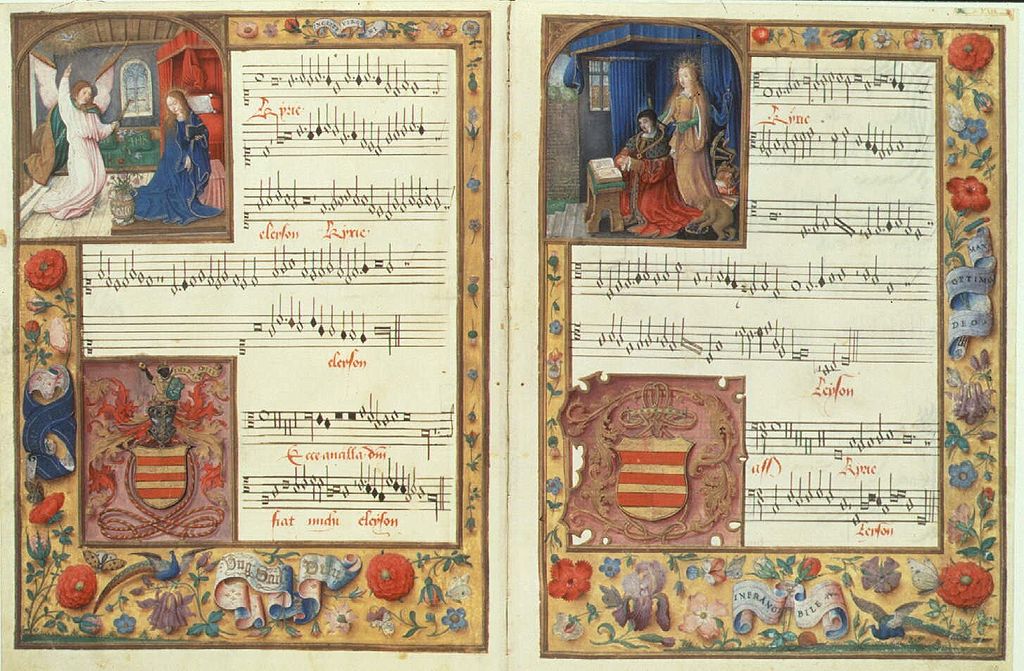
Heinrich Isaac, as early as the 1400s in his Missa Carminum, drew from many of these tavern songs. But perhaps the most egregious example of this, and something that almost caused polyphony to be banned completely from the Catholic Church, was a Mass composed by Orlandus de Lassus.
The Mass in question was his Missa Entre Vous Filles. The main melody of both the Kyrie and the Gloria came from a secular piece by the French composer Jacob Clemens non Papa, the words of which bordered on the pornographic. As the Mass grew widely popular (for it is a lovely melody), Church authorities discovered its source and a great uproar ensued.
This controversy took place during the years of the Council of Trent, and though some scholars are dubious of all the details, it is reported that there were Council Fathers who were serious about seeing that sacred polyphony was forever banned from the Catholic liturgy.
Among those who came to the rescue, I am happy to report, was my patron saint, Charles Borromeo. He assembled some increasingly dubious bishops and cardinals who were attending the sessions of the Council of Trent so that they could hear the Pope Marcellus Mass by Palestrina. This particular Mass seems to have been specifically composed to address some of the critiques about the intelligibility of the text and the secular origins of many melodies. The presentation calmed some of the fears regarding this new music and the crisis largely passed.
This incident demonstrates that what many today consider a very sacred sound (namely Renaissance polyphony) was actually quite controversial in its day. It was only thought of as sacred in a widespread way later on. After surviving this first crisis, polyphony became less “florid” and gave greater emphasis to the intelligibility of the text. Secular melodies were also excluded. For these reasons, later works by Palestrina are more austere than those from his earlier period.
Thus we see how the definition of what makes for sacred music had already passed through two major periods. In the first, harmonies were considered too secular; in the second, harmony was introduced but only slowly accepted as sacred in nature.
V. The Renaissance to the Baroque: New controversies, old problems – In the period of the middle Renaissance, a new cosmology began to replace the idea that the planets revolved around the sun in perfect circles. Astronomy started to reveal that most of the planets revolved around the sun in elliptical orbits, some of them quite elongated. The notion of the circular orbits of the planets, symbolized by the “music of the spheres” and imitated by Renaissance polyphony, began to give way to the understanding of the mathematical progression of elliptical orbits—a kind of Bach fugue in the sky. This change in cosmology helped to usher in the rather more elaborate, yet mathematical, music of the Baroque period.
In this period, we find the wonderful and mathematically precise music of Bach, Vivaldi, Handel, Mozart, Gabrieli, Schubert, Scarlatti, and many others. Perhaps the fugue best exemplifies the kind of mathematical cosmology of the time. In a fugue, mastered by Bach but not wholly unique to him, a musical theme is set forth. For example, quarter notes may announce the theme of the fugue. This theme is then repeated in the left hand and then in the feet (of the organist). It also progresses mathematically: into eighth notes, then into sixteenth and even 32nd notes. Math meets music! Other musical forms like canons emerged similarly. Symphonies also grew to have movements, which were often named for their tempo (e.g., allegro, adagio, presto).
The classical and baroque periods brought the great orchestral or “Classical” Masses, by composers such as Mozart, Schubert, and Scarlatti. Even Bach and Beethoven set the Catholic Mass in great symphonic and orchestral renderings.
Much controversy accompanied these newer forms. Once again, the principle concern was the intelligibility of the text. Another concern was the length of many of these Masses; in some, the Glorias and Credos could go on for twenty minutes or longer.
Some complained that these musical settings of the Mass made it sound more like being at the opera than at Mass. Indeed, they often broke the sacred text into movements sprinkled with soprano or tenor solos and duets, grand choral sections, and often with full symphonic accompaniment. It was quite a feast for the ears! These Masses were generally so elaborate that they could only be performed in the larger, well-endowed, city churches.
The controversy concerning these kinds of Masses continued for many years. Even as liturgical reforms began in the early 1900s, Pope Pius X frowned on their usage, referring to these orchestral Masses as “theatrical” (see Tra Le Sollecitudini # 6). This led to a de facto banishing of the form from the Catholic liturgy at that time. Only after the Second Vatican Council was this form rehabilitated in a small way.
Here, too, we see that what many Catholics today consider unquestionably sacred (e.g., a great Mozart Mass) had to survive much controversy and even a kind of banishment. What is thought of as sacred today has not always enjoyed that rarefied distinction!
VI. The Modern Era: New musical forms, new controversies– This leads us to the modern era. As we have seen, those who think that debates about what constitutes sacred music are new are simply mistaken. These disputes have been quite a constant part of Church life almost from the beginning. To place them at the feet of the Second Vatican Council is to lack historical perspective.
It is true that two documents of the Second Vatican Council (Musicam Sacram and Sacrosanctum Concilium) opened the door to newer forms with a greater freedom toward enculturation (e.g., MS # 18, 63), but they also reasserted the special accord to be given to chant (# 50a), polyphony, and the pipe organ (# 4a).
Although debate continues about newer forms of music and whether or not they are sacred, such tensions have long existed. Some newer forms have already been tried and found wanting (e.g., Polka Masses). Other forms such as “folk,” gospel, or contemporary music, with adaptions over time, have remained.
Summation:
Historically, no form of music currently considered sacred achieved that status without controversy.
Indeed, music itself was controversial in the early Church and was barely tolerated by many of the Church Fathers.
Time ultimately proves where wisdom lies and ultimately mediates for us what is sacred in a way that transcends mere passing tastes or preferences.
Music has made several revolutionary leaps during the age of the Church.
Provided necessary rational limits are applied, there is no need to rush to exclude every newer form.
If we were to do so, only chant would exist in the Church, and we would be deprived of a great treasury of music from the era of polyphony and the classical period.
In saying this I do not mean to indicate that all music is just fine, or that all modern forms are here to stay, or that newer forms should not be questioned; it is clear that some forms are wholly inimical to the Sacred Liturgy. Rather, I seek to remind people that what is called “sacred music” is historically quite complex. It is the result of long and vigorous discussions, refinements, and other factors as diverse as cosmology, architecture, mathematics, and culture.
We do well to let some of the conversations and controversies work themselves out, lest in too quickly ending them by judicial fiat we impoverish ourselves and block what might bless others and even our very selves.
These are just a few of my sources for the above article:
Here are the Kyrie and Gloria from the Missa Entre Vous Filles by Orlando de Lassus, the polyphonic Mass setting that almost torpedoed polyphonic music in the Church. To our “distant” ears it is delightful and melodic. At the time, however, it engendered great outrage as nearly pornographic, because it drew from the melody of a “racy” song of the time.
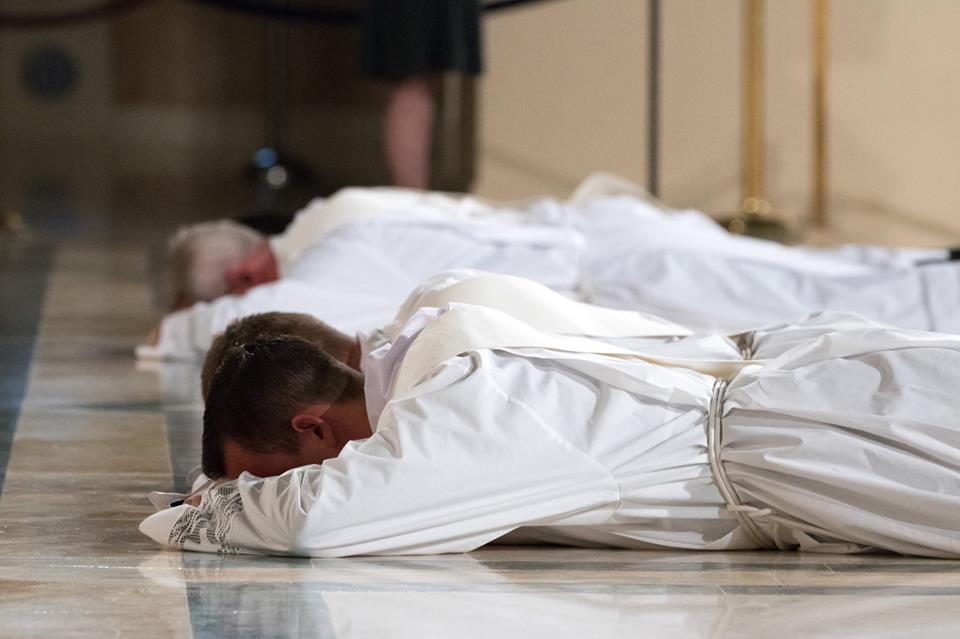
Sunday’s Feast of Corpus Christi brought the first Masses of the new priests ordained here in Washington. It was also Father’s Day. The readings for Corpus Christi suggest a kind of threefold office for the priest (related to teaching, governing, and sanctifying). I thought it might be good to present some of the notes from that homily on the blog today. Here, then, are three facets of a faithful Father—of a faithful priest.
I. The Priest Announces the Truth – Throughout the readings today we see Moses, St. Paul, and Jesus announcing fundamental truths for God’s people. Scripture says, For the lips of a priest should preserve knowledge, and men should seek instruction from his mouth; for he is the messenger of the LORD of hosts (Malachi 2:7). In today’s readings, four truths stand out that the priest should announce.
REMEMBER– Moses says to the people, Do not forget the Lord your God (Deut 8:14). He also adds, Remember how for forty years now the Lord, your God, has directed all your journeying in the desert (Deut 8:2). Hence, every priest must stand before his people and say to them always (whether explicitly or implicitly), “Never forget the works of God. Do not forget what He has done for you. Remember Him and what He has done for you!”
To remembering means to have so present in my mind and heart what God has done for me that I’m grateful and different. Indeed, gratitude is a form of joy. When we are grateful, an awful lot of poison goes out of our heart. When you’re joyfully grateful, it’s pretty hard to despise your neighbor, or to be stingy and greedy, or to be vengeful and envious. Yes, a lot of poison goes out of our system when we remember what the Lord has done for us; we are grateful, joyful, different. At every Mass, the priest, as a Father, should remind his people never to forget the works of the Lord.
REJOICE– Here, too, today’s readings portray the priestly call for his people to rejoice in the Lord. Psalm 147 says, Glorify the Lord O Jerusalem; praise your God oh Zion! (Psalm 147:12), and the beautiful Sequence Hymn says, Laud O Zion your salvation, Laud with hymns of exultation, Christ your king and Shepherd true.
Every priest, as a faithful Father, must summon his people to rejoice in the Lord. The Lord only permits difficulty in order for some greater glory to be ushered in. Every priest should say, as in the words of Scripture, “Do not be sad, do not weep, for rejoicing in the Lord must be your strength!” (Neh 8:10) Joy is the natural state of every Christian, and every faithful priest should summon his people to joy by being a man of joy, hope, and confidence himself.
Sadly, joy is not the first thing that many people see upon walking into a typical Catholic congregation. Too often the scene looks more like a funeral than the wedding that the Mass is supposed to be. While it is true that people express joy in different ways, joyous is not the first way most outsiders would describe a typical Catholic congregation.
Every faithful priest should stand before his people and say “Rejoice,” not only with his words but also by his demeanor, hope, and manifest confidence.
RE-CENTER – In the first reading, Moses says to his people, Not by bread alone does one live, but by every word that comes forth from the mouth of God (Dt 8:3). Here, too, every priest, as a faithful Father, must exhort his people to center their lives on things that really matter. Too many of God’s people focus on lesser things such as sports, politics, money, or how they stack up against other people. But every faithful priest, every faithful Father, must stand before his people and remind them, in the words of Isaiah,
Come, all you who are thirsty, come to the waters; and you who have no money, come, buy and eat! Come, buy wine and milk without money and without cost. Why spend money on what is not bread, and your labor on what does not satisfy? Listen, listen to me, and eat what is good and you will delight in the richest of fare. Give ear and come to me; listen, that you may live (Isaiah 55:1-3).
Yes, Sunday after Sunday, the holy priest must remind the faithful of that which really matters and call them to focus their lives on heavenly, lasting things rather than earthly, passing things.
RECEIVE– In the Gospel today, Jesus warns, Unless you eat the flesh of the Son of Man and drink his blood, you do not have a life in you (Jn 6:53). Thus every priest will celebrate the Eucharist for his people faithfully and will exhort them never to miss a Sunday. His chief desire is to feed the people entrusted to his care and to warn them that if they neglect to feed on the Holy Eucharist of the Lord, they will have no life in them.
They will be like the children of Israel in the wilderness who would never have made it to the Promised Land if they had not faithfully eaten the manna that God gave them to preserve them in the desert for over forty years. Neither will we make it to the heavenly Promised Land if we do not receive frequently our manna—the very Body, Blood, Soul, and Divinity of Jesus Christ.
Every priest, every faithful Father, must stand before his people and say, “Come, eat His Body, which was broken for you, and His Blood, which was shed for you.” Every priest will seek the lost sheep to restore them to the nourishment they desperately need and without which they will die.
II. The Priest Admonishes the Timid and Temperamental – In today’s Gospel, as the Lord Jesus announced the essential truth of the Holy Eucharist He encountered many who were quarrelsome and murmured against Him.
How does He deal with them? Upon hearing their protests, He does not compromise. He does not water down His teaching. Rather, He intensifies it and warns them clearly.
When He tells them that they must eat His Flesh and drink His Blood, and they object, He warns them with this well-known Jewish expression: “Amen, amen I say to you!” Then He goes on to say that unless (which is a very strong and exclusive word) “you eat the flesh of the Son of Man and drink his blood you will not have a life in you.” He then intensifies His teaching even more by substituting an impolite word for eating: τρώγων (trogon), which means to gnaw on or devour.
So when it comes to an essential truth, Jesus does not water down or “cave in.” Rather, He solemnly reasserts the truth even more forcefully. He does this not to be argumentative, but because He loves them and does not want them to be lost forever.
So, too, for the priest of God today. We live in quarrelsome times in which many murmur and protest: about the Eucharist to be sure, but also about many moral teachings. The priest of God, as a faithful Father for his people, must not water down the truth or compromise. Rather, he must speak the truth even more clearly. He must explain it with love, so as to save his people from the error that can and will destroy them. Yes, like Jesus, every priest must speak the truth clearly and in love.
St. Paul admonished Timothy,Preach the word; be ready in season and out of season; reprove, rebuke, exhort with great patience and instruction. For the time will come when they will not endure sound doctrine; but will surround themselves with teachers who will tickle their ears, they will accumulate for themselves teachers in accordance to their own desires (2 Tim 4:2-3).
All the more reason, then, that the priest of God must stand before his people, not counting the personal cost, and speak the truth to them in love, speak to them the truth without which they will perish.
III. He Advances the Transformation of God’s People – Notice that in this brief passage the Lord Jesus presents the same truth four times:
i. I am the living bread that came down from heaven; whoever eats this bread will live forever; ii. Whoever eats my flesh and drinks my blood has eternal life. iii. The one who feeds on me will have life because of me. iv. Whoever eats this bread will live forever.
Obviously, since repetition is the mother of studies, Jesus wants us to lay hold of this truth: if we receive His Body and Blood and follow Him in faith, we will have eternal life!
Yet many misunderstand the concept of “eternal.” The Greek word αἰῶνα (aiona) refers not merely to the length of life but also to its fullness. Therefore, in offering us eternal life, Jesus is not simply saying that we will live forever in the sense of a very long time. Rather, He is saying that we will become more and more fully alive with Him, even in the present, and that one day we will enter into the glory of Heaven forever where we will be so alive that our life here will seem to have been a mere coma. St. Ireneus says that the glory of God is the human person fully alive.
Therefore, every priest must stand before his people and announce to them a fuller life, a richer life, a more wonderful life—not in some distant Heaven, but even now! He cannot be content merely to point to the possibility of such a thing. Rather, he must stand before them as a living witness, as one who has committed himself to prayer, to the sacraments, to the Word of God, and to walking in holy fellowship with the Church. He must show that even now he is experiencing a life made richer and fuller by the grace of the sacraments working in his life. He is not merely to announce to his people the richer and fuller life; he is to stand before them as a witness of it.
Of this, I myself can testify. Now well into my fifties, my body is heading south. My soul, however, is more alive than ever before. I am more joyful and more confident. I love God more. My prayer life is coming alive; my mind and heart are being renewed. I’ve seen sins put to death and new graces come alive.
Yes, every priest must be able to stand before his people as a living witness of how the Lord can transform our lives and bring us into the fullness of eternal life, even now. In this way, he helps to advance his people in the transformation that is the normal, the expected life of God’s people.
Here, then, are some facets of a faithful Father, gleaned from yesterday’s readings at the Solemnity of the Body and Blood of Christ.
In many places this Sunday, the (moved) Solemnity of the Most Holy Body and Blood of Christ Our Lord is celebrated.
While you may puzzle over my title for today’s blog, allow me to delay the explanation to a bit later. On a solemn feast like this, many things might be preached and taught. Let’s look at three areas for reflection: the Reality of the Eucharist, the Requirement of the Eucharist, and the Remembrance of the Eucharist.
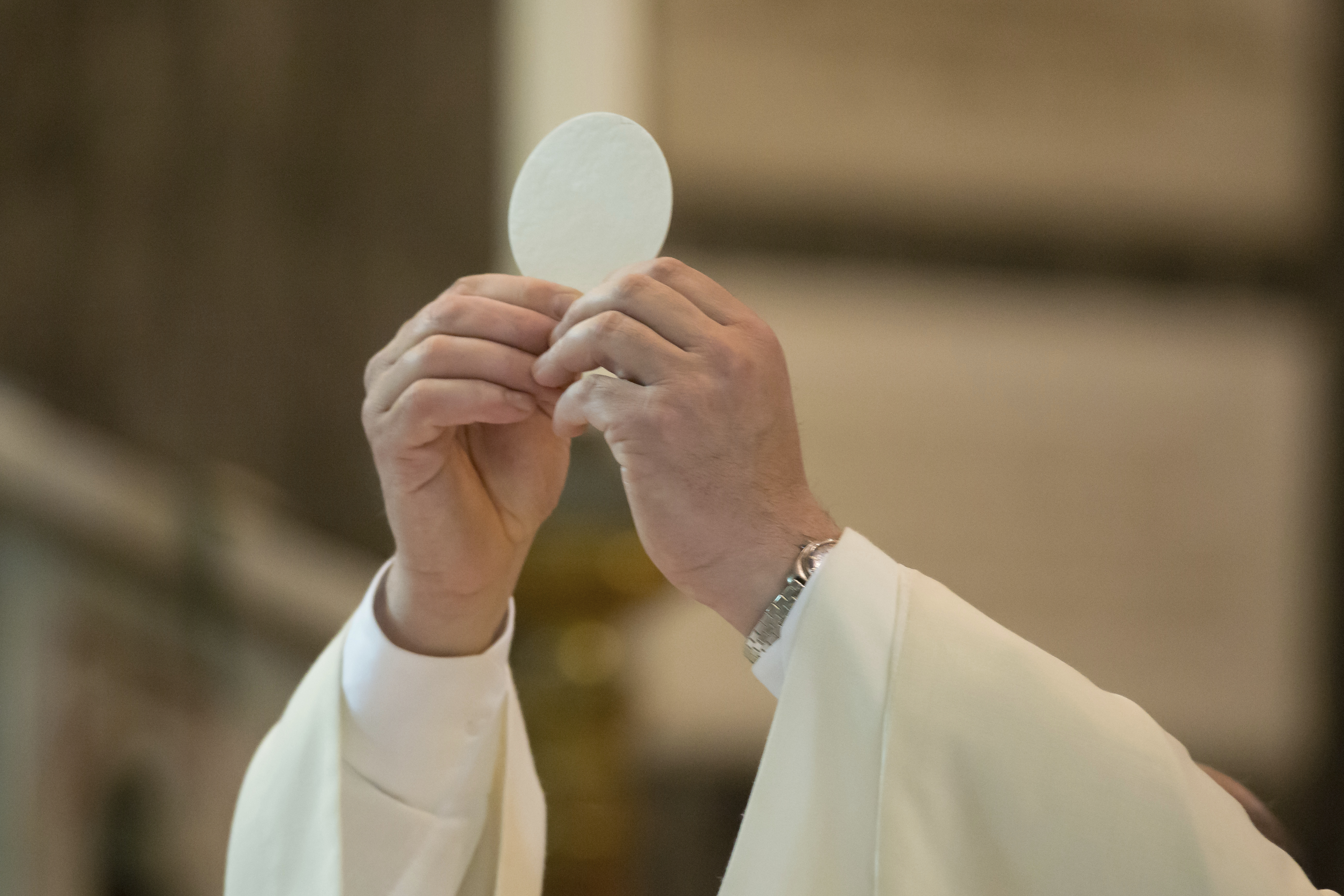
I. The Reality of the Eucharist – On this solemn feast we are called above all to faith in the fact (as revealed by the Lord Himself) that the Eucharist, the Holy Communion, is in fact a reception of the very Body, Blood, Soul, and Divinity of Jesus Christ, whole and entire, in His glorified state. We do not partake of a symbol. The Eucharist is not a metaphor; it is truly the Lord. Neither is it a “piece” of His flesh. It is Christ, whole and entire. Scripture attests to this in many places:
Luke 22:19-20And he took bread, and when he had given thanks he broke it and gave it to them, saying, “This is my body which is given for you. Do this in remembrance of me.” And likewise the cup after supper, saying, “This cup which is poured out for youisthe new covenant in my blood.”
1 Cor 10:16The cup of blessing which we bless, is it not a partaking in the blood of Christ? The bread which we break, is it not a partaking in the body of Christ?
Luke 24:35They recognized him in the breaking of the bread.
1 Cor 11:29For anyone who eats and drinks without recognizing the body of the Lord eats and drinks judgment on himself.
John 6:51I am the living bread which came down from heaven; if any one eats of this bread, he will live forever; and the bread which I shall give for the life of the world is my flesh.
This last quote is from the Gospel for today’s feast. The passage is a profound theology of the Eucharist from Jesus Himself. He makes it clear that we are not permitted to think of the Eucharist as a symbol or in metaphorical terms.
When Jesus referred to the bread as Hisflesh, the Jewish people hearing Him grumbled in protest. Jesus did not seek to reassure them or to insist that He was speaking only symbolically. Rather, He became even more adamant by shifting His vocabulary from the polite form of eating, φάγητε (phagete – meaning simply “to eat”) to the impolite form, τρώγων (trogon – meaning “to munch, gnaw, or chew”).
So insistent was He that they grasp this that He permitted many to leave Him that day, knowing that they would no longer follow in His company due to this very teaching (cf Jn 6:66). Yes, the Lord paid quite a price for this graphic and “hard” teaching (Jn 6:60).
Today He asks us,Do you also want to leave me? (Jn 6:67) We must supply our answer each time we approach the altar and hear, “The Body of Christ.” It is here that we answer the Lord, “Amen,” as if to say, “Lord, to whom shall we go, you have the word of eternal life!” (Jn 6:68)
If only everyone would grasp that the Lord Himself is truly present in our churches! Were that so, one could never empty our parishes of those seeking to pray with the Lord. As it is, though, only 27 percent come to Mass regularly. This is more evidence of the narrow road and how few there are who find it. Just as most left Jesus then, many continue to leave Him now or stand far away through indifference or false notions.
What father would not be severely alarmed if one of his children stopped eating? Consider, then, God’s alarm that many of us have stopped eating.
II. The Requirement of the Eucharist – When I was a young boy I thought of going to Mass and receiving Communion as just something my mother made me do; it was just rituals and stuff. I never thought of it as essential for my survival. But in John’s Gospel today, Jesus teaches something very profound about Holy Communion (the Eucharist). In effect, He says that without Holy Communion we will starve and die spiritually.
Here is what Jesus says: Unlessyou eat the flesh of the Son of Man and drink his blood, you have no life in you (John 6:53).
As a kid and even a young adult I never thought of Holy Communion as essential for my life, as something that, if not received regularly, would cause me to die spiritually. But it makes sense doesn’t it? If we don’t eat food in our physical lives, we grow weak and eventually die. It is the same with Holy Communion.
Remember this from the Book of Exodus: the people were without food in the desert and they feared for their lives, so God gave them bread from heaven, “manna,” and they collected it each morning. Without eating that bread from Heaven they would never have made it to the Promised Land; they would have died in the desert.
It is the same with us. Without receiving Jesus, our living manna from Heaven, in Holy Communion, we will not make it to our Promised Land of Heaven! I guess it’s not just a ritual after all. It is essential for our survival.
Don’t miss Holy Communion; Jesus urges you to eat.
A mother and father in my parish recently noticed that their daughter wasn’t eating enough. Within a very short time they took her to the doctor, who was able to cure the problem; now the young girl is eating again. Those parents would have moved Heaven and earth to make sure that their daughter was able to eat.
It is the same with God. Jesus urges us to eat, to receive the Holy Communion, every Sunday without fail. Jesus urges us with this word: “Unless!” Holy Communion is our required food.
III. The Remembrance of the Eucharist – The word remembrance comes up a lot in reference to Holy Communion. Consider the following passages from Scripture:
Remember how for forty years now the LORD, your God, has directed all your journeying in the desert … and then fed you with manna (Deut 8).
Do not forget the LORD, your God, who brought you out of the land of Egypt (Deut 8:24).
Do this in remembrance of me (1 Cor 11:24, inter al).
What is remembrance and why is it important? In effect, to “remember” is to have present in your mind what God has done for you so that you’re grateful and different. God has saved us, made us His children, and opened Heaven for us. Yet our minds are very weak and too easily we let this slip from our conscious thoughts. Thus, the summons to an ἀνάμνησιν (anamnesin) or “remembrance” that is so common in the Eucharistic liturgy is a summons to our minds to be open to and powerfully aware of what the Lord has done for us. Don’t just stand or kneel there, forgetting; let this be present to you as a living and conscious reality that transforms you!
Are you a mouse or a man? Now to address the puzzling question I posed in my title. Back in my seminary days we were given the example of a mouse who scurries across the altar, takes a consecrated host, runs off, and eats it. We were then asked, “Does the mouse eat the Body of Christ?” The answer is yes! The Eucharist has a reality unto itself. “Does the mouse receive a sacrament?” No, because a mouse has no rational mind. It eats the very Body of Christ, but to no avail, for it has no conscious awareness or appreciation of what (whom) it is eating. So then the question for you is this: “Are you a mouse or a man?”
How do you receive Holy Communion? Do you mindlessly shuffle along in the Communion line in a mechanistic way or do you go up powerfully aware of Him whom you are about to receive? Do you remember? Do you have vividly present in your mind what the Lord has done for you? Are you grateful and amazed at what He has done and what He offers? Or are you just like a mouse, mindlessly receiving something that has been put into your mouth?
Some people put more faith in Tylenol than they do in the Eucharist. Why? Because when they take Tylenol they actually expect something to happen! They expect the pain to go away, for there to be relief and healing. But when it comes to Holy Communion, they expect next to nothing. To them, it’s just a ritual. Hey, it’s time to go up and get the wafer (pardon the expression) now.
Really? How can this be? Poor catechesis? Sure. Little faith? Sure. Boredom? Yes, indeed. On some level it can be no better than a mouse eating a host. We are receiving the Lord of all creation, yet most expect little.
To this the Church says, “Remember! Have present in your mind all that the Lord has done is about to do for you. Let the reality of His presence be alive in your mind so that it changes you and makes you profoundly grateful and joyful. Become the One whom you receive!”
Jesus is more powerful than Tylenol, and we are men (and women), not mice.
On this Solemnity of the Body of Christ, we are summoned to deepen our faith in the Lord, present in the Eucharist and acting through His Sacraments. Routine may have dulling effects, but we cannot let it be such that we receive the Lord of glory each Sunday in any way that would be called mindless.
Ask the Lord to anoint your mind so that you remember and never forget.

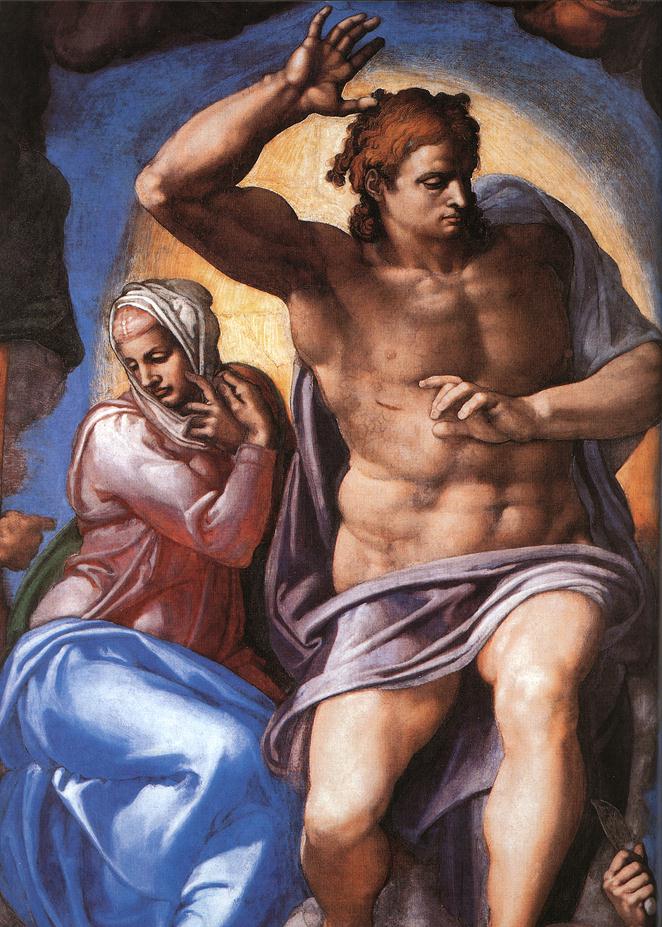 Usually we don’t like to know the end of the story. When someone blurts out the ending it’s called a “spoiler.” What fun is it to read a whodunit when you already know who done it?