Writing as I am on the Feast of Saint James, likely the first Apostle to be martyred, I’d like to ponder the kinds of sufferings the Apostles endured in order to announce the Gospel and win souls for Christ. In the “softer” Church of the declining West, it is hard for us even to imagine. How many Catholics today can barely rouse themselves to get to an hour-long Mass on Sunday? How many of us clergy will not risk so much as a raised eyebrow in order to speak the truth?
Yet all but one of the first Apostles suffered martyrdom as well as countless other sufferings before their lives were brutally ended. Arguably, 30 of the first 33 popes died as martyrs. Two others died in exile. Only one died in his bed.
We should never fail to thank God for the heroic ministry of the early Christians, clergy and laity alike, who risked everything to believe and to announce the Gospel. Having encountered Christ, they were so transfixed by His truth and His very person, that they could not remain silent. Even in the face of persecution and death, the Apostles declared, simply and forcefully, we cannot stop speaking about what we have seen and heard (Acts 4:20).
In tribute to them and to the early Church I want to present a kind of catalogue of the sufferings of St. Paul. Of him we know the most, but surely many others suffered as he did. As you read of what Paul endured, remember the many others as well, and when discomfited by a mere inconvenience or minor persecution, consider the price that others paid so that we could know Christ and be saved.
In this first passage, Paul’s sufferings were announced by God to Ananias:
• Acts 9:15-16 – For he is a chosen vessel of mine to bear My name before Gentiles, kings, and the children of Israel. I will show him how many things he must suffer for My name’s sake (Acts 9:15-16).
Here are some of Paul’s own descriptions of what he endured:
• 2 Corinthians 4:8-12 – We are perplexed, but not in despair; persecuted, but not forsaken; struck down, but not destroyed — always carrying about in the body the dying of the Lord Jesus, that the life of Jesus also may be manifested in our body. For we who live are always manifesting the death of Jesus’ sake, that the life of Jesus also may be manifested in our mortal flesh. So then death is working in us, but life in you. • 2 Corinthians 11:23-27 – … in labors more abundant, in stripes above measure, in prisons more frequently, in deaths often. From the Jews five times I received forty stripes minus one. Three times I was beaten with rods; once I was stoned; three times I was shipwrecked; a night and a day I have been in the deep; in journeys often, in perils of waters, in perils of robbers, in perils of my own countrymen, in perils of the Gentiles, in perils in the city, in perils in the wilderness, in perils in the sea, in perils among false brethren; in weariness and toil, in sleeplessness often, in hunger and thirst, in fasting often, in cold and nakedness—besides the other things, what comes upon me daily: my deep concern for all the churches. • 2 Corinthians 6:3-20 – … in much patience, in tribulations, in needs, in distresses, in stripes, in imprisonments, in tumults, in labors, in sleeplessness, in fasting; by purity, by knowledge, by longsuffering, by kindness, by the Holy Spirit, by sincere love, by the word of truth, by the power of God, by the armor of righteousness on the right hand and on the left, by honor and dishonor, by evil report and good report; as deceivers, and yet true; as unknown, and yet well known; as dying, and behold we live; as chastened, and yet not killed; as sorrowful, yet always rejoicing; as poor, yet making many rich; as having nothing, and yet possessing all things. • Galatians 5:11 – Why do I still suffer persecution? [For, if not] the offense of the cross has ceased. • 2 Corinthians 12:10 – Therefore I take pleasure in infirmities, in reproaches, in needs, in persecutions, in distresses, for Christ’s sake. For when I am weak, then I am strong. • 2 Timothy 3:10-11 – … my doctrine, my manner of life, purpose, faith, longsuffering, love, perseverance, persecutions, afflictions, which happened to me at Antioch, at Iconium, at Lystra—what persecutions I endured. And out of them all the Lord delivered me. • 1 Corinthians 15:30-32 – And why do we stand in jeopardy every hour? I affirm, by the boasting in you which I have in Christ Jesus our Lord, I die daily …. [Indeed] I have fought with beasts at Ephesus. • 2 Corinthians 12:7-10 – And lest I should be exalted above measure by the abundance of the revelations, a thorn in the flesh was given to me, a messenger of Satan to buffet me, lest I be exalted above measure. Concerning this thing I pleaded with the Lord three times that it might depart from me. And He said to me, “My grace is sufficient for you, for My strength is made perfect in weakness.” Therefore, most gladly I will rather boast in my infirmities, that the power of Christ may rest upon me. Therefore, I take pleasure in infirmities, in reproaches, in needs, in persecutions, in distresses, for Christ’s sake. For when I am weak, then I am strong. • Galatians 4:13 – You know that because of physical infirmity I preached the gospel to you at the first …. • Galatians 6:7 – From now on let no one trouble me, for I bear in my body the brandmarks of the Lord Jesus. • Romans 9:1-2 – I tell the truth in Christ, I am not lying, my conscience also bearing me witness in the Holy Spirit, that I have great sorrow and continual grief in my heart. • 2 Timothy 4:10-17 Demas, in love with this present world, has deserted me and gone to Thessalonica. Crescens has gone to Galatia, Titus to Dalmatia. Luke alone is with me …. Tychicus I have sent to Ephesus …. Alexander the coppersmith did me great harm; the Lord will repay him according to his deeds. Beware of him yourself, for he strongly opposed our message. At my first defense [in Jerusalem] no one came to stand by me, but all deserted me. May it not be charged against them! But the Lord stood by me and strengthened me, so that through me the message might be fully proclaimed and all the Gentiles might hear it. So I was rescued from the lion’s mouth. • 2 Timothy 4:6-8 – For I am already being poured out as a drink offering, and the time of my departure is at hand. I have fought the good fight, I have finished the race, I have kept the faith. Finally, there is laid up for me the crown of righteousness, which the Lord, the righteous Judge, will give to me on that Day, and not to me only but also to all who have longed for His appearing.
Death of St. Paul by Stefan Lochner
And lest we think that St. Paul may have exaggerated his sufferings, consider the following occurrences documented by Luke in the Acts of the Apostles:
• Acts 9:23 – Fellow Jews plot to kill him in Damascus, must be lowered in a basket from city walls to escape • Acts 9:29 – Hellenists seek to kill him in Jerusalem, must flee to Caesarea • Acts 13:15 – Persecuted and run out of Antioch in Pisidia • Acts 14:5 – Facing likely arrest and stoning at Iconium, flees to Lystra and Derbe • Acts 14:19 – Stoned, dragged out of Lystra and left for dead • Acts 15:11 – Opposed by elders and others in Jerusalem • Acts 16:23 – Arrested as a disturber of the peace, beaten with rods, and imprisoned at Philippi • Acts 16:39 – Ordered by Roman officials to leave Philippi • Acts 17:5-7, 10 – Attacked where he lodged in Thessalonica, must be secreted away to Beroea • Acts 17:13-15 – Forced out of Beroea, must flee to Athens • Acts 17:32 – Mocked in Athens for teaching about the resurrection • Acts 18:12 – Apprehended by fellow Jews and taken before the judgment seat of Gallio in Corinth • Acts 19:23-41 – Opposed by the silversmiths in Ephesus, who riot against him • Acts 20:3 – Plotted against by the Jews in Greece • Acts 21:27-30 – Apprehended by the mob in Jerusalem • Acts 22:24 – Arrested and detained by the Romans • Acts 22:24-29 – Barely escaped being scourged • Acts 23:1-10 – Rescued from the Sanhedrin and Pharisees during their violent uprising in Jerusalem • Acts 23:12-22 – Assassination plots made against him by fellow Jews, who swear an oath to find and kill him • Acts 23:33-27:2 – Two-year imprisonment in Caesarea • Acts 27:41-28:1 – Shipwrecked on the island of Malta • Acts 28:3-5 – Suffered a snakebite • Acts 28:16-31 – Imprisoned in the Rome
Paul was executed by decapitation ca. 68 A.D.
Never forget the price that others have paid in order that we may come to saving faith. Each Sunday, remember that the Creed was written in the blood of martyrs.
Warning: the following video graphically depicts the sufferings of the early martyrs in the arena:
One of the more difficult biblical themes to understand is that of God hardening the hearts and minds of certain people. The most memorable case is that of Pharaoh. Before sending Moses to him, God said that He would “harden Pharaoh’s heart” (Ex 4:21). There are other instances in which biblical texts speak of God hardening the hearts of sinners, even from among His own people.
Jesus hinted at such a theme in Matthew 13, when He said that He spoke in parables (here understood more as riddles) so as to affirm that the hearts of most people “outside the house” were hardened. He quotes Isaiah 6:9-10 as He does so. Jesus’ own apostles wondered why He spoke plainly only to them and a close company of disciples, but in riddle-like parables to the crowds outside. In His answer we are left to wonder if Jesus has not perchance written off the crowds and left them in the hardness of their hearts. To be fair, Jesus’ remark is ambiguous and open to interpretation.
What are we to make of texts like these which explicitly or implicitly speak of God hardening the hearts of people? How can God, who does no evil, be the source of a sinful mind or hard heart? Why would God do such a thing when Scripture also says this:
• As surely as I live, declares the Sovereign LORD, I take no pleasure in the death of the wicked, but rather that they turn from their ways and live. Turn! Turn from your evil ways! Why will you die, O house of Israel? (Ez 33:11)
• God our Savior … wants all men to be saved and to come to a knowledge of the truth (1 Tim 2:4).
To be sure, these questions involve very deep mysteries, about the interaction between God’s sovereignty and our freedom, about time, and about causality. The question of God hardening hearts cannot be resolved simply. Greater minds than mine have pondered these things and it would be foolish to think that an easy resolution will be found in a blog post.
Some distinctions can and should be made and some context supplied. We do not want to understand the “hardening texts” simplistically or in ways that use one truth to cancel out others that balance it.
I propose that we examine these texts along four lines:
The Context of Connivance
The Mystery of Time
The Mystery of Primary Causality
The Necessity of Humility
To begin, it is important simply to list some of the hardening texts. These will be referred to as we examine each of the four points above. The following are not the only hardening texts, but they provide a wide enough sample to use in our discussion:
• The LORD said to Moses, “When you return to Egypt, see that you perform before Pharaoh all the wonders I have given you the power to do. But I will harden his heart so that he will not let the people go” (Ex 4:21).
• Moses and Aaron performed all these wonders before Pharaoh, but the LORD hardened Pharaoh’s heart, and he would not let the Israelites go out of his country (Ex 11:10).
• Why, O LORD, do you make us wander from your ways and harden our hearts so we do not revere you? Return for the sake of your servants, the tribes that are your inheritance (Is 63:17).
• He [God] has blinded their eyes and deadened their hearts, so they can neither see with their eyes, nor understand with their hearts, nor turn–and I would heal them (Jesus quoting Isaiah 6:9-10, in John 12:40).
• They perish because they refused to love the truth and so be saved. For this reason, God sends them a powerful delusion so that they will believe the lie, so that all will be condemned who have not believed the truth but have delighted in wickedness (2 Thess 2:10-12).
• Therefore, God gave them over in the sinful desires of their hearts to sexual impurity for the degrading of their bodies with one another. … Furthermore, since they did not think it worthwhile to retain the knowledge of God, he gave them over to a depraved mind, to do what ought not to be done (Rom 1:24, 28).
Point I: The Context of Connivance – In properly assessing texts like these we should first consider the contexts in which they were made and written. Generally speaking, most of these declarations that God hardens the heart come after a significant period of disobedience on the part of those whose hearts were hardened. In a way, God “cements the deal” and gives them what they really want. Seeing that they have hardened their own hearts to Him, God determines that their disposition is to be a permanent one. In a sovereign exercise of His will (for nothing can happen without God’s allowance), He declares and permits their hearts to be hardened in a definitive kind of way. In this sense there is a judgment of God upon the individual that recognizes the person’s definitive decision against Him. Hence this hardening can be understood as voluntary on the part of the one hardened, for God hardens in such a way that He uses the person’s own will for the executing of His judgment. God accepts that the individual’s will against Him is definitive.
In the case of Pharaoh, although God indicated to Moses that He would harden Pharaoh’s heart, the actual working out of this is a bit more complicated. We see in the first five plagues that it is Pharaoh who hardens his own heart (Ex 7:13; 7:22; 8:11; 8:28; 9:7). It is only after this repeated hardening by Pharaoh of his own heart that the Exodus text speaks of God as the one who hardens (Ex 9:12; 9:34; 10:1; 10:20; 10:27). Hence the hardening here is not without Pharaoh’s repeated demonstration of his own hardness. God does this as a kind of sovereign judgment on Pharaoh.
The Isaiah texts (many in number) that speak of a hardening being visited upon Israel by God (e.g., #3 and #4 above) are also the culmination of a long testimony by Isaiah of Israel’s hardness. At the beginning of Isaiah’s ministry, God describes (through Isaiah) Israel’s hardness as being of their own doing: For the LORD has spoken: “I reared children and brought them up, but they have rebelled against me. The ox knows his master, the donkey his owner’s manger, but Israel does not know, my people do not understand.” Ah, sinful nation, a people loaded with guilt, a brood of evildoers, children given to corruption! They have forsaken the LORD; they have spurned the Holy One of Israel and turned their backs on him (Is 1:2-4). There follows a long list of their crimes, their hardness, and their refusal to repent.
St. John Chrysostom: Of the numerous texts later in Isaiah (and also referenced by Jesus (e.g., Jn 12:40)) that speak of Israel as being hardened by God (and having their eyes shut by Him), St. John Chrysostom wrote, That the saying of Isaiah might be fulfilled: that here is expressive not of the cause, but of the event. They did not disbelieve because Isaiah said they would; but because they would disbelieve, Isaiah said they would … For He does not leave us, except we wish Him … Whereby it is plain that we begin to forsake first, and are the cause of our own perdition. For as it is not the fault of the sun, that it hurts weak eyes, so neither is God to blame for punishing those who do not attend to His words (on a gloss of Is. 6:9-10 at Jn 12:40, quoted in the Catena Aurea).
St Augustine: This is not said to be the devil’s doing, but God’s. Yet if any ask why they could not believe, I answer, because they would not … But the Prophet, you say, mentions another cause, not their will; but that God had blinded their eyes, and hardened their heart. But I answer, that they well deserved this. For God hardens and blinds a man, by forsaking and not supporting him; and this He makes by a secret sentence, for by an unjust one He cannot (quoted in the Catena Aurea at Jn 12:40).
In the passage from 2 Thessalonians, while the text speaks of God as having sent the delusion, the verses before and after make clear the sinful role of the punished.
Of this text St. Augustine wrote,From a hidden judgment of God comes perversity of heart, so that the refusal to hear the truth leads to the commission of sin, and this sin is itself a punishment for the preceding sin [of refusing to hear the truth] (Against Julian 5.3.12).
St. John Damascus:[God does this] so that all may be condemned who did not believe the truth but had pleasure in unrighteousness (The Orthodox Faith 4.26).
The passages from Romans speak of God handing them over only after they have suppressed the truth (1:18), persevered in their wickedness (1:18), and preferred idolatry (1:23). Hence, as a just judgment, God hands them over to sexual confusion (homosexuality) and countless other destructive drives. So although it is said that God hands them over, it is really not that simple. They do not want to serve Him and so He, knowing their definitive decision, gives them what they want.
Thus our first point of distinction in understanding the hardening texts is that the context of connivance is important in assessing them. Scripture does not assert that God takes a reasonably righteous man and, out of the blue, hardens his heart, confuses his mind, or causes him (against his will) to become obstinate. The texts are usually presented as a kind of prevenient judgment by God, that the state of the person’s hardness has now become permanent. They refuse and so God “causes” them to walk in their own sinful ways since they have insisted on doing so.
Point II: The Mystery of Time – In understanding these hardening texts (which we have seen are akin to judgment texts) we must recall that God does not live in time in the same way that we do. Scripture speaks often of God’s knowledge and vision of time as being comprehensive rather than speculative or serial (e.g., Ex 3:14; Ps 90:2-4; Ps 93:2; Is 43:13; Ps 139; 2 Peter 3:8; James 1:17).
To say that God is eternal and lives in eternity is to say that He lives in the fullness of time. For God, past, present, and future are all the same. God is not wondering what I will do tomorrow; neither is He waiting for it to happen. For Him, my tomorrow has always been present. All of my days were written in His book before one of them ever came to be (Ps 139:16). Whether and how long I live has always been known to Him. Before He ever formed me in my mother’s womb He knew me (Jer 1:4). My final destiny is already known and present to Him.
Hence, when we strive to understand God’s judgments in the form of hardening the hearts of certain people, we must be careful not to think He lives in time the way we do. It is not as though God is watching my life like a movie. He already knows the choices I will make. Thus, when God hardens the hearts of some, it is not as though He is trying to negatively influence the outcome and trip certain people up. He already knows the outcome and has always known it; He knows the destiny that they have chosen.
Be very careful with this insight, for it is a mystery to us. We cannot really know what it is like to live in eternity, in the fullness of time, where the future is just as present as the past. Even if you think you know, you really don’t. What is essential for us to realize is that God does not live in time the way we do. If we try too hard to solve the mystery (rather than merely accepting and respecting it) we risk falling into the denial of human freedom, double predestination, or other misguided notions that sacrifice one truth for another rather than holding them in balance. That God knows what I will do tomorrow does not destroy my freedom to actually do it. How this all works out is mysterious, but we are free and God holds us accountable for our choices. Further, even though God knows our destiny already, this does not mean that He is revealing anything about that to us, so that we should look for signs and seek to call ourselves saved or lost. We ought to work out our salvation in reverential fear and trembling (Phil 2:12).
The key point here is mystery. How, why, and when God hardens the heart of anyone is caught up in the mysterious fact that He lives outside of time and knows all things before they happen. Thus He acts with comprehensive knowledge of all outcomes.
Point III: The Mystery of Causality – One of the major differences between the ancient and the modern world is that the ancient world was much more comfortable dealing with something known as primary causality.
Up until the Renaissance, God was at the center of all things and people instinctively saw the hand of God in everything, even terrible things. Job said, The LORD gave and the LORD has taken away; may the name of the LORD be praised … if we have received good things at the hand of God, why should we not receive evil? (Job 1:21; 2:10) The ancients would commonly attribute everything as coming from the hand of God, for He was the first cause of everything that happened. This is what is meant by primary causality. The ancients were thus much more comfortable attributing things to God, even things that we are not. In speaking like this, they were not engaging in superstitious or primitive thinking; rather, they were emphasizing that God was sovereign, omnipotent, and omnipresent, and that nothing happened apart from His sovereign will. God is the primary cause of all that is.
Of this ancient and scriptural way of thinking the Catechism says, And so we see the Holy Spirit, the principal author of Sacred Scripture, often attributing actions to God without mentioning any secondary causes [e.g., human or natural]. This is not a “primitive mode of speech,” but a profound way of recalling God’s primacy and absolute Lordship over history and the world, and so of educating his people to trust in him (CCC # 304).
The key point here is understanding that the ancient biblical texts, while often speaking of God as hardening the hearts of sinners, did not mean to say that man had no role, no responsibility. Neither did the texts mean to say that God acted in a merely arbitrary way. Rather, the emphasis was on God’s sovereign power as the first cause of all that is. Hence, He is often called the cause of all things and His hand is seen in everything. We moderns are uncomfortable speaking in this way.
After the Renaissance, man moved himself to the center and God was gradually relegated to the periphery. Man’s manner of thinking and speaking began to shift to secondary causes (causes related to man and nature). If something happens we look to natural causes, or in human situations, to the humans who caused it. These are secondary causes because I cannot cause something to happen unless God causes me. Yet increasingly the modern mind struggles to maintain a balance between the two mysteries: our freedom and responsibility, and God’s sovereignty and omnipotence.
In effect primary causality has largely been thrown overboard as a category. Even modern believers unconsciously do this and thus exhibit three related issues:
1. We fail to maintain the proper balance between two mysteries: God’s sovereignty and our freedom.
2. We exhibit shock at things like the “hardening texts” of the Bible because we understand them poorly.
3. We try to resolve the shock by favoring one truth over the other. Maybe we just brush aside the ancient biblical texts as a “primitive mode of speech,” inappropriately concluding that God didn’t have anything to do with this or that. Or we go to the other extreme and become fatalistic, denying human freedom, denying secondary causality (our part), and accusing God of everything (as if He were the only cause and shouldered the sole blame for everything). We either read the hardening texts with a clumsy literalism or we dismiss them as misguided notions from an immature, primitive, pre-scientific age.
The point here is that we have to balance the mysteries of primary and secondary causality. We cannot fully understand how they interrelate, but they do. Both mysteries need to be held. The ancients were more sophisticated than we are in holding these mysteries in the proper balance. We handle causality very clumsily and do not appreciate the distinctions between primary causality (God’s part) and secondary causality (our own and nature’s part). We try to resolve the mystery rather than holding it in balance and speaking to both realities. In doing so, we become poor interpreters of the hardening texts.
Point IV: The Necessity of Humility – By now it is clear that we are dealing with the mysterious interrelationship between God and Man, between God’s sovereignty and our freedom, between primary and secondary causality. In the face of such mysteries we have to be very humble. We ought not to think more of the details than is proper, because they are largely hidden from us. Too many moderns either dismiss the hardening texts or accept them and then sit in harsh judgment over God (as if we could do such a thing). Neither approach bespeaks humility. Consider a shocking but very humbling text in which Paul warns us in this very matter:
What then shall we say? Is God unjust? Not at all! For he says to Moses, “I will have mercy on whom I have mercy, and I will have compassion on whom I have compassion.” It does not, therefore, depend on man’s desire or effort, but on God’s mercy. For the Scripture says to Pharaoh: “I raised you up for this very purpose, that I might display my power in you and that my name might be proclaimed in all the earth.” Therefore, God has mercy on whom he wants to have mercy, and he hardens whom he wants to harden. One of you will say to me: “Then why does God still blame us? For who resists his will?” But who are you, O man, to talk back to God? “Shall what is formed say to him who formed it, ‘Why did you make me like this?’” (Romans 9:14-20)
None of us can demand an absolute account from God for what He does. Even if He were to tell us, could our small and worldly minds ever really comprehend it? My thoughts are not your thoughts, and my ways are not your ways, says the Lord (Is 55:8).
SUMMARY – In this (rather too long) post, we have considered the “hardening texts,” in which it seems that God hardens the hearts of certain people and groups—and so He does. But texts like these must be approached carefully, humbly, and with proper understanding of the scriptural and historical context. At work here are profound mysteries: God’s sovereignty, our freedom, His mercy, and His justice.
We should be careful to admit the limits of our knowledge when it comes to such texts. As the Catechism so beautifully states, when it comes to texts like these they are to be appreciated as a profound way of recalling God’s primacy and absolute Lordship over history and the world, and so of educating his people to trust in him (CCC # 304). This song says, “Be not angry any longer Lord and no more remember our iniquities. Behold and regard us; we are all your people!
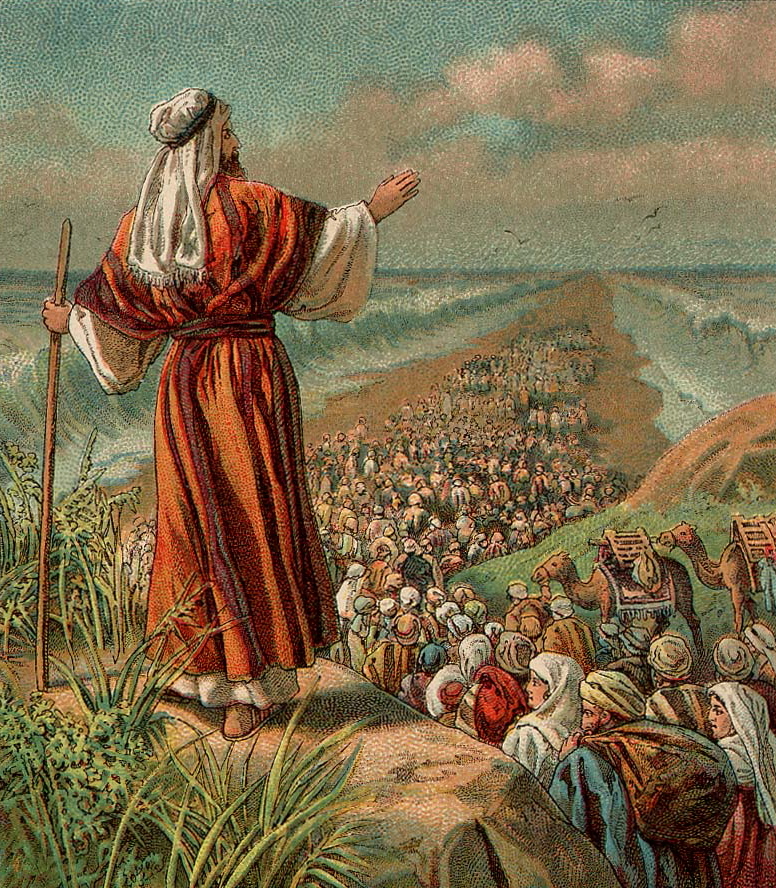
In daily Masses this week we are reading largely from the Book of Exodus, specifically the familiar story of the parting of the Red Sea by God, working through Moses. Unfortunately, Tuesday’s Feast of the St. James, good though it is, interrupts the story and we miss the critical passage in which the water is parted and the people of Israel escape through the sea, dry-shod.
Let’s review the passage:
Then Moses stretched out his hand over the sea, and the LORD drove the sea back by a strong east wind all night and made the sea dry land, and the waters were divided. And the people of Israel went into the midst of the sea on dry ground, the waters being a wall to them on their right hand and on their left (Exodus 14:21-22).
When a story is so familiar to us it is easy to overlook the details. Note that the sea is standing up like a wall on both sides. Though the height is not mentioned, let’s just imagine that the walls of water are thirty feet high.
Imagine the courage of the people entering into the midst of sea while the water is being miraculously held back! If you saw walls of water like that, would you have ventured out into the middle? While it may have “helped” that they had an army pursing them from behind, do not minimize the fear they must have felt and the courage and trust it took for them to go forward in faith.
St. Paul would later say that the passage through the Red Sea is an image of baptism: They were all baptized into Moses (1 Cor 10:2). Note how faith and baptism are joined. Though the Sacrament of Baptism confers the theological virtue of faith, there is (at least in adult baptism) a kind of prevenient faith wherein one is prompted to trust God and what He has revealed. In receiving people into the faith, I have been amazed by the courage shown by many of them. There have been those who faced the dismay of and even persecution by their family members. Others overcame personal obstacles, doubts, and uncertainties. They stepped forth in faith and went through the waters.
Even after baptism, all of us are asked to continue living its implications. The increasing scorn and derision of our faith and the teachings of our Lord by the world may seem like walls of water that we must, in trust, ignore. We must continue in the renewal of our baptismal promises and journey through to the other side. We must also journey, trusting the Lord’s promise to deliver us from the pursuing army of the prince of this world.
Yes, living our baptism requires courage.
You might object to my calling the people of Israel courageous, saying that the Egyptian army also pushed forward into the middle of the parted walls of water. Yes, but their doing so was not the result of courage. Rather, it was the excess of courage we call rashness, folly, or foolhardiness. Why? Because they did not have the promises of God. It is virtuous to step out in faith, trusting the promises of God, but prideful to go forth trusting in one’s own strength. The prideful cannot stand before God, only the humble can.
The Egyptians pursued and went in after them into the midst of the sea, all Pharaoh’s horses, his chariots, and his horsemen. And in the morning watch the LORD in the pillar of fire and of cloud looked down on the Egyptian forces and cast a glance and threw the Egyptian forces into a panic, clogging their chariot wheels so that they drove heavily. And the Egyptians said, “Let us flee from before Israel, for the LORD fights for them against the Egyptians” (Exodus 14:23-25).
Faith delivers. Pride brings only destruction. A simple glance from the Lord destroys pride and all its foolish dreams.
We live in difficult times for the Church; from many sectors the very legitimate cry for reform goes up frequently. Beyond the sexual abuse scandal there are also deep concerns regarding the uncertain trumpet of Catholic preaching, lukewarm and nominal Catholics, an overall lack of self-discipline among Catholics, and a lack of disciplining by the bishops and clergy of those Catholics (lay and clergy) who cause scandal. The list of concerns is long, and in general I have been sympathetic on this blog to the need for reform and greater zeal in the Church.
The Gospel this Sunday, however, featuring the Parable of the Wheat and Tares, cautions against overzealousness in the attempt to root out sin and sinners from the Church. The Lord’s warning to the farmhands who wanted to tear out the weeds was that they might harm the wheat as well. He wants them to wait until the harvest. There will come a day of reckoning, but it is not now.
This does not mean that we are never to take notice of sin or to rebuke a sinner. There is certainly the need for discipline in the Church; other texts call for it as well. But today’s Gospel is meant to warn against a scouring that is too thorough, a puritanical clean sweep that overrules God’s patience and seeks to turn the Church from a hospital for sinners into a germ-free (and hence people-free) zone.
We are going to need to depend on God’s patience and mercy if any of us are to stand a chance. People who summon the wrath of God upon (other) sinners may end up destroying themselves as well. We all have a journey to make from being an “ain’t” to being a saint.
Let’s allow today’s Gospel to give us some guidance in finding the right balance between the summons to reform and the summons to patience. The guidance comes in four steps.
I. WAKE UP.Jesus proposed another parable to the crowds, saying: “The kingdom of heaven may be likened to a man who sowed good seed in his field. While everyone was asleep his enemy came and sowed weeds all through the wheat, and then went off.”
Notice that everyone was sleeping when the enemy sowed weeds. It is a great mystery as to why God allowed Satan to do this in the first place, but there is far less mystery as to why Satan has been so successful in our times. The weeds are numerous and are vigorously growing. Part of the reason for this is that we in the Church have been sleeping while Satan has been steadily sowing his weeds among us.
Don’t just blame the Church leadership (although we certainly share plenty of the blame). Many throughout the Church have been in a deep moral slumber. Too many Catholics will watch anything, listen to anything, and expose themselves to anything. We just “go with the flow,” living unreflective, sleepy lives. We also allow our children to be exposed to almost anything. Too many parents don’t know enough about what their children are doing: what they watch, what they listen to, where they are surfing on the Internet, and who their friends are. We rarely think of God or His plan for our lives. On the whole, our priorities are more worldly than spiritual. We are not awake and wary of sin and its incursions; we are not outraged. We take little action other than to shrug. We seem to be more concerned with fitting in than in living as a sign of contradiction to the ways of the world.
Church leadership, too, has been inwardly focused. While the culture was melting down beginning in the late 1960s, we were tuning guitars, moving the furniture in the sanctuaries, debating about Church authority, engaging in gender wars, and having seemingly endless internal squabbles about every facet of Church life. I do not deny that there were right and wrong answers in these debates and that rebellious trends had to be addressed, but while all this was going on Satan was sowing seeds and we lost the culture.
We are just now emerging from 50 years in a cocoon to find a world gone mad. We who lead the Church (clergy and lay) have to admit that this happened on our watch.
It is long past time to wake up to the reality that Satan has been working while we’ve been bickering and singing songs to ourselves.
Blaming one side of the Church or the other, faulting this kind of liturgy or that, is not very helpful because the focus is still inward.
It’s time to wake up and go out. There is work to be done in reclaiming the culture for Christ and in re-proposing the Gospel to a world that has lost it.
Step one in finding a balance between the need for reform and the need for patience is to wake up.
II. WISE UP.When the crop grew and bore fruit, the weeds appeared as well. The slaves of the householder came to him and said, “Master, did you not sow good seed in your field? Where have the weeds come from?” He answered, “An enemy has done this.”
Part of the sobriety we have to regain is the understanding that we have an enemy who hates us—Satan. He is responsible for much of the spiritual, moral, and even physical ruin we see around us. We have been dismissive of his presence for far too long, as though he were a fairy tale. While we cannot blame everything on him, for we connive with him and also suffer from weakness of the flesh and susceptibility to the bad influence of the world, Satan is real; he is an enemy and he hates us. He hates our children. He hates the Church. He hates anything and anyone holy or even on the path to holiness.
We have to wise up and ask the Lord for an anointing. We need not utterly fear the devil, but we do need to understand that he is at work. We need to learn his moves, designs, tactics, and tools. Once we can recognize him, we need the grace to rebuke him at every turn.
Now be careful here. To wise up means to learn and understand Satan’s tactics, but it does not mean to imitate them in retaliation. Upon waking up and wising up, some want to go right to battle—but in worldly ways. The Lord often proposes paradoxical tactics that are rooted in the wisdom of the cross, not the world. Wising up to Satan and his tactics does not typically mean to engage in a full frontal assault. Often the Lord counsels humility to battle against pride, love to conquer hate, and accepted weakness to overcome strength.
To wise up means to come to the wisdom of the cross, not the world. The Lord is not nearly as warlike in His response to His enemy as some reformers propose to be. It is fine to be appropriately zealous for reform and to want to usher in change rapidly, but be very careful what wisdom you are appealing to. Scripture says, Do not deceive yourselves. If any one of you thinks he is wise by the standards of this age, he should become a “fool” so that he may become wise. For the wisdom of this world is foolishness in God’s sight (1 Cor 3:19-20).
Step two in a finding a balance between the need for reform and the need for patience is to wise up.
III. WAIT UP. His slaves said to him, “Do you want us to go and pull them up?” He replied, “No, if you pull up the weeds you might uproot the wheat along with them. Let them grow together until harvest …”
We have already laid the groundwork for the Lord’s rebuke to these overly zealous reformers. Today in the Church we are well aware of the need for reform; so is the Lord. He says, clearly, an enemy has done this. Yet to those who want to go through the Church rooting out every sinner, ne’er-do-well, and bad theologian (and there are many), and who call for a severe clampdown by bishops across the board, the Lord presents a balancing notion.
There is need for discipline in the Church and even for punitive measures from time to time. The Lord himself proposes excommunication in certain instances (e.g., Matt 18:17); St Paul does, too (e.g., 1 Cor 5:5). Yet these texts need to be balanced by texts such as today’s Gospel. Fraternal correction is an essential work of charity but it must be conducted with patience and love.
The Lord is patient. In today’s Gospel, He directs us to be prepared to wait, and to not be overly anxious to pull out weeds lest we harm the wheat. Remarkably, the Lord says, let them grow together. Notice that now is the time to grow; the harvest comes later. In certain (rare) instances the harm may be so egregious that the Church must act to remove the sinner or to discipline him or her more severely, but there is also a place for waiting and allowing the wheat and tares to grow together. After all, sinners may repent; the Lord wants to give people the time they need to do that. Scripture says, God’s patience is directed to our salvation (2 Peter 3:9).
So while there is sometimes a need for strong discipline in the Church, there is also this directive to balance such notions. Leave it be; wait. Place this in the hands of God. Give the sinner time to repent. Keep working and praying for that but do not act precipitously.
We have had many discussions here on the blog about whether and how bishops should discipline Catholic politicians who, by their bad example and reprehensible voting patterns, undermine the Gospel and even cost lives through their support of abortion and euthanasia.
While I am sympathetic to the need for them to be disciplined, it remains a judgment for the bishop to make as to who, how, and when.
There are Scriptures that balance one another. In the end, we cannot simply make a one-size-fits-all norm. There are prudential aspects to the decision and the Lord Himself speaks to different situations in different ways.
In today’s Gospel the Lord says that we should wait. Generally, this is good advice to follow. After all, how do we know that we don’t or won’t need more time? Before we ask God to lower the boom on sinners we ought to remember that we are going to need His patience and mercy too. Scripture says, The measure that you measure to others will be measured back to you (Matt 7:2; Luke 6:38). Be very careful before summoning God’s wrath, for who may endure the Day of his coming? (Mal 3:2)
Step three in a finding a balance between the need for reform and the need for patience is to “wait up” and balance zeal with patience.
IV. WASH UP.Then at harvest time I will say to the harvesters, “First collect the weeds and tie them in bundles for burning; but gather the wheat into my barn.”
So you see there is a harvest. Those who have sinned or led others to sin, and have not repented, are going to have to answer to the Lord for it.
The Lord is no pushover; He does not make light of sin. In telling us to wait, He does not mean to say that judgment will never come, but His general advice is to leave it to Him. To us He says, in effect, “As for you, wash up, get ready, and help others to get ready as well. Judgment day is surely coming and every knee will bend to me; everyone will have to render an account.”
That’s it. Wash up! You’re either going to be a saint or an “ain’t.” For now, the wheat and tares grow together. But later the tares and all the weeds will be gathered and cast into the fire.
Step four in a finding a balance between the need for reform and the need for patience is to “wash up,” to get ready.
So here’s the balance: God is patient, but there is ultimately a harvest. By God’s grace we have to get ready for it. To the overly zealous God says, “Wait,” but to the complacent He says, “Wake up, wise up, and wash up.”
Here is a great exposition on this Gospel by Fr. Francis Martin. Don’t miss it!
The commercial below from 1949 seems astonishing to us today. We often look back on the days when just about everyone smoked and wonder how we could have been so foolish as to fill our lungs with smoke. That a commercial should actually feature doctors smoking and report that they prefer a particular brand of cigarette (filter-less at that) seems unbelievable.
It took decades to dispel the image of cigarette smoking as glamorous. It took just as long to put to the lie the notion that filling our lungs with toxic smoke wasn’t as unhealthy as, deep down, we suspected it to be.
Am I wrong to hope that we will one day look back on abortion and contraception in this way? Perhaps we will wonder how women could ever have been convinced to swallow pills that would drastically alter their endocrine system, that we ever thought there would be no ill health effects from such a measure.
Even more, I hope for the day when we will be utterly dumbfounded that the legal murder of babies in the womb was ever considered “good,” or a “right,” or labeled “healthcare.”
Call me a dreamer, but I will continue to hope and work for the day when we will be even more astonished at our hardness and obtuseness with respect to abortion and contraception than we are by this old commercial promoting smoking.
One of the more underreported sins is greed. It is easy to conclude that greed is something manifested by “that other person,” who has more than I do. Yes, that rich guy over there, the one who earns a dollar more per hour than I do; he’s greedy, but I’m not.
But honestly, does any one of us ever come to a point in our life when we say, “I earn more than enough money. I’ll just give the rest away”? Not on your life!
Almost never would such a thought even occur to the average person. Instead, most of us respond to a pay increase, for example, by expanding our lifestyle and continuing to complain that we don’t have enough. At some point, we ought to admit that we do cross over into greed.
What is greed? It is the insatiable desire for more. It is a deep drive in us that, no matter how much we have, makes us think that it’s not enough. We still want more, and if we get more we want more still. This is the experience of greed.
Familiar though this sounds, too few of us are willing to consider that greed is really a problem for us. Greed is always something that other guy has.
Of course it doesn’t help that we live in a culture of consumption, which constantly tells us that we don’t have enough. Commercials tell us that the car we’re driving isn’t as good as this other car we could be driving. And so even though we have a perfectly good car, one with four wheels, a working engine, and probably even air conditioning, it still it isn’t good enough. So it is with almost every other product or amenity that is sold to us on a daily basis. The clever marketing experts of Madison Avenue are great at making us feel deprived. As a result, it almost never occurs to most of us that we may have crossed the line into greed. Despite having even six- and seven-figure incomes, many still feel that they don’t have enough.
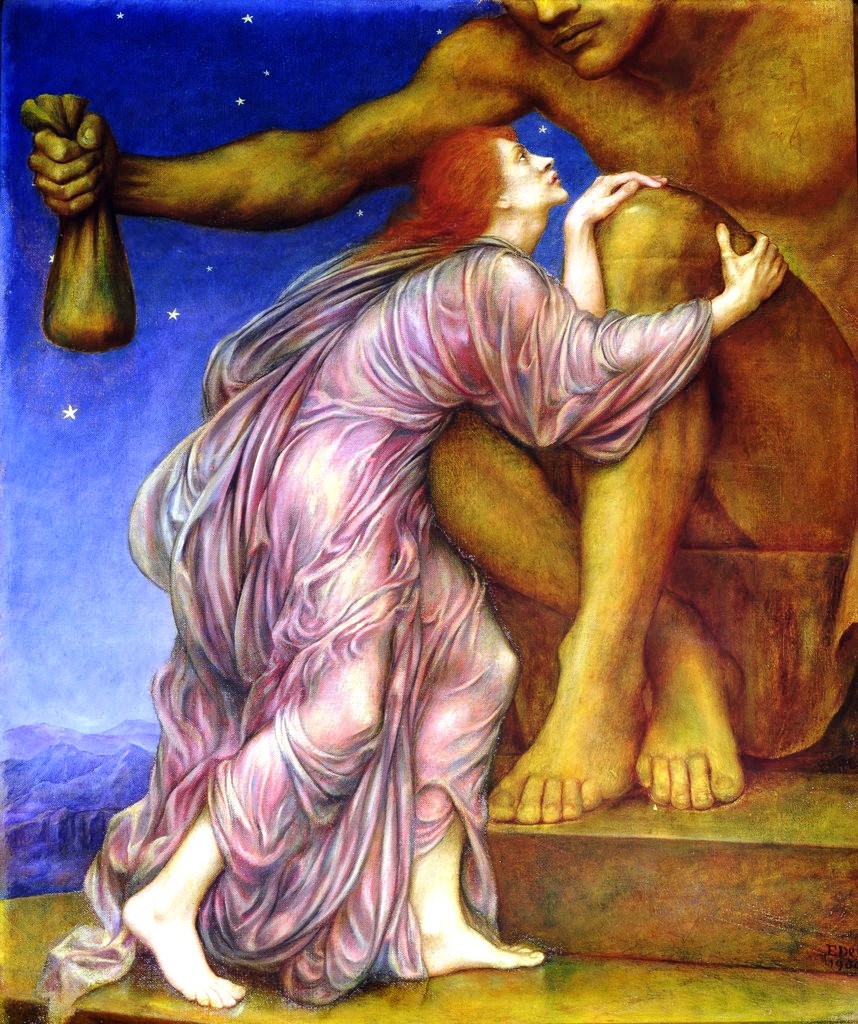
This is all the more reason that we should spend some time reflecting on the nature of greed. Greed is a deep drive of sin, one of the deadly sins, and it brings with it a kind of blindness that causes us to mistake mere wants for true needs. As we entertain this illusion, there’s very little to prompt us to consider that we actually have more than enough. There’s very little to cause me to say, “Gee, I’ve gotten greedy” or to work toward curbing this insatiable desire for more.
No, it’s the other guy who’s greedy; I’m not. It’s a problem that those nasty rich and powerful people have. Never mind that I’m pretty darned rich myself, living in a home with running water, air conditioning, and maybe even luxuries like granite countertops and widescreen TVs.
When was the last time you heard a sermon on greed? If you did, it was probably the priest talking about some abstract group of people (not those present, of course) who probably also hold the “wrong” political opinions, etc. Yes, greed is always someone else’s problem.
When do I honestly look at myselfand wonder if I am greedy? When do I ever conclude that I have more than enough and need to be more generous with what has become excessive in my life? When do I ever apply the old precept that if I have two coats, one of them belongs to the poor? I do understand that it’s good to have something laid up for a rainy day, but do I ever ask myself if I’m really trusting in God or just in my rainy day fund? When do I ever wonder if I’ve crossed the line into greed?
I realize that some of you who read this post will find it disturbing. So do I. These are uncomfortable questions.
Let me assure you that I do not write this post from a political perspective. I do not want the government mandating how much I can or should earn, and how much I can or should give away. I am referring to a very personal moral assessment that we all should make.
I also do not write as an economist. I realize that market-based economies are complex and that there is nothing intrinsically wrong with meeting people’s needs with products and services. I am also aware that markets supply jobs. But still, I must insist that we all ask ourselves some personal questions about limits. We cannot simply conclude that greed is the other guy’s problem.
Greed is one of the seven deadly sins; we ought to take it more seriously than many of us do. Somewhere there’s room for most of us to reflect on one of the most underreported sins: greed.
In this week’s Office of Readings comes a crucial question from Elijah. It came at a time of widespread apostasy among the Jewish people. Elijah summoned a multitude to Mt. Carmel in the far north of Israel:
Elijah appealed to all the people and said, “How long will you straddle the issue? If the Lord is God, follow him; if Baal, follow him.” The people, however, did not answer him (1 Kings 18:21).
The Baals were the gods of the Canaanites. It had become expedient and popular to worship them because the ruling political leaders, the apostate King Ahab and his wicked wife Jezebel, had set forth the worship of the Baals by erecting altars and sacred columns. All who wished their life to go well and to have access to the levers of prosperity were surely “encouraged” to comply. Jezebel funded hundreds of prophets of Baal and the goddess Asherah. She also had many of the prophets of Israel killed and forced others into hiding. Through a policy of favoritism and fear, the true faith was being suppressed and false ideologies were being promoted.
At a critical moment Elijah thus asked his question. In effect he told them that they needed to decide whether to serve the Lord God out of courageous fidelity or the Baals out of cowardly fear.
We, too, must decide. In our times, the true faith has been undermined in the hearts of many by plausible liars, cultural war, and political correctness. Those who strive to hold to the true faith are called hateful, bigoted, and intolerant. A legal framework is growing that seeks to compel compliance to the moral revolution and abandonment of the biblical worldview. Social pressures are at work as well, seeking to force compliance through political correctness, through suppression of speech and ideas, and through the influence of music, cinema, and art.
The same question must be asked of us:
How long will you straddle the issue? If the Lord is God, follow him (whatever the cost). If Baal is your god, follow him! If you prefer what is popular, trendy, politically correct, and safe, go for it. But understand that if you do so, your decision is increasingly for Baal, not the Lord. In a culture that insists you celebrate fornication, homosexual acts, transgenderism, abortion, euthanasia, and all sorts of intemperance, realize that your decision to comply amounts to a choice for Baal.
Some claim that they are not really making a fundamental choice against God and for the modern Baals. Rather, they prefer to think that they are being “tolerant,” that they are pleasant moderates seeking to build bridges and keep the faith “mainstream.”
Today the lines are starkly drawn. The choices required of us are clear. The ancient maxim has never been more true: tertium non datur (no third way is given). Jesus says, You cannot serve God and mammon (Mat 6:24). James adds, Adulterers! Do you not realize that a friendship with the world is enmity at God? (James 4:4) Elijah’s question cannot be watered down. There are two sides in the moral battle of our times: choose a side.
In Elijah’s time, the people did not want to answer. The text says that they just stood there, silent. But silence does not make the question or the choice go away. Indeed, prolonged silence to so fundamental a question becomes an answer in itself. Silence and fence-sitting are not valid answers when the lines are so clearly drawn.
To the fence-sitters is directed this warning in the form of an old story:
A man once refused to take sides in the critical and disputed matters of his day, nobly declaring that he was tolerant of all views. Taking his seat on the fence he congratulated himself for his moderation and openness; others did too. One day the devil came and said, “Come along now, you’re with me.” The man protested, “I don’t belong to you. I’m on the fence!” The devil simply replied: “Oh, but you do belong to me. I own the fence.”
“How long will you straddle the issue? If the Lord is God, follow him; if Baal, follow him.”
One of the many troublesome aspects of the modern age is the demise of friendship. While the terms “friend” and “friendship” might be bandied about rather easily today, they do not usually mean friendship in its deeper and original sense. Rather, we use the terms to refer to acquaintances rather than friends. True friendship has a depth, history, and stability. It involves some sort of commonality of life and a deeper knowledge of the other.
Fr. Reginald Garrigou-Lagrange, drawing on the Thomistic tradition, has this to say about friendship:
Every true friendship, St Thomas tells us, implies three qualities: it is first of all the love of benevolence. By which a man wishes good to another as to himself … [Further] Every true friendship presupposes the love of mutual benevolence, for it is not sufficient that it exist on the part of one person only …. Lastly … friendship requires a community of life (convivere). It implies that people know each other, love each other, live together, spiritually at least, by the exchange of most secret thoughts and feelings. Friendship thus conceived tends to a very close union of thought, feeling, willing, prayer, and action (Garrigou-Lagrange, The Three Ages of the Spiritual Life, Vol II, pp. 188-189 Tan Publications).
Notice the emphasis on sharing private thoughts and feelings, as well as the close union of thoughts, feelings, actions, prayers, and wills. True friendship involves more than the knowledge of acquaintances.
A director of a clinic for the treatment of psychological matters once recounted that as he conducted entrance interviews for those beginning an inpatient treatment program, he would ask them how many friends they had. He would often receive expressive answers such as “Oh, I have lots of friends!” Their answers indicated that they did not really understand what he meant. So he would rephrase the question: “How many people do you share deeply with? How many people on this planet know almost everything about you? How many know that you’re here at this treatment program and why? Did any of them help to get you here?” Questions like these tended to generate blank stares.
Fewer and fewer people have relationships of this deeper nature. True friendships, with all the qualities described above, are increasingly rare in our culture today.
There are many reasons for this.
People today are quite mobile. It is not unusual for people to move several times during their lifetime. Fewer and fewer people grow up, live, and die in the same town, and even those who do have long roots in a certain community will tell you how dramatically it has changed over the years.
Our daily activity takes us far and wide. Because of the automobile, trains, and especially planes, many people no longer limit their activities to their home town or places nearby. They may commute a couple of hours each day and be involved in activities far away from their neighborhood churches, schools, doctors, and hospitals. They may not even frequent the neighborhood shopping centers. It seems there is little opportunity or need to interact with people who live close by.
The pace of life today is rapid. We all seem to be in a big hurry to get somewhere else. The idea of lingering over a cup of coffee seems rare. The few times we do take our time to converse and such things, it is usually in loud bars where communication is actually quite difficult. And if perchance we are in a setting where we are in the presence of others for a lengthy period (e.g., a subway, train, or plane) most people are focused on their cell phones. We seem more interested in information about people far away, many of whom we have never even met.
None of these factors helps in the development of deep, lasting friendships. Most people in our lives are merely acquaintances. We know very little about most of the people we interact with, even those we encounter on a daily basis. Even family relationships are often shallow. Long dinners or extended conversations are rare as family members run off to practices, meetings, shopping, and work.
The lack of deep friendships in the true sense of the word causes many issues. True friends help form our personalities, completing what we lack. True friends rebuke sins and other troublesome quirks we can develop. True friends encourage and enrich us. Without true friends we remain incomplete. Without the necessary rebuke that friends can give, we can suffer from pride and other egotistical character defects.
Scripture both commends friendship and warns against regarding mere acquaintances as friends.
Woe to the solitary man! For if he should fall, he has no one to lift him up (Ecclesiastes 4:11).
Let your acquaintances be many, but your advisers one in a thousand (Sirach 6:5-6).
A faithful friend is a sure shelter, whoever finds one has found a rare treasure. A faithful friend is something beyond price, there is no measuring his worth. A faithful friend is the elixir of life, and those who fear the Lord will find one. Whoever fears the Lord makes true friends, for as a man is, so is his friend (Sirach 6:14-17).
Faithful are the wounds of a friend, But deceitful are the kisses of an enemy (Prov 27:6)
A true friend loves at all times, And a brother is born for adversity (Prov 17:17).
A man of too many friends comes to ruin, But there is a friend who sticks closer than a brother (Prov 18:24).
Better is a neighbor who is near than a brother who is far away (Prov 27:10).
Therefore, our friends should not necessarily be numerous. We ought to be selective in what we share and with whom. All the more reason, then, that we should have close friends with whom we share almost everything.
Do you have close friends?
Are there people who know almost everything about you?
Are there people who can rebuke you, correct you, or summon you to humility?
Are there people about whom you know almost everything and whom you can rebuke with love for their own good?
Is there anyone who looks to you for advice, and who can turn to you for necessary encouragement?
Is there anyone whom you love and esteem for his or her own sake, not merely for what you can get?
Is there anyone whom you are not anxious to impress, to whom you can speak the truth, and who will speak to you truthfully?
Is there anyone who would care enough about you to be present with you in great adversity?
Is there anyone whom you would gladly assist in his or her time of need?
If so, who? Please consider naming your true friends in your heart.
I pray that you do have true friends, but true friendship is rare in this changing, hurried, and polemic culture. Consider well the need for true friends, for deep friendships that are stable and lasting. We all need true friends.
What has happened to friendship in our culture? How do you see it?
This song is a rather good description of true friendship.