Most Catholics have heard the critique from non-Catholics that it is wrong to call priests “Father.” It is a rather tired old charge, which basically goes as follows:
Jesus says, “Call no man on earth your father.”
But Catholics call their priests “Father.”
Therefore, the Catholic Church is wrong to espouse this and is likely wrong in many other things as well.
The problem stems from a rather absolute and literal reading of Jesus’ words. At daily Mass on Saturday, we read this passage:
As for you, do not be called ‘Rabbi.’ You have but one teacher, and you are all brothers. Call no one on earth your father; you have but one Father in heaven. Do not be called ‘Master’; you have but one master, the Christ. The greatest among you must be your servant. Whoever exalts himself will be humbled; but whoever humbles himself will be exalted (Matt 23:10-11).
The problem with reading the text literally (and thereby absolutely) is that it amounts to a complete banishing of the word “father.” Jesus says, “Call no one on earth your father.” The phrase “no one on earth,” if interpreted literally, is about as absolute a forbiddance as could be imagined. In effect, the term “father” must never be uttered in reference to any earthly, human male, ever!
If that be the case, though, then none of the New Testament authors seem to have gotten the message. In the New Testament there are nearly 200 occurrences of the word “father” in reference to earthly males. Most “egregiously,” St Paul wrote, For though you have countless guides in Christ, you do not have many fathers. For I became your father in Christ Jesus through the gospel (1 Cor 4:15). Didn’t St. Paul (and the Holy Spirit who inspired him) know that Jesus forbade the use of the word except to refer to the Father in Heaven?
In fact, Jesus didn’t even appear to get his own memo; either that or He somehow forgot!
I have compiled a list of all of these “violations” here: New Testament verses using the term “father”. It is quite a long list and many of the verses came directly from the mouth of Jesus.
Obviously, then, Jesus does not mean to forbid or eliminate the use of the term or title. Getting into a tedious debate about the linguistics misses the whole point of Jesus’ teaching—and it is a very important one.
The central point that Jesus makes is that no one on this earth should have more authority in one’s life than God.No teacher, no matter how eloquent or convincing; no master, no matter how many advanced degrees; no expert, no matter how many letters come after his name; has the authority to overrule or set aside God’s teaching. None of them should have a greater prominence or influence on us than the Lord. Everything they say should be tested in the light of God’s revealed truth.
Sadly, this is too often not the case. We so easily allow worldly thinking and the views of “experts” or cultural icons to eclipse God’s teaching and His authority in our life.
St. Paul says,
Test everything; hold fast what is good. Abstain from every form of evil (1 Thess 4:21-22).
Is this what we do in practice? When a popular musician comes out with a song celebrating fornication, many say, “I know, I know, but it is a pretty song.” They’ll even play it at Catholic wedding receptions and school dances. When an eloquent spokesperson for any number of sinful practices contrary to God’s law and teaching comes along, too many Christians fall for the false notions of compassion and tolerance. Do we really “test everything” with the measuring rod of God’s teaching? Sadly, often we do not. More often it is God’s teachings that go on trial, to be judged by worldly standards.
St. Paul laments,
For the time is coming when people will not endure sound doctrine, but having itching ears they will accumulate for themselves teachers to suit their own passions, and will turn away from listening to the truth and wander off into myths (2 Tim 4:3-4).
This leads us back to Jesus true concern: no one, be it a teacher, a rabbi, an expert, a scientist, a parent, or a clergyman, should have more authority in one’s life than God does. In effect, Jesus says, “If even your earthly father, whom you should otherwise honor, asks you to do evil or seeks your assent to teachings contrary to what my Father and I have taught, disregard his request and refuse to cooperate.”
Jesus is not focused here on titles, as some erroneously think; He is focused on truth. He is not removing words from our dictionary; He is requiring the truth that He teaches to be the measure by which we test everything else. No one should have a higher authority in our mind than God. We should have no greater devotion in our heart than to the Lord. Too easily we miss Jesus’ crucial point by debating the details.
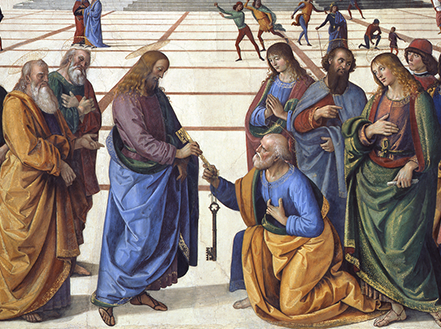
Christ Giving the Keys to St. Peter, Perugino, Sistine Chapel
The Gospel today sets forth the biblical basis for the Office of Peter, the Office of the Papacy, for Peter’s successors are the Popes. The word “pope” is simply an English version (via Anglo-Saxon and Germanic tongues) of the word “papa.” The Pope is affectionately called “Papa” in Italian and Spanish as an affectionate indication that he is the father of the family, the Church.
Let’s look at the basic establishment of the Office of Peter in three steps.
I. The Inquiry that Illustrates – The text says, Jesus went into the region of Caesarea Philippi and he asked his disciples, “Who do people say that the Son of Man is?” They replied, “Some say John the Baptist, others Elijah, still others Jeremiah or one of the prophets.” He said to them, “But who do you say that I am?”
In asking these questions, Jesus is not merely being curious about what people think of Him. He seems, rather, to be using these questions as a vehicle through which to teach the apostles (and us) about how the truth is adequately revealed and guaranteed.
Jesus’ first two questions reveal the inadequacy of two common methods:
1. The Poll – Jesus asks who the crowds say that He is. In modern times, we love to take polls; many put a lot of weight on the results. Many people—Catholics among them—like to point out that x% of Catholics think this or that about certain moral teachings, doctrines, or disciplines. Their position is that if more than 50% of Catholics believe something then it must be true; and therefore the Church should change her teaching.
As today’s Gospel makes clear, taking a poll doesn’t necessarily yield the truth. In fact, in this case all of the assertions of the crowd were wrong. Jesus is not John the Baptist, Elijah, Jeremiah, or one of the prophets redivivus. So, running the Church by poll-taking does not seem be a model that works.
2. The Panel – Jesus now turns to a panel of experts, a “blue ribbon committee,” if you will. He asks the twelve, “Who do you say that I am?” Jesus is met with silence. Perhaps they were looking around like nervous students in a classroom, not wanting to answer lest they appear foolish. The politics on the panel leads not to truth, but to a kind of self-serving, politically correct silence.
Peter finally speaks up, but as Jesus will point out, he does not do so because he is a member of the panel, but for another reason entirely.
Hence the blue ribbon panel, the committee of experts, is not adequate in setting forth the religious truth of who Jesus is.
Through this line of questioning, Jesus instructs through inquiry. Polls and panels are not adequate in yielding the firm truth as to His identity. All we have are opinions, or politically correct silence. Having set forth this inadequacy, the Gospel now presses forth to describe the plan of God in adequately setting forth the truths of faith.
II. The Individual that is Inspired – The text says, Simon Peter said in reply, “You are the Christ, the Son of the living God.” Jesus said to him in reply, “Blessed are you, Simon son of Jonah. For flesh and blood has not revealed this to you, but my heavenly Father.”
We are taught here not merely that Peter spoke, but also how he came to know the truth. Jesus is very clear to teach us that Peter spoke rightly not because he was the smartest (he probably wasn’t), or because someone else told him (Jesus is clear that flesh and blood did not reveal this to him), or because he guessed and just happened to get the right answer. Jesus teaches that Peter came to know the truth and speak it because God the Father revealed it to him. God the Father inspired Peter. There is a kind of anointing at work here.
God’s methodology, when it comes to adequately revealing and guaranteeing the truths of the faith, is to anoint Peter.
It is not polls or panels that God uses; it is Peter.
While truths may emerge in the wider Church reflecting what is revealed, it is only Peter and his successors who can definitively set forth views whose truth is adequately guaranteed. Thus, the other apostles are not bypassed by God, but He anoints Peter to unite them and give solemn declaration to what they have seen and heard.
The Catechism says this of Peter and his successors, the popes:
When Christ instituted the Twelve, he constituted [them] in the form of a college or permanent assembly, at the head of which he placed Peter, chosen from among them …. The Lord made Simon alone, whom he named Peter, the “rock” of his Church. He gave him the keys of his Church and instituted him shepherd of the whole flock. The office of binding and loosing which was given to Peter was also assigned to the college of apostles united to its head. This pastoral office of Peter and the other apostles belongs to the Church’s very foundation and is continued by the bishops under the primacy of the Pope.
The Pope, Bishop of Rome and Peter’s successor, is the perpetual and visible source and foundation of the unity both of the bishops and of the whole company of the faithful. For the Roman Pontiff, by reason of his office as Vicar of Christ, and as pastor of the entire Church has full, supreme, and universal power over the whole Church, a power which he can always exercise unhindered.
The college or body of bishops has no authority unless united with the Roman Pontiff, Peter’s successor, as its head. As such, this college has supreme and full authority over the universal Church; but this power cannot be exercised without the agreement of the Roman Pontiff. The college of bishops exercises power over the universal Church in a solemn manner in an ecumenical council. But there never is an ecumenical council which is not confirmed or at least recognized as such by Peter’s successor (Catechism of the Catholic Church, 880-884 selected).
All of these truths point back to the moment described in today’s Gospel, when we see how God Himself chooses to operate.
Note, too, the dimension of faith we are called to have. We are to assent to the pope’s teaching and leadership not merely because we think he is smarter, or because he might have the power, riches, or other worldly means to impress us or compel our assent. No, we assent to the pope’s teaching because, by faith, we believe he is inspired by God. It is not flesh and blood in which we put our trust; it is God Himself. We believe that God has acted on our behalf by anointing someone to affirm the truth and adequately guarantee that truth to be revealed by Him.
III. The Installation that is Initiated – The text says, And so I say to you, you are Peter, and upon this rock I will build my Church, and the gates of the hell shall not prevail against it. I will give you the keys to the kingdom of heaven. Whatever you bind on earth shall be bound in heaven; and whatever you loose on earth shall be loosed in heaven.
Jesus does not merely praise Simon for a moment of charismatic insight. He goes further, declaring that He will build His very Church upon Simon, whom He names Peter (rock). Jesus does not merely mean this is a personal gift or recognition that will die with Peter. In giving him the keys, He is establishing an office. He is not merely giving Peter a personal promotion. This will be God’s way of strengthening and uniting the Church. In Luke’s Gospel Jesus says more of this:
Simon, Simon, behold, Satan demanded to have you, all that he might sift you all like wheat, but I have prayed for thee, Peter, that thy faith may not fail; and when thou hast turned again, strengthen thy brethren (Luke 22:31).
This makes clear once again that God’s plan for the Church is to strengthen one man, Peter (and his successors in the future), so that in turn the whole Church may be strengthened and united. Thus the Lord Jesus establishes not only Peter, but also his office. This is God’s vision and plan for His Church.
Many have objected to this teaching. There is no time here to provide a complete response to every objection, but frankly most of them amount to a kind of wishful thinking by those who want this text to mean something other than what it plainly does. Nothing could be clearer than the fact that Jesus is establishing Peter and an office, which will serve as a foundation for the unity and strength of His Church.
It is also true that we are living in times that have tested many Catholics who have traditionally been the biggest supporters of the papacy. For many, our current pope has been a source of controversy rather than unity. And yet the office endures; it remains our duty to pray for and respect him, and to seek to maintain unity. Concerns for some of his statements should be expressed with charity and manifest good will. Although St. Paul saw fit to express his dismay over some of St. Peter’s prudential decisions (see Gal 2:11), we should remember that St. Paul was a bishop and apostle. Thus Catholics who have concerns today would do well to work with bishops to express their concerns, whether their own bishop or one they know they can approach.
Truth be told, “If no one is pope, everyone is pope.” Without a visible head, there is no principle on earth for unity in the Church. The Protestant experiment tried to replace the pope with Scripture, giving it sole authority. Yet Protestants cannot agree on what Scripture says and have no earthly way to resolve their conflicts. While they say that authority resides in Scripture alone, in claiming the anointing of the Holy Spirit and thus the ability to properly interpret Scripture, they really place the locus of authority within themselves, in effect becoming the very pope they denounce.
I have read that some objectors think Catholics arrogant in asserting that we have a pope whom we trust to be anointed by God to teach us without error on faith and morals. But which is more arrogant, to claim that there is a pope or to in fact act like one myself?
In the end, the Protestant experiment is a failed one. Estimates place the number of Protestant denominations as high as 30,000. I think that this figure is exaggerated, but not by much. They all claim the Scriptures as their source of truth but differ on many essential matters: the necessity of baptism, “once saved, always saved,” sexual morality, and authority. When they cannot resolve things they simply subdivide.
Jesus has installed an individual in this role to manifest his office of rock and head: Peter and his successors.
The animated short below is a dramatization (sort of) of the story of Samson and Delilah as well as a commentary on lust and power. (If you would like to review the story of Samson and Delilah, clickhere.)
As the video opens, two superheroes are summoned to an emergency. They rush to the scene, but do so recklessly; a great crash occurs. This is symbolic of our pride, for too often we rush headlong into solving problems without considering other problems that might be created in the process. For example, the quest to “end poverty in our time” has led to the demise of the family; the quest to liberate the world from tyranny (through violence, drone strikes, and war) has more often led to even more violence and the rise of new villainies.
The superheroes try to blame each other for the accident. This is symbolic of our tendency to shift blame and avoid personal responsibility. We speak endlessly of our rights and our freedom to do as we please, but we want none of the responsibility; and of course any consequences are someone else’s fault.
Each of them then tries to take control of the situation. This is an image of our desire for power over others. This only serves to usher in a struggle that ultimately no one can win. Rather, all suffer devastating loss. Even victory is fleeting because the cycle of violence soon begins again.
At first, our male superhero (let’s call him Samson) seems to have the upper hand; but the female superhero (let’s call her Delilah) is not to be undone. Delilah tries to overcome Samson through her feminine charms. This symbolizes our lust. Whatever his strengths, Samson has a fatal flaw, one that destroys many men: lust. Many men (and women) and have ruined their lives due to lust. This has resulted in poverty, STDs, abortion, teenage pregnancy, shattered dreams, broken families, and broken hearts.
The end of both of these superheroes is death and destruction. Pride, irresponsibility, unrestrained power, and lust unleash only devastation, destruction, and death—both individually and collectively.
In the biblical story of Samson and Delilah, Delilah only “won” for a brief moment. So it is with every worldly victory; it is temporary at best. Only heavenly victory and treasure stored up there will prevail. The wages of sin is death (Romans 6:23).
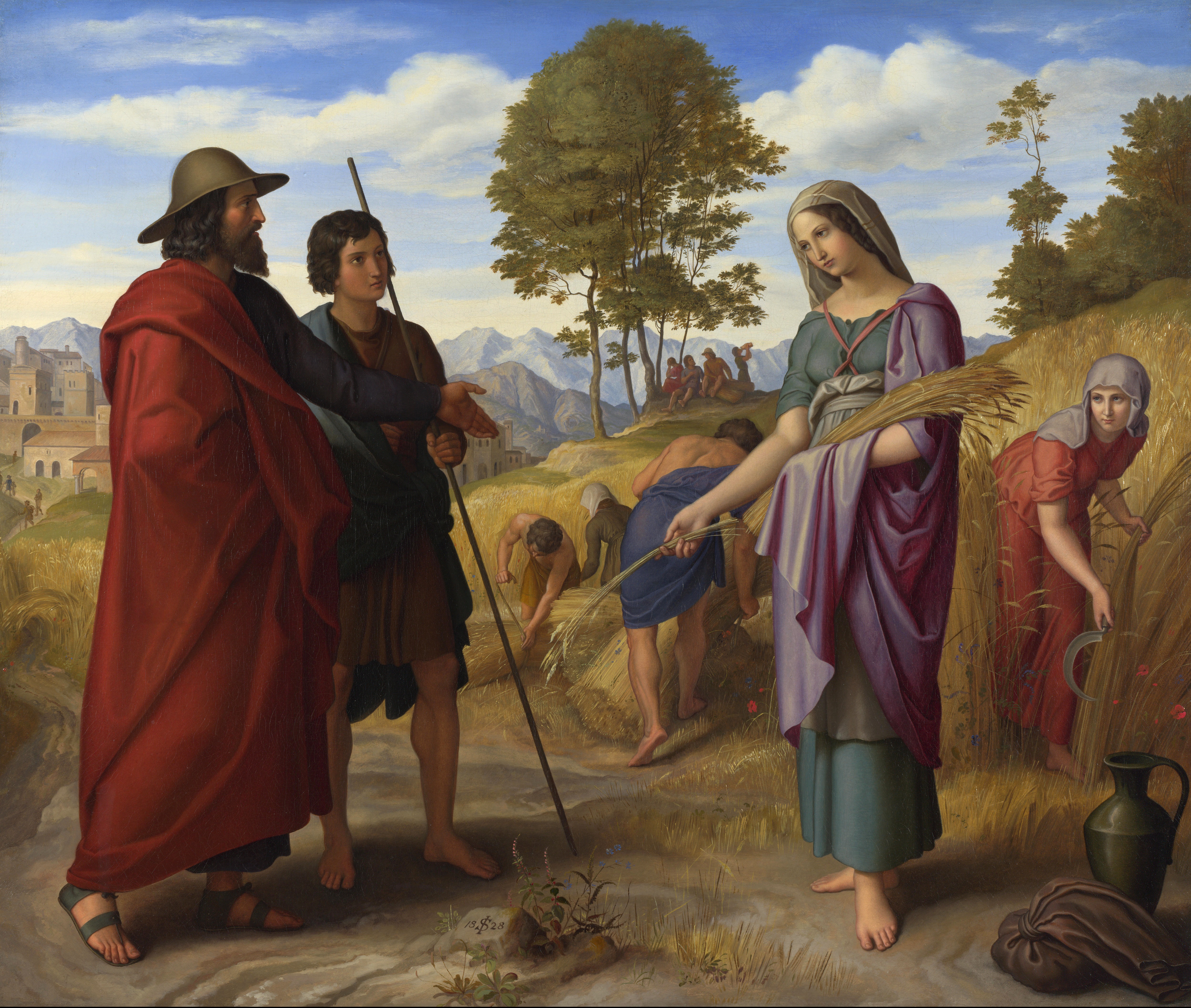
Given our brief sampling of the Book of Ruth in daily Mass, perhaps a reflection is in order.
The detailed background to the text is too lengthy to go into here, but a few points will help. The story features three main characters: Boaz, Ruth, and Naomi. Boaz is clearly a picture (or “type”) of Christ. He was born and lives in Bethlehem; he ultimately acts as Ruth’s “kinsman-redeemer” by rescuing her from poverty and paying the price so as to cancel her debt. This, of course, is just what Christ does for us: He redeems us by His blood, canceling our poverty and debt. Ruth is a picture of the individual soul in need of Christ’s redemption and mercy. Naomi plays several roles in the book, but in the passage we will consider here she is a picture of the Church; she advises Ruth in what to do and draws her to Boaz, her redeemer.
Consider the following text and then let us see how Naomi symbolizes the Church.
Naomi said to Ruth, “Is not Boaz … a kinsman of ours? Tonight he will be winnowing barley on the threshing floor. Wash and perfume yourself, and put on your best clothes. Then go down to the threshing floor, but don’t let him know you are there until he has finished eating and drinking. When he lies down, note the place where he is lying. Then go and uncover his feet and lie down. He will tell you what to do.” “I will do whatever you say,” Ruth answered (Ruth 3:2-5).
The advice that Naomi gives to Ruth is very much in line with the instruction that our Mother the Church gives us. In our poverty and under the debt of our sin, we are exhorted by the Church to seek our “Boaz,” who is Christ. (I am indebted to Rev. Adrian Rogers for supplying the alliterative headings below. They are his; the rest of the text is mine).
Be Firmly Convinced – Naomi says, Is not Boaz … a kinsman of ours? Tonight he will be winnowing barley on the threshing floor. Ruth knows her poverty, her pain, and her debt; so does Naomi. She exhorts Ruth to seek Boaz because he is near and can help. Boaz is wealthy and thus has the power to save Ruth, to draw her out of her overwhelming poverty; he has the capacity to cancel Ruth’s debt. She is to seek him at the threshing floor, where he is preparing and providing the bread that will sustain her. She must go, firmly convinced that Boaz will love her and save her.
So, too, does the Church exhort us: Seek the LORD while he may be found; call on him while he is near (Is. 55:6). Yes, there is one among us, a near kinsman, who is not ashamed to call us his brethren (Heb 2:11); His name is Jesus. As God, He has the power to save us and to cancel our debt. Cast your cares on him, for he cares for you (1 Peter 5:7). Jesus is at the threshing floor of His Church, preparing a banquet for you in the sight of your foe (Psalm 23:5). The grain He is winnowing is the Eucharistic Bread of His own flesh. Yes, says the Church, come to Jesus, firmly convinced of His love and His power to save.
Be Freshly Cleansed – Next, Naomi simply says, “Wash.” In other words, the first step in finding help from Boaz is to be freshly cleansed.
So, too, does the Church draw us to Christ with the exhortation to wash. Repent and be baptized, every one of you, in the name of Jesus Christ for the forgiveness of your sins. And you will receive the gift of the Holy Spirit (Acts 2:38). Yes, the love of God will be poured forth on us and the cancellation of our debt will take place as we are cleansed of our sins.
Here are some other texts in which the Church—our Naomi, our Mother—exhorts us to be washed:
● Come near to God and he will come near to you. Wash your hands, you sinners, and purify your hearts, you double-minded (James 4:8). ● Since we have these promises, dear friends, let us purify ourselves from everything that contaminates body and spirit, perfecting holiness out of reverence for God (2 Cor 7:1). ● Wash and make yourselves clean (Is 1:15). ● Depart, depart, go out from there! Touch no unclean thing! Come out from it and be pure, you who carry the vessels of the LORD (Is 52:11). ● And now what are you waiting for? Get up, be baptized and wash your sins away, calling on his name (Acts 22:16). ● Let us draw near to God with a sincere heart in full assurance of faith, having our hearts sprinkled to cleanse us from a guilty conscience and having our bodies washed with pure water (Heb 10:22).
Be Fragrantly Consecrated – Naomi says to Ruth, “and perfume yourself.” In other words, make yourself nice to be near; Come with an aroma that is sweet and pure.
So, too, does the Church, our Naomi, exhort us to be fragrantly consecrated. The fragrance we are called to is that of a holy life, which we receive in baptism. Our life in God should be like a sweet incense or perfume. Consider some of the following texts that the Church gives us:
● Live a life of love, just as Christ loved us and gave himself up for us as a fragrant offering and sacrifice to God (Eph 5:2). ● For we are to God the aroma of Christ among those who are being saved and those who are perishing (2 Cor 2:15). ● [The groom (Christ) speaks to his beloved:] You are a garden locked up, my sister, my bride; you are a spring enclosed, a sealed fountain. Your plants are an orchard of pomegranates with choice fruits, with henna and nard, nard and saffron, calamus and cinnamon, with every kind of incense tree, with myrrh and aloes and all the finest spices (Song 4:12). ● Aaron must burn fragrant incense on the altar every morning when he tends the lamps (Ex 30:7).
Be Fitly Clothed – Naomi says to Ruth, “and put on your best clothes.”
Our Mother the Church also advises us to be fitly clothed. For a Christian, this means to be adorned in the righteousness that comes to us in Christ by baptism. In the baptismal liturgy, the Church says to the newly baptized of the white garment that he or she wears, You have become a new creation and have clothed yourself in Christ. Receive this baptismal garment, and bring it unstained to the Judgment seat of our Lord Jesus Christ, that you may have everlasting life.
In other words, be fitly clothed. Wear well the garment of righteousness that Christ died to give you. Scripture, too, speaks of the garment in which we are to be fitly clothed:
● I delight greatly in the LORD; my soul rejoices in my God. For he has clothed me with garments of salvation and arrayed me in a robe of righteousness, as a bridegroom adorns his head like a priest, and as a bride adorns herself with her jewels (Is 61:10). ● Let us rejoice and exult and give him the glory, for the marriage of the Lamb has come, and his Bride has made herself ready; it was granted her to be clothed with fine linen, bright and pure—for the fine linen is the righteous deeds of the saints (Rev 19:7).
Be Fully Committed – Naomi continues, Then go down to the threshing floor, … until he has finished eating and drinking. When he lies down, note the place where he is lying. Then go and uncover his feet and lie down.
In other words, she is telling Ruth to place herself at the feet of her redeemer. This action of Ruth’s was a way of saying to Boaz, I put myself under your protection; I am fully committed to you.
The Church bids us to do the same: go to the threshing floor, to that place where the threshed and winnowed bread becomes the Eucharist.
Beneath or near every Catholic altar is the cross; on that cross are the uncovered feet of Jesus Christ.
The most sacred place on earth is at the feet of Jesus Christ. The Church, our Naomi, bids us to gather each Sunday at the altar, beneath the uncovered feet of Christ. The Church says to us just what Naomi said to Ruth: Place yourself at the feet of your Redeemer.
Be Faithfully Compliant – Naomi says to Ruth, confidently and succinctly, He will tell you what to do.
Here, too, the voice of the Church echoes what Mother Mary said long ago regarding her Son: Do whatever he tells you (Jn 2:5). How can our Naomi, the Church, say anything less or anything else? The Church has one message: Do whatever Christ, your redeemer, tells you.
So Naomi is a picture of the Church, Boaz a picture of Christ, and Ruth a picture of the soul in need of salvation.
How does the story end? I’m tempted to tell you to read it for yourself, but since Boaz is a picture of Christ you already know the ending. Ruth, firmly convinced, freshly cleansed, fragrantly consecrated, and fitly clothed, fully commits herself to Boaz and is at his feet. Boaz, who saw and loved Ruth before she ever saw or loved him (cf Ruth 2:5), arises and takes her as his bride, paying off all her debt and giving her a new life. Sound familiar? It is the story of salvation, if we but have eyes to see it.
A reading from the Book of the Prophet Isaiah was featured this week in the Office of Readings of the Liturgy of the Hours. I couldn’t help but be struck by the fact that the ancient diagnosis of Israel applies to our times as well.
And the people shall oppress one another, yes, every man his neighbor. The child shall be bold toward the elder, and the base toward the honorable. … Their very look bears witness against them; their sin like Sodom they vaunt, they hide it not. Woe to them! they deal out evil to themselves (Isaiah 3:5-9).
When a man seizes his brother in his father’s house, saying, “You have clothes! Be our ruler, and take in hand this ruin!” … But he will say: … “You shall not make me leader of the people.” … because their speech and their deeds are against the Lord … My people—a babe in arms will be their tyrant, and women will rule them! O my people, your leaders mislead, they destroy the paths you should follow (Isaiah 3:6-12).
Let’s note four fundamental issues that God assigns to that age (and, I would argue, ours as well). Our culture and nation have become:
Dominating and Loud – And the people shall oppress one another, yes, every man his neighbor.
These are indeed contentious times—so contentious that we cannot seem to have honest debates or disagreements; we just yell at one another. On college campuses, students shout down speakers with differing views and accuse them of hate. Demonstrations both on campuses and elsewhere often devolve into a kind of mob violence, which has included vandalism, setting cars afire, breaking windows, looting, and even murder.
Pope Benedict XVI warned of the tyranny of relativism. By this he meant that as relativism and subjectivism have shifted the source of truth from the object to the subject, from reality to opinion, there is no longer any basis for reasonable discussion.
In such a climate, whose views win the day: Those with the most money, power, and political clout or those who shout the loudest or are best able to intimidate others?
Dishonoring and Low-brow – The child shall be bold toward the elder, and the base toward the honorable.
What is described in this verse has been going on for a considerable time. Those of us who are older remember a time when disrespect for elders was not tolerated. Beginning in the 1950s and picking up speed through the 1960s, our culture devolved into one centered on youth. Youthful vigor and youth itself were esteemed over maturity. Young people were “hip” and relevant; “old people” were out of touch and had nothing to offer. If something was old, it was bad; if something was new it was good. Rock music emphasized rebellion and the rejection of tradition. Television sitcoms featured children who were all-wise and parents (especially fathers) who were stupid and buffoonish.
All of this has led to a breakdown of respect for elders and those in authority. And, frankly, elders and authority figures have not helped matters, as many of them have fearfully declined to insist upon proper respect.
When there is no respect, there can be no teaching. When there is no teaching or handing down of what has proven best and most worthwhile, what is base and low-brow too easily appeals to those who are schooled only in their lower passions.
Rap stars, Hollywood actors, and other pop-culture figures have more influence than Scripture, faith, literature, and tradition. Much of popular culture presents that which is base and most of those who represent it reject the honorable and time-tested traditions that have built our culture. Cultural iconoclasts dominate; those who build on what is honorable are fewer, both in number and influence.
Destructive through Lust – Their very look bears witness against them; their sin like Sodom they vaunt, they hide it not. Woe to them! they deal out evil to themselves.
Today, promiscuity of every sort is celebrated. Again, those of us who are older can remember a time when living together outside of marriage was scorned; it was referred to as “living in sin” or “shacking up.” Now, not only is it widely tolerated; it is even encouraged.
Movies and popular songs since the 1960s have depicted and spoken of illicit sexual unions of every kind as normal, acceptable, routine, and even beautiful. Homosexual acts are now celebrated, made the matter of pride. Contraception, widely rejected by every Christian denomination prior to 1930, is now called virtuous or responsible by most. Divorce, once considered shocking and discouraged by our very laws, is now common; it is often encouraged as a way to happiness.
God warns through Isaiah in this text: Woe to them! they deal out evil to themselves. In other words, if we don’t get marriage and sexuality right as a culture, it will kill our civilization. Sexual distortion leads to distortions about marriage. Distortions about marriage lead to broken families. Broken families lead to broken children. Broken children become broken adults. Broken adults have a hard time leading or making good decisions.
The breakdown of culture and civilization continues. In our sins we deal out evil to ourselves. We sow the wind and we reap the whirlwind (Hosea 8:7). We sow in the field of the flesh and we reap a harvest of corruption (Gal 6:8).
Declining in Leadership – When a man seizes his brother in his father’s house, saying, “You have clothes! Be our ruler, and take in hand this ruin!” … But he will say: … “You shall not make me leader of the people.” … because their speech and their deeds are against the Lord … My people—a babe in arms will be their tyrant, and women will rule them! O my people, your leaders mislead, they destroy the paths you should follow.
This is an especially controversial part of the text. Yet, honestly, there is a crisis of leadership in our culture at nearly every level. In families, many parents do not lead their children, choosing instead to try to be their friends. Many priests and bishops timorously hide, speaking in abstractions and generalities rather than teaching clearly. Too many do not vigorously summon the faithful to a proper moral vision.
In terms of social and political leadership, many of the best in our country do not want to assume leadership of a people who are increasingly surly and incorrigible, who demand everything but are not willing to sacrifice even smallest of benefits.
When qualified and capable leaders do not step forward, people will latch onto any leader at all, no matter how corrupt, morally questionable, or inexperienced. This decline has been going on for a long time in our country at every level.
Isaiah’s “politically unapproved” lament about having women rulers requires of us a deeper understanding of the meaning of the text. Today, we accept and have women who are capable leaders; no one would compare a female leader to a “babe in arms.”
Today, the problem lies more in the lack of traditionally described “masculine” virtues such as engaging the battle, fighting for what is right, competition, and necessary contention. Our age is more steeped in traditionally described “feminine” virtues such as tolerance, acceptance, getting along, understanding, respecting feelings, and “emotional intelligence.” These traits are not bad in themselves, but today they are not properly balanced; in our culture, the feminine predominates. This imbalance is not healthy. A culture in which femininity predominates is no healthier than one with too much masculinity.
I would argue that this text from Isaiah need not be understood as excoriating any or all feminine leadership. Rather, I see it as reminding us that in leadership, masculine virtues are needed to balance feminine virtues and instincts.
The current imbalance, in which the feminine dominates, affects leadership in families and parishes. Parents and clergy are often hesitant to make challenging demands or to insist on what is true because feelings might be hurt or offense taken.
In the political arena, the current imbalance results in a kind of hypersensitivity to the feelings of aggrieved individuals or groups of self-described victims. Many leaders are more preoccupied with not giving offense to certain popular groups than with making difficult decisions that may demand sacrifice and that will not please all, but are still the best answer. What is best can sometimes be hard; the truth is not always pleasing to everyone.
Disclaimer: Without a doubt, some of what Isaiah said was controversial in his day. And without a doubt my application of the text to this day and age will likewise be controversial. But what if ensuing conversations and debates are the result? What if you get a chance to register your comments and complaints in the comment box here and other people get to respond to you? What if my imperfect post is meant to encourage conversation in a culture that increasingly wants to shut down conversation and forbid “politically unapproved” speech?
Finally, remember that biblical passages have a way of comforting the afflicted and afflicting the comfortable. We’re all a little of both and we need both.
This song, recorded in my parish church, was performed by the St. Luke Ordinariate Choir:
To anyone who regularly reads the Liturgy of the Hours, some of the psalms seem downright boastful. They sound too much like the Pharisee who went to pray and said, God, I thank you that I am not like other people — robbers, evildoers, adulterers — or even like this tax collector. I fast twice a week and give a tenth of all I get (Luke 18:11-12). In the very next verse, Jesus recommends a briefer prayer for us: God, have mercy on me, a sinner (Luke 18:13).
How, then, are we to understand some of the psalms that seem to take up a rather boastful and presumptuous tone? Consider these three passages:
The Lord has dealt with me according to my righteousness; according to the cleanness of my hands he has rewarded me. For I have kept the ways of the Lord; I am not guilty of turning from my God. All his laws are before me; I have not turned away from his decrees. I have been blameless before him and have kept myself from sin. The Lord has rewarded me according to my righteousness, according to the cleanness of my hands in his sight (Psalm 18:21-24).
My heart is not proud, Lord, my eyes are not haughty; I do not concern myself with great matters or things too wonderful for me. But I have calmed and quieted myself, I am like a weaned child with its mother; like a weaned child I am content. (Psalm 131:1-4).
I have kept my feet from every evil path so that I might obey your word. I have not departed from your laws, for you yourself have taught me … therefore I hate every wrong path (Psalm 119:100-102).
For us who would pray these, the spiritual approach is twofold.
These psalms are prayed in hope. While we are not worthy to say such words without a lot of qualifications, by God’s grace they will one day be true for us. God is drawing us to perfection. While total perfection will not come until we attain Heaven, if we are faithful we should be progressing toward this lofty reality even now.
Hope is the confident expectation of God’s help in attaining holiness and salvation. One day in Heaven we will be able to say, “I do not sin; I am blameless before God. I am not proud and never depart from your decrees, O Lord.” Hope is the vigorous expectation that these words will one day apply to us fully; for now, we recite them in that fervent hope.
In effect, we are memorizing our lines for a future moment, when by God’s grace we will actually be able to recite them truthfully. Praying psalms like these is like a dress rehearsal for Heaven. These psalms amount to prolepses of a sort, whereby we proclaim a future reality as if it were already present. Our confidence to speak proleptically is in Christ alone.
These psalms are on the lips of Christ. When the Church prays, Head and members pray together; it is the whole Body of Christ that proclaims these psalms.
Christ never wavered, never drew back from God’s Law. He never sinned; His hands were clean from defilement and He was rewarded for His righteousness. Christ alone prays these psalms without any qualification.
In the Old Testament, these psalms pointed forward to the Christ, to the anointed Messiah. Today, they still point to Christ and He alone utters them authentically. None of us can really pray them apart from Christ, as members of His Body.
Even the perfected in Heaven cannot pray them without reference to Christ, for it is He who accomplished in them the perfection that makes such psalms a reality for them.
It is Christ who prays these psalms, and we—through Him, with Him and in Him—head and members—are praying them to the Father.
Without Christ, such psalms amount to haughty boasts and presumptuous declarations, but with Christ our Head, they are true; we can rightly pray them in the hope of our own perfection, one day, by His grace. We can also pray them in the joy that some of our brothers and sisters in Heaven have already attained to the perfection described therein. This is because the grace of Christ has had in them its full effect.
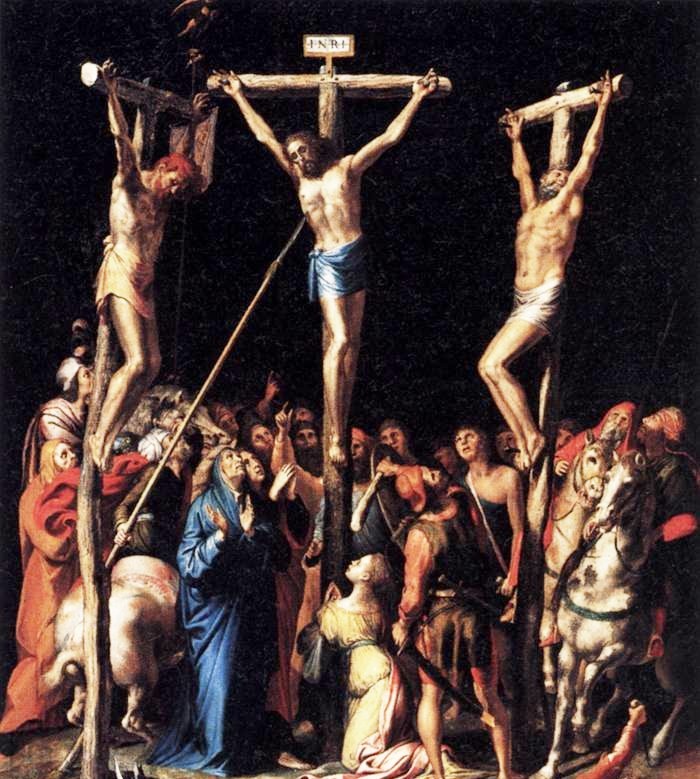
With the solar eclipse that occurred Monday, it occurred to me to consider the darkening of the sun that occurred when Jesus was on the Cross. Though some wish to explain it scientifically (as an eclipse), there may have been more at work than mere astronomy.
In Luke 23:44, we read, It was now about the sixth hour, and there was darkness over the whole land until the ninth hour (i.e., from noon until 3:00 PM).
Although this seems to describe a solar eclipse, it isn’t appropriate to insist that it was an eclipse (at least as we define the term today). Matthew, Mark, and Luke all speak to the darkness of that day using the Greek term σκότος (skotos), meaning simply “darkness.” Only Luke went on to state the reason for the darkness: the sun was darkened (Luke 23:45). He even used the Greek word ἐκλιπόντος (eklipontos), from which the word “eclipse” was derived. In Greek, however, the word eklipontos simply means “darkened,” whereas our word “eclipse” refers to a darkening as a result of the moon blocking the light of the sun. But that is not necessarily, or even likely, what Luke meant here.
As a general rule, we should avoid applying a scientific meaning to a text that is more specific than the author intends. That there was darkness over the land from noon until three is certainly attested to in the sacred texts, but the cause of that darkness is not definitively stated to be an eclipse, at least not as we use the term today. Perhaps God made use of other natural causes, such as very heavy clouds, to cause the light of the sun to dim. It is also possible that the darkness was of purely supernatural origin and was experienced only by some of those present.
Trying to explain the darkness simply in terms of the laws of science risks doing a disservice to the text by missing its deeper meaning: that the darkness of sin had reached its zenith. Whatever the physical mechanism of the darkness, its deepest cause was sin and evil.
Jesus said elsewhere, “This is the judgment: Light has come into the world, but men loved darkness instead of light because their deeds were evil” (Jn 3:19). Referring to His passion, He also said, “Night is coming, when no one can work” (Jn 9:4). And when Judas left the Last Supper to betray Jesus, John observed simply and profoundly, “And it was night” (Jn 13:30). Yes, deep darkness had come upon the world.
Some also question whether the occurrence of darkness on that day has any “basis in fact” or whether the biblical accounts are mere theologizing. Although a few modern scholars consider the reference to be a mere literary device, there seems little reason to doubt that it actually occurred. While some refer to a purported Letter of Pontius Pilate to Tiberius verifying it, the letter’s historical veracity is highly disputed.
Yet it is recorded in three of the gospels (Matthew, Mark, and Luke) and most of the Fathers of the Church treated the darkness as historical.
That said, how many people experienced the darkness and how deep it was, is not clearly specified. We should balance accepting its historical accuracy with an appreciation that the biblical texts are restrained in terms of precise details and were written with a theological purpose more so than to provide a detailed description.
Most of you have probably heard or read the reports trumpeting the “eradication” of Down syndrome in Iceland). The problem is that what is being termed “eradicating” the “problem” actually means that those with Down syndrome are being put to death. The celebratory language is all too similar to the way we once spoke of wiping out malaria by killing infected mosquitoes. But of course children in the womb are not mosquitoes; they are human beings, love and willed by God. Imagine saying that we had eradicated malaria by killing every person who had it!
A low point in the article linked above comes at the end, when a proponent of aborting babies who likely have Down syndrome is quoted as saying,
“We don’t look at abortion as a murder. We look at it as a thing that we ended. We ended a possible life that may have had a huge complication … preventing suffering for the child and for the family. And I think that is more right than seeing it as a murder—that’s so black and white. Life is gray.”
Well, pardon me for considering murder to be so black and white! One minute a heart is beating heart, the next minute it’s not. The “thing” that you ended is a human life. Calling such a child a “possible life” is scientifically dishonest. A beating heart does not exist in something that is possibly alive; he or she is alive. No linguistic gymnastics can legitimately describe the situation otherwise.
Further, “preventing suffering” by killing the patient is an illustration of the twisted logic of the culture of death. Death is the increasing being proposed as the solution to today’s problems. If you—or more perniciously, “we”—decide that your life is not worth living, we will kill you and call ourselves compassionate for doing so.
The greatest tragedy in all of this is that we veto the gift of God. Some of God’s gifts come in paradoxical packages; those with disabilities and special needs have much to teach us and many ways to bless us. Without them we may never reach our full humanity, which is meant to include compassion, humility, reverence, and respect. Not one of us is perfect. All of us have difficulties that require support from others. When we forget or reject this we lose an important aspect of our humanity: interdependence.
Iceland is not alone in this; much of the rest of the world has also refused to accept the disabled into our communities.
Here in the United States, this is perhaps most sadly evidenced by the fact that more than 90% of unborn children with poor prenatal diagnoses are aborted. Perhaps the parents are informed that their child will have Down syndrome or a birth defect that will lead to a lifetime of challenges and an early death.
The pressure placed on such families to abort is often enormous. They are told, “It’s the right thing to do,” or, “You shouldn’t make your child suffer.” Some are even made to feel that they are doing something unethical by bringing forth such children. In addition, parents are often pressured to make a decision quickly; doctors may want the decision to terminate made within a matter of days.
Is there such a thing as a life not worth living? Many in our culture seem to believe that there is. A “therapy” increasingly proposed in today’s culture of death is killing the patient in order to solve the “problem.” People, it would seem, do not have problems, they are the problem, and thus their elimination makes the problem go away. Never mind that a human person of inestimable value is actually killed … Problem solved! Thus has arisen idea that an appropriate “treatment” for disabled unborn children is to kill them. Of course death is neither a treatment nor a therapy; it cannot be considered an acceptable solution for the one who loses his or her life. Yet this is often the advice given to parents faced with this situation.
All of this “advice” and pressure goes a long way toward explaining the dismal abortion rates of the potentially disabled unborn. We in the Church cannot remain silent in the face of this; we must reach out compassionately to families experiencing such a crisis. Many of them are devastated by the news that their baby may have serious disabilities. Often they descend into shock and are overwhelmed by fear, conflicting emotions, and even anger toward God or others. Sometimes the greatest gifts we can give them are time, information, and the framework of faith. Simply considering some of the following may help:
Despite what parents are told, there is no rush. Serious, life-changing decisions should never have to be made within a short period of time. Pressure should not be applied to families (by medical personnel or others) in order to force a quick decision; doing so is a grave injustice.
Prenatal screenings are not always accurate. We often think of medicine as an exact science; it is not. Data can be misinterpreted and predictions can be wrong. Further, there is a difference between the result of a screening and an actual diagnosis. A screening can point to a potential problem and assess its probability, but it is not a definitive diagnosis. Further study is always called for if a screening indicates a possible issue. Sometimes, further testing reveals that in fact there isn’t a problem at all.
As Pope Francis has pointed out, disabilities are not always as terrible as we, in our insistence on perfection, might imagine. Many people with disabilities live very full lives and are tremendous gifts to their families, the Church, and the world. Providing families with more information about disabilities and connecting them with other families who have experience is essential in helping them to avoid the doomsday mentality that can easily set in.
It is vital to connect the faithful with the most basic truths of our Christian faith. To the world, the cross is an absurdity, but to those of the Christian faith it brings life and blessings in spite of the pain. Were it not for our crosses, most of us could never be saved. Raising a disabled child is not easy, but God never fails. He can make a way out of no way; He can do anything except fail. My own sister, Mary Anne, was mentally ill and carried a cross. We, her family, had a share in that cross. But Mary Anne brought blessings to us as well. In fact, I don’t know if I’d be a priest today if it had not been for her. I’m sure that I wouldn’t be as compassionate and I doubt that I could be saved were it not for the important lessons Mary Anne taught me. I know that she brought out strength and mercy, not to mention humility, from all of us in the family. Her cross and ours brought grace, strength, and many personal gifts to all of us. The cross is painful, but it brings life as well. Easter Sunday is not possible without Good Friday. Yes, to the world the cross is an absurdity. To us who believe, it is salvation, life, and our only real hope; it is our truest glory to carry it as Christ did.
Disability is not an all-or-nothing proposition; it exists on a continuum. All of us are disabled in some way. Some have serious weight problems; others are diabetic, have high blood pressure, or experience heart problems. Some are intellectually challenged. Others struggle with anxiety, depression, addiction, or compulsion. Some experience a loss of mobility as a result of an accident or just due to the aging process. The fact is, all of us have abilities and disabilities. Some disabilities are more visible than others; some are more serious than others. In most cases, though, we are able to adjust and still live reasonably full lives. We may not be able to do all that we would like, but life still has blessings for us. And even our weaknesses and disabilities can, and do, bring us blessings by helping to keep us humble. How much disability is too much? Can we really be the judge of that? Can we really decide for someone else that his or her life is not worth living?
Life is often not what it seems. In this world, we value things like wealth, ability, strength, and power, but God is not all that impressed by these sorts of things. He has a special place for the poor and the humble. The Lord has said that many who are last in this life will be first in the next (cf Mat 19:30). There is a great reversal coming, wherein the mighty will be cast down and the lowly raised up. We may look upon those who suffer disability with a misplaced sense of pity, but they are going to be the exalted ones in the kingdom of Heaven. As we accept the disabled and the needy in our midst, we are accepting those who will be royalty in Heaven. We ought to learn to look up to them, to beg their prayers, and to hope that hanging on their coattails may help us to attain some of the glory they will enjoy. The world may refuse to see their dignity, but we who believe cannot fail to remember that the last shall be first. Yes, life is not always what it seems.
What about those who aborted their babies? We as a Church cannot avoid our responsibility to declare the dignity and worth of the disabled. More than ever, our world needs the Church’s testimony, for this 90% statistic is a startling one. But even as we witness to the dignity of the disabled and to the wrongness of abortion, we must also embrace those who chose abortion and now struggle with having made that decision. We are called to reconcile and to bring healing to all who have faced this crisis and fallen. Many were pressured and felt alone and afraid. We offer this embrace through confession and through healing ministries like Project Rachel, which offers counseling, spiritual direction, support groups, and prayer services. Even as the Church speaks out against abortion, she must also reconcile those who have fallen under the weight of these heavy issues.
Tomorrow I will write a little bit more on this topic and present a parable of sorts.


 Most Catholics have heard the critique from non-Catholics that it is wrong to call priests “Father.” It is a rather tired old charge, which basically goes as follows: