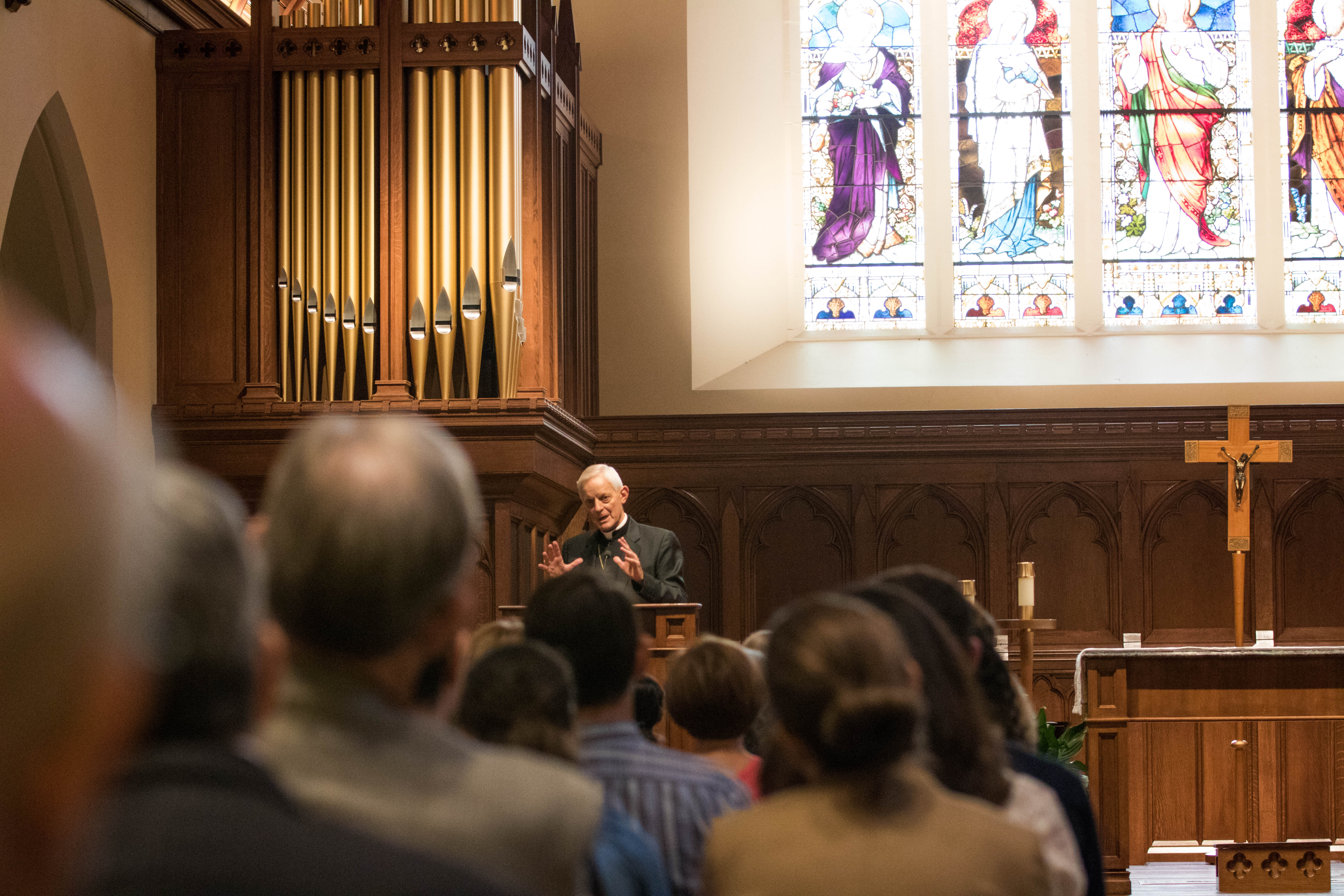
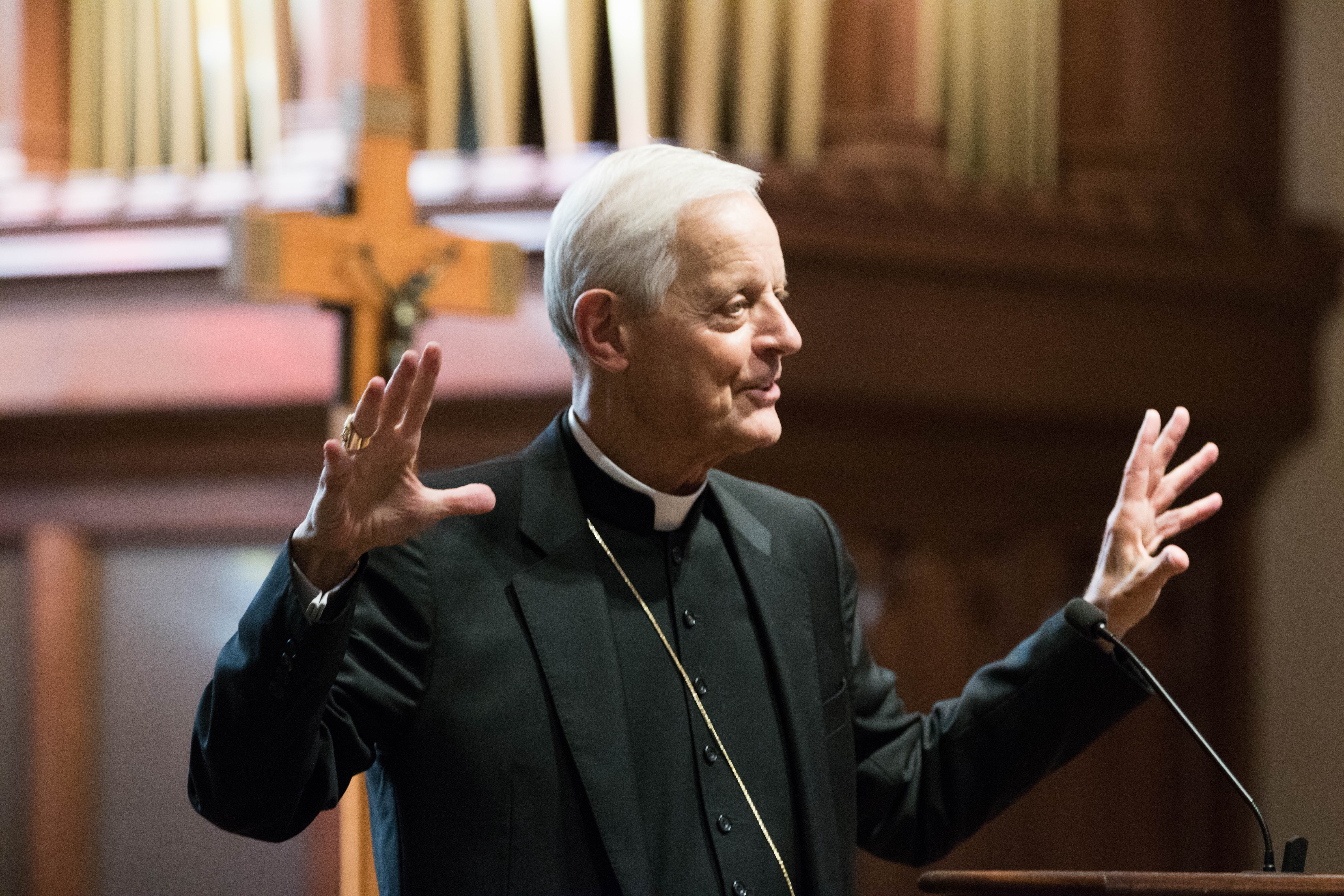
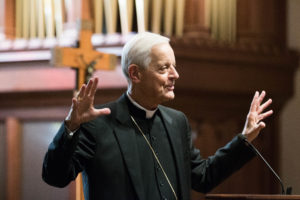
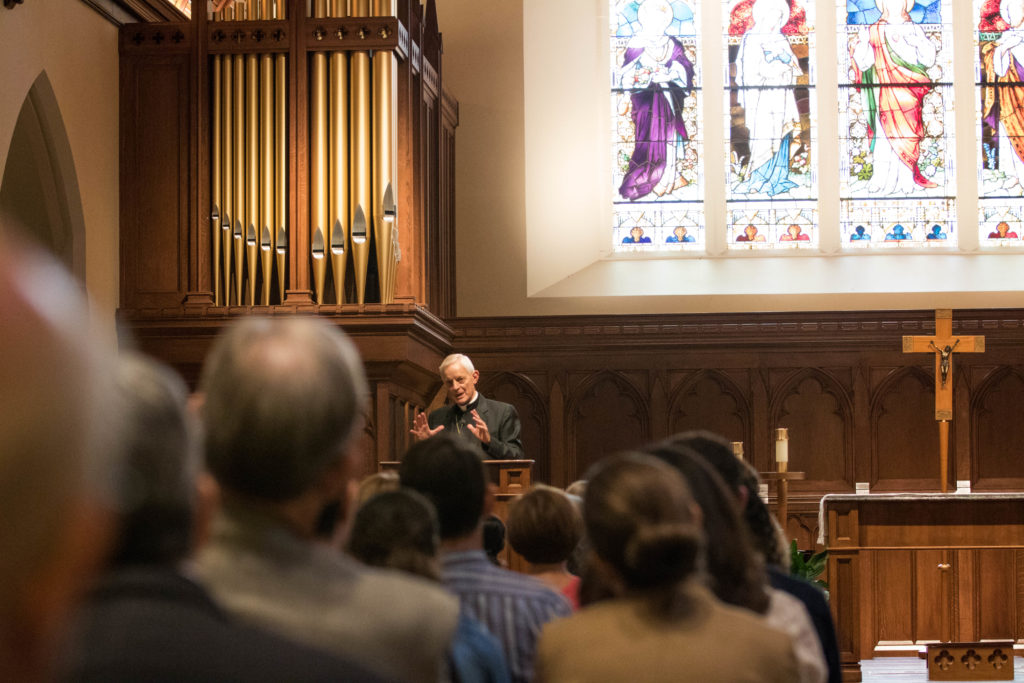
 The Catholic Church has a unique process for confirming Church teaching and setting pastoral guidance. “Synodality” is the process that has been used by Catholic bishops for centuries. But on Tuesday, September 12, Cardinal Donald Wuerl, in Georgetown University’s inaugural 2017-18 Sacred Lecture, explains how Pope Francis has taken this ancient Church ritual and, building on the efforts of his predecessors, expanded synodality to help answer the call to evangelization and pastoral accompaniment laid out in the Papal exhortation, Amoris Laetitia. In this lecture, Cardinal Wuerl reflects on how the collegial approach of Pope Francis with the College of Bishops not only builds on the 50-year tradition of synodality after the Second Vatican Council, but opens the door for new and greater opportunities for pastoral care in the Catholic Church today and in the future. Read the transcript of Cardinal Wuerl’s lecture below.
Sacred Lecture Series: Pope Francis, Synodality and Amoris Laetitia
In these reflections, I touch on three points: synodality, an ecclesial experience; Pope Francis’ expansion of the application of this ecclesial reality, and the post-synodal apostolic exhortation, Amoris Laetitia, as an expression of the fruit of synodality.
The word synodality refers to “coming together” or, more technically, “journeying together.” It has historically been used to denote gatherings of bishops describing their pastoral walking together to confirm already expressed teaching and pastoral practice, and to explore and apply Church teaching and practice in terms of the circumstances of the day.
The word takes on new emphasis today as Pope Francis applies it in order to express the concept of the whole Church, pastors and flock, walking and working together to explore the needed pastoral responses to the challenges of today.
COLLEGE OF BISHOPS
To start, it might be helpful to make some very brief observations on the ecclesial reality that we call the College of Bishops. Just as the 12 Apostles constituted a unique and identifiable group with its own nature and function, so, too, today do their successors. The bishops today throughout the world constitute the College of Bishops.
The coming together of bishops, in its most formal and authoritative form, is an ecumenical council, a gathering of all the bishops worldwide. Other less inclusive and therefore, less authoritative gatherings, at least as they exist today in the Latin/Western Church, are called synods. Pope Francis uses the term “synod” to reflect the structure, and “synodality” to refer to the process whereby bishops play a more active role in discussing significant issues of the day.
The 1998 Motu Proprio Apostolos Suos of Pope John Paul II on the theological and juridical nature of episcopal conferences goes on to point out that the communion of the College of Bishops has found an outstanding and typical expression in the holding of councils, this includes ecumenical and particular councils, both plenary and provincial (3). Other gatherings of bishops to exercise certain pastoral functions are a concrete expression of collegial spirit (affectus collegialis) which however “never takes on the collegial nature proper to the action of the Order of Bishops as such…” (12).
Episcopal conferences, for example, meet so that “by sharing their wisdom and experience and exchanging views, they may jointly formulate a program for the common good of the Church” (Motu Proprio citing the Second Vatican Council Degree on the Pastoral Office of Bishops in the Church, Christus dominus, 37 and the Dogmatic Constitution on the Church, Lumen Gentium, 23) (13).
The United States Conference of Catholic Bishops is not an intermediary ecclesial structure that directs or orders the dioceses in the United States. Rather, the bishops come together to find ways to identify and agree on a common exercise of their own proper pastoral ministry.
My observations however will be primarily about the ecclesial structure identified as the Synod of Bishops. It is not a council of all of the bishops. Rather, it is a gathering of a number of bishops who are intended to be reflective of the episcopate around the world. The assembled bishops of the synod do not exercise an authority as if they were the College of Bishops. However, they do reflect an effort at pastoral solidarity usually directed at specific pastoral issues or aspects of Church structure, mission and ministry. The synod in the Western or Latin Church, unlike synods in the Eastern Churches, does not govern but it does offer counsel and advice.
Then, in light of Pope Francis’ emphasis on synodality and its place in the process of expressing Church teaching and pastoral practice, I will make some observations on the new perspectives offered by the post-synodal apostolic exhortation, Amoris Laetitia.
COLLEGIALITY
Even though our purpose is to investigate synodality as a means of expression of the collegial nature of the episcopate our starting point must include a brief consideration on the theological nature of collegiality, as this is significant in the understanding of synodality. We must begin, therefore, by recognizing that the Church Universal is made up of many and varied local Churches.
Granted, the one holy, catholic and apostolic Church is more than just a federation of individual churches. It is, nonetheless, made up of local Churches throughout the world. These local Churches are essentially the same today as they were in the days of Saint Paul – the communities of believers centered in a specific area around one bishop, their bond and symbol of unity in faith and charity (cf. CCC 832-835).
Each local Bishop, therefore, has a relationship not only to his local Church but also to the Church Universal. Each bishop by that title bears some responsibility for the whole Church.
The rediscovery or renewed emphasis on this ecclesiological landscape, which found a clear presentation in the Dogmatic Constitution on the Church, Lumen Gentium, of the Second Vatican Council was also reflected in the 1983 revision of the Code of Canon Law.
In the Acts of the Apostles, we find an example of apostolic leadership gathering to resolve a serious issue. Clearly the coming together or walking together – the root meaning of the word synod – was a somewhat regular experience of Christian leaders – bishops – in the early centuries.
However, in 325, we find the first effort at an ecumenical or general council of bishops. This meeting was held in Nicaea. When the Second Vatican Council convened in Rome, from October 1962 to December 1965, it marked the 21st Ecumenical Council of the Catholic Church. Seven of these councils are shared with the Orthodox Church. By contrast, the Orthodox have neither summoned nor sanctioned an ecumenical council since the seventh one in 787.
Other gatherings of bishops in the Catholic Church have been a regular part of the life of the Church. In our country, for example, we had for a number of years the experience of plenary councils held in Baltimore. In fact, it is one of these, the third plenary council, that gave rise to the well-known and much used Baltimore Catechism.
SYNODS / SYNODALITY
However, the ecclesiastical structure that we now call the Synod of Bishops has its own identifiable origin and a specific purpose.
The idea of having a synod grew out of the experience of Pope Paul VI and the bishops at the time of the Second Vatican Council. Then some 2,200 bishops from all over the world, from October 1962 to December 1965, came to Rome to reflect on how well the Church was carrying out her mission to be the continuing presence of Christ and his Gospel in the world. As the Council drew to a conclusion in 1965, there was the hope that some mechanism might be found to keep alive the collaborative experience of the Council. Thus was born, at the directive of the Pope, what we now call the Synod of Bishops.
Pope Paul VI’s Motu Proprio Apostolica Sollicitudo, re-established the Synod of Bishops as an ecclesial institution and gave it what was, in effect, its constitution. The document notes that the aims of the Synod are: to promote a closer union and greater cooperation between the Supreme Pontiff and the bishops of the whole world; to see to it that accurate and direct information is supplied on matters and situations that bear upon the internal life of the Church and upon the kind of action that should be carrying on in today’s world; to facilitate agreement, at least on essential matters of doctrine and on the course of action to be taken in the life of the Church.
Saint John Paul II is perhaps the pope that more than any other has underlined the connection between the Synods of Bishops and episcopal collegiality. In his first encyclical, Redemptor Hominis, he referred to the Synod of Bishops as “a permanent organ of collegiality” (51). In his view, “the Synod constitutes a realization and an illustration of the collegial nature of the order of bishops, of which the Second Vatican Council has, so to speak, come to a renewed awareness” (Address to the Synod of Bishops, October 27, 1990, 7).
In the post-synodal apostolic exhortation, Ecclesia in Africa (1995) he elaborated on this very aspect. “The Synod of Bishops is an extremely beneficial instrument for fostering ecclesial communion… the more the communion of the bishops among themselves is strengthened, the more the communion of the Church as a whole is enriched” (15). “It is my conviction”, the pope continued, “that a Synodal Assembly cannot be reduced to a consultation on practical matters. Its true raison d’être is the fact that the Church can move forward only by strengthening communion among her members, beginning with her Pastors” (17). It is this sentiment, articulated over 22 years ago, that Pope Francis is now re-emphasizing.
Pope Francis, elected as the 266th Bishop of Rome, Vicar of Christ, and Head of the Church Universal, now stands on all of the foundation work of his predecessors and begins to pick up, once again, the threads of the energizing focus of the Second Vatican Council.
I do not want to pass over, however, the very significant role of Pope Benedict XVI especially in the 2012 Synod of Bishops on the New Evangelization. Up to that time, most of the synods and certainly those presided over by Saint Pope John Paul II addressed in significant part the documents of the Second Vatican Council providing a magisterial appreciation of them. In a certain sense, much of the work of the Synod of Bishops was focused on the life of the Church and her structures. It was Pope Benedict who called for, initiated and presided over the Synod that called the entire Church to turn its attention outward and, once again, to invite people to the experience of Jesus Christ. The 13th Ordinary General Assembly of the Synod of Bishops gathered from October 7-28, 2012 to discuss the theme, The New Evangelization for the Transmission of the Christian Faith. Pope Francis makes his own the work of that Synod and presents it in the apostolic exhortation, Evangelii Gaudium, The Joy of the Gospel.
The Synod of Bishops “has been one of the fruits of the Second Vatican Council,” Pope Francis has said. “Thanks to God that, in these almost fifty years, we have been able to feel the benefits of this institution that, in a permanent way, is at the service of the Church’s mission and communion as an expression of collegiality” (Pope Francis, June 2013, preparation for 2014 Extraordinary General Assembly of the Synod on the Family).
POPE FRANCIS: FRESH PERSPECTIVES
Ecclesiologically what Pope Francis has done is to refocus, once again, on the ministry of the College of Bishops as was the case in the Second Vatican Council in the document, Lumen Gentium.
We can see the Pope’s perspective on synodality with the post-synodal apostolic exhortation, Amoris Laetitia. It follows on the Synods of Bishops that met, one in October of 2014 and the other in 2015, to discuss the challenges to marriage and family today, and reflects the consensus of those meetings and many voices. In the work of the synod, in the preparation of its documents, and the final exhortation we can see Pope Francis’ appreciation and engagement of synodality.
The Holy Father has highlighted, once again, the role of bishops in collaboration with him in the overall responsibilities for leadership, teaching and pastoral ministry of the Church. In February of 2014, the Holy Father, at a consistory of the cardinals, asked us to begin to reflect on the challenges to marriage today. He then called for a Synod in 2014 that addressed the difficulties that marriage faces. It reminded us of the heavily secular culture we live in, of the materialism that is a part of the mentality of many people, the individualism that dominates our culture, particularly in the Western world and in the United States.
It was clear that the overwhelming majority of bishops shared the Holy Father’s vision that there has to be a way to present the Church’s teaching new in ardor, method and expression rather than simply come together to repeat and restate what is already known. As was quoted later, one bishop indicated that if the purpose of the 2014 Synod was simply to repeat, doctrinally and pastorally, the Church’s teaching it could have ended by the second day and there would have been no need at all for the 2015 Synod.
The open discussion within the synod is clearly a hallmark of Pope Francis’ view of synodality. At no time was there disagreement on the Church’s doctrine. But there was lively engagement on how that teaching is received, understood, appropriated and lived in our modern culture, and how in the circumstances of our time do we effectively and pastorally respond.
Pope Francis’ decision to allow free discussion, respect for divergence of opinion, transparency in the process and the publication of the results of the voting by the bishops at each stage of both synods created a refreshing openness that resulted in a new appreciation of a synod.
I have been present in some capacity for eleven synods and as a bishop member for seven. The last two, the 2014 and the 2015 gatherings were, in my opinion, the most open, engaging and reflective of episcopal collaboration and consultation.
A sign of the growing and expanding nature of synodality can be seen in Pope Francis’ request that there would be a very wide consultation at the level of the local Churches. Invited into this discussion were the faithful of the parishes as well as the voices of Church Institutions such as universities and organizations with a specific expertise in the topic under discussion.
Examples of Pope Francis’ new perspective include his innovative use of the synod structure by calling for two back-to-back assemblies. In this way, he engaged a very large number of bishops in the one process since the membership of both synods was elected by conferences of bishops and during the interval each conference of bishops was asked to be actively engaged in responding the first synod, 2014, and preparing the material for the second synod, 2015.
I would add that his invitation to openness among the bishops in these discussions reflects his perspective on the significance of dialogue. We can recall his advice at the beginning of the synod 2014-2015 process to the bishops to speak with openness and clarity, to listen with humility and to be open to the Holy Spirit.
Another very evident element in Pope Francis’ understanding of synodality is the recognition that while the bishops are the official teachers and guardians of the faith, the faith is also expressed and voiced among all of the faithful. While it is a synod of bishops, it does not mean that the bishops are somehow detached from or not engaged with and immersed in the life of the local Church that the individual bishop serves. Synodality for Pope Francis carries with it the notion of journeying together – all the members of the Church, clergy, religious and laity.
At the end of all of the discussions and all of the reflections carried out over two full years, there emerged the 2016 apostolic exhortation Amoris Laetitia that I would call a “consensus exhortation.”
AMORIS LAETITIA / POST-SYNODAL APOSTOLIC EXHORTATION
 This apostolic exhortation confirms for us the Second Vatican Council’s call for collegial reflection, that is, the bishops coming together and working together, always with and never without Peter (cf. Lumen Gentium, 22).
In Amoris Laetitia, Pope Francis draws deeply and richly on the teaching of his predecessors and from the heart of the Catholic theological tradition. This engagement is evident in the reaffirmation of the doctrine of the Church in regard to marriage and the moral life—a point which the Holy Father makes repeatedly (Amoris Laetitia, 307). The teaching on marriage and human love of Blessed Paul VI, Saint John Paul II, and Benedict XVI is featured prominently in the document.
Now Pope Francis picks up the threads of the energizing focus of the Council while standing on the foundational work of his predecessors. But this is more than mere repetition of certain points of doctrine.
There is a sense in which one can see in this exhortation a renewed call to recognize our Catholic identity, our connectedness to the Church and how our ministry is validated precisely in our participation in and adherence to the articulated Magisterium of the Church. This articulation includes that of all of the popes, not just the ones some might deem more Catholic than others.
In Amoris Laetitia specifically, we find long-held, theologically sound teaching that displays the reality of practical, pastoral guidance that is offered to someone who, like all of us, is struggling to live up to the fullness of the norm, but within the circumstances and situations in which they find themselves.
In many ways the document’s teaching is a further response to the Second Vatican Council’s call for a renewal of Catholic moral teaching and practice and the response to this call by the subsequent papal magisterium.
The assertion of the primacy of love does not in any way diminish the role of law. What the exhortation is calling us to is a recognition that the starting point or principle from which our pastoral actions flow must be the revelation of God’s love and mercy. Church law certainly has great importance but it is not the only point of reference in pastoral ministry.
The document clearly sounds important notes of its own, and significantly contributes to and applies these hallmarks of post-conciliar renewal. The focus on the person and his or her dignity is carried forward in the Holy Father’s critique of what he calls “a culture of the ephemeral” (cf. AL, 39) — a culture which views and treats others as sources of affective or sexual pleasure to be discarded when this pleasure runs dry. This pursuit of a shallow happiness falls short of the joy of which the Exhortation speaks. As was true for the Council, the dignity of the human person is fully disclosed in Christ but in this case especially in Christ’s embrace of families with their struggles, in children and other vulnerable persons, and in sinners.
LISTENING
One can say that Amoris Laetitia is itself the fruit of very intensive LISTENING on the part of Pope Francis. The two synods on family called by the Holy Father were themselves preceded by consultation of local churches throughout the world on the lived situation of families, their challenges, and their experience.
This worldwide consultation involving the clergy, religious and laity touches on a significant aspect of Pope Francis’ vision of synodality. It includes the experience, faith and voice of all the members of the Church, not just the bishops.
Pope Francis understands the process of listening to the faithful and to his brother bishops to be a key part of his own teaching and pastoral ministry. It is part of the “synodality” or “journeying together” which he sees as essential to the Church at every level. The fruit of this listening is reflected in the generous citation and engagement of the reports of the two synods in this exhortation.
ACCOMPANYING
Another activity on which the document focuses is ACCOMPANYING, the pastoral accompaniment of all who seek to find a way closer to God. In many ways this is an extension of listening and of the synodality to which it gives rise. The journeying together of all of the members of the Church implies this accompaniment. But it also calls for a change in pastoral style and intensity.
Pope Francis calls pastors to do more than teach the Church’s doctrine—though they clearly must do that. Pastors must “take on the ‘smell of the sheep’” whom they serve so that “the sheep are willing to hear their voice” (EG, 24). This requires a more careful and intensive formation of all who minister – all who invite people to renew their faith.
Yet it is precisely in this closeness, the proximity to the faithful that another level of experiencing and living the faith develops. It is this challenging and struggling experience of the lived faith that Pope Francis welcomes as that “walking together” that is synodality.
Pope Francis in Amoris Laetitia and the bishops in the 2014 and 2015 synods renew the understanding that the Church’s pastoral mission and ministry must include not only the presentation of Church teaching (her doctrine), but also take into consideration how that teaching can be and is actually received or grasped by individuals, particularly given their situation and circumstances, and also how pastors of souls can engage in the company of the faithful in the journey towards embracing more fully the Church’s life-giving message.
DISCERNING
The Church’s pastoral ministry is intended to help the faithful to grow in the art of DISCERNING. A key part of discernment is the formation of conscience. The Holy Father insists that the Church’s pastors must “make room for the consciences of the faithful, who very often respond as best they can to the Gospel amid their limitations, and are capable of carrying out their own discernment in complex situations. We have been called to form consciences, not to replace them” (AL, 37).
Admittedly, this individual process of discernment may not be easy. A person may know full well Church teaching, Pope Francis notes, yet have great difficulty in either understanding its inherent positive value, or in being able to fully embrace it right away because of circumstances (AL, 301). Yet, the underlying moral principle which should inform both that personal discernment and the priest’s ministry is that a person whose situation in life is objectively contrary to moral teaching can still love and grow in the faith, he or she can still take steps in the right direction and benefit from God’s mercy and grace while receiving the assistance of the Church (AL, 305).
EVANGELIZING
Amoris Laetitia is not a list of answers to each individual human issue. Rather, it is a call to compassionate accompaniment in helping all to experience Christ’s love and mercy. To the extent that our ministry does this, it is also an EVANGELIZING action. As we recall the challenge to go out, to encounter, and to accompany, we also recognize that this is at its heart an act of the evangelizing disciple.
The 2014 and 2015 Synods on marriage and family and the process they represent of sharing, listening, discerning and receiving are beginnings of a fuller and richer concept of synodality. We see in the post-synodal apostolic exhortation Amoris Laetitia, a magisterial expression of the fruit of synodality. It is now seen as a manifestation of the fruit of the whole Church under the guidance of bishops with Peter walking and discerning together.
CONCLUSION
We began these reflections with an understanding that the word synodality means coming together – journeying together. This concept seems to be central to Pope Francis’ understanding of the nature of the Church, how the Church carries out her mission and who all is engaged in the understanding and articulation of that mission.
Just as Jesus said to his disciples as he prepared to return to his Father in glory: “You will be my witnesses” so Pope Francis is calling the whole body of disciples together in a process of discerning the richness of the proclamation of the faith, accompanying one another as we try: to embrace and appropriate the faith, and to announce it to the world today as much by our actions as by our words.
What Pope Francis is doing is helping us all understand that to be true witnesses to Jesus we have to walk together in witnessing and supporting one another. Only in this way can we truly accept the challenge: “You will be my witnesses.”
Watch the Facebook Live Stream of the Cardinal’s Lecture


 On this Feast Day of St. Matthew, we must acknowledge a great mercy in Jesus’ call. As a tax collector, Matthew was considered a great sinner. In fact, the term “tax collector” was a biblical euphemism for great sinner. Yet despite this, Jesus called him to be an Apostle.