The commercial below must have taken weeks to film. Regardless of its intent (selling homeowner’s insurance), there is something of an admonition in both the video and the accompanying music: life and the things of life slip away. Not a bad theme in November, when the Church bids us to meditate on the last things.
The lyrics of the background music set forth the theme: “Don’t stop thinking about tomorrow. Don’t stop; it’ll soon be here.” As the song plays, the objects in the house start to get up and leave the house and its owners. Then, the occupants themselves begin to be swept out. By the end of the commercial, all that was within and all who were within have been swept outside.
This is a paradigm for life. No thing and no person in this world will survive the passage of time. All will be swept away; all will pass, down the river of time. Even lofty mountains were once on the sea floor—and to that floor they will eventually erode and return. Jesus says, Heaven and Earth will pass away, but my words will never pass away (Mat 24:35).
Scripture also says,
For here we do not have an enduring city, but we are looking for the city that is to come (Heb 13:14).
The end of all things is near. Therefore, be alert and of sober mind so that you may pray (1 Peter 4:7).
But according to His promise we are looking for new heavens and a new earth, in which righteousness dwells (2 Peter 3:13).
This commercial is not morbid. Rather, it is almost joyful. For indeed, although earthly glories fade, Scripture says (in many different passages) that trouble doesn’t last forever (cf Psalm 30:6).
The commercial ends with a photograph being taken. Ultimately, each moment in life is but a snapshot in time. Time itself and all things are moving downstream, down the river of time and slipping away. God alone remains forever. Our only hope is to be anchored to Him. He is our rock, our firm foundation. His Kingdom is our lasting city. All else fades and slips away.
This is the tenth in a series of articles on the Four Last Things: Death, Judgment, Heaven, and Hell.
Continuing our series on the Four Last Things, in today’s post we consider an aspect of Heaven called the Communion of Saints. I have discovered that it is frequently misunderstood. Many of you know that I write the weekly “Question and Answer” column for the Our Sunday Visitor newspaper. Every once in a while, someone poses a unique question, one that I had never thought of before. such is the case with the question below. It led me to reflect on the deeper experience of what we call the Communion of Saints in Heaven.
My answers are required to be no more than 600 words, so this response is relatively brief.
(There is an online catalogue of my “Question and Answer” columns available here: Msgr. Pope’s OSV Columns.)
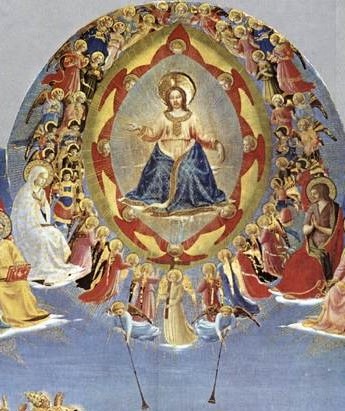
Q: The descriptions in the Bible seem to describe a vast amount of people, and the paintings I have seen from the Renaissance make it look rather crowded and busy. Frankly, I hate big cities and crowds. Are these descriptions accurate or am I missing something? Doris Leben, Wichita, Kansas
A: The danger to avoid when meditating on Heaven is taking earthly realities and merely transferring them to Heaven. Even if there are similarities to things on earth, things in Heaven will be experienced in a perfected way, with unspeakable joy.
The more biblical and theological way to understand the multitudes in Heaven is not as a physical crowding but as a deep communion. In other words, the Communion of Saints is not just a lot of people walking about or standing around talking.
St. Paul teaches, So we, who are many, are one body in Christ, and individually members, one of another (Rom 12:5). Although we experience this imperfectly here on earth, we will experience it perfectly in Heaven. As members of one another we will have deep communion; we will know and be known in a deep and rich way. Your memories, gifts, and insights will be mine, and mine will be yours. There will be profound understanding and appreciation, a rich love and a sense of how we all complete one another and really are all one in Christ.
Imagine the glory of billions of new thoughts, stories, and insights that will come from being perfectly members of Christ and of one another. Imagine the peace that will come from finally understanding and being understood. This is deep, satisfying, and wonderful communion—not crowds of strangers.
Therefore, the biblical descriptions of Heaven as multitudes should not be understood as mere numbers, but as the richness and glory of communion. The paintings showing “crowds” should be understood as an allegory of deep communion, of being close in a way we can only imagine.
St. Augustine had in mind the wonderful satisfaction of this deep communion with God and with one another in Christ when he described Heaven as Unus Christus amans seipsum (One Christ loving Himself). This is not some selfish Christ turned in on Himself. This is Christ, the Head, in deep communion with all the members of His Body, and all the members in Christ experiencing deep mystical communion with Him and with one another—together swept up into the life of the Trinity. As St. Paul says, you are Christ’s, and Christ is God’s (1 Cor 3:23).
This is the ninth in a series of articles on the Four Last Things: Death, Judgment, Heaven, and Hell.
I often think that we haven’t done a very good job of setting forth the doctrine of eternal life. For most people, the concept seems a rather shallow one: that we will live forever. Frankly, many may not consider it all that appealing if the place where we live forever is Heaven. Too often, Heaven is reduced to merely this: a place where I’ll be happy. I’ll have a mansion, I’ll see my mother again, and I won’t ever have to suffer. The description never gets around to mentioning God. If He is mentioned at all, He’s way down on the list somewhere rather than at the top where He belongs. This is sad, for the heart of Heaven is to be with God!
Pope Benedict XVI, in his encyclical “Spe Salvi,” pondered the problem of the generally poor understanding of eternal life:
Perhaps many people reject the faith today simply because they do not find the prospect of eternal life attractive. What they desire is not eternal life at all, but this present life, for which faith in eternal life seems something of an impediment. To continue living for ever—endlessly—appears more like a curse than a gift. Death, admittedly, one would wish to postpone for as long as possible. But to live always, without end—this, all things considered, can only be monotonous and ultimately unbearable. … The term “eternal life” is intended to give a name to this known “unknown.” Inevitably it is an inadequate term that creates confusion. “Eternal,” in fact, suggests to us the idea of something interminable, and this frightens us; “life” makes us think of the life that we know and love and do not want to lose, even though very often it brings more toil than satisfaction, so that while on the one hand we desire it, on the other hand we do not want it (Spe Salvi, 10, 12).
My own pondering and experience has led me to conclude that ultimately eternal life is not about the length of life, but its fullness. To enter eternal life means to become fully alive. Here on this earth we are not fully alive. We experience much of death in these lowly bodies of ours. However, most of us do get glimpses of eternal life and can experience some aspects of it. For example, have you ever had a day when you felt you had all the energy in the world? Not only did you feel energetic but your mind was sharp and you were efficient and effective. Everything seemed to click; there was joy and contentment. Days like that and feelings like that don’t last, but they provide a glimpse of what eternal life might be like—except that eternal life will be immeasurably better!
Another experience I have of eternal life is one that I hope you share. At the age of 56, my body is no longer in prime condition. It is aging and death will one day come to it, but my soul is more alive than ever. I am more joyful, serene, confident, prayerful, and content than ever. Many sins that used to plague me are gone or at least greatly diminished. In effect, I am more alive now than I was when I was in my twenties. Just wait until you see me at 75 or 90! As I get older I become more alive. What I am saying is that eternal life doesn’t just begin after we die. It begins now and should grow in us more and more. Its fulfillment will only be in Heaven but I am a witness (and I hope that you are too) that eternal life has already set deep roots in me.
This experience of being fully alive is to be contrasted with one of the descriptions of Hell in the Scriptures which refers to it as the “second death” (e.g., Rev 21:8). This means that the dammed, having died in the corporal sense, now descend to what is not really life. Yes, they have existence and experience, but their lives are dead because they are not living for what God made them for: His very self. Theirs is a “life” of frustration and emptiness because the whole key to happiness is missing. Having rejected God, His Kingdom, and His values, they have nothing left with which to fill the God-sized hole in their hearts. It is a life so far from eternal life that it is barely a life at all; thus Scripture calls it the “second death.”
Again, the main point is that “eternal” in “eternal life” refers not so much to the length of life as to its fullness. To enter eternal life is to become fully alive with God forever; to experience untold joy, serenity, and peace in an eternal embrace with Him forever. Having our communion with God perfected, we will also have our communion with one another perfected. We will be caught up in the great movement of love that is the life of the Trinity. Who really needs a mansion when you can live in the heart of God? That is our true dwelling place that the Father is preparing. It’s not about houses and seats of honor; it’s about a place in the heart of the God who made us and loves us. It is to become fully alive and perfect as the Father is perfect.
Pope Benedict presents this beautiful image of eternal life:
To imagine ourselves outside the temporality that imprisons us and in some way to sense that eternity is not an unending succession of days in the calendar, but something more like the supreme moment of satisfaction, in which totality embraces us and we embrace totality—this we can only attempt. It would be like plunging into the ocean of infinite love, a moment in which time—the before and after—no longer exists. We can only attempt to grasp the idea that such a moment is life in the full sense, a plunging ever anew into the vastness of being, in which we are simply overwhelmed with joy. This is how Jesus expresses it in Saint John’s Gospel: “I will see you again and your hearts will rejoice, and no one will take your joy from you” (16:22) (Spe Salvi, 12).
In the following video from a few years back, Bishop Robert Barron makes an interesting point, one that I have made in other posts as well: when the Church fails to teach her doctrine well or casts aside her traditions, the world often picks them up but distorts them. In this video, Bishop Barron discusses the current obsession with vampires. He notes that as we have struggled to present well the concept of eternal life, the world has taken up the notion of those “who can never die” in the vampire craze. The fact that they live forever is a horrible curse to them and any biblical notion of eternal life is absent; they are merely the “un-dead.” Yes, when the Church drops the ball, the world picks it up—but flattens and distorts it.
This is the eighth in a series of articles on the Four Last Things: Death, Judgment, Heaven, and Hell.
After some sobering reflection on death and judgment over the past several days, it’s finally time to talk about Heaven. Now that is a topic everyone wants to hear about! Yet there is a strange disconnect today. As it becomes easier and easier to satisfy our desire for instant gratification, we find it harder and harder to take the time to ponder a future paradise.
Almost no one talks about Heaven today—except perhaps at funerals—and then it is often to inappropriately presume the instant promotion of the deceased through Heaven’s gate.
The way most of our prayers sound today, it seems that we would be content to have God make this world a better place. People will ask God to improve their health and solve their financial problems, but rarely will they express any desire to go to Heaven and be with Him. It is almost as if we were saying to God, “If you’ll make this world a little more comfortable I’ll just stay here forever!”
Many older prayers speak of longing for Heaven. The “Hail, Holy Queen” laments that we live in exile, in a valley of tears, and are poor, banished children of Eve, who long to see the blessed fruit of Mary’s womb, Jesus. Many old hymns refer to being free at last, to flying away to Heaven some bright morning when this life is over, to looking forward to that day. Yes, soon and very soon we are going to see the King! Older churches were designed to remind Catholics of Heaven; their structures were often centered around the vision of Heaven.
Do you long for Heaven or are you just trying to make it through the day? When was the last time you heard a sermon about Heaven? Does the thought of it excite you? It is after all our reward, which eye has not seen and ear has not heard!
A big factor for the lack of longing for Heaven is that our lives are so comfortable these days. It is a kind of comfort that both distracts us from spiritual things and focuses us on worldly things. Our comforts also make the cross seem strange, even immoral. If Heaven is obtained through the cross, many say “It’s too much trouble.” They would rather focus on getting that new channel added to their cable television service or planning a cruise.
Add to this that we live in a world that is utterly upside down, a world in which most are not rich in what matters to God, a world that obsesses over passing and trivial things and pays little mind to eternal and heavenly things. Learning to love Heaven can mean some pretty radical things. It often means being willing to be 180 degrees out of phase with the world’s priorities and preoccupations.
St. Cyprian pondered this problem, which seems to have been evident to some degree in the wealthy city of Carthage:
[Regarding death] we struggle and resist like self-willed slaves and are brought into the Lord’s presence with sorrow and lamentation, not freely consenting to our departure, but constrained by necessity.
Why then do we pray for the kingdom of heaven to come if this earthly bondage pleases us? … If we should rather serve the devil here than reign with Christ?
The world hates Christians, so why give your love to it instead of following Christ, who loves you and has redeemed you? So banish the fear of death and think of the eternal life that follows. That will show people that we really live our faith.
Who of us, if he had long been a sojourner in a foreign land would not desire to return to his native country? Who of us, when he had begun to sail there would not wish for a prosperous wind to carry him to his desired home with speed, that he might sooner embrace his friends and relatives? We must account paradise our country (De Mortalitate, 26).
Heaven is something we must learn to love. In this it is like many of the finer things in life. Its appeal may not be immediately obvious, but having been trained in its ways, we learn to love it very deeply.
If we think that it is only natural to love Heaven, we must become more sober. The fact is, we have obtuse spirits. We live in a fallen world, governed by a fallen angel, and we have fallen natures. We tend to love that which is destructive and harmful, and even knowing that, we are still attracted to it. We tend to esteem that which is foolish and passing, while glamorizing evil. We tend to call “good” or “no big deal” what God calls sinful.
G.K. Chesterton observed,
The point of the story of Satan is not that he revolted against being in hell, but that he revolted against being in heaven. The point about Adam is not that he was discontented with the conditions of this earth, but that he was discontented with the conditions of paradise (New York American, 12-15-1932).
If Satan revolted against Heaven even while still in Heaven, and Adam preferred something to paradise while still in paradise, how much more should we be sober about the fact that it is very easy for us, who have not yet seen paradise or Heaven, to despise or minimize the value of the glory of God’s Kingdom.
Help us, Lord, to desire Heaven, to learn its ways, to learn of you, and to love you above all things.
This is the seventh in a series of articles on the Four Last Things: Death, Judgment, Heaven, and Hell.
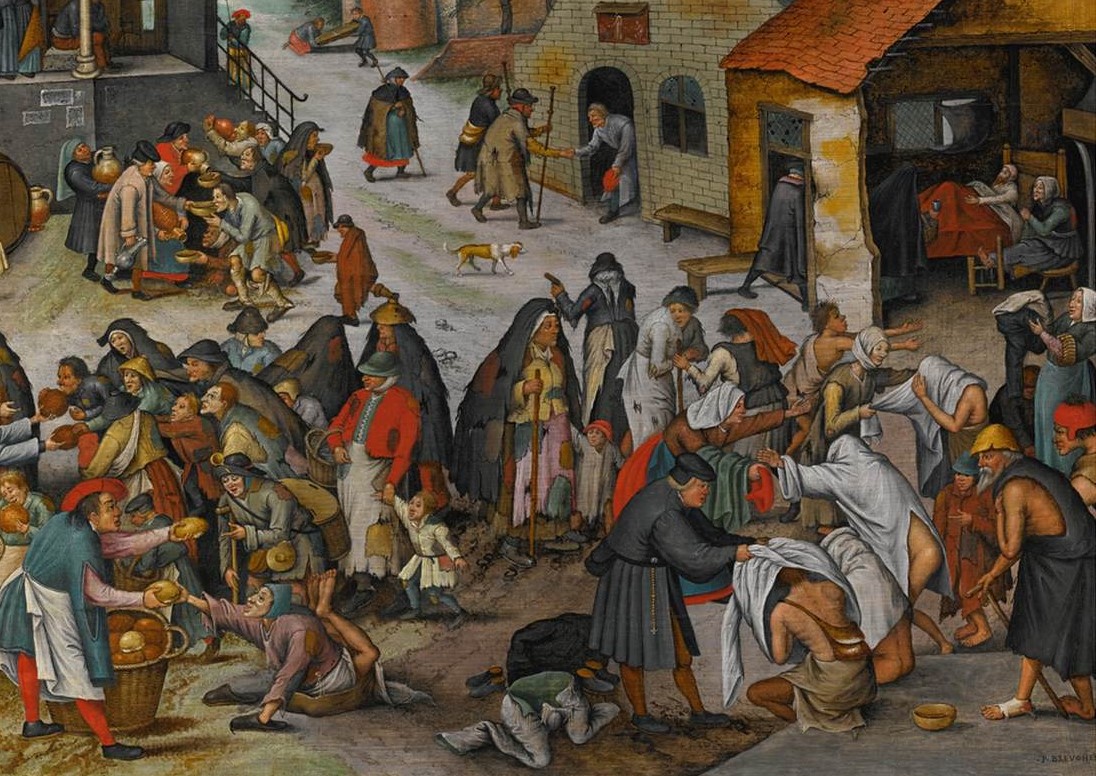
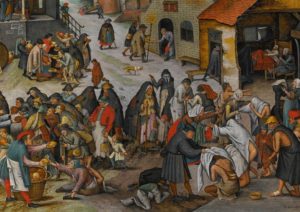
Works of Mercy, Pieter Bruegel
In the past several posts, we have been considering the judgment that awaits us. Not only must we be ready in the ways we have described, but should allow our looming judgment to help our attitude today.
Scripture says, Always speak and act as those who are going to be judged by the Law that gives freedom. For judgment without mercy will be shown to anyone who has not been merciful (James 2:12-13). Herein lies a way that we can influence the standard by which the Lord will judge us.
The key teaching from the Lord here is this: the measure with which you measure will in return be measured out to you (Luke 6:38). This statement comes at the end of a long discourse in which the Lord summons us to be generous, forgiving, merciful, patient, and reluctant to condemn others severely.
Consider this a kind of “mathematics” of the Kingdom of God.
In effect, the Lord says, “Do the math. Realize that if you are merciful, you will be judged with mercy, but if you are harsh and critical, you will be judged by a harsh and critical standard. If you refuse to forgive, you will not be forgiven.”
Like it or not, this is the mathematics of the Kingdom of God. It does not mean that we earn salvation, but it does mean that we have a lot of influence over the standard by which we will be judged.
So, if you are going to need mercy and grace on that day (and we all are), it is good to do the math of the Kingdom and store up mercy and grace for that day.
One day, we will all answer to God. That day, as Scripture repeatedly teaches, is a day about which we should be sober. Sadly, there are many who give little thought to this truth and some who outright scoff at it.
Remarkably, we can influence the manner in which God will judge us, the standard he will use. Here we speak of the manner of God’s judgment. That is, whether He will be strict or merciful. We do not refer to the content. It is an obvious and axiomatic truth that God will judge our deeds. Hence, we should avoid wickedness and grave sins, and repent quickly when we commit such sins.
On the one hand, it would seem that we could have no influence at all on the manner in which we will be judged, for it would seem that God is no respecter of persons, and judges with perfect justice.
On the other hand, there are passages in Scripture that do speak of ways that we can influence the standard God will use, the manner of His judgment. Let’s look at four areas in which we can have influence and consider a few biblical passages.
Whether we show mercy to others
Jesus says, Blessed are the merciful, for they shall obtain mercy (Matthew 5:7). James says something similar and develops it a bit when he says, Always speak and act as those were going to be judged under the law of freedom, because judgment without mercy will be shown to anyone who has not been merciful. So mercy triumphs over judgment (James 2:12-13). Thus we are taught that by observing mercy and patience in our relations with one another, we will influence the manner in which we are judged.
Sometimes in life, particularly if we are leaders or parents, we will need to punish and/or assign consequences to those who transgress moral laws or legal limits. Passages like these do not mean that we should never accompany correction with punitive measures. Such a way of living would be unwise and could confirm people in bad behavior. Even when punitive measures are needed, though, it makes sense to be lenient when possible and to attempt less measures before firmer ones are employed.
It is also clear from these biblical texts that it is highly foolish to go through life with severity toward others, with a lack of compassion or a harsh and unyielding attitude. We are all going to need a lot of grace and mercy at our judgment. Therefore, how misguided, how foolish it would be for us to be harsh and unmerciful toward others! For indeed, these text tell us that the merciful will be blessed and the unmerciful will be shown no mercy. Can you or I really expect that we will make it on the day of judgment without boatloads of mercy?
Now, therefore, is the time for us to seek to invoke the promise of the Lord: Blessed are the merciful for they shall obtain mercy.
Whether we are strict or lenient with others
In a related text, the Lord Jesus says,The measure that you measure to others, will be measured back to you (Mark 4:24). If we hope for and need a merciful judgment, if we want a merciful measure or standard to be used, then we must do the same for others. The Lord makes it clear that He will use the measure or standard that we have used for others when He judges us. Have we been strict? If so, then He will be strict with us. Have we been merciful? If so, then He will be merciful to us. Be very careful before demanding that sinners and others who transgress receive the strongest penalties. There may be a time for such penalties, but it is not necessary that the most severe punishments always be used.
In John chapter 8, the Pharisees wanted to exact the most severe penalty (stoning) on a woman caught in adultery. Jesus reasons with them, telling them that before they demand that He “throw the book at her,” they might want to recall that there are a few things about them that are also written in the book. One by one they drift away, seemingly after considering the foolishness of their demands for the most severe penalty. They finally realize that the measure they want to measure out to her will in turn be measured back to them.
Whether we are generous to the poor
Luke relates the following text more specifically to our generosity:Give and it will be given to you; good measure, pressed down, shaken together, and running over, will be poured into your lap. For the measure that you measure to others will be measured back to you (Luke 6:38). This leads us to a second area in which the Scriptures teach us that we can influence the day of our judgment.
After rebuking the Scribes and Pharisees for their severity and extreme legalism, Jesus says to them (who were obsessing about cleaning the outside of the dish), You fools, did not the one who made the outside of the cup make the inside also? But if you give what is inside the cup as alms to the poor, everything will be made clean for you (Luke 11:40-41). In the light of the theology of grace, this is a daring text. It almost implies that we can somehow “purchase” forgiveness. But of course it is the Lord Himself who says it, and He does not say that we can somehow purchase forgiveness. Surely, though, He does teach that generosity to the poor will in fact influence the day of our judgment.
Later in Luke’s Gospel, Jesus develops the thought, saying,I tell you, use your worldly wealth to gain friends for yourselves, so that when it is gone, you will be welcomed into eternal dwellings (Lk 16:9). It is a complicated text, but Jesus seems to be saying that our generosity to the poor will surely gain advantages for us at the day of our judgment. Indeed, blessing the poor gives us powerful intercessors, for the Lord hears the cries of the poor. The picture painted here is of those poor welcoming us into our eternal dwellings.
Scripture elsewhere warns, If a man shuts his ears to the cry of the poor, he too will cry out and not be heard (Proverbs 21:13). Once again, it would seem that we can have some influence over the manner, measure, or standard that will be used by God at our judgment. To the merciful, mercy will be shown. The generous will experience that their cries are heard, for they heard the cries of the poor. The Lord more than implies that those who have been generous to the poor will have powerful advocates praying and interceding for them on the day of judgment. Indeed, a number of the Fathers of the Church remind us that in this life the poor need us, but in the life to come we will need them.
Whether we forgive others
A final area to explore in terms of how we might have influence over the manner of our judgment is in the matter of forgiveness. Just after giving us the Our Father, the Lord Jesus says, For if you forgive others when they sin against you, your heavenly Father will also forgive you. But if you do not forgive others their sins, your Father will not forgive your sins (Matthew 6:14 – 15).
Later in Matthew’s Gospel, Jesus tells the terrifying parable of a man who had huge debt that was forgiven him by his master. When the man then refused to forgive his brother a much smaller debt, the master grew angry and threw him into debtors’ prison. Jesus concludes the parable by saying, This is how my heavenly Father will treat each of you, unless you forgive your brother from your heart (Matthew 18:35).
So yes, it would seem that we can have some influence over the manner in which God will judge us, the standard He will use. While it is true that God will judge us by our deeds (cf Romans 2:6), the manner in which He judges us, whether with strictness or leniency, does seem to be a matter over which we have influence.
We are all going to need a lot of grace and mercy, for if God judges with strict justice and strict standards, who can stand? We will all have much to answer for. All the more reason for us to follow the teachings of the Lord in His Scripture, so that we can be sure that on the day of our judgment, mercy and the grace of leniency will prevail in abundance. Do we want mercy? Then we must show mercy. Do we want a gentle standard? Then we must measure out gentleness. Do we want forgiveness? Then we must offer forgiveness. Recruit some intercessors for the day of judgment by giving to the poor. They will be the most powerful intercessors for us as we leave this life and go to our judgment.
Indeed, God has shown us how we can store up a treasure of mercy, waiting for us in Heaven at the judgment seat of Christ. There are some good lessons here to heed.
In the next article in this series, we will turn our attention to Heaven, another of the Four Last Things.
Here’s an amusing video illustrating that the measure we measure out to others will be measured back to us:
This is the sixth in a series on the Four Last Things: Death, Judgment, Heaven and Hell.
In the past two articles we have recalled the reality of the judgment that is upon us when we die and we have surveyed the parables in which Jesus urgently warns us of it. In this post we consider something of a plan to prepare for judgment.
You are going to die and you don’t get to say when. This should inspire a sober, urgent, and daily preparation for death and judgment. Yet too many people today are not serious about their spiritual walk. They’re running around as if life is just some big game. They’re not thinking about appearing before the judgment seat. They’re not praying. They’re not reading Scripture. They’re not growing in their faith. They’re are not going to Mass on Sundays. Many of them are stubbornly locked in very serious and unrepentant mortal sin. They are not going to be ready. To them, the message must be turn to Jesus. Repent. Give Him your life.
Obviously, the main point is to live a life of faith and, through ongoing conversion, to permit the Lord to do what is necessary to prepare us. The following description of the Christian life appears in Acts 2:42: They devoted themselves to the apostles’ teaching and to fellowship, to the breaking of bread and to prayer. Four things follow: that we should pray, be obedient to the Scriptures, faithfully and worthily receive the sacraments, and stay united to the Body of Christ, the Church. To this must be added ongoing repentance and the will to allow the Lord to free us from the grip of sin. Consider the following reflection and four-point plan of preparation:
Rest – Prayer is resting in the Lord. Prayer as rest is a great “power-nap,” so pray every day. Some folks tell me that it’s hard to pray or that they don’t know how to pray. Well, do you know what you’re doing when you say that? You’re already praying! Don’t tell me; tell God. If that’s where you’ve got to begin with your prayer, say to Him: “Lord, I don’t like to pray. I struggle to pray. Prayer is boring.” Tell Him whatever you need to tell Him. Prayer isn’t reading words that somebody else wrote that you don’t mean. Prayer is talking to the Lord and telling Him what’s going on in your life. At its heart, prayer is paying attention to God.
Sweet hour of prayer, sweet hour of prayer, that calls me from a world of care. And bids me at my Father’s throne, make all my wants and wishes known. In seasons of distress and grief, My soul has often found relief, And oft escaped the tempter’s snare, By thy return, sweet hour of prayer!
Read – Read Scripture and only holy writings – We simply must read Scripture every day and study the teachings of the Church. Our minds will be polluted if we don’t cleanse them every day with God’s Word and the teachings of the Faith. Some people say that it’s hard to understand Scripture, but there are so many aids available: “My Daily Bread,” “The Word Among Us,” “Magnificat,” study bibles. Some folks even get the Word sent to their cell phones each day along with some commentary. Somehow, some way, get with God’s Word every day. We seem to find time for everything else; find some time for God’s Word.
The Word of God helps us to think more as God does, not as the world does. Our priorities improve and we begin to win the fight in the chief battleground: our mind. Sow a thought, reap a deed; sow a deed, reap a habit; sow a habit, reap a character; sow a character, reap a destiny. It all begins in the mind. As Scripture itself says, we must be transformed by the renewal of our mind (see Romans 12:2). If you’re not winning the battle in your mind, you’re going backward and the abyss is approaching. Study Scripture. Be devoted to learning your faith.
Rehearse – Go to Mass every Sunday. Mass attendance and Church membership are essential for salvation. In the first place, God is worthy of our praise and adoration. To fail in our Sunday obligation displays an egregious lack of gratitude.
We also need to come to God’s house so that we can be instructed and then fed with the Body and the Blood of the Lord. Jesus says, If you do not eat my flesh and drink my blood, you have no life in you (Jn 6:53). Some people say, “Oh, I watch the Mass on TV.” You can’t get Holy Communion through the television! People who don’t go to Mass are starving themselves spiritually and will not have strength for the journey.
If you don’t attend in person, you can’t get real fellowship. Fellowship is about more than coffee and doughnuts; it’s about mutual support and accountability; it’s about the love we are commanded to have for one another.
Go to Mass every Sunday. Receive Communion every Sunday, provided that you are in a state of grace.
Some say, “God doesn’t care if I go to Mass or not.” Yes, He does. He put it right in the Ten Commandments: “Remember to keep holy the Sabbath.” We fulfill this each Sunday. When God puts something in the Ten Commandments, He is serious. Don’t mess around with the Ten Commandments. Missing Mass without a serious reason is a mortal sin.
Mass is the dress rehearsal for Heaven; it’s our training ground for what awaits. If you don’t even want to show up for the dress rehearsal, why should God trust you with the real thing? The fact is we are simply not able to endure the real Heaven unless we are well-rehearsed in its truths and purified by the sacraments.
Repent – If you are aware of any serious or unrepented mortal sin in your life, repent now and call on the Lord’s mercy. Go to confession; go frequently. Some folks tell me, “I’m in such a mess that I don’t know how to get out of it.” Go to the Lord and talk to Him about it. Say, “Help me, Lord!” But please, do not go on calling “good” or “no big deal” what God calls sin! The Lord says, No one who calls on me will I ever reject (Jn 6:37).
Upon hearing the call to repent, too many people today say, “I will not be told what to do. I will not be told what is right and wrong.” Be careful! The one thing that God can’t save us from is that kind of pride, because with it we don’t want to be forgiven. And so again I say to all of us: Repent—and be urgent about it.
No one loves you more than does Jesus Christ, and yet no one warned about judgment and Hell more than He did. Many people today are dismissive of judgment and Hell. They say, “Jesus would never do that.” But Jesus told us over and over again that there will be a judgment, and it’s not so much about what He decides but what we decide through the way we live our life. Jesus says this: Here is the judgment in question, that the Light has come into the world, but many prefer the darkness, because their deeds are sinful (Jn 3:18).
So there is a judgment coming. The Lord warns us in parable after parable. I simply ask you to be ready. In a future post we will talk more about Hell and why it exists. For now, though simply listen to what the Lord is saying. He teaches of a day of judgment, of the reality that “many” go to Hell, and of the need to call upon Him before our hearts are forever lost in pride and sin.
Tomorrow we will consider one final thing about judgment: the wonderful thought that we can have an influence on the standard with which the Lord will judge us.
The Gospel this Sunday presents a number of practical principles of preparation. As always the Lord has a way of teaching us in a very memorable way. Let’s look at four principles taught in the Parable of the Wise and Foolish Virgins. In the end we will find that the Lord turns the tables on us.
I. Procure your Provisions – The text says, The kingdom of heaven will be like ten virgins who took their lamps and went out to meet the bridegroom. Five of them were foolish and five were wise. The foolish ones, when taking their lamps, brought no oil with them, but the wise brought flasks of oil with their lamps.
In looking at this text we see that humanity is divided into the wise the foolish. We generally live in times that like to deemphasize distinctions. While there are times when they truly do not matter, today’s Gospel does not depict one of those times. To be wise is to be richly rooted in God and in what He offers: His love, wisdom, grace, mercy, truth, vision, and priorities—His very life.
If one lacks these things is not merely a matter of unfortunate poverty or bad luck, for they are offered richly and freely to all by God.
Lacking these things shows one to be a fool. Many proceed through this life considering themselves very smart, and they may be smart in science, or finance, or business, or sports; but being smart is not the same as being wise. One can be very smart yet still a fool. One may climb the ladder of success, but if it is leaning up against the wrong wall it will lead only to ruin. The wise, whether smart or simple, know God and are recipients of His gifts. The foolish deny Him or His gifts, whether explicitly through conscious resistance or implicitly through lukewarmness and lip service.
In this parable, the wise virgins bring extra oil. They have procured their provisions.
What is this oil? The Fathers of the Church had many answers. Some said it was love, others wisdom or holy deeds. We need not limit it to any one thing, though. The oil is the love of God, the Wisdom of God. It is God Himself. It is all God’s treasures of Scripture, the Sacraments, prayer, the Church, and the liturgy; it is joy, mercy, forgiveness, peace, and the gift of holiness. The wise virgins have stocked up on God’s abundant gifts. They have richly availed themselves of God’s goodness and plentiful graces.
The foolish virgins are not wholly lacking in God’s gifts, for no human being made in the likeness of God is, but they have endowed themselves sufficiently to see the night of this life through. They are careless and lazy. Perhaps carrying extra oil is too much trouble, just as going to Mass, praying, and reading Scripture are too much trouble for “the foolish” today.
What about you? Are you wise or foolish? Put another way, are you procuring your provisions? Are you availing yourself of the oil of God’s good gifts or do you have other “more important” things to do?
The first principle of proper preparation is to procure your provisions.
II. Prepare Personally – The text says, The foolish ones said to the wise, “Give us some of your oil, for our lamps are going out.” But the wise ones replied, “No, for there may not be enough for us and you. Go instead to the merchants and buy some for yourselves.”
At first the answer of the wise virgins surprises us. Shouldn’t they share? Isn’t that what we would expect Jesus to say?
But there are some things you can’t lend and some things you can’t borrow. You can’t borrow someone else’s relationship with God. You can’t borrow holiness, or mercy, or love, or wisdom. You can’t borrow someone else’s prayer life. You have to have your own.
As a priest, I get lots of requests, sometimes for money, sometimes to use the Church for a funeral. I often inquire, “Was the deceased a parishioner here?” So often the answer is, “Well, no, but his grandmother was,” or “his second cousin used to be.” Now I’ll celebrate the funeral Mass, no matter, but the answer is “No, he wasn’t.” The fact that his Grandmother or his second cousin attended Mass here has nothing to do with it. None of that will profit him before God; none of that adds even a drop of oil to his lamp. You can’t borrow your grandmother’s holiness; you have to have your own.
Hence we must personally prepare to meet God. We must come to know Him and to love Him. We must be open to receiving the gifts He offers: prayer, Scripture, the liturgy, the sacraments, the moral life, a new mind and heart.
What about us? Do we have our own oil, or are we just talking about what a great person our grandmother was? An old gospel hymn says, “Yes, I know Jesus for myself.” Do we? Another old gospel hymn says, “My mother taught me how to pray. So if I die and my soul be lost, it’s nobody’s fault but mine.”
The second principle of proper preparation is to prepare personally.
III. Persevere in Preparations – The text says, At midnight, there was a cry, Behold the bridegroom! Come out to meet him! … and those who were ready went into the wedding feast with him. Then the door was locked.
This is an important reminder we must persevere in our walk until the end. The groom did not come until midnight and the foolish virgins could not hold out to the end.
I cannot tell you, how often people tell me things like this: “I used to be an altar boy.” “I used to go to your church.” “I went to St Cyprian’s School” “I’m old St Cyprian’s. Our family goes way back; my Grandfather helped build the place!” I think I’m supposed to be impressed, but instead I ask, “Where are you today?” Usually they aren’t anywhere at all. If so I often respond with something like this: “You’re telling me that you used to have your lamp trimmed and burning, but it sounds like you’ve run out of oil. Watch out, the Day is drawing nigh!”
The point is that only those who were ready with their lamps trimmed and burning when the groom arrived were allowed to entered the wedding with him. After that, the door was barred. We must be faithful unto the end. Jesus says, He who perseveres to the end will be saved (Matt 24:13). Scripture also says, Call no man blessed till he die. For it is by his end that a man is known (Sirach 11:28).
Persevere. It’s wonderful that you read the entire Bible when you were in high school, but where are you today? Where will you be at midnight?
The third principle of proper preparation is to persevere in your preparations.
IV. Procrastination is Perilous – The text says, While [the five foolish virgins] went off to buy [the oil], the bridegroom came … those who were ready went into the wedding feast with him. Then the door was locked. Afterwards the other virgins came and said, “Lord, Lord, open the door for us!” But he said in reply, “Amen, I say to you, I do not know you.” Therefore, stay awake, for you know neither the day nor the hour.
In the end, our wisdom goes with us or our foolishness catches us. The foolish virgins scrambled at the end to get what they needed, but it was too late. The door was barred.
One physical explanation for this detail may be found in the fact that houses of the ancient world were often rather small, but backed out onto a closed courtyard. Hence, when all the guests had arrived, the doors of these small houses were close and the furniture moved up against the walls and the door to make room as the celebration began. To move everything to open the door was problematic, and it was rude to ask for this.
It was just too late for them. Yes, procrastination is perilous.
Two things call for our special attention:
First, there are the words of the Lord, “I do not know you.” The Greek word here is οἶδα (oida) which bespeaks a kind of intellectual knowing. It may surprise us to hear the omniscient Lord say that He does not know them. Perhaps we can understand the word as meaning that He does not “recognize” them as guests; they are not on the guest list. Or, to use another metaphor, they are not among the sheep of His flock. Later in this same chapter of Matthew Jesus will speak of dividing the sheep from the goats. Hence there is a judgment issued here: I do not recognize you as one of my flock; the door cannot be opened; it is too late. But how did it get to be so late and what does it mean that the door is barred?
This leads us to the second point that demands our attention. It is said that the foolish virgins are knocking on the door, or at least calling out, asking for entrance.
But this precisely backward. It is not we who knock, but the Lord. It is He who bids us to open and we who must answer. Jesus says, Here I am! I stand at the door and knock. If anyone hears my voice and opens the door, I will come in and eat with him, and he with me (Rev 3:20). It is the Lord who calls, It was I who chose you (Jn 15:16).
The way to heaven is not through some door “up there.” It is through the door down here, the door that we must open, the door of our heart. The Lord is knocking now. Procrastination is peril; it is foolishness. Now and every day, we must answer the knock. The choice is ours. Yes, the door to Heaven is opened from the inside of our heart. It is we who ultimately determine our destiny. At the judgment, the Lord merely ratifies our decision.
The Lord wants to know us, to recognize us as His own. That is why He knocks and knocks. Will you answer?
Be careful, the fourth principle of proper preparation realizing that procrastination is perilous. There comes a day when the door is forever closed. Remember, the door is your heart. Answer! Open!
This song says, “Somebody’s knocking at your door. Oh sinner, why don’t you answer? Somebody’s knocking at your door.”
Consider the commercial below. It says a lot about how we can conceive of Christ, and the desire of some to refashion Him. Perhaps we do well to look at it by analyzing the dramatis personae (cast of characters) and weaving in the plot.
As the scene opens there are three women who come upon a car belonging to one of them. The car has been damaged and this little crisis sets the stage for the different notions of the sort of savior who is needed. Let’s look at each person in the drama and see what we can learn:
The woman in the center is a sensible Christian. She is the owner of the car. She is unfazed by the damage to her car; she knows exactly what to do. She summons her insurance agent, who appears as if out of nowhere. She trusts him to handle everything and even encourages her friends to call on him.
The insurance agent is a Christ figure. He wears a red tie, reminding us of the blood that was shed for us. He has a book in his hand in which everything is recorded. He arrives not only to bring help but to make a judgement. He consults his book and gets to work (cfRev 20:12ff). His name is Rich; Christ is surely “rich” in grace (cf2 Cor 8:9). Later on in the ad he will rebuke the darkness.
The woman on the left is a worldly Christian. Although the Christ figure stands in her midst, she ignores him, wanting to see if she can come up with her own helper, a savior of her own making. It would seem that Rich, the Christ figure already standing there, does not suit her fancy. She wants one who is cute and more “sensitive.” An unchallenging agent is what she wants, one who will be more soothing, surely not one dressed in a business suit (as is Rich, the Christ figure with the red tie, who means business).
The woman on the right is a carnal Christian. She is lustful, impetuous, and daring; she wants a man who is similar. She hardly notices the Christ figure, except to reject him with a sneer. She calls for her “savior,” one with a dark side, and he appears on the scene. He is a rogue, a thug; lustful, arrogant, irresponsible, and immature. He is the perfect projection of her carnal, lustful, fallen nature, and you can see it by the look in her eyes.
In the background, the Christ figure just keeps on working, as if to say, My Father is always at his work to this very day, and I, too, am working (Jn 5:17).
Now the carnal thug is sitting on the car. Not only is he not helping, he’s making things worse. So the Christ figure says to him, “Hey, Darkside, get your feet off the car.” It’s as if he’s saying, “Be gone, Satan.”
Yes, there it is: the light rebuking the darkness. The light shines in the darkness and the darkness has not overcome it.
Which one are you in this story: the carnal Christian, the worldly Christian, or the sensible Christian? What sort of a savior are you looking for?

 The commercial below must have taken weeks to film. Regardless of its intent (selling homeowner’s insurance), there is something of an admonition in both the video and the accompanying music: life and the things of life slip away. Not a bad theme in November, when the Church bids us to meditate on the last things.