It may seem odd to say, “Let God find you.” After all, God knows just where we are. But there is something very respectful about a God who, as Jesus says in the Book of Revelation, stands at the door and knocks. Even back in the Garden of Eden, as sinful Adam and Eve hid, God walked through the garden and called, “Where are you?”
Yes, God waits until we let him find us, until we open the door of our heart where he knocks, or until we decide to come out of hiding.
But God does knock. He sends us prophets and speaks through creation and His Word to establish a connection with us. He seeks a connection. Let God find you. Open the gift of His offer.
Something of this dynamic occurred to me while watching the John Lewis Christmas commercial below. And while the roles seem reversed, the dynamic is the same. A little girl spies a lonely man on the moon and seeks to get his attention, to connect with him somehow. But the man seems lost in his loneliness. Through perseverance, she reaches him and the connection is opened.
Let God find you. Let Him connect with you this Christmas.
In our culture’s current self-examination on sexual harassment and sexual abuse, we would also do well to ponder how the “contraceptive mentality” has contributed to the many sexually related problems of the day. This view insists that there is no necessary connection between sex and having children; it separates what God has joined. This has led to a whirlwind of confusion about the nature and purpose of sexual intimacy as well as about marriage and family. Many treat sex lightly and frivolously; they falsely think that sex can be without consequences. As we have seen played out in the recent news, many men no longer see women as wives, mothers, and persons to be respected, but as sexual objects to be exploited.
Two generations have passed since the publication of the boldly pastoral and prophetic encyclical Humanae Vitae, which upheld the ancient ban on the use of artificial contraception. Perhaps no teaching of the Church causes more scoffing (even from Catholics) than our teaching against artificial contraception: Unrealistic! Out of touch! Uncompassionate! Silly! You’ve got to be kidding!
The Lord Jesus had an answer to those who ridiculed Him in a similar way:
“To what can I compare this generation? They are like children sitting in the marketplaces and calling out to others: ‘We played the flute for you, and you did not dance; we sang a dirge and you did not mourn.’ For John came neither eating nor drinking, and they say, ‘He has a demon.’ The Son of Man came eating and drinking, and they say, ‘Here is a glutton and a drunkard, a friend of tax collectors and sinners.’ But time will prove where wisdom lies” (Matt 11:16-18).
Indeed, times does prove where wisdom lies. Some fifty years after acceptance of contraception set in, how are we doing? Perhaps it is best to review some of the “promises” that advocates of contraception made and then review the prophecies of Pope Paul VI. Then let’s review the record and note the “fruits” of contraception.
The Promises of the Contraception Advocates:
Happier marriages and a lower divorce rates, because couples will be able to have all the sex they wanted without the “fear” of pregnancy.
Lower abortion rates because there will be far fewer “unwanted” children.
Greater dignity for women because they will no longer be “bound” by their reproductive system.
A more recent promise: reduction in sexually transmitted diseases (STDs) and AIDS.
The concerns and predictions of Pope Paul VI (in Humanae Vitae):
Consider how easily this course of action could open wide the way for marital infidelity (HV # 17)
A general lowering of moral standards. Not much experience is needed to be fully aware of human weakness and to understand that human beings—and especially the young, who are so exposed to temptation—need incentives to keep the moral law, and it is an evil thing to make it easy for them to break that law. (HV # 17)
Another effect that gives cause for alarm is that a man who grows accustomed to the use of contraceptive methods may forget the reverence due to a woman, and, disregarding her physical and emotional equilibrium, reduce her to being a mere instrument for the satisfaction of his own desires, no longer considering her as his partner whom he should surround with care and affection. (HV # 17)
Who will prevent public authorities from…impos[ing] their use on everyone. (HV # 17)
So who had the wisdom to see? Was it the world or the Church? Let’s consider some of the data:
The divorce rate did not decline; it skyrocketed. Divorce rates soared through the 1970s and beyond until nearly 50 percent of marriages were failing. In recent years the divorce rate has dropped slightly, but this may be due more to the fact that far fewer people get married in the first place, preferring instead to cohabitate and engage in a kind of serial monogamy, drifting from one relationship to the next. The overall divorce rate currently hovers in the low 40 percent range. Advocates of contraception today claim that divorce is a complicated matter, which is certainly true, but they cannot have it both ways: at first claiming that contraception will be a “simple” fix to make marriages happier and then, when they are proved so horrifyingly wrong, claiming that divorce is “complicated.” Pope Paul VI, on the other hand, predicted rough sailing for marriage with the advent of contraception; it looks as if he was right.
Abortion rates did not decline; they skyrocketed as well. Within a few years, the pressure to make abortion more available led to its “legalization” in 1973. It has been well argued that far from decreasing the abortion rate, contraception actually increased it. Because contraception routinely fails, abortion has become the contraception of last resort. Further, just as the Pope predicted, sexual immorality has become widespread; this also has led to higher rates of abortion. It is hard to compare promiscuity rates between periods because people don’t tend to tell the truth when asked about such things. But one would have to be very myopic not to notice the huge increase in open promiscuity, cohabitation, pornography, and the like. All of this bad behavior, made more possible by contraceptives, also fuels abortion rates. Chalk up another one for the Pope’s and the Church’s foresight.
Women’s dignity is a difficult thing to measure, and different people have different yardsticks by which to measure it. Women do have greater career choices today, but is that the true source of a person’s dignity? Dignity certainly involves more than one’s economic and utilitarian capacity. Sadly, motherhood has taken a back seat in popular culture. And, as the Pope predicted, women have been hypersexualized as well. Their dignity as wives and mothers has been set aside in favor of the sexual pleasure they offer to men. Many modern men, no longer bound by marriage for sexual satisfaction, use women and discard them on a regular basis. Men “get what they want” and it seems that many women are willing to supply it rather freely. In this scenario, men win. Women are often left with STDs. They are often left with children they must support and raise alone. And as they get older and “less attractive” to men, they are often alone. I am not sure that this is dignity. Have women really benefited under this new morality, which contraception helped to usher in? I think the Pope wins this point as well.
As for preventing/reducing STDs and AIDS: again, big failure. STDs were not prevented, nor did they decrease. Infection rates skyrocketed through the 1970s and 1980s. AIDS, which appeared on the scene in the 1980s continues to show terribly high rates. Where is the promised deliverance? It seems that contraceptives do not prevent anything. Rather, they encourage the spread of these diseases by encouraging the bad behavior that causes them. Here, too, it looks as if the Church was right and the world was wrong.
Add to this list of effects the high rate of teenage pregnancy, the devastation experienced by single parent families, and even increasing poverty. The link to poverty may seem a stretch, but the bottom line is that single motherhood is the chief cause of poverty in this country. Contraception encourages promiscuity. Promiscuity often leads to pregnancy at a young age. Youthful pregnancy often leads to single motherhood (absent fathers). Single motherhood often leads to welfare dependence and poverty. In our inner cities today, over 80 percent of homes are headed by single mothers. It is the single best predictor of poverty.
Declining birth rates, fueled by contraception, are devastating cultures. Europe as we have known it is simply going out of existence. (I have written on that before here: Contraception is Cultural Suicide!). Europe’s future is as a Muslim continent; Muslims typically have much larger families. Likewise, here in the United State, the birth rate in white and African-American communities is below replacement level. Thankfully, our immigrants are largely Christian and share our American vision. For the Church, the declining birthrates are resulting in the closing of parishes and schools, and a reduction in vocations to the priesthood and religious life. We cannot sustain what we have on a population that is no longer replacing itself. Immigration has insulated the Church from this to some extent, but the decline in Mass attendance has eclipsed the growth from immigration and we are starting to shut down a lot of our operations.
Conclusion: Time will prove where wisdom lies. What have we learned over these decades of contraception? First, we have learned that it is a huge failure in meeting its promises; it has backfired, making things worse rather than better. Marriage, families, and children have all taken a huge hit. Bad behavior has been encouraged and all the bad consequences that flow from it are flourishing. Most people seem largely uninterested in this data. Hearts have become numb and minds have gone to sleep. I hope that you will consider this information thoughtfully and share it with others. Time has proven where wisdom lies. It is time to admit the obvious.
In the Liturgy of the Hours this week we read a remarkable attributed to St. Macarius, a bishop of the early Church. I marvel at its vivid imagery, and yet at the same time, questions arise in my mind as to the general application of the text. In effect, the text states that if the soul does not have Christ living within, it falls into utter disrepair and a contemptible state.
Allow me to have Bishop Macarius speak for himself and then I would like to pose a few questions.
When a house has no master living in it, it becomes dark, vile and contemptible, choked with filth and disgusting refuse. So too is a soul which has lost its master, who once rejoiced there with his angels. This soul is darkened with sin, its desires are degraded, and it knows nothing but shame.
Woe to the path that is not walked on, or along which the voices of men are not heard, for then it becomes the haunt of wild animals. Woe to the soul if the Lord does not walk within it to banish with his voice the spiritual beasts of sin. Woe to the house where no master dwells, to the field where no farmer works, to the pilotless ship, storm-tossed and sinking. Woe to the soul without Christ as its true pilot; drifting in the darkness, buffeted by the waves of passion, storm-tossed at the mercy of evil spirits, its end is destruction. Woe to the soul that does not have Christ to cultivate it with care to produce the good fruit of the Holy Spirit. Left to itself, it is choked with thorns and thistles; instead of fruit it produces only what is fit for burning. Woe to the soul that does not have Christ dwelling in it; deserted and foul with the filth of the passions, it becomes a haven for all the vices. (St. Macarius, bishop, Hom. 28: PG 34, 710-711).
This is a remarkably vivid, creative description of the soul without Christ, of one who has turned aside from the faith. To be sure, St. Macarius speaks in a general sort of way. Each person’s personal journey will be affected by any number of factors: how absolute a person’s rejection of the faith is, how influenced he is for better or worse by the people and culture around him, how operative he has allowed their natural virtues to be, and so forth. Hence, we ought not to simplify the lives of unbelievers. They come in many forms and degrees.
If, however, the “person” in question is a culture or nation, St. Macarius’ words are especially accurate. We have clearly seen how our own Western culture has suffered gravely as it has “kicked God to the curb.” It is not an exaggeration to describe the Western world as a house that has no master living in it … dark, vile, and contemptible, choked with filth and disgusting refuse … darkened with sin, its desires are degraded, and it knows nothing but shame. Increasingly, this is our lot in the West, our daily fare.
As the recent spate of sexual abuse allegations and revelations demonstrate, we as a culture engage in some degree of self-correction. Too often, however, our outrage is both selective and short-lived. There is little evidence that we are willing to consider the overall “pornification” of our culture as an underlying problem. It seems unlikely that the current celebration of sexual misconduct, confusion, and immodesty in movies, music, and popular culture is going to be included in our national examination of conscience.
Thus our culture remains in great disrepair. As St Macarius describes, we are adrift like a pilotless ship, foul with the filth of the passions, and a haven for all the vices. While lust and greed predominate, it is clear that our jettisoning of the faith and of biblical norms is having increasingly devastating effects on every level. We have become more coarse, base, angry, and disrespectful of one another; we are exploitative, wasteful, and often ungrateful for what we have; we are increasingly impatient, resentful, and sullen at even the slightest inconvenience or problem. By jettisoning the first three commandments that refer to our relationship with God, the seven commandments that regulate our relationship with one another are undermined as well. This is central to St. Macarius’ point. When a house [or culture] has no master living in it [because collectively we have shown God the door], it becomes dark, vile and contemptible, choked with filth and disgusting refuse.
Help us, Lord, to rediscover the beauty of your truth. We have suffered by casting you to the margins. Though even in more religious times we were not free of sin, we have only suffered more by departing from you. Bring us back as a nation, O Lord! Keep us more faithful and help us enjoy more than ever before the beauty of your truth and order. In Jesus’ name!
In the readings for Tuesday of the 34th Week of the Year, both Daniel and Jesus speak of the destruction that is upon nations and empires of this world. Daniel spoke to the people of his time and indicated that the Jewish people would suffer from four oppressive kingdoms, which though unnamed we now know as Babylon, Persia, Greece, and Rome. Each of these kingdoms would eventually fall. The only sure kingdom is one that Daniel describes:
the God of heaven will set up a kingdom that shall never be destroyed or delivered up to another people; rather, it shall break in pieces all these kingdoms and put an end to them, and it shall stand forever (Daniel 2:44).
Jesus takes up the theme in His Mount Olivet discourse, warning that the Temple so admired by the Apostles so admired was going to be destroyed and that the hopes of the restoration of a Jewish nation and political power were mistaken.
All that you see here—the days will come when there will not be left a stone upon another stone that will not be thrown down (Luke 21:6).
The Temple and the Jewish nation were not so much being destroyed as being replaced. Jesus Himself is the Temple of the New Covenant and the nation is His Body the Church.
The message of these readings is clear enough: earthly nations and powers come and go, but the Kingdom of God is forever. Though the gates (i.e., powers) of this world and Hell itself would seek to destroy Christ and His Church, they will never prevail. Put not your trust in princes, in mortal men in whom there is no salvation (Psalm 146:3).
Yes, nations, cultures, and civilizations go through cycles. Over time, many civilizations and cultures have risen and then fallen. We who live in painful times like these do well to recall this. Cultures and civilizations come and go; only the Church (although often in need of reform) and true biblical culture remain. An old song says, “Only what you do for Christ will last.” Yes, all else passes; the Church is like an ark in the passing waters of this world and in the floodwaters of times such as these.
For those of us who love our country and our culture, the pain is real. By God’s grace, many fair flowers have come from Western culture as it has grown over the past thousand or so years. Whatever its imperfections (and there were many), great beauty, civilization, and progress emerged at the crossroads of faith and human giftedness. It appears that today we are at the end of an era. We are in a tailspin from which we can’t seem to extricate ourselves. Greed, aversion to sacrifice, secularism, divorce, promiscuity, and the destruction of the most basic unit of civilization (the family), do not make for a healthy culture. There seems to be no basis for true reform and the deepening darkness suggests that we are moving into the last stages of a disease. This is painful but not unprecedented.
Sociologists and anthropologists have described the stages of the rise and fall of the world’s great civilizations. Scottish philosopher Alexander Tyler of the University of Edinburg noted eight stages that articulate well what history has demonstrated. I first encountered these stages in Ted Flynn’s book The Great Transformation.
Let’s look at each of the eight stages. The names of the stages are taken directly from Tyler’s book and are presented in bold red text. My brief reflections follow in plain text.
From bondage to spiritual growth – Great civilizations are formed in the crucible. The Ancient Jews were in bondage for 400 years in Egypt. The Christian faith and the Church came out of 300 years of persecution. Western Christendom emerged from the chaotic conflicts during the decline of the Roman Empire and the movements of often fierce “barbarian” tribes. American culture was formed by the injustices that grew in colonial times. Sufferings and injustices cause—even force—spiritual growth. Suffering brings wisdom and demands a spiritual discipline that seeks justice and solutions.
From spiritual growth to great courage– Having been steeled in the crucible of suffering, courage and the ability to endure great sacrifice come forth. Anointed leaders emerge and people are summoned to courage and sacrifice (including loss of life) in order to create a better, more just world for succeeding generations. People who have little or nothing, also have little or nothing to lose and are often more willing to live for something more important than themselves and their own pleasure. A battle is begun; a battle requiring courage, discipline, and other virtues.
From courage to liberty – As a result of the courageous fight, the foe is vanquished and liberty and greater justice emerge. At this point, a civilization comes forth, rooted in its greatest ideals. Many who led the battle are still alive and the legacy of those who are not is still fresh. Heroism and the virtues that brought about liberty are still esteemed. The ideals that were struggled for during the years in the crucible are still largely agreed upon.
From liberty to abundance – Liberty ushers in greater prosperity because a civilization is still functioning with the virtues of sacrifice and hard work. But then comes the first danger: abundance. Things that are in too easily available tend to weigh us down and take on a life of their own. At the same time, the struggles that engender wisdom and steel the soul to proper discipline and priorities move to the background. Jesus said that man’s life does not consist in his possessions. But just try to tell that to people in a culture that starts to experience abundance! Such a culture is living on the fumes of earlier sacrifices; its people become less and less willing to make such sacrifices themselves. Ideals diminish in importance and abundance weighs down the souls of the citizens. The sacrifices, discipline, and virtues responsible for the thriving of the civilization are increasingly remote from the collective conscience; the enjoyment of their fruits becomes the focus.
From abundance to complacency – To be complacent means to be self-satisfied and increasingly unaware of serious trends that undermine health and the ability to thrive. Everything looks fine, so it must be Yet foundations, resources, infrastructures, and necessary virtues are all crumbling. As virtues, disciplines, and ideals become ever more remote, those who raise alarms are labeled by the complacent as “killjoys” and often considered extreme, harsh, or judgmental.
From complacency to apathy – The word apathy comes from the Greek and refers to a lack of interest in or passion for the things that once animated and inspired. Due to the complacency of the previous stage, the growing lack of attention to disturbing trends advances to outright dismissal. Many seldom think or care about the sacrifices of previous generations and lose a sense that they must work for and contribute to the common good. “Civilization” suffers the serious blow of being replaced by personalization and privatization in growing degrees. Working and sacrificing for others becomes more uncommon. Growing numbers becoming increasingly willing to feed on the carcass of previous sacrifices. They park on someone else’s dime but will not fill the parking meter themselves. Hard work and self-discipline continue to erode.
From apathy to dependence– Increasing numbers of people lack the virtues and zeal necessary to work and contribute. The suffering and the sacrifices that built the culture are now a distant memory. As discipline and work increasingly seem “too hard,” dependence grows. The collective culture now tips in the direction of dependence. Suffering of any sort seems intolerable; virtue is not seen as the solution. Having lived on the sacrifices of others for years, the civilization now insists that “others” must solve their woes. This ushers in growing demands for governmental, collective solutions. This in turns deepens dependence, as solutions move from personal virtue and local, family-based sacrifices to centralized ones.
From dependence back to bondage – As dependence increases, so does centralized power. Dependent people tend to become increasingly dysfunctional and desperate. Seeking a savior, they look to strong central leadership. But centralized power corrupts, and tends to usher in increasing intrusion by that centralized power. Injustice and intrusion multiplies, but those in bondage know of no other solutions. Family and personal virtue (essential ingredients for any civilization) are now effectively replaced by an increasingly dark and despotic centralized control, hungry for more and more power. In this way, the civilization is gradually ended, because people in bondage no longer have the virtues necessary to fight. In this atmosphere, another more powerful nation or group is able to enter, by invasion or replacement, and destroy the final vestiges of the decadent civilization and replace it with their own culture.
These are the stages of civilizations.Sic transit gloria mundi. The Church has witnessed a lot of this in just the brief two millennia of her time. In addition to civilizations, nations have come and gone quite frequently over the years.
The only true ark of safety is the Church, who received her promise of indefectibility from the Lord (Matt 16:18). The Church is always in need of reform and will have much to suffer, but she alone will survive this changing world, because she is the Bride of Christ and also His Body.
These are hard days, but perspective can help. It is hard to deny that we are living at the end of an era. It is painful because something we love is dying, but from death comes forth new life. Only the Lord knows the next stage and long this interregnum will be. Look to Him. Go ahead and vote, but put not your trust in princes (Ps 146:3). God will preserve His people, as He did in the Old Covenant. He will preserve those of us who are now joined to Him in the New Covenant. Find your place in the ark, ever ancient and yet new.
This song says, “Only what you do for Christ will last.”
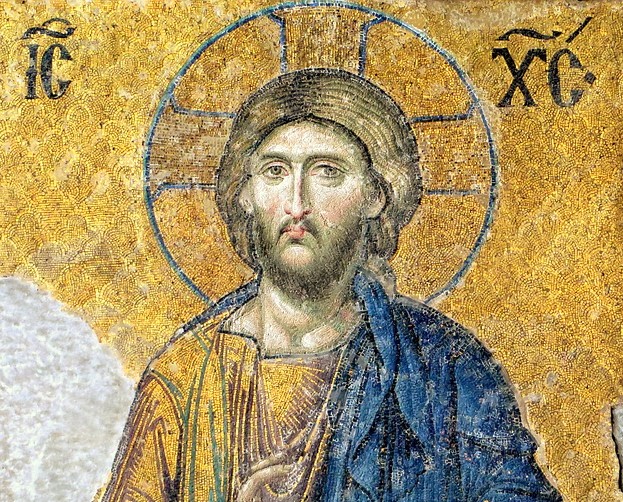
Given that Sunday was the Feast of Christ the King and that we have begun to read the Book of Revelation in the Office of Readings, this is an opportune time to examine the glorious portrait of Jesus Christ presented in Revelation 1:8-20. It is a portrait of the risen Christ in all His glory. The vision is of a high Christology. The Christ that is encountered here is the Lord of glory, who has attained to His glorious kingdom and who is the Lord of history and King of the Universe.
Let’s look at the passage and then draw from it ten descriptions of Jesus the Christ.
“I am the Alpha and the Omega,” says the Lord God, “who is and who was and who is to come, the Almighty.” … Then I turned to see the voice that was speaking to me, and on turning I saw seven golden lampstands, and in the midst of the lampstands one like a son of man clothed with a long robe and with a golden sash round his chest. His head and his hair were white as white wool. His eyes were like a flame of fire, his feet were like burnished bronze, refined in a furnace, and his voice was like the roar of many waters. In his right hand he held seven stars, from his mouth came a sharp two-edged sword, and his face was like the sun shining in full strength. When I saw him, I fell at his feet as though dead. But he laid his right hand on me, saying, “Fear not, I am the first and the last, and the living one. I died, and behold I am alive forevermore, and I have the keys of Death and Hades (Revelation 1:8, 12-18).
The Recapitulating Christ – “I am the Alpha and the Omega,” says the Lord God, “who is and who was and who is to come, the Almighty.” In this usage, recapitulating means subsuming many things under one heading. Saying that the Lord is the Alpha and the Omega means more than just the beginning and the end. It also means, “I am A and Z.” In other words, “I am the alphabet of God. I am in every word you speak or read. I am in every thought you articulate.”
He is the Word of God. He is the refulgence of all wisdom and knowledge. He knows all things. The Bible says this of Jesus:
That in the dispensation of the fullness of times [God the Father] might gather together in one all things in Christ, both which are in heaven, and which are on earth; even in him (Eph. 1:10).
For in Him all things were created, things in heaven and on earth, visible and invisible, whether thrones or dominions or rulers or authorities. All things were created through Him and for Him. He is before all things, and in Him all things hold together (Col 1:16-17).
The Reigning Christ –Then I turned to see the voice that was speaking to me, and on turning I saw seven golden lampstands, and in the midst of the lampstands one like a son of manclothed with a long robe and with a golden sash round his chest. These are regal robes, the dress and splendor of a king, magistrate, or judge. Indeed, the portrait here is not of Jesus Christ as savior per se, but Jesus Christ as judge.
We must all face Jesus one day as judge: For we shall all stand before the judgment seat of God; for it is written, “As I live, says the Lord, every knee shall bow to me, and every tongue shall give praise to God.” So each of us shall give account of himself to God (Romans 14:11-12).
The title “Son of Man” was one Jesus often used to describe Himself. It points to the vision of Daniel: I saw in the night visions, and behold, with the clouds of heaven there came one like a son of man, and he came to the Ancient of Days and was presented before him. And to him was given dominion and glory and a kingdom, that all peoples, nations, and languages should serve him; his dominion is an everlasting dominion, which shall not pass away, and his kingdom one that shall not be destroyed (Daniel 7:13-14).
Thus, we behold Christ here in all his glory.
The Righteous Christ–His head and his hair were white as white wool … This text speaks of His wisdom, righteousness, and purity. White (or gray) hair is a symbol of wisdom. The whitened wool also speaks to His purity and recalls this text from Isaiah: Come now, and let us reason together, saith the LORD: though your sins be as scarlet, they shall be as white as snow; though they be red like crimson, they shall be as wool (Is 1:18). Hence, Jesus’ wisdom is pure, lightsome, and holy. He alone can cleanse us and make us share in His righteousness.
The Revealing Christ–His eyes were like a flame of fire… His eyes illumine and see all things. He has a kind of penetrating vision, like x-rays. He sees right through you.
Neither is there any creature that is not manifest in his sight: but all things are naked and opened unto the eyes of him to whom we must render an account (Heb 4:13).
He knows everything you’ve ever done; every thought, every word, every deed. His eyes not only see all things, they illumine all things, shining the light of truth on them.
The Relentless Christ –his feet were like burnished bronze, refined as in a furnace. This means that His Kingdom and His judgement will be unstoppable. Brass, a hard, weighty metal, symbolizes that which is unyielding and unstoppable.
When Christ comes again, no one will be able to resist His word and judgment. Myriads will be summoned before Him in the valley of decision. Scripture reports an awesome and terrifying aspect of the judgment concerning the feet of Christ: So the angel swung his sickle across the earth and gathered the grape harvest of the earth and threw it into the great winepress of the wrath of God. And the winepress was trodden outside the city (Rev 14:18-20).
Here, then, is burning judgment and strong feet. He is the relentless Christ; you cannot stop Him. He is going forth to judge. He will judge. He must judge. “He is trampling out the vintage where the grapes of wrath are stored.” For the Father judges no man, but hath committed all judgment unto the Son: That all men should honor the Son (John 5:22-23).
The Resounding Christ – and his voice was like the sound of many waters. A likely background to this text is Psalm 29: 2-4 The voice of the LORD is upon the waters: the God of glory thunders: the LORD is upon many waters. The voice of the LORD is powerful; the voice of the LORD is full of majesty. He is our majestic Lord and God.
God has gone up with a shout, the LORD with the sound of a trumpet (Psalm 47:5).
The LORD shall roar from on high, and utter his voice from his holy habitation; he shall mightily roar upon his habitation; he shall give a shout, as they that tread the grapes, against all the inhabitants of the earth. A noise shall come even to the ends of the earth; for the LORD hath a controversy with the nations, he will plead with all flesh; he will give them that are wicked to the sword, saith the LORD (Jeremiah 25:30-31).
For the hour is coming, in the which all that are in the graves shall hear his voice, and shall come forth; they that have done good, unto the resurrection of life; and they that have done evil, unto the resurrection of damnation (John 5:28-29).
The Regulating Christ–in his right hand he held seven stars. Jesus doesn’t just have the whole world in His hand; He’s got the whole universe in His hand. He is the one who regulates it all. He runs and rules all of creation.
He is the image of the invisible God, the firstborn of every creature: For by him were all things created, that are in heaven, and that are in earth, visible and invisible, whether they be thrones, or dominions, or principalities, or powers: all things were created by him, and for him: And he is before all things, and by him all things consist (Col 1:15-17).
The Book of Revelation also defines the stars as the seven churches. Rev 1:20 states, The seven stars are the angels of the seven churches. Thus, we see here the governance over the Church that Christ has. And he is the head of the body, the Church: he is the beginning, the firstborn from the dead; that in all things he might have the preeminence (Col 1:17-18).
The Rebuking Christ – from his mouth issued a sharp two-edged sword. This is a word picture that is reminiscent of Hebrews 4:12. For the word of God is quick, and powerful, and sharper than any two-edged sword, piercing even to the dividing asunder of soul and spirit, and of the joints and marrow, and is a discerner of the thoughts and intents of the heart. The sword that is in His mouth is His Word.
Repent; or else I will come unto you quickly, and will fight … with the sword of my mouth (Rev 2:16).
And out of his mouth goes forth a sharp sword, that with it he should smite the nations: and he shall rule them (Rev 19:15).
Thus, the Word of God must act like a surgeon’s scalpel and remove all that is putrefied in us. We must be healed by God’s word and the sacraments of grace, lest we perish on that day when His Word shall have its full effect.
The Refulgent Christ –and his face was like the sun shining in full strength. He is the brightness of the Father’s glory. He is the Light of the World.
In him was life, and the life was the light of men. The light shines in the darkness, and the darkness has not overcome it. There was a man sent from God, whose name was John. He came as a witness, to bear witness about the light, that all might believe through him. He was not the light, but came to bear witness about the light. The true light, which gives light to everyone, was coming into the world (John 1:4-9).
If we are faithful, this light shall transform us. Beloved, we are God’s children now, and what we will be has not yet appeared; but we know that when he appears we shall be like him, because we shall see him as he is (1 John 3:2).
The Reassuring Christ– When I saw him, I fell at his feet as though dead. But he laid his right hand upon me, saying, “Fear not, I am the first and the last, and the living one; I died, and behold I am alive for evermore, and I have the keys of Death and Hades.” On the one hand, our world needs today a new vision of the holiness of God. Look at John: He knew Christ and lay his head upon His chest at the last supper. Despite all the history that John has with Jesus, when he beholds the glorified Christ, he falls on his face as though dead.
“But you cannot see my face; for man shall not see me and live” (Exodus 33:20). Too frequently, today, God has been trivialized. Look at John’s experience. Jesus will reassure him, but the glory is awesome.
Yet Jesus says, Fear not. He is the reassuring Christ. Notice what He tells John not to fear: death and the power of evil one. Thus, the awesome power and majesty of Jesus becomes the basis for fearing not. His resurrection is the source of His glory and also the reason we should not fear. Jesus lets His glory shine forth not to make John afraid, but to reassure him. Jesus has power to save.
Here then, is a picture of the risen and glorified Christ. He is King; He is Lord and His glory is eternal.
Catholics are often unaware just how biblical the Sacred Liturgy is. The design of our traditional churches; the use of candles, incense, and golden vessels; the postures of standing and kneeling; the altar; the singing of hymns; priests wearing albs and so forth are all depicted in the Scriptures. Some of these details were features of the ancient Jewish Temple, but most are reiterated in the Book of Revelation, which describes the liturgy of Heaven.
The liturgy here on earth is modeled after the liturgy in Heaven; that is why it is so serious to tamper with it. The Book of Revelation describes the heavenly liturgy and focuses on a scroll or book that contains the meaning of life and the answers to all we seek. It also focuses on the Lamb of God, standing but with the marks of slaughter upon it. Does this not sound familiar? It is the Liturgy of the Word and the Liturgy of the Eucharist.
We do well to be aware of the biblical roots of the Sacred Liturgy. Many people consider our rituals to be empty and vain, “smells and bells.” Some think austere liturgical environments devoid of much ritual are “purer” and closer to the worship in “spirit and in truth” that Jesus spoke of in John 4.
To such criticisms we must insist that our rituals, properly understood, are mystical and deeply biblical. Further, they are elements of the heavenly liturgy since almost all of them are mentioned as aspects of the worship or liturgy that takes place in Heaven. In this light, it is a serious mistake to set them aside or have a dismissive attitude toward them.
With that in mind we ought to consider the biblical references to the most common elements of Catholic and Orthodox liturgies. I have added my own occasional note in red.
Candles –
Rev 1:12-13Then I turned to see the voice that was speaking to me, and on turning I saw seven golden lampstands, and in the midst of the lampstands one like a son of man. In traditional catholic parishes, there are six candles on the high altar and a seventh candle is brought out when the bishop is present.
Rev 4:6Seven flaming torches burned in front of the throne.
Altar –
Rev 9:13The sixth angel sounded his trumpet, and I heard a voice coming from the horns of the golden altar that is before God.
Rev 8:3Another angel, who had a golden censer, came and stood at the altar. He was given much incense to offer, with the prayers of all the saints, on the golden altar before the throne.
Chair –
Rev 4:1and lo, a throne stood in heaven, with one seated on the throne! And he who sat there appeared like jasper and carnelian, and round the throne was a rainbow that looked like an emerald …
Daniel 7:9 As I looked, thrones were placed and one that was ancient of days took his seat; … In the Sacred Liturgy, the chair of the priest is prominent. But, as he takes his seat, we are invited to see not Father Jones, but rather the Lord Himself presiding in our midst.
Priests (elders) in Albs –
Rev 4:4the elders sat, dressed in white garments …
Bishop’s miter, priest’s biretta –
Rev 4:4, 10With golden crowns on their heads … they cast down their crowns before the throne …In the Liturgy, the Bishop may only wear his miter at prescribed times. But when he goes to the altar he must cast aside his miter. The priest who wears the biretta in the Old Mass is instructed to tip his biretta at the mention of the Holy Name and to lay it aside entirely when he goes to the altar.
Focus on a scroll (book), The Liturgy of the Word –
Rev 5: 1And I saw in the right hand of him who was seated on the throne a scroll written within and on the back, sealed with seven seals; and I saw a strong angel proclaiming with a loud voice, “Who is worthy to open the scroll and break its seals?” And no one in heaven or on earth or under the earth was able to open the scroll or to look into it, and I wept much that no one was found worthy to open the scroll or to look into it. Then one of the elders said to me, “Weep not; lo, the Lion of the tribe of Judah, the Root of David, has conquered, so that he can open the scroll and its seven seals.” In the ancient world, books as we know them now had not been invented. Texts were written on long scrolls and rolled up.
Incense, Intercessory prayer –
Rev 8:3another angel came and stood at the altar with a golden censer; and he was given much incense to mingle with the prayers of all the saints upon the golden altar before the throne; and the smoke of the incense rose with the prayers of the saints from the hand of the angel before God …
Rev 5:7and the twenty-four elders fell down before the Lamb, each holding a harp, and with golden bowls full of incense, which are the prayers of the saints;
Hymns –
Rev 5:8And they sang a new hymn: Worthy are you O Lord to receive the scroll and break open its seals. For you were slain and with your blood you purchase for God men of every race and tongue, and those of every nation.
Rev 14:1Then I looked, and lo, on Mount Zion stood the Lamb, and with him a hundred and forty-four thousand who had his name and his Father’s name written on their foreheads … and they sing a new song before the throne and before the four living creatures and before the elders. No one could learn that song except the hundred and forty-four thousand who had been redeemed from the earth.
Rev 15:3And they (the multitude no one could count) sing the song of Moses, the servant of God, and the song of the Lamb, saying, “Great and wonderful are thy deeds, O Lord God the Almighty! Just and true are thy ways, O King of the ages! Who shall not fear and glorify thy name, O Lord? For thou alone art holy. All nations shall come and worship thee, for thy judgments have been revealed.”
Holy, Holy, Holy –
Rev 4:8and day and night they never cease to sing, “Holy, holy, holy, is the Lord God Almighty,
Prostration (Kneeling) –
Rev 4:10the twenty-four elders fall down before him who is seated on the throne and worship him who lives for ever and ever; they cast their crowns before the throne …
Rev 5:14and the elders fell down and worshiped In today’s setting, there is seldom room for everyone to lie prostrate, flat on the ground. Kneeling developed as a practical solution to the lack of space, but it amounts to the same demeanor of humble adoration.
Lamb of God –
Rev 5:6And between the throne and the four living creatures and among the elders, I saw a Lamb standing, as though it had been slain …
Acclamations –
Rev 5:11Then I looked, and I heard around the throne and the living creatures and the elders the voice of many angels, numbering myriads of myriads and thousands of thousands, saying with a loud voice, “Worthy is the Lamb who was slain, to receive power and wealth and wisdom and might and honor and glory and blessing!”
Amen! –
Rev 5:14And the four living creatures said, “Amen!”
Silence –
Rev 8:1When the Lamb opened the seventh seal, there was silence in heaven for about half an hour. (And you thought your priest paused too long after communion?)
Mary –
Rev 12:1And a great portent appeared in heaven, a woman clothed with the sun, with the moon under her feet, and on her head a crown of twelve stars; 2she was with child and she cried out in her pangs of birth, in anguish for delivery.
Happy are those called to His “supper” –
Rev 19:6Then I heard what seemed to be the voice of a great multitude, like the sound of many waters and like the sound of mighty thunder peals, crying, “Hallelujah! For the Lord our God the Almighty reigns. Let us rejoice and exult and give him the glory, for the marriage of the Lamb has come, and his Bride has made herself ready; … And the angel said to me, “Write this: Blessed are those who are invited to the marriage supper of the Lamb.”
Golden vessels, vestments –
Rev 1:12And when I turned I saw seven golden lampstands,
Rev 1:13and among the lampstands was someone “like a son of man,” dressed in a robe reaching down to his feet and with a golden sash around his chest
Rev 5:8the twenty-four elders fell down before the Lamb. Each one had a harp and they were holding golden bowls full of incense
Rev 8:3Another angel, who had a golden censer, came and stood at the altar. He was given much incense to offer, with the prayers of all the saints, at the golden altar before the throne.
Rev 15:16The angels were dressed in clean, shining linen and wore golden sashes around their chests.
Rev 15:17 seven golden bowls
Stained Glass –
Rev 21:10[The heavenly city] had a great, high wall, with twelve gates, … The foundations of the wall of the city were adorned with every jewel; the first was jasper, the second sapphire, the third agate, the fourth emerald, the fifth onyx, the sixth carnelian, the seventh chrysolite, the eighth beryl, the ninth topaz, the tenth chrysoprase, the eleventh jacinth, the twelfth amethyst. (The image of stained glass in our Church walls is hinted at here.)
Here is but a partial list, except for one quote drawn only from the Book of Revelation. I invite you to add to it.
The readings for this Feast of Christ the King evoke three images of Christ as King. All of them are to some extent paradoxical because they emphasize things we don’t usually associate with kings. They also tell us that we have already met King Jesus even if we don’t realize it. Let’s look at these three images of our Lord Jesus Christ, King of all Creation:
I. Caring King – The first reading, from Ezekiel 34, speaks of the Lord as a shepherd who cares for His flock. Here are some of the lines that summarize His care: I myself will look after and tend my sheep … I will rescue them from every place where they were scattered when it was cloudy and dark … I myself will give them rest … The lost I will seek out … The strayed I will bring back … The injured I will bind up. The sick I will heal.
In the modern world we don’t typically think of kings and heads of state in such a caring role. Most world leaders are inaccessible to us, existing behind many layers of security and staff. Even bishops of larger dioceses are hard to reach personally.
Jesus, however, is a King who is more present to us than we are to ourselves. An old revival hymn says, “Jesus is on the Main Line … call him up and tell him what you want.” Another song says, “God is just one prayer away.”
In the ancient world it was much more comment to speak of a caring king. Most kings had more immediate contact with their subjects. Many had certain days on which their subjects could line up to talk to them. It is said that St. Athanasius ran up to the emperor on his horse one day, grabbed the reins, and proceeded to debate a theological point with him.
Until relatively recently, even U.S. Presidents had office hours. It is said that on Tuesdays Abraham Lincoln received visitors from among the citizenry who sought to speak to him of their concerns. They would line up at the door without formal appointments and he’d listen to them one by one. As our culture has become more violent and public figures have become more widely recognized and vulnerable, leaders have receded into sealed, bulletproof, and figuratively soundproof worlds, hearing little from “ordinary people.”
The idea of a king who cares for his people personally is somewhat paradoxical to us today, but Jesus does care for His people.
I want to testify that I do indeed have a caring King, Jesus. He’s been good to me. He has led me, rescued me, purified me, fed me, instructed me, and graced me; He died for me.
I also want to testify that He was being good to me even when I didn’t think He was being good to me. Scripture says, All things work together for good to them who love and trust the Lord (Rom 8:28). Notice that not just the “good things” work for my benefit but even the bad things. God sometimes permits some “stuff” to happen because it will bless us in the end. Even if you’re suffering, don’t give up on God. Some of His gifts sometimes come in strange packages. St Paul says, For this affliction is producing for us a weight of glory beyond compare (2 Cor 4:17).
Did you notice the last line in the passage from Ezekiel? But the sleek and the strong I will destroy, shepherding them rightly. Yes, even at those times when I needed to be humbled (to have my pride destroyed) the Lord was shepherding me rightly. There was a time in my life when I was sleeker and stronger, but the Lord let me experience some humiliation, destroying me as it were, and giving me humility. I even see this humiliation physically, for I was once slim and now I am overweight. It is humbling to be fat, especially when people scold me; they seem to think it is easy to lose weight. But God will humble them too, perhaps in other ways. God hates pride; He just can’t stand it. This is because He knows how deadly it is to us.
Yes, God is a caring King. Some of His ways are paradoxical. Do not reduce the noun “care” merely to meaning “that which comforts and consoles.” It can be that, but not always! Sometimes the “caring” thing to do is to rebuke, warn, or even punish. God never ceases to care for us. I’m a witness. He’s been good to me. Even when I didn’t think He was being good to me, He was being good to me.
Finally note that Jesus exercises this care through his Body, the Church. This means all of us, not just clergy. Parents, elders, youngsters, and all area summoned to share the faith, to console and care, find the lost and straying, and correct the sinner. We are Christ’s voice, his heart, his hands.
II. Conquering King – Today’s second reading speaks Jesus’ victory over all things, saying that He has been raised from the dead, the first fruits of those who have fallen asleep; that He has reversed what Adam did; that He is the first fruits, then each one in proper order will also rise. It says that He will hand the kingdom over to God his Father when he has destroyed every sovereignty and every authority and power and that he must reign until he has put all his enemies under his feet, the last enemy to be destroyed being death.
Here, too, there is a great paradox. As Hebrews says, In putting everything under him, God left nothing that is not subject to him. Yet at present we do not see everything subject to him. But we see Jesus, who was made a little lower than the angels, now crowned with glory and honor because he suffered death (Heb 2:8-10).
So while at times it seems that evil triumphs, God is working. One by one, He is putting all His enemies under His feet. One day, even death itself will be destroyed. The paradox of the cross shouts to us that God conquers, not by brutality and cruel strength, but by love, forgiveness, and mercy—things the world dismisses as weak.
Here, too, I want to say that God is a conquering King in my life. He has destroyed the power of many sins and diminished the strength of others on the way to their ultimate destruction. I have seen sins put down and under His feet as He cleanses the temple of my soul. He has conquered so much of my pride. I am seeing lust, greed, anger, sloth, envy, and fear on the ropes. One by one, He is diminishing their power and replacing them with greater love, compassion, kindness, purity, love for the truth, prayerfulness, courage, trust, and eagerness to do good and to win souls.
Thank you, Lord, for being a conquering King in my life.
Unlike worldly kings, this conquering King does not force us to be His subjects and live in His kingdom. Earthly kings conquer regions and force peoples under their rule by might. But Jesus is a King who respects our freedom to decide whether to have Him as our King and to accept the virtues of His kingdom—or not. Hence, Hell is not so much a place of punishment as it is a place for those who refuse, those who say no to Christ and His kingdom. This King, though all-powerful, does not force His kingship and laws. He offers them to all and allows each of us to decide.
III. Concealed King – The Gospel teaches us that Christ will come again to judge the living and the dead. In this second coming we will discover that we have known Him all along, though in a paradoxical way. As Christ comes and takes His seat and all are summoned to Him, we are going to have a strange sense that we’ve met Him before—and He will confirm that.
For indeed, we have met His Majesty and He is the strangest King of all. He is a King who is hungry, thirsty, sick, lonely, a foreigner, in prison, and a stranger. The list He gives should not be seen as exhaustive, for He is in the needy, whether rich or poor. He is in the discouraged loved one who cannot find a job; He is in our children, who need to be taught and encouraged; He is in the co-worker who just lost his wife; he is in the patient who was diagnosed with cancer; He is in the lost family member who needs instruction and to be drawn back to the Sacraments. He is even in you, in your struggles and needs.
Yes, we have met this King every day. And He is not merely saying that these people have some moral union with Him. He is saying, mystically, that He is each one of them. And when we cared for them, we were not simply doing something ethical; we were serving and caring for Him: “You did it for me.”
What a strange King! We usually picture kings in palaces, far removed from trouble, but this King is naked, poor, hungry, and thirsty. We walk past Him every day.
To those who have cared for Him in His poor, He says that He will never forget what they have done. The poor may not be able to repay us, but King Jesus will repay us a millionfold. On the day of our judgment we will look at Jesus and say, “I know you! I recognize you!” And He will say, “I know you, too.” Come, inherit the kingdom prepared for you from the foundation of the world.”
We should not view this judgment scene as containing the only standards by which we are to be judged, for numerous other passages lay out other standards such as having faith, being willing to carry our cross, living in purity, forgiving others, and loving our enemy. But this passage does remind us that we are not to neglect the corporal works of mercy.
Yes, Jesus our King is the strangest one you will ever meet: a caring and close King, a conquering King who never forces, a King who is hungry and thirsty, a King who reigns from the cross, a King who dies so that we don’t have to, a King who washes our feet, a King who comes to serve rather than to be served. He is a King, all right, one who rules with love, not force. He’s the strangest King you’ve ever met, and you meet Him every day: in the Eucharist, in the poor, in His Word, in your heart, in the events of your day, and in your very self.
We’ve all met people who are anxious to keep things in pristine condition. Some of us grew up with parents and grandparents who put plastic slipcovers on sofas or even forbade entering the “living room” on anything but special occasions. I once met a priest who kept the church locked up except for Sundays because he was concerned that people might track in dirt or otherwise alter its perfect, museum-like order. Heaven forfend that the hymnals might not be perfectly aligned in the pews!
Other people concentrate on money, forever saving funds for the proverbial rainy day and barely enjoying the good things of life in the present.
Taking care of possessions and showing prudence about money are both admirable traits in moderation, but excesses that hinder or outright bar the enjoyment of good things is to elevate things above people. The most important things in life aren’t things at all. Jesus once reminded us that the Sabbath was made for man. He said this to correct those who were so litigious about the rules of the Sabbath that the whole point was being lost. The Sabbath should be a joy, not a constant jeopardy. The rules were meant to frame the joy not eliminate it.
In this video below there is something of the message I am trying to convey. In it, a little girl dances her way through the house, causing near disasters of various sorts. In the end, though, she causes little damage. The company would have us insure things so that we can enjoy them rather than being limited by them. This gives the girl the freedom to be a little girl, enjoying her home without being burdened by the fear of breakage.
Insurance has its place, but even more so does detachment and prizing people more than things. Reasonable precautions and responsible limits are good, but things are meant to be used. This means that they may get dented, scratched, and show signs of wear and tear. That’s OK—people are enjoying them and being blessed.