
If Demons Believe and Tremble, What about Us?

As we begin the ordinary time of the Church year, we follow the Lord’s public ministry. The curtain lifts and we are in the synagogue at Capernaum:

Jesus entered the synagogue and taught. The people were astonished at his teaching, for he taught them as one having authority and not as the scribes.
In their synagogue was a man with an unclean spirit; he cried out, “What have you to do with us, Jesus of Nazareth? Have you come to destroy us? I know who you are – the Holy One of God!”
Jesus rebuked him and said, “Quiet! Come out of him!”
The unclean spirit convulsed him and with a loud cry came out of him
. (Mark 1:21-26)

Here are two brief thoughts:

First, note the astonishment of the people. The preaching of the Word of God is not meant to be a perfunctory part of the Mass. Even when the preacher is not gifted with eloquence or charisma, God’s Word has the power to astonish us.

The Greek word used in this passage is very strong: ἐξεπλήσσοντο (exeplessonto). It comes from combining exe or ek (wholly out) and plesso (to strike) Thus the most literal translation is that Jesus “knocked them out” with his proclamation. The word indicates the state of being utterly amazed, dumbfounded, or left at a complete loss after witnessing something incredible. One can picture someone gaping in sheer astonishment.

If we carefully attend to the Word of God rather than just listening half-heartedly, we should expect to be astonished. It may make us mad, sad, or glad; it may console or afflict us; but we cannot be unchanged if we open our heart and mind to its power.

Do you go to Church expecting to hear a Word that will change you? When you read Scripture, do you expect to be surprised, astonished, or even intrigued? If not, why not?

Second, notice that the demon recognizes Christ for who He is: The Holy One of God. James rather sadly observed that demons believe and even tremble (see James 2:19). If even demons recognize and are thunderstruck by the glory of God, how is it that so many of us are half asleep during the sacred liturgy?

Those who have attended exorcisms are quite surprised at the power that simple holy water, the touch of the priest’s hand, and the priest’s stole have over demons. This is also true of relics and sacramentals. The demons experience their power, yet so many of us are casual and unexpectant around such realities.

These observations are meant not so much to shame as to remind us that in the sacred liturgy we encounter the Lord of Glory. He is present in both word and sacrament. If a demon can know that and have servile fear, how about us? Can we know this and have a reverential fear and love?

Tomorrow I will post more on the power of Jesus’ preaching.

Encouragement from Jesus in One of His Lesser-Known Sayings

It’s one of the stranger dialogues that occurs in the Gospel, yet it is difficult not to rejoice in the aplomb of Jesus has he says it.

Some Pharisees, likely disingenuous in their motives, approach Jesus  to warn him that he needs to leave immediately: Go away, leave this area because Herod wants to kill you. Jesus, more likely speaking to them, rather than Herod, says the following:

Go and tell that fox, ‘Behold, I cast out demons and I perform healings today and tomorrow, and on the third day I accomplish my purpose. (Lk 13:32)

Surely Jesus has more in mind here than the next three days on the calendar. He’s obviously speaking of the Paschal mystery, of his passion, death and Resurrection. He is saying in effect, to any who would threaten to kill him, that in so doing, they only serve to undermine their own wickedness and power, and to cause him to fulfill his own purposes.

For nailing him to a cross, he will be on that cross casting out demons and bringing healing. The next day he will descend to Sheol to awaken the dead, summon them to righteousness, and bring healing in life. And on the third day, he arises fully accomplishing his purpose and casting off death like a garment.

There is no way that Herod, or the Pharisees, or Satan himself can win, for in “winning,” they lose.

So also for all who would align themselves with the darkness rather than the Light. For no matter how deep the darkness, the dawn inevitably comes and scatters the darkness, the darkness cannot win. Scripture says The light shines in the darkness, and the darkness has not overcome it. (Jn 1:5)

And in this strange and provocative saying of Jesus, comes important perspective for all of us. The perspective is this, that evil, no matter how powerful it seems, cannot stand, it will ultimately self-destruct and be overcome by the Light. No matter how awful Good Friday seemed to those first disciples, Jesus, by his own description, was casting out demons and bring healing in that very act of suffering. And his apparent disappearance into death, and down into the place of the dead, was only for the purposes of turning out the Devil’s trophy room, and bringing life into the place of the dead, and healing to the deep wounds caused by sin.

In this saying of Jesus, and in the facts of the Paschal Mystery two things are taught to us about evil: one, that we should never glamorize evil, and two, that we should not utterly fear it.

As for glamorizing evil, we love our movies and other things in culture which often glorify evil, whether it is series like “The Untouchables,” “The Godfather,” “Good Fellas,” or perhaps other movies that simply and in a general kind of away exult wrongdoing and equated it with power and glory.

But this is illusion, for evil has its day, but the Word of the Lord remains forever. One of the Psalms says,

I have seen the wicked triumphant, towering like a cedar of Lebanon. I passed by again; he was gone. I searched; he was nowhere to be found. (Psalm 37:35-36)

And therefore neither should we glamorize evil, nor should we inordinately fear its passing power. Yes, we should soberly confront it, and resist its evil demands, but we should not fear it.

No, evil cannot stand. To glorify evil or fear it inordinately, is to miss both Scripture’s lesson and history’s lesson. At the end of the day, evil does not last.

What does last, is God’s holy Word and his Church. Despite repeated attempts to persecute, diminish and destroy the Church she has outlived every one of her opponents. And her history extends back even more than 2000 years into the heritage of God’s people, the Jews. For his word to Abraham persists, and God rescued them from slavery in Egypt, and gave his Word on Mount Sinai. And despite every attempt to ridicule, reduce and redefine God’s Word, his promise to Abraham, his Word from Sinai or His Word from The Sermon the Mount, all these persist and ring through to this day.

This is what lasts, this is what persists, God’s Word, and the Church he founded. This is verifiable by the study of history. Empires have come and gone, wicked philosophies risen and diminished, scoffers and persecutors arrived and departed, all in the age of the Church. And here we are,  and they have gone. And those who claim power now, and laugh at us and say our day is done, when they are gone, we will still be here.

Yes:  Go and tell that fox, ‘Behold, I cast out demons and I perform healings today and tomorrow, and on the third day I accomplish my purpose. (Lk 13:32)

In other words, neither you nor Herod can thwart my plans. In killing me you merely assist me to accomplish my plan. In killing me I will break the back of your power. And when you persecute my disciples, or shed the blood of my Church members, you are sowing seeds for the Church by the very blood of the martyrs you spill. Whatever victory you claim, it is hollow, for it is really my victory.

And by these words the Lord decodes history for us. I doesn’t matter how we might wish to obsess over this loss or that apparent defeat, it doesn’t matter how the world and devil might wish to gloat over an apparent victory, in the end, the Lord holds the cards, and the house, his House, always wins.

A Meditation on Eternal Life

We are concluding our reading of the First Letter of John during daily Mass. Many struggle to understand this letter because they miss the experiential aspects of the faith to which he refers. Consider just a few brief lines from the end of the letter:

[God] has testified on behalf of his Son.
Whoever believes in the Son of God
has this testimony within himself ….
And this is the testimony:
God gave us eternal life,
and this life is in his Son.
I write these things to you so that you may know
that you have eternal life
(1 John 5:11-13).

To a typical modern reader, the argument seems to say that the proof (or testimony) of who Jesus is, is that we will (one day) have eternal life. To many, eternal life is something that happens only in the future, something we cannot know until we die. With that perspective the argument makes little sense because proof is something in the here and now, not after death. In fact, eternal life is something that can be seen, known, and experienced now.

A key in understanding a passage like this one is to consider that the word eternal (aion or aionios in Greek) does not simply refer to the length of life but to its fullness. Aiṓnios does not focus on the future so much as on the quality of life. As such, aiṓn relates to the life of a believer right now, as a growing experience of God’s life. It is a present possession not just a hope for the future.

Thus, John is saying that the testimony of the Father, the proof that Jesus is Savior and Lord, is the fact that you are currently experiencing, in increasing quantity, the fullness of life that He died to give you and rose to show you. That Jesus is Lord is proven by the fact that your life is getting fuller and richer, that you are seeing sins be put to death and graces coming alive, that you are less fearful and more courageous, less angry and more forgiving, less resentful and more grateful; that you are delighting in the truth, walking more closely with God, and seeing your life change for the better.

Even as a person ages physically, his or her spiritual life can become more full, confident, joyful, vibrant, and energetic. This is eternal life: to be fully alive with God forever. And while this gift will be complete for us in Heaven, it began at our baptism and, if we are faithful, will continue to grow throughout our life’s journey and become ever richer.

Walking with the Wise – A Homily for Epiphany

There are so many wonderful details in the Epiphany story: the call of the Gentiles, their enthusiastic response, the significance of the star they seek, the gifts they bring, the dramatic interaction with Herod, and their ultimate rejection of Herod in favor of Christ.

In this meditation I would like to follow these Magi in their journey of faith to become “Wise Men.” As magi, they followed the faint stars, distant points of light; as wise men they follow Jesus, who is the ever glorious Light from Light, true God from true God.

We can observe how they journey in stages from the light of a star to the bright and glorious Light of Jesus Christ. And, of course, to authentically encounter the Lord is to experience conversion. All the elements of this story ultimately serve to cause them to “return to their country by another route.” Let’s look at the stages of their journey from being mere magi to becoming, by God’s grace, wise men.

Stage 1: The CALL that COMPLETES – The text says, When Jesus was born in Bethlehem of Judea, in the days of King Herod, behold, magi from the east arrived in Jerusalem, saying, “Where is the newborn king of the Jews? We saw his star at its rising and have come to do him homage.”

Notice the identity of these individuals: they are called magi (μάγοι (magoi) in Greek) and are from the East.

Exactly what “magi” are is not clear. Perhaps they are learned men; perhaps they are ancient astronomers. (I have written more here: Who Were the Magi?)We often think of them as kings, though the text of this gospel passage does not call them that. It also seems likely that Herod would have been far more anxious had they been actual potentates from an Eastern kingdom. We often think of them as kings because Psalm 72 (read in today’s Mass) speaks of kings coming from the East bearing gifts of gold and frankincense. However, for the record, the text in today’s gospel does not call them kings, but rather “magi.”

Yet here is their key identity: they are Gentiles who have been called. Up until this point in the Christmas story, only Jews had found their way to Bethlehem. This detail cannot be overlooked, for it is clear that the Gospel is going out to all the world. This call completes the Church, which needs both Jews and Gentiles.

In today’s second reading, St. Paul rejoices in this fact, saying, the Gentiles are coheirs, members of the same body, and co-partners in the promise in Christ Jesus through the gospel (Eph 3:6). Because most of us are not Jewish by ancestry we ought to rejoice, for the call of these Magi prefigures our call.

Notice that God calls them through something in the natural world: a star. God uses something in creation to call out to them.

We do well to wonder what is the “star” that God used (and uses) to call each of us? Perhaps it was Scripture, but more typically God uses someone in our life in order to reach us: a parent, a family member, a friend, a priest, a religious sister, or a devoted lay person. Who are the stars in your life through whom God called you?

God can also use inanimate creation, as he did for these Magi. Perhaps it was a magnificent church, or a beautiful painting, or an inspirational song that reached you. By something or someone, God calls each of us; He puts a star in our sky. These Wise Men, these Magi, followed the call of God and began their journey to Jesus.

Stage 2: The CONSTANCY that CONQUERS – Upon arriving in Jerusalem, the Magi find a rather confusing and perhaps discouraging situation. The reigning king, Herod, knows nothing of the birth of this new King. The Magi likely assumed that the newborn King would be related to the current king, so Herod’s surprise may have confused them. And Herod seems more than surprised; he seems threatened and agitated.

Even more puzzling, Herod calls in religious leaders to get further information about this new King. They open the sacred writings and the Magi hear of a promised King. Ah, so the birth of this King has religious significance! How interesting!

But these religious leaders seem unenthusiastic about the newborn King, and after providing the location of His birth, seem to make no effort to follow the Magi. There is no rejoicing, no summoning of the people to tell them that a longed-for King has finally been born, not even further inquiry!

So the wicked (i.e., Herod and his court) are wakeful while the saints are sleepy. How odd this must have seemed to the Magi! Perhaps they even thought about abandoning their search. After all, the actual king knew nothing of this new King’s birth, and those people who did know about it seemed rather uninterested.

Ah, but praise the Lord they persevered in their search; they did not give up!

Thanks be to God, too, that many today have found their way to Christ despite the fact that parents, clergy, and others who should have led them to Jesus were either asleep, ignorant, or just plain lazy. I am often amazed at some of the conversion stories I have heard: people who found their way to Christ and His Church despite some pretty daunting obstacles (e.g., poor religious upbringing, scandalous clergy, and poor role models). God sometimes allows our faith and call to be tested, but Those who persevere to the end will be saved (Matt 24:13).
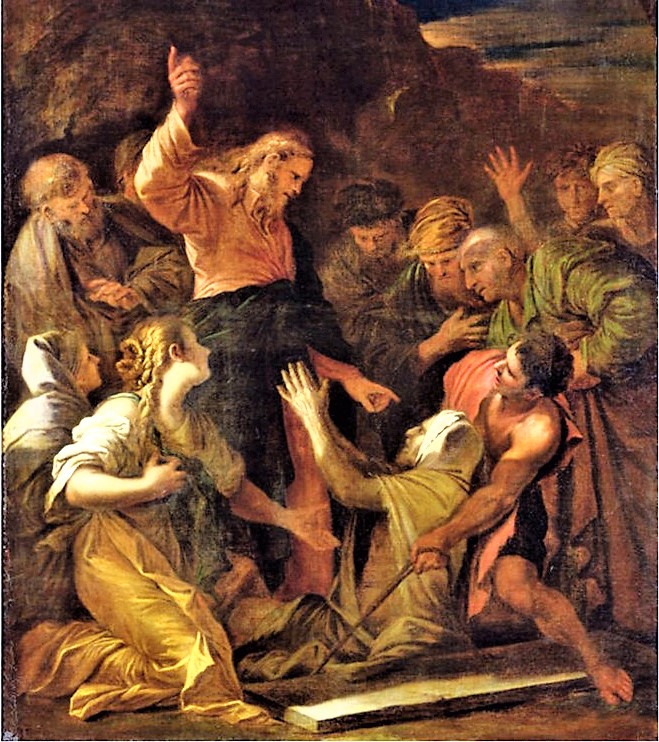
To persevere is to open the door to wisdom, which often must be sought in spite of obstacles. This constancy is often what it takes to overcome the darkness and discouragements of the world.

Stage 3: The CONDESCENSION that CONFESSES – The text says, After their audience with the king they set out. And behold, the star that they had seen at its rising preceded them, until it came and stopped over the place where the child was. They were overjoyed at seeing the star, and on entering the house they saw the child with Mary his mother. They prostrated themselves and did him homage.

With what little information they have, the Magi set out and continue to follow the call of God through the star.

Note that they enter a “house.” We often think of the Magi as coming that same Christmas night to the cave or stable, but it seems not; Mary, Joseph, and Jesus are now in a house. Apparently they have been able to find decent lodging. Has it been days or weeks since Jesus’ birth? Regardless, it is likely not Christmas Day itself.

Notice, too, that they “prostrate” themselves before Jesus. The Greek word used is προσεκύνησαν (prosekunēsan), which means “to fall down in worship” or “to give adoration.” This word is used twelve times in the New Testament and it is clear each time that religious worship is the reason for the prostration.

This is no minor act of homage or sign of respect to an earthly king; this is religious worship. This is a confession of faith. The Magi manifest faith! The beginning of wisdom is the fear of the Lord. And these Magi are well on their way from being mere magi to being wise men!

But is their faith a real faith or just a perfunctory observance? It is not enough to answer an altar call or to get baptized. Faith is never alone; it is a transformative relationship with Jesus Christ. So let’s look for the effects of a real and saving faith.

Stage 4: The COST that COMES – There is a cost to discipleship. The Magi are moved to give three symbolic gifts that show some of what true faith includes. They are costly gifts.

Gold symbolizes all of our possessions. In laying this gift before Jesus, they and we are saying, “I acknowledge that everything I have is yours. I put all my resources and wealth under your authority and will use them only according to your will.” A conversion that has not reached the wallet is not complete.

Frankincense is a resin used in incense and symbolizes the gift of worship. In the Bible, incense is a symbol of prayer and worship (e.g., Psalm 141). In laying down this gift, we promise to pray and worship God all the days of our life, to be in His holy house each Sunday, to render Him the praise and worship He is due, to listen to His word and consent to be fed the Eucharist by Him, to worship Him worthily by frequent confession, and to praise Him at all times.

Myrrh is a strange gift for an infant; it is usually understood as a burial ointment. Surely this prefigures Jesus’ death, but it also symbolizes our own. In laying this gift before Jesus we are saying, “My life is yours. I want to die so that you may live your life in me. May you increase and may I decrease. Use me and my life as you will.”

Yes, these three gifts are highly symbolic.

The Magi manifest more than a little homage to Jesus. They are showing forth the fruits of saving faith. And if we can give these gifts, so are we.

In their holy reverence for God is wisdom in its initial stage!

Stage 5: The CONVERSION that is CLEAR – The text says, And having been warned in a dream not to return to Herod, they departed for their country by another way.

Here, then, is essential evidence for faith: conversion. It is not enough to get “happy” in Church; we have to obey. These Wise Men are walking differently now. They are not going home by the same way they came. They’ve changed direction; they’ve turned around (conversio). They are now willing to walk the straight and narrow path that leads to life rather than the wide road that leads to damnation. They are going to obey Christ. They are going to exhibit what St. Paul calls the “obedience of faith” (Rom 1:5; 16:26). They have not just engaged in perfunctory worship; they are showing signs of a true and saving faith. They are not just calling Jesus, “Lord, Lord!” They are doing what He tells them (cf Luke 6:46).

No longer mere magi, now they are wise men!

So there it is. Through careful stages, the Lord has brought the Gentiles (this means you and me) to conversion. He called these Magi to wisdom. They remained constant, confessed Him to be Lord, accepted the cost of discipleship, and manifested conversion. Have you? Have I?

Walk in the ways of the Wise Men! Wise men still seek Him; even wiser ones listen to and obey Him. Are we willing to go back to our country by another route? Is ongoing conversion part of our journey home to Heaven? Epiphany means “manifestation.” How is our faith made manifest in our deeds and conversion?

I have it on the best of authority that as the (now) Wise Men went home by another route, they were singing this Gospel song:

It’s a highway to heaven! None can walk up there but the pure in heart. I am walking up the King’s highway. If you’re not walking start while I’m talking. There’ll be a blessing you’ll be possessing, walking up the King’s highway.”

No One Goes Away from Jesus Unchanged

The video below is a 2008 Coca-Cola commercial that takes up the theme of the star of Christmas.

Let us review the impact that the star of Christmas had on the wise men, the Magi.

  1. The star moved them to seek meaning outside themselves; it made them look out and up.
  2. The star called them beyond what was familiar in their own country and world and expanded their horizons toward Christ and His Kingdom.
  3. The star summoned them to seek Christ, and when they found Him, to worship Him.
  4. The star drew them to be generous to a poor family in Bethlehem; they made sacrifices as they lay costly gifts of gold, frankincense, and myrrh before the Lord.
  5. The star roused them to conversion; they “returned to their country by another route,” following the straight and narrow path rather than the wide and destructive one.

Yes, no one encounters Jesus Christ and goes away unchanged. A blind man went away able to see, the deaf to hear, the lame to walk. The hungry went away satisfied, the ignorant instructed, the guilty forgiven, sinners converted.

The call of the nations to change and to new life began with a star. The light of the star opens the way to the Light of World, Jesus. The star of my life is Jesus.

In the commercial below we see Santa (a name that means “Holy One”) sending forth a star, one that touches people and radiates a light that transforms them.

  1. A woman sees the light of that star and is able to forgive her husband and be reconciled with him.
  2. A young soccer player sees the light of that star, surrenders his pride, and steps aside to let another share in and get a shot at glory.
  3. A young girl sees the light of that star and, giving up some of her own beauty, seeks to beautify a public park for others.
  4. A museum guard sees the light of that star and shows mercy to the guard dog with him (this was a silly one).
  5. A father sees the light of that star and allows his son a moment of growth.

Yes, there is something about that star that changes everyone who looks at it. They become more forgiving, more gracious, more aware of others, more connected to others, more loving. The light of the star, and the light of the world, is Jesus. His light is meant to have that same effect—and more besides.

In the background of the commercial an old Elvis song plays: “Wise men say only fools rush in, but I can’t help falling in love with you. Shall I stay? Would it be a sin if I can’t help falling in love with you?”

Of course the love that is symbolized by the star is not the romantic love of the song but the brotherly and agape love that Christ gives. Like the Magi who found Christ by the star, no one sees the star of Jesus and encounters Him and then goes away unchanged. Indeed, if we authentically encounter Christ, we are equipped to love, just as the people in this commercial are. We are equipped to forgive, to bring healing, to help others find strength and glory in the truth, and to come to full maturity in Christ. A person who knows Jesus and has encountered Him cannot help loving others, not in some merely sentimental way, but with a strong and vigorous love rooted in the truth. This is the same love that Jesus has for us all.

At the end of the commercial is an exhortation in Spanish that translates as follows: “Give the world the best of you.” The best of me is Jesus.

Defining Ministry or Muddling It? A Reflection on an Article “Assigned” to Me

Not too long ago, one of my readers sent me a collection of sayings or aphorisms on the topic of ministry. The collection is entitled Defining MinistryThe reader, who apparently does not think I follow modern trends very well, scolded me for being out-of-touch and recommended that I review the list. That reader apparently believes that those maxims describe what I should be like but am not.

I took my “assignment” seriously and read each one of the sayings; I’m happy to report that I don’t measure up to most of them! The collection is too large to reproduce here and in addition I have not obtained the author’s permission to publish the material here.

I think we do well to look at a few of them if we want to know how some people view the concept of ministry and the role of pastoring.

I want to emphasize that I have serious problems with every one of the “proverbs” I am about to list. I believe that they water down the kind of leadership and clear teaching that God expects from his ordained ministers. Christ’s Great Commission (Mt 28:18-20) was that His appointed apostles should go forth to the whole world to teach clearly what He had commanded, to make disciples, and to draw those disciples into the sacramental life of the Church unambiguously through baptism. So, in the Great Commission, there are clear truths to be announced and a mission to bring people out of darkness into light. The Lord sent them out to the world because the world needed light, truth, teaching, and a call to access mercy through repentance. In effect, the apostles were given a threefold office: to teach (as the text clearly says), to govern (the text says that they were to teach the commandments of the Lord), and to sanctify (the text says that they are to baptize). Therefore, this was the ministry, the work of the apostles and their successors (the bishops, priests, and deacons). St. Paul, particularly in the Pastoral Epistles, repeatedly instructed Titus and Timothy to teach, govern, and sanctify. Further, he said that they were to appoint other bishops, priests, and deacons to do the same work.

All of this seems rather plain in scriptural texts, but sadly many of these things do not seem to be so plain to some, who are more influenced by cultural trends than the instructions of Sacred Scripture and Tradition.

One the problems that all the sayings have is that they are all in the form of antitheses. Each one has the following structure:

“Ministry is not about ‘A’, it is about ‘B’.”

The problem with this structure is that it often leads to a false dichotomy. Perhaps the author does not mean them to be understood absolutely, but a reader cannot be sure given their rather absolute structure. Perhaps if the structure had been, “Ministry is more ‘A’ than ‘B’,” then the message would have been clearer.

With this background in mind, let’s look at some of the adages.

Ministry is not about doing; it is about growing.

Why place growing and doing in opposition to each other? Isn’t growing a form of doing? Doesn’t doing advance growth?

If I (as a priest) were to say that ministry is not about doing, it would suggest that I could sit in my room all day and still call it “ministry” as long it somehow promoted “growth.” This seems silly; if I did that most people would call me lazy.

If this saying is directed toward those to whom I minister, it is also false, because while I surely do want them to grow, Jesus also makes it clear that He has things for us to “do” such as repent, believe the gospel, turn away from sin, deny ourselves, take up our cross, keep the commandments, love our neighbor, evangelize, cast out demons, and heal. He also warns, Not everyone who says to me, ‘Lord, Lord,’ will enter the kingdom of heaven, but only the one who does the will of my Father who is in heaven (Mt 7:21). And in the judgment scene of Matthew 25:31ff it is clearly important to Him that we actually do things such as feeding the poor and giving drink to the thirsty.

Growth is nice, but deeds are surely required as well. They should not be opposed to each other.

Ministry is not about pulling people toward something; it is about walking with people while searching.

How strange and unbiblical! The road to Emmaus comes to mind; Jesus walked with them and “pulled” them to recognize the truth that was before them. Having heard their complaints and confusion, He called the foolish and slow to believe (Luke 24:25). He went on to “pull” them toward the truth, instructing them at great length.

“Walking with people while searching” paints a picture of groping, not teaching. Jesus says, And if the blind lead the blind, both will fall into a pit (Mt 15:14). Clearly the Lord sent His ministers to bring the light and direction of His teaching to those who are searching, not just to search around with them and facilitate their searching. We are to help them find answers. Instructing the ignorant is a spiritual work of mercy as is counseling the doubtful.

Sacred ministers such as priest are not “know-it-alls,” but we are supposed to have answers and provide clear direction based on our prayer, our study of Sacred Truth, and our anointing. Our call isn’t merely to be out there “searching.” We’re supposed to be teaching because the Lord has already provided answers in His Word and in Sacred Tradition.

And we are supposed to be pulling people toward something—actually, toward Someone. Jesus says that this is exactly what the Father is doing through His Church: No one can come to Me unless the Father who sent Me draws him; and I will raise him up on the last day. It is written in the prophets, “And they shall all be taught of God” (Jn 6:44-45).

Ministry is not about providing answers; it is about provoking more and more fresh questions.

Again we have the false dichotomy. Why are answers and “more questions” opposed to each other? The fact is, answers provoke more questions; questions seldom provoke questions. A person has a question and then waits for an answer; nothing happens until an answer is forthcoming. This answer usually provokes more questions that seek clarification. There is no dichotomy between providing answers and provoking more questions. In fact, there is a strong correlation between them.

So answers are of great importance both in preaching and in the ministry of the Gospel. Clearly the Lord sent us out with teaching, with answers to the questions that are in people’s hearts.

It is true that one teaching technique involves not answering all questions or solving every problem too quickly. This is an especially good method to use with children, who should often be encouraged to struggle with questions and problems so as to learn how to solve problems and to learn how to learn.

But if this is what the maxim is getting at, why not just say that? Instead, we are presented with a false dichotomy that says that giving answers is a bad thing, or at least that it is worse thing than sending people away to come up with more questions (the answers to which they will presumably not get from us).

Ministry is not about promoting doctrine; it is about announcing Jesus.

Again, why put these in opposition? Jesus sent them out to teach doctrine: Therefore go and make disciples of all nations, baptizing them in the name of the Father and of the Son and of the Holy Spirit, and teaching them to obey everything I have commanded you.

Talk about promoting doctrine! Jesus says that they are not just to teach it; they are to summon disciples to obedience. He warns, For whoever is ashamed of me and of my teachings in this adulterous and sinful generation, of him will the Son of Man also be ashamed when he comes in the glory of his Father with the holy angels (Mk 8:38). Thus Jesus connects Himself to His teachings, His doctrine, and His words; He is the Word, the Logos, made flesh. He says that to reject His teaching, His doctrine, is to reject Him and to face judgement for that.

St. Paul exhorted Titus, But as for you, speak the things that are consistent with sound doctrine (Titus 2:1). St. Paul links doctrine to Christ, as he should, because they are connected. He writes, What you heard from me, keep as the pattern of sound teaching, with faith and love in Christ Jesus (2 Tim 1:13). Ministry is promoting doctrine, and in promoting Christ’s teachings we are helping to announce Jesus.

There are dozens of other sayings in the list, and it’s pretty much all downhill from these few. The final one in the collection takes the cake:

Ministry is not about whether one believes in God; it is about following the Christ.

Here is a word to the wise: if you ever happen upon a “minister” who does not believe in God, run, do not walk, to the nearest exit! Further, if you ever happen upon a “ministry” that says it is not important for you to believe in God, make another hasty exit.

There is nothing—nothing—more important than faith in Jesus Christ. Without faith it is impossible to please God (Heb 11:6). Jesus warns, If you do not come to believe that I AM, you will die in your sins (Jn 8:24).

The entire work of the Scriptures is to bring us to faith in Jesus, who is Christ and Lord. St. John writes, There were many other signs Jesus also performed in the presence of the disciples, which are not written in this book; But these are written that you may believe that Jesus is the Messiah, the Son of God, and that by believing you may have life in his name (Jn 20:31).

Nothing could be more flawed and confused than this final “proverb.” There is simply no ministry at all apart from faith in Christ Jesus as Lord. Nothing else matters without faith. What does it even mean to follow the Christ if one does not believe in God?

So, a message to the person who mailed me this list of sayings (over 35 in number): I did read them and have pondered whether my ministry conforms to them. I must say that it does not. I plead guilty to not assimilating these notions of “ministry.” Frankly, I am so far removed from them that I cannot even begin to conceive of how I would apply them to my life.

I just have this crazy idea that my work as a priest is to teach, govern, and sanctify God’s people; and to be taught by, governed by, and sanctified by the Church through the pastors of my own soul. I have this strange notion that there is a truth to be found and to be taught with clarity, patience, and conviction. Living the question is a cute concept, but without any answers at all, questions are cruel and taunting.

I also have this odd idea that Jesus did have a doctrine and that He identified with it, saying, I am the Way, the Truth, and the Life. He warned that we should follow Him, for no one would come to the Father except through Him.

Something tells me that ministry is about providing answers and setting forth doctrine. Because teaching and insisting was at the heart of Jesus’ ministry, and “pulling” people to Father through faith was His deepest desire for us, I am convinced that my ministry should be no less.

Here is a depiction of Christ, the Teacher. In this video, He is teaching at the synagogue in Capernaum:

Who or What Is the Antichrist? A Reflection on the Biblical Teaching

Sermon and Deeds of the Antichrist, Luca Signorelli (1499)

There is much lore about the antichrist (especially among certain Evangelicals) that is out of proportion to the attention Scripture pays to the concept, and more importantly is at possible variance from what is certainly taught. It easily becomes fodder for movies and novels: the antichrist figure steps on the scene, deceiving many, and mesmerizing the whole world with apparent miracles and a message of false peace.

But is this really what or whom the Scriptures call the antichrist?  I would argue not, for in order to create such a picture one would have to splice in images from the Book of Revelation and the Letter to the Thessalonians that do not likely apply to antichrists.

In fact, the use of the term antichrist occurs only in the Johannine epistles. It does not occur in the Book of Revelation at all, though many have the mistaken idea that it does. There are plenty of beasts, dragons, harlots, demons, and satanic legions in Revelation, but no mention of antichrists.

Many also stitch the teaching about antichrists together with St. Paul’s teaching on the “man of lawlessness” (also called “the lawless one”) who is to appear just before the end. The lawless one may well be the stuff of movies, but calling him the antichrist may be to borrow too much from a concept that is more specific. While it is not inauthentic to make a connection between them (some of the Church Fathers seem to), it is not necessarily correct to do so.

In this reflection I take the position that it is improbable that the antichrist and the man of lawlessness are one and the same. In order to explain why, let’s first look at the occurrences of the term antichrist in St. John’s Epistles.

  • Little children, it is the last hour: and as you have heard that antichrist shall come, even now are there many antichrists; whereby we know that it is the last time (1 John 2:18).
  • Who is the liar but the one who denies that Jesus is the Christ? This is the antichrist, the one who denies the Father and the Son (1 John 2:22).
  • By this you know the Spirit of God: every spirit that confesses that Jesus Christ has come in the flesh is from God, and every spirit that does not confess Jesus is not from God. And this is the spirit of the antichrist, of which you have heard that it is coming; and now it is already in the world (1 John 4:2–3).
  • Many deceivers have gone out into the world, those who do not confess that Jesus Christ has come in the flesh; any such person is the deceiver and the antichrist! (2 John 1:7)

Note two things about antichrists. First, St. John (writing in the first century) teaches that he has already appeared. In calling this the “last hour,” St. John and the Holy Spirit do not mean that the Second Coming will take place in the next sixty minutes or even in the next few years. Rather, the teaching is that we are in the Last Age, the Age of the Messiah (also called the Age of the Church), when God is sending out His angels to the four winds to gather all the elect from the ends of the earth (cf Mark 4:21). Sadly, St. John also teaches that the antichrist has already come as well.

Second, after saying that the antichrist has come, St. John immediately clarifies by saying that actually many antichrists have appeared.

Thus St. John does not seem to present the antichrist as a single figure who has come. Rather, he says that there are many antichrists.

And what do these antichrists do? They perpetrate heresy, error, and false teaching. St. John notes in particular that heretics who deny that Jesus is the Christ (the Messiah) are antichrists. He also calls antichrists those who deny Christ having come in the flesh.

What does it mean to deny Christ having come in the flesh? It means reducing the saving work of God to mere appearances by claiming that Jesus did not actually take up a human nature but only appeared to do so. By extension, these same antichrists reduce the Christian moral and spiritual life to mere gnostic ideas rather than a true flesh-and-blood, body-and-soul change in our lives.

Many today extend these denials of the incarnation by undermining the historic authenticity of the Gospels, doubting or outright denying what Jesus actually said and did. Some of them say that Jesus’ resurrection was not a bodily one, but rather that His “ideas live on.” There can be no more fundamental heresy that to deny the bodily resurrection of Christ. As St. Paul says, And if Christ has not been raised, then our preaching is in vain and your faith is in vain … if Christ has not been raised, your faith is futile and you are still in your sins … [and] we are of all people most to be pitied (1 Cor 15:14-17).

Thus St. John, along with all the early Church, emphatically upholds an incarnational faith. We could actually touch our God and He touched us by taking up our human nature. He suffered on the cross and died. And though His suffering was tied to His human nature (for His divine nature is impassible), Jesus, the Second Person of the Blessed Trinity, hypostatically united to His human nature, suffered and died for us. It was this same human nature that God raised from the dead, gloriously transformed.

John takes up this theme elsewhere when he says that Christ came in water and in blood, not in water alone (cf 1 John 5:6). A certain heretic of that time, Cerinthus, held that the Second Person of the Blessed Trinity departed just before Jesus’ passion. John refutes this, insisting that just as at His baptism Jesus’ divine nature was affirmed (This is my beloved Son in whom I am well pleased), so also was it affirmed during the shedding of His blood on Calvary (the inspired word of God records the centurion, on seeing the manner of Jesus’ death, saying, Surely this was the Son of God (Mat 27:54)). Jesus Christ, the Son of God, though of two natures, is one person, and He did in fact die suffer and die for us.

Thus to St. John, the essence of the antichrist is denial that Jesus came in the flesh. An antichrist is one who would relegate Jesus’ presence among us to mere appearances or His teachings to mere abstractions or ideals rather than transformative realities.

By extension, it can be argued that the term antichrist refers to all deceivers, though only logically, not specifically in the text. St. John does not indicate that he means the term antichrist this broadly, but in a wider sense all heresy pertains to the antichrist because Jesus Christ is the truth. Jesus teaches through His apostles that to deny the truth is to deny Christ Himself; it is to deny truth itself and thus to be an antichrist.

So perhaps this is not fodder for movies and novels after all; sorry! And that’s a shame because the term antichrist is so catchy! This brings us to a discussion of the man of lawlessness (or the lawless one).

What or who is the man of lawlessness whom St. Paul mentions and how is he related to the antichrist? As I stated above, I do not think there is a connection. To see why, let’s consider what St. Paul teaches:

  • As to the coming of our Lord Jesus Christ and our being gathered together to him, we beg you, brothers and sisters, not to be quickly shaken in mind or alarmed, either by spirit or by word or by letter, as though from us, to the effect that the day of the Lord is already here. Let no one deceive you in any way; for that day will not come unless the rebellion comes first and the Man of lawlessness is revealed, the one destined for destruction. He opposes and exalts himself above every so-called god or object of worship, so that he takes his seat in the temple of God, declaring himself to be God (2 Thessalonians 2:1–4).
  • For the mystery of lawlessness is already at work, but only until the one who now restrains it is removed. And then the lawless one will be revealed, whom the Lord Jesus will destroy with the breath of his mouth, annihilating him by the manifestation of his coming. The coming of the lawless one is apparent in the working of Satan, who uses all power, signs, lying wonders, and every kind of wicked deception for those who are perishing, because they refused to love the truth and so be saved (2 Thessalonians 2:7–10).

Note the following crucial differences between antichrists and the lawless one:

  1. John speaks of antichrists in the plural whereas St. Paul speaks in the singular: the man of lawlessness or the lawless one.
  2. The lawless one’s deceptions are rather general (every kind of wicked deception), whereas deceptions of antichrists are more specifically related to denying the incarnation of the Son of God.

Jesus also speaks of those who will lead many astray, though He speaks of them in the plural and is likely referring to occurrences in the first century during the time leading up to the war with the Romans in 70 A.D: For false messiahs and false prophets will appear and produce great signs and wonders, to lead astray, if possible, even the elect (Matthew 24:24).

As you can see, there are a lot of moving parts here as well as a lot of singulars and plurals to sort out and time frames to consider. Permit me the following conclusions:

  1. Antichrist is a more restrictive term than most people today think. While the antichrist is not a single person but rather any number of persons, the concept of antichrists seems limited to those who deny that Jesus is the Christ, come in the flesh. However, the term can possibly be applied to heretics in general.
  2. Jesus warns of false prophets and messiahs, but the context of His warning seems to be the first century and the looming destruction of Jerusalem not the end times per se. Further, He speak of many false prophets, not a single one.
  3. It is the man of lawlessness spoken of by St. Paul that most fits the charismatic figure of our “movie script,” a person able to unite the world in a false peace by mesmerizing and deceiving the nations. This lawless one will signal the end times. While I am not saying that these are the end times, I will note that the advent of instant, worldwide communication has made things easier than ever before for the lawless one. One individual actually could mesmerize and deceive all the nations—right on the worldwide web!

All that said, I believe that equating this lawless one with one of the beasts of Revelation or with the antichrist may be too speculative, and possibly inaccurate.

I hope I haven’t toyed with your “movie script” too much, but Scripture is nuanced in these matters and we do well to avoid reducing its teachings to popular concepts and catchy notions.

Scripture does speak to us of the end times and of difficult times preceding them, but the information is often given in general, even cryptic, terms. It is as if Scripture wants to tell us to be ready and to let us know that we don’t need to (and shouldn’t want to) know all the details. Just be ready, and when those times set in remember that Christ has already won the battle. Viva Christo Rey!

Why Was He Named Jesus and Not Emmanuel?

Yesterday we continued our meditation on the Eighth Day of Christmas by pondering the meaning of the Lord’s circumcision, which occurred on that day. In today’s post we consider another thing that took place on the same day: The name “Jesus” was announced and ascribed to Him.

Was this really the best name for Him? Why did the angel say that He should be called Jesus? Was He not referred to by other names (e.g., Emmanuel) in the Old Testament? What is the significance of the name “Jesus”?

St. Thomas Aquinas, through his Summa Theologiae, will be our teacher in this analysis. His teachings are presented below in bold, black italics, while my commentary appears in plain, red text. St. Thomas takes up the following question:

Whether His name was suitably given to Christ? (Summa Theologiae III, Q 37, Art 2).

A name should answer to the nature of a thing. This is clear in the names of genera and species, as stated Metaph. iv: “Since a name is but an expression of the definition” which designates a thing’s proper nature.

Now, the names of individual men are always taken from some property of the men to whom they are given. Either in regard to time; thus men are named after the Saints on whose feasts they are born: or in respect of some blood relation; thus a son is named after his father or some other relation; and thus the kinsfolk of John the Baptist wished to call him “by his father’s name Zachary,” not by the name John, because “there” was “none of” his “kindred that” was “called by this name,” as related Luke 1:59-61. Or, again, from some occurrence; thus Joseph “called the name of” the “first-born Manasses, saying: God hath made me to forget all my labors” (Genesis 41:51). Or, again, from some quality of the person who receives the name; thus it is written (Genesis 25:25) that “he that came forth first was red and hairy like a skin; and his name was called Esau,” which is interpreted “red.”

What St. Thomas discusses in terms of names is somewhat forgotten today. In our era, at least in the West, names are simply a sound associated with us. There is very little sense that names mean something or signify something. For example, my name, “Charles,” means “strong” or “manly.” In addition, I was named after my father and carry a family name forward. My full name is Charles Evans Pope IV. In its entirety, my name speaks to both a legacy and a quality.

Today, however, parents more often seem to choose names based on what is popular, or clever, or that “sound good.” In some cases, whim and/or frivolity replace thoughtful consideration. In biblical times the ancient Jews waited until the eighth day to name a child. This permitted some time to observe something of the nature of the child, of his or her qualities. This was especially important when the child was not going to be named after a relative.

As St. Thomas notes, most Jewish names were highly meaningful; they brought forth images and concepts such as “God has been gracious” (John), “A sojourner there” (Gershon), “The Lord has judged” (Jehoshaphat), “Pleasant” (Naomi), and “Ewe” (Rachel).

God also hints that He has a name for us, a name by which he knows us. Revelation 2:17 says this regarding those who persevere: I will give him a white stone, and a new name written on the stone which no one knows but he who receives it.

The key point for us is that names are not merely random sounds assigned to us. They convey meaning and something of our nature or personality. Thoughtful consideration should be given when naming a child.

But names given to men by God always signify some gratuitous gift bestowed on them by Him; thus it was said to Abraham (Genesis 17:5): “Thou shalt be called Abraham; because I have made thee a father of many nations”: and it was said to Peter (Matthew 16:18): “Thou art Peter, and upon this rock I will build My Church.” Since, therefore, this prerogative of grace was bestowed on the Man Christ that through Him all men might be saved, therefore He was becomingly named Jesus, i.e. Savior: the angel having foretold this name not only to His Mother, but also to Joseph, who was to be his foster father.

Yes, God knows our essence and destiny better than we or any others do. For most of his life, Abram (father of many) considered himself to be anything but the father of many nations. He did not have even a son! Yet God knew him differently and called him Abraham (father of many nations). Today, a vast multitude look to Abraham as a father—Jews, Christians, and Muslims. Indeed, he is the father of many nations. Peter, too, seemed anything but a rock when Jesus named him. He was impetuous and was not to be found during the crisis of the Crucifixion; but the Lord knew that Peter would become a rock and named him accordingly.

In Hebrew, the name Jesus is “Yeshua,” which means “Yahweh is Salvation.” This name is most suitable for Jesus, as St. Thomas sets forth. The angel instructs both Joseph and Mary to name him Jesus: You are to give him the name Jesus, because he will save his people from their sins (Mat 1:21; Luke 1:31).

The name that God has for Him is “Jesus.” In assigning this name through the angel, God teaches that Jesus is both God and Savior.

This line of reasoning raises another question, which St. Thomas now takes up by articulating an objection to the fact that He was named Jesus rather than something else (e.g., Emmanuel):

It would seem that an unsuitable name was given to Christ. For the Gospel reality should correspond to the prophetic foretelling. But the prophets foretold [other names] for Christ: for it is written (Isaiah 7:14): “Behold a virgin shall conceive and bear a son, and His name shall be called Emmanuel”; and (Isaiah 8:3): “Call His name, Hasten to take away the spoils; Make haste to take away the prey”; and (Isaiah 9:6): “His name shall be called Wonderful, Counselor God the Mighty, the Father of the world to come, the Prince of Peace”; and (Zechariah 6:12): “Behold a Man, the Orient is His name.” Thus it was unsuitable that His name should be called Jesus (Objection 1).

St. Thomas responds to that objection as follows:

All these names in some way mean the same as Jesus, which means “salvation.” For the name “Emmanuel, which being interpreted is ‘God with us,’” designates the cause of salvation, which is the union of the Divine and human natures in the Person of the Son of God, the result of which union was that “God is with us.”

When it was said, “Call his name, Hasten to take away,” etc., these words indicate from what He saved us, viz. from the devil, whose spoils He took away, according to Colossians 2:15: “Despoiling the principalities and powers, He hath exposed them confidently.”

When it was said, “His name shall be called Wonderful,” etc., the way and term of our salvation are pointed out: inasmuch as “by the wonderful counsel and might of the Godhead we are brought to the inheritance of the life to come,” in which the children of God will enjoy “perfect peace” under “God their Prince.”

When it was said, “Behold a Man, the Orient is His name,” reference is made to the same, as in the first, viz. to the mystery of the Incarnation, by reason of which “to the righteous a light is risen up in darkness” (Psalm 111:4). (Reply to Objection 1).

Many people today mention only the text from Isaiah, which indicates that He will be called Emmanuel, but as St. Thomas notes there were a many names and titles ascribed to the Messiah. This alone serves as a caution to those who take one text of the Scriptures and elevate its importance.

The key to interpreting Scripture is doing so within the context of the entirety of Scripture. One must read Scripture with the Church, not apart from it. God is not in the business of contradicting Himself.

The prophetic texts do speak of naming the Messiah in various ways. Given the variety of names it is clear that God does not intend that one name or title should prevail, but rather that all of them should complete a kind of picture of Him who comes to save us.

So, the name “Jesus” means that God comes to save us. Therefore, He is wonderful. He is God-hero, Father forever, and Prince of Peace. He is Emmanuel, God with us. The Light of His glory is like the light of ten thousand suns rising in the East (the Orient) to cast out the darkness.

“Jesus” (God saves) pretty well sums it up!