In times like these, you need a refuge, a place to rest.
There is an old African-American spiritual that says, “Rock-a my soul in the bosom of Abraham. Oh, rock-a my soul!” At first glance its meaning may seem obscure, but it speaks to a deep tradition and a kind of spiritual strategy that has great wisdom.
Biblically, the “bosom of Abraham” referred to the place of rest in Sheol, where the righteous dead awaited the Messiah and Judgment Day. It is mentioned once: in the Parable of the Rich Man and Lazarus (Luke16:22-23). In it, Lazarus is said to rest and abide in the bosom of Abraham awaiting the Messiah’s full redemption, while the rich man is in Gehenna, a place of torment.
More generally, though, the image of resting in the bosom of Abraham is rooted in that of a sick, frightened, or wounded child in the arms of his father. Most people can remember awakening from a bad dream when they were young and running into their parents’ bedroom for refuge.
Spiritually, Abraham is our father in faith; he also symbolizes the heavenly Father. The ancient Jews considered the bosom of Abraham a place of security, both in life and after death. Resting in the arms of Abraham meant being where the evil one could not reach and the just rested securely.
Christians, too, have taken this image of safety and rest in the arms of Abraham. It finds expression in the beautiful hymn “In Paradisum,” in which Christians are commended to the place (the bosom of Abraham) where Lazarus is poor no longer. One of the antiphons in the final commendation says, “May angels lead you to the bosom of Abraham.”
Then came this African-American spiritual that added a rocking motion to the beautiful rest in Abraham’s arms. The spiritual life is likened to the action of a father rhythmically rocking his child in his arms. The rocking is soothing and reassuring, and (if one is attuned to it) adds a necessary spiritual rhythm to life.
Yes, rock-a my soul in the bosom of Abraham. Oh, rock-a my soul. In a world of injustice and great darkness, we need the soothing rhythm of the Father’s love. We need to learn to dance and move to its rhythms and not be overcome with the tremors and evils of this world.
Consider the graceful dance in this video and seek to imitate its wisdom. Learn to move to the rhythm of the Father rocking us in His arms. Learn to move to the gentle and steady beat of God’s love as He holds us close.
Rock-a my soul …
Enjoy this video, featuring an interpretation of this beautiful and rhythmic spiritual. It is a graceful and exuberant dance showing security in God’s love and embrace.
In Mass for Monday of the 20th Week of the Year we read from the prophet Ezekiel. The reading warns of the possibility that moral conditions in the Church and the world can get so awful that God must take the strongest and most severe of measures.
Ezekiel experienced the coming disaster upon Israel very personally as a last warning to the people.
Thus the word of the Lord came to me: Son of man, by a sudden blow I am taking away from you the delight of your eyes …. That evening my wife died (Ez 24:15, 17).
Ezekiel wrote in the period just before the Babylonian destruction of Jerusalem. The loss of his wife was a portent of the coming disaster. God instructed him not to mourn but to turn to the people and say,
Thus says the Lord God: I will now desecrate my sanctuary, the stronghold of your pride, the delight of your eyes, the desire of your soul. The sons and daughters you left behind shall fall by the sword. Ezekiel shall be a sign for you: all that he did you shall do when it happens. … you shall rot away because of your sins and groan one to another.
As for you, son of man (Ezekiel) truly, on the day I take away from them their bulwark, their glorious joy, the delight of their eyes, the desire of their soul, and the pride of their hearts, their sons and daughters …. Thus you [are now] a sign to them, and they shall know that I am the Lord (Ezekiel 24, selected verses).
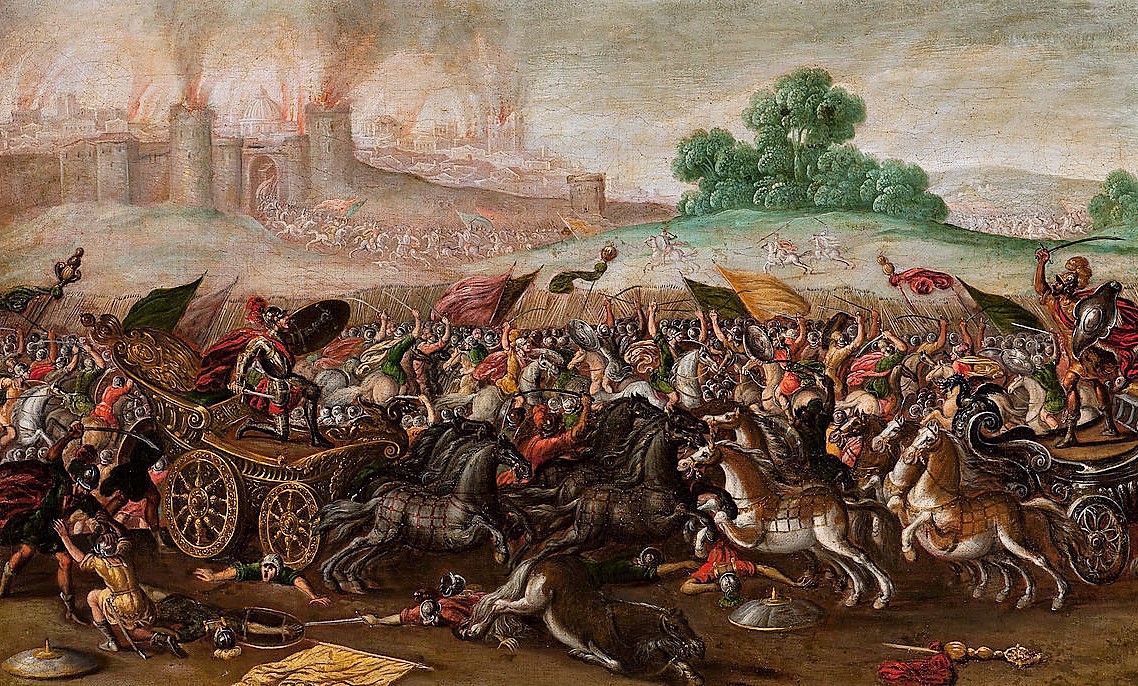
The tragic moment for Judah came in 587 B.C. The Babylonians utterly destroyed Jerusalem. The Temple was burned, and the Ark of the Covenant was lost, never again to be found (until its fulfillment in the Blessed Mother Mary). One could not imagine a more unlikely or complete destruction. Why would God allow His glorious Temple to fall at the hands of an unbelieving nation?
God is not egocentric. He does not need buildings or holy cities to show His power. His most central work is to fashion a holy people and to draw each of us to holiness. God cares more about our holiness and salvation than His own external glory or buildings and shrines in His honor.
The terrible state of affairs of ancient Israel and Judah is well documented by the prophets. God’s own people had become depraved in many ways. There was idolatry, injustice, promiscuity, and a tendency to imitate the nations around them. Further, they had become incorrigible. God often described them has having necks of iron and foreheads of brass; He called them a rebellious house. Moreover, they made the presumption that God would never destroy His own temple or allow Jerusalem to fall.
There comes a time when warnings and minor punishments are no longer effective; only the most severe and widespread of losses will purge the evil. Surely this is evident in the smoking ruins of Jerusalem in 587 B.C. Those who survived were taken to live in exile.
By the waters of Babylon, there we sat down and wept, when we remembered Zion. On the willows there we hung up our harps (Ps 137:1-2).
We should not delude ourselves into thinking that such a terrible event could only occur in the ancient world. We must consider that our condition can become so debased, so corrupted, that the only solution is the most severe of punishments, one so onerous that we cannot possibly return to our former ways, one that levels the very sources of our pride and many of our occasions for sin.
Today, we kill shocking numbers of children in the womb; no amount of preaching or teaching of medical truth seems capable of ending this shedding of innocent blood. Our families are collapsing; we are suffering the ravages of our sexual sins. In our national and international greed, we cannot seem to control our spending or ever say no to ourselves. We are saddling future generations with insurmountable debt. No matter the warnings, we don’t seem to be able to, or will not, stop. Many of the clergy have also become lost in sin; some even go about teaching error and misleading God’s people. There is indeed confusion and silence in the Church, where one would hope for clarity and words of sanity. Corruptio optimi pessima (The corruption of the best is the worst thing). Many of the faith are silent, weak, and divided, while the wicked and secular are fierce, committed, and focused.
All the while, in our affluence, we cannot imagine that a crushing end might come. Yet God said to the ancient, affluent city of Laodicea,
You say, I am rich, I have prospered, and I need nothing, not realizing that you are wretched, pitiable, poor, blind, and naked. I counsel you to buy from me gold refined by fire, so that you may be rich, and white garments so that you may clothe yourself and the shame of your nakedness may not be seen, and salve to anoint your eyes, so that you may see (Revelation 3:17-18).
It becomes hard to see how God might bring us to conversion without the severest of blows.
Nevertheless, do not wish for this. Continue to pray for conversion! The alternative is almost too awful to imagine. Most of us are too comfortable to endure what might come. Saints, sinners, and everyone in between will suffer. Ezekiel was the first to suffer in the collapse of his times, even though he was one who tried to listen and to warn.
The message of this week’s readings from Ezekiel is clear: Pray, pray, pray. Be sober that God will not hesitate to inflict severe blows if necessary, so that He might save at least some, a remnant.
This song says,
Ne irascaris, Domine, satis (Be not angry, O Lord, enough) et ne ultra memineris iniquitatis nostrae. (And remember our iniquities no longer) Ecce, respice, populus tuus omnes nos. (Behold, see, we are all your people) Civitas sancti tui facta est deserta. (Your Holy City is deserted) Sion deserta facta est, (Sion is deserted) Jerusalem desolata est (Jerusalem is destroyed)
In the Gospel this Sunday, we continue with Jesus’ great treatise on the Eucharist (John 6).
Although many of the Jewish listeners who hear Him speaking in the synagogue at Capernaum are grumbling and murmuring in protest at His insistence that they eat His flesh and drink His blood, Jesus does not back down. In fact, He “doubles down” and quite graphically teaches a very real (as opposed to symbolic) call to eat His flesh and drink His blood. Let’s examine Jesus’ teaching in four stages.
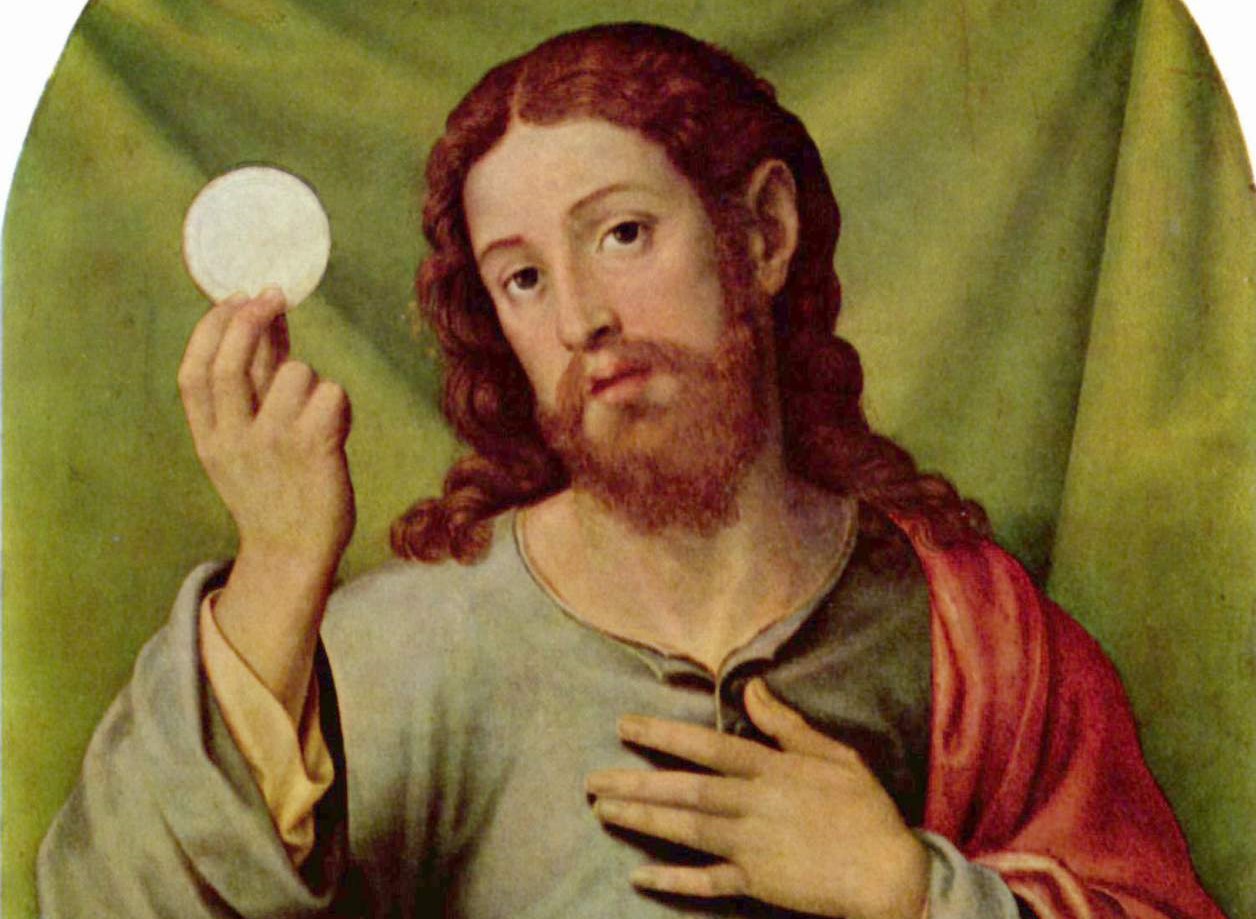
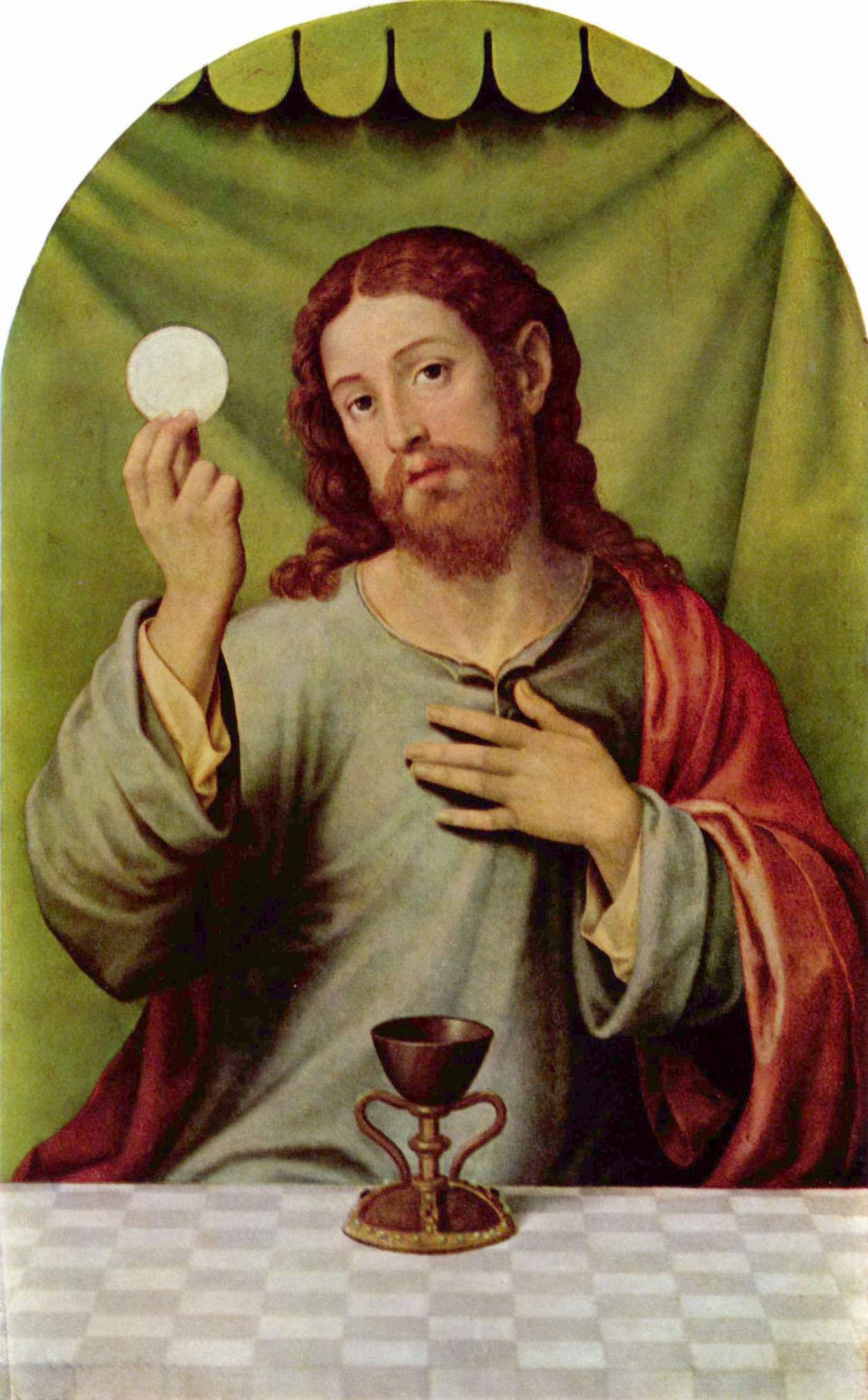
I. REALITY of the Eucharist – Jesus begins by insisting on its reality, saying, “I am the living bread that came down from heaven; whoever eats this bread will live forever; and the bread that I will give is my flesh for the life of the world.” Notice, therefore, that the bread is His flesh. The bread is not simply a symbol of His flesh, of His body, or of His life and teachings. It is not simply a way of remembering Him when He is gone. No, it is His flesh. Other scriptural passages also insist on the true presence of Jesus in the Eucharist and the truth that it is His Body, Blood, Soul, and Divinity.
For I received from the Lord what I also delivered to you, that the Lord Jesus on the night when he was betrayed took bread, and when he had given thanks, he broke it, and said, “This is my body which is for you. Do this in remembrance of me.” In the same way also the cup, after supper, saying, “This cup is the new covenant in my blood. Do this, as often as you drink it, in remembrance of me” (1 Cor 11:23-25).
The cup of blessing which we bless, is it not a communion in the blood of Christ? The bread which we break, is it not a communion in the body of Christ? (1 Cor 10:16)
Whoever, therefore, eats the bread or drinks the cup of the Lord in an unworthy manner will be guilty of profaning the body and blood of the Lord. Let a man examine himself, and so eat of the bread and drink of the cup. For anyone who eats and drinks without discerning the body eats and drinks judgment upon himself (1 Cor 11:27-29).
When he was at table with them, he took the bread and blessed, and broke it, and gave it to them. And their eyes were opened and they recognized him; and he vanished out of their sight. Then they told what had happened on the road, and how he was known to them in the breaking of the bread (Luke 24:31, 35).
Thus, the Lord first teaches them of the reality of the Eucharist, of the bread and wine that He offers: it is in fact His Body and Blood.
II. REACTION – The Lord’s teaching provokes a strong reaction from His listeners: The Jews quarreled among themselves, saying, “How can this man give us his flesh to eat?”
This is one of the most difficult moments of Jesus’ public ministry. The scene is the synagogue at Capernaum, the town where Jesus worked some of His greatest miracles. You’d think he’d have a really supportive audience here!
As it turns out, you might say he had no “Amen corner.” The old spiritual was demonstrated that goes, “Way down yonder by myself and I couldn’t hear nobody pray.”
As we continue with this Gospel next week, we will see that their revulsion is so severe that many leave Him and no longer walk in His company.
I wonder if Jesus had this moment in mind when he said of Capernaum, And you, Capernaum, will you be exalted to Heaven? You shall be brought down to Hades. For if the mighty works done in you had been done in Sodom, it would have remained until this day. But I tell you that it shall be more tolerable on the day of judgment for the land of Sodom than for you” (Mat 11:23-24).
III. REINFORCEMENT – Jesus does not back down. Their rejection leads Him to reinforce His teaching: Jesus said to them, “Amen, amen, I say to you, unless you eat the flesh of the Son of Man and drink his blood, you do not have life within you. Whoever eats my flesh and drinks my blood has eternal life, and I will raise him on the last day. For my flesh is true food, and my blood is true drink.”
Yes, Jesus gets emphatic and uses the intensifier “Amen, Amen I say to you,” which is the Jewish equivalent of “Let me be perfectly clear.” He also switches His vocabulary from the polite word for “eat,” φαγεῖν (phagein), to τρώγων (trogon), which more graphically and almost impolitely speaks of gnawing on, crunching, or chewing His flesh.
Jesus wants to be very clear. His listeners now understand Him to speak literally, rather than metaphorically or symbolically. Jesus assures them that He expects to be understood literally. Why is He so emphatic? He wants to save us. He links the eating of His Body and Blood to eternal life: Whoever eats my flesh and drinks my blood has eternal life, and I will raise him on the last day. In order to be raised up and to make the journey to eternal life, we must be sustained and strengthened for the journey by eating His flesh and drinking His blood.
It is just like the manna that sustained the Israelites for forty years in the desert as they journeyed to the Promised Land. Had they not eaten, they would have died in the desert. So it is for us in the desert of this world. Without our manna, our Bread from Heaven, without the Body and Blood of the Lord to sustain us, we will not make it to the Promised Land of Heaven.
Jesus insists and says, “Unless you eat …” because otherwise the journey will be too long for you! For my flesh is true food, and my blood is true drink. Your fathers ate the manna in the wilderness, and they died. I am the bread which comes down from heaven, that a man may eat of it and not die.
IV. REWARD of the Eucharist – Here Jesus’ words speak plainly of the reward in receiving the Eucharist: Whoever eats my flesh and drinks my blood remains in me and I in him. Just as the living Father sent me and I have life because of the Father, so also the one who feeds on me will have life because of me. This is the bread that came down from heaven. Unlike your ancestors who ate and still died, whoever eats this bread will live forever. Note that Jesus mentions three rewards:
Intimacy– The Eucharist is called Holy Communion because, by it, we grow into a deep, lasting union with Jesus. Our knowledge and experience of Him in our life becomes deeper and more real. We see and experience His power at work in our life.
Increase– We find that our life grows richer. Sin is put to death and graces come alive. We are more joyful, confident, and serene. We are less vain, angry, lustful, and distracted. Jesus in His Eucharistic indwelling of us produces these effects over time.
Immortality– Eternal life refers to the fullness of life more so than its length. We become more alive as we grow into Holy Communion with the Lord. This happens even now, though its fullest effects wait until Heaven. Don’t miss the “now-ness” of eternal! It begins now and grows deeper with each year. Heaven will see its full unfolding, but even now a growing experience of a fuller and fuller life is to be the normative experience of every Christian.
The Teaching of the Eucharist was costly for Jesus in many ways. Clearly it pointed to and flowed from His horrific passion and death, but even before that, He had much to suffer from the murmuring of many of His disciples. As we continue with this Gospel next week, we will see that many would no longer follow Him because of this teaching. It was, to be sure, a shocking—even graphic—teaching. Yet so critical was it to the Lord that we obtain the Eucharist, that He was willing to risk rejection and ultimately give up His life so that we could have it—a costly meal indeed!
In his classic description of love, St. Paul says, Love bears all things, believes all things, hopes all things, endures all things (1 Cor 13:7).
I remember discovering this when I was in the 7th grade. A very pretty girl needed help carrying some heavy books; I had wanted to meet her and saw my chance. I gladly introduced myself and asked if I could help. Those were some heavy books, but I carried them gladly.
Love bears and endures all things. At that age it was just a crush or infatuation, but if even imperfect love can do that, how much more will love that is more mature and perfect gladly bear burdens and hardships?
Think about that as you view this amusing advertisement.
I like many of you am grieving these days. I will not speak directly to it here, but I think you know why I am grieving.
I don’t do grief well. But I have learned to study it in others and thus find my way.
My father died more than 10 years ago, and except for essential papers related to his estate, I simply boxed up most of his papers and stored them in the attic of my rectory for future attention. At long last I am sorting through those boxes. Among his effects were also many papers of my mother’s, who died about two years before he passed away.
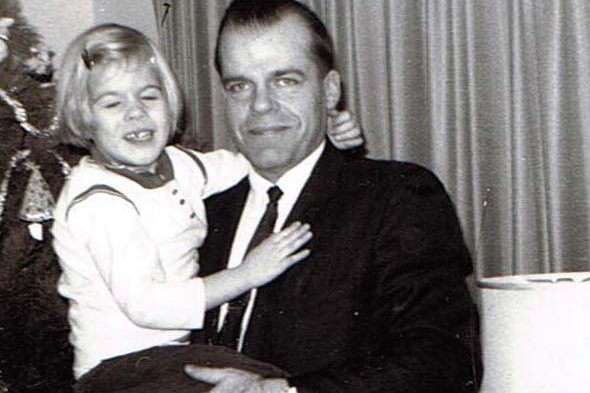
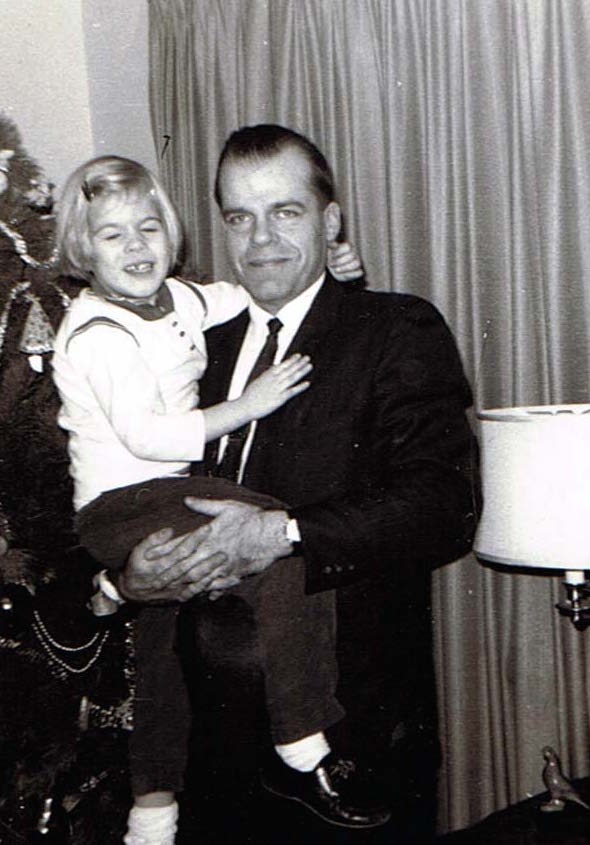
I discovered many things that moved me. As I read through the various papers, I was reminded that many of us never really know the pain and grief that others bear. In particular, I was struck by the poignant file that was simply labeled, “Mary Anne.” (A photo of my father and sister is at right).
My sister Mary Anne was tragically afflicted with mental illness from her earliest days. My parents knew there was trouble early on when she did not speak a word until she was well past two, and even then only at home. She had a pathological shyness that led her to shut down in the presence of others outside the home. The counselor at her elementary school spoke of Mary Anne as “disturbed” and insisted on psychiatric care for her by the time she was six.
Discretion and brevity limit what I intend to share here, but Mary Anne was deeply troubled. By age 13, she had to be hospitalized and spent the remainder of her life in 15 different mental hospitals and 6 different group homes. She was often able to visit with us and even stay over on weekend passes. She had stretches during which she was stable, but soon “the voices” would return, as would the dreams that afflicted her. Her psychotic episodes often led to running away, outbursts of violence, and attempts at suicide.
Through all of this, my parents fought very hard for her, and to be sure she got the care she needed. This often led them to various courts and generated much correspondence with insurance companies, state mental health officials, and private hospitals where she was confined. Indeed, during her lifetime my parents made many sacrifices for Mary Anne, both financial and personal, to ensure her care. At one point in the early 1970s, aware that Mary Anne felt isolated in the house with three brothers and desperately wanted a sister, my parents even went so far as to seek to adopt a baby girl. They filed paperwork and came very close, but the plan ultimately fell through. The baby sister we never had …
Maryanne died in a fire in the winter of 1991 at the age of 30. She likely had a hand in that fire; she had set fires before when the “voices” told her to. I could see the pain on her face as her body lay in the casket and I wept when I saw her. The funeral director explained that there was little he could do since her skin had been singed in the fire. She had clearly been crying when she died—a grief observed.
My father wrote this on the frontispiece of her file:
Mary Anne Pope was our first child.
She led a tortured existence during a short life
and fought hard against great odds.
We remember her for her courage.
And as I read my own parents’ touching recollections of Mary Anne, I could not help but moved, too, by their own pain. Such a heavy grief punctuates each page. I give them great credit for the fact that they insulated the rest of us, their three sons, from the most of the dreadful details of poor Mary Anne’s struggle. They kept their pain largely to themselves and stayed available to us. It is true that there were episodes we had to know about, but as a young boy and teenager I saw in my parents only strength and stability when it came to this matter. I saw my father’s grief and pain for the first time as he wept, standing there at the funeral home looking at my sister—It was a grief observed.
After my sister’s death, my mother’s grief grew steadily worse, causing her struggle with alcohol to worsen as well; she became increasingly incapacitated. Her life ended tragically and suddenly on a cold February day. My father had looked away for only a brief moment, going into the kitchen to make a sandwich, and mom wandered out into a snowstorm. Incapacitated by alcohol and disoriented, she died of hypothermia. We found her body only after three days of searching, when the snow melted a bit. She had died almost a mile away, near the edge of the woods—In her death it was another a grief observed, it was her grief.
My father never quite forgave himself for letting her slip away. The open front door, a first sign of trouble; the searching on a dark, frigid, and stormy night; the steady awareness, “She’s gone.” Those memories haunted him. In the months that followed, he often wondered how he could go on when half of him was gone. He, too, was gone within two years. His congestive heart failure worsened and he died in 2007, literally and figuratively of a broken heart—a grief observed.
All these thoughts swept over me as I looked through this file labeled simply, “Mary Anne.” I too am grieving
There is an old spiritual that says, “Nobody knows the trouble I’ve seen. Nobody knows but Jesus.” And it is a mighty good thing that he does know. Sometimes the grief is too heavy even to share, even to put into words. But Jesus knows all about our troubles. There is a beautiful line in the Book of Revelation that refers to those who have died in the Lord: He will wipe every tear from their eyes. There will be no more death or mourning or crying or pain, for the old order of things has passed away. He who was seated on the throne said, “I am making everything new!” (Rev 21:4-5)
For my brave parents and courageous sister, who all died in the Lord but who died with grief, I pray that this text has already been fulfilled, and that they now enjoy that everything is new—a grief observed no longer.
Requiescant in pace
I made this video on what would have been my parents 50th anniversary. I picked the song “Cold enough to snow,” since it spoke to my Father’s grief in losing mom on that snowy night.
In times like these, filled with errors and a resurgence of heresies (old or recast as new), there is a cry that goes up among the faithful: “How long, O Lord?” We may wonder why the Lord permits such errors to flourish. St. Augustine pondered the question as well:
But that is precisely why divine providence permits so many heretics to come along with various errors; it’s so that when they taunt us and shower us with questions we do not know the answers to, we may at least in this way be shaken out of our mental sloth and start longing to become acquainted with the divine scriptures … many people are lazy to want to be taught, unless they are sort of awakened from their slumbers by heretics making a nuisance of themselves with their taunts, so that then they start feeling ashamed of their ignorance and begin to realize that they are being put in a dangerous position by this ignorance of theirs.
That is why the apostle too says: “There have to be many heresies, so that those who prove reliable may stand out among you” (1 Cor 11:19). Those who can teach well are the ones who prove reliable in God’s eyes. But they can only stand out among people when they teach… (Augustine, On Genesis, Book 1.2).
Yes, our detractors and dissenters provide us a gift, albeit in a strange package. Their scoffs and pronouncements that the Church is out of date and will eventually change to “catch up” to their newly minted “truths,” compels the orthodox to ponder again the ancient truths given by God and to do so more deeply.
In our own times, so beset with public dissent even from some in the clergy, there has also been a blossoming of Catholic teaching as never before. There is a magnificent array of books, videos, websites, podcasts, solid Catholic journalism, radio and television programming, and even new Catholic universities. Our teaching has become sharper and more apologetic, focused not simply on the “what” of faith but also the “why.”
As I look at younger adults, I think it is a small miracle that they even come to Mass. Where would they have gotten such an idea? Certainly not from our current culture! Although only a small percentage of them attend, the ones that do are far more intentional, devout, and knowledgeable in some ways than the generations that preceded them.
I grew up at the end of an era, in the 60s and 70s, when Mass attendance rode the wave of a cultural energy. Back then it was widely held that “decent people” went to Church. Politicians, community leaders, and business owners were all expected to manifest belief and membership, to include regular attendance at sacred services. It was part of one’s bona fides. We went to Church in much larger numbers in those halcyon days, but in many cases we did so mostly because we were expected to do so. It was not that we were particularly devout or spiritual or that we were theological giants. Rather, it was a certain box that needed to be checked off. Surely not all were attending Mass perfunctorily, but a lot of people were swept in by the current of culture. When the culture turned (not just against attendance but against belief altogether), the numbers began to ebb. The whole thing was thousands of miles wide but only two inches deep. It broke up quickly under the scorching sun in the desert of our discontent, starting in the late 1960s.
Those of us who still attend Mass today are more intentional. Few seem to expect us to attend. Indeed, our attendance often provokes scorn, eliciting questions such as, “You don’t really believe all that Catholic stuff, do you?” It is this very scorn, however, that can help to quicken our resolve and to be clearer about what we believe and why it makes sense. If you ask me, there is something deeper and richer about the faith of many Church-goers today. In many cases they have had to swim against the current to believe and to come to Mass each Sunday.
St. Augustine’s observation remains largely true. When you encounter heresy and error don’t just get mad. Instead, get smarter and more devout!
For those looking for the “Wuerl Record” webpage, we have taken it down. Our effort in posting it was not to minimize the information from the grand jury report, but to ensure that Cardinal Wuerl’s full record was treated fairly. I can certainly understand the criticism, so we have taken it down. Our taking down the site, similarly, isn’t an effort at not being transparent. We made a mistake; we’re acknowledging it. Moving forward, some of that information will be housed on our Media page.
In the work of deliverance ministry, one of the first obstacles to overcome in the afflicted soul is an exaggerated notion of the power of Satan and his demons. Often the troubled person is experiencing a time of crisis. Overwhelmed, he is often scared and sees only darkness. The power of the evil one seems very real, while the power of the angels, of grace, and of God Himself is discounted or all but forgotten.
There are some important truths that need to be reestablished in the faith life of those so afflicted:
God is more powerful than Satan.
Angels are more powerful than Satan.
The Word of God, the sacraments, and Christian blessings are more powerful than curses, hexes, or the lies of the evil one.
Satan is not all powerful; his power is limited.
Satan is not Not only is his knowledge limited, it is sometimes inaccurate.
Satan is a creature. Demons are creatures; they are beneath God and subject to His authority.
One must be restored to a trusting faith in the love of God and in His power and authority over all things. Deliverance ministry (to include the Rite of Major Exorcism) is not a magic pill; it is a journey in faith and faith is necessary for its fruitfulness.
Part of faith includes the rather difficult concept that God allows certain afflictions “for a season and for a reason.” God mysteriously allows some of His creatures, human and demonic, to afflict one another, but it is only to draw some greater good and ultimate glory from the sufferings (see 2 Cor 4:17). Faith embraces not only the power of God over demons but also His mysterious providence in allowing some degree of affliction in our lives. From the perspective of faith, Joseph was able to say to his brothers (who had acted wickedly toward him): You intended it for evil, but God intended it for good, so that many would be saved (Gen 5:20).
In this essay, I want to focus on correcting exaggerated notions of Satan’s knowledge, power, and influence. This is not to say that we should have no concern whatsoever about the devil. Indeed, we should be sober. Daily, with confidence and with recourse to the assistance of God, we must stand against Satan’s evil temptations and torments:
Be sober-minded; be watchful. Your adversary the devil prowls around like a roaring lion, seeking someone to devour. Resist him, firm in your faith, knowing that the same kinds of suffering are being experienced by your brotherhood throughout the world. And after you have suffered a little while, the God of all grace, who has called you to his eternal glory in Christ, will himself restore, confirm, strengthen, and establish you. To him be the dominion forever and ever. Amen (1 Peter 5:8-11).
To be sober does not mean to unreasonably fearful of the devil or to forget God’s power and grace. Through strong faith we are to resist, to stand up again and again against Satan. To this end, it is helpful to understand that we can, by grace, stand against him, for God has set limits on Satan’s power, knowledge, and influence.
Let’s consider a few areas that illustrate some of the limitations of demons:
Demons are not omniscient.
To be omniscient means to know all things at all times, past, present, and future. This sort of knowledge pertains to God, but not to His creatures; and Satan and his demon minions are creatures. They are fallen angels. While intelligent, their intellects are darkened by sin as are ours (e.g., Romans 1:21-22).
We see this illustrated in Scripture. Satan has only gradual awareness of who Jesus is and that He has come. Jesus is born quietly in the small town of Bethlehem, in a kind of daring raid behind enemy lines. Satan seems aware of some sort of incursion, but is not certain as to where, or who it is. In the Epiphany account (Matthew 2:1-12), we see him seek information through his agent Herod. Even upon learning of the birthplace, he still does not know who. Herod takes a wild stab and orders the murder of all male children under the age of two (the Holy Innocents). Jesus and the Holy Family evade his grasp and slip away. This demonstrates the limits of Satan’s knowledge. He is aware of the incursion but ignorant of the details. Jesus, the Son of God, continues to live in Satan’s lair for thirty years and Satan does not know who or where He is.
In the narrative of the temptations in the desert (Matthew 4:1-11), Satan seems to narrow in on Jesus and His identity. He still seems unsure, however, for he says, “If you are the Son of God …” (e.g., Matt 4:6). From this time forward it would seem that Satan has reached a conclusion as to the identity of Jesus and through his demons manifests that conclusion. Scripture reports, Whenever the evil spirits saw him, they fell down before him and cried out, “You are the Son of God” (Mk 3:11). Another time a demon cried out, I know who you are—the Holy One of God (Mk 1:24). There are other similar passages in Scripture (e.g., Mk 1:34, Luke 4:41).
We should not conclude that Satan had a comprehensive or flawless knowledge of Jesus and of the full plan of salvation. If Satan had had such complete knowledge, especially of the plan of God, he would not have inspired the crucifixion of Jesus, the very means by which he was defeated. Why play into the hands of your enemy if you know you are going to lose?
Hence, there is evidence that Satan eventually acquired a basic understanding of Jesus’ divinity and of His plan, but his knowledge was limited and likely somewhat flawed.
From this we can conclude that demons are not omniscient. They cannot know the future. They cannot read our minds. They cannot even interpret the present with perfect accuracy. However, demons have long observed human behavior; they can see more widely and know hidden things about the past and the present.
This breadth of knowledge is often evident in exorcisms, where demons show some ability to disclose hidden things of the present or past. They also lie and guess a lot; and anything they claim to know about the future is a lie because they cannot know anything about future events or outcomes.
Demons are smart but lack wisdom.
One of the most surprising things encountered by exorcists and those who work on their teams is that many demons behave in downright juvenile ways. They sneer, call people names, whine, and in many ways seem to be dumb as rocks; they often act like pre-teens.
There are certain higher ranks of demons who are fierce and loud. Others are capable of great subtlety and psychological manipulation. A great many of lower ranking demons, however, are boorish, narcissistic, and incapable of anything close to sophistication.
One explanation for this is that while intelligent, they lack wisdom. Wisdom is a gift of the Holy Spirit that is operative when one is in a state of grace. Without wisdom, demons have no way to organize their intelligence to its proper end.
Wisdom, according to St. Thomas Aquinas, is a gift through which we know the deepest cause of all things: God. Out of this gift comes clear judgment of all things because we know their author, know something of His purposes, and can orient our behaviors toward our truest and highest goal, God Himself (see Summa Theologica II, IIae, q. 45).
Without wisdom, human beings tend to “major in the minors.” They maximize the minimum and minimize the maximum. Their lives are often disorderly and foolhardy because they have lost the moorings of either their origin or their destination. They may be very smart or capable in certain specific (e.g., finance, football), but to what end? There is little to organize their life or prioritize matters.
Similar things must set up in demons as well. It seems hard for demons to develop a coherent strategy other than to sow chaos and elicit fear. There are lots of histrionics, diversions, and silly games, but little that displays anything other than a short-term strategy to disrupt, cause pain, and manifest irrational hatred.
Another explanation for the juvenile behavior of many demons is that sin darkens the intellect. The old saying, “sin makes you stupid” is likely operative here as well.
All this said, we should not presume that demons they are as dumb as they seem. Some of it may be an act to inspire pride during the deliverance session. Pride is the mortal enemy of any exorcist or deliverance team member. The surprisingly “dumb” behavior of demons, whether real or an act, makes most exorcisms more tedious than frightening.
Satan and demons are not all-powerful.
While at the current time the Lord permits a certain freedom of at least some demons to “roam the earth and patrol it” (Job 1:7), he also limits their power.
A remarkable passage of Scripture says,
Then I saw an angel coming down from heaven with the key to the Abyss, holding in his hand a great chain. He seized the dragon, the ancient serpent who is the devil and Satan, and bound him for a thousand years. And he threw him into the Abyss, shut it, and sealed it over him, so that he could not deceive the nations until the thousand years were complete. After that, he must be released for a brief period of time. (Rev. 20:1-3).
Most Catholic scholars and the Fathers of the Church interpret the “thousand years” in the passage above as a figurative long period of time rather than specifically 1000 years. They hold that this “thousand years” has already begun and is the time in which we now live, the current “Church age.” During this time, the gospel goes out to the nations, as it has been, and Satan’s power is limited to some degree.
Although Satan and demons are described as “chained,” “in prison,” or “in darkness,” this is more likely a way of indicating that their power to influence or move about is limited in some way. This does not say that they do not wield considerable power, only that it is not unlimited. If you think it is bad now, just imagine what it will be like when their power is unchained!
It is said that St. John Vianney spoke of the devil as a chained dog. While it can bark and make a lot of noise, it can only bite if we get too close. Thus, Christians must remember that God mysteriously permits some influence of demons; He allows them to cause some harm, but their power is limited. They cannot directly kill, and it would seem that they cannot even fully control the very evil they set loose. This is evident in the way that the wicked often turn on one another. It can also be seen in the way that strong evils often usher in reforms. Consider, further, that the Church is still here preaching and teaching the same gospel after two millennia, while numerous evil regimes, empires, heresies, and corruptions have all come and gone. Although the gates (i.e., powers) of Hell have tried to prevail, they have failed due to Jesus’ promise of indefectibility for the Church as His Body and Bride (see Mat 16:18).
Demons are outnumbered.
While the exact number of demons and angels is unknown, Scripture hints at the fact that demons are outnumbered two to one:
And there was seen another sign in heaven: and behold a great red dragon, having seven heads, and ten horns: and on his head seven diadems: And his tail drew the third part of the stars of heaven, and cast them to the earth … (Rev 12:3-4).
It is likely that the “stars” referred to here are the angels. Satan is able to rally a third of them to his side and they became demons, some of whom roam the earth and others who are consigned already to Hell (see 2 Peter 2:4).
The good news is that for every angel that fell to become a demon, two did not and are thus able to serve God, assist us, and do good works.
These are important reminders for all of us, afflicted or not. There is a kind of theatric fear that too often exaggerates the powers of demons. Movies and other verbal and visual sources emphasize things to scare us and to deepen the drama of the movie or book. Satan and the work of demons should not be summarily dismissed. They are intelligent, crafty, and persistent. Our faith in the Lord must outweigh our fear of demons. We must grow in our faith that God has the power and capacity to both overcome evil on our behalf and to draw greater good from it when He chooses to permit it.
There is an old saying meant to shift our focus: Stop telling God how big your storm is and start telling your storm how big your God is. For deliverance and exorcism to have their fullest effect, confident and trusting faith must grow and exaggerated notions of the power of demons must give way. To all of us experiencing any trouble Jesus has this to say:
These things I have spoken unto you, that in me you might have peace. In the world you shall have tribulation: but have confidence; I have overcome the world. (Jn 16:33).
Here is a classic commercial that emphasizes the “cheap parlor tricks” of demons, though in this case the cause is more natural than first appreciated by those here. Remember, the first goal of demons is to strike fear in us.

 In times like these, you need a refuge, a place to rest.