The commercial below presents one of life’s little tests: the “middle seat.” There’s a lot of stress involved in flying, and on top of that we’re in like cattle. Finally, there is that dreaded middle seat. We’re not happy if we’re consigned to one and often feel apologetic about it to our seatmates, even though we paid for the seat just as they did. If we’re seated in either the window or aisle seats we hope that the person in the middle isn’t too unusual or, dare I say, too large. Yes, we all hate that middle seat and only hope to minimize the discomfort.
This commercial depicts the unfortunate truth that we often judge the physical appearance of others above other things. It is the first thing we see (or experience) of another, but one would wish we were less shallow.
Perhaps airplanes are the last place we will overcome this tendency, for our meetings there are just by chance. Pray for the ability to avoid hasty judgments based on mere appearance, particularly in the more stable settings in your life. Mere appearance leaves too much undisclosed.
Some people suggest that the Church should speak less of sin and instead emphasize positive things. After all, it is said that one can attract more flies with honey than with vinegar. In that vein, we in the Church have been collectively de-emphasizing sin to a large degree for decades, and yet our churches have been getting emptier and emptier. Maybe this is because people are just a little more complicated than the flies in the old saying.
In the Gospel for Thursday of this week (the 24th week in Ordinary Time), Jesus provides the reason our churches are getting emptier. Simply put, there is less love. He says, But the one to whom little is forgiven loves little (Luke 7:47).
Why is this? We love little because we have little appreciation for what the Lord has done for us and for the debt He paid on our behalf. And why is that? Because our debt of sin is no longer preached about the way it should be and thus we are less aware of the gravity of our condition. This diminishes love, and a lack of love leads to neglect and absence.
Understanding sin is essential to fully comprehending what the Lord has done for us. Remembering what the Lord has done for us brings gratitude and love. Again, to those who want the Church to de-emphasize sin, Jesus provides this warning: But the one to whom little is forgiven, loves little (Luke 7:47).
Let’s take a brief look at Thursday’s Gospel:
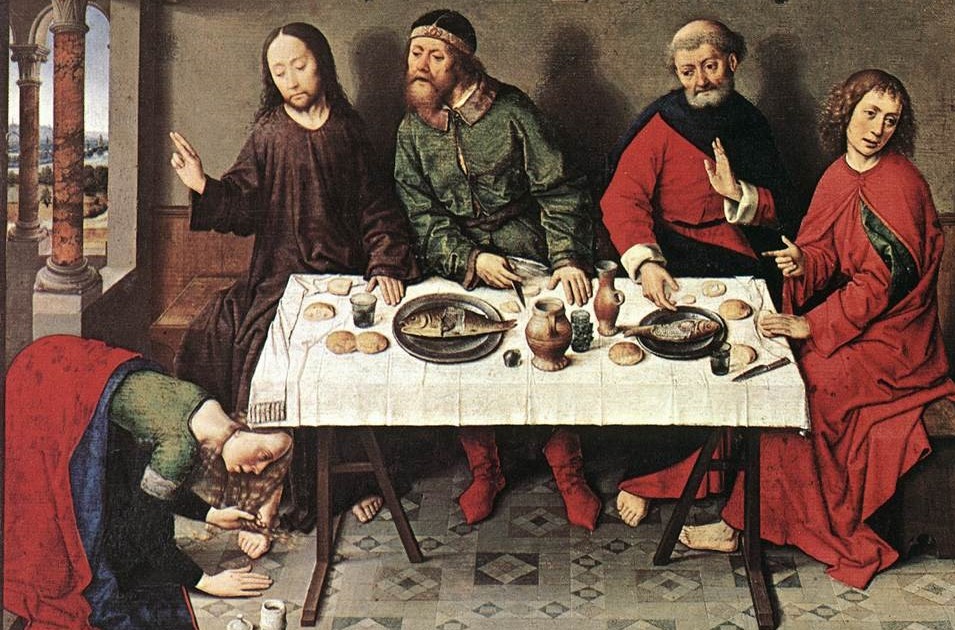
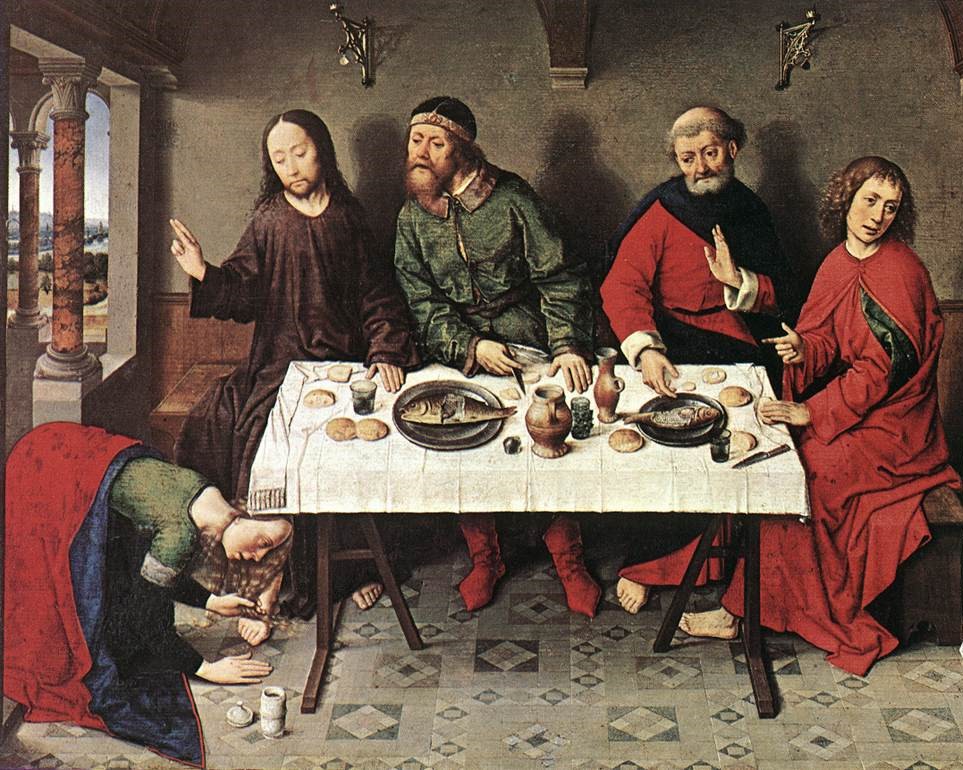
A Pharisee invited Jesus to dine with him, and he entered the Pharisee’s house and reclined at table. Now there was a sinful woman in the city who learned that he was at table in the house of the Pharisee. Bringing an alabaster flask of ointment, she stood behind him at his feet weeping and began to bathe his feet with her tears. Then she wiped them with her hair, kissed them, and anointed them with the ointment.When the Pharisee who had invited him saw this he said to himself, “If this man were a prophet, he would know who and what sort of woman this is who is touching him, that she is a sinner.”
Here is a woman imbued with sorrow for her sins and joy at the Lord’s mercy. The Pharisee’s exasperation is born out of blindness to his own sin. Being blind in this way, his heart is ill-equipped to love or even to experience love. He has no sense at all that he even needs it. His sense is that he has earned God’s love and that God somehow owes him! The Pharisee’s only hope is grace, love, and mercy from God.
Jesus said to him in reply, “Simon, I have something to say to you.” “Tell me, teacher,” he said. “Two people were in debt to a certain creditor; one owed five hundred days’ wages and the other owed fifty. Since they were unable to repay the debt, he forgave it for both.Which of them will love him more?” Simon said in reply, “The one, I suppose, whose larger debt was forgiven.” He said to him, “You have judged rightly.”
The central point of this Gospel is that to appreciate the glory of the good news we must first lay hold of the bad news. We must grasp the depths of our sinfulness in order to appreciate the height of God’s love and mercy.
In this “I’m OK; you’re OK,” world, there is little understanding of the enormity of sin and thus little appreciation for the glory of God’s steadfast love and mercy.
Jesus could not be clearer. Until we recognize the “bill” for our sins and grasp that we cannot even come close to paying it, we will make light of mercy and consider the gift of salvation that was earned for us with His blood as of little or no account.
How tragic it is, then, that many in the Church have either stopped preaching about sin or preach only about selected sins. The effect has been to minimize love and to empty our churches. Knowledge of our sin, if such knowledge is of the Holy Spirit, leads to love. In this Gospel, Jesus points to the woman as a picture of what is necessary.
We often get anxious about rather petty notions related to our ranking relative to one another. On this topic, the Lord teaches an important lesson in the Gospel of Luke:
An argument arose among the disciples about which of them was the greatest. Jesus realized the intention of their hearts and took a child and placed him by his side and said to them, “Whoever receives this child in my name receives me, and whoever receives me receives the one who sent me. For the one who is least among all of you is the one who is the greatest” (Luke 9:46-48).
It is a simple lesson, really, so simple that we usually miss it altogether. The lesson is this: for all our exalted titles, honors, and distinctions, at the end of the day our greatest title is “Beloved Son (Daughter) of God.”
Jesus stands this little child in their midst. To them who would boast of their exalted status and argue about who was the greatest, Jesus demonstrates that this is how he sees them all. What makes them great is simply their status as his beloved little children.
This child is the true picture of greatness, not some big cheese with a big hat. To be humble and to recognize the dignity of humility is to see and experience Jesus.
So much for their debate about who was greatest!
We Catholics, and especially we Catholic Clergy, love our distinctions and honorifics: Excellency, Eminence, Your Grace, Your Holiness, Pontifex Maximus, Reverend, Very Reverend, Right Reverend, Reverend Father … you name it, we’ve got it.
My own full title, given my status as Dean, is this:
The Very Reverend Monsignor Charles Evans Pope, M. Div., M.A.
(You might want to add “Big Mouth Blogger” to that, too!)
Do you want to know what God calls me? “Carlito” (Little Charlie). Whatever “exalted” status I attain, to God I am just a little kid that He dare not let out of his sight lest I run into trouble. Whatever my titles (and I am grateful for every bit of graciousness extended to me), I am no more baptized than any other Christian, and my greatest title is “Child of God.”
The Pope has authority, is deserving of our respect, and rightly has titles accorded him—but he is no more baptized than you or I. Before God each one of us is accorded this highest dignity: God’s chosen ones, holy and beloved (cf Col 3:19). We are just his little children. This is our greatest dignity, our greatest title.
Why, you may ask, do I say, “little children”? Because Jesus did, not only in this Gospel, but elsewhere as well. There is a tender moment when, after His resurrection, the Lord Jesus stood on the shore of the Sea of Galilee and called out to grown men: “Little children, have you caught anything?” The Greek word used is Παιδία (padia) meaning little children or infants. While this diminutive is surely used affectionately, there is little doubt that this is how God sees us.
We easily forget our beloved status before God and devolve into debates about our relative status here. We argue about who is the greatest, who gets to do what, who gets which honors, etc. We debate about roles: why women can’t be priests, who is the head of the household, what leadership positions are open to whom, etc.
Setting aside our greatest dignity, we focus on lesser distinctions.
To be sure there are distinctions and offices, some (not all) of them from God. Scripture says,
And God has placed in the church first of all apostles, second prophets, third teachers, then miracles, then gifts of healing, of helping, of guidance, and of different kinds of tongues. Are all apostles? Are all prophets? Are all teachers? Do all work miracles? Do all have gifts of healing? Do all speak in tongues? Do all interpret? Now eagerly desire the greater gifts (1 Cor 12:28-31).
Whatever our distinctions, even those from God Himself, they do not affect our dignity, for our dignity is something we all have by baptism. Before any other title, role, or honor, our greatest title and dignity is “Child of God and member of the Body of Christ.”
Scripture says this regarding our dignity:
So in Christ Jesus you are all children of God through faith, for all of you who were baptized into Christ have clothed yourselves with Christ. Here there is neither Jew nor Gentile, neither slave nor free, nor is there male and female, for you are all one in Christ Jesus. If you belong to Christ, then you are Abraham’s seed, and heirs according to the promise (Gal 3:26-29).
St. Paul is not denying distinctions. For example, there is of course male and female, but distinctions do not overrule our common, fundamental dignity: Child of God.
Do we really understand this? Too often, no. In an instant, we’re back to our debates about who is the greatest, who gets to do what, who is in charge, etc.
St. Augustine beautifully underscored how distinctions do not affect dignity when he said,For you I am a bishop, with you I am a Christian. I have sometimes used this idea when speaking to my own parishioners, saying, “For you I am your pastor, with you I am your brother, and from you I am your son.”
Distinctions should not be confused with dignity. Our greatest dignity, our greatest title, is something we all share, something given us by God not by man: “Child of God.” It is your greatest title.
I’ll conclude with this humorous story:
One day, a powerful and influential Cardinal Archbishop of a large city was in Jerusalem strolling with his priest secretary in the market. He came upon a vendor, who cried out, “You, sir! Come here and I’ll give you a fair deal!” The secretary, annoyed at the vendor’s use of the lesser title “sir” said to him, “Do you know who this is?” “No,” replied the vendor. The priest said, “This is His Eminence Cardinal Archbishop so-and-so.” “Really?” replied the vendor, “Well, I’ll still give you a fair deal!”
Our distinctions do not affect our fundamental dignity.
The Gospel for Tuesday of the 24th Week provides a kind of prescription for peace in a world of woe. Let’s look at it in four stages.
I. The Place – Jesus journeyed to a city called Nain, and his disciples and a large crowd accompanied him.
The name of the city, Nain, means fair (in the sense of beautiful)—and it was, for it sat upon a high hill and commanded a magnificent view.
This is an apt description of this world as well, which has its beauty, its magnificent vistas, and its pleasures and offerings. As men and women of faith, we ought to appreciate the beauty of what God has created. It makes God angry, to quote Alice Walker’s The Color Purple, “when you walk by the color purple in a field somewhere and don’t notice it.” God has given us many gifts and the mystic in all of us is invited to wonder, awe, gratitude, and serene joy.
Thus, we have the first prescription for peace. The world, with all its woe, never loses the beauty of God’s glory. Appreciating this brings serene peace even in the midst of storms. God is always present and speaking to us in what He has made and is continually sustaining.
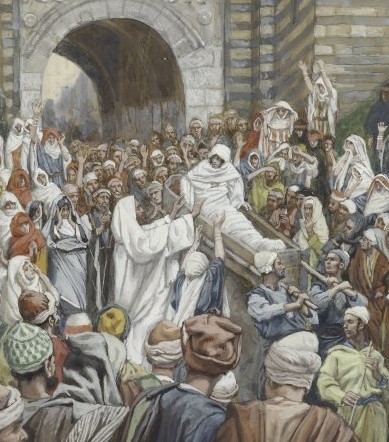
II. The Pain – Fair though this world is, the very next thing we encounter in the text is pain: As he drew near to the gate of the city, a man who had died was being carried out, the only son of his mother, and she was a widow. A large crowd from the city was with her.
Indeed, we live in a fallen world, governed by a fallen angel, and we have fallen natures. God had made paradise for us, and while we cannot fully understand what that paradise would have been like, it is clear that Adam and Eve were driven from the best of what God had made.
Adam was told that the ground was now cursed on account of him; it brought forth thorns and thistles in a kind of protest. For Adam, work became arduous and sweat-producing; a kind of battle set up, pitting him against the forces of nature in order to provide for his basic needs.
Having simple sobriety about this provides a strange kind of serenity. If we are willing to accept them, there are certain hard truths that will set us free. One of those is that life is hard. Joy will come with the morning light, but some nights of weeping must be endured as we journey to our heavenly homeland where sorrows and sighs are no more.
Accepting the pain of this world is the second part of the prescription for peace in a world of woe.
III. The Portrait of Jesus – When the Lord saw her, he was moved with pity for her. This woman’s sorrow becomes His own. While there is a mystery to God’s allowance of suffering, we must never think that He is unmoved or uncaring.
There is a saying (attributed to various sources) that “Jesus didn’t come to get us out of trouble; He came to get into trouble with us.” Yes, He takes up our pain and experiences it to the utmost. An old hymn says, “Jesus knows all about our struggles, He will guide till the day is done; There’s not a friend like the lowly Jesus, No, not one! No, not one!”
Note that the word pity comes from the Latin pietas, a word for family love. Jesus looks at this woman and sees a sister, a mother, a dear family member, and He is moved with family love.
Learning to trust in Jesus’ love for us, especially when we suffer, is a critical part of the prescription for peace. We need to pray constantly in our suffering: “Jesus I trust in your love for me!” If we pray this in the Holy Spirit, it brings peace.
IV. The Preview – [Jesus] said to her, “Do not weep.” He stepped forward and touched the coffin; at this the bearers halted, and he said, “Young man, I tell you, arise!” The dead man sat up and began to speak, and Jesus gave him to his mother.
We have here a directive from Jesus not to weep. That directive is rooted in what He plans to do. This is more than a human, “Cheer up. Don’t be sad” sort of exhortation. Jesus is about to give her back her son. Based on this fact, He says, “Do not weep.”
In a very moving line we are told simply, “Jesus gave him to his mother.”
Do you realize that one day the Lord will do this for you? Jesus will return and restore everyone and everything that the devil and this world have stolen from us. It will all be given back and more than we could ever imagine will be added to it.
In my own life the Lord has given me victories over sufferings and setbacks. I have experienced healings and restorations, as I’m sure you have. These are previews; they are down payments, if you will, on the total restoration that the Lord is going to effect in your life. Whatever you have lost, you will recover it all and far more besides.
What previews have you had in your life? What victories? What healings? What restorations? These are like previews of the promised and more-than-full restoration that is to come. What is your testimony?
It is important for you to reflect on the previews the Lord has already given, for these are another important part of the prescription for peace: the promise of complete restoration and the previews he has already given of that promise.
Here, then, is a prescription for peace in a world of woe:
Make the journey to Nain, a place called fair and beautiful. That is, let the Lord open your eyes to the beauty and blessings all around you. Come to see the magnificence of His glory on display at every moment. It will give you peace and serene joy.
Ask for the grace to accept that we currently live in a “paradise lost” and that life is hard. This sober acceptance of life’s sorrows brings a paradoxical serenity because our resentment that we do not live in a perfect world goes away. Accepting that this world, with all its beauty, also has hardships, brings peace and a determination to journey to the place where joys will never end.
Accept the Lord’s love for you even amidst His mysterious allowance of suffering. Accept that He is deeply moved and just say over and over, “Jesus, I trust in your love for me.”
Be alert to the previews that God gives and has already given you, previews of the future glory that awaits the faithful. Once you have accepted this evidence, this testimony from the Holy Spirit, peacefully accept the Lord’s instruction not to weep and His promise that you will recover it all—and much more besides.
This motet from Night Prayer is by John Shepherd. The translation of the Latin text (In pace, in idipsum dormiam) is “In peace, in the self-same, I will rest.”
During a recent day trip to Sicily, Pope Francis said that homilies should not last more than 8 minutes and that the entire Mass should be completed within 40 (although he may have been exaggerating on this second point). He has said similar things before.
He is entitled to his opinion, of course, but I disagree. No sweeping generalization about sermon length is necessary. There are cultural and even local differences that come into play. In my own parish I offer two rather brief masses, on Saturday and Sunday evenings, that are about 45 minutes long; our Sunday morning liturgies are a good bit longer. Our choir Mass lasts 90 minutes and those that come seem to enjoy it immensely. They say they are enriched in the extended worship of God and appreciate a longer sermon that explores the proclaimed word more thoroughly. It is a tradition here. In many parts of Africa liturgies can last upwards of three hours!
I will grant that no one wants to hear a long homily that contains only 5 minutes of content, but there are forms of preaching that teach out of the sacred text and delve deeply into its meaning and application to our lives—and this takes more than 8 minutes! There are some Catholics in this country who admire Protestant preaching because it typically features a rich message and makes it relevant to everyday life. For the record, though, most Protestant sermons are about 30 minutes long.
At some point, Catholics need to decide what they want in a homily: a short “thought for the day” reflection or something more substantial, which takes more time. Maybe we should offer them such options.
My deeper concern in the demand for briefer sermons and shorter Masses is that today we are in desperate need of liturgies that are more than perfunctory. In a world as secular and hostile as ours we need more prayer and instruction than ever! There are 168 hours in a week; removing time for sleep, that leaves more than 100 waking hours. How does 8 minutes of instruction and less than an hour of worship in total stack up against all those other hours, many of them filled with things that are downright poisonous to the faith?
Rather than simply focusing on length, perhaps it would be better to speak to effective and compelling liturgy and preaching. There are many fine preachers, Catholic and Protestant. It is well within the realm of human ability to preach powerfully, and it is my experience that God’s people will gladly listen to a good sermon even if it is considerably longer than 8 minutes.
In my mind, an 8 minutes ceiling is just too limiting. (There are times when brevity is required for good reason; for example, I have given 3-minute sermons as part of 30-minute televised Masses for shut-ins.) One might hope that the Pope, who sits atop a worldwide Church, would recognize the diverse situations and preferences that exist rather than suggest such a general, restrictive notion.
For the record, the homily Pope Francis gave following his remarks about brief sermons was 17 minutes long—not a bad length for a Sunday homily!
I am teaching out of the Book of Job for our parish bible studies. Consider the following insight by Job on the spiritual life:
God is wise in heart and mighty in strength;
who has withstood him and remained unscathed? (Job 9:3)
At first glance, we might read this to mean that we don’t dare talk back to God or resist Him lest He punish us, but this would be a superficial interpretation. The text surely speaks more richly, of the spiritual life and the journey we must make with God.
It recalls a story about Jacob, told in the 32nd chapter of Genesis. Jacob is in the desert (often a place of testing and encounter) and is returning to make amends with his brother Esau, from whom is estranged. During the night Jacob has a mysterious encounter with God. The text recounts that he wrestles with a man, but is it a man, an angel, or God? Through the night, Jacob wrestles with this man. Even more mysteriously (if the “man” is God), the text says that Jacob “prevails,” or at least holds his own. To end the struggle, God disables Jacob by touching his hip. Out of respect, God then gives Jacob a new name:
Your name will no longer be Jacob, but Israel, because you have struggled with God and with humans and have overcome (Gen 32:28).
The name “Israel” means “he who wrestles (strives) with God.”
As a result of this encounter, Jacob would limp for the rest of his life, leaning on a staff for support. It was as if to say that he would have to learn to lean on God and strive with God rather than against Him. Injured or not, this would be a blessing for Jacob, a new and deeper stage in his walk with God.
And so Job rightly said, Who has withstood God and remained unscathed? Our spiritual life can be seen as this kind of struggle. God respects our freedom and is “glad” to engage us. At least we are willing to stay in a conversation with Him rather than running from Him or refusing to be engaged at all.
As for Job, Jacob, and countless others before us, so too for us. We will not emerge from this spiritual relationship with God unchanged or unscathed. This is because our life with God is no mere friendship, or only a source of consolation. God is Lord and Father, and He has a difficult work to accomplish in us, who (like Jacob) can be stubborn, prideful, and resistant.
As an example, consider how in this world the relationship between parents and children is one of love but also one that is filled with tensions. This is due to the nature of the relationship. Parents, in addition to giving good and pleasant things to their children, also have difficult tasks in their formation. Children must be disciplined and disabused of selfish or destructive behaviors. Children must be taught things that do not necessarily please them. Parents must often make demands on their children that summon them to greater things requiring sacrifice and effort.
None of this is easy—and neither is our relationship with God. Our relationship is not merely about pleasantries. God must work to break sinful, selfish, and harmful drives within us. He must often imbue us with teachings that go against our desires and priorities.
Are you willing to struggle and to strive with God? You will be blessed! No one goes away from Jesus unchanged. No one who has God for his true Father will be unchanged, or “unscathed” as Job puts it. Jacob limped and leaned on a cane for the rest of his life (as a sign of humility). How do you limp? Where are your healing wounds in the saving struggle with God?
The song in this video is a bit over the top; I don’t think Jesus was conflicted, as this song implies. But we often are. The struggle can be difficult, but stay in it!
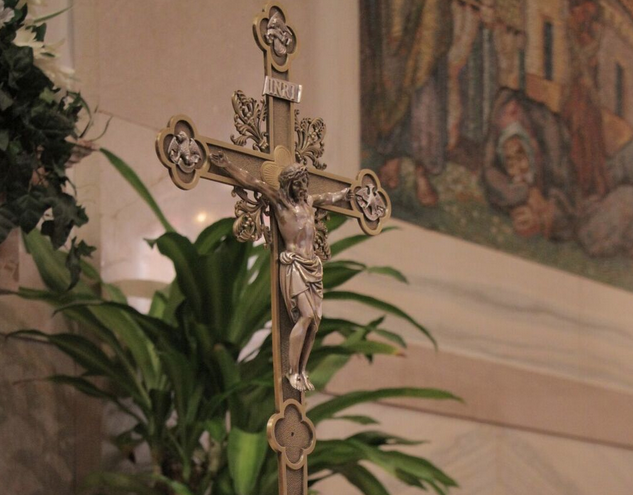
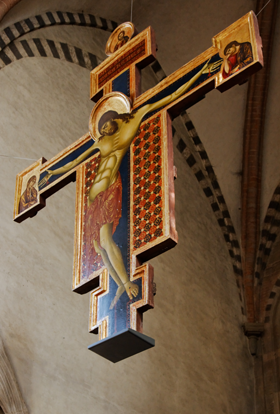
Jesus is Messiah and Lord, but He confounds every notion we have ever had about these titles. His power reaches perfection in “weakness” and He reigns from the cross. To the world this is utter absurdity, but the Lord insists that we meet Him at the cross. He chooses the foolish to shame the wise; He chooses the weak to shame the strong; He chooses the lowly and despised things of the world—and the things that are not—to nullify the things that are (cf 1 Cor 1:27-28). Let us journey to the cross and meet Him there; let us endure a little of His “folly.”
Our journey begins at Cesarea Philippi, a town “way up yonder” in pagan territory.
I. Confusion – Jesus begins by asking the disciples, “Who do people say that I am?” They said in reply, “John the Baptist, others Elijah, still others one of the prophets.”
First, note that not only are many different opinions put forth, but all of them are wrong.
There are many today who think it advisable for the Church to change her teachings based on what “the people” are saying or think is “right.” Yes, we should just take a poll and find out what the people want! So often we are called out-of-date because we do not conform to current (passing) opinions.
The premise, of course, is that we live in “enlightened” times and that if only the Church would just conform to current “wisdom” her halls would be full. Any look at most of the mainline liberal Protestant denominations puts the lie to this. For all their conformity to modern sensibilities, they are far emptier than any Catholic church (or those of the Evangelical denominations).
Further, the “poll” results delivered by the disciples in this passage are all wrong—every one of them. Collecting everyone’s opinion does not produce the truth.
Thus, we ought to acknowledge that there is a lot of confusion and divided opinion in the world; we should be careful about taking cues from the world when it comes to religious, moral, and lasting truth. Even in the physical sciences, which claim to be so objective, there is a considerable shifting of even fundamental premises over time. Further, there is often division among scientists and medical experts over even basic matters.
We do well to approach this world’s teachings and claims soberly, realizing that even in worldly matters, let alone religious ones, the world is divided and sometimes just plain wrong.
The question remains: Who is Jesus Christ and how will the answer be given?
II. Committee – Having rejected poll results as a valid way of determining the truth, Jesus tries to sample the experts. Surely even if the general populace cannot supply the answer, they can. The question now gets posed to the “blue-ribbon panel,” the twelve Apostles: And he asked them, “But who do you say that I am?”
Now we may wish to rush ahead to Peter’s answer, but first let us note that, as a body, the apostles are not able to return a verdict. What we get is silence.
III. Confession– Finally the correct answer comes forth: Peter said to him in reply, “You are the Christ.” Then [Jesus] warned them not to tell anyone about him.
The manner in which God provides the correct answer to us is developed more fully in Matthew’s version, which adds the following: Jesus replied, “Blessed are you, Simon son of Jonah, for this was not revealed to you by man, but by my Father in heaven. And I tell you that you are Peter, and on this rock I will build my Church, and the gates of Hell will not overcome it. I will give you the keys of the kingdom of heaven; whatever you bind on earth will be bound in heaven, and whatever you loose on earth will be loosed in heaven” (Matt 16:17-19).
Hence, we are taught that God the Father anointed Peter with this knowledge and inspired him to speak it for the others. This is the basis of our confidence that Peter and his successors, the popes, are inspired to proclaim the faith infallibly, not on account of their own learning but on account of the grace of God. And while the pope generally works with the college of bishops, his affirmation of their deliberations is essential for formal teachings on faith or morals.
Peter’s declaration is true and correct: Jesus is the Christ. However, Peter and the others still need to grow to a deeper understanding of the full implications of the true Faith. Just as Jesus will lead them to understand it, so too has He led the Church to a deeper understanding over the centuries.
IV. Clarification – Jesus draws them to deeper understanding: He began to teach them that the Son of Man must suffer greatly and be rejected by the elders, the chief priests, and the scribes, and be killed, and rise after three days. He spoke this openly.
Although Peter has spoken rightly, calling Jesus the Messiah, the term “Messiah” was widely misunderstood at that time. The misunderstanding was rooted in an incomplete reading of messianic prophecy. Most Jews of the time thought of the Messiah as a powerful military figure who would usher in a bloodbath, a career of conquest against the Romans; that is how this “Messiah” would reestablish the Kingdom of David in all its glory. It was a worldly and political view of the Messiah, one which Jesus rejected. Instead, He would more likely refer to passages such as these:
The Lord GOD opens my ear that I may hear; and I have not rebelled, have not turned back. I gave my back to those who beat me, my cheeks to those who plucked my beard; my face I did not shield from buffets and spitting. The Lord GOD is my help; therefore, I am not disgraced; I have set my face like flint, knowing that I shall not be put to shame. He is near who upholds my right; if anyone wishes to oppose me, let us appear together. Who disputes my right? Let that man confront me. See, the Lord GOD is my help; who will prove me wrong? (Is 50:5-9)
But he was wounded for our transgressions, he was bruised for our iniquities: the chastisement of our peace was upon him; and with his stripes we are healed. (Is 53:5)
Jesus clarifies what the Messiah must be: a suffering servant who dies so that His people don’t have to.
V. The Cross – Then things get tense for a moment: Then Peter took him aside and began to rebuke him. At this he turned around and, looking at his disciples, rebuked Peter and said, “Get behind me, Satan. You are thinking not as God does, but as human beings do.” He summoned the crowd with his disciples and said to them, “Whoever wishes to come after me must deny himself, take up his cross, and follow me. For whoever wishes to save his life will lose it, but whoever loses his life for my sake and that of the gospel will save it.”
Peter, correct just a moment ago, now needs rebuke, but Jesus is willing to work with him. He was right that Jesus was Messiah, but now he needs to understand more deeply what that really means. The Lord calls him away from the world’s notions and the opinions of sinful humanity.
After this, Jesus gets personal. He now tells them that not only will He take up a cross, but so must they.
Talk about not taking an opinion poll! Could anything rate lower on an opinion poll than the cross? Indeed, if one were to take a poll today, there would likely be no crosses at all, only pillows and buffet tables.
The cross is a paradox if there ever was one: from the cross comes life.
Even the world once had some notion of this. What do we have (that we value) that does not involve some sacrifice? A college degree, a career, children, a home, a television—all of them are the fruit of labor, of sacrifice. Too many today want blessings without sacrifice. If we want something, we “charge it.” We spend money we don’t have in order to possess things we have not earned. Welcome to $13 trillion in U.S. household debt, which of course no one should have to “suffer” to pay down. Indeed, the cross has largely been set aside.
But not for Jesus and not for us. To be true Christians we must embrace the cross. Oftentimes this means doing what is hard. It is easy to give way to temptation; it is harder to withstand it. It is easy to be greedy; it is harder to be generous. It is easy to fornicate; it is harder to be chaste. It is easy to file for divorce; it is harder to work things out. It is easy to do what everyone else is doing; it is harder to be a witness or a martyr. It is easy to do what is sinful and self-serving; it is harder to do what is right.
Yes indeed, the cross is what it is—hard, but there is life that comes from it. I am a witness (and I hope you are too) that to the degree I have embraced the often-harder choice of following God’s way, I have been blessed. The chaste avoid lust’s fires, not to mention child support, alimony, and sexually transmitted diseases. The generous have powerful friends in the poor, not to mention being less addicted to money and possessions. Those who fear the Lord have simpler lives than those who must ingratiate themselves to often-contradictory crowds, compromising at every moment.
In today’s Gospel reading we have been led to a deeper understanding of Jesus Christ. Who is He? Does He hold a worldly kingdom and offer merely passing prosperity? Is He just a divine butler who “steps and fetches” to meet our needs? Or is He the Lord, whom we must obey and who tells us to meet Him at the cross? Ask the martyrs; inquire of the saints. They will tell you of the cross, but they will also shout of the victory.
Jesus is Lord and Messiah, but He will not fight on the world’s terms. He conquers darkness with light, hatred with love, and pride with humility. He gives life by dying and bestows joy by sacrifice. He is Messiah, but on His terms not ours. His “weakness” conquers the strong; His “folly” confounds the learned and clever.
No, He’s not your average Messiah.
This song says, “If you can’t stand a little disappointment … if you think you should always be up and never down, I’ve come to remind you: No cross, no crown.”
We tend to lie to ourselves about many things; we are even “glad” at times to have others lie to us. This is especially true in matters related to flattery and vanity. Perhaps we can label these “vain lies.”
There are other lies that are far more serious in their impact because they besmirch the truth that is necessary for us to thrive and even to be saved. Let’s call these “damnable lies.” Of these St. Paul warned,
For the time will come when people will not put up with sound doctrine. Instead, to suit their own desires, they will gather around them a great number of teachers to say what their itching ears want to hear (2 Tim 4:3).
And he warns more darkly,
Evildoers and impostors will go from bad to worse, deceiving and being deceived. (2 Tim 3:13).
The commercial below speaks more to a vain lie, but edges toward a damnable lie because it can seriously affect our health. We often like to think that we eat less than we do. We also entertain lies related to our weight: we’re only heavy because we have a big frame or large bones. In the commercial, the woman assures us that drinking a small bottle of soda will actually help us to lose weight—not too likely!
Anyway, enjoy this lie from a pretty lady who probably never went anywhere near the product she was paid to sell.

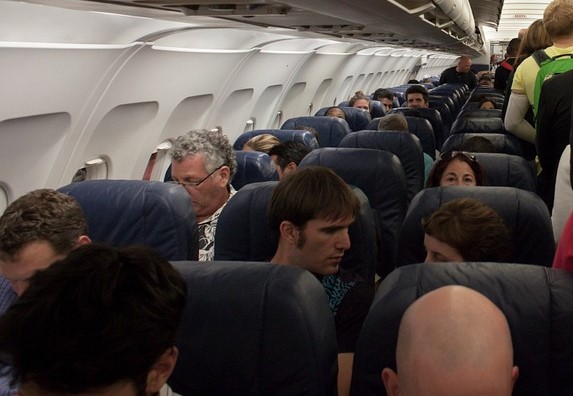 The commercial below presents one of life’s little tests: the “middle seat.” There’s a lot of stress involved in flying, and on top of that we’re in like cattle. Finally, there is that dreaded middle seat. We’re not happy if we’re consigned to one and often feel apologetic about it to our seatmates, even though we paid for the seat just as they did. If we’re seated in either the window or aisle seats we hope that the person in the middle isn’t too unusual or, dare I say, too large. Yes, we all hate that middle seat and only hope to minimize the discomfort.