In the ancient Church and up until rather recently, one genuflected at the two references to the Incarnation during the Mass: during the Creed and in the Last Gospel (John 1). Why was this done? It was explained to me that the mystery of the Incarnation is so deep, one can only fall in silent reverence.
There are many paradoxes and seeming impossibilities in the Incarnation. They cannot be fully solved, so they claim our reverence. We genuflected in the past, and today we bow at the mention of the Incarnation in the Creed, for it is a deep mystery.
As we continue to celebrate Christmas, I would like to list some of the paradoxes of Christmas. I want to say as little about them as possible—just enough to make the paradox clear. This paucity of words (not common with me) is in reverence for the mystery and also to invite your reflection.
The Infinite One becomes an infant.
An antiphon for the Christmas season says, How can we find words to praise your dignity O Virgin Mary, for he whom the very heavens cannot contain, you carried in your womb.
An old Latin carol (in Dulci Jublio) says, Alpha et O, Matris in Gremio (Alpha and Omega, sitting in Mommy’s lap).
He who looks down on all creation looks up to see His Mother. The most high looks up from a cradle. Of this moment, even the pagans wrote with longing and tenderness: Incipe, parve puer, risu cognoscere matrem … ipsa tibi blandos fundent cunabula flores, occidet et serpens, et fallax herba veneni occidet (Begin, little boy, to recognize the face of your mother with a smile … for you, your own cradle will bear delightful flowers; the serpent will die and the plant that hides its venom) – Virgil 4th Eclogue.
He who indwells all creation is born in homelessness, no place to dwell.
He, to whom all things in Heaven and on earth belong, is born in poverty and neediness.
He is the mighty Word through whom all things were made. He is the very utterance of God, the Voice which summons all creation into existence. Of this Word, this Utterance, this Voice, Scripture says, The voice of the LORD is upon the waters; the God of glory thunders, the LORD, upon many waters. The voice of the LORD is powerful, the voice of the LORD is full of majesty … The voice of the LORD flashes forth flames of fire. The voice of the LORD shakes the wilderness … The voice of the LORD makes the oaks to whirl, and strips the forests bare; and in his temple all cry, “Glory!” (Ps. 29) Yet this voice is now heard as the cooing and crying of an infant.
His infant hand squeezes His mother’s finger. From that infant hand, the universe tumbled into existence. That same hand is steering the stars in their courses.
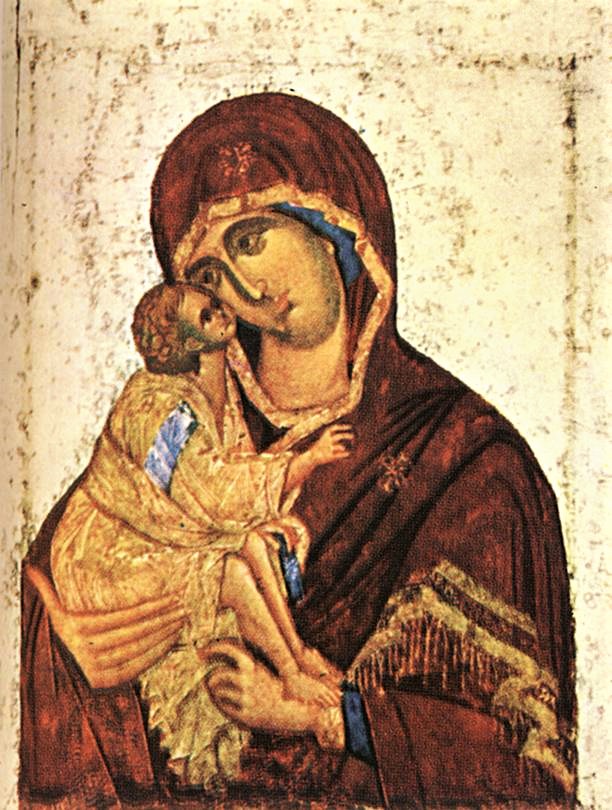
He who holds all creation together in Himself (Col 1:17) is now held by His Mother.
He who is the Bread of Life is born in Bethlehem (House of Bread) and lies in a feeding trough (manger).
He who is our sustainer and our food is now hungry and fed by His Mother.
Angels and Archangels may have gathered there, Cherubim and Seraphim thronged the air! But only his mother in her maiden bliss, could worship the beloved with a kiss (Christina Rosetti “In the Bleak Midwinter”).
Each of these is meant to be a meditation on the great mystery of the Incarnation. Please chime in with your additions to this list!
A paradox is something that defies intuition or challenges the common way of thinking. It unsettles us or startles us into thinking more deeply. The word paradox comes from the Greek para (beside, off to the side, or above) and dokein (to think or to seem). Hence a paradox is something “off to the side” of the usual way of seeing or thinking about things. If you’re going to relate to God you’re going to deal with a lot of paradox, because God’s ways and His thinking often defy those of humans. God is not irrational but He often acts in ways that do not conform to worldly expectations.
This Christmas, consider these paradoxes and learn from them. Remember, though, that mysteries are to be lived more so than solved. Reverence is a more proper response to mystery than is excessive curiosity. More is learned in silence than by many words.
The mysteries of Christmas are many. Among them is the mystery of the music heard that night. The angels shouted the great declaration, “Glory to God in the highest,” and creation took it up as a song. Why this music? Is it merely window dressing, or does it disclose a mystery to us? Is the declaration only for us, or do the angels also need it?
As always with the things of God, there are realities far deeper than most of us imagine. Tonight’s Christmas feast weaves together, among many other mysteries, those of music and descent, and it points up to music and ascent. You see, over my head I hear music in the air; there must be a God somewhere.
Let’s explore this key point: The Lord descends (to one song) so that we might ascend (to a new song) to the highest heavens.
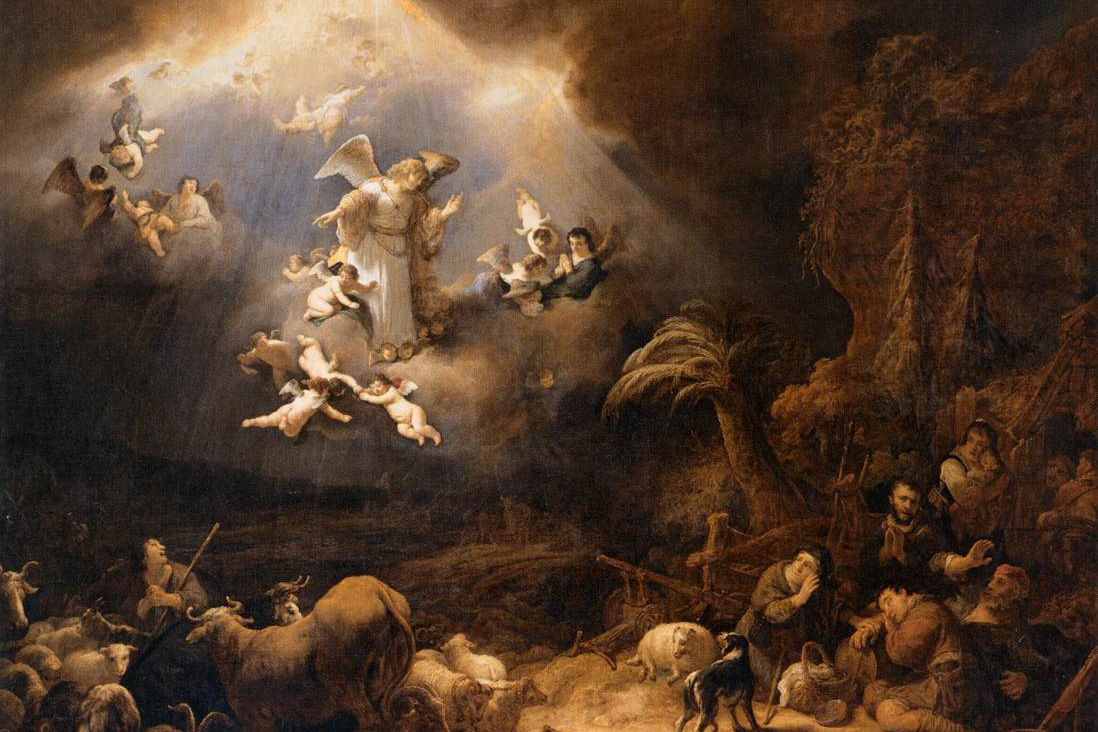
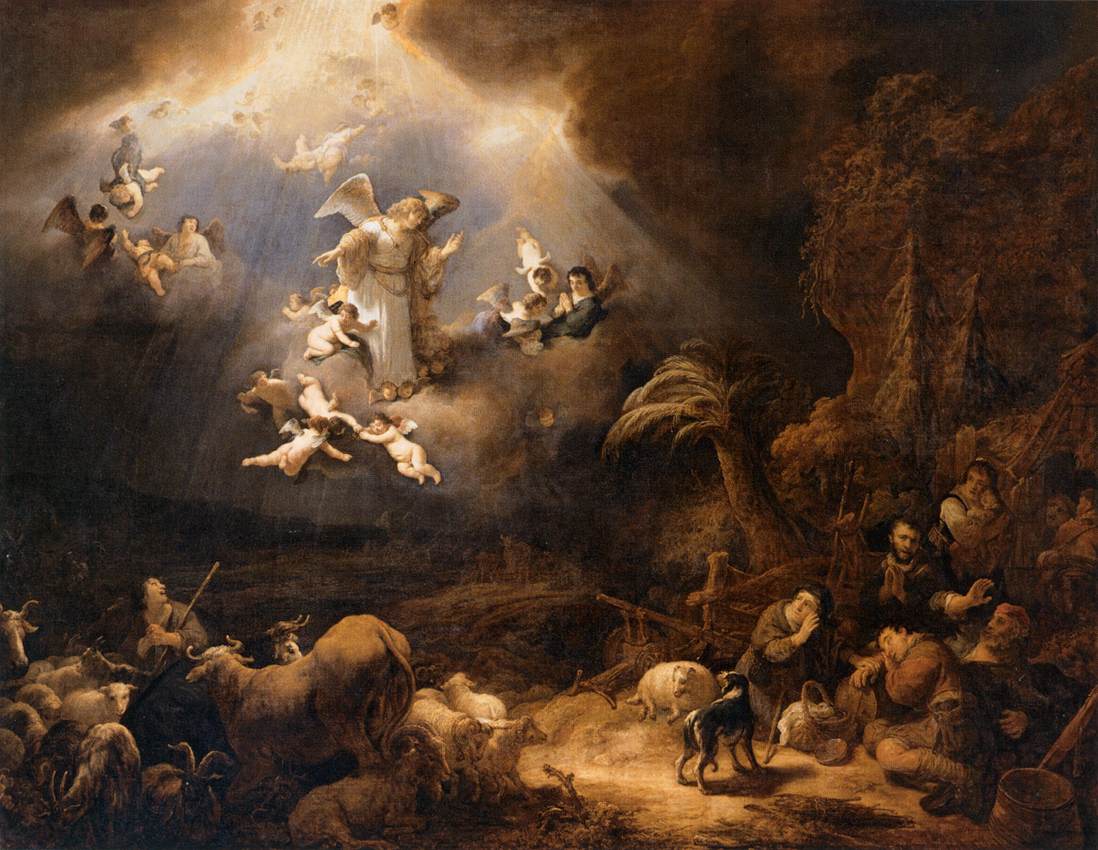
I. Divine Descent – The text says, Now there were shepherds in that region living in the fields and keeping the night watch over their flock. The angel of the Lord appeared to them and the glory of the Lord shone around them, and they were struck with great fear. The angel said to them, “Do not be afraid; for behold, I proclaim to you good news of great joy that will be for all the people. For today in the city of David a savior has been born for you who is Christ and Lord. And this will be a sign for you: you will find an infant wrapped in swaddling clothes and lying in a manger” (Lk 2:8-12).
We look first to Jesus’ divine descent. Note that Jesus, who is called Savior, Anointed One, and Lord, is said to be found wrapped in swaddling clothes and lying in a manger, a trough from which animals are fed.
What sort of king and Lord is this? It is almost a divine comedy. Imagine the shepherds quaking in fear at the presence of an awesome angel, who then says that they will find the Christ lying in a feed box inside a nearby stable.
Indeed, there is a remarkable divine condescension here! The Lord did not merely descend from Heaven to earth but to one of the lowest places on the earth: a smelly cave among animals. His bed a feeding trough not a cozy cradle. Yet how fitting, that He who is the Bread of Life would be born in Bethlehem (which means “House of Bread”) and be found lying in a manger.
Why this descent? The Lord descends today to one song in order that we may ascend with Him one day to a new place and sing a new song. To what song does He descend and to what song will we ascend? Let’s read on.
II. Delighted Declarations – The text says, And suddenly there was a multitude of the heavenly host with the angel, praising God and saying, “Glory to God in the highest and on earth peace to those on whom his favor rests.”
The angels rejoiced in God’s plan and longed for its day! One of the Church Fathers, Eusebius, spoke of discouragement among the lower angels at the advance of evil in the world that had been entrusted to their care. Even the giving of the law and the sending of prophets had done little to stem its tide. Now, God himself would intervene!
Thus, as Christ descends at the Annunciation and is manifest today at Christmas, the Church Father Origen has some of the higher angels say,
“If he has put on mortal flesh, how can we remain!? Come, Angels, let us descend from heaven!” That is why [Scripture says] there was a multitude of the heavenly Hosts praising and glorifying God when Christ was born. Everything is filled with angels! (Hom in Ex. 1:7)
As the Lord is made manifest to the world on this day, the highest angels who descended with Christ at the Annunciation now send word through and to the lower ranks of angels, and a great heavenly throng makes the declaration, Glory to God in the Highest, and on Earth peace!
Another Church Father, Pseudo-Dionysius, says of this Gloria,
The highest order composed of Seraphim, Cherubim, and Thrones, and which is closest of all, by reason of its dignity, to the secret sanctuary of God [instructs] the second order, composed of Dominations, Virtues and Powers. This order in turn reveals the mysteries to the lower tier of angels the Principalities, Archangels and Angels who are set in charge of the human hierarchies (Hier Ceol. 9,2).
This great sung hymn is not just for the human family. According to the Fathers of the Church it is also a signal to the lower ranking angels from the higher-ranking angels: Lift up your heads, Ye ancient Gates, that the King of Glory may come in! Of this mystery, St. Peter would later say, … The things which have now been announced to you by those who preached the good news to you … are things into which angels longed to look (1 Peter 1:12).
An ancient hymn from the Liturgy of St. James says of this moment,
Rank on rank the host of heaven
spreads its vanguard on the way,
as the Light of light descendeth
from the realms of endless day,
that the powers of hell may vanish
as the shadows clear away.
Why all this music at the divine descent? Because the music (Gloria in Excelsis) and the descent are related and are meant to lead us higher. Christ descends to one song in order to lead us to an even nobler, higher song.
III. Dignity of our Destiny– The Psalm for tonight says, Sing to the LORD a new song, sing to the LORD, all you lands. Sing to the LORD; bless his name (Ps 96:1-2).
So again, this music (Gloria in Excelsis) and the descent are related and meant to lead us higher. Christ descends to one song in order to lead us to an even nobler, higher song—a song sung in the highest heavens! Without this descent and this first song, the second song and our ascent would be impossible. Christ descends to the song of the lower heavens so that we, by his saving grace, may ascend to the place and song of the higher heavens.
What is this new song and where is this place? Isaiah heard the music and saw the place:
I saw the Lord sitting upon a throne, high and lifted up; and his train filled the temple. Above him stood the seraphim; each had six wings: with two he covered his face, and with two he covered his feet, and with two he flew. And one called to another and said: “Holy, holy, holy is the Lord of hosts; the whole earth is full of his glory” (Isaiah 6:1-3).
Here is our new song, a higher song, one sung only in the highest heavens before the throne of God, one sung only by the redeemed: Holy, Holy, Holy Lord, God of Hosts! At every Mass, our High Priest, Jesus, speaking through His ministerial priest, says, “Lift up your hearts.” The congregation replies, “We lift them up to the Lord.” In other words, we are told to come higher, to come into the Holy of Holies in Heaven, to come before the throne and sing the hymn of the highest in Heaven.
Our ascent to this highest place is made possible only by the Lord’s descent to the lowest places on earth: the manger, the cross, and Sheol. In the early Church, only the baptized were permitted to sing the Sanctus at Mass. The unbaptized were not allowed to attend. The catechumens, though permitted to sing the hymn announced to the lower realms (The Gloria), were dismissed prior to the singing of the Sanctus, the song of the highest heavens. Only when we are caught up higher by grace can we hear and join the Sanctus. One day it will be fully our song when God says to us, “Come up higher.” By Him who descended, we will then ascend and sing a new song to the Lord!
Over my head I hear music in the air; there must be a God somewhere. The Lord descends to one song that we might ascend to a new song in a new place, in the highest heavens. May He who descends to the manger today cause you to ascend to the highest heavens to sing that new song.
On this Christmas Eve we ponder the approaching mysteries. A question so basic that it does not occur to some to even ask is this: Why did the Lord choose to come to us through a woman, Mary, when He could have come in any manner He pleased?
He could have bypassed conception, gestation, birth, infancy, and youth entirely. He could have appeared suddenly on earth as a grown man — but He did not. Why not?
Remember, too, that although He chose to come through an earthly mother, he bypassed the participation of an earthly father (in the physical sense). If the biological role of a human father was bypassed in His taking flesh, why was the role of a human mother not similarly bypassed?
St. Thomas Aquinas pondered this question in his Summa Theologiae (part III, question 31, article 4) and set forth three reasons. St. Thomas’ commentary is shown below in bold italics, while my poor remarks appear in plain red text.
[Firstly,]Although the Son of God could have taken flesh from whatever matter He willed, it was nevertheless most becoming that He should take flesh from a woman. First because in this way the entire human nature was ennobled. Hence Augustine says (QQ. lxxxiii, qu. 11): “It was suitable that man’s liberation should be made manifest in both sexes.”
So, in this manner both sexes were ennobled. The male sex was ennobled because the Word became flesh and was male. The female sex was ennobled because it was from Mary that Christ took His humanity.
Secondly, because thus the truth of Incarnation is made evident. Wherefore Ambrose says (De Incarnation vi): “Thou shalt find in Christ many things both natural, and supernatural. In accordance with nature he was within the womb … but it was above nature that a virgin should conceive and give birth: that you may believe that He was God, who was renewing nature …”
Both the natural and the supernatural are evident in Christ’s conception and incarnation. St. Thomas emphasized the elevated need for the natural so that we might avoid the heresy of thinking that Christ’s humanity was not real due to its wholly supernatural origin.
And [as] Augustine says (Ep. ad Volus. cxxxvii): “If Almighty God had created a man formed otherwise than in a mother’s womb, and had suddenly produced him to sight … would He not have strengthened an erroneous opinion, and made it impossible for us to believe that He had become a true man? … But now, He, the mediator between God and man, has so shown Himself, that, uniting both natures in the unity of one Person, He has given a dignity to ordinary by extraordinary things, and tempered the extraordinary by the ordinary.”
So, it was fitting that Christ should be born of a woman, Mary, so as not to lose the natural in the supernatural, to show that both the natural (because He is true man) and the supernatural (because He is true God) should balance and complete each other.
Thirdly, … the first man was made from the “slime of the earth,” without the concurrence of man or woman: Eve was made of man but not of woman: [though since], other men are made from both man and woman. So [it] …. remained as it were proper to Christ, that He should be made of a woman without the concurrence of a man.
In other words, it seems fitting or proper that because Adam and Eve were both created outside of the usual order of things, the New Adam, Christ, would be made in a unique manner. Eve was made without the help of another woman, but rather was drawn by God directly from the man, Adam. In a kind of balancing parallelism, God made the New Adam directly from the woman, Mary, without the help of a man.
St. Thomas seems to point to a kind of poetic balance, not a necessary one.
So, here are some interesting insights as to why Christ chose to be born of a woman. Note well however, that these are arguments pointing to fittingness, not necessity. Saying that something is fitting does not mean that it is required, only that it is well suited to the situation. On the one hand, something can be fitting because, by it, we humans can more easily understand it. On the other, something can be fitting because it best suits God’s own purposes.
On the Fourth Sunday of Advent we are close to the unfolding of the great mystery of the Word made flesh. It is easy for us to look right past it, but we do well to pause and ponder what is taught to us today about the salvation that is to unfold. One significant way we can do this is by reflecting on the first reading, which is from the prophet Micah. In four short verses we are presented with a kind of summary of our salvation, a snapshot of what ails us and how God heals us.
Let’s see what the Lord and the Church have to teach us.
I. Our Humility – The text begins, And you, Bethlehem-Ephrathah, too small to be among the clans of Judah, from you shall come forth for me one who is to be ruler in Israel.
Of all the towns and villages in the land of Judah, one of the lowliest was Bethlehem. Though not far from the great city of Jerusalem—a matter of a few miles—it was little more than a rundown, frontier village with little to recommend itself. It was a place by which one passed quickly on the way to nearby Jerusalem.
Even today, despite all that happened there, Bethlehem remains a troubled and rundown little city, impoverished and crowded. Its steep, hilly streets feature little that is pleasant to the eyes. A great sorrow hangs over it. It is hemmed in by guard towers and walls covered with razor wire. These are signs of a great standoff between Israel and the Palestinians. Largely isolated economically, the city suffers from widespread poverty and unemployment.
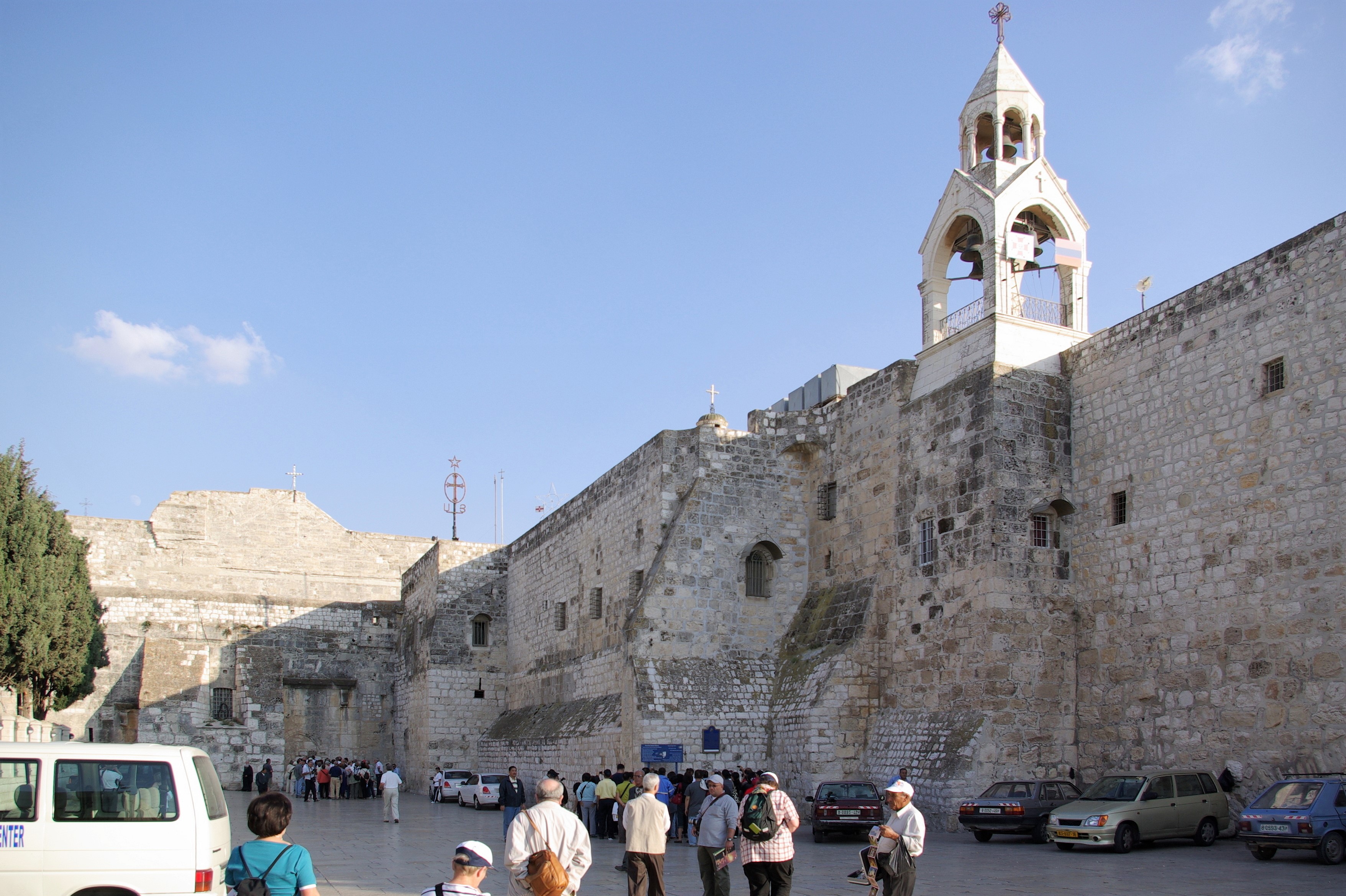
The ancient Church of the Nativity at the top of the hill looks every bit of its 1500 years in age. It is dingy, covered in soot, and largely in a state of poor repair, due to a standoff among the Orthodox factions that oversee the building. Thankfully, recent negotiations have yielded a renovation of some of the nave. The tension is palpable as one enters the church; nervous tour guides engage in delicate negotiations to ensure a quick visit to the cave of the Nativity beneath the altar.
Bethlehem remains lowly, troubled, and humble, yet it was here that our Savior chose to be born. He did not choose nearby Jerusalem, distant Rome, or any great imperial city. Not in a palace was He is born but in a cave. Even within this humble and lowly city, one must get mighty low to find the place where Christ was born. One descends steep, narrow steps into a cave, and once inside one must stoop lower still, even kneeling on the floor, to touch the place where Christ was born.
A lowly place in a lowly village—this is where Christ was born. See how the Lord esteems humility? God hates pride; He just can’t stand it. Pride is our greatest enemy; it is at the root of every sin we commit. That is why the Lord teaches us that humility is one of our greatest gifts.
The story also reminds us of something that took place in Bethlehem 1000 years before. The prophet Samuel was sent to anoint a new king to replace Saul. Having been sent to lowly Bethlehem, Samuel surveyed the sons of Jesse. The seven strong young men impressed Samuel, but none of them was the king he was sent to anoint. There was one other son, a boy so young and insignificant that Jesse had not even thought to include him. It was little David, who was out in the field tending the sheep. Yes, the lowliest one, he was the one whom God chose. Humility won the day (cf 1 Sam 16).
So it is that Bethlehem shows forth the humility, the lowliness that alone opens the door to God. Bethlehem is a name that means “house of bread,” not “house of caviar,” not “house of fine wine.” Humility ushers in our God.
II. Our Hardship – The text goes on to speak of our condition prior to the coming of Jesus: Therefore, the Lord will give them up, until the time when she who is to give birth has borne.
Our condition without Christ is grave. We are given up, given over to sin and to our own fruitless and self-destructive tendencies. Thus, we learn of the gravity of our condition: that we cannot save ourselves. The prophet Isaiah had cried out, Oh, that you would rend the heavens and come down, that the mountains would tremble before you! … All of us have become like one who is unclean, and all our righteous acts are like filthy rags; we all shrivel up like a leaf and like the wind our sins sweep us away. No one calls on your name or strives to lay hold of you; for you have hidden your face from us and made us waste away because of our sins (Is 64:1,6-7).
Yes, our condition apart from Christ is hard and quite hopeless. In the age of the law and the prophets, we learned the hard way that no matter how hard we try we cannot save ourselves. Our wounds are too deep, our pride too great, our hearts too dull, and our minds too dark. We are lost without God. How often have deluded men sought to create utopia only to discover ruins? We have only to consider the utopian notions of the last bloody century.
Yes, the age of the law and the prophets in the Old Testament shouts to us that we cannot save ourselves. We must rely on God; we must turn to Him. We don’t just need an angel—we need a savior. Until she who was to give birth has borne the son, the only way to describe the human family is just the way this text from Micah does: we had been given up, given over to our own sins so as to discover humility and our need for a savior.
Isaiah wrote, All we like sheep have gone astray, every one to his own way (Is 53:6). St. Paul would later write of the time before Christ, we were dead in our sins (Eph. 2:1), given over to our transgressions and iniquity.
So, here is our hardship. We are wandering, lost, and in need of a savior.
III. Our Head – The text goes on to speak of our Savior, our shepherd, our ruler, and our head: Whose origin is from of old, from ancient times. He shall stand firm and shepherd his flock by the strength of the Lord, in the majestic name of the Lord, his God.
Thus, we see that our Savior will be both God and man. He is God, for His origin is from of old, from ancient times (cf also Hebrews 7:3). He also saves us by the strength of the Lord. Yet He is also one of us, for the text speaks of Him as acting in the name of the Lord, His God.
He must be God in order to have the power to save us, and yet He must also be one of us in order to speak and act on our behalf. As God, He cannot obey God, for there is only one divine will. As man, having a human will, He is able to obey the Father. Thus, it makes sense that our Savior must be both God and man.
It is said that He will shepherd His flock. Shepherds feed, lead, and protect their flocks. All this the Lord does for us. It is a trait of sheep to be wayward; sheep tend to stray. They need the watchful care of a shepherd. Similarly, even after saving us from our sins, the Lord must continue to feed us, lead us, and protect us. Otherwise, having been snatched from the wolf, we might run into a bear. Or, having been saved from the edge of a cliff, we might wander into a thicket.
Christ, our shepherd and head, must go before us, showing us and opening the way. He must also walk behind us to guard us and to observe our every action. He must also walk beside us to keep our paths straight. We need our Savior, not just on Good Friday, but every hour of every day.
IV. Our Healing – The text goes on to say, and the rest of his kindred shall return to the children of Israel and they shall remain, for now his greatness shall reach to the ends of the earth; he shall be peace.
Thus, we see that Jesus’ essential task in healing us is not simply a personal healing for me alone or for you alone. It is also healing that removes the divisions within and among us. One of the chief sources of our suffering in this world is division. Nation is divided against nation; races and ethnic groups are in competition; there is conflict and crushing hatred.
At the time of Jesus, Jews and Gentiles (largely Romans and Greeks) were in major conflict. The Jews of Jesus’ time were taught to love their neighbor and their fellow Jews, but to hate their enemy. Jesus taught that we must love and forgive our enemies and began the process of establishing a universal Church, a Catholic Church. He gave the apostles standing orders to preach the gospel to every nation and to unite everyone under the common title of disciple, of Christian. The dignity of baptism and of being a child of God was to be offered to all. As this text of Micah prophesies, the Lord’s salvation and greatness shall reach to the ends of the earth.
The text goes on to say, He shall be our peace. Note that this is not a “can we all just get along” sort of peace. It means that He shall be our peace. That is to say, the Lord Jesus Christ and the truth He proclaims are to be the source of our unity. In sending the apostles forth to proclaim the Gospel to every nation, Jesus said that they should teach the people to observe everything that He commanded and should draw them into the life of the Church through baptism (cf Matt 28:19). He is our peace. Jesus and His teachings are what are meant to unite us. Every other form of peace is not a true or lasting peace.
Thus, Jesus initiated a process that was not meant to conquer the world politically. Rather, it was a process whereby His truth and grace would be proclaimed and those who accepted these gifts would be able to come to greater and more lasting peace.
This peace must begin in the heart and mind of every individual believer who, by the grace of Jesus Christ, experiences an inner healing of the many conflicts and destructive drives caused by sin. Then, by drawing others to that same healing through evangelization to a life-changing, transformative relationship with Jesus Christ, this peace is meant to spread throughout the world. This will put an end to division, bring together the children of God, and show forth God’s greatness, truth, and salvation to the ends of the earth.
He is our peace. Jesus is our healing.
This Sunday’s first reading, coming just before the Christmas reality, presents us with a summary of our salvation. It stresses our need for humility, describes our hardship, announces our Head (a Shepherd), and sets forth the basis for our healing. In a word, the basis for our healing is the Word made flesh, Jesus.
This song says,
We need to hear from you
We need a word from you
If we don’t hear from you
What will we do
Wanting you more each day
Show us your perfect way
There is no other way
That we can live.
Destruction is now is now in view
Seems the world has forgotten all about you
Children are crying and people are dying
They’re lost without you, so lost without you
But you said if we seek
Lord if we seek your face
And turn from our wicked, our wicked ways
You promised to heal our land
Father you can.
The video below is a 2008 Coca-Cola commercial that takes up the theme of the star of Christmas.
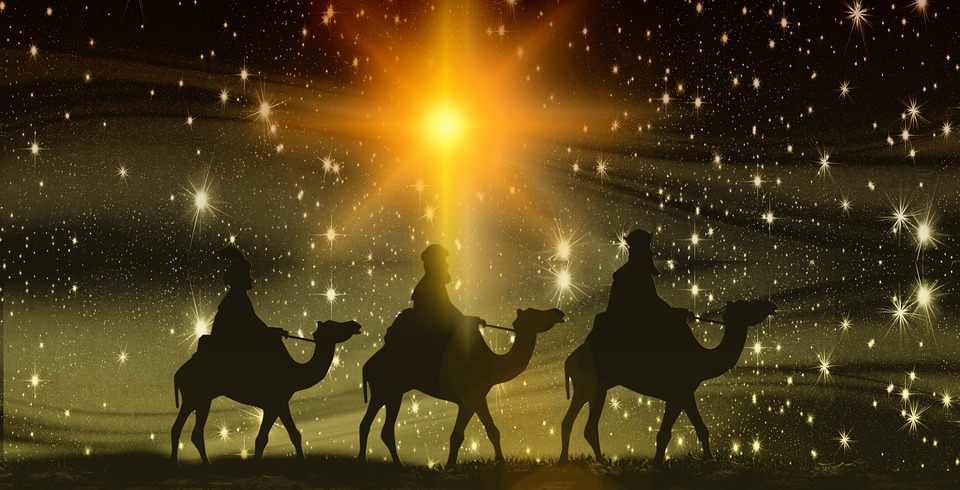
Let us review the impact that the star of Christmas had on the wise men, the Magi.
The star moved them to seek meaning outside themselves; it made them look out and up.
The star called them beyond what was familiar in their own country and world and expanded their horizons toward Christ and His Kingdom.
The star summoned them to seek Christ, and when they found Him, to worship Him.
The star drew them to be generous to a poor family in Bethlehem; they made sacrifices as they lay costly gifts of gold, frankincense, and myrrh before the Lord.
The star roused them to conversion; they “returned to their country by another route,” following the straight and narrow path rather than the wide and destructive one.
Yes, no one encounters Jesus Christ and goes away unchanged. A blind man went away able to see, the deaf to hear, the lame to walk. The hungry went away satisfied, the ignorant instructed, the guilty forgiven, sinners converted.
The call of the nations to change and to new life began with a star. The light of the star opens the way to the Light of World, Jesus. The star of my life is Jesus.
In the commercial below we see Santa (a name that means “Holy One”) sending forth a star, one that touches people and radiates a light that transforms them.
A woman sees the light of that star and is able to forgive her husband and be reconciled with him.
A young soccer player sees the light of that star, surrenders his pride, and steps aside to let another share in and get a shot at glory.
A young girl sees the light of that star and, giving up some of her own beauty, seeks to beautify a public park for others.
A museum guard sees the light of that star and shows mercy to the guard dog with him (this was a silly one).
A father sees the light of that star and allows his son a moment of growth.
Yes, there is something about that star that changes everyone who looks at it. They become more forgiving, more gracious, more aware of others, more connected to others, more loving. The light of the star, and the light of the world, is Jesus. His light is meant to have that same effect—and more besides.
In the background of the commercial an old Elvis song plays: “Wise men say only fools rush in, but I can’t help falling in love with you. Shall I stay? Would it be a sin if I can’t help falling in love with you?”
Of course the love that is symbolized by the star is not the romantic love of the song but the brotherly and agape love that Christ gives. Like the Magi who found Christ by the star, no one sees the star of Jesus and encounters Him and then goes away unchanged. Indeed, if we authentically encounter Christ, we are equipped to love, just as the people in this commercial are. We are equipped to forgive, to bring healing, to help others find strength and glory in the truth, and to come to full maturity in Christ. A person who knows Jesus and has encountered Him cannot help loving others, not in some merely sentimental way, but with a strong and vigorous love rooted in the truth. This is the same love that Jesus has for us all.
At the end of the commercial is an exhortation in Spanish that translates as follows: “Give the world the best of you.” The best of me is Jesus.
Anthony Esolen recently wrote a piece about the beauty of the older poetic and metrical hymns as compared to many modern asymmetrical and syncopated songs. I wrote a post about the beautiful hymn “Rorate Caeli Desuper” yesterday.
The hymn writers of old knew that in order to get a large congregation to sing together, a steady beat or meter was needed. Most modern church songs have complex, uneven rhythms. It is no wonder that many Catholics just stand there while cantors and choirs sing for them. For if the trumpet give an uncertain sound, who shall prepare himself to the battle? (1 Cor 14:8) The lyrics of most modern church songs are also far from noble or memorable; some of them are even theologically questionable.
In his article, Esolen provides excerpts of several beautiful older hymns, some well-known, others less so, but all magnificent.
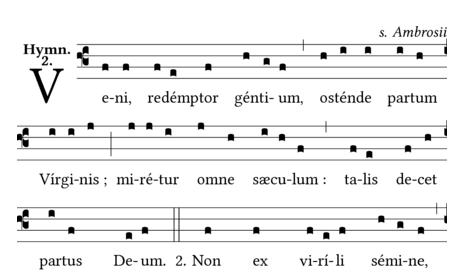
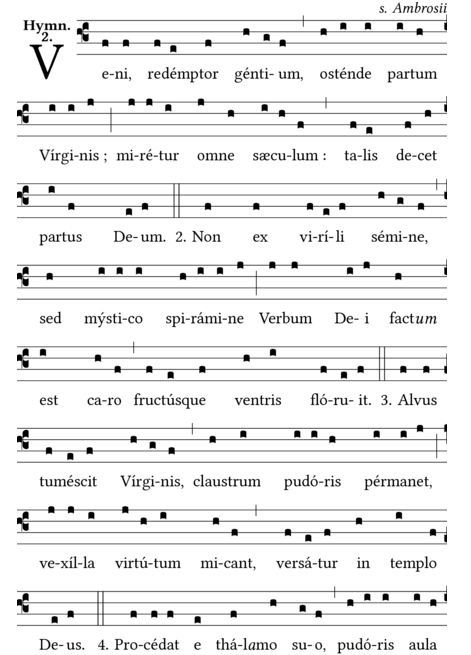
For my money, the best hymn ever composed from the standpoint of textual and theological value is Veni Redemptor Gentium (Come Redeemer of the Nations), written by St. Ambrose in the 4th century. It is more widely known by the title “Come Thou Redeemer of the Earth.” Although is from the Advent season, its sweep is the full soteriological drama of Christ’s work. Jesus is not just coming; He’s redeeming, dying, rising, ascending, and reigning at the Father’s right hand. How can you all of that be squeezed into an Advent hymn? Read the lyrics below and see.
One of the beautiful things about the ancient Latin hymns is how richly theological they are. Not content to merely describe an event, they give an extensive theological vision and delve into its more hidden mysteries. Too often, we see the events of our redemption in a disconnected sort of way, but it is all really one thing and the best theology connects the dots. It is not wrong for us to focus on one thing or another, but we must not forget that it is all one thing in the end.
Without this reminder, we can easily develop a kind of myopia that overemphasizes one aspect of redemption at the expense of others. In the 1970s and 1980s it was “all resurrection all the time,” but no passion or death.
Christmas, too, has its hazards. We get rather sentimental about the “baby Jesus” but miss other important aspects of his incarnation. The passion and death are present in His birth into homeless poverty, the swaddling clothes, the flight into Egypt, and so forth. The Eucharist is evident in His birth at Bethlehem (House of Bread) and His being laid in a manger (a feed box for animals). His glory as God and His ultimate triumph are manifested in the star overhead and the angels’ declaration of glory! You see, it is all tied together, and the best theology connects the dots.
With that in mind, I present this wonderful Advent hymn, my candidate for the best hymn ever written. It can be sung to any long meter (LM) tune but is usually sung to its own melody (Puer Natus). You can find this melody in the index of most hymnals. I provide below only the English translation, but both the Latin and the English are available in this document: Veni Redemptor Gentium. I think the poetic translation reprinted below is a minor masterpiece of English literature. Enjoy this sweeping theological vision of the mystery of Advent caught up into the grand and fuller vision of redemption.
Among the theological truths treated in this brief hymn are these: His title as Redeemer, His birth to a virgin, His inclusion of the Gentiles, His sinlessness, His two natures in one person, His incarnation at conception, His passion, His death, His descent into Hell, His ascension, His seat at the Father’s right hand, His divinity and equality with the Father, His healing and sanctification of our humanity so wounded by sin, His granting us freedom and eternal life, His renewing of our minds through the light of faith, and His opening of Heaven to us.
Not bad for a mere seven verses! St. Ambrose, pray for us!
Come, thou Redeemer of the earth,
Come manifest thy virgin birth:
All lands admire, all times applaud:
Such is the birth that fits our God.
Forth from his chamber goeth he,
That royal home of purity,
A giant in twofold substance one,
Rejoicing now his course to run.
The Virgin’s womb that glory gained,
Its virgin honor is still unstained.
The banners there of virtue glow;
God in his temple dwells below.
From God the Father he proceeds,
To God the Father back he speeds;
Runs out his course to death and hell,
Returns on God’s high throne to dwell.
O Equal to thy Father, thou!
Gird on thy fleshly mantle now;
The weakness of our mortal state
With deathless might invigorate.
Thy cradle here shall glitter bright,
And darkness breathe a newer light,
Where endless faith shall shine serene,
And twilight never intervene.
All laud, eternal Son, to thee
Whose advent sets thy people free,
Whom with the Father we adore,
And Holy Ghost, for evermore.
The video below gives you an idea of what the melody for Veni Redemptor Gentiumsounds like. The words in this version are slightly different from what is shown above, but the tune is perfect.
One of the less-well-known Advent hymns is “Rorate Caeli Desuper” (Heavens, drop dew from above). It is a plaintive hymn that recalls our desperate need for a savior and concludes with consolations from God, who has heard our cries and hastens to save us.
The refrain, which comes from Isaiah 45:8, is shown below in both Latin and English:
Roráte caéli désuper, (Heavens, drop dew from above) et núbes plúant jústum. (and let the clouds rain forth justice).
This is an image for the gentle work of the Holy Spirit. The Spirit works subtly like the dewfall and more boldly like rainfall to bring forth Him who is our justice. For indeed, dew and rain are symbols of life, vigor, and/or providence. Water is also a symbol of the Holy Spirit. The Archangel St. Gabriel told Mary, The Holy Spirit shall come upon you, and the power of the most High shall overshadow you. And therefore also the Holy which shall be born of thee shall be called the Son of God (Luke 1:35). Like a gentle dewfall, the Holy Spirit overshadows Mary and quietly she conceives; He who is our justice begins to dwell among us.
The rains that come forth from the clouds also are an image of God’s work in the Incarnation. Isaiah 45:8 continues by saying, Let the earth open up that salvation may sprout and righteousness spring up with it; I, the LORD, have created it. As God’s grace comes forth like rain from the clouds, truth shall spring up from the earth (see Psalm 85:11). Indeed, we are of the dust of this earth, and as the Lord tabernacles Himself in flesh in the womb of the Blessed Mother, justice and truth spring up from the earth as well. Both the quiet dewfall and the rain bring forth Him who is our justice and truth.
The need for this saving work of God is set forth in the verses that follow. (The Latin and English can be seen side by side here: Rorate Caeli Disuper.)
Be not angry, O Lord, and no longer remember our iniquity:
Behold, the holy city is made a wilderness,
Sion is deserted, Jerusalem a desolation:
the house of your holiness and your glory,
where our fathers praised thee.
The next verse says that our sins have caused this:
We have sinned, and are as an unclean thing,
and we fall as do all the leaves:
and our iniquities, like the wind, have taken us away:
thou hast hid thy face from us: and hast consumed us,
because of our iniquities.
We are fallen like the leaves and the winds carry us away. We cannot see the Lord because we are blinded, consumed, and withered by our sins.
In the next verse, we cry to God to send a savior and shepherd to rescue us:
Behold, O Lord, the affliction of thy people,
and send forth him whom thou wilt send;
send forth the Lamb, the ruler of the earth,
from Petra of the desert to the mount of daughter Sion:
that he may take away the yoke of our captivity.
God responds to our cries:
You are my witnesses, saith the Lord,
and my servant whom I have chosen;
that ye may know me and believe me:
I, even I, am the Lord,
and beside me there is no Savior:
and there is none that can deliver out of my hand.
Not only do I save you, says the Lord, but you shall then be my witnesses to draw others to me; I alone can save.
Then comes the great consolation and promise:
Comfort ye, comfort ye my people;
your salvation shall suddenly come:
why wilt thou waste away in sadness?
why hath sorrow seized thee?
Fear not, for I will save thee:
For I am the Lord thy God,
the Holy One of Israel, thy Redeemer.
Such a beautiful hymn, with its image of the dewfall and the rain symbolizing the Holy Spirit; with its image of Jesus our Savior as justice and truth springing forth from Mary’s womb and, by extension, from the earth! Such beautiful verses, setting fort our pitiful condition, giving voice to our cries, and ushering in the consolations and promises of our God!
Here is a simple, hauntingly beautiful version of the hymn in Gregorian Chant. (Note that the hymn tune is different from that of the antiphon for the Fourth Sunday of Advent.)
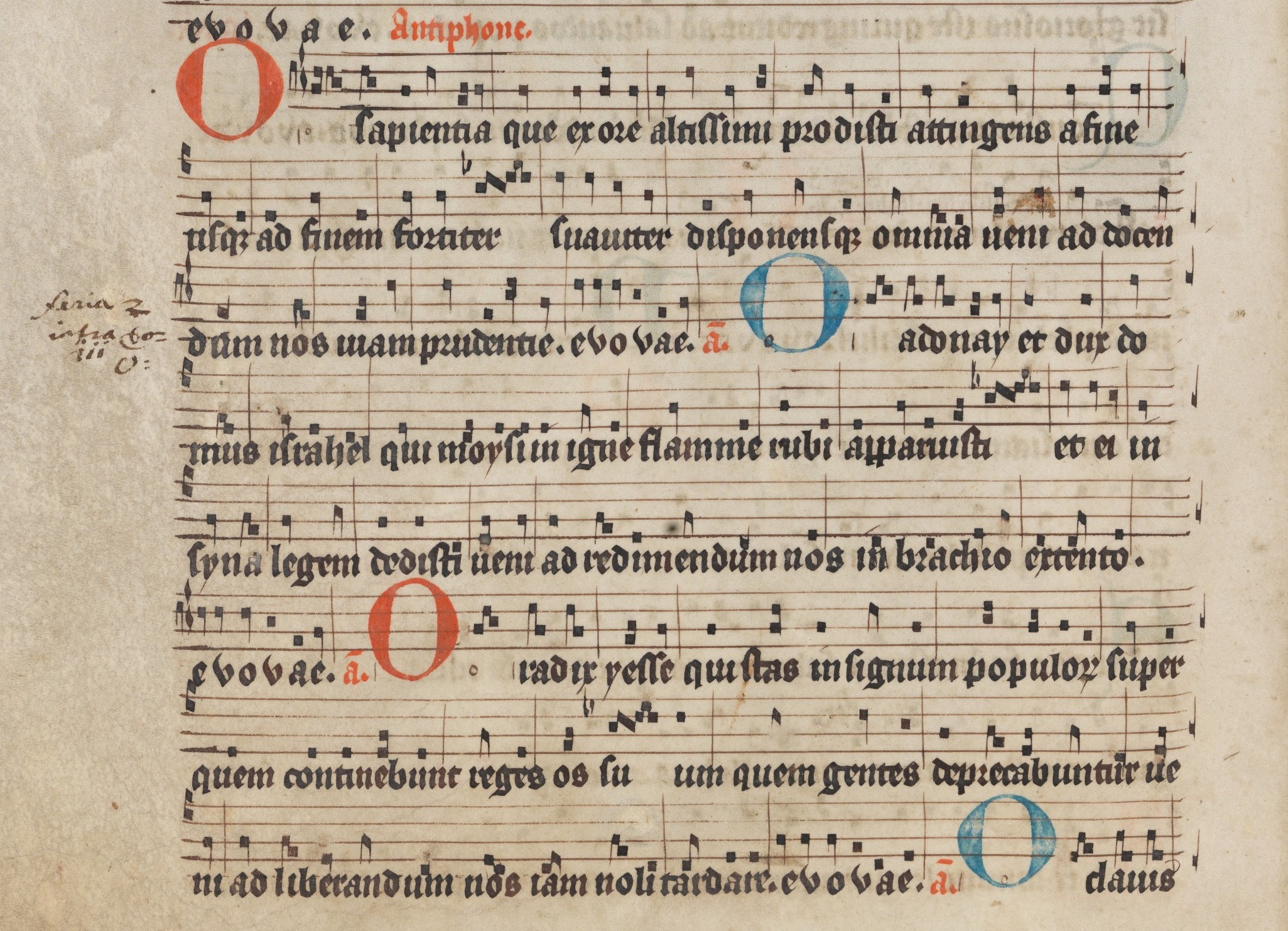
The Catholic Church has been singing the “O Antiphons” since about the 8th century. They were first composed as antiphons to accompany the singing of the Magnificat in Vespers of the Divine Office. They were composed for the last week of Advent, December 17th – 23rd.
They are a compact and beautiful theology that draws on biblical themes of the Old Testament. As such, they proclaim the coming Christ as the fulfillment of Old Testament prophecies and hopes. They also express current longings rooted in those themes. And although the prophecies are fulfilled, they remain an ever-longing aspect of all human hearts.
In these antiphons, note the repeated use of both the expression “O” and the word “come.”
These antiphons are memorably and poetically reworked in the beautiful and well-known hymn “O Come, O Come, Emmanuel,” which is included at the end of this post.
What follows here is less a scholarly presentation than a devotional reflection. Others have undertaken well the work of exploring the biblical roots and traditions. While I do not wholly ignore that, this is a modest and devotional meditation in joyful preparation for Christmas and in hopes of helping others to find joy and exhortation in these laconic and beautiful teachings. Let’s look at each of the antiphons in turn.
Dec 17: O Wisdom that comes out of the mouth of the Most High, that reaches from one end to another, and orders all things mightily and sweetly, come to teach us the way of prudence.
O Sapientia, quæ ex ore Altissimi prodiisti, attingens a fine usque ad finem, fortiter suaviterque disponens omnia: veni ad docendum nos viam prudentiæ.
The antiphon here is a brief summary of the wisdom tradition of the Bible. This wisdom, which comes forth from the mouth of God, orders all things mightily.
Notice that the antiphon says that wisdom orders all things. This refers to the obvious fact that there is an order in all of creation. Things work together intricately on many levels. The microscopic level of atoms, molecules, and cells is the foundational matter of an amazing interplay of delicately balanced realities that make possible complex systems of higher life and matter.
Our own bodies bespeak amazing organization in the interplay of the endocrine system, the nervous system, the lymphatic system, muscular and structural parts, and amazingly sophisticated organs such as the eyes and ears, not to mention the brain.
All around us are ecosystems that both support and enable life. There is photosynthesis, amazing weather patterns, and further above us, the Van Allen belts magnetically deflecting the harmful rays of the sun while letting in the helpful ones.
Add to this the beautiful balance of our solar system: the earth being just where it needs to be to permit enough warmth but not too much. Nearby, too, there are comet-catchers like Jupiter and Saturn in the asteroid belt keeping most of the asteroids at bay.
All of this magnificent interplay of systems, this balance and design, is what the wisdom tradition extols, and what the antiphon describes as coming forth from the mouth of God to order all things mightily and sweetly.
The book of Sirach, which announces the glory of God’s creation from 42:15 through 43:35, expressively says at its conclusion, Beyond these, many things lie hid; only a few of God’s works have we seen (Sirach 43:34).
St. Paul takes up the wisdom tradition when he says, For God’s invisible attributes, namely, his eternal power and divine nature, have been clearly perceived, ever since the creation of the world, in the things that have been made (Rom 1:20).
St. John takes it up when he writes in the prologue, In the beginning was the Word, and the Word was with God, and the Word was God … All things were made through him, and without him was not any thing made, that was made (Jn 1:1-3). And that word, the Logos, became flesh and dwelt among us. For indeed, God spoke all thinking to being through His word (e.g., Let there be light and there was light). And this Logos conveys a logic (logike) on and in all created things.
The hymn of the Letter to the Colossians says regarding Jesus, the Word made Flesh, For by him all things were created, in heaven and on earth, visible and invisible, whether thrones or dominions or rulers or authorities—all things were created through him and for him. And he is before all things, and in him all things hold together (Col 1:16-17).
This, then, is the great wisdom tradition so beautifully expressed in the antiphon.
Dec 18: O Adonai, and Ruler of the house of Israel, Who didst appear unto Moses in the burning bush, and gave him the law in Sinai, come to redeem us with an outstretched arm!
O Adonai, et Dux domus Israel, qui Moysi in igne flammæ rubi apparuisti, et ei in Sina legem dedisti: veni ad redimendum nos in brachio extento.
This antiphon speaks of Jesus as Lord and Ruler. We shall ponder him as ruler and king in another antiphon below.
But here, note the description of the Lord particularly in the aspect of fire. The first aspect of fire is explicit, in the burning bush that Moses encountered. The second image is less explicit, speaking of Moses up on the mountain receiving the law. The great theophany on Sinai’s heights was described in a fiery sort of way in Exodus 20:18-20 as being almost like a volcano. There are clouds, fire, lightning, and trumpet blasts as Moses goes up on the mountain. The people below are terrified; they instinctively realize that they cannot even touch the base of the mountain because they are not worthy or holy enough to be in God’s fiery presence.
Scripture speaks of God as a consuming fire (Heb 12:29, Psalm 18), a holy fire, and, most productively for us, as a refining fire (Mal. 3:2). As a refining fire, He shall burn away impurities so that we may one day be able to stand before Him with hands raised up praising Him who has redeemed us with strong hand and outstretched arm.
It is no accident that the Holy Spirit descended in the form of tongues of fire. The Holy Spirit enters us as fire to bring us up to the temperature of glory, burning away sinfulness, refining us as pure gold, enabling us to endure the blazing fire of God’s love.
Dec 19:O Root of Jesse, which stands for a sign over the people, at Whom the kings shall shut their mouths, Whom the Gentiles shall seek, come to deliver us, do not tarry.
O Radix Jesse, qui stas in signum populorum, super quem continebunt reges os suum, quem Gentes deprecabuntur: veni ad liberandum nos, jam noli tardare.
This antiphon stresses the historical roots of the Gospel in and among the Jewish people, whom God chose long ago to be the root, the vine, and eventually the very cradle of His saving love for all the nations.
The root of Jesse here (in accord with Isaiah 11) speaks of the Jewish people, of whom Jesus said and affirmed, “Salvation is from the Jews” (John 4:22).
And yet, as countless prophecies also disclosed, there would come a day when the Gentiles would also be joined to the saving plan of God and receive their Messiah from and through the Jewish people. In Romans 11:17 St. Paul speaks of the Gentiles as being like wild olive shoots grafted onto the olive tree, onto the vine of Israel. In this way all Israel will be saved, believing Jews and Gentiles together, grafted to the one vine, made members of the one Body of Christ. And Christ Himself joined the family of Jesse; He is a member of our own family tree!
This, then, is an antiphon that speaks to family ties and history. The Gospel is not located up in the skies; it is down-to-earth; it is among us by God’s grace. He is from us in His human roots and surely is also for us.
Dec 20: O Key of David, and Scepter of the house of Israel, that opens and no man shuts, and shuts and no man opens, come to liberate the prisoner from the prison, and them that sit in darkness.
O Clavis David, et sceptrum domus Israel; qui aperis, et nemo claudit; claudis, et nemo aperit: veni, et educ vinctum de domo carceris, sedentem in tenebris, et umbra mortis.
A key bespeaks access, and the one who holds the keys has the power to give or refuse admittance.
After original sin, we could no longer endure the presence of God; we were mercifully excluded from the garden, now guarded by an angel with the flaming sword (Gen 3:24). We could not, on our own, ever hope to regain access to the Father. There was no way for us, in our sinful state, to tolerate the holiness of God.
Thus the prophet Malachi memorably asked, But who may abide the day of his coming, and who shall stand when he appears? Malachi went on to answer that only when God acted as a refining fire could we be pure enough to endure or abide His presence (Mal 3:3ff). And this Jesus did for us on the cross, purifying us with His own blood, with the fire of His love.
Therefore, it is Jesus who holds the key to open so that no one can close, to close so that no one can open (Rev. 3:7). He alone restores us access to His Father. He opens the gates, not of some earthly paradise, but of Heaven itself. And how beautifully this is shown in the rending of the curtain in the sanctuary from top to bottom.
Yes, Jesus holds the keys to the kingdom. He alone can grant access to the heart of His Father.
Both the keys and the mention of His scepter are reminders of His authority. One day we will stand before Him who will judge us. He alone will grant access, opening so that no one can shut. He alone will deny access to those unfit and incapable of the kingdom, closing so that no one can open.
Dec 21: O Morning Star, Brightness of the everlasting light, and Sun of justice, come to give light to those sitting in darkness and in the shadow of death.
O Oriens, splendor lucis æternæ, et sol justitiæ: veni, et illumina sedentes in tenebris, et umbra mortis.
The Latin word used here, oriens, literally and most simply means “the East.” More politically and allegorically it can be translated “morning star,” “the dawn,” “Daystar,” “morning light,” “sunrise,” etc.
Christ is the light of the world. And He will come again from the East. Scripture says in numerous places that Christ will appear from the East:
For as the lightning comes from the east and shines as far as the west, so will be the coming of the Son of man (Mt 24:27–28).
Look toward the east, O Jerusalem, and see the joy that is coming to you from God! (Bar 4:36)
Afterward he brought me to the gate, the gate facing east. And behold, the glory of the God of Israel came from the east; and the sound of his coming was like the sound of many waters; and the earth shone with his glory. And the vision I saw was like the vision, which I had seen when he came to destroy the city, and like the vision, which I had seen by the river Chebar; and I fell upon my face. As the glory of the LORD entered the temple by the gate facing east, the Spirit lifted me up, and brought me into the inner court; and behold, the glory of the LORD filled the temple (Eze 43:1–5).
Sing to God, ye kingdoms of the earth: sing ye to the Lord: Sing to God, who mounts above the heaven of heavens, to the east. Behold he will give to his voice the voice of power: give ye glory to God for Israel, his magnificence, and his power is in the clouds! (Psalm 68:32-34)
Until relatively recently, the Church faced to the East to pray. Doing so is a way of turning toward God and looking for Him and to Him. Where the altar could not be situated facing East according to the compass, the crucifix became a kind of liturgical East. Everyone would face the same way to pray, especially during the Eucharistic prayer.
The Latin word oriens is also the root of the English word “orientation.” To be oriented means to be properly directed, to be facing in the correct direction.
To say the least, the modern practice of the priest facing the people to pray the Eucharistic prayer is historically flawed. It amounts to a departure from a centuries-old practice and instinct, going all the way back to Old Testament times. Increasingly in the Church today there is a desire by some to “re-orient” the liturgy, literally and figuratively, so that all face the liturgical East during the Eucharistic prayer. On altars that face the people, Pope Benedict encouraged the placement of the crucifix, and he encouraged the clergy to instruct the people that we are really gathered around the cross more so than facing one another. Our focus is to be on God at this moment not one another.
The antiphon goes on to speak of the Lord Jesus as the light of the world and begs Him to shed light on all of us who are in darkness and in the shadow of death. Indeed, Christ alone is the true light of the world and the lamp of the city of God!
The Lord wants His light to shine in this world! In the Sermon on the Mount, Jesus indicates that He wants His light to shine through us. In this way, in a subordinate sense, we are to be the light of the world (cf Matt 5:14) as Christ shines through us.
But O, the darkness, when Christians do not allow the light of Christ’s truth, His teachings, and His call to repentance and healing to shine through us! One may wonder how the world has become so dark today. The answer is not far away; look around. This is happened on our watch. Too many Christians have sheepishly hidden their light under a bushel basket.
O come Lord Jesus, O Daystar rising in the East, remove whatever hinders us from allowing your light to shine through us. Remove the fear. Remove the aversions. Cleanse us of our sins, which, like soot on glass, do not allow the light to go through. Come, Jesus, light of the world, shine in this world and through us.
Dec 22: O King of the Gentiles, and desire of them, Cornerstone, that makes of two one, come to save man, whom Thou hast made out of the dust of the earth!
O Rex Gentium, et desideratus earum, lapisque angularis, qui facis utraque unum: veni, et salva hominem, quem de limo formasti.
This antiphon calls Jesus “King.” Is He our king? Does He call the shots or is there someone else we obey? Do you and I obey Christ? Do we allow His thoughts to replace ours? Are His priorities, thoughts, and teachings ours as well?
Jesus Christ told Pontius Pilate that His kingship was about the fact that He came to bear witness to the truth, and that those who were of the truth would listen to His voice. See the connection between faith, kingship, and obedience to the truth that Christ, as King and teacher, proclaims to us!
The antiphon goes on to refer to Christ as the cornerstone. And while in our experience cornerstones tend to be more ceremonial, the cornerstone of a building is critical; the walls above rest on it. Therefore, a cornerstone has to be true, perfectly cut, reliable, sturdy, and firm. Jesus and His teachings are this for us; He is the cornerstone, the foundation on which we stand. And Peter is His vicar. Christ calls Peter the rock on which He will build His Church. Are you standing on the solid rock of Christ’s teachings or on the shifting sands of this world?
The antiphon also says that Christ is the desire of the nations. All of our desires that we think can be fulfilled by worldly things are really pointing to the Lord, who alone can fill the God-sized hole in our hearts. No one but the Lord can really and ultimately satisfy us. Sadly, though, we always think that just one more drink, just a little more money, just one more thing will fulfill us and make us happy. It will not. Christ really is your desire.
Are you and I in touch with this? Or do we think that just one more drink, just one more thing will do it?
Dec 23: O Emmanuel, our King and our Law-giver, Longing of the Gentiles, and their Savior, come to save us, O Lord our God!
O Emmanuel, Rex et legifer noster, exspectatio gentium, et Salvator earum: veni ad salvandum nos Domine Deus noster
This last antiphon is a great summation of most of the antiphons that have preceded it. The Lord Jesus is summoned as king, lawgiver, the desire of the nations, Savior—indeed, God Himself with us. Come, Lord Jesus. Come, you who are God among us; come and save your people.
VENI veni, Emmanuel captivum solve Israel, qui gemit in exsilio, privatus Dei Filio.
R: Gaude! Gaude! Emmanuel, nascetur pro te Israel!
O COME, O come, Emmanuel,
and ransom captive Israel,
that morns in lonely exile here
until the Son of God appear.
R: Rejoice! Rejoice! O Israel,
to thee shall come Emmanuel!
Veni, O Sapientia, quae hic disponis omnia, veni, viam prudentiae ut doceas et gloriae. R.
O come, Thou Wisdom, from on high,
and order all things far and nigh;
to us the path of knowledge show,
and teach us in her ways to go. R.
Veni, veni, Adonai, qui populo in Sinai legem dedisti vertice in maiestate gloriae. R.
O come, o come, Thou Lord of might,
who to thy tribes on Sinai’s height
in ancient times did give the law,
in cloud, and majesty, and awe. R.
Veni, O Iesse virgula, ex hostis tuos ungula, de spectu tuos tartari educ et antro barathri. R.
O come, Thou Rod of Jesse’s stem,
from ev’ry foe deliver them
that trust Thy mighty power to save,
and give them vict’ry o’er the grave. R.
Veni, Clavis Davidica, regna reclude caelica, fac iter tutum superum, et claude vias inferum. R.
O come, Thou Key of David, come,
and open wide our heav’nly home,
make safe the way that leads on high,
that we no more have cause to sigh. R.
Veni, veni O Oriens, solare nos adveniens, noctis depelle nebulas, dirasque mortis tenebras. R.
O come, Thou Dayspring from on high,
and cheer us by thy drawing nigh;
disperse the gloomy clouds of night
and death’s dark shadow put to flight. R.
Veni, veni, Rex Gentium, veni, Redemptor omnium, ut salvas tuos famulos peccati sibi conscios. R.
Veni, veni, Emmanuel captivum solve Israel, qui gemit in exsilio, privatus Dei Filio.
O come, Desire of the nations, bind
in one the hearts of all mankind;
bid every strife and quarrel cease
and fill the world with heaven’s peace. R.
O Come, O come, Emmanuel,
and ransom captive Israel,
that morns in lonely exile here
until the Son of God appear.

 In the ancient Church and up until rather recently, one genuflected at the two references to the Incarnation during the Mass: during the Creed and in the Last Gospel (John 1). Why was this done? It was explained to me that the mystery of the Incarnation is so deep, one can only fall in silent reverence.