Many people say that they don’t hear too many sermons about Hell anymore. I believe this is true in general, but I will say that I preach about it a good bit. However, I would like to point out that the same could be said about sermons on Heaven. Try to remember the last time you heard a sermon that dealt with the topic let alone inspired a longing for Heaven. Too many sermons focus on this world: how to live in it, how to deal with moral and ethical problems, and how to be happier in it. It is not wrong to preach about such things as long as it does not divert focus from our ultimate destination: Heaven or Hell. To be vague, uninspiring, or silent about our goal and desired destination is spiritually disastrous.
To illustrate, consider a man who sets out in his car for New York City from Washington, D.C. His destination guides every turn he takes, every navigational decision he makes. If he sees a sign that says, “South to Richmond” he knows not to take that exit. He doesn’t have to deliberate; the answer is clear because his destination is clear. Consider, though, what might happen if he were uncertain about where he was going or forgot: The road signs might cause stress and confusion. He might think, “Perhaps this is the way I should go … or maybe not. How do I know? Maybe there will be fun things to see and do along that route.” Soon enough he might be driving all over the map, lost in diversions, distractions, and—ultimately—dead ends. He might in fact see some pleasant sights along the way, but deep down he would begin to sense that none of this driving around was adding up to anything.
Without a destination we are lost, confused, and worried. To live without a clear goal is stressful because we have little basis on which to make good decisions; every choice seems difficult. With little ability to determine what is truly good for us, we focus on temporary pleasure, becoming easy prey for the hucksters of this world. So, our credit cards are maxed out, our hearts are divided, and we feel unmoored.
Where are we going? When was the last time we really thought about it? Too many of us are living unreflective, directionless lives. We don’t really know where we are going, but we’re sure in a big hurry to get there!
Have a goal: Heaven! Focus on it. Dream about it. Long for it. Make it direct your modus vivendi. We should want to die loving God and our neighbor so that we can go home to Heaven and be with God forever. Let every decision you make be in service of this one, clear goal. Carefully review your life and ask yourself, “Am I moving closer to my goal? How? What things have hindered me or diverted me from it?”
Consider this beautiful meditation from Pope St. Gregory the Great, which is in the Office of Readings this week:
If anyone enters the sheepfold through me, he shall be saved; he shall go freely in and out and shall find good pasture. He will enter into a life of faith; from faith he will go out to vision, from belief to contemplation, and will graze in the good pastures of everlasting life.
So our Lord’s sheep will finally reach their grazing ground where all who follow him in simplicity of heart will feed on the green pastures of eternity. These pastures are the spiritual joys of heaven. There the elect look upon the face of God with unclouded vision and feast at the banquet of life for ever more.
Beloved brothers, let us set out for these pastures where we shall keep joyful festival with so many of our fellow citizens. May the thought of their happiness urge us on! Let us stir up our hearts, rekindle our faith, and long eagerly for what heaven has in store for us.
To love thus is to be already on our way. No matter what obstacles we encounter, we must not allow them to turn us aside from the joy of that heavenly feast.
Anyone who is determined to reach his destination is not deterred by the roughness of the road that leads to it. Nor must we allow the charm of success to seduce us, or we shall be like a foolish traveler who is so distracted by the pleasant meadows through which he is passing that he forgets where he is going (From a homily on the Gospels by Pope St. Gregory the Great, Hom. 14, 3-6: PL 76, 1129-1130).
In his Letter to the Philippians, St. Paul wrote,
This one thing I do: Forgetting what is behind and straining toward what is ahead, I press on toward the goal to win the prize of God’s heavenly calling in Christ Jesus. Whatever was an asset to me I count as loss for the sake of Christ. More than that, I count all things as loss compared to the surpassing excellence of knowing Christ Jesus my Lord, for whom I have lost all things. I consider them rubbish, that I may gain Christ and be found in Him …. Not that I have already obtained all this, or have already been perfected, but I press on to take hold of that for which Christ Jesus took hold of me … (Phil 3: 7-9; 12-14).
What are we to make of “the numbers”? As the Church it is hard to ignore the large decline in attendance at Mass and reception of the sacraments, yet the Lord never seemed overly concerned with numbers; He even distrusted them.
The information can help us to gauge the effectiveness of our preaching, teaching, and engagement of God’s people; it can also be a pernicious temptation to water down the gospel just to improve our numbers. The data* below showing the change over the past fifty or so years don’t paint a pretty picture:
These are astonishing declines! Remember, too, that these dry figures represent individual human beings called to know, love, and serve God in the Church here on earth and one day in the Church Triumphant in Heaven. Every loss is a soul who may be lost forever.
Many want to attribute the decline to this or that cause and then propose solutions. The danger, of course, is merely trying to increase the numbers and forgetting that our mission is not to be popular but to be a colony of Heaven, a people set apart; we were promised persecution and the world’s hatred, not its esteem or love. It is not our goal to be hated, of course, but it is sometimes our lot.
These numbers should sober us and cause us to consider how we—clergy and laity—may have contributed to this decline.
It is not entirely our fault, however. The problem cannot be fully resolved merely through better techniques or more engaging presentations—and it certainly will not be rectified by watering down or even ignoring the Lord’s more challenging teachings.
Consider that even the greatest evangelizer who ever graced this world, Jesus, lost a significant number of followers because of His teachings. He was quite willing to do this because it is the truth that saves and sets us free. Better to save some than to dilute or disregard the truth and lose everyone. Many of Jesus’ followers deserted Him after He taught that the Eucharist was His true Body and Blood (Jn 6:66). Many people scoffed at His teaching against divorce (Mat 19:10). Even residents of His own home town turned on Him when He praises the Gentiles (Luke 4:29). No one could preach the way Jesus could (Jn 7:46). No one was more eloquent. No one more perfectly exuded the Holy Spirit than Christ. To these He added miracles and the personal authority of His holiness and divinity. Yet He, too, was rejected, even by some of His disciples. Think about how small the Church looked on that Good Friday at noon: only John, Mary, and a few other women stayed with Him. Yet never was the Church more pure and powerful than at that very moment.
Concern for the decline in our numbers is proper, but it should not cause us to be so overwrought that we abandon hope or lose faith in the teachings we have received from the Lord Himself. Consider well that the mainline (liberal) Protestant denominations have cast aside many Christian dogmas as well as nearly every moral doctrine in order to appeal to modernity, and their decline has been even more precipitous than ours.
One surprising thing to note is that Jesus did not seem to trust crowds; some of His most challenging teachings were addressed to large numbers of people:
Large crowds were now traveling with Jesus, and He turned and said to them, “If anyone comes to Me and does not hate his father and mother and wife and children and brothers and sisters—yes, even his own life—he cannot be My disciple” (Lk 14:25-26).
In the meantime, when there were gathered together an innumerable multitude of people, so that they stepped one on another, he began to say to his disciples first of all, “Beware you of the leaven of the Pharisees, which is hypocrisy” (Luke 12:1).
Large crowds followed Him, and He healed them there …. [And Jesus said to them] “Now I tell you that whoever divorces his wife, except for sexual immorality, and marries another woman, commits adultery.” His disciples said to Him, “If this is the case between a man and his wife, it is better not to marry” (Matt 19:1-2; 9-10).
Truly, truly, I tell you, it is not because you saw these signs that you are looking for Me, but because you ate the loaves and had your fill. Do not work for food that perishes, but for food that endures to eternal life, which the Son of Man will give you (John 6:26-27).
So critical were His teachings, particularly on the Eucharist, that Jesus was willing to lose some—even many—in order to save others. A watered-down gospel cannot save. Jesus would not remove unpopular teachings to gain numbers, for that would be to lose everyone and everything.
What, then, are we to do? The answer is not complicated—we are to preach the truth. St. Paul wrote to Timothy in this regard:
I charge you in the presence of God and of Christ Jesus, who will judge the living and the dead, and in view of His appearing and His kingdom: Preach the word; be prepared in season and out of season; reprove, rebuke, and encourage with every form of patient instruction. For the time will come when men will not tolerate sound doctrine, but with itching ears they will gather around themselves teachers to suit their own desires. So they will turn their ears away from the truth and turn aside to myths. But you, be sober in all things, endure hardship, do the work of an evangelist, fulfill your ministry (2 Tim 4:1-5).
The task is clear. We must preach the full gospel, whether it is in season or out of season. And when it is out of season (as it certainly is today) it is all the more important that we reprove, encourage, and rebuke while patiently enduring any hardship or persecution that may result.
Perhaps this decline should encourage us to be more earnest in our efforts and to look for various effective ways to reach this increasingly doubtful, skeptical, stubborn world. New methods may be considered but never an alteration of the message itself, for Jesus Christ is the same yesterday and today and forever. Do not be carried away by all kinds of strange teachings (Heb 13:8-9).
We do well to recall the strange story of the census that David took of his people (2 Samuel 24). God was displeased with the census and even issued a severe punishment for it. Why? There are many possible reasons, but something tells me that it was God’s way of saying, “David, it is none of your business how many people I have. They are mine, after all, not yours. Your strength is not in numbers but in me.” Gideon heard a similar message (Judges 7).
Jesus has sent us to the ends of the earth to make disciples of all nations, baptizing them in the name of the Father, and of the Son, and of the Holy Spirit, and teaching them to obey all that I have commanded you. And surely I am with you always, to the very end of the age (Matt 28:18-20).
Whether the Church is large or small, we must sow the seed of His Word. God alone knows the harvest. No matter what the numbers look like, let’s get to back to work!
The Lord says, “My sheep hear my voice.” That’s right, He called us sheep. Get a little indignant with me here! The Lord is comparing us not to majestic eagles, beautiful gazelles, swift horses, mighty lions, or clever doges, but to sheep. While reality may hurt, the truth can liberate. Although sheep are considered somewhat lowly animals, they are valuable as well. Let’s consider today’s Gospel in three stages.
I. THE SIGN OF THE SHEEP – What does the Lord mean in using sheep as a sign for us? Here are some qualities of sheep that may help illustrate what He is teaching.
Sheep are WAYWARD – They tend to wander off. A sheep will graze for a while and then look around and seem to wonder, “Where am I?” He doesn’t know how to get back to the fold unless the shepherd goes out and brings him back. Sheep just keep on going and don’t come back. Dogs and cats can find their way home, horses can find the barn, but sheep can’t manage to find their way back without the shepherd seeking them out and guiding them.
Don’t tell me that doesn’t describe us! Like sheep, we have gone astray, each to his own way (Isaiah 53:6). Yes, we easily become lost. We need the sheepfold of the Church; we need Christ the Shepherd, ministering through His Pope, bishops, and priests. Without that we would just wander here and there.
Sheep are WITLESS – Sheep are just not that bright. We train dogs, birds, horses, and even lions, but you don’t hear about trained sheep too frequently!
We human sheep like to think we’re smart. Sure, we’ve been to the moon, and we have all this advanced technology, but too many of us aren’t even bright enough to pray every day, go to Mass on Sundays, and follow God’s basic directions for life.
We’re so witless that we do things that we know will harm us. Even the simplest directions from God we either confuse or stubbornly refuse to follow. We cop an attitude and say, “We know a few things too.” That’s right, we know veryfew things.
In fact, we’re so dumb that we think we’re smarter than God! We think our way is better than His way. Now that is really dumb!
Sheep are WEAK – Sheep have no way to protect themselves. Mules can kick, cats can scratch, dogs can bite, rabbits can run away, and skunks—well, you know what they can do—but without the care of the shepherd and the help of sheep dogs, sheep are doomed! The wolf comes and all they can do is stand there get devoured.
So it is with us. If it were not for the care of Jesus the Good Shepherd, we’d be cornered by the world, the flesh, and the devil. If it were not for the Lord and the power of His grace, we would be toast!
We like to think we’re strong; we have armies, political power, monetary power, and star power that can feed that illusion. Then at the slightest temptation we fall! We need the Lord and His grace and mercy, or we don’t stand a chance. We are weak and prone to sin.
YET …
Sheep are WORTHWHILE – In Jesus’ day, many a man counted his wealth by the number of sheep he owned. Shepherds made many sacrifices to breed, herd, and protect these valuable animals, which provided meat, milk, and wool. So it is with us. At times we may not feel worthy, but apparently we were worth saving because the Lord paid the price of our redemption. He knew the price and paid it all—not with silver and gold but with His own precious blood (1 Peter 1:18-19).
Sheep WALK together – Sheep flock together and are safer that way. To be a solitary sheep is dangerous; it’s a good way to get eaten.
Be sober, be vigilant; because your adversary the devil, as a roaring lion, walketh about, seeking whom he may devour (1 Peter 5:8). Scripture also says, Woe to the solitary man! For if he should fall, he has no one to lift him up (Eccles 4:10). Sheep are not supposed to go off on their own, and neither are we.
We are called to part of a flock and to be under the care of a shepherd. Most of us realize this in a parish setting, but in the wider sense, each of us is under the care of a bishop and ultimately the care of the Pope, who is the chief shepherd and Vicar of Christ, the Good Shepherd.
The Lord Jesus said that there is to be one flock and one shepherd (John 10:16). God wants us to be in the protection of the flock with a shepherd watching over us. An old spiritual says, “Walk together, children. Don’t you get weary. There’s a great camp meeting in the promised land.” Too many like to point out that the Pope doesn’t know this or that, but please consider that to wander from the care of the flock and the shepherd is a mighty dangerous thing.
Sheep are WARY – In the Gospel of John, Jesus says, He who enters by the door is the shepherd of the sheep. To him the gatekeeper opens; the sheep hear his voice, and he calls his own sheep by name and leads them out. When he has brought out all his own, he goes before them, and the sheep follow him, for they know his voice. A stranger they will not follow, but they will flee from him, for they do not know the voice of strangers (John 10:11-14).
Sheep have the remarkable quality of knowing their master’s voice and of instinctively fearing any other.
In this matter, sheep are smarter than most of us, for we do not flee voices contrary to Christ’s. Instead, we draw close to those voices and ask, “Tell me more.” In fact, we spend a lot of time and money to listen to those other voices. We buy televisions so that the enemy’s voice can influence us and our children. We spend large amounts of time watching television, listening to the radio, and perusing the Internet.
Yes, we can so easily be drawn to the enemy’s voice. Not only do we not flee from it, we feast upon it. Instead of rebuking it, we rebuke the voice of God. We put His Word on trial instead of putting the world on trial.
We must be more wary, like sheep, and respond only to one voice: that of the Lord speaking though His Church. We must flee every other voice.
II. THE SAFETY OF THE SHEEP – Jesus goes on to say, my sheep hear my voice; I know them, and they follow me. No one can take them out of my hand. My Father, who has given them to me, is greater than all, and no one can take them out of the Father’s hand.
Note Jesus’ promise that He will not be overpowered, no one can snatch from His hand. The Book of Daniel says, His kingdom is an everlasting kingdom that shall not be destroyed, his kingship shall not be destroyed (Dan 7:14). In no way can the devil have power over Jesus or His flock.
This is all predicated on what’s been said: if we want protection and safety, we have to know only Jesus’ voice and stop running after all sorts of false shepherds and contrary voices. We have to stay with the true Shepherd, Jesus, and within the protection of His flock. If you want safety, stay in the shelter of Jesus’ shepherding.
Let us be clear on this point: no weapon waged against us can ever prosper (Isaiah 54:17). Satan cannot harm us unless we open the door. Satan is like a dog on a leash: he can only harm us if we get too close to him through our own foolish decisions! Satan is a chained dog; do not stray into his range or territory!
Yet so many people do! They savor the darkness of pop culture, visit pornographic Internet sites, consume a steady diet of revengeful “action” movies, and are drawn in by commercials telling them to buy the latest product with its promises of empty fulfillment. A steady stream of polluted water and then we wonder why we are sick and weak, full of the parasites of sin.
Is it any wonder that our thinking is distorted, unbiblical, dark, and foolish? At least sheep know to flee a false shepherd. Too many of us are intrigued by the ranting of false shepherds. We glamorize evil and fill our minds with false teaching and improper priorities.
Thus, while no one can snatch from Jesus’ hand, this is not some magical protection that prevents us from foolishly and sinfully walking away from Him. If we do walk away, woe to us; if we stray, our strength will fail!
Pay attention, fellow sheep: do not stray from the Shepherd. The protection of the Lord is only for those who desire and freely choose such protection. He can protect you, but not if you live a double life or open the door to your heart to Satan. The Lord is not a slave owner; He is a lover who invites us to freely accept His offer of new life rooted in a loving and trusting relationship with Him.
Do you know His voice? Do you know only His voice? Do you run form every voice contrary to His, or do you seek counselors who tell you what your itching ears want to hear? (cf2 Tim 4:3) If you remain true, you have the protection of the Savior Jesus Christ, and nothing will ever harm you (Luke 10:19)—but if you stray, be not surprised at the presence of wolves.
III. THE SALVATION OF THE SHEEP – The text goes on to say, I give them eternal life, and they shall never perish.
For the flock of the Lord there is the gift of “eternal life.” Too many Christians equate this with some distant future that they vaguely hope to attain.
Eternal life does mean the capacity to “live forever and never die,” but it is so much more than that! “Eternal” refers not only to length of life but to its fullness.
In this sense, eternal life is now, as we become ever more aware that If anyone is in Christ, he is a new creation (2 Cor 5:17). Of this I am a witness, being far more alive in my fifties than I ever was in my twenties! My body ages, but my soul is younger and more vibrant than ever.
Here is the promise to lay hold of: those who are in the shepherd’s care come, in stages, to experience life more fully, to become more fully alive. Jesus our Shepherd promises us eternal life, but this does not wait until Heaven—it is now. We sheep are brought to salvation, to healing, if we will accept it. If we choose freedom and the Shepherd’s cares, it is ours! If we reject some or all of it, then we live apart from His care and vision and become easy prey for savage wolves.
Are you smarter than a sheep? Do you know how to recognize the Shepherd’s voice and follow only Him, or are you foolishly running after worldly advice and sinful priorities? On this Good Shepherd Sunday, strive to be good sheep.
Yes, He called us that—sheep. Sheep have this going for them: they recognize only their shepherd’s voice and run from any other.
The video below is a humorous depiction of the utter frustration of seeking fulfillment in or from this world. It features a pig, Ormie, who goes to ridiculous lengths to obtain some cookies that are just beyond his reach.
Many people are like this, sparing no expense in search of illusory happiness. Some practically self-destruct in their quest to fill the God-sized hole in their heart.
It never works, though, because our desires are infinite; a finite world will always leave us unsatisfied. Complete fulfillment can only be found with God. For now, we walk by faith toward Him, of whom our heart says, “Seek His face. Seek always the face of the Lord!”
Seeking the Lord does several things for us. It helps us to stop thinking that finite things can really satisfy us. It increasingly ends our frustrating, futile, intense pursuit of those things. As our prayerful union with God deepens, our satisfaction with Him increases and He becomes more desirable than the things of this world. More and more we can say that God really does satisfy us.
In the video, Ormie is a very unhappy pig because no matter how hard he tries, he can’t get what he wants. The world seems to taunt him as he tries again and again. Frankly, even if he did get the cookies, they would probably only satisfy him for about twenty minutes!
Allow the cookies to represent happiness. Ormie expends all his effort on pursuing something that this world can’t give him. An awful lot of people live like that, forever chasing butterflies. Somehow, they think that if they can just get that one thing, then they will be happy. They will not—at least not in the infinite sense that their heart really desires. Wealth brings comfort, not happiness. The finite world just can’t provide what many want it to give them.
Enjoy this amusing animated short. Often humor registers in us because it contains an element of truth that we recognize in our own self. Laugh and learn with Ormie the Pig!
In the Office of Readings during these Easter weeks, we are reading from the Book of Revelation. In it is this passage reminding us that there are some things that are not for us to know:
Then I saw another mighty angel coming down from heaven. He was robed in a cloud, with a rainbow above his head; his face was like the sun, and his legs were like fiery pillars. He was holding a little scroll, which lay open in his hand. He planted his right foot on the sea and his left foot on the land, and he gave a loud shout like the roar of a lion. When he shouted, the voices of the seven thunders spoke. And when the seven thunders spoke, I was about to write; but I heard a voice from heaven say, “Seal up what the seven thunders have said and do not write it down” (Rev 10:1-4).
A similar passage occurs in the Book of Daniel. Having had certain things revealed to him, Daniel is told,
But thou, O Daniel, shut up the words and seal the book, even to the time of the end (Dan 12:4).
To the apostles, who pined for knowledge of the last things, Jesus said,
It is not for you to know the times or the seasons, which the Father hath put in his own power (Acts 1:7).
In all of these texts we are reminded that there are some things—even many things (seven is a number indicating fullness)—that are not for us to know. This is a warning against sinful curiosity and a solemn reminder that not all of God’s purposes or plans are revealed to us.
A few reasons come to mind for this silence and for the command to seal up the revelation of the seven thunders:
It is an instruction against arrogance and sinful curiosity. Especially today, people seem to think that they have right to know just about everything. The press speaks of the people’s “right to know.” While this may be true about the affairs of government, it is not true about people’s private lives, and it is surely not true about all the mysteries of God. There are just some things that we have no right to know, that are none of our business. Much of our prying is a mere pretext for gossip and for the opportunity to see others’ failures and faults. It is probably not an exaggeration to say that more than half of what we talk about all day long is none of our business.
It is a rebuke of our misuse of knowledge. Sadly, especially in the “information age,” we speak of knowledge as power. We seek to know in order to control, rather than to repent and conform to the truth. We think that we should be able to do anything that we know how to do. Even more reason, then, that God should withhold from us the knowledge of many things; we’ve confused knowledge with wisdom and have used our knowledge as an excuse to abuse power, to kill with might, and to pervert the glory of human life with “reproductive technology.” Knowledge abused in this way is not wisdom; it is foolishness and is a path to grave evils.
It is to spare us from the effects of knowing things that we cannot handle. The very fact that the Revelation text above describes this knowledge as “seven thunders” indicates that these hidden utterances are of fearful weightiness. Seven is a number that refers to the fullness of something, so these are loud and devastating thunders. In His mercy to use, God does not reveal all the fearsome terrors that will come upon this sinful world, which cannot endure the glorious and fiery presence of His justice. Too much for this world are the arrows of His quiver, which are never exhausted. Aside from the terrors already foretold in Scripture, the seven thunders may well conceal others that are unutterable and too horrifying for the world to endure. Ours is a world that is incapable of enduring His holiness or of standing when He shall appear.
What, then, is to be our stance in light of the many things too great for us to know, which God mercifully conceals from us? We should have the humility of a child who knows what he does not know but is content that his father knows.
O Lord, my heart is not proud nor haughty my eyes. I have not gone after things too great nor marvels beyond me.
Truly I have set my soul in silence and peace. Like a weaned child on its mother’s lap, even so is my soul.
O Israel, hope in the Lord both now and forever (Psalm 131).
Yes, like humble children we should seek to learn, realizing that there are many things that are beyond us, that are too great for us. We should seek to learn, but with a humility that is reverence for the truth, a humility that realizes that we are but little children, not lords and masters.
Scripture says, Beyond these created wonders many things lie hid. Only a few of God’s works have we seen (Sirach 43:34).
Thank you, Lord, for what you have taught us and revealed to us. Thank you, too, for what you have mercifully kept hidden because it is too much for us to know. Thank you, Lord. Help us to learn; keep us humble, like little children.
In the Office of Readings this Easter season, we are reading from the Book of Revelation. This choice might seem surprising, but there are good reasons for it.
While many suppose that the Book of Revelation is merely about the end of the world, it is about far more; it is also about what is happening right now. It was not written only for the end of the ages but for all ages. It is a book of glory that discloses the victory that Jesus has already won. Don’t get lost in lots of exotic theories; Revelation is a book of glory that prophetically declares what is really going on.
Its title in Greek is Ἀποκάλυψις Ἰησοῦ Χριστοῦ (Apokalupsis Jesou Christou), which literally means “The Unveiling of Jesus Christ.” It is as if Jesus is pulling back the veil to show us what is really going on. He shows us the great drama of history and tells us that He has already won the victory. He tells us that we should not lose heart while the dust settles, while the wheat is separated from the chaff and the harvest brought in.
We are too easily either mesmerized or terrified by our limited view of history. We think that life depends on which political party wins, or whether a cure is found for some disease, or whether world leaders can reach rapprochement. However, the battle is higher and deeper than our little sliver of the 21st century. It is far deadlier and is about more dramatic issues than what will happen to the GNP of the U.S. or which of the latest political theories will prevail.
This is a great drama between good and evil. It concerns the fundamental issue of where you will spend eternity. Yes, there is a great and cosmic battle in which we are all caught up; it is happening all around us. St. Paul says,
For we do not contend against flesh and blood, but against the rulers, against the authorities, against the cosmic powers over this present darkness, against the spiritual forces of evil in the high places. Therefore, take up the whole armor of God, that you may be able to withstand in the evil day, and having done all, to stand firm (Eph 6:11-13).
The Book of Revelation is speaking to the same reality. It unveils the true and cosmic battle. In so doing, it declares without ambiguity who the victor is: Jesus Christ our King, who has already won. There are only two kingdoms, two armies, two sides. You must decide whom you will serve: the prince of this world or the King and Lord of all creation.
Revelation opens with a vision of the glory of Jesus the Great Lord and Son of Man:
I, John, your brother and partner in the tribulation and the kingdom and the patient endurance that are in Jesus, was on the island called Patmos on account of the word of God and the testimony of Jesus. I was in the Spirit on the Lord’s day, and I heard behind me a loud voice like a trumpet saying, “Write what you see in a book and send it to the seven churches, to Ephesus and to Smyrna and to Pergamum and to Thyatira and to Sardis and to Philadelphia and to Laodicea.” Then I turned to see the voice that was speaking to me, and on turning I saw seven golden lampstands, and in the midst of the lampstands one like a son of man, clothed with a long robe and with a golden sash around his chest. The hairs of his head were white, like white wool, like snow. His eyes were like a flame of fire, his feet were like burnished bronze, refined in a furnace, and his voice was like the roar of many waters. In his right hand he held seven stars, from his mouth came a sharp two-edged sword, and his face was like the sun shining in full strength. When I saw him, I fell at his feet as though dead (Rev 1: 10-17).
Yes, here is our Lord Jesus in His resurrected and conquering glory! At the name of Jesus every knee shall bend in the heavens, on the earth, and under the earth, and every tongue proclaim to the glory of God the Father that Jesus Christ is Lord (Phil 2:10-11).
Yes, Jesus Christ is the faithful witness, the firstborn of the dead, and the ruler of kings on earth. To him who loves us and has freed us from our sins by his blood and made us a kingdom, priests to his God and Father, to him be glory and dominion forever and ever. Amen. Behold, he is coming amid the clouds, and every eye will see him, even those who pierced him, and all tribes of the earth will wail on account of him. Even so. Amen (Rev 1:5-7).
The second part of the Book of Revelation calls the Church and us as individuals to repentance and perseverance. The cosmic battle reaches the Church and individual disciples. The battle is in the Church and in the heart of every person. Hence, the letters to the seven churches. We are not to lose the love we had at first. We must be willing to endure hardship and persecution. We are to reject the fornicators and all those who propose any sort of sexual immorality. We are to resist syncretism and every form of false religion. We must resist all the deep secrets of Satan; we must not be in any agreement with his ways. We must resist sloth and not fall back. We must resist lukewarmness and every sort of pride and self-satisfaction. The Church, clergy, and laity must fight the good fight, must persevere. We must endure hardship and always keep in mind the reward that awaits the courageous and the eternal disgrace that is coming to cowards and all who embrace the world, the flesh, and the devil.
John is then caught up into Heaven to see the glory of God and the heavenly liturgy. God has revealed to him what must take place soon. Historically, the Book of Revelation pointed to the destruction of Jerusalem and to the end of an era. Down through the ages, empires and nations have crumbled; eras and epochs have come and gone; only God’s Kingdom, as proclaimed and made sacramentally present by the Church, has survived or will survive.
Today we are arguably at the end of another era. The West is crumbling, and decadence abounds. Confusion about basic reality is so widespread that our current cultural situation can credibly be described as a lunacy. Even within the Church, voices that should speak out prophetically are infected by worldliness and silenced by fear. There is among Church leaders, clergy, and laity a widespread softness and a feeling that the risk of speaking out is too great.
The message of the Book of Revelation is a strong antidote to times like these, now, in the past, and in the future: be strong, be prepared, and be willing to suffer, realizing that no matter how powerful and glamorous evil may seem, Jesus is the victor. We must persevere and realize that we are swept up into a cosmic battle that is much larger than our current situation but that reaches us nonetheless. We must choose sides. Don’t think that you can sit on the fence. Satan owns the fence; he will come for you and say, “You belong to me.”
The seals, the bowls, and the trumpets of Revelation are but a further description of the cosmic battle and the wretched defeats that ultimately come upon the defiant and disobedient. God will not leave unpunished those who despise His Kingdom and His holy ones. These seven ordeals times three are a call to repentance to those who survive. They are also a manifestation of God’s justice and ultimate authority over history.
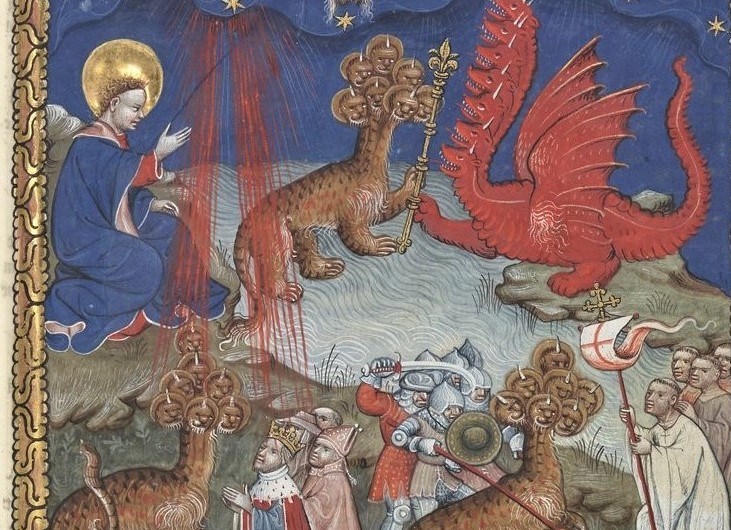
A crucial battle comes in Revelation 12, when the red dragon with seven heads and ten horns besets Mother Mary, who is also an image of the Church. However, the devil cannot prevail in the war that breaks out in Heaven. He is hurled to the earth, where he unsuccessfully pursues the woman (who represents both Mary and the Church). In a rage he continues to pursue us.
For the time being, the cosmic battle continues. Satan rages, for he knows his time is short. He is a big loser.
Even losers still have an odd ability to dupe and impress foolish, gullible people. So Satan still flashes the cash, makes empty promises, and dangles passing pleasures before us. Sadly, many of the worldly and unspiritual foolishly fall prey to his pomp and lies. Mysteriously, God permits this until the full number of the elect is gathered in.
Then comes the end:
And fire came down from heaven and devoured Satan and his armies and followers. And the devil, who deceived them, was thrown into the lake of burning sulfur, where the beast and the false prophet had been thrown. They will be tormented day and night for ever and ever. Then I saw a great white throne and him who was seated on it. The earth and the heavens fled from his presence, and there was no place for them. And I saw the dead, great and small, standing before the throne, and books were opened. Another book was opened, which is the book of life. The dead were judged according to what they had done as recorded in the books. The sea gave up the dead that were in it, and death and Hades gave up the dead that were in them, and each person was judged according to what they had done. Then death and Hades were thrown into the lake of fire. The lake of fire is the second death. Anyone whose name was not found written in the book of life was thrown into the lake of fire.
Then I saw a new heaven and a new earth, for the first heaven and the first earth had passed away, and there was no longer any sea. I saw the HolyCity, the new Jerusalem, coming down out of heaven from God, prepared as a bride beautifully dressed for her husband. And I heard a loud voice from the throne saying, “Look! God’s dwelling place is now among the people, and he will dwell with them. They will be his people, and God himself will be with them and be their God. He will wipe every tear from their eyes. There will be no more death or mourning or crying or pain, for the old order of things has passed away.” He who was seated on the throne said, “I am making everything new.” Then he said, “Write this down, for these words are trustworthy and true” (Rev 20:9-21:5).
Yes, it is good that we read the Book of Revelation. It is a pulling back of the veil, wherein the Lord tells us what is really going on and what the outcome shall be. He is telling us not to lose heart. “In this world you shall have tribulation, but have courage, I have overcome the world (John 16:33).
Be not dismayed, fellow Christians. Do not fear what is coming upon this world. Even if it is the end of the era, the Church has endured such sea changes before. Christ has already won the victory and has promised that the Church will remain indefectible. When the current foolishness has run its course, we will still be here preaching the Gospel, even if we have become a small remnant and are preaching from our prison cells!
Do not be fearful. Do not be a coward. Preach boldly and with love. Continue to shine the light of the gospel in the darkness. The gospel will win; it always wins.
Don’t get lost in the details of the Book of Revelation and miss its message of victory in the midst of persecution and trial. It is a call to persevere. It is a pulling back of the veil to show us what the end shall be! Be strong, be courageous, be certain. Jesus has already won the great victory in the cosmic battle. The dust is still settling, but know for certain that Jesus has won, and if you choose Him, so will you!
He who overcomes will inherit these things, and I will be his God and he will be My son. But for the cowardly and unbelieving and abominable and murderers and immoral persons and sorcerers and idolaters and all liars, their part will be in the lake that burns with fire and brimstone, which is the second death (Rev 21:7-8).
Regardless of what youthinkis going on, this is what isreallygoing on. Choose sides. I urge you to choose Christ with courage. Don’t look back. Come what may, Viva Christo Rey!
The Acts of the Apostles sets forth an event that amounts to a tale of one Church in two cities or regions. It illustrates well a couple of points: that the Church is always in need of reform and that our lives are not merely about us and what we want. Let’s look at the event in two scenes.
Scene 1: The Church in Jerusalem –
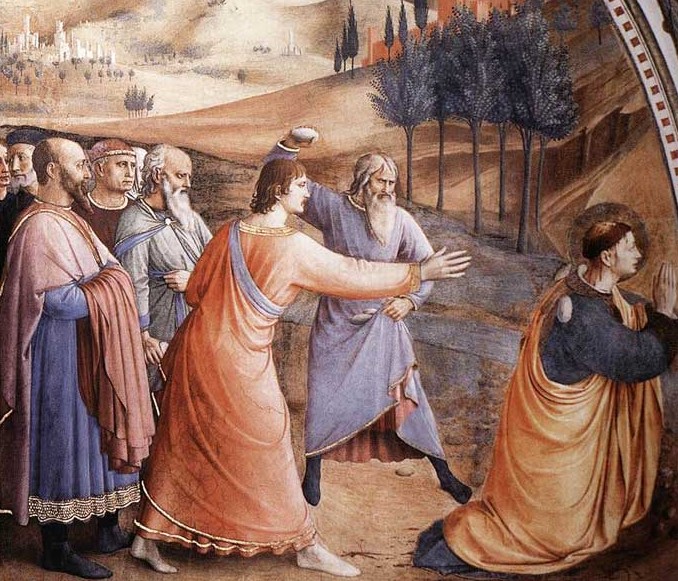
There broke out a severe persecution of the Church in Jerusalem, and all were scattered throughout the countryside of Judea and Samaria, except the Apostles. Devout men buried Stephen and made a loud lament over him.
Saul, meanwhile, was trying to destroy the Church; entering house after house and dragging out men and women, he handed them over for imprisonment. (Acts 8:1-4)
Up until now the Church in Jerusalem has experienced steady growth. To be sure there has been some persecution, but mainly of Peter, John and the other apostles. A passage from earlier in Acts describes a kind of springtime for the Church in Jerusalem following Pentecost:
They devoted themselves to the apostles’ teaching and to the fellowship, to the breaking of bread and to prayer. A sense of awe came over everyone, and the apostles performed many wonders and signs. …With one accord they continued to meet daily in the temple courts…sharing their meals with gladness and sincerity of heart, praising God and enjoying the favor of all the people. And the Lord added to their number daily those who were being saved. (Acts 2:42-47)
And yet, just at this moment of growth the Lord permits a persecution that, in many ways devastates the young community. There is the first martyrdom, a widespread arrest of Christians (led by Saul) and a scattering of “all” the community. A worldly perspective may ask, “Why O Lord?! This is bad timing. The Church was just getting her feet on the ground in Jerusalem and you have permitted her to be all but destroyed!”
Yes, the Lord had summoned the Church to the cross. And why? God alone knows the full reason, but we can speculate as to some reasons.
In the first place, the idyllic picture of Acts 2 has already been marred by squabbles and injustice of ethnic origin. The Greek-speaking widows were being neglected, it would seem (Acts 6:1). This may also point to other internal struggles that give the impression that the Church may be losing focus on essentials and that the outward priority of evangelizing is giving way to inward squabbles.
Further, there is the emerging picture of a Church rather settled in Jerusalem. But had the Lord not summoned them to go into all the world teaching, evangelizing, saving and drawing people to the sacraments? (see Matthew 28:19-20; Luke 24:47). There is no mention to this point of that taking place, or of any plans for it. So, perhaps the Lord permits this persecution to give the Church a nudge out of the nest. In saying they were scattered, we get the image of seed being sown. The blood of martyrs is seed for the Church and persecution fires up the faithful and distinguishes them from the merely fair-weather friends of the Lord. Ecclesia semper reformanda (the Church is always in need of reform).
The upshot of the whole episode is evangelical, for the faith now spreads north to Samaria and into Judah.
Scene 2: The Church in Samaria (The Church and Mission are Bigger than Us) –
Now those who had been scattered went about preaching the word. Thus Philip went down to the city of Samaria
and proclaimed the Christ to them.
With one accord, the crowds paid attention to what was said by Philip when they heard it and saw the signs he was doing. For unclean spirits, crying out in a loud voice, came out of many possessed people, and many paralyzed and crippled people were cured.
There was great joy in that city. (Acts 8:4-8)
Here is a very different picture! Having been prodded by the Lord through a permitted persecution, the tears and suffering in one city, in one part of the Church, benefit others in a new and different part of the Church. Demons are being cast out, healings are taking place, the lame are walking, and there is great joy!
The seeds of faith are being sown by the suffering of some and watered by their tears that others be saved and come to joy. A psalm comes to mind: He who goes out weeping, bearing the seed for sowing, shall come home with shouts of joy, bringing his sheaves with him. (Psalm 126:6)
So, the Lord had to prod the early Church to get moving. But this is only so that the work may become more fruitful and many more be saved.
And this points to two hard truths that, if accepted, are liberating:
1. Your life is not (only) about you.
2. You are not THAT important.
If we are not careful, we are very prone to become self-absorbed and think that our situation is the only thing on God’s radar. But the truth is, God has everyone’s needs in mind. My life is not simply about me and what I want and need and think and see. My life is also about what others need, and what others see and can contribute. I am not so important that God will sacrifice everything and everyone else just to answer my needs. God might actually ask me to suffer and sacrifice so that others may thrive. Our lives are intertwined with the lives of others. I have surely benefited from the sacrifices others have made, and I am called at times to sacrifice that others may come to know God and thrive. Thus, the Church at Jerusalem was permitted by God a persecution and a suffering so that others in Samaria and throughout the world would come to hear the Gospel and be saved. Scripture says elsewhere:
He who has an ear, let him hear. “If anyone is destined for captivity, into captivity he will go; If anyone is to die by the sword, by the sword he must be killed.” Here is a call for the perseverance and faith of the saints. (Rev 13:9-11)
In our times of self-esteem, we can go too far and presume that my life is all about me and nothing and no one is more important that me and I what I and my family need. Or we can become very focused on the issues that preoccupy us in the Church in America or think that everyone sees what we see, or experiences what we do. This is myopic. The Church is bigger than me or my parish or my country. The Church is in every land, speaks every language and extends back in time and forward as well. God has a little more on his radar than “me” or our small and temporary group.
This small story from Acts reminds us that the Church is always in need of reform. It also reminds us that the Church is more than me or us. Here is one Church with two scenes. In Jerusalem there is weeping, but in Samaria there is joy. My life is not about me alone. I both benefit from the sacrifices of others and am called to make sacrifices for others. The blood of martyrs is seed for the Church, the tears of the persecuted will often water those seeds. It is a hard but a freeing truth. In heaven we will see what our sufferings accomplished. For now, we must accept whatever the Lord decides, be it suffering or joy, or some combination of both. My life isn’t just about me or what I want. It’s also about you and what you need.
The Gospel from Saturday’s daily Mass (Saturday of the 2nd Week of Easter) describes troubles rising and demonstrates how to endure them:
When it was evening, the disciples of Jesus went down to the sea, embarked in a boat, and went across the sea to Capernaum. It had already grown dark, and Jesus had not yet come to them. The sea was stirred up because a strong wind was blowing. When they had rowed about three or four miles, they saw Jesus walking on the sea and coming near the boat, and they were afraid. But he said to them, “It is I. Do not be afraid.” They wanted to take him into the boat, but the boat immediately arrived at the shore to which they were heading (John 6:16-21).
The images in this passage are reminiscent of the journey of life. The disciples have set out in a boat to cross to the other shore. We, too, have set out for another shore in our life. Darkness grows for them as it often does for us. The winds are contrary, and the sea becomes choppy. The must row because the sails are useless. So it is for us also. We would rather let the wind carry us effortlessly to the other shore, but while life has many pleasant moments when we can do this, there are other times when the storms and winds assail us and make our journey difficult.
The disciples are a few miles into their journey when the crisis arises—or is it a blessing? They see Jesus walking on the water. Although He is their blessing, they don’t see it that way. Other gospel passages say that they thought they were seeing a ghost (e.g., Matt 14:26).
Life can be like this. Our blessing, our solution, our healing can be right in front of us, yet we are terrified. I remember one time when my cat was trapped in the attic of the rectory (I have no idea how she got up there). We made an opening in the ceiling to get her out, but she was too terrified to come near enough that I could let her down. It took a long time (and some kitty snacks) to lure her. Although I was her rescuer, she saw me as her tormenter. We are often like this, fearing the very Savior sent to us. We are like children who scream in fright as the doctor approaches with the shot that will cure or prevent sickness. The Lord God once said of us,
When Israel was a child, I loved him, and out of Egypt I called My son. But the more I called them, the farther they ran from Me …. Yet it was I who taught Ephraim to walk, taking them in My arms, but they never realized that it was I who healed them … [who] bent down to feed them (Hosea 11:1-4).
Yes, we often fear the very source or means of our blessing.
The text says, “… and they were afraid.” They are looking right at Jesus, their savior, yet they do not realize it; they do not recognize Him and are afraid. We, too, are like this. Why do we sometimes fear Jesus, the very source of our salvation? Because He does not always heal us on our terms. He talks of strange remedies like the cross. Strangely, He permits storms in our life and we are both fearful and resentful. However, the very cross and storms we fear are often the means by which He saves us! We need some degree of suffering and storms to keep us humble, to help us to grow in wisdom, to trust Him, and to keep calling on Him. Jesus talks of unsettling things like taking up our cross and following Him, losing our life so as to find it and save it. Jesus Himself won the victory hanging on a cross, not astride a war-horse slaughtering His enemies.
We see Jesus coming toward us in a storm, but rather than simply stopping the storm, He tells us not to be afraid. Why doesn’t He just take away the storm? I don’t know; He simply says, Do not be afraid. It is I. In the Gospel of John, Jesus says, In this world you will have tribulation, but take courage; I have overcome the world (Jn 16:33).
Jesus wants His presence to be enough for us. He is with us, so why are we afraid? There are going to be storms; that’s a promise—but He will be with us; that, too, is a promise. There’s a saying that’s particularly: “Don’t tell God how big your storm is. Tell the storm how big your God is.”
The gospel passage we are discussing ends abruptly by saying, They wanted to take him into the boat, but the boat immediately arrived at the shore to which they were heading. Well, what do you know, they finally understand that it is Jesus and they reach the shore!
Note that there is no indication in the passage that the storm ended. The winds may have still been blowing, the seas still rough, but none of that matters once they have reached their destination. One may think that this destination merely refers to the boat docks at Capernaum, but that would be worldly, limited, and erroneous. The shore to which we all sail is none other than the Lord Himself. He is our peace, our goal, our destination.
At times His solutions may involve paradox. The cross is strange medicine to the worldly—but loss can usher in gain, a door may close only that another may open, death can bring life. Do not be afraid; He is near. That is not a ghost approaching you in the storm, it is the Lord! All things work together for good to them that love God, to them who are the called according to his purpose (Rom 8:28).
This is a vignette, an essay on life. Storms will come, but the solution is near: Do not be afraid. It is I.
Help me, Lord, to know that you are the source of my peace. You are always near; Help me to hear your voice, saying, Do not be afraid. It is I.
There is an old gospel song that has these lyrics:
I love the Lord;
He heard my cry;
And he pitied every groan.
Long as I live;
And troubles rise;
I’ll hasten to his throne.