The Charter and Mandate of the Church

Jesus gives a concise summary of the work and experience of the Church in His discourse with Nicodemus, which we read at Tuesday’s daily Mass:

Amen, amen I say to you, we speak of what we know, and we testify to what we have seen, but you people do not accept our testimony (Jn 3:11).

I. Plural Note that when Jesus speaks to Nicodemus He does not say, “I speak to you.” He says, “We speak to you.” The use of the first-person plural is common in Johannine literature. For example, at the beginning of the First Letter of John it is said, That which was from the beginning, which we have heard, which we have seen with our eyes, which we have looked at and our hands have touched—this we proclaim concerning the Word of life (1 John 1:1).

Who is the “we” referred to here? As with most things in Scripture, there are layers of meaning. First, it certainly means the apostolic college. On a wider level it refers to the first eyewitnesses, the disciples who heard and saw Jesus and were able to report what He said and did. Even more widely the “we” is the Church down through the centuries. The Church here is more than an institution; it is the Body of Christ, the living, active presence of Jesus Christ in the world.

II. Proclamation“We speak of what we know, and we testify to what we have seen.” Just after the resurrection, the common expression of apostles and disciples is this: “I have seen the Lord” (e.g., John 20:18, 20:25). If the Church could no longer say this, she would no longer be the Church! If she could no longer say, “Jesus is Lord. We know this; we experience this; and we see it with our eyes,” then she would no longer be the Church.

Note that in the biblical sense, the word “know” does not simply refer to intellectual knowing, as if the Church were merely reciting words written centuries ago. Biblical knowing emphasizes experience; something known means something actually seen and experienced, not just learned in the abstract. The Church does not simply know Jesus is Lord and speak of it as if regurgitating reciting ancient formulas, precious though they are. Rather, she speaks of her experience with the Lord Jesus Christ in the sacred liturgy and of His powerful ministry to all her members throughout time.

The proclamation of the Church is that we speak to the world of what we know, what we have experienced. To emphasize this, Jesus adds that the proclamation of the Church is not simply what we know but what we have “seen.” Here, too, a tangible experience is referenced. This is the proclamation of ancient truths, presently experienced—seen. In other words, the Church can raise her right hand and swear to the truth of all that Jesus has said and done because she knows it; she experiences it; she has seen it—she has witnessed it occurring.

Indeed, souls are healed and set free, and human beings are gloriously transformed by the celebration of her sacred liturgy with her Blessed Groom and Lord, Jesus Christ.

The Church announces her experience with Jesus Christ, with the ability of His Word and truth to transform her and her members. The Church proclaims to the world, “We testify to what we have known and what we have seen.”

III. PersecutionThen Jesus says to Nicodemus, and by extension to the world, “You do not accept our testimony.”

It is often the lot of the Church to be scorned, ridiculed, and mocked—even hated and persecuted—because of our proclamation. There are many who demand that the Church conform to the world and its ideas and values.

Yet, as Pope Paul VI noted in Humanae Vitae, one of the Church’s most rejected encyclicals,

There is too much clamorous outcry against the voice of the Church, and this is intensified by modern means of communication. But it comes as no surprise to the Church that she, no less than her divine Founder, is destined to be a “sign of contradiction.” She does not, because of this, evade the duty imposed on her of proclaiming humbly but firmly the entire moral law, both natural and evangelical (#18).

The Church is to be this sign of contradiction. Yes, we must often stand up before a worldly consensus and say no, regardless of how many around us who say yes. It is the lot of the Church to experience rejection and to have to say, “You do not accept our testimony.”

Yet this is judgment, for Jesus says, Light has come into the world, but people loved darkness instead of light because their deeds were evil. Everyone who does evil hates the light (John 3:19-20). St. Paul adds, For the time will come when people will not put up with sound doctrine. Instead, to suit their own desires, they will gather around them a great number of teachers to say what their itching ears want to hear (2 Tim 4:3). Simeon, as he held the infant Jesus and thereby the infant Church, is recorded as saying this: This child is destined to cause the falling and rising of many in Israel, and to be a sign that will be contradicted (Lk 2:34).

Yes, this is our place—among the persecuted, scorned, and derided. The Church must be willing to say to the world, “You do not accept our testimony.” We must not “cave.” Too many people today, wanting the Church to be “relevant,” and “acceptable,” insist that we alter our doctrines so that the world will accept our testimony. God forbid the Church ever do this, for we would no longer be the Church!

Here, then, is Jesus’ charter—His mandate—for the Church: that we should say to the world, “We speak to you of what we know and of what we have seen, but you do not accept our testimony.”

Cross-posted at the Catholic Standard: The Charter and Mandate of the Church

Why Did Christ’s Glorified Body Still Have Wounds?

Several of the Resurrection accounts stress that Jesus showed the disciples His wounds. On one level we can understand that He was trying to make clear to them that the same Christ who was crucified stood before them; He was not a ghost or an apparition or simply someone who looked like Jesus.

When Christ rose, He took up His same, true body, but it now manifested a perfected glory. When we rise on the last day, the same will be true of our bodies. Why, then, were Christ’s wounds visible in His glorified body? Are not wounds and scars inconsistent with a glorified body?

St. Thomas Aquinas provides five reasons that Christ’s wounds are fitting in His glorified body. His reflections, from the Summa Theologiae III, Q. 54, Art. 4, are beautiful and poignant. St. Thomas’ words are presented below in bold, black italics, while my remarks appear in plain red text.

It was fitting for Christ’s soul at His Resurrection to resume the body with its scars. In the first place, for Christ’s own glory. For Bede says on Luke 24:40 that He kept His scars not from inability to heal them, “but to wear them as an everlasting trophy of His victory.” Hence Augustine says (De Civ. Dei xxii): “Perhaps in that kingdom we shall see on the bodies of the Martyrs the traces of the wounds which they bore for Christ’s name: because it will not be a deformity, but a dignity in them; and a certain kind of beauty will shine in them, in the body, though not of the body.”

Christ’s wounds are a dignity not a deformity, a sign of love not of loss, an indication of obedience not of onerousness. Through His wounds the Lord can say, “Here is what the world did to me, yet I live. Here is the cost of your redemption and the lavishness of my love.”

Secondly, to confirm the hearts of the disciples as to “the faith in His Resurrection” (Bede, on Luke 24:40).

This is what theologians refer to as “continuity.” The wounds demonstrate that the body that died on the cross is the same one the disciples see standing before them. Jesus has not taken up or fashioned a new body or a similar one; He is truly risen. The Greek word for resurrection is anastasis, which literally means “to stand again.” The word “resurrection” means the same thing: re (again) + surrexit (he stands). None of this would be true if a different body were before them, no matter how similar. Thus, Christ’s wounds confirm the truth of the resurrection.

Thirdly, “that when He pleads for us with the Father, He may always show the manner of death He endured for us” (Bede, on Luke 24:40).

Beautiful! The picture here is of the Son, Jesus, showing His wounds to His Father and saying, “See how I have loved them, Father. Have mercy on them.”

The Book of Hebrews says, Consequently, Jesus is able to save to the uttermost those who draw near to God through him, since he always lives to make intercession for them. For it was indeed fitting that we should have such a high priest, holy, innocent, unstained, separated from sinners, and exalted above the heavens. He has no need, like those high priests, to offer sacrifices daily, first for his own sins and then for those of the people, since he did this once for all when he offered up himself (Heb 7:25-27).

Fourthly, “that He may convince those redeemed in His blood, how mercifully they have been helped, as He exposes before them the traces of the same death” (Bede, on Luke 24:40).

To those who doubt the Lord’s love or His understanding of our trials, Christ’s wounds speak tenderly and clearly of His love and of the price He was willing to pay for us. His wounds are more eloquent testimony than any words could be. Is God merciful? Does God understand or care at all about our condition? Look to the wounds of Christ; dwell in them; take shelter in them.

Lastly, “that in the Judgment Day He may upbraid them with their just condemnation” (Bede, on Luke 24:40). Hence, as Augustine says (De Symb. ii): “… So will [Christ] show His wounds to His enemies, so that He who is the Truth may convict them, saying: ‘Behold the man whom you crucified; see the wounds you inflicted; recognize the side you pierced, since it was opened by you and for you, yet you would not enter.’”

Such powerful and moving word, in this case from St Augustine. There is also a refutation of the idea that God is simply harsh on Judgment Day. In effect, He will say, “I endured suffering from you out of love for you. When I was on the cross, the soldier pierced my side. My heart was literally opened for you and still you would not enter. What more could I have done than to allow your own sins to be your redemption? Still you refused.”

In spite of receiving lifelong graces and unmerited favors and blessings, in spite of God’s call echoing in their depths, many still refuse God’s offer. It is a tragedy that some hearts are so hardened. Christ’s wounds testify to the justice of God’s only (and final) recourse: allowing them to live apart from Him. Accepting the choice of their free will, God’s last act is simply to recognize their refusal and say, “you would not enter.”

Dwell in the wounds of Christ.

Cross-posted at the Catholic Standard: Why Did Christ’s Glorified Body Still Have Wounds?

An Easter Exhortation

We’ve had quite a week of gatherings here in Washington, D.C. during this Easter Octave. The National Catholic Prayer Breakfast was held on Tuesday and I was privileged to be able to speak to the organizers of that event on Monday evening. On Friday there was a wonderful gathering of leaders from EWTN and our local affiliate, WMET 1160 AM. Catholic radio and Catholic television have had a profound effect on the lives and faith of so many!

Despite the Easter glow, there was also at those gatherings a sober awareness that these are dark days and that the Lord is calling us to be willing to suffer and sacrifice for the truth of the gospel.

Recent readings from Scripture have also had this theme. The readings in daily Mass this past week (from the Acts of the Apostles) show the joy of a poor, lame man healed by Peter and John at the Gate called Beautiful. By week’s end Peter and John were arrested for the “dangerous” act of glorifying Jesus and forced to appear before the Jewish court. More suffering and arrests would follow.

In the Office of Readings, we are reading from the First Letter of Peter, which is a kind of survival guide for those who suffer on account of Jesus. Consider these excerpts from this past week:

Do not be surprised, beloved, that a trial by fire is occurring in your midst. It is a test for you, but it should not catch you off guard. Rejoice instead, in the measure that you share Christ’s sufferings. When his glory is revealed, you will rejoice exultantly. Happy are you when you are insulted for the sake of Christ, for then God’s Spirit in its glory has come to rest on you ….

The season of judgment has begun, and begun with God’s own household. If it begins this way with us, what must be the end for those who refuse obedience to the gospel of God? And if the just man is saved only with difficulty, what is to become of the godless and the sinner? Accordingly, let those who suffer as God’s will requires continue in good deeds, and entrust their lives to a faithful Creator….

Stay sober and alert. Your opponent the devil is prowling like a roaring lion looking for someone to devour. Resist him, solid in your faith, realizing that the brotherhood of believers is undergoing the same sufferings throughout the world. The God of all grace, who called you to his everlasting glory in Christ, will himself restore, confirm, strengthen, and establish those who have suffered a little while. Dominion be his throughout the ages! Amen (1 Peter 4:12-5:14).

I have written before on the bloodiness of the Christmas Octave; the Easter Octave is not much different. The ancient Church had little time for the sentimentality we have introduced into the celebrations of Christmas and Easter. Indeed, there was no Santa Claus with flying reindeer, no Easter bunny, no Easter parades. Jesus was born to do battle and rose to show forth the victory. But a victory presupposes a battle and a struggle.

The Sequence that should be sung during the Easter Octave is as follows:

Mors et vita duello,            (Death and life have contended)
conflixere mirando:           (in a stupendous conflict)
dux vitae mortuus,             (The Prince of life having died)
regnat vivus!                         (Now reigns living).

Easter is serious business with a message that summons us to the battle with confidence. In effect the message is this:

Enough of all this cowardice. No more hiding out in upper rooms. Get out there like soldiers who know they are on the winning team. Manfully engage the battle and win some souls for Christ. As in any war, there is going to be suffering. Jesus says, In this world you shall have tribulation; but have confidence I have overcome the world (John 16:33). The Easter message is not that there is no battle, but rather that the battle is a glorious one whose outcome has already been decided. Choose sides!

Scripture says,

Jesus Christ is the faithful witness, the firstborn of the dead and ruler of the kings of the earth. To Him who loves us and has freed us from our sins by His Blood, who has made us into a Kingdom, priests for His God and Father, to Him be glory and power forever and ever. Amen. Behold, He is coming amid the clouds, and every eye will see Him, even those who pierced Him. All the peoples of the earth will lament Him. Yes, Amen. “I am the Alpha and the Omega,” says the Lord God, “the One who is and who was and who is to come, the Almighty” (Rev 1:5-8).

Make sure you are on the winning team. Some people foolishly choose the wrong side, thinking that winning means having power, popularity, money, and possessions—that is not victory. A team can be ahead until the final play of the game yet still lose. You already know who is going to win; present appearances mean nothing. Choose the winning team even if, for now, it means being subjected to ridicule, disapproval, and desertion. Be ready and willing to suffer for the Kingdom. The Easter message is not that there is no suffering, but that our suffering, united to Jesus’, will lead to glory and victory.

Stop acting like a loser, hiding out and being afraid to announce the truth of the gospel. Stop being so anxious about what others are saying. You may be called hateful, bigoted, misogynistic, homophobic, transphobic, backward, and uptight—anything but a child of God. Do not hate them, but keep on summoning them to join us; know that some will do so if you persevere. Be willing to suffer for the truth and still remain joyful.

Peter and John were arrested in the first week after Pentecost; can’t we at least tolerate a raised eyebrow or some laughter at our expense? The martyrs stared down deadly threats; they endured the swords and lions of a hateful, scornful world. Must they bear the cross alone?

The Easter message is not one of cheap joy. It is about a courageous transformation that equips us to be willing to face down death in order to proclaim the truth of the gospel. We are going to need this in the years ahead. This fallen world is going to get darker, and a people used to the darkness despises the light. To those who hate the truth, it seems hateful; they will call themselves righteous as they expel us from the public square. They already label themselves victims at the mere utterance of moral truth. “Safe zones” will have no room for us. Despite all their calls for tolerance, there will be no tolerance shown to us. Our speech and our actions will be increasingly criminalized.

This is my Easter exhortation. What do you think of it? If you think it is too negative, why? If you like it, great. Will you live it? How? When? Why not now?

Catholic catechist, speaker, and writer Dr. David Anders spoke to us at the EWTN/WMET gathering about something Mother Angelica once said. When asked what she thought the future of EWTN would be she said, “Nothing lasts forever. For now, we have an open window of opportunity and we should use it while we can. For one day, the window may close and EWTN will be declared illegal. Let’s strengthen everyone now, while we still have the time”—a sober understanding to say the least. Courage and action today will lay the groundwork for what will be needed tomorrow.

Jesus is risen from the dead and He is not going away. He has won the victory and I will either gather souls with Him, or I will scatter and squander. I will work for Him and win, or I will contend with Him and lose. I think I’ll choose Jesus!

The song in the clip below has these lyrics:

I told Jesus it would be alright if He changed my name
And He told me that I would go hungry if He changed my name
Yes He told me that I would go hungry if He changed my name
But I told Jesus it would be alright if He changed my name
I told Jesus it would be alright if He changed my name
So I told Him it would be alright and the world would hate me
That I would go hungry if He changed my name

Cross-posted at the Catholic Standard: An Easter Exhortation

From Fear to Faith – A Homily for the Second Sunday of Easter

In today’s Gospel, the risen Lord appeared to the Apostles, who were gathered together in one place. The fact that they were gathered in one place is not without significance, for it is there that the Lord chose to appear to them. One of them was not there and thus missed the blessing of seeing and experiencing the risen Lord. It might be said that Thomas, the absent Apostle, blocked his blessing.

Some people want Jesus without the Church. No can do. Jesus is found in His Church, among those who have gathered. There is surely joy to be found in a personal relationship with Jesus, but the Lord also announced a special presence whenever two or three are gathered in His name. It is essential for us to discover how Mass attendance is essential for us if we want to experience the healing and blessing of the Lord. This Gospel has a lot to say to us about the need to gather together to find the Lord’s blessing in the community of the Church, in His Word, and in the sacraments. Let’s look at today’s Gospel in five stages.

I. Fearful Fellowship – Notice how the text describes the gathering of the Apostles: On the evening of that first day of the week, when the doors were locked, where the disciples were, for fear of the Jews …. These men are frightened, but they are in the right place. It is Sunday, the first day of the week, and they have gathered together. The text says nothing about what they are doing, only that they have gathered, but in a sense this is all we need to know, for this will set the stage for blessings and for the presence of the Lord.

These are men who need a blessing! The locked doors signify their fear of the Jewish authorities. One may also assume that they are discouraged, lacking in hope, and maybe even angry. They have experienced the earthquake that Jesus’ crucifixion was for them. Some of the women in their midst claim to have seen Him alive, but now it is night and they have heard of no other sightings.

Thanks be to God, they have gathered. It is not uncommon for those who have “stuff” going on in their lives to retreat, withdraw, and even hide. This is probably the worst thing that one can do. It would seem that Thomas has taken this approach, though his absence is not explained. Their gathering is an essential part of the solution to everything that afflicts them. This gathering is the place in which their new hope, new hearts, and new minds will dawn.

So it is for us, too, afflicted as we are in so many ways, troubled at some times and joyful at others. It is critical importance that we gather each Sunday, each first day of the week. In every Mass the Lord prepares blessings for us. I am powerfully aware that every Mass I celebrate, especially Sunday Mass, is a source of blessings for me. Not only does God instruct me with His Word and feed me with His Body and Blood, He also helps form me through the presence and praise of others: the people I have been privileged to serve. I don’t know where I’d be if it were not for the steady support of the people of God: their prayers, their praise, their witness, and their encouragement.

The Book of Hebrews states well the purpose and blessing of our liturgical gatherings:

Let us hold fast the confession of our hope without wavering, for He who promised is faithful; and let us consider how to stir up one another to love and good deeds, not neglecting to meet together, as is the habit of some, but encouraging one another; and all the more as you see the Day drawing near (Heb 10:22-25).

So the Apostles are meeting together, encouraging one another. They are about to be blessed, but the blessing occurs only in the context of the gathering, so Thomas will miss it. This blessing is only for those who are there. So it is for us, too, who also have blessings waiting but only if we are present, gathered for Holy Mass. Don’t block your blessings!

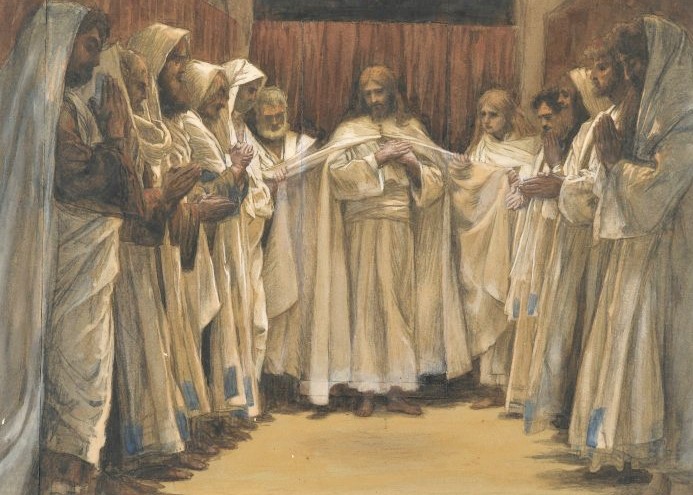
II. Fabulous Fact – Then comes the blessing: For where two or three are gathered in my name, there am I among them (Matt 18:20). The text from today’s Gospel says, Jesus came and stood in their midst and said to them, “Peace be with you.” When he had said this, he showed them his hands and his side. The disciples rejoiced when they saw the Lord. Jesus said to them again, “Peace be with you.”

Suddenly there is a completely new reality, a new hope, a new vision. Note that there is also a new serenity, a peace, a shalom. Not only do they see and come to experience an entirely new reality, they also receive an inner peace. Observe again that this is only for those who are present.

This is a basic purpose of the gathering we call the Sacred Liturgy. It is here that we are invited to encounter the living Lord, who ministers to us and offers us peace. Through His Word, we are increasingly enabled to see things in a new way, one that gives us hope, clarity, and confidence. Our lives are reordered. Inwardly, too, a greater peace is meant to come upon us as the truth of this newer vision begins to transform us, giving us a new mind and heart. Looking to the altar, I draw confidence that the Lord has prepared a table for me in the sight of my enemies and my cup is overflowing (Ps 23). The Eucharist is thus the sign of our victory and our election. As we receive the Body and the Blood of the Lord, we are gradually transformed into the very likeness of Christ.

Is this your experience of the gathering we call the Mass? Is it a transformative reality or just a tedious ritual?

As for me, I can say that I am being changed, transformed into a new man, into Christ, by this weekly—indeed daily—gathering we call the Mass. I have seen my mind and heart changed and renewed. I see things more clearly and have greater hope, joy, and serenity. I cannot imagine what my life would be like were it not for this gathering of the Holy Sacrifice of the Mass, where Jesus is present to me and says, “Shalom, peace be with you.” Over the years, I am a changed man.

Yes, the Mass works. It transforms; it gives a new mind and heart. Don’t block your blessings; be there every Sunday.

III. Forgiving Fidelity – Next comes something quite extraordinary, something that simply cannot take place within a private notion of faith. The text says, “As the Father has sent me, so I send you.” And when he had said this, he breathed on them and said to them, “Receive the Holy Spirit. Whose sins you forgive are forgiven them, and whose sins you retain are retained.”

In this remarkable moment, the Lord gives the Apostles the power to forgive sin. Note that He is not simply giving them the ability to announce that we are forgiven; He is giving them the juridical power to forgive or in certain cases to withhold/delay forgiveness. This is extraordinary! Not only has He given this authority to men (cf Matt 9:8), He has given it to the very men who abandoned Him (with the exception of John) at His crucifixion. These are men who are well aware of their shortcomings. Perhaps it is only because Jesus knows of their awareness that He can truly trust them with such power.

There are those who deny that Confession is a biblical sacrament, but here it is in today’s Gospel. There are other texts in Scripture showing Confession to be quite biblical:

  • Also many of those who were now believers came, confessing and divulging their practices (Acts 19:18).
  • Is any one of you sick? He should call the presbyters of the church to pray over him and anoint him with oil in the name of the Lord. And the prayer offered in faith will make the sick person well; the Lord will raise him up. If he has sinned, he will be forgiven. Therefore, confess your sins to one another and pray for each other so that you may be healed. The prayer of a righteous man is powerful and effective (James 5:14-16).

Many consider it sufficient to speak to God privately about their sins, but the Scriptures instruct us away from such a solitary notion and bid us to approach the Church. The Lord gives the Apostles the authority to adjudicate and then to absolve or retain sins, but this presupposes that someone has first approached them for such absolution. St. Paul was approached by the believers in Ephesus, who made open declaration of their sins. The Book of James also places the forgiveness of sins in the context of the calling of the presbyters, the priests of the Church, and sees this as the fulfillment of this passage: declare your sins to one another … the prayer of the righteous man has great power (James 5:16).

Thus, again, there is a communal context for blessing, not merely a private one. I have written more on the biblical roots of Confession here: The Sacrament of Confession.

IV. Faltering Fellowship – We have already noted that Thomas blocked his blessing by not being present. The text says, Thomas, called Didymus, one of the Twelve, was not with them when Jesus came. So the other disciples said to him, “We have seen the Lord.” But he said to them, “Unless I see the mark of the nails in his hands and put my finger into the nail marks and put my hand into his side, I will not believe.”

Thomas exhibits faltering fellowship in two ways:

First, he is not with the other Apostles on resurrection evening, thus he misses the blessing of seeing and experiencing the resurrection and the Lord.

Second, Thomas exhibits faltering fellowship by refusing to believe the testimony of the Church that the Lord has risen.

One of the most problematic aspects of many people’s faith is that they do not understand that the Church is an object of faith. In the Creed every Sunday we profess to believe in God the Father and in Jesus Christ, His only Son, our Lord, and to believe in the Holy Spirit, the Lord and giver of life. But we are not done yet. We go on to say that we believe in one, holy, catholic, and apostolic Church. We know and believe what we do about Jesus Christ on the basis of what the Church hands on from the Apostles. Some say, “No, I believe in what the Bible says,” but the Bible is a book of the Church. God has given it to us through the Church who, by God’s grace, collected and compiled its contents and vouches for the veracity of the Scriptures. Without the Church there would be no Bible.

Therefore, in rejecting the testimony of the Church, Thomas is breaking fellowship and refusing to believe in what the Church, established by Christ to speak in His name (e.g. Lk 24:48; Lk 10:16; Matt 18:17; Jn 14:26; 1 Tim 3:15; inter al.), teaches. We, too, falter in our fellowship with the Church if we refuse to believe the testimony of the Church in matters of faith and morals. This a privatization of faith, a rejection of fellowship, and a refusal to gather with the Church and accept what she proclaims through her Scriptures, Tradition, and the catechism.

Note that as long as Thomas is not present, he has blocked his blessings. He must return to gather with the others in order to overcome his struggle with the faith.

V. Firmer Faith – Thomas then returns to fellowship with the other Apostles. Just as we do not know the reason for his absence, his return is also unexplained. Some may wish to chalk up his absence to some insignificant factor such as being busy, or in ill health, or some other largely neutral factor, but John seldom provides us detail for no reason. Further, Thomas does refuse to believe the testimony of the others, which is not a neutral fact.

Praise God, Thomas is now back with the others and in the proper place for a blessing. Whatever his struggle with the faith, he has chosen to work it out in the context of fellowship with the Church. He has gathered with the others. Now comes the blessing.

You know the story, but the point here is that regardless of our doubts and difficulties with the faith, we need to keep gathering with the Church. In some ways faith is like a stained glass window that is best appreciated from inside the church. From the outside there may seem very little about it that is beautiful. It may even look dirty and leaden, but once one ventures inside and adjusts to the light, one can see that the window radiates beauty.

It is often this way with the faith. I have found that I could only really appreciate some of the more difficult teachings of the Church after years of fellowship and instruction by the Church, in the liturgy and in other ways. As my fellowship and communion have grown more intense, my faith has become clearer and more firm.

Now that he is inside the room, Thomas sees the Lord. When he was outside, he did not see and so he doubted. The eyes of our faith see far more than our fleshly eyes, but in order to see and experience our blessings we must gather; we must be in the Church.

Finally, it is a provocative but essential truth that Christ is found in the Church. Some want Christ without the Church. No can do. He is found in the gathering of the Church, the ekklesia, the assembly of those called out. Any aspects of His presence that are found outside the Church are mere glimpses, shadows emanating from the Church. He must be sought where He is found, among sinners in His Church. The Church is His Body and His Bride. It is here that He is found. “Feeling” His presence while alone on some mountaintop can never compare to hearing the priest say, “Behold the Lamb of God.”

Thomas found Him, but only when he gathered with the others. It is Christ’s will to gather us and unite us (Jn 17:21). Congregavit nos in unum Christi amor (The love of Christ has gathered us in one).

Note: This Sunday is also Divine Mercy Sunday. I published a homily in the past (Perfect Mercy) with this focus.

Cross-posted at the Catholic Standard: From Fear to Faith – A Homily for the Second Sunday of Easter

God’s Perfect Mercy – A Meditation for Divine Mercy Sunday

We live in times in which mercy, like so many other things, has become a detached concept in people’s minds, separated from the things that really help us to understand it. For indeed, mercy makes sense and is necessary because we are sinners in desperate shape. Yet many today think it unkind and unmerciful to speak of sin as sin. Many think that mercy is a declaration that God doesn’t really care about sin, or that sin is not a relevant concept.

On the contrary, mercy means that sin does exist. Thanks be to God for the glory, the beauty, and the gift of His mercy! Without it, we don’t stand a chance. I don’t know about you, but I’m certainly going to need boatloads of grace and mercy to make it. Only through grace and mercy can we be freed from sin and healed from its effects, or ever hope to enter the presence of God’s glory in Heaven, of which Scripture says, But nothing unclean will ever enter it, nor anyone who does what is detestable or false (Rev 21:27). Somebody say, “Lord, have mercy!”

Mercy does not mean there is no judgment; mercy exists because there is a day of judgment. Mercy does not mean there is no Hell; mercy exists because Hell does. Somebody say, “Lord, have mercy!” Without mercy we are lost. With it we stand a chance, but only if we accept our need for it. Mercy, Lord, have mercy!

Oh, thanks be to God for mercy! So let’s consider the glory and the gift of mercy on this Sunday of divine mercy. The Gospel for today’s Mass speaks both to the need for mercy and the glory of it. Let’s look at four teachings on mercy, God’s perfect mercy.

I. The Prelude to Mercy – There is an old saying that if you don’t know the bad news, the good news is no news. And thus as this Gospel opens we enter a room where ten Apostles are gathered in fear; the doors are locked. These are broken, troubled, and disturbed men. All of them but John had fled, deserting the Lord. One of them had denied even knowing Jesus, not once but three times. Here they are, humiliated, downcast, and sinfully without faith. Never mind that Jesus had told them on numerous occasions that He would rise on the third day. Even though several women and two disciples from Emmaus had said they had seen Him alive, on this the third day, these men persist in sinfully rejecting this news that conformed to His promise. Yes, we enter a locked room of fearful men who are downcast, disgraced, and disbelieving.

But it is here that we find the prelude to mercy! They are about to blessed and to experience profound mercy. But don’t miss this prelude. Again, if you don’t know the bad news, the good news is no news; so don’t miss this picture.

One of the great errors of our day is the proclamation of mercy without repentance, without reference to our sinful condition. So many pulpits have gone silent on sin! And therefore are silent on the true glory of mercy and the astonishing gift that it is! Ah, mercy! Divine mercy! Perfect mercy!

But the point of mercy is not to go out and tell others how terrible they are, but rather to tell them about the forgiveness of sin! Now this is why we need a mercy Sunday. On the one hand we’re living in rebellious times, times in which many are dismissive of sin and have refashioned God into just a nice fellow who doesn’t really care all that much about sin (despite what His own scriptures say to the contrary), reducing mercy is to mere kindness and a sort of blindness on God’s part.

On the other hand these are also times when many are scared and angry with God, rejecting His judgments and glorious moral vision. A lot of people know that their lives are in disorder: their families are broken; they are confused; greed, materialism, lust, and other sinful drives are taking a heavy toll. Many are angry with the Church because deep down they know we are right; they don’t like being reminded that people don’t have any business calling good what God calls sinful.

But most of all, many are confused and angry because they don’t know forgiveness. Consider what Psalm 32 says so beautifully:

Blessed is the one whose fault is taken away, whose sin is forgiven, to whom the Lord imputes no guilt!As long as I would not speak of my sin, my bones wasted away and your hand was heavy upon me. Then I acknowledged my sin to you, my guilt I did not hide, and you took away the guilt of my sin!

You see, the key to having this blessed state is the acknowledgement of sin.

The Lord said to St. Faustina,

You see what you are of yourself, but do not be frightened at this. If I were to reveal to you the whole misery that you are, you would die of terror. … But because you are such great misery I have revealed to you the whole ocean of my mercy (Diary II. 718).

Now some reading this sort of text think, “There goes that Catholic guilt thing again.” But let’s be honest, it’s not really an exaggeration. The truth is that most of us can be thinned-skinned, egotistical, unforgiving, unloving, unkind, mean-spirited, selfish, greedy, lustful, jealous, envious, bitter, ungrateful, smug, superior, vengeful, angry, aggressive, unspiritual, un-prayerful, stingy, and just plain mean. And even if all the things on the list don’t apply to you, many of them do. In addition, even that long list is incomplete. We are sinners with a capital ‘S’ and we need serious help.

And thus, just as Psalm 32 says, the glory of mercy is unlocked by the acknowledgment of sin. Jesus said further to St. Faustina,

My love and my mercy [for you] know no bounds! … The graces I grant are not for you alone, but for a great number of other souls as well. … The greater the sinner the greater the right he has to my mercy (Diary II.723).

Do not forget this necessary prelude to mercy: the acknowledgement of our sin. If you don’t know the bad news, the good new is no news.

II. The Peace of mercy – Into this upper room filled with men who are dejected, disgraced, doubting, humiliated, hurt, sinful, and sorrowful, the Lord came. The text says, Jesus came and stood in their midst and said to them, “Peace be with you.” When he had said this, he showed them his hands and his side. The disciples rejoiced when they saw the Lord. Jesus said to them again, “Peace be with you.

Do you see the glory and the gift of this moment? The Lord says to them, “Peace be with you.” Now I don’t know about you, but if I had been hiding out, denying Him, and running from responsibility at the critical moment, and then suddenly the Lord whom I had let down and offended appeared, I might be a little nervous! But what does the Lord say to these embarrassed and dejected men? “Peace be with you!”

What is peace? It is more than the absence of conflict or division. Peace is the presence in a relationship of all that should be there: justice, integrity, reciprocity, mutuality, and so forth. The Greek word used is eirḗnē, which is from the root eirō meaning “to join or tie together into a whole.” So it means wholeness, a state in which all essential parts are joined together. Peace is God’s gift of wholeness.

Do you see the glory of this moment? The Lord does not merely say, “I will not punish you for what you have done.” He says, “Between you and my Father there is now peace, there is wholeness, there is completeness, there is present in the relationship all that should be there, there is justice.” The Lord does not merely overlook what a mess we are, He makes us whole and pleasing to His Father.

All is well, all is complete, all that is necessary is supplied by my atoning death and resurrection!

Such mercy, such a grace, such a gift!

In English, the text says that they rejoiced. But here, too, the English translation does not capture the richness of the Greek word ἐχάρησαν (echarēsan), which means to delight in God’s grace. It means to powerfully experience God’s grace (favor), to be conscious of and astonished by (glad for) His grace! This is no mere passing happiness. This is abiding astonishment at the sheer gift of God’s mercy and grace. The Apostles do not just get happy for a moment; they are given the gift of stable, serene, confident joy at the unfathomable gift of God’s mercy and goodness. They had sinned and yielded to fear; they had run from the Lord and ignored His teaching; but the Lord stands before them and says “Shalom, Peace be with you. May the full favor of the Lord be with you. May you experience that God is pleased that you are well and seeks to draw you more deeply into His love.”

Here is mercy; sweet, beautiful, soul-saving mercy; and astonishing and unexpected grace! There is shalom; there is peace; there is deep, abiding, and confident mercy. It is a joy and mercy that is unmerited. It is stable because it is rooted in the stable and abiding love of God.

III. The Priesthood of Mercy – The text says, As the Father has sent me, so I send you.” And when he had said this, he breathed on them and said to them, “Receive the Holy Spirit. Whose sins you forgive are forgiven them, and whose sins you retain are retained.”

There is not time here to develop a full apologetic of the Sacrament of Confession entrusted to the Church. But to those who say, “I don’t have tell my sins to any priest, I can just go straight to God,” the Lord Jesus never got your little memo. He gave the power to forgive sins to the Apostles and their successors. That is clear in this passage. The Lord does not do pointless, foolish things; what He says here is to be taken seriously. He tells these imperfect men, “Whose sins you forgive are forgiven them, and whose sins you retain are retained.”

There is something deeply personal, even if imperfect (on account of the imperfection of priests), in the way the Lord wants us to experience his mercy. But the emphasis is on the personal.

There is a beautiful story of St. John Paul and a fallen bishop. The bishop had fallen from grace; he had had an affair with a woman, and although he ended it, the story came out later and he resigned. Some months later he was called to Rome to meet with Pope John Paul. As he waited to see the Pope, he was nervous. Had the Pope called him to rebuke him? He sat alone, waiting for the Pope to enter. The door opened and the sainted pope walked across the room and greeted the fallen bishop. “I have one question to ask you,” said Pope John Paul. “Are you at peace?” “Yes,” he replied. “Thanks be to God!” said Pope John Paul. The fallen bishop took the joy of that mercy into the remainder of his life and went on to care quietly for the spiritual needs of religious who were underserved in a certain part of this country. He never forgot the mercy he experienced and the story was told at his funeral, for he himself told it often.

There is just nothing that surpasses the way the Lord can convey his mercy in the deeply personal way of the confessional. There is nothing more precious than those words that conclude every confession: “I absolve you of your sins, in the name of the Father and of the Son and of the Holy Spirit. Go in peace. Thanks be to God!”

The Lord did not want his mercy to depend on some self-generated notion that mercy was extended. He wanted us, for whom faith comes by hearing, to hear those precious words: “I absolve you from your sins … Go in peace.” There is nothing more wonderful and certain than those words spoken by the Lord through His priests.

IV. The Prerequisite of Mercy – But one of the Apostles, Thomas, was missing. Here was the most wounded of all the Apostles, so wounded that he drew back from the only place mercy could be found, for where two or three were gathered the risen Lord appeared in the midst of them. In drawing back, Thomas blocked his blessings.

The point is this: the Lord unfailingly offers His mercy. He says, No one who calls on me will I ever reject (Jn 6:37).

The question is, will we call on him? There is only this one need, this one requirement for mercy: that we ask for it. Jesus says, Behold, I stand at the door and knock. If anyone hears my voice and opens the door, I will come in to him and eat with him, and he with me (Rev 3:20). The door to our heart and to repentance must be opened from the inside. The Lord will not force His mercy. This is why there is a Hell. Without God’s mercy we are doomed; we don’t stand a chance. His mercy is free except for this price: we must surrender our pride, admit our need, and open the door.

Thanks be to God that St. Thomas did not persist in his impenitent stance, but instead rejoined the community where mercy and the Lord were to be found. Sure enough, where two or three were gathered the Lord appeared once again and St. Thomas found mercy. The Lord rebuked Thomas’ lack of faith but rewarded his penitence.

St. Thomas opened the door from the inside of his heart. The Lord lovingly entered and built up his faith so that never again would Thomas think that he could find the Lord on his own terms. Rather, Thomas would seek the Lord where He could be found: in the Church, among those gathered in His name. Mercy is found where God is found. He knocks but it is we who must open the door and receive Him into our hearts on His terms not ours.

St. Thomas fell to his knees, astonished by the Lord’s mercy; such mercy, such a glorious gift. “My Lord and my God!” The Lord never stopped calling Thomas. The Lord did not give up but waited until Thomas answered the door. “Peace, Shalom, Thomas. I am glad you are here. Now never again stop believing in my mercy and love for you. Never again draw back thinking I am lost to you. I love you with an everlasting Love. I have called you and you are mine. Peace to you, and mercy, Thomas.”

Mercy! So great, so divine, so perfect. It is a mercy that does not deny the need for its own existence. When humbly received, it conveys peace through the priesthood that Christ Himself established. It is a mercy which, as a prerequisite, respectfully knocks and waits for our “yes.” Lord, give us your perfect mercy.

I have it on the best of authority that Thomas sang a song later that night, a song that sang of the Lord’s mercy and persistence, of His abiding call when we would give up. Yes, I have it on the best of authority that he sang,

I almost let go;
I felt like I just couldn’t take life any more.
My problems had me bound;
Depression weighed me down;
But God held me close
so I wouldn’t let go.
God’s mercy kept me;
so I wouldn’t let go

I almost gave up;
I was right at the edge of a break through,
but couldn’t see it.
The devil really had me,
but Jesus came and grabbed me,
and He held me close,
so I wouldn’t let go.
God’s mercy kept me,
so I wouldn’t let go.

So I’m here to day because God kept me
I’m A live today only because of His grace
Oh He kept me, God kept me
God’s mercy kept me,
so I wouldn’t let go

God’s perfect mercy: divine, healing, calling, converting, and soul-saving. Mercy, yes, perfect mercy.

Cross-posted at the Catholic Standard: God’s Perfect Mercy – A Meditation for Divine Mercy Sunday

Doing Something Even Though Everything Is Needed

The commercial below depicts the common problem of feeling overwhelmed by the all of the need we see around us. There is so much neediness, yet we don’t have sufficient resources to help in every effort or to donate to every worthy cause.

The commercial rightly concludes that we can address this feeling by doing. In other words, while we cannot do everything, we can surely do something. What that “something” is requires discernment. What are my gifts? What are the needs I am best positioned to help with? What is my state in life (married or single, parent with young children or empty-nester, wealthy or poor)? What is my natural demeanor (patient, energetic, organized, creative)?

I don’t have all of the gifts; you don’t have all of the gifts; but together we have all of the gifts.

Sometimes the sense of being overwhelmed is God’s way of tapping us on the shoulder and asking us, “What do you have?” “Five loaves and two fish, but what good is that?” (see John 6:9). Jesus simply says that we should bring them, bring what we have. Even little things can mean a lot; they can make a big difference. Lots of little things add up to a lot.

Cross-posted at the Catholic Standard: Doing Something Even Though Everything Is Needed

How Can We Understand the Passage About the Dead Coming Forth From Their Tombs When Jesus Died on the Cross?

There is a passage in Matthew’s Gospel which says something quite astonishing but then leaves us starved for more information:

[When Jesus died on the cross], the bodies of many saints who had fallen asleep were raised. And coming forth from their tombs after his resurrection, they entered the holy city and appeared to many.” (Mt. 27: 52-53).

It is a very mysterious text that does not lend itself to simple or satisfying explanations. Was this reported elsewhere in literature from time? Why do the other Gospels not mention something so startling? Who rose? How many? What happened after they rose? Did they go back to life in Jerusalem or did they appear for only a moment?

We are simply left to wonder as to the details. But we must recall that each of the Evangelists selected their material carefully and according to set purposes. Brevity of written texts in those times was more important than verbiage given the costly nature of writing long before the printing press.

Matthew seems to have two purposes in mind: he reports what actually happened, but he does this with the goal of showing how scripture is fulfilled. For example,

  • Therefore prophesy and tell them that this is what the Lord GOD says: ‘O My people, I will open your graves and bring you up from them, and I will bring you back to the land of Israel. Then you, My people, will know that I am the LORD, when I open your graves and bring you up from them. (Ezekiel 37:12-13)
  • I will ransom them from the power of Sheol; I will redeem them from Death. Where, O Death, are your plagues? Where, O Sheol, is your sting? (Hosea 13:14)

The main purpose of Matthew in recounting the event seems to be a relating of the fulfillment of Scripture, not reporting all the details as if we were watching an episode of the “night of the living dead.”

Further, the rending of the veil in the temple and the earthquake reported in earlier verses of the same passage are not just events; they are signs of God’s judgment on this world. As Archbishop Fulton Sheen once said, “Christ gave the world the only serious wound it ever received, the wound of an empty tomb.” This world is shaken by Christ’s death and the rending of the veil indicates He, and not the Temple rituals, has opened the way out of this world and unto the Father.

The details of the passage about the dead come forth and appearing to many are sparse. But what should be avoided is the elaborated notions of our imagination that the dead emerged from their tombs and wandered the streets in a zombie-like way. This is not an American horror film being described. Rather, Matthew asserts that many (indicating more than a few, but not necessarily thousands, hundreds or even dozens) rose bodily and appeared to many (again, indicating more than a few, but not necessarily thousands, hundreds or even dozens). How they appeared and to whom is not elaborated. But the text does not directly report them walking about Jerusalem and being seen indiscriminately by everyone. It may well have been a select number who were privileged to encounter the risen dead. It is similar to the way that Scripture reports the appearances of Jesus: He was not seen by all the people, but by witnesses whom God had already chosen–by us who ate and drank with him after he rose from the dead. (Acts 10:41)

Beyond this, the details permit little more than speculation about this mysterious and wondrous incident.

St. Thomas Aquinas, basing his views on Jerome, says several things about this passage in his Commentary on Matthew :

First of all he does not think this event actually happened at this moment of the Lord’s death, but only after the Lord’s resurrection. And thus Matthew puts it here as a kind of proleptic. St Thomas says, 

And one should note that although this was said in the description of Christ’s death, yet one should understand that it was said by way of anticipation, because it was done after the resurrection; for Christ is the first begotten of the dead (Rev 1:5).

Further, he speculates on the possibility that the Holy City mentioned here where they appear may not have been Jerusalem at all, but the Holy City called heaven. He writes:

And they came into the holy city, not because it was holy [at that time], but because it had been before; how is the faithful city, that was full of judgment, become a harlot? (Isa 1:21). Or, it is called holy because holy things were done there. Or, following Jerome, [they entered] into the holy city, namely the heavenly city, because they went with Christ into glory. And appeared to many.

He also concludes that they rose and did not die again at some later time:

There is usually a question about these people, whether they rose again and died again, or did not die. It is agreed that some have arisen and later died, like Lazarus. But one can say about these people that they rose and did not die again, because they rose for the manifestation of Christ’s resurrection, and it is certain that Christ rising again from the dead, dies now no more (Rom 6:9). Also, if they had risen only to die again, it would not have been a kindness shown them but rather an injury; therefore they rose to enter into heaven with Christ.

St. Thomas also summarizes the Church Fathers in the Catena Aurea. Here are a few citations:

  • Hilary of Poitier describes the earthquake and the dead coming forth as a kind of judgment on this world: “The earth quaked,” because it was unequal to contain such a body; “the rocks rent,” for the Word of God that pierces all strong and mighty things, and the virtue of the eternal Power had penetrated them; “the graves were opened,” for the bands of death were loosed. “And many bodies of the saints which slept arose,” for illumining the darkness of death, and shedding light upon the gloom of Hades, He robbed the spirits of death.
  • John Chrysostom speaks of the event as a great victory for those who had died in friendship with God awaiting the Messiah: When He remained on the cross they had said tauntingly, “He saved others, himself he cannot save.” But what He would not do for Himself, that He did and more than that for the bodies of the Saints. For if it was a great thing to raise Lazarus after four days, much more was it that they who had long slept should now show themselves alive; this is indeed a proof of the resurrection to come. But that it might not be thought that that which was done was an appearance merely, the Evangelist adds, “And came out of the graves after his resurrection, and went into the holy city, and appeared unto many.”
  • Remigius says: We ought therefore to believe without hesitation that they who rose from the dead at the Lord’s resurrection, ascended also into heaven together with Him.
  • Origen does not deny the event but spiritualizes its ongoing meaning for us: These same mighty works are still done every day; the veil of the temple is rent for the Saints, in order to reveal the things that are contained within. The earthquakes, that is, all flesh because of the new word and new things of the New Testament. The rocks are rent, i.e. the mystery of the Prophets, that we may see the spiritual mysteries bid in their depths. The graves are the bodies of sinful souls, that is, souls dead to God; but when by God’s grace these souls have been raised, their bodies which before were graves, become [p. 965] bodies of Saints, and appear to go out of themselves, and follow Him who rose again, and walk with Him in newness of life; and such as are worthy to have their conversation in heaven enter into the Holy City at divers times, and appear unto many who see their good works.

And thus passage, fascinating though difficult, is explained in various ways by the Patristic and scholastic tradition.

https://youtu.be/ZDNKBo9TKWA

Cross-posted at the Catholic Standard: How Can We Understand the Passage About the Dead Coming Forth From Their Tombs When Jesus Died on the Cross?

Why Didn’t Christ Stay with His Disciples Continually from the Resurrection to His Ascension?

After Christ rose from the dead, He appeared to His disciples at certain places and times, but did not seem to stay with them continuously. On the first Easter Sunday, He appeared six times in rather rapid succession: first to Mary Magdalene, then to the women at the tomb, third as the women left the tomb, fourth to Peter, fifth to the two disciples going to Emmaus, and sixth to the ten Apostles in Jerusalem (when Thomas was not present).

In His public ministry, Jesus seemed to be with His disciples nearly all the time. However, after His Resurrection he would appear, converse, and teach, but then be absent from them bodily. For example, John 20:26 says that “after eight days” Christ appeared to the disciples, suggesting that He was not otherwise present to them during that period.

While it is true that we do not have an exact calendar of His appearances and not every appearance is necessary recorded, it seems apparent that the Lord was not constantly with the disciples during the forty days prior to His ascension.

Why is this?

St. Thomas Aquinas reflected on this question and offers two basic reasons. In so doing he does not propose an absolute explanation, but rather demonstrates why it was fitting that Christ was not with them continuously during the forty days prior to the ascension. St. Thomas writes,

Concerning the Resurrection two things had to be manifested to the disciples, namely, the truth of the Resurrection, and the glory of Him who rose.

Now in order to manifest the truth of the Resurrection, it sufficed for Him to appear several times before them, to speak familiarly to them, to eat and drink, and let them touch Him. But in order to manifest the glory of the risen Christ, He was not desirous of living with them constantly as He had done before, lest it might seem that He rose unto the same life as before … [For as Bede says] “He had then risen in the same flesh, but was not in the same state of mortality as they.”

That Christ did not stay continually with the disciples was not because He deemed it more expedient to be elsewhere: but because He judged it to be more suitable for the apostles’ instruction that He should not abide continually with them, for the reason given above.

He appeared oftener on the first day, because the disciples were to be admonished by many proofs to accept the faith in His Resurrection from the very out set: but after they had once accepted it, they had no further need of being instructed by so many apparitions (Summa Theologiae, Part III, Q. 55, Art. 3).

While St. Thomas observes that there may well be appearances that were not recorded, he is inclined to hold that there were not a lot more of them. He writes,

One reads in the Gospel that after the first day He appeared again only five times. For, as Augustine says (De Consens. Evang. iii), after the first five apparitions “He came again a sixth time when Thomas saw Him; a seventh time was by the sea of Tiberias at the capture of the fishes; the eighth was on the mountain of Galilee, according to Matthew; the ninth occasion is expressed by Mark, ‘at length when they were at table,’ because no more were they going to eat with Him upon earth; the tenth was on the very day, when no longer upon the earth, but uplifted into the cloud, He was ascending into heaven. But, as John admits, not all things were written down. And He visited them frequently before He went up to heaven,” in order to comfort them. Hence it is written (1 Corinthians 15:6-7) that “He was seen by more than five hundred brethren at once … after that He was seen by James”; of which apparitions no mention is made in the Gospels (ibid).

St. Thomas strikes a balance between the Lord’s need to instruct them and summon them to faith in the resurrection, and the need for them to grasp His risen glory. Christ did not merely resume His former life. The disciples were not to cling to their former understandings of Him as Rabbi and teacher; now they were to grasp more fully that He is Lord.

Though Thomas does not mention it here, I would add another reason for the Lord’s action of not abiding with them continuously: It was fitting for Him to do this to accustom them to the fact that they would no longer see Him as they had with their physical eyes. Once He ascended, they would see Him mystically in the Sacraments and in His Body the Church. Thus, as the Lord broke the Bread and gave it them in Emmaus, they recognized Him the Eucharist (Luke 24). Thereupon He vanished from them. It was as if to say, “You will no longer go on seeing me in the same manner. Now you will experience me mystically and in the Sacraments.”

Cross-posted at the Catholic Standard: Why Didn’t Christ Stay with His Disciples Continually from the Resurrection to His Ascension?