I am not one who is known for brevity. Despite this, I was most impressed with the brevity emphasized in the video below of a skit from the old Carol Burnett Show. In the three-and-a-half minute conversation, not a single sentence (until the punch line at the end) contains more than one word!
Really? How?
Watch!
Where?
Below
OK!
The clip goes “a long way” toward showing just how remarkable is our ability to communicate. One word, especially combined with context, tone of voice, and/or gesture(s), can convey far more than we imagine.
It is said that God utters but one word, for the Scriptures say that the “Word” (not Words) became flesh and made His dwelling among us (Jn 1:1-3). Jesus is the one Word, through whom all things came to be and are held together (Col 1:16, 18).
When I was a young man—a teenager, really—I did the usual crazy stuff of the early ’70s: kept my hair long; wore bell bottoms, wide ties, and crazy plaids; kept at least the top three buttons of my shirt open; and, of course, listened to rock-n-roll.
But through it all I had this love for older things. I think it had something to do with my grandmother, Nana, whom I loved with great affection. She often lamented the loss of the old things and the old ways. She missed the Latin Mass. She missed when manners were better, when people remembered how to dress well, when things were more certain. She often told me how much she missed the beautiful old songs, the incense, the veils, the priests in cassocks, and so many other things. She had my ear; I was sympathetic.
Somehow her love for older things and older ways took hold in me, even as I indulged in the silly trappings of the seventies. My parents’ generation (born in the late ’20s and ’30s) and even more so the generation born after the Second World War were somewhat iconoclastic. The motto seemed to be “Out with the old and in with the new … new and improved.”
Much of the iconoclasm of the ’50s through the mid-’80s has now given way; many older things are once again appreciated. As I brought some things down out of the attic of my parents’ house in the early ’90s, my mother (strangely) appreciated them again. Other family members took some of the old silver. My chalice was actually an old castoff that I had restored.
Statues have begun to return to churches; some of the old hymns have returned. The Latin Mass, once relegated to the basement, has been dusted off and is now appreciated again by many (mostly younger) Catholics. I have also had the good fortune of being able to help restore two old churches to their former glory, undoing some of the iconoclasm from which they suffered. I even wear my cassock quite often.
Traditions are established and endure for a reason. Fundamentally, they simplify life by giving structure, boundaries, and expectations. It is easier for people to navigate in the realm of tradition. But traditions begin to be endangered when people forget their purpose, when people forget where they came from or why they are observed, when people forget what they mean or symbolize.
What would happen if I were to get into a time machine, go back to 1940, and ask the people of the parish some of these questions: Why do women wear hats and veils while men do not cover their heads? Why do we kneel to receive Communion? Why is the Mass in Latin? Why does the priest face toward the altar? Why are all these things done this way? I suspect I would get answers like this one: “I dunno, we just do it that way. Why don’t you ask the priest?”
I wonder if the first step in the loss of a tradition occurs when it no longer makes conscious sense to people, when it is no longer clear to them why something is done, when all that they can say about it is “That’s just what we do.”
At some point traditions run the risk that they become wooden and rote, and we find that we are sifting through the ashes of an old fire that has largely gone out. Unless we fan into flames the gifts of God’s love (cf 2 Tim 1:6), our love and appreciation of these things grows cold and their beauty fades. And then when someone asks, “What is this thing?” we reply, “What, that old thing?” And then the suggestion that we “get rid of it” receives a cursory nod of agreement and the response, “Sure, that’s fine; get rid of it.”
But the process begins with forgetfulness. And forgetfulness leads to a lack of understanding, which then gives way to a lack of appreciation. All this culminates in an almost gleeful dismissal of the old things and of the now-tarnished traditions that once sustained and framed our lives.
To be sure, some things need to fall away. Perhaps there is a time and place to “lose” things for a while, only to rediscover them later. But what we have experienced in the last 60 years has been more severe than this sort of natural ebb and flow. It has been a rupture, a radical discontinuity that has shaken many of our foundations, Church and family especially.
Therefore we do well to remember many of our traditions. The word “remember” suggests a process of putting the pieces back together again, a process of collecting some precious things that have been severed from the body and making them once again “members” of the body, the Church, and of our families. Remembering our lost traditions, even as we establish some new ones, is an important way of ensuring continuity with our heritage.
In the words of G.K. Chesterton, tradition is the “democracy of the dead,” wherein our ancestors get a say in what we do. Tradition is a way to “remember” the Church, to honor the ways and practices of the ancients that my grandmother recalled with fondness and a sense of loss. And it was a loss, but a loss I pray we are beginning to remedy as we remember the best of the past and recover our traditions.
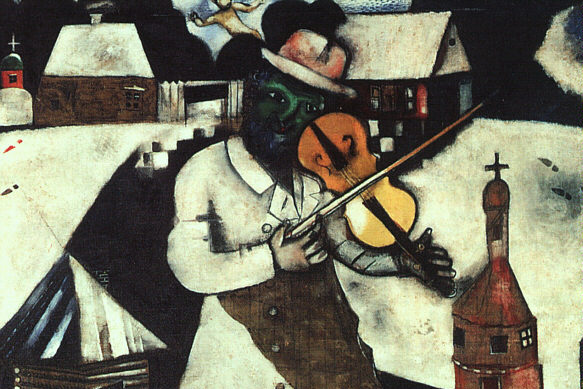
I thought of all of this as I watched this video of the song “Tradition!” from the musical Fiddler on the Roof. It was written at a time (1964) when the sweeping changes of the last 60 years were already underway. And although the song tips a hat to tradition, it ultimately ridicules it by implying that tradition is the kind of thing that keeps men in charge, women down, and forces children into unhappy arranged marriages.
At a key moment in the song, Tevye describes the tradition of the prayer shawl and says, “You may ask, ‘How did this tradition get started?’ I’ll tell you.” And then after a pause he says, “I don’t know, but it’s a tradition!” The first sign that a tradition is in trouble is forgetfulness.
The musical pretty well captures the iconoclastic attitudes emerging at the time that were cynical of tradition in a general sort of way. Despite that cynicism, Tevye rightly notes what we have come to discover only too well:
“Without our traditions our lives would be as shaky as a fiddler on the roof.”
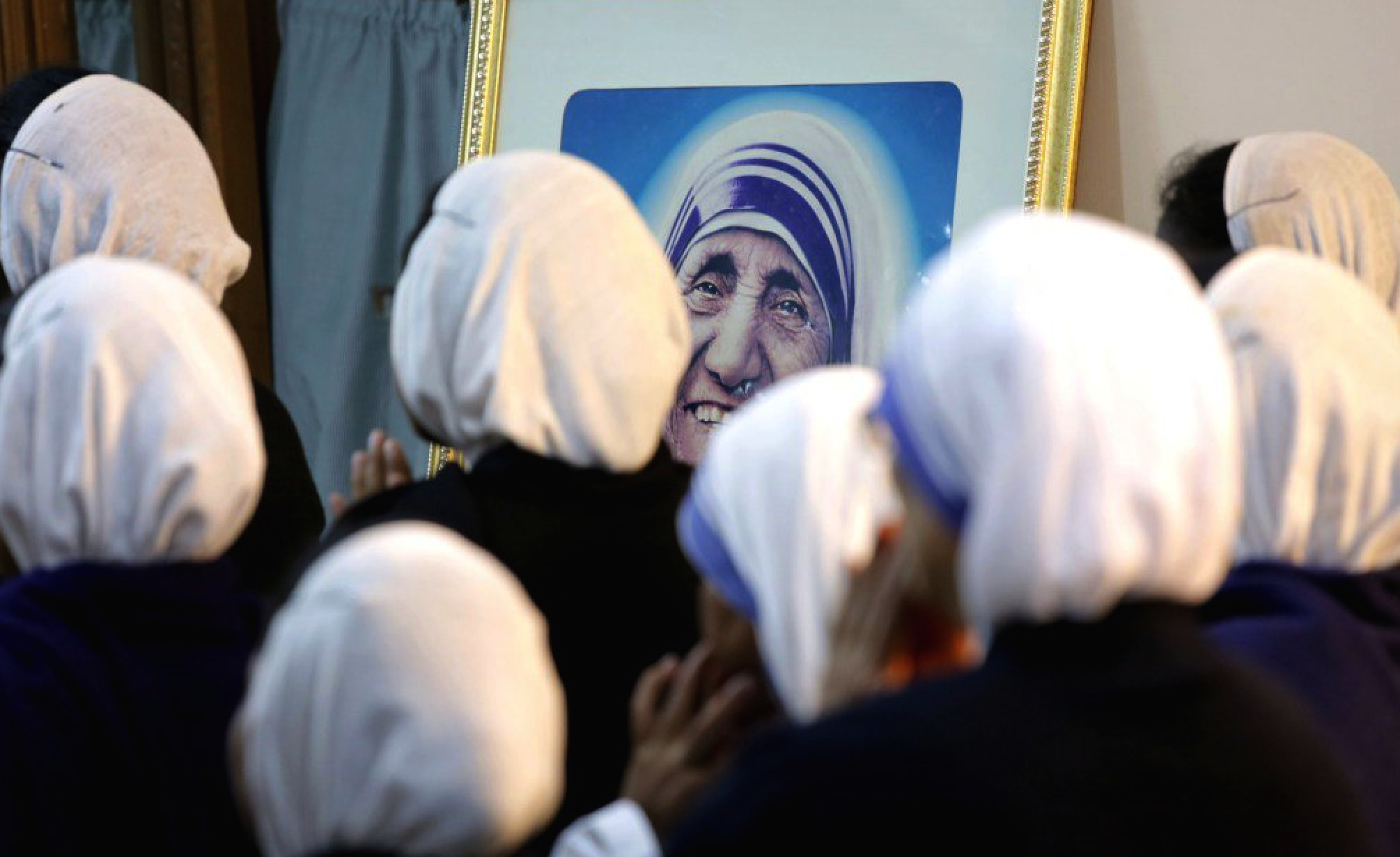
The recent martyrdom of the four Missionaries of Charity sisters in Yemen reminds us all that our Christian witness and duty may in fact lead to our death. Bless those sisters for their heroic lives, living in a hostile situation daily and giving visible witness to the presence of Christ. Here is true evangelization, the announcing of the Gospel. And while it is unlikely that most of us will be called to die for the faith, there is a kind of daily martyrdom that is expected of us and about which Christ warned us. If we are going to evangelize we must be prepared to suffer.
In today’s post, I’d like to talk about the relationship between martyrs and evangelization. The word “martyr” has two meanings, both of which are related to evangelization. On the one hand, “martyr” gets its meaning from the Greek word μάρτυς (martus), meaning “witness.” On the other hand, the current English meaning of “martyr” refers to those who suffered and died for their faith. Both concepts are essential for evangelizers (this means you).
Let’s look first at the concept of a “martyr” as one who suffers. If you’re going to evangelize you must be prepared to suffer. This goes a long way in explaining why most Christians don’t evangelize.
When I was training some people in my parish to do door-to-door evangelization and also when preparing another group to go to their own family members to summon them back to the faith, it became clear that we had to get something out of the way at the very start: we were all going to suffer for doing this. We would be rejected, scorned, ridiculed, vented at, and asked questions we couldn’t answer. But we would also have people who would be delighted to see us, interested in finding out more, and perhaps even open to the invitation to come to Mass.
I wanted to be clear at the outset; we have to expect to get it with both barrels: POW!
Are you ready to suffer? If you’re going to be a witness (from the Greek derivation of “martyr”) you have to be ready to suffer for Jesus. There are many who have gone so far as to be killed for announcing Jesus. How about us? Are we even willing to risk a raised eyebrow? How about laughter, scorn, derision, anger, rejection, or simply being dismissed or ignored?
These things are just part of the picture. In no way does receiving those reactions from others indicate that we have failed; in fact, it may mean we were successful because Christ promised such things to faithful disciples and witnesses. Further, anger and protests do not mean that a seed has not been sown. For a seed to take root, the ground must first be broken, and that is often not an easy task. The ground often “protests” and we will only get fruit by the sweat of our brow. Scripture says of such suffering,
Remember the words I spoke to you: ‘No servant is greater than his master.’ If they persecuted me, they will persecute you also. If they obeyed my teaching, they will obey yours also. They will treat you this way because of my name, for they do not know the One who sent me (John 15:20-21).
The apostles left the Sanhedrin, rejoicing because they had been counted worthy of suffering disgrace for the Name (Acts 5:41).
If you are insulted because of the name of Christ, you are blessed, for the Spirit of glory and of God rests on you. (1 Peter 4:14).
If you suffer for being a Christian, don’t feel ashamed, but praise God for being called that name (1 Peter 4:16).
We are fools for Christ’s sake (1 Cor 4:10).
God was pleased through the foolishness of what was preached to save those who believe (1 Cor 1:21).
As servants of God we commend ourselves in every way: in great endurance; in troubles, hardships and distresses; in beatings, imprisonments and riots; in hard work, sleepless nights and hunger; in purity, understanding, patience and kindness; in the Holy Spirit and in sincere love; in truthful speech and in the power of God; with weapons of righteousness in the right hand and in the left; through glory and dishonor, bad report and good report; genuine, yet regarded as impostors; known, yet regarded as unknown; dying, and yet we live on; beaten, and yet not killed; sorrowful, yet always rejoicing; poor, yet making many rich; having nothing, and yet possessing everything (2 Cor 6:4-10).
How can we read texts like these and think that we will not suffer for speaking and living our faith? Some will accept us; many will reject us. But in experiencing rejection, derision, and scorn, consider yourself in good company. Jesus, the apostles, martyrs, and saints all suffered in this way. It is not failure to be thought of in this way; it is simply the lot of the faithful. In this sense it is a sign of success. We should not go out looking for a fight or trying to make people angry. But often they will react in this way and we should expect it. Suffering is an essential part of being an evangelizer, a witness (a martyr).
Here are a few things to remember when being scorned or the object of anger:
Don’t take anger and rejection personally. In most cases, it’s not about you. Most people’s anger is really directed at Christ, at God in general, at His Church, or at organized religion. Some have been hurt by the Church or feel hurt by God. It’s not about you.
Just because someone is angry or takes offense doesn’t mean that you did anything wrong or that you gave offense. I have often thought that in a primitive part of our brain, developed in childhood, we automatically think that if someone is angry with us we must have done something wrong. This is not necessarily so. In fact, anger is sometimes a sign we have done something right! If we are faithful, we are raising issues that, though uncomfortable, are necessary to consider.
Do not give in to the temptation to retaliate. Rather, rejoice that you have been deemed worthy to suffer for Christ.
Do not be discouraged. Shake the dust from your feet and move on (cf Matt 10:14).
Remember that you are sowing seeds. You may not experience the harvest, but others may well bring it in. The fruitfulness of what you do may take years to come to harvest. Just stay faithful and keep sowing seeds.
An evangelizer is a witness and the Greek word for witness is the root of the word “martyr.” Suffering is simply part of the package.
When we understand and accept these things we are less resentful and anxious when it actually happens. Don’t lose heart. Accept the martyrdom of evangelization.
And this leads us to the second notion of the word “martyr,” that of being a witness.
A witness is someone who has seen or experienced the thing he is describing. Because he has personally seen or experienced it, he knows what he is talking about. The word “witness” carries in it the sense of “knowing.” Its etymological roots are Old English and Germanic words such as wit and wissen meaning to know something; it was also likely influenced by the German verb kennen meaning to be personally familiar with someone or something.
Combining these roots, we come to the conclusion that a witness is someone who knows the facts and truth of something personally, by firsthand knowledge. I cannot really serve as a witness in a court of law merely by stating what others said they saw. Hearsay evidence is not admissible. I have to testify to what I saw and personally know. This is what it means to be a witness.
In evangelization work, too, we are called to be witnesses. That is, we are called to speak not only what we intellectually know, or have heard others say, but also what we have personally experienced. As witnesses we are called to have firsthand knowledge, not just to repeat what others have said. It is not enough to know about the Lord, we have to personally know the Lord. Children know whether their parents are just going through the motions of teaching them a prayer, or whether they really know the Lord personally and are actually praying. Congregants know whether their priest is just giving an informational sermon or whether he has really met the Lord and knows personally of what and of Whom he speaks.
People know the difference. And frankly, what people are most hungry for is firsthand witnesses, not people who just quote the safe, well-tested words of others. What people need to hear is this:
God is real. I know this because I just talked with Him this morning and I experience His presence even now. And, in the laboratory of my own life, I have tested God’s teachings from the Scriptures and the Church have found them to be true and reliable. I am talking to you from experience. God is real and His teachings are true. I know this personally because I have experienced it in my life.
Too often, what could be evangelical moments devolve into religious debates about whether Pope so-and-so really said such-and-such back in the 8th century, or why women can’t be ordained, or why the “evil” Catholic Church conducted the Inquisition. These sorts of topics come up quickly because we talk only about issues rather than testifying from personal experience. It is much harder for a person to deny what you have experienced if you can say, “I have come to experience that God is real and that what He says through His Church is true. I have staked my whole life on what He has revealed.”
What we need are witnesses more so than experts in apologetics who can debate every point. We do need apologists, and intellectual knowledge is important, but personal witness is even more important. It’s OK to say that you don’t know the answer to some particular question, but it’s not OK to be incapable of being a witness. Even as a priest I sometimes have to say,
I don’t know the answer to that. I’ll try to find out and let you know. But Let me tell you what I do know, and that is that God is at the center of my life and I have come to experience His love for me and for every human being. I have come to experience His power to set me free from sin and every bondage, and to root me in the truth of His Word. And whatever the answer to your question is, I know it will be rooted in that.
Yes, we need martyrs for the work of evangelization, those who are willing to suffer and to be firsthand witnesses with a personal testimony to give of the Lord they have come to know by experience. You should be an evangelizer, a witness, a martyr.
Honor to the Missionaries of Charity sisters who knew Christ and died witnessing to Him!
Here is a video clip from Fr. Francis Martin in which he beautifully described the second notion of the word “martyr” (as a witness). This is part of a longer series on the Gospel of John, available here: Gospel of John Series 3A.
In yesterday’s post I discussed the overall disconnect from reality effected by nominalism and its successor movements (e.g., Cartesian, Kantian, nihilist). Increasingly we live in our heads and no longer view reality itself as a reliable indicator of what is; we claim a kind of right to determine our own individual notion of reality.
This notion is so widespread today that many don’t even recognize the logical absurdity of such utterances as “Well it may be true for you, but not for me.” Never mind little niceties like the principle of non-contradiction, which says that “A” cannot at the same time be “Not A.” Most moderns are content to claim that they live in their own silo, in their own individual world, in their own head. Increasingly, they do not recognize any debt to a reality “out there” or to their need to make rational claims easily understood by others.
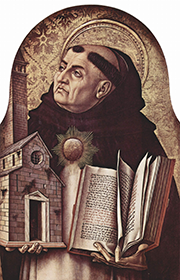
In yesterday’s post I listed the five universal natural inclinations discussed by St. Thomas in both his commentary on Aristotle’s Ethics and in various places in the Summa Theologica (e.g., I IIae qq. 6-10, I q. 5 inter al). Here they are again:
The natural inclination to what we see as good
The natural inclination to self-preservation
The natural inclination to the knowledge of the truth
The natural inclination to sexual intimacy and the rearing of offspring
The natural inclination to live in society
Today I would like to discuss just the first one and leave the others for future posts. Because the ideas of nominalism and its successor movements are lodged very deeply in the minds of many—even pew-sitting, catechism-reading Catholics—the notions on the list may seem to you to be naïve at best and dangerous at worst. Some consider this approach dangerous because it exudes a confidence in our capacity to discover and be inclined to the good and true that some fear is too vague to form the basis for a moral vision.
Because I have written extensively on our human tendency to prefer lies to truth, I pray that you, dear reader, will not accuse me of naiveté. Despite whatever sinful tendencies may cloud our natural inclination to what is good, true, and beautiful, our nature has not changed; we are still wired for the good. We must, in spite of our tendencies to darkness, never forget that we were made for the light and that somewhere under all the layers of denial and sin lies a heart and mind wired for the truth and unhappy with anything less. I might add that the very same Jesus who remarked that many prefer the darkness because their deeds are evil (Jn 3:19) also said that we who are evil know how to give good things to our children (Mat 7:11). Both of these things are collectively true of us.
So again, I would argue that although these inclinations are not lived out perfectly (they are only inclinations) they are hard to completely refute because they are so obviously present in the whole of humanity. As such they form a bridge from the illusion of radical individualism and the “right” to invent our own reality, back to a universal and common understanding of reality. If reality is merely something we “invent” (as our post-nominalist world insists), then how does one account for the existence of such universal human inclinations, which seem to demonstrate a received and common human nature and the existence of goodness and truth “out there” for which we are wired? We must continue to insist on this as a way out of radical individualism and back to a common perception of basic truth.
Let us then press on to the discussion of the first human inclination: The natural inclination to what we see as good.
The principle described and defined – No one is inclined to do what he sees as harmful to himself; we naturally pursue what we consider beneficial. Even when we make sacrifices such as hard work, fasting, or yielding to someone else’s needs, we do so for the sake of some higher goal or good.
So “the good” is not merely that which is immediately pleasurable or preferred. But neither is the good merely that to which we are bound by moral obligation, as if it were wholly separated from happiness or even opposed to it. (I’ll expound further on the morality of the good below.)
Interestingly, St. Thomas did not actually define the good. It is so primordial that it defies description. It is known only as that to which the appetite moves the will (cf 1 Ethics 1). The good is what we desire.
The principle experienced – That people act for what they see as good is a fundamental inclination shared by all. We are attracted to what we perceive will bless or augment us and are averse to things that will curse or harm us. We desire what seems good and are repelled by what seems odious or harmful.
This appetite for the good is so axiomatic that we do it almost without thinking. With very little deliberation, we are almost instantly drawn to basic and necessary goods such as food, shelter, and safety. The same is true for more spiritual things such as what we see as just, true, good, and beautiful. We also, in an almost instinctive sense, seek other perceived goods such as a sense of well-being, honor, respect, and esteem.
This movement toward what is seen as good is universal among human beings. We do well to ask from whence it comes and why it is so universal. It is more than instinct because human beings, unlike animals, will often forgo lower desires for the sake of higher ones. A person may fast for spiritual gain or to be admired for looking thinner. A young man may become a solider and enter a dangerous war in order to be thought brave; he may even forfeit his life to save his friends.
There must be something deeper here than mere physical instinct because many metaphysical goals are often more profound than merely physical ones. For the sake of uncovering new knowledge, new lands, or truth, many have risked life and limb. Some have set sail or voyaged into the very heavens in order to see what is on the other shore or in the skies above. Others have dedicated their whole being to the pursuit of truth and God Himself. This is not only to answer the physical question “What?” but also the more deeply metaphysical question “Why?”
We are intensely drawn to what we see as good. Everyone is wired this way; there are no exceptions.
We do well to ponder this universal inclination to the good (physical and metaphysical) as well as why we all agree on what is good (at least fundamentally). Indeed, beyond the merely physical desires for food, shelter, clothing, and safety (which we all agree are good things to be sought), many metaphysical goods are also universally esteemed. Everyone wants to be treated justly, to be free, to be esteemed, to be respected in basic ways, and to have access to what he sees as beautiful and good. No one wants to be hindered, robbed, treated unjustly, scorned, or mocked. As for social goods, heroism is universally esteemed over cowardice, telling the truth over lying, acting justly over exploiting, earning and sharing over stealing and destroying, honor and trustworthiness over treachery and unreliability. Self-control and personal discipline are esteemed. Personal responsibility and accountability are esteemed while irresponsibility and casting blame are not.
Indeed, writers throughout the centuries (and movies in the modern day) appeal to basic human longings for justice, intimacy, meaning, affirmation, challenge, and belonging to craft books, dramas, and books that appeal to our universal longing and inclination for these things we call “the good.”
We desire these things and are inclined to them even if we do not live them perfectly. They are wired into us in a way that is hard to deny by any truthful admission of our experience as human beings. This is our experience of the universal principle of our inclination to the good.
The principle distinguished– This does not mean that all human desires are lawful or free from evil. It does not mean that whatever we want is morally good. But neither is all that we desire purely egocentric or utterly individualistic. St. Thomas and those before him did not live in the post-nominalist world of radical individualism and thus should not be seen as affirming it at all.
Rather “the good” is what is capable of moving all human beings; it is what all human beings desire. As such, it is distinguished from merely what one or a few people desire. In a pre-nominalist world freer of radical individualism, St. Thomas and others before him could confidently point to “the good” and speak of it as that which all men esteem and can understand (by reason) as good through study, education, perception, and personal experience.
St. Thomas and the ancients were not unaware of the deep difference between real and apparent good. Despite our overall grasp of the good and what constitutes universal appreciation of the good, there are individual assessments of the good that do not coincide with and may even oppose what is truly good. Passions such as anger or lust can cloud individual decisions so that we may reach for what seems apparently good to us in the moment but is not really good for us and/or others in the long term. Such individual choices must be evaluated against better and higher goals to see why they are not only sinful and wrong but are self-defeating (because they substitute apparent good in place of what is truly good).
The principle reiterated – Despite the human tendency to misjudge the good in this way, the fundamental point remains valid: human reason and will are profoundly oriented to the truly good and beautiful; we will never be happy without that. We are wired for the truth. Whatever we do to try to suppress this (e.g., repeated bad choices, rationalizations, or surrounding ourselves with false teachers), ultimately we cannot shake our orientation toward the good, the true, and the beautiful. We are wired for it and cannot silence that small, still voice of God within us saying, “This is the way; walk in it,” whenever we would stray to the right or the left (cf Is 30:21). A thousand misapplications of pursuing the good cannot jettison our deeper desire to lay hold of what we know is truly good. We will either move toward it or else remain sad and angry trying to resist it.
Recovering this crucial insight into our natural inclination is an important milestone on our way out of the radical individualism and skepticism of our day. Because the inclination to the good is so universal it is a first countermeasure against individualism. The individualistic claim of a right to construct a reality that is true for me cannot account for the universal inclination to the good observed everywhere in the human family. Simply put, there are basic goods to which we are all inclined. And this inclination, though not perfectly lived, points inward to a received and common nature, and outward to actual goods out there that are the objects of our inclinations and desires.
I understand that this type of post is heavy reading. I will discuss the other universal inclinations in future posts, but not tomorrow. This sort of stuff is best read in smaller bites with time to digest in between courses!
N.B. I have based some of my post today on reflections made by Fr. Servais Pinckaers, O.P. in his lengthy book The Sources of Christian Ethics (pp. 401-456).
There is a rather humorous aspect of the story of the Tower of Babel in the Book of Genesis. You likely know the basic story, which begins with the men of that early time saying, Come, let us build ourselves a city, with a tower that reaches to the heavens, so that we may make a name for ourselves (Gen 11:4). The tower was an image of pride and grandiosity. The funny thing is that when the “great” tower is finally complete, with its top reaching to the skies, it’s actually so puny that God has to come down from Heaven in order to be able to see it! The text says, And the LORD came down to see the city and the tower, which the children of man had built (Gen 11:5).
Now of course God sees everything. The humor in the text is not in some primitive notion of a God who cannot. Rather, it is in the fact that man’s greatest, tallest, most prominent, most glorious work, which is seen as reaching Heaven itself, is in fact so inconsequential that God has to stoop down in order to “see” it. He has to descend to even get a glimpse of it. What ultimately does alarm God is how colossal man’s pride is. He responds by humbling us, by confusing our language and scattering us about the planet.
I recalled this story when I saw the video below. It shows wonderful footage of Earth, taken from the Space Shuttle. There is some accompanying commentary by one of the shuttle astronauts, who explains/identifies the images as they pass by. While the view is quite remarkable, what is even more remarkable is what we do not see: us!
Even though the shuttle is passing over well-populated areas, there is no visual evidence that we even exist. No cities or buildings are visible; no planes streak through the skies; even large-scale agricultural features seem lacking. There is only one mention of a color difference (across the Great Salt Lake) and that is due to a railroad bridge preventing lake circulation. The bridge itself is not visible, only its effect.
We think of ourselves as so big, so important, and so impressive. And yet even from the low Earth orbit of the shuttle, we cannot be seen. At night, our cities light the view, but during the day there is little evidence that we are even here. Even with the images magnified on my 30″ computer screen, there is no indication of our presence.
Viewing the video brought this Psalm to mind:
O Lord, our Lord, how majestic is your name in all the earth! You have set your glory above the heavens … When I consider your heavens, the work of your fingers, the moon and the stars, which you have set in place, what is man that you are mindful of him, the son of man that you care for him? Yet, You made him a little lower than the angels and crowned him with glory and honor. You made him ruler over the works of your hands; you put everything under his feet: all flocks and herds, and the beasts of the field, the birds of the air, and the fish of the sea, all that swim the paths of the seas. O Lord, our Lord, how majestic is your name in all the earth! (Psalm 8)
We are so powerful (by God’s gift) and yet at the same time so tiny as to be nearly invisible from just a short distance into space. Our mighty buildings rise, but they rise on a speck of space dust called Earth. And Earth revolves around a fiery point of light called the Sun, which is but one of more than 100 billion stars in the Milky Way galaxy. And the Milky Way galaxy, so huge to us as to be nearly unfathomable, is but one of an estimated 200 billion galaxies.
Yes, What is man that you are mindful of him …? (Psalm 8:5) Jesus says this of us: And even the very hairs of your head are all numbered (Matt 10:30). God, who numbers all the stars and calls them by name also knows the number of hairs on each of our heads. Nothing escapes Him.
There’s old preacher’s saying, “We serve a God who sits high, yet looks low!” Indeed, never forget how tiny you are. Never cease to marvel that God knit you together in your mother’s womb and sustains every fiber of your being. We cannot even be seen from a low Earth orbit, but God, who sees all, looks into each of our hearts. Always remember that although we are tiny, you and I are wonderfully, fearfully made (Psalm 139), and that He has put all things under our feet.
Most pastors and confessors are aware that in any parish there are going to be a few who are scrupulous, even in times like these. Some have a mild scrupulosity that is almost admirable. A sensitive conscience is a beautiful thing and bespeaks a kind of innocence that is rare today.
Others have a more unhealthy form of scrupulosity, rooted too much in cringing fear of a God who is seen more as a punishing adversary than a delivering Father who wants to help us to overcome our sin.
But saddest of all are the large number of people who have very little compunction for their sins. Most Catholics have lived for so long in a culture that dismisses, excuses, or even makes light of sin that they have very little notion of its seriousness. That God had to send His only Son to die in order save us from our sins shows just how serious they are; weeping for our sins is not some extreme reaction.
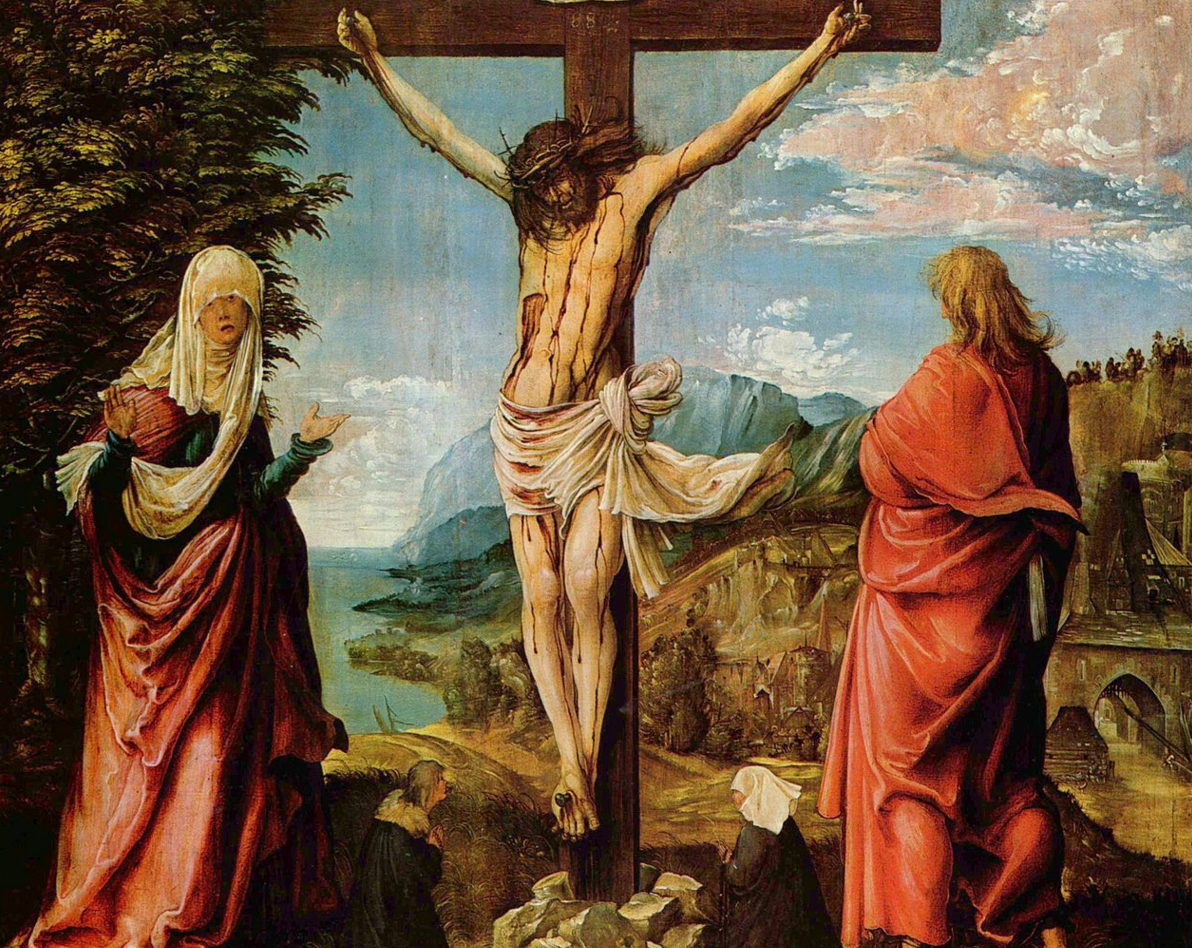
Indeed, a worthy Lenten practice is going to the foot of the Cross and allowing the Lord to anoint us, so that we see both how serious our sins are and at the same time how deep His love for us is. When we finally start to realize that the Son of God died for us, our heart breaks open, light pours in, and we can begin to weep for our sins and in gratitude for His love.
Consider that Jesus looked at a paralyzed man and, seeming not to notice his paralysis, said to him, “Courage, son, your sins are forgiven” (Mat 9:2). In a sense, He saw the man’s sins as more serious than his paralysis. Jesus also said,
I tell you that anyone who looks at a woman lustfully has already committed adultery with her in his heart. If your right eye causes you to stumble, gouge it out and throw it away. It is better for you to lose one part of your body than for your whole body to be thrown into hell. And if your right hand causes you to stumble, cut it off and throw it away. It is better for you to lose one part of your body than for your whole body to go into hell (Matt 5:28-30).
Now the Lord does not mean that we should literally gouge out our eyes or cut off appendages. What He is saying is that it is more serious to sin (in this case through lust) than to lose an eye, hand, or foot.
We don’t usually think this way but we should. Sin is much more serious than most of us imagine; in fact it is our most serious problem. It is more serious than poor physical heath or lack of money. Sin is our most serious problem and whatever is in second place isn’t even close.
In times like these, when self-esteem is overemphasized, personal responsibility is minimized, and excuses abound, we do well to ask for the gift of tears. We do well to ask for a profound and healthy grief for our sins.
More than ever, this is a gift to be sought. Note that these tears are not meant to be tears of depression, discouragement, or self-loathing. The tears to be sought here are tears of what St. Paul calls “godly sorrow.” Godly sorrow causes us to have sorrow for our sins but in such a way that it draws us to God and to great love, gratitude, and appreciation for His mercy. St. Paul writes,
Even if I caused you sorrow by my letter, I do not regret it. Though I did regret it—I see that my letter hurt you, but only for a little while—yet now I am happy, not because you were made sorry, but because your sorrow led you to repentance. For you became sorrowful as God intended and so were not harmed in any way by us. Godly sorrow brings repentance that leads to salvation and leaves no regret, but worldly sorrow brings death. See what this godly sorrow has produced in you: what earnestness, what eagerness to clear yourselves, what indignation [at sin], what alarm, what longing, what concern, what readiness to see justice done (2 Cor 7:8-11).
With all this in mind, consider that in the current (2011) Roman Missal there is a beautiful “Mass for the Forgiveness of Sins (B).” In the old Roman Missal (1962) it is called the Missa ad Petendam Compunctionem Cordis (Mass Requesting Compunction of Heart). It is known more colloquially as the “Mass for the Gift of Tears.”
Consider these beautiful prayers from the Roman Missal (both the 1962 and 2011 versions). I post here the English translation from the 2011 version:
Collect:
Almighty and most gentle God,
who brought forth from the rock
a fountain of living water for your thirsty people,
bring forth we pray,
from the hardness of our heart, tears of sorrow,
that we may lament our sins
and merit forgiveness from your mercy.
Through our Lord Jesus Christ your Son,
who lives and reigns with you
in the unity of the Holy Spirit,
one God forever and ever.
Prayer over the gifts:
Look mercifully, O Lord, upon this oblation,
which we offer to your majesty, for our sins,
and grant, we pray, that the sacrifice
from which forgiveness springs forth for the human race,
may bestow on us the grace of the Holy Spirit,
to shed tears for our offenses.
Through Christ our Lord.
Prayer after Communion:
May the reverent reception of your Sacrament O Lord,
Lead us to wash away the stains of our sins
with sighs and tears, and in your generosity
grant that the pardon we seek may have its effect on us.
Through Christ our Lord.
So beautiful, scriptural, and spiritual! Pray these prayers. Ask your priest to celebrate this votive Mass often. We need the gift of tears today.
Here is the Lacrimosa from the Mozart Requiem. The text says, “Day of tears that day when from the ashes man arises and goes to his judge. Spare O God then, O sweet Jesus, Grant them eternal rest.”
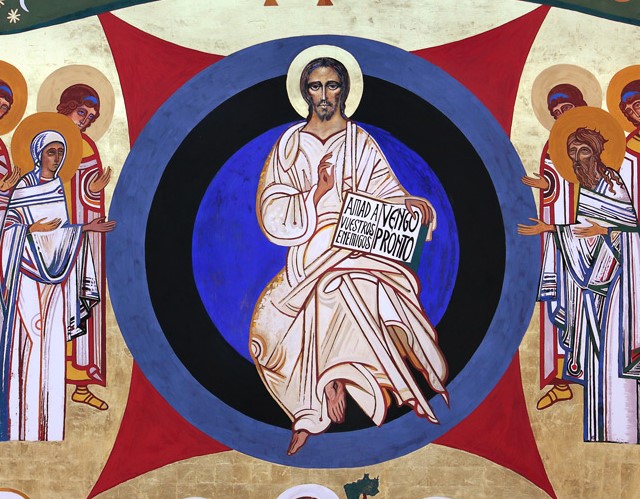
There is a specific depiction of Christ known as Christ Pantocrator. It was widespread in the ancient world and still is today. The title “Pantocrator” is most often translated into English as “The Almighty One” or “The Omnipotent One.” It comes from the Greek words παντός (pantos, meaning all) and κράτος (kratos, meaning strength, might, or power).
In the particular image at right, Christ is seated (as a sign of authority). In many of the specific images he holds a book, sometimes open and sometimes closed. If the book is open, there can be a few of many different texts displayed. In some of the images there is an interesting juxtaposition of texts meant to provoke thought and lead to both catechesis and repentance.
Among the more interesting and provocative juxtapositions of texts is the one commonly used in the Neocatechumenal communities (see above right). On the left-hand page of the open book is the Scripture passage in which Jesus says, “Love your enemies” (Matt 5:44), and on the right is the one in which Jesus says, “I am coming soon” (Rev. 22:7).
Provocative indeed, and a sober call repentance! It is hard to see how we could hope to enter Heaven with hatred or vengeful anger for our enemies in our heart. With that eating at our heart it wouldn’t be Heaven! Therefore we should consider our final end and beg for the grace to love our enemies by praying for them, working for their conversion, and supplying their basic human needs (cf Rom 12:20; Prov. 25:21). Our goal is to be at one with them in Heaven, and even here in this life if it be possible and rooted in the truth.
Jesus sets apart the love of one’s enemies as the “acid test” for Christians:
Love your enemies and pray for those who persecute you, so that you may be sons of your Father who is in heaven. For he makes his sun rise on the evil and on the good, and sends rain on the just and on the unjust. For if you love those who love you, what reward do you have? Do not even the tax collectors do the same? And if you greet only your brothers, what more are you doing than others? Do not even the Gentiles do the same? You therefore must be perfect, as your heavenly Father is perfect (Matt 5:44-48).
There’s nothing like a passage such as this one to get us on our knees asking for grace and mercy! Indeed, we will surely fail if we seek to love our enemies only through the power of our own flesh or from our fallen nature.
Jesus is coming soon and He will look for this fruit in us. All the more reason, then, to ask it of Him:
Good Jesus, who alone can save me from my hard heart, grant me the grace to love my enemies and pray for those that persecute me. I am weak and too self-centered and thin-skinned to do it on my own. I consent, good and merciful Jesus, to this work of yours in me. Accomplish this, Lord, by your grace!
In the Gospel of the Samaritan Woman from this past Sunday that was read in some parishes, Jesus gives an important teaching on sowing seeds and reaping harvests. The teaching has special importance for us who live in a modern, technological age that is so insistent on instant results. So easily we become resentful and discouraged when our efforts not yield quick fruits or when solutions take time.
We often take these attitudes with our spiritual life as well. Perhaps we think our progress is too slow. Perhaps we are frustrated because we have prayed for years for someone’s conversion and think that little or nothing has come of it. Yes, too often we fail to remember that there is a delay between the sowing of the seed and the reaping of the harvest. Indeed, there are usually many months that pass between them.
In our technological, instant-update, instant-download, Internet-infused culture we have lost the patient insight of the farmer. Thus, we do well to listen carefully to what Jesus teaches us about sowing and reaping.
This particular teaching comes after an interaction that Jesus has with a Samaritan woman at a well. Having had her desires clarified and having been called to conversion by Jesus, she has begun to experience the living waters that result from the dialogue and the journey she has made with Him. She leaves her water jar and runs to town joyfully to bring others to the Lord Jesus. Prior to this, Jesus’ disciples had gone into town to buy food. While Jesus was still speaking to the woman, though, the disciples return and are puzzled because it was quite uncommon for a Jewish man to talk to a Samaritan woman in that modest, segregated culture. After the woman leaves, the disciples say nothing of the encounter but instead urge Jesus to have something to eat. In answer to their concerns about food, Jesus speaks about the harvest, reaping and sowing, and the need to appreciate both aspects of life:
Do you not say, ‘In four months the harvest will be here’? I tell you, look up and see the fields ripe for the harvest (John 4:35).
Thus begins Jesus’ teaching on sowing and reaping. He reminds them of the delay between the sowing of the seed and the reaping of the harvest. And although Jesus is overjoyed to see the quick harvest (the Samaritans walking across the field toward Him), He is quick to remind the disciples of the delay between sowing and reaping.
Yes, Jesus is about to enjoy the harvest. But perhaps His mind also goes back to His many years preparing for ministry, living and working humbly in Nazareth. Perhaps He thinks of His forty days in the desert, or of His many difficult days walking throughout Galilee preaching, calling disciples, and naming apostles. Perhaps He also recalls the months of toil and difficulty, the misunderstandings and hostility of others, the slowness of the apostles to understand, the arduous journey to Samaria, and the long conversation with the Samaritan woman in the heat of the day.
The sowing of the seed was but the beginning. Great labor and time were required for the harvest to be realized.
But now the harvest is here, and how glorious it looks as the Samaritans in their white robes come across the field toward Him!
Jesus goes on to say,
For here the saying is verified that “One sows and another reaps.” I sent you to reap what you have not worked for; others have done the work, and you are sharing the fruits of their work (Jn 4:37-38).
This is another very important lesson about sowing and reaping. We often sow seeds that we ourselves will not be able to reap—others will. Conversely, we sometimes reap the harvests of the seeds that others have sown and tended.
As a priest, I most often walk into buildings that I did not build and minister to congregations that I did not found; others have done this work, and I am grateful for everything I harvest as a result of their hard work. In my last assignment, I built a 5.5 million dollar building for young people. No sooner was the paint dry than I was transferred. Now others are yielding the harvest in that building that I struggled to build. But praise the Lord, it is bearing fruit!
At the rectory, it is not uncommon for the doorbell to ring and for someone I do not know to ask to speak to me. Some years ago, an older man came to the rectory in just that way and told me that his wife of 47 years had recently died. She had always prayed for him to be baptized, but he had always refused. Now that she was dead, somehow he knew it was finally time for him to be baptized. He asked me to prepare him. I joyfully reaped the harvest of seeds I did not sow. His wife had sowed those seeds and watered them with her tears. She did not live to see the harvest in this world, but in fact this was the harvest she had prayed and worked for. Shortly after his baptism, the man died. And now they both enjoy the harvest.
Never give up. Harvests come, but there is time between the sowing of the seeds and the reaping of the harvest. Too many today are easily discouraged by any delay, any separation in time between the sowing and the harvesting. But we must learn to accept this delay; any harvest takes time.
Many also do not like the hard work of planting seeds. They prefer only to reap harvests. But of course life does not work that way. Scripture says, A man will only reap what he sows. Whoever sows sparingly will also reap sparingly, and whoever sows generously will also reap generously (2 Cor 9:6). Scripture also speaks of the difficulty in sowing seeds: Going they went and wept, casting their seeds. But the same verse says this of the harvest: they shall come with joyfulness, carrying their sheaves (Ps 126:6).
In this Gospel, the Lord teaches us not to be discouraged. There is some delay between the sowing of the season and the reaping of the harvest. While Jesus refers to it as a delay of four months, we all know that it is sometimes much longer. The point is that there is some delay. Indeed, we may not even live to see the fruits of some of the seeds we sow. But we must also realize that we often reap the harvests of those before us who did not live to see the fruits of the seeds they sowed.
Scripture says, And let us not be weary in well doing: for in due season we shall reap, if we faint not (Gal 6:9). Another passage says, I planted, Apollos watered, but God gave the growth.So neither he who plants nor he who waters is anything, but only God who gives the growth (1 Cor 3:6-8).
Do your work; leave the harvest to God and the one to whom He assigns it.
This section of the movie The Color Purple is an allegory of the Samaritan woman bringing the townsfolk to see Jesus:

 I am not one who is known for brevity. Despite this, I was most impressed with the brevity emphasized in the video below of a skit from the old Carol Burnett Show. In the three-and-a-half minute conversation, not a single sentence (until the punch line at the end) contains more than one word!