A Diagnosis of Sin and a Healing Remedy

sign double wayThere is a reading in daily Mass this week (Tuesday of the 7th Week of the year) in which James masterfully sets forth a fundamental aspect of our struggle against sin. He speaks of our disordered passions and double-minded ways. He assesses our problems and then offers solutions. The text from the Letter of James (James 4:1-10) is presented below in bold italics, while my commentary is shown in normal font.

I. SourceWhere do the wars and where do the conflicts among you come from? Is it not from your passions that make war within your members? You covet but do not possess. You kill and envy but you cannot obtain; you fight and wage war.

The text states simply that our problems center on our disordered passions. Notice that it is not the passions per se, but disordered passions, the passions that “wage war” within us.

Of themselves, the passions are good. Without hunger we would forget to eat or find it to be too much effort. Without anger, we would care little for justice and no longer pursue it. Without curiosity (a kind of intellectual passion) we would never ask or solve.

So the problem is the disordered passions, the passions that wage war and summon us to foolish pursuits and conquests. In the moment, our passions are over the top. The eye never has enough of seeing, nor the ear its fill of hearing (Eccl 1:8).

The text says that we covet but do not possess. Why? Because acquiring, our desire expands and we still feel empty! The promise that one can “have it all” rings hollow, because the meaning of “all” is ever expanding. It is like the mirage of water in the desert: always just ahead, always inviting us, yet never there!

And thus, as the text says, we rage. We acquire unjustly. We conquer, kill, and seize if necessary. But we will have what is “ours,” what we think we need, and even what we merely want. Collectively, we will sacrifice anything in order to acquire: family, children, health, sleep, you name it. We’ll do anything just to have a little more of something we can’t even really enjoy because we have to work so hard to get it. And then when we get it, we need something else.

When do we ever say, “It’s enough”? Greed drives many conflicts, within and without.

II. SupplyYou have not because you ask not.

God will give us what we need; He will not necessarily give us what we want. But in the end, an essential solution to our deadly greed is to ask God for what we need and be grateful for what we have.

III. SlipYou ask but do not receive, because you ask wrongly, miss to spend it on your passions. Yes even our prayers are often misdirected, spent on passing things of this world.

We don’t hesitate to ask God for money, for health, or for that promotion. But when do we ever ask for holiness, whatever it takes? When do we ask for the grace to forgive, to love our enemies, to have better-ordered priorities? Too often we don’t. But Lord, would you please do something about my arthritis?

And thus our prayers “slip” or miss the mark. We ask for worldly things and do not seek the things that matter to God. We don’t ask for what He really wants to give us.

IV. SpouseAdulterers! Do you not know that to be a lover of the world means enmity with God? Therefore, whoever wants to be a lover of the world makes himself an enemy of God. Or do you suppose it is to no purpose that the Scripture says, “He yearns jealously over the Spirit that he has made to dwell in us”? But he bestows a greater grace; therefore, it says: God resists the proud, but gives grace to the humble.

The Lord places our struggle here in personal and relational terms. Our disordered passions, our lust for this world, are a form of adultery. We prefer these other lovers to our true spouse, who is God. Adulterers!

And boldly, too, the text speaks of a jealous God, who will not so easily give up on us, who will seek to draw us back from our false lovers to His true love. He does this by repulsion and attraction. He resists the proud and seeks to break every form of pride in them, and He bestows grace on the humble.

Given the mess that we are in, given our disordered passions and wandering hearts, what are some remedies? The text presents them in two basic parts: submission and sorrow.

V. Submission So submit yourselves to God. Resist the Devil, and he will flee from you. Draw near to God, and he will draw near to you. Cleanse your hands, you sinners, and have purified your hearts, you of two minds.

In the first place, we are to submit to God and draw close to Him. To submit is to be placed under the authority of another. Thus we must let the Lord have increasing authority in our lives as we willingly hear His word and seek to heed it. Paradoxically, it is this very submission that brings us increasing freedom. For the Christian, freedom is the capacity to obey God.

To draw near to God is seek His presence with increasing affection. Prayer is a way of paying attention to God, of being aware of His presence and work in our life. As we open the door to Him, He increasingly enters our life and goes to work repairing our disordered drives.

The text also speaks of resisting the devil. Note the “re” in resist; it indicates a repetitive action. We stand against the devil not just once, but again and again; it is a lifelong battle. But note that the text says that ultimately our resistance will cause the devil to depart.

And thus by this work of God our hands are increasingly cleansed from our sinful practices and our hearts are “purified.” I put purified in quotes because here it means more than just merely clean; it means single-hearted, free of all sorts of admixtures that come from being double-minded. James says elsewhere, The double-minded man is unstable in all his ways (James 1:8). The fact is, we want too many conflicting things. This messes with our mind and further divides our heart. It is the source of a lot of our suffering and discontentedness.

God wants to heal this bad condition in us. He wants us to draw close and to submit to His authority and vision for our life.

VI. Sorrow Begin to lament, to mourn, to weep. Let your laughter be turned into mourning and your joy into dejection. Humble yourselves before the Lord and he will exalt you.

There is a place for holy sorrow over our sins. This is very different from the gnawing guilt that comes from the accuser (who is Satan) or from our flesh and pride. St. Paul speaks of godly sorrow in Corinthians:

I rejoice, not because you were grieved, but because you were grieved into repenting. For you felt a godly grief, so that you suffered no loss through us. For godly grief produces a repentance that leads to salvation without regret, whereas worldly grief produces death. For see what earnestness this godly grief has produced in you, but also what eagerness to clear yourselves, what indignation, what fear, what longing, what zeal … (2 Cor 7:9-11).

Therefore, James advises a healthy lament for our sins. He says that we should cease making light of the sinful world and taking too much joy in this present evil age. Sin should be mourned over, not laughed at or made light of.

Let us come before God humbly and let Him go to work to exalt and perfect us.

Five Images of the Holy Spirit from Scripture

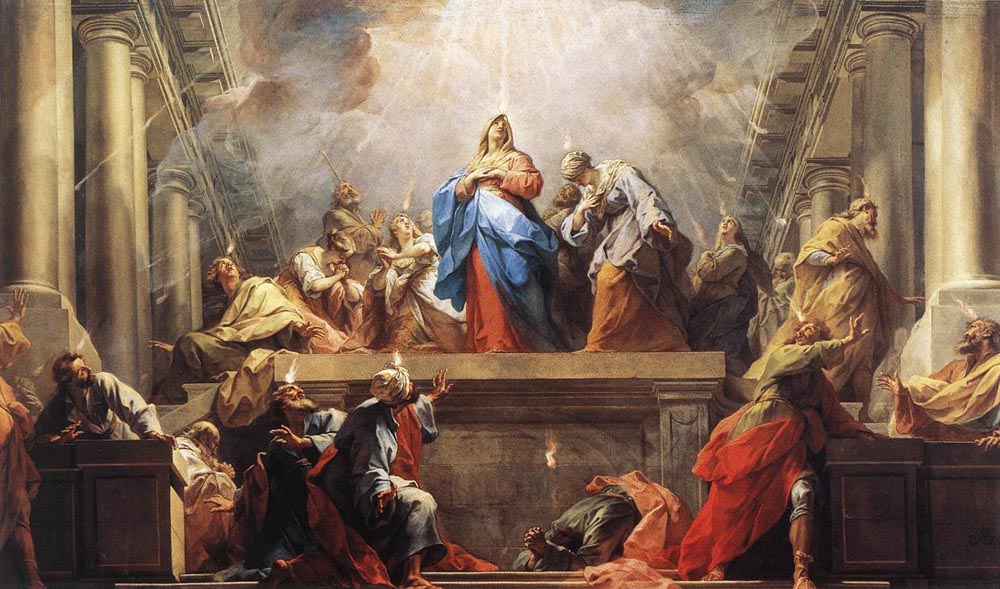
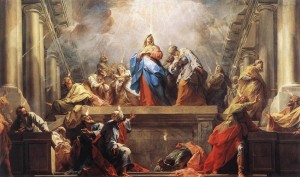
PentecostOne of the quirks of the post-conciliar liturgy is that the octave of Pentecost was dropped. Generally, the post-conciliar age has tried to emphasize the gifts and works of the Holy Spirit, so eliminating the octave of Pentecost is quite paradoxical. The Feast of Pentecost ranks right up there with Easter and the Nativity, both of which have an octave, yet the octave of Pentecost fell away. And thus on the Monday after Pentecost we are back to ordinary time and green vestments.

However, priests have the option (which I intend to exercise) of celebrating votive Masses of the Holy Spirit for every day possible from now until next Monday.

On the blog this week I hope to reflect a bit on the Holy Spirit and His role in quickening the Church and empowering her for her mission of making disciples from all the nations.

In today’s post I will consider some of the biblical images for the Holy Spirit, and in so doing, strive to learn more about what God the Holy Spirit does for us. These descriptions do not simply reduce the Holy Spirit to fire, water, or tongues. Rather, the Holy Spirit is described as being like these things, but also greater than they are.

Wind – Scripture says, When the day of Pentecost arrived, they were all together in one place. And suddenly there came from heaven a sound like a mighty rushing wind, and it filled the entire house where they were sitting (Acts 2:1).

Note that the text speaks of the Spirit as being like a mighty rushing wind. It but does not say He is a mighty rushing wind. For indeed, the Holy Spirit cannot be reduced to mere physical things, even if He is like them.

This text brings us to the very root meaning of the word “spirit.” Spirit refers to breath. This is preserved in the word “respiration,” which is the act of breathing. So, the Spirit of God is the breath of God, the Ruah Adonai (the Spirit, the breath of God).

  • Genesis 1:2 speaks of this, saying, the Spirit (ruah) of God was moving over the face of the waters.
  • Genesis 2:7 speaks even more remarkably of something that God did only for man (not the animals): then the LORD God formed man of dust from the ground, and breathed into his nostrils the breath of life; and man became a living soul.

So the very Spirit of God was breathed into Adam! But, as we know, Adam lost this gift and died spiritually when he sinned. And thus we lost the Spirit of God and died spiritually. St. Paul says plainly that we were dead in our sins (cf Col 2:13).

Thus we see in this passage from Acts an amazing and wonderful resuscitation of the human person, as these first Christians experience the rushing wind of God’s Spirit breathing spiritual life back into them. God does CPR and brings humanity, dead in sin, back to life! The Holy Spirit comes to dwell in us once again as in a temple (cf 1 Cor 3:16).

And thus this image of the rushing wind reminds us that the Holy Spirit brings us back to life and sustains us. If Christmas is the feast of God with us, and Good Friday is the Feast of God for us, then Pentecost is the Feast of God in us. The Holy Spirit, like a rushing wind, breathes life back into us.

Fire – Scripture says, And tongues, like flames of fire that were divided, appeared to them and rested on each one of them.

The Bible often speaks of God as fire, or in fiery terms:

  1. Moses saw God as a burning bush. God led the people out of Egypt through the desert as a pillar of fire. Moses went up onto a fiery Mt. Sinai where God was.
  2. Psalm 97 says, The LORD reigns; let the earth rejoice; let the many coastlands be glad! Clouds and thick darkness are round about him; righteousness and justice are the foundation of his throne. Fire goes before him, and burns up his adversaries round about. His lightnings lighten the world; the earth sees and trembles. The mountains melt like wax before the LORD, before the Lord of all the earth. The heavens proclaim his righteousness; and all the peoples behold his glory.
  3. Scriptures call God a Holy fire, a consuming fire (cf Heb 12:29) and a refining fire (cf Is. 48:10; Jer 9:7; Zec 13:9; & Mal 3:3).

And so it is that our God, who is a Holy Fire, comes to dwell in us through his Holy Spirit. And as a Holy Fire, He refines us by burning away our sins and purifying us. As Job once said, But he knows the way that I take; when he has tested me, I will come forth as gold (Job 23:10).

Fire changes everything it encounters. Nothing goes away from fire unchanged. It is consumed, converted, purified, warmed, mollified, or steeled—but nothing goes way from fire unchanged.

And thus God the Holy Spirit, like a Holy Fire, is within us. It is changing and transforming us, burning away sin, refining us, enlightening us, stirring the flame of God’s love in us, and bringing us up to the temperature of God’s glory. He is kindling a fire that gives light and warmth in our darkest and coldest moments. Little by little we become a burning furnace of God’s love and we give warmth to those around us.

As fire, God is also preparing us for judgement, for if He is a Holy Fire, then who may endure the day of His coming or of going to Him? What can endure the presence of Fire Himself? Only that which is already fire. Thus we must be set afire by God’s love.

So, in the coming of the Holy Spirit, God sets us on fire to make us a kind of fire. In so doing, He purifies us and prepares us to meet Him one day, to meet Him who is a Holy Fire.

Tongues – The Fire is described as tongues. And thus we learn that one of the chief fruits of Spirit is to help us witness to others. What is a witness? A witness is one who speaks of what he has seen, heard, and experienced.

Of this need to witness, the Lord said,

  1. You will be my witnesses in Jerusalem, and in all Judea and Samaria, and to the ends of the earth. (Acts 1:8).
  2. You are witnesses of these things. I am going to send you what my Father has promised; but stay in the city until you have been clothed with power from on high (Luke 24:48-49).
  3. When the Advocate comes, whom I will send to you from the Father—the Spirit of truth who goes out from the Father—he will testify about me. And you also must testify, for you have been with me from the beginning (John 15:26-27).

Thus the spirit comes as tongues in order to strengthen us for our mission, for witness. And, oh, how this witness is needed today! Evil has triumphed because the good have remained silent; pulpits have been silent; parents have been silent. The tongues of fire remind us that God wants bold and fiery saints who are courageous witnesses in a doubting, deceitful, scoffing world.

Many martyrs have died courageously, yet many of us are afraid that someone might merely raise an eyebrow at us. Pray for the courage of tongues, the courage to speak.

Water – Jesus often used water as an image of the Spirit:

On the last and greatest day of the festival, Jesus stood and said in a loud voice, “Let anyone who is thirsty come to me and drink. Whoever believes in me, as Scripture has said, rivers of living water will flow from within them.” By this he meant the Spirit, whom those who believed in him were later to receive. Up to that time the Spirit had not been given, since Jesus had not yet been glorified (John 7:37-39).

And in the Gospel of John, the giving over of the Holy Spirit is described powerfully even at the very moment of crucifixion:

Jesus said, “It is finished.” With that, he bowed his head and gave up his spirit. Now it was the day of Preparation, and the next day was to be a special Sabbath. Because the Jewish leaders did not want the bodies left on the crosses during the Sabbath, they asked Pilate to have the legs broken and the bodies taken down. The soldiers therefore came and broke the legs of the first man who had been crucified with Jesus, and then those of the other. But when they came to Jesus and found that he was already dead, they did not break his legs. Instead, one of the soldiers pierced Jesus’ side with a spear, bringing a sudden flow of blood and water. The man who saw it has given testimony, and his testimony is true. He knows that he tells the truth, and he testifies so that you also may believe (John 19: 30-35).

In this flow of water, the Spirit comes forth in a kind of Johannine Pentecost. It is a classic Johannine play on words that he relates that Jesus “gave over his Spirit,” a phrase that can mean that he died or that he gave us of his Holy Spirit.

The Fathers of the Church also see water as a fitting image for the Spirit.

  1. Irenaeus said, Like dry flour, which cannot become one lump of dough, one loaf of bread, without moisture, we who are many could not become one in Christ Jesus without the water that comes down from heaven. And like parched ground, which yields no harvest unless it receives moisture, we who were once like a waterless tree could never have lived and borne fruit without this abundant rainfall from above. Through the baptism that liberates us from change and decay we have become one in body; through the Spirit we have become one in soul … the devil had been cast down like lightning. If we are not to be scorched and made unfruitful, we need the dew of God (Against the Heresies Lib. 3, 17. 1-3: SC 34, 302-306).
  2. Cyril of Jerusalem said, But why did Christ call the grace of the Spirit water? Because all things are dependent on water; plants and animals have their origin in water. Water comes down from heaven as rain, and although it is always the same in itself, it produces many different effects, one in the palm tree, another in the vine, and so on throughout the whole of creation. It does not come down, now as one thing, now as another, but while remaining essentially the same, it adapts itself to the needs of every creature that receives it. In the same way the Holy Spirit, whose nature is always the same, simple and indivisible, apportions grace to each man as he wills. Like a dry tree which puts forth shoots when watered, the soul bears the fruit of holiness when repentance has made it worthy of receiving the Holy Spirit. Although the Spirit never changes, the effects of this action, by the will of God and in the name of Christ, are both many and marvelous. The Spirit makes one man a teacher of divine truth, inspires another to prophesy, gives another the power of casting out devils, enables another to interpret holy Scripture. The Spirit strengthens one man’s self-control, shows another how to help the poor, teaches another to fast and lead a life of asceticism, makes another oblivious to the needs of the body, trains another for martyrdom. His action is different in different people, but the Spirit himself is always the same. In each person, Scripture says, the Spirit reveals his presence in a particular way for the common good (Cat. 16, De Spiritu Sancto 1, 11-12.16: PG 33, 931-935. 939-942).

And thus this is another fundamental image of the Holy Spirit. For all things are dependent on water to sustain their existence as well as to activate and empower their gifts. I cannot speak more profoundly than did these two saints and Fathers, so I will let their words suffice.

Dove – We know that the Holy Spirit descended on Jesus in the form of a dove. Scripture says,

and the Holy Spirit descended on him in bodily form like a dove. And a voice came from heaven: “You are my Son, whom I love; with you I am well pleased (Luke 3:22).

Again, note the use of simile and analogy here. The Holy Spirit is not a bird or a body of any sort. Rather He is seen in bodily form like a dove. The Holy Spirit is God; He is the Third Person of the Holy Trinity.

The image of the Holy Spirit as a dove is reminiscent of the story of Noah:

After forty days Noah opened a window he had made in the ark and sent out a raven, and it kept flying back and forth until the water had dried up from the earth. Then he sent out a dove to see if the water had receded from the surface of the ground. But the dove could find nowhere to perch because there was water over all the surface of the earth; so it returned to Noah in the ark. He reached out his hand and took the dove and brought it back to himself in the ark. He waited seven more days and again sent out the dove from the ark. When the dove returned to him in the evening, there in its beak was a freshly plucked olive leaf! Then Noah knew that the water had receded from the earth (Genesis 8:6-11).

The dove announced to Noah that the bitterness and death that overwhelming sin had brought was now at an end. The dove brought Noah a sign of peace and a sign that the promise of God to cleanse the world was now fulfilled. Noah, having passed through the flood within the safety of God’s ark, may walk in newness of life.

And so, too, for us. In the Holy Spirit is peace, is shalom. The long reign of sin is ended and grace is now available to us. And we, too, having passed through the waters of baptism, may walk in newness of life. The Holy Spirit descends on us like a dove, bringing peace, promise, and every good grace.

And thus we have these five images to ponder the Holy Spirit’s work in us. Surely there are other images and other ways of describing His work, but these five speak powerfully to us for now. Please feel free to add your own reflections.


A Short Consideration of the Sequence Hymn for Pentecost

pentecost-reflectionThere are several feasts of the Church during which a “sequence” hymn may be sung. The sequence hymn is sung just before the Alleluia (Gospel Acclamation). The feasts with sequence hymns are these:

  1. Easter – Victimae Paschali Laudes (To the Paschal Victim give praise)
  2. Pentecost – Veni Sancte Spiritus (Come, Holy Spirit)
  3. Corpus Christi – Lauda Sion (Praise O Sion)
  4. Our Lady of Sorrows – Stabat Mater (Stood the Mother, sad and weeping)
  5. All Souls – Dies Irae (Day of Wrath)

Too many parishes simply omit the sequence hymn. But for my money, it ought to be sung, especially if it occurs on a Sunday. (I will admit, though, that the Lauda Sion is rather long.)

Most sequence hymns were written in the Middle ages and were sung just before the Gospel as the clergy processed to the place of Gospel. Sometimes, particularly in larger churches, the Gospel was chanted midway down the nave so that it could be heard, and these sequence hymns helped to fill up the time of that procession. Many important feasts of the Church began to have these sequence hymns composed for them during the period of the 11th through 13th centuries.

However, after the Council of Trent, in the Missal of Pius V (published in 1570), there were only four sequence: Victimae paschali laudes sung at Easter, Veni Sancte Spiritus for Pentecost, Lauda Sion Salvatorem sung at Corpus Christi, and the Dies Irae for All Souls and in Masses for the Dead. In the 1700s, Stabat Mater for the feast of Our Lady of Sorrows was added. Much later (in the early 1970s) the Dies Irae was removed from the Requiem Mass of the revised Roman Missal and restored in the Liturgy of the Hours as an Advent hymn, which it originally was. It may, however, still be sung on the Feast of All Souls.

Let’s look at the sequence hymn for Pentecost (Veni Sancte Spiritus) in a little more detail.

The hymn was likely written by Pope Innocent III (1161-1216). Written in Trachaic dimeter (catalectic), it is widely regarded as one of the masterpieces of sacred Latin poetry. It was obviously written by someone who had experienced many sorrows, but also consolation in those sorrows. The rhyme in this hymn is quite rich and complex. The first and second lines always rhyme, and the third line of every verse ends in “ium.”

The sung version of this hymn is gorgeous and soaring. It starts subtly and builds through the center with soaring notes; then it sets us down gently at the end.

My favorite verses speak of the moderation that the Spirit offers:

In labor rest,
in the heat, moderation;
in tears, solace.
 

Make flexible that which is rigid,
Warm that which is cold,
Rule that which is deviant.

Here is the Latin text along with a (fairly literal) translation of my own:

VENI, Sancte Spiritus,
et emitte caelitus
lucis tuae radium.
COME, Holy Spirit,
send forth from heaven
the rays of thy light
Veni, pater pauperum,
veni, dator munerum
veni, lumen cordium.
Come, Father of the poor,
Come, giver of gifts,
Come, light of our hearts.
Consolator optime,
dulcis hospes animae,
dulce refrigerium.
Oh best Comforter,
Sweet guest of the soul,
Sweet refreshment.
In labore requies,
in aestu temperies,
in fletu solatium.
In labor rest,
in the heat, moderation,
in tears, solace.
O lux beatissima,
reple cordis intima
tuorum fidelium.
O most blessed light,
fill the inmost heart
of thy faithful.
Sine tuo numine,
nihil est in homine,
nihil est innoxium.
Without your spirit,
nothing is in man,
nothing that is harmless
Lava quod est sordidum,
riga quod est aridum,
sana quod est saucium.
Wash that which is sordid
water that which is dry,
heal that which is wounded.
Flecte quod est rigidum,
fove quod est frigidum,
rege quod est devium.
Make flexible that which is rigid,
warm that which is cold,
rule that which is deviant.
Da tuis fidelibus,
in te confidentibus,
sacrum septenarium.
Give to thy faithful,
who trust in thee,
the sevenfold gifts.
Da virtutis meritum,
da salutis exitum,
da perenne gaudium,
Amen, Alleluia.
Grant to us the merit of virtue,
grant salvation at our going forth,
grant eternal joy.
Amen, Alleluia.

Here is the traditional Gregorian Chant of this sequence. Enjoy this little masterpiece!

And here is another version—modern, but nice:


Time Can Be Tricky, As Seen in a Humorous Commercial

timeThe video below plays humorously with the notion of time. In some ways time is something very specific (e.g., “It’s 2:09 P.M.”) while in other ways it is rather vague (e.g., “That sermon went on for hours!” or “Time flies!”)

The ancient Greeks had several words concerning time, including chronos, kairos, and aeon. Chronos refers to what we think of as “clock time,” time considered as a rather precise thing. Kairos refers to the “elasticity” of time that we sometimes experience (in which ten minutes might seem like an hour, or vice versa). Kairos also refers to the “fittingness” of a certain thing to time (e.g., the proper time to say or do something). Aeon refers to eternity, the fullness of time.

In the world of science, it would seem that chronos (precise clock time) would have pride of place. And so it does, except that even clock time has been discovered to be less precise than first thought. Time is actually somewhat elastic; it is affected by speed and gravity. As one moves at a speed closer and closer to the speed of the light, time slows to a crawl relative to its normal pace. Gravity also affects time; we would age a little more slowly in the heavy gravity of Jupiter as compared here on Earth. Tests have confirmed these insights. While we don’t currently have the ability to travel at anything approaching the speed of light speed, we do have very accurate atomic clocks. An experiment was conducted in which two planes flew around the earth, one at twice the speed of sound (Mach 2) and the other at a mere 500 miles per hour. Sure enough, the clock on the faster plane ran more slowly than the clock on the slower plane.

So time, a seemingly simple concept, is actually quite complex and mysterious. Think about all that as you watch this commercial:

Mind your Mind! A Reflection on the Battleground of the Mind

5.11.16In the Gospel for Mass yesterday (Wednesday after Ascension), the Lord said that the world would hate and persecute the disciples and He thus prayed that we would be consecrated in the truth. In the first reading, St. Paul warned the presbyters that after his departure “savage wolves” would seek to mislead the faithful. We hardly ever talk like this today, but there is a great battle for our hearts and minds. How seriously do we consider this battle?

There is also a tendency today to trivialize and reduce the human person. One of the ways we do this is by claiming that it doesn’t really matter what people think or believe; all that matters is that they behave well. For example, we think that if a man is a good citizen, pays his taxes, doesn’t beat his wife, and is kind to children and animals then it doesn’t matter what he believes. But this trivializes us, because we were made to know the one, true God. We were made to know the truth and, knowing this truth, to be set free (Jn 8:32). God’s plan for us is more than just that we behave well from some humanistic perspective. He offers each of us a complete transformation: a new mind and new heart, attained through personal knowledge and experience of Him. Now all of this will surely affect our behavior, but we must be clear that God is offering us much more than just being considered nice in the eyes of men and getting along with people.

One of the ways Scripture expresses what God is offering us at a deeper level is the appeal to the mind that so frequently occurs in the New Testament. The very first words of Jesus as He began His public ministry announced the invitation to receive a new mind. Sadly, most English translations do not adequately capture what the Greek text actually reports Jesus as saying. Most English renderings of Jesus’ opening words are “Repent and believe the Good News” (cf. Mark 1:15; Matt 3:2). The most common meaning of “to repent” is to reform one’s behavior, to do good and avoid evil, to stop sinning. But the Greek word used in the text is far richer than this. Μετανοείτε (metanoeite) most literally means “to come to a new mind.” It comes from  meta  (hard to translate perfectly into English but often indicating accompaniment, change, or movement of some sort) and nous or noieo (meaning mind or thought). Hence metanoeite means thinking differently, reconsidering, coming to a new mind. So what the Lord is more fully saying is “Come to new mind and believe in the Good News.”

Thus Jesus is not merely saying that we should clean up our act, He is inviting us to come to a new mind, which He alone can give us. If we think differently we will surely act differently. Hence metanoeite can and does include the notion of reformed behavior. But notice that this reformed behavior is the result of a new mind. If we think differently (by the new mind Christ will give us) we will start to see things more as God does. We will share His priorities, His vision. We will love what He loves. We will think more as He does. This, then, will effect a change in our behavior.

There is a famous quote (attributed to various sources) that goes, “Sow a thought, reap a deed. Sow a deed, reap a habit. Sow a habit reap a character. Sow a character, reap a destiny.” Notice how it all begins with the mind. Our mind shapes our decisions, habits, character, and ultimately our destiny.

The mind is the deepest part of the human person. It is not always possible in Scripture to perfectly distinguish between the words mind and heart. Sometimes they are used interchangeably, and at other times distinctively. But for our purposes here, the mind can be understood as quite similar to the heart in that it is at the deepest part of the human person, where thought, memory, imagination, and deliberation take place. The mind is not to be equated merely with the brain or the intellect; it is deeper and richer than these. The mind is not simply a function of the physical body, but rather involves the soul as well. The mind is where we live, think, reflect, ponder, remember, and deliberate.

Hence, in appealing to the mind, God is offering a transformation of the whole human person, for it is from within the mind and heart that all proceeds forth. Good behavior is a nice goal, but God does not trivialize us by trying to reform only our behavior. He offers us much more: to transform us.

Thus, what a person thinks and believes does matter. In these hyper-tolerant times, in which tolerance is one of the few agreed-upon virtues remaining, we like to brush aside the details. We are almost proud of ourselves for affirming that people can think and believe whatever they want as long as they behave well. Well, perhaps a person is free to think whatever he pleases, but we are foolish if we think that this does not ultimately influence behavior. Our dignity is that we were made to know the truth and thus to know Jesus Christ, who is the truth and the only way to the Father (Jn 14:6). Hence our dignity is not just an outer transformation but an inner one as well. In fact, it is an inner transformation that leads to an outer transformation.

Below are a few more Scripture passages that refer to the mind as the locus of transformation and as the main battleground where grace must win. Without a transformed, clear, sober mind we will give way to sin and bad behavior. Transformation begins with the mind. My comments on each text are in red.

  1. Do not conform any longer to the pattern of this world, but be transformed by the renewing of your mind (Rom 12:2). Note that transformation comes by the renewal of our mind.
  2. The wrath of God is being revealed from heaven against all the godlessness and wickedness of men who suppress the truth by their wickedness. … for although they knew God, they neither glorified him as God nor gave thanks to him, but their thinking became futile and their senseless minds were darkened. Although they claimed to be wise, they became fools …. Because of this, God gave them over to shameful lusts. Even their women exchanged natural relations for unnatural ones. In the same way the men also abandoned natural relations with women and were inflamed with lust for one another. Men committed indecent acts with other men, and received in themselves the due penalty for their perversion. … he gave them over to a depraved mind, to do what ought not to be done. They have become filled with every kind of wickedness, evil, greed and depravity. They are full of envy, murder, strife, deceit and malice. They are gossips, slanderers, God-haters, insolent, arrogant and boastful; they invent ways of doing evil; they disobey their parents; they are senseless, faithless, heartless, ruthless. Although they know God’s righteous decree that those who do such things deserve death, they not only continue to do these very things but also approve of those who practice them (Rom 1:18 ff selectae). Notice how a suppression of the truth leads to a depraved mind, and a depraved mind leads to depraved and shameless behavior. It begins in the mind, which is the real battleground.
  3. Those who live according to the sinful nature have their minds set on what that nature desires; but those who live in accordance with the Spirit have their minds set on what the Spirit desires (Rom 8:5). Sinful nature proceeds from a worldly mind. Those who have received the gift of the Spirit and embraced it fully have their minds set on what God desires. The remainder of Romans 8 goes on to describe the complete transformation of the human person that results from having a mind set on what God desires.
  4. The god of this age has blinded the minds of unbelievers, so that they cannot see the light of the gospel of the glory of Christ, who is the image of God (2 Cor 4:4). This text simply says that worldly thinking leads to spiritual blindness.
  5. So I tell you this, and insist on it in the Lord, that you must no longer live as the Gentiles do, in the futility of their thinking. They are darkened in their understanding and separated from the life of God because of the ignorance that is in them due to the hardening of their hearts. Having lost all sensitivity, they have given themselves over to sensuality so as to indulge in every kind of impurity, with a continual lust for more. You, however, did not come to know Christ that way … put off your old self, which is being corrupted by its deceitful desires; to be made new in the attitude of your minds; and put on the new self, created to be like God in true righteousness and holiness (Eph 4:17-24) The bad behavior of the Gentiles comes from minds that are frivolous and darkened. The new mind we receive from Christ gives us a new (transformed) self.
  6. Their destiny is destruction, their god is their stomach, and their glory is in their shame. Their mind is on earthly things (Phil 3:19). Destruction comes from a mind that is set on earthly things.
  7. This is the covenant I will make with the house of Israel after that time, declares the Lord. I will put my laws in their minds and write them on their hearts. I will be their God, and they will be my people (Heb 8:10). God wants to transform us interiorly, not merely to improve our behavior. He wants to give each of us a new mind and heart that have his law written deeply in them.
  8. The double-minded man is unstable in all his ways (James 1:8). When the mind is divided or impure, behavior is corrupted.
  9. Therefore, gird the loins of your mind; be self-controlled; set your hope fully on the grace to be given you when Jesus Christ is revealed (1 Peter 1:13). A sober and clear mind that actively seeks God’s will, leads to a self-controlled and hopeful life.
  10. The end of all things is near. Therefore, be of clear mind and self-controlled so that you can pray (1 Peter 4:7). In turbulent times, it is necessary to have a clear, sober mind so as to be able to control one’s behavior and to be serene enough to pray.

The lyrics of this song (“Caribbean Medley” or “I’ve Got My Mind Made Up,” by Donnie McClurkin) say, “I’ve got my mind made up and I won’t turn back because I want to see my Jesus someday.”

Justice and Mercy Are Alike for God

Justice and MercyI recently prepared a talk to present to a group of lawyers on the relationship between justice and mercy. The following is a summary of the basic points:

I. Distinctions – From our perspective as humans, we tend to distinguish sharply between justice and mercy.

For us, justice is the rendering to each person what is due to him or her. There is a kind of “You did it, you get it” mentality (whether praise or rebuke, reward or punishment). For us, justice is about exactness; it about what is required or due.

In contrast, mercy to us is the giving beyond what is strictly required or the withholding of due punishment. Mercy is about tempering the stricter requirements of justice.

Not only do we tend to distinguish between justice and mercy, but we also often set them in opposition to each other. Thus mercy challenges justice and asks it to lessen its demands.

In God, however, justice and mercy are alike; they are as one, simply. God has no “parts” as we do; He is utter simplicity. He is I AM.

As an illustration, think about how, even in created things, aspects that we distinguish from one another exist simply so as to be one. Consider a candle flame. We can discern many different aspects of the candle flame: its heat, its light, its color, and so forth. And while these distinctions can help us, in reality they cannot be so simply separated. I cannot wield a knife and separate these qualities so that I put the heat over here, the light over there, and the color in yet another place. In my mind I can distinguish between these different aspects, but in reality they are so together as to be one.

In God we can distinguish many traits, but in Him they are so together as to be one. Justice and mercy are like this. They are not “opposite” modes in which God acts as if He were subject to mood swings. In God, justice and mercy are not isolated or opposed; they are united as if to be one. This is true with all of God’s aspects. What we isolate, divide, and distinguish, are in God more simply united. They are one in Him, who is being itself, who describes himself simply as I AM.

Therefore, when we discuss the relationship between justice and mercy in the Church and in God, we must avoid distinctions that merely see them in opposition. We must seek to see them as rooted in God, simply, and in a way that harmonizes them.

As always, St. Thomas Aquinas is of great help in both distinguishing between and uniting justice and mercy. He reminds us that our understanding of God’s justice must always include that fact that it presupposes His mercy and is founded upon it! To those who would set justice and mercy in opposition St. Thomas says,

It is said (Psalm 24:10), “All the ways of the Lord are mercy and truth.” … Thus justice must exist in all God’s works. [But] the work of divine justice always presupposes the work of mercy; and is founded thereupon …. We may say, for instance, that to possess hands is due to man on account of his rational soul; and his rational soul is due to him that he may be man; [but] his being man is on account of the divine goodness. So, in every work of God, viewed at its primary source, there appears mercy. In all that follows, the power of mercy remains, and works indeed with even greater force; as the influence of the first cause is more intense than that of second causes … (Summa Theologica Pars Prima, q. 21 art 4).

In other words, whatever may seem due to us by God (given that He has created us and that we require certain things in order to be what we are), we ultimately confront the truth that we are not necessary beings; we are contingent beings. Our entire existence is therefore an act of pure mercy and love by God. Yes, whatever might seem due to us on account of God’s justice is ultimately founded upon an act of His grace and mercy: our very existence.

For God, therefore, justice and mercy cannot so easily be set in opposition to each other. On account of His mercy in creating us, his justice is built and it flows. Though justice and mercy are distinct in our minds, In God they exist more simply. Some of this is brought out in the Book of Psalms, where the rhyme is in the thought rather than the sound. Similar thoughts are paired together and rhyme. Consider just three examples:

  • The LORD loves righteousness and justice. His mercy fills the earth (Ps 35:5).
  • Righteousness and justice are the habitation of your throne:
    mercy and truth shall go before your face
    (Ps 89:14).
  • Hear my prayer, O LORD; give ear to my pleas for mercy! Because of your faithfulness and justice, answer me (Ps 143:1).

Notice that in God, justice and righteous rhyme with mercy and faithfulness. That is to say, they are more alike than different.

II. Definition – How, then, can we define God’s justice?

God’s justice is His fidelity to His merciful promises. This definition unites God’s justice and mercy and shows how His justice rests on His mercy and presupposes it.

As an illustration, consider one of the most fundamental promises of God in the Old Testament and see how it makes for the foundation of God’s justice and the whole of the moral law:

[O My people], I will sprinkle clean water on you, and you shall be clean from all your uncleanness, and from all your idols I will cleanse you. And I will give you a new heart, and a new spirit I will put within you. And I will remove the heart of stone from your flesh and give you a heart of flesh. And I will put my Spirit within you, and cause you to walk in my statutes and be careful to obey my statutes (Ezekiel 36:25-27).

This merciful promise of God to us should revolutionize our understanding of His law and the justice it declares. It moves law from a merely prescriptive set of requirements to a more descriptive assertion of what God will accomplish for the believer as a work of His mercy. God’s law is a description of the transformed human person. It is what become like when God mercifully cleanses us of our idols and then takes our stony hearts and gives us true, transformed hearts.

This is a very different understanding of God’s law than conceiving of it merely as a list of requirements (that we’d better do, or else). No, God’s justice is His fidelity to His merciful promises to save us from our sins, to transform us, to configure us to what is right and just, and to restore us to a right relationship with Him and one another. It is a work of God’s mercy to conform us to His justice!

III. Delineations and Difficulties – We see that God’s law is not a threatening or oppressive expression of raw justice in the detached, worldly sense. Rather, it is an expression of His merciful promise to restore us and transform us.

The law does provide metrics. The transformed human person is one thing rather than another: he is generous rather than greedy, chaste rather than impure, he loves God and neighbor, he has authority over his anger, and so forth. The law paints a picture; it is a description before it is a prescription.

True charity and mercy do not abridge or dilute the law. Mercy points to the law, it is its origin and manifestation. To dilute the law or to think that mercy merely sets it aside is a foundational error and is in fact most unmerciful.

But what about difficulties and seemingly paradoxical realities such as punishment, warnings about Hell, and suffering?

Punishment – Scripture is clear that God’s punishment is rooted in His mercy and love:

My son, do not regard lightly the discipline of the Lord, nor be weary when reproved by him. For the Lord disciplines the one he loves, and chastises every son whom he receives. It is for discipline that you have to endure. God is treating you as sons. For what son is there whom his father does not discipline? If you are left without discipline, in which all have participated, then you are illegitimate children and not sons. Besides this, we have had earthly fathers who disciplined us and we respected them. Shall we not much more be subject to the Father of spirits and live? For they disciplined us for a short time as it seemed best to them, but he disciplines us for our good, that we may share his holiness. For the moment all discipline seems painful rather than pleasant, but later it yields the peaceful fruit of righteousness to those who have been trained by it (Heb 12:5-11).

Punishment is, therefore, an aspect of mercy. The purpose of punishment is to help us to experience the lesser consequences of our sin so that we do not experience the fuller, more dire consequences. Punishment also imparts a greater a greater understanding of God’s justice and vision for us, as opposed to the false promises offered to us by this world.

For many of us today, it is difficult to see punishment as an aspect of mercy, because we tend to equate love and mercy with mere kindness or approval. It is an immature notion of love that says, “If you love me you will always be nice and kind, and you’ll let me do and be whatever I please.” God loves us too much to yield to that notion of love and mercy.

Hell – I have written much on this topic before. Briefly, Hell exists as a manifestation of God’s respect for our freedom. By a sheer act of His mercy, God created each of us and summoned us to love. But love requires a fundamental freedom that is not haphazardly abridged (or set aside altogether) by God when we make choices that reject His plan for us. Scripture indicates that many people mysteriously reject God, and they do so in ways that tend to become ever more firm over the years if they do not yield to the grace of repentance that God consistently offers. Heaven is not a designer paradise. It is the full manifestation of the truths and values of God’s Kingdom. It includes the deep love and ongoing worship of God. It fully manifests things like love of one’s neighbor (and even one’s enemy), esteem for the poor, chastity, forgiveness, and generosity. There are some people who do not esteem or want things like this; God will not force them to esteem or accept such virtues or the fruits that come from them. Hell is a place apart that some mysteriously prefer in an ever-deepening way. There comes a moment when our decision becomes final and forever fixed. Judgment and the “Depart from me!” that God utters is rooted in His respect for our freedom. This freedom is a glory He mercifully gave us and which He mercifully respects, even if it means accepting that we reject Him and the Kingdom He offers. To force Heaven on those who do not want what it clearly is, would neither be just nor merciful.

Suffering – God offered Adam and Eve the paradise of the Garden of Eden. But despite being warned of the suffering and death it would bring, they still freely chose to know and experience evil for themselves rather than trust God’s teaching. As a result of this, we now live in paradise lost. All of us have ratified their choice by our own sins. In His just respect for human freedom, God did not overrule Adam and Eve’s free choice. Instead, he mercifully works with and through the very suffering and death they/we chose as a way back. It is the way of the cross, and justice and mercy meet at the cross. Mercy and faithfulness have met; justice and peace have embraced (Psalm 85:11). In the suffering heart of Christ on the cross, we see the truest and most vivid way that justice and mercy are alike in God. While there are many mysteries related to suffering, God permits it for some greater good. In allowing suffering, God respects our freedom. Most of us know that suffering promotes growth in us, prunes our heart of often-disordered desires, and bestows on us greater wisdom than do the mere frivolities of this life.

IV. Duties – Having set forth some insights into the relationship between mercy and justice in God’s Law, I cannot in a brief reflection propose a complete legal philosophy for civil lawyers. As human beings we cannot comprehend all things or embrace them “simply,” as God does. God’s Law as revealed is perfect and eternal; our laws are imperfect and passing, as circumstances sometimes require.

And yet what is best in our human legal system does reflect God’s law, which we access by both reason and revelation. In order that our imperfect legal system may better reflect God’s perfect law, let me propose to you that as Catholic and Christian lawyers you do well to ponder (especially in this Year of Mercy) how to make it better reflect that mercy and justice are not opposed to each other, but go hand in hand.

Thus, one error to avoid is that of legalism, which idolizes the letter of the law and forgets that even its human authors conceived of it for the common good. The law is a mercy before it is a mandate. It is meant to be for man, not against him; It is meant to promote our welfare not imperil it. As such, the law must have some leeway that accounts for special circumstances and unforeseen situations. Law speaks to the general, but not to every specific. “Zero tolerance” policies should be rare; they often result in foolish, excessive outcomes.

And yet the opposite error is also to be avoided: dismissing the role of law in setting norms and ensuring an equitable playing field. Too often today, sentimentalism seeks to supplant the role of law in ensuring justice. Paradoxically, ensuring justice is actually a very merciful thing to do. It makes the world more certain and stable; it enables people to maneuver more freely and to have recourse when problems arise. The truest freedom is a limited and circumscribed one. Too much freedom is anarchy, which promotes the bondage of chaos, power struggles, and the tyranny of relativism. In its best moments of securing justice and equity, the law supplies precious mercies such as stability, recourse and redress, commonality, and protection.

If God’s Justice is His fidelity to His merciful promises, then a Catholic and Christian lawyer ought to consider if and how our legal system enshrines the merciful promises that our Constitution seeks to promote: justice, equity, equality, the common good, individual dignity, and the individual rights of every person (including life, liberty, and the pursuit of happiness).

If God’s law paints a picture of the transformed human person, then our laws should also paint a picture of the virtuous citizen, who properly provides for himself and his family and who also participates in and respects the common good.

If God’s law provides for punishment with a remedial purpose in mind (and this is mercy), then a Catholic and Christian lawyer ought to consider if our penal system does this to the appropriate degree. Incarceration and other punishments may be necessary to protect the wider citizenry (and this, too, is a mercy), but how do we assist the criminal in becoming a better and more productive citizen (thus showing mercy to him as well)?

Justice and mercy therefore are not opposed to each other; they come from the same font, which is love. Love rejoices in the truth, which the law seeks to enshrine. It is the truth that sets us free, and this is a very great mercy! Even in civil law, justice and mercy walk together and seek the same goal: liberation in the truth.

With God, justice and mercy are alike. Why not with us, too?

Sin Can Be Attractive Bait, but There’s Always a Hook

blog 5.9Satan, it would seem, does not act in an arbitrary manner when trying to tempt us. Rather, he is more a master hunter carefully setting traps, or a skilled fisherman studying behavior in order to choose the most effective bait. Satan is calculating and clever.

Sadly, most of us are far less calculating and clever in seeking to avoid temptation and sin. We often engage in the wishful thinking that no trouble will befall us. Our strategy seems to depend more on dumb luck than anything else. Would that we were as ingenious in holiness as Satan is in trying to trap us! Jesus sadly and ironically observed, For the people of this world are more shrewd in dealing with their own kind than are the people of the light (Luke 16:8).

Let us ponder for a moment the notion of the bait and the hook, to use imagery from the fishing world.

Let’s consider first the bait: It is of course the purpose of bait to be alluring, to be attractive. If a fisherman were to lower an empty hook, or a hook with a rock attached to it, no fish would come near. So he chooses a bait that appeals to the fish: an insect or some other morsel that seems to promise a meal.

Thus in choosing the bait to attach to his hook, Satan will strive to render it appealing, even beautiful. He often casts a spell to hide the ugliness of sin and to distract us from the presence of the hook.

In our time especially, Satan cloaks sins in exalted language, speaking of them as ways of giving us “freedom,” or of “fulfilling ourselves.” Abortion is not the killing of a baby; it is “reproductive choice,” or “reproductive freedom.” Many exalt sinful acts by disguising them in the language of tolerance and acceptance. Still others exude a false compassion in declaring it licit to actively kill the suffering or to terminate the lives of children in the womb who have been given a poor prenatal diagnosis.

In ways like these, evil masquerades as good. Sins once thought of as clearly awful and ugly are now presented as good and even beautiful.

Of course other more traditional bait is still used by Satan as well: sex, money, glory, power, and so forth. Not all of these things are bad in themselves, but they are presented in excess or in the wrong context. And how tasty, attractive, beautiful, and desirable they can seem!

And thus the bait is attractive, beautiful, and tasty. Scripture describes Eve’s assessment of the forbidden tree as follows: the woman saw that the fruit of the tree was good for food and pleasing to the eye, and also desirable for gaining wisdom, she took some and ate it (Genesis 3:6).

But then comes the hook—there’s always the hook with Satan. Never forget this: the hook is always there with Satan. No matter how beautiful, reasonable, or desirable the bait may seem, there’s always the hook.

With the bait of illicit sexual union dangled before us comes the hook. Perhaps it is addiction to pornography, sexually transmitted diseases, AIDS, teenage pregnancy, single motherhood, absent fathers, abortion, ruined marriages, broken families, improperly formed families, and terrible injustice to children.

With the bait of gluttony comes the hook. It can be obesity, heart disease, high cholesterol, hypertension, arthritis, addiction to alcohol or drugs, and even death.

With the bait of more and more possessions comes the hook. Perhaps it is credit card bills we cannot pay, or slavery to a lifestyle we think we cannot live without but which drives us to need two incomes and work long hours. And thus we never really know our children or even enjoy the things we think we need. Perhaps it is the supreme frustration to realize that no matter how much we have, it will never be enough. Our eyes are never really satisfied with seeing, or our ears with hearing, or our will with amassing. We seem to be insatiable; we want more and more as the hook of greed drives deeper within us, snaring our hearts so that Satan can reel us in.

But there is always the hook. Never forget that no matter how pleasing the bait may seem, there is always the hook.

We moderns are perhaps more foolish than those who came before us, for we live in a culture that is rather successful in at least temporarily hiding the consequences of many things. Our medicine and advanced technology may temporarily stave off the effects of too much food and drink or the diseases that come with sexual irresponsibility. So-called government safety nets, many of them well-intentioned and to some degree necessary, have also expanded over time to create the illusion that there are no consequences. Too easily and too repeatedly, many are bailed out from their foolish decisions. This makes is easier to maintain the illusion that the hook isn’t really there.

But the hook is there. The hook always follows the bait.

So just a simple reminder: don’t forget the hook. With the bait comes the hook. The bait is about the hook. First the bait, then the hook—always the hook.

Your Love Is Lifting Me Higher, Than I’ve Ever Been Lifted Before!

Ascension 2017I would like to develop something more concerning the Feast of the Ascension, which was celebrated on Thursday (or Sunday in some dioceses).

I wonder if many of us have pondered the great glory of this feast for humanity. For indeed, as Jesus enters into the highest heavens and into the Holy of Holies, unto the very throne of God, He goes there just as God (which He had always done) but also as man. Mystically, we, as members of His Body, go there with Him. Not even many of the angelic choirs are so close to the throne, and none of them sit at the Father’s right hand! Scripture says,

After making purification for sins, he sat down at the right hand of the Majesty on high having become as much superior to angels as the name he has inherited is more excellent than theirs. For to which of the angels did God ever say, “You are my Son, today I have begotten you”? Or again, “I will be to him a father, and he shall be to me a son”? And again, when he brings the firstborn into the world, he says, “Let all God’s angels worship him” (Heb 1:4-6).

Another passage from the Feast of the Ascension says,

Christ did not enter into a sanctuary made by hands, a copy of the true one, but heaven itself,
that he might now appear before God on our behalf….Therefore, brothers and sisters, since through the blood of Jesus we have confidence of entrance into the sanctuary by the new and living way he opened for us through the veil…and our bodies washed in pure water
(Heb 9:24-25).

Again, I wonder if many Catholics realize the astonishing reality that in Christ, and as members of His Body, we ascend to a place in Heaven so high that even many of the angels stand back in awe.

By way of explanation, let’s recall some teachings on Heaven, God, and the angels.

According to Sacred Tradition and the teaching of the Fathers, the inner life of the Trinity is not a mere static vision of the three persons for one another. The inner life of the Trinity is a movement of love. The Father loves the Son; the Son loves the Father; the Holy Spirit processes between them in this great movement, which the Greek Fathers call the divine perichoresis, a kind of dance of love.

And the angels are arranged around God in ranks or choirs, somewhat like concentric circles. They, too, take up the dance of love, passing love and revelation from God through each rank or choir out to us and all creation, and then back again. Yes, here is the great dance, the perichoresis. God’s inner love, radiating out to angels, then down through their ranks to us, and then from us back through them to God.

The nine choirs (ranks) of angels are divided into three tiers or triads, each with specific concerns.

  1. The Highest Tier: Seraphim, Cherubim, and Thrones – who concern themselves with contemplating the glory of God. It is the six-winged seraphim who sing the Sanctus, “Holy, Holy, Holy Lord, God of Hosts” (Isaiah 6:3).
  2. The Middle Tier: Dominations, Virtues, and Powers – who are known as the “angels of creation” because they concern themselves with the ordering of the cosmos and the causes of things.
  1. The Lowest Tier: Principalities, Archangels, and Angels – who concern themselves with the minute ordering of the universe and with specific causes, including the welfare of people. Each human being, each church, and each country has a Guardian Angel.

Thus the Gloria in Excelsis, sung on Christmas night, is not just a hymn of praise; it is a dance and a passing of information down through the chain of angelic choirs. The highest choirs of angels descended with the Word made Flesh, Jesus, because it is their role to surround Him with perpetual adoration. 

The Church Father Origen has those higher angels saying, “If He has put on mortal flesh, How can we remain, doing nothing!? Come Angels, let us descend from heaven!” That is why [Scripture says] there was a multitude of the heavenly Hosts praising and glorifying God when Christ was born. Everything is filled with angels (Hom in Ex. 1:7).

And so at Jesus’ birth, the Seraphim, Cherubim, and Thrones signaled to the lower angels, “This is He, who is Lord of all Creation; He who is ever to be adored and glorified.” The lower angels take up the information and cry out, “Glory to God in the highest.”

Another Church Father, Pseudo-Dionysius, says of this great heavenly hymn, The highest order composed of Seraphim, Cherubim, and Thrones, and which is closest of all, by reason of its dignity, to the secret sanctuary of God [instructs] the second order, composed of Dominations, Virtues and Powers. This order in turn reveals the mysteries to the lower tier of angels the Principalities, Archangels and Angels who are set in charge of the human hierarchies (Hier Ceol. 9,2).

And thus at Christ’s birth, the great Gloria in Excelsis resounds on the earth and in the heavens. The angels receive the good news along with us! An ancient hymn from the Liturgy of St. James says of this moment,

Rank on rank the host of heaven
spreads its vanguard on the way,
as the Light of light descendeth
from the realms of endless day,
that the powers of hell may vanish
as the shadows clear away.

Why all this music at the divine descent? Because both the music (Gloria in Excelsis) and the descent are related to another song that is meant to lead us even higher. Christ descends to one song in order to lead us to an even nobler and higher song. And this brings us to His Ascension and ours. Without this descent and this first song, the second song and our ascent are impossible. 

And what is this new song and place? Isaiah heard the music and saw the place:

I saw the Lord sitting upon a throne, high and lifted up; and his train filled the temple. Above him stood the seraphim; each had six wings: with two he covered his face, and with two he covered his feet, and with two he flew. And one called to another and said, “Holy, holy, holy is the Lord of hosts; the whole earth is full of his glory.” And the foundations of the thresholds shook at the voice of him who called, and the house was filled with smoke of incense (Isaiah 6:1-5).

Here is our new song, a higher song, one sung only in the highest heavens before the throne of God, one sung only by the redeemed: Holy, Holy, Holy Lord, God of Hosts! And thus at every Mass, Jesus our High Priest, speaking through His ministerial priest, says, “Lift up your hearts.” The congregation replies, “We have lifted them up to the Lord.” In other words, we are told to come up higher, to come into the Holy of Holies in Heaven, to come before the throne and sing the hymn of the highest in Heaven.

Our ascent to this highest place is made possible only by the Lord’s descent to the lowest places: the manger, the cross, and Sheol. In the early Church, only the baptized were permitted to sing the Sanctus at Mass. The unbaptized were not allowed to attend the later portion of Mass. The catechumens, though permitted to sing the hymn of the lower heavens (the Gloria), were dismissed prior to the singing of the Sanctus, the song of the higher heavens. Only when we are caught up higher by grace can we hear and join in the Sanctus. And one day it will be fully our song, when God, who descended, says to us, “Come up higher.” And then, by Him who descended, we will ascend and sing a new song to the Lord!

Yes, the Lord descends to one song, that we might ascend to a new song in a new place: in the highest heavens.

Do you see the glory of the Ascension? The Lord goes into the Holies of Holies, but He does not ascend alone. He takes with him multitudes (see Eph 4:8) who had awaited His coming and whom He awoke in Sheol. He preaches the Gospel to those who awaited Him: “Awake, O Sleeper, and Christ will give you light” (See Eph 5:14). As He ascends, He leads a host of those who had been captives in Sheol. And because the ascension transcends time, He also leads us there! Although we do not always experience it now, mystically, we who are faithful are already seated with Christ in glory at the Father’s right hand. For there is only one Body of Christ (Unus Christus, amans seipsum (One Christ, loving himself)) and His Father.

As He goes, the cry goes up through the ranks of heavenly angels, Lift up your heads, O gates, And be lifted up, O ancient doors, That the King of glory may come in! Who is this King of glory? The LORD of hosts, He is the King of glory (Ps 24:9-10).

Yes, here is a magnificent ascension for the Lord and for us in the Lord. For in saving us, God did not merely restore us to an earthly paradise, but to a heavenly one. Indeed, he restored us to a paradise in the highest heavens, in the Holy of holies. God’s condescension, and later ascension, leads us to a place even higher than we were before. Such a grace! So undeserved by us, yet merited by Christ! Your love, Lord, is lifting me higher, than I’ve ever been lifted before!

Ascend with the Lord!