
A Dad’s Gotta Do What a Dad’s Gotta Do

blog-5-20The video below is a bit over the top, but it still communicates a basic point that is too often absent today: a father ought to protect his daughter’s honor. I was a teen in the late 1970s, and though it was towards the end of an era, most of us young men still knew that any young lady we dated had a father to whom we were answerable for our actions. We knew that we were expected to return her to her home at a reasonable hour and that we were going to be held accountable for any transgressions, sexual or otherwise.

Frankly, it helped to remember that this young lady was someone’s daughter. And while the system wasn’t perfect, it was helpful. Accountability is always helpful.

Much has changed today. Fathers are often absent, or if not absent, at least more passive than in the past. Further, young people today marry later in life, when the influence of a father may well have decreased.

I offer simply this observation: parents (and other adults) no longer do so well by their teens and twenty-somethings. We used to offer dances so that they could meet. We used chaperone the younger ones so that imprudence did not destroy them. Yes, we used to act like parents/adults. Too often today there is little involvement either in helping young people to meet good candidates for marriage or in protecting them from their all-too-new passions, over which they need to develop mastery.

It’s time to recover the pivotal role of parents, to which this video points, even if in a comical way.


Nine Brief Examples of the Power of Metaphor

Words, while an important part of our toolset, can also get in the way of reality. But how can we live without them? On some level we must allow a deep level of language to help us in sorting out reality; words are something that help us to form a mental picture. In particular, we sometimes turn to metaphors and extended metaphors (parables, allegories, stories, etc.).

A metaphor is a figure of speech in which two different things are equated for rhetorical effect. It can be used to provide clarity to something unfamiliar by comparing it to something familiar, or to point out hidden similarities between two unlike things. The word comes from the Greek metapherein (meta (beyond) + pherein (to bear or carry)) meaning “to transfer,” or, more literally, “to carry something beyond.”

A metaphor often seeks to capture something deeper by comparing it to something that is more easily grasped. In the metaphor “All the world’s a stage,” Shakespeare takes a deep concept (the world (or life)) and frames it in the context of something more manageable (a stage). This is not to say that a stage is precisely the equivalent of the world, but rather to capture some truth about the world and highlight it for understanding.

Similarly, stories can be used to communicate what is complex or to some degree inexpressible, by relating memorable experiences that disclose truth. Good stories often convey many complex truths at once. The best stories use surprise, irony, conflict, or some combination thereof to convey truth and wisdom in a memorable way.

Stories and metaphors can expose a unity between seemingly unlike things that exists beneath the surface level. On these deeper levels, things often shift, surprise, and even amuse us. Not everything in life is as it first appears; God does not easily fit into a convenient little box. Stories and metaphors can open windows onto wider vistas and expose deeper mysteries.

With this background in mind, consider the following stories. There is a wide collection of such stories from both the Rabbinic tradition and the Desert Fathers. The saints, too, have supplied us with many. The following selections are somewhat random as I drew them from various sources. Many of them were taken from The Spirituality of Imperfection: Story Telling and the Search for Meaning. They are a rich stories of the magnificent and mysterious reality called life.

In each case, the “story” is presented in bold, black italics. I have limited myself to very brief comments, shown in plain, red text.

When the disciples of the Rabbi Baal Shem Tov asked him how to know whether a celebrated scholar whom they proposed to visit was a true wise man he answered, “Ask him to advise you what to do to keep unholy thoughts from disturbing you in your prayers and studies. If he gives you advice, then you will know that he belongs to those who are of no account.

Not all things have a solution. God sometimes allows things to happen in order test us and He asks us to live with difficulties. If there really were a solution to the problem of distraction and temptation, spiritual teachers would long ago have provided it. Therefore, those who claim some insight into this common human problem are of little account.

2. When the Rabbi Bunam was asked why the first of the Ten Commandments speaks of God bringing us out of the land of Egypt, rather than of God creating heaven and earth, the Rabbi expounded, “‘Heaven and earth!’ Then man might have said, ‘Heaven—that is too much for me.’ So God said to man, ‘Look, I am the one who fished you out of the mud. Now come over here and listen to me!’

We often relate first to earthly things and then to higher spiritual matters.

3. A woman sought out a confessor of long experience. In her confession she recounted the behaviors that troubled her. She then began to detail how these behaviors seemed somehow connected with her experience of having grown up in an alcoholic home. At that point the grizzled veteran confessor reached out and, gently patting her hand, asked: “My dear do you want forgiveness or an explanation?

Some people confuse confession and spirituality with therapy. Therapy offers explanations; confession seeks mercy and forgiveness.

4. Concepts create idols; only wonder comprehends everything. People kill one another over idols. Wonder makes us fall to our knees (St. Gregory of Nyssa).

Too often our certitude is rooted not in God or in true faith but in our own thoughts. Our thoughts can become idols and we can become ideologues. Wonder is able to bring us to our knees in humility and gratitude. Wonder opens us to all that God has done. Blind adherence to ideology can close us in on ourselves and our own limited thoughts.

5. The philosopher Diogenes was eating bread and lentils for his supper. He was seen by the philosopher Aristippus, who lived comfortably by flattering the king. Said Aristippus to Diogenes, “If you would learn to be subservient to the king, you would not have to live on lentils.” Said Diogenes in reply, “Learn to live on lentils, and you will not have to be subservient to the king.”

This is analogous to our serving of this world and our consequent slavery to it.

6. A man of piety complained to Baal Shem Tov, saying, “I have labored hard and long in the service of the Lord, and yet I am little improved. I’m still an ordinary, ignorant person.” The rabbi answered, “You have gained the realization that you are ordinary and ignorant, and this in itself is a worthy accomplishment.

Humility, reverence for the truth about ourselves, is the door.

7. One day some disciples of Abba Besarian ceased talking in embarrassment when he entered the house of study. He asked them what they were talking about. They said, “We were saying how afraid we are that the evil urge will pursue us.” “Don’t worry,” he replied, “You have not gotten high enough for it to pursue you. For the time being you are still pursuing it.

Too often we determine the cause of our problems to be the devil, when, more truly, it is our own flesh.

8. The priest put this question to a class of children: “If all the good people in the world were red, and all the bad people were green, what color would you be?” A young girl thought hard for a moment, then her face brightened, and she replied, “I’d be streaky!”

We are all a mixed bag, neither wholly good, nor wholly bad. The journey from evil to good is not yet complete. God alone is wholly good.

9. For me, prayer is a surge of the heart; it is a simple look turned toward heaven; it is a cry of recognition and of love, embracing both trial and joy (St. Therese of Lisieux).

Too often we make of prayer a complicated thing.

Please feel free to add your own insights. I hope to post more of these in the near future.

Here is a collection of sayings, most of which ring true to me, set to music:

Blessed are the Pure of Heart – A Reflection on an Often Misunderstood Beatitude and Virtue

roseThis post is a kind of follow-up to yesterday’s reflection from the Letter of James, in which we were summoned away from our double-minded ways.

One of the beatitudes taught by Jesus is often misunderstood, largely due to the popular translations of it from the Greek text: “Blessed are the pure of heart,” or “Blessed are the clean of heart.” Let’s look at three facets of the beatitude: its fundamental meaning, its focus, and the freedom it gives.

I. Fundamental Meaning – While the words “pure” and “clean” are not inauthentic translations of the Greek word καθαρός (katharos), a more literal translation is “to be without admixture, to be simply one thing.” Hence it means to be that one thing, purely and simply, with nothing else mixed in. Another helpful way of translating the Greek μακάριοι οἱ καθαροὶ τῇ καρδίᾳ (makarioi hoi katharoi te kardia) is “Blessed are the single-hearted.”

The reason I suggest that the phrase “single-hearted” is more descriptive is that in modern English the words “pure” and “clean” tend to evoke a moral sense of being free of sin, of being morally upright. And while this is surely a significant part, being single-hearted is a deeper and richer concept than simply being well-behaved, because to be well-behaved is the result of the deeper truth of being one thing, of not being duplicitous, of not having a divided heart.

II. Focus – Fr. Reginald Garrigou-Lagrange says, Simplicity is opposed not only to duplicity, but to every useless complexity, to all that is pretentious or tainted with affectation … Christ says to us “If thy eye be single thy whole body shall be lightsome” (Mat 6:22); that is, if our intention is upright and simple, our whole life be one, true and luminous, instead of being divided, like that of those who try to serve two masters … The perfect soul is thus a simplified soul … willing things only for God (Three Ages of the Interior Life, Tan Publishers, Vol 2, pp. 162-163).

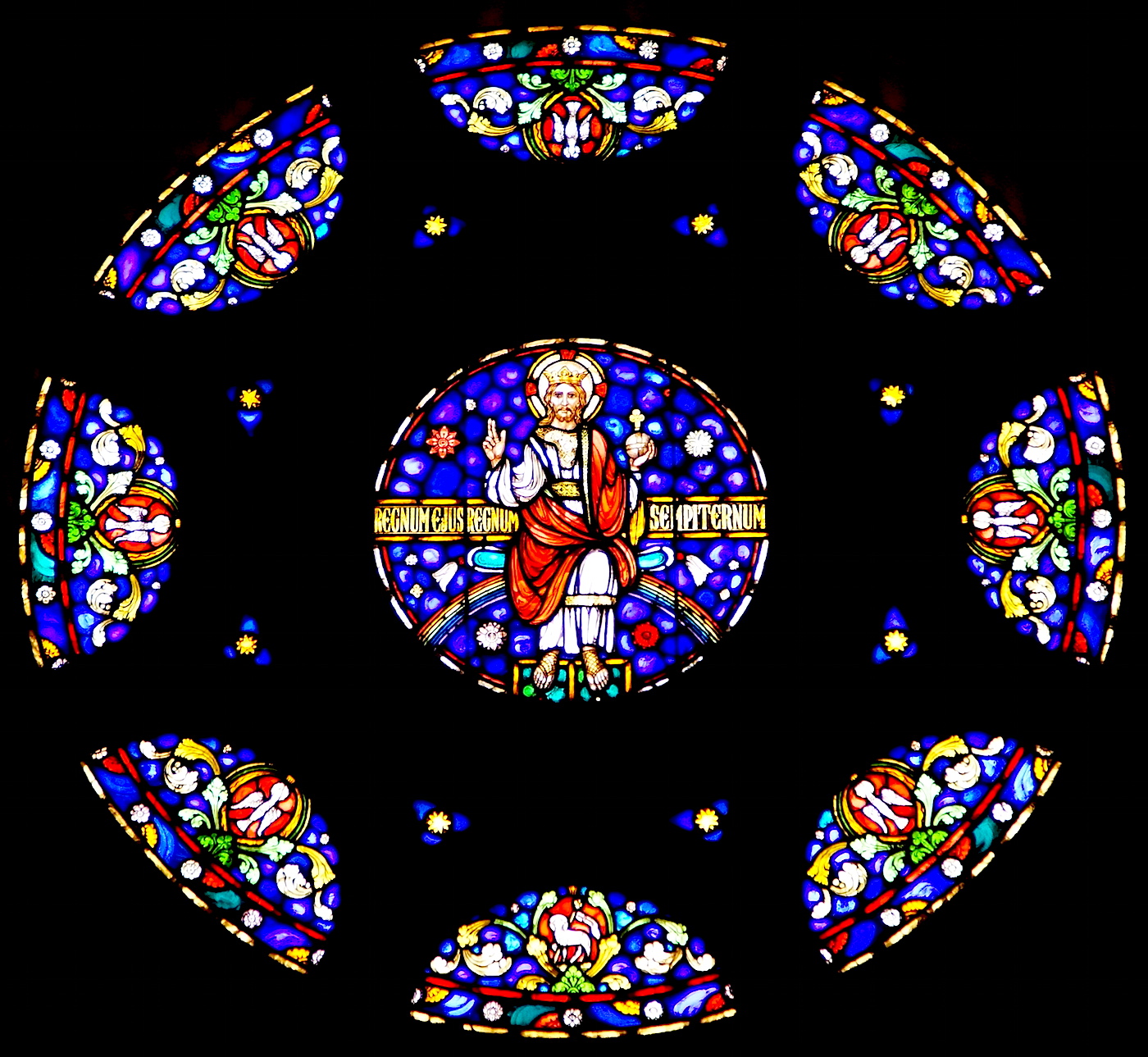
The image of the rose window in my church (see upper right), which I have used before on this blog, is a good illustration of what it means to be single-hearted. It does not deny that life has different facets, but rather shows that every facet of life is ordered around and points to Christ, is subsumed in Jesus and His heavenly kingdom along with the Father and the Spirit as the ordering principle of every other thing. And thus career, family, marriage, finances, spending priorities, use of time, where one lives, and all other imaginable aspects of life are subsumed in Christ, point to Him, and lead to the Lord and His kingdom on high.

So the single-hearted life is a well-ordered life. Each step, each decision leads in the right direction. St. Paul said, This one thing I do: forgetting what lies behind and reaching forward to what lies ahead, I press on toward the goal for the prize of the upward call of God in Christ Jesus (Philippians 3:13-14). While Paul made many journeys to many places, he was really on one journey and headed to one place. This simplified and ordered his life. He was single-hearted.

A simple life is a well-ordered, singly focused life. But duplicity introduces many complexities and disorders. Jesus says, He who does not gather with me, scatters (Luke 11:23). Unfortunately, this image of scattering or being hindered describes many Christians whose lives are not ordered on the one thing necessary, who are not single-hearted, whose hearts are not focused on the one thing they should be. Such people have lives that are often scattered, confused, disordered, and filled with a jumble of conflicting drives that hinder them from the true goal of life. The double minded man is unstable in all his ways (James 1:8).

St. Thomas Aquinas wrote that simplicity is related to the virtue of veracity, because it opposes the duplicity that James denounced (Summa Theologica IIa IIae q. 109 art. 2, the 4th). 

III. Freedom – Finally, being single-hearted, being pure of heart, not only orders our life but it also grants us freedom. In modern Western thinking, freedom is often equated with doing more rather than less. Freedom is interpreted as “being able to do anything I please.” This attitude has led to the kind of jumbled mess that much of modern life has become: a tangled web of contrary desires with little unifying direction or purpose. We tend to think of freedom in abstract terms and hence we tend to get abstract and disconnected results. 

But biblically and spiritually, freedom is the capacity or ability to do what is right, best, and proper. And thus, paradoxically, freedom often means doing less, not more.

Being single-hearted helps to focus us and to pare away a lot of the unnecessary baggage of modern life. Life gets simpler, and simplicity is a form of freedom that allows us to focus on what is important more so than on what is urgent. We discover that what often seems to be urgent is not really so necessary or urgent after all. Regarding the good options in life, St. Paul said, All things are lawful to me, but not all things are expedient (1 Cor 6:12).

Pray for the gift to become more single-hearted. More than ever in this modern age, with its myriad distractions and endless possibilities, we need to learn the lesson of the rose window and center our lives on Christ, the one thing necessary.

I have used the video below in other posts. Please pardon a brief profane word in the clip, but it does help to emphasize the point being made.

A Diagnosis of Sin and a Healing Remedy

sign double wayThere is a reading in daily Mass this week (Tuesday of the 7th Week of the year) in which James masterfully sets forth a fundamental aspect of our struggle against sin. He speaks of our disordered passions and double-minded ways. He assesses our problems and then offers solutions. The text from the Letter of James (James 4:1-10) is presented below in bold italics, while my commentary is shown in normal font.

I. SourceWhere do the wars and where do the conflicts among you come from? Is it not from your passions that make war within your members? You covet but do not possess. You kill and envy but you cannot obtain; you fight and wage war.

The text states simply that our problems center on our disordered passions. Notice that it is not the passions per se, but disordered passions, the passions that “wage war” within us.

Of themselves, the passions are good. Without hunger we would forget to eat or find it to be too much effort. Without anger, we would care little for justice and no longer pursue it. Without curiosity (a kind of intellectual passion) we would never ask or solve.

So the problem is the disordered passions, the passions that wage war and summon us to foolish pursuits and conquests. In the moment, our passions are over the top. The eye never has enough of seeing, nor the ear its fill of hearing (Eccl 1:8).

The text says that we covet but do not possess. Why? Because acquiring, our desire expands and we still feel empty! The promise that one can “have it all” rings hollow, because the meaning of “all” is ever expanding. It is like the mirage of water in the desert: always just ahead, always inviting us, yet never there!

And thus, as the text says, we rage. We acquire unjustly. We conquer, kill, and seize if necessary. But we will have what is “ours,” what we think we need, and even what we merely want. Collectively, we will sacrifice anything in order to acquire: family, children, health, sleep, you name it. We’ll do anything just to have a little more of something we can’t even really enjoy because we have to work so hard to get it. And then when we get it, we need something else.

When do we ever say, “It’s enough”? Greed drives many conflicts, within and without.

II. SupplyYou have not because you ask not.

God will give us what we need; He will not necessarily give us what we want. But in the end, an essential solution to our deadly greed is to ask God for what we need and be grateful for what we have.

III. SlipYou ask but do not receive, because you ask wrongly, miss to spend it on your passions. Yes even our prayers are often misdirected, spent on passing things of this world.

We don’t hesitate to ask God for money, for health, or for that promotion. But when do we ever ask for holiness, whatever it takes? When do we ask for the grace to forgive, to love our enemies, to have better-ordered priorities? Too often we don’t. But Lord, would you please do something about my arthritis?

And thus our prayers “slip” or miss the mark. We ask for worldly things and do not seek the things that matter to God. We don’t ask for what He really wants to give us.

IV. SpouseAdulterers! Do you not know that to be a lover of the world means enmity with God? Therefore, whoever wants to be a lover of the world makes himself an enemy of God. Or do you suppose it is to no purpose that the Scripture says, “He yearns jealously over the Spirit that he has made to dwell in us”? But he bestows a greater grace; therefore, it says: God resists the proud, but gives grace to the humble.

The Lord places our struggle here in personal and relational terms. Our disordered passions, our lust for this world, are a form of adultery. We prefer these other lovers to our true spouse, who is God. Adulterers!

And boldly, too, the text speaks of a jealous God, who will not so easily give up on us, who will seek to draw us back from our false lovers to His true love. He does this by repulsion and attraction. He resists the proud and seeks to break every form of pride in them, and He bestows grace on the humble.

Given the mess that we are in, given our disordered passions and wandering hearts, what are some remedies? The text presents them in two basic parts: submission and sorrow.

V. Submission So submit yourselves to God. Resist the Devil, and he will flee from you. Draw near to God, and he will draw near to you. Cleanse your hands, you sinners, and have purified your hearts, you of two minds.

In the first place, we are to submit to God and draw close to Him. To submit is to be placed under the authority of another. Thus we must let the Lord have increasing authority in our lives as we willingly hear His word and seek to heed it. Paradoxically, it is this very submission that brings us increasing freedom. For the Christian, freedom is the capacity to obey God.

To draw near to God is seek His presence with increasing affection. Prayer is a way of paying attention to God, of being aware of His presence and work in our life. As we open the door to Him, He increasingly enters our life and goes to work repairing our disordered drives.

The text also speaks of resisting the devil. Note the “re” in resist; it indicates a repetitive action. We stand against the devil not just once, but again and again; it is a lifelong battle. But note that the text says that ultimately our resistance will cause the devil to depart.

And thus by this work of God our hands are increasingly cleansed from our sinful practices and our hearts are “purified.” I put purified in quotes because here it means more than just merely clean; it means single-hearted, free of all sorts of admixtures that come from being double-minded. James says elsewhere, The double-minded man is unstable in all his ways (James 1:8). The fact is, we want too many conflicting things. This messes with our mind and further divides our heart. It is the source of a lot of our suffering and discontentedness.

God wants to heal this bad condition in us. He wants us to draw close and to submit to His authority and vision for our life.

VI. Sorrow Begin to lament, to mourn, to weep. Let your laughter be turned into mourning and your joy into dejection. Humble yourselves before the Lord and he will exalt you.

There is a place for holy sorrow over our sins. This is very different from the gnawing guilt that comes from the accuser (who is Satan) or from our flesh and pride. St. Paul speaks of godly sorrow in Corinthians:

I rejoice, not because you were grieved, but because you were grieved into repenting. For you felt a godly grief, so that you suffered no loss through us. For godly grief produces a repentance that leads to salvation without regret, whereas worldly grief produces death. For see what earnestness this godly grief has produced in you, but also what eagerness to clear yourselves, what indignation, what fear, what longing, what zeal … (2 Cor 7:9-11).

Therefore, James advises a healthy lament for our sins. He says that we should cease making light of the sinful world and taking too much joy in this present evil age. Sin should be mourned over, not laughed at or made light of.

Let us come before God humbly and let Him go to work to exalt and perfect us.

Five Images of the Holy Spirit from Scripture

PentecostOne of the quirks of the post-conciliar liturgy is that the octave of Pentecost was dropped. Generally, the post-conciliar age has tried to emphasize the gifts and works of the Holy Spirit, so eliminating the octave of Pentecost is quite paradoxical. The Feast of Pentecost ranks right up there with Easter and the Nativity, both of which have an octave, yet the octave of Pentecost fell away. And thus on the Monday after Pentecost we are back to ordinary time and green vestments.

However, priests have the option (which I intend to exercise) of celebrating votive Masses of the Holy Spirit for every day possible from now until next Monday.

On the blog this week I hope to reflect a bit on the Holy Spirit and His role in quickening the Church and empowering her for her mission of making disciples from all the nations.

In today’s post I will consider some of the biblical images for the Holy Spirit, and in so doing, strive to learn more about what God the Holy Spirit does for us. These descriptions do not simply reduce the Holy Spirit to fire, water, or tongues. Rather, the Holy Spirit is described as being like these things, but also greater than they are.

Wind – Scripture says, When the day of Pentecost arrived, they were all together in one place. And suddenly there came from heaven a sound like a mighty rushing wind, and it filled the entire house where they were sitting (Acts 2:1).

Note that the text speaks of the Spirit as being like a mighty rushing wind. It but does not say He is a mighty rushing wind. For indeed, the Holy Spirit cannot be reduced to mere physical things, even if He is like them.

This text brings us to the very root meaning of the word “spirit.” Spirit refers to breath. This is preserved in the word “respiration,” which is the act of breathing. So, the Spirit of God is the breath of God, the Ruah Adonai (the Spirit, the breath of God).

  • Genesis 1:2 speaks of this, saying, the Spirit (ruah) of God was moving over the face of the waters.
  • Genesis 2:7 speaks even more remarkably of something that God did only for man (not the animals): then the LORD God formed man of dust from the ground, and breathed into his nostrils the breath of life; and man became a living soul.

So the very Spirit of God was breathed into Adam! But, as we know, Adam lost this gift and died spiritually when he sinned. And thus we lost the Spirit of God and died spiritually. St. Paul says plainly that we were dead in our sins (cf Col 2:13).

Thus we see in this passage from Acts an amazing and wonderful resuscitation of the human person, as these first Christians experience the rushing wind of God’s Spirit breathing spiritual life back into them. God does CPR and brings humanity, dead in sin, back to life! The Holy Spirit comes to dwell in us once again as in a temple (cf 1 Cor 3:16).

And thus this image of the rushing wind reminds us that the Holy Spirit brings us back to life and sustains us. If Christmas is the feast of God with us, and Good Friday is the Feast of God for us, then Pentecost is the Feast of God in us. The Holy Spirit, like a rushing wind, breathes life back into us.

Fire – Scripture says, And tongues, like flames of fire that were divided, appeared to them and rested on each one of them.

The Bible often speaks of God as fire, or in fiery terms:

  1. Moses saw God as a burning bush. God led the people out of Egypt through the desert as a pillar of fire. Moses went up onto a fiery Mt. Sinai where God was.
  2. Psalm 97 says, The LORD reigns; let the earth rejoice; let the many coastlands be glad! Clouds and thick darkness are round about him; righteousness and justice are the foundation of his throne. Fire goes before him, and burns up his adversaries round about. His lightnings lighten the world; the earth sees and trembles. The mountains melt like wax before the LORD, before the Lord of all the earth. The heavens proclaim his righteousness; and all the peoples behold his glory.
  3. Scriptures call God a Holy fire, a consuming fire (cf Heb 12:29) and a refining fire (cf Is. 48:10; Jer 9:7; Zec 13:9; & Mal 3:3).

And so it is that our God, who is a Holy Fire, comes to dwell in us through his Holy Spirit. And as a Holy Fire, He refines us by burning away our sins and purifying us. As Job once said, But he knows the way that I take; when he has tested me, I will come forth as gold (Job 23:10).

Fire changes everything it encounters. Nothing goes away from fire unchanged. It is consumed, converted, purified, warmed, mollified, or steeled—but nothing goes way from fire unchanged.

And thus God the Holy Spirit, like a Holy Fire, is within us. It is changing and transforming us, burning away sin, refining us, enlightening us, stirring the flame of God’s love in us, and bringing us up to the temperature of God’s glory. He is kindling a fire that gives light and warmth in our darkest and coldest moments. Little by little we become a burning furnace of God’s love and we give warmth to those around us.

As fire, God is also preparing us for judgement, for if He is a Holy Fire, then who may endure the day of His coming or of going to Him? What can endure the presence of Fire Himself? Only that which is already fire. Thus we must be set afire by God’s love.

So, in the coming of the Holy Spirit, God sets us on fire to make us a kind of fire. In so doing, He purifies us and prepares us to meet Him one day, to meet Him who is a Holy Fire.

Tongues – The Fire is described as tongues. And thus we learn that one of the chief fruits of Spirit is to help us witness to others. What is a witness? A witness is one who speaks of what he has seen, heard, and experienced.

Of this need to witness, the Lord said,

  1. You will be my witnesses in Jerusalem, and in all Judea and Samaria, and to the ends of the earth. (Acts 1:8).
  2. You are witnesses of these things. I am going to send you what my Father has promised; but stay in the city until you have been clothed with power from on high (Luke 24:48-49).
  3. When the Advocate comes, whom I will send to you from the Father—the Spirit of truth who goes out from the Father—he will testify about me. And you also must testify, for you have been with me from the beginning (John 15:26-27).

Thus the spirit comes as tongues in order to strengthen us for our mission, for witness. And, oh, how this witness is needed today! Evil has triumphed because the good have remained silent; pulpits have been silent; parents have been silent. The tongues of fire remind us that God wants bold and fiery saints who are courageous witnesses in a doubting, deceitful, scoffing world.

Many martyrs have died courageously, yet many of us are afraid that someone might merely raise an eyebrow at us. Pray for the courage of tongues, the courage to speak.

Water – Jesus often used water as an image of the Spirit:

On the last and greatest day of the festival, Jesus stood and said in a loud voice, “Let anyone who is thirsty come to me and drink. Whoever believes in me, as Scripture has said, rivers of living water will flow from within them.” By this he meant the Spirit, whom those who believed in him were later to receive. Up to that time the Spirit had not been given, since Jesus had not yet been glorified (John 7:37-39).

And in the Gospel of John, the giving over of the Holy Spirit is described powerfully even at the very moment of crucifixion:

Jesus said, “It is finished.” With that, he bowed his head and gave up his spirit. Now it was the day of Preparation, and the next day was to be a special Sabbath. Because the Jewish leaders did not want the bodies left on the crosses during the Sabbath, they asked Pilate to have the legs broken and the bodies taken down. The soldiers therefore came and broke the legs of the first man who had been crucified with Jesus, and then those of the other. But when they came to Jesus and found that he was already dead, they did not break his legs. Instead, one of the soldiers pierced Jesus’ side with a spear, bringing a sudden flow of blood and water. The man who saw it has given testimony, and his testimony is true. He knows that he tells the truth, and he testifies so that you also may believe (John 19: 30-35).

In this flow of water, the Spirit comes forth in a kind of Johannine Pentecost. It is a classic Johannine play on words that he relates that Jesus “gave over his Spirit,” a phrase that can mean that he died or that he gave us of his Holy Spirit.

The Fathers of the Church also see water as a fitting image for the Spirit.

  1. Irenaeus said, Like dry flour, which cannot become one lump of dough, one loaf of bread, without moisture, we who are many could not become one in Christ Jesus without the water that comes down from heaven. And like parched ground, which yields no harvest unless it receives moisture, we who were once like a waterless tree could never have lived and borne fruit without this abundant rainfall from above. Through the baptism that liberates us from change and decay we have become one in body; through the Spirit we have become one in soul … the devil had been cast down like lightning. If we are not to be scorched and made unfruitful, we need the dew of God (Against the Heresies Lib. 3, 17. 1-3: SC 34, 302-306).
  2. Cyril of Jerusalem said, But why did Christ call the grace of the Spirit water? Because all things are dependent on water; plants and animals have their origin in water. Water comes down from heaven as rain, and although it is always the same in itself, it produces many different effects, one in the palm tree, another in the vine, and so on throughout the whole of creation. It does not come down, now as one thing, now as another, but while remaining essentially the same, it adapts itself to the needs of every creature that receives it. In the same way the Holy Spirit, whose nature is always the same, simple and indivisible, apportions grace to each man as he wills. Like a dry tree which puts forth shoots when watered, the soul bears the fruit of holiness when repentance has made it worthy of receiving the Holy Spirit. Although the Spirit never changes, the effects of this action, by the will of God and in the name of Christ, are both many and marvelous. The Spirit makes one man a teacher of divine truth, inspires another to prophesy, gives another the power of casting out devils, enables another to interpret holy Scripture. The Spirit strengthens one man’s self-control, shows another how to help the poor, teaches another to fast and lead a life of asceticism, makes another oblivious to the needs of the body, trains another for martyrdom. His action is different in different people, but the Spirit himself is always the same. In each person, Scripture says, the Spirit reveals his presence in a particular way for the common good (Cat. 16, De Spiritu Sancto 1, 11-12.16: PG 33, 931-935. 939-942).

And thus this is another fundamental image of the Holy Spirit. For all things are dependent on water to sustain their existence as well as to activate and empower their gifts. I cannot speak more profoundly than did these two saints and Fathers, so I will let their words suffice.

Dove – We know that the Holy Spirit descended on Jesus in the form of a dove. Scripture says,

and the Holy Spirit descended on him in bodily form like a dove. And a voice came from heaven: “You are my Son, whom I love; with you I am well pleased (Luke 3:22).

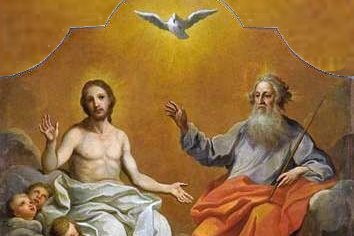
Again, note the use of simile and analogy here. The Holy Spirit is not a bird or a body of any sort. Rather He is seen in bodily form like a dove. The Holy Spirit is God; He is the Third Person of the Holy Trinity.

The image of the Holy Spirit as a dove is reminiscent of the story of Noah:

After forty days Noah opened a window he had made in the ark and sent out a raven, and it kept flying back and forth until the water had dried up from the earth. Then he sent out a dove to see if the water had receded from the surface of the ground. But the dove could find nowhere to perch because there was water over all the surface of the earth; so it returned to Noah in the ark. He reached out his hand and took the dove and brought it back to himself in the ark. He waited seven more days and again sent out the dove from the ark. When the dove returned to him in the evening, there in its beak was a freshly plucked olive leaf! Then Noah knew that the water had receded from the earth (Genesis 8:6-11).

The dove announced to Noah that the bitterness and death that overwhelming sin had brought was now at an end. The dove brought Noah a sign of peace and a sign that the promise of God to cleanse the world was now fulfilled. Noah, having passed through the flood within the safety of God’s ark, may walk in newness of life.

And so, too, for us. In the Holy Spirit is peace, is shalom. The long reign of sin is ended and grace is now available to us. And we, too, having passed through the waters of baptism, may walk in newness of life. The Holy Spirit descends on us like a dove, bringing peace, promise, and every good grace.

And thus we have these five images to ponder the Holy Spirit’s work in us. Surely there are other images and other ways of describing His work, but these five speak powerfully to us for now. Please feel free to add your own reflections.

A Short Consideration of the Sequence Hymn for Pentecost

pentecost-reflectionThere are several feasts of the Church during which a “sequence” hymn may be sung. The sequence hymn is sung just before the Alleluia (Gospel Acclamation). The feasts with sequence hymns are these:

  1. Easter – Victimae Paschali Laudes (To the Paschal Victim give praise)
  2. Pentecost – Veni Sancte Spiritus (Come, Holy Spirit)
  3. Corpus Christi – Lauda Sion (Praise O Sion)
  4. Our Lady of Sorrows – Stabat Mater (Stood the Mother, sad and weeping)
  5. All Souls – Dies Irae (Day of Wrath)

Too many parishes simply omit the sequence hymn. But for my money, it ought to be sung, especially if it occurs on a Sunday. (I will admit, though, that the Lauda Sion is rather long.)

Most sequence hymns were written in the Middle ages and were sung just before the Gospel as the clergy processed to the place of Gospel. Sometimes, particularly in larger churches, the Gospel was chanted midway down the nave so that it could be heard, and these sequence hymns helped to fill up the time of that procession. Many important feasts of the Church began to have these sequence hymns composed for them during the period of the 11th through 13th centuries.

However, after the Council of Trent, in the Missal of Pius V (published in 1570), there were only four sequence: Victimae paschali laudes sung at Easter, Veni Sancte Spiritus for Pentecost, Lauda Sion Salvatorem sung at Corpus Christi, and the Dies Irae for All Souls and in Masses for the Dead. In the 1700s, Stabat Mater for the feast of Our Lady of Sorrows was added. Much later (in the early 1970s) the Dies Irae was removed from the Requiem Mass of the revised Roman Missal and restored in the Liturgy of the Hours as an Advent hymn, which it originally was. It may, however, still be sung on the Feast of All Souls.

Let’s look at the sequence hymn for Pentecost (Veni Sancte Spiritus) in a little more detail.

The hymn was likely written by Pope Innocent III (1161-1216). Written in Trachaic dimeter (catalectic), it is widely regarded as one of the masterpieces of sacred Latin poetry. It was obviously written by someone who had experienced many sorrows, but also consolation in those sorrows. The rhyme in this hymn is quite rich and complex. The first and second lines always rhyme, and the third line of every verse ends in “ium.”

The sung version of this hymn is gorgeous and soaring. It starts subtly and builds through the center with soaring notes; then it sets us down gently at the end.

My favorite verses speak of the moderation that the Spirit offers:

In labor rest,
in the heat, moderation;
in tears, solace.
 

Make flexible that which is rigid,
Warm that which is cold,
Rule that which is deviant.

Here is the Latin text along with a (fairly literal) translation of my own:

VENI, Sancte Spiritus,
et emitte caelitus
lucis tuae radium.
COME, Holy Spirit,
send forth from heaven
the rays of thy light
Veni, pater pauperum,
veni, dator munerum
veni, lumen cordium.
Come, Father of the poor,
Come, giver of gifts,
Come, light of our hearts.
Consolator optime,
dulcis hospes animae,
dulce refrigerium.
Oh best Comforter,
Sweet guest of the soul,
Sweet refreshment.
In labore requies,
in aestu temperies,
in fletu solatium.
In labor rest,
in the heat, moderation,
in tears, solace.
O lux beatissima,
reple cordis intima
tuorum fidelium.
O most blessed light,
fill the inmost heart
of thy faithful.
Sine tuo numine,
nihil est in homine,
nihil est innoxium.
Without your spirit,
nothing is in man,
nothing that is harmless
Lava quod est sordidum,
riga quod est aridum,
sana quod est saucium.
Wash that which is sordid
water that which is dry,
heal that which is wounded.
Flecte quod est rigidum,
fove quod est frigidum,
rege quod est devium.
Make flexible that which is rigid,
warm that which is cold,
rule that which is deviant.
Da tuis fidelibus,
in te confidentibus,
sacrum septenarium.
Give to thy faithful,
who trust in thee,
the sevenfold gifts.
Da virtutis meritum,
da salutis exitum,
da perenne gaudium,
Amen, Alleluia.
Grant to us the merit of virtue,
grant salvation at our going forth,
grant eternal joy.
Amen, Alleluia.

Here is the traditional Gregorian Chant of this sequence. Enjoy this little masterpiece!

And here is another version—modern, but nice:


Time Can Be Tricky, As Seen in a Humorous Commercial

timeThe video below plays humorously with the notion of time. In some ways time is something very specific (e.g., “It’s 2:09 P.M.”) while in other ways it is rather vague (e.g., “That sermon went on for hours!” or “Time flies!”)

The ancient Greeks had several words concerning time, including chronos, kairos, and aeon. Chronos refers to what we think of as “clock time,” time considered as a rather precise thing. Kairos refers to the “elasticity” of time that we sometimes experience (in which ten minutes might seem like an hour, or vice versa). Kairos also refers to the “fittingness” of a certain thing to time (e.g., the proper time to say or do something). Aeon refers to eternity, the fullness of time.

In the world of science, it would seem that chronos (precise clock time) would have pride of place. And so it does, except that even clock time has been discovered to be less precise than first thought. Time is actually somewhat elastic; it is affected by speed and gravity. As one moves at a speed closer and closer to the speed of the light, time slows to a crawl relative to its normal pace. Gravity also affects time; we would age a little more slowly in the heavy gravity of Jupiter as compared here on Earth. Tests have confirmed these insights. While we don’t currently have the ability to travel at anything approaching the speed of light speed, we do have very accurate atomic clocks. An experiment was conducted in which two planes flew around the earth, one at twice the speed of sound (Mach 2) and the other at a mere 500 miles per hour. Sure enough, the clock on the faster plane ran more slowly than the clock on the slower plane.

So time, a seemingly simple concept, is actually quite complex and mysterious. Think about all that as you watch this commercial:

Mind your Mind! A Reflection on the Battleground of the Mind

5.11.16In the Gospel for Mass yesterday (Wednesday after Ascension), the Lord said that the world would hate and persecute the disciples and He thus prayed that we would be consecrated in the truth. In the first reading, St. Paul warned the presbyters that after his departure “savage wolves” would seek to mislead the faithful. We hardly ever talk like this today, but there is a great battle for our hearts and minds. How seriously do we consider this battle?

There is also a tendency today to trivialize and reduce the human person. One of the ways we do this is by claiming that it doesn’t really matter what people think or believe; all that matters is that they behave well. For example, we think that if a man is a good citizen, pays his taxes, doesn’t beat his wife, and is kind to children and animals then it doesn’t matter what he believes. But this trivializes us, because we were made to know the one, true God. We were made to know the truth and, knowing this truth, to be set free (Jn 8:32). God’s plan for us is more than just that we behave well from some humanistic perspective. He offers each of us a complete transformation: a new mind and new heart, attained through personal knowledge and experience of Him. Now all of this will surely affect our behavior, but we must be clear that God is offering us much more than just being considered nice in the eyes of men and getting along with people.

One of the ways Scripture expresses what God is offering us at a deeper level is the appeal to the mind that so frequently occurs in the New Testament. The very first words of Jesus as He began His public ministry announced the invitation to receive a new mind. Sadly, most English translations do not adequately capture what the Greek text actually reports Jesus as saying. Most English renderings of Jesus’ opening words are “Repent and believe the Good News” (cf. Mark 1:15; Matt 3:2). The most common meaning of “to repent” is to reform one’s behavior, to do good and avoid evil, to stop sinning. But the Greek word used in the text is far richer than this. Μετανοείτε (metanoeite) most literally means “to come to a new mind.” It comes from  meta  (hard to translate perfectly into English but often indicating accompaniment, change, or movement of some sort) and nous or noieo (meaning mind or thought). Hence metanoeite means thinking differently, reconsidering, coming to a new mind. So what the Lord is more fully saying is “Come to new mind and believe in the Good News.”

Thus Jesus is not merely saying that we should clean up our act, He is inviting us to come to a new mind, which He alone can give us. If we think differently we will surely act differently. Hence metanoeite can and does include the notion of reformed behavior. But notice that this reformed behavior is the result of a new mind. If we think differently (by the new mind Christ will give us) we will start to see things more as God does. We will share His priorities, His vision. We will love what He loves. We will think more as He does. This, then, will effect a change in our behavior.

There is a famous quote (attributed to various sources) that goes, “Sow a thought, reap a deed. Sow a deed, reap a habit. Sow a habit reap a character. Sow a character, reap a destiny.” Notice how it all begins with the mind. Our mind shapes our decisions, habits, character, and ultimately our destiny.

The mind is the deepest part of the human person. It is not always possible in Scripture to perfectly distinguish between the words mind and heart. Sometimes they are used interchangeably, and at other times distinctively. But for our purposes here, the mind can be understood as quite similar to the heart in that it is at the deepest part of the human person, where thought, memory, imagination, and deliberation take place. The mind is not to be equated merely with the brain or the intellect; it is deeper and richer than these. The mind is not simply a function of the physical body, but rather involves the soul as well. The mind is where we live, think, reflect, ponder, remember, and deliberate.

Hence, in appealing to the mind, God is offering a transformation of the whole human person, for it is from within the mind and heart that all proceeds forth. Good behavior is a nice goal, but God does not trivialize us by trying to reform only our behavior. He offers us much more: to transform us.

Thus, what a person thinks and believes does matter. In these hyper-tolerant times, in which tolerance is one of the few agreed-upon virtues remaining, we like to brush aside the details. We are almost proud of ourselves for affirming that people can think and believe whatever they want as long as they behave well. Well, perhaps a person is free to think whatever he pleases, but we are foolish if we think that this does not ultimately influence behavior. Our dignity is that we were made to know the truth and thus to know Jesus Christ, who is the truth and the only way to the Father (Jn 14:6). Hence our dignity is not just an outer transformation but an inner one as well. In fact, it is an inner transformation that leads to an outer transformation.

Below are a few more Scripture passages that refer to the mind as the locus of transformation and as the main battleground where grace must win. Without a transformed, clear, sober mind we will give way to sin and bad behavior. Transformation begins with the mind. My comments on each text are in red.

  1. Do not conform any longer to the pattern of this world, but be transformed by the renewing of your mind (Rom 12:2). Note that transformation comes by the renewal of our mind.
  2. The wrath of God is being revealed from heaven against all the godlessness and wickedness of men who suppress the truth by their wickedness. … for although they knew God, they neither glorified him as God nor gave thanks to him, but their thinking became futile and their senseless minds were darkened. Although they claimed to be wise, they became fools …. Because of this, God gave them over to shameful lusts. Even their women exchanged natural relations for unnatural ones. In the same way the men also abandoned natural relations with women and were inflamed with lust for one another. Men committed indecent acts with other men, and received in themselves the due penalty for their perversion. … he gave them over to a depraved mind, to do what ought not to be done. They have become filled with every kind of wickedness, evil, greed and depravity. They are full of envy, murder, strife, deceit and malice. They are gossips, slanderers, God-haters, insolent, arrogant and boastful; they invent ways of doing evil; they disobey their parents; they are senseless, faithless, heartless, ruthless. Although they know God’s righteous decree that those who do such things deserve death, they not only continue to do these very things but also approve of those who practice them (Rom 1:18 ff selectae). Notice how a suppression of the truth leads to a depraved mind, and a depraved mind leads to depraved and shameless behavior. It begins in the mind, which is the real battleground.
  3. Those who live according to the sinful nature have their minds set on what that nature desires; but those who live in accordance with the Spirit have their minds set on what the Spirit desires (Rom 8:5). Sinful nature proceeds from a worldly mind. Those who have received the gift of the Spirit and embraced it fully have their minds set on what God desires. The remainder of Romans 8 goes on to describe the complete transformation of the human person that results from having a mind set on what God desires.
  4. The god of this age has blinded the minds of unbelievers, so that they cannot see the light of the gospel of the glory of Christ, who is the image of God (2 Cor 4:4). This text simply says that worldly thinking leads to spiritual blindness.
  5. So I tell you this, and insist on it in the Lord, that you must no longer live as the Gentiles do, in the futility of their thinking. They are darkened in their understanding and separated from the life of God because of the ignorance that is in them due to the hardening of their hearts. Having lost all sensitivity, they have given themselves over to sensuality so as to indulge in every kind of impurity, with a continual lust for more. You, however, did not come to know Christ that way … put off your old self, which is being corrupted by its deceitful desires; to be made new in the attitude of your minds; and put on the new self, created to be like God in true righteousness and holiness (Eph 4:17-24) The bad behavior of the Gentiles comes from minds that are frivolous and darkened. The new mind we receive from Christ gives us a new (transformed) self.
  6. Their destiny is destruction, their god is their stomach, and their glory is in their shame. Their mind is on earthly things (Phil 3:19). Destruction comes from a mind that is set on earthly things.
  7. This is the covenant I will make with the house of Israel after that time, declares the Lord. I will put my laws in their minds and write them on their hearts. I will be their God, and they will be my people (Heb 8:10). God wants to transform us interiorly, not merely to improve our behavior. He wants to give each of us a new mind and heart that have his law written deeply in them.
  8. The double-minded man is unstable in all his ways (James 1:8). When the mind is divided or impure, behavior is corrupted.
  9. Therefore, gird the loins of your mind; be self-controlled; set your hope fully on the grace to be given you when Jesus Christ is revealed (1 Peter 1:13). A sober and clear mind that actively seeks God’s will, leads to a self-controlled and hopeful life.
  10. The end of all things is near. Therefore, be of clear mind and self-controlled so that you can pray (1 Peter 4:7). In turbulent times, it is necessary to have a clear, sober mind so as to be able to control one’s behavior and to be serene enough to pray.

The lyrics of this song (“Caribbean Medley” or “I’ve Got My Mind Made Up,” by Donnie McClurkin) say, “I’ve got my mind made up and I won’t turn back because I want to see my Jesus someday.”