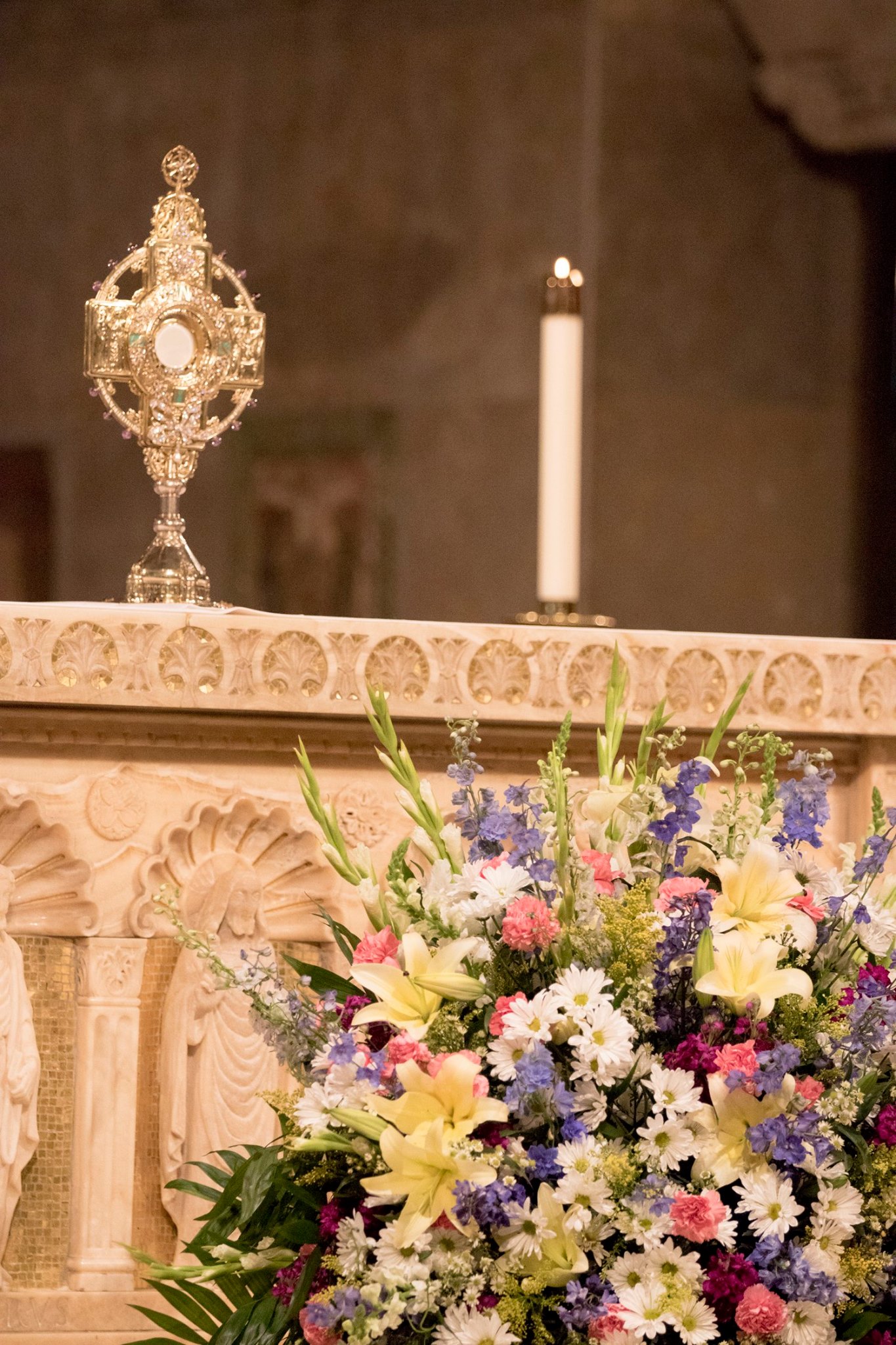
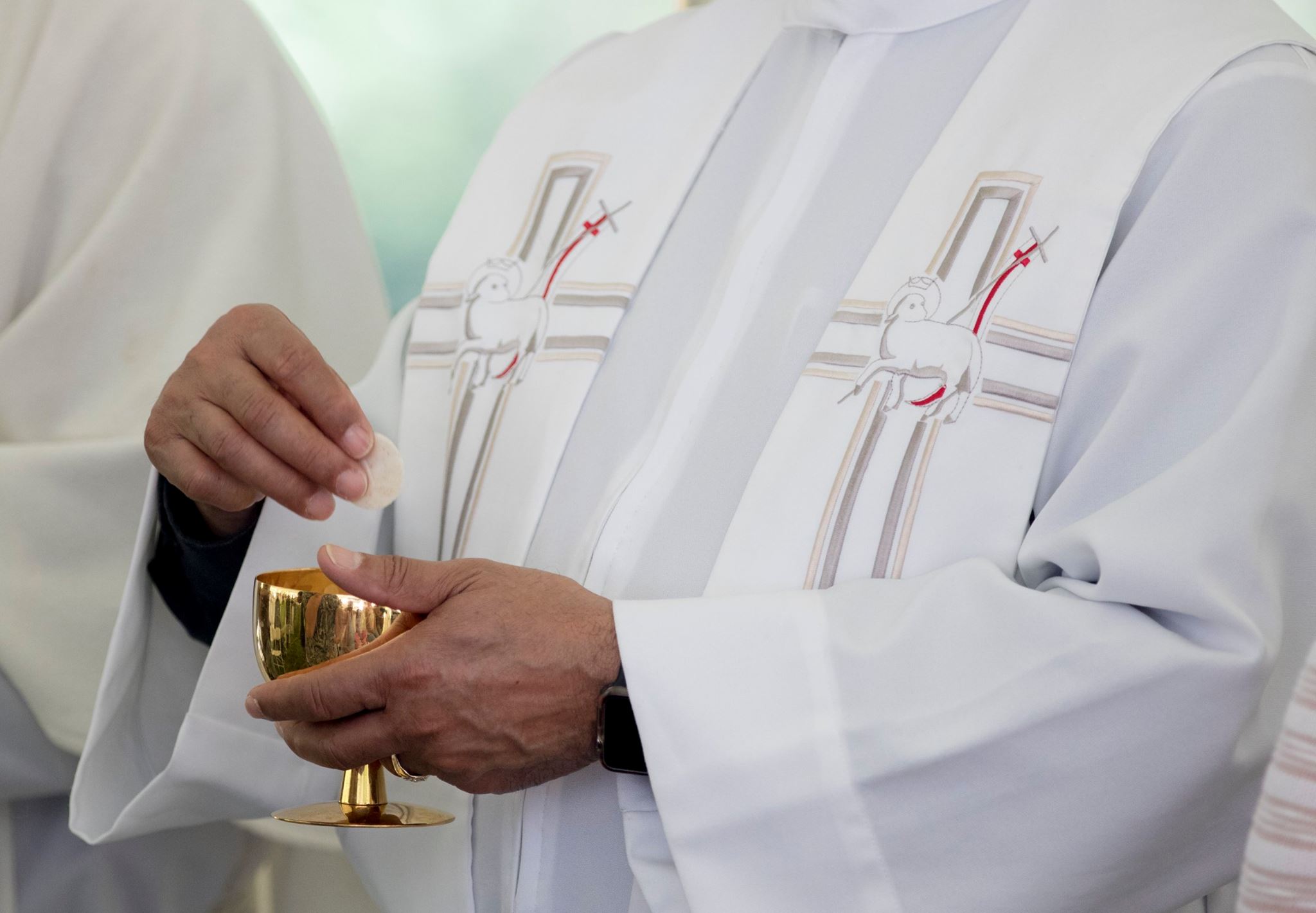
New financial realities and mechanisms raise questions for the traditional collection and offertory procedures at Mass. For as far back as most of us can remember, the “collection” has always taken place after the Creed and Intercessory prayers. A basket is passed and people drop in cash or a check, often inside an envelope. It is often brought up along with the bread and wine as an actual offering to the Lord and His Church.
But the problem is that cash, and even checks, are going away. Increasing numbers of people use electronic giving. Most younger people rarely carry cash and they seldom if ever write checks. I have to say that even I seldom carry cash, and these days I typically write fewer than five checks a month. I contribute to the parish through the “Faith Direct,” program which automatically withdraws my offering from my bank account each month.
A woman told me that she recently corrected her daughter for never putting anything in the collection basket. The daughter, a young woman in her late twenties, wondered what she was supposed to do since she didn’t carry cash or write checks. She paid all her bills online using her phone. “What am I supposed to do? I can’t put my phone in the basket!”
The question I raise here is more a liturgical than a financial one. More and more parishes are offering their parishioners other ways to contribute. We need to get better at it and to continue to offer more solutions, but the adjustment to new financial mechanisms is underway.
Liturgically, however, we are still “passing the basket” to a congregation that increasingly has no capacity to participate with this ritual. Some parishes provide cards that online givers can drop into the basket saying that they gave electronically, but most forget to bring the card to Mass. An essential point of electronic giving is to be freed from the hassle of carrying cash or checks, so needing to remember another piece of paper seems counter to that goal.
But then what to do with a practice that still makes sense liturgically? Passing the basket makes sense because we are called as a people of God to make sacrificial offerings to the Lord and to assist in the support of His Church. The offertory procession is about more than presenting bread and wine. It is also about offerings for the Church and the poor; it is about offering the gift of our very self. So the money we put (or used to put) into the basket is a symbol of something more than the monetary gift itself. The offering of actual valuables at the offertory is ancient and serves as a visible sign of our participation in the sacrifice of the Mass. In ancient barter economies, people brought tangible items such as foods and other valuables. Gradually money replaced such items and our long practice of collecting money began. And now paper money and checks are going away.
But again, there is still some value in placing offerings in a basket and bringing the basket forward at the offertory.
Perhaps we can adjust as follows:
Provide offering cards in the pews so that those who contribute electronically can quickly fill one out and place it in the basket. They could supply their name (or not) and simply indicate that they have given electronically. They could indicate the amount of the offering (or not). There should also be boxes to check that go beyond money (for the offertory should be about more than just money). People could check boxes indicating the sacrificial gifts of time and talent along with treasure. For example, one could indicate by checking boxes that he visited the sick that week, served as a lector, sang in the choir, offered tutoring, prayed for the needs of others, and so forth.
The card would need to be simple and quick to fill out. Catechesis would also be necessary to explain the purpose of taking part in the offertory in a visible and tangible manner, even if one gives electronically. Worship without sacrifice is ill-conceived. The “collection” is more than a practical gathering of money; it is a summons to link our own sacrifices of time, talent, and treasure with the Lord’s perfect sacrifice in the Eucharist.
I am interested in your thoughts on this matter, both practical and liturgical. The fact is, paper-based monetary transactions are going away. How do we adjust the offertory of the Mass in response to that?
Here is one of the more interesting things to end up in a parish collection.
Today’s Gospel provides a kind of prescription for peace in a world of woe. Let’s look at this Gospel in four stages.
I. The Place– The text says plainly, Jesus journeyed to a city called Nain, and his disciples and a large crowd accompanied him.
The name of the city, Nain, means fair (in the sense of beautiful). And it was, for it sat upon a high hill and commanded a magnificent view.
This is an apt description of this world as well, which has its fair beauty, its magnificent vistas, and its pleasures and offerings. As men and women of faith, we ought to appreciate the beauty of what God has created. It makes God angry, to quote Alice Walker’s The Color Purple, “when you walk by the color purple in a field somewhere and don’t notice it.” God has given us many gifts and the mystic in all of us is invited to wonder, awe, gratitude, and serene joy.
We, along with Jesus and His disciples, are journeying to a beautiful city.
Do not overlook the word “journey” in this passage. As we go through life, we are sorely tempted to walk right past “the color purple,” to be unreflective and ungrateful. Part of life’s task is to make the journey that sees God’s glory and is able to be in conscious contact with God at all times, seeing His beauty and glory on display and being in mystical contemplation of it. We need to journey to a city called Nain by having our eyes open to God’s fair beauty. This is the gift of wonder and awe.
If we can make this journey we will have followed the first prescription for peace. For the world, with all its woe, never loses the fair beauty of God’s glory. Appreciating this brings serene peace even in the midst of storms. God is always present and speaking to us in what He has made and is continually sustaining.
II. The Pain – And yet, fair though this world is, the very next thing we encounter is pain. The text says, As he drew near to the gate of the city, a man who had died was being carried out, the only son of his mother, and she was a widow. A large crowd from the city was with her …
Indeed, we live in a fallen world, governed by a fallen angel, and we have fallen natures. God had made paradise for us. And while we cannot fully understand what that paradise would have been like, it is clear that Adam and Eve were driven from the best of what God had made.
Adam was told that the ground was now cursed on account of him; it brought forth thorns and thistles in a kind of protest. For Adam, work became arduous and sweat-producing; a kind of battle set up, pitting him against the forces of nature in order to provide for his basic needs.
Eve was told that she would bring forth her children in pain. In addition, strife and some degree of shame entered into her relationship with her husband, and his with her.
The first shedding of blood took place as God killed an animal and clothed Adam and Eve with its skin. The world had now grown cold and hostile.
And while the world is not lost all its fair beauty, there is a long scarlet cord of suffering, pain, and death that reaches from outside Eden’s closed gates to this moment outside the gates of Nain.
And such a pain it is! A woman, already a widow, has now lost her only son as well as her livelihood.
We do well to maintain a sober perspective about this world. There is much to enjoy, all of which comes to us from the hand of God. And yet we must also remember that we live in a paradise lost. Its once and future glory is still on display, but its pain is very present.
Having simple sobriety about this provides a strange kind of serenity. There are certain hard truths, if we accept them, that will set us free. One of those is that life is hard. Joy will come with the morning light, but some nights of weeping must be endured as we journey to our heavenly homeland where sorrows and sighs are no more.
Accepting the pain of this world is the second part of the prescription for peace in a world of woe.
III. The Portrait of Jesus – The text says, When the Lord saw her, he was moved with pity for her. This woman’s sorrow becomes His own. And while there is a mystery to God’s allowance of suffering, we must never think that Lord is unmoved or uncaring.
There is a saying (attributed to various sources) that “Jesus didn’t come to get us out of trouble; He came to get into trouble with us.” Yes, He takes up our pain and experiences it to the utmost. An old hymn says of Him, “Jesus knows all about our struggles, He will guide till the day is done; There’s not a friend like the lowly Jesus, No, not one! No, not one!”
Note that the word pity comes from the Latin pietas, a word for family love. Jesus looks at this woman and sees a sister, a mother, a dear family member and He is moved with family love.
Learning to trust in Jesus’ love for us, especially when we suffer, is a critical part of the prescription for peace. We need to pray constantly in our suffering: “Jesus I trust in your love for me!” If we pray this in the Holy Spirit, it brings peace.
IV. The Preview – The text says, [Jesus] said to her, “Do not weep.” He stepped forward and touched the coffin; at this the bearers halted, and he said, “Young man, I tell you, arise!” The dead man sat up and began to speak, and Jesus gave him to his mother.
We have here a directive from Jesus not to weep. That directive is rooted in what He plans to do. This is more than a human, “Cheer up. Don’t be sad” sort of exhortation. Jesus is about to give her back her son; based on this fact, He says, “Do not weep.”
She and the others weeping with her are about to get a preview of what the Lord will do for all of us who believe, when we are finally delivered from this “paradise lost” to the Kingdom of Heaven.
In a very moving line we are told simply, “Jesus gave him to his mother.”
Do you realize that one day the Lord will do this for you? Jesus will return and restore everyone and everything that the devil and this world have stolen from us. It will all be given back and more than we could ever imagine will be added to it.
We might all wish that the Lord would raise some of our loved ones as he did for this widow. But what is done here is a powerful preview for this widow and for us. And even if you haven’t personally experienced this particular preview of what the Lord will do for you, you surely have experienced others.
In my own life the Lord has given me victories over sufferings and setbacks. I have experienced healings and restorations, as I’m sure you have. These are previews—down payments, if you will—on the total restoration that the Lord is going to effect in your life. Whatever you have lost, you will recover it all and far more besides.
What previews have you had in your life? What victories? What healings? What restorations? These are like previews of the promised and more-than-full restoration that is to come. What is your testimony?
It is important for you to reflect on the previews the Lord has already given, for these are another important part of the prescription for peace: the promise of complete restoration and the previews or down payments he has already made on that promise.
Here then is a prescription for peace in a world of woe:
Make the journey to Nain, a place called fair and beautiful. That is, let the Lord open your eyes to the beauty and blessings all around you. Come to see the magnificence of His glory on display at every moment. It will give you peace and serene joy.
Ask for the grace to accept that we currently live in a “paradise lost” and that life is hard. This sober acceptance of life’s sorrows brings a paradoxical serenity, as our resentment that we do not live in a perfect world goes away. Accepting that this world, with all of its beauty, also has hardships, brings peace and a determination to journey to the place where joys will never end.
Accept the Lord’s love for you even amidst His mysterious allowance of suffering. Accept that He is deeply moved and just say over and over, “Jesus, I trust in your Love for me.”
Be alert to the previews that God gives and has already given you, previews of the future glory that awaits the faithful. Once you have accepted this evidence, this testimony from the Holy Spirit, peacefully accept the Lord’s instruction not to weep and His promise that you will recover it all—and much more besides.
There is a saying from Psalms that speaks to the transitory victory of evil:
I have seen the wicked one triumphant, towering like a cedar of Lebanon. I passed by again; he was gone. I searched; he was nowhere to be found (Psalm 37:35-36).
We are often too fearful of or too impressed by evil. But ultimately it cannot last. Evil consumes but does not give back, tears down but does not build up. It will at some point exhaust its resources because, unlike love, it cannot abide sharing itself or depending on another.
Think of all the sinful (and often silly) fads that have come and gone over the years. Remember, too, that empires have risen and fallen, nations have come and gone—all in the age of the Church. Thousands of enemies have sworn to destroy the Church, but we have read the funeral rites over all of them. Myriad heresies have sought to eclipse the truth, yet here we are, still.
Only the Church has the promise of indefectibility (see Mat 16). Evil and error cannot abide. The truth will out. Evil and error will rise, appearing glorious, glamorous, relevant, and “real.” But they will ultimately collapse. And here we will be, still preaching the same Gospel.
Elsewhere in Psalm 37 we read the following:
A little longer—and the wicked one is gone. Look at his place: he is not there. 11 But the humble shall own the land and delight in fullness of peace. The wicked one plots against the just man and gnashes his teeth against him; but the LORD laughs at the wicked, for he sees that his day is at hand. The wicked draw the sword, bend their bows, to slaughter the poor and needy, to slay those whose ways are upright. Their sword shall pierce their own hearts, and their bows shall be broken to pieces. … The wicked shall perish; the enemies of the LORD shall be consumed. They are like the beauty of the meadows; they shall vanish; they shall vanish like smoke. … Then wait for the LORD, keep to his way. He will exalt you to inherit the land, and you will see the wicked destroyed (ps 37, varia).
Something of this truth is contained in the lyrics of a Jim Croce song. The song is about a famous pool hustler named Jim, who was the “king” of 42nd Street. Of him they said, “You don’t mess around with Jim.” One day Jim hustled the wrong fellow, a man named Slim. And after the ensuing conflicts, the new saying is “You don’t mess around with Slim.”
Yeah, old Jim got taken out and now Slim rules the roost. But beware, Slim, your days are short. The glamor of your evil will have its day, but soon enough we’ll pass by and you’ll be gone. And we’ll be here, still preaching the Gospel.
One of the consistent observations that God makes of our human family, and we, the individual members of it is that we are stiff-necked (cf Ex 32:9; 33:3; Deut 9:3; 10:16; 2 Chron 30:8; 2 Kings 17:14; Jer 7:26, and many, many other texts). That is to say we tend to be stubborn, prideful, and difficult to correct. And when reproved we easily become resentful and tend to harden our hearts.
One of the more humorous and true things God ever said to us (in love) is:I know that you are obstinate, and your neck is an iron sinew and your forehead brass (Is 48:4). This is another way of saying: I know that you are stubborn. Like iron, you are hardheaded. Like bronze, nothing gets through your thick skull. 🙂 Yes, we are difficult to be sure! God calls us sheep, but in some way we are more like cats, and our Shepherd Jesus, has the unenviable task of herding cats!
For many of us, this tendency to be stiff-necked is gradually softened by the power of grace, the medicine of the sacraments, instruction by God’s Word, and the humility that can come from these.
But for some, the stubbornness never abates. In fact it grows even stronger as a descent into pride, and an increasing hard-heartedness sets up. The deeper this descent, the more obnoxious the truth seems to them, and the less likely their conversion, as a they are not just resistant to the truth, but hostile to it. They harden their hearts and stiffen their necks and at some point, it would seem they reach the point of no return.
This is a very great mystery, which St. Paul termed the mystery of iniquity (2 Thess 2:7). The Greek word here translated “iniquity” is ἀνομία (anomia) which literally means, “without law,” and by extension, speaks of an attitude of living in lawlessness; and of having utter disregard for God’s law. While it is clear that our rebelliousness has its roots in Original Sin, there remains a mysterious aspect of why we are so easily rebellious and stiff-necked. The mystery deepens as we ponder why some are this way more than others, why some harden their hearts, while others find the path of humility more open to them.
But let us be clear, being stiff-necked, stubborn, impenitent, and ultimately hard-hearted is deadly. It is a path straight to destruction, to Hell, if it is not repented for those who have hardened their hearts to God cannot submit to him in order to be saved.
Let’s consider a short text from Proverbs to illustrate the grave and mysterious problem of “anomia,” of being lawless, of being stubbornly impenitent and persisting in disregard and even contempt of God’s Law:
He who is often reproved, yet stiffens his neck, will suddenly be broken beyond healing. (Prov 29:1)
Consider this text in three stages (with acknowledgment to Rev. Adrian Rogers who preached a sermon on this I’ve never forgotten. The alliterated structure here is his, the content is mine):
1. Spiritual Direction– Note how the text describes us as being often reproved. God sends us endless messages always urging us to repentance, to, to turn toward Him, to call on Him, to learn obedience, and to rejoice in the salvation he offers. He whispers, he urges, and he calls. No one who ever went to Hell, went there without being “often reproved.” The Hebrew word is תּוֹכֵחָה (towkechah) means chastisement, correction, refutation, proof, argument, reasoning, rebuke, or reproof. Well, you get the idea, God is pleading with us to come to him, to accept his Kingdom and the Kingdom values that underlie it. He does this in many ways. He sends to us his:
Spirit – The Holy Spirit of God pleads with our spirit. The voice of God is echoing in our conscience. Scripture says, And your ears shall hear a word behind you, saying, “This is the way, walk in it,” when you turn to the right or when you turn to the left (Isaiah 30:21). Another text says, This is what the LORD says–your Redeemer, the Holy One of Israel: “I am the LORD your God, who teaches you what is best for you, who directs you in the way you should go (Isaiah 48:17). So the Holy Spirit of God directs us.
Servants – God sends his servants, the prophets, he sends his priests, deacons, bishops, indeed, he sends many holy men and women to each of us, to testify to the truth and summon us to holiness and truth. Even in a sinful world, there are many around us who live lives of exceptional holiness and by their testimony summon to God and offer us direction and reproof, where necessary. Scripture says, The Lord gave the Word, and great was the company of the preachers and those who announced it (Ps 68:11)
Situations – In many and varied ways God directs us through the situations of our life. Since we are stubborn, it often takes great difficulties and challenges to get to us. But where necessary God will allow these to draw us to humility and dependence. Scripture says, Before I was afflicted I went astray, but now I obey your word (Ps 119:67)
Scripture – God directs us through his Word and through the Teachings of the Church. Scripture says, All Scripture is breathed out by God and profitable for teaching, for reproof, for correction, and for training in righteousness (2 Tim 3:16). And again, I am writing you these instructions so that, if I am delayed, you will know how people ought to conduct themselves in God’s household, which is the church of the living God, the pillar and foundation of the truth (1 Tim 3:15)
Yes, it is clear that God gives us spiritual direction in many ways. We must be clear, God is pleading with sinners. There is no one on this planet according to this scripture (Prov 29:1) who is not often reproved.
2. Stubborn Disobedience – The text goes on to say that, despite this, some “stiffen their necks.” as we have noted this is caught up in the mystery of iniquity. Why some stiffen their necks all the more and others heed, is mysterious. The usual reasons and manifestations of these are:
Procrastination – some become hardened merely through endless delay. Scripture says, Do not boast about tomorrow, for you do not know what a day may bring forth (Prov 27:1). And yet many say, siempre manana (always, tomorrow). Yet the more we delay our conversion the less likely it becomes. The further down a road we travel, the more invested in it we become, and the way back seems too large an undertaking. We become invested in the familiar. As we adjust to the darkness, the light begins to seem harsh. God is light and those accustomed to the darkness cannot endure him easily. The longer we wait, the deeper we sink. Deathbed conversions are possible, but not as frequent as one might think. Jesus said, This is the verdict: Light has come into the world, but men loved darkness instead of light because their deeds were evil (Jn 3:19). Yes, the light is detestable to a world in darkness.
Pride – Pride is the sinful refusal to recognize anyone or anything greater than us, to whom, or to which we owe reverence and obedience. Modern man has not only abandoned God, but even natural law. In Original Sin Adam said, “I will do what I want to do and I will decide if it is right or wrong.” Thus he refused submission to God. Modern Man extends this concept beyond God’s law, even to reality itself. In this attitude, there is no reality outside himself to which he must conform himself or to which he woes any allegiance. In abandoning natural law, modern man increasing says that reality is what he says it is. Reality no longer matters, all that matters is what I think or feel. In severing his relationship with God, and even with reality itself, the human person can turn in almost entirely on himself and be unreachable. He becomes hardened in his self-enclosed thinking and will only admit data and people who conform to his stinking thinking. As time goes by, almost nothing can break through this wall of pride. Scripture says, For although they knew God, they did not honor him as God or give thanks to him, but they became futile in their thinking, and their senseless minds were darkened. Claiming to be wise, they became fools….(Rom 1:22-23). They become hardened in their hearts and stubborn in their thinking.
Pleasures – Scripture is replete with warnings about the pernicious effects of wealth and worldly pleasure and how these things draw us away from God and cause us to stiffen our neck against God and following him. The world and its pleasures are considered preferable to God and those who go down this path become lovers of pleasure rather than lovers of God (2 Tim 3:4). This makes God and any limits he might set, or demands he might make, seem obnoxious and too costly. The rich and the lovers of this word have too much too loose. Thus they harden themselves against God whom they come to see as unreasonable. Jesus said, How hard it is for the rich to enter the kingdom of God! (Lk 18:24). Knowing this, most people, including Church going Christians, still want to be rich. Jesus’ teaching is “for someone else” who earns a $1 more an hour than I do. St Paul says, But those who desire to be rich fall into temptation, into a snare, into many senseless and harmful desires that plunge people into ruin and destruction. For the love of money is a root of all kinds of evils. It is through this craving that some have wandered away from the faith and pierced themselves with many pangs (1 Tim 6:9-10). Thus the pernicious effect of wealth and pleasures of this world cause many to stiffen their necks against God who they increasingly come to see as a thief.
And so it is that some, even though often reproved stiffen their necks and harden their hearts against God.
3. Sudden Destruction – There comes a point when this hardening, this stiffening of the neck become permanent, beyond repair. Here too is a deep mystery. For in this life, conversion seems always possible. Yet God teaches, there comes a point when this is no longer the case, when our hardness of heart will be forever fixed and beyond remedy, our destruction complete. When exactly this happens may not always be clear. It could be death itself, or perhaps it happens for some, long before death. But the Lord is teaching us a very hard truth that, if we are not careful, our “No” will become permanent, our hardness of heart complete.
And the LORD said, My Spirit shall not always strive with a man (Gen 6:3), as if to say “There comes a day when I will accept that your “no” is final.” For now the Lord “often reproves us” but there comes a day when that will end for some, for they have stiffened their necks and hardened their hearts.
While we may think this time to be way down the road, the Lord warns us it may come suddenly, that is, more quickly than we think. For the descent into deep sin and toward a hard heart is steeper and faster than most imagine or admit. So God says, “suddenly.”
Please understand this post for what it intends to be. It is not a post of despair, or severity, but of sobriety. God is a Good God, and a divine Physician. But a good doctor does not lie to his patients, and make light of things that are deadly and harmful. He warns of heart disease not because he is cruel or judgmental, but because he loves his patients and wants them to be well and saved from sudden loss of health. It is more so with God who loves us and want to save us, but who also respects our freedom and warns us of the cumulative effects of our sin. If today you hear his voice, harden not your hearts! (Psalm 95; Heb 3:15)
There are times when Scripture seems to contradict itself. On the one hand we read, Truly I tell you, anyone who will not receive the kingdom of God like a little child will never enter it (Mk 10;15). And yet elsewhere Scripture says, then we will no longer be infants, tossed about by the waves and carried around by every wind of teaching and by the clever cunning of men in their deceitful scheming. Instead, speaking the truth in love, we will in all things grow up into Christ Himself, who is the head (Eph 4:15).
However, the seeming contradiction flows more from the modern human tendency to absolutize certain teachings while forgetting that others also exist to balance and augment, than from a true contradiction. Sophistication is necessary in interpreting speech/writing, because everything cannot be communicated all at once.
Therefore, the above passages indicate that there are some qualities of children that ought to be emulated and others that should be avoided.
What are some qualities of children that should be strived for by the spiritually mature? Fr. Reginald Garrigou-Lagrange, O.P. speaks to these qualities as he meditates on the teachings of St. Therese of Lisieux:
We find in a child as a rule, simplicity and consciousness of his weakness …. The simplicity, or absence of duplicity, of a child is wholly spontaneous, in him there is no labored refinement, no affectation. He generally says what he thinks and expresses what he desires without subterfuge, without fear of what people will say. As a rule, he does not pose; he shows himself as he is. Conscious of his weakness … he depends in everything on his father and mother, from whom he should receive everything (The Three Ages of the Interior Life, Part Two, Tan Publications P. 433).
Clearly there are many qualities here that we should have, before God and also one another. For indeed as adults we posture; we wear masks; we are pretentious; and sometimes we’re just downright phony. Above all we are self-conscious, which is actually a paradoxical way of saying that we are obsessed with what others think of us. Full of pride, we refuse to acknowledge that we need God’s help in everything. Instead, we think that we only need His help in extreme situations; then we will pray.
Oh, for the simple and unpretentious qualities of children, who have not yet learned to be obsessed with what others think of them; who have not yet become cynical to the point of retreating into lies and posturing to navigate the convenient deceptions of men and ingratiate themselves to others!
Lagrange continues,
The child of God should, first of all, be simple and upright, without duplicity; he should exclude hypocrisy and falsehood from his life, and not seek to pass for what he is not …. Our Lord says, “If thy eye be single, thy whole body shall be lightsome.” That is, if the gaze of your spirit is honest, if your intention is upright, your whole life will be illuminated. The child of God should [also] preserve the consciousness of his weakness and indigence … (p. 435)
The idea of our “eye being single” is similar to being pure in heart. The concept is a kind of purity that is not admixed with all sorts of foreign materials. The pure heart is intent on one thing, not thousands of competing things. The simple eye is content to look to one thing, not every passing pleasure and distraction. One = pure = simple. Thus we are warned by the Lord that we cannot serve both Him and the mammon of this world; we cannot serve two masters. But as it is, we want too many things. We want to please too many people. We want to be in two kingdoms. Holiness, and the purity and simplicity it requires, cannot abide such duplicity. To some degree, children are more able to say, “Sum quod sum” (I am what I am). They are focused on pleasing their parents rather than myriad other people. And the very youngest children need only the basics: food, shelter, and intimacy.
Here are some final thoughts on spiritual childhood: Children are not perfect, but in their better moments they display important traits that we who would be spiritual ought to imitate.
Everything I need to know about being God’s child, I learned in infancy!
As a further reflection in the wake of Corpus Christi Sunday, permit me to offer a reflection on the two great Eucharistic hymns of Benediction. I sometimes get requests for help in understanding the Latin texts of these very familiar hymns for Eucharistic Adoration and Benediction.
“O Salutaris Hostia” and “Tantum Ergo Sacramentum,” though familiar to many Catholics, remain only vaguely understood in terms of a word-for-word translation. They are sometimes referred to as just “O Salutaris” and “Tantum Ergo.” Most know the poetic English renderings (“O Saving Victim opening wide” and “Humbly let us voice our homage”) but this does not necessarily facilitate a word-for-word understanding as the Latin is sung. What I hope to accomplish here is to provide a very literal rendering (preserving the Latin word order) so that one can understand the Latin precisely. It is my hope to bring these hymns more alive for the faithful who sing them, but may not be highly skilled in Latin.
“O Salutaris Hostia” – This is actually the last two verses of the hymn “Verbum Supernum Prodiense” (The heavenly Word going forth), written by St. Thomas Aquinas. He composed it for Lauds (Morning Prayer) of the Divine Office for the Feast of Corpus Christi. The meter is iambic dimeter, which is accentual with alternating rhyme. Even the hostile Jean-Jacques Rousseau was said to have been so pleased by this hymn that he said he would have given all his poetry to be its author. To facilitate easier comparison, I present the Latin text on the left; a very literal, word-for-word English translation preserving the Latin word order in the center; and an English translation with more English-like word order (and some punctuation for additional clarity) on the right:
O salutaris Hostia quae caeli pandis ostium bella premunt hostilia da robur fer auxilium
O saving Victim
who of heaven opens the gate
wars press hostile
give strength bear aid
O saving Victim
who opens the gate of heaven
hostile wars press;
give strength; bear aid
Uni Trinoque Domino sit sempiterna gloria qui vitam sine termino nobis donet in patria
To the One and Threefold Lord
may there be eternal glory
who life without end
to us may give in the Fatherland
To the One and Threefold Lord
may there be eternal glory;
who life without end
may give to us in the Fatherland
“Tantum Ergo Sacramentum” – This is actually the last two verses of the hymn “Pange Lingua” (Sing, my tongue), also written by St. Thomas Aquinas. It was composed for Vespers (Evening Prayer) of the Divine Office for the Feast of Corpus Christi. The meter is trochaic tetrameter catalectic, which rhymes at both the caesura and the end of the line. There is in this hymn a wonderful union of sweetness of melody with clear-cut dogmatic teaching. To facilitate easier comparison, I present the Latin text on the left; a very literal, word-for-word English translation preserving the Latin word order in the center; and an English translation with more English-like word order (and some punctuation for additional clarity) on the right:
Tantum ergo sacramentum
veneremur cernui
So great therefore a sacrament
let us venerate with bowed heads
So great therefore a sacrament
let us venerate with bowed heads;
et antiquum documentum novo cedat ritui praestet fides supplementum
sensuum defectui
and the ancient document
new give way to the rite
may supply faith a supplement
of the senses for the defect
and the ancient document
to the new rite give way;
may faith supply a supplement
for the defect of the senses
Genitori Genitoque laus et jubilation salus, honor, virtus, quoque sit et benediction procedenti ab utroque compare sit laudatio
To the One who generates and the One who is generated (i.e., to the Father and Son)
be praise and joy
health, honor, strength also
may there be and blessing
to the One proceeding from both
equal may there be praise.
To the One who generates and the One who is generated (i.e., to the Father and Son)
be praise and joy,
health, honor, strength also
may there be, and blessing.
to the One proceeding from both
may there be equal praise.
In light of Sunday’s Feast of Corpus Christi, I would like to recall the need for the reverent and worthy reception of Holy Communion and to develop an explanation for the Church’s practice of what some call “closed Communion.” Not everyone who uses this terminology means it pejoratively, although some do. But to some extent it is fair to say that we do have “closed Communion.” For the Catholic Church, Holy Communion is not a “come one, come all” event. It is reserved for those who, by grace, preserve union with the Church through adherence to all that the Catholic Church believes, teaches, and proclaims to be revealed by God. Our response of “Amen” at Holy Communion signifies our communion with these realities and our faith in the true presence of Christ in the Eucharist.
Many today have reduced Holy Communion to a mere sign of hospitality, such that if the Church does not extend it to all we are considered unkind. There is often a mistaken notion about the nature of the Last Supper (and the Eucharist that proceeds from it) that lurks behind this misconception. Many years ago, Joseph Cardinal Ratzinger articulated the misunderstanding well. I summarize the description here from his Collected Works, Vol 11, Ignatius Press pp 273-274:
Nowadays [some] New Testament scholars … say that the Eucharist … is the continuation of the meals with sinners that Jesus had held … a notion with far-reaching consequences. It would mean that the Eucharist is the sinners’ banquet, where Jesus sits at the table; [that] the Eucharist is the public gesture by which we invite everyone without exception. The logic of this is expressed in a far-reaching criticism of the Church’s Eucharist, since it implies that the Eucharist cannot be conditional on anything, not depending on denomination or even on baptism. It is necessarily an open table to which all may come to encounter the universal God …
However tempting the idea may be, it contradicts what we find in the Bible. Jesus’ Last Supper was not one of those meals he held with “publicans and sinners”. He made it subject to the basic form of the Passover, which implies that the meal was held in a family setting. Thus he kept it with his new family, with the Twelve; with those whose feet he washed, whom he had prepared by his Word and by this cleansing of absolution (John 13:10) to receive a blood relationship with him, to become one body with him.
The Eucharist is not itself the sacrament of reconciliation, but in fact it presupposes that sacrament. It is the sacrament of the reconciled, to which the Lord invites all those who have become one with him; who certainly still remain weak sinners, but yet have given their hand to him and have become part of his family.
That is why, from the beginning, the Eucharist has been preceded by a discernment … (I Corinthians 11:27 ff). The Teaching of the Twelve Apostles [the Didache] is one of the oldest writings outside the New Testament, from the beginning of the Second Century, it takes up this apostolic tradition and has the priest, just before distributing the sacrament saying: “Whoever is holy, let him approach, whoever is not, let him do penance” (Didache 10).
Thanks to Pope Benedict’s writing prior to his papacy, we can see the root of the problem: the failure to see the Eucharist for what it truly is—a sacred banquet wherein those who enjoy communion with the Lord (by His grace) partake of the sign and sacrament of that communion. Holy Communion serves to celebrate and deepen the communion already operative through the other sacraments of Baptism, Confirmation, and Confession.
If you want to call this communion “closed,” fine, but at its heart it is more positively called a “sacrum convivium,” a sacred meal of those who share a life together (con = with or together + vivium = life). This is not a “come one, come all” meal; it is a Holy Banquet for those who wear the wedding garment. The garment is righteousness and those who refuse to wear it are cast out (cf: Matt 22:11-12 & Rev 19:8).
Many moderns surely would prefer a “no questions asked” invitation to all who wish to come; they love this notion of unity. But to a large degree it is a contrived unity that overlooks truth (the opposite of which is falsehood, not just a different viewpoint). Yes, it overlooks the truth necessary for honest, real, and substantive unity. Such a notion of communion is shallow at best and a lie at worst. How can people approach the Eucharist, the sacrament of Holy Communion and unity, and say “Amen” when they differ with the Church over essentials such as that baptism is necessary; that there are seven sacraments; that the Pope is the successor of Peter and the Vicar of Christ on Earth; that homosexual acts, fornication, and adultery are gravely sinful; that women cannot be admitted to Holy Orders; that there is in fact a priesthood; that Scripture must be read in the light of the Magisterium; and on and on? Saying that there is communion in such a case is either a contrivance or a lie, but in either case it does not suffice for the “Amen” that is required at the moment of reception of Holy Communion.
Such divisions do not make for a family meal or a “sacrum convivium.” Hence, to share Holy Communion with Protestants, dissenters, and others who do not live in communion with the Church is incoherent. To paraphrase Cardinal Ratzinger (Pope Benedict), the Eucharist is not a table fellowship with publicans and other “sinners”; it is a family meal that presupposes grace and shared faith.
This, then, leads us to a second point: the need to approach the Sacrament of Holy Communion free from serious and unrepentant sin. Let’s consider some texts to show that the Church’s desire that her sons and daughters receive Holy Communion in a state free from serious sin is not only a proper requirement but a loving one. Each quote is followed by some of my own commentary in plain red text.
So then, whoever eats the bread or drinks the cup of the Lord in an unworthy manner will be guilty of sinning against the body and blood of the Lord. Everyone ought to examine themselves before they eat of the bread and drink from the cup. For those who eat and drink without discerning the body of Christ eat and drink judgment on themselves. That is why many among you are weak and sick, and a number of you have fallen asleep. But if we were more discerning with regard to ourselves, we would not come under such judgment. Nevertheless, when we are judged in this way by the Lord, we are being disciplined so that we will not be finally condemned with the world (1 Cor 11:27-32).
St. Paul teaches that examining oneself is a prerequisite for worthy reception of the Eucharist. If not, Holy Communion has the opposite of the desired effect of union with our Lord, bringing condemnation rather than blessing. So, out of respect for Christ and for our own good, the Church requires us to be in a state of grace when we receive. We are required to abstain only when there is mortal sin. Confessions of devotion, however, are highly recommended.
[At the Last Supper the disciples asked]: “Lord, who is it [who will betray you]?” Jesus answered, “It is he to whom I will give this morsel of bread when I have dipped it.” So when he had dipped the morsel, he gave it to Judas, the son of Simon Iscariot. Then after he had taken the morsel, Satan entered into him. Jesus said to him, “What you are going to do, do quickly.” Now no one at the table knew why he said this to him. Some thought that, because Judas had the moneybag, Jesus was telling him, “Buy what we need for the feast,” or that he should give something to the poor. So, after receiving the morsel of bread, he immediately went out. And it was night (Jn 13:21-30).
It is unclear and debatable whether or not the “morsel” taken by Judas was Holy Communion (why would Jesus have dipped it?). But still, there is something of a picture of what unworthy (sacrilegious) reception of Holy Communion might cause in an extreme case.
So if you are offering your gift at the altar and there remember that your brother has something against you, leave your gift there before the altar and go. First be reconciled to your brother, and then come and offer your gift. Come to terms quickly with your accuser while you are going with him to court, lest your accuser hand you over to the judge, and the judge to the guard, and you be put in prison. Truly, I say to you, you will never get out until you have paid the last penny (Mat 5:21-26).
Note the use of the simple word “first.” Jesus teaches that we cannot approach the altar if we are filled with hate or injustice toward our brethren. Reconciliation and the restoration of unity are required prior to approaching the Sacrament of Holy Communion, lest our “Amen” be incoherent or a lie.
A person who is conscious of grave sin is not to celebrate Mass or to receive the Body of the Lord without prior sacramental confession unless a grave reason is present and there is no opportunity of confessing; in this case the person is to be mindful of the obligation to make an act of perfect contrition, including the intention of confessing as soon as possible (Code of Canon Law # 916).
Note that the use of the Act of Contrition mentioned here is an exception requiring moral or physical impossibility to go to Confession beforehand and the necessity of receiving Communion immediately (such as a priest who must celebrate Mass). There are some pastoral notes that can be added here later for those who struggle with certain habitual sins that are possibly grave (e.g., masturbation). The Catechism has some notes to review that a confessor can apply to a penitent in such cases. But no Catholic should simply take it upon himself to use the exception described in Canon 916. A confessor must be consulted.
To respond to this invitation, we must prepare ourselves for so great and so holy a moment. St. Paul urges us to examine our conscience: “Whoever, therefore, eats the bread or drinks the cup of the Lord in an unworthy manner will be guilty of profaning the body and blood of the Lord. Let a man examine himself, and so eat of the bread and drink of the cup. For anyone who eats and drinks without discerning the body eats and drinks judgment upon himself.” Anyone conscious of a grave sin must receive the sacrament of Reconciliation before coming to communion (Catechism # 1385).
If anyone is holy, let him approach; if anyone is not so, let him repent. Maranatha. Amen. … But let no one eat or drink of your Eucharist, unless they have been baptized into the name of the Lord; for concerning this also the Lord has said, “Give not that which is holy to the dogs” (Didache 10, 9).
Note that the Didache was written sometime between 90 and 110 AD. Hence very early on there was an understanding that the Eucharist was not a mere “table fellowship with sinners” but rather a sacral meal that presupposed grace and communion with the Church.
Presenting oneself to receive Holy Communion should be a conscious decision, based on a reasoned judgment regarding one’s worthiness to do so, according to the Church’s objective criteria, asking such questions as: “Am I in full communion with the Catholic Church? Am I guilty of grave sin? Have I incurred a penalty (e.g., excommunication, interdict) that forbids me to receive Holy Communion? Have I prepared myself by fasting for at least an hour?” The practice of indiscriminately presenting oneself to receive Holy Communion, merely as a consequence of being present at Mass, is an abuse that must be corrected (Ratzinger Memo to Cardinal McCarrick, # 1). Clear enough!
In all these quotes we see a tradition that is Scriptural, ancient, and clear: the Eucharist is a sacred meal that requires of us something more than just “showing up.” Indeed, there are warnings against irreverent reception, in which the Eucharist is regarded as ordinary or is treated casually.
Is the Church merely being “fussy” about Holy Communion? No more so than were St. Paul and the Holy Spirit, who inspired him to write and warn us against unworthy reception of the Eucharist. The Church is charitably exhorting us to receive the Eucharist, but also charitably warning those who are unprepared to refrain from reception. Indeed, Scripture warns that the unworthy reception of Holy Communion brings not a blessing but a condemnation. This is God’s teaching, not mine.
Perhaps an analogy can be found by noting that some people are allergic to penicillin. For them, a drug that has saved many lives can threaten their own. They are simply not able to receive it, though it is good in itself. Similarly, sinners, not by accident of birth or genetics but by choice, will find that the Eucharist, though life-giving to many, is problematic for them. In charity, the Church teaches that individuals unprepared to receive Communion should refrain from doing so until the problem can be resolved. This is charity, not cruelty or a lack of hospitality.
I have written more extensively (here) on some pastoral issues and solutions related to the Church’s stance. Questions do arise as to what is meant by mortal sin and how to handle the current problem of dissenters, those in serious sin, and those in invalid marriages or other irregular situations. Such questions and issues must be handled charitably and equitably by the Church, but not in a way that violates the principles given by Scripture and Tradition on the need for worthy reception of Holy Communion. This fundamental stance of the Church deserves to be reiterated and needs to be better taught and applied with clarity and charity:
The practice of indiscriminately presenting oneself to receive Holy Communion, merely as a consequence of being present at Mass, is an abuse that must be corrected (Joseph Cardinal Ratzinger, 2004).
Last week as we finished the Easter Cycle and crowned it with Pentecost. We also finished the lengthy reading of the Acts of the Apostles. There are two parts of the Acts of the Apostles: The Acts of Peter and those of Paul. But to be honest, the book has an unfinished quality to it. Let’s consider that.
First, a quick summary: The second part of Acts is focused on the evangelical mission of St. Paul as he made four journeys into Asia Minor and then into Greece. The final chapters of Acts deal with Paul’s arrest, imprisonment, and appearance before Roman officials (e.g., Felix and Festus, Herod Agrippa in Jerusalem and Caesarea).
Paul appeals his case to Rome and is sent there on an ill-fated journey that ends in shipwreck at Malta). After finally making it to Rome, Paul is imprisoned and awaits trial. The story seems to be building to a climactic conclusion, but then the story just ends! Here is the concluding line of the Acts of the Apostles:
[Paul] remained for two full years in his lodgings. He received all who came to him, and with complete assurance and without hindrance he proclaimed the kingdom of God and taught about the Lord Jesus Christ (Acts 28:30-31).
And that’s it. Acts just ends. But Luke, don’t just leave us hanging! Did Paul ever go on trial? Was he acquitted (as some traditions assert) and then made his way to Spain as he wanted? Or did he lose his appeal and suffer beheading right away? What was the outcome of the trial?
How can we answer this exasperating and unsatisfying end?
The simplest answer is that the Acts of the Apostles is not really about Paul. It’s about the going forth of the Gospel of Jesus Christ to all the nations. Luke chose to recount this going forth of the Gospel by focusing first on Peter and then on Paul.
Once Paul reaches Rome (and though under house arrest is able to freely preach the Gospel there) the story reaches its natural conclusion. While others had preached the Gospel in Rome before, Luke chose to illustrate the going forth of the Word of God through Paul’s activities, and so once Paul arrives there the goal has been accomplished. From the central hub of Rome, the Gospel would now radiate outward, by the grace of God, to every part of the Roman Empire.
But what about Paul’s fate? The answer is that it doesn’t matter. It never was about Paul; it was about the Gospel. Paul himself testified to this when he said, I consider my life worth nothing to me, if only I may finish the race and complete the task the Lord Jesus has given me—the task of testifying to the gospel of God’s grace (Acts 20:24).
We are often focused on personalities, and in so doing lose track of what is most important. Frankly, the person we are most focused on is often our own self. Acts never really was about Paul. And your life is not about you; it is about what the Lord is doing for you and through you. We often want things to revolve around us: around what we think and what we want. But truth be told, we are not all that important. We must decrease and the Lord must increase (Jn 3:30).
Some of these notions hit hard in today’s culture that is so focused on bolstering self-esteem. But in the end, our true glory is not our own; it is the glory of God radiating in us. If we decrease, the Lord increases. That does not mean that we are swallowed up and lost in Christ. Rather, it means that we truly become the man or woman God has always made us to be, one who reflects the very glory of God. Perhaps it is best to let Paul himself have the final word:
For we do not preach ourselves but Jesus Christ as Lord, and ourselves as your slaves for the sake of Jesus. For God who said, “Let light shine out of darkness,” has shone in our hearts to bring to light the knowledge of the glory of God on the face of (Jesus) Christ (2 Cor 4:5-6).
This video is a depiction of the conclusion of the Acts of the Apostles. The scene begins with Paul speaking to Jewish leaders in Rome. (Note that the epilogue, which shows Luke leaving Rome, is not part of the Acts of the Apostles.)

 New financial realities and mechanisms raise questions for the traditional collection and offertory procedures at Mass. For as far back as most of us can remember, the “collection” has always taken place after the Creed and Intercessory prayers. A basket is passed and people drop in cash or a check, often inside an envelope. It is often brought up along with the bread and wine as an actual offering to the Lord and His Church.