The video below contains a surprise, reminding us that not all things are as they appear. We should be careful about sizing things up, and when we must do so, do it with great humility. There is an old saying that seems appropriate:
If your words are soft and sweet, they won’t be as hard to swallow if you have to eat them.
Before watching the video, consider these cautionary quotes from Scripture:
But the LORD said to Samuel [who seeking a king, was impressed with Jesse’s eldest son], “Do not consider his appearance or his height, for I have rejected him. The LORD does not look at the things people look at. Man looks at the outward appearance, but the LORD looks at the heart” (1 Sam 16:7).
So from now on we regard no one from a worldly point of view. Though we once regarded Christ in this way, we do so no longer (2 Cor 5:16).
Stop judging by mere appearances, but instead judge correctly (John 7:24).
You judge by human standards; I pass judgment on no one. But if I do judge, my decisions are true, because I am not alone. I stand with the Father, who sent me (John 8:15-16).
Jesus said to them, “You are the ones who justify yourselves in the eyes of others, but God knows your hearts” (Luke 16:15).
[O Lord] Forgive and act; deal with everyone according to all they do, since you know their hearts (for you alone know every human heart) (1 Kings 8:39).
Call no one happy before his death; by how he ends, a person becomes known (Sirach 11:28).
The Gospel from Wednesday’s Daily Mass contains memorable but often misunderstood lines:
Come to me, all you who labor and are burdened, and I will give you rest … Take my yoke upon you … For my yoke is easy, and my burden light.
The most important word in this sentence is the word “my.” Jesus says, my yoke is easy; my burden is light.
What is a yoke? It’s a wooden truss that makes it easier to carry a heavy load by distributing the weight across a wider part of the body or by allowing the weight to be shared by two or more people or animals. In the picture at left, the woman is able to carry the heavy water more easily with the weight distributed across her shoulders rather than in her hands. The load is eased by involving more parts of the body. Yokes are also used to join two animals and help them work together in pulling a load.
What is Jesus saying? First, He is saying that He has a yoke for us. That is, He has a cross for us. Notice that Jesus is not saying that there is no yoke or cross in following Him. There is a cross that He allows, and He allows it for a reason and for a season.
Easy? Jesus says that the cross he has for us is “easy.” The Greek word χρηστὸς (chrestos) is better translated as “well fitting,” “suitable,” or even “useful.” In effect, the Lord is saying that the yoke he has for us is suited to us; it fits us well and has been carefully chosen so as to be useful for us. God knows that we need some crosses in order to grow. He knows what those crosses are. He knows what we can bear and what we are ready for. Yes, His yoke for us fits us well.
But notice again that little word: “my.” The cross or yoke that Jesus has for us is well suited and useful for us. The problem comes when we start adding to that weight with things of our own doing. We put wood on our shoulders that God never put there and never intended for us. We make decisions without asking God. We undertake projects, launch careers, accept promotions, and even enter marriages without ever discerning if God wants this for us. And sure enough, before long our life is complicated and burdensome; we feel pulled in many different directions. But this is not the yoke of Jesus; this is largely the yoke of our own making. Of course it is not easy nor does it fit well, because Jesus didn’t make it.
Don’t blame God; simplify. Be very careful before accepting commitments and making big decisions. Ask God. It may be good, but not for you. It may help others, but destroy you. Seek the Lord’s will. If necessary, seek advice from a spiritually mature person. Consider your state in life; consider the tradeoffs. Balance the call to be generous with the call to proper stewardship of your time, talent, and treasure. Have proper priorities. It is amazing how many people put their career before their vocation. They accept promotions, take on special assignments, and think more about money and advancement than their spouse and children. The burdens increase and the load gets heavy when we don’t ask God or even consider how a proposed course of action might affect the most precious and important things in our lives.
Jesus’ final advice, then, is this: Take my yoke and only my yoke. Forsake all others. Simplify.
So stop “yoking around.” Take only His yoke. If you do, your burdens will be lighter. Jesus says, “Come and learn from me. I will not put heavy burdens on you. I will set your heart on fire with love. And then, whatever I do have for you, will be a pleasure for you to do. Because, what makes the difference is love.” Love lightens every load.
As we go through the Book of the Prophet Isaiah at Mass, we read of Israel’s painful purifications and also of a coming punishment of the surrounding nations. These ancient stories have something to say to us today.
As Isaiah sets forth, God permitted the nations to persecute Israel in order that she be purified. But the iniquity and sin of the nations and of this world cannot go on forever; wickedness must be ended. The Lord will judge the nations, not merely purify Israel.
In a complex passage, God says (through Isaiah) that although He had used Assyria as a tool to purify Israel, Assyria would not escape punishment for her iniquity. Here is an excerpt:
Woe to Assyria! My rod in anger, my staff in wrath. Against an impious nation [Israel] I send him, and against a people under my wrath I order him to seize plunder, carry off loot …. But this is not what he intends, nor does he have this in mind; Rather, it is in his heart to destroy …. [And] he says: “By my own power I have done it, and by my wisdom, for I am shrewd. I have moved the boundaries of peoples ….” Will the axe boast against him who hews with it? Will the saw exalt itself above him who wields it? As if a rod could sway him who lifts it …. Therefore, the Lord, the LORD of hosts, will send among his fat ones leanness, And instead of his glory there will be kindling like the kindling of fire (Isaiah 10:5-16).
Although God wielded Assyria like an axe to prune Israel, that did not make the axe good. And now it is time for the axe also to be refined as in fire.
What do stories like these have to say to us today? A lot, especially if we see Israel as an image for the Church, and the nations around us as akin to Assyria and Babylon.
For indeed, the Church has been going through a great pruning and purification. The once luxuriant vine of Catholicism and Christendom in the West is reduced. Only 25% of Catholics in the U.S. attend Mass; in Europe the numbers are far worse. Indifference to the faith and to God is widespread. Many are Catholic in name only. Yet for those who remain there is an increasingly fervent experience of the faith. On account of doubt and persecution, many of us are actually clearer about what we believe and why than we were in the past. There has been a great blossoming of Catholic apologetics and media. The smaller numbers of Catholics who remain are getting clearer, more devout, and more creative. And thus we see a pruning and purification that is so often necessary in the Church. Ecclesia semper reformanda (the Church is always in need of reform).
This purification is being effected by God, who is permitting an increasingly secular and hostile world to afflict the Church. These afflictions take many forms: simple scoffing at our beliefs, the promulgation of error and lies to lead us away from the faith, the excoriating and even criminalization of long-held beliefs of our faith, and even outright martyring of believers.
For the time being, God seems to be permitting the “Assyria” of modern, decadent culture to afflict us. But things do by opposition grow. Even if God is wielding the axe of modernity now, this does not make the axe holy; soon enough the axe will have to answer for its wickedness.
What are faithful Catholics to do under the current circumstances? The answer to this may vary based our state in life (parent, priest, married, single, young, old, etc.). Many younger families are choosing to “hunker down” and live as isolated from our toxic culture as possible: homeschooling, restricting television viewing, and/or limiting Internet access.
Others have chosen to engage the culture boldly in order to seek its conversion and/or to rescue as many as possible from its grip.
Both approaches are certainly valid. But as we journey further into the darkness, the banners of tolerance under which the revolutionaries marched are increasingly being exposed for what they really are: banners of tyranny. They never really meant what they said about tolerance; it was just a smoke screen. Under the new tyranny, our options for influencing the culture are decreasing; faithful Catholics proclaiming ancient truths are seeing their religious liberty erode. Merely quoting certain Scripture passages or reading from the Catechism of the Catholic Church is being labeled hate speech. There are increasing efforts to compel faithful Catholics and others to directly cooperate in evils such as contraception, abortion, and euthanasia.
With all this in mind, a text from another part of Isaiah seems appropriate for an increasing number of Catholics:
Come, my people, enter your chambers, and shut your doors behind you; hide yourselves for a little while until the wrath has passed by. For behold, the LORD is coming out from his place to punish the inhabitants of the earth for their iniquity, and the earth will disclose the blood shed on it, and will no more cover its slain (Is 26:21-22).
In effect, this text advises the faithful to hunker down and preserve the faith by seeking to live as far apart from the prevailing culture as possible. Now that Israel’s purification was bearing fruit, God was preparing to punish the nations that afflicted His faithful in Israel.
A possible modern application of this text is to view the wickedness in current Western culture as a sign of the wrath of God, who is allowing it to collapse under the weight of its own sin. A kind of delusion and lunacy has taken hold that reminds one of a rabid animal madly running around in circles. Rabid animals are not to be engaged; flee from them!
Much as in the days of Noah, our job may well be to hunker down and preserve the faith from the flood of rebellion. Scripture says,
The nations have drunk the wine of the passion of her immorality. The kings of the earth were immoral with her, and the merchants of the earth have grown wealthy through the extravagance of her luxury. Then I heard another voice from heaven say: “Come out of her, my people, so that you will not share in her sins, so that you will not receive any of her plagues; for her sins are piled up to heaven …” (Rev 18:3-5).
I will punish Bel in Babylon and make him spew out what he has swallowed. The nations will no longer stream to him. And the wall of Babylon will fall. Come out of her, my people! Run for your lives! Run from the fierce anger of the Lord. But do not lose heart or be afraid … (Jer 51:44-46).
In the months and years ahead, the priority for many in the Church may shift to a protective stance, a kind of hunkering down while God’s judgment brings an end to the evils in the cultures and nations around us.
This of course is not the usual stance of the Church, which ordinarily is to be zealously evangelical. But even the first evangelists were told by Jesus that in the face of fierce opposition to the Gospel they were to flee: When you are persecuted in one place, flee to another (Matt 10:24). There are times to hole up in the enclosure of the ark in order to preserve the life and light of the Gospel and then emerge again when the storms of destruction have passed by.
What does all of this mean to you? You must decide. Some may be called to isolate their families in order to preserve them from the caustic culture. Others may be called to engage with this world and seek to save as many as possible. But increasingly, the Church is simply not going to be able to make the compromises that the world will require.
Isaiah’s prophecies are not merely locked in the past; they are operative now as well.
In the video below, Bishop Robert Barron does a wonderful job of describing this stance (hunkering down) that the Church must occasionally take. It is a stance that is less one of hiding thank of preserving the faith so that it can be set loose later, with its purity still intact.
We are reading excerpts from the Prophet Isaiah this week in the Daily Liturgy, particularly from passages in which God’s judgment on unbelief and sin is proclaimed. I will write a bit more on this tomorrow, but perhaps for today there is some benefit in looking at Isaiah by way of overview. Let’s consider key elements of his life, struggle, and message. If you already have a firm grasp on Isaiah’s life and teachings and would like to read a shorter meditation, you can skip down to the section labeled in red: Lessons from Isaiah.
Isaiah was born in 760 B.C. He is further identified as the son of Amoz (Is 1:1). His name in Hebrew (Yeshayahu) means “Yah[weh] is salvation.” Isaiah lived this name well, insisting that Judah’s kings and people trust only in God, make no alliances with foreign nations, and refuse to fear anyone but God.
Isaiah lived in the terrible period following the great severing of the northern kingdom of Israel (with its ten tribes) from the southern kingdom of Judah. In the period prior to Isaiah’s birth, the northern kingdom had known almost nothing but godless kings. Idolatry had begun there from the start, when the first king, Jeroboam, erected golden calves (of all things!) in two northern cities and strove to dissuade northern Jews from going south to Jerusalem (in Judah) to worship. Other ugly moments in the north featured King Ahab and the wicked Queen Jezebel, who advanced the worship of the Canaanite fertility god, Baal, and who persecuted Elijah and the few others who sought to stay true to the faith of Abraham.
By the time Isaiah began his ministry (742 B.C.), the division was some 200 years old. Though living in Judah to the south, Isaiah both prophesied doom for the north and warned the kings of the south to rebuke wickedness and fears and to form no foreign alliances against the growing menaces to the north (Israel) and the east (Assyria). In this passage, he warned of northern destruction: In a single day the Lord will destroy both the head and the tail … The leaders of Israel are the head, and the lying prophets are the tail (Is 9:14-15). But his own Judah remained the focus of his concern and warnings.
Isaiah’s mission and ministry in Judah spanned four kings: Uzziah, Jotham, Ahaz, and Hezekiah. It is likely that he was a cousin of King Uzziah, which gave him both access and influence. Isaiah’s eloquence and influence also suggest that he received a royal education; little else is known of him personally.
Although the opening chapters of the Book of Isaiah describe the wickedness of the people of Judah and the need for their repentance and his ministry, Isaiah’s prophetic call seems to have begun in 742 B.C., “the year King Uzziah died,” and is described in Chapter 6:
1In the year that King Uzziah died I saw the Lord sitting upon a throne, high and lifted up; and his train filled the temple. 2Above him stood the seraphim; each had six wings: with two he covered his face, and with two he covered his feet, and with two he flew. 3And one called to another and said: “Holy, holy, holy is the Lord of hosts; the whole earth is full of his glory.” 4And the foundations of the thresholds shook at the voice of him who called, and the house was filled with smoke. 5And I said, “Woe is me! For I am lost; for I am a man of unclean lips, and I dwell in the midst of a people of unclean lips; for my eyes have seen the King, the Lord of hosts!” 6Then flew one of the seraphim to me, having in his hand a burning coal, which he had taken with tongs from the altar. 7And he touched my mouth, and said: “Behold, this has touched your lips; your guilt is taken away, and your sin forgiven.” 8And I heard the voice of the Lord saying, “Whom shall I send, and who will go for us?” Then I said, “Here am I! Send me” (Is 6:1–8).
While God accepts Isaiah’s offer, He warns that Isaiah’s message will be resisted. Isaiah asks, sadly,
11“How long, O Lord?” And he said, “Until cities lie waste without inhabitant, and houses without men, and the land is utterly desolate, 12and the Lord removes men far away, and the forsaken places are many in the midst of the land. 13And though a tenth remain in it, it will be burned” (Is 6:11–13).
Sure enough, the first 39 chapters of Isaiah describe a fiercely stubborn resistance to Isaiah’s calls. However, the prophesied destruction of the south would not occur until 587 B.C., long into the future, due in part to some limited success Isaiah had in working with King Hezekiah at a critical moment.
The winds of war were blowing. Assyria was expanding and the ominous clouds of its destructive conquest were moving westward. Israel to the north joined in a coalition to fight Assyria and tried to strong-arm Judah to join, threatening invasion and overthrow of King Ahaz if there was no agreement. Let’s just say that Ahaz was anxious, and all of Judah with him—threats to the north, threats to the east, and the Mediterranean to the west. There was no real escape.
God dispatches Isaiah to Ahaz with the following message:
4… Take heed, be quiet, do not fear, and do not let your heart be faint because of these two smoldering stumps of firebrands 5… [who have] devised evil against you, saying, 6“Let us go up against Judah and terrify it, and let us conquer it for ourselves, and set up the son of Tabe-el as king in the midst of it,” 7thus says the Lord GOD: It shall not stand, and it shall not come to pass (Is 7:4–7).
In other words, trust God. Make no alliances and do not give in to your fears. Stand your ground! God offers Ahaz a sign that a virgin shall conceive and bear a Son, Immanuel (God is with us). But Ahaz cops a falsely pious attitude, talking about not putting God to the test. Yet it is Ahaz who fails the test. Caving in, he sends tribute to Assyria and offers to become a vassal state.
In the end, this frees Assyria to concentrate on destroying Israel to the north. And while it can be argued that Israel’s wickedness brought her destruction, Ahaz helped seal the fate of fellow Jews in the north through his fearful and self-serving political calculations. The northern kingdom of Israel fell to the Assyrians in 721 B.C. and the survivors were carried off into exile. It was farewell to the Ten Lost Tribes. Only Judah and the Levites in the south remained intact.
Though Judah was spared, the relief from threatening Assyriawas to be temporary. Meanwhile, Ahaz’s son Hezekiah became king (ruling from 715-687 B.C.). Hezekiah was a better king: more faithful, more trusting, and thus less fearful. He rid Judah of any elements of Canaanite religious practice and by 705 B.C. had courageously broken free of the alliance with Assyria. He fortified Jerusalem (and his faith) against the backlash that was sure to come from Assyria.
Sure enough, in 701 B.C., Assyria came to collect past-due tribute and to assert who was boss. Jerusalem was surrounded with troops and her fate seemed sealed. But Isaiah summoned Hezekiah and Judah to courage:
33“Therefore thus says the Lord concerning the king of Assyria: He shall not come into this city, or shoot an arrow here, or come before it with a shield, or cast up a siege mound against it. 34By the way that he came, by the same he shall return, and he shall not come into this city, says the Lord. 35For I will defend this city to save it, for my own sake and for the sake of my servant David.” 36And the angel of the Lord went forth, and slew a hundred and eighty-five thousand in the camp of the Assyrians; and when men arose early in the morning, behold, these were all dead bodies (Is 37:33–36).
The Assyrian survivors left and returned by the way they had come. Their king, Sennacherib, returned home and was killed by his own sons.
A fear rebuked brought victory to Judah.Now maybe people would listen to Isaiah and trust God rather than foreign alliances! Well, not so fast. Hezekiah, who had been ill but miraculously recovered, started to get awfully friendly with the Babylonians, who were then emerging as a power to the east. Faith and trust are surely difficult things, especially for a king.
Because it looked like another alliance was being formed with a pagan state, Isaiah warned,
5“Hear the word of the Lord of hosts: 6Behold, the days are coming, when all that is in your house, and that which your fathers have stored up till this day, shall be carried to Babylon; nothing shall be left, says the Lord. 7 And some of your own sons, who are born to you, shall be taken away; and they shall be eunuchs in the palace of the king of Babylon.” 8Then said Hezekiah to Isaiah, “The word of the Lord which you have spoken is good.” For he thought, “There will be peace and security in my days” (Is 39:5–8).
Hezekiah’s selfish response reminds me of an old saying of my father’s: “People disappoint.” Alliances and dalliances with foreign lands and a corresponding lack of trust in God would continue to plague Judah despite miracles against Assyria.
We know little of Isaiah’s final demise. According to an extra-biblical tradition (and hinted at in Hebrews 11:37), he died by being sawed in half by Hezekiah’s unfaithful son, Manasseh. If the tradition is true, Manasseh answered to God for the murder of Isaiah.
Lessons from Isaiah:
Despite often disappointing results, Isaiah never gave up. God told him to prophesy and so he did. Isaiah lived what he preached. He feared God, not man. He never thought twice about going up to kings and declaring to their faces, “Thus saith the Lord!” Isaiah was willing to rebuke and encourage people regardless of their standing.
In the end, Isaiah’s message is remarkably clear: Do not fear! Clearly, fear leads all of us to a lot of foolish decisions. It is through fear that the devil holds us in bondage (Heb 2:15). The solution to fear is trust in God. And even if we were to be killed, we would still win, for the martyr’s crown would await us. Do not fear!
Why were foreign alliances so troubling to Isaiah? First of all, they manifested a lack of trust in the Lord with the following thinking: “Can God really save us? Maybe, but just in case He doesn’t come through, let’s make sure we have a plan B.” Hmm … not much faith there! But second (and related) the secular states of today were unknown at that time. People and nations were deeply religious. Alliances with foreign lands meant marriages to foreign queens as well as adopting the false religions of those nations and queens. Can someone say, “Jezebel”? Or how about Solomon and his 1000 wives and all their foreign gods? It was his folly that led to a divided Jewish nation and that introduced the wicked practices of the Baals and other Canaanite atrocities. These alliances manifested a lack of trust in God and introduced, inevitably, the adultery of “sleeping with” other gods.
An admonition is in order for us as well. As a Church, we ought to be wary of too many entanglements or partnerships with our increasingly hostile secular government. Many strings are attached to the federal and state monies we accept to serve the poor, give tuition assistance, etc. Compromises are increasingly demanded of us. Sadly, some sectors of the Church (especially certain universities) are caving in to the power and slavery of money and are compromising on same-sex unions and providing contraception (and even abortifacients) to their employees through health care plans. Large blocks of federal money are currently administered by some Catholic charitable organizations around the country. These government entanglements increasingly demand compromises of us and it is only going to get worse. Beware! We need to shift back to using our own monies to care for the poor. We need to be willing to say no to funding that comes with the demand to make compromises we cannot make. Serving the poor is important, but we cannot let even that become an idol. And frankly, if we are using mostly government money, can we really say that we are serving the poor? Are we not, rather, merely administering a government program? The Pope recently warned that the Church is not merely an NGO (any non-governmental, voluntary, not-for-profit organization).
Individual Catholics would also do well to be more hesitant to form political alliances. Too often, we allow political views to overrule our faith. Catholics need to be Catholics first, and be willing to denounce sin and evil no matter who perpetrates it or promotes it.
Alliances are often dangerous things. Too easily do we slip into adultery with the world. Beware! Compromise is ugly; adultery is a disgraceful betrayal of the Lord, whom we should fear and love.
Do not be afraid!
Tomorrow we will look at a passage that speaks of staying faithful and prayerful until the storms of destruction pass by.
For some twenty-four of my twenty-seven years as a priest I have lived in and ministered to largely African-American parishes and communities. It has been a great blessing to me spiritually, liturgically, and personally.
As you may imagine, I get a lot of questions from people when racially charged events appear in the news. I’m asked what my parishioners think as well as what I think.
This past week began with the death of two African-American men, Philando Castile and Alton Sterling, in interactions with the police. Their deaths are certainly tragic and appear prima facie to be unnecessary, even possibly criminal. And while the investigations into the circumstances must continue, the videos are nevertheless horrible to watch. Add to this a long string of recently publicized deaths under similar conditions and the result is a widespread, deeply held belief among African-Americans that the weapons of law enforcement are too quickly drawn, guilt is too easily presumed, and deadly solutions are too frequently the recourse when the dispatcher notes that the subject is a black male.
The week ended with the tragic shooting death of five police officers and injury of several others. These officers had no connection with the questionable deaths earlier in the week other than the blue uniforms they wore. Whatever injustices police in other cities may have committed, the shooting of the Dallas policemen was an egregious crime that will likely set back any reasonable discussions on these matters for a long time. Violent responses only encourage more injustice and more violence. Absolutely no one is helped by this act of declared vengeance by the assailant, a man who does not deserve to be named.
In the midst of all of this, how should we respond? Something tells me that the first step is to stop and really listen to one another.
Not a Spokesman – Although I have pastored in and been immersed in the African-American community for many years, I often humorously note, “I’ve been white all my life.” I cannot begin to know the depths of what it feels like to be African-American in a country with a history like ours. I am not, and cannot be, a spokesman for the black community. And thus I resist answering those who ask me what my parishioners think. My response can only be inadequate.
But I can say that I have learned to listen and simply to accept the experiences of others, experiences that often surprise me because I’d like to think we’ve made more progress than what I hear. My parishioners are people whom I trust and I will not doubt their experiences just because they aren’t mine, or because I think America isn’t or shouldn’t be like that. Our parishioners have varied backgrounds. Many are college-educated. Some are government employees; some own their own businesses. Some work in healthcare: doctors, nurses, or nursing home staff. Others are teachers, lawyers, or work on Capitol Hill. Still others have IT-related jobs, work in retail, or are involved in real estate. Although some of our parishioners are poor, overall my parish is an upper-middle-class African-American parish. With 600 in attendance (120 of whom are children), the offertory alone is almost a million dollars per year; other donations amount to another 200,000. We are not a poor, black, inner-city parish by any definition.
Despite this, most of my parishioners (many of whom earn six figures) can attest to the ongoing frustration of “driving while black,” “shopping while black,” and “hailing a taxi while black.” A man in my parish who is nearly sixty and a professional with a job on K Street, rejoices that Uber has arrived; prior to that it was very difficult for him to get a cab. He once filmed his attempts. Empty taxi after empty taxi drove right past him only to stop further up the block to pick up another patron, usually white and/or female.
Stories like this shock me. I think to myself that this can’t possibly still be going on in America. But these are people I trust and have lived with for a long, long time; they are not fired-up activists looking for trouble. They are talking about experiences that are realities for them. I once took a walk with an African-American deacon from a nearby Catholic parish. He was wearing trousers and a button-down shirt—ordinary, “respectable” clothing. We stepped into a store and he said to me, “Now watch. I am the ‘face of crime.’ We’re going to get extra scrutiny.” Dubious, I kept a little distance from him so that I could observe. Sure enough, that extra scrutiny was subtle but undeniably there.
Many African-Americans have also experienced problems with their treatment by the police. This is not to say that every interaction with law enforcement is bad every time. But it is common enough that many African-Americans do not have the same level of trust in the police that white Americans do. The widespread anger in the black community is not artificially created by activists or by the media; even if they at times light the fuse, the powder keg comes from past experiences and from events that are still happening today.
This may not be your experience or mine. We tend to doubt the experiences of others, especially when they are different from ours. But the point is that these are the experiences of many, if not most, African-Americans.
The first step in listening is to accept the stated experiences of many African-Americans without discounting or doubting them, to respectfully acknowledge them. A respectful reply could be as simple as saying, “I’m sorry that this has happened to you in the past and still continues in our country. Thank you for telling me so that I can better understand.”
White Americans also have experiences with race that are painful. In fact, one of the greatest difficulties in this time of political correctness is that many of the feelings and experiences of white Americans are excoriated and/or disallowed. In some sense they are not even allowed to express them at all without being shamed or sidelined.
There is much dismay and fear among many white Americans at the soaring rate of crime in poor neighborhoods, the high rate of black-on-black crime, and the further breakdown of African-American families. There is also a frustration when, despite the emergence of a strong black middle-class in many regions and the election (and reelection) of an African-American president, many activists minimize progress and still label the United States a racist country.
Most white Americans do not simply lay this at the feet of the African-American community. The causes are also seen as rooted in a poorly designed, patronizing welfare system that has undermined poor families, isolated them in housing projects and inferior schools, and locked many into a suffocating cycle of intergenerational poverty.
But again, publicly expressing such thoughts, fears, or experiences is extremely difficult in today’s politically correct culture. And thus resentments simmer and honest conversations about mutual solutions seem impossible.
The terrible, radical act of an isolated gunman has surely not helped the advancement of honest, respectful, candid discussion of our various experiences. But I remain convinced that such conversation is essential. We ought not to doubt or excoriate the experiences of others.
Some will say, “What good will listening do? It’s just a bunch of talk.” Perhaps, but if real listening can take place, maybe better understanding and mutual respect will pave the way to better, more mutually satisfactory solutions. I know it’s big and idealistic, but I think there’s a place for big and idealistic—even in this cynical, decaying culture of ours.
I’m no policy wonk; I’m just a white guy who has loved and ministered to God’s people in largely African-American parishes for a long and wonderful time. There’s something about this long conversation over the years that has fostered mutual respect, love, and understanding. Believe it or not, we actually talk about things other than race! We talk about God and about the stuff of life: family, the death of loved ones, the latest movie, football, the weather, and how bad traffic is getting. People are people.
After all these years I can say to my parishioners, most of whom are African-American, “For you, I am your pastor. With you, I am your brother. From you, I am your son.”
Life lived together can do that. Race gives way to relationships, fears to familial feelings, concerns to commonality, and different experiences to delightful enrichment. It’s a long conversation that isn’t over yet, but that already blesses us.
Given the violence of the past week both in the U.S. and abroad, it is important to consider the dignity of human life. I think the video below helps to do this. In it, you will see a visual representation of worldwide airline traffic over a 24-hour period. Each plane is represented by a small dot of yellow light.
As you view the video consider some of the following:
Each dot is a plane that carries hundreds of people.
Each individual has a story.
Some people are joyful, flying to attend a weddings or family events.
Some people are sad, flying to attend funerals.
Some people are nervous, flying to job interviews.
Other people are flying to attend conferences or give business presentations.
Each dot is a plane filled with people who have both gifts and struggles.
The life of each person on each plane intersects with that of hundreds of other people.
Some people are influential and/or well-known.
Other people live more quiet, hidden lives but are still very precious to others.
The people on the planes are parents and children, brothers and sisters, husbands and wives, old and young.
Some of the people on the planes will die soon.
Other people on the planes will live for many more years.
All of the people on these planes have lives that are swept up into the great mystery of God’s unfolding plan.
None of the people on the planes is an “accident” or a surprise to God.
Each person has the dignity of being an intentional and loving creation of God.
Each person is known by God more than he knows himself.
God knows everything about every person on each plane.
God knows the past, present, and future of every person on each plane.
God sustains every fiber of every person on each plane.
Before these people were ever formed in their mother’s wombs, God knew them, loved them, and intended them.
Every one of their days was written in God’s book before any of those days came to pass.
Each dot: a plane. Each dot: a gathering of people. Each person has both a history and a destiny unfolding, and is known to God, loved by God, and sustained by God.
Behold the mystery and the dignity of humanity as seen in a thousand points of light:
We recently pondered the story of Hosea’s marriage and through it had a glimpse into the heart of God. In today’s reading from Hosea, we get another look into the heart of the Father, not from the perspective of God as husband, but as Father to Israel. In this passage we get another moving portrait of a God who loves tenderly and immensely but who is also grieved at His son’s rebelliousness and all the trouble it brings.
By examining chapter 11 of Hosea, we can grow in deeper knowledge and appreciation of God’s love for us as a Father. In the reflection below, I have varied the order of the verses so as to group together parallel thoughts in the text. I show the verse numbers as superscripts so that you can see my changes to the normal order. The text from Hosea is shown in bold, black italics; my comments are in red.
I. Fond memories – When Israel was a child, I loved him, and out of Egypt I called my son … 3 It was I who taught Ephraim to walk, taking them by the arms; but they did not realize it was I who healed them. 4 I led them with cords of human kindness, with ties of love; I lifted the yoke from their neck and bent down to feed them.
God the Father has always loved us. Jeremiah 1:4 attests that God knew and loved us before He ever formed us in our mother’s womb. This is a moving image of a Father who loves and is proud of His son. It is the tender image of God, like a father, stooping down to feed His son. There are the cords of love and kindness that are tied, almost reminiscent of the swaddling clothes of an infant.
This young son had wandered to Egypt and there was vexed and troubled (by 400 years of slavery). God called for His son to come forth from that awful and fearful state.
I once was in a store and noticed that a child had become separated from his father. Suddenly he realized he did not know where his father was and cried out, “Daddy! Daddy!” Then the father, a mere aisle over, leaned back from around the end cap and said “Here I am; come!” It was a tender moment of rescue and bonding for father and son.
Clearly God’s son Israel was in a far worse jam than being lost in a store. When Israel cried out to God, He (through Moses and Aaron) said, “Here I am; come!” It was a tender moment of rescue and of bonding for Father and son. And so God describes with great fondness His tender love for Israel from infancy and youth.
II. Wandering son – 2But the more I called Israel, the further they went from me. They sacrificed to the Baals and they burned incense to images ….5 Will they not return to Egypt and will not Assyria rule over them because they refuse to repent? 6 Swords will flash in their cities, will destroy the bars of their gates and put an end to their plans.
We have all had the experience of trying to hug or console a young child, only to have him run away from us. Perhaps he was just fidgety or maybe sulking, but as we reached out he turned away and ran off as if trying to escape something he feared or misunderstood. Under certain circumstances this can be painful for us. In this passage, God expresses such a pain. He calls to His son, but His son runs further away. Perhaps it is fear, perhaps misunderstanding, perhaps aversion, perhaps not wanting to be under authority.
But hear the “grief” in the Father’s heart. I put grief in quotation marks because the way God experiences passions such as grief, anger, and sorrow is mysterious to us. In Scripture these things are said by way of metaphor and analogy. They say something that is very real, but exactly how God experiences something like grief is mysterious to us.
God’s grief extends to what happens next. When His son Israel runs off, bad things begin to happen. His son turns to the false and fearsome gods of the Canaanites, who even demanded child sacrifices. He also forms alliances with Egypt and thus incurs the wrath of Assyria. Israel’s wandering brings war and calamity. All of this grieves the heart of God. God also grieves what our sin and wandering does to us today.
I have had the sad duty of burying more than a few young men who got involved in gang activity and died violently. It is often the case that the parents, like God in this passage, reminisce about their son’s more innocent years, times when he was a joyful young child, at home instead of out running in the streets. Yes, I have seen the same grief on the faces of parents that God expresses of Himself here.
III. Hardened sinner – 7My people are determined to turn from me. Even if they call to the Most High, they will by no means exalt them…. 12Ephraim has surrounded me with lies, the house of Israel with deceit. And Judah is unruly against God, even against the faithful Holy One.
God is grieved at Israel’s hard, impenitent heart. Occasionally Israel pays God lip service and the people go through ritual observances, but they are not really worshipping God. Lies, deceit, and unruly behavior are the norm. As God says in verse 8 below, this angers Him and causes Him pain and grief. We, too, are sometimes guilty of paying lip service, of going through the motions with ritualistic, half-hearted observance. Meanwhile, we stubbornly refuse to repent. We can become hardened in sin, unruly, and deceitful toward God. God is not indifferent to this.
IV. Grieved and moved Father – 8How can I give you up, Ephraim? How can I hand you over, Israel? How can I treat you like Admah? How can I make you like Zeboiim? My heart is moved within me; all my compassion is aroused. 9 I will not carry out my fierce anger, nor will I turn and devastate Ephraim. For I am God, and not man—the Holy One among you. I will not come in wrath.
Admah and Zeboiim were two cities destroyed along with Sodom and Gomorrah. But though God considers venting His anger on them, He recoils from it. God’s heart is moved with compassion. He will not punish them as he did at Sodom. God’s mercy is stirred; He reminds us that He is not like a man who, when angry, always seems to vent that anger. God does not seek revenge; He has no egotistical need to get back at people. If He does punish, it is always with our conversion in mind. God’s punishment is medicine. Despite our lack of love, God renews His love and extends His mercy. Thanks be to God! I live, says the Lord, I do not wish the death of the sinner, but rather that he turn to me and live (Ex 33:11).
V. Homeward bound– 10“They will follow the LORD; he will roar like a lion. When he roars, his children will come trembling from the west. 11 They will come trembling like birds from Egypt, like doves from Assyria. I will settle them in their homes,” declares the LORD.
The Father’s ultimate goal for us is that we be with Him forever in Heaven, true home. God restored ancient Israel after the Babylonian captivity. Once again the people (his son Israel) were settled in their homes. This prefigures a far greater settling that the Father provided for us through Christ’s passion and resurrection. In the Father’s heavenly kingdom are many mansions; He wants to settle us there in our home. This is what is in the Father’s heart and what He desires for us.
Hell does not exist because the Father desires it for us, but rather because He respects our choice. He will not force His love upon us nor force us to accept the Kingdom of God and its values. We are summoned to love and this love must be given freely. Thus Hell is real and many (according to Scripture) choose it and its values over Heaven.
Have no mistake about what God desires for us: a great homecoming wherein He will settle us in our true home.
Here then is another look into the heart of God—God the Father. Do not doubt His love and His truest desire for you.
Below is a video I put together. The song is a plaintive, almost mournful spiritual. The lyrics say, “Sinner, please don’t let this harvest pass … before you die and lose your soul at last.” Consider the words as coming from the Father.
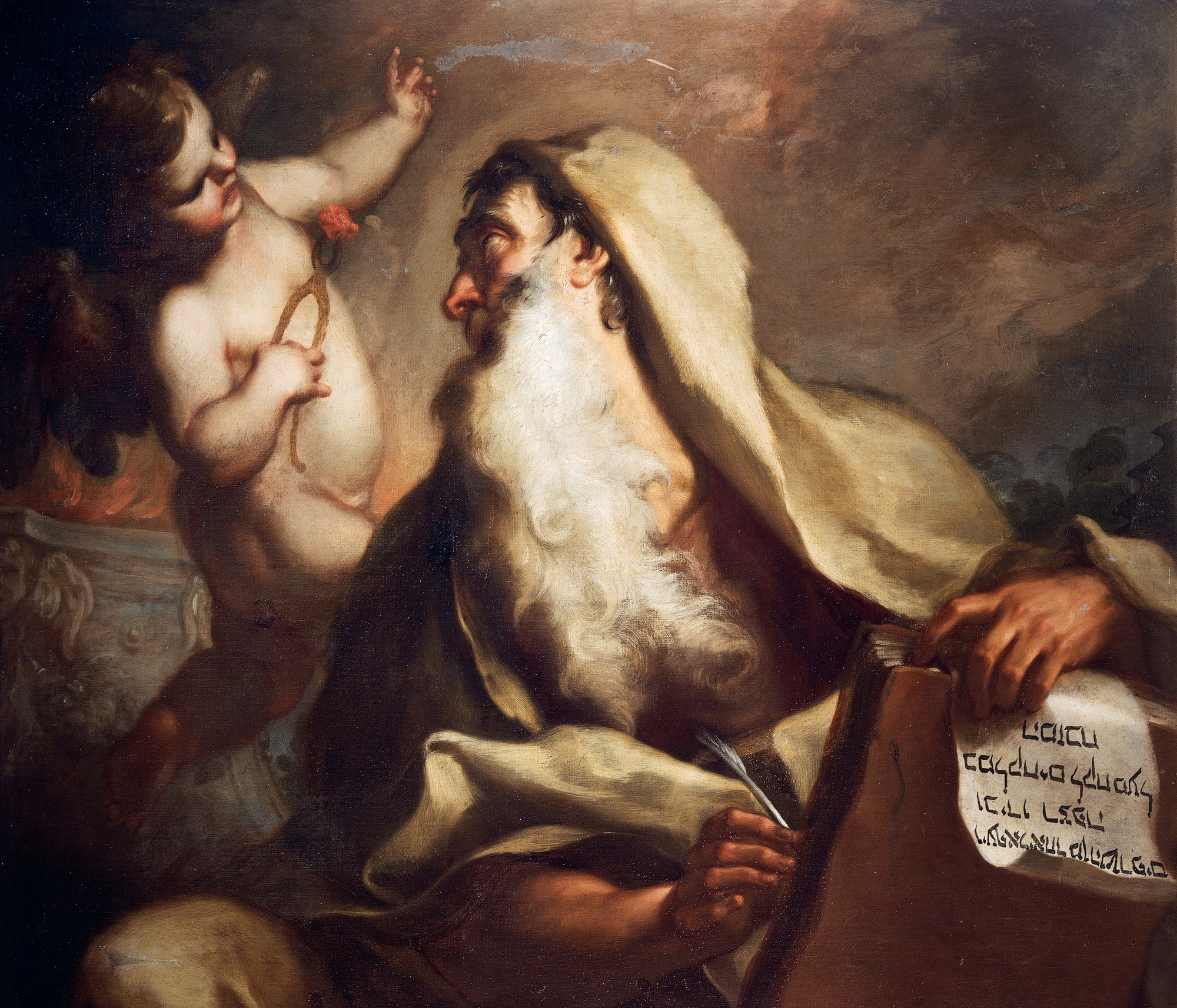
There is a tendency for us to simplistically dismiss the gods of the ancient world as mere figments of human imagination, but the biblical approach is a bit more complex than that.
To be clear, at no time in the Scriptures were these gods ever acknowledged to be gods in any true sense of the word. There is only one God and He is the LORD.
Consider the following text by St. Paul:
For although there may be so-called gods in heaven or on earth—as indeed there are many “gods” and many “lords”—yet for us there is one God, the Father, from whom are all things and for whom we exist, and one Lord, Jesus Christ, through whom are all things and through whom we exist (1 Cor 8:5-6).
It is a bit unclear whether St. Paul is affirming the existence of these gods or simply prescinding from a debate about that topic. For example, if I were to say to you, “Look, even if you may be right about that particular detail, it still doesn’t change the final answer,” I am not necessarily affirming that you are right about that detail, I am saying that I don’t really want to discuss that point, but rather, move on to the more fundamental point and conclusion.
So St. Paul may not necessarily be affirming that these gods actually exist, but neither is he outright denying that some beings exist that the pagans wrongly call gods.
In the Old Testament a similar stance is evident. There are repeated references to the gods of the pagans or Gentiles. The gods are not usually declared to be nonexistent, but rather it is said that if they do exist they are of no avail and far inferior to the one, true God of Israel: the LORD. There is even a passage in the Book of Psalms that seems to presuppose God in the midst of these gods:
God has taken his place in the divine council; in the midst of the gods he holds judgment: “How long will you judge unjustly and show partiality to the wicked? … I said, “You are gods, sons of the Most High, all of you; nevertheless, like men you shall die, and fall like any prince” (Ps 82 1-2; 5-6).
It is a complex passage. The context seems to be God rebuking princes and leaders of the people. But then why are they called gods? And why are they told that they will fall like princes?
The Scriptures do not tend to deny that entities called gods may in fact exist among the pagans. Hence they may not merely be figments of imagination. Yet if they do exist, they are powerless before the True God of Israel and none of them is a true god in any proper sense of the word. They are called gods but are not.
But if they do exist, what could they be? The frequent biblical answer is that they are demons posing as gods, deceiving the nations. Consider some of the following texts:
They did not destroy the peoples, as the Lord commanded them, but they mixed with the nations and learned to do as they did. They served their idols, which became a snare to them. They sacrificed their sons and their daughters to the demons; they poured out innocent blood (Psalm 106:34-38).
Note here that many of the psalms are written in a poetic manner. But here the poetic structure is based on the correspondence of the thoughts, not the similarity of the sounds. Thus the parallel in this psalm is between “They served their idols” and “They sacrificed their own children to demons.” The gods of the peoples and nations around them are called demons.
They stirred him to jealousy with strange gods; with abominations they provoked him to anger. They sacrificed to demons that were no gods, to gods they had never known (Deut 32:16-17).
The attestation here is pretty straightforward: the strange gods are demons.
For you provoked your Maker with sacrifices to demons and not to God; You forgot the eternal God who nourished you, and you grieved Jerusalem who nurtured you (Baruch 4:7-8).
While in this passage the term “gods” is not used along with the reference to demons, the echo of other texts referring to the idols and gods of the heathen seems clear.
What do I imply then? That food offered to idols is anything, or that an idol is anything? No, I imply that what pagans sacrifice they offer to demons and not to God. I do not want you to be participants with demons. You cannot drink the cup of the Lord and the cup of demons. You cannot partake of the table of the Lord and the table of demons. Shall we provoke the Lord to jealousy? Are we stronger than he? (1 Cor 10:20-22)
St. Paul says here that the idols and gods of the pagans are no gods at all but are in fact demons. The sacrifices that the pagans think they are directing to their gods are really being directed to demons.
Thus the Biblical approach to the gods of the pagans is not as simple as mere scoffing and consigning them to the realm of fantasy. The reality was often more tragic and harmful than mere fantasy. The Scriptures hold forth the fearsome possibility (and likelihood) that many of these gods were in fact demons in disguise. They were the deceiver, mockingly assuming his place as a god among the deceived nations.
Early Church Fathers such as Justin Martyr and Tertullian held similar views (that the gods were actually demons).
We do well to remember that when people turn away from God today, it is usually not that they believe nothing, but rather they believe in something (in fact, some believe in almost anything). And in turning to their modern idols, they may not merely be embracing an idea, but far worse, a demon. Our task is not just to summon people away from bad ideas, errors, ignorance, or false doctrines. In many cases we must also rescue them from demons.
Beware the doctrines of demons and their very presence. Scripture’s stance on the gods of the nations is not merely to dismiss them as nonexistent. These gods may in fact be pernicious enemies who are very real, who are not fantasy. As it was then, even so today.


 The video below contains a surprise, reminding us that not all things are as they appear. We should be careful about sizing things up, and when we must do so, do it with great humility. There is an old saying that seems appropriate: