A familiar Gospel passage read recently in daily Mass gives us a short theological teaching on suffering and the cross:
Jesus said to the crowds:
“Come to me, all you who labor and are burdened,
and I will give you rest.
Take my yoke upon you and learn from me,
for I am meek and humble of heart;
and you will find rest for yourselves.
For my yoke is easy, and my burden light” (Matt 11:28-30).
On reading a passage like this, two problematic reactions are possible. One is to react resentfully, thinking, “There’s nothing light or easy about the burdens I have to carry!” Another is to simplistically conclude that if one just follows Jesus, all one’s troubles will vanish. This is a recipe for future disappointment and resentment.
Both of these reactions should be avoided. Jesus gives us here a balanced teaching on the role of suffering and the cross that is best understood in its subtleties.
I There is a yoke and there is a burden in following Jesus
Jesus uses these very images; He does not exclude them. A burden is a weight that must be carried. We do not grow or gain in strength by reclining on a couch. We grow and gain in strength by carrying the weight of our duties. Burdens, though unpleasant, are necessary for growth.
A yoke is a device that helps us to carry our burdens. Consider an ox pulling a wagon. A rope around its neck would kill it, and so a wooden truss is built to distribute the weight across the front of its body. Some yokes permit two oxen to pull a load together. Horses sometimes wear a leather yoke that goes around their midsection. People who transport water from wells seldom carry pails with their hands as it is too painful for any extended period of time. Instead, they use a wooden beam, carved to fit their shoulders, with pails hanging from it.
A yoke does not lighten the load; it just makes it easier to carry. Jesus indicates that we who would follow Him will not have a life that is free of burdens; there are burdens and thus there is the need for a yoke.
II His yoke is “easy”
The common English translation of “easy” fails to capture the subtlety of what the Lord is conveying. The Greek word use is χρηστὸς (chrestos), and it refers to what is suitable, useful, well-fitted, or beneficial—not merely “easy.”
Consider how old shoes can be a blessing because they fit us perfectly; new shoes sometimes cause blisters until they (and our feet) adjust to each another. A good carpenter would work carefully to craft the yoke to the contours of the animal or to the shoulders of a human being. Only after these adjustments would the yoke be said to be chrestos (well-fitting).
One can almost picture Jesus, as a carpenter, doing this sort of work quite frequently. One can also whimsically imagine a sign hanging outside Jesus’ shop: “Well-Fitting Yokes Sold Here!”
Spiritually, Jesus is indicating in this text that while He does have a yoke (or cross) for us; it is suitable for us and will bring benefit. The burdens and yokes He has for us are not suffering merely for the sake of suffering. If carried and accepted with faith, they will benefit us. Each of us needs certain yokes and burdens, crosses and sufferings, in order to grow, be humbled, and gain wisdom. The Lord has crafted these yokes and burdens for us carefully. They are for good, not ill; for growth, not diminishment.
III. My yoke, my burden
Jesus is careful to refer to “my yoke” and “my burden.” For indeed, not every suffering we endure is from Him.
Frankly, we pile a lot of extra burdens on ourselves that He neither wills for us nor wants for us. Surely our sins bring us extra burdens, but beyond this there are many things that are good in and of themselves but which are not what God asked us to do.
Some of us undertake projects and efforts that are good and beneficial to others, but we do not ask God if it is His will that we do them. Perhaps God would tell us that He has other things for us to do, that He doesn’t want us to spend time doing things He has reserved for others and then end up not being able to do what He has designed for us.
And thus we must discern carefully what the true yokes and burdens are for us. God gives us the strength for those yokes and burdens, not for the yokes and burdens of our own design.
Here, then, is a brief teaching on burdens, suffering, and the cross. God does have these for us because we need them, but they are suited to us; they are possible for us to endure; they are carefully crafted to benefit us. “Beware,” says the Lord, “of what is not my burden and yoke, but is instead from you.”
To most modern minds, freedom is a very detached concept; it is an abstraction of sorts, a free-floating power unmoored from any limits or defining standards. Freedom today is often viewed as personal and self-referential, with little consideration as to how one’s “freedom” might affect that of someone else. A healthy sense of the common good suffers mightily in a world of deeply conflicting personal freedoms.
I have written before on the paradoxes of freedom and will not repeat all of that here, but one point to reiterate is that for us (who are limited and contingent beings) the only true and healthy freedom is a limited one.
I was free to write this column and you are free to read it, but in order for shared communication to occur, we must each limit our respective personal freedom by following certain rules. I had to post the article in the expected place and you had to go there to read it. I had to follow many grammatical and linguistic rules in order to be intelligible, and you must apply similar norms in order to understand. As soon as either of us starts to cop an attitude and say, “I will not be told what to do; I will do whatever I please,” communication suffers. And thus each of us limits his freedom in order to communicate.
Another example can be found in the realm of sports. Rules, in a sense, make the game. The players and spectators limit their freedom by accepting that a given game has a specific goal. Further there are boundaries and rules of play. If some or all of these limits are removed, there is no framework. Players start moving aimlessly about the field and teams break apart. Spectators argue about everything and even forget why they are in the stadium at all. All order on the field and in the stands breaks down; even the distinction between the field and the stands starts to lose meaning. Chaos and conflict result.
To some degree this picture describes our modern age. Cultures, like the microcosm of a sports event, need agreed upon goals and rules of play in order to function properly. In the modern Western world, we are currently engaged in a misguided experiment as to whether a culture can exist without a shared cultus.
Obviously, the word cultus is at the heart of the word culture. In Latin, a cultus is something for which we care or are concerned, something of worth, something considered valuable. It describes the most central, fundamental values of a group. In later Latin, cultus came to describe the worth or value we attribute to God, who is our truest goal.
Remove the cultus from culture and you get the breakdown we have today. While pluralism and diversity have value, they must exist within a framework that is shared and agreed upon. Otherwise pluralism and diversity are unmoored and become like ships crashing about in a stormy bay.
In order for a culture to exist, there must be a shared cultus, a shared focus on what is good, true, beautiful, and sacred. Our modern experiment shows the failure of trying to have a culture without this.
Bishop Robert Barron, himself commenting on Pope Benedict’s analysis, writes the following:
The setting aside of God can take place both explicitly (as in the musings of the atheists) or implicitly (as in so much of the secular world where “practical” atheism holds sway). In either case the result is a shutting down of the natural human drive toward the transcendent and, even more dangerously, the elevation of self-determining freedom to a position of unchallenged primacy. [Pope Benedict elaborates] here a theme that was dear to his predecessor, namely, the breakdown of the connection between freedom and truth. On the typically modern reading, truth is construed as an enemy to freedom—which explains precisely why we find such a hostility to truth in the contemporary culture. Indeed, anyone who claims to have the truth—especially in regard to moral matters—is automatically accused of arrogance and intolerance. Society will be restored to balance and sanity, Benedict argued, only when the natural link between freedom and truth—especially the Truth which is God—is reestablished. … Behind all our arguments about particular moral and political issues is a fundamental argument about the centrality of God [Vibrant Paradoxes, pp. 217-218].
And thus freedom cannot be an abstraction. It cannot be unmoored; it is not an unlimited concept. It can only exist in a healthy and productive way when it is in reference to the truth—and truth is rooted in God and what He has revealed in creation, Sacred Scripture, and Tradition. This is the cultus necessary for every culture. True and healthy freedom is the capacity to obey God. Anything that departs from this necessary framework is a deformed freedom, on its way to chaos and slavery.
The more one does what is good, the freer one becomes. There is no true freedom except in the service of what is good and just. The choice to disobey and do evil is an abuse of freedom and leads to “the slavery of sin” (Catechism of the Catholic Church, 1733).
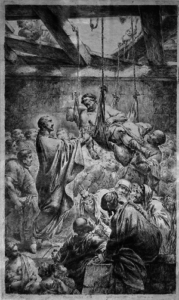
Today I’d like to reflect further on the Gospel from yesterday’s Mass (Monday of the second week of Advent). The Gospel tells of the paralyzed man whose friends lowered him through the roof in order to see Jesus. It is read during Advent because one of the prophecies about the Messiah was that He would make the lame walk. In a provocative way, this Gospel also helps us to focus on Jesus’ central mission for us.
The Gospel passage contains a rather peculiar and somewhat awkward moment: Jesus looks at the paralyzed man and says to him, As for you, your sins are forgiven (Lk 5:20). What a strange thing to say to a paralyzed man!
Now we might be tempted to tap Jesus on the shoulder and say, “Excuse me, Lord, but this man is paralyzed. His problem is paralysis, that’s what he needs healing for!” (The Pharisees and scribes get worked up for a different reason;they don’t think that Jesus has the authority to forgive sins.)
Of course Jesus is neither blind nor lacking in intelligence. But unlike us, Jesus looks at the man and does not consider his paralysis to be his most serious problem; to Jesus, the man’s biggest problem is his sin.
Living as we do in this world, most of us have the world’s priorities. The Lord sees something more serious than paralysis, while we wonder what could possibly be more serious than paralysis! But not as man sees does God see. For God, the most serious problem we have is our sin. We don’t think like this even if we are told we should think like this.
Influenced by the flesh as we are, most of us are far more devastated by the thought of losing our health, or our money, or our job, than we are by the fact that we have sin. Threaten our health, well-being, or money, and we’re on our knees begging God for help. Yet most people are far less concerned for their spiritual well-being. Most of us are not nearly so devastated by our sin (which can deprive us of eternal life) as we are by the loss of our health or some worldly possession.
Even many of us who have some sense of the spiritual life still struggle with this obtuseness, and with misplaced priorities. Even in our so-called spiritual life, our prayers are often dominated by requests that God fix our health, improve our finances, or help us to find a job. It is not wrong to pray for these things, but how often do we pray to be freed of our sins? Do we earnestly pray to grow in holiness and to be prepared to see God face-to-face? Sometimes it almost sounds as if we are asking God to make this world more comfortable so that we can just stay here forever. This attitude is an affront to the truer gifts that God offers us.
And so it is that Jesus, looking at the paralyzed man, says to him, Your sins are forgiven. In so doing, Jesus addresses the man’s most serious problem first. Only secondarily does He speak to the man’s paralysis, which He almost seems to have overlooked in comparison to the issue of his sin.
We have much to learn hear about how God sees, and about what are the most crucial issues in our life.
Joseph and Mary were told to call the child “Jesus,” because He would save His people from their sins. In his book Jesus of Nazareth: The Infancy Narratives, Pope Benedict XVI writes,
… Joseph is entrusted with a further task: “Mary will bear a son, and you shall call his name Jesus, for he will save his people from their sins” (Matthew 1:21). … On the one hand, a lofty theological task is assigned to the child, for only God can forgive sins. So this child is immediately associated with God, directly linked with God’s holy and saving power. On the other hand, though, this definition of the Messiah’s mission could appear disappointing. The prevailing expectations of salvation were primarily focused upon Israel’s concrete sufferings—on the reestablishment of the kingdom of David, on Israel’s freedom and independence, and naturally that included material prosperity for this largely impoverished people. The promise of forgiveness of sins seems both too little and too much: too much, because it trespasses upon God’s exclusive sphere; too little, because there seems to be no thought of Israel’s concrete suffering or its true need for salvation.
Benedict then cites this same story of the paralytic and says,
Jesus responded [to the presence of the paralyzed man] in a way that was quite contrary to the expectation of the bearers and the sick man himself, saying: “My son, your sins are forgiven” (Mark 2:5). This was the last thing anyone was expecting; this was the last thing they were concerned about.
He concludes,
Man is a relational being. And if his first, fundamental relationship is disturbed—his relationship with God—then nothing else can be truly in order. This is where the priority lies in Jesus’ message and ministry: before all else he wants to point man toward the essence of his malady.
Yes, God sees things rather differently than we do. There is much to ponder about the fact that Jesus said to the paralyzed man, Your sins are forgiven you.
One of the dangers in presenting New Testament moral teaching is reducing the Gospel to a moralism, a rule to follow using the power of one’s own flesh. This is an incorrect notion because for a Christian, the moral life is not merely achieved; it is received. The moral life is not an imposition; it is a gift from God.
The Gospel chosen for Thanksgiving Day features the familiar story of the ten lepers who are healed by Jesus, but only one of whom returns to thank Him. The ingratitude of the other nine prompts an irritable response from Jesus, who more than suggests that they also should have returned to give thanks. Reading this Gospel on the surface, it is easy to conclude that it is a moralism about being thankful to God and others. Well, that’s all well and good, but simply reminding people of a rule of polite society isn’t really the Gospel.
True thankfulness is receiving from God a deeply grateful heart so that we do not merely say thank you in a perfunctory way, but are deeply moved with gratitude. We are not merely being polite or justly rendering a debt of obligation; we actually are grateful from the heart. True gratitude is a grace, a gift from God, which proceeds from a humble and transformed heart. We do not render thanks merely because it is polite or expected, but because it naturally flows from a profound experience of gratitude. This is the Gospel. It is not a moralism, but a truth of a transformed heart.
An anointing that we should seek from God is the powerful transformation of our intellect and heart such that we become deeply aware of the remarkable gift that is everything we have. As this awareness deepens so does our gratitude and joy at the “magnificent munificence” of our God. Everything—literally everything—is a gift from God.
Permit me a few thoughts on the basis for a deepening awareness of gratitude. Ultimately, gratitude is a grace, but having a deeper awareness of the intellectual basis for it can help to open us more fully to this gift.
We are contingent beings who depend upon God for our very existence. He holds together every fiber of our being: every cell, every part of every cell, every molecule, every part of every molecule, every atom, every part of every atom. God facilitates every function of our body: every beat of our heart, every movement of our body. God sustains every detail of the universe: the perfectly designed orbit of Earth so that we do not overheat or freeze, the magnetic shield around Earth protecting us from the harmful aspects of solar radiation, and every process (visible and hidden) of everything on our planet, in our solar system, and in our galaxy. All of this, and us, are contingent; we are sustained by God and provided for by Him. The magnitude of what God does is simply astonishing—and He does it all free of charge! Pondering such goodness and providence helps us to be more grateful.
Every good thing we do is a gift from God. St. Paul said, What have you that you have not received? And if you have received, why do you glory as though you had achieved? (1 Cor 4:7) Elsewhere, he wrote, For it is by grace you have been saved, through faith—and this not from yourselves, it is the gift of God—not by works, so that no one can boast. For we are God’s workmanship, created in Christ Jesus to do good works, which God prepared in advance for us to do (Eph 2:8-10). Hence even our good works are not our gift to God; they are His gift to us. On judgment day we cannot say to God, “Look what I’ve done; you owe me Heaven.” All we can say on that day is “Thank you!”
Gifts sometimes come in strange packages. There are some gifts of God that do not seem like gifts at all. There are sudden losses, tragedies, natural disasters, and the like. In such moments we can feel forsaken by God; gratitude is the last thing on our mind. But Scripture bids us to look again: And we know that all things work together for the good of those who love God and who have been called according to his purpose (Romans 8:28). We don’t always know how, but even in difficult moments God is making a way unto something good, something better. He is paving a path to glory—perhaps through the cross—but unto glory. We may have questions, but remember that Jesus said, But I will see you again and you will rejoice, and no one will take away your joy. On that day you will have no more questions to ask me (Jn 16:22-23). Yes, even in our difficulties we are more than conquerors (Rm 8:37) because the Lord can write straight with crooked lines, and make a way out of no way.
Yes, all is gift. Absolutely everything is gift. Even our failures are gifts, provided we are in Christ and learn humility from them. For what shall we give thanks? Everything! There is an old saying, “Justice is when you get what you deserve. Mercy is when you don’t get what you deserve. Grace is when you get what you don’t deserve.” Like you, I am asked many times a day, “How are you doing?” I’ve trained myself to respond, “More blessed than I deserve.”
The word “thanks” in English is unfortunately abstract. In Latin and the Romance languages, the words for thanks are more closely related to the concepts of grace and gift. In Latin, one says thank you by saying, “Gratias ago tibi,” or simply, “Gratias.” And although gratias is translated as “thanks,” it is really the same root word as that of “grace” and “gift,” which in Latin are rendered as “gratia.” Hence in saying this, one is exclaiming, “Grace!” or “Gifts!” It is the same in Spanish (Gracias) and Italian (Grazie). French has a slightly different approach: Merci comes from the Latin merces, which refers to something that has been paid for or given freely. So all of these languages recognize that the things for which we are grateful are really gifts. The English word “thanks” does not quite make the connection. About the closest we get in English are the words “gratitude” and “grateful.” All of these words (gratias, gracias, grazie, merci, gratitude) teach us that everything is gift!
Gratitude is a gift to be received from God and should be asked for humbly. One can dispose oneself to it by reflecting on some of the things described above, but ultimately gratitude comes from a humble, contrite, and transformed heart. True gratitude is a grace, a gift that springs from a heart moved, astonished, and deeply aware of the fact that all is gift.
If we could travel back in time to 30 A.D. and meet the Lord Jesus as He carried forth His public ministry, we might be quite surprised by what we saw. I say this because many of us are heirs to a rather filtered description of Him that is both Western and modern.
Most picture Jesus as fair-skinned and slender, with long, straight hair and a gentle beard. This physical reimagining of Him began rather early, gathered steam during the Renaissance, and has come to our day. I will not dwell here on His physical traits in this post, as I have written in detail on them elsewhere: What Did Jesus Look Like?.
As for His mannerisms, most imagine Jesus as gentle, kind, soft-spoken (except to mean people like the Pharisees), and “loving” in the modern sense. Images of him welcoming children, being the Good Shepherd, speaking of the lilies of the field, and forgiving the woman caught in adultery (but not the part when He tells her to stop sinning), predominate. Many modern people default to or strongly emphasize these images (rather than consulting the fuller text of Scripture) in interpreting Jesus. For many, the preferred images overrule the Sacred text, no matter how voluminous those balancing texts might be.
And thus if the Church, or a priest, or any Christian says anything that seems “hard” to modern ears, many will retort that Jesus is love and would never talk like this. Some years ago, after preaching a sermon on Hell and the need to be prepared for judgment, a woman in the parish I was visiting said this to me: “I didn’t hear the Jesus I know in your words today.” I replied that I was quoting Jesus Himself (the gospel of that Sunday was about the narrow road to salvation and the wide road to Hell). She was not fazed, and simply replied, “I know He never said that.” Her personal image of Jesus overruled even the sacred text. This is common today.
This is why I think the real Jesus, as described in Scripture, would surprise many modern people.
Surprise #1: His physical vigor and stamina
A mere consultation of the map reveals an enormous and diverse terrain where Jesus, His family, and His apostles routinely walked. Each year, Jesus journeyed on foot approximately 70 miles south to Jerusalem and then back again. His daily journeys took Him throughout the whole of Galilee and as far as 35 miles to the north (Tyre, Sidon, Caesarea Philippi). The terrain in the area was difficult, hilly (even mountainous) areas alternating between fertile lands and deserts within mere miles.
Jesus climbed the hills around the Sea of Galilee and mountains as high as Tabor. He, His family, and His followers often trod long journeys of many days. Travels could be dangerous because brigands and thieves lay in wait for opportune moments. The availability of lodging was unpredictable and many nights had to be spent out in the elements.
In His final journey to Jerusalem, Jesus took the desert route that went through Jericho. It is a howling desert that descends more than 800 feet below sea level. His climb to Jerusalem (more than 2500 feet above sea level) was more than 3000 feet up. Despite this difficult journey, He was the guest that very evening at the house of Martha and Mary, where He was anointed by Mary with costly nard.
Most moderns know little of such vigor and stamina. Many of us become winded by a mere hill; the thought of walking 70 miles would seem almost impossible to us. Those who go to the Holy Land today and follow the paths of Jesus usually do so in air-conditioned buses and complain of the steep hills that must be climbed on foot in Nazareth, Ein Karem, and Jerusalem.
These were hardy people, not the slight figures that modern artists often depict. It does not mean that they were extremely muscular, but they were used to hard physical work, long walks, and the sorts of hardships that would discourage many of us.
Surprise #2: His loud and challenging preaching
In those days there were no microphones or amplification of any kind. Preachers of that time did not (could not) use a gentle, suggestive tone. They had to shout out their message. Town criers were called such for a reason. Even indoors an elevated tone was required because crowded rooms muffle sound.
Jesus often preached outdoors, sometimes to crowds of thousands. Consider again His stamina and that such sermons were more of a shout than a mere discourse or exhortation. This would likely be challenging to us who are used to the more discussion-like quality of the preaching in the last hundred years.
A number of years ago I gave a talk on the Sacrament of Holy Matrimony to a large church gathering. For some reason the public address system was not working. Now I have a loud voice, but projecting it in such a large venue required a near shout. I tried to mitigate that by interspersing humor and other disarming methods, but about half of the audience indicated (on the evaluation forms they filled out) that I seemed angry or harsh. I was certainly not angry, and although the message of traditional marriage is challenging to modern notions, the emphasis was that grace assists fidelity and the forgiveness that is necessary for lifelong love.
A further surprising note on Jesus’ preaching is that he preached while seated. The sacred text affirms this tradition in many places. All the ancient rabbis preached while seated, it was a sign of authority.
Surprise #3: His uncompromising stance
Jesus was in the mode of the prophets, and the prophets were never ones to soft-pedal, compromise, or be vague. Any analysis of Jesus’ true message (not the selective and filtered modern version) shows that He made expansive, uncompromising demands on any who would be His disciples. We must repent and believe His Gospel. We must clearly accept that He is the only light, the only truth, and the only Son to the Father. We are to love no one and nothing more than we love Him. This includes our very family as well as the things most essential to our physical survival, such as career and livelihood. If we do not do this, then we are not worthy of Him. We must take up our cross daily. We must be willing to suffer even unto death for Him and what He teaches. It is not enough to love our neighbor; we must love our enemy. It is not enough to avoid adultery; we must have a comprehensive sexual purity that excludes all forms of sexual activity outside of biblical marriage, even impure thoughts. We must forgive others who have hurt us or else the Father will not forgive us.
Time and time again, the real Jesus warned of Hell and the necessity to be sober and serious about judgment. Jesus was not some angry preacher. Jesus, who loves us, warned that many would be unable and unwilling to enter Heaven on its terms; few would take the narrow road of the cross. Not all who say, “Lord! Lord!” will enter heaven, but only those who do the will of the Father. Many will hear from Him, “I know you not. I know not from whence you come. Depart from me.”
There is no compromise, no third way. We cannot serve two masters, God and mammon. A friend of the world is an enemy to God. He would say that no one who sets his hand to the plow and keeps looking back is fit for the reign of God. To our excuses and pleas for time in “getting our act together,” He might say, “Let the dead bury their dead, but you go and proclaim the Kingdom!”
There is little we can call gentle or soft in the mainstream of Jesus’ preaching. Though He invited His disciples to discover Him as the true shepherd, the true lover of our souls, who can give us the true Bread for which we hunger and lasting water to quench our thirst, He wants us carrying our cross, not reclining on our couch. Jesus healed many, but He insisted on faith being operative prior to performing miracles.
Jesus’ plan for us involves deep paradox; He challenges our every expectation. He does not apologize for offending our notions. He declared that if anyone was ashamed of Him and His teachings, then He would be ashamed of that person on the Day of Judgment. There is to be no compromise with the wisdom of the world.
All of this, though recorded clearly and consistently in the biblical record, is conveniently forgotten by. Most modern people prefer nuance and/or euphemisms; they prefer a suggestive and inviting tone. But Jesus, like the prophets of the day, combined a searing judgment on worldly ways with an uncompromising insistence that we choose sides.
Surprise #4: His urgency
Jesus had a determination that a lot of us would interpret as a kind of inflexibility. We like to discuss things; we celebrate collaboration and team work.
Jesus doesn’t fit in this box at all. He knew exactly what He wanted to do. He sent missionaries ahead of Him into every town and village. He accepted no correction from those objected to His course or to the fact that He ate with sinners. When the crowds objected to Jesus’ teachings (such as His teaching on the Eucharist at Capernaum), He did not reconsider His words or go out and hire a public relations firm to improve His image. He did not conduct focus groups to test out His words and ideas. No, Jesus doubled down on disputed teachings and then asked His disciples if they were going to desert Him. He had an urgent mission to convey the truth, not debate it at length with detractors.
Jesus was on the move and urgently pursued His task. He told His disciples that He must work while it was still day because the darkness was coming when work would cease. In his final journey to Jerusalem, it was said that Jesus “set His face like flint,” an expression that conveys firm resolve. He set out on the journey, fully knowing (and announcing) that He would suffer at the hands of men, die, and rise.
Jesus’ own apostles balked and resisted, wondering why He would go there knowing that the leaders sought to kill Him. When Peter tried to dissuade Him, Jesus turned to him angrily, challenged his worldly thinking, and called him Satan.
No, Jesus would not turn back. At one point, He rebuked the weak faith of the Apostles, saying, “How much longer must I tolerate you?!” He also warned, “He who does not gather with me scatters.”
So Jesus was urgent and unstoppable. Meanwhile, His apostles vacillated between resistance to the looming danger, denial, and avoidance. More than once, the sacred text indicates that they were afraid to ask Him any more questions.
Nothing would stop Jesus. Even at the Last Supper, as He arose to go forth to His Passion, Jesus said, “The world must know that I love the Father and that He sent me. Arise. Let us go hence.”
Only briefly (in the garden) did Jesus express even the slightest doubt. Quickly it was resolved: whatever the Father wanted would receive His assent. We are saved by the human decision of a divine person.
Why this urgency? It was to save us! “What should I say? ‘Father save me from this hour?’ No, it was for this hour that I came into the world” (John 12:27).
I am convinced that all of this urgency would surprise us. We are more comfortable with a Jesus who wandered about blessing people, telling stories, and who only at the very end fell into trouble. Nothing could be further from the recorded history of the sacred text. Knowing everything that would take place, Jesus set out manfully to His goal and would allow nothing to stop or sidetrack Him. This was His Father’s will and He was urgent.
Yes, I suspect that most of us would be surprised if we encountered Jesus back around the year 30 A.D. For those who have not internalized the biblical texts and have substituted a modern image far removed from the recorded truth, Jesus might seem overbearing and even impatient. They would see Jesus speaking broadly—even bluntly—in the mode of the prophets. Would there be nothing of the gentle Jesus that so many prefer? Of course there would, but not in the exclusive amount that many moderns prefer.
Perhaps I do well to finish with the words of Ross Douthat, who in his book Bad Religion, summarizes this well:
Christianity is a paradoxical religion because the Jew of Nazareth is a paradoxical character. No figure in history or fiction contains as many multitudes as the New Testament’s Jesus. He’s a celibate ascetic who enjoys dining with publicans and changing water into wine at weddings. He’s an apocalyptic prophet one moment, a [careful and] wise ethicist the next. … He promises to set [spouses against one another and] parents against children, and then disallows divorce; he consorts with prostitutes while denouncing even lustful thoughts. … He can be egalitarian and hierarchical, gentle and impatient, extraordinarily charitable and extraordinarily judgmental. He sets impossible standards and then forgives the worst of sinners. He blesses the peacemakers and then promises that he’s brought not peace but the sword. He’s superhuman one moment; the next he’s weeping.
The boast of Christian orthodoxy, as codified by the councils of the early Church and expounded in the Creeds, has always been its fidelity to the whole of Jesus. … [Where heresy says which one] Both, says orthodoxy …. The goal of the great heresies, on the other hand, has often been to extract from the tensions of the gospel narratives a more consistent, streamlined, and noncontradictory Jesus [1].
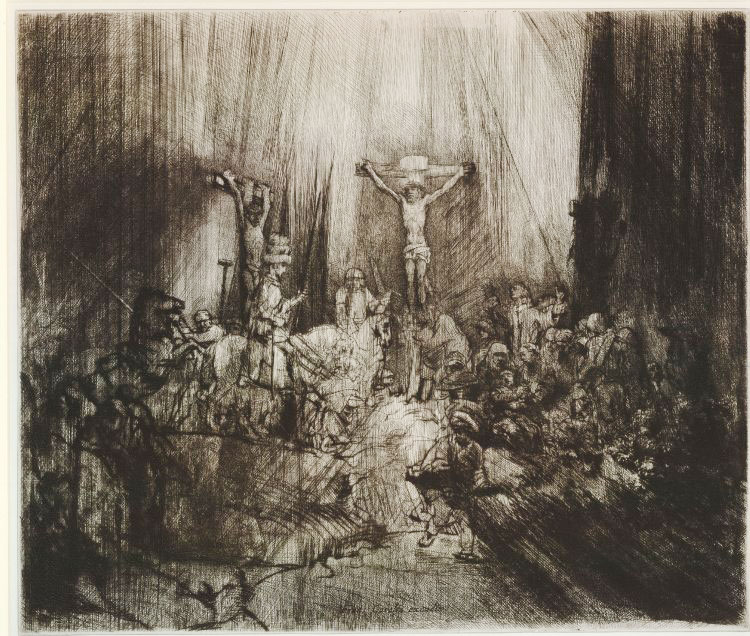
It is good and necessary to ponder more of the Gospel of yesterday’s Solemnity of Christ the King. It remains a profound teaching that Christ was crucified between two thieves. Why?
St. Thomas Aquinas proposes three answers to the question. Let’s consider them, with particular emphasis on the third.
I. To Identify with Fallen Sinners – St Thomas said, As Christ became accursed of the cross for us, so for our salvation He was crucified as a guilty one among the guilty (Comm. xxxiii in Matth.) (Summa Theologica III, Q 46, Art. 11).
In other words, Jesus bore our guilt and our shame, though He Himself was sinless (see 1 Peter 2:24 and Isaiah 53:4). He was assigned a grave with the wicked, and with the rich in his death, though he had done no violence, nor was any deceit in his mouth (Is 53:9). And thus Christ took up and endured the punishments we deserved.
We are all sinners and thieves.How are we thieves? One who takes what belongs to another is a thief, but so also is one a thief who uses what he received from another in a way contrary to his will. In this way we are all thieves, for we have used the things of God in ways contrary to what He wants.
Consider our bodies, which belong to God (see 1 Cor 6:19-20). How often do we use them in ways contrary to what God, the true owner of our bodies, wants? We often use our bodies to sin. We use the gift of speech to speak words of malice and deceit rather than those of truth and encouragement. We allow our eyes to look upon things that violate what God would have us see. We use our ears to listen to gossip, hatred, and impurity. Using our bodies in ways that oppose what the true owner wants is a form of theft.
So we are all thieves. And yet Christ, who never stole and never sinned, is willing to be seen and counted among us! The book of Hebrews says that He is not ashamed to call us brethren. Yes, He is identified with sinners and thieves like us.
II. To Image the Final Separation – Jesus indicates that there is a great separation between those on his right (the sheep) and those on his left (the goats) on the Day of Judgment (see Matt 25:41ff). St. Thomas said,
… [A]s Pope Leo observes (Serm. iv de Passione): “Two thieves were crucified, one on His right hand and one on His left, to set forth by the very appearance of the gibbet that separation of all men which shall be made in His hour of judgment.” And Augustine on John 7:36: “The very cross, if thou mark it well, was a judgment-seat: for the judge being set in the midst, the one who believed was delivered, the other who mocked Him was condemned. Already He has signified what He shall do to the quick and the dead; some He will set on His right, others on His left hand.” … because of the cleavage between believers and unbelievers, the multitude is divided into right and left, those on the right being saved by the justification of faith (Summa Theologica III, Q 46, Art. 11).
Thus this moment indicates or pictures the final judgment, when Christ, seated on His throne as Judge of the World and Lord of all, will have some to His right and others to His left. Some will be the sheep and others the goats; some will be the wise virgins and others the foolish ones. Those on His right will hear, Come, you who are blessed by my Father, inherit the kingdom prepared for you from the foundation of the world (Matt 25:34). Those on his left will hear, Depart from me, you cursed, into the eternal fire prepared for the devil and his angels (Matt 25:41).
III. To Insist on Freeing Suffering – Christ insisted that true disciples would be distinguished by their willingness to carry the cross. Though God originally offered paradise, Adam and Eve’s (our) rejection of it and insistence upon living in Paradise Lost, means that the Lord must insist upon the cross (suffering) as the only remedy for our salvation. St. Thomas wrote,
Bede says on Mark 15:27: “The thieves crucified with our Lord denote those who, believing in and confessing Christ, either endure the conflict of martyrdom or keep the institutes of stricter observance. But those who do [this] for the sake of everlasting glory are denoted by the faith of the thief on the right; while others who do so for the sake of human applause copy the mind and behavior of the one on the left.” (Summa Theologica III, Q 46, Art. 11).
Yes, to follow Christ involves suffering and rejection. It also involves stricter observance, which postpones certain passing pleasures in order to inherit lasting ones, which rejects apparent goods in order to receive true goods. Some are willing to endure this, while others are not.
The good thief accepted that he was suffering as he deserved, asking only to suffer with Christ. He accepted the cross and was willing to be identified with the true Christ—crucified Christ. He was willing to endure this as the way to paradise.
The bad thief wanted to be taken down. He wanted nothing to do with the cross. He thought as human beings do, not as God demanded. Like the scoffers beneath the cross, he demanded that the Messiah come down rather than endure it, that the Messiah eliminate the cross rather than insist upon it. In so doing, the bad thief sought human applause rather than God’s approval. And so the bad thief suffered in vain.
Jesus said, Anyone who does not take up his cross and follow Me is not worthy of Me (Matt 10:38). Whoever wants to be my disciple must deny himself and take up his cross and follow me (Matt 16:24). St. Paul said, … we preach Christ crucified, a stumbling block to Jews and foolishness to Gentiles, but to those who are called, both Jews and Greeks, Christ the power of God and the wisdom of God (1 Cor 1:23-25). He also lamented, For, as I have often told you before and now tell you again even with tears, many live as enemies of the cross of Christ. Their destiny is destruction, their god is their stomach, and their glory is in their shame. Their mind is set on earthly things (Phil 3:18-19).
The men on either side of the Lord are both thieves, but the similarity ends there. The one is not bad merely because he reviled Christ, but also because he refused the cross and the Messiah who embraced it. The other is good not only because he did not revile Christ, but also because he accepted his cross and was willing to suffer alongside Him. Christ’s cross (and his own sliver of it) was his spes unica (only hope), and he was willing to endure it.
The question for you is this: Which thief are you?
Many people today will have nothing to do with the cross, insisting that the Messiah would demand no such thing. Among them are many so-called Catholics. They scoff at the notion that God wants them to be anything but happy and content. Speak to them of any difficult thing such as turning away from sin or doing what is unpopular, and they will insist, “God wants me to be happy, doesn’t He?”
The latest “anti-cross” trend is physician-assisted suicide; it is a rejection of the cross. Yet those who support it insist on calling it “death with dignity” and/or the “right to die.” Among them, sadly, are many Christians, who should know better. They seem to think that suffering of this sort is meaningless.
Suffering is not meaningless. It brings wisdom, humility, perspective, strength, and trust. It reminds us of the passing quality of this world and prepares us to meet God.
To many, the cross must go; it shall not be. It is not far from the cry of the bad thief and the scoffers at the foot of the cross: “If you are the Messiah, come down from that cross!” But He will not be the messiah we expect. He does not seek human applause. He will be the true Messiah. Only the true Messiah can save us.
Which thief are you? Are you the one who accepts the cross and is willing to die outside the gate with Christ, or are you the one who insists that the cross must go?
One of the things that I have learned about myself, and humans in general, is that our strengths are very closely related to our struggles. Some people are very passionate; this makes them dedicated and driven to make a difference. But it also makes them prone to anger or depression. Their passion in one area (e.g., truth, justice) can cause difficulties with passions in other areas such as sexuality, food, or drink. Passionate people can inspire others and are often great leaders. But they also run the risk of crashing and burning, whether emotionally or morally.
At the other end of the spectrum, consider those who are very relaxed and steady emotionally. They are thoughtful, thinking and acting deliberately. They are calm under pressure, not easily excited. They make good diplomats; they are the sort to bring conflicting parties together. But such people may often struggle to maintain integrity. Sometimes they make too many compromises and forget that there are things that are worth being angry about, worth fighting for. If a person never gets worked up, it could be because he doesn’t care enough about important issues. There’s a saying that the opposite of love isn’t hate; it’s indifference.
This is part of what makes human beings complex and fascinating. There is a certain tipping point at which a virtue becomes a vice either by excess or defect. St. Thomas Aquinas said, In medio stat virtus (Virtue stands in the middle).
And thus in our example here of the passion of anger, the virtue to be sought is meekness. Aristotle defined meekness as the proper middle ground between too much anger and not enough.
The unusual commercial below shows an example of underwhelming joy. It is humorously portrayed in a perfectly deadpan way. But like anger, joy indicates a zeal for what is good, true, and beautiful (even if the subject is just shoes). It is certainly a virtue to be emotionally balanced, avoiding silliness and frivolity. But the strength of a stable and balanced personality can too easily become indifference about things that are important and should bring joy.
Think of someone you love. I’ll bet the thing you like most about him or her is often the very thing that frustrates you the most. Now think about yourself. What are your strengths? Are they not in fact closely related to the areas in which you struggle the most?
Enjoy this humorous commercial. In his subdued joy, is he exhibiting admirable control or is his heart dull? Is this virtue (balance) or is it a defect?
The Gospel from Wednesday’s Mass (Wed. of the 33rd Week – Luke 19:11-27) is known as the “Parable of the Ten Gold Coins.” It has an ending so shocking that, when I read it at Mass some years ago, a young child said audibly to her mother, “Wow, that’s mean!”
I’d like to look at it and ponder its shocking ending.
Today’s parable is like Matthew’s “Parable of the Talents,” but with some significant differences. In today’s parable, ten people each receive one gold coin. We only hear the reports of three of them (as in the Matthean account): two who show a profit and one who shows none.
Another difference is the interweaving of another parable (let’s call it the “Parable of the Rejected King”) within the story. Here is a shortened version, including the shocking ending:
A nobleman went off to a distant country to obtain the kingship for himself and then to return. His fellow citizens, however, despised him and sent a delegation after him to announce, “We do not want this man to be our king.” But when he returned after obtaining the kingship … [he said] “Now as for those enemies of mine who did not want me as their king, bring them here and slay them before me” (Luke 19:12,14, 27-28).
In analyzing a text like this I must say that I was disappointed at the silence of most commentaries with respect to this ending. The shocking phrase “slay them before me” goes largely unremarked.
The Church Fathers seem to say little about it. I was, however, able to find two references in St. Thomas Aquinas’s Catena Aurea. St. Augustine said of this verse, Whereby He describes the ungodliness of the Jews who refused to be converted to Him. Theophilus wrote, Whom he will deliver to death, casting them into the outer fire. But even in this world they were most miserably slain by the Roman army.
Hence both Fathers take the verse at face value, even declaring it historically fulfilled in the destruction of Jerusalem in 70 A.D. Josephus indicated in his work that 1.2 million Jews were killed in that dreadful war.
Historically fulfilled or not, Jesus’s triumphal and vengeful tone still puzzles me. If this verse does refer to the destruction of 70 A.D., then how do we account for Jesus’s tone here when just a few verses later He wept over Jerusalem?
As Jesus approached Jerusalem and saw the city, he wept over it and said, “If you, even you, had only known on this day what would bring you peace—but now it is hidden from your eyes. The days will come upon you when your enemies will build an embankment against you and encircle you and hem you in on every side. They will dash you to the ground, you and the children within your walls. They will not leave one stone on another, because you did not recognize the time of God’s coming to you” (Lk 19:41-44).
Certainly a variety of emotions can sweep over even the God-man Jesus, but let me also suggest some other contextual and cultural considerations that frame Jesus’s startling and “mean” words (Now as for those enemies of mine who did not want me as their king, bring them here and slay them before me).
1. Jesus was speaking in the prophetic tradition – Prophets often spoke this way, using startling and often biting imagery and characterizations. Though many today try to “tame” Jesus, the real Jesus spoke vividly, in the prophetic tradition. He often used shocking and paradoxical images. He spoke bluntly, as prophets do, calling his hostile interlocutors hypocrites, vipers, children of the devil, whitewashed tombs, evil, foolish, blind guides, and sons of those who murdered the prophets. He warned them that they would be sentenced to Hell unless they repented; He laid them out for their inconsistency and hardness of heart. This is the way prophets speak.
In speaking in this “mean” way, Jesus was firmly in the tradition of the prophets, who spoke similarly. Thus, in understanding these harsh words of Jesus’s, we cannot overlook the prophetic context. His words, which seem to us to be angry and even vengeful, were expected in the prophetic tradition from which He spoke; they were intentionally shocking. Their purpose was to provoke a response.
Prophets used hyperbole and shock to convey and frame their call to repentance. And while we ought not to simply dismiss Jesus’s words as exaggeration, we should not fail to see them in the traditional context of prophetic speech.
Hence Jesus’s words were not evidence of vengeance in His heart, but rather a prophecy directed at those who refused to repent: they will die in their sins. Indeed, their refusal to reconcile with God and their neighbors (in this case the Romans) led to a terrible war during which they were slain.
2. The Jewish culture and language often used hyperbole – Even beyond the prophetic tradition, the ancient Jews often used all-or-nothing language in their speech. Although I am no Hebrew scholar, I have been taught that the Hebrew language contains far fewer comparative words (e.g., more, less, greatest, fewest) than does English (and many other languages). If an ancient Jew were asked if he liked chocolate or vanilla ice cream more, he might reply, “I like chocolate and I hate vanilla.” By this he really meant “I like chocolate more than I like vanilla.” When Jesus said elsewhere that we must love Him and hate our parents, spouse, and children (e.g., Lk 14:26), He did not mean that we should hate them vengefully. Rather, this was a Jewish way of saying that we must love Him more.
This background explains the ancient Jewish tendency to use hyperbole. It is not that they did not comprehend nuances; they just did not speak in that manner, instead allowing the context to supply that “hate” did not mean literal hate.
This linguistic background helps to explain how the more extremist elements of prophetic language take shape.
We ought to be careful, however, not to simply dismiss things as hyperbole. We who speak English may love that our language allows for greater nuance, but sometimes we are so nuanced in our speech that we say very little. At some point we must say either yes or no; we must be with God or against Him. In the end (even if Purgatory intervenes) there is only Heaven or Hell.
The ancient Jewish way of speaking in a rather all-or-nothing manner was not primitiveper se. It has a refreshing and honest way of insisting that we decide for or against God, that we decide what is right and just.
Thus, though Jesus’s words were harsh they did make an important point. For either we choose God and live, or we choose sin and die spiritually. For the wages of sin is death, but the gift of God is eternal life in Christ Jesus our Lord (Romans 6:23).
3. Jesus was speaking to hardened sinners – The audience here is important as well. As Jesus drew near to Jerusalem, He was entering hostile territory. The sinners and unbelievers He encountered were very rigid and had hardened their hearts against Him. Hence, Jesus’s words must be understood as strong medicine.
One can imagine a doctor saying to a stubborn patient, “If you don’t change your ways, you’ll die soon and I’ll see you at your funeral.” While some may consider this to be poor “bedside manner,” there are some patients for whom such language is both necessary and appropriate.
Because Jesus was dealing with hardened sinners, He spoke bluntly. They were headed for death and Hell and He told them so.
Perhaps we, who live in these “dainty” times, who are so easily offended and so afraid of giving offense, could learn from such an approach. There are some who need to hear from priests, parents, and others, “If you do not change your ways, I do not see how you can avoid being sentenced to Hell.”
4. A final thought—a theory really—that some have advanced – According to this theory, Jesus was referring to an actual historical incident and using it to disabuse His listeners of their fond thoughts of a new king. After the death of Herod the Great, his son Archelaus went to Rome to request the title of king. A group of Jews also appeared before Caesar Augustus, opposing Archelaus’s request. Although not given the title of king, Archelaus was made ruler over Judea and Samaria; he later had those Jews who opposed him killed.
Kings are often despots – Because many Jews thought that the Messiah (when he came) would be a king, some were hoping that Jesus was traveling to Jerusalem in order to take up the role of an earthly king. According to this theory, because the people were pining for a king, Jesus used this fearsome parable as a reminder that earthly kings are usually despotic. Jesus was thus trying to disabuse them of the idea that He or anyone else should be their earthly king.
While this theory has a lot to recommend it, especially historical precedent, it seems unlikely that the Gospel text would use such an historically localized event to make the point. Jesus was not just speaking to the people of that time and place; He is also speaking to us. Even if this explanation has partial historical context, the meaning needs to be extended beyond one ancient incident.
Well, there you have it. I am interested in your thoughts. Because the commentaries I consulted seemed rather silent on this, I am hoping that some of you have read commentaries worth sharing. Likewise, perhaps you know of some other quotes of the Fathers that I was unable to find.
Is Jesus being mean here? No. Is He being blunt and painfully clear? Yes. And frankly, some of us need it. In these thin-skinned times we may bristle at such talk, but that’s our problem. Honesty and a clear diagnosis are far more important than our precious feelings.
Here is a video depicting Jesus in prophetic mode—no compromises.

 A familiar Gospel passage read recently in daily Mass gives us a short theological teaching on suffering and the cross: