The Penitential Rite in general – Let us recall that we have just acknowledged and celebrated the presence of Christ among us. First we welcomed him as he walked the aisle of our Church, represented by the Priest Celebrant. The altar, another sign and symbol of Christ was then reverenced. Coming to the chair, a symbol of a share in the teaching and governing authority of Christ, the priest then announced the presence of Christ among us in the liturgical greeting. Now, in the Bible whenever there was a direct experience of God, there was almost always an experience of unworthiness and even a falling to the ground! Isaiah lamented his sinfulness and needed to be reassured by the angel (Is 6:5). Ezekiel fell to his face before God (Ez. 2:1). Daniel experienced anguish and terror (Dan 7:15). Job was silenced before God and repented (42:6); John the Apostle fell to his face before the glorified and ascended Jesus (Rev 1:17). Further the Book of Hebrews says that we must strive for the holiness without which none shall see the Lord (Heb 12:14). Thus is makes sense that, acknowledging the presence of the Lord and longing to see him more clearly, we ought to repent of our sins and seek the Lord’s mercy. How can we, who enter the presence of the Holy not see more clearly our sins and desire to be free of them?
Thus, The priest invites them (the congregation) to take part in the penitential rite which the entire community carries out through a communal confession and which the priest’s absolution brings to an end. He uses these or similar words, Let us acknowledge our sins that we may worthily celebrate these sacred mysteries. The priest and people recall their sins and repent of them in silence. The penitential rite may take a number of different forms.
A confiteor (I confess) recited by the priest and people together followed by the absolution
A rarely used Miserere consisting of the following formula:
Lord We have sinned against you. Lord Have Mercy.
Lord Have Mercy
Lord show us your mercy and love.
And grant us your salvation.
A Kyrie Litany. There are numerous forms for this given in the sacramentary which are not themselves seen as an exhaustive list since, once again, the directive indicates that “the priest (or some other suitable minister) makes the following or other invocations. Here is one sample:
You raise the dead to life in the Spirit. Lord have mercy.
You bring pardon and peace to the sinner. Christ have mercy.
You bring light to those in darkness. Lord have mercy.
History of the Penitential Rite. It is a rather surprising fact to many that, strictly speaking, there is no history to the penitential rite in the Mass prior to Vatican II. The inclusion of the penitential rite as a communal gesture is an innovation in the new order of the mass. “But Father, but Father!” you might say, “I remember the old Mass and hearing the priest and servers recite the confiteor and strike their chest three times!” True there was a confiteor in the Tridentine Liturgy but this was a private devotional gesture between the priest and the servers done at the foot of the altar which was actually prior to the actual beginning of Mass. Thus the introduction of this element into the Mass itself and as a communal gesture is new. Some have suggested a historical precedent may be found in Protestantism. Communal confession of sins was first introduced into protestant communion services of the 16th century. Others However, see its roots in the Eastern liturgies wherein a penitential act at the beginning of Mass is almost universal and very ancient in origin. The form of this practice varied however and was sometimes linked to the incensing at the beginning of mass. Even as early as the Didache (written ca 90-100 AD) a confession of sins is prescribed before the Sunday celebration of the Eucharist: “On the Lord’s day gather together, break bread and give thanks after confessing your transgressions so that your sacrifice may be pure. Let no one who has a quarrel with his neighbor join you until he is reconciled, lest your sacrifice defiled. For this is that which was proclaimed by the Lord, “In every place and time let there be offered to Me a clean Sacrifice’” Elements of the Penitential rite (the confiteor and the kyrie) do have a history and their histories will be dealt with separately below.
The History of the Confiteor (I Confess). The history of this part of the Mass is somewhat convoluted. The remote history may be found in the Western Liturgy in the silent worship which the Pope made when he first came to the altar. Later (by the 7thcentury) this silent prayer became more elaborate with the directive being that the celebrant lie prostrate before the altar. Likewise, the nature of the prayer came to be more specified. The celebrant was directed to pour forth prayers for himself of for the sins of the people. The general term for this was the apologiae and may be called the forerunner of the confiteor. Thus a penitential theme is introduced. By the 11th century the Confiteor had developed as a specific dialogue between the Celebrant and those immediately around him. Thus he not only acknowledges his sinfulness before God but also before those who serve him and asks their mediation on his behalf. The actual text of the confiteor, was taken from those used in sacramental confession. The oldest confiteor formulas were simple and brief. For example here is an 11th Century version from Cluny, “I confess to God and before all His saints and you, Father, that I have sinned in thought word and deed through my fault. I ask you to pray for me. They confessed before God and the heavenly Church (i.e. the saints) as well as asking intercession from the Church on earth. In the Gothic period there grew a practice of listing some of the Saints by name. This is evident in the confiteor used in the Tridentine Mass. The shorter, simpler version of the confiteor now prescribed is closer to the oldest formulas although the angels and the Mother of God are still specifically mentioned in addition to the general phrase “all the saints.” Both versions can be compared HERE. One other difference today from the Tridentine Mass is that there is no longer a separate recitation of the confiteor for priest and the servers. Now the communal aspect of the act is stressed even while the personal aspect is retained: I confess.
The History of the Kyrie is much more complicated and will be covered in a separate post.
Sometimes in the Extraordinary Form of the Mass there is a second recitation of the Confiteor just prior to communion that may even be sung.
As you can see just below there has been a vote of DC City Council to recognize same-sex “marriages” that have been contracted in other states where such unions are legal. There is also the statement of the Archdiocese in response to that vote.
How have we gotten to the place where marriage has been so radically redefined by a growing number in our society? I wonder if it doesn’t come down to a shift in thinking about marriage that took place beginning in the late 1960s? It was during that time that a fundamental understanding about marriage slipped away. What was that understanding?? Simply this: that marriage is about children. Almost everyone today thinks that marriage is about adults and only includes children if it suits the adults. And even if it suits the adults they decide how many children and when. The bottom line is that most people think about marriage today as for and about adults. To be sure, the spouses are surely an important object of consideration in marriage but children provide the essential reference as to why marriage should be structured as it is. It should be stable (no easy divorce) for the sake of the children. It should be heterosexual because that is an obvious prerequisite for child bearing. Parents should seek to establish a strong bond and strive for unity for the sake of the children. Emphasis should be given to “staying together for the sake of the children” even if there are difficulties in a marriage. But slowly this thinking has slipped away.
The first big chips in the foundations began in the 1950s when the first “Hollywood” divorces began to publicly take place. People, (who love their movie stars!) began to state that if someone is “unhappy” in a marriage that they shouldn’t have to stay. “After all, is happiness not one of the chief ends of marriage?” Or so the thinking began to go. Some even brought God into all of this, “God doesn’t want me to be unhappy does he?”
The second wave of chips in the foundation took place in the sexual revolution of the late 1960s. Now it seemed that if marriage wasn’t about children, neither was sex. Sex came to been seen primarily for pleasure and for the enjoyment of the partners. The link to child bearing was also severed by the large scale availability and use of contraceptives. To be sure there was pleasure to be had in sex but it is also clear from the nature of the act that it is intrinsically linked to child bearing and its very nature was to bring sperm and ova into regular proximity (pardon the biology lesson). Nevertheless all this was set aside by the sexual revolution. Now couples gave sex what ever meaning they chose. If they wanted to link it to having a child so be it. If they preferred to keep the whole thing sterile through contraception fine too. So here too, as with marriage, the link to children was diminished or entirely dismissed.
So here we are today. If sex and marriage are no longer necessarily linked to children, but only to the adults and what ever meaning they choose to give these then we have an “anything goes” mentality that starts to develop among many. If marriage takes its primary meaning from what adults want rather than the needs of children then why not easy divorce? If marriage is primarily about the happiness of the adults then surely we should not require or even encourage them to stick it out for the sake of the children. If marriage isn’t about children then why can’t same-sex couples marry? Or so the thinking goes. After all if marriage is about happiness, don’t same-sex people deserve to be happy? And if sex is just about pleasure and not really about child bearing who is to say that people can’t engage in it any number of formats: gay, straight but sterile, pre-marital, etc. It’s not about kids so why bother with all the restrictions? Or so the tinking goes.
Well, this is a lot to consider. But here is the bottom line. If marriage is primarily about adults and only incidentally about children then should it surprise us that some have taken this thinking (very common even among Christians today) to the next level? If marriage and sex aren’t about children but about adults and the meaning they choose to give it then limits to the definition of marriage are decried by increasing numbers as intolerant attacks on the happiness of another (adult).
But Marriage is about children. Yes, adults are involved and they are important, but in the end marriage takes its limits and structure from the fact that it’s primary fruit is children. Proponents of Gay marriage would surely reject this. But sadly, so do many Christians who have long dabbled in a culture of easy divorce, tolerated promiscuity and notions that my primary right is always to be happy and seldom inconvenienced.
The Pew Research Firm recently issued further reflections on a a 2007 Survey it did on religious practice and affiliation. There are important matters raised in this report for the Catholic Church to consider. Rather than reinvent to reportage on this matter I thought I might use a “blog technique” of posting an AP report and then commenting (in red) along the way. Please feel free to comment back. I don’t claim to have all the answers here. Just some reflections, some wake up calls and some rebuttals of mine to the survey and the reportage. The reporter is Eric Gorski, AP Religion Writer. Here then follows the Article with my red commentary
The U.S. is a nation of religious drifters, with about half of adults restlessly switching faith affiliation at least once during their lives, a new survey has found. And the reasons behind all the swapping greatly depend on whether one grows up kneeling at Roman Catholic Mass, praying in a Protestant pew or occupied with nonreligious pursuits, according to a report issued Monday by the Pew Forum on Religion and Public Life.
While Catholics are more likely to leave the church because they stopped believing its teachings, many Protestants are driven to trade one Protestant denomination oraffiliation for another because of changed life circumstances, the survey found.
The ranks of those unaffiliated with any religion, meanwhile, are growing not so much because of a lack of religious belief but because of disenchantment with religious leaders and institutions. In a certain sense all the Christian Denominations are in the boat together!
The report estimates that between 47 and 59 percent of U.S. adults have changed affiliation at least once. Most described just gradually drifting away from their childhood faith. Again, this fact does not just affect Catholics. Note too that word “drifting.” This is an important word to help keep things in perspective. While much commentary follows below on how people left due to disagreements over doctrine, the plain fact is that many people just “drift” away. They don’t leave angry or as some sort of protest. They just gradually disconnect. What this means for the Church however is that we have to do a better job of keeping people engaged and connected. Liturgies need to be effective, nourishing and properly celebrated. People need to be engaged to participate more fully in Church life and the Church needs to be more relevant to their broader needs. Perhaps to include: marriage support and enrichment, Parent support groups, more opportunities for younger adult Catholics to meet, fall in love, marry, have lots of kids and raise ’em Catholic :-)! Seminars in parishes on imporatant ethical and social issues etc. The point is that the drifting and disconnect is real and the MAIN source of loss.
“This shows a sort of religion a la carte and how pervasive it is,” said D. Michael Lindsay, a Rice University sociologist of religion. “In some ways, it’s an indictment of organized Christianity. It suggests there’s a big open door for newcomers, but a wide back door where people are leaving.”
The report, “Faith in Flux: Changes in Religious Affiliation in the U.S.,” sought to answer questions about widespread religion-changing identified in a 2007 Pew survey of 35,000 Americans. The new report, based on re-interviews withmore than 2,800 people from the original survey, focuses on religious populations that showed a lot of movement: ex-Catholics, ex-Protestants, Protestants who’ve swapped denominational families within Protestantism, and people raised unaffiliated who now belong to a faith.
The 2007 survey estimated that 44 percent of U.S. adults had left their childhood religious affiliation. This is a huge number!
But the re-interviews found the extent of religion-swapping likely is much greater. The new survey revealed that one in six Americans who belong to their childhood faith are “reverts” – people who left the faith, only to return later.
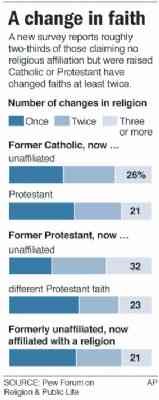
About two-thirds of those raised Catholic or Protestant who now claim no religious affiliation say they have changed faiths at least twice. Thirty-two percent of unaffiliated ex-Protestants said they’ve changed three times or more. What this means is that a lot of Catholic are no where now. They tried several other places but now belong nowhere: they claim “no religious affiliation” There is a saying, I have not seen numbers to back it up that the Largest denomination in this country by far is the Roman Catholic Church (this is clear numerically). But the second largest denomination is “former Catholics” who now go no where. The harvest is rich but the laborers seem few. One of the purposes of this blog is to try to reach out and reconnect.
Age is another factor. Most people who left their childhood faith did so before turning 24, and a majority joined their current religion before 36.
Sixteen percent of U.S. adults identified as unaffiliated in the 2007 survey; 7 percent of Americans described being raised unaffiliated, suggesting many Americans end up leaving their religion for none.
About half of those who have become unaffiliated cited a belief that religious people are hypocritical, judgmental or insincere. Large numbers said they think religious organizations focus too much on rules, or that religious leaders are too focused on money and power. The uninspiring example of many Christians remains a big image problem for the churches. To be sure, we don’t evangelize merely with words but also with transformed lives. However one of the things we have to communicate a little better is that the Church is like a hospital. People are not surprised to find sick people in hospitals, a place theoretically associated with healing. But they understand that people are “on the mend” or being treated because they are sick. Well the Church is the same. We are not running some sort of “sanctified society ” here. We are here because to some extent we are all sick and in need of healing. The Church dispenses that healing as well as knowledge of “best practices” to avoid poor spiritual health but the fact is, we’re running a hospital and people should not be surprised to the “sick” among our ranks, all in various stages of recovery. As for being Judgemental, we expect doctors and healthcare workers to speak to us truthfully about what can harm us. We do not consider this judgemental. We may not always like it but we understand that it is their job to speak in this way and to exhort us to more healthy living. Why do fingers start wagging when clergy and Church leaders do this? Isn’t it really their job to prophetically uphold biblical doctrine and morality? As for rules, what kind of healthcare can take place without rules. Clearly there are foods to be avoided in large quantities, clearly exercise is called for, clearly prescribed medicines must be taken in exactly proper does. But when it comes religion many people want to make it a vague sort of wishy-washy directive-free zone. So here too, we have a lot of work to do to answer thoughtfully and respectfully on the view that we are hypocritical, judgemental, too many rules etc. But we ought to have a clear answer as well that questions some of the premises involved in this criticism .
John Green, a University of Akron political scientist and a senior fellow with the Pew Forum, classified most unaffiliated as “dissatisfied consumers.” Only 4 percent identify as atheist or agnostic, and one-third say they just haven’t found the right religion. Some good news here. Outright Atheism seems a much bigger problem in Europe but here in American we still seem to be a nation that generally believes in the existence of God. However, that does not necessarily mean that all, even most believers go to Church regularly
“A lot of the unaffiliated seem to be OK with religion in the abstract,” Green said. “It’s just the religion they were involved in bothered them or they disagreed with it.”
The unaffiliated category is not just a destination. It’s also a departure point: a slight majority of those raised unaffiliated eventually join a faith tradition.Again, some good news here. Just because a person was not raised with religious observance does not necessarily mean that they will always stay unchurched. A lot of them, more than half, eventually find a church home.
Those who do eventually join a faith tradition cite several reasons: attraction of religious services and worship (74 percent), feeling unfulfilled spiritually (51 percent) or feeling called by God (55 percent).Interesting how 3/4 of the unchurched report that the liturgy is an important reason for their embrace of a faith tradition. Once again, we are reminded of the critical importance of liturgy celebrated well, effectively and in conformity with Church norms.
The survey found that Catholicism has suffered the greatest net loss in all the religion switching. Nearly six in 10 former Catholics who now are unaffiliated say they left Catholicism because of dissatisfaction with Catholic teachings on abortion and homosexuality. About half cited concerns about Catholic teachings on birth control and about four in 10 named unhappiness with Catholicism’s treatment of women. And here is a soul searching moment for the Church. Will we change our teachings just to keep members or will we preach the Gospel in season and out of season? Jesus often suffered the loss of many disciples for his teaching. In John 6 “Many left him and would no longer follow in his company as a result of the this [teaching on the Eucharist].” Likewise in Matthew 19 most seemingly rejected his teaching against divorce. So, is the Church about numbers or about the truth? But here too is another challenge for the Church. Many simply do not understand our teachings well. It is not our teachings that are being rejected but rather, a caricature of our teachings that is being rejected. In my conversations with Catholics, former Catholics and non-Catholics it is very often the case that the teachings of the Church have not been faithfully or fully communicated to them. Much of what they know has come from a hostile media or culture. Many of the teachings are often understood “out of context” or in extreme versions. The nuance of our teachings are not well communicated. This is on us. We cannot simply complain of a hostile culture or media. We have to get out there in the mix and effectively present our teachings thoughtfully and effectively. Our Sunday School, and adult Education has to get better and clearer. None of this guarantees that we will keep our numbers, but we ought to be sure that, if people reject our teachings, it really IS our teachings they reject. I am convinced that some are not rejecting Catholic teaching, but a false or incomplete version of Catholic teaching.
Converts to evangelicalism were more likely to cite their belief that Catholicism didn’t take the Bible literally enough, while mainline Protestants focused more on the treatment of women. But the mainline Protestants are in steep decline themselves and those who depart there are fewer in number. Further those who depart there often carry issues with them that we can do little to change. We cannot change our teachings on the ordination of women, or on homosexuality, or on abortion which the study also indicates as issues of importance to those who depart to mainline Protestant denominations. However, from those who depart to Evangelical denominations we might be able to learn more about things we CAN change. We can and should work more on developing better preaching in the Catholic clergy. We can and should do a better job of demonstratingour faith from the Scriptures. Good, solid Biblical based preaching is not at odds with Catholicism. Our teachings are there in Scripture and we need to do a better job of teaching from the Scripture. It is true we also have the sources of the Apostolic Tradition and have great respect for Natural Law. But it remains true that people report their hunger to taught the Scriptures and we can and should do a better job of teaching clearly. As for the reference to interpreting the Bible the Literally, no one does that all the time. If you think the Evangelicals or others do then why do they not interpret literally passage that call us to cut off our foot, or hand or tear out eye? Why do they not interpret the words of our Lord “This is my Body” literally? The notion of literalism is a simplistic one and again, as a Church we need to better explain our position here. But NO ONE interprets all of the Bible literally all the time. Catholics take a lot of passages literally, others, due to context we interpret more symbolically. But so do the Evangelicals. The question is what to read literally. In the end I think the view that Catholics don’t “take the Bible Literally enough” really means that they don’t think we take the Bible seriously enough. Here I think we can make improvements. I think we do take the Bible very seriously as a Church. But our preaching and other teaching methods don’t always convey this very well.
Fewer than three in 10 former Catholics cited the clergy sexual abuse scandal as a factor – a finding that Washington Archbishop Donald Wuerl cited as an example of the faith’s resilience.“Catholics can separate the sins and human failings of individuals from the substance of the faith,” Wuerl said in a statement. This is my experience too.
Wuerl said getting teenagers to weekly Mass greatly improves their chances of staying in the fold; the same holds true for Protestant teens attending services. Amen. Another huge group is young adults, 21-35 especially those who are not yet married. We need to do a better job of reaching them.
Perhaps too not enough study was done of those who have been hurt by the Church. Not by doctrine but by some insensitivity, by an omission, or comission of sin, whether by clergy or one of the faithful. If you are among those please consider contacting your local parish to let the healing begin. Don’t let anyone or anything get between you and the Lord who wants to minister to you through the sacraments and in the liturgy. The following video is about clergy sexual abuse specifically but allow it also to speak to others who were wounded in other ways. Let the healing begin.
“I am the good shepherd. A good shepherd lays down his life for the sheep. This is why the Father loves me, because I lay down my life in order to take it up again. No one takes it from me, but I lay it down on my own. I have power to lay it down, and power to take it up again.
On this Good Shepherd Sunday we celebrate the fact of what our Shepherd has done for us. He has given his life for ours. Consider this, there are many things and people that will try to claim your loyalty. Maybe it is a political party, maybe it is a philosophy, maybe it is the boss at work, maybe it is popular opinions. But there is only one contender for your loyalty who ever died for you. His Name is Jesus. He alone is worthy of your most fundamental loyalty since he alone gave his life for you. Freely he died, not merely as a victim of circumstances. He laid down his life of his own accord and he took it up again. Only Jesus died for you.
I have often thought that Pope Benedict XVI is quite photogenic. Some of the pictures I have seen are quite humorous. Here are a few photos I have collected of him that I think are funny. I set them to the music of Irving Berlin’s What do I have to do to get my picture took.