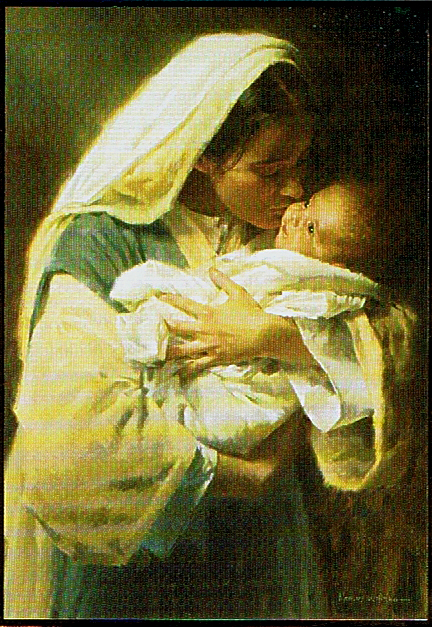
Today at Mass, the prelude was a hymn that I had never heard before but found to be quite beautiful. It is helping me to understand what Luke meant when he wrote “and Mary pondered all of these things in her heart.” It also seems to capture in song the mysteries of the Rosary.
An audio recording of the song can be heard here The Very First Blessing that Mary Had. It is sung by Candace Carraway on the Album Three Log Night.
Here are the words to The Blessings of Mary:
The very first blessing that Mary had, it was the blessing on one: To think that her Son, Jesus, could live a father’s son; could live a father’s son; like Emmanuel in glory, Father, Son and Holy Ghost, through all eternity.
The very next blessing Mary had, it was the blessing of two: To think that her Son, Jesus, could read the Scriptures through like Emmanuel in glory, Father Son and the Holy Ghost, through all eternity.
The very next blessing Mary had, it was the blessing of three: To think that her Son, Jesus, could set the sinner free; could set the sinner free like Emmanuel in glory, Father Son and Holy Ghost through all eternity.
The very next blessing Mary had, it was the blessing of four: To think that her Son, Jesus, could live for evermore.
The very next blessing that Mary had, it was the blessing of five: To think that her Son, Jesus could bring the dead alive.
*******
I pray that under the patronage of Mary our Mother, that the new year be full of grace for you.
How remarkable is it that one man could affect the world so much that our entire calendar system is based on his life and ministry?
What is today’s date?
Once, a man who said that he did not believe in Jesus challenged me. Understand, he was not someone struggling with his faith. Rather, he was obstinate in his disbelief and openly hostile to mine. After listening to his faulty arguments about the non-existence of Christ, I casually asked him for the day’s date. When he responded, I pointed out that his response was based on the life, death and resurrection of a man that supposedly did not exist.
No one else in human history can claim influence over the direction of the world like Christ. No monarch, president or billionaire will ever again change the world to the point that our entire calendar system would be based on his or her life.
Jesus Christ is Lord!
Only a truly divine being could do such a thing. Even without faith in Him, the life of Jesus has touched anyone who has dated a check, booked an airline or hotel reservation, disclosed his or her own birthday or simply answered the question, “What is today’s date?”
2010 AD
In recent years, some have tried to diminish this undeniable fact. For example, some historians have abandoned the designation “A.D.” or “Anno Domini”, which means “Year of our Lord” in favor of the secular “C.E.” which means “Christian Era.” Or “B.C.” or “Before Christ” is replaced with “B.C.E.” or “Before the Christian Era.” Despite these efforts at secularization, our calendar system is STILL based on the life of Our Lord and Savior, Jesus Christ. A rose by any other name is still a rose. So, as we celebrate the New Year, think about the fact that this is may be the one day everyone in the world expresses a belief in Christ, whether they like it or not.
Last night, I babysat my cousin’s five young children while she and her husband enjoyed a Christmas overnight downtown. Along with playing board games, taking a walk in the snow, and watching their favorite Christmas movie, we read a number of books.
One of these was “When Joy Came: The Story of the First Christmas” by Pauline Palmer Meek. I recognized the cover from the stack of Christmas books we used to have when I was little. But I don’t think I had ever actually read the book myself, so I decided to take a peek.
What a beautiful book! The vivid illustrations sweeping across each page brought the Nativity story to life in a way that it hadn’t yet for me this Christmas. I realized that, though I may have read the scripture at home or listened to the gospel at Mass, I had missed the wonder of engaging my imagination in the Nativity story.
So if you get a chance to poke around your child, cousin, niece, nephew, sister, or brother’s collection of Christmas picture books, take a moment to put yourself in the story and just imagine…
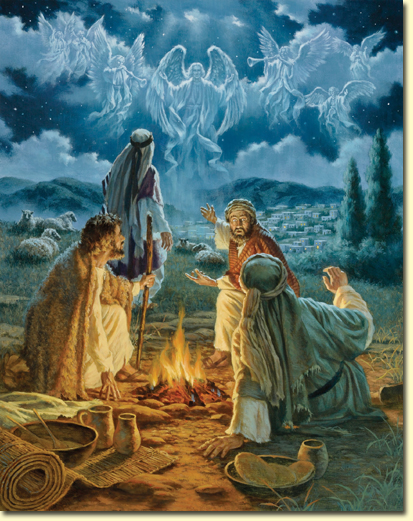
Behold, I proclaim to you good news of great joy that will be for all the people. For today in the city of David a savior has been born for you who is Messiah and Lord. And this will be a sign for you: you will find an infant wrapped in swaddling clothes and lying in a manger.” And suddenly there was a multitude of the heavenly host with the angel, praising God and saying: “Glory to God in the highest and on earth peace to those on whom his favor rests.”
Luke 2:10-14
Brothers and sisters, Advent is not really about waiting for Christmas as much as it is about waiting for the second coming of Christ. The Birth of Jesus is something that most of us contemplate, we celebrate, we are familiar with the stories and are familiar with how the birth of Jesus came about. But, it is his second coming, the event that hasn’t happened yet, the day when he will call his followers together, that is what Advent is all about. Advent is defined as the beginning of the church year because waiting for Christ to come a second time is what the existence of the church is all about. Everything we, do we do, until he comes again in glory. Let me say that again, everything we do, we do until he comes again in glory.
Warning – Salvation ahead.
And brothers and sisters, Advent is a poignant reminder, maybe even a warning, that when he comes again in glory, you had better be ready. It is why the colors of repentance characterize this season. We all know the story of salvation. We know how this ends, but sometimes we forget. The warning signs are there but sometimes, we ignore them.
Photo-enforced speed zones
I got a confession; I enjoy driving down Connecticut Avenue and the Anacostia Freeway. I ready enjoy driving down both of those major Washington area streets for two reasons – Each of those streets has photo-enforced speed zones AND I know exactly where they are. Since I know where they are, typically, I speed down Connecticut Avenue until I get to Chevy Chase Village or I speed down the Anacostia Freeway until I get to the Pennsylvania Avenue exit. I know where the cameras are and I know exactly when to slow down.
Now, brothers and sisters, that same sort of warning is coming to us during Advent. Like all Christians, we know the road and all of the speed traps that can divert us away from our salvation. The Church knows how this story ends, it knows which team is going to win and it wants to make sure that we are on the winning team. Just like I know what to do to avoid a ticket and get to my destination safely, the Church knows what we need to do regarding our own salvation.
Happy Advent
Brothers and sisters, we know how all of this is going to end. We profess it each time we say, “Christ has died, Christ is risen and Christ will come again.” We profess our faith that Jesus is coming and I want to be ready. And for those who do not share this faith, frankly Advent is a warning. Advent is a warning that God is coming and to be prepared.
In the early church, debates on the divinity of Jesus and the nature of the Trinity were the talk of the town. The Church fathers record stories of these debates happening in the village square, in the market place and around kitchen tables. A debate is indeed swirling around town, not of the nature of dogma but nonetheless critical to the practice of our faith. In this debate, blogs are the new village square. Over the last couple of weeks in blogs and opinion pieces politicians, college presidents, attorneys, radio hosts, professors and people in the pew have weighed in on how same-sex marriage legislation will alter Catholic Charities partnership with the city.
Under Consideration
I want to respond to Nancy Polikoff’s piece in the Washington Post in which she writes “that Catholic Charities is misleading the public about the impact of the D.C. marriage bill authorizing same-sex marriage.” http://voices.washingtonpost.com/local-opinions/2009/12/how_catholic_charities_could_l.html. The Archdiocese has explored a number of options talked about in the press;including “the San Francisco option” and Ms. Polikoff suggestion to move our health care plan under ERISA. Our research shows that the reality is that the U.S. Labor Department has released that ERISA only applies to pension benefits and not health care. This does not seem to hold promise as a real solution.
She also suggests that what might really be at issue is that Catholic Charities needs to cut its budget and is using the city as a “scapegoat” to deal with budget issues. Now, that seems just plain rude, especially in light of the fact that Catholic Charities recently received an award for its ethical and business standards. In a statement, Edward Orzechowski, President of Catholic Charities writes “everyone, from government to business to nonprofits, has reduced services and programs in this challenging economic environment, and sadly budget pressures will continue to impact everyone – her [Polikoff] comment is insulting to the dedicated staff and volunteers who serve at Catholic Charities every day.
Religious Liberty
As I blogged earlier, at the heart of this debate and at the heart of the Archdiocese’s concern is the erosion of religious liberty as the government increasingly imposes requirements on religious organizations in their policies. Under the narrow religious exemptions in the bill, Catholic Charities might become ineligible to partner with the government in the delivery of social services.
We desire to continue a partnership with the city that has successfully served those people most in need. We know that it would be next to impossible to continue the breadth of our services without this partnership. The language we are proposing insures the kind of religious exemption that is more consistent with existing protections and exemptions under the DC Human Rights Act, the Constitution and federal protective statutes.
It will not be a bad thing if issues related to religious liberty will be discussed with interest and passion around kitchen tables, at the water cooler and in the public forum because they are indeed critical to our practice of the faith.
If your family and friends are at all like my family and friends, you probably talked a lot about the state dinner party-crashers at the White House. That story certainly provides a welcome diversion to some of the other headlines over the last couple of weeks. If you have been following our blog, you know that the Catholic Church has been in the headlines quite a bit. Nationally, as we contribute to the health care debate and locally as we oppose the legislation to legalize same-sex marriage and more recently in stories as about the possible closure of some of our Catholic schools. We will come back to these stories in future blogs because in one way or another they are part of a very important debate in which we–the laity– need to listen and participate. At issue is the nature of partnerships between church and state. The more common language is the presence of faith based initiatives and public funding.
Indeed, in the United Sates we have a long and proud history of partnerships between church and state in the field of education, health care and social service; our many great Catholic Universities, the Young Men Christian Association(YMCA), The Salvation Army are just a few “faith based initiatives” that are part of the fabric of public life.
It Begins with Matthew 25
For Christians, we are obliged through our discipleship to care for those in need. In Matthew 25, a follower of Jesus’ asks, “Lord, when did we see you hungry?” Jesus tells us that in the face of our neighbor, we see his face. As Catholics, we have been enormously creative in founding and sustaining programs that address people’s physical and spiritual needs. We welcome opportunities to work with–as Gaudium et Spes puts it– “all people of good will.” To this end we see our involvement in civil society as a service provider and not a political power.
Service Providers
In the health care debate, we have a seat at the table, because we are the single largest private provider of health care in the country. We have a particular competence but as the Catechism of the Catholic Church teaches “our commission and competence is not to be confused in any way with the political community.” The church wades into the debate when the dignity of the human person is at risk or when a voice of moral judgment related to the fundamental rights of men and women is at stake (CCC, 2445-2446).
Thankfully, it seems to be the minority voice that is suggesting that faith based organizations cease taking public funds and entering into partnerships with the government to provide services. The Pew Forum on Religion and Public Life recently conducted a poll to see how the general public feels about some of these church-state questions. The whole study can be found at http://pewforum.org/newassets/images/reports/faithbased09/faithbased09.pdf.
Here are some of the most interesting findings:
Currently 69% of Americans say they favor allowing churches and other houses of worship, along with other organizations, to apply for government funding
37% think that religious organizations can do the best job serving the needy when asked “generally, whether religious organizations, non-religious organizations or the government can do the best job providing services for the needy.”
74% say that religious organizations that receive government funds should not be able to hire only people who share their religious beliefs
This indicates there is strong support for the idea of partnerships. What this particular study does not address and what is critical to the ongoing discussion is what happens when civil legislation and the belief of the religious organization clash. How do both state and church balance the Constitutional separation of church and state with the Constitutional right to the free expression of religion? One example, as indicated in the study is that faith based organizations do not discriminate on the basis of faith when hiring employees. Another example is that faith based organizations provide social services to anyone who is in need, not just members of their faith. However, in other cases the issue of religious liberty is far more complex, particularly as society experiences less and less universal agreement on certain moral principles.
What is religious liberty?
In his recent editorial that ran in the Washington Post, Archbishop Wuerl asked that the church not be forced to compromise deeply held religious beliefs and teachings in order to continue serving those in need in partnership with the city. The larger question that needs to be reflected upon, studied and debated in a serious way is how to balance the right of faith based organizations who wants to enter into service partnerships with governmental organizations but not be forced to violate their beliefs by adhering to legislation that is contrary to the teaching of their faith. Do faith based organizations have the right to seek exemptions and protection from civil legislation that is contrary to the teaching of the faith?
I have found myself saying again and again to friends that we have a responsibility to be active in this very important debate. As hard as it is sometimes to see another headline that presents the church in a negative light or to enter into a discussion that will be heated, we must be witnesses to the Good News in season and out of season as St. Paul likes to say.
As a Catholic and a priest I remain quite stunned at the decline in Mass attendance during my lifetime. When I was a little child I remember jam packed Masses, get there early or stand. In those days of the early to mid sixties if you put up four walls Catholics would fill them. There were waiting lists for the parochial School, lots of Religious Sisters, and there was not just an associate pastor or curate, there was a first, second, third and fourth curate. Long lines for confession on Saturdays were common then too.
But this is largely gone. Yes there are still some large parishes in suburban areas but even they used to be a lot bigger. Weekly Mass attendance has gone from 80% to less than 30% Vocations are beginning to rebound but the usual experience is empty convents and largely empty rectories. An Associate Pastor is unknown in many parishes and in some parts of the country even a resident pastor is often missing.
There is no other way to describe this than “stunning.” And I can hear all the usual arguments about why swimming in my brain. We abandoned tradition! No! Say others, we are not progressive enough!…..There are too many rules! No, say others our problem is that we abandoned all the rules!….I could go on. Everyone has their human explanations and there are lots of disagreements about them.
But what might God be doing or allowing? Now I know I am on difficult ground in attempting to ponder this question. But please be sure, I am merely pondering it, not proposing a complete answer. But I have often asked the Lord, “What’s up with the Church?….What has happened Lord?” I do not claim a bolt from heaven came in answer but just a gradual and increasing awareness that what we are experiencing is not really new. There does seem to be a Biblical precedent that in the past God has frequently seen fit to thin his ranks, to prune and purify his people. In the Old Testament as well as the New there seems to be a kind of remnant theology at work. That is to say, of the many followers of God, many if not most fall away and only a small remnant remain to begin again. Perhaps some examples from Scripture will help:
There were Twelve Tribes in Israel. But ten of them were lost in the Assyrian Conquest of the northern kingdom of Israel in 721 BC. The Prophets had warned the Northern Kingdom of its wickedness but a refusal to repent brought the destruction promised. Those who did not die in the war were deported and disappeared by assimilating into the peoples around then. They are known as the Ten Lost tribes of Israel. Only a remnant, the Tribes of Judah and Levi survived in the Southern Kingdom of Judah.
Judah too grew wicked and prophets warned of destruction. The Babylonians destroyed Judah, and Jerusalem with it, in 587 BC They deported the survivors to Babylon. Eighty years later the Persians conquered the Babylonians and allowed the Jewish people to return to the Promised Land. But only a remnant went, most chose to stay in the Diaspora, preferring Babylon to the Land promised by God.
Gideon had an army of 30,000 and faced the Midianites who had 60,000. But said to him, “Your Army is too large. Tell the cowards to go home.” So Gideon dismissed any of the soldiers who didn’t think they were up for this battle. 20,000 left. Now with only 10,000 God said to Gideon, “Your army is still too large, lest you think you would win this battle on your own.” So God had Gideon observe the men at the stream as they drank water. Some drank leisurely and others lapped up the water like dogs! “That’s your army,” said the Lord, “300 men and I will be with you.” Gideon won that day with three hundred men whom the Lord had chosen. God thinned his ranks, and chose only a remnant as his true soldiers. (cf Judges 6 & 7)
Jesus too didn’t seem to trust big crowds. Some of his most difficult sayings come when there is a big crowd. In fact, anytime you see a mention of a large crowd in the Gospels, fasten your seat belt because I can guarantee you that a hard saying is coming! Once when there was a large crowd, Jesus taught against divorce (Matt 5 & 19, Mark 10). Another time spoke to crowds and declared that no one could be his disciple unless they renounced their possessions took up a cross and followed (e.g. Luke 14). Yet another time Jesus taught on the Eucharist and many left him and would no longer walk in his company (Jn 6).
These are just a few examples of remnant theology in the Scriptures. There are many more. I would like to quote one last one from Zechariah because it also gets to the root of what God may be doing in our times, if my hunch is right. First the quote:
“Awake, O sword, against my shepherd, against the man who is close to me!” declares the LORD Almighty. “Strike the shepherd, and the sheep will be scattered, and I will turn my hand against the little ones. In the whole land,” declares the LORD, “two-thirds will be struck down and perish; yet one-third will be left in it. This third I will bring into the fire; I will refine them like silver and test them like gold. They will call on my name and I will answer them; I will say, ‘They are my people,’ and they will say, ‘The LORD is our God.‘ ” (Zech 13:6-9)
A stunning passage to be sure. But it also show the purpose of God thinning his ranks. There is something very mysterious as to why God allows many to stray and yet it is true that we are free to stay or go. There seem to be times in the History of the Church and Israel that God allows many to depart, even “causes” them to depart as this passage describes it. It is a hard mystery to stomach. But I suppose I understand one aspect of it. It is currently pruning time here in the Northeast. My mighty rose bushes, eight feet tall have been pruned to one foot off the ground. And I had it done on purpose. But if my roses are to thrive next year and be beautiful, the prunings have to be done. The roses do not understand what I do, but I know of what I do. It is necessary, though painful. And God too knows of what he does and we cannot fathom it any more than my rosebushes fathom me. But he does it. And the 1/3 who remain in this passage must also be purified, refined as in fire. But when it is done: pure gold. Those who remain and accept purification will call on God’s name. They will be a people, a Church after his own heart.
To me it has become clear that the Lord is pruning his Church. He is preparing us for spring. And we do in fact have a difficult winter we are enduring. But we’re being purified, cleansed. These are tough days for the Church but I already see signs of a great springtime ahead. There are many wonderful lay movements and growth areas in the Church. I am very impressed with the calibre of men entering the priesthood. These are men who love the Lord and His Church and who deeply desire to speak the truth in love. In my own Convent we have 25 young sisters of the Servants of the Lord, a wonderful new and missionary order. They too love the Lord and his Church and want to spread his gospel everywhere. Though our overall numbers of practicing Catholics are diminished, I see greater fervency in those who remain. In my own parish there are many who are devoted to prayer, bible study and praise of God. Eucharistic piety is stronger in the Church today through adoration, daily mass. On the Internet there are many signs of excitement and zeal for the faith. Many wonderful blogs and websites are emerging to strengthen Catholics. EWTN is doing wonderful works and many Catholic Radio Stations have begun.
I could go on, but I think you get the point. God has pruned and is purifying us as Church. There are already many signs of this great work of God. I have no doubt that there are still some difficult winter days ahead before a full springtime sets in. But God never fails. He is renewing his Church and preparing us for whatever lies ahead. I realize this post will not be without controversy. I do not propose it as the only answer to the times. Neither do I claim that fallen-away Catholics have simply been pruned as though we could know they will never return and be grafted on again. We should continue to Evangelize and seek to grow the Church by Christ’s own mandate. We cannot know when spring will set in fully and so we must step out as if it is already here.
Please remember a blog is about discussion so feel free to comment. I do not propose this as a full answer but as a discussion starter: Add subtract, multiply but DON’T divide! 😉