Things Are Often Not as They Seem – A Lesson from the Life of Moses

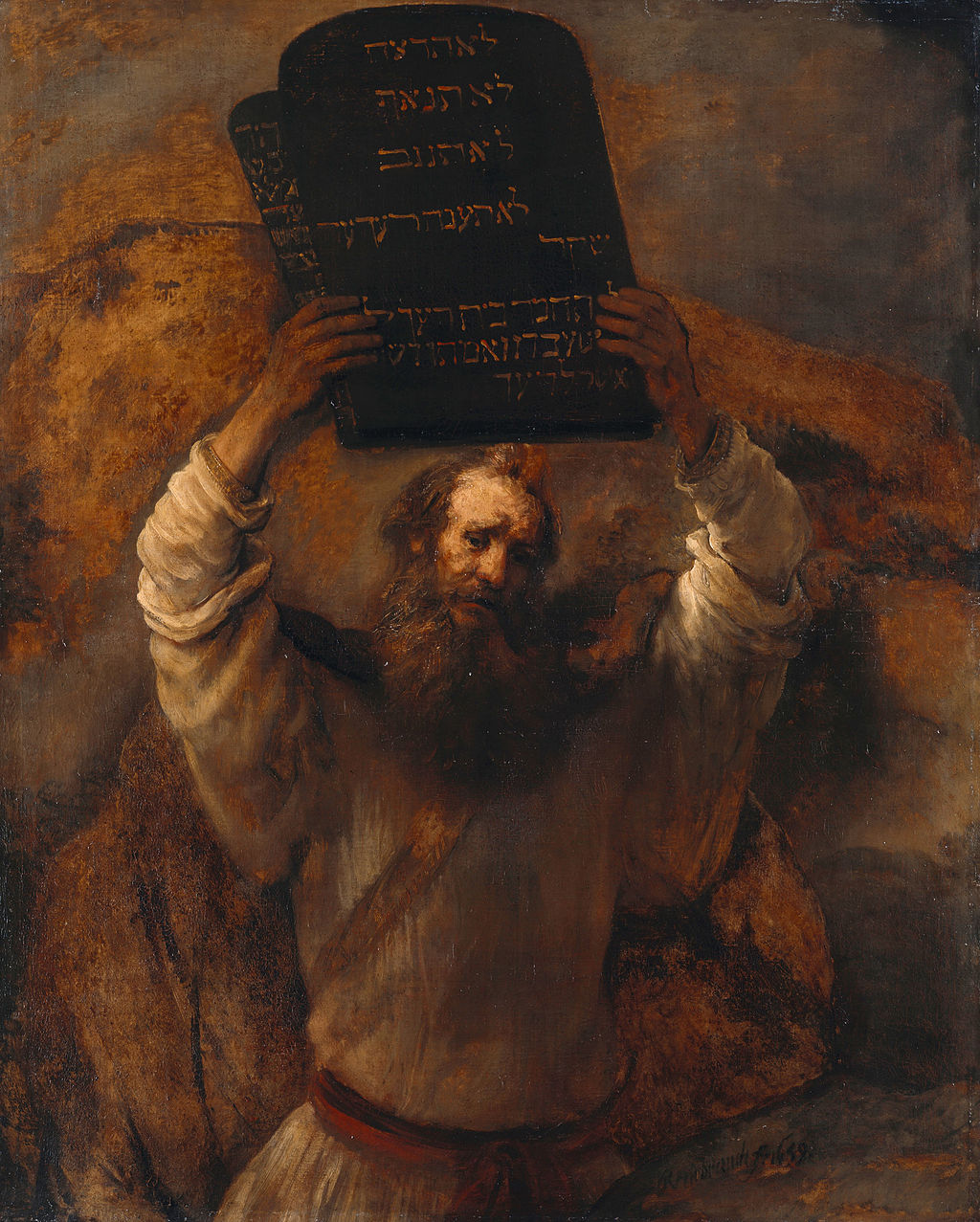
moses-0715We are currently reading the story of Moses in daily Mass. The story reminds us that not all things are as they appear, and that God’s ways are not our ways.

Moses’ early years are marked with clear signs that he is gifted and chosen. Drawn from the water by Pharaoh’s own daughter, Moses’ very own mother is chosen to be his caretaker and is paid for that privilege by getting to live in Pharaoh’s palace. Pharaoh pays for Moses’ diapers, his food, and his education. And he is unwittingly preparing and equipping his nemesis. God can be very sly!

But at age forty, Moses gets ahead of God (never a good idea). He grows angry at an Egyptian who is oppressing a Hebrew and ends up killing the Egyptian. Moses has to flee.

Now why has God let this happen? From our perspective, Moses was in the prime of his life. At forty, he has experience but has not lost his youth. He is educated, gifted, and has access to power and lots of connections in Pharaoh’s own palace. Moses is in a perfect position to lead the people out of slavery! Or so we think. Except for one problem: God doesn’t think so.

But why not? In a word, pride. Moses, in getting out ahead of God and trying to take things in his own hands, is exhibiting pride. God says, in effect, “You’re too proud. I can’t use you in this condition. It’s time for some lessons in humility.”

And so Moses learns humility. He is forced to flee (humiliating). He must live out in the desert (humbling). And he marries and has children (quite humbling indeed! J).

Ok, so a few years’ worth of humility lessons and then Moses gets started. No, not a few, forty years’ worth!

Now Moses is eighty. He’s feeble, leaning on a staff, and he stutters when he talks. And God comes and tells Moses that it’s time to lead the people out. Moses says, in effect, “Are you crazy? I’m old, I can’t speak, I’m feeble … I can’t do it.” And that’s just the attitude that God needs from Moses: that he can’t do it. And he couldn’t do it at forty, either; he just didn’t know it. God has to do it and Moses will be His instrument. But now this instrument will be docile in the hands of the artist, now Moses can be useful to God.

This is not the way we think. We equate ability and leadership with vigor, power, money, access, talent, etc. For us, the prime of life is in our thirties, forties, and fifties. But God’s ways are not our ways; His thoughts are not our thoughts. Moses at eighty is what God needs. Moses at forty was not of use.

What are some conclusions we can draw?

First, be careful how you assess your own life. In typical earthly fashion most of us consider our prime as being those years when we were most in command of our gifts, when we were working, “making a difference,” earning an income. We measure human life in its prime in terms of money, power, access, physical strength, stamina, etc.

But has it occurred to us that our most powerful moments might be on our deathbed? For there we have many sufferings to offer and our prayers will pierce the clouds as never before. The Lord hears the cry of the poor, the suffering, and the repentant.

I often counsel the bedridden, and the dying in this way: I tell them that we are depending on their prayers as never before because their prayers are more important than ever before. And even if they have a hard time, because of age and discomfort, formulating prayers, just one word on our behalf, “Help!” may change the history of the world. St. Augustine said, More is accomplished in prayer by sighs and tears, than by many words (Letter to Proba).

Yes, be very careful how you assess your life’s worth. Our math is not God’s math; our thoughts are not His. God sizes us up quite differently.

Second, be careful how you assess the lives of others. Here, too, we tend to value those people who are powerful, have money, strength, beauty, talents, and “obvious” gifts. But the Lord warns us in many places that we should esteem the poor, the disabled, and the suffering. He says, Many who are last shall be first (Matt 19:30).

God also counsels that we ought to make friends among the needy and poor by our use of worldly wealth, so that when worldly wealth fails us (and it will), the poor and needy, those who benefitted from our generosity, will welcome us to eternal dwellings (See Lk 16:9).

Yes, befriend the needy, the disabled, and the poor. In this world they need us, but in the next world, we are going to need them! Those who have suffered and those who were poor due to injustice, if they have been faithful, are going to be in high places in Heaven. We’re going to have to get an appointment to see them! Things are not always as they appear. The poor, the disabled, and the suffering are quite often among the real powerhouses of this world.

So pay attention to what the story of Moses tells us. Not as man sees does God see (1 Sam 16:7). We are vainglorious and we look to worldly power and its categories. God is not impressed with our sandcastles, our big brains, and our bulging muscles. He bids us in stories like these to say, with St. Paul, Therefore I am well content with weaknesses, with insults, with distresses, with persecutions, with difficulties, for Christ’s sake; for when I am weak, then I am strong (2 Cor 12:10).

Things are often not as they appear to us. Put on your “God glasses” and by God’s grace see more as He sees.

On The Passing of All things as Seen on T.V.

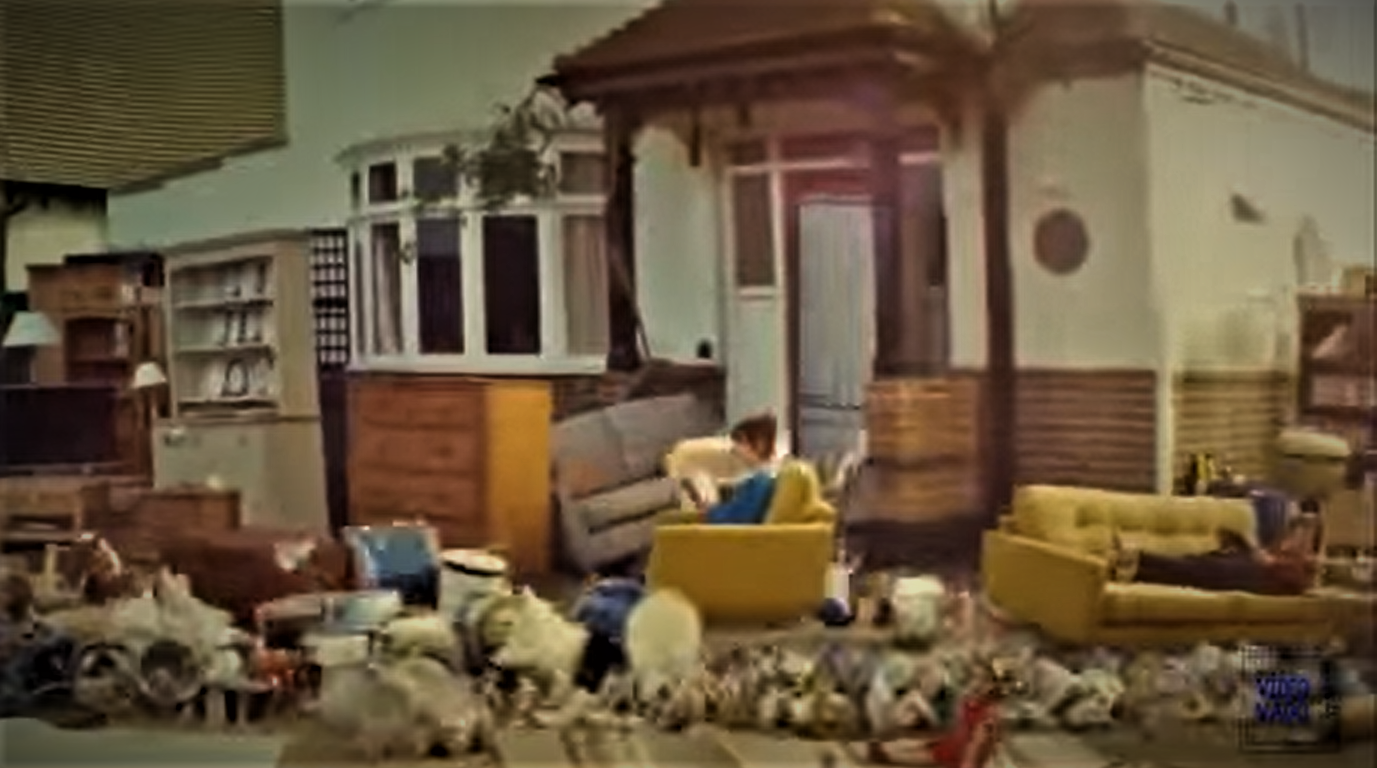
The Video below is a commercial that must have taken weeks to film. And whatever the intent of the commercial, (I think they are selling insurance), there is something of an admonition in both the video and the music that life and the things of life slip away.

While the music of the video set forth the theme: Don’t stop, thinking about tomorrow, Don’t stop, it’ll soon be here, every object in the home begins to get up and move away from the owners. And the owners themselves too begin to be swept away. By the end, all that was within, and all who were within, are swept outside and away.

And here is a paradigm for life. No thing, and no one in this world will endure the passage of time. All will be swept away, all will pass. Geologically, even lofty mountains were once on the sea floor, and to that floor they will erode and return.

Scripture says, For here we do not have an enduring city, but we are looking for the city that is to come (Heb 13:14). And again, The end of all things is near. Therefore be alert and of sober mind so that you may pray (1 Peter 4:7) but adds later, But according to His promise we are looking for new heavens and a new earth, in which righteousness dwells (2 Peter 3:13).

And thus, this video is not morbid. Rather it is almost joyful. For indeed, though earthly glories fade, Scripture also says, “Trouble don’t last always.” (cf Psalm 30:5).

The video ends with a snapshot. And ultimately each moment in life is but a snapshot in time. But time itself and all things are moving downstream, and slipping away. But God alone remains forever and our only hope is to be anchored him him. He is our Rock, our firm Foundation, and his Kingdom is our lasting city. All else fails and slips away.


On the Balance of Love and Correction according to St. Gregory.

102814Applying salutary  discipline, and balancing it with necessary consolations and encouragement is never an easy task. It is possible that a parents can be too severe on their children, such that they become disheartened, and lack necessary self-esteem. But it is also possible that parents can be too lax such that their children become spoiled and lack proper self-discipline and humility. Hence Scripture seeking to balance teaching with encouragement says, Fathers, do not exasperate your children; instead, bring them up in the training and instruction of the Lord (Eph 6:4)

Pastors too in their leadership of parishes need also to find proper balance, offering kindness, consolations, and encouragement and witness to their congregation, while not failing to properly rebuke sin and warn of its consequences  and of the coming judgment. And thus St Paul says, You are witnesses, and so is God, how devoutly and uprightly and blamelessly we behaved toward you believers; just as you know how we were exhorting and encouraging and imploring each one of you as a father would his own children, so that you would walk in a manner worthy of the God who calls you into His own kingdom and glory (1 Thess 2:11-13). Thus, like a loving Father must the priest exhort, as one who teaches, wants and expects the best for his flock, but also as one who loves them.

It is hard to argue that we have the balance right in the Church today. Correction and rebuke, according to what most Catholics report, is seldom a feature of preaching today. And where this is the case it is hard to argue that the priest is acting like a father. For a father would see how sin can threaten the future of his children and in love he will correct, being willing to upset his child to prevent something worse. Yet in some places there are also priests who teach and preach as if trying to win an argument and prevail over others, than as an act of loving concern, and perhaps he will be unnecessarily harsh.

In families too the trend seems to lean toward being too permissive and thus the necessary balance is lost. Too many children today have become incorrigible, since they did not learn discipline when they were young. Too many are bold toward elders and have lost the humility necessary for learning and maturity. And this speaks to families where the balance between encouragement and discipline has been lost. It is also true that some children are oppressed by the other extreme and are weighed down with discouragement, poor self image and anger.

Hence balance is necessary.

St Gregory in his Pastoral Rule presents some good advice in regard to this balance. And while much of what he says is common sense, it is important to review it since common sense isn’t as common today. What he says is also excellent since he uses two very memorable images that can stay with the thoughtful priest or parent who reads it. There hear what St. Gregory has to say about addressing the wound of sin:

But often a wound is made worse by unskilled mending…in every case, care should be provided in such a way that discipline is never rigid, nor kindness lax.… Either discipline or kindness is lacking if one is ever exercised independently of the other. … This is what the scriptures teach through the Samaritan who took the half dead man to the inn and applied wine and oil to his wounds. The wine purged them and the oil soothed them.

Indeed, it is necessary that whoever direct the healing of wounds must administer with wine the bite of pain, and with oil the caress of kindness; so that what is rotten may be purged to by the wine, and what is curable may be soothed by the oil.

In short, gentleness is to be mixed with severity, a combination that will prevent the laity from becoming exasperated by excessive harshness, or relaxed by undue kindness. … Wherefore David said, “Your rod and your staff have comforted me.” (Psalm 23:4) Indeed, by the rod we are punished and by the staff we are sustained. If therefore, there is correction by the rod it, let there also be support through the staff. Let there be love that does not soften, vigor that does not exasperate, zeal that is not immoderate or uncontrolled, and kindness that spares, but not more than is befitting. Therefore justice and mercy are forge together in the art of spiritual direction. (Rule II.6)

Practical reminders to be sure, but also with the memorable images of wine and oil, rod and staff. Both are necessary, both must balance the other. There must be clarity with charity, and charity with clarity; there must be veritatem in caritate (truth in love).

From Simply Sentimental to Strong and Sure – A Consideration of Devotion to the Sacred Heart

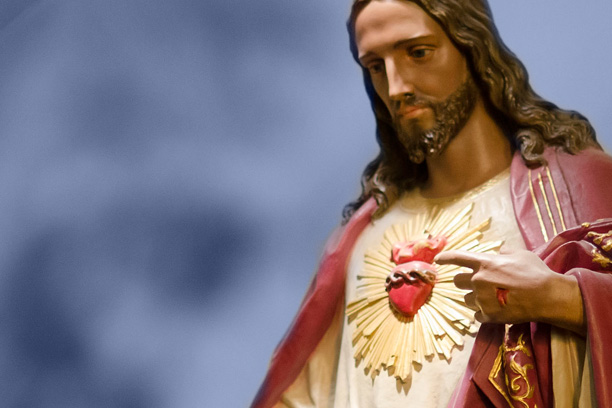
I must say that in the past I was not always as on board as I should have been when it came to the Feast of the Sacred Heart. As a man, I have struggled especially with some of the Sacred Heart images of past years, especially from the 1940s into the 1970s that, frankly, made Jesus look like a bearded lady. Deep red lips, baby soft skin, “come-hither” look, “feminine” head tilt, long slender fingers, and strangely bent wrists all seemed too feminine for me.  See for example the image here:  Sacred Heart. Frankly, the feminized portrayal of Jesus made me cringe. “Maybe this works for some,” I thought, “but not for me.” Women are beautiful, but men shouldn’t look like women.

Then too, the whole notion of the heart has become rather distorted. The heart is thought of by most as the domain of sentimental feelings and romance. Stronger biblical notions of the heart were lost in favor of these sentimental and romantic ones.  So there was Jesus, pointing to His heart to indicate His love, but I experienced it through the current notion of sentimentality and romance. While the true teaching on the Sacred Heart was much richer and more proper, the version that reached me was distorted and had little appeal.

In recent years, I have tried to recover a more proper notion of the Feast of the Sacred Heart. I have done this by coming to understand the heart in a more biblical way. I have also done this by learning to understand the heart of Christ in a stronger way that is more helpful for me.

Recovering a more biblical understanding of the heart – In celebrating the heart of the Lord Jesus, we ought to see it in a more biblical way. In the biblical world, the heart did not exclude feelings, but feelings were thought of as more located in the gut. Things such as tenderness, mercy, love, and emotions were spoken of in terms more visceral than we are comfortable with today. Most of our modern translations do not render the Hebrew and Greek references, which speak of the “bowels of mercy”  in God or in the human person, literally.  Most modern translations render the Hebrew “bowels of mercy” as “tender mercy” and expressions such as “my bowels are moved within me” as “my heart is moved within me.” We just don’t talk about bowels today in polite company!

I say this to indicate that for the biblical writers, feelings, sentiment, and mercy were not usually located in the heart but elsewhere. You can see this if you get a rather literal rendering of the Hebrew and Greek such as the Douay Rheims or Young’s Literal Translation and refer to passages such as these: Gen 43:30; 1 Kings 3:26; Song 5:4; Is 63:15; Jer 31:20; Lam 2:11; 2 Cr 6:12; Phil 1:8; Phil 2:1; Col 3:12. While feelings such as anxiety, fear, romance, and tenderness were pondered in the heart, their real “place” was shifted down one level to the “gut” or viscera. We do have some vestiges of these ancient notions in expressions like “gut reaction” or “butterflies in my stomach.”

So what then IS the biblical notion of the heart? While not wholly excluding feelings, the “heart” in the Scriptures is the deepest part of us; it is where we “live.” It is where we deliberate, where our memories and thoughts are. It is where we process feelings and events. It is where we ponder what to do and then decide. It is where we reflect and consider the direction of our life and most deeply understand who we are and how we are related to God and others. It is the place of our decisions and where we set priorities. In short, it is the place where “I am” in the deepest sense. Most moderns locate this in the brain (or mind, a word that the Scriptures often use for a similar understanding), but the ancients located all this in the heart.

A broader and stronger notion of the heart – Hence, as we ponder the Heart of Christ on this feast of the Sacred Heart we do not wholly exclude His tender feelings for us. But we must also broaden our notions of what it means to celebrate the Heart of Christ. The Heart of Christ is where He lives and is most essentially His very self. Hence His human heart is a heart that first of all worships and obeys His Father. It is in His heart that He ponders His Father’s will and sets out to obey it. It was in His heart that He set his face like flint for Jerusalem (Lk 9:51) and said to this apostles, “the world must know that I love the Father and that I do just as the Father has commanded me” (John 14:31). It is in His heart that He decides to lay down His life for us: No one takes it from me, but I lay it down on my own. I have power to lay it down, and power to take it up again. This command I have received from my Father (Jn 10:18). Isaiah had said of Jesus, Oblatus est quia ipse voluit (He was offered because he himself willed it) (Is 53:7). It is ultimately by Christ’s obedience that we are saved, and this was determined in His heart. His love was manifested by His decision to both obey His Father and die for us. This is deeper than emotion or feeling, though it does not exclude them. When the solider thrust a lance in His chest and heaved it open, there was revealed the human heart of Christ who resolutely chose to save us. There was also revealed the very heart of God, who loves us infinitely.

A heart tender but also strong – On this Feast of the Sacred Heart of Jesus, we celebrate not just that He loves us in an emotional sense, but even more, that He decided to die for us. He freely pondered what our salvation would cost Him and took up the cross. He chose to obey the Father for us. His love is tender but it is also decisive. The warmth of His love is sure but the wounds of His obedience also speak of a love that is strong and enduring unto the end.

Sentiment has its place but (perhaps because I am a man) I need more. On this Feast of the Sacred Heart, I am glad to point to a love that is strong, obedient, loyal, and sacrificial; a love that engages the battle on my behalf and summons me to follow; a  love that is not just visceral but is of the true and deep Heart of Christ, a heart tender but also strong.

This video has many images of Jesus (some better than others). Sacred Heart of Jesus, have mercy on us!

Learn the Latin of “O Salutaris Hostia” and “Tantum Ergo Sacramentum”

As a further reflection in the wake of Corpus Christi Sunday, permit me to offer a reflection on the two great Eucharistic hymns of Benediction. I sometimes get requests for help in understanding the Latin texts of these very familiar hymns for Eucharistic Adoration and Benediction.

“O Salutaris Hostia” and “Tantum Ergo Sacramentum,” though familiar to many Catholics, remain only vaguely understood in terms of a word-for-word translation. They are sometimes referred to as just “O Salutaris” and “Tantum Ergo.” Most know the poetic English renderings (“O Saving Victim opening wide” and “Humbly let us voice our homage”) but this does not necessarily facilitate a word-for-word understanding as the Latin is sung. What I hope to accomplish here is to provide a very literal rendering (preserving the Latin word order) so that one can understand the Latin precisely. It is my hope to bring these hymns more alive for the faithful who sing them, but may not be highly skilled in Latin.

“O Salutaris Hostia” – This is actually the last two verses of the hymn “Verbum Supernum Prodiens” (The heavenly Word going forth), written by St. Thomas Aquinas. He composed it for Lauds (Morning Prayer) of the Divine Office for the Feast of Corpus Christi. The meter is iambic dimeter, which is accentual with alternating rhyme. Even the hostile Jean-Jacques Rousseau was said to have been so pleased by this hymn that he said he would have given all his poetry to be its author. To facilitate easier comparison, I present the Latin text on the left; a very literal, word-for-word English translation preserving the Latin word order in the center; and an English translation with more English-like word order (and some punctuation for additional clarity) on the right:

O salutaris Hostia
quae caeli pandis ostium
bella premunt hostilia
da robur fer auxilium
O saving Victim
who of heaven opens the gate
wars press hostile
give strength bear aid
O saving Victim
who opens the gate of heaven
hostile wars press;
give strength; bear aid
Uni Trinoque Domino
sit sempiterna gloria
qui vitam sine termino
nobis donet in patria
To the One and Threefold Lord
may there be eternal glory
who life without end
to us may give in the Fatherland
To the One and Threefold Lord
may there be eternal glory;
who life without end
may give to us in the Fatherland

I have prepared a more thorough word study here: Study of the O Salutaris.

“Tantum Ergo Sacramentum” – This is actually the last two verses of the hymn “Pange Lingua” (Sing, my tongue), also written by St. Thomas Aquinas. It was composed for Vespers (Evening Prayer) of the Divine Office for the Feast of Corpus Christi. The meter is trochaic tetrameter catalectic, which rhymes at both the caesura and the end of the line. There is in this hymn a wonderful union of sweetness of melody with clear-cut dogmatic teaching. To facilitate easier comparison, I present the Latin text on the left; a very literal, word-for-word English translation preserving the Latin word order in the center; and an English translation with more English-like word order (and some punctuation for additional clarity) on the right:

Tantum ergo sacramentum
veneremur cernui
So great therefore a sacrament
let us venerate with bowed heads
So great therefore a sacrament
let us venerate with bowed heads;
et antiquum documentum
novo cedat ritui
praestet fides supplementum
sensuum defectui
and the ancient document
new give way to the rite
may supply faith a supplement
of the senses for the defect
and the ancient document
to the new rite give way;
may faith supply a supplement
for the defect of the senses
Genitori Genitoque
laus et jubilation
salus, honor, virtus, quoque
sit et benediction
procedenti ab utroque
compare sit laudatio
To the One who generates and the One who is generated (i.e., to the Father and Son)
be praise and joy
health, honor, strength also
may there be and blessing
to the One proceeding from both
equal may there be praise.
To the One who generates and the One who is generated (i.e., to the Father and Son)
be praise and joy,
health, honor, strength also
may there be, and blessing.
to the One proceeding from both
may there be equal praise.

I have prepared a more thorough word study here: Study of the Tantum Ergo.

Here is setting of the Tantum Ergo (composer unknown, but sometimes attributed to Mozart), which I paired with some video footage I found:

Three Teachings on Corpus Christi

The feast of Corpus Christi affords us an opportunity to renew our understanding of the Holy Eucharist and Sacred Liturgy. It also helps us clarify certain errors that have crept into our thinking. Let’s look at the readings today under three headings: The Righteousness of our Worship, the Reality of our Worship, and Readiness of our Worship.

The Righteousness of our Worship – In the first reading today Moses has the faithful swear an oath:

Taking the Book of the Covenant, he read it aloud to the people, who answered, “All that the LORD has said, we will heed and do.” Then he took the blood and sprinkled it on the people, saying, “This is the blood of the covenant that the LORD has made with you in accordance with all these words of his.”

Jesus too gives a solemn command at the Last Supper:

Take and eat, this is my Body… take and drink this is my Blood of the new and everlasting Covenant…do this is in memory of me.

He too seals the covenant, not with the blood of animals, but with his very own blood. We who would heed and do all that the Lord commands cannot skip out on Holy Communion and absent ourselves from the Sacrifice and Liturgy that is at the very heart of the New Covenant.

Too many people today think of Sunday worship in rather egocentric terms. They speak of “being fed.” But usually what they mean by this is that the preacher gave them an uplifting message in terms that please them and seem relevant to them, or that the choir sang well and there was good fellowship. These are all fine.

But the first and most essential reason that we are to show up on Sunday is to worship God, to give Him the thanks and adoration He is due. To worship is an act of justice and righteousness. St. Thomas Aquinas in the Summa does not put worship where we might expect it, (likely under Faith or Love). Rather he puts worship in his treatise on Justice. We owe God praise, gratitude and adoration. He is the source of every blessing, all that we call our own is really His, everything, quite literally every thing is his and generously shared by Him. God has been too good to us for us to shirk our duty to worship and obey him. Even our troubles work together for our good, if we trust God. To fail in our duty to worship God on his terms is to fail in righteousness and justice. When Jesus says, “Do this is remembrance of me,” we owe him obedience in this regard. Our faithful Sunday worship and regular and worthy reception of Holy Communion is our righteous worship and an act of Justice.

The Reality of our Worship – In the Gospel today Christ makes it clear that we are receiving him: Body, Blood, Soul and Divinity. The Eucharist is no mere symbol of Jesus. Sadly today, many Catholics, according to polls, have lost faith in the Eucharist, seeing it as only a symbol. But we do not partake of a symbol; the Eucharist is truly the Lord. Neither is it a “piece” of His flesh; it is Christ, living, glorified, whole and entire. Scripture attests to this in many places.

And he took bread, and when he had given thanks he broke it and gave it to them, saying, “This is my body which is given for you. Do this in remembrance of me.” And likewise the cup after supper, saying, “This cup which is poured out for you is the new covenant in my blood” (Luke 22:19-20).

The cup of blessing which we bless, is it not a partaking in the blood of Christ? The bread which we break, is it not a partaking in the body of Christ? (1 Cor 10:16).

They recognized him in the breaking of the bread. (Luke 24:35).

For anyone who eats and drinks without recognizing the body of the Lord eats and drinks judgment on himself. (1 Cor 11:29).

I am the living bread which came down from heaven; if any one eats of this bread, he will live for ever; and the bread which I shall give for the life of the world is my flesh. (John 6:51).

This last passage is a profound theology of the Eucharist from Jesus Himself. He makes it clear that we are not to think of the Eucharist as symbolic.

As Jesus spoke the words saying that the bread was His flesh, the Jewish people grumbled in protest. Jesus did not seek to reassure them or to say that He was speaking only symbolically. Rather, He became even more adamant, shifting His choice of words from the polite form of eating, φάγητε (phagete, meaning to eat), to the impolite form, τρώγων (trogon, meaning to munch, gnaw, or chew).

So insistent was He that they grasp this, that He permitted most of them to leave, no longer following in His company due to this teaching (cf Jn 6:66). Yes, the Lord paid quite a price for His graphic and “hard” teaching (Jn 6:60).

Today, He asks us, Do you also want to leave me? (Jn 6:67) We must give our answer each time we approach the altar and hear the words, “The Body of Christ.” It is at this time that we respond, “Amen,” as if to say, “Lord, to whom shall we go? You have the words of eternal life” (Jn 6:68).

Would that people grasped that the Lord Himself is truly present in our Churches! Were that so, one would never be able to empty our parishes of those seeking to pray with the Lord. As it is, though, only about 25% of Catholics attend Mass regularly. This is more evidence of the “narrow road” and of how few there are who find it. Two thousand years ago, Jesus experienced that most left Him; many today continue to leave Him (or stand far away), either through indifference or false notions.

What father would not be alarmed if one of his children stopped eating? Consider, then, God’s alarm that many of us have stopped eating.

The Readiness of our Worship – Notice that in preparing for the Last Supper and First Mass, Jesus told two of his disciples to enter Jerusalem and look for an unusual thing, a man carrying a water jar. This was usually women’s work and thus a man doing so would stand out. They were to follow him, and: he will show you a large upper room furnished and ready. Now, this is for us a spiritual prescription for the inner room that is our soul:

    • It is to be large, a spacious place not cluttered with sin and worldly trinkets trappings and distractions. There is to be plenty of room for the Lord, who is the guest of our soul in Holy Communion!
    • It is to be furnished with holiness, justice, patience and love to receive so great a guest as Jesus!
    • It is to be ready. That is, it is to be clean, free of the filth of sin and fully apportioned unto the great liturgy about to occur in every Mass. The heart and mind are to be eagerly alert, awaiting in full readiness our divine Guest!

Of course, at the heart of this large upper room furnished and ready, is to be free of serious sin as St. Paul admonishes:

The Lord Jesus, on the night He was betrayed, took bread, and when He had given thanks, He broke it and said, “This is My body, which is for you; do this in remembrance of Me.” In the same way, after supper He took the cup, saying, “This cup is the new covenant in My blood; do this, as often as you drink it, in remembrance of Me….” Therefore, whoever eats the bread or drinks the cup of the Lord in an unworthy manner will be guilty of sinning against the body and blood of the Lord. Each one must examine himself before he eats of the bread and drinks of the cup. For anyone who eats and drinks without recognizing the body eats and drinks judgment on himself. (1 Cor 11:24-29)

Because of this, the Catechism of the Catholic Church plainly states: Anyone conscious of a grave sin must receive the Sacrament of Reconciliation before approaching Holy Communion (Catechism # 1385). For how can the upper room of our soul be spacious, furnished and ready if it is filled with sin? In my own parish we hear confessions before every Sunday Mass to ensure the faithful an opportunity to confess if necessary or simply out of devotion.  If we priests are to be sincere in promoting the worthy reception of Holy Communion, we must be generous in celebrating the Sacrament of Confession and the faithful must be zealous in seeking it when necessary.

Here then are three teachings and reminders about Holy Communion. May we be righteous in our observance, real in our understanding and ready in our souls!


A Short Consideration of the Sequence Hymn for Pentecost

pentecost-reflectionSeeking not to leave behind Pentecost so soon, I propose here to briefly consider the sequence hymn for Pentecost and the purpose and history of such hymns in the liturgy. There are several feasts of the Church during which a “sequence” hymn may be sung. The sequence hymn is sung just before the Alleluia (Gospel Acclamation). The feasts with sequence hymns are these:

  1. Easter – Victimae Paschali Laudes (To the Paschal Victim give praise)
  2. Pentecost – Veni Sancte Spiritus (Come, Holy Spirit)
  3. Corpus Christi – Lauda Sion (Praise O Sion)
  4. Our Lady of Sorrows – Stabat Mater (Stood the Mother, sad and weeping)
  5. All Souls – Dies Irae (Day of Wrath)

Too many parishes simply omit the sequence hymns. But for my money, they ought to be sung, especially if it occurs on a Sunday. (I will admit, though, that the Lauda Sion is rather long.)

Most sequence hymns were written in the Middle ages and were sung just before the Gospel as the clergy processed to the place of Gospel. Sometimes, particularly in larger churches, the Gospel was chanted midway down the nave so that it could be heard, and these sequence hymns helped to fill up the time of that procession. Many important feasts of the Church began to have these sequence hymns composed for them during the period of the 11th through 13th centuries.

However, after the Council of Trent, in the Missal of Pius V (published in 1570), there were only four sequence: Victimae paschali laudes sung at Easter, Veni Sancte Spiritus for Pentecost, Lauda Sion Salvatorem sung at Corpus Christi, and the Dies Irae for All Souls and in Masses for the Dead. In the 1700s, Stabat Mater for the feast of Our Lady of Sorrows was added. Much later (in the early 1970s) the Dies Irae was removed from the Requiem Mass of the revised Roman Missal and restored in the Liturgy of the Hours as an Advent hymn, which it originally was. It may, however, still be sung on the Feast of All Souls.

Let’s look at the sequence hymn for Pentecost (Veni Sancte Spiritus) in a little more detail.

The hymn was likely written by Pope Innocent III (1161-1216). Written in Trachaic dimeter (catalectic), it is widely regarded as one of the masterpieces of sacred Latin poetry. It was obviously written by someone who had experienced many sorrows, but also consolation in those sorrows. The rhyme in this hymn is quite rich and complex. The first and second lines always rhyme, and the third line of every verse ends in “ium.”

The sung version of this hymn is gorgeous and soaring. It starts subtly and builds through the center with soaring notes; then it sets us down gently at the end.

My favorite verses speak of the moderation that the Spirit offers:

In labor rest,
in the heat, moderation;
in tears, solace.
 

Make flexible that which is rigid,
Warm that which is cold,
Rule that which is deviant.

Here is the Latin text along with a (fairly literal) translation of my own:

VENI, Sancte Spiritus,
et emitte caelitus
lucis tuae radium.
COME, Holy Spirit,
send forth from heaven
the rays of thy light
Veni, pater pauperum,
veni, dator munerum
veni, lumen cordium.
Come, Father of the poor,
Come, giver of gifts,
Come, light of our hearts.
Consolator optime,
dulcis hospes animae,
dulce refrigerium.
Oh best Comforter,
Sweet guest of the soul,
Sweet refreshment.
In labore requies,
in aestu temperies,
in fletu solatium.
In labor rest,
in the heat, moderation,
in tears, solace.
O lux beatissima,
reple cordis intima
tuorum fidelium.
O most blessed light,
fill the inmost heart
of thy faithful.
Sine tuo numine,
nihil est in homine,
nihil est innoxium.
Without your spirit,
nothing is in man,
nothing that is harmless
Lava quod est sordidum,
riga quod est aridum,
sana quod est saucium.
Wash that which is sordid
water that which is dry,
heal that which is wounded.
Flecte quod est rigidum,
fove quod est frigidum,
rege quod est devium.
Make flexible that which is rigid,
warm that which is cold,
rule that which is deviant.
Da tuis fidelibus,
in te confidentibus,
sacrum septenarium.
Give to thy faithful,
who trust in thee,
the sevenfold gifts.
Da virtutis meritum,
da salutis exitum,
da perenne gaudium,
Amen, Alleluia.
Grant to us the merit of virtue,
grant salvation at our going forth,
grant eternal joy.
Amen, Alleluia.

Here is the traditional Gregorian Chant of this sequence. Enjoy this little masterpiece!

And here is another version—modern, but nice: