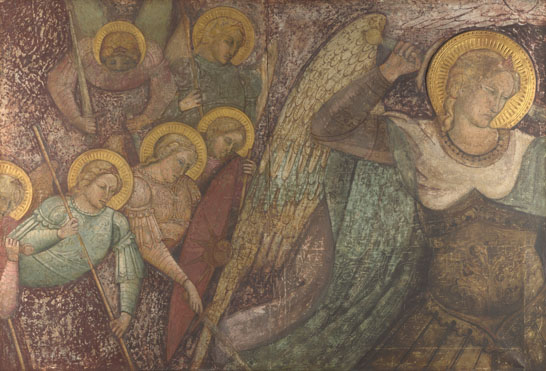
Today, we celebrate the feast of the Guardian Angels. It would be hard to improve on Msgr. Pope’s excellent blog last week. So, rather than do that, I’d like to propose that we can learn something about evangelization from the angels. After all, one of the primary missions of angels is to announce good news. Dr. Jem Sullivan in a recent talk at the John Paul II Cultural Center, suggested that angels show us how our lives can radiate the message and truth of the Gospel.
Pope Benedict also pointed to the enduring presence of angels in his address to public officials at Westminster Hall when he pointed to the painting on the ceiling of the hall and said “The angels looking down on us from the magnificent ceiling of this ancient hall remind us of the long tradition from which British Parliamentary democracy has evolved. They remind us that God is constantly watching over us to guide and protect us. And they summon us to acknowledge the vital contribution that religious belief has made and can continue to make to the life of the nation.”
It seems fitting today to thank God for the gift of our guardian angel and to thank our guardian angel for staying so close to God and to us.
We live in a time when science is exulted. But the problem with science is that it is only able to deal with the material and the measurable. Hence to exalt science to the exclusion of other ways of knowing is to take the partial and declare it to be the whole.
Yet it is demonstrable that there are many things that are real yet not physical, not material, not measurable. Love is real, hate is real. They are not physical, measurable entities, though we can see their effects. Concepts such as justice, happiness and the like are not material or real though it is clear enough that they exist and that we can see their effects. They cannot be placed in a test tube or weighed on a scale, not matter how sensitive the scale. They are simply beyond what science is equipped to address.
So too with faith and with God. Many dismiss the claims of faith that God exists. This is done because there is no “proof” for it. By “proof” is usually meant scientific evidence and physical, measurable things. But, as already discussed, not all reality falls into this realm of the physical and measurable. What faith claims is, that God exists, but not that he would tip the scales in some laboratory. There is more to life and reality than what physical science can measure.
That God exists is beyond the realm of science which deals only with the physically observable and measurable. We cannot see him though I would assert we can experience the effects of God’s existence. These effects manifest themselves in the careful order of the world, in the evident design we see about us. For example, we live a world wherein things tend to fall apart and return to their basic components unless acted upon by an outside energy. Consider for example how a corpse does this, or an abandoned house. And yet when we look at creation we see a kind of reverse process as well where simple things become more complex and build up in an orderly sort of way. We rightly conclude that they are being acted upon by some outside force of intelligence and reason. This force cannot be measured in a test tube but its effects are observable.
I accept that this alone does not prove the Christian God, only an outside force. I do not expect science to conclude that God exists, only that there is order observable in the universe otherwise prone to entropy and chaos.
I only ask – Proving God is beyond the realm and capacity of science. I only ask this, that science and scientists limit themselves to scientific pronouncements and resist the urge to go beyond science by declaring that there is no God. They cannot say this by science. To say there is no God is not a scientific statement, it is a philosophical and theological one. Some scientists have strayed from their field making such claims. Even more commonly, many fans of science, often try invoke science for their atheist claims. But science cannot be enlisted in this way. All that can be asserted is that science cannot prove by its own methods that God exists. The partial is not the whole and all knowledge cannot be reduced to physical science. All the scientist can or need say is that existence of God is not our call to make. It is beyond the realm of science, beyond the measurable or visible. There are many such things beyond the realm of science and all I ask is that science, and fans of science, accept its limitations and not make claims that science cannot make.
This song says, “There’s more to life than just what I can see. ”
My wife is very much a fan of everything horses. So last weekend, we went to see part of the World Equestrian Games in the horse capital of the world, Lexington, Kentucky. Being a “Horse Capital” Lexington is covered with horse statues decorated with various themes and motifs. It reminded me of the panda bears that dotted Washington a few years ago.
“The Run for the Rosaries”
On Saturday evening on our way out of church, we discovered a horse whose motif was a play on the nickname for the Kentucky Derby. Instead of the “Run for the Roses” this horse was entitled “The Run for the Rosaries.” As you can see from the picture, the horse is decorated with Marian symbols and has an actual rosary painted around its torso. After having seen so many of these horses during the day, this one caught our attention, made us laugh and turned us into obvious picture-taking tourists.
Catholicism is fun
We were so animated in our amusement that two parishioners easily tagged us as tourists. They were equally amused at our reaction to the artwork. They eagerly explained the history of the painted horses in Lexington and the history of the horse we were admiring. Additionally, they readily admitted that they walk by the horse every week but never really appreciated it. We laughed about the horse and about the pride it showed in our faith as well as their town. In the middle of our conversation one of the two parishioners exclaimed, “You know, Catholicism is a lot of fun, isn’t it?”
If you are Catholic, have a little fun today
I can’t remember that last time I have heard someone describe Catholicism as “fun.” I have heard it described as fulfilling, enduring, influential, essential and even complicated – but fun?
In front of a Catholic Church is Lexington, Kentucky, four Catholics from different parts of the country discovered that Catholicism is indeed fun. This equestrian tribute to Our Lady and her Rosary is a reminder that our faith can bring laughter and joy as readily as it can bring comfort and security.
I pray that you have fun being a Catholic today. My wife and I sure did last week in Kentucky!
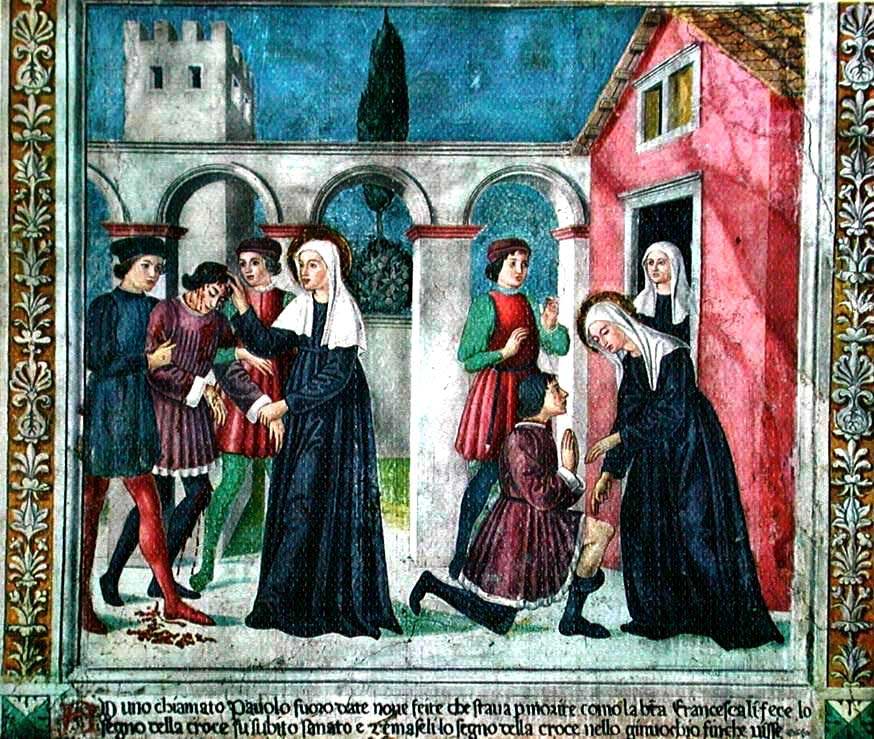
Last week I wrote about people in the archdiocese putting evangelization into practice by making the sign of the cross and praying grace in public places. Of course, this is not something new. In this painting, the great early 15th century English mystic, Julian of Norwich, is making the sign of the cross as she blesses a person seeking her prayer.
Yesterday and Today
A fellow Brit, Archbishop Vincent Nichols, following in Julian’s footsteps and seeking to make more ermanent some of the graces of the Holy Father’s visit is asking Catholics to bless themselves openly with the sign of the cross, to offer to pray for people and to make such remarks to people as “God bless you,” as a way to make one’s faith more visible in daily life. It seems that the New Evanglization is finding a place on both sides of the pond!
Last week on the blog we had a discussion of the Florida Court of Appeals’ declaration that two fathers or two mothers was just as good as having a father and mother. I argued that this is absurd and made what was essentially a Natural Law argument against such a supposition. The article in question is here: Fla Decision Denies Reality)
While many wrote to agree with the view I presented there was a also the usual devolution of the argument into a debate on homosexuality in general. Fine. But once again it is troubling how disregarded Natural Law is today in favor of ideological views. I must repeat, even before Scripture is opened, it is clear that the human body does not lie. A Man is not for a man, a woman is not for a woman. Rather, the man is for the woman and the woman is for the man. Scripture surely confirms what natural law discloses.
Yet it occurred to me that we ought to review what is meant by Natural Law. I would like to represent an article I wrote almost a year ago on Natural Law. I am away this week preaching a retreat for priest. I will try and monitor the comments (since I am not on retreat). But since it may not be possible to write new material in this busy week I though it timely to represent this article on Natural Law.
The Natural Law Tradition of the Catholic Church is often criticised by some Protestants and more often by secularists. Some think of it as merely an invention of the scholastic period. Others (esp. some of the Protestants) think we should limit our discourse to the Scriptures alone. But Catholicism has always seen God’s revelation in broader terms that Scripture alone. To be sure, Scripture along with Sacred Tradition is revelation it is clearest manifestation. But creation too is revelation from God and speaks to his will and to his attributes.
Natural Law, far from being an invention of the Middle Ages, is enshrined in Scripture. We find it in the Wisdom Tradition of the Scriptures and also in the New Testament. Most clearly, St. Paul points to it in the Letter to the Romans:
What may be known about God is plain to [the Gentiles], because God has made it plain to them. For since the creation of the world God’s invisible qualities—his eternal power and divine nature—have been clearly seen, being understood from what has been made, so that men are without excuse. (Rom 1:19-20)
Notice that St. Paul does not speak of a “murky” sort of revelation, only vaguely noticeable in creation, but rather a revelation that can be “clearly seen.” Paul does not call this revelation “natural law” (that designation would come later) but what we now call Natural Law is what Paul is speaking of here.
Further, the concept of “Logos” present in the prologue to St. John’s Gospel also enshrines Natural Law premises. The ancient Jews, particularly those who collected the Wisdom Tradition in the Scriptures (Books such as Wisdom, Sirach, Ecclesiastes, Proverbs etc.) understood that the created world has a Logike (a kind of Logic) based on the fact that God made it through his Logos (Word). When God spoke creation into existence through his Word (Logos) his Logos sets things forth with a Logike(logic) that is discernible and could be studied to make one wise in the ways (the logic) of God. We have come to call this scriptural teaching, Natural Law. In effect we can discern a logic of rationality to what God has made and come to know of God and his will for us.
As a final example of the antiquity of Natural Law in the I would like to share excerpts from one of the Church Fathers, Athanasius who teaches on in his great work, “Against the Arians.” In this excerpt Athanasius uses the term “Wisdom” but the teaching, as you shall see is the same as the Logos tradition and what we have come to call “Natural Law.” Here are excerpts:
An impress of Wisdom has been created in us and in all his works. Therefore, the true Wisdom which shaped the world claims for himself all that bears his image…Wisdom himself is not created, because he is the Creator, but by reason of the created image of himself found in his works, he speaks [of himself] as if he were a creature, and he says: The Lord created me in his works, when his purpose first unfolded. The likeness of Wisdom has been stamped upon creatures in order that the world may recognise in it the Word who was its maker and through the Word come to know the Father. This is Paul’s teaching: What can be known about God is clear to them, for God has shown it to them. Ever since the creation of the world his invisible nature has been there for the mind to perceive in things that have been made….So there is a wisdom in created things, as the son of Sirach too bears witness: The Lord has poured it out upon all his works, to be with men as his gift, and with wisdom he has abundantly equipped those who love him….and in the light of this wisdom the heavens declare the glory of God, and the firmament proclaims the work of his hands. – Discourse “Against the Arians” by St Athanasius
Hence we see a valuable and very ancient pearl in what we have come to call Natural Law. In these secular times the testimony of Natural Tradition gives us something of a basis to address a world that rejects the authority of Scripture. The use of Scripture may still be best in the circle of believers, (though even there the testimony of Natural Law should not be overlooked), but Natural Law can provide a possible basis for discussion with non-believers. Even here, there are challenges today. In an age as “skeptical” as ours the plain testimony of “reality” is not so plain to some who radically doubt that we can or should derive moral norms from things that appear in creation. Still Natural Law at least provides some navigating points for a discussion with most non-believers.
One of the glories of the Catholic Church is our rich appeal to several sources for truth. Scripture surely ranks first but Sacred Tradition supplies us additional revelation in addition an interpretive key for the Scriptures. Further, Natural Law, attested to in the Scriptures also supplies a witness to the truth about God and it reveals his glory. This is the broad and beautiful foundation upon which the Catholic faith rests.
The following video sets forth the challenges that a radical skepticism poses and illustrates why the Natural Law is a precious gift to be recovered and respected.
In the Gospel for today about the rich man and Lazarus the Lord gives us some important teachings on judgment and on hell. Now it is a fact that we live in times where many consider the teaching on Hell to be untenable. Many struggle to understand how a God described as loving, merciful and forgiving can assign certain souls to Hell forever. No matter that the Doctrine of Hell is taught extensively in Scripture and quite a lot by Jesus himself, the doctrine does not comport well with many modern notions and emphases of God, and, hence many think it has to go.
But this reading goes a long way to address some of the modern concerns about Hell and so we ought to look at it. Prior to doing that however it might be important to state why Hell has to exist. I have done that more extensively on this blog here: http://blog.adw.org/2010/07/hell-has-to-be/ However I summarize that lengthier article in the nest paragraph
Hell has to exist essentially for one reason: “Respect.” God has made us free and respects our freedom to chose his Kingdom or not. Now the Kingdom of God is not a mere abstraction. It has some very specific values and these values are realized and experienced perfectly in heaven. The values of the Kingdom of God include: Love, kindness, forgiveness, justice to the poor, generosity, humility, mercy, chastity, love of Scripture, love of the truth, worship of God, God at the center and so forth. Now the fact is that there are many people in our world who do not want a thing to do with chastity, or forgiveness, or being generous and so forth. And God will not force them to adopt and live these values. While it is true that everyone may want to go to heaven, heaven is not merely what we want, it is what it is, as God has set it forth. Heaven is the Kingdom of God and the values thereof in all their fullness. Hence there are some (many?) who live in such a way that they consistently demonstrate that they are not interested in heaven, since they are not interested in one or many of the Kingdom values. Hell “has to be” since God respects their freedom to live in this way. Since they demonstrate they do not wnat heaven, God respects their freedom to choose “other arrangements.”
Now this leads to today’s Gospel which we can see in three stages.
1. The Ruin of the Rich Man– As the Gospel opens we see described a rich man (some call him Dives, which simply means “rich”). There was a rich man who dressed in purple garments and fine linen and dined sumptuously each day. Now it is clear he lives very well as has the capacity to help the poor man, Lazarus, outside his gate. But he simply does not. His sin is not so much one of hate, but of indifference. He is living in open rejection of one of the most significant Kingdom values, that of the love of the poor. His insensitivity is a “damnable sin” in the literal sense since it lands him in Hell. So the ruin of this rich man is his insensitivity to the poor.
Now the care of the poor may be a complicated matter and there may be different ways of accomplishing it, but in no way can we ever consider ourselves exempt from caring for the poor if it is in our means to help them. We simply cannot avoid judgement for our greed and insensitivity. As God said in last week’s reading from Amos regarding those who are insensitive to the poor: The LORD has sworn by the pride of Jacob: Never will I forget a thing they have done! (Amos 8:7) God may well “forget” many of our sins (cf Is 43:23; Heb 8:12) but apparently, trampling the poor and disregarding their needs isn’t one of them.
Hence this rich man has willfully and repeatedly rejected the Kingdom and is ruined by his greed and insensitivity. He lands in Hell since he doesn’t want heaven where in the poor are exulted (cf Luke 1:52) Abraham explains the great reversal to him: ‘My child, remember that you received what was good during your lifetime while Lazarus likewise received what was bad; but now he is comforted here, whereas you are tormented.
2. The Rigidity of the Rich Man– Now you might expect the rich man to be finally repentant and to have a change a heart but he does not. Looking up into heaven he seems Lazarus next to Abraham. Rather than finally seeing Lazarus’ dignity and seeking his forgiveness, the rich tells Abraham to send him to Hell with a pail of water in order that the rich man might be refreshed. He still sees Lazarus as beneath him (even though he has to look up to see him). He sees Lazarus as a “step and fetch errand boy” and wants him to come to Hell. Notice too, the rich man does NOT ask to be admitted to heaven! He is unhappy with where he is but still does not seem to desire heaven and the Kingdom of God with all its values. So he has not really changed. He is regretful of his currently tormented condition but does not see or desire heaven as a solution to that. Neither does he want to appreciate Lazarus’ exalted state. He wants to draw him back to the lower place he once occupied.
Now this helps explain why Hell is eternal. It would seem that there is a mystery of the human person which we must come to accept. Namely, that we come to a point in our life where our character is forever fixed, where we no longer change. When exactly this occurs is not clear. Perhaps it is death that effects this fixed quality. The Fathers of the Church often thought of the human person as clay on a potter’s wheel. As long as it is on the wheel and moist it can be molded, changed and fashioned. But there comes a moment when the clay is taken off the wheel and placed in the fiery kiln (judgment day (cf1 Cor 3:15)) and it’s shape is forever fixed and cannot be changed. The rich man manifests this fixed quality. He has not changed one bit. He is unhappy with his torments and even wants to warn his brothers. But he apparently does not intend to change or somehow experiences his incapacity to change. Hence, Hell is eternal since we will not change there. Our decision against the Kingdom of God and its values (a decision which God respects) is forever fixed.
3. The Reproof of the Rest of Us – As already noted, the rich man, though he cannot or will not change, would like to warn his brothers. Perhaps if Lazarus would rise from the dead and warn his brothers they would repent! Now let’s be clear, we are the rich man’s brethren. And we are hereby warned. The rich man wants exotic measures but Abraham says no, ‘They have Moses and the prophets. Let them listen to them.’ The rich man replied, ‘Oh no, father Abraham, but if someone from the dead goes to them, they will repent.’ Then Abraham said, ‘If they will not listen to Moses and the prophets, neither will they be persuaded if someone should rise from the dead.'” Of course, this reply is dripping with irony given Jesus’ resurrection from the dead. That aside, the fact is we should not need exotic signs to bring us conversion. The phrase “they have Moses and the Prophets” is a Jewish way of saying, they have Scripture.
And the scriptures are clear to lay out the way before us. They give us the road map to heaven and we have but to follow it. We ought not need an angel or a ghost, or some extraordinary sign. The Scriptures and the teachings of the Church are sufficient. Their instructions are clear enough: Daily prayer, daily scripture, weekly Eucharist, frequent confession all lead to a change of heart wherein we begin to love the Kingdom of God and its values. We are more merciful, kind, generous, loving toward the poor and needy, patient, chaste, devout, self controlled and so forth.
In the end we have to be clear: Hell exists. It has to exist for we have a free choice to make and God will respect that choice even if he does not prefer our choice. You and I are free to choose the Kingdom of God, or not. This Gospel also makes it clear that our choices lead ultimately to final and permanent choice wherein our decision is forever fixed. The modern world needs to sober up. There is a Hell and its existence is both reasonable and in conformity with a God who both loves us and respects our freedom.
If you are a Washington Redskins fan, you have, no doubt, already answered this question! “R You In?” was the rally cry for Redskins training camp and the tag line for season ticket sales. I’m not in with the Redskins but I love the simple and direct nature of the question. It really demands a “yes” or “no.”
Archbishop Wuerl is asking us the same question, in much more poetic language in his pastoral letter Disciples in Mission: Sharing the Vision. While we can opt in or out with the Redskins with very little consequence, opting out of full and active participation in the New Evangelization for those of us who are baptized, does have consequences for us and for the church.
Sharing the vision
Msgr. Pope did a nice job introducing us to the pastoral letter and I plan, from time to time, to share stories about people and parishes who are in– who are giving new definition to what it means to be Catholic Evangelizers.
It begins with the sign of the cross
One of the ideas in the pastoral letter that seems to have hit home is the suggestion to pray grace before meals in public. I was out with a group of colleagues, with whom I had not shared a meal and wondered if they were the types who pray grace in public places. The food came, there was a pause, and then a chuckle and two of us in unison said, “We’re all about the New Evangelization, and we are going to pray.”
At Mass on Sunday, I was chatting with a fellow parishioner and he said, “Susan, a friend read the pastoral letter, and told me that before reading the letter, he would make a small and quick Sign of the Cross before eating in public, now he decided, he would make a real Sign of the Cross.” Another friend wrote, “My husband and I are going to pray grace in restaurants.”
Evangelization really can be this easy and people do notice. At the hotel where we stayed while we were at the Passion Play, we had assigned tables for meals in the hotel restaurant. When we sat down for dinner, there was a woman who was also assigned to our table. She was just about finished when we arrived. She was reading the paper and sipping coffee. We sat down and began with Grace. The next day, we came back to the hotel and were sitting in the coffee bar. She came in and sat down and we started to chat with her. At the end of the conversation, she said, “I just want to say that I thought it was really nice you prayed Grace before you ate, you don’t see that often and not from Catholics.”
Hopefully, as we study and discuss the pastoral letter and our renewed commitment to the New Evangelization we will take advantage of other opportunities to share our love for the Lord and the joy we have found in the Catholic Church. The Sign of the Cross, the public acclamation that we live, and move and have our being in the name of the Father and of the Son and Holy Spirit is a great way to start. Buon apetito!
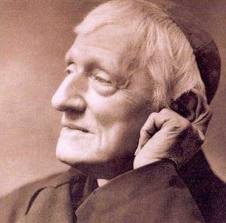
So, if a member of the family (Body of Christ) is going to be canonized, will I still be accused on jumping on the bandwagon by writing about him just like every other Catholic blog, newspaper, and news outlet. I’ve decided not to write much, there is so much you can read. See The Catholic Standard or or Zenit.
I want to share an excerpt from Newman that is part of the philosophy of Education Parish Service, where I worked for four years in Rome and ten years in Washington D.C. EPS is a lay formation program for Catholics adults, so it is not surprising that John Newman would be a guiding light. This piece however is what best describes why I am so passionate about my work.
“I want a laity, not arrogant, not rash in speech, not disputatious, but men [and women] who know their religion, who enter into it, who know just where they stand, who know what they hold and what they do not, who know their creed so well that they can give an account of it, who know so much of history that they can defend it. I want an intelligent, well-instructed laity – I wish [them] to enlarge [their] knowledge, to cultivate [their] reason, to get an insight into the relation of truth to truth, to learn to view things as they are, to understand how faith and reason stand to each other, what are the bases and principles of Catholicism.’ (Sermon 9, Duties of Catholics towards the Protestant View, 1851)
As we give thanks for the gift of Cardinal John Henry Newman and how he lived to perfection to vocation to which God called him, I pray our parishes will be the home of exactly this kind of person.

 Today, we celebrate the feast of the Guardian Angels. It would be hard to improve on Msgr. Pope’s excellent blog last week. So, rather than do that, I’d like to propose that we can learn something about evangelization from the angels. After all, one of the primary missions of angels is to announce good news. Dr. Jem Sullivan in a recent talk at the John Paul II Cultural Center, suggested that angels show us how our lives can radiate the message and truth of the Gospel.