A Chronological Sequence of the Resurrection Events

This blog post is a follow-up from yesterday’s blog. You can read yesterday’s post by clicking HERE.

When we encounter the resurrection accounts in the New Testament we face a challenge in putting all the pieces together in a way that the sequence of the events flow in logical order. This is due to the fact that no one Gospel presents all, or even most of the data. Some of the data also seems to conflict. I tried to show in yesterday’s blog that these apparent conflicts are not, usually, true conflicts. Another problem with putting all the facts together in a coherent and reasonably complete manner is that the time line of the events is often unclear in some of the accounts. Luke and John are the clearest as to the time frame of the events they describe but Matthew and Luke given us very few parameters. Both Acts and Paul also supply data wherein the time frame is not always clear.

Nevertheless I want to propose to you a possible, even likely, sequence of the Resurrection events. The work is my own and I make no claim that this scenario is certain or backed up by recognized ancient authority. St Augustine has done quite a lot of work in this matter and you can read that by clicking HERE. My attempts here are  simply the fruit of 20+ years of praying over and pondering the events of those forty days between the Lord’s resurrection and ascension. My reflections are based as solidly as possible on the actual biblical data with a small sprinkling of speculation. I realize that the  attempt to do this will irritate some modern biblical scholars who, for reasons unclear to me, seem to insist it is wrong to attempt any synthesis of the texts.

Nevertheless I boldly press on figuring that the average believer will benefit from it and find such a synthesis interesting. Take it for what it is, the work of an obscure pastor who has prayed and carefully sought to follow the sequence of the forty days. You may wish to offer correction or alternative interpretation and are encouraged to do so in the comments. I have posted a PDF of this Document that is easier to read here: Resurrection Chronological Sequence

  • I. The Morning of Day One
    • A. Very early in the morning a group of several women, including Mary Magdalene, approach the tomb to complete burial customs on behalf of Jesus (Matt 28:1; Mk 16:1; Jn 20:1).
    • B. They behold the tomb opened and are alarmed.
    • C. Mary Magdalene runs to Peter and John with distressing news of likely grave robbers (John 20:2)
    • D. The women who remain encounter an angel who declared to them that Jesus had risen and that they should tell this to the brethren (Mk 16:5; Lk 24:4; Matt 28:5).
    • E. They are filled with fear at first and depart from the tomb afraid to speak (Mk 16:8)
    • F. Recovering their courage they decide to go to the Apostles. (Luke 24:9; Matt 28:8)
    • G. Meanwhile Peter and John have gone out to the tomb to investigate Mary’s claim. Mary Magdalene followed them back out to the tomb arriving before they left. Peter and John discover the tomb empty though they encounter no angel. John believes in the resurrection. Peter’s conclusion is not recorded.
    • H. The other women have reported what the angels say to the Apostles. Peter and John have not yet returned and these remaining apostles are dismissive of the women’s story at first (Lk 24:9-11).
    • I. Mary, lingering at the tomb weeps and is fearful. Peering into the tomb she sees this time two angels who wonder why she weeps. Jesus then approaches her from behind. Not looking directly at Jesus, she supposes him to be the gardener. Then he calls her by name, and Mary, recognizing his voice, turns and sees him. Filled with joy she clings to him. (APPEARANCE 1) (Jn 20:16)
    • J. Jesus sends her back to the apostles with the news to prepare them for his appearance later that day. (Jn 20:17)
    • K. The other women have departed the apostles and are on their way possibly back home. Jesus then appears to them (Mat 28:9) after he had dispatched Mary. He also sends them back to the apostles with the news that he had risen and that he would see them. (APPEARANCE 2)
  • II. The Afternoon and evening of day one.
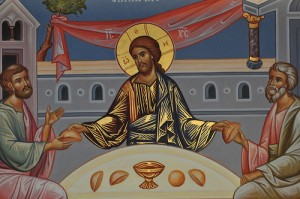
    • A. Later that Day, two disciples on their way to Emmaus are pondering what they have heard about rumors of his resurrection. Jesus comes up behind them but they are prevented from recognizing him. First Jesus breaks open the word for them, then sits at table with them and celebrates the Eucharist whereupon their eyes are opened and they recognize him in the breaking of the bread. (APPEARANCE 3) (Luke 24:13-30)
    • B. The two disciples returned that evening to Jerusalem and went to the Eleven. At first the eleven disbelieved them just as they had the women (Mk 16:13). Nevertheless they continue to relate what they had experienced. At some point Peter drew apart from the others (perhaps for a walk?) And the Lord appeared to Peter (APPEARANCE 4)(Lk 24:34; 1 Cor 15:5) who informed the other ten who then believed. Thus the disciples from Emmaus (still lingering with the apostles) were now told (perhaps by way of apology) that it was in indeed true that Jesus had risen (Lk 24:34).
    • C. Almost at the same moment Jesus appears to the small gathering of apostles and the two disciples from Emmaus. (APPEARANCE 5) Thomas was absent (although the Lucan text describes the appearance as to “the eleven” this is probably just a euphemism for “the apostles” as a group) They are startled but Jesus reassures them and opens the scriptures to them (Lk 24:36ff).
    • D. There is some debate as to whether he appeared to them a second time that night. The Johannine account has significantly different data about the appearance on the first Sunday evening from the Lucan account. Is it merely different data about the same account or is it a wholly separate appearance? It is not possible to say. Nevertheless since the data is so different we can call it (APPEARANCE 6) (John 20:19ff) though it is likely synonymous with appearance 5.
  • III. Interlude –
    • A. There is no biblical data that Jesus appeared to them during the week that followed. The next account of the resurrection says, “Eight days later” namely the following Sunday.
    • B. We do know that the apostles surely exclaimed to Thomas that they had seen the Lord but he refused to believe it. (Jn 20:24-26)
    • C. Were the apostles nervous that Jesus had not appeared again each day? Again we do not know, the data is simply silent as to what happened during this interlude.
  • IV. One week later, Sunday two.
    • A. Jesus appears once again (APPEARANCE 7) to the apostles gathered. This time Thomas is with them. He calls Thomas to faith who now confesses Jesus to be Lord and God. (John 20:24-29)
  • V. Interlude 2
    • A. The apostles received some instructions to return to Galilee (Mat 28:10; Mk 16:7) where they would see Jesus. Thus they spent some of the week journeying 60 miles to the north. This would have taken some time. We can imagine them making the trek north during the intervening days.
  • VI. Some time later –
    • A. The time frame of the next appearance is somewhat vague. John merely says “After this.” Likely it is a matter of days or a week at best. The scene is at the Sea of Galilee. Not all the Twelve are present. They have gone fishing and Jesus summons them from the lakeside. They come to shore and see him (APPEARANCE 8 ) . Peter has a poignant discussion with Jesus in this appearance and is commissioned to tend the flock of Christ (John 21).
    • B. The Appearance to the 500. Of all the appearances you might think that this one would have been recorded in some detail since it was the most widely experienced appearance. Many accounts it seems would have existed and at least one would have made its way into the scriptures. Yet there is no account of it other than it did in fact happen. Paul records the fact of this appearance: 1Corinithians 15:6 Then he appeared to more than five hundred brethren at one time, most of whom are still alive, though some have fallen asleep. (APPEARANCE 9) Where did this take place. What was it like. What was the reaction? We simply do not know. Proof once again that the Bible is not a history book in the conventional sense. Rather it is a highly selective telling of what took place, not a complete account. The Bible makes no pretenses to be something it is not. It is quite clear that it is a selective book: (John 20:30).
    • C. The Appearance to James. Here again we do not have a description of this appearance only a remark by Paul that it did in fact happen: 1Cor 15:7 Then he appeared to James. (APPEARANCE 10) The time frame is not clear. Only that it happened after the appearance to the five hundred and before the final appearance to the apostles.
  • VII. The rest of the forty days.
    • A. Jesus certainly had other on-going appearances with the disciples. Luke attests to this in Acts when he writes: Acts 1: 3 To them he presented himself alive after his passion by many proofs, appearing to them during forty days, and speaking of the kingdom of God.
    • B. During this time there is perhaps the one appearance we can attribute to this time period as recorded by Matthew (28:16ff) and Mark (16:14ff). It takes place an “a mountaintop in Galilee.” Mark adds that they were reclining at table. For these notes this appearance (time frame uncertain) is referred to as (APPEARANCE 11) It is here that he give the great commission. Although Mark’s text may seem to imply that Jesus was taken up from this mountain, such a conclusion is rash since Mark only indicates that Jesus ascended only “after he had spoken to them” (Mk 16:19).
    • Evidently Jesus had also summoned them back to Jerusalem at least toward the end of the period of the forty days. There they would be present for the feast of Pentecost. We can imagine frequent appearances with on-going instruction for Luke records that Jesus “stayed with them.” Most of these appearances and discourses are not recorded. Luke writes in Acts: And while staying with them he charged them not to depart from Jerusalem, but to wait for the promise of the Father, which, he said, “you heard from me, for John baptized with water, but before many days you shall be baptized with the Holy Spirit.” (Acts 1:4)
  • VIII. The final appearance and ascension:
    • A. After forty days of appearances and instructions we have a final account of the last appearance (APPEARANCE 12) wherein he led them out to a place near Bethany, gave them final instructions to wait in Jerusalem until the Holy Spirit was sent. And then he was taken up to heaven in their very sight. (Luke 24:50-53; Acts 1).

So here is a possible and, if I do say so myself, likely chronological sequence of the resurrection appearances. It is a kind of synthesis that attempts to collect all the data and present it in a logical order. There are limits to what we can expect of the Scriptural account, and fitting perfectly into a time frame and logical sequence is not what the texts primarily propose to do. Yet such a chronological sequence can prove helpful and it is in that spirit that I present this.

Resurrection: Rob Bell from Rob Bell on Vimeo.

Smiling in Church

One Easter Sunday Mass, as I went through the church and sprinkled the people with Holy Water, was struck by how many long, gloomy, and sad faces I saw. After I was done I said, “I just want to remind you that it’s Easter Sunday- so it’s okay to smile in church!”

There were long faces on Easter in today’s gospel as well. When the risen Jesus joined two disciples on their journey and asked what they were talking about, “They stopped, looking downcast.” Or as another translation puts it, “They stood still, looking sad.” Just like so many of the people I saw at Easter Mass.

But let’s not forget the rest of the gospel story. After they recognized Jesus in the breaking of the bread, the two disciples were so filled with joy that they ran to tell their friends. The risen Jesus had replaced their sadness with joy!

The good news that Jesus has risen should also fill us with joy this Easter season. As St. Augustine once wrote, “A Christian should be an ‘alleluia’ from head to foot!” Do you remember the Opening Prayer at this Mass? We thanked God for the joy of the resurrection, and asked that the joy of our celebration may bring us to the joy of eternal life. And as we prayed together in the responsorial psalm, “Rejoice, O hearts that seek the Lord.”

Easter joy doesn’t mean that we ignore life’s real difficulties and problems. But it does mean that we confront them with the assurance that if we have a God who loves us so much that he died and rose for us, then surely he will lead us through our present troubles into his everlasting peace. Mother Teresa once put it very well. “Never let anything cause you so much sorrow,” she said, “that you forget the joy of Jesus risen.”

Readings for today’s Mass: http://www.usccb.org/nab/042711.shtml

Photo Credit: visualthinker via Creative Commons

A Lover’s Search

A beautiful love story lies at the heart of today’s Easter gospel. In a subtle way, the evangelist has portrayed Mary Magdalene as the woman lover in the Old Testament’s Song of Songs.

This lover searches for her beloved in the night, just as Mary Magdalene went to the tomb before the sun had risen. The lover asks the city watchmen if they had seen her beloved, just as Mary Magdalene laments to the angels keeping watch that she doesn’t know where Jesus is to be found. As it was in a secret garden that the lover would meet her beloved, so Mary Magdalene first mistook Jesus for a gardener. And finally, when the lover finally discovered her beloved she took hold of him and refused to let go, just as Mary Magdalene clung to Jesus, after he revealed himself to her.

Mary Magdalene’s deep love for Jesus gave her the courage to overcome the doubts and fears that seemed to paralyze the disciples after the crucifixion. As a reward for her courageous love, Jesus appeared to her first and appointed her the messenger to tell the others the good news of the resurrection. Because of this, she has been honored throughout history as the “Apostle to the Apostles.”

Mary Magdalene’s courageous love is an inspiration and example for us, because so often we need courage in order to be a follower of Jesus. For instance:

• We need courage to trust God, when we can’t see the road ahead of us;

• We need courage to confess our sins when our shame would hold us back;

• We need courage to witness to our faith in the face of injustice and ridicule;

• We need courage to love others when we risk being rejected by them;

• We need courage to forgive, when we’re afraid of appearing weak;

• And we need courage to grow in holiness, when we fear the change that growth requires.

Mary Magdalene serves to remind us that perfect love casts out fear, because we love a Lord whose love for us conquered not only fear, but even death itself.

Readings for today’s Mass: http://www.usccb.org/nab/042611.shtml

Photo Credit: bobosh_t via Creative Commons

Come to Jesus?!?

Ever hear of a “Come to Jesus” meeting? That’s how some refer to summons from a superior when they know they’re in trouble. It’s something to be dreaded.

Perhaps the disciples felt dread when the two Marys told them that the risen Jesus would meet them in Galilee. After all, most of them had abandoned him in his hour of need. One had denied him. And it wasn’t they who came to his tomb on Easter morning. It was the women. In light of all this, maybe they feared some sort of punishment from Jesus- a tongue-lashing, a dressing-down, or worse.

We too can dread coming before Jesus when we feel guilty about something. We imagine that he’ll shame us or even reject us. But that’s not the case at all, and today’s gospel gives us a hint of what to expect. In speaking to the two Marys, he calls his disciples “brothers.” He makes no threats. They’re family, he loves them, and he very much wants to see them.

We’re Jesus’ family too. He loves us, and he wants to see is. He will call us to a “Come to Jesus” meeting! Not to make us shake in fear! But so we can share his resurrection joy.

Readings for today’s Mass: http://www.usccb.org/nab/042511.shtml

Photo Credit: epicxero via Creative Commons

Happy Easter – Jesus is on line one

Do you have a cell phone?  Does your cell phone tell you who it is that is trying to call you?  Do you usually check that caller ID and decide, based on who it is, whether to answer the phone or not?

“Answer”, “Ignore” or “Send to voicemail”?

I do! In all honesty, when someone at my school says to me, “You have a call on line one,” I almost always ask, “Who is it?”  Then, I decide if the person is worthy of my time, if I am prepared to talk to that person, if I don’t like that person or if it is conversation I would prefer to have later.  I am sure the same thing happens to me when I call others as well.  I am not offended , trust me, I am a high school principal.  Try calling a parent in the middle of the day.

Caller ID

I love caller ID.  When I know who is calling, I know how I am going to react.  I am going to pickup the phone if it is my mom or wife because I want to make sure they are OK.  I am going to pick up my calendar if it is my Pastor because he probably has something for me to do.  I am not going to always pick up the phone if it is my best friend because, we will talk forever and I got to make sure I have time to sit and chat.  I am not going to pick up the phone at all if I am driving because that is dangerous and I am not trying to kill anyone. Like many of you, I make these discernments each time my phone rings.  And that it OK.

If it is God, pick up and answer!

But, when it comes to Christ, when it comes to God, you can’t hit the “ignore” button but so many times; Can I get an amen?  I shouldn’t say to God,” I will call you back later.”  You shouldn’t say to God, “Not now I am busy.”  We shouldn’t say to God, “I have something more important to do.” You can’t say to God, “This isn’t a good time, go talk to someone else and get back to me later.”  You can’t put God into your voicemail but so many times.  When God calls, you must pick up the phone and answer.  And unlike your mother, pastor, wife or best friend, don’t simply say “Hello.”  Answer God’s call by saying, “Here I am Lord, what do you want me to do!”

Are you sure you have the right number?

Brother and sisters, I know at least for me, I have put God on hold many times in my life.  I hit the ignore button, turned on my voice mail and took a message.  And he kept calling.  I tried my best to not be a deacon but God kept calling and I kept saying, “You must have the wrong number.”  God said, “Follow me” and I said, but I don’t have the time. I said to myself, “Most Deacon’s are retired, I still have to work” (Which isn’t true by-the-way, but that was my excuse at the time).  God said, “I gave you that job that keeps you so busy, want to keep it?”  I said “God, I have not studied religion since high school, and I wasn’t all that great at it.”  God said, “I am the perfect teacher, I can teach anyone, including you.”  I even said “God, I am really not sure I am worthy.” And God said, “I know; That is why the Holy Spirit will be heavily involved in this endeavor.”  Like the disciples on the Sea of Galilee, with me, God knew whom he was calling.  Sometimes, we think God doesn’t know what he is doing don’t we?  God’s doesn’t ask for a resume because he already knows our qualifications.  This is important because we often ignore God’s call not out of spite for Our Lord but rather lack of confidence in the graces he has given us.  You see, God is not asking us to change who we are, he is asking us to take the talents that he built into us and use them for the Kingdom of God.

I knew you before you were formed in the womb

I often meditate upon the reason why God chose fisherman to be the first disciples, the first Bishops of the flock.  Maybe because fishing was a dangerous profession and he needed men who would not be frightened easily.  Maybe it was because fisherman had to be patient and building the Kingdom of God requires among many things patience.  Perhaps it was because fisherman had to be able to read subtle changes in the weather and water conditions in order to fill their nets and those same skills were needed in leading the early Christian community.  Perhaps it was because fisherman rarely worked alone and they had a sense of community that he wanted in his Church on Earth.  Maybe it was all of the above and maybe it was a set of qualities that I have yet to understand. But he never said to them, “Stop being fisherman.”  Rather, I will take those skills I gave you and make yourselves “Fishers of men.”

Brothers and sisters, when God calls us, he knows what he is doing and he knows whom he is calling.  When you answer God’s call, you will never hear God say, “Sorry, I dialed the wrong number!”   I heard a priest say once, “God never calls the qualified but qualifies everyone he calls.”

Each of us has a talent or a gift that God wants us to use to build his Kingdom.  God is calling us to use that talent.  For some of us, you are being called to lector, join the choir, be a minister of holy communion, join the St. Vincent de Paul Society become active in any number of ministries we have in an average parish.  Your phone is ringing, answer the call, it’s God!  Some of you are called to be priests, deacons, religious sisters or brothers.  Don’t send God to your voice mail, answer and say, “Here I am Lord.”  Some of you are called to be married and to be parents, maybe even adoptive parents, God is calling, don’t text him back saying, “I am busy.”

Say yes!

Brothers and sisters, God is calling and when we answer yes, he doesn’t promise that our life will be easy.  But, he promises that our life will be fulfilled.  In your prayer life, God is calling; Through your friends, God is calling;  Through the voices of your family, God is calling.  Perhaps even through this blog post, God is calling.  Answer the phone and say, “Here I am Lord.  What do you want me to do?”   Happy Easter!

More than Words

As I cross the Potomac River on my Sunday morning drive to St. Hugh’s, I’m typically treated to a beautiful scene filled with peaceful water, impressive monuments, a rising sun, and a sky colored with brilliant shades of red, orange, and blue. As I take in this sight, I often imagine that another Sunday, the first Easter morning, must have been beautiful as well. I think of Mary Magdalene making her way to the tomb, and I picture her as disheveled, head hung low in grief, and bleary-eyed from weeping and a lack of sleep. But then I try to imagine the change that must have come over her when she finally realized that her beloved Jesus had risen from the dead. I wonder what she did. Did she shed tears of joy? Did she leap or dance or burst into song? Did she fall on her knees, lift her head, and raise her hands to the sky in a gesture of gratitude to God?

The Bible doesn’t tell us, so I guess that this side of heaven we’ll never really know what Mary Magdalene did. But I think it fair to say that she didn’t just stand there, and that her joy over Jesus’ resurrection was expressed with more than just words. Perhaps, for those first moments, she couldn’t find anything to say at all. Which would be understandable, because the Resurrection is such a marvelous and magnificent event that it’s hard to find the right words to describe it. Mere words can’t seem to do it justice.

In a sense, we Christians on Easter morning are a bit like the victorious team at the Super Bowl. As they celebrate their victory, the winning players express their jubilation by jumping, shouting, hugging, running, dog piling, pumping their fists, slapping high fives, lifting teammates on their shoulders, popping champagne bottles in the locker room, and dumping Gatorade on their coach. It would seem that they have to express their joy with much more than words.

The same is true for us today. We celebrate the rising of Jesus from the dead! The Son of God, who died for us on a cross, has risen to new life so that we might live in hope of living forever with him in heaven. This is something far more wonderful than winning a Super Bowl ring. In fact, it’s far more wonderful than anything else we will ever have, learn about, or experience. So how can words alone possibly be sufficient to celebrate such an event? We sing, “This is the day the Lord has made! Let us rejoice and be glad!” But that’s not enough. There has to be something we can do, in addition to what we can say. Not necessarily jumping or dancing, although maybe we can imagine doing that. And while I can sprinkle Holy Water on all of you, please do not dump any Gatorade on me.

Perhaps the greatest thing we can do to celebrate the resurrection with more than words it to share some of the love that Jesus has already shared with us by rising from the dead. Consider the two disciples in today’s gospel. We know that Peter was one of them. The other is simply identified as the “beloved disciple.” He’s not given a name here; we’re just told that Jesus loved him. But, in a sense, that’s all we need to know. Because even though he was a real person, the so-called “beloved disciple” represents each one of us because we, like him, are beloved of Jesus.

Remember what the beloved disciple did. When he and Peter learned from Mary Magdalene that Jesus’ tomb was empty, they ran to the tomb. Which is a reasonable thing to do, given the circumstances. Yet the gospel makes the point that they actually got into something of a race, and the beloved disciple won. Then he waited at the tomb, so that Peter could go in first. But what’s the point of our knowing this? Who cares which disciple was the fastest? Who cares that Peter went into the tomb first? Is this just a bit of biblical trivia, or is there some hidden meaning here?

Indeed there is a hidden meaning here. We’re meant to understand that the beloved disciple ran so fast, not because he was especially quick or Peter was particularly slow, but because he was impelled forward by his great love for Jesus. Yet he chose to allow Peter to enter the tomb first, not because he was courteous or catching his breath or afraid of going in, but because he acknowledged the authority of Peter, the head of the band of disciples and, of course, our first pope. By acting in this way, the beloved disciple shows the rest of us who are loved by Jesus how we can celebrate his resurrection with more than words. Like him, our lives are to be driven by love for Jesus within the fellowship of, and under the authority of, the Church and its chief shepherd, the pope.

At the beginning of this Mass, we were sprinkled with Holy Water, the water of baptism, to remind us of our own baptism and the promises that we made, or were made for us, on that day. Immediately after this homily, we will renew those baptismal promises, and pledge once again to live a life driven by the love of Jesus, and lived within the Church. We will promise to reject sin, so we can live in real freedom. We will promise to reject the “glamour of evil”- in other words, all the selfish, materialistic, and superficial temptations of our culture. We will promise to reject Satan, who hates us as much as Jesus loves us.  And we will renew our promise, and I quote, “to serve God faithfully in his holy Catholic Church.” Should we honor these promises, we will be able to celebrate the resurrection of Jesus with far more than mere words.

Readings for today’s Mass: http://www.usccb.org/nab/042411.shtml

Photo Credits (top to bottom): randomduck,  avinashkunnath, http://www.flickr.com/photos/jbtaylor/, via Creative Commons

What Our Life Is Worth

How much is one human life worth? The head of our government’s compensation fund for 9/11 victims, Kenneth Feinburg, had to wrestle with that question over 1,500 times. In his book, appropriately titled What is Life Worth?, Feinburg shares his agonizing struggle in trying to ensure that victims’ survivors received a fair compensation for their loss. The average victim’s family received $2 million dollars. But not everyone received the same amount. For instance, the amount awarded for stockbrokers was higher that that awarded to military families, because stockbrokers’ annual salaries were higher. But some military families complained, saying that their relatives would have left the military soon and taken higher-paying civilian jobs. Feinburg also heard from people whose relatives had died when the Oklahoma City federal building was bombed. But those families received nothing, as Feinburg’s government mandate restricted the fund to 9/11 victims. Feinburg ultimately concluded that the whole process was unfair. He wrote: “Don’t ask one person to act like Solomon and try to calculate the value of lives. To be judge, jury, accountant, lawyer, rabbi, et cetera, is very, very difficult.”

Just what is one life worth? That’s a good question for us to ponder today. Perhaps a person’s value is his or her net worth of assets. Yet this would mean that Donald Trump is far more valuable than Mother Teresa of Calcutta. As Catholics, would we agree with that assessment? Our faith tradition holds in high esteem those men and women who have taken voluntary vows of poverty. But if the value of their lives were based soley upon what they possessed in this world, they would be worth very little indeed.

The truth is that at our most basic, physical level, we are worth very little. The combined value of all of the chemicals and minerals found in a typical human body, 96% of which is Oxygen, Carbon, Hydrogen, and Nitrogen, is less than one, single U.S. Dollar. One dollar is pocket change to most of us; it won’t even buy a small cup of coffee at McDonald’s. Contrast that with the price of an ounce of gold, which recently topped $1000. An ounce of gold is about the size of a matchbook, and can fit comfortably in the palm of our hand. But is it worth more than we are? Maybe on the commodities market. But not in the eyes of God. If you and I want to know what we are worth to God, all we need to do is listen carefully to today’s Passion gospel, and reflect on what is recalled in this solemn liturgy.

We are reminded today that God considers us to be so valuable, that his only Son surrendered his own life, so that we might live forever. If God thought that we were cheap, expendable, or dime-a-dozen, would he have bothered? How much effort do we make to save or protect that which we think has no value? Not much. We’re generally happy to throw it away, or write it off as a loss. But God, through the suffering and death of Jesus, has shown us clearly how much our lives are worth to him. As Pope Benedict has written: “Man is worth so much to God that he himself became man in order to suffer with man…as is revealed to us in the account of Jesus’ Passion.”

Can we put a dollar amount on how much we’re worth to God? If we were to try, we’d have to put a price on Jesus’ life, since he gave his life for ours. Judas Iscariot, when he betrayed our Lord, received 30 silver pieces for Jesus’ life. But this amount was an intentional insult, as it represented the fine to be paid a slave owner by anyone who injured his slave. Nicodemus, I think, was closer to the mark. We heard how he anointed Jesus’ dead body with over a hundred pounds of costly spices, an extravagant amount fit only for a king. Yet even this, of course, comes nowhere near to representing the true value of Jesus’ life. It would be absurd, and even obscene, to try to place a monetary value on Jesus’ life. It’s much better, and far more accurate, to say simply that Jesus’ life was priceless. And if Jesus’ life is priceless, then, in a sense, the same is true of ours.

In God’s eyes, we are indeed priceless. Nevertheless, God did pay a very specific price for us. More specifically, he paid the price of our sins. Like our lives, we can’t really attach a dollar value to our sins. But that doesn’t mean that our sins aren’t costly, because they are. Sin hurts our neighbors, our families, our enemies. Sin hurts us, as it keeps us from being the people God wants us to be. And sin harms our relationship with God. We might say that our sins have bankrupted us. Bankruptcy, of course, means that we owe more than we are able to pay. In terms of our sins, bankruptcy means that there’s nothing we can do to truly make up for all the harm our sin has done. Jesus had to do it for us. He is the one who satisfied our debt; he is the one who paid the price. And the price he paid was the cross.

In just a matter of minutes, we will venerate the cross of Jesus. We will bow before it, praise Christ for it, adore it as it’s lifted on high, and many of us, after the liturgy, will remain behind to reverence it with a kiss. We will do this because the cross shows us how precious we are in God’s sight; it shows us, more than anything else could, how much we are valued, and loved, by God. We may not be able to place a dollar value on our lives. But because of the cross, because of this “Good Friday,” you and I know exactly what our lives are worth.

Photo credits: pnoeric, moneyblognewz, nikoretro, via Creative Commons

Is He Your King? The Trial Before Pilate

GOOD FRIDAY – All through the night Jesus has been locked in the dungeon of the high priest’s house. Early this morning he was bought before a Pilate who transferred his case to Herod. Herod sent him back to Pilate who, sometime in the mid-morning, bowed to the pressure of the Temple leadership and the crowds, and condemned Jesus to a horrible death by crucifixion. In the late morning Jesus was taken by the soldiers through the city and up the hillside of Golgotha. By noon he is nailed to the cross where he hangs in agony for some three hours. He dies around three in the afternoon. He is taken down from the cross and placed in the tomb hastily before sundown. Today is a day of prayer, fasting and abstinence. Whenever possible, Christians are urged to keep today free of work, of social engagements, of entertainment, and to devote themselves to communal prayer and worship. At noon many parishes gather for stations of the cross for recollections of the seven last words of Jesus. Many parishes also offer stations of the cross at 3pm the hour of Jesus death. In the evening, we gather quietly in our parish Churches to enter into time of prayer as we reflect on Jesus death on the cross. We also pray for the needs of the world. To acknowledge the power of the cross in our lives today, we one by one come forward to venerate the cross with a kiss. Our hunger from this day of fasting is satisfied with Holy Communion distributed at the end of this liturgy. Consider too how the apostles might have gathered that night together in fear and prayer reflecting on all that happened.

The following videos depicts Jesus and Pilate. The First is from The Passion of the Christ. What is remarkable about this clip is that when Pilate addresses Jesus in Aramaic, Jesus answers him in Latin. This is not a biblical fact, but a technique that the producer, Mel Gibson (pray for him) uses. It is something that startles Pilate and the bystanders, for it was unlikely that a Galilean would know enough Latin to hold a conversation, let alone about philosophy and theology! But it would seem to be Gibson’s (pray for him) way of illustrating that this conversation is personal, between Pilate and Jesus, for Jesus uses Pilate’s mother-tongue. Jesus speaks to Pilate in a very personal and serious way: Who do YOU think I am and what will YOU do about it?

The Second clip is from the movie The Gospel of John. It follows the Gospel of John exactly. Notice how Jesus turns the tables on Pilate. Although Jesus is on trial, he ends up putting Pilate on trial! Notice too how many times Pilate goes in and out of Praetorium (Governor’s Palace). At least four times! He is vacillating. He knows Jesus is innocent of the charges. But in the end, out of fear, he suppresses his conscience and hands Jesus over. Pilate had wanted to avoid committing to Jesus one way or the other. But he, like you and me had to make a decision. You might say he goes from vacillation to assassination!

Notice particularly the question Pilate wrestles with over Jesus’ Kingship. He asks, “Are you the King of the Jews?” But Jesus will not answer. This is a question Pilate must answer. It is a question you and I must answer. And so Jesus says, “Are you saying this on your own or have others been saying this to you?” In other words am I a King because you say so or are you just saying what others say? Only Pilate can answer if Jesus is a king. Only you and I can answer for ourselves. Is he your King?