Warts and All

God loves imperfect people! This is the good news for us in today’s gospel. As we heard, Simon Peter had witnessed a miraculous catch of fish. But then he told Jesus to go away, because Peter knew that he was a sinner. But Jesus didn’t go away. Instead, he called Peter to himself, told him not to be afraid, and made him a fisher of men.

Like Peter, we too can sometimes fear Jesus because of our sins and imperfections. They can lead us to think that we’re not worthy to be Jesus’ disciple. At times like this, we need to remember the experience of Peter. As one old slogan puts it: “God doesn’t call the perfect. But he does perfect the called!”

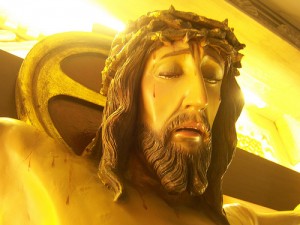
At other times we’re so deeply ashamed of our sins that we fear Jesus will reject us or punish us. But that’s not the Jesus who hung on the cross. When we’re sorry for our sins, the only punishment we need fear is the one we inflict on ourselves when we don’t seek Jesus’ forgiveness, and when we don’t forgive ourselves.

You see, Jesus loved Peter in spite of his imperfections, and he loves us too. Because of Jesus loved only the perfect, he’d have no one on earth to love.

Readings for today’s Mass: http://www.usccb.org/bible/readings/090111.cfm

Photo Credit: DNisha via Creative Commons

Bringing Jesus Home

During Mass, we hear Jesus speak to us in Scripture, and we receive Him in Holy Communion. After Mass, Jesus asks us to bring him home.

Simon Peter did this in today’s gospel. Like us, he encountered Jesus in word and worship, at the synagogue. And afterwards, Peter took Jesus to his home, where a family member was in need of a healing only Jesus could provide.

In our own families, we too may find a need for Jesus’ healing touch- healing of brokenness, jealousy, resentments, old wounds, rivalries, physical sickness, mental illness, addictions.

Like Peter, we need to bring Jesus home. Yes, sometimes Jesus does arrive unannounced! But more often than not, Jesus waits for an invitation- and an escort.

We can bring Jesus home in so many ways. Maybe we need to share our faith by sharing our story. Maybe we need to lend a helping hand. Maybe we need to confront one who is hurting others, or hurting themselves. Maybe we need to say “I’m sorry” and “I forgive you.” Maybe we need to say “I love you.” Maybe we just need to stop being a stranger, and pick up the phone.

There are any number of ways Jesus can bring healing into our homes. But we can’t just wait for him to appear. Because the truth is, it might be Jesus who is waiting for us!

Readings for today’s Mass: http://www.usccb.org/bible/readings/083111.cfm

Photo Credit: Mikecogh via Creative Commons

Is Forever Possible?

Susan Gibbs,  the former Executive Director of the Office of Communications for the Archdiocese of Washington posted this blog on the Diocese of Arlington website. With her permission, we are re-posting it because it is a perfect introduction to the importance of a conference the archdiocese is hosting on October 1 at Catholic University of America.

Christ…or a sandy beach?

Ok, I admit it. Nearly every Sunday, I read the wedding section of the New York Times.

After a double dose of bad news from the front pages of the Times and TheWashington Post, I usually need some entertainment and the “how-we-met” stories tend to be a lot of fun. Plus, it can be inspiring to seecouples ready to embark on a new life together.

But what started as a diversion turned into something else. I started noticing fewer church weddings. Priests and ministers were being replaced with “Universal Life” celebrants and other officiants who were friends of the couple “ordained” for the occasion. (Like everything else these days, it turns out you can go online and get instantly “ordained.”) No longer held in churches, weddings are migrating to beaches, restaurants and exotic destinations.

Is this just the result of editors choosing unusual venues, or a sign that church weddings are on the decline?

Sadly, it seems to be the latter. A new study, released by Our Sunday Visitor and the Center for the Applied Research in the Apostolate, reports a nearly 60-percent plunge in weddings celebrated in the Catholic Church alone since 1972.

Given that the number of Catholics in the United Statesis growing, that’s not good news. What is going on?

According to the researchers,it’s not that Catholics areless likely than anyone else to marry,although that’s not saying a lot. The rate of marriage in the United States has dropped by nearly half since 1970, while the number of couples cohabitating has skyrocketed, according to The National Marriage Project. Instead, CARA researchers found:

  • Catholics are waiting slightly longer to marry
  • Catholics who divorce may be remarrying outside the Church
  • Catholics are marrying non-Catholics in increasing numbers
  • Catholics are not marrying at all.

That last one – not marrying at all– turns out to be the biggest factor in explaining the precipitous decline in weddings celebrated in Catholic churches. In 1970, nearly 80 percent of all adult Catholics in the U.S. were married. Today, barely 53 percent are. For younger Catholics (18- to 40-year-olds), the drop is even more significant: 69 percent were married in 1972, but only 38 percent are today.

In 2007, nearly a quarter of never-married U.S. Catholics said they were “not at all likely” to ever get married.

And, when they are marrying, they aren’t marrying other Catholics as often as in the past. From 1991 to 2008, the percent of young married Catholics (under age 41) married to other Catholics dropped from 78 percent to 57 percent. These couples may or may not marry in a Catholic Church.

Does it matter? Yes, quite a lot, because being married means something as a Catholic. There are only seven sacraments and marriage is one of them.

As the U.S. bishops’ website explains, “The sacraments make Christ present in our midst. Like the other sacraments, marriage is not just for the good of individuals, or the couple, but for the community as a whole. The Catholic Church teaches that marriage between two baptized persons is a sacrament. The Old Testament prophets saw the marriage of a man and woman as a symbol of the covenant relationship between God and his people. The permanent and exclusive union between husband and wife mirrors the mutual commitment between God and his people.”

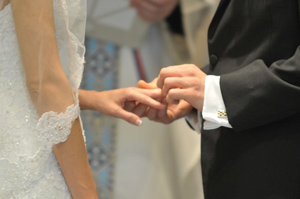
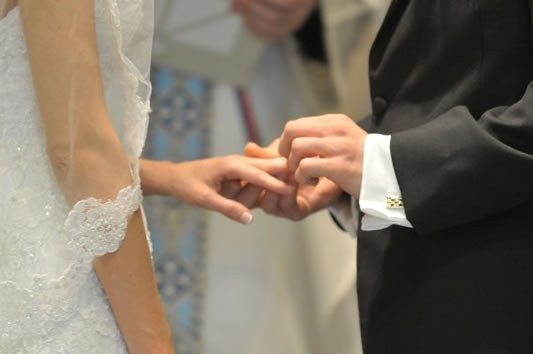
Getting married – making that commitment – and holding the wedding in the sacred place of a church keeps the focus on what a wedding truly is – a joining of two people before Christ who now will become one within a community. I’m all for friends at a wedding, but I’d rather have them in the pews. After all, having Christ in your wedding and marriage will get you a lot further than a buddy on a sandy beach.


Tuning Out a Wordy World

It’s been said that we live in a very “wordy world.” Every day we’re bombarded with words from TV, radio, the internet, billboards, road signs, t-shirts, bumper stickers, and goodness knows what else. We can’t even go to the beach without seeing airplanes dragging banners advertising beer or seafood.

Because we’re so inundated by them, words can often lose their power for us. We say things like, “Talk is cheap” or “They’re only words” or “Words don’t mean anything.” What a contrast to the situation described in today’s gospel, in which Jesus spoke at a synagogue.  We’re told that people were “astonished at his teaching” and that they said to one another, “What is there about his word?”

It’s interesting that we aren’t told much of what Jesus actually said except for the command: “Be quiet!” These words were initially directed to a demon! But perhaps we can understand them as the Holy Spirit’s little reminder to us today to “tune out” our “wordy world” and spend a moment in quiet reflection on Holy Scripture, that the amazing, astonishing, authoritative, life-giving words of Jesus- the Word made flesh- might resound in our hearts.

Readings for today’s Mass: http://www.usccb.org/bible/readings/083011.cfm

Photo Credit: Terwilliger911 via Creative Commons

Conscience vs. Reputation (Martyrdom of St. John the Baptist)

Have you ever feared to do the right thing, or bear witness to your faith, because you were concerned about what others might do or say? I would imagine that most of us have; it’s something of a universal struggle. Teens struggle with peer pressure about sex and drugs. Workers weigh the pros and cons about resisting a corrupt or unethical corporate culture. Public figures bow to opinion polls. Christians keep their faith under wraps, lest they be labeled a “holy roller.” It’s all a matter of our conscience, versus our reputation.

King Herod was a case in point. He knew that the right thing to do was to set John the Baptist free. But he was afraid of what his guests might think. So against his better judgment, he delivered John to death. For his part, John could not have been a greater contrast to King Herod. As a true prophet of God, he spoke the hard truth. And he paid a hard price. All because he made a hard choice to be faithful to his Lord and true to his conscience.

John’s witness is an inspiration to us to be courageous in always choosing to do the right thing. Sure, in some people’s eye’s we’ll look like a fool; but in God’s eyes, we’ll look like a saint.

Readings for today’s Mass: http://www.usccb.org/bible/readings/082911.cfm

Image Credit: http://www.zeno.org/ via Wikipedia Commons

Hope for Every Family (St. Monica)

St. Monica, whose feast we celebrate today, is not only a saint. She’s also the mother of a saint, St. Augustine. So what the Church presents to us today for our veneration is a saintly family!

Some of you may be thinking, “That’s nice, but it certainly doesn’t describe my family.” That may be true. But consider this: At one time, St. Monica was an alcoholic. She had a verbally abusive, non-Christian husband who cheated on her. Her son Augustine abandoned his faith as a teenager, defiantly embraced another religion, came home from college with a live-in girlfriend, fathered a child out of wedlock with her, and then later sneaked out of the country in order to get away from Mom.

For his part, St. Augustine suffered from depression at times; he spent many years adrift as he sought meaning and purpose in life; he wasted time and money on silly and immoral entertainment; and he struggled with a sexual compulsion that filled him with shame.

Does that sound a bit more familiar? Sound a bit more like a real family. It even sound a bit like a dysfunctional family. But that’s not the entire story, which has a happy ending. Augustine eventually returned to his Christian roots and became a great bishop; Monica’s pagan husband changed his ways and became a Christian as well; and Monica recovered from alcoholism and died in the company of her son, whom she had shortly beforehand watched being baptized at the hands of another saint, St. Ambrose.

Their story, I think, should give real hope to real families who struggle with real problems: Hope that now matter how bad things may seem, there’s always the possibility for healing, conversion, reconciliation, growth, and freedom. For nothing is impossible with God!

Readings for today’s Mass: http://www.usccb.org/bible/readings/082711.cfm

Image Credit: Wikipedia Commons

Reflections from WYD – The Vigil Miracle by Elizabeth Lent

Elizabeth Lent, junior at Notre Dame and parishioner from Little Flower takes us back to World Youth Day.  Read about her final night at WYD.

After Benedict XVI drove through the crowd in his Popemobile, we could actually see him walk on stage.  He gave an opening prayer as the youth continued its energetic cheers, again and again… “Esta es la Juventud del Papa!”  A group of youth carried a life size cross across the stage while the audience quieted in reverent anticipation of the Pope’s words.

Sitting all day under the heat of the sun, we were hoping to be blessed with shade to cool ourselves and water to quench our thirst.  As the vigil approached, threatening clouds appeared and youth murmured about the approaching rain storm in fear that it would soak our sleeping bags (lying out in our assigned sleeping zone).

Then it began to drizzle.  The crowds erupted into cheers, not relenting in their enthusiasm for God and the spirit of Catholic youth.  It continued to rain harder, and the high winds forced the Pope to take cover under the stage.  The youth cheered louder and louder; they would not give up.  We were all fighting against this act of the devil who was trying to prevent our celebration of faith, The Holy Father, and God the Father.  Well we won.  The Pope addressed the Youth, “Say a little prayer and then maybe the rain will stop.”  Hail Mary’s in all languages scattered the crowd, “…Salve Regina, Madre de Dios…  In minutes the rain had stopped.  It was a miracle.  I felt completely engulfed in God’s love.

Though the rain did start up again, this was the climax of World Youth Day.

Pope Benedict XVI prepared the exposition of the Blessed Sacrament and everyone knelt in adoration of Our Lord for some time.  It was powerful to see the juxtaposition of the Pope with the actual presence of God himself.  We had all been cheering and praising our Pope, but God our Savior is the true omnipotent being we are honoring.

The rest of the night was spectacular.  Renewed by the spirit of the youth and of Our Lord, we slept happily (though a little uncomfortably) on a sandy dirt ground among fellow believers.  Waking up to a gorgeous sunrise and Mass with the Holy Father, the experience could not have ended any better.  As a friend and I sprinted with our backpacks after the final blessing to the metro in order to catch our plane home, thoughts about what we had just witnessed were running through my head…

Wow, that was crazy.  I just saw the Pope, like with my naked eye, no big screen needed or anything.  What am I supposed to make of all this? I sure hope I make my flight… I don’t even know what to think right now, I guess I am just so overwhelmed by the amount of faithful Catholic youth out there.  And we talked to so many people who were so energetic about sharing their faith.  That one French girl was really geared up, so cool!  I am so blessed to have been able to come here, wow, thanks God.  And that rain, amazing! This will be a week I will never forget.

God bless you all and thank you so much for your prayers!

Eliz.

Prepare for the Banquet

If you knew a guest was coming to your home for dinner tonight, what would you do beforehand? I imagine you’d plan a menu, go shopping, cook, clean the house, and set the table. We’d do this because if our guests arrived and we were unprepared, we would be embarrassed, to say the least, and our guests would think we were very poor hosts.

Jesus tells us today that we need to prepare for his arrival, or more specifically, his second coming. As we heard in his parable of the wise and foolish virgins, this will be a cause of celebration for some, but a time of judgment for those who are unprepared. On the one hand, this parable is a source of hope, because it speaks of the wedding banquet of Jesus to which we’ve all been invited. At the same time, it’s also a call to repentance, conversion, and amendment of life.

Perhaps we might ask ourselves the question: If we knew that Jesus were coming today, what would we do? St. Francis of Assisi was once asked that question while he was working in a garden, and he said that if he knew that Jesus were coming, he’d continue working in his garden, because he was ready to meet him. Francis was at peace, because he was prepared. Jesus calls us to prepare today, that we might live in his peace, forever.

Readings for today’s Mass: http://www.usccb.org/bible/readings/082611.cfm

Image Credit: Carodean Road Designs via Creative Commons