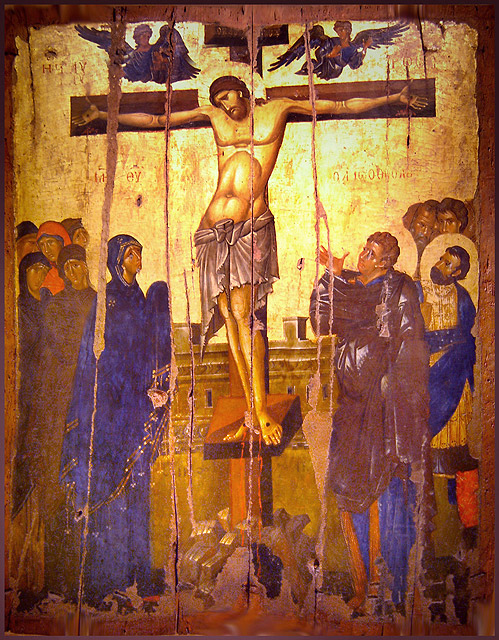
Hope for Every Family (St. Monica)

St. Monica, whose feast we celebrate today, is not only a saint. She’s also the mother of a saint, St. Augustine. So what the Church presents to us today for our veneration is a saintly family!

Some of you may be thinking, “That’s nice, but it certainly doesn’t describe my family.” That may be true. But consider this: At one time, St. Monica was an alcoholic. She had a verbally abusive, non-Christian husband who cheated on her. Her son Augustine abandoned his faith as a teenager, defiantly embraced another religion, came home from college with a live-in girlfriend, fathered a child out of wedlock with her, and then later sneaked out of the country in order to get away from Mom.

For his part, St. Augustine suffered from depression at times; he spent many years adrift as he sought meaning and purpose in life; he wasted time and money on silly and immoral entertainment; and he struggled with a sexual compulsion that filled him with shame.

Does that sound a bit more familiar? Sound a bit more like a real family. It even sound a bit like a dysfunctional family. But that’s not the entire story, which has a happy ending. Augustine eventually returned to his Christian roots and became a great bishop; Monica’s pagan husband changed his ways and became a Christian as well; and Monica recovered from alcoholism and died in the company of her son, whom she had shortly beforehand watched being baptized at the hands of another saint, St. Ambrose.

Their story, I think, should give real hope to real families who struggle with real problems: Hope that now matter how bad things may seem, there’s always the possibility for healing, conversion, reconciliation, growth, and freedom. For nothing is impossible with God!

Readings for today’s Mass: http://www.usccb.org/bible/readings/082711.cfm

Image Credit: Wikipedia Commons

Reflections from WYD – The Vigil Miracle by Elizabeth Lent

Elizabeth Lent, junior at Notre Dame and parishioner from Little Flower takes us back to World Youth Day.  Read about her final night at WYD.

After Benedict XVI drove through the crowd in his Popemobile, we could actually see him walk on stage.  He gave an opening prayer as the youth continued its energetic cheers, again and again… “Esta es la Juventud del Papa!”  A group of youth carried a life size cross across the stage while the audience quieted in reverent anticipation of the Pope’s words.

Sitting all day under the heat of the sun, we were hoping to be blessed with shade to cool ourselves and water to quench our thirst.  As the vigil approached, threatening clouds appeared and youth murmured about the approaching rain storm in fear that it would soak our sleeping bags (lying out in our assigned sleeping zone).

Then it began to drizzle.  The crowds erupted into cheers, not relenting in their enthusiasm for God and the spirit of Catholic youth.  It continued to rain harder, and the high winds forced the Pope to take cover under the stage.  The youth cheered louder and louder; they would not give up.  We were all fighting against this act of the devil who was trying to prevent our celebration of faith, The Holy Father, and God the Father.  Well we won.  The Pope addressed the Youth, “Say a little prayer and then maybe the rain will stop.”  Hail Mary’s in all languages scattered the crowd, “…Salve Regina, Madre de Dios…  In minutes the rain had stopped.  It was a miracle.  I felt completely engulfed in God’s love.

Though the rain did start up again, this was the climax of World Youth Day.

Pope Benedict XVI prepared the exposition of the Blessed Sacrament and everyone knelt in adoration of Our Lord for some time.  It was powerful to see the juxtaposition of the Pope with the actual presence of God himself.  We had all been cheering and praising our Pope, but God our Savior is the true omnipotent being we are honoring.

The rest of the night was spectacular.  Renewed by the spirit of the youth and of Our Lord, we slept happily (though a little uncomfortably) on a sandy dirt ground among fellow believers.  Waking up to a gorgeous sunrise and Mass with the Holy Father, the experience could not have ended any better.  As a friend and I sprinted with our backpacks after the final blessing to the metro in order to catch our plane home, thoughts about what we had just witnessed were running through my head…

Wow, that was crazy.  I just saw the Pope, like with my naked eye, no big screen needed or anything.  What am I supposed to make of all this? I sure hope I make my flight… I don’t even know what to think right now, I guess I am just so overwhelmed by the amount of faithful Catholic youth out there.  And we talked to so many people who were so energetic about sharing their faith.  That one French girl was really geared up, so cool!  I am so blessed to have been able to come here, wow, thanks God.  And that rain, amazing! This will be a week I will never forget.

God bless you all and thank you so much for your prayers!

Eliz.

Prepare for the Banquet

If you knew a guest was coming to your home for dinner tonight, what would you do beforehand? I imagine you’d plan a menu, go shopping, cook, clean the house, and set the table. We’d do this because if our guests arrived and we were unprepared, we would be embarrassed, to say the least, and our guests would think we were very poor hosts.

Jesus tells us today that we need to prepare for his arrival, or more specifically, his second coming. As we heard in his parable of the wise and foolish virgins, this will be a cause of celebration for some, but a time of judgment for those who are unprepared. On the one hand, this parable is a source of hope, because it speaks of the wedding banquet of Jesus to which we’ve all been invited. At the same time, it’s also a call to repentance, conversion, and amendment of life.

Perhaps we might ask ourselves the question: If we knew that Jesus were coming today, what would we do? St. Francis of Assisi was once asked that question while he was working in a garden, and he said that if he knew that Jesus were coming, he’d continue working in his garden, because he was ready to meet him. Francis was at peace, because he was prepared. Jesus calls us to prepare today, that we might live in his peace, forever.

Readings for today’s Mass: http://www.usccb.org/bible/readings/082611.cfm

Image Credit: Carodean Road Designs via Creative Commons

Stay Awake!

“Stay awake!” These are Jesus’ words to us in today’s gospel, and they’re very timely at this hour of the morning!* Seriously, however, Jesus spoke them so we would live in anticipation of his coming again.

But do we do this? I can’t imagine that our first thought this morning was: “Maybe Jesus will return today!” But perhaps it should be. Because if we lived in real expectation that Jesus might appear at any time, we would probably live very different lives. I say this because we so often we don’t do today the things we can put off until tomorrow.

This tendency to procrastinate affects our spiritual life. We say things like: I’ll work on getting rid of that bad habit- tomorrow. I’ll start praying more regularly- tomorrow. I’ll apologize to that person I hurt- tomorrow. I’ll become more generous with my money- tomorrow. I’ll make my confession- tomorrow. And so on and so on. What’s worse, our “tomorrow” often becomes the next day, and then the next, until whatever it is we should have done doesn’t get done at all.

But the truth is that one day there will be no tomorrow. That’s why Jesus insists that we “stay awake”- so we don’t put off until tomorrow, the things he wants us to do today.

Readings for today’s Mass: http://www.usccb.org/bible/readings/082511.cfm

Photo Credit: theogeo via Creative Commons

* homily was preached at a 7:15 a.m. Mass!

Reflections from WYD by Elizabeth Lent

Elizabeth Lent, junior at Notre Dame and parishioner from Little Flower takes us back to World Youth Day.  Read about her experience at Cuatro Vientos.

Saturday, August 20th-Sunday, August, 21st

The past 48 hours have been a whirlwind of emotions, culminating World Youth Day 2011 in an unimaginably high spirit of enthusiasm and hope.

At 9:15 am on Saturday morning our group head out to make the 5 mile hike to Cuatro Vientos, an airport outside of town where the vigil would be held that evening.  That night everyone would sleep outside and then wake up to attend mass with the Pope on Sunday morning.  Carrying backpacks stuffed with our next three meals, sleeping bags and pads, we prayed the Joyful mysteries of the Holy Rosary and sang the Chaplet of Divine Mercy…For the sake of His sorrowful passion, have mercy on us and on the whole world… We also joined in signing praise songs with other groups walking along side us.  Making friends with some fellow Americans from California, we got lost with them a few times during the hike; don’t we all lose our way in life occasionally, knowing though that the Lord will always come after us like the lost sheep, just as he did through the helpful volunteers scattered all over to help direct the crowds.

Arriving at Cuatro Vientos at noon we maneuvered around masses of people all gathering to honor the Pope andreceive his words and blessing.  We left our things in section D8 where we would be sleeping that evening and then proceeded to stuff our pockets with food, water, a journal, cards, and anything else we would want for the rest of the day.  Next stop was to claim our seats in front of the stage where Pope Benedict XVI would lead a vigil celebration that evening and we would not return to our backpacks until 11pm.  Our group, fortunate to receive tickets for the front section of seats, secured the seventh row in the second bunch of seats, front and center from the stage.  As we waited for the Pope’s arrival at 7pm, the sun’s heat beat down on us but we were all just so pleased to be sitting down, it was a blessing to see how much we take for granted in our ordinary life, something so simple as a chair.  We also may take advantage of how present Our Lord is to us each and every day.  We may not always make us of his love for us, believing that we can do it on our own, but nothing can be done without the power and love of God.

Throughout the afternoon, several bands performed and pop culture music was played on loud speakers.  It was purely fun the many times the whole community of youth stood up on our chairs, waving flags, singing, and dancing along to these songs we were all familiar with, uniting us into one body, one family.  As we had these 6 hours to spare, my friend and I who are working on a documentary film about World Youth Day had a lot of time to go around and meet with youth from several countries.  Asking why they came to WYD and what they believed to be the significance of the youth in the Catholic Church, we had the opportunity to interview two young adults from Ethiopia, several girls from Canada, two English guys, an Aussie, and others.  At one point we talked to a brother and sister from Southern France.  The sister answered our questions in French, and though we had no clue what she was saying, it was clear to see she was quite hyped up and enthusiastic about her faith.  The excitement and emotion that came through in her eyes, hand motions, and tone of voice was absolutely powerful.  It makes me smile now, remembering how alive this young women was.  This is the spirit of the youth in the Church, the spirit that we are all hear fighting to renew in the world.

Written by: Elizabeth Lent, Junior at University of Notre Dame and parishioner at Little Flower in Bethesda

Photos by: Elizabeth Lent

Feast of the Unknown Apostle (St. Bartholomew)

Today we celebrate the legacy of someone we know next to nothing about. You’ve heard of the Tomb of the Unknown Soldier? Perhaps we could call today the Feast of the Unknown Apostle! I’m speaking, of course, about St. Bartholomew.

We know that he’s an apostle. We know that he was born in Cana of Galilee. We know that he was first brought to Jesus by Philip, because today’s gospel tells us that. And we know that he was sometimes called Nathaniel, because today’s gospel tells us that too. Later traditions say that he traveled to India, maybe he wrote a gospel that’s now lost to us, and was martyred for the faith. But that’s about it!

But perhaps it’s a good thing we don’t know much about St. Bart. Maybe the fact that we don’t have a lengthy chronicle of his teachings and mighty deeds should remind us that as Christians, we aren’t meant to draw attention to ourselves.

 Instead, we’re asked to die to self, and live for Christ;

 We’re to build up God’s kingdom, not our own reputations;

 It’s God’s glory we are to seek, and not our own;

 Self-sacrifice, and not self-promotion, is our goal;

 We are to ask: “Lord, what can I do for you?” and not, “Lord, what’s in it for me?”

History doesn’t always remember those who answered this call, but heaven is full of them. And we know that St. Bartholomew is in heaven! But at the end of the day, perhaps that’s all we really need to know.

Readings for today’s Mass: http://www.usccb.org/bible/readings/082411.cfm

Image Credit: wikipedia commons

More than Ritual

An Irish bishop once preached: “Paddy Murphy went to Mass, and never missed a Sunday. But Paddy Murphy went to hell, for what he did on Monday!” It was the bishop’s intention to remind his listeners –in a rather crude and direct way!- that Christianity involves more than simply fulfilling religious obligations.

Our Lord seems to say the same thing in today’s gospel. As we heard, he challenged those scribes and Pharisees who kept religious rituals but neglected more important matters, such as justice, mercy, faith, generosity, and sacrifice.

You and I can be tempted to fall into this same trap. And when this happens, we lose sight of the fact that at the heart of Christianity are not rituals but a relationship- a personal relationship with God the Holy Trinity.

Such a relationship was Jesus’ deepest wish for the scribes and Pharisees he criticized. And it is his deepest wish for us.

Readings for today’s Mass: http://www.usccb.org/bible/readings/082311.cfm

Photo credit: momentcaptured1 via Creative Commons

Mistaken Identity

When he was the Archbishop of Washington, Cardinal James Hickey told a funny story of an experience he had at Reagan National Airport, while on his way to Rome. Even though he was 75 years old and obviously dressed as a bishop, he was told by an embarrassed ticket agent that he had “fit the profile” of an international terrorist, mostly because he held a one-way ticket. As a result, he had to submit to a complete search. Although he was able to laugh about it later, at the time Cardinal Hickey was, shall we say, not amused.

This story just goes to show that none of us wants to be falsely identified or misunderstood. Jesus himself was very concerned about being properly understood, as we heard in today’s gospel. When he asked his friends about who people thought he was, he received a variety of answers: John the Baptist, Elijah, Jeremiah, maybe one of the other old prophets come back to life. Yet each of these answers, while not bad in light of the circumstances, was wrong. It was up to Peter who, prompted by the Holy Spirit, proclaimed Jesus to be the Messiah, the Son of the living God.

Jesus wishes to be properly understood, not for his sake, but for ours. This is because our understanding of who Jesus is has profound implications for our behavior. As Christians, we seek to live in imitation of Christ. It follows, then, that the image we have of Christ will largely dictate how we shape our lives in order to conform to his. If we operate with a distorted image of Jesus, we will end up living distorted lives.

All of us here today share common beliefs about Jesus. When we recite the Creed together, we say, “We believe in one Lord, Jesus Christ, the only Son of God, eternally begotten of the Father,” and so forth. Nevertheless, we can profess correct doctrine in Jesus and still operate with a warped image of who he is. Just consider Peter in today’s gospel. He correctly identified Jesus as the Messiah. But then, moments later, as we’ll hear in next week’s gospel, he was appalled to learn that Jesus would be tortured and executed. His image of Jesus, at that time, did not include the possibility of his suffering and death.

Like Peter, most of us operate with a limited understanding of who Jesus is. Which is understandable; as today’s second reading reminded us, the things of God are largely a mystery to us! I have a suspicion that when we meet the Lord face-to-face at the end of our lives, we will be absolutely astonished by the full reality of who he is. In the meantime, however, our image of Jesus needs to be constantly revisited, challenged, and revised.

To do this, it’s important to recall where our images of Jesus have come from. For instance, our culture shapes our image. I once read how Victorian England was scandalized by a painting, called “The Carpenter’s Shop,” that depicted Jesus and the rest of the Holy Family in Joseph’s workplace. They were portrayed as rustic, simple, and poor- just as Scripture and historians tell us they were. Yet the class-conscious Victorian English refused to accept Jesus as portrayed in such a way. Their culture had a warped understanding of Jesus. You and I need to be on guard for how our materialistic, faced-paced, self-centered, and superficial culture might disfigure our image of our Lord.

In addition, our parents play a significant role in shaping our image of Jesus. Their attitudes, prejudices, ways of handling stress, work-habits, intelligence, and temperament all contribute. Distant parents suggest a distant Jesus; angry parents evoke an angry Jesus; happy parents reflect a joyful Jesus, and so forth. Conscious of this, we need to honestly reflect on our experience with our parents and consider how this may have influenced our understanding of Jesus.

Sometimes our image of Jesus is simply a projection of ourselves. This might result in a Jesus who never challenges us and smiles upon everything we do. It might also result in a Jesus who too much reflects our anger and incapacity to forgive each other. This Jesus is quick to punish and slow to pardon, is easy to fear but hard to love. Once an adult daughter asked her mother to forgive some old hurts. Both of them are committed, practicing Catholics. Yet when the mother hesitated to forgive, the daughter asked, “Don’t you think if I told Jesus I was sorry, he’d forgive me?” But the mother said, “I don’t presume to say what Jesus would or would not do.” Sadly, her image of Jesus had been warped by her pain and resentment.

To grow in an authentic understanding of Jesus, we can do several things. First of all, we need to explore the Scriptures, especially the gospels, which paint for us complimentary and complex portraits of the Lord. “Ignorance of the Scriptures,” insisted St. Jerome, “is ignorance of Christ.” We also need to pray- honestly, openly, and frequently- and let the Spirit of Jesus deepen our relationship, and thus deepen our understanding. We need to be active in the Church, the body of Christ, where our brothers and sisters in Christ can help shape our image of Christ. We need to embrace the teachings of the Church, which come with authority and the guidance of the Holy Spirit. And we need to try and understand our pain and suffering in light of the Jesus’ cross.

First and foremost, however, you and I need to love. To truly understand Jesus, the one who came not to be served but to serve, who gave up his life that ours might be saved, we need to be generous, sacrificial, and loving people as well. Imitation may be the sincerest form of flattery. But when it comes to Jesus, imitation is the key to understanding who he truly is. To love him is to know him, and to know him is to love him.

Readings for today’s Mass: http://www.usccb.org/bible/readings/082111.cfm

Image Credits: Wikipedia Commons