The world tears us in a thousand different directions, and gives us a million different opinions about every subject, most of which contradict. Marketing, newspapers, blogs, and the like churn out a constant stream of facts and emotions that can be hard to make sense of, and even harder to sort by importance: Is Caribou Coffee better than Starbucks? Is global warming real? Is Facebook’s new look better than the old one? Is faith really opposed to reason? Does my mom want a Kindle or a Nook for Christmas? Should I marry my girlfriend? How can we answer any of these questions?
There is a solution to all this chaos in a surprising place: the sixth beatitude, “Blessed are the pure in heart, for they shall see God.” The pure of heart are those whose lives are totally integrated, who live with one goal in mind: God. The pure of heart see God in every person and in every deed, no matter how small; St. Therese of Lisieux spoke about how she wanted to praise God when she picked up a pin.
Advent is especially a time to pray for purity of heart, because in this season we prepare for the coming of Jesus, the Word of God, in whom God says everything there is to say about himself. Jesus is the Truth—not part of the truth, not one truth among many, but the Truth. The welter of the world’s questions finds its answer in the Truth, in Jesus Christ.
To the pure, the infinite good and bad questions of the world are only interesting insofar as they show us the face of God, in whatever surprising or familiar way. Sometimes the truth about a question is that it doesn’t matter much, even when it feels like it does; at other times, the issue might matter a lot, even when it feels trivial. Jesus’ invitation to purity of heart is the invitation to see the world around us with God’s eyes, and to trust him who is the Way, the Truth, and the Life.
Today’s meditation: Give God all your desires. Ask him to purify your mind, so that you might desire everything for his sake.
Mercy is a funny thing. We all expect other people to show us mercy, but only rarely do we think other people are right to expect us to show them mercy. If someone cuts me off in traffic, I’m likely to scream and curse; if I cut someone else off, I get angry at him for honking at me—he should have known I didn’t do it maliciously. We are generally convinced that our own good intentions are so obvious that everyone should be able to see them, but other people can’t be trusted with so much confidence.
The fifth beatitude teaches us how to escape the selfish trap of one-way mercy: “Blessed are the merciful, for they shall obtain mercy.” Jesus isn’t turning mercy into a spiritual brokerage deal—you give me thirty units of mercy and I give you thirty back. Rather, he’s pointing to the core meaning of mercy. Mercy means love for the other—not stinting, begrudging, or partial love, but love in good measure, pressed down, shaken together, and overflowing.
When we ask for mercy, we are asking to be treated according to what is most deeply true about us: that we are children of God. Mercy does not mean overlooking injustice or turning a blind eye to sin; it means loving the other enough to desire his highest good, to treat him as a son of God. This love is from God, drawing the other out of himself, and simultaneously drawing us out of ourselves. When we show mercy, we receive it because God loves through our love.
Advent is the season of mercy. Each of us is marred by sin, each of us has turned away from God’s love to his own selfish desires, each of us has tried to live by his own strength. Yet in his love God did not demand that we mend our ways before he saved us; he sent his Son to us because he loves us and wants to bring us back to himself. We look forward to the day when his Son will come again, bringing the sons and daughters of God to the kingdom of mercy in heaven.
Today’s meditation: Reflect on the mercy God shows us in the sacraments of Penance and the Eucharist. Ask him to increase your devotion to those sacraments.
“If you want to make God laugh,” said St. Teresa of Avila, “just tell him your plans!” What God laughs at
is when we put our cart before our horse. We make our plans, we do whatever it is we want to do, and then
we expect God to accept our decisions, bless them, and help them to be successful. As Christians, what we
should do first is ask what God’s plan is, and then pray for the grace to carry it out.
This was a lesson king David had to learn in today’s first reading. He had decided that he would build for God a great and beautiful Temple in Jerusalem. This seemed to everyone, including the prophet Nathan, like a good and worthwhile and noble thing to do. The problem was that this was not God’s plan for David. God did have plans for David- very great plans that included a covenant with David’s family that would culminate in the birth of Jesus. Nevertheless, God wanted David’s son Solomon, and not David, to be the one to build a Temple. So David had to surrender his plans to the plans of God.
This is what God calls us to do as well. He asks us to surrender our plans and take on his. Consider Mary. I wonder what plans she had as a young girl. Did she want to have lots of children? Did she imagine growing old in the company of a husband and a big family? We’ll never know, but it’s possible. However, whatever plans she may have had all came to an end when the Archangel Gabriel appeared and announced that she would conceive and bear a son named Jesus.
Mary might have said no. She was a free person who could make her own decisions. Some of the earliest Christian writers spoke of all heaven and earth holding their breath, sitting on pins and needles as they awaited Mary’s decision. But of course Mary did say yes. “I am the handmaid of the Lord,” she proclaimed. “May it be done to me according to your word.” Mary had surrendered her plans for God’s. As the Opening Prayer for today’s Mass said, “…the Virgin Mary placed her life at the service of (God’s) plan.”
In a word, Mary was obedient. Her obedience is an example to us of how we should be obedient to the plan of God. In fact, in a certain way Mary’s obedience made it possible for us to be obedient. In today’s second reading, from his letter to the Romans, St. Paul told us that the Jesus’ revelation of God was made “to bring about the obedience of faith.” Yet that would not have been possible without the obedience of Mary.
Mary willingness to surrender her own plans for the plans of God presents a challenge to us. Mary challenges us to think about whatever plans we’ve made and dreams for the future we have. Consider, for instance, the plans you have for the new year about to begin. Plans about your job, your family, your relationships, your education, your home. Think about the purchases you plan to make, the vacations you hope to take, the volunteer commitments you expect to accept, any medical or health procedures you intend to undergo. Then ask yourself: Is it really God’s will that I do these things? Have I placed these decisions before the Lord? Did I ask if they will help build up God’s kingdom and help me and or my family grow in holiness? Were my plans prayerfully made? Did I ask for God’s help and direction when I made them?
We can’t automatically assume that whatever we’ve planned is consistent with God’s plan, even if our plans were made with the best of intentions. That’s the way King David thought, and he wound up being surprised. We need to have the openness, and the humility, to accept that some of our plans may not necessarily be the same as God’s. As has often been said, our God is a God of surprises and he acts in mysterious ways. Just ask a guy who wound up being a married Catholic priest. Or better yet, ask my wife!
Another question we should ask ourselves is: Am I willing to surrender the plans I have to God? Am I
willing to give them up if he wants me to? For instance, what if our health changed and prevented us from
carrying out my plans? What if we had to suddenly care for a sick relative? What if God blessed us with a
new child? What if our circumstances changed or the money just wasn’t there? What if a long-time plan
and our conscience came into conflict? Would we be willing to give up our plans with peaceful
resignation? Or would we resist, run away, make bad compromises, or sink into anger and bitterness? If
that’s the case, then we don’t just have a plan. We have an idol.
It can be hard to surrender. Surrender involves sacrifice; saying “Yes” to God often means saying “No” to something else. Sometimes our pride gets in the way. We want to call the shots in our life. We believe we know what’s best for us better than everybody else, even God. At other times, our fears hold us back. We’re afraid of the unknown and we don’t like moving out of our comfort zones. Surrender can require a lot of courage and trust and love. Even Mary had questions. And Gabriel had to tell her not to be afraid.
Thankfully, God always gives us the strength we need; his grace is always sufficient to the task. As we heard St. Paul say: “To him who can strengthen you…be glory for ever and ever!” Gabriel assured Mary, “nothing will be impossible for God.” And nothing will be impossible with God. God may indeed laugh at our plans. But he smiles when we embrace his.
In today’s Gospel we step back nine months to March 25, the feast of the Annunciation, an event all but hidden, but which changed the world.
God whose focal presence had departed the Temple, just prior to the Babylonian invasion (cf Ez 10:18) and the loss of the Ark of the Covenant, now returns to the Ark of Mary’s womb. The Glorious presence of God returns now to his people in an obscure town of less than three hundred, a town so small that no road went to it.
We are reading here of a pivotal moment in the history of mankind. God not only returns to his people but becomes one with them in the incarnation.
And at this moment we do well to consider four aspects of this pivotal moment. As we do so, we consider, not only Mary’s glories, but also ours in a subordinate but real way. For Mary is the perfect disciple and typifies in a most excellent way the glories that God also wishes to bestow on us, in perhaps a different but still substantial way. Lets look at for aspects of this Gospel.
I. The RESPECT of God – the text says, The angel Gabriel was sent from God to a town of Galilee called Nazareth. To virgin betrothed to a man name Joseph and the virgin’s name was Mary…Mary said “Behold I am the Handmaid of the Lord, May it be done to me according to your word.”
Note that God asks of Mary her cooperation. Although the Angel Gabriel’s words are not in the form of a question, that Mary considers this to be a request from God is clear from Mary’s response. She says yes, and thus understands it as a request, not merely a statement of what shall be.
In this regard we see an important indicator of the respect of God for her freedom. Surely he has prepared her and equipped her with every good grace to say, yes, but in the end, her free “yes” is significant, and something that God looks for and respects. Otherwise, why send an angel at all? Why come through Mary at all? Why not simply appear suddenly as a full grown man and start to work? As it is, God wills to come through Mary (cf Gen 3:15) and seeks her “yes” in the place of Eve’s “no.”
And this respect for her free “yes” is also a respect God extends to us. Indeed we can see here how God’s respect is in contrast to the devil, who shouts, is invasive, provocative and intrusive. Through cultural noise etc., he tempts and provokes. But God whispers and respectfully invites. He does not force our decision but summons us in love and awaits our answer.
In scripture we read of Jesus, Behold, I stand at the door and knock; if any one hears my voice and opens the door, I will come in to him and eat with him, and he with me. (Rev 3:20). Hence, though all powerful and able to coerce, God does not do so, he does not act violently or impose his will. He repsects the freedom He Himself gave us, and invites us to cooperate in his plan for us.
Mary (and we) are thus respected by God in terms of our freedom.
II. The REGARD of God – Note in the text the great love of God, appreciation and regard extended to Mary through the Angel. The text says, Hail, Full of grace! The Lord is with you…Do not be afraid Mary. You have found favor with God...
As the great and glorious Angel, Gabriel comes to Mary, (and every angel is glorious) he must still, in an astonishing way acknowledge Mary’s beauty, holiness, and perfection, by God’s grace. Imagine an all glorious Archangel rendering a kind of debt of praise to a mere human being! And in so speaking this way He is speaking for God, of the deep love, appreciation and regard that God has for Mary, his greatest human work.
Indeed, we should never forget the Love and deep regard God has for Mary and also for us. Mary is surely God’s masterpiece. But she is also the result of His grace and work.
In a less perfect way, but a still true manner, God also loves us and loves in us the perfection we will one day attain by his grace and mercy. A couple of texts come to mind:
I have loved you with an everlasting love; I have drawn you with loving-kindness. (Jer 31:3)
Fear not, for I have redeemed you; I have summoned you by name; you are mine. For I am the LORD, your God, the Holy One of Israel, your Savior…you are precious and honored in my sight, and..I love you. (Isaiah 43:1-3)
We are not good, and therefore God loves us. God loves us and therefore we are good, if we accept his love. Mary was, by a singular grace wholly open to God’s love and perfection. But, if we are faithful, we too will one day become the man or woman God has always intended us to be.
God thus shows great regard for Mary (though Gabriel) and he also knows the glory we will one day share.
III. The RIDDLE in the middle – There remains the mysterious question of Mary: “How will this be since I do not know man?” Had she been thinking in merely biological terms she would would have known the obvious answer to the question: she and Joseph would conceive. But her question seems to suppose she had other notions about her future than regular marital relations.
Some hold that the question here is not really her question, but is rhetorically placed here by Luke so that the angel can inform us, the readers, that God alone is the true Father of this Son. But such a notion seems more made up by nervous moderns in an attempt to solve the mystery. Reducing a pivotal question like this to a mere literary device seems unbecoming.
Catholic tradition surely sees evidence here of the doctrine of Mary’s perpetual virginity. To be sure many other questions are are raised by this resolution of the question: Why would two people get married and live as virgins?….Were such arrangements common at that time? (it would seem not). And so forth.
In the end Mary’s question would surely seem to point to some expectation of Mary that she would “not know man” in some sense, going forward. But at any level we are not going to wholly satisfy our curiosity, and maybe it is none of our business.
One thing is sure, the Church teaches, without ambiguity that Mary remained ever virgin. That this question of hers indicates she was clear on this here, seems a reasonable conclusion, but there remains also a mystery that we must respect and understand, that it is none of our business, ultimately.
In this case, Protestants have some thinking to do. For Mary’s question is not meaningless or naive, it is a true question, with a true context that ought to be respected as at least pointing to her virginity, even if it alone does not alone prove it. For more on this topic read here: New Theological Movement.
IV. The REASSURANCE of God – Mary is in the presence of an Archangel. This alone is frightening enough. But it is also true that her world is shifting quite dramatically. Hence her natural fear and anxiety is understandable. Thus Archangel Gabriel gives a number of reassurances to Mary: Do not be afraid Mary, For you have found favor with God…Behold you will conceive in your womb and bear a son and you shall name him Jesus. He will be great and will be called the Son of the most high, and the Lord God will give him the throne of David his father, and he will rule over the house of Jacob forever, and of his Kingdom there will be no end…”
In effect St Gabriel is saying to her that, however the details unfold, in the end there will be total victory, for she is to bear a Son who is the Son of the most High God and who will have a kingdom that will never end or be conquered. Hence, whatever her concerns, this all leads to victory.
Mary will need this reassurance for, to be clear, there ARE some difficult days ahead: the crisis of homelessness at birth, the flight to Egypt, Simeon’s prophecy that a sword would pierce her heart, and the actual thrusting of that sword at the foot of the cross. This knowledge of ultimate victory is an important reassurance for her to hold close, and not forget.
So too for us. For we too have some difficult valleys to cross, some hills to climb. We must constantly keep in mind the end of the story, that Jesus is already the victor and that however our eyes my think that we are losing, in the end, total victory belongs to Jesus, and to us, if we stay with him. The end of the story is already declared: Jesus wins, overwhelmingly, and all his enemies are placed under his feet (e.g. Rev 20-22; 1 Cor 15:25-26; John 16:33 inter al.).
Consider this magnificent passage from Isaiah:
I am God there is no other. At the beginning I foretell the outcome; in advance, things not yet done. I say that my plan shall stand. I accomplish my every purpose. Yes, I have spoken, I will accomplish it; I have planned it and I will do it. Listen to me you fainthearted, you who seem far from the victory of justice: I am bringing on my justice, it is not far off, my salvation shall not tarry; I will put salvation within Zion, and give my glory to Israel (Isaiah 46:12ff).
If we were to memorize and internalize this passage so many of our fears and anxieties would flee, our trust would build and we would live victorious lives. It may at times seem that evil has the upper hand. Evil has its day, But God has the victory. No matter how dark it can seem, God has already won, only the news has not yet leaked out.
But in our hearts this truth and reassurance must be emblazoned. For, like Mary, we have difficult days in our future. All the more reason God’s reassurance is essential for us. It got Mary through the Cross and it will get us through ours.
Hence, we have here a pivotal moment in History. God’s presence returns to the human family. And it all happens so quietly, in a town of 300, so small that there was not even a road that went to Nazareth. Quietly, but clearly and powerfully, God has thrust the first blow at Satan’s realm. Victory is sure.
Painting above: Annunication by H. Tanner
I have it on the best authority that Mary sang this song after the Angel left: Done made my vow to the Lord and I never will turn back, I will go, I shall go to see the end shall be.
It occurs to me that Mary, at this time was not much older than the young ladies in this choir.
A big change has taken place in my household: no longer do plain white lights hang on our Christmas tree. They’ve been replaced by good old-fashioned colored lights- big ones! And I love it.
We see lights everywhere this time of year. That’s why it’s sometimes called a “season of light.” But all these lights should serve to remind us of the great light who entered our world at the first Christmas. All other lights point to him.
Jesus said as much in today’s gospel. He spoke of those who rejoiced in the light of St. John the Baptist, whom he described as a “bright and shining lamp.” But then Jesus explained that John’s light was meant as a beacon for the greater light which he came to bring. A light which, as Isaiah told us in today’s first reading, revealed God’s salvation and justice, and extended God’s covenant of love to people of every race and nation.
I hope we enjoy all the lights we see this season- white and colored, blinking and not. But let’s not forget that the light we rejoice in above all others is Jesus Christ. Because in Jesus, to steal a phrase from today’s psalm, God let his face shine upon us.
All hikers have, at some point or another, found themselves completely out of water, several arduous miles away from trail’s end. Once the heat and labor of the day exhaust the body’s normal water supplies, the burning thirst that results has a curious effect; rather than simply sapping the hiker’s strength, the thirst focuses his energy and attention on the single goal of finishing the hike and finding water.
Hunger and thirst are physical imperatives that will not let themselves be ignored; we either obey our body’s demands for food and water or we die. There are no other options.
The fourth beatitude transforms and elevates those physical desires, without losing any of their seriousness: “Blessed are those who hunger and thirst for righteousness, for they shall be satisfied.” The desire for righteousness, for a genuine relationship with God, is as real as hunger and thirst, and is even more essential. The body will die without food and drink, but without a living relationship with God, the soul itself may be imperiled.
But the desire for righteousness is not desperate or frantic; rather, the desire focuses our attention on God, making us more single-minded, more willing to give up all else in order to live in his love. Neither is the desire for righteousness a matter of forcing myself to feel something I don’t. Because God is the only one who can bring us to relationship with him, only he can put the desire in our hearts.
The good news is that God has already given us that desire. Jesus Christ redeemed us through his Incarnation, death, and resurrection so that he might draw us out of the selfish morass into which our sin sinks us and fill us with longing for unity with him in heaven. He sustains us by his grace, that we might live with our hearts fixed with joy on his Second Coming, when he will quench the thirst of all who burn for love of him.
Today’s meditation: Skip a meal today and offer God your hunger. Spend some time in prayer when hungry.
I was explaining to a new Catholic recently that the color purple (violet) used in advent is akin to its use in Lent, in that both are considered penitential seasons. Hence we are to give special attention to our sins and our need for salvation. Traditionally we would also take part in penitential practices of fasting and abstinence.
Of course, in recent decades Advent has almost wholly lost any real penitential practices. There is no fasting or abstinence required. Confession is encouraged and the readings still retain a kind of focus on repentance.
But long gone are the days of a forty day fast beginning on Nov 12. The observances were every bit as strict as Lent. St. Martin’s Feast Day was a day of carnival (which means literally “farewell to meat” (carnis + vale)). In those days the rose vestments of Gaudete were really something to rejoice about, since the fast was relaxed for a day. Then back into the fast until Christmas. Lent too began with Mardi Gras (fat Tuesday), as the last of the fat was used used up and the fast was enjoined beginning the next day.
And the fast and abstinence were far more than the tokenary observances we have today. In most places, all animal products were strictly forbidden during Advent and Lent. There were many regional differences about the rest of the details. While most areas permitted fish, others permitted fish and fowl. Some prohibited fruit and eggs, and some places like monasteries ate little more than bread. In some places, on Fridays of Lent and Advent, believers abstained from food for an entire day; others took only one meal. In most places, however, the practice was to abstain from eating until the evening, when a small meal without vegetables or alcohol was eaten.
Yes, those were the day of the Giants! When fasting and abstinence were real things.
Our little token fast on only two days really isn’t much of a fast: two small meals + one regular meal; is that really a fast at all? And we abstain from meat only on the Fridays of Lent, instead of all forty days.
What is most remarkable to me is that such fasts of old were undertaken by men, women and children who had a lot less to eat than we do. Not only was there less food, but is was far more seasonal and its supply less predictable. Further, famines and food shortages were more a fact of life than today. Yet despite all this they were able to fast, and twice a year at that, for eighty days total. There were also ember days sporadically through the year when a day long fast was enjoined.
Frankly I doubt we moderns could pull off the fast of the ancients, and even the elders of more recent centuries. Can you imagine the belly aching (pun intended) if the Church called us to follow the strict norms of even 200 years ago? We would hear that such demands were unrealistic, even unhealthy.
Perhaps it is a good illustration of how our abundance enslaves us. The more we get the more we want. And the more we want the more we think we can’t live without. To some degree or another we are so easily owned by what we claim to own, we are enslaved by our abundance and we experience little freedom to go without.
I look back to the Catholics of 100 years and before and think of them like giants compared to us. They had so little compared to me, but they seem to have been so much freer. They could fast. Though poor, they built grand Churches and had large families. They crowded into homes and lived and worked in conditions few of us would be able to tolerate today. And sacrifice seemed more “normal” to them. I have not read of any huge outcries that the mean nasty Church imposed fasting and abstinence in Advent and Lent. Nor have I read of outcries of the fasting from midnight before receiving Communion. Somehow they accepted these sacrifices and were largely able to undertake them. They had a freedom that I think many of us lack.
And then too, imagine the joy when, for a moment the fast lifted in these times: Immaculate Conception, Gaudete, Annunciation, St. Joseph’s Feast day, Laetare Sunday. Imagine the joy. For us its just a pink candle and a pondering, “Rejoice? Over what?” For them these were actual and literal “feast days.”
I admit, I am a man of my time and I find the fasting and abstinence described above nearly “impossible.” I am thinking about going meatless for all forty days, this coming Lent and am currently discerning if that is what the Lord intends for me. But something makes me look back to the Giants of old, who, having far less than I, did such things as a matter of course.
When we are waiting for the return of a long absent friend, for instance at a train station or airport, we strain our eyes as we attempt to pick him out of the crowd of people, wondering perhaps whether he will look the same as when we last saw him, whether we will even recognize him. We seek his face in the crowd, but have misgivings when we see someone who looks similar. Our imagination strains to recreate how he looked when we last saw him, to suggest how he might look now.
Something similar can happen even when we await someone we’ve never seen — we imagine what her features may be, how her voice will sound, what mannerisms she may exhibit. This is particular poignant, I imagine, for a mother who awaits the arrival of her unborn child. She feels the presence of the baby, kicking or lounging about as the case may be, but can only imagine what he may look like, how he might coo or cry, who he will resemble most. During the months of waiting, the mother longs to see the face of her child.
As we await the coming of the baby Jesus this Advent season, we have in a way both kinds of longing. The one we await is a traveller from a far-away land, who has existed since before time began, with God and in God, leaving sign posts concerning himself in Moses and in the Prophets–and yet he comes to us as a little baby, whose countenance has been formed anew in the womb of the Virgin Mary. As Mary awaits the birth of her son, she eagerly looks forward to seeing his face. She already has heard the holy name of Jesus, and has perhaps pronounced it, at least to her betrothed, who knows it also. Now she awaits the revelation of his holy face, the face of the child she has been told is the son of God. “Seek the face of the Lord always,” she prays. “Let the light of your countenance shine on me, O Lord.”
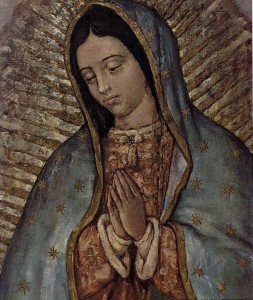
Meditation: On the feast of Our Lady of Guadalupe, Mary reveals herself as an expectant woman, bearing God in a hidden way within herself. Take a moment to join her in her longing to see her son. Pray to her that she may help you to long more profoundly to see the face of God.

 The world tears us in a thousand different directions, and gives us a million different opinions about every subject, most of which contradict. Marketing, newspapers, blogs, and the like churn out a constant stream of facts and emotions that can be hard to make sense of, and even harder to sort by importance: Is Caribou Coffee better than Starbucks? Is global warming real? Is Facebook’s new look better than the old one? Is faith really opposed to reason? Does my mom want a Kindle or a Nook for Christmas? Should I marry my girlfriend? How can we answer any of these questions?