The Word Honesty comes from the honestas meaning an honor received from others, a kind of “standing in honor” before others (honor + stas (to stand)). It’s an interesting insight in the word that most people are willing to be a little phony in order to get vague appreciation or to be thought of well. (The whole cosmetics industry is based on this). But when one is actually “honored” in a formal way by others, there is an elevated sense that we need to truthfully deserve the honor. And thus honor calls forth honesty.
A similar concept is sincerity. The Word sincerity comes from the Latin as well: sine (without) + cera (wax). It seems that sculptors in the ancient world often used a hard, resin like wax, to hide their errors. But every now and then there was the perfect carving, with no wax, nothing phony about it, no coverups.
I thought about these words as I saw this commercial. In the ad the “honor” of engagement draws forth honesty and sincerity. The honesty of one person brings forth the honesty of the other and they both end up more relaxed in each others presence.
In recent weeks leading up to the Conclave, and this day after, an awful lot of people, Catholic and Non-Catholic, are trotting out their agendas and looking for the new Pope to somehow bring he Church into conformity with what they want and demand.
Chief on the list of the world are things that include the ordination of women, a total surrender of the Church’s sexual teachings, embracing of the homosexual agenda etc.
The worldly experts often opine that unless the Church surrenders to this agenda, we are destined to be empty halls and “irrelevant” to the modern scene.
Of course one need not go far to test this little theory and see if surrender really works. One need only look to the example of the Episcopal denomination and a good number of other liberal mainline Protestant denominations. There it will be observed that their halls are far more empty and getting emptier all the time.
You name it they’ve got it: Homosexual unions, Gay clergy, LGBTQ-sensitive worship, women clergy, abortion is OK, environmentalism, “pet-friendly services, etc; a veritable menu of every modern demand and trendy idea. Yes they got the rainbows out, and talk endlessly of every latest form of inclusion, and their “halls” are more empty than ever.
Yes, the T.V. and Newspapers have the spotlight on any dissenter they can find to give the usual reportage cut from the usual “Church it out of touch” template, and demands that the Church to strive to fit in more, be kinder and gentler than in the past, and that her essential mission is merely to accept everyone and make sure they feel good about themselves. Yes Mother Church ought to be more appealing and less “alienating” then her membership will increase. Otherwise we are simply “on the wrong side of history.”
But is this really the role of the Church? Is it really her role to be “with the times?” Surely not, since she is the Bride of Christ and also Body of Christ (for in this holy Marriage she and her spouse are one).
And frankly, to be even more bold, the job of the Church is not to reflect the views of the world or even her members, but to reflect the views of our Head and Founder, Jesus Christ. And perhaps we might do well to remember that Jesus, despite modern attempts to remake him into “Mr Rogers”, did not exactly fit into his times either. No Jesus was a sign that would be contradicted, and so to his body, the Church. He promised to his true followers not popularity, but hatred from the world. (cf Jn 15:18)
Consider too the words of Simeon to Mary as he held the infant Christ:
Behold, this child is destined for the fall and rise of many in Israel, and to be a sign that will be contradicted (and you yourself a sword will pierce)so that the thoughts of many hearts may be revealed. (Lk 2:34)
And in holding the infant Jesus, Simeon was also holding the Church, for the Church is the Body of Christ. And Simeon looked to Jesus and saw that he would be a sign of contradiction to many. Surely Jesus would not be the affirmer-in-chief, but rather, as one who spoke the truth and feared no man, he would stand clearly and announce the truth without compromise. Some would love him and many would hate him, but no one could remain neutral. He would make us choose, tertium non datur (no third way is given).
And, as we have already alluded, Christ said two very important things to the Church:
If the world hates you, keep in mind that it hated me first. If you belonged to the world, it would love you as its own. As it is, you do not belong to the world, but I have chosen you out of the world. That is why the world hates you. Remember the words I spoke to you: ‘No servant is greater than his master.’If they persecuted me, they will persecute you also. If they obeyed my teaching, they will obey yours also. They will treat you this way because of my name, for they do not know the One who sent me. (John 15:18-21)
Woe to you when all men speak well of you, for that is how their fathers treated the false prophets.(Luke 6:26)
So, that world hates us is not necessarily due to the fact that we have done anything wrong. It is often a sign that we have done something precisely right for it is often our lot, as the Body of Christ, to be a “sign of contradiction.” That is to say that we must announce the Gospel to a world that is often and in increasing measure, stridently opposed to it.
St. Paul admonished Timothy to preach the Gospel, whether in season or out of season (2 Tim 4:2). Increasingly now it is out of season and the world hates us for what we say. But we can do no other, for if we are faithful, we must speak.
Pope Paul VI said it so well in the very in the “out of season” encyclical Humane Vitae:
It is to be anticipated that perhaps not everyone will easily accept this particular teaching. There is too much clamorous outcry against the voice of the Church, and this is intensified by modern means of communication. But it comes as no surprise to the Church that she, no less than her divine Founder, is destined to be a “sign of contradiction.” She does not, because of this, evade the duty imposed on her of proclaiming humbly but firmly the entire moral law, both natural and evangelical. Since the Church did not make either of these laws, she cannot be their arbiter—only their guardian and interpreter. It could never be right for her to declare lawful what is in fact unlawful, since that, by its very nature, is always opposed to the true good of man. (H.V. # 18)
We in the Church must courageously accept our lot. Simeon spoke of it clearly in the beginning as he held the infant Christ (and thus the infant Church).
And then, looking at Mary, who also represents the Church as mother and bride, he says. “A sword will pierce your heart too!” So the Church as Body of Christ and the Church as Bride and Mother cannot evade the fact that we will often be called to be a sign of contradiction.
And we will often be required to suffer for our proclamation. The world will try and shame us, try to cause us to experience guilt through indignant outcries and labels such as: Rigid, backward, conservative, right wing, fundamentalist, homophobic, judgmental, intolerant, harsh, mean-spirited, hateful and so on.
But do not be amazed and do not buy into the false guilt. Simply pray and accept the fact that the Church is a sign of contradiction and we must continue to address ourselves to the conscience of a world that seems bent on going morally insane. To this world our announcement of the Truth of Gospel must be courageous, clear, consistent, constant and quite often a sign of contradiction. This is our lot, we can do no other, we can be no other.
If you can bare to watch it, here is a silly video of one of the update-demanding groups. It is supremely illustrative that the video was filmed here in DC among the ruins of an old Episcopal parish (St. Paul’s destroyed by fire back in the 1970s). So, in effect we are told to imitate the example of the Episcopals, a rapidly depopulating denomination barely one third of its former size and shrinking fast. How powerfully the ruined Church in the background shows the irony the demands of those who call for such relevance.
And here is the emblematic interview of Shepard Smith which summarizes well the demands of the modern world:
When we heard the chosen name of the New Pope, “Francis” most of us likely thought of St. Francis of Assisi. Though on closer examination it is possible our New Pope, as a Jesuit, has St. Francis Xavier in mind. But either Saint has a lot to recommend to our thoughts as we pray for our new Pope, Francis I.
N.B. I am not a Vatican Insider and I don’t know Vatican insiders. And frankly, a lot of the “insider” stuff both alarms and bewilders me. Thus, my reflections are pure speculation and rooted only in the meditation on the lives of two saints and how they might frame our thoughts as we consider the work ahead for Pope Francis and how we must pray.
A few thoughts, in today’s post on St. Francis of Assisi. Tomorrow, St. Francis Xavier.
1. On the possibility of radical conversion and the role of affliction and humiliation – St. Francis of Assisi had lived and experienced the life of great wealth. The son of a successful cloth merchant, he enjoyed a very affluent easy life growing up and partook of the permissiveness of the times. He was a natural leader and drew to himself a crowd of young people who spent their nights in wild parties. His biographer, Thomas of Celano, said of him that him that, “He attracted to himself a whole retinue of young people addicted to evil and accustomed to vice.”
He had visions of grandeur and became a knight. Perhaps the horrors of battle and a year as a prisoner of war began a gradual conversion in him. The Fourth Crusade was called in 1205 and Francis impulsively bought new armor and sallied forth. But perhaps his own anxiety, and more surely a vision, wherein God rebuked his manner of life, led him to turn back. At home he was derided as a coward and suffered great wrath from his earthly father.
This crisis in his life led ultimately to his conversion, and a dramatic one at that. The Book of Psalms says, Before I was afflicted I strayed. But now I have kept your word, O Lord (Psalm 119:67).
We all know people whose conversion seems unlikely. But God may yet humble them and draw them to conversion. Further, we ought never underestimate the fact that affliction and humiliation may be a necessary component of conversion for many of us. At times we may feel as though God has abandoned us, or others we love. In fact he may be doing some very important work.
Our greatest enemy is pride and our best friend is humility. Humility and affliction may be gifts in strange packages. Learn to trust in God’s ways, painful though they may be, sometimes. God may be drawing us, and those we love, to deeper conversion.
Pope Francis takes the helm of a Church in need of constant purification. Further a large part of the flock in the affluent West is proud, rich, is rooted in hardened sinful habits and unbelief, and has left the practice of the faith.
Yet as St. Francis of Assisi shows, even hardened sinners can be reached. And as they are reached, others are reached too. The name of our New Pope is a reminder to all that radical conversion in the world is possible.
2. On the freedom of poverty and simplicity – Francis and his early companions embraced a life of radical poverty. So severe was this poverty that some thought them mad and rebuked their ways as beyond rational. St. Francis responded, If we had any possessions we should need weapons and laws to defend them. One hagiographer says, Possessing something was the death of love for Francis. Also, Francis reasoned, what could you do to a man who owns nothing? You can’t starve a fasting man, you can’t steal from someone who has no money, you can’t ruin someone who hates prestige. They were truly free. [1]
Not all of us may be able to embrace this radical poverty due to our obligations to others. But, more and more, we ought to experience a growing simplicity of life that frees us from the power of this world.
Poverty and simplicity are powerful and fruitful gifts of God. Once again, they are gifts in strange packages. But, if we can learn to embrace them, we discover greater freedom.
Though we are just getting to know him, our New Pope exhibits a humility, and is well known for his love of the poor of a life of simplicity. It is said, though a “Prince of the Church,” he rode the bus to work each morning.
One great danger of the Church is that we “have too much to lose.” Embracing greater simplicity and less in the way of worldly power seems to have been a track the Lord has had us since the proud days of the late Middle Ages, when St. Francis lived and surely since the heady days of the Renaissance Popes. Perhaps St. Francis of Assisi will help us to keep the proper balance of dignity and simplicity.
3. On the Love of God’s Church and how reform is best accomplished – During St. Francis’ lifetime the Church was in need of reform. Greed, worldliness and scandal were problems among clergy and laity as well. Heresies were abundant.
Some, noting sin in the Church, have chosen to hate the Church and leave her. But others, like Francis, hear the call of God, who never ceases to love His Church, and they, themselves, intensify their love for the Church and work for her reform. In a vision, St. Francis sensed the call from God: “Francis, Repair my Church.” Gradually he deepened his understanding of the Lord’s call and began that reform by seeing first to his very own life.
It is possible for critics of the Church to excoriate the sins of others, but not see their own. Francis began in the vineyard of his own life and then went forth gently preaching conversion by personal example to his neighbors.
The movement for reform spread. It was grassroots, it was personal. True reform begins with me. Simply denouncing the sins of others or the Church, real though these sins may be, seldom has lasting effect.
The best reform starts with personal conversion. Personal conversion spreads to others, and reform is underway. Within 10 years there were over 5,000 men in Francis’ community and the Poor Clares were also well underway. It works. If I let God set me on fire, then I can spread that fire.
Pope Francis has in St. Francis a power ally who loved the Church, worked for required reforms and led others to personal conversion and love for the Church. May our new Pope experience many blessings from St. Francis.
4. On unity with all creation and the gift of wonder and awe -St. Francis thought of nature, all God’s creation, as part of his brotherhood. In some sense, the sparrow was as much his brother as the Pope.
There is a radical tendency today, by some in the environmental movement, that sees man as the enemy of the natural world, rather than an integral part of it. We can tend to see ourselves as outsiders of the natural world, rather than partakers and members of it. But for St. Francis there was brotherhood.
And in brotherhood there are legitimate needs we supply one another. Nature supplies us and we in turn help to perfect nature. We have done this in our best moments by helping to increase the yield of our fields and bring far greater bounty to the earth by agriculture and animal husbandry. We also seek to master disease and push back the destructive boundaries of what is unruly in nature, such as infestations and the like.
It is true we have often transgressed by unnecessary pollution and the like. But in the end we are not the enemies of nature, we are companions and “brethren” to the natural world.
Pope Francis faces many challenges related to a lack of balance in modern man’s relation to the natural and physical world. Too many today have turned environmentalism and the physical sciences into a kind of religion, verging on idolatry. In St. Francis the Pope and the Church can be inspired to help our modern world recover sanity and balance in these matters. In the first video below is a meditation based on the poem and prayer of St. Francis known as the Canticle of the Sun, his meditation on the magnificence of creation.
5. On the Need to Evangelize the Muslim World – We may think that the struggle with the Muslim world is new. It is not. In his life, St Francis decided to go to Syria to convert the Muslims while the Fifth Crusade was being fought.
In the middle of a battle, Francis decided to do the simplest thing and go straight to the sultan to make peace. He and his companions were captured and Francis was taken to the Sultan, Melek-el-Kamel. Francis challenged the Muslim scholars to a test of true religion by fire; but they refused. Francis proposed to enter the fire first, under the condition that if he left the fire unharmed, the sultan would have to recognize Christ as true God. The offer was turned down but the sultan was so impressed that he allowed Francis to preach to his subjects. Though Francis did not succeed in converting the sultan, the last words of the sultan to Francis of Assisi were, Pray for me that God may deign to reveal to me that law and faith which is most pleasing to him.
This work of Francis and his attempted rapprochement with the Muslim world had far-reaching consequences, long past his own death, since after the fall of the Crusader Kingdom, it would be the Franciscans, of all Catholics, who would be allowed to stay on in the Holy Land and be recognized as “Custodians of the Holy Land” on behalf of Christianity. [2]
In times like these, when extremist forms of Islam have emerged, we need, more than ever to have the courage of St. Francis to engage the Islamic world and seek to bring them to Christ.
It may be difficult work and successes may be few at this stage. But God calls us to be faithful, not successful. Ultimate success is up to God. We who are Catholics have a special role in this evangelization since the Muslim world shares with us a respect for Mary, Mother of Jesus our Lord. More on that in a future post.
And thus Pope Francis who has a significant challenge in dealing well with the Muslim World and increasing radicalism there has a powerful ally, intercessor and example in St. Francis of Assisi.
Just a few thoughts on what’s in a name. Pope Francis, and St. Francis of Assisi: ally, intercessor, example and Saint. Tomorrow some thoughts on St. Francis Xavier, the great Saint of Evangelization.
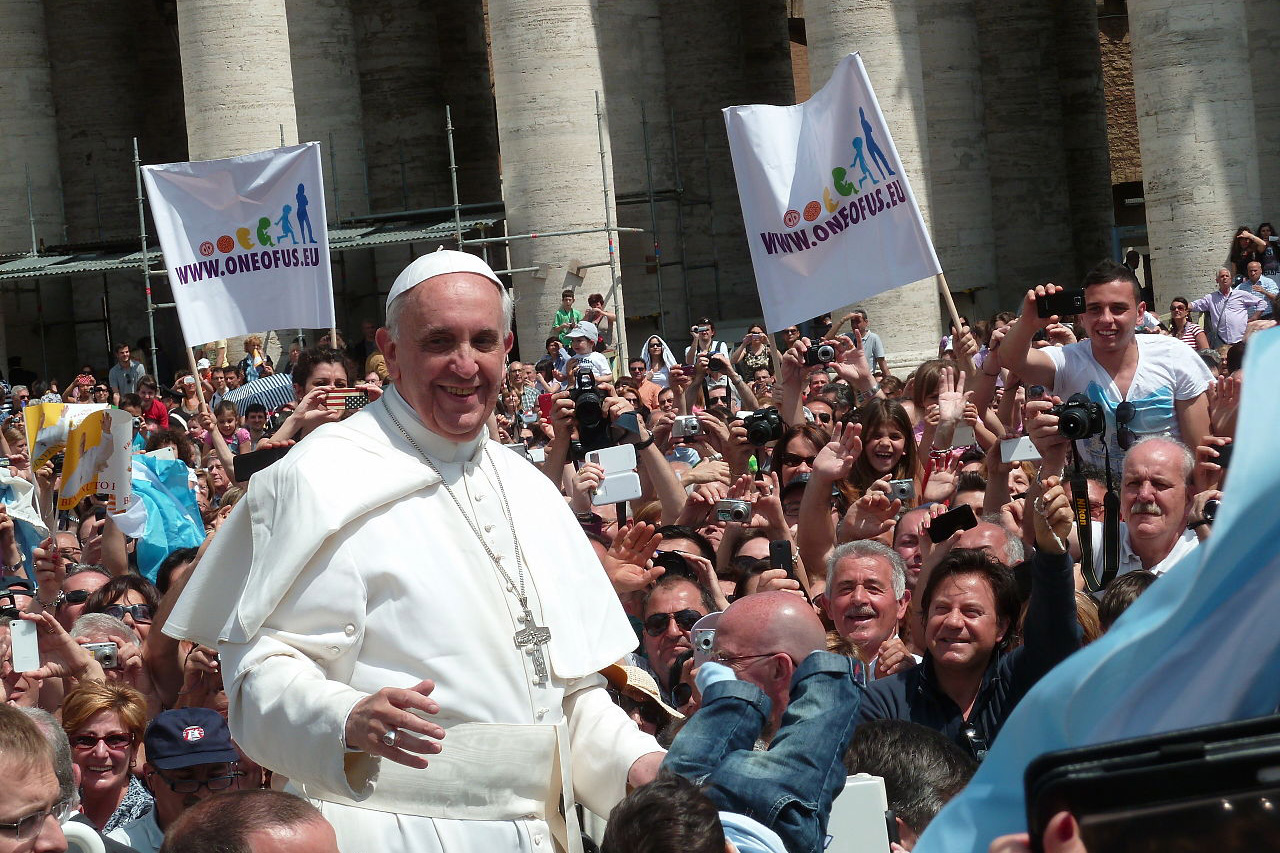
“Pope Francis among the people at St. Peter’s Square – 12 May 2013” by Edgar Jiménez from Porto, Portugal, Licensed under CC BY-SA 2.0 via Wikimedia Commons
As we await word of a new Pope, there are some in the media and among our Protestant Brethren who are dismissive of the need for a Pope at all, or who indicate that the hierarchical structure of the Church ought to be replaced with more “modern” forms of governance.
Never mind that Christ chose NOT to be born in these “enlightened” times of ours and was rather intentional in summoning certain men who he named apostles. Never mind too that Peter was singled out by the Lord for a special role with “keys” of authority and the role to strengthen and unite his brethren whom the devil would sift as wheat (cf Lk 22:32).
So, many use this election of a Pope to issue their plan for the reorganization of the Church, even though the Lord has set forth a plan that has brought us through some pretty awful turmoil.
I’d like to take some reflections on the need for authority from Fr. Thomas Dubay’s S.M. (R.I.P.) Authenticity – A Biblical Theology of Discernment. Fr. Dubay pondered what happens if we, in some utopian way, think we can live apart from authority.
Fr. Dubay has been one of my chief teachers in spirituality. He passed away in 2010 – headed home to meet the Lord, whom he loved and preached. He was a devout and sober man, a fine theologian, deeply immersed in Scripture and Tradition, a terrific spiritual master, and always a keen observer of what ails us.
As is often the case, I will present his text in bold, black italics, and my poor comments in plain red text. I would like to give you page numbers in the book, but, sadly, the Kindle edition from which I have read does not have a coherent way of referring to pages (as far as I can tell). I can only say that the passage is in the last third of the book in a section entitled “Verification.”
Christ and St. Paul and the whole New Testament community were hardheadedly human. They knew better than we (because they were more holy than many of us) of human weaknesses and failings, but they could not imagine [as some do today] an “invisible Church of Christ.” In more than a theoretical way, the disciples knew they were not angels, and they could not have dreamed of the ekklesia of the bodily risen Kyrios lacking effective institutional elements.
Yes, the word I like to use is that they were “sober” about human sinfulness, and our tendency to be divisive and fractional, often about the most petty of things. And even in more profound matters, our sinfulness often causes us to have distorted thinking, our senseless minds can become very dark and jaded.
In the midst of all the scandalous division after the Eastern Schism, and the Protestant movements, some have tried to imagine that there is somehow an “invisible church” where “nasty little things” like structures, and authority are not necessary. In this dreamy, “kumbaya” thinking where all hold hands and sway as they sing “we are one in the Spirit,” there may be a legitimate dream.
But imagining we are one is not the same as actually being one. True unity will manifest in concrete, not just theoretical ways, for a central tenet of the faith is that of the incarnation. And the Church remains, incarnationally, the Body of Christ. I may like to imagine that a severed hand is still part of my body. But while I dream, the hand begins to decay, and my body bleeds out. In the end reality has a way of setting in.
The Biblical fact is, that where Peter is, there is the Church (ubi Petrus, ibi Ecclesia). He is Christ’s vicar on earth, and the one who holds the keys. Christ noted that the devil would seek to divide, to “sift” the apostles like wheat. But Jesus solution was clear: But I have prayed for you, Simon, that your faith may not fail. And when you have turned back, you will strengthen your brothers (Luke 22:32). Bishop Sheen once said of this passage that we share in Christ’s prayer for unity in the Church, only through Peter.
There is no “invisible church.” Only the visible and structured one founded by Christ and rooted in his prayer for Peter.
Graphically St. Paul reminds the overseer-bishops of Ephesus that it was the Holy Spirit himself who established them in office, and it is through these human instruments that the Spirit will deal with “fierce wolves” who invade the flock (Acts 20:28-31). The apostle goes so far as to say that anyone who objects to his teaching is not objecting to a human authority but to God himself, who gives us his Holy Spirit (1 Th 4:8). The Thessalonians are to foster the “greatest respect and affection” for their leaders (1 Th 5:12-13). All sorts of gifts from the spirit are given to the authorities in the Church: apostleship, prophecy, teaching, leading (Eph 4:11-13).
Yes, in our anti-authority modern age, we must recall that authority in the Church is established by God, and upheld by him. It is the Lord’s way of protecting the Church from the fierce wolves of error and division. God teaches authoritatively through his Church, and her appointed and anointed leaders. We have to trust God in this.
Authority is not perfect. God uses imperfect human instruments to accomplish his tasks.
In my personal journey I have come to discover that, while I have often wished that those in authority were more prompt and prophetic at times, I have also come to discover that there is a place to be more reflective. When I was first ordained, I was zealous for orthodoxy, but I was also rigid in unnecessary ways, and often impatient. “If only the Church would adopt my plan of action, all would be well.” Or so I thought. But, interestingly enough the Lord did not choose to promote me to bishop in those early zealous years, (or even now), and I must humbly recognize that there are often other ways of approaching issues. The general demeanor of the Church is to be thoughtful, reflective, and yes, slower than many moderns prefer.
But somewhere in the midst of this rather consistent approach, we need to see that our leaders have been anointed by God. We can surely seek to influence them and be part of the discussion. Most reform movements well up from the people of God. But we do not, and ought not, get ahead of our leaders, or refuse submission to them merely because we have a bright new idea. There may well be a reason to go slower and be more broad based that some who are zealous would prefer.
This bodily-structural element in the ekklesia comes out in many ways in the New Testament: Jesus sends men into the world, and they speak with his own authority so that those who listen to these representatives listen to him (Mt 28:16-20; Lk 10:16) . . . the leaders in the Church test the authenticity of her members (Rev 2:2; pastorals, passim) . . . all are to obey their spiritual leaders (1 Pet 5:5; Heb 13:17) . . . they who disobey are inauthentic, not from God (1 Cor 14:37-38; 1 Jn 4:6) . . . even a supposed messenger from heaven may not contradict what the human leaders have taught (Gal 1:6-9) . . . the presiding officer in the local church has all sorts of duties in the areas of teaching and governing (1 and 2 Tim and Titus) . . . the Holy Spirit is with them in the performance of these duties (2 Tim 1:6, 14). i.e. authority is biblical and from God.
Although we do not find the same degree of organization in the first-century ekklesia that we find in that of the twentieth century (it would be amazing if we did), we do find a plurality of functions that are clearly governmental. The leaders teach and proclaim the word (1 Tim 3:2; 4:13, 16; 5:7, 17; 6:2; 2 Tim 1:8; 2:2, 14, 24; 4:1-5; Titus 1:9; 2:1-10, 15; 3:1-8; Acts 20:28). They pray for the sick and heal them (James 5:14-15). They correct aberrations and errors and faults (1 Tim 5:20; 6:17; 2 Tim 2:25; 4:1-5; Titus 1:9-14; 2:15). They govern the ecclesial community, the Church of God (1 Tim 3:5; 2 Tim 1:14; Acts 20:28; 1 Pet 5:1-4). These superiors are said to be God’s representatives, and their authority is not to be questioned (Titus 1:7; 2:15). The faithful are told in plain language to obey these leaders and do as they say (Heb 13:17; 1 Pet 5:5)….
To teach govern and sanctify are the essential roles of Church authority and the faithful are expected to be submitted to their leaders.
This is a critical reminder in an age like ours that often celebrates rebellion as well as angry invective and derision directed at leaders, both secular and religious. While our world may celebrate this and many who act rebelliously get “credit” for being bold and “free,” there is little or no biblical basis for this behavior, especially insofar as the Church is concerned.
While a Catholic may make some discernment as to the level of authority involved in a given pronouncement, legalistic minimalism should also be avoided and Catholics should remain teachable even in non-infallible teaching of the popes, bishops and magisterium (cf CCC # 892).
It is not accidental that people who now commonly speak of our generation as “men come of age” are often those who belittle the need for societal government. ….The error in this position lies in its partiality. It fails to provide for the many other needs among perfectly adult men and women that cannot be met [apart from]… the essential role of authority. No matter how mature a society has become, its members cannot provide for protection, for international trade, for airports and highways (and a host of other things) by mere friendly agreements. To desire to substitute consensus as a universal replacement for authority is merely utopian.
Yes, utopian is the word.
It is the dreamy arrogance of our modern age that has caused us the most grief. The more we speak of ourselves as “men come of age,” the less mature we seem to become. In our culture, maturity is further and further delayed, and there are many in our culture who never grow up. Dependent and demanding, many sound more like petulant children, than grown adults. Further, the dismissal of the wisdom of previous generations, and the refusal to be accepting of authority, bespeaks more of a teenage rebellious stage than sober adult refelction. I have written more on that here: Stuck on Teenage
When the members of a group are all open to the Holy Spirit, a discernment process can produce consensus, but who will maintain that, in our sinful condition, we can hope, in larger societies, to be free from selfishness and ignorances of all sorts. And even aside from our sinfulness, we need to note that all judgments made for an action are surrounded with contingencies that make it impossible to demonstrate the necessity of any [one] given prudential judgment. One of the functions of authority, therefore, is to choose among many defensible courses of action one that all must follow….
Yes, so well said. Even in the best, the most mature and spiritual of communities, some one still has to call the shots. For not all, or even most, decisions are between good and bad things, but often between numerous good options in the face of limited resources.
If a group of people rejects an official teaching authority in the Church, it does not follow that there is no teaching authority. There surely is, and often it is more apodictic [demanding of submission] and harsh in its condemnations than most popes have ever been. The allegiance given to quotations from “in” theologians can be remarkable….
Pope Benedict has often remarked on the tyranny of relativism wherein those who cloak themselves in tolerance and open-mindedness are often the least tolerant when it comes to a host of issues they regard as politically correct. Many of the College campuses who have prided themselves on their liberal openness often have the most severe “speech codes” and the most strident applications of political correctness. Don’t try and uphold a lot of traditional Catholic and Biblical moral teaching there. If you do, prepare in most instances to shouted down, shown the door, and called hateful, bigoted, close-minded and number of other personal attacks.
Further, unquestioned loyalty to certain theories, scientific, political and philosophical, and the kind of venom, if you even have just a few questions, is remarkable. Talk about “religious” zeal.
Oh yes, we will confer authority on someone, it just depends on who. I had rather accept as authoritative a Church I believe founded by God and upheld by him. An old hymn says, I dare not trust the sweetest frame, but wholly lean on Jesus’ name. Jesus founded, establishes and upholds the Church, so I’ll go there and be submitted to authorities I believe, by faith, he upholds and inspires.
The binding force of an ecclesiastical Magisterium is commonly viewed [today] as an infringement on a healthy freedom in the academic realm. It is no more an infringement on freedom than the experimental data of the positive sciences are an impediment to scientific progress and freedom. The divinely guaranteed Magisterium liberates the theologian from the morass of his own subjectivity, just as the hard-nosed data of scientific research liberate the theoretician in pure physics from the illusions of a thought, lacking contact with the real world…..
One of the keys to understanding freedom is that it is only enjoyed within limits. I am free to communicate with you now only if I accept certain grammatical parameters.
Absolute freedom does not exist for limited and contingent beings such as ourselves. Hence, Christian theology must accept that there are necessary limits and guard rails which guarantee the greatest freedoms. Outside the guard rails of Scripture, Tradition and the Magisterium, lie only thickets, precipices, dead ends and a howling wilderness of subjectivism and the directionless wandering of an “off road” experience.
I have written more on the paradox of true freedom HERE
It is alleged that Roman congregations have made mistakes and that these impede progress. Some (not all) of these allegations are true. But in sheer number they are few indeed in comparison to the thousands of mistakes that theologians have made….History abounds in examples of the bizarre aberrations possible even in well-intentioned enthusiasms.
Yes. Thank you Fr. Dubay. Rest in peace.
Here is video that illustrates the modern tendency to celebrate rebellion. While it’s funny, it must also be said that this ads ridicules limits and people who believe in them. The man who says “stay within the lines” is presented for us as an object of ridicule and the notion of limits as “childish” hides the teenage immaturity of those who celebrate rebellion and reject limits. The ad does not follow the woman “off road” as she surely hits ruts, messes up her alignment and may even flip the vehicle. Paved roads with guard rails are usually better, faster and safer.
As we get ready to elect a new Pope it occurs to me that we are also electing a chief evangelizer. And the new Pope will enter the room of tears to don the papal vestments because, in effect he is embracing a martyrdom.
I want to talk about the relationship of the word “martyr” and Evangelization in two ways. For the word martyr has two senses, and they both apply to Evangelization. On the one hand martyr is simply the Greek word (μάρτυς – martus) that means “witness.” On the other hand, in modern English, we think of the martyrs as those who suffered and died for their faith. Both concepts are essential for evangelizers (this means you).
Lets look first at the concept of “martyr” as one who suffers. – If you’re going to evangelize prepare to suffer. This explains a lot in terms of why most Christians don’t evangelize.
When I was training people in my parish to go door to door (we had fifty people), and also preparing others to go to their family members and summon them back, it was clear we had to get something out of the way at the very start. And that was that we were all going to suffer for doing this. We would be rejected, scorned, ridiculed, have anger vented on us and be asked questions we couldn’t answer. And yes, we would also have people who were delighted to see us and were very friendly, even open to the invitation to come to Mass, or to find out more.
But in the end, I wanted to be clear, we have to expect to get it with both barrels: POW!
Ready to Suffer? For, if you’re going to be a witness, you have to know that the Greek word for witness is μάρτυς – (martus) – “martyr.” Are you ready to suffer for Jesus? There are many who have gone so far as to be killed for announcing Jesus. And how about us? Are we even willing to risk a raised eyebrow? How about laughter, scorn, derision, anger, rejection, or even worse, simply being dismissed or ignored?
These things are just part of the picture. In no way does it indicate failure. In fact, it may indicate success for Christ promised such things to faithful disciples and witnesses. Further, anger and protests does not mean a seed has not been sown. In sowing the seed, the ground must first be broken, and that is not often an easy task. For the ground often makes “protest” and we will only get fruit from it by the sweat of our brow. Scripture says of such suffering:
Remember the words I spoke to you: ‘No servant is greater than his master.’ If they persecuted me, they will persecute you also. If they obeyed my teaching, they will obey yours also. They will treat you this way because of my name, for they do not know the One who sent me. (John 15:20-21)
The apostles left the Sanhedrin, rejoicing because they had been counted worthy of suffering disgrace for the Name. (Acts 5:41)
If you are insulted because of the name of Christ, you are blessed, for the Spirit of glory and of God rests on you. (1 Peter 4:14)
If you suffer for being a Christian, don’t feel ashamed, but praise God for being called that name. (1 Peter 4:16)
We are fools for Christ’s sake (1 Cor 4:10)
God was pleased through the foolishness of what was preached to save those who believe. (1 Cor 1:21)
As servants of God we commend ourselves in every way: in great endurance; in troubles, hardships and distresses; in beatings, imprisonments and riots; in hard work, sleepless nights and hunger; in purity, understanding, patience and kindness; in the Holy Spirit and in sincere love; in truthful speech and in the power of God; with weapons of righteousness in the right hand and in the left; through glory and dishonor, bad report and good report; genuine, yet regarded as impostors; known, yet regarded as unknown; dying, and yet we live on; beaten, and yet not killed; sorrowful, yet always rejoicing; poor, yet making many rich; having nothing, and yet possessing everything. (2 Cor 6:4-10)
How can we read texts like these and think that we will not suffer for speaking and living our faith? Some will accept us, many will reject us. But in rejection, derision, scorn, and being called a fool consider yourself in good company. Jesus, the apostles and martyrs, the saints and all the heroes suffered in this way. It is not failure to thought of this way, it is simply the lot of the faithful to be often considered as such. In this sense it is a sign of success. We do not go looking for a fight or to make people angry. But often they are, and this is to be expected. Suffering is an essential part of being and evangelizer, a witness (a martyr).
Here are few things to remember when being scorned or the object of anger:
Don’t take anger and rejection personally. In most cases, it is not about you. Most people’s anger is really directed at Christ, or at God in general, or at his Church, or at organized religion. Some have been hurt by the Church, or feel hurt by God. It’s not about you.
Just because someone is angry or takes offense, doesn’t mean you did anything wrong or gave offense. I have often thought that, in a primitive part of our brain, developed in childhood, we instinctively think that, if some one is angry or upset with us, we have done something wrong. Not necessarily so. In fact, anger is sometimes a sign we have done something right, for, if we are faithful, we are raising issues that, though uncomfortable, are necessary to consider.
Do not give in to the temptation to retaliate or be personally hurt. Rather, rejoice that you have been deemed worthy to suffer for Christ.
Do not be discouraged. Shake the dust and move on. (cf Matt 10:14).
Remember that you are sowing seeds. You may not experience the harvest, but others may well bring it in. The fruitfulness of what you do may take years to come to harvest. Just stay faithful and keep sowing seeds.
Remember too, an evangelizer is a witness and the Greek word for witness is martyr. Suffering is simply part of the picture.
When we understand and accept these things we are less resentful and anxious when it happens. Don’t lose heart. Accept the martyrdom of evangelization.
And this leads us to the second notion of the word “martyr,” that of being a witness.
Now the word “witness” indicates someone who has seen or experienced the thing they are talking about. They are a witness because they themselves have personally seen or experienced and know what they are talking about. In English the word “witness” contains the sense of “knowing” for its etymological roots come from Old English and Germanic words such as “wit” and “wissen” meaning to know something, and also likely influenced by the the German verb “kennen” meaning to be personally familiar with someone or something.
Hence, to combine these roots, a “witness” is someone who knows the facts and truth of something personally, by first hand knowledge. I cannot really serve as a witness in a court by saying what others saw. Hearsay is not admissible. I have to say what I saw and and personally know. This is what it means to be a witness.
In evangelization work too, we are called to be witnesses. That is, we are called to speak not only what we intellectually know, or have heard others say, but also what we have personally experienced. As witnesses we are called to have firsthand knowledge, and not only say what others have said. It is not enough to know about the Lord, we have to personally KNOW the Lord. A child knows if his parents are just going through the motions of teaching them a prayer, and whether they really know the Lord personally, and are actually praying. Congregants know if their priest is just giving an informational sermon or if he has really met the Lord and “knows” personally what and Whom he speaks of.
People know the difference. And frankly what people are most hungry for is first hand witnesses, not people who just quote slogans and “safe, ” “tested” sayings of others. What people need to hear is: God is real, and I know this because I just talked with him this morning, and I experience his presence even now. And, in the laboratory of my own life I have tested God’s teachings from the Scriptures and the Church, and I have found them to be true and reliable. I am talking to you from experience, God is real, and his teachings are true, and I know this personally for I have experienced it in my life.
Too often, what could be evangelical moments devolve into religious debates about whether Pope “so-and-so” said this or that in the 8th Century, or about why women can’t be ordained, or why the “evil” Catholic Church conducted the inquisition. These sorts of topics come up quickly because we talk only of issues, and not from personal experience. It is harder for a person to deny what you have experienced when you or I say, “I have come to experience that God is real, that what he says through his Church is true, and I have staked my whole life on what he has revealed.”
What we need are witnesses more than apologetical experts who know every rebuttal. We DO need apologists out there and intellectual knowledge is important, but personal witness is even more important. It’s OK to say “I don’t know” to some technical question, but it’s not OK to be incapable of witness. Even as a priest I sometimes have to say I don’t know the answer to that, I’ll try to find out and let you know…But Let me tell you what I do know, and that is that God is at the center of my life and I have come to experience his love for me and every human being. I have come to experience his power to set me free from sin and every bondage and root me in the truth of his Word. And whatever the answer to your question is, I know it will be rooted in that.
Yes, we need martyrs for the work of evangelization. Those who are willing to suffer, and also those who are willing to be first hand witnesses, who have a personal testimony to give of the Lord they have come to know by experience.You should be an evangelizer, a witness, a martyr.
Photo Credit above: Paul in Jail by Rembrandt
Here is a video clip from Fr. Francis Martin wherein he beautifully described the second notion of the word martyr as “witness.” This clip is part of a longer series on the Gospel of John Series which you can see here: Gospel of John Series 3A
There are subtleties of language and in argumentation that I’m convinced many of us moderns fail to appreciate. And the loss of appreciation for these subtleties often leads to a shrill quality of or a coarsening of modern discourse. This in turn least to misunderstanding and the tendency to take personally many things which are not intended as so.
The misunderstandings are often magnified on the Internet, and especially in the blogosphere which, as a written form of communication, means that we often lack some of the other signals in conversation that communicate intent; things like the look on one’s face, the tone of voice, even posture. In person, when someone speaks words that may seem challenging or even harsh a major change in interpretation can be caused if we see a wink, or a smile, or at least a gentle look on the face of the other. And thus, there is added to the conversation and additional context of serenity. But such “contextualizers” are usually missing in the written conversation that predominates the Internet.
But even when all the usual helps of more personal conversation are present, there are still and often misunderstandings that come down to a simple failure to appreciate the subtlety of human language. In the past on this blog we have discussed the problem of all or nothing thinking (HERE).
Today there might be some value and also making an observation that many fail to appreciate the difference between general observations or remarks and universal observations or remarks. A general remark is one in which the perceived qualities mentioned of a group or idea are generally observable or true, but are not always true, in each and every case of a person or a group.
Universal Remarks, refer to traits of individuals or groups that are true in each and every circumstance, almost without exception.
As you might guess, universal comments or remarks are far more rare than general remarks or comments. And the point to emphasize here is that general remarks admit of distinctions and exceptions.
To illustrate the problem of failing to distinguish the general from universal , and also to state plainly why I think this sort of reflection is necessary, let me recall some remarks I made about the baby boom generation last week on the blog. (HERE)
In that article I argued that the “Baby Boom” generation (those born 1945 to 1965) is a generation largely marked by individualistic, self-centered thinking, and revolutionary and iconoclastic ideas. Frankly it is hard to argue that the boomer generation which began to step into leadership beginning in the late 1960s, ushered in a good cultural era for this country. With the possible exception of moving forward with civil rights reforms begun in the 50s, and a certain creative use of new technologies, things have been otherwise a pretty unmitigated disaster in the wake of boomer “leadership.” .
Our families and family structure are in the shredder, sexual promiscuity, STDs and teenage pregnancy are rampant, divorce an abortion have skyrocketed, even as birthrates and marriage rates have plummeted. There are strong increases in school dropout rates problems, and drops in SAT scores and other common measurements for academic success as America slips lower and lower in comparison to other countries in academic success. Addictions of all sorts, along with the crime and other social ills that accompany it are widespread as is uncontrollable spending and the amassing of huge personal debt. Bankruptcy, once though a disgrace is now highly common. Church attendance has plummeted as has participation in any number of civic functions and groups oriented to the common good. You get the point…
Frankly, most people who read the blog understood and accepted this data for what it is, namely that the baby boom generation sowed the wind and now reaps the whirlwind.
But there were some who wrote in on the comments who were greatly offended, indeed, taking quite personal offense at what I wrote. A few of the angry comment I posted, most I did not.
At the end of the day, most who were offended seem to of take what I wrote as a personal accusation. It was not. What I made was a general remark. It was not a universal remark, such that I argued that every single member of the baby boom generation without exception has lived a dysfunctional, disorderly and destructive life.
Many of those who wrote to express offense said to me in effect, “How dare you condemn a whole generation.” That of course is not what I did. I made a general remark not a universal one. I myself am a member of the baby boom generation and to a large degree have avoided some of the most deleterious behaviors and traits of my generation. I know others who have as well.
That a certain trait or traits are generally observable in this segment of our culture, and a large segment at that, does not mean that every member of the group has the said traits to the same degree, in the same manner, or even at all. General observations are general, not universal.
Another angry commentor accuse me of being “judgmental.” But here too, she seems to take personally what I say. To the degree that some judgments are forbidden us, they refer to judging a condemning way, individual persons, their motives or state before God.
But engaging in social commentary, which is one of the things we do here in a blog like this, is not to be judgmental. It is only to state an opinion or point of view that readers are free to accept, reject, or something in between.
Only if I had said something to the effect, of a universal comment, for example, that “every member of the generation of the baby boomers are bad people,” could I be accused in some sense of being judgmental.
Just a couple of visual illustrations and then I’m done. Note in the graph that I’ve posted at the above right, that there are many data points, and in the the middle is something called the mean line. This means that approximately half the dots fall to one side of the line or the other. But very few of the dots are actually on the line. Most are to some degree close to the mean line, but some are actually quite far from a line, a few dots are real outliers.
Speaking with general observation we can say that most of the dots on the grass exhibit some relationship to the line, some more than others. That is, they have a general relationship to the line, but not a universal relationship. If the dots had a universal relationship to the line, the dots would all be right on the line. Instead they are generally related, more or less to the mean line.
In the picture here to the immediate left, there is a circle and a number of randomly space dots. In drawing the circle, many dots are included within it but some fall outside. Some degree, all the dots are related to the circle in some way. Looking at this reality I could generally observe that dots are circle dwellers as a group. But this is a general observation, for it remark of what is generally true, not universally true. The average dot is going to have the strong tendency to be a circle-dweller, but there are some which are not.
Thus I hope to illustrate the difference between making general remarks, and universal ones, between making general observations, and universal ones.
And grasping this distinction, is one way of appreciating the subtlety of human speech and argumentation. And, grasping appropriate subtleties is one way of defusing hostile reactions Sophistication about human modes of speech accepts the possibility that one’s opponent or interlocutor is not simply an ideologue, making unqualified statements.
Sadly today, many lack the sophistication necessary to sort out ideas, and make necessary distinctions. The result is that many today in our culture are thin-skinned and take things personally, which they ought not.
There is also a modern tendency (which is either antecedent to, or flows from the problem I have described here), which brings many people to doubt good will on the part of those who speak in a general way to make observations or arguments. In other words, there is a strong tendency to be cynical and to have a hostile stance when we presume that people are speaking in a universal way, rather than a general way.
The result of all of this is poisonous discourse and/or, taking offense when none was given or intended.
So, how about a little sophistication which recognizes the necessary distinction that general observations are not universal ones?
This video is a hoot. One of my favorites. Now, the soul of wit is that it contains some element of truth. And as you enjoy this video you may recognize what is generally true, but realize that there are many exceptions to what he says. Not every man is exactly as he describes, nor is every woman as he describes. Our comedian speaks to what is generally or often true, but not always and not unvaryingly in every man or woman. He speaks in a general way, not a universal way.
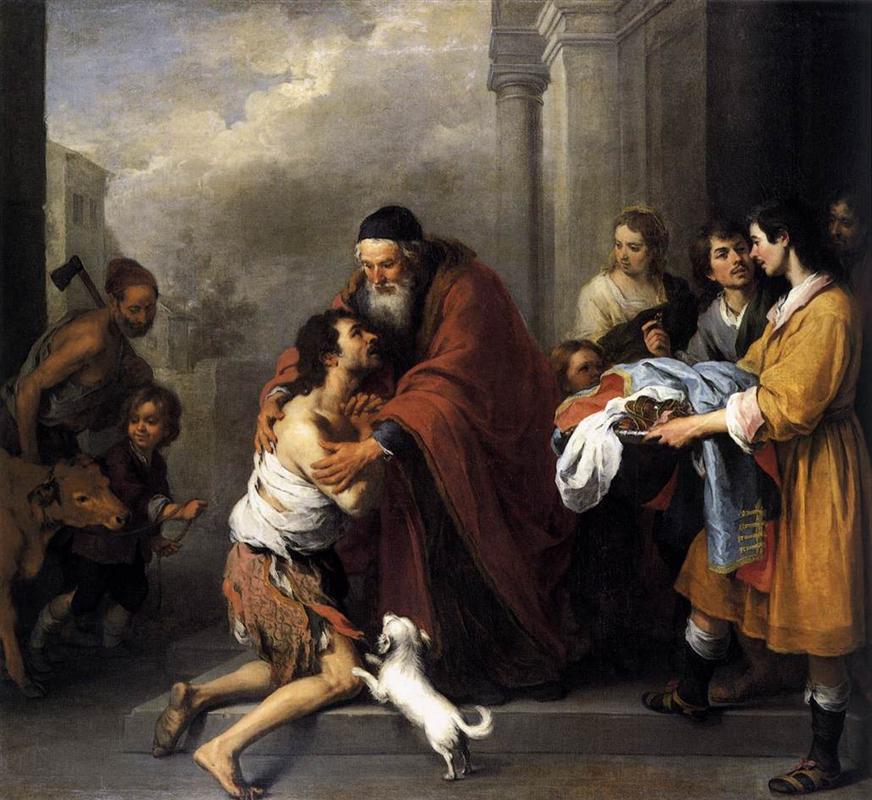
This is a Gospel about a man who had two sons. And both of these sons forsook their father and refused to relive in relationship with him. Although, in our mind, both sons are very different at the level of personality, one outwardly rebellious, and the other outwardly obedient, inwardly, they have a very similar struggle. In effect, neither one of them really wanted a relationship with the Father. Both, in fact, preferred what their father had, to having their Father. Both look more to what their Father could bestow, rather than to their father himself.
In the end, one son repents and finds his way to the heart of the father. Of the 2nd son, we are not so sure, for the story ends before that detail is supplied. Why does the story not end? It does not end, because the story is about you and me, and it is we who must finish the story. And the question we must answer is, What do I really want?….the consolations of God, or the God of all consolation? The gifts of God, or the giver of every good and perfect gift?
Let’s look at this gospel in four stages.
I. Renegade Son–Most of us are quite familiar with the story of the Prodigal Son. Indeed, most of us focus on the first and obviously sinful son, more than the second son. This is interesting, because it would seem that the Lord Jesus has his focus more on the second son. For, the parable is addressed to the scribes and Pharisees who see themselves as obedient. Nevertheless, lets observed three things about this renegade son, also known as the Prodigal Son.
A. Corruption–Here is an angry son, alienated from his father. He wishes to possess what his father has, but he wants nothing to do with his father. In effect he tells his father to drop dead. Yes, in effect he says, “Old man, you’re not dying fast enough. I want my inheritance now… I want to be done with you and cash in now what is coming to me.”
His astonishing effrontery is even more astonishing given where and when it happened. For, we live in times when reverence for parents and elders is tragically lacking. But if our times are extreme, those times in the ancient Middle East where the other extreme. In telling this parable as he does Jesus shocks his listeners who lived in a culture where no son would dream to speak to his father this way. Indeed a son could be killed by his father for such insolence! Even to this day, in many parts of the Middle East, so-called “honor killings” still exist. If a child brings dishonor to the family, it is not unheard of for the father to kill such a child. And while most governments forbid such practices, in many cultures people, while not preferring such extremes, will often look the other way, and governments will seldom prosecute such inter familial killing.
Thus, for Jesus to tell such a parable must have shocked his listeners. Here was a son who did something so bold and daring as to the unthinkable, as insolent as it was insensitive, ungrateful and wicked.
So hateful is this son that he will have to go to a distant land to live. For even if his father does not kill him, his neighbors would surely set upon him and have him stoned for such insolence.
In even more astonishing detail, the father gives him his inheritance and allows him to leave.
Here is Jesus’ description of the patience and mercy of the Father who endures even worse insolence from us, His often ungrateful children; we who demand his gifts, grasped in them with ingratitude, and want what God has, but do not want Him. More of the Father in a moment. But what we begin with the portrait the deep corruption of this renegade son.
B. Consequences–The text says that the renegade son sets off “to a distant country.” For it is always in a distant country that we dwell apart from God. And the consequences of his action are great indeed.
This parable does not make light of sin. The Lord Jesus describes well a man who chooses to live apart from God and in sinful rebellion. The result is that this renegade son lives in anguish and depravity. Once he runs out of money, he has no friends, no family, and no experience of his father.
So low is he, that ends up looking up to pigs! So awful is his state, that he becomes hungry for the disgusting mash that pigs eat. Yes, he is lower than an unclean animal, the most unclean animal that Jews can imagine, a swine.
Let us be clear, sin debases the human person, and if it’s effects are not averted, it orients us increasingly toward depravity. What was once unthinkable, too easily becomes common fair.
St. Augustine wrote of sin’s hold on individuals in the Confessions when he said, For of a forward will, was a lust made; and a lust served, became custom; and custom not resisted, became necessity. By which links, as it were, joined together (whence I called it a chain) a hard bondage held me enthralled. (Conf 8.5.10).
And here is what we find the renegade son locked and the consequences of his sinful choices: debased, debauched, and nearly dead.
C. Conversion–Almost miraculously the text says simply of him, “coming to his senses at last…” Too many, especially today, suffer a darkened intellect due to the debasement of their sin. And it would seem, the no matter how debased, confused, and even enslaved, many people become, they still do not come to their senses, for their senseless minds have become darkened (cf Romans 1:21).
But thanks be to God, the renegade son does come to his senses and he says, I shall arise and go to my father! In saying that he shall arise the Greek text uses the word anistemi, which is the same word used to describe the resurrection of Jesus. His father will later joyfully described him as having been dead, but having come back to life.
St. Paul reminds us, that we were dead in our sins, but God made us alive in Christ (cf Col 2:13). Thanks be to God for the mercy of God and for the conversion that he alone can effect in all of us, his renegade children, who ourselves have been debased, debauched and dead in our sins. The conversion of this renegade son, we pray, is also our conversion, our rising and going back to the Father.
II. Rejoicing Father–the astonishment in this parable is only just beginning, for Jesus goes on to describe a Father so merciful as to be shocking. He ascribes to the father in this parable things that no ancient father would ever do. And as he describes this ancient father, so filled with love and mercy that he casts aside personal dignity to bestow it, we must remember that Jesus is saying, “This is what my Father is like.”
As the parable unfolds we hear that the father sees the son,while he’s still a long way off. This tells us that he was looking for his son, praying for and hoping for his return.
From a human perspective, such mercy is rare, and the average earthly person who is hurt and has had their dignity scorned, is usually resentful and avoidant, saying “Never darken my door again!”
But how shockingly different this father is, lovingly and longingly waiting for the day when his son will appear on the horizon; looking for him day after day.
The text next tells us that, when he saw his son, he ran to meet him; something no ancient noblemen would ever do. For running was a sign of being in flight, or of being a slave on some errand. Further, in order to run, the ancients who wore long garments, had to bare their their legs. And this was considered, for nobility, a disgraceful thing. Only common workers and slaves would bare their legs in order to work.
Thus, here is the portrait of a father willing to debase himself in order to run and greet his returning son. When I take one step, God takes two; nay, he comes running!
The robe and the ring are signs of family belonging, or restoration. This is the full restoration of a young man who was willing to live as a mere slave in his Father’s house. But the Father will have none of it, “You are my son! And my Son you have always been, whatever your sins. They are forgotten. You are my beloved son!”
What kind of Father is this?! No earthly Father would behave this way. This is the Heavenly Father. Jesus is saying, this is what my Father is like!
III. Resentful Son–And now we look to the brother, the other son. His sins are more subtle. Outwardly he follows his father’s rules. He does not sin in overt ways. His sins are more hidden, his struggles more subtle.
Unlike his prodigal brother, it seems he has never openly rejected his father. But inwardly, as we shall see, he is not so different from his prodigal brother.
But like his prodigal brother, he wants his father’s goods, but not really his father. To understand the subtlety of his struggle, let’s look at some of the details of the story. Let us note the following fundamental issues with the resentful son:
1. Distant–It is interesting that the last one who seems to know the existence of the feast, and the reason for it is this reason is this second son. Here is the implicit picture of a son who is far away from his father, who was unaware of the happenings in his father’s life.
Off on some far-flung area of the property, one gets the sense that he is perhaps going about his duties, which he seems to fulfill. But there is also communicated to us a sense of distance.
Did this son not know that the father worried of his brother, and was looking for him each day? It seems not! But even the lowly slaves in the household are drawn into the preparations in celebration of this great feast at the return of the renegade son. It seems that he is the only one in the whole area who knows nothing of this party, and more importantly, of his father’s joy in the return of his brother.
Yes, the resentful son is distant, a thousand miles away from the heart of his father.
2. Disaffected–When this resentful son discovers the feast, and the reason for it, he is sullen, angry, and resentful. He is disaffected. He stays outside of the feast, and refuses to enter it.
So bitter is his resentment that the word reaches his father in the feast who will soon emerge to plead with him. Yes, here is a bitter angry and disaffected son.
But dear reader, do not spurn or scorn him, for too easily we are him. Too easily, do we die the death of a thousand cuts when some sinner finds mercy, so quickly are we envious when someone other than ourselves is blessed. Yes, so easily we die a thousand times over!
3. Disconsolate–the father emerges from the feast to plead with his son! Again, this is unheard of in the ancient world! Every ancient father would command his son to enter the feast and expect those commands to be immediately followed.
But this father is different, for he is the heavenly Father, a Father rooted in love more than prerogatives, and privileges. He has shown already his love for his renegade son. And now he demonstrates his love for his resentful son.
The fact is, he loves both his sons. Yes, he loves you, even as he loves me.
Tragically, the resentful son is unmoved by this love. He is disconsolate, he must be confronted in his resentful anger.
4. Disrespectful–And now we see the ugly side of the apparently obedient son. He does not really love or respect his father; neither does he really know him. He disrespects him to his face. He speaks of him as a slave master saying, “I have slaved for you… I have never disobeyed any one of your orders.
Orders?!?! I have slaved for you?? Where is his love for his father? He does not see himself as a son, but as an unwilling slave, one who follows orders, merely because he has to. In effect he calls his father, to his face, a slave master, a despot.
Further, he accuses him of injustice. Somehow, he sees the mercy for the renegade son as a lack of due mercy toward himself. He considers his father unreasonable, unjust, even despicable. How dare his father show mercy to someone that he, the “obedient” son, does not think deserves it!
Calling his father an unjust slave owner and taskmaster, he disrespects him to his face. But the father, as we shall see stays in the conversation, pleading with his son to reconsider.
5. Disordered.Among the son’s complaints is that his father never even gave him a kid go to celebrate with his friends. But pay very close attention here: the goal in life is not to celebrate with my friends, the goal in life is to celebrate with the heavenly Father.
Note how similar the resentful son is to the once renegade son. At one point, the renegade son saw his father only in terms of what his father could give him, his father was only valuable in terms of the “stuff” he could get from his father.
But for all his obedience, this second “obedient” son, this resentful son, has the same problem. He seems to value only what his father can give him. It is not his father he really loves, or knows. It is the inheritance, it is the “stuff” that really concerns him. It is not really his father he wants, or knows, or loves. It is only what his father can give him.
In this, the resentful son is disordered. He misses the whole point, which is not the things of the father, but the relationship with the father. This is the point, this is the goal in life, to live with it forever with the Father in a relationship of love.
Be very careful, before you condemn this resentful son. For, too easily he is us. It is so easy for us to want the good things of God, but not God himself. We want God’s blessings, his benefits, but not His beloved self. We want the gifts, but not the God who is the giver every good and perfect gift.
Yes, the disorder of this resentful son is too easily our disorder. There is something about our flesh that wants God to rain down blessings, but having received them, we want to run and keep our distance from any true relationship with God. For relationships are complicated and dynamic. Our flesh prefers trinkets, prefers to receive gifts on our own terms. Our flesh says give me the priceless pearls, but begone with the powerful person who gives them.
IV. Response. The Father, is outside pleading with his resentful son to enter the feast. And then, abruptly, Jesus ends the parable. Yes, the story ends! Does the resentful son enter the party or not?! Why is the story left unfinished?
Simply put, because you and I have to finish the story. For we are so easily the resentful son.
Right now, that heavenly Father is pleading with you and me to enter the feast. Too easily we can brood and say, we have our reasons for not wanting to go into the feast. After all, that renegade son is in there, and my enemy is in there. If heaven involves meeting our enemy and celebrating with him, too easily our flesh says, “I’ll have nothing to do with it!”
And here’s the great drama, will we enter the real heaven? For the real heaven is not merely a heaven of our own making, a heaven of our own parameters. Heaven is not a “members only” place.
Am I willing to enter on God’s terms? Or will I resentfully stand outside, demanding heaven is on my terms? Further, do I see heaven as being with the Father, or is heaven merely having the “stuff” I like?
The heart of heaven is to be with the Father, to be with the Trinity. The danger with so many, even the religiously observant, is to be the resentful son. Meanwhile, the Father is pleading, pleading for us to enter the feast, pleading for us to set aside our prejudices, and our notions of exclusivity.
To the resentful son who said, “this son of yours…,” the father says, “your brother,” yes, your brother was lost and is found, was dead, and has come back to life.”
The Father is pleading for us to enter the feast, not some made-up feast where we ourselves simply choose the attendees, but the real, and actual feast of heaven, where some surprising people may be in attendance.
Will you enter the feast? The Father is pleading!, Saying in effect, “come in, before it’s finally time to rise and closed the door.” How we’ll answer him what is your response.
This parable is unfinished, you must finish it, I must finish it. What is your response to the Father’s pleading? Answer him!
The Prodigal Son in the Key of F Major:
Feeling footloose and frisky, a feather-brained fellow forced his fond father to fork over the farthings and flew to foreign fields and frittered his fortune, feasting fabulously with faithless friends.
Fleeced by his fellows, fallen by fornication, and facing famine, he found himself a feed-flinger in a filthy farmyard. Fairly famishing, he fain would have filled his frame with foraged food from fodder fragments . “Fooey! My father’s flunkies fare finer,” the frazzled fugitive forlornly fumbled, frankly facing facts. Frustrated by failure and filled with foreboding, he fled forthwith to his family. Falling at his father’s feet, he forlornly fumbled, “Father, I’ve flunked and fruitlessly forfeited family favor!”
The farsighted father, forestalling further flinching, frantically flagged the flunkies to fetch a fatling from the flock and fix a feast.
The fugitive’s fault-finding brother frowned on fickle forgiveness of former folderol. But the faithful father figured, “Filial fidelity is fine, but the fugitive is found! What forbids fervent festivity? Let flags be unfurled. Let fanfares flare”
And the father’s forgiveness formed the foundation for the former fugitive’s future faith and fortitude.
It is late on the east coast of the United States, the 23rd hour (11 pm) of the day we have called March 8. But in Sydney Australia, it is 1pm in the afternoon of March 9 and they finishing lunch; before I have even gone to bed on the previous day. In Wellington, New Zealand, their day is almost over, it is 3pm and many are perhaps pondering dinner plans on a day that doesn’t even exist for me yet.
Time, what could be simpler than for me to look at the clock and say, It is 11pm March 8. And yet what could be more mysterious than a simple thing like 11pm, March 8; for time interacts with space and folds back on itself. It is simply a human reckoning of a mysterious passage.
And yet the mystery is also beautiful. At any given time some of us sleep, and some of us are at noonday. There is a wonderful verse in an old English hymn that says:
The sun that bids us rest is waking
Our brethren ‘neath the western sky,
And hour by hour fresh lips are making
Thy wondrous doings heard on high.
Other verses beautifully say:
We thank Thee that thy Church unsleeping,
While earth rolls onward into light,
Through all the world her watch is keeping,
And rests not now by day or night.
As o’er each continent and island,
The dawn leads on another day,
The voice of prayer is never silent,
nor dies the strain of praise away.
Magnificent lines, a beautiful and poetic description of the Church, always praising, always sighing, always at worship. While some sleep, the praises continue. One of the psalms says, Let the name of the Lord be praised, both now and forevermore. From the rising of the sun to the going down of the same, the name of the Lord is to be praised. The Lord is exalted over all the nations. (Psalm 113:2-4). And yet the praises never end for the sun is always rising, even as it is setting somewhere on this earth.
And Malachi, prophesying the glory of the Mass celebrated worldwide says, My name will be great among the nations, from the rising to the setting of the sun. In every place incense and pure offerings will be brought to my name, because my name will be great among the nations,” says the LORD Almighty. (Mal 1:11). At any one time, Mass is surely being offered somewhere on the orb of this earth. The Liturgy of the Hours too, always uttering forth from the lips of the faithful, somewhere on this spinning orb of the earth. Yes, in the mystery of time this planet of ours is a perpetual place of praise. And our praises join the perpetual praises of heaven for as the Liturgy proclaims (in the words of the new translation): And so, Angels and Archangels, with Thrones and Dominions, and with all the host and Powers of heaven, as we sing the hymn of your glory, without end we acclaim: Holy, Holy Holy Lord God of hosts…..
Yes, the mystery of time and our praises caught up in the ever moving sweep of time. What St Paul says to us as individuals is also fulfilled by the worldwide Church. And the advice is so simple and yet profound. He says, Pray always (1 Thess 5:17)
Here is the full hymn (The Day Thou Gavest, Lord, is Ended) that was quoted above. The full text is here: The Day Thou Gavest.


 The Word Honesty comes from the honestas meaning an honor received from others, a kind of “standing in honor” before others (honor + stas (to stand)). It’s an interesting insight in the word that most people are willing to be a little phony in order to get vague appreciation or to be thought of well. (The whole cosmetics industry is based on this). But when one is actually “honored” in a formal way by others, there is an elevated sense that we need to truthfully deserve the honor. And thus honor calls forth honesty.