Most of us are familiar with concept of a matching gift. So, if I work for a certain company and donate to a certain cause, my employer may match my gift up to a certain amount; a matching gift.
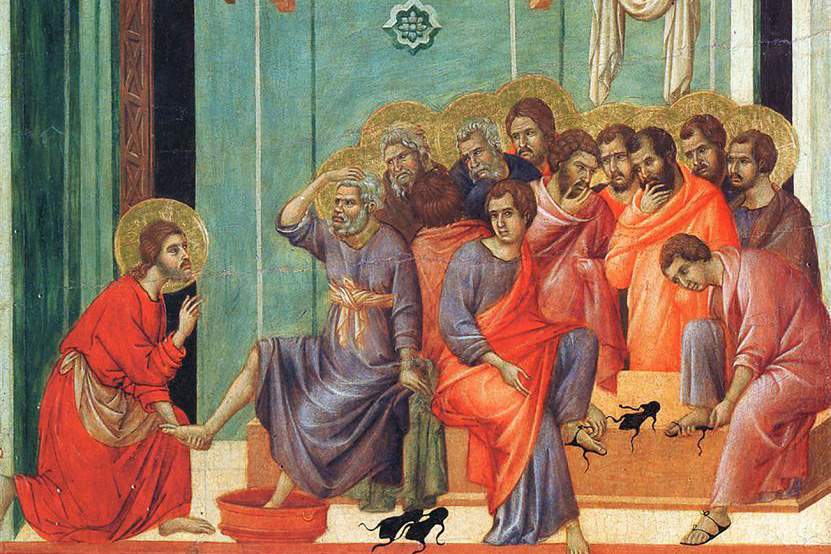
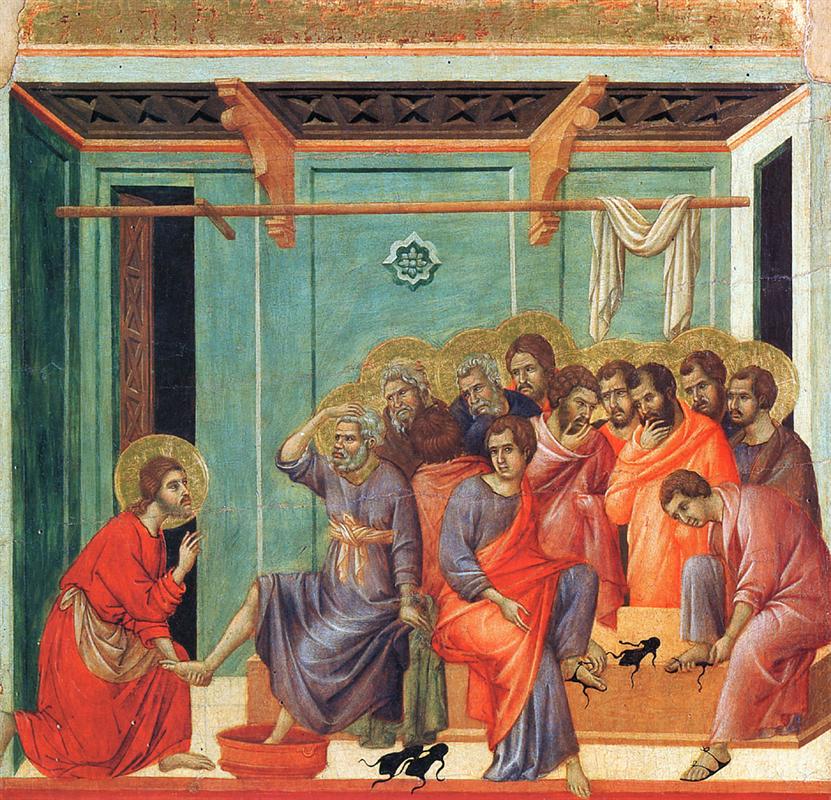
And there is something of this evident in the Liturgy of Holy Thursday, which commemorates the institution of the Holy Eucharist and the Priesthood, but which couches it in the context of the mandatum novum, the “new commandment” of love and service, and signified by the foot washing.
These three things are distinguishable in our minds, but in reality they are so together as to be one. And we need to be careful not to separate them in our minds.
To illustrate this danger, consider how, within our minds, we are able to distinguish things that are, in reality, inseparable. For example, think of a candle flame and how, in your mind, you can distinguish the heat of the flame from the light of that flame. But in reality you could not take a knife and separate the heat from the light and put them in different places. In reality they are so together as to be one.
And this is how it is with our triple mystery this night. Though we can distinguish them, they are meant to be so together, as to be one. Without the priesthood there is no Holy Eucharist. And without love there would be neither priest nor Eucharist. And we are asked by the Lord and the to ponder all three tonight, but to remember that they are meant to be one reality.
The Lord gathers his first priests, institutes their priesthood, washes their feet and and gives them his Body and Blood. And then he says “Do this in remembrance of me.” Do what? Surely, celebrate the Eucharist. But the Lord also surely means that they are to wash the feet of others. For, in establishing their priesthood he says to them, I have given you a model to follow, so that as I have done for you, you also must do (Jn 13:15). Yes, it is all connected, the new law of love and service, the priesthood and the Eucharist.
Lets go a little deeper
St. Augustine says, reflecting on Proverbs 23:1 says, If you sit down to eat at the table of a ruler observe carefully what is set before you, then stretch out your hand, knowing that you must provide the same kind of meal yourself. (Tract in Iohannem 84:1-2)
And in this gloss on the proverb is a reminder to every priest and every soul who would approach the Eucharist: we must provide the same kind of meal, a matching gift.
It is true we cannot give all Christ gave and did, we have but five loaves and two fish. But the fact is we are called to provide the same kind of meal, a meal of love, of self sacrifice that is will to wash the feet of others.
In the Old Testament priesthood, the priest and victim were distinct. Perhaps the priest offered a lamb, or turtle doves of a bull. But the victim was distinct from him.
But in the New Testament priesthood, the priesthood of Jesus Christ, the priest and victim are one and the same. Jesus offered himself as the sacrifice.
And every priest who would gather with Jesus our king and ruler ought, as St Augustine says, observe carefully what is set before him, realizing that he must provide the same meal, a matching gift.
Thus, when the priest who stands at the altar says, “This is my Body” the first meaning is that it is Jesus Christ who is speaking these words through the priest.
But it must also be somehow true that the Priest, as a man, is also saying to his people, this is my body. He must be willing to way to them, without simulation, I, your priest also give you my very self in sacrificial love and service. I will wash your feet. I am willing to die for you if necessary. I will spend myself in your service. My body, my life, is yours.
Yes, the priest must be willing to provide the same meal as the Lord, a matching gift. The priest and the victim are one and the same. And thus, the priesthood, Eucharist and the mandatum novum of love and service are ultimately one reality.
And what is true for the priest is also true for the faithful. For to approach the altar of the Lord, to partake of this sacred and sacrificial meal is to incur the same admonition that one must provide the same meal, a matching gift. the faithful who hear the words, this is my body, comes the ultimate obligation to say to another, this is my body, here is my life for you, i will wash your feet. Same meal, matching gift.
There are some who have, in recent years wished to downplay the mandatum, the foot washing at Holy Thursday mass. To some extent this is understandable, given all the shenanigans of the past decades. The rite ought to be done but can be omitted for pastoral reason.
But theologically, there can be no downplaying the mandatum. For those who would wish to downplay what the washing of the feet signifies: Sorry, no can do. The Eucharist, and the command to wash one another s feet cannot be separated in reality. They are so together as to be one. An unloving priest or communicant is a countersign. Every priest and communicant who stretches out their hand to the Lord and his Eucharist, must provide the same meal, a matching gift.
Pope Francis gave elevated importance to the foot washing this year in going to a prison. And while it does not follow that every priest should relocate the Holy Thursday Mass outside the parish, it is a though Pope Francis is saying to those who would minimize the foot washing: Don’t do that. For the mandatum novum it signifies is so one with the priesthood and the Eucharist as to be one reality.
The three mysteries we preach tonight are really one mystery of love. And we who would partake of the Eucharist, or be its celebrants, must never forget that we must provide the same meal, the matching gift.
There is, among faithful Catholics, a dismay, and even an understandable anger at the events unfolding at the Supreme Court these past days related to to gay unions. And even if the court were to uphold traditional marriage (which does not seem likely), or merely return the matter to the States, it seems quite clear where our culture is going regarding this matter, approving things once, not so long ago, considered unthinkable.
What then to do with our dismay and anger? It is too easy to vent anger, which is not only unproductive, but in the current state of “hyper-tolerance” for all things gay, angry denunciations are counter-productive.
Rather our anger should be directed to a wholehearted embrace and living out of the biblical vision of human sexuality and marriage. Our anger should be like an energy that fuels our zeal to live purity, and speak of its glory to a confused and out-of-control culture.
The fact is, traditional marriage has been in a disgraceful state for over 50 years, and heterosexual misbehavior has been off the hook in the same period. And, if we are honest, heterosexual misbehavior and confusion has been largely responsible for bringing forth the even deeper confusion and disorder of homosexual activity, and particularly the widespread approval of it.
We have sown the wind, and now reap the whirlwind (Hosea 8:7).
Our anger, dismay and sorrow are better directed inward toward our own conversion to greater purity as a individuals, families and parishes, than outward toward people who will only interpret it as “hate” and bigotry” anyway.
A few thoughts to frame our own reflections in how we have gotten to this place of darkness in our culture.
1. The fundamental flaw in modern thinking about human sexuality, the “Ur” (root) problem, is the (sinful) declaration that there is “no necessary connection” between human sexual activity and procreation. Here is the real taproot of modern confusion about human sexuality and all the disorders that flow from it. Such notions began as early as 1930 in the Lambeth Conference where the Church of England was the first Christian Denomination to serious brook this sinful notion. The thinking gained steam through the 1950s, via Margaret Sanger et al. and came to full (and ugly) flower in 1960s with the pill and the sexual revolution.
2. Any 8th grade biology student ought to be able to see the flaw in the “no necessary connection” argument. For if sex has no necessary connection to procreation but can be only for fun or pleasure, then what are the sperm and ova doing there? Did not nature and nature’s God intend some connection. Alas, what even an 8th grader can see, was set aside and/or became unintelligible to a generation obsessed with its passions. Claiming to be wise they became fools and their senseless minds were darkened (Rom 1:22-23)
3. Once the necessary connection between sex and procreation was set aside, contraceptives moved from being something related to prostitution to being a downright “noble” thing to use and promote. Sex became a frivolous plaything and promiscuity became widespread, since the most obvious consequences of sinful, frivolous and out of control behavior, now seemed to be to largely preventable. Promiscuity exploded on the scene and was celebrated in popular culture, in the music, on T.V. and so forth. Enter the further explosion of sexually transmitted diseases, teenage pregnancy, single motherhood and exploding divorce rates. Because guess what? Contraceptives were not full-proof (or should we say “foolproof”). It’s not nice to fool Mother Nature and our “no-necessary connection” insistence thus ushers in all these disorders.
4. But never mind all that, we didn’t learn, we just doubled-down. Next we put marriage in the shredder by further declaring that there is no necessary connection between marriage and procreation. More pills and condoms please. Divorces continued to skyrocket, as birthrates plummeted.
5. In a parallel trend, single parent families entered the scene in a big way. For if it is true that marriage does not have any necessary connection to children, then apparently having children has no necessary connection to marriage. As single parent families rise, so do juvenile delinquency rates, and teen suicides. SAT scores and graduation rates, however, went down.
6. But never mind all that. What was needed is more condoms! Never mind that contraceptives and the underlying “no necessary connection” distortion ushered all this pain and distortion in. No! what we need is some more hair of the dog that bit us. More contraceptives! The government should promote and provide them free. In fact, start giving them to children and teens. After all, with decades of sexual misbehavior, who is really able to control themselves? And any one who suggests we ought to try is called puritanical, judgmental, unrealistic and a likely Christian. Let’s add free abortion to the mix and pass laws that permit parents to be kept in the dark when their daughters are taken to abortionists.
OK, you get the point, we heterosexuals have been involved in a down spiraling series of distortions and sexual misbehavior for over fifty years now. And this misbehavior is widespread and even celebrated in our culture.
Add to this terrible picture, the scandalous silence of pulpits, the shrugging over flagrant fornication, cohabitation and high divorce rates by Church leaders, parents, and other community leaders.
Yes, we have sown the wind. And now comes the whirlwind. Enter the “gay” community who have in effect called our bluff and illustrate the absurdity of our “no-necessary connection” philosophy. For, if sex has “no necessary connection” to procreation, and can just be about what pleasures you, or is just your way to show “care” for another, if this is the case, what’s wrong with homosexual behavior? And if marriage is just about two adults being happy and there is “no necessary connection” to procreation, why can’t homosexuals “marry”?
Welcome to the whirlwind. Yes, we heterosexuals have misbehaved for over fifty years now, and, in process dispensed widespread confusion about sex and distorted its purpose. We have loved the darkness, and now the darkness deepens with the obvious absurdity of homosexual “marriage” a misnomer before it is even uttered. But so is contraceptive marriage.
Is Homosexual activity disordered? You better believe it. But so is contraceptive heterosexual activity since it is no longer ordered per se to procreation. In fact, it is rightly argued that contraceptive sex is really just mutual masturbation, it is not true or ordered human sexual activity at all. It is disordered, for it is not ordered to its proper end.
The grave disorder of homosexual acts and the equally grave celebration on them in our culture is a very deep darkness. Scripture calls homosexual activity παρὰ φύσιν “para physin” (contrary to nature – cf Rom 1:26). Any cursory examination of the structure and design of the human body (which is revelation) makes it clear that the man is not for the man, the man is for the woman. The woman is for the man, not another woman. Having eyes do you not see, and having ears do you not hear? (Mk 8:18)
In Romans 1:17ff St. Paul and the Holy Spirit describe a culture that has gone very dark. For the men of St. Paul’s day “suppressed the truth by their wickedness” (v. 18). And this suppression of the truth led to an ever deepening darkness wherein their thinking became futile and their senseless minds were darkened. Although they claimed to be wise, they became fools (vv 21-22). And darkness led to depravity wherein: God gave them over in the sinful desires of their hearts to sexual impurity for the degrading of their bodies with one another. They exchanged the truth about God for a lie…Because of this, God gave them over to shameful lusts. Even their women exchanged natural sexual relations for unnatural ones. In the same way the men also abandoned natural relations with women and were inflamed with lust for one another. Men committed shameful acts with other men, and received in their bodies the due penalty for their error. (v 24-27).
Some Protestant preachers have warned over the years that God would punish this nation for celebrating homosexual activity. But St. Paul’s point is even more poignant: The widespread acceptance of homosexual activity IS God’s punishment. It is a punishment that does not single out homosexuals, it is a punishment on us all. We are collectively very confused, and the darkness grows every deeper. We have sown the wind, we are now reaping the whirlwind.
The faithful Catholic is right to be dismayed and angry. But allow this anger to fuel commitment to living and speaking the truth. Do not direct it merely to wrath or scapegoating. Let this anger fuel your commitment to speak the truth about human sexuality to your children and grandchildren, to be silent no more, embarrassed no more. Speak plainly and boldly, clearly and with charity. But let your anger fuel commitment to the truth, by what you say and how you live. Be angry, but do not sin (Eph 4:26).
Most of us have contributed to the darkness of these times and need to repent. Perhaps we have bought into the lie of contraception and spread it. Perhaps some have been promiscuous. Other too may have been pure, but were too silent to the impurity around them. And having sown the wind, we reap now the whirlwind. It’s time to repent. It’s time to be angry but sin not.
Update:
Thanks to everyone who participated in the discussion here. I think it is now necessary to close to any further comments.First it is Good Friday and time to focus on the Lord who died for us poor and confused sinners, who endured our darkness to bring us light. Secondly, the remarks have turned largely poisonous and I’m getting some pretty awful remarks.
Trackbacks show that this post was linked to by a couple of “gay” interest sites because the tide has rather suddenly turned and the discussion has drifted from the point of the original post. The initial hit backs came at the post mostly from the contraception dissenters and that was ugly enough but now things are getting even uglier in the combox and the topic in the thread is morphing too much.
I admit to opening the door to “gay” push-back. I am very clear, as is the Catechism, that homosexual acts are intrinsically disordered and that this is obvious not only from Scripture but also from biology. Our bodies are simply not built or designed for what homosexuals do.
But as is well attested in the article, there are many ways in which Heterosexuals also offend against the proper ordering of sex and thus also engage in disordered sexual practices.
For what it is worth, as a closing comment the point of the post was to wade into the current “marriage equality” (I would call it the “marriage redefinition”) debate with the perspective that we are all to some degree responsible for the current darkness. 50 years of heterosexual misbehavior and redefining the meaning of both sex and marriage has set the stage for cultural whirlwind we are currently in. Many moderns are currently exulting in its lusty breezes, but as I argue, it is rooted in darkness and the body count of the sexual revolution (literally and figuratively) is very high. We all have much to answer for, whether as outright sinners in these matters or as all too silent “saints.”
Clergy are high on the hit list for our silence. But, as can be seen, these issues are hard to discuss well, and with the proper balance of courage and compassion. Yet still we ought to have spoken long before things got so dark and hot.
I do not deny my anger at the current situation that many of my interlocutors accuse me of (as if they were not also angry). My point is to suggest that we who are believers be angry without sin. To use the energy that anger supplies to do whatever personal repenting is necessary, to become ever clearer on the central issues and the “why” of biblical and Church teaching, and to courageously witness to the beauty and truth of a proper understanding of human sexuality.
I want to write more next week and focus a bit more on what the Church must finally offer to those of homosexual orientation (namely the call to live as celibates in heroic witness to the truth of God’s Revelation) if she is to be faithful to Scripture, Sacred Tradition, and Natural Law.
Peace to all even if you think badly of me. Veritatem in Caritate!
This commercial teaches that trouble tends to multiply and advises us to try an avoid ending up in a roadside ditch.
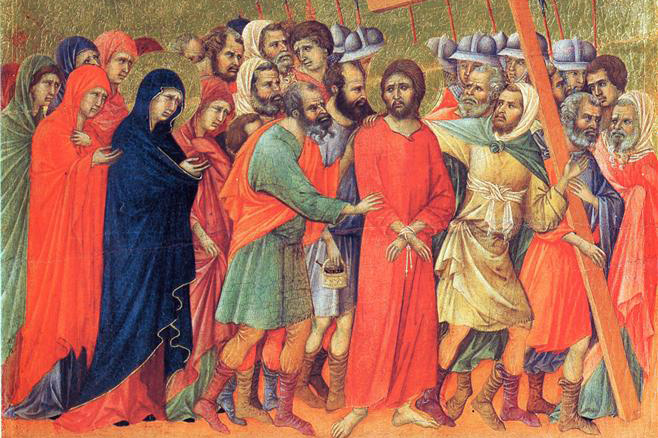
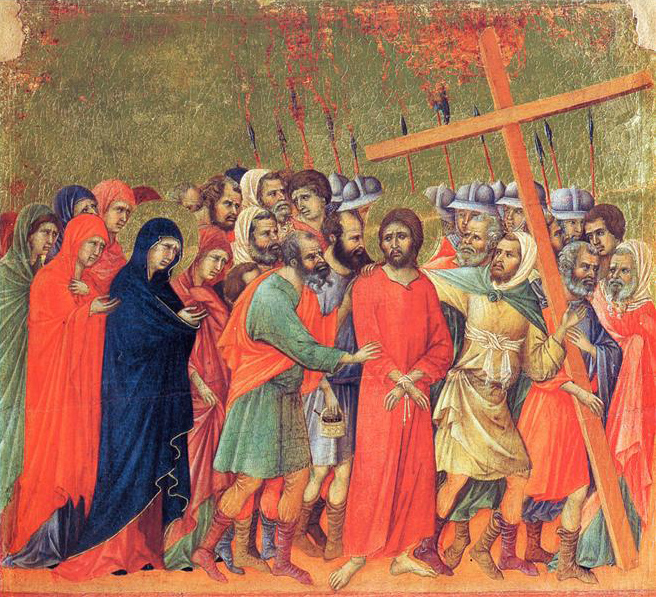
There is an important “logion” (utterance) of Jesus on his way to the cross that speaks powerfully to this modern age of ours, and is fulfilled in a gruesome manner in our times.
It is the word of Jesus to the women who lamented him as he made his way to Crucifixion:
A large crowd of people followed Jesus, including many women who mourned and lamented him. Jesus turned to them and said, “Daughters of Jerusalem, do not weep for me; weep instead for yourselves and for your children for indeed, the days are coming when people will say, ‘Blessed are the barren, the wombs that never bore and the breasts that never nursed.’ At that time people will say to the mountains, ‘Fall upon us!’ and to the hills, ‘Cover us!’ for if these things are done when the wood is green what will happen when it is dry?”
In this text is a likely historical context rooted in the First Century. But Scripture, as I pray you know, was not written merely for First Century Christians. It also speaks to our times. In fact it may speak more ghoulishly to our times than to the First Century, as we shall see. Lets take a look at the First Century context, only briefly, and then turn attention to our owns times.
The First Century context of Jesus’ words is surely rooted in 70 AD and the terrible culmination of a 3 1/2 Year war of the Jewish people with the Romans, (66-70 AD – The War actually culminated with the fall of Masada in 73AD). Jesus had spoken of this terrible war extensively in i the the Mount Olivet Discourse (Matthew 24:1 – 25:46; Mark 13:1-37; Luke 21:5-36), and He even wept as he looked upon Jerusalem just before his Palm Sunday entrance:
As he approached Jerusalem and saw the city, he wept over it and said, “If you, even you, had only known on this day what would bring you peace—but now it is hidden from your eyes. The days will come upon you when your enemies will build an embankment against you and encircle you and hem you in on every side. They will dash you to the ground, you and the children within your walls. They will not leave one stone on another, because you did not recognize the time of God’s coming to you.” (Luke 19:41-44)
And now, as these woman weep for him, we weeps for them and their children. For indeed, the says are coming, in forty short (biblical) years when they will see a destruction so overwhelming that, as Josephus records, 1.2 million Jews will die. And the terrible and suicidal phrase of asking the mountains to fall on them etc. are a Jewish way of lamenting that death is preferable to the calamity that is upon us!
And so we see the First Century fulfillment of the passage. Indeed, those women who lamented him had little idea about how awful it would get for them and their children, for sin and rebellion, hatred and revenge, would have their way, and boil over like a cauldron. 70 AD would bring a bloodbath like the world had never seen until that time.
But what of us? How, does this text speak to us? It a word or three: Horribly, poignantly and prophetically.
It does not take a genius to see that the Lord’s words are true for us in ugly and sickening ways. Our bloodbath is far worse that 70 AD. 55 million are dead from abortion in America alone since 1973. And add to that the 100 Million + who were killed in the last century alone for ideological purposes in two world wars, a cold war, and the pogroms and systematic starvation of Stalin, Mao, Pol Pot and their successors.
Though we like to think ourselves civilized in comparison to previous centuries, our blood bath is far deeper than any age before. True, we murder our millions in less publicly brutal ways. We do not experience hoards of warriors descending from day to day on unsuspecting cities. Our brutality takes place in more hidden ways, out of sight if you will, in concentration camps, abortion “clinics”, killing fields, and remote locations away from cameras.
Yes, our murder seems more abstract, but it is not. The death toll is almost unimaginable. And meanwhile we go on considering ourselves civilized.
And the Lord Jesus, looking beyond 70 AD must have seen our times and had them in mind when he said to those women of old that they would see an enemy (Satan): dash you to the ground, you and the children within your walls.
Yes, Satan has deceived us with deceptions of power, distortions of freedom, and crushing lies of “choice.” 55 million dead in American alone since 1973, our children dashed to the ground.
The Lord goes on to say, the days are coming when people will say, ‘Blessed are the barren, the wombs that never bore and the breasts that never nursed.’ Yes, and those days are here, days when people celebrate barrenness, have themselves surgically sterilized, and celebrate contraception. The days are here when the greatest danger seems to be the “terrible and fearsome proposition” of getting pregnant, of having “too many children.”
Yes, the days are here when most people cry out: blessed is barrenness, blessed are small families. Life it would seem, is a terrible burden to be contracepted and aborted away and some awful threat. It is an age that cries out “Blessed the career women who has not stymied her life and progress by the terrible and terrifying prospect of children.”
Yes, said the Lord to those ancient women, in effect, “You think this is bad? The days are actually coming when things will be so bad and so dark that people will celebrate NOT having children, will celebrate barrenness.”
But the Lord does not stop there. He goes on to describe quite well the culture of death so literally lived out in our times: people will say to the mountains, ‘Fall upon us!’ and to the hills, ‘Cover us!’
One may argue that this is just a Jewish way of speaking that indicates despair. Perhaps. But we live it out quite literally in our times, for it is the refrain of the culture of death. And what is the culture of death? It is the mentality that increasingly sees the death or non-existence of human beings as the “solution” to problems. In our times there has arisen a group of radicals who see human beings as a hindrance to their ecological goals, and they seek population reductions and even dream of a pristine earth without humanity. They peddle History Channel programs such as “Life after People” as a kind of fantasy of their vision and advocate contraceptive and abortive policies that see mankind as the problem that must be eliminated. In effect they cry to the mountains “fall on us” and dream of a world that is “post-human.” They even peddle disaster movies as though they were longing for it all.
You may say, I exaggerate. Fine. But would you ever dream we would be were we are today in fifty short years of social engineering, and anti-life policies?
Jesus spoke to the women that day of their own time, but surely his words describe our own times in sickening detail, times where barrenness is exalted and the fertility of large families treated with shock and even contempt, times where extremists have infected the modern psyche with notions that human beings are worse than roaches on this planet and that things will be better without us, or with dramatically fewer of us.
Of times like 70AD and times like these Jesus says, “Weep.”
Yes, Blessed are those who mourn for they shall be comforted. (Matt 5:4). And who are those who mourn? They are those who see the awful state of God’s people, that God is not know to them, that they do not glorify God or even know why they were made, they are confused, deceived, and misled. And some, seeing this are mourning and weeping, they are led to prayer and action, to speaking out, and pointing once again to the light, from the dark places of times like these.
Mourn with Jesus, and pray for a miraculous conversion for times like these, times which seem eerily consistent with the dreadful things Jesus prophesied.
Back in February I gave a talk to a large group (300+) at the Blessed John Paul II Shrine here in Washington. The topic was a pastoral plan for the family. The video of that talk became available recently and I thought I’d share it here.
So you think the idea of the 12 Steps is new. Well, if you think you’ve got a new idea, go back and see how the Greeks put it, or in this case how the Medieval Latins put it. St. Bernard of Clairvaux identified twelve steps up the mountain of pride. These are detailed in a work by him entitled Steps of Humility and Pride.
In today’s post we focus on the Twelve Steps of Pride. Tomorrow, on the Twelve Steps of Humility (from St Benedict’s rule). Here I list the 12 Steps of Pride only briefly and give a brief commentary on each which is mine, so don’t blame St. Bernard. 🙂 Again, the list is his. The inferior comments are mine.
One will note how the 12 steps grow far more serious as we go along and and lead ultimately to the slavery of sin. The steps tend to build on one another, beginning in the mind, moving to behavior, and then to deepening attitudes of presumption and ultimately bringing forth revolt and slavery. For if one does not serve God, he will serve Satan.
Twelve steps up the mountain of pride. Think of these like escalating symptoms:
(1) Curiosity – There is such a thing as healthy curiosity but often we also delve into things we ought not: other peoples affairs, private matters, sinful things and situations, and so forth. What makes such curiosity to be annexed to pride is that so often we think we have a right to know things we do not. And hence we pridefully and indiscreetly look into things that we ought not, things that are not for us to know, or which are inexpedient and distracting for us, or perhaps the knowledge which we seek is beyond our ability to handle well. But casting all caution aside, and with a certain prideful and privileged sense we pry, meddle, and look into things we ought not as if we had a right to do so. This is sinful curiosity.
(2) Levity of mind – Occupying our mind with things not appropriate grows and we tend to become playful in wider matters. Here too, there is a valid sense of humor and a kind of recreational diversion that has a place. A little light banter about sports or pop culture may provide momentary diversions that are relaxing. But too often this just about all we do and we pridefully cast aside matters about which we should be serious and pursue only light and passing things. In ignoring or making light of serious things pertaining to eternity and delving only into entertaining and passing things, we pridefully ignore things to which we ought to attend. Hours watching sitcoms and “reality” TV but no time for prayer, study, instruction of children in the faith, caring for the poor, and so forth is a lack of seriousness that manifests pride. We lightly brush aside what is important to God and substitute our own foolish priorities. This is pride.
(3) Giddiness – Here we move from a levity of mind to the frivolous behaviors they produce, behaviors in which we over-emphasize lightweight experiences or situations, at the expense of more serious and important things having to do with profundities. Silly, vapid, foolish and capricious behaviors indicate a pride wherein one is not rich in what matters to God. We pridefully maximize the minimum and minimize the maximum. We find all the time for frivolities but no time for prayer or study of Holy Truth.
(4) Boasting – Increasingly locked into our little world of a darkened intellect and foolish behavior we begin to exult in lower behaviors and consider such carnal behaviors to be a sign of greatness. And thus we begin to boast of foolish things. To boast is to speak and think of oneself more highly than is true or reasonable. While we should learn to appreciate the gifts we have, we ought to recall that they ARE gifts give us by God and often through others who helped us develop them. St. Paul says, What have you that you have not received? And if you have received it, why do you boast as though you had not? (1 Cor 4:7) But the boaster thinks too highly of himself either asserting gifts he does not have or forgetting that what he does have is a grace, a gift. This is pride. And, as we have seen our boasting tends to be about foolish and passing things.
(5) Singularity– Our world gets ever smaller and yet we think ourselves even greater. We are king alright, king of an ant hill, rulers of a tiny speck of dust sweeping through the immensity of space. But as our pride grows we too easily we forget our dependance on God and others for who and what we are. There is no such thing as a self made man. We are all contingent beings, very dependent on God and others. Further, we also too easily draw into our own little mind and world and tend to think that something is so just because we think so. Withdrawing only to our own counsel we discount the evidence of reality and stop seeking information and counsel from others. The man who seeks only his own counsel has a fool for and adviser, and a prideful adviser at that. Singularity is pride. Yet this pride swells as our world gets ever smaller and more singular, focused increasingly only on our self.
(6) Self-conceit – Here is described an unjustly favorable and unduly high opinion of one’s own abilities or worth. As our world gets ever smaller and our pride ever greater our self focus and delusion grows ever stronger and we become increasingly self-referential. Something is now so merely because I say so. I am fine because I say so. Never mind that all of us are a mixture of strengths and weaknesses, sanctity and sinfulness. Too easily we grow blind to just how difficult we can be to live with. Too easily we find faults in others but fail to see them in our very self. Further, we too easily seek for others to favorably compare our self, thinking, “Well at least I am not like that prostitute or drug dealer over there.” But being better than a prostitute or drug dealer is not the standard we must meet. Jesus is the standard we must meet. But rather than refer our self to Jesus and seek mercy, we refer our self to others we look down on and give way to pride.
(7) Presumption – Now even God’s judgements must cede to ours. I am fine and will be saved because I say so. This is a sin against hope wherein we simply take salvation as granted and due to us no matter what we do. In effect we already claim to possess what we do not. It is right for us to confidently hope for God’s help in attaining eternal life. This is the Theological virtue of Hope. But it is pride to think we have already accomplished and possess what we do not already have or possess. It is a further pride to set aside God’s Word which over and over teaches us walk in hope and seek God’s help as a beggar, not as a possessor or as one legally entitled to glory in heaven. Presumption is pride.
(8) Self-justification – Jesus must now vacate the Judgment seat because I demand his place. Not only that, but he must also vacate the cross because I don’t really need his sacrifice. I can save myself, and frankly I don’t need a lot of saving. Self-justification is the attitude that says I am able, by my own power to justify, that is save myself. It is also an attitude that says, in effect: “I will do what I want to do and I will decide if it is right or wrong.” St. Paul says, I do not even judge myself. My conscience is clear, but that does not make me innocent. It is the Lord who judges me. (1 Cor 4:3-4). But the prideful person cares only for his own view of himself and refuses to be accountable ultimately even to God. The prideful person forgets that no one is a judge in his own case.
(9) Hypocritical confession – The word hypocrite in Greek means “actor.” Now we will observe that in certain settings some degree of humility and acknowledgement of ones fault is “profitable.” One can get “credit” for humbly acknowledging certain faults and calling himself a “sinner.” But, the prideful man is just acting. Just playing a role and doing his part more for social credit than out of real contrition or repentance. After all, I’m really not that bad off. But if posturing and playing the role of the humble and contrite sinner will get me somewhere, I’ll say my lines, play the part and look holy. But only if the applause from the audience is forthcoming.
(10) Revolt – Pride really begins to go off the rails when one outright revolts against God and his lawful representatives. To revolt means to renounce allegiance to or any sense of accountability or obedience to God, to his Word or to His Church. To revolt is to attempt to overthrow the authority of others, in this God and his Church. It is prideful to refuse to be under any authority and act in ways that are directly contrary to what lawful authority rightly asserts.
(11) Freedom to sin – Here pride reaches its near conclusion as it arrogantly asserts and celebrates that it is utterly free to do what it pleases. The prideful man is increasingly rejecting of any restraints or limits. But the freedom of the proud man is not really freedom at all. Jesus says, Whoever sins is a slave to sin (John 8:34) and the Catechism echoes: The more one does what is good, the freer one becomes. There is no true freedom except in the service of what is good and just. The choice to disobey and do evil is an abuse of freedom and leads to the slavery of sin. (Catechism 1733) But the proud man will have none of this and arrogantly goes on asserting his freedom to do what he pleases even as he descends deeper and deeper into addiction and every form of slavery.
(12) The habit of sinning – and thus we see Pride’s full and ugly flower: habitual sin and slavery to sin. As St. Augustine says, For of a forward will, was a lust made; and a lust served, became custom; and custom not resisted, became necessity.(Conf 8.5.10)
And thus we have climbed in twelve steps the mountain of pride. It begins in the mind with a lack of sobriety rooted in sinful curiosity and frivolous preoccupation. Next come frivolous behavior and excusing, presumptive and dismissive attitudes. Last comes out right revolt and slavery to sin. Pride is now in full flower. The slavery comes for if one refuses in pride to serve God he will serve Satan.
We have seen an escalation in these steps which is not far from an old admonition: sow a thought, reap a deed; sow a deed, reap an habit; sow a habit, reap a character, sow a character, reap a destiny.
Is there a way down this mountain of pride? Tune in tomorrow.
We have discussed before on this blog that we live in a culture where maturity is often significantly delayed. In fact there are many in our culture who never grow up. One paradigm of our culture is to that it is fixated on teenage years. Fixation is a psychological description of a person who has not successfully navigated one of the stages of infancy or youth and thus remains stuck in the thinking and patterns of that stage, to one degree or another. Out culture’s fixation on teenage issues and attitudes is manifest in some of the following:
Irrational aversion to authority
Refusal to use legitimately use the authority one has
Titillation and irresponsibility regarding sexuality
General irresponsibility and a lack of personal accountability
Demanding all of one’s rights but avoiding most of one’s responsibilities
Blaming others for one’s own personal failings
Being dominated by one’s emotions and carried away easily by the passions
Obsession with fairness evidenced by the frequent cry, “It’s not fair!”
Expecting others and government agencies to do for me what I should do for myself
Aversion to instruction
Irrational rejection of the wisdom of elders and tradition
Obsession with being and looking young, aversion to becoming or appearing old
Lack of respect for elders
Obsession with having thin and young looking bodies
Glorification of irresponsible teenage idols in culture.
Inordinate delay of marriage, widespread preference for the single life.
I have often been accused when writing in this manner, especially by younger men that I have little idea what they really face. I do plead to being guilty of being less sensitive to the struggle of men simply because I am a man. I don’t generally like to hear men make excuses, as a man it alarms me. Men tend to tell each other to make no excuses and to “be a man.”
But I was alerted recently to two other articles on this subject. One of them is by a woman who has some good insights to the lack of male maturity today. Sometimes it takes someone on the outside to better grasp the dynamics. I think she shows a little more understanding (in both the intellectual and sympathetic sense of the word), and if it helps male readers to experience greater insight than I have to offer, I offer here an excerpt with comments by me in red:
Not so long ago, the average American man in his 20s had achieved most of the milestones of adulthood: a high-school diploma, financial independence, marriage and children. Today, most men in their 20s hang out in a novel sort of limbo, a hybrid state of semi-hormonal adolescence and responsible self-reliance. This “pre-adulthood” has much to recommend it, especially for the college-educated.
So she coins a term here called “pre-adulthood.” I have tended just to call this “extended adolescence” but her terms does capture the fact that many of the immature men (and some women too) do live away from parents and do have jobs, but otherwise are not so different from adolescents and college preppies. So her term does include a necessary distinction.
But it’s time to state what has become obvious to legions of frustrated young women: It doesn’t bring out the best in men….They are more like the kids we babysat than the dads who drove us home…..
Exactly. I have had many women tell me how tedious young men are. I usually reply that a feminized culture has largely produced them. So has a culture fixed on teen themes. Men also get mixed messages from both women and culture to the effect “Be a man, but don’t do it in a manly way…Show some leadership but get out of the way…. Many men are rightly confused, especially younger men who are some two generations removed from anything resembling a patriarchal family structure. Today matriarchy is the norm almost everywhere, and if there is even a whiff of Patriarchy it is round mocked and even punished legally. Ms Hymowitz will develop this more.
Among “pre-adults,”(again, her word for the extension of adolescence)women are the first sex. They graduate from college in greater numbers (among Americans ages 25 to 34, 34% of women now have a bachelor’s degree but just 27% of men), and they have higher GPAs. As most professors tell it, they also have more confidence and drive. These strengths carry women through their 20s, when they are more likely than men to be in grad school and making strides in the workplace. In a number of cities, they are even out-earning their brothers and boyfriends….Their male peers often come across as aging frat boys…
Yes the feminists in our culture have long ago succeed in emasculating culture and making male proclivities almost criminal. In schools young boys who show the traditional spit and vinegar are declared ADHD and medicated. They are forbidden the rough and tumble that used to be usual fare for growing boys. Leadership and the aggression (within proper limits) that often fuels male leadership is excoriated etc. In this strange land of largely feminine run schools boys are poorly formed and it makes sense that they under-achieve. Nevertheless, despite decades of this, most feminists still claim victim status and continue to double-down on further feminizing the scene. Gone are the days when Father Flanagan caught two boys fighting and issued them boxing gloves and set the time for a proper fight between gentlemen after school.
For a long time, the poor and recent immigrants were not part of adolescent life; they went straight to work, since their families couldn’t afford the lost labor and income….today’s pre-adults have been wait-listed for adulthood. Yes this phenomenon is quite recent and rooted in western affluence and to some degree decadence.
Marketers and culture creators help to promote pre-adulthood as a lifestyle…. Precisely.
Pre-adulthood has also confounded the primordial search for a mate. It has delayed a stable sense of identity, dramatically expanded the pool of possible spouses, mystified courtship routines and helped to throw into doubt the very meaning of marriage.
In 1970, to cite just one of many numbers proving the point, nearly seven in 10 25-year-olds were married; by 2000, only one-third had reached that milestone… In 1974 there were 400,000 weddings in Catholic Parishes in the USA. In 2004 there were 199,000 weddings. Cut more than in half and it has dropped like a rock since.
It’s been an almost universal rule of civilization that girls became women simply by reaching physical maturity, but boys had to pass a test. They needed to demonstrate courage, physical prowess or mastery of the necessary skills. The goal was to prove their competence as protectors and providers. Today, however, with women moving ahead in our advanced economy, husbands and fathers are now optional, and the qualities of character men once needed to play their roles—fortitude, stoicism, courage, fidelity—are obsolete, even a little embarrassing.
George Guilder made this same point in a landmark Book Men and Marriage. Ms. Hymowitz does a remarkable job in just two sentences of describing the remarkable toll the break down of the family has had on men. Along with expansive (Mommy State) government usurping a provider role and the general feminization of culture, men are in a cauldron of confusion and obsolescence, a kind of perfect storm.
Today’s pre-adult male is like an actor in a drama in which he only knows what he shouldn’t say. He has to compete in a fierce job market, but he can’t act too bossy or self-confident. He should be sensitive but not paternalistic, smart but not cocky….
Why should they grow up? No one needs them anyway. There’s nothing they have to do. They might as well just have another beer. Wow.
I realize both Ms Hymnowitz’s remarks and mine too are not without controversy, especially my remarks about the feminizing of culture. I saying this I do not mean to say there is no value in femininity, only that things have gone out of balance for men. Comments are open.
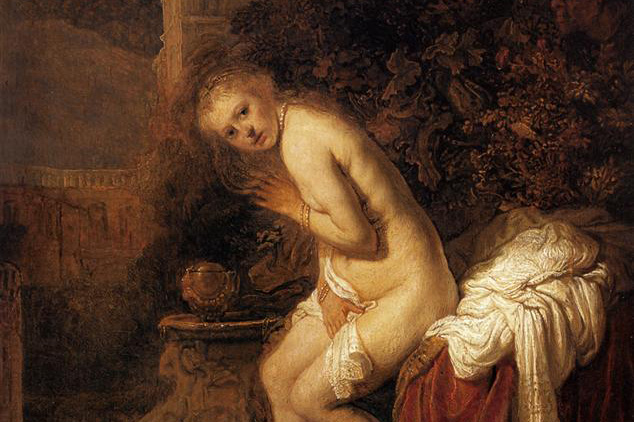
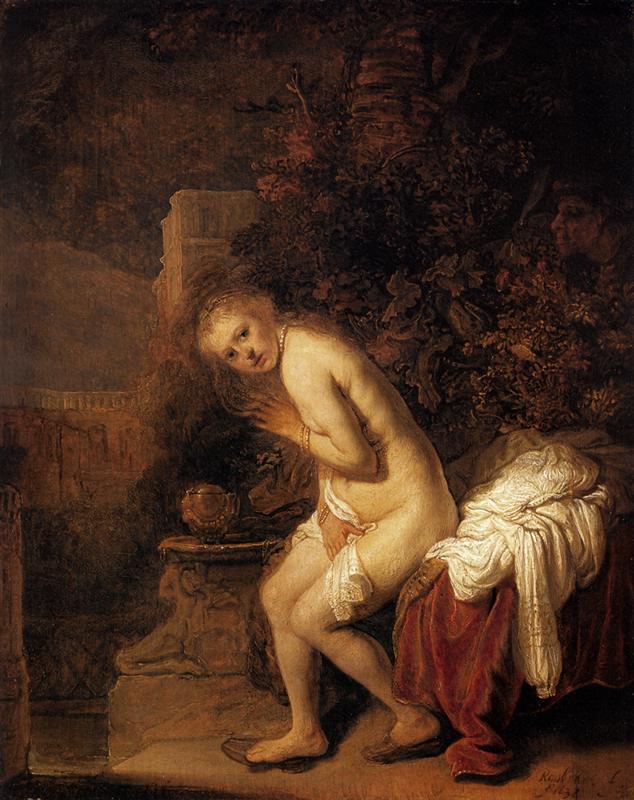
The first reading from today’s Mass is an extraordinary moral tale from the Book of Daniel. It is the story of Susanna. The full passage (which is quite lengthy) can be found here: Daniel 13:1-62. Interestingly it is missing from Protestant Bibles which use a truncated version of the Book of Daniel. As such it is a lesser known passage, even among Catholics since it is only read on a weekday Mass once a year.
It features the story of a beautiful young woman, Susanna, married to a man named Joakim. One day as she is bathing in a private garden two older men who have hidden themselves there out of lust try to seduce Susanna who rebuffs their brazen overture. They threaten to falsely accuse her of having committed adultery with a young man in garden if she does not give way to their desires. She still refuses and they follow through on their threatened lie. They further demand that she should be stoned. Things look bleak for Susanna until Daniel comes to the rescue and, through crafty interrogation, exposes their lie for what it is. The story is a small masterpiece. If you have never read it, you should. In the course of its engaging tale it gives us a kind of anatomy lesson of sin. It is good to consider the teachings here.
In a remarkable description the story describes a threefold source from which their sins spring forth. The text says: They suppressed their consciences; they would not allow their eyes to look to heaven, and did not keep in mind just judgments. (Daniel 13:9). I’d like to take a look at each of these three sources from which sin springs.
1. They suppressed their consciences– What is the conscience? The Catechism defines it thus: For Man has in his heart a law inscribed by God, This is his conscience, there he is alone with God whose voice echoes in his depths… (Catechism of the Catholic Church (CCC) # 1776). So, in effect, the conscience is the voice of God within us. God has written his Law in the hearts of every human person.
Thus, in terms of basic right and wrong, we know what we are doing. There may be certain higher matters of the Law that the conscience must be taught (eg. the following of certain rituals or feasts days etc.). But in terms of fundamental moral norms, we have a basic and innate grasp of what is right and wrong. Deep down inside we know what we are doing. We see and salute virtues like bravery, self-control, and generosity. We also know that things like murder of the innocent, promiscuity, theft, destruction of reputations etc are wrong.For all the excuses we like to make, deep down inside we know what we are doing, and we know that we know. I have written substantially about conscience elsewhere (HERE).
But notice that it says that they “suppressed their consciences.” Even though we know something is wrong we often want to do it anyway. One of the first things our wily minds will do is to try and suppress our conscience. To suppress something is to put it down by force, to inhibit or to try and exclude something from awareness or consciousness.
The usual way of doing this is through rationalizations and sophistry. We invent any number of thoughts, lies and distortions to try and reassure our self that something is really OK, something that deep down inside we know isn’t OK.
We also accumulate false teachers and teachings to assist in this suppression of the truth that our conscience witnesses to. St. Paul wrote to Timothy: For the time will come when men will not put up with sound doctrine. Instead, to suit their own desires, they will gather around them a great number of teachers to say what their itching ears want to hear. They will turn their ears away from the truth and turn aside to myths. (2 Tim 4:1-3).
It is quite an effort to suppress one’s own conscience and I would argue that we cannot ever do it completely. In fact the whole attempt to suppress the conscience is not only quite an effort, it is also very fragile. This helps explain the anger and hostility of many in the world toward the Church. Deep down they know we are right and often, just the slightest appeal to the conscience to awaken its voice, causes quite an eruption of fear and anger.
So here is the first stage in the anatomy of a sin: the suppression of the conscience. In order to act wickedly and not face deep psychological pain of significant guilt these men in the story first suppress their conscience in order to shut off the source of that pain. Step one is underway.
2. They would not allow their eyes to look to heaven– In order to sustain the fictions, stinking thinking, rationalizations, and sophistry that are necessary to suppress the conscience, it is necessary for one to distance himself from the very source of conscience, God himself.
One way to do this is to drift away from God though neglect of prayer, worship, study of the Word of God and association with the Church which speaks for God. Drifting away may become more severe as times goes on and the refusal to repent becomes deeper. Drifting soon becomes absence and absence often becomes outright hostility to anything religious or biblical.
Another way that some avert their eyes from heaven is to redefine God. The revealed God of Scripture is replaced by a designer God who does not care about this thing or that. “God doesn’t care if I go to church, or shack up with my girlfriend etc.” On being shown scripture quite contrary to their distorted notions of God they simply respond that Paul had hangups, or that the Bible was written in primitive times.
Culturally the refusal to look heavenward is manifest in the increasing hostility to the Catholic Christian faith. Demands growing increasingly strident that anything even remotely connected to the faith be removed from the public square. Prayer in public, nativity sets, Church Bells, any reference to Jesus or Scripture in schools, etc. It must all be removed according to the radical seculars who refuse to turn their eyes heavenward or even have anything around that reminds them to do so.
The cumulative effect is that many are no longer looking to heaven or to God. Having suppressed their conscience they now demand a Godless public square. Still others reinvent a fake God, a false kingdom, an idol. Either way, the purpose is to isolate and insulate the self from God and what he reveals.
This makes it easier to maintain the rather exhausting effort of suppressing the conscience.
So for these men in the story, step two in engaged and it further supports the suppression of conscience necessary to commit sin without the pain of guilt.
3. And did not keep in mind just judgment– Finally lets throw in a little presumption which dismisses any consequences for evil acts. This of course is one of THE sins of our current age. There are countless people, even many Catholics in the pew and clergy too who seem outright to deny that they will ever have to answer to God for what they have done. But of course this is completely contrary to Scripture that insists that we will indeed answer one day to God for what we have done.
This final stage of presumption is meant to eliminate the salutary fear that should accompany evil acts. The sinner at this stage has had some success in alleviating the psychic pain of guilt and even a lot of the fear that used to accompany sin when the voice of conscience was less layered over and muted.
But, even after suppressing the conscience and refusing heaven’s influence, still some fear remains so now an attack is made on any notion of consequences. Perhaps the sinner exaggerates the mercy and patience of God to the exclusion of God’s holiness which sin cannot endure. Perhaps he denies the reality of hell which God clearly teaches. Perhaps he denies that God exists at all and holds that there is no judgment to be faced. However he does it, he must push back the fear the punishment and/or judgment.
Here then is the anatomy of sin. Having suppressed the conscience, the voice of God to the extent possible and having removed oneself from heaven’s influence, and then denying that anything of negative consequence will come, one is freer to sin gravely. It is as though one has taken a number of stiff drinks and anesthetized himself sufficiently to proceed without pain.
But guess what, it’s still there deep down inside. The voice of conscience remains. Under all the layers of stinking thinking and attempts to insulate oneself from the true God, deep down the sinner still knows what he is doing is wrong. Even the slightest thing to prick his conscience causes increasing unease. Anger, projection, name-calling, ridiculing of anyone or anything awaken his conscience will increasing be resorted to. Sin is in full bloom now and repentance seems increasingly difficult or unlikely. Only great prayers and fasting by others for him will likely spring him loose from the deep moral sleep he is currently in. Pray for the conversion of sinners.
Well, since this post has been a little heavy it might be good to end on a lighter note:
The Gospel for Mass this past Saturday contains one line that deserves some attention from us. At one level it seems like a mere scene-ender, a line that merely ends a section and has the dramatis personae (cast of characters) walk of stage. But as most who have any familiarity with Scripture know, there is perhaps not one wasted syllable in the whole text, especially in John’s Gospel. Quite profoundly, there is not one word or syllable that should be merely cast aside as filler when the Holy Spirit is at work inspiring the sacred authors.
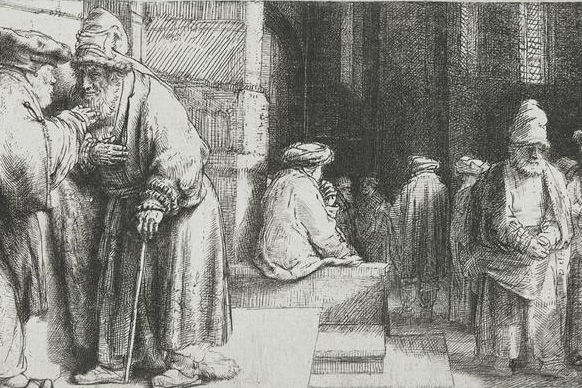
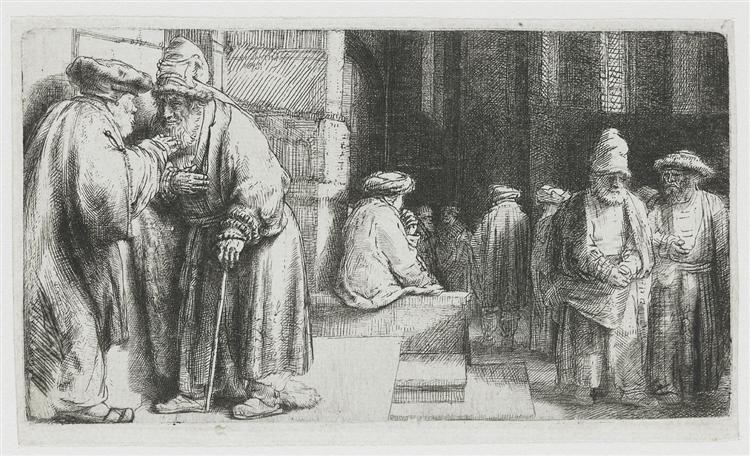
The line in question appears in the 7th Chapter of John’s Gospel at the end of a debate among the Temple leaders as to the identity of Jesus. They wrestle with the question of who Jesus is and if he is or is not the coming Messiah, and also the eternal Son of the Father as he claims.
The majority of the interlocutors reject Jesus out of hand based on mistaken notions and due to the fact that he comes from Galilee and “no Prophet has EVER come from Galilee! One of their number, Nicodemus, encourages them to be more open to the possibilities and have greater command of the facts before rendering judgement. After much debate the pericope (passage) ends thus:
Then each went to his own house. (John 7:53)
This line ought not be overlooked, since, if we allow it, it invites great significance. Let’s consider three ways of seeing this line. We can distinguish here three rather separate understandings: an inward meaning, and outward meaning and an eternal meaning.
1. At the inward level each one returning to his own house can be understood as descriptive of how we must ultimately enter into the “house” of our our soul. We must all go to that deep, inner room of our heart and mind, that place were we are alone with our God, that place were we ponder and reflect, where we deliberate and discern.
This is that place where we must ultimately decide for ourselves the deepest questions of life: who am I? Who is God? What is the meaning of my life? What am I doing and why. Who is the man (or woman) that God has made me to be? Yes, here is that deep inner sanctum, the holy place where we are alone with God.
Too often, when we are with others, there is posturing by us. Too easily do we merely seek to conform in response to pressure and other social influences. In these sorts of settings there is often undue influence from persuasion or excessive human respect, from group pressure and group dynamics. In a word, there is posturing.
But there comes a moment when we are summoned by the Lord to come apart, to go to our own house, to enter into that quiet place of our innermost self and answer the deeper questions, and listen carefully to voice of God that echoes in our heart. (cf Catechism # 1776).
In the cited Gospel above, the Temple leader have had their debate. They have sought to influence one another. Some have experienced pressure and persuasive argumentation. Many of them also likely experienced the human tendency to ingratiate themselves to others and to fit in by speaking in certain ways they perceive will advance them in the opinion of others.
Now all that posturing is over and it is time for each man to go, each to his own house and there privately ponder and decide what he really thinks. Yes, it is decision time. The Lord is calling a question: who do YOU say that I am? It is time for these men to go to their own house and be face to face with God.
Sadly today, many reject this requirement to “go to our own house” and to deeply reflect. Most take little time today to enter the room of their own soul. In our modern world, with its extensive distractions, most prefer to flip on the T.V. rather to “go to their own house.”
But ultimately we cannot wholly evade this call from God to decide inwardly, in that inner room of our own “house” who God is, and how we will respond to him. For those who go on too long refusing to go to their own house, God has ways of supplying it anyway. Maybe its one of those sleepless at 3:00 AM moments. Maybe it is a time of crisis that provokes soul searching. But ultimately, at some moment each of us must “go to his own house” that there reflect quietly with God, away from social pressures, away from posture. And there we, alone with God must face the deepest questions.
2. At the outward level, this text involves a very different perspective, an insight that is almost opposite. For, while it is of critical importance to go to that secret place, that house of our own soul and there reflect with God, it is also of critical importance to stay connected to the reality that is outside our house. Thus, in saying that each of the Temple leaders went off to his own house, there may also be understood the human tendency to go off and live in our own little world, to retreat for any evidence we don’t like, to avoid anything that challenges our worldview.
Jesus had earlier confronted these Temple leaders with evidence of his divinity and his identity as Messiah and Lord. He spoke to them of his miracles, of his fulfillment of prophecy, of the Testimony of John the Baptist, and of the Father’s voice echoing in their hearts. (cf John 5:31-47).
But for many of us there is the tendency merely to retreat to our own little world, our own house, no matter the evidence. In effect we retreat from reality to our own made up world.
There is an old saying, “Don’t Believe everything you think.” For, we tend to think something is so just because we think it or agree with it.
There is another saying, “Who is an adviser to himself has a fool for a counselor.” Yet too easily we take counsel merely with our self. Or, we surround ourselves only with teachers who tickle our ears.
Thus, these Temple leaders, though having been confronted with many facts that point to the veracity of Jesus’ identity as Lord and Messiah, choose instead to brush it off and merely to go each of them to his own house, his own little world.
Further they err with the facts, for they argue that the Messiah had to be born in Bethlehem, but Jesus was born in Galilee. But of course their command of the facts is poor here, for Jesus was born in Bethlehem.
Never mind all that, they just go off to their own house, to their own little world. And too often many do exactly this.
The challenge for us all to live in reality, not merely in the confines of our own house, our own little world, our own (sometimes flawed or incomplete) thoughts.
3. The Third and eternal implication is the ultimate home, the ultimate destination to which we all journey. Thus when the text says they all went each to his own house, it may also refer to that place where they will dwell for all eternity. Where that house is, in heaven or hell, depends on our stance regarding Jesus.
These Temple leaders, having scoffed at Jesus, now head off each to their home. Sadly, no one comes to the Father except through Jesus, and thus their home is somewhere other than the heart of the Father.
There is an old saying, “You made your bed, now lie in it.” And thus, you and I too must choose where to make our home. And where that is will depend on our acceptance or rejection of Jesus.
There comes a day when each of us will have said of us: Then each went to his own house. Where will your house be?
Somehow I am reminded of an old song from my youth about that secret place of the heart:

 Most of us are familiar with concept of a matching gift. So, if I work for a certain company and donate to a certain cause, my employer may match my gift up to a certain amount; a matching gift.