
Don’t Believe Everything You Think. A Consideration of Distorted Thinking and the Spiritual Life

062313In my work as a spiritual director, and also in deliverance ministry, as well as in my own experience of growth, it is very clear that there are common patterns of distorted thinking that disrupt spiritual growth and cause distress and disorder. These cognitive distortions lead one to misinterpret, or to over interpret the data of the world and to live in a kind of unreality, or exaggerated reality.

But of course holiness and wholeness presuppose what scripture calls a “sober mind” (cf 1 Thess 5ff; 1 Peter 1:13; 4:7; 5:8; Titus 2:2ff; among many others). Romans 12 exhorts us:

Do not conform to the pattern of this world, but be transformed by the renewing of your mind. Then you will be able to test and approve what God’s will is—his good, pleasing and perfect will. For by the grace given me I say to every one of you: Do not think of yourself more highly than you ought, but rather think of yourself with sober judgment, in accordance with the faith God has distributed to each of you. (Romans 12:2-3)

Many sinful attitudes, fears, resentments, aversions and anxieties come from distorted thinking. These patterns emerge from our flesh but are also open doors for demonic influence as demons can exploit and further twist our experience of reality. The world too is able to exploit cognitive distortions both for profit and for influence.

The renewal of our minds is a key aim of spiritual direction, deliverance ministry and of overall spiritual growth. Hence, learning to recognize and name the more common forms of distorted thinking, also called cognitive distortions. Learning their “moves” we can begin to have mastery over them and begin to experience greater freedom and authority over our thought life. And, since most feelings come from thoughts, our emotional life will also be in greater repair. This includes having greater authority over and freedom from anxieties, resentments, anger, paranoia, and depression.

Lets take a brief look at some of these cognitive distortions and see their moves and bad fruits:

1. Overgeneralizing – The frequent tendency to think that a negative situation is part of a constant cycle of bad things that happen. People who overgeneralize often use words like “always” or “never.”

For example, a person might think: I had plans to go to the movie with friends, but the plans fell through. This always happens to me! I never get to have fun!

The more likely truth is that such a person does have enjoyable things in their life. And, like most other people, there are also disappointing moments. Life is a mixed bag. But, at the end of the day, most people have far more blessings than burdens.

Everyday ten trillion things go right and a few things go wrong. This is not an exaggeration when we consider that every function of every atom, molecule, cell and organ is a blessing and a success. Further, most every part of every system on this planet is up and running in a functional way so as to sustain our life. Things we seldom think about are taking place at every moment: photosynthesis is supplying oxygen, millions of ecosystems are running in symbiotic harmony, the Van Allen belts in the upper atmosphere are deflecting harmful radiation from the sun, the gulf stream and weather patterns are distributing warmth and rain, etc. Beyond the earth, Jupiter and Saturn are catching comets, the asteroid belt holds a lot of other space debris at bay, the sun is stable, and our earth has an orbit that is only 3 degrees off from a perfect circle, ensuring that the warmth of the sun is fairly even throughout our orbit.

The list could go on. But we ought to avoid overgeneralizing and exaggerating about how bad things “always” happen to us, and good things “never” come our way. This is not reality. It is not sober thinking. It makes us negative, fearful and anxious. It is not of God and has its origin in the sinful drive of ingratitude. There is much (ten trillion+) for which to be grateful for on any given day, even when certain disappointments have come. We need to embrace reality, and the reality is that overgeneralizing about negative outcomes is neither real nor balanced.

Satan can surely tap into this distortion to stir up resentment, fear, anxiety, and other negative emotions. The world too can “cash in” but string up the same negativity and proposing false or incomplete solutions for just $19.95 plus shipping and handling. Politicians and other organizations can also command too much of our loyalty and have too much power over us by inciting this distortion.

2. All or Nothing Thinking – Seeing things as only perfect or terrible, good or bad, 100% or Zero, with little or no room in between. For example, I am either a hero, or a total loser. Small mistakes are seen as total failure. Perhaps a person on diet slips, and has a large piece of cake, and then thinks, I am a total failure, I just gained ten pounds. There is very little “middle ground” in all or nothing thinking.

There is also the tendency in all or nothing thinking to think that affirming one thing, means denying others. For example, if I say, I like “A” that this therefore means I am somehow saying that B, C and D are of no value whatsoever. But of course that may not be the case at all. Yet, the all or nothing thinker may take offense at the affirmations or points made by others since they see no middle ground, or the possibility that many things can be affirmed and praised at once, or that preferences can be on a continuum somewhere between zero and one hundred.

Indeed, the reality is that most things in life, and most scenarios admit of a kind of continuum of outcomes between all and nothing, 100 and zero. There are often many different outcomes and possible combinations that are both praiseworthy and acceptable. But the all or nothing thinker, because of this cognitive distortion has a difficult time remembering and accepting this.

The result of all or nothing thinking at the personal level is either pride, wherein one thinks of themselves or their performance too highly, or low self esteem wherein one, seeing something less than perfect in their performance deems themselves to be a total loser. There are any number of issues that revolve around anxiety (e.g. performance anxiety) and fear (fear of failure), resentments and depression that set up on account of this cognitive distortion.

At the social level there is often hostility to all opinions that are not 100% in sync with what the all or nothing thinker insists is best. Such people often take offense when none is intended. For example, perhaps someone other than them, or what they think, is affirmed.  They then think that they, or  what they think, is therefore wholly discarded or ridiculed. In this way, all or nothing thinking tends to make people hostile, fearful, thin-skinned and unnecessarily insistent on perfect agreement or outcomes.

It is not hard to imagine how both the devil and the world can lay hold of and tap into this distorted drive of the flesh and hold people in bondage to fear, hostility and many anxious notions that see no middle ground, and no reason to hope. Since the world is not perfect, there is nothing good to celebrate, and those who do celebrate something are dismissed as naive, stupid or worse. The all or nothing thinker presumes that if someone affirms one thing, they “must think it is all good,” which, of course is not necessarily true. But the distortion leads them to scorn and even ridicule people unnecessarily. Thus the evil one easily locks all or nothing thinkers into ever deepening degrees of negativity, hostility and fear.

3. Fortune Telling – Predicting that something bad will happen, without any evidence. For example, a person may think, “I don’t care how hard I have prepared for the talk, it is going to go terribly. People will hate my talk or be bored.”

Essentially this is a form pessimism and negativity that taps into the sin against hope called “despair.” Fortune tellers tend to see the world merely as a hostile place, and opportunities merely as burdens and traps.

But, of course opportunities are not necessarily good or bad, hostile or benign. They are just opportunities.

Further, ‘failure’ is not always total, or even failure at all. The cross was a failure to many who saw it that day, but it was actually victory. Some of my “worst” sermons have had surprising effects. Life is a funny proposition. But the Fortune teller rejects all this and insists that disaster is just over the next ridge.

Sadly, most fortunetellers set up self-fulfilling prophecies. Expecting bad things, they usually get it, or can at least collect ample evidence to prove their thesis and be confirmed in their downward cycle of negativity, anxiety, depression, despair, and cynicism.

Satan can easily exploit negativity and the “hunch” that bad things are going to happen. Fortunetellers keep the door wide open to the devil’s shenanigans, practically delighting in his works so as to say, “See, I told you so.”

This negative thinking has to go. It is a distortion that denies the possibilities of every opportunity, and the possibility of paradoxical and surprising outcomes.

4. Emotional Reasoning – Believing that bad feelings or emotions reflect the situation. For example, I feel anxious when I fly, so airplanes are not safe.

Our feelings have the capacity to “damn reason.” We need to be very careful to remember that feelings are just feelings. They ought not be wholly ignored, but neither should they be the deciding factor. Many of our feelings are simply wrong and rooted in traumatic or powerful events of the past.They may not in fact reflect the current reality. That I feel unsafe does not mean I am unsafe. That I feeling bad about a meeting does not mean it was a bad meeting etc.

Once I was walking with a friend and a dog came running up to up. My friend, who had once been bitten and infected by a dog was afraid. But I had grown up with dogs and could see that the dogs was lumbering up to us to greet us, not attack us. Both of us were looking at the same data, and both of us had different feelings. I was right, there was nothing to fear. The dog came an sniffed my hand and wagged its tail. No harm.

But the point is that the feelings were not the reality, they were just feelings. Mine happened to be right, and my friend’s were wrong. But neither set of feelings changed the reality.

Here too, Satan and the world can easily exploit feelings to make us think things that are not necessarily so. An important part of spiritual growth is learn how to discern feelings, and seem them as part of the picture, not the whole picture.

5. Mind Reading – Jumping to conclusions about what others are thinking, without any evidence. For example, My friend didn’t stop to say hello. She must be angry at me. Well, perhaps, or perhaps too she was in a hurry, or maybe she didn’t even see you or know you were there. Or, My boss cast a negative glance at me, he is upset and I am going to get fired. Maybe, or perhaps as he was looking in your direction he remembered something he forgot to do, or an argument he had with his wife. Perhaps too he had gas pains!

This sort of distortion is often rooted in a form of pride called grandiosity, wherein  we think we are always the main thing on other people’s mind, or the reason they act. I once knew a man who was very paranoid and I would often remind him that people had better things to do with their time than think of him or ways to trip him up.

Mind reading is also rooted in pride because we trust too much that we have command of all the facts and really know what is going on. We do not. This is a distortion. We do well to develop a healthy type of reserve in our conclusions about what others are thinking or about their motives. We ought to ask of God a certain kind of “blindness” that fails to notice so many things we really can’t even understand.

This form of distorted thinking leads to many fears and anxieties that are usually needless and baseless. Satan surely has many doorways through this form of pride and anxiety producing thinking.

6. Mental Filter – Focusing only on the negative parts of a situation and ignoring anything good or positive. For example, I got a lot of good feedback from the conference I led. But one person disagreed with my premise. I guess the conference wasn’t so good after all.

This distortion is similar to number one above.

7. ‘Should’ Statement – excessively telling yourself how you “should” or “must” act. For example, I should be able to handle this without getting upset and crying!

Clearly there are moral parameters that we must observe in our Christian walk. But there are also many other “rules” and norms we demand of our self that are not necessarily reasonable or correct.

In spiritual direction a person will often say, “I should do this or that” And often I must ask, “Who told you that?” Not everything we think we should do, must in fact be done.

And thus we must carefully discern what is really required from us, and what is not, or what is merely optional based on circumstances.

The devil loves “should” statements because he loves to destroy truth by exaggerating it and making it an unbearable burden. It also gives him the opportunity to masquerade in pious clothes.

For example consider the following “should” scenario. “You know, your prayers would be answered if you just prayed or fasted a little more. You really “should”  multiply your prayers and double your fasts.” But this can be very devilish.

First it is devilish because to some degree it is true. We probably could pray more (if we neglected other things). But, that we can pray more, if for example, we never slept, does not me we ought to do so or must do so.

Further it is devilish, because if the devil can sow that the sought that we could or ought to pray more, they we have NEVER prayed enough. And now he has us where he wants us: discouraged, guilty, anxious, and seeing prayer as an increasing burden, and God as a task master.

Finally it is devilish because it suggests that we will get what we want as a result of our efforts, rather than the grace of God.

So, “should” statements can be very devilish. And they are this way because they masquerade in pious clothing and moral duties. But too often should statements are wolves in sheep clothing. There are legitimate duties we have, but do not trust every should thought. Discern carefully.

There are more cognitive distortions we could discuss, but allow these to suffice. Add your own in the comments file.

The life of the mind is very important in the spiritual life. Our thoughts are critical to what we do, how we feel and to our sense of well being and serenity.

Bottom line – DO NOT BELIEVE EVERYTHING YOU THINK. Discern, distinguish, sift and sort. Consider well that God wants to give you a sober mind, that is, a clear mind, a mind that is in touch with reality, not lost in distortions, and unreality. Ask for a sober mind and make the journey.

Video – Maybe our cluttered lives reflect our often cluttered thoughts:

Charm is Deceptive – As Humorously Seen in A Commercial

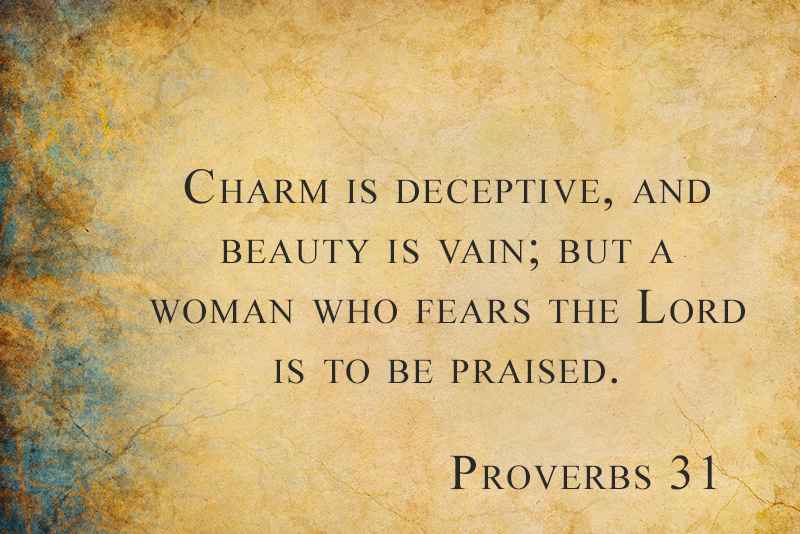
062113The famous and oft quoted Proverbs 31 says, Charm is deceptive, and beauty is vain; but a woman who fears the Lord is to be praised.

This is no disrespect of women, especially those of widely regarded physical beauty. But it is something that men especially need to be mindful of, for men are very visual, and thereby focused on physical beauty. Yet physical beauty, however a man accounts it, is no guarantee that the woman in question shares his faith, values, or outlook. Neither does it reflect anything for or against her virtue, honesty or integrity.

This is a remarkably hard truth for men to apply. It is NOT a hard concept to understand in the abstract. And most men will nod or say amen to what was said above. But when abstraction becomes reality and “she” walks in the door, “lookin so fine” it is too easy to watch how every shred of common sense vanishes in an instant. Thinking shuts down, and decisions are often made with little sober reflection. And suddenly the man goes into his “Baby if you’ve got the curves, I’ve got the angles” mode.

Again, let the disclaimer be clear that “attractive” women (however one accounts that) are no more or less likely to be virtuous. The point isn’t to be suspicious of women regarded as attractive, but rather that men need to be on guard in reference to their tendency to equate looks alone with inner realities, or, alternately to disregard more serious and deeper considerations altogether when good looks enter the scene.

Proverbs 31 quoted above reminds men that charm can be deceptive and that beauty, considered simply as physical beauty is vain (i.e. an empty or neutral quality) when considering a woman. Physical beauty is also “fleeting” as men  account it in our culture, since, in these times especially beauty is tied to youthful features which necessarily mature as years progress.

Thus, Proverbs 31 sets forth a whole host of qualities that a man ought to esteem in a woman, beyond looks. The qualities are too numerous to set forth in this post but you can read them here: The Woman of Proverbs. But surely among those qualities are that she is of noble character, industrious, generous to the poor, caring of her family, faithful and kind.

Yes, comes the advice, look to these, not just to “looks.” There is more to life than charm and looks. Men need to be sober about this, but often are not. There is actually a person attached to those looks who needs to be discovered, respected and also assessed for who she really is.

In the video below, two men are driving along a road and come upon a beautiful woman standing provocatively next to a disabled car. You know they are going to stop! And stop they do! But suddenly one of the men thinks beyond the looks, and sees something wrong. Yes, there is more to the picture than a beautiful woman. Something beyond mere beauty must be considered!

Enjoy this humorous illustration of Proverbs 31:30 Charm is deceptive and beauty is not only vain, but in this case it is downright fleeting!

Pondering the Mysterious Word in the Lord’s Prayer No One Can Agree how to Translate

062013In the breviary we are currently reading St Cyprian’s commentary on the Lord’s prayer. It is a prayer shared by and prized by all Christians. Few if any have not committed to memory.

Yet within the Lord’s prayer is a mysterious word that both Greek and Biblical scholars have little agreement over or even a clear understanding of in terms of its precise meaning.  Most Christians who do not read Greek are unaware of the difficulties and debate surrounding the word. They simply accept that the most common English translation of the Our Father as undisputed. To them the problem is largely unknown.

The mysterious word occurs right in the middle of the prayer: τὸν ἄρτον ἡμῶν τὸν ἐπιούσιον (ton arton hēmōn ton epiousion) which is rendered most usually as “give us this day our daily bread.”

The problematic word is epiousion. The difficulty is that the word seems to exist nowhere else in ancient Greek and that no one really knows what it means. Even the Greek Fathers who spoke and wrote Greek as their mother-tongue were unaware of its exact meaning. It occurs no where else in the Bible (with the exception of the parallel passage in Luke’s version of the Our Father in Luke 11:3). It appears nowhere in wider Greek literature, whether Christian or Pagan. The early Church Father Origen, a most learned and well read man, thought that Matthew and Luke, or the early Church had “made up” or coined the term.

So, frankly, we are at a loss as to the exact and original meaning of this word! It’s actually pretty embarrassing when you think of it. Right there in the most memorable text of Christendom is a word whose meaning seems quite uncertain.

Now, to be sure, over the centuries there have been many theories and positions as to what this word is getting at. Let’s look at a few.

  1. Grammatical Analysis– The Greek word seems to be a compound word from epi+ousios. Now epi means over, above, beyond, in addition to, or some similar superlative. Ousious refers to the substance of something. Hence, to put these words together we have something amounting to supersubstantial, or super-essential.
  2. The Eucharist – Some of the Greek and Latin Fathers thought is clearly referred to the Eucharist and surely not to ordinary food or bread. Origien for example cites how Jesus rebuked the people in John 6 for seeking bread that perishes rather than the Bread which endures unto eternal life which is Jesus’ flesh and which he will give us. (cf Origen On Prayer 27.2) St. Cyprian too, while admitting that “bread” can be understood simply, goes on to advance that the bread referred to here is more certainly Christ himself in the Eucharist (cf. Treatise on the Lord’s Prayer, 18).
  3. Ordinary and daily bread – St. John Chrysostom however favors a notion that the bread for which we pray is only “bread for today: Just enough for one day….Here Jesus condescends to the infirmity of our nature….[which] does not permit you to go without food….I require necessary food not a complete freedom from natural necessities….It is not for wastefulness or extravagant clothing that we pray, but only for bread and only for bread on a daily basis so as not to worry about tomorrow (Gospel of Matthew Homily 19.5)
  4. Bread for tomorrow – St. Jerome says, The word used by the Hebrews to denote supersubstantial bread is maar. I found that it means “for tomorrow” so that the meaning here is “give us this day our bread for tomorrow” that is, for the future (Commentary on Matthew 1.6.11). Many modern scholars favor this understanding as well.
  5. Supernatural bread – But St. Jerome also says in the same place: We can also understand supersubstantial bread in another sense as bread that is above all substances and surpasses all creatures (ibid). In this sense he also seems to see it linked to the Eucharist. When he translated the text into Latin as the Pope had asked him to do he rendered it rather literally: panem nostrum supersubstantialem da nobis hodie (give us today our supersubstantial bread). If you look up the text of Matthew 6:11 in the Douay Rheims Bible you will see the word “supersubstantial” since that English text renders the Vulgate Latin quite literally.
  6. Every good thing necessary for subsistence – The Catechism of the Catholic Church adopts an inclusive approach: Daily” (epiousios) occurs nowhere else in the New Testament. Taken in a temporal sense, this word is a pedagogical repetition of “this day,” to confirm us in trust “without reservation.” Taken in the qualitative sense, it signifies what is necessary for life, and more broadly every good thing sufficient for subsistence. Taken literally (epi-ousios: “super-essential”), it refers directly to the Bread of Life, the Body of Christ, the “medicine of immortality,” without which we have no life within us. Finally in this connection, its heavenly meaning is evident: “this day” is the Day of the Lord, the day of the feast of the kingdom, anticipated in the Eucharist that is already the foretaste of the kingdom to come. For this reason it is fitting for the Eucharistic liturgy to be celebrated each day. (CCC # 2837) As such the Catechism attempts no resolution to the problem but simply indicates that several interpretations are possible and non-exclusive to one another.

So when we have a Greek word that is used no where else and when such important and determinative Fathers struggle to understand it and show forth rather significant disagreement, we are surely left at a loss. It seems clear that we have something of a mystery.

Reverencing the Mystery – But perhaps the Lord intended that we should ponder this text and see a kind of multiple meaning. Surely it is right that we should pray for our worldly food. Likewise we should pray for all that is needed for subsistence, whether just for today or for tomorrow as well. And surely we should ask for the Bread of Life, the Holy Eucharist which is the necessary Bread that draws us to eternal life and which (Who) is over and above all earthly substances.

So there it is, the hidden and mysterious word in the middle of the Our Father. My own preference is to see that “epiousion” (supersubstantial) is a reference to the Eucharist. Jesus who super-abounds in all we could ask or want, said, “I am the Bread of life.” He is surely, in his Eucharistic presence, our Bread which super abounds.

Most modern translations have settled on the word “daily.” For the record, the Latin Liturgy also uses the word daily (quotidianum). But in truth no one word can capture what is said here. The Lord has left us a mystery to ponder. I know many of you who read here are learned in Greek, Latin, the Fathers, and scripture scholarship and I am interested in your thoughts. This article is incomplete and has not covered every possible facet of the argument. I leave that you, all who wish to comment.

Why the Church Opposes Surrogate Motherhood and attempts to legalize it in The District of Columbia

Unlike many other countries, the United States does not have federal statutes or guidelines governing surrogacy parenting. Thus, many states have their own laws in this regard. Currently The District of Columbia prohibits surrogate parenting: Any person or entity who or which is involved in, or induces, arranges, or otherwise assists in the formation of a surrogate parenting contract for a fee, compensation, or other remuneration, or otherwise violates this section, shall be subject to a civil penalty not to exceed $ 10,000 or imprisonment for not more than 1 year, or both.” (D.C. Code § 16-402)

But Council Member David Catania has introduced legislation that would legalize and regulate surrogacy parenting within the District of Columbia. Every council member except for Council Member Marion Barry co-sponsored the proposed legislation.

The Catholic Church opposes surrogate motherhood, a process wherein an embryo from one couple is placed in the womb of a second woman and carried to term by her, usually for remuneration.

Even many Catholics are not certain why we oppose this, along with the similar procedure of in vitro fertilization. Let’s consider from a faith perspective and also from Natural Law why the Church must oppose such procedures.

We begin by noting a kind of sacred trilogy that encompasses human sexuality and procreation.

First, we begin with the truth that human life is sacred. In saying that our life is “sacred” we do not mean merely that human life is somehow “very special” or “unique.”  Rather, to say that human life is “sacred” is to say  “it is of God.”

Human life comes intentionally and lovingly from the very hand of God. Every human being, even our enemies, and great sinners, are known by God, loved by God, willed by God,  intended by God. In Jeremiah 1:5 God says Before I formed you in the womb, I knew you. Thus, in a mysterious way, our existence was already present to God long before we were ever conceived. We were already in the heart and the mind of God as he was preparing for our conception and existence. Psalm 139 speaks about God knitting us  together in our mother’s womb. The same Psalm says that all of our days were written in gods book before one of them ever came to be.

Thus, the human person is sacred. That is, our lives have the mark of God upon them. Our life, our very existence, is caught up in the intention, the will, the very heart of God. Human life is sacred.

Second, since human life is sacred, so are the means by which we come into existence. Thus, our second truth is that sexual intercourse is sacred. Again, the word “sacred” is not simply a way of saying that sex is very special. Rather, it indicates the sexual intercourse is from God, and is touched by him.

Just as in marriage there are three to get married, the husband, the wife and  the Lord; so, in the great sacramental expression of marriage, sexual intercourse, the husband and wife are joined, but in the Lord. The Lord, who is the author of their love, joins the spouses and, according to his will, makes their love fruitful in their children.

So, the origin of every sacred human person, is in the sacred sexual act, which involves not only the spouses, but also the Lord.

Sadly, in our culture, sex is treated as anything but sacred. It is often the butt of jokes, suffers from lewd conduct, countless misapplications and perversions, to include: fornication adultery, pornography, immodesty, homosexual acts, and so forth. What is beautiful and sacred, is treated to base and profane. What is serious and requires commitment, is treated as casual and often passing.

And, if the sacredness of sex is treated lightly, so is the sacredness of human life easily discarded. It is no coincidence that the culture of death has emerged in the age of promiscuity. The body count associated with lust is truly staggering.

Third, since human life is sacred, and the sexual intercourse, which gives rise to it, is sacred, so is the context of sex and life we call marriage also sacred. Once again, calling marriage “sacred” is not merely a way of saying it is “really neat” or  “very special.” Once again, we call marriage sacred because it is set forth by God, and is from God, and every valid marriage is in fact a work of God.

Scripture details in Genesis (1 & 2) how God set forth marriage, declaring that it was not good for the man to be alone.  God thus made Eve, and  we are told that, for this reason a man leaves his father and mother and clings to his wife and the two of them become one (Gen 2:24). Therefore, marriage is one man, for one woman, in a stable and lasting bond.  Jesus adds, What God has joined together, let no one divide (Matt 19:6). In saying this, Jesus also underscores that, not only is marriage an institution from God, but that every valid marriage is in fact a work of God. What God has joined together, no one is to divide.

It makes sense that marriage should be an enduring institution, for each couple. Why?  For God sets fourth that the fruit of marriage should be godly offspring. He tells the first couple, Adam and Eve, to be fruitful and multiply, to fill the earth! (Gen 1:28). Thus that marriage should be heterosexual, fruitful and lasting makes sense,  because that is what is best, and what is just for children. Namely, that they should be raised by their own father and mother, formed by a male and female influence, in an environment that is both stable, and gives complementary witness to the fullness of the human person.

And so, having set forth a kind of sacred trilogy  that the human person, human sexual intercourse, and marriage are all sacred, we now observe the God has united these three sacred realities and intends them to be together. The human person, who is sacred, is intended to be conceived in the loving and sacred embrace of sexual intercourse, between a man and woman in the sacred union of holy matrimony.

Marriage, sex and children are all meant to be united, and God has joined them. Sadly, we seem today to be intent on dividing them.

We see any number of ways that the sacred trilogy is often violated today. Obviously fornication, adultery, and homosexual acts, all violate the trilogy by separating out or removing essential parts of it.

Fornicators and adulterers violate the marital aspect, and usually also, (by contraception), violate the connection to life. Indeed, all contraception denies that there is any necessary connection between sexual intercourse and procreation. As such, contraceptives separate what God intends to be joined.

Homosexuals deny the nuptial meaning of the body, and obviously cannot procreate in any way or be open to life in their acts. And now they seem, at least collectively, determined to utterly set aside marriage as God himself sets it forth in the Scriptures.

But now we also come to other aberrations that are proposed today which also violate the sacred trilogy of sacred human life, being conceived in the sacred sexual embrace, within sacred marriage.

Thus we see, so called “in vitro” fertilization wherein human conception is removed from sacred sexual intercourse, and done in a petri dish. Life now is no longer caught up in this sweet mystery of the marital embrace, and left to the hand of God. Life becomes now a product, produced in a laboratory, usually at a stated price. Sacred human life, becomes a commodity for sale.

The hand of God is overruled as is done in every human sinful practice where in God’s will is simply overridden by prideful human beings.

It will be admitted that infertility in certain couples is lamentable and, at human level, it may seem understandable that they should want to do what is possible to conceive. Yet, in the end, the reality is that we are separating what God has joined.

Also resisted is the notion that perhaps the couple is infertile for reasons known to God. Perhaps he wishes them to adopt. Or, perhaps He wishes them to engage in some dedicated work in the Church or the world, other than parenthood. In vitro fertilization resists discerning God’s will and seeks merely to supplant our wishes.

The killing of many embryos is also morally odious. The vast number of embryos that are conceived are either discarded, frozen, or sent off to experimentation and to be  harvested by those engaged in stem cell research etc. Again, human life is treated as a commodity to be bought and sold, and used at will.

And this leads us then to the problem of so-called surrogate motherhood. The process is similar to in vitro fertilization wherein the father and mother both contribute sperm and ovum and these are combined in a petri dish. But the difference is, instead of being placed in the womb of the genetic mother, the embryo is placed in the womb of a second woman who carries the baby to term.

Genetically, this is not her child. But of course, motherhood is little more complicated than simply whose genes are involved. The mother who carries a child in her womb develops an intimacy and a real bond of connection to that child. And hence we are involved in some very great distortions of what God intends, and are playing with the notion of what motherhood really is about.

Once again, we are seeing a great break up of the trilogy that God intends to be together. The child is not conceived in the sacred marital embrace, but rather in a petri dish. God’s hand is once again overruled, or in effect He is a dis-invited from the decision of conception. Thirdly, the couple, even if married, goes outside the marriage and places their child in the womb of another woman.

There is a kind of a notion to work here, it would seem, that the womb of the surrogate mother is simply a container, a temporary resting place that can be borrowed or rented, if you will.

Absolutely nothing is left in place of what God intends to be together. There is a complete break up here.

Again, it will be admitted that infertility for a couple is a less desirable, even a very sad reality. But here too, the Church cannot simply say it’s okay to overrule God seems to will, or at least permit for reasons of His own. Neither can we fail to insist on the need to discern God’s will. If natural parenthood is not open, what is? Adoption? Some other worthy and noble undertaking? God never closes one door without opening others.

Surrogate motherhood is forbidden to a Catholic for the reasons stated above. We in the Church also argue that it is bad public policy to be supportive of the sorts of activities.

Natural law – In surrogate motherhood, not only is human life treated as a commodity; not only are many embryos discarded in the ways described above, but Natural Law and common sense arguments also show that surrogate motherhood is a bad idea to encourage.

Even without mentioning God, is clear that nature provides that children are conceived in the heterosexual embrace of sexual intercourse. Further, nature also shows that it is best for children to be raised in a stable environment and be raised with a male and female influence.  Further, nature also demonstrates that the natural affections created by physical descent are stronger than merely legal or secondary relationships. Tampering with the normal course of families, and what nature provides as the best and most healthy environment to conceive and bear children, is a recipe for trouble.

It is bad public policy to in any way encourage the willful tampering with the natural order of things.

That the DC government thinks it necessary to pass laws regulating legal transactions around surrogate motherhood, shows that the practice is leads to all sorts of legal problems.  What frequently happens is that when we meddle with natural affections, and try to think of motherhood merely in terms of genetics, (rather than nurturing and so forth), we end up with a real mess, and many conflicted feelings. Surrogate mothers are not always so happy to relinquish their babies after all. Imagine that!

Now into this fray, with all of its  confusion, is proposed all sorts of legalities and a government trying to regulate but really shouldn’t be happening in the first place.

The District of Columbia should leave unchanged the current laws which forbid and discourage surrogate motherhood. Certain District residents may want to engage in practices harmful for the reasons stated, and  the District government may not be able to stop them or enforce the laws forbidding the practice, but in no way should the District encourage such practices by enforcing contractual agreements related to them. Surrogate motherhood is a  lamentable practice, and it is bad policy to support it in any way.

This video illustrates the strange but true world of Surrogacy.

33,000 Years of Marriage In This Place – A Few Pointers From Catholics Married for Long Years

072613This past week six couples in my parish joined about 850 other couples in the Archdiocese of Washington at the Basilica here for the Jubilarian Mass. Couples celebrating 25, 40, 45, 50 and 60 or more years of marriage gather each year to receive gratitude and recognition from the diocese for their witness to the fact that love never fails. We may fail, but love is our constant call, and, if we will let love have its way amor omnia vincit (love conquers all).

In times like these the witness of many years of marriage is all the more necessary and all the more inspiring. My parents made it to 45 years before my mother died. And I know they were not all easy years. I have written on that here before. But as the years ticked by Charles and Nancy Pope, my parents were quite inseparable. When my mother did die, and she died suddenly and tragically, I knew my father wasn’t long for this world. We kids wondered how dad would manage without mom. Shortly after her death he wondered aloud how he could go on living when half of him was gone.

Saying those words witnessed to the miracle of holy matrimony where God takes two and makes them one. My father and mother did not get to that place quickly or easily (there we some stormy years in their forties). But they got there, by God’s grace, they got there.

My Aunt and Uncle just celebrated their 50th. Again, many years, lots of love but also their share of struggles and sorrows. Yes, God is faithful, and he will do what he says: “They are no longer two, they are one.” (Matt 19:6)

In the Basilica last Sunday some one did the math and found that there were 33,000 years of Holy Matrimony collectively among the Jubilarians in that place. Amor omnia vincit.

Many will point to the crisis of Holy Matrimony today. I would not be so foolish to deny it and have discussed it here. But to those who say it is not reasonable or possible to expect people to get married and stay that way today, My mom and dad, my aunt and uncle, 850 other couples in the Basilica and 33,000+ years of marriage all stand in witness to the fact that God can do this, and God STILL does this.

I am not a married man in the conventional sense, but I have had the privilege of talking with many married couples over the years, and I have asked of,  and been able to discern the ingredients of success in holy matrimony, and the priesthood, by extension. Here are few brief pointers that the successful have offered in one way or another over the years to me:

1. No Ideal Marriage – Many people want marriage to be ideal, if there is any ordeal they want to look for a new deal. And the problem is that they want marriage to be ideal. But there is not such thing. Every marriage is imperfect. It has blessings, but also burdens. Clinging to the “ideal Marriage” fantasy is a recipe for resentment and disappointment. Living in reality is essential. Many good marriages are far from ideal, but they are good. And the best should not be the enemy of the good.

2. Always remember, you are sinner, who married a sinner. God wants marriage, as a sacrament to be a means of salvation for both spouses. Hence, marriage somewhat presumes that work was necessary for both spouses upon the beginning of a marriage. Let God do his work, and that work is sometimes painful. Marriage is an important way that God teaches and virtues such as humility, forgiveness, patience, kindness, honesty, accountability, and so forth. Honestly, if we do not learn these virtues and receive them from God, we will likely go to hell. Marriage is one of the ways God works to save us. It is a call to holiness, and as a sacrament, it is a way to holiness.

3. Stay in your lane and work your own stuff first. Always begin by saying, “My marriage is not perfect because I am in it.

4. Some of God’s gifts come in strange packages. For those who are faithful, all things work together for good (cf Rom 8:28). Notice that, ALL things. Not just the good things, even the bad things. Spouses bring many blessings to one another in pleasant ways. But even the less pleasant and difficult things, for the reasons stated in # 2 above, redound to our good if we can learn to learn from adversity as well as pleasantries. A spouse, by God’s grace, is a means by which the other spouse grows in holiness.

5. What you feed grows – It is usually the case when couples date that they compliment each other and overlook negative things rather easily. But a few years into a marriage when the “I Do” has become “You’d Better”  the negative is focused on. Couples in crisis all too easily have great recall of all the foibles and sins of the other, what they have done and not done is easily recited. When I ask what is good about the other, suddenly the memory is less clear and the recitation less articulate. It is a simple truth that what you feed will grow, and what you starve will shrink and die. Couples who have made often talk of being blessed with a poor memory, and a forgetfulness of hurts, and of being grateful for the blessings that their spouse brings. They have learned to feed the positive and starve the negative.

6. Beware the noonday devil – It often happens that when one sets about a good thing like marriage, priesthood or the religious life, or other paths, that at the four or five year mark a certain lethargy sets in that combines boredom, perhaps some discouragement and a desire to get free for something new. This is the noonday devil, the five-year itch. Beware it, but even more, ignore it. Those who make it through this transition are all glad they did. I say “transition” because that is what it is. Life cannot simply be based on newness and thrills. Our commitments must ultimately have deeper roots to be stable and it is important to transition to the daily living of the tasks before us. One ultimately adjusts to slowing down to the pace of life and comes to appreciate what is familiar and stable. If one can make this transition in marriage a more stable and mature love replaces the more mercurial love of romance and courtship.

7. Marriage is hard because life is hard. It is so easy to think life would be better outside the marriage or in another marriage. No. Life is hard. It is hard being a priest, it is hard being single, it is hard being married. Life is hard. Life also has joys in all these states. One of the hard truths that sets us free if we accept it is simply that life is hard. There is not escaping this. There is no where to go where this will not be so. Running from marriage because it is hard is futile. If you try to run from this truth you will meet yourself coming back. There is no escaping this, we live in paradise lost. Life is hard. Running never works.

8. Your spouse’s strengths and struggles are very much related. If we are honest we will discover that what we most like about people is only separated by 3 degrees from what we dislike. For example, we may know someone who is a great organizer or manager. And we very much like and depend on the leadership they have. However, the same person can also be controlling or a bit anxious about things. Their strength and their struggle are very closely related. Perhaps too we know of person who is passionately committed and creative. But that same person also struggles with the passion of anger, or the moodiness of the creative. Someone many be very outgoing and friendly, but they also, thereby, struggle to be committed to core principles and may be a people-pleaser. Successful spouses learn to take the bad with the good, and to accept that what they most like and admire about their spouse, is also accompanied by a less desirable side to it. But at the end of the day they are able to link the two, accepting the tension with appreciation for what it points to.

9. Happiness is an inside job – Most successful spouses come to love and admire many things about their spouse, and their marriage brings with it many happy moments. But, at the end of the day, most individuals are about as happy as they set out to be. Too often we think that happiness comes from external factors. It is true that external factors can bring comfort. But happiness has its origin in our own own heart. There are many people who have very admirable external settings who are not happy. There are also people who have difficult external situations but are happy and content. In the end, happiness is a gift that comes from God which we must allow him to work in us, whatever our circumstances. It is wrong and idolatrous to make another human being, even your spouse, the source of your happiness. Not only is it wrong, it is unfair to your spouse. Only God can grant true and lasting happiness. And we must individually cooperate with that work of God. Our spouse can and should help in this regard, but they cannot be the ultimate source of our happiness. Ultimately we have a God-sized hole in our heart that only God can fill. No human being can take that place.

10. Faith is Fundamental – While it is true that irreligious couples do succeed in marriage, the best guarantee for a successful marriage is for each of the spouses to report to and be accountable and obedient to God. The remedies of the sacraments, God’s word, prayer, sacred teaching and walking in fellowship with other believers are essential helps that we are foolish to try and live without.

11. Headship Matters – There is an old saying, Marriage makes two people one. The trouble comes in determining which one. – One of the biggest problems today in marriage is power struggle. In our modern age we have rejected the biblical teaching of headship in marriage. God establishes a husband in authority in the home. Every organism and organization requires headship. A creature with two heads is a freak. A creature with no head is dead. Having rejected the necessity of headship and the biblical teaching assigning that to the husband (eg Eph 5:19 ff) the result is power struggle between the spouses. Now a husband’s authority is not a worldly, autocratic authority but a Christian, servant based authority (Cf Mark 10:41-45).  It does not follow that the husband always “gets his way.” Rather, if he is smart, he listens carefully to his wife and her wisdom. Practically speaking women have great authority in the home and its daily running and a smart husband will not seek to micromanage and usurp his wife’s role and her practical authority there and with the children. But in the end, two have to become one. Oneness requires headship, common faith, shared fear of the Lord, and a heartfelt appreciation for the gifts of each.

12. Your Marriage belongs to God, not you. The Scripture says, “What God has joined together, let no one divide. (Matt 19:6) Therefore note that God worked this work, not you. Your marriage is His work, it belongs to him. Respect what God has done and reverence it as of him, and by him and belonging to him.

Here then are a few things I have learned in 25 years of marriage counseling and talking to married couples. It is things like these, and more that I am sure you will add in the combox that adds up to 33,000 years of marriage and counting.

Here is a video from last year’s celebration. The couple seen in the still shot of this video box are Morris and Mary Freeman from my parish, who, that year celebrated their 50th. Mary died of a rapid form of cancer just two months after this video was taken. May she rest in peace.

Clergy, Catechists, Parents: Have you Proclaimed The Whole Counsel of God?

061713One of the more powerful moments in pastoral ministry as described in Scripture is Paul’s farewell speech to the presbyters (priests) of the early Church. Here is a skilled bishop and pastor, exhorting others who have pastoral roles in the Church.

Lets take a look at this text and apply its wisdom to Bishops and priests as well as to parents and other leaders in the Church.

Paul’s Farewell Sermon – The scene is Miletus, a town in Asia Minor on the coast not far from Ephesus. Paul, who is about to depart for Jerusalem summons the presbyters (priests) of the early Church at Ephesus. Paul has ministered there for three years, and now gathers the priests for this final exhortation.

In the sermon, St. Paul cites his own example of having been a zealous teacher of the faith who did not fail to preach the “whole counsel of God.” He did not merely preach what suited him or made him popular. He preached it all. To these early priests Paul leaves this legacy and would have them follow in his footsteps. Let’s look at excerpts from this final exhortation. First the text them some commentary:

From Miletus Paul had the presbyters of the Church at Ephesus summoned. When they came to him, he addressed them, “You know how I lived among you the whole time from the day I first came to the province of Asia. I served the Lord with all humility and with the tears and trials that came to me…., and I did not at all shrink from telling you what was for your benefit, or from teaching you in public or in your homes. I earnestly bore witness for both Jews and Greeks to repentance before God and to faith in our Lord Jesus…..But now, compelled by the Spirit, I am going to Jerusalem……“But now I know that none of you to whom I preached the kingdom during my travels will ever see my face again. And so I solemnly declare to you this day that I am not responsible for the blood of any of you, for I did not shrink from proclaiming to you the whole counsel of God….. (Acts 20:1-38 selected)

Here then is the prescription for every Bishop, every priest and deacon, every catechist, parent and Catholic: that we should preach the whole counsel (the entire plan of God). It is too easy for us to emphasize only that which pleases us or makes sense to us or fits in our worldview.

There are some who love the Lord’s sermons on love, but cannot abide his teachings on death, judgment, heaven and hell. Some love to discuss liturgy and ceremony, but the care of the poor is far from them. Others point to Jesus’ compassion, but neglect his call to repentance. Some love the way he dispatches the Pharisees and other leaders of the day, but become suddenly deaf when the Lord warns against fornication or insists that we love our neighbor, enemy and spouse. Some love to focus inwardly and debate over doctrine, but the outward focus of true evangelization to which we are commanded (cf Mat 28:19) is neglected.

In the Church today, as a whole, we too easily divide out rather predictably along certain lines and emphases: Life issues here, social justice over there; strong moral preaching over here, compassionate inclusiveness over there. When one side speaks, the other side says, “There they go again!”

And yet somewhere we must be able to say with St. Paul that we did not shrink from proclaiming the whole counsel of God.

While this is especially incumbent on the clergy, it must also be true for parents and all who attain to any leadership in the Church. All of the issues above are important and must have their proper place in the preaching and witness of every Catholic, clergy and lay. While we may have gifts to work in certain areas, we should learn to appreciate the whole counsel and the fact that others in the Church may be needed to balance and complete our work. It is true, we must exclude notions that stray from revealed doctrine, but within doctrine’s protective walls, it is necessary that we not shrink from proclaiming and appreciating the whole counsel of God.

And if we do this we will suffer. Paul speaks above of tears and trials. In preaching the whole counsel of God, (not just your favorite passages and politically correct and “safe” themes), expect to suffer. Expect to not quite fit in with people’s expectations.

Jesus got into trouble with just about everyone. He didn’t just offend the elite and powerful. Even his own disciples puzzled over his teachings on divorce saying If that is the case of man not being able to divorce his wife it is better never to marry! (Matt 19). Regarding the Eucharist, many left him and would no longer walk in his company (John 6). In speaking of his divine origins many took up stones to stone him, but he passed through their midst (Jn 8). In addition he spoke of taking up crosses, forgiving your enemy and preferring nothing to him. He forbade even lustful thoughts, let alone fornication, and insisted we must learn to curb our unrighteous anger. Preaching the whole counsel of God is guaranteed to earn us the wrath of many.

As a priest I have sadly had to bid farewell to congregations, and this farewell speech of Paul is a critical passage whereby I examine my ministry. Did I preach even the difficult stuff? Was I willing to suffer for the truth? Did my people hear from me the whole counsel of God, or just the safe stuff? In my time with these good people, did they hear clearly from me as to the critical moral issues of our day? Do they know what the Church teaches and her scriptures announce? Have I been clear with them not just what is taught, but also why?

How about you? Have you proclaimed the whole counsel of God? If you are clergy when you move on…..if you are a parent when your child leaves for college…..if you are a Catechist when the children are ready to be confirmed or have reached college age…..If you teach in RCIA and the time comes for sacraments……Can you say you preached it all?

God warned Ezekiel that if he failed to warn the sinner, that sinner would surely die for his sins but that Ezekiel himself would be responsible for his death, (Ez 3:17 ff). Paul is able to say he is not responsible for the death (the blood) of any of them for he did not shrink from proclaiming the whole counsel of God. How about us?

The whole counsel of God; not just the safe stuff, the popular stuff, not just the stuff that agrees with my politics and those of my friends. The whole counsel, even the difficult stuff, the ridiculed things. The Whole Counsel of God.

This video contains the warning to the watchmen (us) in Ezekiel 3. Watch it if you dare.

Pray, Pray, Pray for Priests! A Meditation on Something My Mother Taught Me

061613Last week I blogged on how priests pray for God’s people. indeed, such prayers are built into our daily schedule.

And this post is the other side of the equation, the need that priests have for your prayers. Indeed, I will say, pray, pray, pray for priests. We need your prayers!

I attended another ordination this week, my second this month. It is a good thing for a priest to return each year to his roots, and see other, younger brothers ordained. The rite is so rich and the readings so transformative, the instructions of the rite and the Bishop so necessary. Cardinal Wuerl was in good form and I hope to share some of his thoughts later.

This year though, my heart was heavy as I thought of two brother priests who are in real crisis right now. Pray for them.

Satan hates priests and seeks above all to get to us. Jesus remarked laconically and pointedly, quoting from Zechariah (13:7): Strike the shepherd, and the sheep of the flock will be scattered.’ And thus Satan hates priests and seeks to topple them above all, corruptio optime pessima (the corruption of the best is the worst).

In this regard of praying for priests, I must say, have always felt my mother’s prayers very powerfully. My mother, Nancy Geiman Pope who died in 2005, and is now at home, I pray, with the Lord, always told me that she was praying for me! I often attributed her prayers to her tendency to worry. But I have learned of the power of her prayers, and the necessity of them. She said the Lord had told her that Satan wanted me and all priests, and that she had better pray for me. I never doubt she did, and still does.

I remember once, a week before my ordination in 1989, I was up on the roof of our family house, cleaning out the gutters. She came out and told me to come down from the roof at once and that she would hire some one to clean them. She insisted, I was to come down at once. She explained later that her concern was that I, so near ordination, was now a special target of the evil one.

She always told me she was praying for me. I usually thought she was just fretting. But, as I have seen too many of my brother priests struggle and fall over the years, I have come to see her wisdom and the need for her prayers. I have also come to value the prayers of so many of my parishioners who have told me they were praying. Yes, I need a hedge of protection. And so do all other priests. Pray for priests! Pray, pray, pray!

My mother has long since gone home to the Lord. But I still feel her prayers. Somehow she knew I needed them in a way that I, in my pride, did not always know. But I have come to know.

Thanks be to God, I have been a faithful and fruitful priest for almost 25 years. But I know it was not me. It was the Lord and the prayers of so many, like my mother, who have prayed for me.

Back in my 33rd year of life and 5th year of priesthood I was severely attacked by the evil one. He made his move and sought to discourage and destroy me. He did not succeed. My mother and others were praying. My parishioners too, saw my distress and rallied to pray for me and hold me up. And now, almost 20 years later, I feel strong, alive, joyful and grateful.

But I am no fool, Satan will try again. I pray only for the prayers of God’s holy people and for my own sober awareness of the need to pray and to fulfill the mandate of the Lord who said, Watch and pray so that you will not fall into temptation. The spirit is willing, but the flesh is weak (Matt 26:41)

Yes, somehow during Saturday’s ordination of six news priests, I was joyful, yet sober and prayerful for two for my brothers who are suffering. I thought too of at least a dozen I have known who fell under the burden of office and are no longer in the active priesthood.

And somewhere, in the midst of all of it, my thoughts stretched to my mother. Thanks Mom, for your prayers, and for your wisdom. You knew that precious gifts, like the priesthood, come also with crushing burdens and temptations that require sober and vigilant prayer. One day you called me down from the “roof” of my pride and told me to keep my feet on solid ground. Yes, you knew, and you prayed. You warned and prayed some more.

Thank you mom for your prayers. And thank you dear readers and beloved parishioners for your prayers. They have sustained me. Better men than I are suffering, and better men than I have fallen under the burden of office. It is only your prayers that have kept me. Yes, pray, pray, pray for priests. Join your prayers to those of my mother Nancy Geiman Pope, and others in the great beyond, and many others here on this earth. Pray for priests. Pray, pray, pray.

The photo at the top? Yeah, that’s me, in a needy moment and my mom holding me up in prayer and care. She still does this from her current location, closer to the Lord. Her prayers still hold me, and mine, for her. Requiescat in Pace.

Always Remember: A Homily for the 11th Sunday of the Year

061513Every now and then it will be said by some that the Church should speak less of sin and emphasize more positive things. It is said that honey attracts more flies than vinegar. And indeed, we in the Church have been collectively de-emphasizing sin to a large degree for more than forty years. But, despite predictions, our churches have been getting emptier and emptier. Maybe this is because people are a little more complicated than the “flies” in the old saying.

Jesus also gives the reason in today’s Gospel as to why our churches are getting emptier. Simply put there is less love. He says, But the one to whom little is forgiven, loves little. (Luke 7:47)

Why is there less love? As Jesus says, there is less love because there is less appreciation of what the Lord has done for us and the debt He paid for us. Because debt of sin is no longer preached as it should be, we are less aware of just how grave our condition is. Thus we under-appreciate what the Lord has done for us. This in turn diminishes love,  and a lack of love leads to absence and neglect.

Understanding sin is essential for us to understand what the Lord has done for us. Remembering what the Lord has done for us brings gratitude and love. To those who want the Church to de-emphasize sin Jesus warns, But the one to whom little is forgiven, loves little. (Luke 7:47)

Here then is the gospel in summary form, and the short, TV Mass version of my sermon. If you wish to ponder more, here follows a further commentary:

I. Rich Love – The Gospel opens with a sign of extravagant love. The text says, A Pharisee invited Jesus to dine with him, and he entered the Pharisee’s house and reclined at table. Now there was a sinful woman in the city who learned that he was at table in the house of the Pharisee. Bringing an alabaster flask of ointment, she stood behind him at his feet weeping and began to bathe his feet with her tears. Then she wiped them with her hair,
kissed them, and anointed them with the ointment.

One may argue as to the value of the ointment in this passage. Some have wished to opine that she was a wealthy on account of prostitution, and could thus afford an expensive ointment. Fine. But her tears were far more costly than any ointment. Yes, her tears are the most costly thing in her life, born on great pain and costly sorrow.

It is true, many of her sorrows are likely the result of her own foolishness. But that does not decrease her pain, it increases it. Yes, the most costly thing with which she anoints the Lord’s feet is her tears. There is nothing more precious to the Lord than the love of his faithful, than their sorrow for sins, and their turning to him in love and repentance; no greater gift.

In Jesus day people ate a formal dinner reclining on the floor, on a mat, on their left side. Their feet were behind them and they ate with their right hand. This explains the ability of the woman to approach Jesus’ feet from behind.

In this sense she is able to “surprise” Jesus by her love. Perhaps she was not ready to look upon his face and behold his holy countenance. Just his feet, the lowliest aspect of his sacred humanity, that is where she begins. She humbles herself to serve that part of him that most engages our lowly earth. There, even the Son of God had callouses, perhaps even a wound or two. Yes, there she saw reflected her own humility, saw her own callouses and wounds. There she would discover the first wounds the Savior endured for us; wounds that reflected that He knew what this world can do to a person.

She loves, sharing the incalculable gift of her own sorrows, sorrow for sin and sorrow on account of others who sinned against her. And there she found a friend in Jesus who, though sinless himself, had suffered mightily on account of the sins of others and would suffer more.

Such love, such relief. And, as we shall see, her love is rooted in an experience of mercy. And her experience of mercy is rooted in a deep knowledge of her sinfulness. That experience led her to deep gratitude for the love the Lord had shown her. As we shall also see, her experience of the depths of God’s mercy is something we must all some how experience.

And we too are called to go to the Lord in sorrow and love. And there at the foot of the cross we look up. And what is the first thing we see? His feet. And there, like the woman, we are called to love, to weeping for our sins, and to the remembrance of His mercy for us.

II. Rebuke – When the Pharisee who had invited him saw this he said to himself, “If this man were a prophet, he would know who and what sort of woman this is who is touching him, that she is a sinner.

Here is a dangerous comparison. The Pharisee accounts himself and others to be better or more holy than she. He seems to have no idea that he is also in need of grace and mercy as well.

There is a great danger in thinking that we can attain to heaven merely by being better than someone else. But that is NOT the standard. The Standard, to obtain heaven is to be like Jesus. And if we will lay hold of that, we will see that we are ALL going a lot of grace and mercy to even stand a chance! Yes, to this Pharisee and to some of us the cry must go out: “Danger (Will Robinson)!”

The danger for us is a danger that prevents us from experiencing God’s grace mercy and love. The danger is our prideful presumption that we are less needy that others who are more sinful.

While it is true that, a purely human level, some many have sins more serious than others, at the divine level we are ALL poor and blind beggars who don’t stand a chance in comparison with the perfection and holiness of God. Even if I were to have $500 in comparison to your $50, the true value necessary to be able to endure God’s holiness is $50 Trillion. Thus, whatever differences may exist between you and I are nothing in comparison to the boatloads of grace mercy we will both need to ever hope to see God.

The Pharisee’s exasperation is borne on a blindness to his own sin. And, being blind in this way, his heart is ill-equipped to love or even experience love. He has no sense he needs it all! His sense is that he is has earned God’s love and that God somehow owes him. But God does not owe him. His only hope is grace, love and mercy from God.

Having no sense of his sin, he smugly dismisses this woman’s action as reprehensible. And he even considers Jesus naïve and of no account for accepting her love. Yet, Jesus is not naïve and the Pharisee had ought to be rather more careful since the measure that he measures will be measured back to him. His lack of mercy for her, brings a standard of strict justice on him. But he cannot endure this sort of justice. He is badly misled.

III. RejoinderJesus said to him in reply, “Simon, I have something to say to you.” “Tell me, teacher, ” he said. “Two people were in debt to a certain creditor; one owed five hundred days’ wages and the other owed fifty. Since they were unable to repay the debt, he forgave it for both. Which of them will love him more?” Simon said in reply, “The one, I suppose, whose larger debt was forgiven.” He said to him, “You have judged rightly.

And here comes the central point of this gospel, a point we have too widely set aside today. And the point is simply that, to appreciate the glory of the good news, we must first lay hold of the of the bad news. We must grasp the depths of our sin to appreciate the heights of God’s love and mercy.

But in this modern age which minimizes sins and has said, in effect, “I’m OK you’re OK,” little penetration of the depths of sin is made. And thus, there is little appreciation for the glory for God’s steadfast love and mercy.

Jesus could not be clearer, until we know the bill of our sins and grasp that we cannot even come close to paying it, we will make light of mercy and consider the gift of salvation wrought for us as of little or no account.

How tragic it is then, that many preachers in Church have stopped preaching sin. The effect of course, as was mentioned above, has been to minimize love and empty our churches. Knowing our sin, if such knowledge is of the Holy Spirit, leads to love. Jesus now points to the woman as a picture of what is necessary.

IV. Remembrance – Jesus points to the Woman and says, “Do you see this woman? When I entered your house, you did not give me water for my feet, but she has bathed them with her tears and wiped them with her hair. You did not give me a kiss, but she has not ceased kissing my feet since the time I entered. You did not anoint my head with oil, but she anointed my feet with ointment. So I tell you, her many sins have been forgiven because she has shown great love. But the one to whom little is forgiven, loves little.

Yes, behold her love, a love which is the fruit of a remembrance of what the Lord has done for her. She knows and remembers that she has been forgiven much. It is fixed in her mind what the Lord has done for her and she is grateful and different.

And here is the heart of what it means to remember. Has not the Lord told us all to remember what he has done for us? Indeed, he says it at every Mass: Do this in remembrance of me.
What does it mean to remember? It means to have so present in my mind and heart what the Lord has done for you that you’re grateful, and you’re different.

This woman cannot forget what Jesus has done for her. She remembers, she is grateful and she is different.

We too must be willing to go to the foot of the cross and let it dawn on us what the Lord has done for us, to let it dawn so that we are grateful and different, so that we are moved to love for the Lord and for others.

Go with me to the foot of the cross and pray (in the words of psalm 38):

Foul and festering are my sores,
at the face of my own foolishness.
I am stooped and turned deeply inward
And I walk about, all the day in sorrow.

I am afflicted and deeply humiliated
I groan in the weeping of my heart.

Before you O Lord are all my desires,
And my weeping is not hid from you.
My hearts shudders, my strength forsakes me,
And the very light itself has gone from my eyes.

But it is there, at the foot of the cross, that his mercy dawns on us, there in the shadow of our own sins does the power of his mercy break through our broken and humbled hearts:

I Love the Lord for he has heard
The voice of my lamentation.
For he turned his ear to me
On the day I called to him!

The lines of death had surrounded me,
And the anguish of Hell had found me.
In my tribulation and sorrow I called on the Lord,
“O Lord save my soul!”

Ah, The Lord is merciful and just,
Our God has had mercy!
The Lord guards his little ones.
I was humbled and he saved me!

Be turned back my soul to your rest,
My eyes, from tears, and my feet from slipping!
For I will walk in the presence of the Lord,
In the land of the living. (Psalm 116)

Always remember what the Lord has done for you. Go to the foot of the Cross. Let the Lord show you what he has done for you. Always remember and never forget. If you do, you will be grateful and different.

Some time ago the world cast off sorrow for sin as “unhealthy.” And, sadly, the larger part of the Church bought into the self esteem craze of the 1970s and 80s. It is true, there such a thing as morbid and unhealthy guilt. But there is also a godly sorrow of which St. Paul writes:

If I caused you sorrow by my letter, I do not regret it. Though I did regret it—I see that my letter hurt you, but only for a little while— yet now I am happy, not because you were made sorry, but because your sorrow led you to repentance. For you became sorrowful as God intended and so were not harmed in any way by us. Godly sorrow brings repentance that leads to salvation and leaves no regret, but worldly sorrow brings death. See what this godly sorrow has produced in you: what earnestness, what eagerness to clear yourselves, what indignation, what alarm, what longing, what concern, what readiness to see justice done. (2 Cor 7:8-11)

It is time for us all to rediscover godly sorrow, a sorrow for sins that comes from the Holy Spirit and which is the root of love and gratitude for the salvation of God. Without it we are too easily like the Pharisee in today’s Gospel: arrogant, harsh, dismissive, and self satisfied. As the Lord says, The one to whom little is forgiven, loves little. But with it we are like the woman: grateful, loving, serving, and extravagant.

Remember what the Lord has done for you. That is, let what the Lord has done for you be so present in your mind and heart that you are grateful and you are different.

Always Remember.