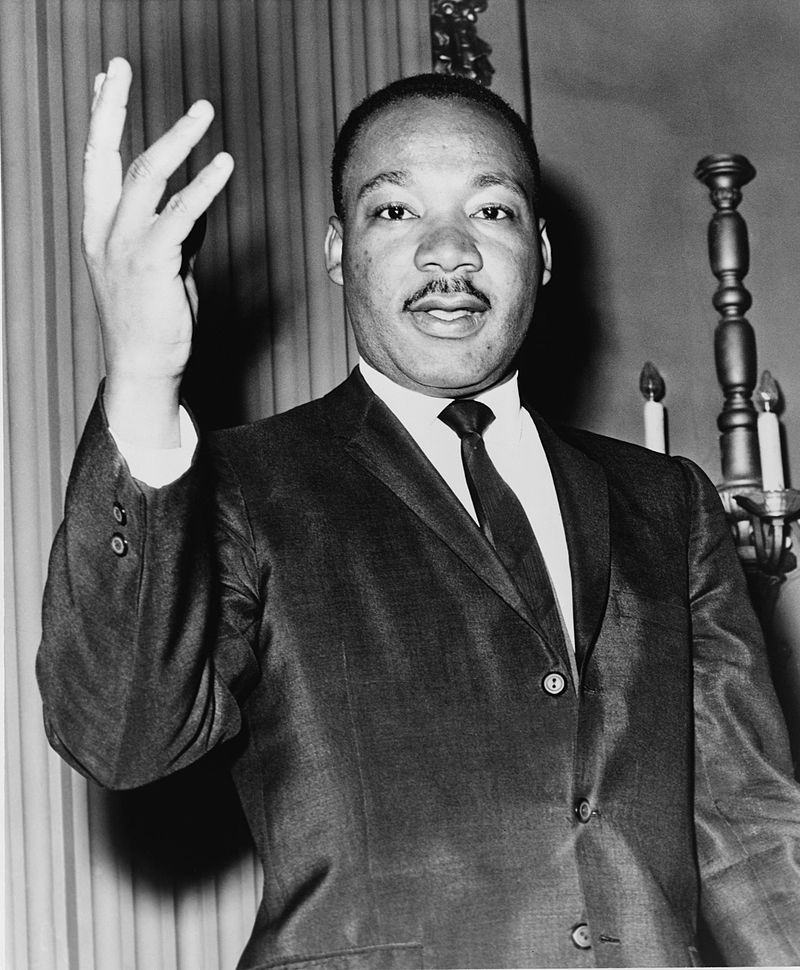
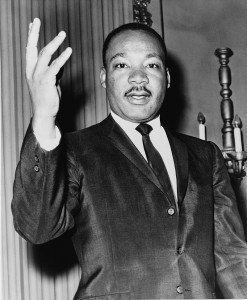
 Dr. Martin Luther King Jr., whose birth we commemorate this weekend, is most known for his work with racial justice and civil rights. But Dr. King had other things to say as he preached each Sunday, first in his own assembly and later as he moved about.
Among the recorded sermons that are available comes the excerpt below from one, where Dr. King addresses the problem of unbelief, of materialism and atheism. His reflections are worth pondering since the issues he addresses here are more widespread than when he made these remarks in 1957.
The title of the sermon is “Why the Lord Called a Man a Fool” He is commenting on the parable of the Lord about the wealthy man who had a huge harvest and, instead of sharing, just built bigger barns. The Lord called him a fool for thinking his material wealth could supply is needs and give him security. As a sidebar in his sermon Dr. King addressed the problem in the modern world of unbelief, and speaks to the foolishness of this. I present here excerpts. The full sermon is here: Why the Lord Called a Man a Fool
As usual, the original remarks are in black, bold, italic print and my comments are plain red text. After discussing several reason why the man was a fool, Dr. King writes:
Jesus [also] called the rich man a fool because he failed to realize his dependence on God. He talked as though he unfolded the seasons and provided the fertility of the soil, controlled the rising and the setting of the sun, and regulated the natural processes that produce the rain and the dew. He had an unconscious feeling that he was the Creator, not a creature.
For the materialist and atheist, having discovered the inner realities of many processes, fail to ask the more fundamental questions of where the cosmos ultimately comes from, or what is the ultimate destiny of all things? Having found penultimate answers, they mistake these answers for the ultimate answers. They are not.
There is no problem with a scientist saying these sorts of questions lay beyond science, that science is only focused on material and efficient causality. That is fine, each discipline has its area of focus. But the modern error of “scientism” says that science alone explains reality. It does not.
The usual approach of scientism (not all scientists!) to those who ask questions science is not equipped to handle is to dismiss the question or to say, “one day science will answer this.” When we who are obviously creatures, and contingent beings dismiss a Creator, this is a form of madness or of hardness of heart. But such a dismissal is neither rational nor reasonable.
This man-centered foolishness has had a long and oftentimes disastrous reign in the history of mankind. Sometimes it is theoretically expressed in the doctrine of materialism, which contends that reality may be explained in terms of matter in motion, that life is “a physiological process with a physiological meaning,” that man is a transient accident of protons and electrons traveling blind, that thought is a temporary product of gray matter, and that the events of history are an interaction of matter and motion operating by the principle of necessity.
He describes here the problem of modern reductionism wherein things are reduced to matter only, and attributed to merely material causes. Thus even immaterial things like, justice, meaning, beauty, etc., must somehow be explained materially in terms of their cause. It is evident that the human soul that knows immaterial things does mediate its thoughts through the brain and central nervous system, but it does not follow that the medium is the cause. For it does not pertain to matter to be the cause of what is immaterial or spiritual.
Having no place for God or for eternal ideas, materialism is opposed to both theism and idealism. This materialistic philosophy leads inevitably into a dead-end street in an intellectually senseless world. To believe that human personality is the result of the fortuitous interplay of atoms and electrons is as absurd as to believe that a monkey by hitting typewriter keys at random will eventually produce a Shakespearean play. Sheer magic!
Many atheists think they have solved this conundrum. But I must say that they “solve” it by a set of assumptions so wild and un-demonstrated that it requires far more “faith” than to believe in an intelligent designer and creator.
The statistical possibility that things could come together “by chance” as they have to form complex life, let alone intelligent life, and not just once, but at least twice (for reproduction’s sake) is astronomical! (As Dr. King says, “Sheer magic!”) It indicates that those who demand we accept this notion are far more “credulous” than believers who observe creation and the obvious fact that it is intricately designed and thereby conclude, reasonably that there is an intelligent creator.
It is much more sensible to say with Sir James Jeans, the physicist, that “the universe seems to be nearer to a great thought than to a great machine,” or with Arthur Balfour, the philosopher, that “we now know too much about matter to be materialists.” Materialism is a weak flame that is blown out by the breath of mature thinking. Exactly – the universe shouts design and intelligence.
Another attempt to make God irrelevant is found in non-theistic humanism, a philosophy that deifies man by affirming that humanity is God. Man is the measure of all things. Many modern men who have embraced this philosophy contend, as did Rousseau, that human nature is essentially good. Evil is to be found only in institutions, and if poverty and ignorance were to be removed everything would be all right. The twentieth century opened with such a glowing optimism. Men believed that civilization was evolving toward an earthly paradise.
Yes, the Catholic Faith defines this error as utopianism and pseudo-messianism. The catechism says,
Before Christ’s second coming the Church must pass through a final trial that will shake the faith of many believers. The persecution that accompanies her pilgrimage on earth will unveil the “mystery of iniquity” in the form of a religious deception offering men an apparent solution to their problems at the price of apostasy from the truth. The supreme religious deception is that of the Antichrist, a pseudo-messianism by which man glorifies himself in place of God and of his Messiah come in the flesh. The Antichrist’s deception already begins to take shape in the world every time the claim is made to realize within history that messianic hope which can only be realized beyond history through the eschatalogical judgment. The Church has rejected even modified forms of this falsification of the kingdom to come under the name of millenarianism,especially the “intrinsically perverse” political form of a secular messianism. (CCC #s 675-676)
We all know what a bloodbath the 20th Century became. SO much for man being his won measure!
Herbert Spencer skillfully molded the Darwinian theory of evolution into the heady idea of automatic progress. Men became convinced that there is a sociological law of progress which is as valid as the physical law of gravitation. Possessed of this spirit of optimism, modern man broke into the storehouse of nature and emerged with many scientific insights and technological developments that completely revolutionized the earth. The achievements of science have been marvelous, tangible and concrete….
[But] Man’s aspirations no longer turned Godward and heavenward. Rather, man’s thoughts were confined to man and earth. And man offered a strange parody on the Lord’s Prayer:
“Our brethren which art upon the earth, Hallowed be our name. Our kingdom come. Our will be done on earth, for there is no heaven.”
Those who formerly turned to God to find solutions for their problems turned to science and technology, convinced that they now possessed the instruments needed to usher in the new society.
Scripture says, Claiming to be wise they became fools and their senseless minds were darkened. (Rom 1:22)
Then came the explosion of this myth. It climaxed in the horrors of Nagasaki and Hiroshima and in the fierce fury of fifty-megaton bombs. Now we have come to see that science can give us only physical power, which, if not controlled by spiritual power, will lead inevitably to cosmic doom.
Atheists are forever saying how many lives were lost i the name of religion. Frankly our numbers are not even close to the blood bath ushered in by atheist materialists.
The words of Albert the Great are still true: “Power is never a good unless he be good that has it.” We need something more spiritually sustaining and morally controlling than science. It is an instrument that, under the power of God’s spirit, may lead man to greater heights of physical security, but apart from God’s spirit, science is a deadly weapon that will lead only to deeper chaos. Make it plain, Dr. King.
Why fool ourselves about automatic progress and the ability of man to save himself? We must lift up our minds and eyes unto the hills from whence comes our true help. Then, and only then, will the advances of modern science be a blessing rather than a curse. Without dependence on God our efforts turn to ashes and our sunrises into darkest night. Unless his spirit pervades our lives, we find only what G.K. Chesterton called “cures that don’t cure, blessings that don’t bless, and solutions that don’t solve.” “God is our refuge and strength, a very present help in trouble.“
Note that Dr. King has called upon two Catholic intellectuals to be his witnesses 😉
Unfortunately, the rich man [in the parable] did not realize this. He, like many men of the twentieth century, became so involved in big affairs and small trivialities that he forgot God. He gave the finite infinite significance and elevated a preliminary concern to ultimate standing. After the rich man had accumulated his vast resources of wealth — at the moment when his stocks were accruing the greatest interest and his palatial home was the talk of the town — he came to that experience which is the irreducible common denominator of all men, death.
I say at every funeral to the mourners: You, are going to die. And then I tell them we have to get ready, not with more things, but with more God.
The fact that he died at this particular time adds verve and drama to the story, but the essential truth of the parable would have remained the same had he lived to be as old as Methuselah. Even if he had not died physically, he was already dead spiritually. The cessation of breathing was a belated announcement of an earlier death. He died when he failed to keep a line of distinction between the means by which he lived and the ends for which he lived and when he failed to recognize his dependence on others and on God.
May it not be that the “certain rich man” is Western civilization? Rich in goods and material resources, our standards of success are almost inextricably bound to the lust for acquisition.
The means by which we live are marvelous indeed. And yet something is missing. We have learned to fly the air like birds and swim the sea like fish, but we have not learned the simple art of living together as brothers. Our abundance has brought us neither peace of mind nor serenity of spirit.
An Oriental writer has portrayed our dilemma in candid terms:
“You call your thousand material devices ‘labor-saving machinery,’ yet you are forever ‘busy.’ With the multiplying of your machinery you grow increasingly fatigued, anxious, nervous, dissatisfied. Whatever you have, you want more; and wherever you are you want to go somewhere else…. You have a machine to dig the raw material for you, a machine to manufacture [it], a machine to transport [it], a machine to sweep and dust, one to carry messages, one to write, one to talk, one to sing, one to play at the theater, one to vote, one to sew, and a hundred others to do a hundred other things for you, and still you are the most nervously busy man in the world. Your devices are neither time-saving nor soul-saving machinery. They are so many sharp spurs which urge you on to invent more machinery and to do more business.” So true!
…The means by which we live have outdistanced the ends for which we live. Our scientific power has outrun our spiritual power. We have guided missiles and misguided man. Like the rich man of old, we have foolishly minimized the internal of our lives and maximized the external. We have absorbed life in livelihood. We have maximized the minimum and minimized the maximum.
We will not find peace in our generation until we learn anew that “a man’s life consists not in the abundance of the things which he possesses,” but in those inner treasuries of the spirit which “no thief approaches, neither moth corrupts.” Our hope for creative living lies in our ability to re-establish the spiritual ends of our lives in personal character and social justice. Without this spiritual and moral reawakening we shall destroy ourselves in the misuse of our own instruments. Our generation cannot escape the question of our Lord: What shall it profit a man, if he gain the whole world of externals — airplanes, electric lights, automobiles, and color television — and lose the internal — his own soul? Amen!


 The video below has a scary side to it. Although it is a cartoon, I do not recommended for the youngest children, simply because it is scary. But its message is an important one on several different levels